Part 1 — THOMAS CLARKE LUBY.
Reading edition
Looking along the course of Irish history, it is easy to point out certain periods in which England could have found an opportunity for making terms with the Irish nation, healing some of the old wounds and mitigating in some degree the burning sense of wrong and the desire of vengeance that rankled in the hearts of the Irish race. There were lulls in the struggle, intervals of gloomy calm, occasions when the heart of Ireland might have been touched by generous deeds, and when the offer of the olive branch, or even a few of its leaves, would have had a blessed effect. But England never availed of them—never for an instant sought to turn them to good account. She preferred when Ireland was defeated, prostrate, and forlorn, to taunt her with her failure, scoff at her sufferings, and add to her afflictions. Such was her conduct during the mournful time that followed on the attempted insurrection of 1848.
It was an appaling time, in whose death-laden atmosphere political action was impossible. The famine had made of the country one huge graveyard. A silence fell upon the land, lately so clamorous for her rights, so hopeful, and so defiant. The Repeal organization spoke no more; the tramp of the Confederate Clubs was no longer heard in the streets; O'Connell was dead; the Young Ireland leaders were fugitives or prisoners; and the people were almost bewildered by a sense of their great calamity. Then, if England had stooped to raise her fallen foe, offered her some kindly treatment, and spoken some gracious words, the bitterness of the old quarrel might have been in some degree assuaged, even though its cause should not be entirely obliterated. But England did not choose to take that politic and Christian course. She found it much pleasanter to chuckle over the discomfiture of the Irish patriots, to ridicule the failure of their peaceable agitation, to sneer at their poor effort in arms, to nickname, and misrepresent, and libel the brave-hearted gentleman who led that unlucky endeavour; and above all to felicitate herself on the reduction that had taken place in the Irish population. That—from her point of view—was the glorious part of the whole affair. The Irish were "gone with a vengeance!"—not all of them, but a goodly proportion, and others were going off every day. Emigrant ships clustered in the chief ports, and many sought their living freights in those capacious harbours along the Atlantic coast which nature seemed to have shaped for the accommodation of a great commerce, but where the visit of any craft larger than a fishing smack was a rare event. The flaming placards of the various shipping-lines were posted in every town in Ireland,—on the chapel-gates, and the shutters of closed shops, and the doors of tenantless houses; and there appeared to be in progress a regular breaking up of the Irish nation. This, to the English mind, was positively delightful. For here was the Irish question being settled at last, by the simple process of the transference of the Irish people to the bottom of the deep sea, or else to the continent of America—nearly the same thing as far as England was concerned, for in neither place—as it seemed to her—could they ever more trouble her peace, or have any claim on those fruits of the Irish soil which were needed for the stomachs of Englishmen. There they could no longer pester her with petitions for Tenant Right, or demands for a Repeal of the Union. English farmers, and drovers, and labourers, loyal to the English government, and yielding no sort of allegiance to the Pope, would cross the Channel and take possession of the deserted island, which would thenceforth be England's in such a sense as it never was before. O magnificent consummation! O most brilliant prospect, in the eyes of English statesmen! They saw their way clear, they understood their game; it was to lighten in no degree the pressure which they maintained upon the lives of the Irish people, to do nothing that could tend to render existence tolerable to them in Ireland, or check the rush of emigration. Acting in conformity with this shallow and false estimate of the situation, they allowed to drift away unused the time which wise statesmen would have employed in the effectuation of conciliatory and tranquilising measures, and applied themselves simply to the crushing out from the Irish mind of every hope of improved legislation, and the defeat of every effort to obtain it. Thus when the people—waking up from the stupefaction that followed on the most tragic period of the famine—began to breathe the breath of political life again, and, perceiving the danger that menaced the existence of the peasant classes, set on foot an agitation to procure a reform of the land-laws, the government resolutely opposed the project; defeated the bills which the friends of the tenantry brought into parliament; and took steps, which proved only too successful, for the break up of the organization by which the movement was conducted. And then, when Frederick Lucas was dead, and Mr. Duffy had gone into exile, and the patriot priests were debarred from taking part in politics, and Messrs. John Sadlier and William Keogh were bought over by bribes of place and pay, the government appeared to think that Irish patriotism had fought in its last ditch, and received its final defeat.
But they were mistaken. The old cause that had survived so many disasters was not dead yet. While the efforts of the Tenant Righters in Ireland were being foiled, and their party was being scattered, a couple of Irishmen, temporarily resident in Paris, fugitive because of their connexion with the events of '48, were laying the foundations of a movement more profoundly dangerous to England, than any of those with which she had grappled since the days of Wolfe Tone and Lord Edward Fitzgerald. Those men were John O'Mahony and James Stephens.
Since then their names have been much heard of, and the organization of which they were the originators has played an important part in Irish history. But at the period of which we are now writing, the general public knew nothing of O'Mahony or of Stephens beyond the fact that they were alleged to have taken some part in the recent insurrectionary demonstrations. Stephens, who was then a very young lad, had been present at the Ballingarry attack, and had been severely wounded by the fire of the police. He managed to crawl away from the spot to a ditch side, where he was lost sight of. A report of his death was put into circulation, and a loyal journal published in Kilkenny—the native town of the young rebel, who in this instance played his first trick on the government—referred to his supposed decease in terms which showed that the rule de mortuis nil nisi bonum found acceptance with the editor. The following are the words of the obituary notice which appeared in the Kilkenny Moderator on or about the 19th of August, 1848:—
"Poor James Stephens, who followed Smith O'Brien to the field, has died of the wound which he received at Ballingarry whilst acting as aide-de-camp to the insurgent leader. Mr. Stephens was a very amiable, and apart from politics, most inoffensive young man, possessed of a great deal of talent, and we believe he was a most excellent son and brother. His untimely and melancholy fate will be much regretted by a numerous circle of friends."
It is said that his family very prudently fostered this delusion by going into mourning for the loss of young James—the suggestion of which clever ruse probably came from the dear boy himself. A short time afterwards he managed to escape, disguised as a lady's maid, to France. As one may gather from the paragraph above quoted, the family were much respected in the locality. Mr. Stephens, father of the future C.O.I.R., was clerk in the establishment of a respectable auctioneer and bookseller in Kilkenny. He gave his children a good education, and sent young James to a Catholic seminary with a view to his being taught and trained for the priesthood. But circumstances prevented the realization of this design, and before any line of business could be marked out for young Stephens, the political events above referred to took place and shaped his future career.
John O'Mahony was a different stamp of man. He belonged to the class known as gentlemen-farmers, and of that class he was one of the most respected. His family owned a considerable tract of land in the southern part of the County of Tipperary, of which they had been occupants for many generations. He was well educated, of studious habits, and thoroughly imbued with patriotic feeling, which came to him as a hereditary possession. When the Young Ireland leaders were electrifying the country by their spirited appeals to the patriotism and bravery of the Irish race, and the population in all the chief centres of intelligence were crystalizing into semi-military organizations, O'Mahony was not apathetic or inactive. One of the strongest of the Confederate clubs—which were thick sown in the contiguous districts of the Counties of Cork, Waterford, and Tipperary—was under his presidency; and when in July, 1848, the leaders of the movement scattered themselves over the country for the purpose of ascertaining the degree of support they would receive if they should decide on unfurling the green banner, his report of the state of affairs in his district was one of their most cheering encouragements.
A few days afterwards the outbreak under O'Brien occurred at Ballingarry. The failure of that attempt, and the irresolute manner in which it was conducted, had disheartened the country, but the idea of allowing the struggle to rest at that point was not universally entertained by the leaders of the clubs; and John O'Mahony was one of those who resolved that another attempt should be made to rally the people to the insurrectionary standard. He acted up to his resolution. On the night of the 12th of September there were signal-fires on the slopes of Slievenamon and the Comeragh mountains, and the district between Carrick-on-Suir and Callan was in a state of perturbation. Next day the alarm was spread in all directions. The gentry of the disturbed districts rushed into the nearest towns for protection; police from the outlying barracks were called in to reinforce the threatened stations, and troops were hastily summoned from Dublin and the neighbouring garrisons. Meanwhile parties of the insurgents began to move about. One proceeded to the police station at the Slate-quarries, and finding it deserted—the policemen having retired on Piltown—burned it to the ground. Another attempted the destruction of Grany bridge, to delay the advance of the soldiery. A third proceeded to attack the Glenbower station. The defenders of the barracks were in a rather critical position when another party of police, on their way from the Nine-Mile-House station to Carrick, came upon the spot, and the combined force speedily put their half-armed assailants to flight, with a loss to the latter of one man severely wounded and one killed. An attack was made on the barrack at Portlaw, but with a like result; two men were stricken dead by the bullets of the police. The people soon afterwards scattered to their homes, and the soldiery and police had nothing to do but hunt up for the leaders and other parties implicated in the movement. John O'Mahony narrowly escaped capture on three or four occasions. He lingered in the country, however, until after the conviction of the state prisoners at Clonmel, when it became clear to him that the cause was lost for a time; and he then took his way to Paris, whither several of his fellow outlaws, for whose arrest the government had offered large rewards, had gone before him.
In that famous centre of intellect and of intrigue, the focus of political thought, the fountain-head of great ideas, John O'Mahony and James Stephens pondered long over the defeat that had come upon the Irish cause, and in their ponderings bethought them that the reason of the failure which they deplored was to be found in the want of that quiet, earnest, secret preparation, by means of which the Continental revolutionists were able to produce from time to time such volcanic effects in European politics, and cause the most firmly-rooted dynasties to tremble for their positions. The system of secret conspiracy—that ancient system, "old as the universe, yet not outworn"—a system not unknown in Ireland from the days of the Attacots to those of the Whiteboys—the system of Sir Phelim O'Neill and of Theobald Wolfe Tone—that system, as developed, refined, and elaborated by the most subtle intellects of modern times, those two men proposed to propagate among the Irish race at home and abroad. They divided the labour between them. O'Mahony took the United States of America for his field of action, and Stephens took the Old Country.
It was in the year 1858 that the first symptoms indicative of the work to which James Stephens had set himself made their appearance in the extreme south-west of Ireland. Whispers went about that some of the young men of Kenmare, Bantry, and Skibbereen were enrolled in a secret sworn organization, and were in the habit of meeting for the purpose of training and drilling. Indeed the members of the new society took little pains to conceal its existence; they seemed rather to find a pride in the knowledge which their neighbours had of the fact, and relied for their legal safety on certain precautions adopted in the manner of their initiation as members. When informed firstly by well known nationalists in a private manner, and subsequently by public remonstrances addressed to them by Catholic clergymen and the national journals, that the government were on their track, they refused to believe it; but ere long they suffered grievously for their incredulity and want of prudence. In the early days of December, 1858, the swoop of the government was made on the members of the "Phoenix Society" in Cork and Kerry, and arrests followed shortly after in other parts of the country. The trials in the south commenced at Tralee in March, 1859, when a conviction was obtained against a man named Daniel O'Sullivan, and he was sentenced to penal servitude for ten years. The remaining cases were adjourned to the next assizes, and when they came on in July, 1859, the prisoners put in a plea of guilty, and were set at liberty on the understanding that if their future conduct should not be satisfactory to the authorities, they would be called up for sentence. Amongst the Cork prisoners who took this course was Jeremiah O'Donovan (Rossa), whose name has since then been made familiar to the public.
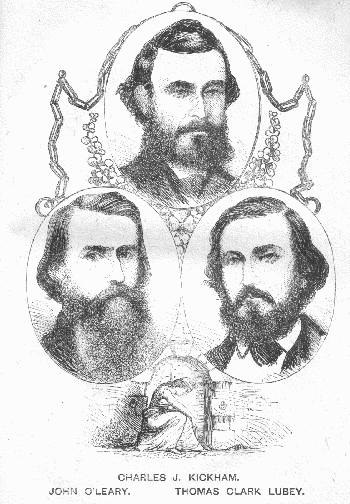
Those events were generally supposed to have extinguished the Phoenix conspiracy. And many of Ireland's most sincere friends hoped that such was the case. Recognising fully the peculiar powers which a secret society can bring to bear against the government, they still felt a profound conviction that the risks, or rather the certain cost of liberty and life involved in such a mode of procedure, formed more than a counterpoise for the advantages which it presented. They were consequently earnest and emphatic in their endeavours to dissuade their countrymen from treading in the dangerous paths in which their steps were dogged by the spy and the informer. The Catholic clergy were especially zealous in their condemnation of secret revolutionary societies, urged thereto by a sense of their duty as priests and patriots. But there were men connected with the movement both in America and Ireland, who were resolved to persevere in their design of extending the organization among the Irish people, despite of any amount of opposition from any quarter whatsoever. In pursuit of that object they were not over scrupulous as to the means they employed; they did not hesitate to violate many an honourable principle, and to wrong many an honest man; nor did they exhibit a fair share of common prudence in dealing with the difficulties of their position; but unexpected circumstances arose to favour their propagandism, and it went ahead despite of all their mistakes and of every obstacle. One of those circumstances was the outbreak of the civil war in America, which took place in April, 1861. That event seemed to the leaders of the Irish revolutionary organization, now known as the Fenian Brotherhood, to be one of the most fortunate for their purposes that could have happened. It inspired the whole population of America with military ardour, it opened up a splendid school in which the Irish section of the people could acquire a knowledge of the art of war, which was exactly what was needed to give real efficacy to their endeavours for the overthrow of British dominion in Ireland. Besides, there appeared to be a strong probability that the line of action in favour of the Southern States which England, notwithstanding her proclamation of neutrality, had adopted from an early stage of the conflict, would speedily involve her in a war with the Federal government. These things constituted a prospect dazzling to the eyes of the Irishmen who had "gone with a vengeance." Their hearts bounded with joy at the opportunities that appeared to be opening on them. At last the time was near, they believed, when the accumulated hate of seven centuries would burst upon the power of England, not in the shape of an undisciplined peasantry armed with pikes, and scythes, and pitchforks, as in 1798—not in the shape of a half famished and empty-handed crowd, led to battle by orators and poets, as in 1848, but in the shape of an army, bristling with sharp steel, and flanked with thunderous cannon—an army skilled in the modern science of war, directed by true military genius, and inspired by that burning valour which in all times was one of the qualities of the Irish race. Influenced by such hopes and feelings, the Irish of the Northern States poured by thousands into the Federal ranks, and formed themselves into regiments that were at the same time so many Fenian circles. In the Southern army, too, there were many Irishmen who were not less determined to give to their native land the benefit of their military experience, as soon as the troubles of their adopted country should be brought to an end. Fenianism, with that glow of light upon it, spread like a prairie-fire through the States. The ranks of the organization swelled rapidly, and money contributions poured like a tide into its treasury. The impulse was felt also by the society in Ireland. It received a rapid development, and soon began to put on a bold front towards the government, and a still more belligerent one towards all Irishmen who, while claiming the character of patriots, declined to take part in the Fenian movement or recommend it to their countrymen. In November, 1863, the brotherhood started the Irish People newspaper in Dublin, for the double purpose of propagating their doctrines and increasing the revenues of the society. James Stephens was the author of this most unfortunate project. The men whom he selected for working it out were Thomas Clarke Luby, John O'Leary, and Charles Joseph Kickham.
From the date of its establishment up to the mouth of September, 1865—a period of nearly two years—the Irish People occupied itself in preaching what its editors regarded as the cardinal doctrines of the society, which were:—That constitutional agitation for the redress of Ireland's grievances was worse than useless; that every man taking part in such agitation was either a fool or a knave; that in political affairs clergymen should be held of no more account than laymen; and that the only hope for Ireland lay in an armed uprising of the people. These doctrines were not quite new; not one of them was absolutely true; but they were undoubtedly held by many thousands of Irishmen, and the Fenian society took care to secure for the journal in which they were advocated, a large circulation. The office of the Irish People soon came to be regarded as, what it really was, the head quarters of the Fenian organization in Ireland. To it the choice spirits of the party resorted for counsel and direction; thither the provincial organisers directed their steps whenever they visited Dublin; into it poured weekly from all parts of the country an immense mass of correspondence, which the editors, instead of destroying after it had passed through their hands, foolishly allowed to accumulate upon their shelves, though every word of it was fraught with peril to the lives and liberties of their friends. In their private residences also they were incautious enough to keep numerous documents of a most compromising character. There is but one way of accounting for their conduct in this matter. They may have supposed that the legal proceedings against them, which they knew were certain to take place at one time or another, would be conducted in the semi-constitutional fashion which was adopted towards the national journals in 1848. If the staff of the Irish People had received a single day's notice that they were about to be made amenable to the law, it is possible that they would have their houses and their office immediately cleared of those documents which afterwards consigned so many of their countrymen to the horrors of penal servitude. But they saw no reason to suppose that the swoop was about to be made on them. On the fifteenth day of September, 1865, there were no perceptible indications that the authorities were any more on the alert in reference to Fenian affairs then they had been during the past twelve months. It was Friday; the Irish People had been printed for the next day's sale, large batches of the paper had been sent off to the agents in town and country, the editors and publishing clerks had gone home to rest after their week's labours—when suddenly, at about half-past nine o'clock in the evening, a strong force of police broke into the office, seized the books, manuscripts, papers, and forms of type, and bore them off to the Castle yard. At the same time arrests of the chief Fenian leaders were being made in various parts of the city. The news created intense excitement in all circles of society, and more especially amongst the Fenians themselves, who had never dreamed of a government coup so sudden, so lawless, and so effective. The government had now thrown off the mask of apathy and impassiveness which it had worn so long, and it commenced to lay its strong hand upon its foes. Amongst the men who filled the prison cells on that miserable autumn evening were John O'Leary, Thomas Clarke Luby, and Jeremiah O'Donovan (Rossa). Before the crown was ready to proceed with their trial, the third editor of the paper, Charles J. Kickham, was added to their company, having been arrested with James Stephens, Edward Duffy, and Hugh Brophy, on the 11th November, at Fairfield House, near Dublin.
On Monday, November 27th, 1865, the state trials commenced before a Special Commission in the Courthouse, Green-street—the scene of so many a previous grapple between British law and the spirit of Irish patriotism. Mr. Justice Keogh and Mr. Justice Fitzgerald were the presiding judges. There was a long list of prisoners to be tried. James Stephens might have been honoured with the first place amongst them, were it not that two days previously, to the unspeakable horror and surprise of the government and all its friends, he had effected his escape, or rather, we might say, obtained, by the aid of friendly hands, his release from Richmond prison. In his regretted absence, the crown commenced their proceedings by placing Thomas Clarke Luby in the dock to answer to a charge of treason-felony.
He stood up to the bar, between the jailors that clustered about him, a quiet-faced, pale, and somewhat sad-looking man, apparently of about forty years of age. A glance around the court-house showed him but few friendly faces—for, owing to the terrors felt by the judges, the crown prosecutors and other officials of the law, who dreaded the desperate resolves of armed conspirators, few were admitted into the building except policemen, detectives, and servants of the crown in one capacity or another. In one of the galleries, however, he recognised his wife—daughter of J. De Jean Fraser, one of the sweetest poets of the '48 period—with the wife of his fellow-prisoner, O'Donovan Rossa, and the sister of John O'Leary. A brief smile of greeting passed between the party, and then all thoughts were concentrated on the stern business of the day.
There was no chance of escape for Thomas Clarke Luby or for his associates. The crown had a plethora of evidence against them, acquired during the months and years when they appeared to be all but totally ignorant of the existence of the conspiracy. They had the evidence of the approver, Nagle, who had been an employè of the Irish People office and a confidential agent of James Stephens up to the night of the arrests, but who during the previous eighteen months had been betraying every secret of theirs to the government. They had the evidence of a whole army of detectives; but more crushing and fatal than all, they had that which was supplied by the immense store of documents captured at the Irish People office and the houses of some of the chief members of the conspiracy. Of all those papers the most important was one found at the residence of Mr. Luby, in which James Stephens, being at the time about to visit America delegated his powers over the organization in Ireland, England, and Scotland to Thomas Clarke Luby, John O'Leary, and Charles J. Kickham. This, which was referred to during the trials as the "executive document," was worded as follows:—
"I hereby empower Thomas Clarke Luby, John O'Leary and Charles J. Kickham a committee of organization, or executive, with the same supreme control over the home organization, England, Ireland, and Scotland, as that exercised by myself. I further empower them to appoint a committee of military inspection, and a committee of appeal and judgment, the functions of which committee will be made known to every member of them. Trusting to the patriotism and abilities of the executive, I fully endorse their actions beforehand. I call on every man in our ranks to support and be guided by them in all that concerns the military brotherhood.
"J. STEPHENS."
Not all the legal ingenuity and forensic eloquence of their talented counsel, Mr. Butt, could avail to save the men who, by the preservation of such documents as the foregoing, had fastened the fetters on their own limbs. The trial of Mr. Luby concluded on the fourth day of the proceedings—Friday, December 1st 1865—with a verdict of guilty. The prisoner heard the announcement with composure, and then, in response to the question usual in such cases, addressed the court as follows:—
"Well, my lords and gentlemen, I don't think any person present here is surprised at the verdict found against me. I have been prepared for this verdict ever since I was arrested, although I thought it my duty to fight the British government inch by inch. I felt I was sure to be found guilty, since the advisers of the Crown took what the Attorney-General was pleased the other day to call the 'merciful course.' I thought I might have a fair chance of escaping, so long as the capital charge was impending over me; but when they resolved on trying me under the Treason-Felony Act, I felt that I had not the smallest chance. I am somewhat embarrassed at the present moment as to what I should say under the circumstances. There are a great many things that I would wish to say; but knowing that there are other persons in the same situation with myself, and that I might allow myself to say something injudicious, which would peril their cases, I feel that my tongue is to a great degree tied. Nothwithstanding, there are two or three points upon which I would say a few words. I have nothing to say to Judge Keogh's charge to the jury. He did not take up any of the topics that had been introduced to prejudice the case against me; for instance, he did not take this accusation of an intention to assassinate, attributed to my fellow-prisoners and myself. The Solicitor-General in his reply to Mr. Butt, referred to those topics. Mr. Barry was the first person who advanced those charges. I thought they were partially given up by the Attorney-General in his opening statement, at least they were put forward to you in a very modified form; but the learned Solicitor-General, in his very virulent speech, put forward those charges in a most aggravated manner. He sought even to exaggerate upon Mr. Barry's original statement. Now, with respect to those charges—in justice to my character—I must say that in this court, there is not a man more incapable of anything like massacre or assassination than I am. I really believe that the gentlemen who have shown so much ability in persecuting me, in the bottom of their hearts believe me incapable of an act of assassination or massacre. I don't see that there is the smallest amount of evidence to show that I ever entertained the notion of a massacre of landlords and priests. I forget whether the advisers of the crown said I intended the massacre of the Protestant clergymen. Some of the writers of our enlightened press said that I did. Now, with respect to the charge of assassinating the landlords, the only thing that gives even the shadow of a colour to that charge is the letter signed—alleged to be signed—by Mr. O'Keefe. Now, assuming—but by no means admitting, of course—that the letter was written by Mr. O'Keefe, let me make a statement about it. I know the facts that I am about to state are of no practical utility to me now, at least with respect to the judges. I know it is of no practical utility to me, because I cannot give evidence on my own behalf, but it may be of practical utility to others with whom I wish to stand well. I believe my words will carry conviction—and carry much more conviction than any words of the legal advisers of the crown can—to more than 300,000 of the Irish race in Ireland, England, and America. Well, I deny absolutely, that I ever entertained any idea of assassinating the landlords, and the letter of Mr. O'Keefe—assuming it to be his letter—is the only evidence on the subject. My acquaintance with Mr. O'Keefe was of the slightest nature. I did not even know of his existence when the Irish People was started. He came, after that paper was established a few months, to the office, and offered some articles—some were rejected, some we inserted, and I call the attention of the legal advisers of the Crown to this fact, that amongst the papers which they got, those that were Mr. O'Keefe's articles had many paragraphs scored out; in fact we put in no article of his without a great deal of what is technically called 'cutting down.' Now, that letter of his to me was simply a private document. It contained the mere private views of the writer; and I pledge this to the court as a man of honour—and I believe in spite of the position in which I stand, amongst my countrymen I am believed to be a man of honour, and that if my life depended on it, I would not speak falsely about the thing—when I read that letter, and the first to whom I gave it was my wife, I remember we read it with fits of laughter at its ridiculous ideas. My wife at the moment said—'Had I not better burn the letter?' 'Oh no,' I said, looking upon it as a most ridiculous thing, and never dreaming for a moment that such a document would ever turn up against me, and produce the unpleasant consequences it has produced—mean the imputation of assassination and massacre, which has given me a great deal more trouble than anything else in this case. That disposes—as far as I can at present dispose of it—of the charge of wishing to assassinate the landlords. As to the charge of desiring to assassinate the priests, I deny it as being the most monstrous thing in the world. Why, surely, every one who read the articles in the paper would see that the plain doctrine laid down there was—to reverence the priests so long as they confined themselves to their sacerdotal functions; but when the priest descended to the arena of politics he became no more than any other man, and would just be regarded as any other man. If he was a man of ability and honesty, of course he would get the respect that such men get in politics—if he was not a man of ability there would be no more thought of him than of a shoemaker or any one else. This is the teaching of the Irish People with regard to the priests. I believe the Irish People has done a great deal of good, even amongst those who do not believe in its revolutionary doctrines. I believe the revolutionary doctrines of the Irish People are good. I believe nothing can ever save Ireland except independence; and I believe that all other attempts to ameliorate the condition of Ireland are mere temporary expedients and make shifts——"
Mr. Justice Keogh—"I am very reluctant to interrupt you, Mr. Luby."
Mr. Luby—"Very well, my lord, I will leave that. I believe in this way the Irish People has done an immensity of good. It taught the people not to give up their right of private judgment in temporal matters to the clergy; that while they reverenced the clergy upon the altar, they should not give up their consciences in secular matters to the clergy. I believe that is good. Others may differ from me. No set of men I believe ever set themselves earnestly to any work, but they did good in some shape or form."
Judge Keogh—"I am most reluctant, Mr. Luby, to interrupt you, but do you think you should pursue this!"
Mr. Luby—"Very well, I will not. I think that disposes of those things. I don't care to say much about myself. It would be rather beneath me. Perhaps some persons who know me would say I should not have touched upon the assassination charge at all—that in fact I have rather shown weakness in attaching so much importance to it. But, with regard to the entire course of my life, and whether it be a mistaken course or not will be for every man's individual judgment to decide—this I know, that no man ever loved Ireland more than I have done—no man has ever given up his whole being to Ireland to the extent I have done. From the time I came to what has been called the years of discretion, my entire thought has been devoted to Ireland. I believed the course I pursued was right; others may take a different view. I believe the majority of my countrymen this minute, if, instead of my being tried before a petty jury, who, I suppose, are bound to find according to British law—if my guilt or innocence was to be tried by the higher standard of eternal right, and the case was put to all my countrymen—I believe this moment the majority of my countrymen would pronounce that I am not a criminal, but that I have deserved well of my country. When the proceedings of this trial go forth into the world, people will say the cause of Ireland is not to be despaired of, that Ireland is not yet a lost country—that as long as there are men in any country prepared to expose themselves to every difficulty and danger in its service, prepared to brave captivity, even death itself if need be, that country cannot be lost. With these words I conclude."
On the conclusion of this address, Judge Keogh proceeded to pass sentence on the prisoner. The prisoner's speech, he said, was in every way creditable to him; but the bench could not avoid coming to the conclusion that, with the exception of James Stephens, he was the person most deeply implicated in the conspiracy. The sentence of the court was that he be kept in penal servitude for a term of twenty years. Mr. Luby heard the words without any apparent emotion—gave one sad farewell glance to his wife and friends, and stepping down the little stairs from the dock, made way for the next prisoner.