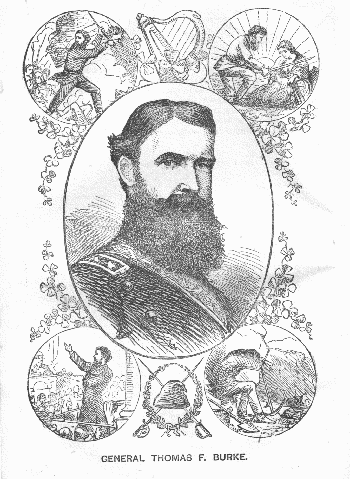
Part 1 — GENERAL THOMAS F. BURKE.
Reading edition
The year of grace, 1867, dawned upon a cloudy and troublous period in Irish politics. There was danger brewing throughout the land; under the crust of society the long confined lava of Fenianism effervesced and glowed. There were strange rumours in the air; strange sounds were heard at the death of night on the hill-sides and in the meadows; and through the dim moonlight masses of men were seen in secluded spots moving in regular bodies and practising military evolutions. From castle and mansion and country seat the spectre of alarm glided to and fro, whispering with bloodless lips of coming convulsions and slaughter, of the opening of the crater of revolution, and of a war against property and class. Symptoms of danger were everywhere seen and felt; the spirit of disaffection had not been crushed; it rode on the night wind and glistened against the rising sun; it filled rath and fort and crumbling ruin with mysterious sounds; it was seen in the brightening eyes and the bold demeanour of the peasantry; in the signals passing amongst the people; in their secret gatherings and closely guarded conclaves. For years and years Fenianism had been threatening, boasting, and promising, and now the fury of the storm, long pent-up, was about to burst forth over the land—the hour for action was at hand.
Between the conviction of Luby, O'Leary, and Kickham, and the period at which we are now arrived, many changes of importance had taken place in the Fenian organization. In America, the society had been revolutionized—it had found new leaders, new principles, new plans of action; it had passed through the ordeal of war, and held its ground amidst flashing swords and the smoke of battle; it had survived the shocks of division, disappointment, and failure; treachery, incapacity and open hostility had failed to shatter it; and it grew apace in strength, influence, and resources. At home Fenianism, while losing little in numerical strength, had declined in effectiveness, in prestige, in discipline, and in organization. Its leaders had been swept into the prisons, and though men perhaps as resolute stepped forward to fill the vacant places, there was a loss in point of capacity and intelligence, and to the keen observer it became apparent that the Fenian Society in Ireland had attained to the zenith of its power on the day that the Irish People office was sacked by the police. Never again did the prospects of Fenianism, whatever they might then have been, look equally bright; and when the brotherhood at length sprang to action, they fought with a sword already broken to the hilt, and under circumstances the most ominous and inauspicious.
The recent history of the Fenian movement is so thoroughly understood that anything like a detailed account of its changes and progress is, in these pages, unnecessary. We shall only say that when James Stephens arrived in America in May, 1866, after escaping from Richmond Prison, he found the society in the States split up into two opposing parties between whom a violent quarrel was raging. John O'Mahony had been deposed from his position of "Head Centre" by an all but unanimous vote of the Senate, or governing body of the association, who charged him and his officials with a reckless and corrupt expenditure of the society's funds, and these in turn charged the Senate party with the crime of breaking up the organization for mere personal and party purposes. A large section of the society still adhered to O'Mahony, in consideration of his past services in their cause; but the greater portion of it, and nearly all its oldest, best-known and most trusted leaders gave their allegiance to the Senate and to its elected President, William R. Roberts, an Irish merchant of large means, of talent and energy, of high character and unquestionable devotion to the cause of his country. Many friends of the brotherhood hoped that James Stephens would seek to heal the breach between these parties, but the course he took was not calculated to effect that purpose. He denounced the "senators" in the most extravagant terms, and invited both branches of the organization to unite under himself as supreme and irresponsible leader and governor of the entire movement. The O'Mahony section did not answer very heartily to this invitation; the Senate party indignantly rejected it, and commenced to occupy themselves with preparations for an immediate grapple with British power in Canada. Those men were thoroughly in earnest, and the fact became plain to every intelligence, when in the latter part of May, 1866, the Fenian contingents from the various States of the Union began to concentrate on the Canadian border. On the morning of the 1st of June some hundreds of them crossed the Niagara river, and took possession of the village of Fort Erie on the Canadian side. They were soon confronted with detachments of the volunteer force which had been collected to resist the invasion, and at Limestone Ridge they were met by the "Queen's Own" regiment of volunteers from Toronto, under the command of Colonel Booker. A smart battle ensued, the result of which was that the "Queen's Own" were utterly routed by the Irish under Colonel John O'Neill, and forced to run in wild confusion for a town some miles distant, Colonel Booker on his charger leading the way and distancing all competitors. Had the Irish been allowed to follow up this victory it is not unlikely that they would have swept Canada clear of the British forces, and then, according to their programme, made that country their base of operations against British power in Ireland. But the American government interfered and put an effectual stopper on their progress; they seized the arms of the Irish soldiers on the frontier, they sent up large parties of the States soldiery to prevent the crossing of hostile parties into British territory, and stationed war-vessels in the river for the same purpose. Reinforcements being thus cut off from them, the victors of Limestone Ridge found themselves under the necessity of re-crossing the river to the American shore, which they did on the night of the 2nd of June, bringing with them the flags and other trophies which they had captured from the royal troops.
The first brush between the Fenian forces and the Queen's troops inspired the former with high hopes, and with great confidence in their capacity to humble "the English red below the Irish green," if only they could start on any thing like fair terms. But now that the American government had forbidden the fight in Canada, what was to be done? James Stephens answered that question. He would have a fight in Ireland—the right place, he contended, in which to fight for Ireland. The home organization was subject to his control and would spring to arms at his bidding. He would not only bid them fight, but would lead them to battle, and that at no distant day. The few remaining months of 1866 would not pass away without witnessing the commencement of the struggle. So he said, and so he swore in the most solemn manner at various public meetings which he had called for the purpose of obtaining funds wherewith to carry on the conflict. The prudence of thus publishing the date which he had fixed for the outbreak of the insurrection was very generally questioned, but however great might be his error in this respect, many believed that he would endeavour to make good his words. The British government believed it, and prepared for the threatened rising by hurrying troops and munitions of war across to Ireland, and putting the various forts and barracks in a state of thorough defence. As the last days and nights of 1866 wore away, both the government and the people expected every moment to hear the first crash of the struggle. But it came not. The year 3867 came in and still all was quiet. What had become of James Stephens? The astonished and irate Fenians of New York investigated the matter, and found that he was peacefully and very privately living at lodgings in some part of that city, afraid to face the wrath of the men whom he had so egregiously deceived. We need not describe the outburst of rage and indignation which followed on the discovery; suffice it to say that the once popular and powerful Fenian leader soon found it prudent to quit the United States and take up his abode in a part of the world where there were no Fenian circles and no settlements of the swarming Irish race.
Amongst the men who had rallied round James Stephens in America there were many whose honesty was untainted, and who had responded to his call with the full intention of committing themselves, without regard to consequences, to the struggle which he promised to initiate. They believed his representations respecting the prospects of an insurrection in Ireland, and they pledged themselves to fight by his side and perish, if necessary, in the good old cause, in defence of which their fathers had bled. They scorned to violate their engagements; they spurned the idea of shrinking from the difficulty they had pledged themselves to face, and resolved that come what may the reproach of cowardice and bad faith should never be uttered against them. Accordingly, in January, '67, they began to fend in scattered parties at Queenstown, and spread themselves through the country, taking every precaution to escape the suspicion of the police. They set to work diligently and energetically to organize an insurrectionary outbreak; they found innumerable difficulties in their path; they found the people almost wholly unarmed; they found the wisest of the Fenian leaders opposed to an immediate outbreak, but still they persevered. How ably they performed their work there is plenty of evidence to show, and if the Irish outbreak of '67 was short-lived and easily suppressed, it was far from contemptible in the pre-concert and organization which it evidenced.
One hitch did occur in the accomplishment of their designs. On Wednesday, February 13th, the exciting news was flashed throughout the land that the Fenians had broken into insurrection at Kerry. The news was true. The night of the 12th of February had been fixed for a simultaneous rising of the Fenians in Ireland; but the outbreak had been subsequently postponed, and emissaries were despatched to all parts of the country with the intelligence of the change of date. The change of date was everywhere learned in time to prevent premature action except at Cahirciveen, in the west of Kerry, where the members of the Brotherhood, acting upon the orders received, unearthed their arms, and gaily proceeded towards Killarney to form a junction with the insurgents whom they imagined had converged from various parts of the county in that town. Before many hours had elapsed they discovered their mistake—they heard before arriving at Killarney that they were the only representatives of the Irish Republic that had appeared in the field, and turning to the mountains they broke up and disappeared.
Short-lived as was their escapade, it filled the heart of England with alarm. In hot haste the Habeas Corpus Suspension Act, which had been permitted to lapse a month before, was re-enacted; the arrests and police raids was renewed, and from the Giant's Causeway to Cape Clear the gaols were filled with political prisoners. Still the Irish-Americans worked on; some of them were swept off to prison, but the greater number of them managed to escape detection, and spite of the vigilance of the authorities, and the extraordinary power possessed by the government and its officials, they managed to carry on the business of the organization, to mature their plans, and to perfect their arrangements for the fray.
We do not propose to write here a detailed account of the last of the outbreaks which, since the Anglo-Norman invasion, have periodically convulsed our country. The time is not yet come when the whole history of that extraordinary movement can be revealed, and such of its facts, as are now available for publication, are fresh in the minds of our readers. On the night of the 5th of March, the Fenian bands took the field in Dublin, Louth, Tipperary, Cork, Waterford, Limerick, and Clare. They were, in all cases, wretchedly armed, their plans had been betrayed by unprincipled associates, and ruin tracked their venture from the outset. They were everywhere confronted by well-armed, disciplined men, and their reckless courage could not pluck success for the maze of adverse circumstances that surrounded them. The elements, too, befriended England as they had often done before. Hardly had the insurgents left their homes when the clear March weather gave place to the hail and snow of mid-winter. The howling storm, edged by the frost and hail, swept over mountain and valley, rendering life in the open air all but impossible to man. The weather in itself would have been sufficient to dispose of the Fenian insurgents. Jaded and exhausted they returned to their homes, and twenty-four hours after the flag of revolt had been unfurled the Fenian insurrection was at an end.
Amongst the Irish officers who left America to share in the expected battle for Irish rights, a conspicuous place must be assigned Thomas F. Burke. He was born at Fethard, county Tipperary, on the 10th of December, 1840, and twelve years later sailed away towards the setting sun, his parents having resolved on seeking a home in the far West. In New York, young Burke attended the seminary established by the late Archbishop Hughes, where he received an excellent education, after which he was brought up to his father's trade—that of house painter. For many years he worked steadily at his trade, contributing largely to the support of his family. The outbreak of the war, however, acted in the same manner on Burke's temperament as on thousands of his fellow-countrymen. He threw aside his peaceful avocation and joined the Confederate army. He served under General Patrick Cleburne, who died in his arms, and he fought side by side with the son of another distinguished exile, John Mitchel. When the war had closed, he returned a Brevet-General, northwards, with a shattered limb and an impaired constitution. In June, 1865, he joined the Wolfe Tone Circle of the Fenian Brotherhood in New York, and was appointed soon afterwards to act as organizer in the Brotherhood for the district of Manhattan. He filled this post with great satisfaction to his associates, and continued to labour energetically in this capacity until his departure for Ireland, at the close of 1866.
Tipperary was assigned to Burke as the scene of his revolutionary labours in Ireland. He arrived in Clonmel early in February, where he was arrested on suspicion, but was immediately discharged—his worn appearance and physical infirmity giving strong corroboration of his assertion, that he had come to Ireland for the benefit of his health. On the night of the insurrection he placed himself at the head of the Fenian party that assembled in the neighbourhood of Tipperary, but he quickly saw the folly of attempting a revolution with the scanty band of unarmed men that rallied round him. On the evening of the 6th his followers were attacked by a detachment of soldiers at Ballyhurst Fort, about three miles from Tipperary; Burke saw the uselessness of resistance, and advised his followers to disperse—an injunction which they appear to have obeyed. Burke himself was thrown from his horse and captured. He was conveyed to the jail of Tipperary, and was brought to trial in the Greenstreet court-house, in Dublin, on the 24th of April following. He was convicted of high treason, and sentenced to death in the usual form. The following speech delivered by him after conviction is well worthy of a place in the Irish heart:—
"My lords—It is not my intention to occupy much of your time in answering the question—what I have to say why sentence should not be passed upon me? But I may, with your permission, review a little of the evidence that has been brought against me. The first evidence that I would speak of is that of Sub-Inspector Kelly, who had a conversation with me in Clonmel. He states that he asked me either how was my friend, or what about my friend, Mr. Stephens, and that I made answer and said, that he was the most idolised man that ever had been, or that ever would be in America. Here, standing on the brink of my grave, and in the presence of the Almighty and ever-living God, I brand that as being the foulest perjury that ever man gave utterance to. In any conversation that occurred the name of Stephens was not mentioned. I shall pass from that, and then touch on the evidence of Brett. He states that I assisted in distributing the bread to the parties in the fort, and that I stood with him in the waggon or cart. This is also false. I was not in the fort at the time; I was not there when the bread was distributed. I came in afterwards. Both of these assertions have been made and submitted to the men in whose hands my life rested, as evidence made on oath by these men—made solely and purely for the purpose of giving my body to an untimely grave. There are many points, my lords, that have been sworn to here to prove my complicity in a great many acts it has been alleged I took part in. It is not my desire now, my lords, to give utterance to one word against the verdict which has been pronounced upon me. But fully conscious of my honour as a man, which has never been impugned, fully conscious that I can go into my grave with a name and character unsullied, I can only say that these parties, actuated by a desire either of their own aggrandisement, or to save their paltry miserable lives, have pandered to the appetite, if I may so speak, of justice, and my life shall pay the forfeit. Fully convinced and satisfied of the righteousness of my every act in connection with the late revolutionary movement in Ireland, I have nothing to recall—nothing that I would not do again, nothing for which I should feel the blush of shame mantling my brow; my conduct and career, both here as a private citizen, and in America—if you like—as a soldier, are before you; and even in this, my hour of trial, I feel the consciousness of having lived an honest man, and I will die proudly, believing that if I have given my life to give freedom and liberty to the land of my birth, I have done only that which every Irishman and every man whose soul throbs with a feeling of liberty should do. I, my lords, shall scarcely—I feel I should not at all—mention the name of Massey. I feel I should not pollute my lips with the name of that traitor, whose illegitimacy has been proved here—a man whose name even is not known, and who, I deny point blank, ever wore the star of a colonel in the Confederate army. Him I shall let rest. I shall pass him, wishing him, in the words of the poet:—
"'May the grass wither from his feet; The woods deny him shelter; earth a home; The dust a grave; the sun his light: And heaven its God!'
"Let Massey remember from this day forth that he carries with him, as my able and eloquent counsel (Mr. Dowse) has stated, a serpent that will gnaw his conscience, will carry about him in his breast a living hell from which he can never be separated. I, my lords, have no desire for the name of a martyr; I seek not the death of a martyr; but if it is the will of the Almighty and Omnipotent God that my devotion for the land of my birth shall be tested on the scaffold, I am willing there to die in defence of the right of men to free government—the right of an oppressed people to throw off the yoke of thraldom. I am an Irishman by birth, an American by adoption; by nature a lover of freedom—an enemy to the power that holds my native land in the bonds of tyranny. It has so often been admitted that the oppressed have a right to throw off the yoke of oppression, even by English statesmen, that I do not deem it necessary to advert to the fact in a British court of justice. Ireland's children are not, never were, and never will be, willing or submissive slaves; and so long as England's flag covers one inch of Irish soil, just so long will they believe it to be a divine right to conspire, imagine, and devise means to hurl it from power, and to erect in its stead the God-like structure of self-government. I shall now, my lords, before I go any further, perform one important duty to my learned, talented, and eloquent counsel. I offer them that which is poor enough, the thanks, the sincere and heartfelt thanks of an honest man. I offer them, too, in the name of America, the thanks of the Irish people. I know that I am here without a relative—without a friend—in fact, 3,000 miles away from my family. But I know that I am not forgotten there. The great and generous Irish heart of America to-day feels for me—to-day sympathises with and does not forget the man who is willing to tread the scaffold—aye, defiantly—proudly, conscious of no wrong—in defence of American principles—in defence of liberty. To Messrs. Butt, Dowse, O'Loghlen, and all the counsel for the prisoners, for some of whom I believe Mr. Curran will appear, and my very able solicitor, Mr. Lawless, I return individually and collectively, my sincere and heartfelt thanks.
"I shall now, my lords, as no doubt you will suggest to me, think of the propriety of turning my attention to the world beyond the grave. I shall now look only to that home where sorrows are at an end, where joy is eternal. I shall hope and pray that freedom may vet dawn on this poor down-trodden country. It is my hope, it is my prayer, and the last words that I shall utter will be a prayer to God for forgiveness, and a prayer for poor old Ireland. Now, my lords; in relation to the other man, Corridon, I will make a few remarks. Perhaps before I go to Corridon, I should say much has been spoken on that table of Colonel Kelly, and of the meetings held at his lodgings in London. I desire to state, I never knew where Colonel Kelly's lodgings were. I never knew where he lived in London, till I heard the informer, Massey, announce it on the table. I never attended a meeting at Colonel Kelly's; and the hundred other statements that have been made about him. I now solemnly declare on my honour as a man—as a dying man—these statements have been totally unfounded and false from beginning to end. In relation to the small paper that was introduced here, and brought against me as evidence, as having been found on my person in connexion with that oath, I desire to say that that paper was not found on my person. I knew no person whose name was on that paper. O'Beirne, of Dublin, or those other delegates you heard of, I never saw or met. That paper has been put in there for some purpose. I can swear positively it is not in my handwriting. I can also swear I never saw it; yet it is used as evidence against me. Is this justice? Is this right? Is this manly? I am willing if I have transgressed the laws to suffer the penalty, but I object to this system of trumping up a case to take away the life of a human being. True, I ask for no mercy. I feel that, with my present emaciated frame and somewhat shattered constitution, it is bettor that my life should be brought to an end than that I should drag out a miserable existence in the prison dens of Portland. Thus it is, my lords, I accept the verdict. Of course my acceptance of it is unnecessary, but I am satisfied with it. And now I shall close. True it is there are many feelings that actuate me at this moment. In fact, these few disconnected remarks can give no idea of what I desire to state to the court. I have ties to bind me to life and society as strong as any man in this court can have. I have a family I love as much as any man in this court loves his family. But I can remember the blessing I received from an aged mother's lips as I left her the last time. She, speaking as the Spartan mother did, said—'Go, my boy, return either with your shield or upon it.' This reconciles me—this gives me heart. I submit to my doom; and I hope that God will forgive me my past sins. I hope also, that inasmuch as He has for seven hundred years preserved Ireland, notwithstanding all the tyranny to which she has been subjected, as a separate and distinct nationality, He will also assist her to retrieve her fallen fortunes—to rise in her beauty and majesty, the Sister of Columbia, the peer of any nation in the world."
General Burke, as our readers are well aware, was not executed. The government shrank from carrying out the barbarous sentence of the law, and his punishment was changed to the still more painful, if less appalling fate, of penal servitude for life. Of General Burke's private character we have said little; but our readers will be able to understand it from the subjoined brief extracts from two of his letters. On the very night previous to his trial he wrote to his mother from Kilmainham Prison:—
... "On last Easter Sunday I partook of Holy Communion at a late mass, I calculated the difference of time between this longitude and yours, for I knew that you and my dear sisters were partaking of the sacrament at early mass on that day, as was your wont, and I felt that our souls were in communion together."
We conclude with the following letter from General Burke, which has never before been published, and which we are sure will be of deep interest to our readers. It is addressed to the reverend gentleman who had been his father confessor in Clonmel:—
"KILMAINHAM GOAL,
"4th, Month of Mary.
"DEAR REV. FATHER,
" ... I am perfectly calm and resigned, with my thoughts firmly centered with hope in the goodness and mercy of that kind Redeemer, whose precious blood was shed for my salvation; as also in the mediation and intercession of His Blessed Mother, who is my Star of Hope and Consolation. I know, dear father, I need not ask you to be remembered in your prayers, for I feel that in your supplication to the Throne of Mercy I have not been forgotten.... I have only one thought which causes me much sorrow, and that is that my good and loving mother will break down under the weight of her affliction, and, oh, God, I who loved her more than the life which animates the hand that writes to be the cause of it! This thought unmans and prostrates me. I wrote to her at the commencement of my trial, and told her how I thought it would terminate, and spoke a long and last farewell. I have not written since; it would break my heart to attempt it; but I would ask you as an especial favour that you would write to her and tell her I am happy and reconciled to the will of God who has given me this opportunity of saving my immortal soul. I hope to hear from you before I leave this world."
"Good-bye, father, and that God may bless you in your ministry is the prayer of an obedient child of the church."
"THOMAS F. BURKE."