Volume 3 — CHAPTER VII THE WONDER OF THE WORLD (continued 2)
Reading edition
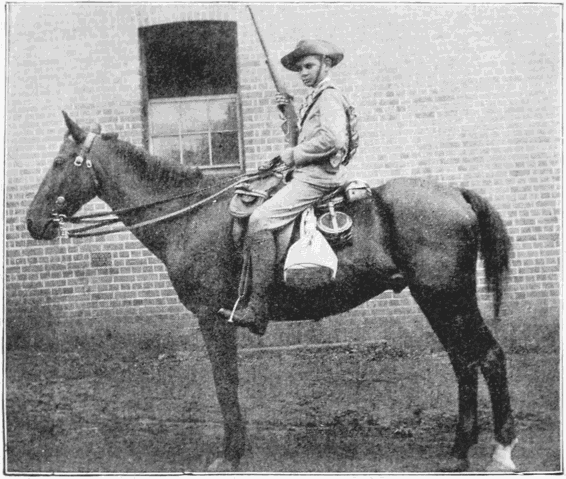
South African Scout. Full Equipment.
To prove his appreciation of the devotion and military prowess of the Cape colonists Lord Roberts, on his arrival in South Africa, decided on raising a Colonial Division. The official intimation of the formation of this division was contained in the following announcement:—
“The Commander-in-Chief, recognising the value of the services rendered by the Colonial troops, has authorised the formation of a division. Colonel Brabant, M.L.A., C.M.G., has been given the local and temporary rank of a Brigadier-General, and will be in command. Brabant’s Horse, with several other irregular corps and mounted contingents, limited in number, from the infantry volunteer regiments, will form the first portion of this force, and its first object will be to drive the enemy out of the Colony, and to co-operate with the Imperial troops. It has been decided to raise a further 1500 mounted irregulars, so as to give all Colonials and men with Colonial experience a chance of joining this division. Men who enrol in this Mounted Irregular Corps, and who cannot afford to go on a long campaign, will be allowed to register their names for service in the Colony only, but any portion of such registered men can volunteer to take part in any further advance that may be ordered beyond the Orange River. To raise this latter force recruiting stations will be open in all parts of the Colony, and it is proposed to elect officers from Colonial gentlemen or those with Colonial experience.”
As may be imagined, there was great jubilation among the thousands of martial spirits at the Cape, who for long had been fretting at enforced inactivity.
Some very interesting particulars regarding raising of some of the Colonial Corps were elicited from Mr. W. Hosken, who was chairman of the Uitlander Council and the Chamber of Commerce at Johannesburg. He said: “I was chairman of the committee which obtained permission from the Government to raise Thorneycroft’s and Bethune’s Corps of mounted infantry and the Imperial Light Horse, and all raised in Natal and mainly from refugee Uitlanders from Johannesburg. From the Imperial officers with whom I was brought into contact I received every consideration and the greatest cordiality. But again it should be remembered that we got the permission only after pressure had been brought to bear by public meetings at Durban and Maritzburg, and in other ways. The response was most gratifying. Only when the Boers were threatening to advance on Maritzburg were we allowed to form the Imperial Light Horse. Intimation of the permission was given on the Friday. By the following Wednesday we were able to report that 1300 men had offered for service, and that the medical examination would be at once begun. Thorneycroft’s Corps was the first to take the field, and was actually fighting within six weeks from the date of its enrolment. The testimony from Boer sources as to the value of these regiments has been most gratifying. In one verbal statement by a Boer commandant they were described as ‘evidently skilled sharpshooters.’ Then there are the Natal Volunteers, recruited in very much the same way as your Volunteers at home, clerks and artisans from the towns, with the mounted companies from the country districts. They took the field possibly with some misgivings as to their capacity, just as the Volunteers here might do; but they have proved themselves equal to any military duty that is imposed on them. The soldiers of the regular army recognise them as worthy comrades, and the greatest cordiality exists between the regular and volunteer forces. Later on there was formed also in Natal a body of Colonial scouts—750 strong—recruited from local men who knew the country. Those who wished to serve together were placed in the same squad. Every section of twenty-five men elects its own leader, and every four sections its commander. They have already proved their efficiency in service with Sir Redvers Buller’s army. Then there is the corps of ambulance bearers. When General Buller was making arrangements for the attack on Colenso last month he asked for 1200 white bearers. On the first day the notice was posted in Durban 900 men volunteered. Far more than the required number offered, and a selection was made of those who were considered the most fitted for the duty. These men did excellent work, bringing out the wounded under fire during that disastrous day at Colenso. Three were killed and several wounded, and every one of the corps behaved splendidly.”
In regard to the apparent neglect of the Volunteers at the Cape, he went on to say: “The delay in recruiting irregulars at the Cape was not in the least due to the unwillingness of the Uitlanders there or of the British residents. It was the result of political considerations which were then thought to be of sufficient weight by well-advised men on the spot. The delay caused a great deal of heart-burning among hundreds who were only too keen to take up arms; and it is only quite recently that permission has been given to form irregular corps and to accept the services of the Cape Volunteers already in existence, who were eager to serve. Directly the permission was given men flocked to the standard, and you have now Rimington’s Guides, the South African Light Horse, and the Cape Volunteers, who have all promptly proceeded to the front. Another most useful body is now being recruited both in Natal and in Cape Colony—I mean the Railway Pioneer Corps. It is being officered by the most eminent of the mining engineers of Johannesburg, and the rank and file are made up of skilled mechanics, who are specially qualified for the particular duties they will have to perform. They will be armed in the ordinary way, drilled as an engineer corps, and will be expected to do the ordinary work of the military engineer.”
The Imperial Light Horse, formed by Majors Sampson and Karri Davies, was largely composed of Australians. Many Johannesburg people joined it, most of them “all-round sportsmen, capital shots, and keen riders.” They joined on the principle of not allowing the Mother Country to fight their battles for them while they had a right arm with which to assert themselves.
The Cape Mounted Police, 1000 strong, who were also sent on active service at the commencement of the war, were invaluable. They were remarkable, not alone for gallantry, but efficiency. When Captain de Montmorency’s Scouts were cut off near Labuschagnes Nek by some 800 Boers, Captain Golsworthy on the last day of the year came to the rescue with a party of the Cape Mounted Police, and put the enemy to flight.
Early in 1900, the Rhodesian Field Force, under the command of Lieut.-General Sir Frederick Carrington, was organised to operate in Northern Rhodesia, and stop any trekking of members of the Free State or Transvaal or rebels of Cape Colony into Rhodesian territory.
The officers were:—Major C. D. Learoyd, Royal Engineers; Major A. V. Jenner, D.S.O., Rifle Brigade; Major C. L. Josling, Royal Army Medical Corps; Major G. A. R. Carew, 7th Hussars; Captain E. Peach, Indian Staff Corps; Captain R. G. Partridge, Army Ordnance Department; Captain W. E. Lawrence, South Wales Borderers; Second Lieutenant C. S. Rome, 11th Hussars; Second Lieutenant C. H. Dillon, Rifle Brigade; Paymaster G. J. C. Whittington, Hon. Colonel; Lieutenant Pemberton; Major P. Dalton, late 3rd V.B. Royal Fusiliers; Major C. D. Guise, 3rd Gloucester Regiment; Brevet-Major P. Moir Byres, 1st Dragoon Guards; Captain C. W. Kennard, 3rd Gordon Highlanders; Second Lieutenant W. H. Longden, 4th East Surrey Regiment; Chaplain Rev. F. P. Moreton, M.A.; Lieutenant R. Laing, surgeon; Lieutenant E. A. Parsons, surgeon; Lieutenant H. Cardin, surgeon; Lieutenant F. F. Bond, surgeon; Lieutenant G. H. Collard, surgeon; Lieutenant F. R. Pullin, surgeon; Lieutenant H. D. Buss, surgeon; Colonel H. C. Wood, late 10th Hussars; Lieut.-Colonel J. Leslie, 5th Royal Irish Fusiliers; Lieutenant-Colonel B. G. Booth, late Scots Guards; Major J. W. Traill, late 4th Cheshire; Captain R. Gray, C.M.G., late 6th Dragoons; Captain E. C. P. Curzon, late 18th Hussars; Captain F. C. P. Curzon, Royal Irish Rifles; Captain H. F. F. Fisher, Army Service Corps; Veterinary-Captain H. T. W. Mann; Lieutenant J. K. Rashleigh, late Artillery Militia; Lieutenant F. J. Lawrence, late English Militia; Lieutenant C. A. Burgoyne, 3rd Dragoon Guards; Lieutenant A. Wormald, surgeon; Major E. J. Tickell, D.S.O., 14th Hussars; Captain J. Ponsonby, Coldstream Guards; Captain Pereira, Coldstream Guards; Captain H. J. Haddock, Royal Welsh Fusiliers; Captain R. K. Arbuthnot, Royal Irish Regiment; Lieutenant W. D. P. Watson, late Scots Greys; Major G. Wright, R.G.A.; Major A. Paris, R.M.A.; Captain and Hon. Major G. E. Giles, late R.A. In all, forty-four officers.
NATAL
The following is a list of the names and numbers of the local forces which the colony of Natal has put into the field: Natal Naval Volunteers, 150; Natal Carabineers (Colonel Royston, since dead), 465; Natal Mounted Rifles, 200; Border Mounted Rifles, 270; Umvoti Mounted Rifles (Major Leuchars), 130; Natal Field Artillery, 120; Natal Royal Rifles, 145; Durban Light Infantry, 400; Medical Staff, 7; Veterinary, 3; Staff, 19; Natal Mounted Police (Europeans) at Ladysmith and other portions of the Colony (Colonel Dartnell), 649; Thorneycroft’s Mounted Infantry (Colonel Thorneycroft, Royal Scots Fusiliers, D.A.A.G.), 500; Bethune’s Mounted Infantry (Lieut.-Colonel Bethune, 16th Lancers, Colonel Addison second in command), 500; Imperial Light Infantry (Colonel Nash), 1000; Imperial Light Horse (Colonel Scott Chisholm, killed 21st November 1899), 500; Colonial Scouts (Colonel Edwards, Captain Sydney Osborne), 500; Ambulance Bearers (1st section), 1000; Ambulance Bearers (2nd section), 600. Total, 7158.
The South African Light Horse is mentioned among the Cape Colonial troops, though it has done notable work in Natal. The second and third regiments of the corps became respectively Roberts’s and Kitchener’s Horse. In the district of Kaffraria half the available men were embodied, men belonging to the Duke of Edinburgh’s Own Volunteer Rifles—one of the corps of “regulars” belonging to Cape Colony.
The South African Light Horse was started on the 12th of November. By order of Sir Redvers Buller a recruiting office was opened in Cape Town, whereupon the place was instantly invaded. Patriotic fervour ran high, and every one desired to take a share in showing forth the might of Great Britain. The officers, Major Byng (10th Hussars, with temporary rank of colonel) and Captain Villiers (R.H.G., with temporary rank of major), set themselves manfully to hurry the work of organisation. In no time men were picked—fine riders and fine shots—mounted and equipped. Saddlery, tents, harness, ammunition—all were gathered together with startling celerity. Among the troopers were British-born subjects, Uitlanders, Colonials, Americans, farmers, seamen, &c. The officers hailed from many regiments—the 10th Hussars, Royal Horse Guards, Life Guards, 11th Hussars, 20th Hussars, Gordon Highlanders, Yeomanry, Militia—all manner of men of distinction and wealth and breeding uniting together in a common brotherhood for a common cause.
The following is a list of the officers: Colonel Byng, 10th Hussars, commanding; Major Villiers, Royal Horse Guards, second in command; Captain Fraser, 1st Life Guards, adjutant; Captain French, late L.G., Maxims; Captain Harden, Transport; Captain Murray; Captain Anderson; Captain Hull, paymaster; Vet.-Captain Walker; Vet.-Lieutenant Steele; Chaplain Rev. G. Eales. Squadron Leaders—Captain Balfour, late 11th Hussars; Major (Bimbash) Stewart, Gordon Highlanders; Captain Kirkwood; Captain Gatacre; Captain Renton; Captain Whittaker; Captain Child; Captain Allgood. Lieutenants Milne, Tucker, Brown, Jobling, De Rougemont, Tarbutt, Davis, Bathurst, Shepherd; Second Lieutenants Warren, Carlton Smith, Hamilton, Cock, Leith, Welstead, Robinson, Oates, Johnson, Vignelles, Vaughan, Carlisle, Marsden, Overbeck, Newman, Penrose, Kuhlman, Horne, Cloete, Walker-Leigh, Hon. de Saumarez, Thorold, Kitson, Vaghan.
Three squadrons under Captain Byng proceeded to the front to Natal, where they immediately distinguished themselves, while the remainder of the regiment went to the western border, and there took a full share of incessant work.
The Natal Mounted Police under Colonel Dartnell, “a genius, planner, and guide,” did wonderful deeds in relation to the defence of Ladysmith and during the trying actions which preceded it. The gallant colonel, who has been described in action as being “as good as a brigade,” placed his own horse at the disposal of General Symons, who was wounded, and saw him safely off the field at Glencoe.
The Natal Carabineers served splendidly both within and without Ladysmith, some of the force, under Lord Dundonald, being the first to relieve the town. Their fighting qualities are well known, and it is unnecessary to do more than quote the words of General Hunter, who said, “I never wish to serve with better men.”
First-rate work has been done by the Frontier Mounted Rifles, a well-trained and excellently-equipped body of men, all in the prime of life, and drawn from the eastern border towns of the Cape Colony. They held a position of continual danger, being encamped nearest the enemy. Being born and bred among the kopjes which afforded the Boers such cosy hiding-places, they were acquainted with every nook and corner, and could find their way about them both in daylight and dark. This force, with the Cape Police, helped to keep General Gatacre informed regarding the seething mass of disloyalty that surrounded him. It was difficult to choose between the honest hostility of the Free Staters and the crafty antagonism of the rebel Dutchmen, who had joined the enemy almost to a man. These were known to be in active collusion with the foe, assisting them by spying, blowing up culverts, wrecking railway lines, and generally assisting in the development of the plots to sweep British rule from the soil of Africa. Loyal British subjects had much to suffer at the hands of these people, who spent their time carrying off and destroying furniture and valuables, smashing windows and doors, and damaging all property other than their own that they could lay hands on, and with these duplicit ruffians the British troops unaided by Colonials could never have been even. Besides the valuable services of the Frontier Mounted Rifles and the Cape Police, General Gatacre had under him four other regiments of Cape Colonials, who were all trying to outrival each other in nobility, pluck, and usefulness. Of many other regiments pages might be written, but space does not permit. In regard to the Imperial Light Horse, one sentence expressed by Sir George White speaks volumes. He said it was composed of the finest fighting material that he had ever had under his command.
THE IMPERIAL YEOMANRY
Early in the days of war Lord Lonsdale offered to take out to South Africa 200 men of the Westmoreland and Cumberland Yeomanry, of which he is colonel, and to fully equip and clothe them. Lord Harris and his regiment, the East Kent Mounted Rifles, also were among the first to volunteer for the front, and before that the Middlesex Yeomanry (the Duke of Cambridge’s Hussars) made a hurried application to go to the Transvaal, which impetuosity of loyalty was met by the War Office with courteous refusal. At that time the need for light cavalry in South Africa seemed scarcely to have dawned on the authorities. It was true that October mists and November fogs had enveloped London, and that no one between Downing Street and the Mansion House could see an inch before his nose, and it was equally true that by the time these mists had cleared away there was only one question, namely, “How many men could be sent abroad out of the 10,000 who constituted the Yeomanry Cavalry?”
Then, in December, the following announcement, with regulations to be observed in the organisation of a Contingent of Yeomanry and Volunteers, was published:—
Yeomanry.—1. Her Majesty’s Government have decided to raise for service in South Africa a mounted infantry force, to be named “The Imperial Yeomanry.” 2. The force will be recruited from the Yeomanry, but Volunteers and civilians who may possess the requisite qualifications (as given below) will be specially enrolled in the Yeomanry for this purpose. 3. The force will be organised in companies of 115 rank and file, five officers being allotted to each company, viz., one captain and four subalterns, preference being given to Yeomanry officers. 4. The term of enlistment for officers and men will be for one year, or for not less than the period of the war. 5. The officers and men will bring their own horses, clothing, saddlery, and accoutrements. Arms and ammunition, camp equipment, and regimental transport will be provided by Government. 6. The men will be dressed in Norfolk jackets, of woollen material of neutral colour, breeches and gaiters, lace boots, and felt hats. Strict uniformity of pattern will not be insisted upon. 7. The pay will be at cavalry rates, with a capitation grant for horses, clothing, saddles, and accoutrements. All ranks will receive rations from date of joining. Gratuities and allowances will be those laid down in special army order of May 10, 1899. 8. Applications for enrolment should be addressed to colonels commanding Yeomanry regiments, or to General Officers commanding districts, to whom instructions will be immediately issued.
Qualifications.—(a) Candidates must be from twenty to thirty-five years of age and of good character. (b) Volunteers or civilian candidates must satisfy the colonel of the regiment through which they enlist that they are good riders and marksmen, according to Yeomanry standard. (c) The standard of physique to be that for cavalry of the line.
Volunteers.—Her Majesty’s Government have decided to accept offers of service in South Africa from the Volunteers. A carefully selected company of 110 rank and file, officered by one captain and three subalterns, will be raised (one for each British line battalion serving in, or about to proceed to, South Africa) from the Volunteer battalions of the territorial regiment. These Volunteer companies will, as a general rule, take the place in the line battalion of its company, serving as mounted infantry. The Volunteer battalions from which a company is accepted will form and maintain a waiting company in reserve at home. The selection of men from the Volunteer battalions for service with the line battalion in the field, will devolve on the commanding officers of Volunteer battalions. The terms of enlistment for officers and men will be for one year, or for not less than the period of the war. Full instructions for the information of all concerned will be issued with the least possible delay through General Officers commanding districts.
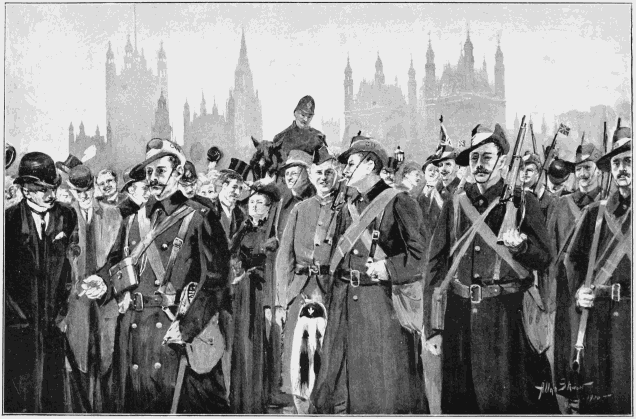
LONDON’S RESPONSE—THE CITY IMPERIAL VOLUNTEERS CROSSING WESTMINSTER BRIDGE. Drawing by Allan Stewart.
A committee was formed to assist in organising the Yeomanry force, among which were the following notable persons: Colonel Lord Chesham, Colonel A. G. Lucas, Colonel Viscount Valentia, Colonel the Right Hon. W. H. Long, M. P. Colonel the Earl of Lonsdale consented to assist the committee in the obtaining of horses. The following Acting Staff Officers were nominated to assist Colonel Lord Chesham: Captain the Hon. W. Bagot (late Scots Guards), Captain L. Sandwith (8th Hussars), Adjutant of the 2nd Yeomanry Brigade.
In a short, an almost incredibly short, space of time numerous battalions were in readiness, and a strong contingent from Ireland was raised, composed mainly of hunting men. The Under-Secretary for War wrote to correct the impression which prevailed in some quarters that the raising of funds by private subscriptions for the Volunteers and Imperial Yeomanry going to South Africa was promoted by Government in order to do work which ought to be done with Government money. He pointed out that the Government was bearing the whole cost of those forces, providing them directly with their pay, food, and arms, and, through their regiments, with clothing and equipments. But the Government allowance for these things was calculated on the regular army scale, and the public subscription would be serviceable in the way of making better provision in those directions for the local Volunteers and Yeomanry, of locally overcoming certain difficulties of organisation, and of decentralising a great deal of contracting for horses, saddles, clothing, &c. Why, they argued, should the man who volunteers his service in the field bear also all the cost of making himself efficient, and all the cost entailed by his absence from his trade or profession? Surely those who could not volunteer for the front will be glad to assist him, or his corps in this case, as they have assisted him or his corps in time of peace for forty years? Quantities of men of independent means throughout the country, a great many of whom were acquainted with each other, were ready and anxious to form a corps of the Imperial Yeomanry, messing and fighting together, and enduring the hardships and dangers of the trooper in emulation of the regular service man; and to this body of men the corps specially appealed. Though at first some 5000 men were called for, it was evident that 10,000 could have been recruited if needed. The magnificent example set by thousands of young men in humble stations of life, who left home and good employment courageously to serve their country, acted as a powerful incentive to their more fortunate brethren of means and leisure, and it was astonishing to find how readily all the members of the “upper ten” sacrificed themselves rather than be “out of it.” Eventually the Duke of Cambridge’s Own, the Special Corps, went to Africa, paying their own expenses. In this corps every trooper, equally with every other member of the Imperial Yeomanry, was entitled to a grant of £65 on joining, but all other expenses were defrayed by themselves, and even the pay received during the campaign was devoted to swell the Imperial War Fund for the widows and orphans of soldiers who had fallen in action. The cost of equipment of each recruit amounted to £170. The special purpose of the scheme was to attract men of social standing and education, and enable groups of friends to serve together in the same unit at the front. Among those who were enrolled was Lord Elphinstone; Mr. Geoffrey Malcolm Gathorne-Hardy, grandson of the Earl of Cranbrook; Captain Shaw; the Hon. Aubrey N. Molyneux Herbert (brother of the Earl of Carnarvon); the Hon. A. Hill-Trevor. Lord Lovat engaged himself actively in raising a corps of Highland gillies. In addition to the Government grant, magnificent contributions poured in for the full equipment of the corps. Lord Loch worked energetically in organising the South African Contingent of the Imperial Yeomanry. These troops were formed only of men who had South African experience, and had seen service there.
The following is a list of the various battalions:—
1st Battalion (Colonel Challoner)—1st and 2nd Co. Royal Wiltshire Yeomanry; 4th Co. Glamorganshire Detachment; 3rd Co. Gloucestershire Yeomanry. 2nd Battalion (Colonel Burke)—32nd Co. Lancashire Hussars; 21st and 22nd Co. Cheshire Yeomanry; 5th Co. Warwickshire Yeomanry. 3rd Battalion (Colonel Younghusband)—9th Co. Yorkshire Hussars; 11th Co. Yorkshire Dragoons; 12th Co. South Notts; 10th Co. Notts (Sherwood Rangers). 4th Battalion (Colonel Blair)—7th Co. Leicestershire Yeomanry; 8th Co. Derbyshire Yeomanry; 6th Co. Staffordshire Yeomanry; 28th Co. Bedfordshire Detachment. 5th Battalion (Colonel Meyrick)—14th and 15th Co. Northumberland; 13th Co. Shropshire; 16th Co. Worcestershire. 6th Battalion (Colonel Burn)—17th Co. Ayrshire Yeomanry; 18th Co. Lanarkshire Yeomanry; 19th Co. Lothian and Berwickshire; 20th Co. Fife Light Horse. 7th Battalion (Colonel Helyar)—27th Co. Royal 1st Devon, Royal North Devon; 48th Co. North Somerset; 25th Co. West Somerset; 26th Co. Dorsetshire. 8th Battalion (Colonel Crawley)—23rd Co. Duke of Lancaster’s Own; 51st and 52nd Co. Mr. Paget’s Corps; 24th Co. Westmoreland and Cumberland. 9th Battalion (Colonel Howard)—29th Co. Denbighshire; 30th Co. Pembrokeshire; 31st and 49th Co. Montgomeryshire. 10th Battalion (Colonel Lord Chesham)—37th and 38th Co. Buckinghamshire; 39th Co. Berkshire; 40th Co. Oxfordshire, 11th Battalion (Colonel Wilson)—42nd Co. Hertfordshire; 43rd and 44th Co. Suffolk; 41st Co. Hampshire Carabineers. 12th Battalion (Colonel Mitford)—34th and 35th Co. Middlesex; 33rd Co. Royal East Kent; 36th Co. West Kent. 13th Battalion—54th and 56th Co. Irish (Belfast) Companies; 45th Co. Irish (Dublin) Company; 47th Co. Lord Donoughmore’s Corps (Duke of Cambridge’s Own). 14th Battalion (Lieut.-Colonel Brookfield)—55th Co. Northumberland; 53rd Co. Royal East Kent; 50th Co. Hampshire; 62nd Co. Middlesex. 15th Battalion (Lieut.-Colonel Sandwith)—56th and 57th Co. Bucks; 58th Co. Berks; 59th Co. Oxford. 16th Battalion (Lieut.-Colonel Ridley)—63rd Co. Wilts; 64th Co. Cheshire; 65th Co. Suffolk; 66th Co. York. 17th Battalion (Lieut.-Colonel Moore ?)—60th Co. North Irish, Belfast; 61st Co. South Irish, Dublin. 18th Battalion—67th, 70th, and 71st Co. Sharpshooters. 19th Battalion (Lieut.-Colonel Rodney ?)—69th Co. Sussex; 68th Co. Paget’s Corps; 72nd Co. Rough Riders; 73rd Co. Paget’s Corps.
Each battalion consisted of four companies of 116 each.
Colonel Viscount Downe, who was serving on Lord Roberts’s staff in South Africa, was elected to command a brigade of the Imperial Yeomanry, and Lieutenant the Hon. R. F. Molyneux, Royal Horse Guards, was selected as his aide-de-camp.
Lord Dunraven’s Battalion of Sharpshooters embarked for Africa to join the Rhodesian Force on the 6th of April. It was composed of four companies. The 67th, under the command of Captain Crum (late 52nd Regiment), was accompanied by Lieutenants Langford, Jones, Curley, and Dyke. The 75th, commanded by Major Warden (late Middlesex Regiment), was accompanied by Lieutenants Gabbett, Power, Warde, and Bosanquet. The 70th Company, comprising the Scottish Unit under Colonel Hill (late 12th Lancers), was accompanied by Lieutenants Clark, Torrance, Hotchkiss, and Andrews. The remaining company was commanded by Sir Savile Crossley.
The Earl of Dunraven, the founder of the corps, went to South Africa as Supernumerary Captain on the Battalion Staff.
THE CITY IMPERIAL VOLUNTEERS
The announcement that the Government had decided to send to South Africa a force of Volunteers, was received with general delight by our civilian soldiers throughout the country. Here was a chance—a chance never before offered to earn distinction in the field; and here was an opportunity—most seasonable and appropriate, for the expression of public opinion, and for the display, the universal and effervescent patriotism that had found little chance of outlet in the prosaic walks of everyday life. The official intimation came as a surprise, and surprise in a few moments developed into unrestrained joy. The proposal to employ “a strong contingent of carefully selected Volunteers” was no sooner published than the War Office was besieged with applicants all eager to know what chance of being included in the great military movement might be available. A few weeks before the opening of Parliament Colonel Sir Howard Vincent volunteered “marksmen” for service in South Africa, and other colonels of Volunteer regiments followed suit. General Trotter (commanding the Home District) expressed a belief that the employment of Volunteers in the present crisis would demonstrate for all who should care to profit by the lesson the magnificent reserve force of civilian soldiers possessed by our nation, a force utterly ignored by Continental nations. This force was practically a force of picked men, selected marksmen who, unlike the “Regulars,” were all first-rate shots, and fit to cope with the skilled sharpshooters of the Boers. The marksmanship of many of the London corps of Volunteers has for many years been phenomenal, and it was said that in one company of the 13th Middlesex there were no less than sixty-three first-class shots out of eighty. Finally, it was decided that the “C.I.V.’s,” as they were called, should consist of 1400, and both corps sailed towards the end of January. Prior to their departure the Freedom of the City was conferred upon the officers of the regiment at the Guildhall, and later an impressive farewell service was held at St. Paul’s Cathedral. Their departure through London was somewhat difficult, owing to the dense and enthusiastic multitude that thronged the streets to see the last of them.
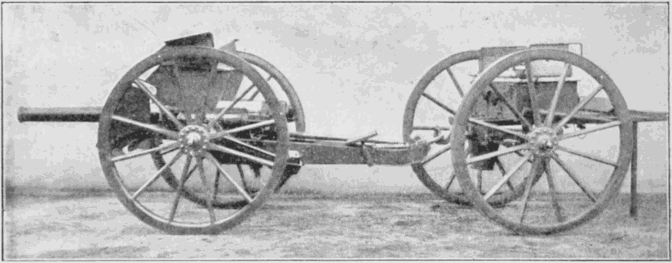
12½-Pounder Quick-Firing Field-Gun—City of London Field Battery. (By permission of Messrs. Vickers, Sons & Maxim, and the publishers of the Engineer.)
The Lord Mayor, Mr. Newton (now Sir A. J. Newton, Bart.), who was the moving spirit in the organisation of the corps, gave an excellent account of the splendid work that had been accomplished and of the prompt equipment and despatch of the regiment. This report concisely and modestly describes the enormous undertaking, though it does not sufficiently enlarge on the keen personal interest and magnificent services rendered by the prime mover in the great scheme. The Lord Mayor said: “From the moment when the Commander-in-Chief did me the honour of placing in my hands, as Chief Magistrate of the City of London, the organisation of a regiment of thoroughly qualified Volunteers for service in South Africa, I have been profoundly impressed with the responsibility of the trust, and the importance of every promise made on behalf of the Corporation and City of London being fulfilled in its integrity. The original promise was 1000 Metropolitan Volunteers, all recommended by their commanding officers, all between twenty and thirty-five years, all bachelors, and that at least 250 should be mounted. That was on the 20th of December (1899), and now, on the 3rd of February (1900), the City of London, with the approval of the military authorities, has completely equipped and despatched to the seat of war upwards of 1550 selected Volunteers, of whom 500 men and 17 officers are already in Cape Town—all approved by the General Officer commanding the Home District. Of these, 400 are mounted infantry, having their saddlery with them, and their horses ready at the Cape. Four small Maxim guns, with 200,000 rounds of ammunition, have also been shipped. A highly trained battery of field artillery, mainly provided by the Honourable Artillery Company, through the zealous co-operation of the Earl of Denbigh, composed of 140 men and officers, left the Royal Albert Docks by the steamship Montfort. This section took with it four 12½-pounder quick-firing guns and ample ammunition, together with their full complement of 110 horses, purchased here, as they must be of a stouter type than the Cape horses. The City has also—which was not originally intended—provided the entire camp and tent equipment for the whole force when it leaves Cape Town, and, at the request of the authorities, done a good deal in the direction of land transport, without interfering with the responsibility of the Headquarters Staff in South Africa in respect of maintenance of the corps. The regiment constitutes a part of her Majesty’s regular army. The officers and men are soldiers, and remain so during the campaign. The time has been very brief, but there has been neither hurry nor confusion, and the explanation of the successful results may be fairly summed up as follows: As soon as Lord Wolseley accepted my offer, made on behalf of the Corporation and City, I was in the position of an autocrat in this business, and the power of the purse was promptly placed at my disposal—in the first instance by the Corporation with its grant of £25,000, by the City Livery Companies, the large shipowners, bankers, merchants, the Honourable Artillery Companies, its members, and the citizens generally. The Metropolitan Volunteer commanding officers vied with each other as to who could send the most men, do the most work, and be the most useful. The result is that, with the exception of a few staff officers from the regular army, the officers of the City Imperial Volunteers are gentlemen engaged in civil pursuits, but who have spent years in efficiently performing their duties. The non-commissioned officers are most carefully picked from the vast band of qualified men holding the same or higher rank in their own Volunteer regiments, and every man of the rank and file has been expressly recommended by his commanding officer for the particular duty allotted to him. Several committees have dealt with sea and land transport, equipment, saddlery, and finance, and Volunteer commanding officers have served on all these. A committee of the Honourable Artillery Company and the battery officers arranged the details of their own equipment without coming to the Mansion House for anything but the inevitable cheque. The selection of Colonel Mackinnon, A.A.G., Home District, as commandant was a very fortunate one for all concerned. Major-General Turner, C.B., R.A., has been constant in his attendance at the Mansion House, and always at hand when technical assistance was required. Major Freemantle and Lieutenant Grantham have been indefatigable, while my son as hon. secretary to, and Mr. A. D. Watson, a member of, the Equipment Committee, have gone to Cape Town as the connecting link for a short time between the regiment and its headquarters—the Mansion House. Colonel C. G. Boxall, C.B., on whose initiative I took up this work, has thoroughly and loyally fulfilled in every sense his promise to me to see this business completed, for which his admittedly great technical knowledge and his indomitable zeal in the Volunteer cause so eminently fit him. Mr. Abe Bailey, D.L. of the City, who from the first placed his services at my disposal, is acting as honorary agent of the regiment at Cape Town. He purchased over four hundred horses, and arranged for their being put in training and ready for the arrival of the first contingent, besides rendering other and invaluable aid. Several City firms have furnished contingents of their expert employees, whose services at the Guildhall in the preparation and distribution of “kits” have been of great assistance. The payment of accounts is now progressing, and at the first opportunity an audited statement of receipts and expenditure will be presented. In conclusion, I would state that the whole force has gone to the front with no burning desire for glory, but with a determination to do its duty, and with an intense loyalty and devotion to their beloved Sovereign.”
Roll of the City of London Imperial Volunteers.
Officers.—Infantry—Colonel, Earl of Albemarle; second in command, Lieutenant-Colonel A. G. Pawle; Adjutant, Captain the Hon. J. R. Bailey. A Company—Captain A. Reid; Lieutenant F. R. Jeffrey; Lieutenant E. D. Townroe. B Company—Captain C. W. Berkeley; Lieutenant B. W. Garnett; Lieutenant J. W. Cohen. C Company—Captain C. Matthey; Lieutenant the Hon. S. McDonnell, C.B.; Lieutenant E. Treffry. D Company—Captain F. J. Cousens; Lieutenant J. H. Smith; Lieutenant F. R. Burnside. E Company—Captain R. B. Shipley; Lieutenant W. J. P. Benson; Lieutenant F. B. Marsh. F Company—Captain W. Edis; Lieutenant P. F. Brown; Lieutenant S. H. Hole. G Company—Captain A. A. Howell; Lieutenant C. P. Grindle; Lieutenant P. Croft. H Company—Captain C. A. Mortimer; Lieutenant W. B. I. Alt; Lieutenant B. C. Green. Quartermaster, Captain S. Firth. Medical Officer, Surgeon-Captain E. St. V. Ryan. Staff—Colonel W. H. Mackinnon; Lieutenant E. H. Trotter; Transport Captain J. E. H. Orr; Paymaster Captain Triggs (late A. P. D.); Medical Officer, Surgeon-Captain R. R. Sleman; Veterinary Officer, W. S. Mulvey. Battery—Major G. McMicking; Captain E. C. Budworth; Lieutenant A. C. Lowe; Lieutenant H. Bayley; Lieutenant J. F. Duncan; Surgeon, Captain A. Thorne. Mounted Infantry—Colonel H. C. Cholmondeley; Adjutant Captain E. Bell; Quartermaster J. Ridler. Machine-Gun Section—Lieutenant E. V. Wellby. No. 1 Company—Captain J. W. Reid; Lieutenant G. Berry; Lieutenant W. H. Brailey; Lieutenant B. Moeller; Lieutenant C. H. W. Wilson. No. 2 Company—Captain J. F. Waterlow; Lieutenant A. Bailey; Lieutenant E. G. Concanon; Lieutenant A. H. Henderson; Lieutenant E. A. Manisty.