Volume 3 — CHAPTER VI BULLER’S SECOND ADVANCE (continued 2)
Reading edition
At this date a journalist made a daring sortie on his own account, and reached Durban in safety. He left with permission at nightfall on the 18th of January, and, guided by a wily Kaffir, made tracks for Chieveley. Having gone about two miles to the east of Cæsar’s Camp and approached unwarily a Boer picket, he was promptly challenged. Then ping! ping! ping! a swift whistling sound of Boer bullets, and silence! The journalist, to use a sporting phrase, was lying “doggo.” Not a shot touched him. Flat on his stomach he remained for fully half an hour with bated breath, then, when murmurs of the disquieted Boers ceased to ruffle the night air, he resumed his way, groping on hands and knees, and wishing fervently that he had taken lessons in deportment earlier—from the quadrupeds. Perilous was the onward journey, clambering and crawling up hill and down dale, and falling over rocks and stones in the pitch darkness. Daylight saw him at the hut of a friendly native not far from Chieveley, and here concealed, he spent twenty-four hours of terrible suspense till it was time again to proceed on his journey. The Boers almost discovered him. They called at the hut for milk, absorbed it, and looked about suspiciously, while the man of the pen was penned in amongst a heap of blankets, a perspiring mass, quaking but safe.
Meanwhile with the rumour of battle in the air, hope revived. It continued to increase as the British positions from the heights around the town became visible—the newly gained positions on Swartz Kop and the eminences near the Tugela at Potgieter’s and Trichardt’s Drifts. Every red flash was like a smile of welcome—every roar of bursting shrapnel seemed a very chorus of jubilation. To the ears of the besieged the tremendous awe-striking cannonade appeared as the loved assurance of Great Britain, their deliverer, saying, with grand majestic tone, “I am coming.” In the distance the Boers could be seen in frenzied activity inspanning their waggons, and towards the evening they were observed trekking northwards towards Van Reenan’s Pass. Many conjectures were rife, and subsequently on the 25th curiosity grew to fever heat. Surely the British were in possession of Spion Kop! Decidedly they were masters of the situation! Yet in the nek below, by the light of the telescope, Boer camps could be seen on the plains; under cover of the great hill Boer cattle were grazing. What could this mean? Had the Boers gone and left everything to the mercy of their victors? or were they merely in hiding, intending to return at nightfall, and remove their valuables? Certainly the Burghers were to be viewed mounted and decamping in the direction of the pass, and also winding strings of waggons pursuing their slow way in the same direction. Still the riddle remained unsolved. Night fell. The suspense grew more and more fevered; it became almost a delirium. There was little sleep; then, when morning dawned, there was more anxiety and more puzzling, more mental torture. The Boers were as much in evidence as ever!
Disappointment may be borne with a show of spirit when the inner machinery is well oiled, but the inhabitants of Ladysmith had no such source of fortitude. True, they had fared, if not sumptuously, at least practically, on horse-sausages, which were turned out wholesale from a factory for the benefit of the troops, and on fairly nourishing soup which was supplied in the same way; but of civilised food there was none. Eggs had now gone up to 36s. a dozen, and a diminutive and emaciated fowl could be purchased for 18s. These luxuries were for the elect. For the mass a varying dietary of horse and mule was obligatory. Vegetables were sold at a prohibitive price, and a case of whisky was raffled for and fetched £145, so that “Dutch courage” wherewith to meet their misfortune was unpurchasable.
Not till Sunday the 28th the fearful truth was learned, that Warren, after holding Spion Kop, had retired, and left the Boers in undisturbed occupation of their commanding position!
As all the latest events to the south were communicated to the garrison as fast as they were made known to the chief, the news of the capture of Spion Kop and the disappointing retirement therefrom was published in general orders. Blank faces turned from each other, that none should see the reflection of his own despondency. Intense had been the rapture of the anxious inhabitants when they had heard the far-away booming of the British guns, seen the splashing of British lyddite, watched the great spouts of smoke that spoke of tremendous activity and their possible salvation. Now their dismay was more than proportionate. After all their agony—silence. Silence, so far as they were concerned. Mystery, doubt, and agonising suspense—and now the news, the woeful news, that the second splendid effort to break through the imprisoning Boer girdle had failed!
Still the garrison was resolved to hold on to the last, preferring death by starvation or disease rather than surrender. The malodorous surroundings were borne with patience, the diminution of the supply of medicines, watched with pathetic resignation. Nevertheless an untold weariness crept over the unhappy sufferers, who spent their days huddled underground and dreading to expose themselves in the open lest they should be caught by a shell or “sniped” at by some Boer more enterprising than the rest. How they longed, how they prayed for the great hour! They believed in Buller; they knew he would come, they said to themselves. But when, O when? And echo answered—When?
LORD ROBERTS AT THE CAPE
On the 10th of January Lord Roberts arrived. He was received by General Sir F. Forestier Walker on behalf of Sir Alfred Milner. All the ships in port were dressed, and there was immense excitement at the prospect of better things. Many recalled to mind the occasion of the last coming of the great little man, when, on the eve of a campaign to retrieve Majuba, he found that the British Government, unknown to him, had arranged peace on contemptible terms. At that time it was said he broke his sword in indignation at the betrayal to which he had been subjected, and vowed never again to serve under a British Government. Be this as it may—he had now come at the earnest call of his country, and all felt that his coming meant a turn in the wheel of fortune. After his arrival things began gradually to unfold themselves, and the promise of decisive movement was in the air.
Lord Roberts’s decision to bring the Colonial volunteers to the support of the Imperial forces was acknowledged to be a great move. The Colonist’s services were eminently to be desired, for he had taken the Boer measure. He knew him in all the complex windings of his sinuous, twisting nature. In some respects the Boer had been his lesson-book. From him he had learned the necessity to be a good shot, a smart horseman, and a long stayer. He followed the ins and outs of the Dutchman’s war game, and could practise the art of dodging round kopjes and into dongas, hiding in scrub and disappearing from mortal ken at a moment’s notice, with the zest and agility of a schoolboy playing at hide and seek, and with a certain enjoyment in the diamond-cut-diamond sort of exercise.
On the 26th of January General Brabant arrived at Queenstown to take over the command of the Colonial Division, and on the same day General Kelly Kenny, commanding the Sixth Division, occupied Thebus, a position on the railway between Middleburg and Stormberg Junction. This station is situated about ninety miles from Colesberg, around which General French so untiringly operated, and forty-five miles from Stormberg, the scene of General Gatacre’s disaster.
On the 1st of February the City of London Volunteers landed. Immediately after their arrival at the Cape they were honoured by a visit from the great man who was about to control the destinies of South Africa. Gracefully he welcomed them, and said how little it had been imagined in days gone by, the days when the Volunteer force had been established, that any of its members would come to take part in a war in South Africa. He expressed his belief that nothing was more calculated to benefit the army than employment together on service of all its component parts, and that these would learn to appreciate each other, and acquire a spirit of comradeship which would have far-reaching results. He reminded them that strangely enough the first Volunteers left home three hundred years ago to fight for the Dutch, and arrived just in time to save Flushing from the Spaniards. On this occasion they would take an equally brilliant part in establishing peace, order, and freedom in South Africa.
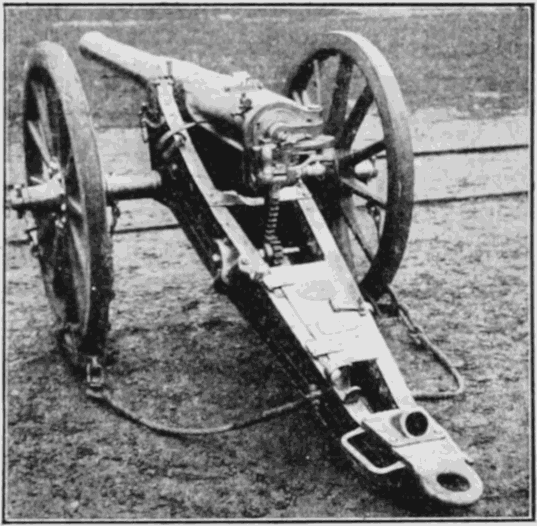
Type of Arms—New Naval 12-Pounder Field-Gun. (Photo, Cribb, Southsea.)
The members of the corps were delighted. Colonel Cholmondeley expressed their thanks, and they all cheered right royally. They were burning to get to the front, and, in spite of the sudden change of temperature from British midwinter to tropical sunshine, their zeal to be up and doing was unabated. They waited at the Cape to be joined by the second detachment and receive their horses, after which they entrained for the western border, where they were so soon to distinguish themselves.
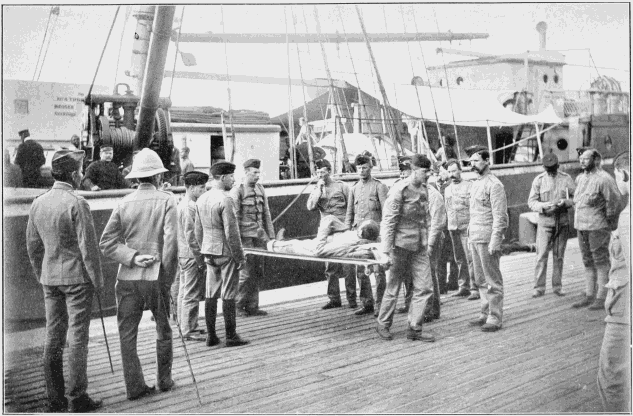
ARRIVAL AT CAPE TOWN OF WOUNDED FROM NATAL. Photo by Hosking, Cape Town.
There was great satisfaction at the announcement that General Brabant would command the Colonial corps. The class of men enlisting in Brabant’s Horse, the Imperial Horse, Bailey’s Horse, and other of the South African mounted corps was a superior one. The volunteers were mostly well-to-do men, sons of farmers and Colonials who were residents in the country, and were intimately acquainted with its geography. Moreover, they were men and not striplings, and were averse from being commanded by young officers who were absolutely without South African experience.
It has been rumoured that the British officers and those of the irregular troops have not always been in accord. The fact is, that one is a master of discipline and the other a master of independence. The Colonial is accustomed to habits of complete self-reliance; he expects to be treated like an individual and not as a machine. Our military system is a machine-made system, and one which, unluckily for us, has been incapable of any of the smart plasticities which warfare with the Boers has demanded. Colonial troops will be led, but they won’t be driven. They are composed of men of first-rate quality, but not men accustomed blindly to obey orders. The Colonist obeys because of the personal influence of a man or men whom he holds intellectually or morally in esteem, but the word discipline for sheer discipline’s sake he is disinclined to understand. Among the ranks of the Colonials are many men of wealth and influence, men of high character and good education. These could not suddenly be treated in the same way as the British regulars, who, being gifted with more dare-devil courage than knowledge of the three R’s, require to be welded together on a system. A tactician once asked the question—What is the difference between an army and a mob? and the general answered—“Discipline.” It is discipline that converts a rowdy British youngster into the glorious British Tommy that he is. With the Colonial we have already the trained and independent man, and the system of give and take is the only system that can avert friction between men who, though brothers in blood, have, and always must have, the special idiosyncrasies attendant on their dissimilar forms of life.
Lord Roberts, recognising all this, with his usual diplomacy and sympathy for those who serve the Queen, decided to form a bodyguard, to accompany him to the front, of Colonials, the troops to be representative of all the corps—volunteers, irregulars, &c. The guard was to consist of Major Laing, an officer well versed and distinguished in Colonial matters, a lieutenant, two sergeants and corporals, and about forty picked troopers taken from the various irregular corps already at the front. The men of the corps were to continue to wear their own uniform, and merely to be distinguished by a badge. Preference in choosing the members of the guard was given to men of Colonial birth, good shots, riders, and scouts, who were well acquainted with all the peculiarities of Colonial life.
To further show his appreciation of the services of the Colonials, Lord Roberts appointed as extra aide-de-camp on his personal staff Colonel Bryon of the Australian Artillery. He also sent telegrams to the Governors of Victoria and New South Wales congratulating them on the spirit of patriotism in Australia, and expressing his appreciation of the useful and workmanlike troops that had been sent to assist in restoring peace, order, and freedom in South Africa.
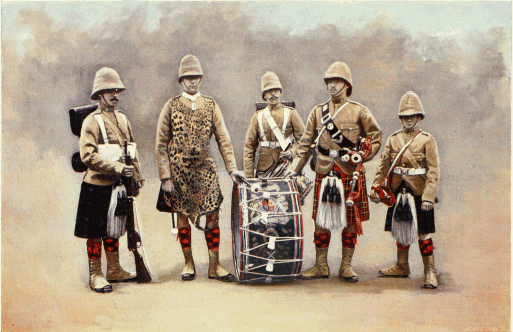
PRIVATE, DRUMMERS, PIPER, AND BUGLER—THE BLACK WATCH. Photo by Knight, Aldershot.
At this time the following correspondence between the Presidents of the Transvaal and the Orange Free State and Lord Roberts was published at the Cape. It began with a joint despatch from Presidents Steyn and Kruger dated Bloemfontein, February 3, stating:—
“We learn from many sides that the British troops, contrary to the recognised usages of war, have been guilty of destruction by burning and blowing up with dynamite farmhouses and devastating farms and goods therein, whereby unprotected women and children have often been deprived of food and shelter. This happens not only in places where barbarians are encouraged by British officers, but even in Cape Colony and in this State (Orange Free State), where white brigands come out from the theatre of war with the evident intention of carrying on general devastation without any reason recognised by the custom of war and without in any way furthering the operations. We wish earnestly to protest against such practices.”
Mr. Kruger’s Autograph

In reply Lord Roberts wrote:—
“I beg to acknowledge your Honours’ telegram charging British troops with the destruction of property contrary to the recognised usages of war, and with brigandage and devastation. These charges are made in vague and general terms. No specific case is mentioned. No evidence is given. I have seen such charges made before now in the Press, but in no case which has come under my notice have they been substantiated. Most stringent instructions have been issued to British troops to respect private property so far as it is compatible with the conduct of military operations. All wanton destruction and injury to peaceful inhabitants are contrary to British practice and traditions, and will, if necessary, be vigorously repressed by me.
“I regret that your Honours should have seen fit to repeat the untrue statement that barbarians have been encouraged by British officers to commit depredations. In the only case in which a raid has been perpetrated by native subjects of the Queen, the act was contrary to the instructions of the British officer nearest the spot, and entirely disconcerted his operations. The women and children taken prisoners by the natives were restored to their home by the agency of the British officer in question.
“I regret to say it is the Republican forces which in some cases have been guilty of carrying on war in a manner not in accordance with civilised usage. I refer especially to the expulsion of loyal subjects of Her Majesty from their homes in the invaded districts because they refused to be commandeered by the invaders. It is barbarous to attempt to force men to take sides against their sovereign country by threats of spoliation and expulsion. Men, women, and children had to leave their homes owing to such compulsion. Many of those who were formerly in comfortable circumstances are now maintained by charity.
“That war should inflict hardships and injury on peaceful inhabitants is inevitable, but it is the desire of Her Majesty’s Government and my intention to conduct this war with as little injury as possible to peaceful inhabitants and private property. I hope your Honours will exercise your authority to ensure that it is conducted in a similar spirit on your side.”
Meanwhile the British Commander was rapidly maturing his plans. Troops were pouring into the Cape and mysteriously departing none knew whither. Great doings were in the air, and secret communications between Lord Roberts and the wily General French—communications which Boer spies endeavoured to intercept—promised that the splendid fastnesses hitherto enjoyed by the enemy would not much longer serve to keep him from the punishment that was his due.