IV OXFORD BOOKS
Reading edition
§ 1. Oxford Series
At one time Oxford books were produced almost always at the instance of an author; and many Oxford books are still so produced. A scholar having devoted, it may be, many years of his life to a subject which he has made his own, applies to the University Press for publication of his researches; and such a claim is often admitted as irresistible. In modern times, however, the need for organization by the publisher has become increasingly apparent. Many books which if published in isolation would reach only a small public are found capable of a wider usefulness when issued as part of a larger plan; and thus the initiative in publishing passes more and more into the hands of the professional commanding the advice of a body of experts. School-books, reprints of the Classics, text-books of the applied sciences, and books of the nature of Dictionaries and Encyclopaedias are now almost always conducted in this way by co-operative enterprise.
The number of such homogeneous series promoted by the Press during the last twenty years is large, even if all school-books are excluded. The Oxford English Dictionary (which is of earlier origin) bulks so large in the public eye as somewhat to obscure all humbler enterprises; but it does not stand alone. In English literature the Press has built up in a quarter of a century a whole library of uniform series, all of respectable dimensions. The Oxford English Texts are library editions of famous authors edited after exhaustive examination of the materials, in print and in manuscript, and handsomely printed from type; the Tudor and Stuart Library consists of first editions and exact reprints of famous books of that period, printed in the types of the period on paper calculated to last for many centuries more; these books are now finding their way into the second-hand catalogues and the collections of connoisseurs; the Oxford Library of Prose and Poetry is a series of little books for fanciers, offering especially the classics of the Romantic Revival in a form approximating to that of the originals; the Oxford Poets claim to be the last word for accuracy of text, condensed yet fine printing, and the lowest price compatible with these qualities; the Oxford Standard Authors offer the same texts as the Oxford Poets, together with many prose classics, in a cheaper form; the average volume containing nearly 600 pages of close yet legible print. Finally, the World’s Classics furnish a collection of over two hundred of the most famous English books in a very handy form, still maintained in print as far as possible in spite of the costs of production, which make it increasingly difficult to keep any but the most popular books on sale in a cheap series.
None of these series has been created by the simple expedient of taking an existing edition and sending it to the printer—a plan too commonly followed, as is well known to every one who has ever investigated the text of a well-known author, and has found that each edition contains almost all the errors of its predecessors and adds fresh errors of its own. The Oxford texts are the result of the laborious co-operation of editor, publisher, and printer, involving the choice of the most authoritative original—very often the collation of a number of printed originals and sometimes of manuscripts as well—expert attention to the problems both editorial and typographical of which the successful solution produces a well-designed book, and finally scrupulous diligence in the elimination of error. The substantial accuracy of Oxford texts is widely recognized, and is known to be due to the united vigilance of the editors, the publishers (themselves scholars and sometimes editors), and the printers. It is less well known how complex and difficult are the problems which the modern editor has to solve. The scientific editing of English texts is indeed a relatively recent growth, and depends upon the application of principles which in the field of Greek and Latin textual criticism have been elaborated in the course of centuries. It is thus no accident that the work done in English editing in the last five-and-twenty years has been largely in the hands of scholars trained in the Oxford school of Literae Humaniores, and has synchronized with the production of the Scriptorum Classicorum Bibliotheca Oxoniensis.
This series, now popularly known as the Oxford Classical Texts, is the only large series of critical texts of Greek and Latin authors produced in recent times outside Germany and able to hold its own in competition with its great German rivals. The texts, which now fill nearly eighty volumes and include the most important writers of the ‘classical’ periods of Greek and Roman literature, have been based upon much fresh examination of the manuscript originals. Some of the editors, indeed, have devoted years to this kind of investigation; the labours of Mr. Allen on the manuscripts of Homer and of Professor Clark and Sir William Peterson on those of Cicero have secured for their authors a permanent place in the long history of classical scholarship.
The aim of the series is to give the best text which the examination of the manuscripts in their relation to each other affords, and to provide in a brief apparatus criticus sufficient information to show the evidence on which the editor has based his decision. Conjectural emendations are mentioned in the notes when they are considered plausible, but are not admitted to the text except where they reach a high degree of probability. This principle, which is mainly due to the authority of the late Ingram Bywater, has commended itself in the course of years even to those who were at first disposed to think it too austere, and has greatly enhanced the permanent value of the series, which before the war was finding its way into Germany itself. A famous German publisher went so far indeed as to address to Oxford (on the eve of the war) a letter of remonstrance on the price of the series, which was described as too low for its value.
The Oxford Library of Translations consists mainly of prose versions of Greek and Latin authors. These have not been made to order or in accordance with any single principle of translation, but have been produced at the instance of scholars unable to deny themselves the satisfaction of translating a favourite author. This, which is perhaps the best guarantee of excellence, accounts for the miscellaneous constitution of the series, which has been enlarged by degrees as a happy conjunction of author and translator chanced to present itself, and from the same cause admits some interesting authors seldom or never included in series of translations made upon a less elastic plan.
Another series of translations is the great collection of the Sacred Books of the East, which was begun many years ago by the late Max Müller and reached its fiftieth and concluding volume in 1910. The value of these translations to Orientalists is shown by the steady sale, which after forty years is still increasing, and by the high prices asked for the few volumes which are now unfortunately out of print.
History, and the subjects akin thereto, afford less scope for homogeneous series than does the editing of ancient and modern classical literature; and it has been the policy of the Press rather to secure monographs of unique authority in special fields than to compile works of encyclopaedic information. A few examples will serve to illustrate the range and importance of the Oxford books produced in this way which have become classics in their subject: in the History of Antiquity, Sir Arthur Evans’s Scripta Minoa, Sir Edward Maunde Thompson’s Palaeography, Vincent Smith’s Early History of India; in the Fine Arts, Barclay Head’s Historia Numorum, Vincent Smith’s Fine Art in India, Dalton’s Byzantine Art; in Constitutional History and Law, Anson’s Law and Custom of the Constitution and Law of Contract, Sir Courtenay Ilbert’s Government of India, Lord Bryce’s Studies in History and Jurisprudence, Hall’s International Law, Prof. Keith’s Responsible Government, Sir Erskine Holland’s Jurisprudence; in British History, Stubbs’s Constitutional History of England, Freeman’s Norman Conquest, Sir Paul Vinogradoff’s Villainage in England and English Society in the Eleventh Century, Sir Charles Oman’s Peninsular War; in European History, Finlay’s Greece, Hodgkin’s Italy and Her Invaders; in Geography, Prof. Beazley’s Dawn of Modern Geography and Mr. R. L. Poole’s great Historical Atlas.
Books of this kind best represent the type at which Oxford has aimed in the historical and human sciences, and it is to the promotion of such works that the resources of the Press have in this field been most advantageously applied. When, however, the progress of a subject and the enthusiasm of an editor have combined to suggest another way, the opportunity has been taken of organizing research upon a common plan. Notable results of such combined endeavour are the Oxford Survey of the British Empire and the Historical Geography of the Dominions promoted by the late Prof. Herbertson and by Sir Charles Lucas of the Colonial Office respectively. The former work, containing in six volumes a general and a particular survey of the geographical, economic, and administrative aspects of the Empire and its constituent parts, was completed within a short time and published within a few weeks of the outbreak of the war. In an important sense therefore it cannot become out of date, since it affords a conspectus of conditions as they existed at the culmination of the former age, to which it will always be necessary to refer as a standard of comparison. The other series, which is in seven volumes (comprising twice as many separate parts), has had a longer and more chequered history, the march of events since the early years of the century, when publication began, having made necessary frequent revision and reconstitution. The work is still in progress, and India has recently been added to its scope.
A more recent collection arose out of the demand during the war for a compendious survey of the history of the belligerent powers. To satisfy the demand was one of the pieces of war work undertaken by the Press, and the evident usefulness of the volumes having survived the war has led to the establishment of a series on a permanent and wider plan, including Histories of the Nations and treatises of similar scope on leading questions of International politics. The series now covers France, Belgium, Italy, Portugal, the Balkans, Serbia, Russia, Prussia, China, and Japan, with books on the Eastern Question, Diplomacy, Nineteenth-Century Treaties, and other topics. Many of the volumes have been frequently reprinted, and additions are in preparation.
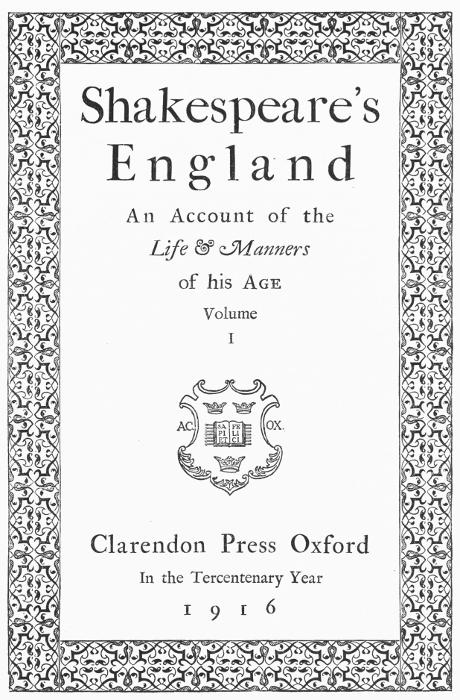
Not the least interesting of Oxford books written by a number of contributors on a uniform plan is Shakespeare’s England, an Account of the Life and Manners of his Age, published in two volumes in the centenary year 1916. The book contains an Ode by the Poet Laureate, a long essay on the Age of Elizabeth by Sir Walter Raleigh, and some forty special articles by the first authorities.
Another co-operative enterprise is the Oxford History of Music, which in six volumes surveys the whole subject from the beginning to the time of Wagner; it is not a collection of biographies, but a history of music as such—of origins, tendencies, and evolution. The authors include the late H. E. Wooldridge, the late Sir Hubert Parry, and Sir Henry Hadow, whose enlightened enthusiasm has done so much for the study of music in England.

§ 2. Oxford Books on the Empire
Oxford is proud to consider itself as par excellence the Imperial University. The administration of the Empire owes much to Oxford men, as the University in its turn owes much to her sons from overseas. Imperial subjects are an important and growing branch of study at Oxford; and the Press, true to its tradition of building upon the foundations of experience, has in time put together an imposing collection as well of the classics of colonization and administration as of new and original treatises by scholars versed in its theory and practice. These books being very diverse have not been confined within the limits of a series uniform in size or appearance; but they have a real unity, and deserve it is believed to be acquired as a whole by every library with any pretensions to an imperial character. Among the most important volumes may be enumerated Wakefield’s View of the Art of Colonization, first published in 1849, Lord Durham’s Report on British North America, Cornewall Lewis’s Government of Dependencies; and (among modern treatises) Prof. Keith’s Responsible Government (in its present form published as recently as 1912, yet already an established classic), and the same author’s Imperial Unity, Prof Egerton’s Federations and Unions, Sir Courtenay Ilbert’s Government of India.
The Press is so strong in books on India that it has seemed well to issue a special catalogue bringing together a mass of books which in the General Catalogue are listed under a variety of subject-headings. These include a large and important section published by the Press under the patronage of the Secretary of State—notably the Imperial Gazetteer of India in twenty-six volumes, the noble series of documents on the early history of ‘John Company’ compiled at the India Office, and the sumptuous publication of Sir Aurel Stein’s discoveries in Turkestan; but they include also a whole library of books produced by the Press at its sole charges and dealing with the history of India from the Empire of Asoka to the formulation of Dyarchy, with the geography, politics, and economics of modern India, and with the religion and literature, the fine art, and the music of Hindostan. The production by the Press in India itself of vernacular and other educational books has recently made great progress. (See also p. 65 for some notice of the series of Classics of Indian History.)

§ 3. The Oxford Standard
The standard of scholarship, accuracy, and literary excellence which the Delegates maintain in the books published under their authority is believed to be as high as that attempted by any other publisher in the world. Its maintenance imposes upon the Delegates much labour and expense; but the effort is repaid in the reputation which Oxford books enjoy in the public estimation. The supervision exercised by the Delegates, both personally and through their advisers, is not limited to the initial judgement passed upon a book offered to them for publication; it extends through the whole process of revision in manuscript and in proof. When a book is favourably considered, an expert’s detailed report is very often laid before the author, who is asked to consider the suggestions made and to confer with the Delegates’ advisers; and this process of scrutiny is frequently far-reaching, the criticism being invited at one stage or another of a number of specialists in various fields. In this way many, perhaps most, of the books produced by the Press have received substantial improvement; and not a few have undergone something like transformation. To these benefits abundant testimony is borne in the prefaces of authors; more, perhaps, reposes in the archives in Walton Street.
The technical services rendered to scholarship by the Clarendon Press proof-readers are likewise commemorated in many a preface. The late Mr. J. C. Pembrey, who in 1847 read Wilson’s Sanskrit Grammar, and in 1916 read Prof. Macdonell’s Vedic Grammar for press, was well known to three generations of Oriental scholars; the late Mr. W. F. R. Shilleto did much to secure accuracy and uniformity in the series of Oxford Classical Texts; and Mr. George Ostler has left the marks of his vigilance upon many editions of the English classics. Long training in a severe school develops unusual powers; and authors are sometimes startled by instances of what seems beyond natural acumen. An author who had misquoted Tempora mutantur, nos et mutamur in illis in the usual form, was naturally astonished when the reader inquired in the margin ‘Should it not be et nos?’, which is of course unmetrical. The reader was right, nevertheless; but the source of his information remained obscure. In fields less recondite than this the authority of the readers is generally recognized; many editors have confessed that in the matter of Greek accents they should not think of disputing it.
The attention thus paid to the claims of scholarship and accuracy brings doubtless unmixed benefits to learning and education. To the Press as a business concern the blessing is less unequivocal. The Delegates’ resources are not without limits; and they are sometimes embarrassed by the ambitions of learned authors from all parts of the world, to whom nothing but the imprint of the Clarendon Press seems an adequate reward. They are obliged to pick and choose, and sometimes to decline a proposal which would attract them if it had fewer rivals. Another imputation is less deserved. A distinguished American who had been invited to dine in an Oxford College confessed afterwards that as he entered the room his knees knocked at the thought that ‘all these Fellows talked Latin’; and the public is sometimes frightened away from an Oxford book by the apprehension that it will be found full of Greek quotations. There is in fact no necessary connexion between accuracy and pedantry; and even Dons are often men of the world, well acquainted with the limitations of the average intelligence. No one need be afraid that an Oxford book on any ordinary subject will be any more abstruse than another book, though its facts will perhaps be better authenticated and its arguments more closely reasoned. The booksellers know this; and in reply to a customer’s inquiry ‘Is this a good book?’ have been heard to reply ‘Why it’s an Oxford book’.
Another fallacy which dies hard is that Oxford books are dear. This is perhaps no more than a hasty inference from the fact that Oxford produces an exceptionally large proportion of books which from their nature cannot be cheap. No one would expect to buy Liddell and Scott’s Greek Lexicon, or the Index Kewensis, for a few shillings; but these books and many like them are really inexpensive, if regard is paid to the number of words they contain. The Oxford Dictionary itself is sold at an almost nominal price. Many of the books, however, which appeal to a narrow public are properly priced higher than if they could be sold in large numbers; for the price of a book depends mainly upon two things—the number of words it contains and the number of people who will buy it. The art of publishing lies in nothing so much as in estimating whether a book is more likely to sell say, 750 copies at 15s. or 5,000 at 5s. The policy of the Press has always been elastic in this respect; and very many of its books are among the cheapest in their kind.
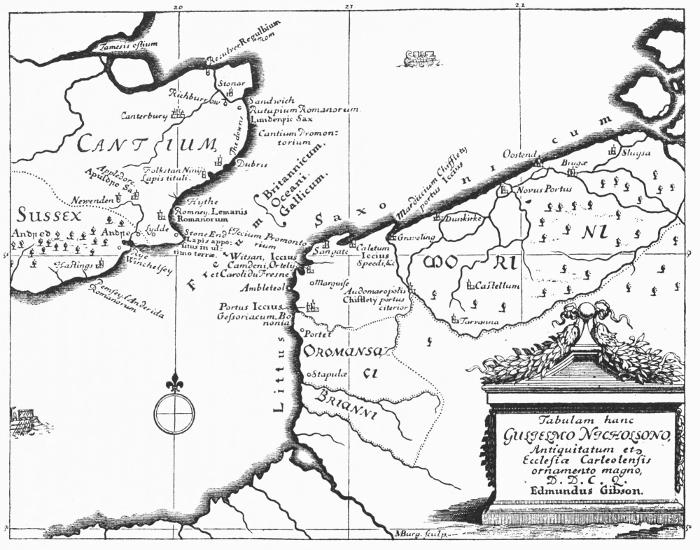
Specimen of work done by M. Burghers, Engraver to the University about 1700
Specimen of work done in the studio of the Clarendon Press to-day
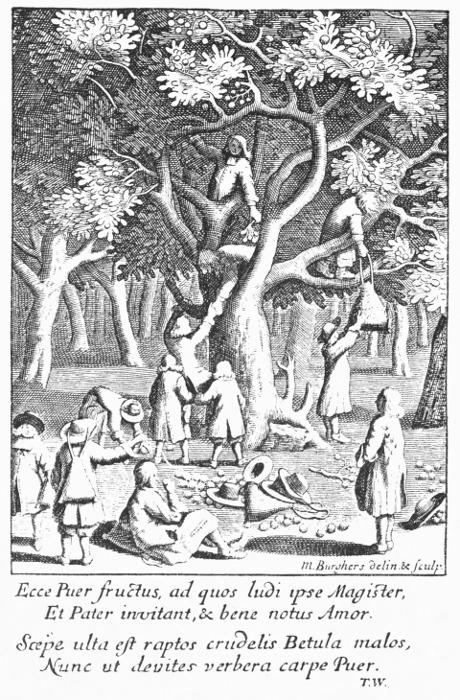
From Lily’s Latin Grammar, Oxford 1692
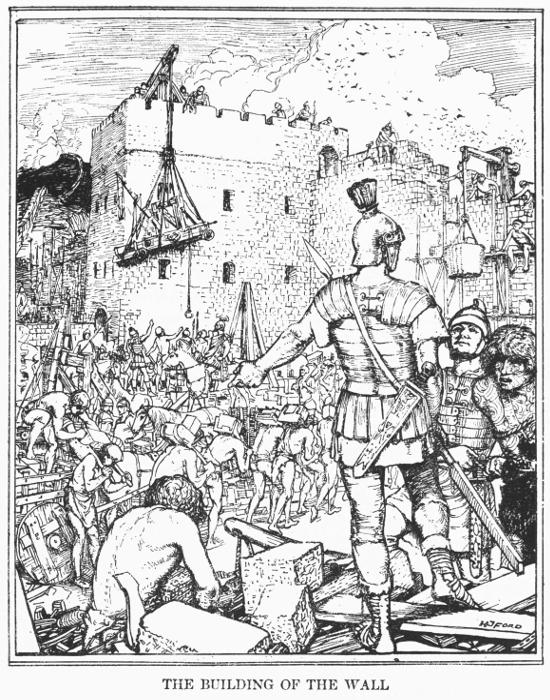
One of the drawings by Henry Ford from A School History of England by C. R. L. Fletcher and Rudyard Kipling, 1911

§ 4. Illustrated Books
The publication by the Press of beautifully illustrated books is mainly a development of comparatively recent years, and it has been furthered by the progress of collotype printing at Oxford. The catalogue now includes a large number of sumptuous monographs on artistic subjects. In its facsimiles of manuscripts and rare printed books, published on its own account or for the British Museum, the Press has done much to make accessible to scholars the treasures of the great collections. Well-known examples are the magnificent collotype reproduction of the New Testament part of the Codex Sinaiticus (from negatives made at St. Petersburg under the old régime; negatives were fortunately made of the Old Testament part as well, and the reproduction of the whole of this most famous of all manuscripts will before long be completed); and the complete collotype reproduction of the Shakespearian corpus, consisting of the Folio of 1623, which went out of print on publication in 1912, and the Poems and Pericles from the first editions, still on sale.
The Press has also published very numerous reproductions of works of art of all kinds, partly by way of illustrated catalogues of special collections or genres (such as the three folio volumes of Oxford Drawings by the old masters, the numerous coin catalogues, and the cheap collection of British Historical Portraits in half-tone); partly in the form of profusely illustrated monographs, which moreover are all scientific works by experts and not mere collections of pretty pictures with illustrative letterpress.
These works are of great importance to students and collectors, and a select list is appended: Head’s Historia Numorum, Gardner’s Ancient Coinage, Beazley’s and other books on Greek Vases, Hill’s Renaissance Medals, Dalton’s Byzantine Art, Maunde Thompson’s Palaeography, Murray’s History of Chess, ffoulkes’s Armour and Weapons, Rivoira’s Moslem Architecture, Vincent Smith’s Fine Art in India, Sir Aurel Stein’s Khotan and Serindia and other special works on Eastern Art, the important series of monographs on English Church Art written or edited by the late Francis Bond, with his comprehensive Introduction to English Church Architecture in two volumes, and many more too numerous to cite, particularly the great wealth of British Museum catalogues. A very welcome recent accession to the catalogue is supplied by the sumptuous monographs on Italian Masters produced by the Harvard and Princeton University Presses.
The use of illustration is, however, by no means confined to facsimiles and works on the arts. The modern productions of the Press have made an increasing use of illustration both as an embellishment and as a medium of information. School-books in particular are now lavishly illustrated with portraits, maps, diagrams, and other reproductions, often either of modern photographs or of old cuts and engravings carefully chosen, so that the actual men and things of former times may be faithfully mirrored.
The Press prints for the British Museum and other London collections, as well as for the Ashmolean Museum at Oxford, very large numbers of postcards in collotype, by means of which a knowledge of our national art treasures is being widely spread.

§ 5. Official Publications
The Press prints for the official purposes of the University the University Gazette (recording the official Acts and Agenda of the University), the annual Calendar (primarily a list of the members of the University), the Statuta Universitatis and the Examination Statutes (both published every year), and a number of smaller pamphlets &c. giving special information. The numerous and far-reaching changes, made necessary by the war and the fruits of the war, have hitherto precluded the republication of the useful and popular Oxford University Handbook, last published in 1915. Meanwhile, the pamphlet of General Information (on admission, residence, scholarships, and some examinations) will be found valuable by those, at home and abroad, who wish to form a general conception of the opportunities afforded to students and the requirements which they must fulfil.
There are many other official books, both utilitarian and antiquarian. Employers and others have often occasion to inquire what places a member of the University obtained in the class-lists. The information, not always available elsewhere, is given, from the beginning to 1900, in the Historical Register of the University, and for the years 1901-20, in the Supplement to that work recently published. Benefactors and others interested in University Finance are directed to the Abstract of the Accounts of the University and Colleges published annually. Other publications of local usefulness include the Oxford University Pocket Diary for the academical year, and the terminal list of all Resident Members of the University (with addresses, telephone numbers, &c.).
The University twice during the war printed its Roll of Service, and in 1920 published the third and definitive edition: it contains the names, fourteen thousand five hundred and sixty-one in number, of those members of the University who served in the Military and Naval forces of the Crown. The names of those who gave their lives, two thousand four hundred and seventy-four in number, are distinguished by heavy type.
The Oxford University Almanack has been printed annually since 1674, and of the illustrations since 1716 the Press possesses the original plates. By far the greater number are still on sale. Many of the recent plates are of great interest and beauty; those for 1906-10, and that for 1918, are collotypes from drawings made for the Almanack by Mr. Muirhead Bone; most of the later issues are chromo-collotypes reproducing water-colour drawings, preserved at Oxford, by J. M. W. Turner and other artists of his time.
The historical books dealing with Oxford and published by the Press include Mr. Madan’s Oxford Books, ‘1468’-1650, a work much esteemed by bibliographers; Mr. Shadwell’s Enactments in Parliament (concerning Oxford, Cambridge, Winchester, Eton, and Westminster); Mrs. Poole’s three volumes (one is out of print) of illustrated catalogues of Oxford Portraits (all these published for, or in co-operation with, the Oxford Historical Society); and, in a lighter vein, Mr. Lamborn’s popular Story of Architecture in Oxford Stone and handy guides, written by experts, to the Bodleian, other Oxford Libraries, the Ashmolean Museum, the University Museum (of Natural Science), and the picturesque Degree Ceremony (by the Warden of Wadham). The Press offers also a History of Oxford Rowing, and the collected Orationes of the late Public Orator, Dr. W. W. Merry, perhaps the only man of modern times who could make a Latin speech intelligible to an audience of undergraduates and ladies.
Lord Curzon’s work on University Reform published in 1909 is still on sale.

§ 6. The Oxford English Dictionary
The work described on its title-page as A New English Dictionary on Historical Principles, and long known familiarly as N.E.D. or Murray’s Dictionary, but now generally as the Oxford Dictionary, has a continuous history of more than half a century. It was in 1857 that Dean Trench (afterwards Archbishop Trench) laid the foundation of the work by calling the attention of the Philological Society to the inadequacy of all existing English Dictionaries. He pointed out that thousands of words which had become obsolete, but remained in the national literature, had either escaped the diligence of lexicographers or had been excluded by the limitations of their plan; and in especial that no dictionary gave any account of the history of words and their senses; in none was it ascertained when a word was first used, when (if obsolete) it had last been used, and how its senses had been developed.
The members of the Philological Society threw themselves eagerly into the plan proposed for supplying these deficiencies, and an army of volunteers set about the systematic examination of the whole body of English literature. At length a dictionary was projected (in place of the supplement first suggested, which it was realized would be much larger than the works it was designed to supplement), and Mr. Herbert Coleridge was appointed editor. Fresh volunteers were enlisted, and the work made progress. But it could hardly have taken shape without the tireless industry and indomitable courage of the next editor, Dr. Furnivall, who saw, but did not shrink from, the immense preparatory labours yet to be faced. Furnivall realized that an English Dictionary could not be made until the roots of the language could be examined in the mass of our early literature, which was then hardly known; and to provide this essential he founded in 1864 the Early English Text Society—the long list of whose publications, still growing, may be read in the Clarendon Press Catalogue.
But even the enthusiasm of a Furnivall did not avail to prevent a growing sense of despondency, when the work seemed to lengthen out indefinitely with no promise of performance. No private publisher could be found to undertake a work so vast. It was decided to invite the co-operation of the Clarendon Press. The Philological Society and Dr. James Murray, who had thrown himself into the work with an energy equal to Furnivall’s own, and was by acclamation designated as editor, entered into negotiations with the Delegates of the Press, and an agreement was signed.
It is fortunate that the magnitude of human undertakings is seldom perceived by those who engage upon them. Coleridge had intimated that it would be time to begin the Dictionary when a hundred thousand quotations had been pigeon-holed. The efforts of Furnivall and Murray brought the total to three and a half million quotations, selected by thirteen hundred readers from the works of five thousand authors. The work of accumulation has gone on for forty years since, and to-day the Dictionary contains about one and three-quarter million printed quotations, selected from a greatly larger number. Dr. Murray himself agreed with the Delegates for a work of between 6,000 and 7,000 pages. The total will exceed 15,000. He expected to complete the book in ten years with a small staff. To-day, thirty-five years after printing began, the work, to which Murray himself contributed more than 7,000 pages, is being carried on by three editors with twelve assistants; and the end is not yet.
It is impossible to value too highly the services of voluntary helpers from the beginning to the present day. The completeness and accuracy of the work, which is probably without a rival in any country or in any age, could not have been secured except by editors of the greatest learning and ability and by the training of a lifetime; but these qualities would not have availed if the work had not been founded upon inductive investigations of a range never before attempted. For the wealth of the materials made available our gratitude is due to readers not only in the United Kingdom but in all parts of the world, and notably in the United States of America, where the Dictionary is regarded with affectionate admiration as the common achievement of the English-speaking people.
Valuable, however, as the work of these voluntary helpers has been, an even larger debt of gratitude is due to the faithful labours of the editorial staff of assistants, some of whom can trace back their term of service to the earliest years of the undertaking. To their acumen, vigilance, and zeal have been and are due in large measure the completeness of the evidence and the correctness of detail in the presentation of words and their meanings.
Dr. Murray with his staff moved to Oxford in 1885, and there the work has been continuously carried on, partly in the Scriptorium attached to Dr. Murray’s house, partly (and in recent years wholly) in the Old Ashmolean Building, next door to the old Sheldonian Press and within a stone’s throw of the Bodleian. Here, as a section of the alphabet comes to be treated, the material is sifted, extracts from it are put in order, fresh investigations, often laborious, are undertaken to settle etymologies and doubtful points in the history of a word; copy is prepared for the printer, and references are checked. The complete preparation of the material involves researches of the most varied nature, some of which lead the editors even beyond the confines of our own language to novel and important discoveries.
The scope of the Dictionary, in the form which it finally assumed, is thus stated in the preface to Volume I:—‘The aim of this dictionary is to furnish an adequate account of the meaning, origin, and history of English words now in general use, or known to have been in use at any time during the last seven hundred years. It endeavours (1) to show, with regard to each individual word, when, how, in what shape, and with what signification, it became English; what development of form and meaning it has since received; which of its uses have, in the course of time, become obsolete, and which still survive; what new uses have since arisen, by what processes, and when: (2) to illustrate these facts by a series of quotations ranging from the first known occurrence of the word to the latest, or down to the present day; the word being thus made to exhibit its own history and meaning: and (3) to treat the etymology of each word strictly on the basis of historical fact, and in accordance with the methods and results of modern philological science.’
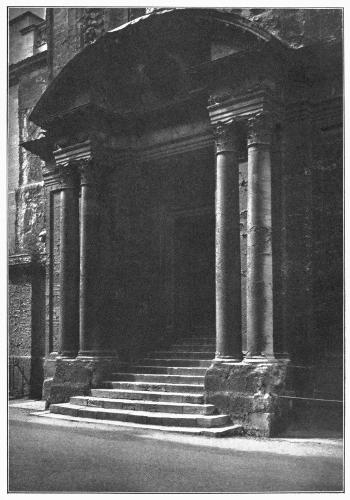
GATEWAY OF THE OLD ASHMOLEAN
As the history of many English words begins with the Anglo-Saxon period, and the ‘first known occurrence’ may be as early as the seventh century, the period actually covered by hundreds of the articles in the Dictionary is one of ten, eleven, or twelve centuries.
The extent to which the aim of the Dictionary has been accomplished is not yet so widely known as it ought to be. Many discussions as to the origin, history, and meaning of words are carried on in newspapers and periodicals which could be decided at once by a reference to the Dictionary. Inquirers spend much of their own and others’ time, and in the end write to one of the editors, in quest of information which has for years been available in the published volumes. Nor is it solely the student of language who can profit by the use of the Dictionary, although in this respect it is of unique value both for English and Continental philologists. Every scholar and scientist is likely to find in it some fresh light upon his own subject, for many special points in the history and terminology of the various sciences have for the first time been elucidated in its pages.
The reputation, however, of the Dictionary is now so widely spread that it would be superfluous to call witnesses to its unique qualities and its profound usefulness. In the legislature and in the law courts, as well as in the library and the market place, its ruling on the meanings and use of words is accepted as final. Nor is the range of the work limited in this respect to the usage of the United Kingdom; it embraces all forms of the language sanctioned as standard by literary use, wherever English is spoken and written.
For these and other reasons no proper comparison can be made with any other English dictionary; but the magnitude of the result may none the less be gauged by means of these. Taking one of the ten volumes as a basis of comparison, the seventh, comprising words beginning with O and P, has nearly 49,000 words (of which over 5,000 are obsolete and nearly 2,000 are naturalized aliens). No other English dictionary has more than 27,000 words beginning with O and P. When comparison is made of the number of illustrative quotations, the difference is overwhelming; Vol. VII has 175,000 quotations, and no other dictionary has much more than 20,000 for the same sections of the alphabet.
If it is thought that, great as the work is, it has taken an inordinate time to produce, comfort may be taken from the fate of comparable enterprises abroad. The great Deutsches Wörterbuch started by the brothers Grimm in 1838 began to be printed as long ago as 1851, and thus had a start of over thirty years; but though it is only some two-thirds of the scale of the Oxford book, there still after sixty-seven years remains about a sixth to do. The Dutch Woordenboek is less advanced, and the dictionary of the Swedish Academy has not passed the letter D.
The state of the work to-day is that of the ten volumes nine are published, and of the tenth (Ti-Z) substantial parts are complete, namely Ti-Ty, and V, X Y Z, and the first sections of U and W. The end, however, is not so near as might be thought; U is a large section, and W is in many respects the most difficult letter in the alphabet, consisting as it does almost entirely of words of Teutonic origin, and therefore of obscure etymology and complicated history. A lexicographer makes light work of parallelepiped and supralapsarian; it is when he comes to words like wealth and work, war and waste, wild and wilful, that his powers of discovery and of discrimination are seriously taxed.
Sir James Murray (he was knighted in 1908) died 26 July 1915. His ambition to see the completion of the work on his eightieth birthday in 1917 was not fulfilled, and even if he had lived to devote to it his amazing powers of application, could not have been fulfilled. He lived, however, to see the end of his life-work in sight, and more than that of any other man his name will be associated with the long and efficient working of the great engine of research. The volumes produced by him have characteristic excellences which cannot be exactly matched, though they may be rivalled by merits of another kind.
The work is now carried on by three editors, working independently on different sections of the alphabet. Dr. Henry Bradley, whose period of work on the Dictionary now rivals Murray’s in point of time, is by common consent the greatest of living English philologists. He has been an editor since 1888. Professor W. A. Craigie, who has been an editor since 1901, and Rawlinson and Bosworth Professor of Anglo-Saxon since 1916, brings to the work of the Dictionary a rare combination of qualifications. He is especially eminent as a Scandinavian scholar. Mr. C. T. Onions, appointed an editor in 1913, has been on the staff since 1895. He is also known to scholars as the author of the Oxford Shakespeare Glossary and for his editorial part in Shakespeare’s England.
The London Goldsmiths’ Company contributed £5,000 towards the cost of the sixth volume of the Dictionary, the title-page of which records their generous support. Apart from this the whole of the editorial and manufacturing cost of the work has been borne by the Delegates of the Press, who have defrayed from their general revenues a heavy annual outlay for many years. This has necessarily risen since the war, and it is fortunate that so large a part of the work had been completed under conditions less onerous than now obtain.
The price of the Dictionary has been kept very low, the sections being published at the rate of 2s. 6d. for sixty-four pages or less than a halfpenny per page containing on an average over 300 lines of type and nearly 3,000 words. Few books have ever been sold at so low a rate. The prices of volumes and half volumes stoutly bound in leather have necessarily been advanced in recent years to meet the enhanced cost of manufacturing; but the price of the Dictionary is still no more than nominal, if regard is paid to the outlay precedent to the actual manufacture of the books. Sections in paper wrappers, issued after 1920, will be priced at the rate of 5s. for sixty-four pages; but it is not proposed to raise the price of the bulk of the work in this form.
The London Times in 1897 described the Dictionary as ‘the greatest effort which any University, it may be any printing press, has taken in hand since the invention of printing.... It will be not the least of the glories of the University of Oxford to have completed this gigantic task’.
Lord Curzon in his Letter to the University of 1909 wrote: ‘In the staff of the English Dictionary alone the Press contributes to the University what is probably the largest single engine of Research working anywhere at the present time.’

§ 7. Dictionary of National Biography
This, the largest of all national collections of biography, owes its existence to the enterprise and munificence of the late George Smith, who founded it in 1882. The work was produced by the co-operation of a large number of scholars acting under the direction of the late Sir Leslie Stephen, with whom was afterwards associated Mr. Sidney Lee; and the latter half of the work was produced under Sir Sidney Lee’s sole editorship.
It was produced in sixty-three quarterly volumes, 1885-1900, the arrangement being alphabetical; and the lives of those who died too late to be admitted in their alphabetical place were included by the issue of three supplementary volumes, which brought the work down to the death of Queen Victoria and just past the close of the nineteenth century. The sixty-six volumes were later reissued, with corrections, on thinner paper, three volumes being converted into one; and this edition in twenty-two volumes constitutes the main dictionary from the earliest times to the close of the Victorian era, in the form now on sale. It contains, in rather more than 30,000 pages, some 30,000 lives, each equipped with a select bibliography. The roll of contributors includes many famous names; conspicuous among the articles are those of Sir Leslie Stephen himself, which are models of form and substance, and those of the present Regius Professor of Modern History at Oxford, Dr. C. H. Firth, whose Life of Cromwell is an acknowledged classic.
Continuing the work of the founder, Mrs. George Smith undertook a Supplement covering the years 1901-1911, which was produced by Sir Sidney Lee in 1912-13. This, as the first of a series of twentieth-century volumes, inaugurated what may be regarded as a second and distinct work.
Further, in 1903 was published in one volume an Index and Epitome to the Dictionary, giving within 1,500 pages 30,000 succinct biographies. The value of this compendium, to the very large non-professional public to whom the main work in twenty-two bulky volumes is not readily accessible, need not be emphasized. It has been thought proper, however, to lay stress upon its usefulness as an independent work of reference, which may fairly be expected to take its place, upon thousands of shelves, along with other compendious dictionaries and encyclopaedias; the Index and Epitome, therefore, along with the Index and Epitome to the Supplement of 1901-11, bound with it, is now issued under the short title of Concise Dictionary of National Biography.
The Dictionary of National Biography, with the responsibility for its maintenance, was offered to the University of Oxford in 1917 and gratefully accepted. Work is now in progress on a further decennial supplement covering the years 1912-21. This supplement will be edited by Mr. H. W. Carless Davis of Balliol and Mr. J. R. H. Weaver of Trinity. The Supplement of 1901-11, the Concise Dictionary, and many volumes of the main work, have recently been reprinted from plates; and the sale of the work shows an improvement when compared with the years preceding the war. Whether it will in the future be found practicable to attempt the systematic revision of the main work must still remain in doubt. The manufacturing expense of a new edition would be very heavy, and could be justified only by searching investigations, leading to a very substantial gain in accuracy, which must occupy years and involve a further heavy expenditure. The total outlay required has been estimated at £100,000, and this perhaps could not be defrayed without the munificence of a second founder. It may, however, be hoped that such a work will not at last languish for lack of funds. Meanwhile, under the direction of Mr. H. W. Carless Davis, the Delegates’ adviser upon the Dictionary, preliminary work is being steadily carried on. Subject-indexes have been prepared; a bibliography is in hand of the biographical literature which has accumulated since the publication of the Dictionary; and various special investigations are being made into periods for which the work is especially in need of revision. When it is remembered that a whole army of scholars was continually at work upon the material of the New English Dictionary for more than a quarter of a century before the first page was sent to press, it will be seen that the material of the Dictionary of National Biography may have to be newly surveyed with something of the same elaboration, if that Dictionary is ever to be rebuilt from its foundations.


§ 8. The Oxford Medical Publications
In the year 1907 a Joint Committee was formed between the Oxford University Press and Messrs. Hodder and Stoughton, under the Directorship of Mr. Humphrey Sumner Milford and Sir Ernest Hodder Williams, which had for its object the production of Medical, Surgical, and Scientific books, under the general title of the ‘Oxford Medical Publications’.
The Committee were peculiarly fortunate in having the invaluable advice and assistance, in the choice of Authors and Subjects, of the late Sir William Osler, Regius Professor of Medicine in the University of Oxford, and a Delegate of the Press.
The key-note of the Oxford Medical Publications has always been the practical character of the treatment. The popular Medical Manuals, Monographs, and the ‘General Practitioner Series’ have now a world-wide reputation, and include a large number of standard works, such as Diseases of the Heart, and Principles of Diagnosis and Treatment in Heart Affections by Sir James Mackenzie, A System of Operative Surgery by F. F. Burghard, C.B., Common Disorders and Diseases of Childhood by G. F. Still, Practical Obstetrics by Professor E. Hastings Tweedy, Guide to Gynaecology in General Practice by Comyns Berkeley and Victor Bonney, The Practitioner’s Encyclopaedia of Medical Treatment, The Practitioner’s Encyclopaedia of Medicine and Surgery.
By the acquisition in 1908 of Mr. Young J. Pentland’s business, leading Text-books by the most eminent Scottish authors were incorporated, including such well-known books as Cunningham’s Text-book of Anatomy and Manual of Practical Anatomy, Muir and Ritchie’s Manual of Bacteriology, Thomson and Miles’s Manual of Surgery, Waring’s Manual of Operative Surgery, Thomson’s Outlines of Zoology.
The Oxford Medical Publications were awarded the Grand Prix at the seventeenth International Congress of Medicine held in London in 1913. This award was bestowed for the general excellence of the Students’ books produced in the Series, and for the production of new and original work therein.
In 1916 the Committee sustained a great loss in the death of their Editor, James Keogh Murphy. A further heavy loss was sustained at the end of 1919 by the death of Sir William Osler, whose advice and assistance had always been of inestimable value. After the death of Mr. Murphy, the Editorship was temporarily undertaken by Lieut.-Colonel Sir D’Arcy Power, who was responsible for several important additions to the Series, including the well-known Oxford War Primers of Medicine and Surgery. Towards the close of hostilities Captain Robert McNair Wilson, M.B., Ch.B., late Assistant to Sir James Mackenzie under the Medical Research Committee, became Editor, and under his direction further important additions have been made, including Menders of the Maimed by Professor Arthur Keith, Studies in Neurology by Henry Head, Operative Treatment of Chronic Intestinal Stasis by Sir W. Arbuthnot Lane, Diagnosis and Treatment of Venereal Diseases in General Practice by Brevet-Colonel L. W. Harrison, D.S.O., Plastic Surgery of the Face by Major H. D. Gillies, C.B.E., R.A.M.C., War Neuroses and Shell Shock by Sir Frederick Mott, K.B.E., Trench Fever by Lieut.-Colonel W. Byam, O.B.E., Clinical Ophthalmology for the General Practitioner by A. Maitland Ramsay, and Tropical Ophthalmology by Lieut.-Colonel R. H. Elliot, I.M.S. The present Regius Professor of Medicine at Oxford, Sir Archibald Garrod, is a Delegate of the Press and an Oxford author.
The Oxford Catalogue now devotes many pages to the medical list, and the American Branch, by the publication of the encyclopaedic ‘loose-leaf’ Oxford Surgery, has produced an important and valuable adaptation of a British original. In the Quarterly Journal of Medicine the University possesses one of the most valuable scientific journals in the world; and in the other medical publications it administers what is at once a valuable property and a powerful instrument of education. Oxford medical books are known wherever English is spoken.
§ 9. Oxford Books for Boys and Girls
The more recent activities of the Press include a notable enterprise, started by Mr. Henry Frowde jointly with Messrs. Hodder and Stoughton, but now carried on by Mr. Milford alone. This was the foundation in 1907 of a new department for the issue of educational works for elementary schools, and of ‘gift-books’, useful and recreative literature, for young people of all ages. The Oxford Reading Books, which headed the list, set a new literary standard for books of the class; and the series established itself not only in this country but in parts of the Empire so remote and so diverse as Australia and Burma. It was followed by further series of reading books, and of books on history, geography, arithmetic, nature study, and other subjects of the elementary curriculum. The part taken by the Press in the educational system of the English-speaking world may now be said to comprehend the whole scholastic field from the infant school upwards.
Concurrently with the school publications, the J. Department, as it is known for convenience, has issued from Falcon Square a great variety of books for the leisure hours of boys and girls. These include finely illustrated editions of classics, such as Robinson Crusoe, Grimm’s Tales, Kingsley’s Water Babies, Alice in Wonderland; books on nature, science, industry, imperial history; miscellanies both instructive and entertaining; stories for boys, girls, and young children; and for the very youngest, picture books of all kinds.
All these publications are edited with care, and both on the literary and on the artistic side a high level of excellence is aimed at. Some two million copies of the books are distributed during the year.