III THE PRESS ABROAD
Reading edition
§ 1. The Press in India

The activities of the Press in India are of relatively recent date. Until 1912, when a branch was opened in Bombay, Oxford books had been accessible only to those who were determined to procure them. The existence of a distributing centre made it possible to reach more directly the educational and the general public. But it early became apparent to the Manager—Mr. E. V. Rieu of Balliol College—that the educational needs of India could only to a small extent be met by direct importation; that it was necessary to adapt existing books to the special requirements of the country, and to create new books similar in kind. In the course of a few years many such books were produced, at first chiefly in England, but later to an increasing degree in India itself. By 1918 at least a dozen native presses were engaged in printing and binding for the Branch. These books range from ‘simplified classics’ to editions of Shakespeare’s plays, from school geographies to handbooks for students of medicine and law. At the same time the sale of more advanced Oxford books was largely increased. A brief description is given elsewhere of the books produced at Oxford upon the history and art of India as well as upon its classical literature and its religions. Books like Mr. Vincent Smith’s Early History of India and his Fine Art in India command a wide sale among the educated natives of India.
Another field of enterprise is in vernacular education. Here the opportunities are vast, but the difficulties are great, for in most provinces many languages are spoken, and no one press is adequately equipped with the numerous founts of type required to deal with the vernaculars of India as a whole. The Branch was therefore fortunate in being, in 1916, invited by the Government of the Central Provinces to produce a series of Readers—in Hindi and Marathi—for use in schools throughout the province. At that time no paper could be imported from England, and the staff of the Branch was depleted by war. Nevertheless, within a year over half a million volumes had been written, printed, and illustrated, and were ready for distribution over a country nearly twice as large as England and Wales.
The activities of the Branch in placing the issues of the War before Indian readers in a true light attracted in 1918 the attention of Government; and the Branch was engaged by the Central Publicity Bureau to produce an illustrated War Magazine and a mass of pamphlets in English and the vernacular tongues.
In spite of these preoccupations the Branch has been able to emulate the activities of the Press at home by co-operating with learned bodies in India to produce books of scientific value. Notable among its publications in this kind are the historical treatises of Mr. Rawlinson, Mr. Kincaid, Mr. Mookerji, and other writers, and the economic studies published on behalf of the Universities of Bombay and Madras.
Mention may also be made here of the Classics of Indian History which are being issued by the Press. In reviewing the latest volume of the series—Meadows Taylor’s Story of My Life—The Times Literary Supplement says: ‘It is one of those books from which history hereafter will be written. The great books—in one sense or other—like Colonel Mark Wilks’s Historical Sketches of Southern India, Grant Duff’s History of the Mahrattas, Tod’s Rajasthan, Broughton’s Letters from a Mahratta Camp, must be supplemented not only by the native records, which are more and more becoming accessible, but by the personal narratives of Englishmen who lived in out-of-the-way places and entered into the lives of the rural inhabitants of India. Beside Colonel Sleeman’s Reminiscences must be put the autobiography of Meadows Taylor, a much superior book.’ Of the books mentioned by The Times, Sleeman’s and Tod’s have already been issued, uniform with Meadows Taylor’s, Dubois’s Hindu Manners, Bernier’s Travels, Mrs. Meer Hassan Ali’s Mussulmanns, and Cunningham’s Sikhs; editions of Grant Duff and Broughton are in preparation.
Mr. Rieu, when in 1919 reasons of health compelled him to retire, had in a few years proved himself a real pioneer. He had immensely increased the volume of business done by the Branch, and had opened up new and promising fields. His successor, Major G. F. J. Cumberlege, D.S.O., of Worcester College, who was accompanied by Mr. N. L. Carrington, of Christ Church, took over a successful and growing business. The original premises in Bombay had already been outgrown, and new offices opened in Elphinstone Circle. The increase of staff has made it possible to open a new branch in Calcutta—a sub-branch in Madras already existed—and it is confidently hoped that in the near future the business done in Oxford books, and adaptations of them, will be increased in volume, and that the service rendered by Oxford to the Indian Empire will be further enhanced by the activities of its Press.

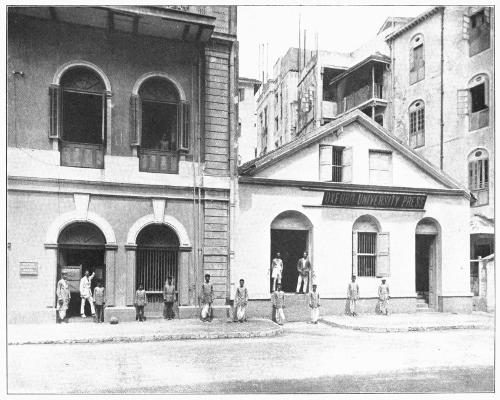
THE BOMBAY BRANCH

THE TORONTO BRANCH

§ 2. The Press in Canada
The Oxford University Press Canadian Branch was founded in 1904 at 25 Richmond Street West, Toronto. The manager was Mr. S. B. Gundy, who still presides at the same address; but the building was destroyed by fire in 1905 and completely reconstructed.
Although Canada has still a relatively small population, scattered over an immense area, the volume of business done by the Branch is substantial, and it continues to grow. The sale of Oxford Bibles, Clarendon Press books, Medical and Elementary books is supplemented by the sale of books published in Canada and the United States, for which Mr. Gundy acts as agent. Thus the Branch sells all the publications of the great American house of Doubleday, Page and Company; and through this connexion it has recently become the sole publisher in Canada of the works of Mr. Rudyard Kipling.
Among the more notable Canadian enterprises of the Press are the Church of England Hymn Book (the Book of Common Praise), published in 1909, the large stocks of which caused Mr. Gundy ‘to overflow into a neighbouring barber shop’, and the new edition of the Presbyterian Book of Praise, produced in defiance of submarines and other obstacles in 1917. The editor, the Rev. Alexander Macmillan, carried the manuscript across the Atlantic in small packets sewn into his clothes.

§ 3. The Press in Australasia
This part of the business was first developed by visits regularly made from London by Mr. E. R. Bartholomew, who in 1908 became manager of the Branch then established at Cathedral Buildings, Melbourne. Australia is not only many thousands of miles from the great centres of book-production, but is itself a land of great distances, as yet but sparsely populated; and this creates difficulties for both publishers and booksellers. It is remarkable how far these obstacles have been overcome; and if regard is paid to the number and character of the population, Australia, and New Zealand no less, have a right to be proud of the quantity and quality of the books they buy.
The Branch has paid attention to the special needs of Australian education, and in co-operation with the universities and schools has produced a number of successful text-books.
It acts as agent for some of the leading British publishers, including the houses of Murray, Heinemann, Black, Chapman and Hall, and Mowbray; and for the large publishing business of Messrs. Angus and Robertson of Sydney.

THE MELBOURNE BRANCH
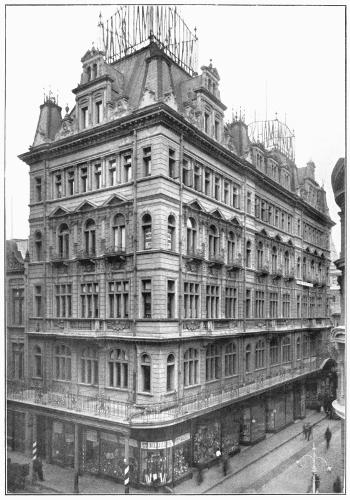
MARKHAM’S BUILDINGS, CAPE TOWN in which the South African Branch is situated
§ 4. The Press in South Africa
The South African Office of the Press is at Markham’s Buildings, Adderley Street, Cape Town. Mr. C. R. Mellor, the present Representative, was appointed to that post in March 1915. From his office at Cape Town Mr. Mellor visits the principal booksellers, not only in the Cape Province, but in the Transvaal, the Orange Free State, and Natal.
§ 5. The Press in China
The Chinese Agency of the Press is at C 445 Honan Road, Shanghai, of which Mr. T. Leslie is the present Representative. The first agent in China for the Press was the Christian Literature Society of Shanghai, the agency being started in 1913. Mr. Leslie, who had been manager of that Society, took over the Press agency in 1917. Stocks of all Oxford books likely to be in demand in China are held in Shanghai.
§ 6. The Press in Scandinavia
For many years before the war a traveller from Amen Corner visited the Continent annually, but business in Scandinavia developed so rapidly after the Armistice that it was found desirable to open a Branch, and premises were accordingly secured in Copenhagen, Mr. H. Bohun Beet, the Continental traveller of the Press, being appointed manager. The Branch was opened in August 1920, at St. Kongensgade 40 H, close to the King’s Palace. The Branch represents also Messrs. Hodder & Stoughton and the Medici Society.

§ 7. The Press in the United States
The sale of Oxford books in the United States began long before the foundation of the American Branch. It is recorded that ‘the growth of the business was hindered by the Civil War, but after the restoration of peace it grew rapidly’; and that a landmark in its progress was the publication of editions of the American Book of Common Prayer.
The foundation of the Oxford University Press American Branch, an institution which has made the name of Oxford familiar throughout the Union, was due to the foresight and enterprise of Mr. Henry Frowde. Acting on his advice the Delegates of the Press authorized the formation of a Corporation in the State of New York, and the Branch in 1896 opened premises at 91 Fifth Avenue, under the management of the late Mr. John Armstrong. In the following year Mr. Armstrong added to the Bibles and other books, previously sold by Messrs. Nelson, the Clarendon Press publications, previously sold by the Macmillan Company. The business grew rapidly in Mr. Armstrong’s hands, and in 1908 moved ‘up town’ to the premises it now occupies at 35 West 32nd Street. Mr. Armstrong died in 1915, and was succeeded by Mr. W. W. McIntosh, one of the original members of the staff.
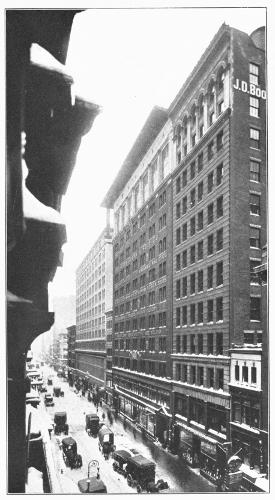
THIRTY-SECOND STREET, NEW YORK
The New York Branch is situated in the Central Building on the right
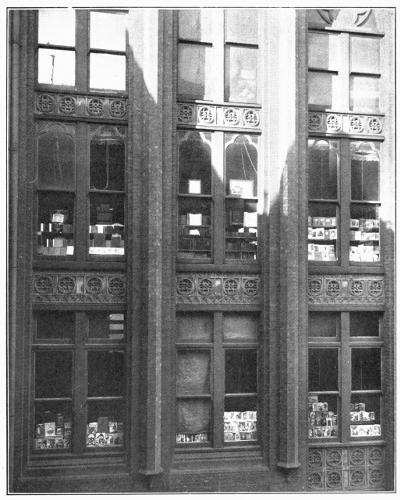
SHOW ROOMS AT THE NEW YORK BRANCH
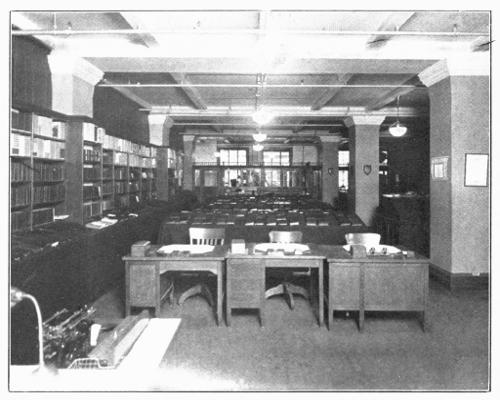
Bible Show Room
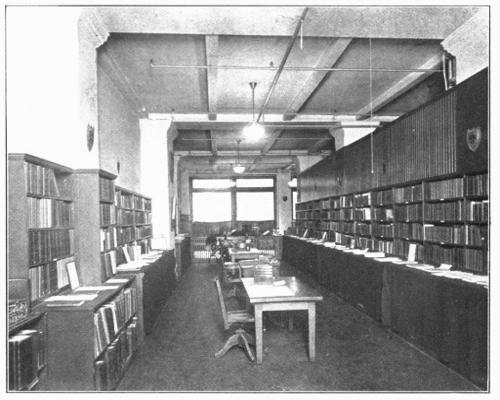
Clarendon Press Show Room
The main function of the Branch has always been that of keeping the American public acquainted with Oxford books, both sacred and secular, and of supplying the books without avoidable delay. To this end it has been necessary to hold large stocks in New York, and to maintain an expert staff which is in touch with the book-stores and with the universities, the schools, and the book-buying public at large. The Branch has its own catalogues and its own advertisements, and it has been able to make Oxford Bibles and Clarendon Press books known and valued throughout the United States. The Branch, however, is not merely an importer; it has long recognized that many Oxford products are capable of useful adaptation to special American requirements, and that such adaptation is consistent with the preservation of what Americans have themselves called ‘the Oxford stamp’. This aspect of the activities of the Press in America is shown by the large number of Bibles which are manufactured (‘made’ is the American idiom) in the United States—among these the now famous Scofield Reference Bible is conspicuous—and also by books written—or at least rewritten—for American requirements. The Branch, in co-operation with American scholars, has produced valuable series of text-books for schools and universities—the Oxford English Series, the Oxford French Series, and the Oxford German Series. Even more important, perhaps, are adaptations of Oxford books of tried merit. Thus the Oxford Loose-Leaf Surgery derives from a (British) Oxford original (one of the Oxford Medical Publications), but has important differences in substance as well as in its novel form. This very successful work is now being followed by the Oxford Loose-Leaf Medicine, edited by Dr. Henry Christian and Sir James Mackenzie with the help of leading physicians on both sides of the Atlantic. To promote co-operation of this kind in medical science was a great part of the life-work of William Osler, who, as Regius Professor at Oxford, and a leading promoter of the Oxford Medical Publications, may be described as the founder of the medical activities of the Oxford Press as they are now carried on in Oxford, in London, in New York, and in Toronto.
Another work of adaptation, now in progress, illustrates further the possibilities of Anglo-American co-operation. The Concise Oxford Dictionary of current English, adapted from the great Oxford Dictionary, has been and is very widely used throughout the British Empire and by students of English in foreign countries. But its spelling, and certain other features, were found to disqualify the book for general use in the United States; and a special American edition is now in preparation, the adapter of which is Mr. G. Van Santvoord, of Oriel College, Oxford, and Yale University.
The Press is publisher, on both sides of the Atlantic, to the Carnegie Endowment for International Peace, many of whose books have been printed at Oxford. Special mention may be made of the first volumes, printed at the Press and recently published, of the British Section of the great Economic and Social History of the World War undertaken by the Endowment. These volumes are by Professors Keith and Bowley and Mr. J. A. Salter.