Part 2 — ILLUSTRATIONS (continued 5)
Reading edition
"I git marry in Baton Rouge when I sixteen and my husban' he name Arras Shaw and he lots older'n me and I couldn't keep him. He in Port Arthur now. My husban' and I sawmill 20 year in Grayburg, here in Texas, and then us sep'rate. I been in Beaumont 16 year and I's rice farm cook in the camp on the Fannett Road. They tells me I got uncles in Africy. I goes to Sanctified church and that all I can do now.
420050
Mary Ellen Johnson
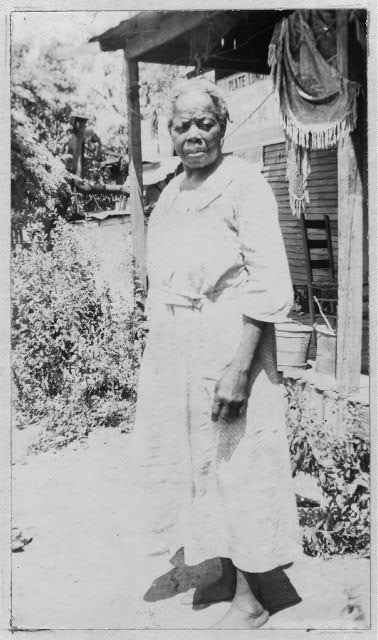
MARY ELLEN JOHNSON, owner of a little restaurant at 1301 Marilla St., Dallas, Texas, is 77 years old. She was born in slavery to the Murth family, about ten miles from San Marcos, Texas. She neither reads nor writes but talks with little dialect.
"I don't know so fur back as befo' I was born, 'cept what my mammy told me, and she allus said little black chillen wasn't sposed to ask so many questions. Her name was Missouri Ellison, 'cause she belonged to Miss Micelder Ellison and then when she married with Mr. Murth, her daddy said my mammy was her 'heritance.
"My first mem'ries are us playin' in the backyard with Miss Fannie and Miss Martha and Mr. Sammie. They was the little Murth chillen. We used to make playhouses out there and sweep the ground clean down to the level with brush brooms and dec'rate it all up with little broken glasses and crockery.
"In them days we lived in a little, old log cabin in the backyard and there was just one room, but it was snug and we had a plenty of livin'. My mammy had a nice cotton bed and she weren't no field nigger, but my pappy were.
"Miss Micelder had a fine farm and raised most everything we ate and the food nowadays ain't like what it was then. Miss Micelder had a wood frame house with a big kitchen and they were cookin' goin' on all the time. They cooked on a wood stove with iron pots and skillets, and the roastin' ears and chicken fried right out of your own yard is tastier than what you git now. Grated 'tater puddin' was my dish.
"When I am seven years old I hear talk 'bout a war and the separation but I don't pay much 'tention. It seem far away and I don't bother my kinky head 'bout it. But then they tells eme [typo: me] the war is over and I'm goin' to be raised free and that I don't 'long to anybody but Gawd and my pappy and mammy, but it don't make me feel nothin', 'cause I ain't never know I ain't free.
"After the war we removed to a house on a hill where they is five houses, little log houses all in a row. We had good times, but we had to work in the cotton and corn and wheat in the daylight time, but when the dusk come we used to sing and dance and play into the moonlight.
"But one man called Milton, he's past his yearling boy days and he didn't like to see us spend our time in sin, so he'd preach to us from the Gospel, but I had the hardest time to get 'ligion of anybody I knowed. Fin'ly I got sick when I were fifteen and was in my bed and somethin' happened. Lawd, it was the most 'lievable thing ever happened to me. I was layin' there when sin formed a heavy, white veil just like a blanket over my bed and it just eased down over me till it was mashing the breath out of me. I crys out to the Lawd to save me and, sho' 'nough, He hear the cry of a pore mis'able sinner. I ran to my mammy and pappy a-shoutin'.
"The next year I marries and went on 'nother farm right near by and starts havin' chillen. I has ten and think I done rightly my part, 'cause I lived right by the word and taught my chillen the same. I'm lookin' to the promise to live in Glory after my days here is done.
420115
Pauline Johnson and Felice Boudreaux
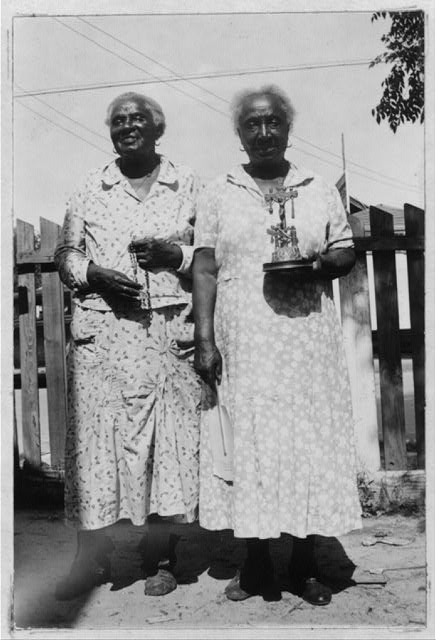
PAULINE JOHNSON and FELICE BOUDREAUX, sisters, were once slaves on the plantation of Dermat Martine, near Opelousas, Louisiana. As their owners were French, they are more inclined to use a Creole patois than English.
"Us was both slaves on de old plantation close to Opelousas," Pauline began. As the elder of the two sisters she carried most of the conversation, although often referring to Felice before making positive statements.
"I was 12 year old when freedom come and Felice was 'bout six. Us belonged to Massa Dermat Martine and the missy's name Mimi. They raise us both in the house and they love us so they spoil us. I never will forget that. The little white chillen was younger than me, 'bout Felice's age. They sho' had pretty li'l curly black hair.
"Us didn't have hard time. Never even knowed hard time. That old massa, he what you call a good man.
"Us daddy was Renee and he work in the field. The old massa give him a mud and log house and a plot of ground for he own. The rain sho' never get in that log house, it so tight. The furniture was homemake, but my daddy make it good and stout.
"Us daddy he work de ground he own on Sunday and sold the things to buy us shoes to put on us feet and clothes. The white folks didn't give us clothes but they let him have all the money he made in his own plot to get them.
"Us mama name Marguerite and she a field hand, too, so us chillen growed up in the white folks house mostly. 'Fore Felice get big enough to leave I stay in the big house and take care of her.
"One day us papa fall sick in the bed, just 'fore freedom, and he kep' callin' for the priest. Old massa call the priest and just 'fore us papa die the priest marry him and my mama. 'fore dat they just married by the massa's word.
"Felice and me, us have two brothers what was born and die in slavery, and one sister still livin' in Bolivar now. Us three uncles, Bruno and Pophrey and Zaphrey, they goes to the war. Them three dies too young. The Yankees stole them and make them boys fight for them.
"I never done much work but wash the dishes. They wasn't poor people and they uses good dishes. The missy real particular 'bout us shinin' them dishes nice, and the silver spoons and knives, too.
"Them white people was good Christian people and they christen us both in the old brick Catholic church in Opelousas. They done torn it down now. Missy give me pretty dress to get christen in. My godmother, she Mileen Nesaseau, but I call her 'Miran'. My godfather called 'Paran.'
"On Sunday mornin' us fix our dress and hair and go up to the missy's looking-glass to see if us pretty enough go to church. Us goes to Mass every Sunday mornin' and church holiday, and when the cullud folks sick massa send for the priest same's for the white folks.
"We wears them things on the strings round the neck for the good of the heart. They's nutmeg.
"The plantation was a big, grand place and they have lots of orange trees. The slaves pick them oranges and pack then down on the barrel with la mosse (Spanish moss) to keep them. They was plenty pecans and figs, too.
"In slavery time most everybody round Opelousas talk Creole. That make the words hard to come sometime. Us both talk that better way than English.
"Durin' the war, it were a sight. Every mornin' Capt. Jenerette Bank and he men go a hoss-back drillin' in the pasture and then have drill on foot. A white lady take all us chillen to the drill ground every mornin'. Us take the lunch food in the basket and stay till they done drill out.
"I can sing for you the song they used to sing:
"O, de Yankee come to put de nigger free, Says I, says I, pas bonne; In eighteen-sixty-three, De Yankee get out they gun and say, Hurrah! Let's put on the ball.
"When war over none the slaves wants leave the plantation. My mama and us chillen stays on till old massa and missy dies, and then goes live on the old Repridim place for a time.
"Both us get marry in that Catholic church in Opelousas. As for me, it most too long ago to talk about. His name Alfred Johnson and he dead 12 years. Our youngest boy, John, go to the World War. Two my nephews die in that war and one nephew can't walk now from that war.
"Felice marry Joseph Boudreaux and when he die she come here to stay with me. There's more hard time now than in the old day for us, but I hope things get better.
420103
Spence Johnson
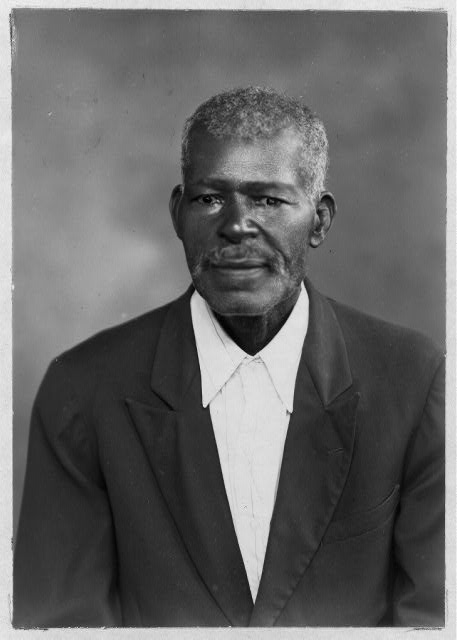
SPENCE JOHNSON was born free, a member of the Choctaw Nation, in the Indian Territory, in the 1850's. He does not know his exact age. He and his mother were stolen and sold at auction in Shreveport to Riley Surratt, who lived near Shreveport, on the Texas-Louisiana line. He has lived in Waco since 1874.
"De nigger stealers done stole me and my mammy out'n de Choctaw Nation, up in de Indian Territory, when I was 'bout three years old. Brudder Knox, Sis Hannah, and my mammy and her two step-chillun was down on de river washin'. De nigger stealers driv up in a big carriage and mammy jus' thought nothin', 'cause the road was near dere and people goin' on de road stopped to water de horses and res' awhile in de shade. By'n by, a man coaxes de two bigges' chillun to de carriage and give dem some kind-a candy. Other chillun sees dis and goes, too. Two other men was walkin' 'round smokin' and gettin' closer to mammy all de time. When he kin, de man in de carriage got de two big step-chillun in with him and me and sis' clumb in too, to see how come. Den de man holler, 'Git de ole one and let's git from here.' With dat de two big men grab mammy and she fought and screeched and bit and cry, but dey hit her on de head with something and drug her in, and throwed her on de floor. De big chilluns begin to fight for mammy, but one of de men hit 'em hard and off dey driv, with de horses under whip.
"Dis was near a place called Boggy Depot. Dey went down de Red Ribber, 'cross de ribber and on down in Louisian to Shreveport. Down in Louisan us was put on what dey call de 'block' and sol' to de highes' bidder. My mammy and her three chillun brung $3,000 flat. De step chillun was sol' to somebody else, but us was bought by Marse Riley Surratt. He was de daddy of Jedge Marshall Surratt, him who got to be jedge here in Waco.
"Marse Riley Surratt had a big plantation; don't know how many acres, but dere was a factory and gins and big houses and lots of nigger quarters. De house was right on de Tex-Louisan line. Mammy cooked for 'em. When Marse Riley bought her, she couldn' speak nothin' but de Choctaw words. I was a baby when us lef' de Choctaw country. My sister looked like a full blood Choctaw Indian and she could pass for a real full blood Indian. Mammy's folks was all Choctaw Indians. Her sisters was Polly Hogan, and Sookey Hogan and she had a brudder, Nolan Tubby. Dey was all known in de Territory in de ole days.
"Near as Marse Riley's books can come to it, I mus' of been bo'n 'round 1859, up in de Territory.
"Us run de hay press to bale cotton on de plantation and took cotton by ox wagons to Shreveport. Seven or eight wagons in a train, with three or four yoke of steers to each wagon. Us made 'lasses and cloth and shoes and lots of things. Old Marse Riley had a nigger who could make shoes and if he had to go to court in Carthage, he'd leave nigger make shoes for him.
"De quarters was a quarter mile long, all strung out on de creek bank. Our cabin was nex' de big house. De white folks give big balls and had supper goin' all night. Us had lots to eat and dey let us have dances and suppers, too. We never go anywhere. Mammy always cry and 'fraid of bein' stole again.
"Dere was a white man live close to us, but over in Louisan. He had raised him a great big black man what brung fancy price on de block. De black man sho' love dat white man. Dis white man would sell ole John—dat's de black man's name—on de block to some man from Georgia or other place fur off. Den, after 'while de white man would steal ole John back and bring him home and feed him good, den sell him again. After he had sol' ole John some lot of times, he coaxed ole John off in de swamp one day and ole John foun' dead sev'ral days later. De white folks said dat de owner kilt him, 'cause 'a dead nigger won't tell no tales.'
"Durin' de Freedom War, I seed soldiers all over de road. Dey was breakin' hosses what dey stole. Us skeered and didn' let soldiers see us if we could he'p it. Mammy and I stayed on with Marse Riley after Freedom and till I was 'bout sixteen. Den Marse Riley died and I come to Waco in a wagon with Jedge Surratt's brother, Marse Taylor Surratt. I come to Waco de same year dat Dr. Lovelace did, and he says that was 1874. I married and us had six chillun.
"I can't read or write, 'cause I only went to school one day. De white folks tried to larn me, but I's too thickheaded.
420244
Harriet Jones
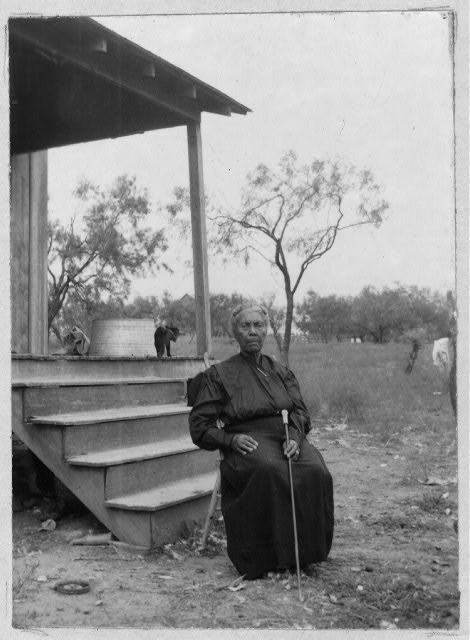
Harriet Jones with Daughter and Granddaughter
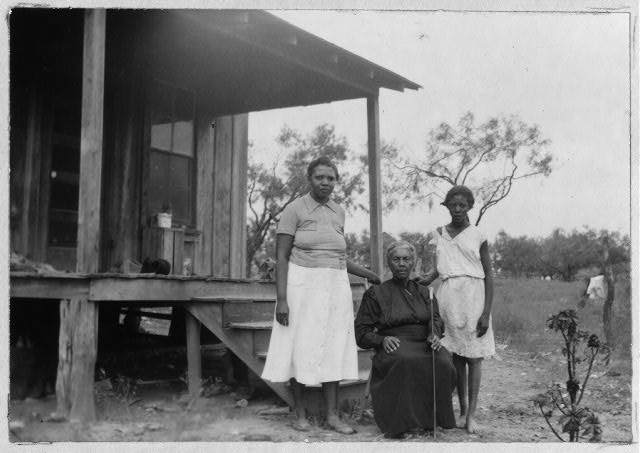
HARRIET JONES, 93, was born a slave of Martin Fullbright, who owned a large plantation in North Carolina. When he died his daughter, Ellen, became Harriet's owner, and was so kind to Harriet that she looks back on slave years as the happiest time in her life.
"My daddy and mammy was Henry and Zilphy Guest and Marse Martin Fullbright brung dem from North Carolina to Red River County, in Texas, long 'fore freedom, and settled near Clarksville. I was one of dere eight chillen and borned in 1844 and am 93 years old. My folks stayed with Marse Martin and he daughter, Miss Ellen, till dey went to de reward where dey dies no more.
"De plantation raise corn and oats and wheat and cotton and hawgs and cattle and hosses, and de neares' place to ship to market am at Jefferson, Texas, ninety miles from Clarksville, den up river to Shreveport and den to Memphis or New Orleans. Dey send cotton by wagon train to Jefferson but mostly by boat up de bayou.
"When Marse Martin die he 'vide us slaves to he folks and I falls to he daughter, Miss Ellen. Iffen ever dere was a angel on dis earth she was it. I hopes wherever it is, her spirit am in glory.
"When Miss Ellen marry Marse Johnnie Watson, she have me fix her up. She have de white satin dress and pink sash and tight waist and hoop skirt, so she have to go through de door sideways. De long curls I made hang down her shoulders and a bunch of pink roses in de hand. She look like a angel.
"All de fine folks in Clarksville at dat weddin' and dey dances in de big room after de weddin' supper. It was de grand time but it make me cry, 'cause Miss Ellen done growed up. When she was a li'l gal she wore de sweetes' li'l dresses and panties with de lace ruffles what hung down below her skirt, and de jacket button in de back and shoes from soft leather de shoeman tan jus' for her. When she li'l bigger she wear de tucked petticoats, two, three at a time to take place of hoops, but she still wear de white panties with lace ruffles what hang below de skirt 'bout a foot. Where dey gone now? I ain't seed any for sich a long time!
"When de white ladies go to church in dem hoop skirts, dey has to pull dem up in da back to set down. After freedom dey wears de dresses long with de train and has to hold up de train when dey goes in de church, lessen dey has de li'l nigger to go 'long and hold it up for dem.
"All us house women larned to knit de socks and head mufflers, and many is de time I has went to town and traded socks for groceries. I cooked, too, and helped 'fore old Marse died. For everyday cookin' we has corn pone and potlicker and bacon meat and mustard and turnip greens, and good, old sorghum 'lasses. On Sunday we has chicken or turkey or roast pig and pies and cakes and hot, salt-risin' bread.
"When folks visit dem days dey do it right and stays several days, maybe a week or two. When de quality folks comes for dinner, Missie show me how to wait on table. I has to come in when she ring de bell, and hold de waiter for food jus' right. For de breakfas' we has coffee and hot waffles what my mammy make.
"Dere was a old song we used to sing 'bout de hoecake, when we cookin' dem:
"'If you wants to bake a hoecake, To bake it good and done, Slap it on a nigger's heel, And hold it to de sun. "'My mammy baked a hoecake, As big as Alabama, She throwed it 'gainst a nigger's head, It ring jus' like a hammer. "'De way you bake a hoecake, De old Virginny way, Wrap it round a nigger's stomach, And hold it dere all day.'
"Dat de life we lives with old and young marse and missie, for dey de quality folks of old Texas.
"'Bout time for de field hands to go to work, it gittin' mighty hot down here, so dey go by daylight when it cooler. Old Marse have a horn and 'long 'bout four o'clock it 'gin to blow, and you turn over and try take 'nother nap, den it goes arguin', blow, how loud dat old horn do blow, but de sweet smell de air and de early breeze blowin' through de trees, and de sun peepin' over de meadow, make you glad to git up in de early mornin'.
"'It's a cool and frosty mornin' And de niggers goes to work, With hoes upon dey shoulders, Without a bit of shirt.'
"'When dey hears de horn blow for dinner it am de race, and dey sings:
"'I goes up on de meatskins, I comes down on de pone— I hits de corn pone fifty licks, And makes dat butter moan.'
"De timber am near de river and de bayou and when dey not workin' de hosses or no other work, we rides down and goes huntin' with de boys, for wild turkeys and prairie chickens, but dey like bes' to hunt for coons and possums.
"'Possum up de gum stump, Raccoon in de hollow— Git him down and twist him out, And I'll give you a dollar.'
"Come Christmas, Miss Ellen say, 'Harriet, have de Christmas Tree carry in and de holly and evergreens.' Den she puts de candles on de tree and hangs de stockin's up for de white chillen and de black chillen. Nex' mornin', everybody up 'fore day and somethin' for us all, and for de men a keg of cider or wine on de back porch, so dey all have a li'l Christmas spirit.
"De nex' thing am de dinner, serve in de big dinin' room, and dat dinner! De onlies' time what I ever has sich a good dinner am when I gits married and when Miss Ellen marries Mr. Johnnie. After de white folks eats, dey watches de servants have dey dinner.
"Den dey has guitars and banjoes and fiddles and plays old Christmas tunes, den dat night marse and missie brung de chillen to de quarters, to see de niggers have dey dance. 'Fore de dance dey has Christmas supper, on de long table out in de yard in front de cabins, and have wild turkey or chicken and plenty good things to eat. When dey all through eatin', dey has a li'l fire front de main cabins where de dancin' gwine be. Dey moves everything out de cabin 'cept a few chairs. Next come de fiddler and banjo-er and when dey starts, de caller call, 'Heads lead off,' and de first couple gits in middle de floor, and all de couples follow till de cabin full. Next he calls, 'Sashay to de right, and do-si-do.' Round to de right dey go, den he calls, 'Swing you partners, and dey swing dem round twice, and so it go till daylight come, den he sing dis song:
"'Its gittin' mighty late when de Guinea hen squall, And you better dance now if you gwine dance a-tall— If you don't watch out, you'll sing 'nother tune, For de sun rise and cotch you, if you don't go soon, For de stars gittin' paler and de old gray coon Is sittin' in de grapevine a-watchin' de moon.'
"Den de dance break up with de Virginny Reel, and it de end a happy Christmas day. De old marse lets dem frolic all night and have nex' day to git over it, 'cause its Christmas.
"'Fore freedom de soldiers pass by our house and stop ask mammy to cook dem something to eat, and when de Yankees stop us chillen hides. Once two men stays two, three weeks lookin' round, pretends dey gwine buy land. But when de white folks gits 'spicious, dey leaves right sudden, and it turn out dey's Yankee spies.
"I marries Bill Jones de year after freedom. It a bright, moonlight night and all de white folks and niggers come and de preacher stand under de big elm tree, and I come in with two li'l pickininnies for flower gals and holdin' my train. I has on one Miss Ellen's dresses and red stockin's and a pair brand new shoes and a wide brim hat. De preacher say, 'Bill, does you take dis woman to be you lawful wife?' and Bill say he will. Den he say, 'Harriet, will you take dis nigger to be you lawful boss and do jes' what he say?' Den we signs de book and de preacher say, 'I quotes from de scripture:
"'Dark and stormy may come de weather, I jines dis man and woman together. Let none but Him what make de thunder, Put dis man and woman asunder.'
"Den we goes out in de backyard, where de table sot for supper, a long table made with two planks and de peg legs. Miss Ellen puts on de white tablecloth and some red berries, 'cause it am November and dey is ripe. Den she puts on some red candles, and we has barbecue pig and roast sweet 'taters and dumplin's and pies and cake. Dey all eats dis grand supper till dey full and mammy give me de luck charm for de bride. It am a rabbit toe, and she say:
"'Here, take dis li'l gift, And place it near you heart; It keep away dat li'l riff What causes folks to part. "'It only jes' a rabbit toe, But plenty luck it brings, Its worth a million dimes or more, More'n all de weddin' rings.'
"Den we goes to Marse Watson's saddleshop to dance and dances all night, and de bride and groom, dat's us, leads de grand march.
"De Yankees never burned de house or nothin', so Young Marse and Missie jes' kep' right on livin' in de old home after freedom, like old Marse done 'fore freedom. He pay de families by de day for work and let dem work land on de halves and furnish dem teams and grub and dey does de work.
"But bye'n-bye times slow commence to change, and first one and 'nother de old folks goes on to de Great Beyon', one by one dey goes, till all I has left am my great grandchild what I lives with now. My sister was livin' at Greenville six years ago. She was a hundred and four years old den. I don't know if she's livin' now or not. How does we live dat long? Way back yonder 'fore I's born was a blessin' handed down from my great, great, grandfather. It de blessin' of long life, and come with a blessin' of good health from livin' de clean, hones' life. When nighttime come, we goes to bed and to sleep, and dat's our blessin'.
420057
Lewis Jones
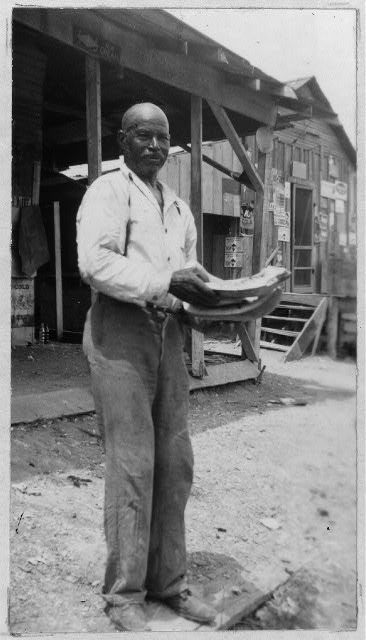
LEWIS JONES, 86, was born a slave to Fred Tate, who owned a large plantation on the Colorado River in Fayette Co., Texas. Lewis' father was born a slave to H. Jones and was sold to Fred Tate, who used him as a breeder to build up his slave stock. Lewis took his father's name after Emancipation, and worked for twenty-three years in a cotton gin at La Grange. He came to Fort Worth in 1896 and worked for Armour & Co. until 1931. Lewis lives at 3304 Loving Ave., Fort Worth, Texas.
"My birth am in de year 1851 on de plantation of Massa Fred Tate, what am on de Colorado River. Yes, suh, dat am in de state of Texas. My mammy am owned by Massa Tate and so am my pappy and all my brudders and sisters. How many brudders and sisters? Lawd A-mighty! I'll tell you 'cause you asks and dis nigger gives de facts as 'tis. Let's see, I can't 'lect de number. My pappy have 12 chillen by my mammy and 12 by anudder nigger name Mary. You keep de count. Den dere am Liza, him have 10 by her, and dere am Mandy, him have 8 by her, and dere am Betty, him have six by her. Now, let me 'lect some more. I can't bring de names to mind, but dere am two or three other what have jus' one or two chillen by my pappy. Dat am right. Close to 50 chillen, 'cause my mammy done told me. It's disaway, my pappy am de breedin' nigger.
"You sees, when I meets a nigger on dat plantation, I's most sho' it am a brudder or sister, so I don't try keep track of 'em.
"Massa Tate didn't give rations to each family like lots of massas, but him have de cookhouse and de cooks, and all de rations cooked by dem and all us niggers sat down to de long tables. Dere am plenty, plenty. I sho' wishes I could have some good rations like dat now. Man, some of dat ham would go fine. Dat was 'Ham, what am.'
"We'uns raise all de food right dere on de place. Hawgs? We'uns have three, four hundred and massa raise de corn and feed dem and cure de meat. We'uns have de cornmeal and de wheat flour and all de milk and butter we wants, 'cause massa have 'bout 30 cows. And dere am de good old 'lasses, too.
"Massa feed powerful good and he am not onreas'ble. He don't whup much and am sho' reas'ble 'bout de pass, and he 'low de parties and have de church on de place. Old Tom am de preacherman and de musician and him play de fiddle and banjo. Sometime dey have jig contest, dat when dey puts de glass of water on de head and see who can jig de hardes' without spillin' de water. Den dere am joyment in de singin'. Preacher Tom set all us niggers in de circle and sing old songs. I jus' can't sing for you, 'cause I's lost my teeth and my voice am raspin', but I'll word some, sich as
"'In de new Jerusalem, In de year of Jubilee.'
"I done forgit de words. Den did you ever hear dis one:
"'Oh, do, what Sam done, do dat again, He went to de hambone, bit off de end.'
"When Old Tom am preacherman, him talks from he heartfelt. Den sometime a white preacherman come and he am de Baptist and baptize we'uns.
"Massa have de fine coach and de seat for de driver am up high in front and I's de coachman and he dresses me nice and de hosses am fine, white team. Dere I's sat up high, all dress good, holdin' a tight line 'cause de team am full of spirit and fast. We'uns goes lickity split and it am a purty sight. Man, 'twarnt anyone bigger dan dis nigger.
"I has de bad luck jus' one time with dat team and it am disaway: massa have jus' change de power for de gin from hoss to steam and dey am ginnin' cotton and I's with dat team 'side de house and de hosses am a-prancin' and waitin' for missy to come out. Massa am in de coach. Den, de fool niggers blows de whistle of dat steam engine and de hosses never heered sich befo' and dey starts to run. Dey have de bit in de teeths and I's lucky dat road am purty straight. I thinks of massa bein' inside de coach and wants to save him. I says to myself, 'Dem hosses skeert and I don't want to skeer 'em no more.' I jus' hold de lines steady and keep sayin', 'Steady, boys, whoa boys.' Fin'ly dey begins to slow down and den stops and massa gits out and de hosses am puffin' hard and all foam. He turns to me and say, 'Boy, you's made a wonnerful drive, like a vet'ran.' Now, does dat make me feel fine! It sho' do.
"When surrender come I's been drivin' 'bout a year and it's 'bout 11 o'clock in de mornin', 'cause massa have me ring de bell and all de niggers runs quick to de house and massa say dey am free niggers. It am time for layin' de crops by and he say if dey do dat he pay 'em. Some stays and some goes off, but mammy and pappy and me stays. Dey never left dat plantation, and I stays 'bout 8 years. I guess it dat coachman job what helt me.
"When I quits I goes to work for Ed Mattson in La Grange and I works in dat cotton gin 18 years. Fin'ly I comes here to Fort Worth. Dat am 1896. I works for Armours 20 years but dey let me off six years ago, 'cause I's too old. Since den I works at any little old job, for to make my livin'.
"Sho', I's been married and it to Jane Owen in La Grange, and we'uns have three chillen and dey all dead. She died in 1931.
"It am hard for dis nigger to git by and sometime I don't know for sho' dat I's gwine git anudder meal, but it allus come some way. Yes, suh, dey allus come some way. Some of de time dey is far apart, but dey comes. De Lawd see to dat, I guess.
420148
LIZA JONES, 81, was born a slave of Charley Bryant, near Liberty, Texas. She lives in Beaumont, and her little homestead is reached by a devious path through a cemetery and across a ravine on a plank foot-bridge. Liza sat in a backless chair, smoking a pipe, and her elderly son lay on a blanket nearby. Both were resting after a hot day's work in the field. Within the open door could be seen Henry Jones, Liza's husband for sixty years, a tall, gaunt Negro who is helpless. Blind, deaf and almost speechless, he could tell nothing of slavery days, although he was grown when the war ended.
"When de Yankees come to see iffen dey had done turn us a-loose, I am a nine year old nigger gal. That make me about 81 now. Dey promenade up to de gate and de drum say a-dr-um-m-m-m-m, and de man in de blue uniform he git down to open de gate. Old massa he see dem comin' and he runned in de house and grab up de gun. When he come hustlin' down off de gallery, my daddy come runnin'. He seed old massa too mad to know what he a-doin', so quicker dan a chicken could fly he grab dat gun and wrastle it outten old massa's hands. Den he push old massa in de smokehouse and lock de door. He ain't do dat to be mean, but he want to keep old massa outten trouble. Old massa know dat, but he beat on de door and yell, but it ain't git open till dem Yankees done gone.
"I wisht old massa been a-livin' now, I'd git a piece of bread and meat when I want it. Old man Charley Bryant, he de massa, and Felide Bryant de missus. Dey both have a good age when freedom come.
"My daddy he George Price and he boss nigger on de place. Dey all come from Louisiana, somewhere round New Orleans and all dem li'l extra places.
"Liz'beth she my mama and dey's jus' two us chillen, me and my brudder, John. He lives in Beaumont.
"'Bout all de work I did was 'tend to de rooms and sweep. Nobody ever 'low us to see nobody 'bused. I never seed or heared of nobody gittin' cut to pieces with a whip like some. Course, chillen wasn't 'lowed to go everywhere and see everything like dey does now. Dey jump in every corner now.
"Miss Flora and Miss Molly am de only ones of my white folks what am alive now and dey done say dey take me to San Antonio with dem. Course, I couldn't go now and leave Henry, noway. De old Bryant place am in de lawsuit. Dey say de brudder, Mister Benny, he done sharped it 'way from de others befo' he die, but I 'lieve the gals will win dat lawsuit.
"My daddy am de gold pilot on de old place. Dat mean anything he done was right and proper. Way after freedom, when my daddy die in Beaumont, Cade Bryant and Mister Benny both want to see him befo' he buried. Dey ride in and say, 'Better not you bury him befo' us see him. Dat's us young George.' Dey allus call daddy dat, but he old den.
"My mama was de spring back cook and turkey baker. Dey call her dat, she so neat, and cook so nice. I's de expert cook, too. She larnt me.
"Us chillen used to sing
"'Don't steal, Don't steal my sugar. Don't steal, Don't steal my candy. I's comin' round de mountain.'
"Dey sho' have better church in dem days dan now. Us git happy and shout. Dey too many blind taggers now. Now dey say dey got de key and dey ain't got nothin'. Us used to sing like dis:
"'Adam's fallen race, Good Lawd, hang down my head and cry. Help me to trust him, Help me to trust him, Help me to trust him, Gift of Gawd. "'Help me to trust him, Help me to trust him, Help me to trust him, Eternal Life. "'Had not been for Adam's race, I wouldn't been sinnin' today, Help me to trust him, Gift of Gawd.'
"Dey 'nother hymn like dis:
"'Heavenly land, Heavenly land, I's gwineter beg Gawd, For dat Heavenly land. "'Some come cripplin', Some come lame, Some come walkin', In Jesus' name.'
"You know I saw you-all last night in my sleep? I ain't never seed you befo' today, but I seed you last night. Dey's two of you, a man and a woman, and you come crost dat bridge and up here, askin' me iffen I trust in de Lawd. And here you is today.
"Dey had nice parties in slavery time and right afterwards. Dey have candy pullin' and corn shuckin's and de like. Old Massa Day and Massa Bryant, dey used to put dey niggers together and have de prize dances. Massa Day allus lose, 'cause us allus beat he niggers at dancin'. Lawd, when I clean myself up, I sho' could teach dem how to buy a cake-walk in dem days. I could cut de pigeon wing, jes' pull my heels up and clack dem together. Den us do de back step and de banquet, too.
"Us allus have de white tarleton Swiss dress for dances and Sunday. Dem purty good clothes, too and dey make at home. Us knowed how to sew and one de old man's gals, she try teach me readin' and writin'. I didn't have no sense, though, and I cry to go out and play.
"When freedom come old massa he done broke down and cry, so my daddy stay with him. He stay a good many year, till both us chillen was growed. Us have de li'l log house on de place all dat time. Dey 'nother old cullud man what stay, name George Whitehouse. He have de li'l house, too. He stay till he die.
"Dey was tryin' to make a go of it after de war, 'cause times was hard. De white boys, dey go out in de field and work den, and work hard, 'cause dey don't have de slaves no more. I used to see de purty, young white ladies, all dress up, comin' to de front door. I slips out and tell de white boys, and dey workin' in de field, half-naked and dirty, and dey sneak in de back door and clean up to spark dem gals.
"I been marry to dat Henry in dere sixty year, and he was a slave in Little Rock, in Arkansas, for Anderson Jones. Henry knowed de bad, tejous part of de war and he must be 'bout 96 year old. Now he am in pain all de time. Can't see, can't hear and can't talk. Us never has had de squabble. At de weddin' de white folks brung cakes and every li'l thing. I had a white tarleton dress with de white tarleton wig. Dat de hat part what go over de head and drape on de shoulder. Dat de sign you ain't never done no wrong sin and gwinter keep bein' good.
"After us marry I move off de old place, but nothin' must do but I got to keep de house for Mister Benny. I's cleanin' up one time and finds a milk churn of money. I say, 'Mr. Benny, what for you ain't put dat money in de bank?' He say he will. De next time I cleanin' up I finds a pillow sack full of money. I says, 'Mr. Benny, I's gwineter quit. I ain't gwineter be 'sponsible for dis money.' He's sick den and I put de money under he pillow and git ready to go. He say, 'You better stay, or I send Andrew, de sheriff, after you.' I goes and cooks dinner and when I gits back dey has four doctors with Mr. Benny. He wife say to me, 'Liza, you got de sight. Am Benny gwineter git well?' I goes and looks and I knowed he gwine way from dere. I knowed he was gone den. Dey leant on me a heap after dat.
"It some years after dat I leaves dem and Henry and me gits married and us make de livin' farmin'. Us allus stays right round hereabouts and gits dis li'l house. Now my son and me, us work de field and gits 'nough to git through on.
420089
Lizzie Jones
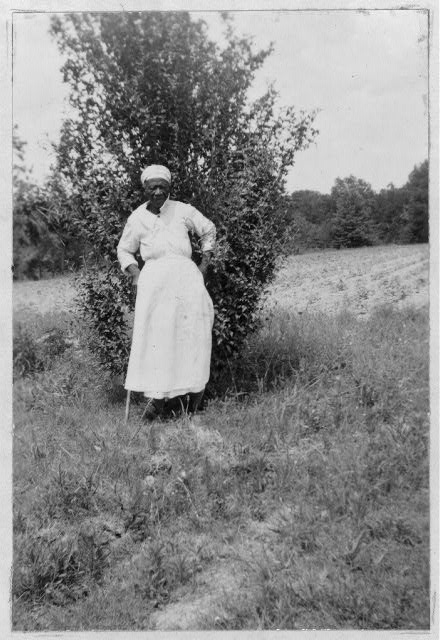
LIZZIE JONES, an 86 year old ex-slave of the R.H. Hargrove family, was born in 1861, in Harrison County, Texas. She stayed with her owner until four years after the close of the Civil War. She now lives with Talmadge Buchanan, a grandson, two miles east of Karnack, on the Lee road.
"I was bo'n on the ole Henry Hargrove place. My ole missus was named Elizabeth and mammy called me Lizzie for her. But the Hargroves called me 'Wink' since I was a chile, 'cause I was so black and shiny. Massa Hargrove had four girls and four boys and I helped tend them till I was big enough to cook and keep house. I wagged ole Marse Dr. Hargrove, dat lives in Marshall, round when he was a baby.
"I allus lived in de house with the white folks and ate at their table when they was through, and slep' on the floor. We never had no school or church in slavery time. The niggers couldn' even add. None of us knowed how ole we was, but Massa set our ages down in a big book.
"I 'member playin' peep-squirrel and marbles and keepin' house when I was a chile. Massa 'lowed the boys and girls to cou't but they couldn' marry 'fore they was 20 years ole, and they couldn' marry off the plantation. Slaves warn't married by no Good Book or the law, neither. They'd jes' take up with each other and go up to the Big House and ask massa to let them marry. If they was ole enough, he'd say to the boy, 'Take her and go on home.'
"Mammy lived 'cross the field at the quarters and there was so many nigger shacks it look like a town. The slaves slep' on bunks of homemade boards nailed to de wall with poles for legs and they cooked on the fireplace. I didn' know what a stove was till after de War. Sometime they'd bake co'nbread in the ashes and every bit of the grub they ate come from the white folks and the clothes, too. I run them looms many a night, weavin' cloth. In summer we had lots of turnips and greens and garden stuff to eat. Massa allus put up sev'ral barrels of kraut and a smokehouse full of po'k for winter. We didn' have flour or lard, but huntin' was good 'fore de war and on Sat'day de men could go huntin' and fishin' and catch possum and rabbits and squirrels and coons.
"The overseer was named Wade and he woke the han's up at four in the mornin' and kep' them in the field from then till the sun set. Mos' of de women worked in de fields like de men. They'd wash clothes at night and dry them by the fire. The overseer kep' a long coach whip with him and if they didn' work good, he'd thrash them good. Sometime he's pretty hard on them and strip 'em off and whip 'em till they think he was gonna kill 'em. No nigger ever run off as I 'member.
"We never have no parties till after 'mancipation, and we couldn' go off de place. On Sundays we slep' or visited each other. But the white folks was good to us. Massa Hargrove didn' have no doctor but there wasn' much sickness and seldom anybody die.
"I don' 'member much 'bout de War. Massa went to it, but he come home shortly and say he sick with the 'sumption, but he got well real quick after surrender.
"The white folks didn' let the niggers know they was free till 'bout a year after the war. Massa Hargrove took sick sev'ral months after and 'fore he did he tell the folks not to let the niggers loose till they have to. Finally they foun' out and 'gun to leave.
"My pappy died 'fore I was bo'n and mammy married Caesar Peterson and 'bout a year after de war dey moved to a farm close to Lee, but I kep' on workin' for de Hargroves for four years, helpin' missus cook and keep house.
420288
TOBY JONES was born in South Carolina, in 1850, a slave of Felix Jones, who owned a large tobacco plantation. Toby has farmed in Madisonville, Texas, since 1869, and still supports himself, though his age makes it hard for him to work.
"My father's name was Eli Jones and mammy's name was Jessie. They was captured in Africa and brought to this country whilst they was still young folks, and my father was purty hard to realize he was a slave, 'cause he done what he wanted back in Africa.
"Our owner was Massa Felix Jones and he had lots of tobacco planted. He was real hard on us slaves and whipped us, but Missie Janie, she was a real good woman to her black folks. I 'members when their li'l curlyheaded Janie was borned. She jus' loved this old, black nigger and I carried her on my back whole days at a time. She was the sweetes' baby ever borned.
"Massa, he lived in a big, rock house with four rooms and lots of shade trees, and had 'bout fifty slaves. Our livin' quarters wasn't bad. They was rock, too, and beds built in the corners, with straw moss to sleep on.
"We had plenty to eat, 'cause the woods was full of possum and rabbits and all the mud holes full of fish. I sho' likes a good, old, fat possum cooked with sweet 'taters round him. We cooked meat in a old-time pot over the fireplace or on a forked stick. We grated corn by hand for cornbread and made waterpone in the ashes.
"I was borned 'bout 1850, so I was plenty old to 'member lots 'bout slave times. I 'members the loyal clothes, a long shirt what come down below our knees, opened all the way down the front. On Sunday we had white loyal shirts, but no shoes and when it was real cold we'd wrap our feet in wool rags so they wouldn't freeze. I married after freedom and had white loyal breeches. I wouldn't marry 'fore that, 'cause massa wouldn't let me have the woman I wanted.
"The overseer was a mean white man and one day he starts to whip a nigger what am hoein' tobacco, and he whipped him so hard that nigger grabs him and made him holler. Missie come out and made them turn loose and massa whipped that nigger and put him in chains for a whole year. Every night he had to be in jail and couldn't see his folks for that whole year.
"I seed slaves sold, and they'd make them clean up good and grease their hands and face, so they'd look real fat, and sell them off. Of course, most the niggers didn't know their parents or what chillen was theirs. The white folks didn't want them to git 'tached to each other.
"Missie read some Bible to us every Sunday mornin' and taught us to do right and tell the truth. But some them niggers would go off without a pass and the patterrollers would beat them up scand'lous.
"The fun was on Saturday night when massa 'lowed us to dance. There was lots of banjo pickin' and tin pan beatin' and dancin', and everybody would talk 'bout when they lived in Africa and done what they wanted.
"I worked for massa 'bout four years after freedom, 'cause he forced me to, said he couldn't 'ford to let me go. His place was near ruint, the fences burnt and the house would have been but it was rock. There was a battle fought near his place and I taken missie to a hideout in the mountains to where her father was, 'cause there was bullets flyin' everywhere. When the war was over, massa come home and says, 'You son of a gun, you's sposed to be free, but you ain't, 'cause I ain't gwine give you freedom.' So, I goes on workin' for him till I gits the chance to steal a hoss from him. The woman I wanted to marry, Govie, she 'cides to come to Texas with me. Me and Govie, we rides that hoss most a hundred miles, then we turned him a-loose and give him a scare back to his house, and come on foot the rest the way to Texas.
"All we had to eat was what we could beg and sometimes we went three days without a bite to eat. Sometimes we'd pick a few berries. When we got cold we'd crawl in a breshpile and hug up close together to keep warm. Once in awhile we'd come to a farmhouse and the man let us sleep on cottonseed in his barn, but they was far and few between, 'cause they wasn't many houses in the country them days like now.
"When we gits to Texas we gits married, but all they was to our weddin' am we jus' 'grees to live together as man and wife. I settled on some land and we cut some trees and split them open and stood them on end with the tops together for our house. Then we deadened some trees and the land was ready to farm. There was some wild cattle and hawgs and that's the way we got our start, caught some of them and tamed them.
"I don't know as I 'spected nothin' from freedom, but they turned us out like a bunch of stray dogs, no homes, no clothin', no nothin', not 'nough food to last us one meal. After we settles on that place, I never seed man or woman, 'cept Govie, for six years, 'cause it was a long ways to anywhere. All we had to farm with was sharp sticks. We'd stick holes and plant corn and when it come up we'd punch up the dirt round it. We didn't plant cotton, 'cause we couldn't eat that. I made bows and arrows to kill wild game with and we never went to a store for nothin'. We made our clothes out of animal skins.
"We used rabbit foots for good luck, tied round our necks. We'd make medicine out of wood herbs. There is a rabbit foot weed that we mixed with sassafras and made good cough syrup. Then there is cami weed for chills and fever.
"All I ever did was to farm and I made a livin'. I still makes one, though I'm purty old now and its hard for me to keep the work up. I has some chickens and hawgs and a yearling or two to sell every year.
420173
AUNT PINKIE KELLY, whose age is a matter of conjecture, but who says she was "growed up when sot free," was born on a plantation in Brazoria Co., owned by Greenville McNeel, and still lives on what was a part of the McNeel plantation, in a little cabin which she says is much like the old slave quarters.
"De only place I knows 'bout is right here, what was Marse Greenville McNeel's plantation, 'cause I's born here and Marse Greenville and Missy Amelia, what was his wife, is de only ones I ever belonged to. After de war, Marse Huntington come down from up north and took over de place when Marse Greenville die, but de big house burned up and all de papers, too, and I couldn't tell to save my life how old I is, but I's growed up and worked in de fields befo' I's sot free.
"My mammy's name was Harriet Jackson and she was born on de same plantation. My pappy's name was Dan, but folks called him Good Cheer. He druv oxen and one day they show me him and say he my pappy, and so I guess he was, but I can't tell much about him, 'cause chillen then didn't know their pappys like chillen do now.
"Most I 'members 'bout them times is work, 'cause we's put out in de fields befo' day and come back after night. Then we has to shell a bushel of corn befo' we goes to bed and we was so tired we didn't have time for nothin'.
"Old man Jerry Driver watches us in de fields and iffen we didn't work hard he whip us and whip us hard. Then he die and 'nother man call Archer come. He say, 'You niggers now, you don't work good, I beat you,' and we sho' worked hard then.
"Marse Greenville treated us pretty good but he never give us nothin'. Sometime we'd run away and hide in de woods for a spell, but when they cotch us Marse Greenville tie us down and whip us so we don't do it no more.
"We didn't have no clothes like we do now, jes' cotton lowers and rubber shoes. They used to feed us peas and cornbread and hominy, and sometime they threw beef in a pot and bile it, but we never had hawg meat.
"Iffen we took sick, old Aunt Becky was de doctor. They was a building like what they calls a hospital and she put us in there and give us calomel or turpentine, dependin' on what ailed us. They allus kep' the babies there and let de mammies come in and suckle and dry 'em up.
"I never heered much 'bout no war and Marse Greenville never told us we was free. First I knows was one day we gwine to de fields and a man come ridin' up and say, 'Whar you folks gwine?' We say we gwine to de fields and then he say to Marse Greenville, 'You can't work these people, without no pay, 'cause they's as free as you is.' Law, we sho' shout, young folks and old folks too. But we stay there, no place to go, so we jes' stay, but we gits a little pay.
"After 'while I marries. Allen Kelley was de first husban' what I ever owned and he die. Houston Edmond, he the las' husban' I ever owned and he die, too.
"Law me, they used to be a sayin' that chillen born on de dark of de moon ain't gwineter have no luck, and I guess I sho' was born then!"
420217
Sam Kilgore
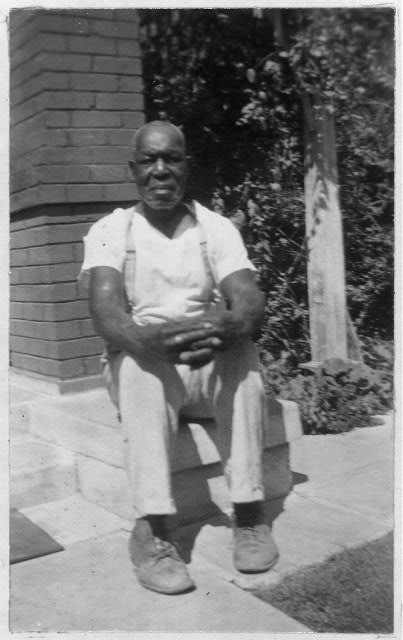
SAM KILGORE, 92, was born a slave of John Peacock, of Williams County, Tennessee, who owned one of the largest plantations in the south. When he was eight years old, Sam accompanied his master to England for a three-year stay. Sam was in the Confederate Army and also served in the Spanish-American War. He came to Fort Worth in 1889 and learned cement work. In 1917 he started a cement contracting business which he still operates. He lives at 1211 E. Cannon St., Fort Worth, Texas.
"You asks me when I's born and was I born a slave. Well, I's born on July 17, 1845, so I's a slave for twenty years, and had three massas. I's born in Williamson County, near Memphis, in Tennessee. Massa John Peacock owned de plantation and am it de big one! Dere am a thousand acres and 'bout a thousand slaves.
"De slave cabins am in rows, twenty in de first row and eighteen in de second and sixteen in de third. Den dere am house servants quarters near de big house. De cabins am logs and not much in dem but homemade tables and benches and bunks 'side de wall. Each family has dere own cabin and sometimes dere am ten or more in de family, so it am kind of crowded. But massa am good and let dem have de family life, and once each week de rations am measure out by a old darky what have charge de com'sary, and dere am allus plenty to eat.
"But dem eats ain't like nowadays. It am home-cured meat and mostly cornmeal, but plenty veg'tables and 'lasses and brown sugar. Massa raised lots of hawgs, what am Berkshires and Razorbacks. Razorback meat am 'sidered de best and sweetest.
"De work stock am eighty head of mules and fifty head of hosses and fifteen yoke of oxen. It took plenty feed for all dem and massa have de big field of corn, far as we could see. De plantation am run on system and everything clean and in order, not like lots of plantations with tools scattered 'round and dirt piles here and there. De chief overseer am white and de second overseers am black. Stien was nigger overseer in de shoemakin' and harness, and Aunty Darkins am overseer of de spinnin' and weavin'.
"Dat place am so well manage dat whippin's am not nec'sary. Massa have he own way of keepin' de niggers in line. If dey bad he say, 'I 'spect dat nigger driver comin' round tomorrow and I's gwine sell you.' Now, when a nigger git in de hands of de nigger driver it am de big chance he'll git sold to de cruel massa, and dat make de niggers powerful skeert, so dey 'haves. On de next plantation we'd hear de niggers pleadin' when dey's whipped, 'Massa, have mercy,' and sich. Our massa allus say, 'Boys, you hears dat mis'ry and we don't want no sich on dis place and it am up to you.' So us all 'haves ourselves.
"When I's four years old I's took to de big house by young Massa Frank, old massa's son. He have me for de errand boy and, I guess, for de plaything. When I gits bigger I's his valet and he like me and I sho' like him. He am kind and smart, too, and am choosed from nineteen other boys to go to England and study at de mil'tary 'cademy. I's 'bout eight when we starts for Liverpool. We goes from Memphis to Newport and takes de boat, Bessie. It am a sailboat and den de fun starts for sho'. It am summer and not much wind and sometimes we jus' stand still day after day in de fog so thick we can't see from one end de boat to de other.
"I'll never forgit dat trip. When we gits far out on de water, I's dead sho' we'll never git back to land again. First I takes de seasick and dat am something. If there am anything worser it can't be stood! It ain't possible to 'splain it, but I wants to die, and if dey's anything worser dan dat seasick mis'ry, I says de Lawd have mercy on dem. I can't 'lieve dere am so much stuff in one person, but plenty come out of me. I mos' raised de ocean! When dat am over I gits homesick and so do Massa Frank. I cries and he tries to 'sole me and den he gits tears in he eyes. We am weeks on dat water, and good old Tennessee am allus on our mind.
"When we gits to England it am all right, but often we goes down to de wharf and looks over de cotton bales for dat Memphis gin mark. Couple times Massa Frank finds some and he say, 'Here a bale from home, Sam,' with he voice full of joy like a kid what find some candy. We stands round dat bale and wonders if it am raised on de plantation.
"But we has de good time after we gits 'quainted and I seed lots and gits to know some West India niggers. But we's ready to come home and when we gits dere it am plenty war. Massa Frank jines de 'Federate Army and course I's his valet and goes with him, right over to Camp Carpenter, at Mobile. He am de lieutenant under General Gordon and befo' long dey pushes him higher. Fin'ly he gits notice he am to be a colonel and dat sep'rates us, 'cause he has to go to Floridy. 'I's gwine with you,' I says, for I thinks I 'longs to him and he 'longs to me and can't nothing part us. But he say, 'You can't go with me this time. Dey's gwine put you in de army.' Den I cries and he cries.
"I's seventeen years old when I puts my hand on de book and am a sojer. I talks to my captain 'bout Massa Frank and wants to go to see him. But it wasn't more'n two weeks after he leaves dat him was kilt. Dat am de awful shock to me and it am a long time befo' I gits over it. I allus feels if I'd been with him maybe I could save his life.
"My company am moved to Birmingham and builds breastworks. Dey say Gen. Lee am comin' for a battle but he didn't ever come and when I been back to see dem breastworks, dey never been used. We marches north to Lexington, in Kentuck' but am gone befo' de battle to Louisville. We comes back to Salem, in Georgia, but I's never in no big battle, only some skirmishes now and den. We allus fixes for de battles and builds bridges and doesn't fight much.
"I goes back after de war to Memphis. My mammy am on de Kilgore place and Massa Kilgore takes her and my pappy and two hundred other slaves and comes to Texas. Dat how I gits here. He settles at de place called Kilgore, and it was named after him, but in 1867 he moves to Cleburne.
"Befo' we moved to Texas de Klu Kluxers done burn my mammy's house and she lost everything. Dey was 'bout $100 in greenbacks in dat house and a three hundred pound hawg in de pen, what die from de heat. We done run to Massa Rodger's house. De riders gits so bad dey come most any time and run de cullud folks off for no cause, jus' to be orn'ry and plunder de home. But one day I seed Massa Rodgers take a dozen guns out his wagon and he and some white men digs a ditch round de cotton field close to de road. Couple nights after dat de riders come and when dey gits near dat ditch a volley am fired and lots of dem draps off dey hosses. Dat ended de Klux trouble in dat section.
"After I been in Texas a year I jines de Fed'ral Army for de Indian war. I's in de transportation division and drives oxen and mules, haulin' supplies to de forts. We goes to Fort Griffin and Dodge City and Laramie, in Wyoming. Dere am allus two or three hundred sojers with us, to watch for Indian attacks. Dey travels on hosses, 'head, 'side and 'hind de wagon. One day de Sent'nel reports Indians am round so we gits hid in de trees and bresh. On a high ledge off to de west we sees de Indians travelin' north, two abreast. De lieutenant say he counted 'bout seven hundred but dey sho' missed us, or maybe I'd not be here today.
"I stays in de service for seven years and den goes back to Johnson County, farmin' on de Rodgers place, and stays till I comes to Fort Worth in 1889. Den I gits into 'nother war, de Spanish 'merican War. But I's in de com'sary work so don't see much fightin'. In all dem wars I sees most no fightin', 'cause I allus works with de supplies.
"After dat war I goes to work laborin' for buildin' contractors. I works for sev'ral den gits with Mr. Bardon and larns de cement work with him. He am awful good man to work for, dat John Bardon. Fin'ly I starts my own cement business and am still runnin' it. My health am good and I's allus on de job, 'cause dis home I owns has to be kept up. It cost sev'ral thousand dollars and I can't 'ford to neglect it.
"I's married twict. I marries Mattie Norman in 1901 and sep'rates in 1904. She could spend more money den two niggers could shovel it in. Den I marries Lottie Young in 1909, but dere am no chillens. I's never dat lucky.
"I's voted ev'ry 'lection and 'lieves it de duty for ev'ry citizen to vote.
"Now, I's told you everything from Genesis to Rev'lations, and it de truth, as I 'members it.
420058
Ben Kinchlow
BEN KINCHLOW, 91, was the son of Lizaer Moore, a half-white slave owned by Sandy Moore, Wharton Co., and Lad Kinchlow, a white man. When Ben was one year old his mother was freed and given some money. She was sent to Matamoras, Mexico and they lived there and at Brownsville, Texas, during the years before and directly following the Civil War. Ben and his wife, Liza, now live in Uvalde, Texas, in a neat little home. Ben has straight hair, a Roman nose, and his speech is like that of the early white settler. He is affable and enjoys recounting his experiences.
"I was birthed in 1846 in Wharton, Wharton County, in slavery times. My mother's name was Lizaer Moore. I think her master's name was Sandy Moore, and she went by his name. My father's name was Lad Kinchlow. My mother was a half-breed Negro; my father was a white man of that same county. I don't know anything about my father. He was a white man, I know that. After I was borned and was one year old, my mother was set free and sent to Mexico to live. When we left Wharton, we was sent away in an ambulance. It was an old-time ambulance. It was what they called an ambulance—a four-wheeled concern pulled by two mules. That is what they used to traffic in. The big rich white folks would get in it and go to church or on a long journey. We landed safely into Matamoros, Mexico, just me and my mother and older brother. She had the means to live on till she got there and got acquainted. We stayed there about twelve years. Then we moved back to Brownsville and stayed there until after all Negroes were free. She went to washing and she made lots of money at it. She charged by the dozen. Three or four handkerchiefs were considered a piece. She made good because she got $2.50 a dozen for men washing and $5 a dozen for women's clothes.
"I was married in February, 1879, to Christiana Temple, married at Matagorda, Matagorda County. I had six children by my first wife. Three boys and three girls. Two girls died. The other girl is in Gonzales County. Lawrence is here workin' on the Kincaid Ranch and Andrew is workin' for John Monagin's dairy and Henry is seventy miles from Alpine. He's a highway boss. This was my first wife. Now I am married again and have been with this wife forty years. Her name was Eliza Dawson. No children born to this union.
"The way we lived in those days—the country was full of wild game, deer, wild hogs, turkey, duck, rabbits, 'possum, lions, quails, and so forth. You see, in them days they was all thinly settled and they was all neighbors. Most settlements was all Meskins mostly; of course there was a few white people. In them days the country was all open and a man could go in there and settle down wherever he wanted to and wouldn't be molested a-tall. They wasn't molested till they commenced putting these fences and putting up these barbwire fences. You could ride all day and never open a gate. Maybe ride right up to a man's house and then just let down a bar or two.
"Sometime when we wanted fresh meat we went out and killed. We also could kill a calf or goat whenever we cared to because they were plenty and no fence to stop you. We also had plenty milk and butter and home-made cheese. We did not have much coffee. You know the way we made our coffee? We just taken corn and parched it right brown and ground it up. Whenever we would get up furs and hides enough to go into market, a bunch of neighbors would get together and take ten to fifteen deer hides each and take 'em in to Brownsville and sell 'em and get their supplies. They paid twenty-five cents a pound for them. That's when we got our coffee, but we'd got so used to using corn-coffee, we didn't care whether we had that real coffee so much, because we had to be careful with our supplies, anyway. My recollection is that it was fifty cents a pound and it would be green coffee and you would have to roast it and grind it on a mill. We didn't have any sugar, and very rare thing to have flour. The deer was here by the hundreds. There was blue quail—my goodness! You could get a bunch of these blue top-knot quail rounded up in a bunch of pear and, if they was any rocks, you could kill every one of 'em. If you could hit one and get 'im to fluttering the others would bunch around him and you could kill every one of 'em with rocks.
"We lived very neighborly. When any of the neighbors killed fresh meat we always divided with one another. We all had a corn patch, about three or four acres. We did not have plows; we planted with a hoe. We were lucky in raisin' corn every year. Most all the neighbors had a little bunch of goats, cows, mares, and hogs. Our nearest market was forty miles, at old Brownsville. When I was a boy I wo'e what was called shirt-tail. It was a long, loose shirt with no pants. I did not wear pants until I was about ten or twelve. The way we got our supplies, all the neighbors would go in together and send into town in a dump cart drawn by a mule. The main station was at Brownsville. It was thirty-five miles from where they'd change horses. They carried this mail to Edinburg, and it took four days. Sometimes they'd ride a horse or mule. We'd get our mail once a week. We got our mail at Brownsville.
"The country was very thinly settled then and of very few white people; most all Meskins, living on the border. The country was open, no fences. Every neighbor had a little place. We didn't have any plows; we planted with a hoe and went along and raked the dirt over with our toes. We had a grist mill too. I bet I've turned one a million miles. There was no hired work then. When a man was hired he got $10 or $12 per month, and when people wanted to brand or do other work, all the neighbors went together and helped without pay. The most thing that we had to fear was Indians and cattle rustlers and wild animals.
"While I was yet on the border, the plantation owners had to send their cotton to the border to be shipped to other parts, so it was transferred by Negro slaves as drivers. Lots of times, when these Negroes got there and took the cotton from their wagon, they would then be persuaded to go across the border by Meskins, and then they would never return to their master. That is how lots of Negroes got to be free. The way they used to transfer the cotton—these big cotton plantations east of here—they'd take it to Brownsville and put it on the wharf and ship it from there. I can remember seeing, during the cotton season, fifteen or twenty teams hauling cotton, sometimes five or six, maybe eight bales on a wagon. You see, them steamboats used to run all up and down that river. I think this cotton went out to market at New Orleans and went right out into the Gulf.
"Our house was a log cabin with a log chimney da'bbed with mud. The cabin was covered with grass for a roof. The fireplace was the kind of stove we had. Mother cooked in Dutch ovens. Our main meal was corn bread and milk and grits with milk. That was a little bit coarser than meal. The way we used to cook it and the best flavored is to cook it out-of-doors in a Dutch oven. We called 'em corn dodgers. Now ash cakes, you have your dough pretty stiff and smooth off a place in the ashes and lay it right on the ashes and cover it up with ashes and when it got done, you could wipe every bit of the ashes off, and get you some butter and put on it. M-m-m! I tell you, its fine! There is another way of cookin' flour bread without a skillet or a stove, is to make up your dough stiff and roll it out thin and cut it in strips and roll it on a green stick and just hold it over the coals, and it sure makes good bread. When one side cooks too fast, you can just turn it over, and have your stick long enough to keep it from burnin' your hands. How come me to learn this was: One time we were huntin' horse stock and there was an outfit along and the pack mule that was packed with our provisions and skillets and coffee pots and things—we never did carry much stuff, not even no beddin'—the pack turned on the mule and we lost our skillet and none of us knowed it at the time. All of us was cooks, but that old Meskin that was along was the only one that knew how to cook bread that way. Sometimes we would be out six weeks or two months on a general round-up, workin' horse stock; the country would just be alive with cattle, and horses too. We used to have lots of fun on those drives.
"I tell you, I didn't enjoy that 'court' at night. They got so tough on us you couldn't spit in camp, couldn't use no cuss words—they would sure 'put the leggin's on you' if you did!"
Uncle Ben hitched his chair, and with much chuckling, recalled the "kangaroo court" the cowboys used to hold at night in camp. These impromptu courts were often all the fun the cowboys had during the long weeks of hunting stock in the open range country.
"Oh, it was all in fun. Just catch somebody so we could hold court! They would have two or three as a jury. They would use me as sheriff and appoint a judge. The prisoner was turned over to the judge and whatever he said, it had to be carried out exactly. The penalty? Well, sometimes—it was owing to the crime—but sometimes they would put it up to about twenty licks with the leggin's. If they was any bendin' trees, they would lay you across the log. They got tough, all right, but we sure had fun. We had to salute the boss every mornin', and if we forgot it...! They never forgot it that night; you'd sure get tried in court.
"We camped on the side of a creek one time, and we had a new man, a sort of green fellow. This new man unsaddled his horse by the side of the creek and he lay down there. He had on a big pair of spurs, and I was watchin' him and studyin' up some kind of prank to play on 'im. So I went and got me a string and tied one of his spurs to his saddle and then I told the boss what I'd done and he had one of the fellows put a saddle on and tie tin cups and pots on it and then they commenced shootin' and yellin'. This man with the saddle on went pitchin' right toward that fellow, and that man got up, scared to death, and started to run. He run the length of the string and then fell down, but he didn't take time to get up; he went runnin' on his all-fours as fur as he could, till he drug the saddle to where it hung up. He woulda run right into the creek, but the saddle held 'im back. We didn't hold kangaroo court over that! Nobody knowed who did it. Of course, they all knowed, but they didn't let on. But nobody ever got in a bad humor; it didn't do no good.
"I've stood up of many a bad night, dozin'. It would be two weeks, sometimes, before we got to lay down on our beds. I have stood up between the wagon wheel and the bed (of the wagon) and dozed many a night. Maybe one or two men would come in and doze an hour or two, but if the cattle were restless and ready to run, we had to be ready right now. Sho! Those stormy nights thunderin' and lightnin'! You could just see the lightnin' all over the steers' horns and your horse's ears and mane too. It would dangle all up and down his mane. It never interfered with you a-tall. And you could see it around the steer's horns in the herd, the lightnin' would dangle all over 'em. If the hands (cowboys) or the relief could get to 'em before they got started to runnin', they could handle 'em; but if they got started first, they would be pretty hard to handle.
"The first ranch I worked on after I left McNelly was on the Banqueta on the Agua Dulce Creek for the Miley boys, putting up a pasture fence. I worked there about two months, diggin' post holes. From there to the King Ranch for about four months, breaking horses. I kept travelin' east till I got back to Wharton, where my mother was. She died there in Wharton. I didn't stay with her very long. I went down to Tres Palacios in Matagorda County. I did pasture work there, and cattle work. I worked for Mr. Moore for twelve years. Then he moved to Stockdale and I worked for him there eight years. From there, after I got through with Mr. Moore, I went back to Tres Palacios and I worked there for first one man and then another. I think we have been here at Uvalde for about twenty-three years.
"I've been the luckiest man in the world to have gone through what I have and not get hurt. I have never had but two horses to fall with me. I could ride all day right now and never tire. You never hear me say, 'I'm tired, I'm sleepy, I'm hongry.' And out in camp you never see me lay down when I come in to camp, or set down to eat, and if I do, I set down on my foot. I always get my plate in my hand and eat standin' up, or lean against the wagon, maybe.
"When Cap'n. McNelly taken sick and resigned, I traveled east and picked up jobs of work on ranches. The first work after I left the Rio Grande was on the Banqueta, and then I went to work on the King Ranch about fifty miles southeast (?) of Brownsville. It wasn't fixed up in them days like it is now. But the territory is like it was then. They worked all Meskin hands. They were working about twenty-five or thirty Meskins at the headquarters' ranch. And the main caporal was a Meskin. His wages was top wages and he got twelve dollars a month. And the hands, if you was a real good hand, you got seven or eight dollars a month, and they would give you rations. They would furnish you all the meat you wanted and furnish you corn, but you would have to grind it yourself for bread. You know, like the Meskins make on a metate. You could have all the home-made cheese you want, and milk. In them days, the Meskins didn't have sense enough to make butter. I seen better times them days than I am seein' now. We just had a home livin'. You could go out any time and kill you anything you wanted—turkeys, hogs, javalinas, deer, 'coons, 'possums, quail.
"I'll tell you about a Meskin ranch I worked on. It was a big lake. It covered, I reckin, fifty acres, and these little Meskin huts just surrounded that big lake. And fish! My goodness, you could just go down there and throw your hook in without a bait and catch a fish. That was what you call the Laguna de Chacona. That was out from Brownsville about thirty-five miles. That ranch was owned by the old Meskin named Chacon, where the lake got its name.
"It seems funny the way they handled milk calves—you know, the men-folks didn't milk cows, they wouldn't even fool with 'em. They would have a great big corral and maybe they would have fifteen or twenty cows and they would be four or five families go there to milk. Every calf would have a rawhide strap around his neck about six foot long. Now, instead of them makin' a calf pen—of evenin's the girls would go down there and I used to go help 'em—they would pull the calf up to the fence and stick the strap through a crack and pull the calf's head down nearly to the ground where he couldn't suck. Of course, the old cow would hang around right close to the calf as she could git. When they let the calf suck, they'd leave 'im tied down so he couldn't suck in the night. They always kep' the cows up at night and they'd leave the calves in the pen with 'em, but tied down. But buildin' just what you call a calf pen, they'd set posts in the ground just like these stock pens at the railroad and lay the poles between 'em. Then again, they would dig a trench and set mesquite poles so thick and deep, why, you couldn't push it down!
"Now, in dry times, they would have a banvolete (ban-bo-la-te). Hand me two of them sticks, mama. Now, you see, like here would be the well and you cut a long stick as long as you could get it, with a fork up here in this here pole, and have this here stick in the fork of the pole. They'd bolt the cross piece down in the fork of the pole that was put in the ground right by the well, and have it so it would work up and down. They'd be a weight tied on the end of the other pole and they could sure draw water in a hurry. I made one out here on the Anderson Ranch. Just as fast as you could let your bucket down, then jerk it up, you had the water up. The well had cross pieces of poles laid around it and cut to fit together.
"Now, about the other way we had to draw water. We had a big well, only it was fenced around to keep cattle from gettin' in there. The reason they had to do that, they had a big wheel with footpieces, like steps, to tread, and you would have the wheel over the well and they had about fifteen or twenty rawhide buckets fastened to a rope (that the wheel pulled it went around), and when they went down, they would go down in front of you. You had to sit down right behind the wheel, and you would push with your feet and pull with your hands, and the buckets came up behind you and as they went up, they would empty and go back down. They had some way of fixin' the rawhide. I think they toasted it, or scorched the hide to keep it hard so the water wouldn't soak it up and get it soft. That was on that place, the Chacona Lakes. That old Meskin was a native of the Rio Grande and run cattle and horses. In them days, you could buy an acre of land for fifty cents, river front, all the land you wanted. Now that land in that valley, you couldn't buy it for a hundred dollars an acre.
"Did I tell you about diggin' that pit right in the fence of our corn patch to catch javalines? The way we done, why, we just dug a big pit right on the inside of the field, right against the fence, and whenever they would go through that hole to go in the corn patch, they would drop off in that hole. I think we caught nine, little and big, at one trappin' once. It was already an old trompin' place where they come in and out, and we had put the pit there. But after you use it, they won't come in there again.
"You see, I tell you about them brush fences. The deer had certain places to go to that fence to jump it, and after we found the regular jumpin' place, we would cut three sticks—pretty good size, about like your wrist, about three foot long—and peel 'em and scorch 'em in the fire and sharpen the ends right good and we would go to set our traps. We would put these three sharp sticks right about where the forefeet of the deer would hit. You'd just set the sticks about four inches from where his forefeet would hit the ground, and you'd set the sticks leanin' towards the brush fence, and they would be one in the center and two on the side and about two inches apart. When he jumped, you would sure get 'im right about the point of the brisket. He'd hardly ever miss 'em, and you'd find 'im right there. Oh, sometimes he'd pull up a stick and run a piece with it, but he didn't run very far.
"I been listenin' to the radio about Cap'n McNelly and I tell you it didn't sound right to me. In what way? Why, they never was no cattle on the steamboats down the Rio Grande. I just tell you they was no way of shippin' cattle on a steamboat. They couldn't get 'em down the hatch and they couldn't keep 'em on deck and they wasn't no wharf to load 'em, either. I was there and I seen them boats too long and I know they never shipped no cattle on them steamboats. After they crossed the Rio Grand into Mexico, they might have been shipped from some port down there, but all them cattle they crossed was swum across. They was big boats, but they wasn't no stock boats. They shipped lots of cotton on them steamboats, but they wasn't fixed to ship no cattle. They was up there for freight and passengers. The passengers was going on down the Gulf, maybe to New Orleans. They would get on at Brownsville. The steamboats couldn't go very fur up the river only in high water, but they could come up to Brownsville all the time.
"I was in the Ranger service for about a year with Captain McNelly, or until he died. I was his guide. I was living thirty-five miles above Brownsville. I was working for a man right there on the place by the name of John Cunningham. It was called Bare Stone. You see, hit was a ranch there. McNelly was stationed there after the government troops moved off. They had 'em (the troops) there for a while, but they never did do no good, never did make a raid on nothin'. I was twenty or twenty-one. How come me to get in with McNelly, they had a big meadow there, a big 'permuda' (Bermuda) grass meadow. Me and another fellow used to go in there, and John Cunningham furnished Cap'n McNelly hay for his horses. That's how come me to get in with 'im. Fin'ly, he found out I knew all about that country and sometimes he would come over there and get me to map off a road, though they wasn't but one main road right there. So, one day I was over in the camp with 'im and I say, 'Cap'n, how would you like to give me a job to work with you?' He said, 'I'd like to have you all right, but you couldn't come here on state pay, and under no responsibility.' I told 'im that was all right. I knew how I was going to get my money, 'cause I gambled. Sometimes I would have a hundred or a hundred, twenty-five dollars. Durin' the month I would win from the soljers dealin' monte or playin' seven-up. They wasn't no craps in them days. We played luck too; we never had no shenanigans, a-stealin' a man's money. If you had a good streak o' luck, you made good; if you didn't, you was out o' luck. Sometimes, I had up as high as twenty-five or thirty dollars.
"One thing about the cap'n, he'd tell his men—well, we had a sutler's shop right across from our camp, all kinds of good drinks—and he would tell his men he didn't care how much they drank but he didn't want any of 'em fighting'. He kep' 'em under good control.
"You see, they was all dependin' on me for guidin'. There was no way for them cow rustlers or bandits to get to the cow ranches after they crossed the river (Rio Grande) excep' to cross that road for there was no other way for 'em to get out there. You see, there was where it would be easy for me, pickin' up a trail. I would just follow that road on if I had a certain distance to go, and if I didn't find no trail I would come back and report, and if I would find a trail he would ask me how many they was and where they was goin', and I would tell 'im which way, 'cause I didn't know exactly where they was goin' to round-up. He would always give 'em about two or three days to make the round-up from the time that trail crossed. And we always went to meet 'em, or catch 'em at the river. We got into two or three real bad combats.
"The worst one was on Palo Alto Prairie, one of Santa Anna's battle grounds. About twelve or fifteen miles east of old Brownsville. They was sixteen of the bandits and they was fifteen of 'em killed—all Meskins excep' one white man. One Meskin escaped. The cap'n just put 'em all up together in a pile and sent a message to Brownsville to the authorities and told 'em where they was at and what shape they was in. They must have had two hundred or two hundred and twenty-five head (of cattle) with 'em. It was open country and they would get anybody's cattle. They just got 'em off the range.
"They mostly would cross that road at night, and by me gettin' out early next mornin' and findin' that trail, I could tell pretty much how old it was. I reckon that place wasn't over thirteen miles from Brownsville and our camp was thirty-five miles, I guess it must have been twenty-five miles from our camp to where we had that battle. We sure went there to get 'em. I trailed them horses and I knowed from the direction they was takin' that they was goin' to those big lakes called Santa Lalla. They was between Point Isabel and Brownsville and that made us about a forty-five mile ride to get to that crossin', to a place called Bagdad, right on the waters of the Rio Grande.
"We got our lunch at Brownsville and started out to go to this crossin'. I knowed right about where this crossin' was and I says to the cap'n, 'Don't you reckon I better go and see if they was any sign?' We stayed there about three hours and didn't hear a thing. And then the cap'n said, 'Boys, we better eat our lunch'. While we was eatin', we heard somebody holler, and he said, 'Boys, there they are.' And he said to me, 'Ben, you want to stay with the horses or be in the fun?' And I said, 'I don't care.' So he said, 'You better stay with the horses; you ain't paid to kill Meskins! I went out to where the horses were. The rangers were afoot in the brush. It was about an hour from the time we heard the fellow holler before the cattle got there. When the rangers placed themselves on the side of the road, the Meskins didn't know what they was goin' to get into!
"The Meskins was all singin' at the top of their voices and they was comin' on in. The cap'n waited till they went to crossin' the herd, he waited till these rustlers all got into the river behind the cattle, and then the cap'n opened fire on the bandits. They didn't have no possible show. They was in the water, and he just floated 'em down the river. They was one man got away. I saw 'im later, and he told me about it. The way he got away, he says he was a good swimmer and he just fell off his horse in the water and the swift water took 'im down and he just kep' his nose out of the water and got away that way. They was fo'teen in that bunch, I know.
"The echo of the shootin' turned the cattle back to the American side. The lead cattle was just gettin' ready to hit the other side of the river when the shootin' taken place and the echo of the shootin' turned 'em and they come back across. Now, in swimmin' a bunch of cattle, if you pop your whip, you are just as liable to turn 'em back, or if you holler the echo might turn 'em back. It'll do that nearly every time.
"After the fight, the cap'n says to the boys, 'Well, boys, the fun is all over now, I guess we'd better start back to camp.' And they all mounted their horses and begun singin':
"O, bury me not on the lone prairie-e-e Where the wild coyotes will howl o'er me-e-e, Right where all the Meskins ought to be-e-e!"
420949
Mary Kindred
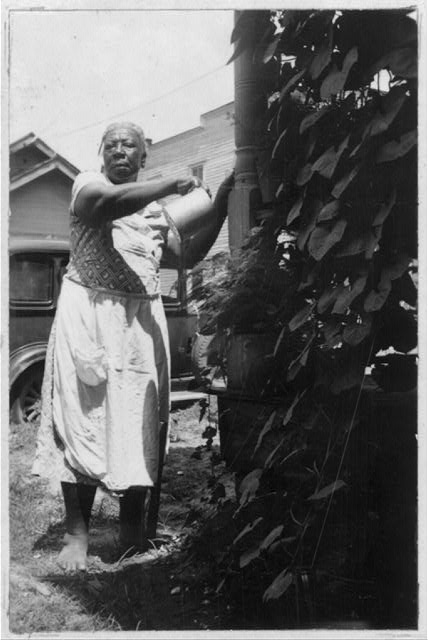
MARY KINDRED was a slave on the Luke Hadnot plantation in Jasper, Texas. She does not know her age but thinks she is about 80. She now lives in Beaumont, Texas.
"My mind don't dwell back. The older I gits the lessen I thinks 'bout the old times. I ain't gittin' old. I's done got old. I not been one of them bad, outlawed fellers, so de good Lawd done 'low me live a long time. Some things I knows I heered from my mother and my grandma. They so fresh to them in that time, though, I mostly sure they's truth.