XVI. THE LITERARY GUILD. (continued 2)
Reading edition
“The wife that manages her husband is a genius, the one that bosses him is a tartar, the one that fights him is a fool, while the one that does none of them is now as much out of fashion as her grandmother’s wedding-gown.”
“The pygmies of Africa are such by nature, but elsewhere they are produced artificially by a diet of petty and envious thoughts.”
“‘Truth is mighty and will prevail,’ but Error generally has the better of it till the seventy-seventh round.”
“One of the greatest evils that humanity has to contend with is that so many icebergs have floated down from the North Pole and persist in passing themselves off for men.”
“Former lovers in making out their title-deeds of the heart to their successors always reserve at least a narrow pathway across a corner.”
“Wise men and fools have foolish thoughts; fools tell them, wise men keep them to themselves.”
“Parents that haven’t time to correct their children when they are small have time to weep over them when they are grown.”
“Affectation (alias of Deceitfulness) has three picked cronies from whom she is seldom separated. Their names are False Pride, Weakmindedness and Bad Temper.”
“If one has too much vitality in his brains he can get rid of it by taking them out and boiling them. If he finds this too much bother, he can accomplish the same result by swallowing a few doses of a decoction of faith-cure, spook-lore and hypnotismhypnotism.”
“For peace of mind and length of days, put this inscription above the doorway of workshop and home: Troubles that will not be worth worrying over seven years hence are not worth worrying over now.”
“The ancient Israelites once worshiped a golden calf, but the modern Americans would worship a golden polecat if they couldn’t get the gold in any other form to worship.”
“The young man who starts out in life with character and brains and energy as his outfit will distance the one whose sole capital is the money his father left him.”
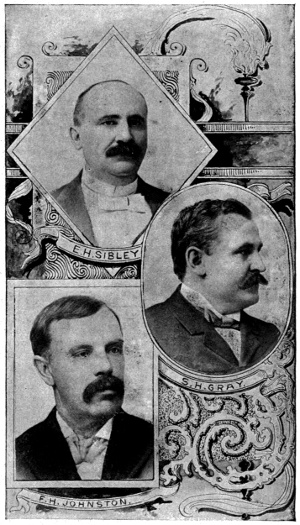
E. H. SIBLEY. S. H. GRAY. F. H. JOHNSTON.
Samuel H. Gray carries under his hat plenty of the gray-matter that makes bright writers and bright wooers of the Muses. He has been court stenographer of Venango county and holds a confidential position with the firm of Miller 378& Sibley, applying his spare moments to newspaper-writing. His pictures of petroleum-traits and incidents are finished word-paintings, with “light and shade and color properly disposed.” Like Silas Wegg, he “drops into poetry” in a friendly way. Such papers as the New-York Truth strive for his emanations, which savor of Bret Harte and “hold the mirror up to nature” in oleaginous circles. Judge of this “By the Order of the Lord,” founded on an actual occurrence in Scrubgrass township:
“It was back, if I remember, in the year of sixty-five,
When we formed a part and parcel of that rushin’, busy hive
That extended from Oil City up the crooked crick until
It reached its other endin’ in the town of Titusville;
When every rock an’ hillside was included in a lease,
An’ everyone was huntin’ fer the fortune-makin’ grease;
When a poor man pushed and elbowed ’gainst the oily millionaire,
An’ ‘the devil take the hindmost’ seemed the all-pervadin’ prayer.
“An’An’ we hed formed a pardnership, jest Tom an’ Jim an’ me,
That was properly recorded as the ‘Tough and Hungry Three,’
An’ hed gone an’ leased a portion of some hard an’ rocky soil
That we thought looked like the cover of a fountain filled with oil.
An’ we set the drill a’goin’ on its long an’ greasy quest,
That meant so much or little to the capital possessed.
Our money was all in the well, in Providence our trust,
An’ we waited for a fortune, or to liquidate an’ bu’st.
“An’ while the drill was chuggin’ at its hard an’ rocky way
We three would hold a meetin’ at a certain time each day,
The ‘resolves’ an’ the ‘whereases’ that the secretary took
Were properly recorded ’twixt the covers of a book.
An’ we passed a resolution by a vote unanimous
Thet if Providence would condescend to sorter favor us,
An’ assist the operations on the ‘Tough and Hungry’ lease,
We would give to Him a quarter of the total flow of grease.
“Next day the drill broke through into a very oily sand
An’ Providence remembered us with strong, unsparin’ hand;
The oil came out with steady flow an’ loaded up the tanks,
An’ the Lord was due rewarded by a solid vote of thanks.
A resolution then came up thet caused the vote to split,
A sort of an amendment, readin’ somethin’ like, to wit—
‘Whereas, a tenth is all the Lord was ever known to crave,
Resolved we give it to Him; but resolved the rest we save.’
“I fit that resolution, an’ I fit it tooth an’ nail,
Spoke of dangers such proceedin’s was most likely to entail;
But two votes were in its favor, an’ two votes it only took
Fer to have it due recorded in the resolution-book.
Next day the oil stopped flowin’ an’ it never flowed no more,
An’ the ‘Tough and Hungry’ combine was a’ feelin’ blue an’ sore.
But they nailed upon the derrick this notice, on a board,
‘This well has stopped proceedin’s, by the order of the Lord.’”
The late Rev. Harry L. Yewens, rector of St. John’s church, was an accomplished writer and contributed many timely articles to the press. Rev. Dr. Fradenburg, formerly of Oil City and Franklin, has published seven scholarly volumes on religious subjects of vital interest.
The Bolivar Breeze, seven years old, under the able management of J. P. Herrick is one of the most readable sheets published in any section of the country. Editor Herrick is a philosopher and wit, who looks on the bright side of life and, better still, helps others to do likewise.
P. A. Rattigan, the very-much-alive perpetrator of the Millerstown Herald, once received an article entitled “Why Do I Live?” It was written on both 379sides of the sheet of foolscap, whereupon P. Anthony in next issue printed this conclusive answer: “You live because you sent your dog-goned rot by mail instead of bringing it in person.”
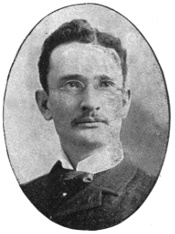
MELVILLE J. KERR.
Melville J. Kerr, a Franklin boy, son of the senior proprietor of the marble-works, is a popular writer of facetiæ and society small-talk. Possibly “a rose by any other name would smell as sweet,” but his cognomen of “Joe Ker” is known to thousands of smiling readers who never heard of Melville. The aspiring youth, believing in the advantages of a big city, journeyed to New York to look for an opportunity that might want a party about his size and style. Unlike Jacob for Rachel, Penelope for Ulysses, the zealots who prayed for Ingersoll’s conversion or the Governor of South Carolina for the Governor of North Carolina to “fill ’em up again,” he didn’t wait long. A soap-mogul liked the ambitious, sprightly young man, introduced him to the swell set and booked him as editor of The Club. Kerr’s refined humor popped and effervesced with more “bead” than ever. He hobnobbed with millionaires, delighted Ward McAlister and married a lovely girl. Blood will tell as surely as a gossip or a tale-bearer. He is now editing The Yellow Kid, a semi-monthly crowded with good things, and raking in wealth at a Klondyke-gait from his newest book, “The World Over,” a graphic and geographic burlesque that is fated to be read the world over. And this is how the “Joe Ker” is the winning card in one oil-region instance.
Last year a compact “Life of Napoleon Bonaparte,” in harmony with the age of steam and electricity that won’t winnow a bushel of chaff for a grain of wheat, which had run through the winter and spring of 1894-5 in McClure’s Magazine, was published in book-form. Napoleonic ground had been so plowed and harrowed and raked and scraped and sifted by Hugo, Scott, Abbott, Hazlitt, Bourrienne, Madame Junot and a host of smaller fry that it seemed idle to expect anything new concerning the arbiter of Europe. Yet the beauty and freshness and acumen of this “Life” surprised and captivated its myriad readers, whose pleasure it increased to learn that the book was the production of a young woman. The authoress is Miss Ida M., daughter of Franklin S. Tarbell, a wealthy oil-operator. Her childhood was spent at Rouseville, where her parents lived prior to occupying their present home at Titusville. The romantic surroundings were calculated to awaken glowing fancies in the acute mind of the little girl. After graduating from Allegheny College, Meadville, she taught in the seminary at Poland, O., assisted to edit The Chautauquan at Meadville and spent three years in Europe gathering materials for articles on the dark days of Robespierre, Danton, Marat and Marie Antoinette. She wrote for Scribners’, McClure’s and the New-England Magazine, adding to her fame by an exhaustive study of Abraham Lincoln’s youth. Scribners’ will soon publish her biography of Madame Roland, the heroine of the French Revolution. Her success thus early in her career gives fruitful promise of a resplendent future for the vivacious, winsome biographer of the “Little Corporal.”
While many names and terms and phrases peculiar to oil-operations are unintelligible to the tenderfoot as “the confusion of tongues” at Babel, others will be valuable additions to the language. “He has the sand” aptly describes 380a gritty, invincible character. The fortunate adventurer “strikes oil,” the pompous strutter is “a big gasser,” foolish anger is “pumping roily” and fruitless enterprise is “boring in dry territory.” Misdirected effort is “off the belt,” failure “stops the drill,” a lucky investment “hits the jugular,” a hindrance “sticks the tools” and an abandoned effort “plugs the well.” A man or well that keeps at it is “a stayer,” one that doesn’t pan out is “a duster,” one that cuts loose is “a gusher” or “a spouter.” Fair promise means “a good show,” the owner of pipe-line certificates “has a bundle,” fleeced speculators are “shorn lambs”—not limited to Oildom by a large majority—and the ruined operator “shuts ’er down.” In a moment of inspiration John P. Zane created “the noble producer,” Lewis F. Emery invented “the downtrodden refiner” and Samuel P. Irvin exploited “the Great Invisible Oil-Company.” Some of these epigrammatic phrases deserve to go thundering down the ages with Grant’s “let us have peace,” Cleveland’s “pernicious activity,” and “a sucker is born every minute.”
Nor is the jargon of places and various appliances devoid of interest to the student of letters. Oil City, Petroleum Centre, Oleopolis, Petrolia, Greece City—first spelled G-r-e-a-s-e—Gas City, Derrick City and Oil Springs were named with direct reference to the slippery commodity. From prominent operators came Funkville, Shamburg, Tarr Farm, Rouseville, McClintockville, Fagundas, Prentice, Cochran, Karns City, Angelica, Criswell City, Gillmor, Duke Centre and Dean City. Noted men or early settlers were remembered in Titusville, Shaffer, Plumer, Trunkeyville, Warren, Irvineton, McKean, De Golier, Custer City, Garfield, Franklin, Reno, Foster, Cooperstown, Kennerdell, Milton, Foxburg, Pickwick, Parker, Troutman, Butler, Washington, Mannington and Morgantown. Emlenton commemorates Mrs. Emlon Fox. St. Joe recalls Joseph Oberly, a pioneer-operator in that portion of Butler county. Standoff City kept green a contractor who wished to “stand-off” his men’s wages until he finished a well. A deep hole or pit on the bank of the creek, from which air rushed, suggested Pithole. Tip-Top, near Pleasantville, signified its elevated site. Cornplanter, the township in which Oil City is situated, bears the name of the stalwart chief—six feet high and one hundred years old—to whom the land was ceded for friendly services to the government and the white settlers. This grand old warrior died in 1836 and the Legislature erected a monument over his grave, on the Indian reservation near Kinzua. Venango, Tionesta, Conewago, Allegheny, Modoc and Kanawha smack of the copper-hued savage once monarch of the whole plantation. Red-Hot, Hardscrabble, Bullion, Babylon, St. Petersburg, Fairview, Antwerp, Dogtown, Turkey City and Triangle are sufficiently obvious. SistersvilleSistersville, the centre of activity in West Virginia, is blamed upon twin-islets in the river. Alemagooselum is a medley as uncertain in its origin as the ingredients of boarding-house hash. Diagrams are needed to convey a reasonable notion of “clamps,” “seed-bags,” “jars,” “reamers,” “sockets,” “centre-bits,” “mud-veins,” “tea-heads,” “conductors,” “Samson-posts,” “bull-wheels,” “band-wheels,” “walking-beams,” “grasshoppers,” “sucker-rods,” “temper-screws,” “pole-tools,” “casing,” “tubing,” “working-barrels,” “standing-valves,” “check-valves,” “force-pumps,” “loading-racks,” “well-shooters,” “royalty,” “puts,” “calls,” “margins,” “carrying-rates,” “spot,” “regular,” “pipage,” “storage,” and the thousand-and-one things that make up the past and present of the lingo of petroleum.
The Literary Guild is not the smallest frog in the petroleum-pool.
381
THE WOMAN’S EDITION.
To raise twenty-five-hundred dollars for an annex to the hospital, the ladies of Oil City, on February twelfth, 1896, issued the “Woman’s Edition” of the Derrick. It was a splendid literary and financial success, realizing nearly five-thousand dollars. This apt poem graced the editorial page:
Oh! sad was her brow and wild was her mien,
Her expression the blankest that ever was seen;
She was pained, she was hurt at the plain requisition:
“We expect you to write for the Woman’s Edition.”
Her babies wept sadly, her husband looked blue,
Her house was disordered, each room in a stew;
Do you ask me to tell why this sad exhibition?
She was trying to write for the Woman’s Edition.
Oh, what should she write? she had nothing to say;
She pondered and thought all the long weary day;
The question of woman, her life and her mission,
Must all be touched up in the Woman’s Edition.
But what could she do—oh, how could she write?
She could bake, she could brew from morning to night;
She had even been known to get up a petition:
But now she must write for “The Woman’s Edition.”
She felt that she must; her sisters all did it,
Would she fall behind? The saints all forbid it!
If the rest of her life should be spent in contrition,
She felt she must write for the Woman’s Edition.
She did it, she wrote it, now read it and ponder;
She treated a subject a little beyond her,
But that was much better than total omission
Of her name from the list on the Woman’s Edition.
Now her home is restored, her husband has smiled,
But, alas! that pleased look on his face was beguiled
By her cheerful assent to his simple condition:
That she’ll not write again for a Woman’s Edition.
THE GIRL AND THE EDITOR.
D. A. Denison, the lively editor of the Bradford Era, is rarely vanquished in any sort of encounter. A “sweet-girl graduate” wrote a story and wanted him to print it. Thinking to let her down gently, he remarked: “Your romance suits me splendidly, but it has trivial faults. For instance, you describe the heroine’s canary as drinking water by ‘lapping it up eagerly with her tongue.’ Isn’t that a peculiar way for a canary to drink water?” “Your criticism surprises me,” said the blushing girl in a pained voice. “Still, if you think your readers would prefer it, perhaps it would be better to let the canary drink water with a teaspoon.” Dennison wilted like an ice-cream in July, promised to publish the story and the girl walked away mistress of the situation.
382
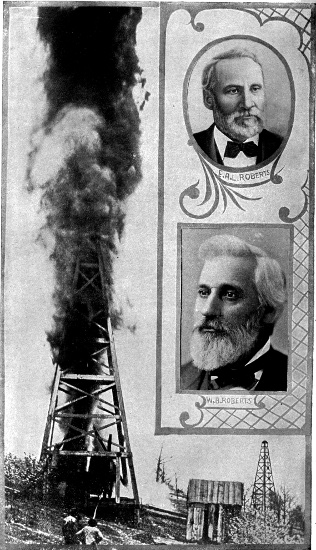
WELL FLOWING OIL AFTER TORPEDOING. E. A. L. ROBERTS W. B. ROBERTS
383