VII. THE VALLEY OF PETROLEUM. (continued 2)
Reading edition
Occasionally his prodigality assumed a sensible phase. Twenty-eight-hundred dollars, one day’s receipts from his wells and royalty, went toward the erection of the soldiers’ monument—a magnificent shaft of white marble—in the Franklin park. Except Dan Rice’s five-thousand memorial at Girard, Erie county, this was the first monument in the Union to the fallen heroes of the civil war. Ten, twenty or fifty dollars frequently gladdened the poor who asked for relief. He lavished fine clothes and diamonds on a minstrel-troupe, touring the country and entertainingentertaining crowds in the oil-regions. John W. Gaylord, an artist in burnt-cork and member of the troupe, has furnished these details:
“Yes. ‘Coal-Oil Johnnie’ was my particular friend in his palmiest days. I was his room-mate when he cut the shines that celebrated him as the most eccentric millionaire on earth. I was with the Skiff & Gaylord minstrels. Johnnie saw us perform in Philadelphia, got stuck on the business and bought one-third interest in the show. His first move was to get five-thousand dollars’ worth of woodcuts at his own expense. They were all the way from a one-sheet to a twenty-four-sheet in size and the largest amount any concern had ever owned. The cartoon, which attracted so much attention, of ‘Bring That Skiff Over Here,’ was in the lot. We went on the road, did a monstrous business everywhere, turned people away and were prosperous.
“Reaching Utica, N. Y., Johnnie treated to a supper for the company, which cost one-thousand dollars. He then conceived the idea of traveling by his own train and purchased an engine, a sleeper and a baggage-car. Dates for two weeks were cancelled and we went junketing, Johnnie footing the bills. At Erie we had a five-hundred-dollar supper; and so it went. It was here that Johnnie bought his first hack. After a short ride he presented it to the driver. Our dates being cancelled, Johnnie insisted upon indemnifying us for the loss of time. He paid all salaries, estimated the probable business receipts upon the basis of packed houses and paid that also to our treasurer.
“In Chicago he gave another exhibition of his eccentric traits. He leased the Academy of Music for the season and we did a big business. Finally he proposed a benefit for Skiff & Gaylord and sent over to rent the Crosby Opera-House, then the finest in the country. The manager sent back the insolent reply: ‘We won’t rent our house for an infernal nigger-show.’ Johnnie got warm in the collar. He went down to their office in Root & Cady’s music-store.
“‘What will you take for your house and sell it outright?’ he asked Mr. Root.
“‘I don’t want to sell.’
“‘I’ll give you a liberal price. Money is no object.’
“Then Johnnie pulled out a roll from his valise, counted out two-hundred-thousand dollars and asked Root if that was an object. Mr. Root was thunderstruck. ‘If you are that kind of a man you can have the house for the benefit free of charge.’ The benefit was the biggest success ever known in minstrelsy. The receipts were forty-five-hundred dollars and more were turned away than could be given admission. Next day Johnnie hunted up one of the finest carriage-horses in the city and presented it to Mr. Root for the courtesy extended.
“Oh, Johnnie was a prince with his money. I have seen him spend as high as one hundred-thousand 148dollars in one day. That was the time he hired the Continental Hotel in Philadelphia and wanted to buy the Girard House. He went to the Continental and politely said to the clerk: ‘Will you please tell the proprietor that J. W. Steele wishes to see him?’ ‘No, sir,’ said the clerk; ‘the landlord is busy.’ Johnnie suggested he could make it pay the clerk to accommodate the whim. The clerk became disdainful and Johnnie tossed a bell-boy a twenty-dollar gold-piece with the request. The result was an interview with the landlord. Johnnie claimed he had been ill-treated and requested the summary dismissal of the clerk. The proprietor refused and Johnnie offered to buy the hotel. The man said he could not sell, because he was not the entire owner. A bargain was made to lease it one day for eight-thousand dollars. The cash was paid over and Johnnie installed as landlord. He made me bell-boy, while Slocum officiated as clerk. The doors were thrown open and every guest in the house had his fill of wine and edibles free of cost. A huge placard was posted in front of the hotel: ‘Open house to-day; everything free; all are welcome!’ It was a merry lark. The whole city seemed to catch on and the house was full. When Johnnie thought he had had fun enough he turned the hostelry over to the landlord, who reinstated the odious clerk. Here was a howdedo. Johnnie was frantic with rage. He went over to the Girard and tried to buy it. He arranged with the proprietor to ‘buck’ the Continental by making the prices so low that everybody would come there. The Continental did mighty little business so long as the arrangement lasted.
“The day of the hotel-transaction we were up on Arch street. A rain setting in, Johnnie approached a hack in front of a fashionable store and tried to engage it to carry us up to the Girard. The driver said it was impossible, as he had a party in the store. Johnnie tossed him a five-hundred-dollar bill and the hackman said he would risk it. When we arrived at the hotel Johnnie said: ‘See here, Cabby, you’re a likely fellow. How would you like to own that rig?’ The driver thought he was joking, but Johnnie handed him two-thousand dollars. A half-hour later the delighted driver returned with the statement that the purchase had been effected. Johnnie gave him a thousand more to buy a stable and that man to-day is the wealthiest hack-owner in Philadelphia.”
Steele reached the end of his string and the farm was sold in 1866. When he was flying the highest Captain J. J. Vandergrift and T. H. Williams kindly urged him to save some of his money. He thanked them for the friendly advice, said he had made a living by hauling oil and could do so again if necessary, but he couldn’t rest until he had spent that fortune. He spent a million and got the “rest.” Returning to Oildom “dead broke,” he secured the position of baggage-master at Rouseville station. He attended to his duties punctually, was a model of domestic virtue and a most popular, obliging official. Happily his wife had saved something and the reunited couple got along swimmingly. Next he opened a meat-market at Franklin, built up a nice business, sold the shop and moved to Ashland, Nebraska. He farmed, laid up money and entered the service of the Chicago, Burlington & Quincy Railroad some years ago as baggage-master. His manly son, whom he educated splendidly, is telegraph-operator at Ashland station. The father, “steady as a clock,” is industrious, reliable and deservedly esteemed. Recently a fresh crop of stories regarding him has been circulated, but he minds his own affairs and is not one whit puffed up that the latest rival of Pears and Babbitt has just brought out a brand of “Coal-Oil Johnnie Soap.”
John McClintock’s farm of two-hundred acres, east of Steele and south of Rynd, Chase & Alden leased in September of 1859, for one-half the oil. B. R. Alden was a naval officer, disabled from wounds received in California, and an oil-seeker at Cuba, New York. A hundred wells rendered the farm extremely productive. The Anderson, sunk in 1861 near the southeast corner, on Cherry Run, flowed constantly three years, waning gradually from two-hundred barrels to twenty. Efforts to stop the flow in 1862, when oil dropped to ten or fifteen cents, merely imbued it with fresh vigor. Anderson thought the oil-business had gone to the bow-wows and deemed himself lucky to get seven-thousand dollars in the fall for the well. It earned one-hundred-thousand dollars subsequently and then sold for sixty-thousand. The Excelsior produced fifty-thousand barrels before the interference with the Hammond destroyed both. The 149Wheeler, Wright & Hall, Alice Lee, Jew, Deming, Haines and Taft wells were choice specimens. William and Robert Orr’s Auburn Oil-Works and the Pennechuck Refinery chucked six-hundred barrels a week into the stills. The McClintocks have migrated from Venango. Some are in heaven, some in Crawford county and some in the west. If Joseph Cooke’s conundrum—“Does Death End All?”—be negatived, there ought to be a grand reunion when they meet in the New Jerusalem and talk over their experiences on Oil Creek.
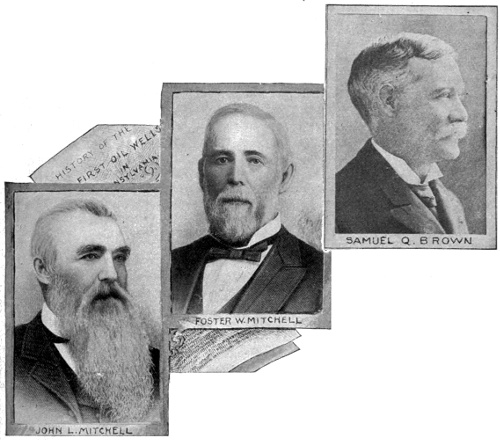
SAMUEL Q. BROWN
FOSTER W. MITCHELL
JOHN L. MITCHELL
Eight miles east of Titusville, at Enterprise, John L. and Foster W. Mitchell, sons of a pioneer settler of Allegheny township, were lumbering and merchandising in 1859. They had worked on the farm and learned blacksmithing from their father. The report of Col. Drake’s well stirred the little hamlet. John L. Mitchell mounted a horse and rode at a John-Gilpin gallop to lease Archibald Buchanan’s big farm, on both sides of Oil Creek and Cherry Run. The old man agreed to his terms, a lease was executed, the rosy-cheeked mistress and all the pupils in the log school-house who could write witnessed the signatures and Mitchell rode back with the document in his pocket. He also leased John Buchanan’s two hundred acres, south of Archibald Buchanan’s three-hundred on the same terms—one-fourth the oil for ninety years. Forming a partnership with Henry R. Rouse and Samuel Q. Brown, he “kicked down” the first well in 1860 to the first sand. It pumped ten barrels a day and was bought by A. Potter, who sank it and another to the third sand in 1861. A three-hundred-barreler for months, No. 1 changed hands four times, was bought in 1865 by Gould & Stowell and produced oil—it pumped for fifteen years—that sold for two-hundred-and-ninety-thousand dollars! This veteran was the third or fourth producing well in the region. The Curtis, usually considered “the first flowing-well,” in July of 1860 spouted freely at two-hundred feet. It was not tubed and surface-water soon mastered the flow of oil. The Brawley—sixty-thousand barrels in eight months—Goble & Flower, Shaft and Sherman were moguls of 1861-2. Beech & Gillett, Alfred Willoughby, Taylor & Rockwell, Shreve & Glass, Allen Wright, Wesley Chambers—his infectious laugh could be heard five squares—and a host of companies operated in 1861-2-3. Franklin S. Tarbell, E. M. Hukell, E. C. 150Bradley, Harmon Camp, George Long and J. T. Jones arrived later. The territory was singularly profitable. Mitchell & Brown erected a refinery, divided the tracts into hundreds of acre-plots for leases and laid out the town of Buchanan Farm. Allen Wright, president of a local oil-company, in February of 1861 printed his letter-heads “Rouseville” and the name was adopted unanimously.
Rouseville grew swiftly and for a time was headquarters of the oil industry. Churches and schools arose, good people feeling that man lives not by oil alone any more than by bread. Dwellings extended up Cherry Run and the slopes of Mt. Pisgah. Wells and tanks covered the flats and there were few drones in the busy hive. If Satan found mischief for the idle only, he would have starved in Rouseville. Stores and shops multiplied. James White fitted up an opera-house and C. L. Stowell opened a bank. Henry Patchen conducted the first hotel. N. W. Read enacted the role of “Petroleum V. Nasby, wich iz postmaster.” The receipts in 1869 exceeded twenty-five-thousand dollars. Miss Nettie Dickinson, afterwards in full charge of the money-order department at Pittsburg and partner with Miss Annie Burke in a flourishing Oil-City bookstore, ran the office in an efficient style Postmaster-General Wilson would have applauded. Yet moss-backed croakers in pants, left over from the Pliocene period, think the gentle sex has no business with business! The town reached high-water mark early in the seventies, the population grazing nine-thousand. Production declined, new fields attracted live operators and in 1880 the inhabitants numbered seven-hundred, twice the present figure. Rouseville will go down in history as an oil-town noted for progressiveness, intelligence, crooked streets and girls “pretty as a picture.”
You could always count on a lively rustle—
The boys knew how to get up and hustle,
And of course the girls had plenty of bustle.
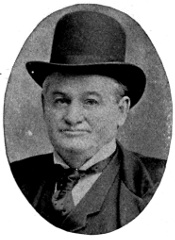
WESLEY CHAMBERS.
The Buchanan-Farm Oil-Company purchased Mitchell & Brown’s interest and the Buchanan Royalty Oil-Company acquired the one-fourth held by the land-owners. Both realized heavily, the Royalty Company paying its stock-holders—Arnold Plumer, William Haldeman and Dr. C. E. Cooper were principals—about a million dollars. The senior Buchanan, after receiving two or three-hundred-thousand dollars—fifty times the sum he would ever have gained farming—often denounced “th’ pirates that robbed an old man, buyin’ th’ farm he could ’ave sold two year later fur two millyun!” The old man has been out of pirate range twenty-five years and the Buchanan families are scattered. Most of the old-time operators have handed in their final account. Poor Fred Rockwell has mouldered into dust. Wright, Camp, Taylor, Beech, Long, Shreve, Haldeman, Hostetter, Cooper, Col. Gibson and Frank Irwin are “grav’d in the hollow ground.” Death claimed “Hi” Whiting in Florida and last March stilled the cheery voice of Wesley Chambers. The earnest, pleading tones of the Rev. R. M. Brown will be heard no more this side the walls of jasper and the gates of pearl. Scores moved to different parts of the country. John L. Mitchell married Miss Hattie A. Raymond and settled at Franklyn. He organized the Exchange Bank in 1871 and was its president until ill-health obliged him to resign. Foster W. Mitchell also located at the county-seat and 151built the Exchange Hotel. He operated extensively on Oil Creek and in the northern districts, developed the Shaw Farm and established a bank at Rouseville, subsequently transferring it to Oil City. He was active in politics and in the producers’ organizations, treasurer of the Centennial Commission and an influential force in the Oil-Exchange. David H. Mitchell likewise gained a fortune in oil, founded a bank and died at Titusville. Samuel Q. Brown, their relative and associate in various undertakings, was a merchant and banker at Pleasantville. Retiring from these pursuits, he removed to Philadelphia and then to New York to oversee the financial work of the Tidewater Pipe-Line. He procured the charter for the first pipe-line and acquired a fortune by his business-talent and wise management.
“Let Hercules himself do what he may,
The cat will mew, the dog will have his day.”
Born in New York in 1824, Henry R. Rouse studied law, taught school in Warren county and engaged in lumbering and storekeeping at Enterprise. He served in the legislatures of 1859-60, acquitting himself manfully. Promptly catching the inspiration of the hour, he shared with William Barnsdall and Boone Meade the honor of putting down the third oil-well in Pennsylvania. With John L. Mitchell and Samuel Q. Brown he leased the Buchanan farm and invested in oil-lands generally. Fabulous wealth began to reward his efforts. Had he lived “he would have been a giant or a bankrupt in petroleum.” Operations on the John Buchanan farm were pushed actively. Near the upper line of the farm, on the east side of Oil Creek, at the foot of the hill, Merrick & Co. drilled a well in 1861, eight rods from the Wadsworth. On April seventeenth, at the depth of three-hundred feet, gas, water and oil rushed up, fairly lifting the tools out of the hole. The evening was damp and the atmosphere surcharged with gas. People ran with shovels to dig trenches and throw up a bank to hold the oil, no tanks having been provided. Mr. Rouse and George H. Dimick, his clerk and cashier, with six others, had eaten supper and were sitting in Anthony’s Hotel discussing the fall of Fort Sumter. A laborer at the Merrick well bounded into the room to say that a vein of oil had been struck and barrels were wanted. All ran to the well but Dimick, who went to send barrels. Finishing this errand, he hastened towards the well. A frightful explosion hurled him to the earth. Smouldering coals under the Wadsworth boiler had ignited the gas. In an instant the two wells, tanks and an acre of ground saturated with oil were in flames, enveloping ninety or a hundred persons. Men digging the ditch or dipping the oil wilted like leaves in a gale. Horrible shrieks rent the air. Dense volumes of black smoke ascended. Tongues of flame leaped hundreds of feet. One poor fellow, charred to the bone, died screaming with agony over his supposed arrival in hell. Victims perished scarcely a step from safety. Rouse stood near the derrick at the fatal moment. Blinded by the first flash, he stumbled forward and fell into the marshy soil. Throwing valuable papers and a wallet of money beyond the circuit of fire, he struggled to his feet, groped a dozen paces and fell again. Two men dashed into the sea of flame and dragged him forth, his flesh baked and his clothing a handful of shreds. He was carried to a shanty and gasped through five hours of excruciating torture. His wonderful self-possession never deserted him, no word or act betraying his fearful suffering. Although obliged to sip water from a spoon at every breath, he dictated a concise will, devising the bulk of his estate in trust to improve the roads and benefit the poor of Warren county. Relatives and intimate friends, his clerk and hired boy, the men who bore him from the broiling 152furnace and honest debtors were remembered. This dire calamity blotted out nineteen lives and disfigured thirteen men and boys permanently. The blazing oil was smothered with dirt the third day. Tubing was put in the well, which flowed ten-thousand barrels in a week and then ceased. Nothing is left to mark the scene of the sad tragedy. The Merrick, Wadsworth, Haldeman, Clark & Banks, Trundy, Comet and Imperial wells, the tanks and the dwellings have been obliterated. Dr. S. S. Christy—he was Oil City’s first druggist—Allen Wright, N. F. Jones, W. B. Williams and William H. Kinter, five of the six witnesses to Rouse’s remarkable will, are in eternity, Z. Martin alone remaining.
Warren’s greatest benefactor, the interest of the half-million dollars Rouse bequeathed to the county has improved roads, constructed bridges and provided a poor-house at Youngsville. Rouse was distinguished for noble traits, warm impulses, strong attachments, energy and decision of character. He dispensed his bounty lavishly. It was a favorite habit to pick up needy children, furnish them with clothes and shoes and send them home with baskets of provisions. He did not forget his days of trial and poverty. His religious views were peculiar. While reverencing the Creator, he despised narrow creeds, deprecated popular notions of worship and had no dread of the hereafter. To a preacher, in the little group that watched his fading life, who desired an hour before the end to administer consolation, he replied: “My account is made up. If I am a debtor, it would be cowardly to ask for credit now. I do not care to discuss the matter.” He directed that his funeral be without display, that no sermon be preached and that he be laid beside his mother at Westfield, New York. Thus lived and died Henry R. Rouse, of small stature and light frame, but dowered with rare talents and heroic soul. Perhaps at the Judgment Day, when deeds outweigh words, many a strict Pharisee may wish he could change places with the man whose memory the poor devoutly bless. As W. A. Croffut has written of James Baker in “The Mine at Calumet”:
“‘Perfess’? He didn’t perfess. He hed
One simple way all through—
He merely practiced an’ he sed
That that wud hev to do.
‘Under conviction’? The idee!
He never done a thing
To be convicted fer. Why, he
Wuz straighter than a string.”
Seventy-five wells were drilled on Hamilton McClintock’s four-hundred acres in 1860-1. Here was Cary’s “oil-spring” and expectations of big wells soared high. The best yielded from one-hundred to three-hundred barrels a day. Low prices and the war led to the abandonment of the smaller brood. A company bought the farm in 1864. McClintockville, a promising village on the flat, boasted two refineries, stores, a hotel and the customary accessories, of which the bridge over Oil Creek is the sole reminder. Near the upper boundary of the farm the Reno Railroad crossed the valley on a giddy center-trestle and timber abutments, not a splinter of which remains. General Burnside, the distinguished commander, superintended the construction of this mountain-line, designed to connect Reno and Pithole and never completed. Occasionally the dignified general would be hailed by a soldier who had served under him. It was amusing to behold a greasy pumper, driller or teamster step up, clap Burnside on the shoulder, grasp his hand and exclaim: “Hello, General! Deuced glad to see you! I was with you at Fredericksburg! Come and have a drink!”
The Clapp farm of five-hundred acres had a fair allotment of long-lived 153wells. George H. Bissell and Arnold Plumer bought the lower half, in the closing days of 1859, from Ralph Clapp. The Cornplanter Oil Company purchased the upper half. The Hemlock, Cuba, Cornwall—a thousand-barreler—and Cornplanter, on the latter section, were notably productive. The Williams, Stanton, McKee, Elizabeth and Star whooped it up on the Bissell-Plumer division. Much of the oil in 1862-3 was from the second sand. Four refineries flourished and the tract coined money for its owners. A mile east was the prolific Shaw farm, which put two-hundred-thousand dollars into Foster W. Mitchell’s purse. Graff & Hasson’s one-thousand acres, part of the land granted Cornplanter in 1796, had a multitude of medium wells that produced year after year. In 1818 the Indian chief, who loved fire-water dearly, sold his reservation to William Connely, of Franklin, and William Kinnear, of Centre county, for twenty-one-hundred-and-twenty-one dollars. Matthias Stockberger bought Connely’s half in 1824 and, with Kinnear and Reuben Noyes, erected the Oil-Creek furnace, a foundry, mill, warehouses and steamboat-landing at the east side of the mouth of the stream. William and Frederick Crary acquired the business in 1825 and ran it ten years. William and Samuel Bell bought it in 1835 and shut down the furnace in 1849. The Bell heirs sold it to Graff, Hasson & Co. in 1856 for seven-thousand dollars. James Hasson located on the property with his family and farmed five years. Graff & Hasson sold three-hundred acres in 1864 to the United Petroleum Farms Association for seven-hundred-and-fifty-thousand dollars. James Halyday settled on the east side in 1803. His son James, the first white baby in the neighborhood, was born in 1809. The Bannon family came in the forties, Thomas Moran built the Moran House—it still lingers—in 1845 and died in 1857. Dr. John Nevins arrived in 1850 and in the fall of 1852 John P. Hopewell started a general store. Hiram Gordon opened the “Red Lion Inn,” Samuel Thomas shod horses and three or four families occupied small habitations. And this was the place, when 1860 dawned, that was to become the petroleum-metropolis and be known wherever men have heard a word of “English as she is spoke.”
Cornplanter was the handle of the humble settlement, towards which a stampede began with the first glimmer of spring. To trace the uprising of dwellings, stores, wharves and boarding-houses would be as difficult as perpetual motion. People huddled in shanties and lived on barges moored to the bank. Derricks peered up behind the houses, thronged the marshy flats, congregated on the slopes, climbed the precipitous bluffs and established a foothold on every ledge of rock. Pumping-wells and flowing-wells scented the atmosphere with gas and the smell of crude. Smoke from hundreds of engine-houses, black, sooty and defiling, discolored the grass and foliage. Mud was everywhere, deep, unlimited, universal—yellow mud from the newer territory—dark, repulsive, oily mud around the wells—sticky, tricky, spattering mud on the streets and in the yards. J. B. Reynolds, of Clarion county, and Calvin and William J. McComb, of Pittsburg, opened the first store under the new order of things in March of 1860. T. H. and William M. Williams joined the firm. They withdrew to open the Pittsburg store next door. Robson’s hardware-store was farther up the main street, on the east side, which ended abruptly at Cottage Hill. William P. Baillee—he lives in Detroit—and William Janes built the first refinery, on the same street, in 1861, a year of unexampled activity. The plant, which attracted people from all parts of the country—Mr. Baillee called it a “pocket-still”—was enlarged into a refinery of five stills, with an output of two-hundred barrels of refined oil every twenty-four hours. Fire destroyed it and 154the firm built another on the flats near by. On the west side, at the foot of a steep cliff, Dr. S. S. Christy opened a drug-store. Houses, shops, offices, hotels and saloons hung against the side of the hill or sat loosely on heaps of earth by the creek and river. One evening a half-dozen congenial spirits met in Williams & Brother’s store. J. B. Reynolds, afterwards a banker, who died several years since, thought Cornplanter ought to be discarded and a new name given the growing town. He suggested one which was heartily approved. Liquid refreshments were ordered and the infant was appropriately baptized Oil City.
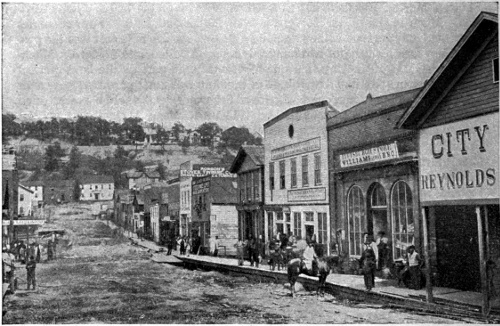
MAIN STREET, EAST SIDE OF OIL CREEK, OIL CITY, IN 1861.
Peter Graff was laid to rest years ago. The venerable James Hasson sleeps in the Franklin cemetery. His son, Captain William Hasson, is an honored resident of the city that owes much to his enterprise and liberality. Capable, broad-minded and trustworthy, he has been earnest in promoting the best interests of the community, the region and the state. A recent benefaction was his splendid gift of a public park—forty acres—on Cottage Hill. He was the first burgess and served with conspicuous ability in the council and the legislature. Alike as a producer, banker, citizen, municipal officer and lawgiver, Captain Hasson has shown himself “every inch a manly man.”
When you talk of any better town than Oil City, of any better section than the oil-regions, of any better people than the oilmen, of any better state than Pennsylvania, “every potato winks its eye, every cabbage shakes its head, every beet grows red in the face, every onion gets stronger, every sheaf of grain is shocked, every stalk of rye strokes its beard, every hill of corn pricks up its ears, every foot of ground kicks” and every tree barks in indignant dissent.
Such was the narrow ravine, nowhere sixty rods in width, that figured so grandly as the Valley of Petroleum.
155
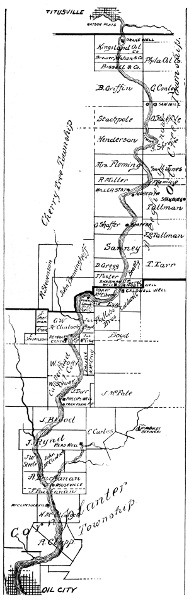
FARMS ON OIL CREEK, VENANGO COUNTY, PA., IN 1860-65.
A SPLASH ON OIL CREEK.
The dark mud of Oil Creek! Unbeautiful mud,
That couldn’t and wouldn’t be nipped in the bud!
Quite irreclaimable,
Wholly untamable;
There it was, not a doubt of it,
People couldn’t keep out of it;
On all sides they found it,
So deep none dare sound it—
No way to get ’round it.
To their necks babies crept in it,
To their chins big men stept in it;
Ladies—bless the sweet martyrs!
Plung’d far over their garters;
Girls had no exemption,
Boys sank past redemption;
To their manes horses stall’d in it,
To their ear-tips mules sprawl’d in it!
It couldn’t be chain’d off,
It wouldn’t be drain’d off;
It couldn’t be tied up,
It wouldn’t be dried up;
It couldn’t be shut down,
It wouldn’t be cut down.
Riders gladly abroad would have shipp’d it,
Walkers gladly at home would have skipp’d it.
Frost bak’d it,
Heat cak’d it;
To batter wheels churned it,
To splashes rains turned it,
Bad teamsters gol-durned it!
Each snow-flake and dew-drop, each shower and flood
Just seem’d to infuse it with lots of fresh blood,
Increasing production,
Increasing the ruction,
Increasing the suction!
Ev’ry flat had its fill of it,
Ev’ry slope was a hill of it,
Ev’ry brook was a rill of it;
Ev’ry yard had three feet of it,
Ev’ry road was a sheet of it;
Ev’ry farm had a field of it,
Ev’ry town had a yield of it.
No use to glare at it,
No use to swear at it;
No use to get mad about it,
No use to feel sad about it;
No use to sit up all night scheming
Some intricate form of blaspheming;
No use in upbraiding—
You had to go wading,
Till wearied humanity,
Run out of profanity,
Found rest in insanity;
Or winged its bright way—unless dropp’d with a thud—
To the land of gold pavements and no Oil-Creek mud!
156
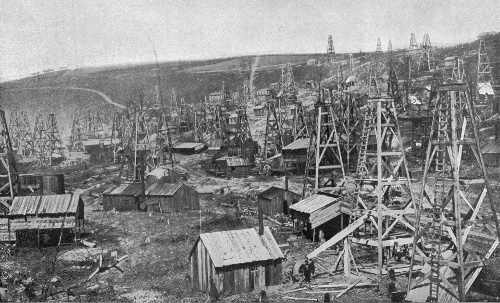
WELLS ON BENNINGHOFF RUN, VENANGO COUNTY, PA., IN 1866. [From a photograph taken one hour before they were destroyed by lightning.]
157