XV. FROM THE WELL TO THE LAMP. (continued 2)
Reading edition
John J. Fisher bought the first thousand barrels of oil in the new exchange at Oil City, on April twenty-third, 1878. Probably the largest purchase was by George Lewis, who took from a syndicate of brokers a block of two-hundred-thousand barrels. The first offer was fifty-thousand, increasing ten-thousand until it quadrupled, with the object of having Lewis cry: “Hold! Enough!” Lewis wasn’t to be bluffed and he merely nodded at each addition to the lot until the other fellow weakened, the crowd watching the pair breathlessly. “Sam” Blakeley, the most eccentric genius in the aggregation, once bid at Parker for a million barrels. Nobody had that quantity to sell and he advanced the bid five cents above the quotations. There was not a response and he offered a million barrels five cents below the ruling price, toying with the market an hour as if it were a foot-ball. He played for big stakes, but none knew who backed him. Coming to Oil City, he reported the market for the 341Derrick and cut up lots of shines. One morning he looked glum, oil had tumbled and “Sam” hired an engine to whirl him to Corry. By nightfall he landed in Canada and his oil was sold to square his account in the clearing-house. An hour after his flight William Brough came up from Franklin to take the oil and carry “Sam” over the drop. In the afternoon a sudden rise set in, which would have left Blakeley twenty-thousand dollars profit had he stayed at his post! That was the time “Sam” didn’t do “the great kibosh,” as he phrased it. For years he has been hanging around New York. He was one of the boys distinguished as high-rollers and extinguished before the shuffle ended.
Telegraph-operators and messenger-boys at the oil-exchanges learned to note the movements of leading speculators and profit thereby. Some of them, with more hope of gain than fear of loss, beginning in a small way by risking a few dollars in margins, coined money and entered the ring on their own account. “Jimmy” Lowe, one of the biggest brokers at Parker and Oil City, slung lightning for the Western-Union when the Oil-City Exchange needed the services of twenty operators and scores of messenger-boys. Among the latter was “Jim” Keene, the Franklin broker. He and John Bleakley often received fifty cents or a dollar for delivering a message to “Johnnie” Steele, who stopped at the Jones House and flew high during his visits to Oil City. Steele and Seth Slocum would dash through the mud on their black chargers, dressed in the loudest style and sporting big diamonds. These halcyon times have passed away and the oil-exchanges have departed. “The glories of our mortal state are shadows.”
In January of 1894 the Producers’ and Refiners’ Oil-Company erected an iron-tank on the hill south-east of Titusville. Lightning destroyed the tank and its contents in May. The second tank was built on the spot in October and on June twelfth, 1895, lightning struck a tree beside it. The burning tree fired the gas and the tank and oil perished. The site is still vacant, the company deciding not to give the electric fluid a chance for a third strike.
George W. N. Yost, who died in New York last year, was once the largest oil-buyer and shipper in the region. He lived at Titusville and removed to Corry, where he built the Climax Mower and Reaper Works, a church, a handsome residence and blocks of dwellings. Patents of different kinds recouped losses in manufacturing. With Mr. Densmore, of Meadville, he brought out the caligraph. Yost sold to his partner and developed the Yost Typewriter, organized the American Writing-Machine Company and fitted up the shops at Bridgeport, Connecticut, used to manufacture Sharp’s rifles during the border-troubles in Kansas. Mr. Yost was a man of striking personality and unflagging energy. He became a strong spiritualist and believed a medium, to whom he submitted completely, put him in communication with his dead relatives and recorded their thoughts on his typewriter.
The men of the oil-region have ever been noted for their commercial honor. It passed into a proverb—“honor of oil.“ The spirit of the saying, “his word is as good as his bond,” has always been lived up to more closely in Oildom than in any other section of the country. The force of business-obligation ran high in the exchanges and among the early dealers in crude. Transactions involving hundreds-of-thousands of dollars occurred every day, without a written bond or a scrap of paper save a pencil-entry in a memorandum-book. Certificates were borrowed and loaned in this way and the idea of shirking a verbal contract was never thought of. The celerity with which property thus 342passed from man to man was one of the striking features of business in the bustling world of petroleum. And the record is something to be proud of in these days of embezzlements, defalcations, breaches of trust and commercial deviltry generally.
The average tank-steamer carries about two-million gallons of oil in bulk across the Atlantic. In addition to this fleet of steamers, scores of sailing vessels, under charter of the Orient, France, Italy and foreign countries, load cases and barrels of refined-oil for transport to European ports. American wooden-ships are chartered sometimes to convey oil to Japan. Thus Russian competition is met through the instrumentality of pipe-lines to the coast and transportation by water to points many thousand miles away from the wells that produced the oil.
The production of crude-petroleum in the United States in 1895, according to the statistics compiled for the Geological Survey by Joseph D. Weeks, was fifty-three-million barrels, valued at fifty-eight-million dollars. For 1894 the figures were fifty-million barrels and thirty-five-million dollars respectively. All districts except West Virginia and New York shared in the increase. The total production from the striking of the Drake well in 1859 to the end of 1895 was seven-hundred-and-ten-million barrels. Five-hundred-and-seventeen-million barrels of this enormous aggregate represent the yield of the Pennsylvania and New-York oil-fields. Who says petroleum isn’t a big thing?
At Pittsburg you can easily gather a little group of men, such as Charles Lockhart and Captain Vandergrift, who recall the time when the Tarentum petroleum was termed “a mysterious grease.” They had a hand in handling it when the oil had no commercial name. They watched Samuel M. Kier’s efforts to give it a commercial name and a marketable value. They saw it run to waste at first, they remember paying a dollar a gallon for it and can tell all about Drake’s visit to Tarentum. They hold their breath when they think of the gold that changed hands in Venango county after “Uncle Billy” Smith bored the seventy-foot hole below Titusville, of the wonderful spread of operations and the dazzling progress of the commodity once despised. They noted the flow of petroleum toward Europe—how forty casks were sent to France in 1860 as a curiosity and thirty-nine-hundred in 1863 as a commercial venture. They have seen this “mysterious grease,” that used to flow into the Pennsylvania Canal, light the world from the Pyramids of Egypt to the salons of Paris, from the shores of Palestine to the Chinese Wall. They have seen the four salt-and-oil wells at Tarentum and the solitary oil-well at Titusville multiplied into a hundred-thousand holes drilled for petroleum and a production almost beyond calculation. Do the gentlemen composing this little group occupy a position dramatic in the marvelous events they review? Is petroleum freighted with interest and a touch of romance at every step of its passage from the well to the lamp?
343
MERELY DROPPED IN.
To big oil-wells a man may be a claimant,
From the sand-rock take in enormous payment,
Yet all he gets on earth is food and raiment.
The good well is the humble bee
With honey on its wings;
The dry-hole is the bumble-bee
That buzzes loud and stings.
Oilmen who run in debt, despite their rapid talk,
Not very often come out faster than a walk.
Uneasy lies the face that wears a frown;
No wonder, at the rate crude-oil goes down.
“What are your favorite books?” the gushing damsel cried;
“Bank-books and pocket-books,” the oilman quick replied.
Idle gossip? Oh, no, that isn’t right,
For gossip keeps on working day and night,
Beating a flowing oil-well out of sight.
The driller mutter’d, as he stagger’d with unsteady gait,
“There is no evil mixture here, I took my whisky straight.”
Of all uncertain kinds of biz
An oilman’s most uncertain is;
To-day, perhaps, his anguish’d soul
Laments because of a dry-hole;
He tries again, and who can tell
But he may strike a flowing-well?
Sound money? Yes indeed; no oilman has a doubt
The coin that jingles is the “soundest” money out.
Who with himself is satisfied
Wants little here below;
He has a small excuse for pride,
For if the third-sand once he tried
He might find a poor show.
The fabric of the clothing may not wear a little bit,
But the clothier’s fabrications will outlast Berea grit.
“Pay as you go.” We will, for all the oilmen know
All men must pay the debt of nature as they go.
The gusher and the duster
May be on one town-plot,
Angels and devils muster
Upon the self-same lot,
And sobs and smiles may cluster
Like flies on one bald spot.
Rare goodness and tough badness
May come from the same shank,
Twin-links of grief and gladness
Be issued by one bank,
For tears of joy and sadness
Still flow from the same tank.
“A rolling stone gathers no moss,” for trying junctures
May some wildcatters fit;
But then it is the rolling wheel that gathers punctures,
Which makes the old saw nit.
Be not a spouting well that keeps an endless flow;
It isn’t always wise to tell all that you know,
But all you tell be mighty sure it’s truly so.
“Young Luckyboy made fifty-thousand plunks
From one small can of crude,”
The oilman said, while silence lay in chunks;
“I pray don’t think me rude”—
A list’ner spoke—“It strikes me you’re a man
Must practice on the lyre.”
The oilman smil’d: “His rich aunt used the can
To hurry up the fire!”
He put the glycerine to thaw, the water was too hot,
The stuff let go; it was the man, and not the well, was shot.
“No!” said the oilman’s daughter, when young Dudelet sought her hand,
“You may have lots of money, but you haven’t got the sand.”
Why are proof-readers needed, those careless printers’ terrors?
Because our first impressions are often full of errors.
344
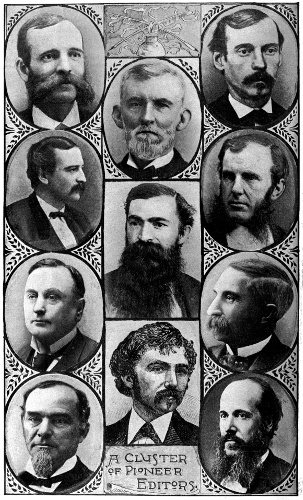
A CLUSTER OF PIONEER EDITORS.
COL. LEE M. MORTON.
W. H. LONGWELL.
WARREN C. PLUMER.
COL. J. T. HENRY.
WALTER R. JOHNS.
MAJOR W. W. BLOSS.
J. H. BOWMAN.
L. H. METCALFE.
C. E. BISHOP.
HENRY C. BLOSS.
COL. M. N. ALLEN.
345