Front matter
Reading edition
SERGEANT J.B. GILLETT, TEXAS RANGER IN 1879
SIX YEARS WITH THE TEXAS RANGERS
1875 TO 1881
BY
JAMES B. GILLETT
Ex-Sergeant Company "A," Frontier Battalion
Von Boeckmann-Jones Co., Publishers Austin, Texas
Copyright 1921
by
James B. Gillett
TO MY OLD RANGER COMRADES WHEREVER THEY MAY BE
FOREWORD
To write a true and complete history of the Texas Rangers as a state organization would require much time and an able historian. I am not a historian and could not undertake such an exhaustive treatise, which would fill several volumes the size of this, and it is only at the earnest solicitation of my children, frontier friends, and old comrades that I have undertaken to write a short history of the rangers during the years I served with them. This little volume, then, has only the modest aim of picturing the life of the Texas Rangers during the years 1875-1881. I cannot, at this late date, recount in detail all the scouts that were made while I was in the service. I have, therefore, confined myself principally to the description of those in which I was a participant. Naturally, I remember those the best.
It has been said that truth never makes very interesting reading. Of the accuracy of this dictum I leave my readers to judge, for I have told my story just as I remember it, to the very best of my ability and without any effort to embroider it with imagination. If I can interest any of my old ranger comrades or even just one little boy that loves to read about a real frontier, I will feel amply repaid for all the time, trouble and expense expended in presenting this work.
I wish sincerely to thank Miss Mary Baylor for placing at my disposal all the books and papers of her distinguished father, Captain G.W. Baylor. And I would be an ingrate, indeed, did I fail here to record my obligation to my wife without whose inspiration and sympathetic encouragement this book had never been written.
That I might show the training of the typical Texas Ranger, I have ventured to include a short biography of my own life up to the time I became a ranger, June 1, 1875.
TABLE OF CONTENTS
ChapterPage
I The Making of a Ranger 11
II The Texas Rangers 29
III I Join the Rangers 41
IV My First Brush With the Indians 55
V The Mason County War 72
VI Major Jones and His Escort 81
VII The Horrell-Higgins Feud 103
VIII Service With Reynolds, the Intrepid 118
IX Sam Bass and His Train Robber Gang 155
X A Winter of Quiet and a Transfer 183
XI The Salt Lake War and a Long Trek 192
XII Our First Fight With Apaches 212
XIII Scouting in Mexico 225
XIV Treacherous Braves, a Faithful Dog, and a Murder 237
XV Victorio Becomes a Good Indian 251
XVI Some Undesirable Recruits 264
XVII Last Fight Between Rangers and Apaches 278
XVIII An International Episode 293
XIX Last Scoutings 309
XX Fruits of Ranger Service 322
LIST OF ILLUSTRATIONS
Sergeant J.B. Gillett_
General Jno. B. Jones_
Captain D.W. Roberts_
Captain Neal Coldwell_
Lieutenant N.O. Reynolds_
Captain Geo. W. Baylor_
Dallas Stoudenmire_
James B. Gillett
SIX YEARS WITH THE TEXAS RANGERS
CHAPTER I
THE MAKING OF A RANGER
The greatest shaping force in human life is heredity, and from my father I inherited my love of the open frontier and its life of danger and excitement. This inheritance was further strengthened by environment and training, and finally led me to embrace the life of the Texas Ranger. My father, James S. Gillett, was himself a frontiersman, though born in the quieter, more settled east. At a very early age his parents emigrated from his birthplace in Kentucky and moved to Missouri. Here, after a short time, they died and the young orphan lived with a brother-in-law. When still quite a youth my father, with three other adventurous Missourians, set out on an expedition to Santa Fe, New Mexico. While passing through Indian Territory, now the State of Oklahoma, the little party was captured by the Osage Indians. Fortunately for the youngsters, their captors did them no harm, but turned them loose after two weeks' imprisonment in the redskin camp.
Despite this first setback my father persevered and reached Santa Fe. Here he lived several years and mastered the Spanish language. Not long afterward the emigrating fever again caught him up and he journeyed to Van Buren, Arkansas. While living there he studied law and was admitted to the bar. Shortly thereafter he removed to Paris, Texas, from which he was elected to the Texas Legislature as representative for Lamar and adjoining counties.
When Texas entered the Union and brought on the Mexican War with the United States, my father enlisted in 1846 and rose to the rank of major. In 1854 he was Adjutant-General of Texas. Between 1859 and 1860, during the governorship of Sam Houston, my father was quartermaster of a battalion of rangers, thus making it natural that I should also feel drawn toward this famous organization.
At the beginning of the Civil War my father was beyond military age,—he was born in 1810—but as the South became hard pressed for men he enlisted in the spring of 1864 and served in Captain Carington's company until the end of the war.
In 1850, a few years before he became Adjutant-General, my father married Miss Bettie Harper, then a resident of Washington County, Texas. My mother's father, Captain Harper, was a southern planter who emigrated from North Carolina between 1846 and 1848, and, settling in Washington County, established a Dixie plantation with a hundred slaves. My mother was a highly cultivated and refined woman. On her marriage she brought several negro servants with her to her new home in Austin. Of her union with my father five children were born. The first two, both boys, died in infancy. I was the fourth child born to my parents, and first saw the light of day in Austin, Texas, on November 4, 1856. An older sister, Mary, and a younger, Eva, survived to adulthood.
At the close of the Civil War my father returned to his family pretty well broken in health and probably also in spirit. His slaves were all freed and his land holdings, about two hundred acres of cedar land, some five or six miles from Austin, and a tract of pine land in Grimes County, Texas, were not very productive. There was not much law practice in Austin in the early post-war days, but my father set to work resolutely to provide for his family. Though I did not realize it then, I now know that he had a hard struggle. I was only eight and a half years old when father returned to us from the Confederate Army, but I remember he used to amuse himself by relating to us vivid accounts of his Indian fighting and frontier adventures. What heredity gave me a predilection for was strengthened by these narratives, and I early conceived a passionate desire to become a frontiersman and live a life of adventure.
In those early days in Texas there were no free schools in Austin, so my father sent the three of us, Mary, Eva, and myself, to the pay schools. None of these was very good, and I lost nearly two years at a German school, trying to mix German and English. I have never been of a studious nature—the great out of doors always called to me, and I found the desk's dead wood particularly irksome. When school closed in the early summer of 1868, like some of Christ's disciples, I went fishing and never attended school an hour thereafter. For books I substituted the wide-open volume of nature and began the life of sport and freedom that was to prepare me later for service with the rangers.
As poor as he was my father always kept a pony, and I learned to ride almost before I could walk. Raised on the banks of the Colorado River, I learned to swim and fish so long ago that I cannot now remember when I was unable to do either. I fished along the river with a few hand lines and used to catch quantities of gaspergou or drums. These were fine fish and sold readily on the streets of Austin, so I soon saved money enough to buy a small skiff or fishing boat. I now bought a trot line with a hundred hooks and began fishing in real earnest. About five or six miles below Austin on the Colorado was Mathews' mill. Just below the dam of this mill the fishing was always good, and here I made my fishing grounds. I had a large dry goods box with inch auger holes bored in it. This box, sunk in the river and secured by a rope tied to a stob, made a capital trap, and into it I dropped my fish as they were caught. In this way I kept them alive and fresh until I had enough to take into town.
Many free negroes were farming along the banks of the Colorado, and I would hire a pony of them for twenty-five cents a trip when I was ready to take my catch into town. Many times I have left the river by starlight and reached the Old Market House at Austin at dawn, spread out a gunny sack, bunch my fish and be ready for the first early marketers. I kept up my fishing until the fish stopped biting in the fall of 1868.
Confederate soldiers returning home from the war brought with them many old Enfield muskets. These were smooth bore and chambered one large ball and three buckshot. These old guns, loaded with small shot, were fine on birds and squirrels, but they had one serious objection—they would kick like a mule. As the boys used to say, they "would get meat at both ends!" A day's shooting with one of these muskets would leave one's shoulder and arm black and blue for a week.
When fishing failed I decided to become a hunter, and bought one of these old guns for $3.50. It was as long as a fence rail, and at my age I could not begin to hold it out and shoot off hand, so I had to use a rest. The Enfield musket had the longest barrel I ever saw on a gun, and the hammer was as long as a man's hand. I could cock my gun with both hands, but if I failed to get a shot I was not strong enough to let the hammer down without letting it get away, so I had to carry it cocked to keep from losing the cap. I would take it off the tube and put it in my pocket until I had a chance for another shot. I remember once when I cocked my musket I could see no cap on the tube and, thinking it had fallen off, I pulled the trigger. The cap had stuck up in the old hammer and the gun roared like a cannon. I was always sure to look for the cap after this. I did not make much headway using this kind of weapon, but it taught me the use and danger of firearms,—a knowledge I was to find very useful in later years.
When fishing opened up in the spring of 1869 I returned to my fishing lines, and in the fall of the same year I bought a double-barreled shotgun for $12. With it I killed quail, ducks and other small game, all of which I sold on the streets of Austin. By the fall of 1870 I was fourteen years old and could handle a gun rather well for one of my age.
Early that winter wild geese came south by the hundreds. I used to hunt them down the Colorado River, ten or twelve miles below Austin. The birds would feed in the corn fields in the early morning, then flock to the sand bars in the river during the middle of the day. There was nothing silly about those geese, for they were smart enough to frequent only the big islands, three or four hundred yards from any cover. It was impossible to reach them with any kind of a shotgun. I used to slip up to them as close as I could and watch them for hours, trying to think of some plan to get within gun shot of them. I saw as many as a thousand geese on those bars at a single time. I have thought regretfully of those birds many times since, and have wished I could have shot into one of those flocks with a modern rifle—I could have killed a dozen geese at a shot.
In the spring of 1871 I had my first trip to the frontier of Texas. My father traded some of his Grimes County pine land for a bunch of cattle in Brown County, and took me with him when he went to receive the herd. This was the first time I had ever been twenty-five miles from Austin. I was delighted with the trip, the people, and the country. Those big, fine frontiersmen, each wearing a pair of sixshooters and most of them carrying a Winchester, fired my boyish imagination. Their accounts of frontier life and their Indian tales fascinated me. I wanted to stay right there with them and lost all interest in ever living in town again. During the same year my father drove several bunches of cattle to Austin and I helped him on those drives. Thus I began to be a cowboy,—my first step toward the life of the open, upon which I had set my heart.
In the summer of 1872 my mother's health began to fail and my father took her to Lampasas Springs. The water seemed to help her so much that he decided to make Lampasas our home. At that time Lampasas County was strictly a cattle country, but there was not much cow hunting during the winter in those days. The cattlemen and the cowboys spent a good deal of time in town just having a good time. During this period I became well acquainted with them. In the spring of 1873 my father made a trip back to Austin on some business. The frontier had been calling to me ever since my first visit there, and I now took advantage of my father's absence to slip out to Coleman County, at that time on the frontier of Texas.
Monroe Cooksey and Jack Clayton had bought a bunch of cattle in Coleman County and I saw the outfit when it left Lampasas. I was slightly acquainted with most of the men in this outfit, so I decided to follow it and try to get work. It was an Indian country every step of the way, and I was afraid to make the trip alone. In a day or two I met a man named Bob McCollum. He was hauling a load of flour to Camp Colorado and let me travel with him. I bade my mother and sisters good bye and did not see them again until the next December.
We reached old Camp Colorado without mishap in about five days. Clayton and Cooksey's outfit was there loading up supplies for the spring work. I stood around watching the cowboys making their preparations, but lacked the courage to ask them for work. Finally, the outfit started down on Jim Ned Creek to camp for dinner. I went with the men and at last got up spunk enough to ask Mr. Monroe Cooksey for a job. He looked at me for a minute and then asked, "What kind of work can a boy of your size do?"
I told him I was willing to do anything a boy of my age could do. He made no reply and we went on and camped for dinner. After dinner the men made ready to go over on Hoard's Creek to camp for the night. The boys made a rope corral and began to catch their mounts. I just stood there like an orphan watching them. Presently Mr. Cooksey dashed his rope on a heavy set bay horse. The animal showed the whites of his eyes, made a rattling noise in his nose and struggled so violently that it took three men on the rope to hold him. Mr. Cooksey then turned to me and said, "Here, boy, if you can ride this * * * (giving an unmentionable name to the horse) you have a job cinched."
I turned, grabbed my saddle, bridle and blanket and started to the animal. An elderly man in the outfit headed me off.
"Young man," he said, "this is an old spoiled horse, and unless you are a mighty good rider you had better not get on him."
I brushed him aside.
"Pshaw, I'm hunting work, and while I'm not a broncho buster, I will make a stab at riding him if he kills me."
By this time one of the boys had caught the horse by both ears and was holding him fast. They threw my saddle on him, tightened up the cinch, and finally, after much trouble, got the bridle on him and lifted me into the saddle. When I had fixed myself as best I could they let the animal go. He made two or three revolting leaps forward and fell with his feet all doubled up under him.
Mr. Cooksey seemed to realize the danger I was in, and shouted to me to jump off. Before I could shake myself loose the old horse had scrambled to his feet and dashed off in a run. I circled him around to the remuda and rode him until night without further trouble. I had won my job, but it was a dirty trick for a lot of men to play on a boy, and a small boy at that. However, to their credit, I wish to say they never put me on a bad horse again but gave me the best of gentle ponies to ride.
Our first work was to gather and deliver a herd of cattle to the Horrell boys, then camped on Home Creek. We worked down to the Colorado River, and when we were near old Flat Top ranch the men with the outfit left me to drive the remuda down the road after the mess wagon while they tried to find a beef. I had gone only a mile or two when I saw a man approaching me from the rear. As he came up I thought he was the finest specimen of a frontiersman I had ever seen. He was probably six feet tall, with dark hair and beard. He was heavily armed, wearing two sixshooters and carrying a Winchester in front of him and was riding a splendid horse with a wonderful California saddle. He rode up to me and asked whose outfit it was I was driving. I told him Cooksey and Clayton's. He then inquired my name. When I told him he said, "Oh, yes; I saw your father in Lampasas a few days ago and he told me to tell you to come home and go to school."
I made no reply, but just kept my horses moving. The stranger then told me his name was Sam Gholston. He said it was dangerous for one so young to be in a bad Indian country and unarmed, that the outfit should not have left me alone, and counselled me to go back to my parents. I would not talk to him, so he finally bade me good bye and galloped off. His advice was good, but I had not the least idea of going home—I had embraced the frontier life.
The Cooksey and Clayton outfit did not stay in the cow business long. After filling their contract with the Horrell boys they sold out to Joe Franks. I suppose I was sold along with the outfit, at least I continued to work for Mr. Franks. A kinder heart than that of Joe Franks never beat in a human breast. He was big of stature and big of soul. He seemed to take an interest in his youthful cow-puncher, and asked me where I was raised and how I came to be away out on the frontier. As cold weather came on that fall he gave me one of his top coats. It made a pretty good overcoat for me and came down quite to my knees. The sleeves were so long I could double them up and hold my bridle reins, and in one garment I had both coat and gloves.
During the summer of 1873 John Hitsons, Sam Gholston and Joe Franks were all delivering cattle to old John Chislom, whose outfit was camped on the south side of the Concho River, about where the town of Paint Rock now stands. The other outfits were scattered along down the river about half a mile apart. There were probably seventy-five or a hundred men in the four camps and at least five hundred horses. One evening just after dark the Indians ran into Gholston's outfit, captured about sixty head of horses and got away with them. The redskins and the cowboys had a regular pitched battle for a few moments, probably firing two hundred shots. This fight was in plain view of our camp and I saw the flash of every gun and heard the Indians and the cowboys yelling. One of Mr. Gholston's men received a flesh wound in the leg and several horses were killed. Two nights later the Indians ran upon Franks' outfit and tried to take our horses. Bob Whitehead and Pete Peck were on guard and stood the redskins off. We saved our horses by keeping them in a pen for the remainder of the night. I was beginning to get a taste of frontier life early in the game.
For years cattle had drifted south into Menard and Kimble Counties, and Joe Franks was one of the first of the Coleman County outfits to go south into the San Saba and Llano country. He worked the Big and Little Saline Creeks, the Llano and San Saba Rivers and found many of his cattle down there. By the last of November he had about finished work for the year, and, gathering three hundred fat cows to drive to Calvert, Texas, he left John Banister down on the Big Saline to winter the horses.
I passed through Lampasas with these cows, and saw my mother and sisters for the first time in nine months. When we reached Bell County a cow buyer met us and bought the cows at $10 per head. He just got down off his horse, lifted a pair of saddle bags off and counted out three thousand dollars in twenty dollar gold pieces, and hired some of the boys to help him drive the cattle into Calvert. Mr. Franks, with most of the outfit, turned back to Lampasas. When he settled with me Mr. Franks owed me just $200, and he handed me ten twenty dollar gold pieces. It was the most money I had ever earned and almost the greatest amount I had seen in my life.
I spent December and January at home, and early in February, 1874, I started back to Menard County with Mr. Franks, as he was anxious to begin work as early in the spring as possible. When we reached Parsons Ranch on the Big Saline we learned that the Indians had stolen all his horses,—seventy-five or eighty head, and he had left only eight or ten old ponies. Mr. Franks sent Will Banister and myself back to Coleman County to pick up ten or twelve horses he had left there the year before, while he himself returned to Lampasas and Williamson Counties to buy horses.
This trip from Menard County to Coleman County, a distance of about one hundred and fifty miles, was rather a hazardous trip for two boys to make alone. However, we were both armed with new Winchesters and would have been able to put up a stiff fight if cornered. Our ponies were poor and weak, so that it would have been impossible for us to have escaped had we met a band of Indians. And this is what we came very near doing.
There was no road from Menard to Coleman at that time, so we just traveled north. I had cow hunted over most of that country the year before and knew by landmarks pretty well how to go. We reached the head of Big Brady Creek one evening while a cold north wind was blowing. We camped for the night right down in the bed of a dry creek to get out of the wind. We saddled up next morning and had not gone more than a hundred and fifty yards from camp before we discovered where sixteen or seventeen Indians had just gone along,—at least there was that number of pony tracks. These redskins had hopped a skunk, gotten down and killed it with a chunk of wood. When we found the body it had scarcely quit bleeding. We saw moccasin tracks as if the savages had all gotten off their ponies for a few moments. Banister and I made the trip safely, and returned to Menard County early in March. Mr. Franks soon came with a new bunch of horses, and we went right to work gathering and delivering cattle.
About the first of June, Bee Clayton came to the outfit from Lampasas County and told me my father had been dead more than a month. Mr. Franks settled with me and I started for home the next day. Upon reaching Lampasas I began work with Barrett and Nicholls' outfit. They were the biggest cattle owners in that country and ran three large outfits, one in Llano County, one in San Saba County, and another in Lampasas. I worked with the last mentioned outfit that I might be near my mother and sisters.
I had now become familiar with most aspects of frontier life. I had cow punched and seen Indian raids, but I had not yet met the Texas "bad man"—the murderer and the bandit. My education was not long neglected, for it was while working with Barrett and Nicholls that I made my acquaintance with gentry of that ilk. One day five or six of our boys were sitting down in a circle eating on a side of calf ribs. One of the men, Jack Perkins, suddenly became involved in an altercation with Levi Dunbar, and, without warning, jerked out his six-shooter and shot him to death. In rising to my feet I had my right shoulder powder burned.
I stayed with Barrett and Nicholls until they quit work about December 1, 1874. In those days cattle were not worked much in the winter months, so I spent the winter at home. By spring I had become as restless as a bear and longed to get back to the frontier. Finally I could stand the idleness no longer and told my mother I was going back to Menard County to work for Mr. Franks. I reached the town of Menardville early in March, 1875. There I learned that Joe Franks was then at work on South Llano in Kimble County, about sixty miles from Menard. Wess Ellis had just bought the Rufe Winn stock of cattle and was ready to start on a cow hunt. He wanted me to work for him, declaring he could pay me as much as Joe Franks or anybody else, so I hired to him for $30 a month,—the top wages for a cowboy at that time.
During the year I was at home a company of Texas Rangers commanded by Captain Dan W. Roberts had been stationed over on Little Saline. This company received its mail at Menardville, and I became acquainted with this famous organization. Their free, open life along the frontier had fired me with longing to become one of them and join in their adventurous lives. In the spring of 1875 the Governor of Texas authorized Captain Roberts to increase his command to fifty men. Almost immediately Captain Roberts announced in Menardville and vicinity that he would enlist twenty good men on June 1st to bring his company to full strength. Here was my opportunity, and I decided I would be one of those twenty recruits.
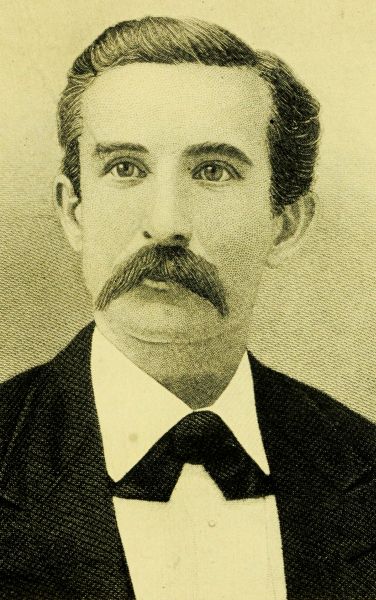
Jno. B. Jones
CHAPTER II
THE TEXAS RANGERS
The Texas Rangers, as an organization, dates from the spring of 1836. When the Alamo had fallen before the onslaught of the Mexican troops and the frightful massacre had occurred, General Sam Houston organized among the Texan settlers in the territory a troop of 1600 mounted riflemen. This company, formed for the defense of the Texan borders, was the original Texas Ranger unit, and it is interesting to note that the organization from its very inception to the present moment has never swerved from that purpose—the protection of Texan borders, whether such protection be against the Indian, the bandit or marauding Mexicans from beyond the Rio Grande. This little troop of rangers won everlasting laurels in its stand against Santa Anna at the battle of San Jacinto.
When the Republic of Texas was organized in December, 1837, the new state found herself with an enormous frontier to protect. To the south was the hostile Mexico while to the west and northwest roved the Indian and the bandit. To furnish protection against such enemies and to form the nucleus of a national standing army the ranger troop was retained. During the seven years that Texas had to maintain her own independence before she was admitted into the American Union, her rangers repelled hordes of Mexicans, fought the murderous Apaches, Comanches, and Kiowas, and administered justice on a wholesale plan to a great number of outlaws and ruffians that had flocked pell mell into the new Republic from the less attractive parts of the United States.
So vital was the service rendered by the rangers in protecting the lives and property of the settlers along the frontiers of the state that Texas retained twelve hundred rangers as mounted police for patrol of the Mexican border and as a safeguard against the savage redskins of the southwest. When the Civil War broke out between the North and the South, Texas was drawn into the conflict on the side of the Confederacy. General Con Terry, an old ranger, organized the famous body of men known as Terry's Texas Rangers. This command was composed almost exclusively of ex-rangers and frontiersmen. From Bull Run to Appomattox this ranger troop rendered gallant service, and lost seventy-five per cent of its original muster roll. General Sherman, in his memoirs, speaks admiringly of the bravery of the rangers at the battle of Shiloh.
Return to peace and the days of reconstruction did not do away with the necessity for the service that could only be rendered by the ranger. Banditry, Indian uprisings and massacres, cattle thievery, all flourished, for the bad man confidently expected the post-war turmoil would protect him from punishment for his misdeeds. He was to be undeceived, for the rangers effectively taught him that they were in the state for the purpose of protecting lives and property, and right royally did they perform that duty. From 1868 to 1873 the ranger companies were gradually reduced from one thousand to about three hundred men.
The Federal Government adopted a most unfortunate policy toward the Indians after the war. The tribes were removed to reservations and rationed as public charges. Unscrupulous dealers, in their desire for gain, illegally sold firearms to the Indians, and whenever a redskin massacred a frontiersman he was sure to capture good weapons, so that they soon became well armed and very expert in handling their new weapons. As no attempt was made to confine them to the reservation limits, the redskins, under their native chiefs, were always sneaking off and raiding West Texas. These marauders stole thousands of horses and cattle, and did not hesitate to murder and scalp the defenseless people along the frontier. Numbers of women and children were carried off as captives, a very small proportion of which were subsequently ransomed. Repeated complaints to Washington brought no redress. Indeed, some of the government officials calmly declared that the Indians were doing no harm—it was white men disguised as redskins that caused the trouble!
In 1874 conditions along the frontier had become so acute that the need for an organized mounted police for the protection of the settlers against the continued Indian raids became apparent. As in the past the state looked again to her rangers. Early in 1874, during the administration of Governor Richard Coke, the first Democratic governor since secession, the Legislature appropriated $300,000 for frontier defense, thus authorizing the formation of the Texas Rangers as now constituted. The governor immediately issued a call for four hundred and fifty volunteers. These were formed into six companies of seventy-five men each. Each of these units was officered by a captain and a first and second lieutenant. The companies were designated A, B, C, D, E, and F, and received the official name of the Frontier Battalion of Texas Rangers. Major John B. Jones of Corsicana, Texas, was commissioned major of the command. At this time the captains received a salary of $100 per month, lieutenants $75, sergeants $50, and corporals and privates $40. Subsequently, as the Legislature continually sliced into the ranger appropriation, the pay of the private was reduced to only $30 a month, a mere pittance for the hazardous service demanded of them.
Early in 1874 the force took the field, and each company was assigned a definite territory along the frontier. Company "A," being the northernmost company, was camped on the main fork of the Brazos River; Company "F," the southernmost, was stationed on the Nueces River. The remaining four companies were posted along the line between the two commands mentioned about one hundred and twenty-five miles apart, so that the battalion of four hundred and fifty men was required to cover a frontier of between five and six hundred miles.
Major Jones was a very able commander, and quickly won the confidence of his men and of the people along the border he was sent to protect. The frontiersmen cooperated with him in every way possible, sending runners to the various ranger camps whenever an Indian trail was found or a bunch of horses stolen. During the very first six months of its existence nearly every company in the battalion had had an Indian fight and some of them two or three. This command finally cleared the Texas frontier of the redskins and then turned its attention to the other pests of the state,—thieves, bandits, and fugitives from justice. In this work the ranger rendered service second to none, and became in an incredibly short time the most famous and the most efficient body of mounted police in the world.
Between 1865 and 1883 the Texas Rangers followed one hundred and twenty-eight Indian raiding parties, and fought the redskins in eighty-four pitched battles. During this same period they recovered six thousand stolen horses and cattle and rescued three citizens carried off by Indians. In this period twelve rangers were killed. Despite this record of service, the Legislature at Austin could not always be made to see the advantages,—nay, the necessity,—for a ranger force, and it was continually tinkering with the appropriations for the support of the force. When the appropriation was small the command was reduced to keep within the expenditure doled out by the parsimonious solons, and recruited to full strength whenever the lawmakers could be prevailed upon to increase the annual ranger budget.
By 1885 conditions had changed. Texas was no longer endangered by Indians, for the rangers had done much to convert the red devils into good Indians,—that is, into dead ones. Although the Indians had utterly disappeared from the state, the activities of the rangers did not cease. The white "bad man" who had stirred up the first Indian troubles now began to plunder and murder his own race and indulge in every form of lawlessness. From hunting the murderous redskins the rangers became now stalkers of the man-killers and those who despoiled their neighbors of their property. The local legal authorities could not or would not handle this task themselves, so the rangers were made peace officers and given the right of arrest without warrant in any part of the state. They then became mounted constables to quell disorder, prevent crime and bring criminals to justice and assist the duly constituted authorities in every way possible. This new work was less romantic than the old Indian warfare, but it was every bit as dangerous and as necessary in the building up of the fast developing state. As in every other task assigned him the ranger did his duty fearlessly and well. Between 1889 and 1890 the rangers made five hundred and seventy-nine arrests, among them seventy-six murderers. With the coming of the railroads the rangers began to use them, as they permitted speed and the covering of greater distances than were possible on horseback. Moreover, commands could be dispatched from one part of the state to another as occasion demanded. This greater mobility led to larger usefulness and increasing number of arrests by the ranger forces.
The outbreak of the Spanish-American War found the ranger ready and anxious for service in the defense of the Union. Large numbers of them were enlisted in the world famous Rough Riders.
"I have heard from the lips of reliable rangers," declared General Miles, in speaking of the ranger service in Cuba, "tales of daring that are incomparable. It is indeed too bad that the world knows so little about those marvelous men. There have been hosts of men among the Texas Rangers who were just as nervy as Davy Crockett, Travis, or Bowie at the Alamo."
Thanks to her rangers, Texas is now one of the most law-abiding, most orderly states in the Union. And, today, more than forty-six years since the organization of the battalion, the state still maintains a tiny force of rangers numbering sixty-three officers and men. In 1920-21, the battalion was composed of a headquarters company and Companies A, C, D, E, and F. As in the beginning of its history, the force is stationed along the frontier. The headquarters company, under command of Captain J.P. Brooks, was stationed at Austin and used for emergency calls. Company "A," stationed at Presidio, and commanded by Captain Jerry Gray, patrols the border between El Paso, Presidio, and Jeff Davis Counties and the back country southward. Company "E," Captain J.L. Anders, patrols the line of Presidio and Brewster Counties to the line of Terrell and Val Verde Counties and eastward. Company "F," under Captain W.W. Davis, was stationed at Del Rio and covered the line from Terrell and Val Verde Counties down the river to the line between Maverick, Dimmit and Webb Counties and the back country. Under the command of Captain William Ryan, Company "C" was located at Laredo and patrolled the line of Maverick, Dimmit and Webb Counties to the line of Zapata and Starr Counties and the back country, while Company "D," stationed at Brownsville, under Captain W.L. Wright, patrols from the line of Zapata and Starr Counties down the Rio Grande to its mouth and the adjacent back country.
Sketchy as has been this history, it will show a ranger record of continuous duty throughout the forty-six years of its existence in guarding the lives, the liberty and the property of Texas citizens. And the ranger has been content to perform his duty unheralded and almost unsung. Performance of duty, it matters not where it may lead him, into whatever desperate situation or howsoever dangerous the thing demanded, has always been the slogan of the organization. For courage, patriotic devotion, instant obedience and efficiency, the record of the Texas Ranger has been equalled by no body of constabulary ever mustered.
Though formed into military units and officered as a soldier, the ranger is not a military man, for scant attention is paid to military law and precedent. The state furnished food for the men, forage for their horses, ammunition and medical attendance. The ranger himself must furnish his horse, his accoutrements and his arms. There is, then, no uniformity in the matter of dress, for each ranger is free to dress as he pleases and in the garb experience has taught him most convenient for utility and comfort. A ranger, as any other frontiersman or cowboy, usually wears good heavy woolen clothes of any color that strikes his fancy. Some are partial to corduroy suits, while others prefer buckskin. A felt hat of any make and color completes his uniform. While riding, a ranger always wore spurs and very high-heeled boots to prevent his foot from slipping through the stirrup, for both the ranger and the cowboy ride with the stirrup in the middle of the foot. This is safer and less fatiguing on a long ride. For arms, the ranger after 1877 carried a Winchester rifle or carbine, a Colt's .45 revolver, and a Bowie knife. Two cartridge belts, one for Winchester and one for revolver ammunition, completed his equipment, and so armed he was ready to mount and ride.
"We live in the saddle and the sky is our roof," say the old rangers, and this is literally true. The rangers are perfect centaurs and almost live in the saddle. They take horse where they will and may arrest or search in any part of the state. There is very little of what a West Point graduate would call drill. A ranger is expected simply to be a good rider and a quick and accurate shot. Every one of them are skilled horsemen and crack shots. No crack cavalryman in any army can mount a horse more quickly or more expertly than a ranger, and he can keep a constant stream of fire pouring from his carbine when his horse is going at top speed and hit the mark nine times out of ten! Should a ranger drop anything on the ground that he wants he does not even check the speed of his horse, but, bending from the saddle as if he were made of India rubber, he picks up the object in full gallop.
While not on active duty the rangers amuse themselves in various ways. Some play cards, others hunt, while the studious spend their time over books and good literature. Horse racing is popular, and the fastest horse in the company is soon spotted, for the rangers match their mounts one against the other. At night around their camp fires the men are constantly telling stories of their own or some comrade's adventures that put to shame all the inventions of the imaginative fiction writers. But when on duty all this is changed. No pace is too quick, no task too difficult or too hazardous for him. Night and day will the ranger trail his prey, through rain and shine, until the criminal is located and put behind the bars where he will not again molest or disturb peaceful citizens. For bravery and endurance and steadfast adherence to duty at all times the ranger is in a class all to himself. Such was the old ranger, and such is the ranger of today. Is it surprising, then, that I was early attracted to the force and wished to join them in their open, joyous and adventurous life?
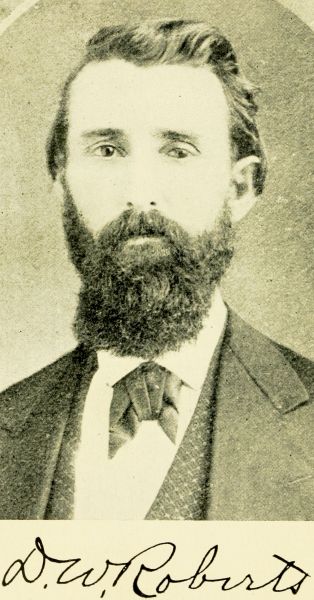
D.W. Roberts
CHAPTER III
I JOIN THE RANGERS
The fame of the Texas Rangers had, of course, become common knowledge among all Texans. Their deeds of adventure and their open, attractive life along the frontier, had always appealed to me, and I had long cherished the desire to enlist in the battalion. But the enlistment, as announced by Captain Roberts, would not be made until June 1, 1875, and I reached Menardville early in March. I had intended going on to join Mr. Franks' outfit, but, as explained in a previous chapter, I hired out to Mr. Ellis until I could enlist in Captain Roberts' company.
About the middle of May, 1875, Joe Franks had worked back over into Menard County. I wished to see my old friends in his outfit, and so went over to meet them. While there I mentioned that I was going to join the rangers. A cowboy named Norman Rodgers, who was working for Mr. Franks, said he would also like to join, so we decided we would go over to Captain Roberts together and see if we couldn't get him to recruit us into his company.
Rodgers and I rode over to the ranger camp beyond Menardville. Neither of us had ever been in such a camp before nor did we know anyone in the company. Of the first ranger we met we inquired where we could find the captain. His tent was pointed out to us and we went toward it.
"Jim," said Norman as we approached the tent, "you will have to do the talking."
Captain Roberts met us as we came up and invited us to be seated. I told him at once that we had come to enlist as rangers. He asked us our names, where we were working, and finally inquired if we had anyone that would recommend us. We had not thought of references, but told him that probably Mr. Franks or Mr. Ellis would stand for us, as they were well known and prominent cattlemen for whom we had worked.
Captain Roberts looked straight at me and said, "Did you say your name was Gillett?"
"Yes, Jim Gillett," I replied.
He then asked me where I was born, and I told him at Austin, Texas.
"Are you a son of James S. Gillett who was Adjutant-General under Governor Sam Houston?"
I told him I was.
"I have often heard my father, Buck Roberts, speak of your father," he said in a friendly tone.
Captain Roberts then asked us what kind of horses we had, telling us that a ranger was required to have a good mount, for each man was allowed to have only one horse, which had to be a good one, that could be ridden every day for a month if necessary. I told the captain I had two good pony mares. He burst out laughing, and said a mare was not allowed in the service. He then told us to go and see what kind of a mount we could get, come back and let him inspect the animals. The captain never once said he would enlist us, but, as the interview was now over and he had not refused us, we went back to camp feeling very hopeful we would soon be rangers.
I secured a big black pony and Norman a gray one, not so large as mine but a much prettier horse. We returned to the ranger camp a few days later mounted on these ponies. The captain looked them over, said they were rather small but that he would accept them, and told us to be at his camp by May 31st to be sworn into the service. We left camp that evening all puffed up at the prospect of being Texas Rangers.
The last day of May arrived. Norman Rodgers and myself with many other recruits we had never seen before were at the ranger camp. On June 1, 1875, at 10 o'clock, we were formed in line, mounted, and the oath of allegiance to the State of Texas was read to us by Captain Roberts. When we had all signed this oath we were pronounced Texas Rangers. This was probably the happiest day of my life, for I had realized one of my greatest ambitions and was now a member of the most famous and efficient body of mounted police in the world.
Immediately upon being sworn in the men were divided into messes, ten men to the mess, and issued ten days' rations by the orderly sergeant. These rations consisted of flour, bacon, coffee, sugar, beans, rice, pepper, salt and soda. No potatoes, syrup or lard was furnished, and each man had to supply his own cooking utensils. To shorten our bread we used bacon grease. Beef was sometimes supplied the men, but wild game was so plentiful that but little other meat was required. Furthermore, each recruit was furnished a Sharps carbine, .50 caliber, and one .45 Colt's pistol. These arms were charged to each ranger, their cost to be deducted from our first pay. Our salary of $40 per month was paid in quarterly installments. The state also supplied provender for the horses.
Though a ranger was forced to supply his own mount, the state undertook to pay for the animal if it were killed or lost in an Indian fight. To establish the impartial value of our animals, Captain Roberts marched us into Menardville and asked three citizens of the town to place a value on each man's mount. This was done, and I was highly gratified when old Coley, my mount, was appraised at $125. This formality over, the company was moved from Little Saline to Camp Los Moris, five miles southwest of Menardville, Texas. We were now ready to begin scouting for Indians.
As is usual under the same circumstances the new recruits came in for their share of pranks and mishaps. One raw rooky in my mess, fired with love of economy, undertook to cook ten days' rations for the whole mess at one time. He put a quantity of rice on the fire. Soon it began to boil and swell, and that surprised ranger found his rice increasing in unheard of proportions. He filled every cooking vessel in the mess with half-cooked rice, and still the kettle continued to overflow. In desperation he finally began to pour it on the ground. Even then he had enough rice cooked to supply the entire company.
Another recruit, anxious to test his new weapons, obtained Captain Roberts' permission to go hunting. He had not gone far from camp before he began firing at some squirrels. One of his bullets struck the limb of a tree and whizzed close to camp. This gave an old ranger an idea. He hastened after the hunter and gravely arrested him, declaring that the glancing bullet had struck a man in camp and that Captain Roberts had ordered the careless hunter's arrest. The veteran brought in a pale and badly scared recruit.
One of the favorite diversions of the old rangers was to make a newcomer believe that the state furnished the rangers with socks and start him off to the captain's tent to demand his share of free hosiery. The captain took these pranks in good part and assured the crestfallen applicant that the rangers were only playing a joke on him, while his tormentors enjoyed his discomfiture from a safe distance.
When they had run out of jokes the rangers settled down to the regular routine of camp. Each morning the orderly sergeant had roll call, at which time he always detailed six or eight men with a non-commissioned officer to take charge of the rangers' horses and the pack mules until relieved the following morning by a new guard. The guard was mounted and armed and drove the loose stock out to graze. The horses were never taken far from camp for fear of being attacked by Indians, and also to keep them near at hand in case they were needed quickly.
The rangers not on guard spent their time as they wished when not on duty, but no man could leave the camp without the captain's permission. The boys played such games as appealed to them, horse-shoe pitching and cards being the favorite diversions. As long as it did not interfere with a man's duty as a ranger, Captain Roberts permitted pony racing, and some exciting contests took place between rival horse owners. And hunting and fishing were always available, for woods and streams were stocked with game and fish.
I soon had cause to congratulate myself on my enlistment in Company "D," for I found Captain D.W. Roberts the best of company commanders. At the time I joined his command he was just thirty-five years of age, very slender and perhaps a little over six feet tall. His beard and hair were dark auburn. He was always neatly dressed and was kind and affable in manner,—looking more like the dean of an Eastern college than the great captain he was.
Captain Roberts was a fine horseman and a good shot with both pistol and rifle. He was also a fine violinist and often played for the boys. He had been raised on the frontier and had such a great reputation as an Indian fighter that the Fourteenth Legislature of Texas presented him with a fine Winchester rifle for his gallantry in fighting the redskins. The captain had made a close study of the habits and actions of the Indians and had become such an authority that their life was an open book to him. This, of course, gave him a great advantage in following and fighting them, and under his able leadership Company "D" became famous. There was not a man in the company that did not consider it a compliment to be detailed on a scout with Captain Roberts.
In the latter part of the summer or early fall of 1875, Captain Roberts visited Colorado County, Texas, and returned with a bride, a Miss Lou Conway. Mrs. Roberts was a very refined and elegant lady, and soon adapted herself to the customs of the camp. She was with her husband on the San Saba River during the winter of 1875-76 and soon became as popular with the company as Captain Roberts himself.
Most people consider the life of the Texas Ranger hard and dangerous, but I never found it so. In the first place, the ranger was always with a body of well armed men, more than a match for any enemy that might be met. Then, there was an element of danger about it that appealed to any red-blooded American. All of western Texas was a real frontier then, and for one who loved nature and God's own creation, it was a paradise on earth. The hills and valleys were teeming with deer and turkey, thousands of buffalo and antelope were on the plains, and the streams all over Texas were full of fish. Bee caves and bee trees abounded. In the spring time one could travel for hundreds of miles on a bed of flowers. Oh, how I wish I had the power to describe the wonderful country as I saw it then. How happy I am now in my old age that I am a native Texan and saw the grand frontier before it was marred by the hand of man.
The Lipans, Kickapoos, Comanches, and Kiowa Indians used to time their raids so as to reach the Texas settlements during the light of the moon so they would have moonlight nights in which to steal horses and make their get-away before they could be discovered. By morning, when their thefts became known, they would have a long lead ahead and be well out on their way into the plains and mountains. The captains of the ranger companies knew of this Indian habit, and accordingly kept scouts constantly in the field during the period of the raids. The redskins coming in from the plains where water was scarce generally took the near cut to the headwaters of the Colorado, Concho, San Saba, Llanos, Guadalupe, and Nueces Rivers. By maintaining scouts at or near the heads of these streams the rangers frequently caught parties of Indians going in or coming out from the settlements, and destroyed them or recaptured the stolen stock.
The first light moon in June Captain Roberts ordered a detail of fifteen men in command of Sergeant James B. Hawkins to make a ten days' scout toward the head waters of the North Llano River. He was to select a secluded spot near old abandoned Fort Territ and make camp there. Each morning a scout of one or two men would be sent out ten or fifteen miles south and another party a like distance toward the north to hunt for Indian trails. The main body of rangers, keeping carefully concealed, was in readiness to take up an Indian trail at a moment's notice should one be found by the scouts.
One morning Sergeant Hawkins ordered me to travel south from camp to the head draws of the South Llano and watch for pony tracks.
"Suppose the Indians get me?" I asked laughingly as I mounted my pony.
"It's your business to keep a sharp lookout and not let them catch you," he replied.
However, though I watched very carefully I could find no pony tracks or Indian trails.
We had with us on this scout Mike Lynch, a pure Irishman. Though he was old and gray-headed, he was a good ranger, and had much native wit. One morning it was Uncle Mike's turn to go on scout duty, but in a few hours he was seen coming into camp with his horse, Possum, on the jump. He reported a fresh Indian trail about ten miles north of our camp. When asked how many pony tracks he had counted, Lynch at once declared he had counted seventeen and thought there were more. As the Indians usually came in on foot or with as few ponies as they could get by on until they could steal others, Sergeant Hawkins suspected the tracks Lynch had seen were those of mustangs. The excited scout declared vehemently that the tracks were not those of wild horses but of Indians. The sergeant was just as positive that no Indian party was responsible for the trail, and the two had quite a heated argument over the tracks.
"But how do you know it is an Indian trail?" demanded Hawkins.
"Because I know I know," cried out Lynch in a loud voice.
That settled it. Horses were saddled and mules packed as quickly as possible, and the rangers marched over to the suspicious trail. When Sergeant Hawkins examined the trail he soon discovered that the sign had been made by mustangs but could not convince the hard-headed Irishman until he followed the trail two or three miles and showed him the mustang herd quietly grazing under some shade trees. Uncle Mike did not mention Indian trail any more on that scout.
Though we did not find any trails or Indians the scouting party killed two black bear, several deer and about fifteen wild turkey.
Early in September, 1875, Captain Roberts again ordered Sergeant Hawkins to take fifteen men and make a ten days' scout on the Brady Mountains. To my great joy I was detailed on this expedition. When near the head of Scalp Creek, Menard County, on our return trip, the sergeant told the boys to keep a sharp lookout for a deer, as we would reach the San Saba by noon and would camp on that stream for the night. We had not traveled far before Ed Seiker killed a nice little spiked buck. We strapped him on one of the pack mules, and when we arrived at the river we came upon a flock of half-grown wild turkeys. Bill Clements leaped from his horse and killed six of them.
We then camped, hobbled and sidelined our horses and put a strong guard with them. While some of the boys were gathering wood for our fire they found an old elm stump ten to twelve feet high with bees going in at the top. One of the rangers rode over to Rufe Winn's ranch and borrowed an ax and a bucket. When he returned we cut the tree and got more honey than sixteen men could eat, besides filling the bucket with nice sealed honey, which we gave to Mrs. Winn in return for the use of her ax. Then, after dinner, out came fishing tackle and, using venison for bait, we caught more catfish than the entire crowd could eat.
Hunting conditions in those days were ideal. I have known a single scout to kill three or four bears on a single trip. The companies to the north of us were never out of buffalo meat in season. Then, in the fall, one could gather enough pecans, as fine as ever grew, in half a day to last the company a month. I have seen hundreds of bushels of the nuts go to waste because there was no one to gather them—besides they sold on the market for fifty cents per bushel. No wonder that a boy that loved the woods and nature was charmed and fascinated with the life of the Texas Ranger. It was a picnic for me from start to finish, and the six years I was with the battalion were the happiest and most interesting of my life.
But hunting and fishing and vacation scouts were not the sole duties of a ranger. Pleasure was abundant, but there were times when all these were laid aside. For the game guns and the fishing rod we exchanged our carbines and our sixshooters and engaged in hazardous expeditions after marauding redskins. I was soon to see this latter aspect of ranger life, for in the latter part of August, 1875, I became a real ranger and entered upon the real work of our battalion—that of protecting the frontier against the roving Indians and engaging them in regular pitched battles.
CHAPTER IV
MY FIRST BRUSH WITH INDIANS
The latter part of August, 1875, Private L.P. Seiker was sent on detached service to Fort Mason, about fifty miles due east of our camp. While there a runner came in from Honey Creek with the report that a band of fifteen Indians had raided the John Gamble ranch and stolen some horses within twenty-five steps of the ranch house. The redskins appeared on their raid late in the evening and the runner reached Mason just at dark.
Lam Seiker had just eaten his supper and was sitting in the lobby of the Frontier Hotel when the message came. He hurried to the livery stable, saddled his horse, Old Pete, and started on an all-night ride for the company. The nights in August are short, but Seiker rode into our camp about 8 o'clock the following morning and reported the presence of the Indians.
The company horses were out under herd for the day, but Captain Roberts sent out hurry orders for them. Sergeant Plunk Murray was ordered to detail fifteen men, issue them ten days' rations and one hundred rounds of ammunition each. Second Sergeant Jim Hawkins, Privates Paul Durham, Nick Donnelly, Tom Gillespie, Mike Lynch, Andy Wilson, Henry Maltimore, Jim Trout, William Kimbrough, Silas B. Crump, Ed Seiker, Jim Day, John Cupps and myself, under command of Captain Roberts, were selected as the personnel of the scout. As can be imagined I was delighted with my good fortune in getting on the party and looked forward with intense satisfaction to my first brush with Indians.
The mules were soon packed and by the time the horses reached camp the scout was ready. Sergeant Hawkins, as soon as the men had saddled their horses, walked over to the captain, saluted and told him the scout was ready. Before leaving camp Captain Roberts called to Sergeant Murray and told him that he believed the Indians had about as many horses as they could well get away with, and that they would probably cross the San Saba River near the mouth of Scalp Creek and follow the high divide between the two streams on their westward march back into the plains. If the redskins did not travel that way the captain thought they would go out up the Big Saline, follow the divide between the North Llano and San Saba Rivers westward and escape, but he was confident the band would travel up the divide north of Menardville. He determined to scout that way himself, and instructed Murray to send two rangers south over to the head waters of Bear Creek to keep a sharp lookout for the trail. These two scouts were to repeat their operations the next day, and if they discovered the Indian trail Murray was to make up a second scout and follow the redskins vigorously.
His plan outlined, Captain Roberts gave the order to mount, and we rode toward Menardville, making inquiry about the Indians. All was quiet at this little frontier village, so we crossed the San Saba River just below the town, and after passing the ruins of the Spanish Fort, Captain Roberts halted his men and prepared to send out trailers. Two of the best trailers in the command were ordered to proceed about four hundred yards ahead of the party and keep a close watch for pony tracks while they traveled due north at a good saddle horse gait. The main body of men, under the captain himself, would follow directly behind the outposts.
Our party had traveled about eight or nine miles when Captain Roberts' keen eyes discovered a lone pony standing with his head down straight ahead of us. He sighted the animal before the trailers did, and remarked to us that there the trail was. The outposts halted when they saw the pony and waited for us to come up. Sure enough, here was the Indian trail probably twenty yards wide. Captain Roberts dismounted and walked over the sign, scrutinizing every pony track, bunch of grass and fallen leaf. He then examined the old pony. The animal was cut with a lance, with his back sore and his feet all worn out. It was then between 12 and 1 o'clock, and the captain thought the Indians had passed that way about sunrise, for the blood and sweat on the horse was now dry. The trail showed the raiders were driving rather fast and were probably thirty-five or forty miles ahead of us. The captain decided it would be a long chase and that we would just have to walk them down if we caught them at all.
There was no water on this divide so we took the trail without stopping for dinner. Captain Roberts had a fine saddle horse, Old Rock, and we followed the trail at a steady gait of five or six miles an hour. At sundown we reached the old government road that runs from Fort McKavett to Fort Concho. We were then about twelve or fifteen miles south of Kickapoo Springs, so we turned up the road, reaching the springs late at night. The horses had not had a drop of water since leaving the San Saba that morning, and, facing a hot August sun all day, the men were pretty well tired out when they reached camp, had supper and gotten to bed. We estimated we had ridden about sixty miles since leaving camp. During the day Captain Roberts' horse cast a shoe, so Tom Gillespie shod him by firelight, as it was the captain's intention to resume the trail at daylight.
The following morning Captain Roberts took a southwest course from Kickapoo Springs and paralleled the Indian trail we had left the evening before. It was late in the day before we picked the trail up again, and many of the boys were afraid we had lost it altogether, but the captain laughed at their fears and never doubted that we should find it again. The Indians, as their trail showed, were now traveling over a tolerably rough country, which made our progress slow. About noon we found some rain water, and, as it was fearfully hot, we camped for dinner and to give the horses a short rest.
When the boys went out to catch their mounts we found that we had camped right in a bed of rattlesnakes. Two of our horses had been bitten. Jim Day's Checo had a head on him as big as a barrel, while the captain's horse, Old Rock, had been bitten on his front leg just above the ankle, and it had swollen up to his body. Neither of the animals was able to walk. Jim Day could not be left alone in that Indian country, so Captain Roberts detailed Private Cupps to stay with Day until the horses died or were able to travel,—in either case they were then to return to camp. The animals soon recovered and Day and Cupps beat us back to camp.
The pack loads were now doubled on one mule so Captain Roberts could ride the other. Reduced to thirteen men, we followed the Indians until night. It was a hard day on both men and beasts, so we camped where we found a little water in a draw that drained into the South Concho River. Considering the way we had come the captain thought we had covered sixty miles during the day's ride. We had two rather old men on the scout, Mike Lynch and Andy Wilson, and they were nearly all in. I awoke Andy at 2 a.m. to go on guard. The poor fellow was so stiff he could hardly stand, and I tried to get him to go back to bed, telling him I would stand his guard, but he was game, and in a few minutes hobbled out to the horses and relieved me.
Early in the morning we were up and traveling. The mule Captain Roberts was riding did not step out as fast as Old Rock had done, and the boys had an easier time keeping up. We camped at noon on just enough rain water to do us and took up the trail again after dinner. The trailers stopped suddenly, and as we rode up Captain Roberts asked what was the matter. They said it seemed as though the Indians at this point had rounded up the horses and held them for some cause or other.
The captain dismounted and swept the country with his field glasses. He circled around where the horses had been standing and found where a lone Indian had walked straight away from the animals. He followed the tracks to an old live oak tree that had been blown down. Then the reason for the stop became apparent: the Indians had sighted a herd of mustangs grazing just beyond this tree and the redskin had slipped up on them and killed a big brown mare. Captain Roberts picked up the cartridge shell the old brave had used and found it to be from a .50 caliber buffalo gun. We also found the mustang, from which the Indians had cut both sides of ribs and one hind quarter.
Captain Roberts was much elated.
"Boys," he said with a smile, "we now have ninety-five chances out of a hundred to catch those Indians. They will not carry this raw meat long before stopping to cook some. We have followed them now over one hundred and fifty miles, and they have never stopped to build a fire. They are tired and hungry and probably know where there is water not far away."
He spoke with such confidence that I marveled at his knowledge of the Indian habits.
We were now on the extreme western draw of the South Concho River, far above the point at which the water breaks out into a running stream. Finally the trail led out on that level and vast tract of country between the head of South Concho and the Pecos on the west. These Indians turned a little north from the general direction they had been traveling, and all of a sudden we came to some rock water holes.
Here the redskins had built three fires, cooked both sides of the mustang ribs and had picked them clean. From this high table land they could look back over their trail for fifteen miles. The captain thought they had been there early in the morning, as the fires were out and the ashes cold. We did not lose any time at this camp, but hurried on, following the trail until late in the evening, when the trailers again halted. When we came up we found that the trail that had been going west for nearly two hundred miles had suddenly turned straight north.
Captain Roberts seemed to be puzzled for a time, and said he did not understand this move. About one mile north there was a small motte of mesquite timber. This he examined through his glasses, seeming to me to examine each tree separately. The trail led straight into these trees, and we followed it. In the mesquite timber we found the Indians had hacked some bushes partly down, bent them over, cut up the horse meat they had been carrying with them into tiny strips, strung it on the bushes and, building a fire beneath them, had barbecued their flesh. The redskins had made the prettiest scafelo for meat cooking I ever saw. We found plenty of fire here, and the captain was sure we would have an Indian fight on the morrow.
From the trees the trail swung west again. The redskins were traveling slowly now, as they evidently thought they were out of danger. Just before sundown the scout halted, and we were ordered not to let any smoke go up lest the band we were trailing should spot it and take alarm. As soon as we had cooked our supper Captain Roberts had the fires carefully extinguished. It had been a good season on the table lands and there were many ponds filled with water, some of them one hundred yards wide. We camped right on the edge of one of these big holes and where the Indians had waded into it the water was still muddy. The boys were cautioned not to strike a match that night as we were certain the Indians were not far ahead of us. We covered between forty and fifty miles that day.
Camp was called at daybreak. We dared not build a fire, so we could have no breakfast. We saddled our horses and again took the trail. Old Jennie, the pack mule, was packed for the last time on earth, for she was killed in the fight that shortly followed. As soon as it was light enough to see a pony track two of the boys traced it on foot and led their horses, the remainder of our party coming along slowly on horseback. By sunrise we were all riding and following the trail rapidly, eager to sight the marauding thieves. We had traveled some five or six miles when Paul Durham called Captain Roberts' attention to a dark object ahead that looked as if it were moving. The captain brought his field glasses to bear on the object specified and exclaimed it was the Indians.
He ordered the boys to dismount at once, tighten their cinches, leave their coats and slickers and make ready to fight. As we carried out this order a distressing stillness came over the men. Captain Roberts and Sergeant Hawkins were the only ones of our party that had ever been in an Indian fight, and I suppose the hearts of all of us green, unseasoned warriors beat a little more rapidly than usual at the prospect of soon smelling powder. Captain Roberts called out to us in positive tones not to leave him until he told us to go, and not to draw a gun or pistol until ordered, declaring that he wanted no mistake on the eve of battle. He ordered the pack mule caught and led until we went into the fight, when she was to be turned loose.
The Indians were out on an open prairie dotted here and there with small skirts of mesquite timber. The captain thought our only chance was to ride double file straight at them in the hope they would not look back and discover us. We moved forward briskly, and as luck would have it, we got within four or five hundred yards of the redskins before they sighted us.
At once there was a terrible commotion. The Indians rounded up their stock and caught fresh mounts almost in the twinkling of an eye. Then, led by their old chief, they took positions on a little elevated ground some two hundred yards beyond the loose horses. The redskins stationed themselves about fifteen or twenty feet apart, their battle line when formed being about one hundred yards wide. As each warrior took his station he dismounted, stood behind his horse and prepared to fire when given the signal.
The captain with a smile turned to us and said, "Boys, they are going to fight us. See how beautifully the old chief forms his line of battle."
From a little boy I had longed to be a ranger and fight the Indians. At last, at last, I was up against the real thing and with not so much as an umbrella behind which to hide. I was nervous. I was awfully nervous.
We were now within one hundred steps of the redskins. Then came the order to dismount, shoot low and kill as many horses as possible. The captain said as we came up that every time we got an Indian on foot in that country we were sure to kill him. With the first shot everybody, Indian and ranger, began firing and yelling.
In a minute we had killed two horses and one Indian was seen to be badly wounded. In another minute the redskins had mounted their horses and were fleeing in every direction. Captain Roberts now ordered us to mount and follow them. The roar of the guns greatly excited my pony and he turned round and round. I lost a little time in mounting, but when I did get settled in the saddle I saw an Indian running on foot. He carried a Winchester in his hand and waved to another Indian who was riding. The latter turned and took the one on foot up behind him. As they started away for a race I thought to myself that no grass pony on earth could carry two men and get away from me and Old Coley. The Indians had a good animal, but I gradually closed on them. The redskin riding behind would point his gun back and fire at me, holding it in one hand. I retaliated by firing at him every time I could get a cartridge in my old Sharps carbine. I looked back and saw Ed Seiker coming to my aid as fast as old Dixie would run. He waved encouragement to me.
Finally the old brave ceased shooting, and as I drew a little closer he held out his gun at arm's length and let it drop, probably thinking I would stop to get it. I just gave it a passing glance as I galloped by. He then held out what looked to be a fine rawhide rope and dropped that, but I never took the bait. I just kept closing in on him. He now strung his bow and began using his arrows pretty freely. Finally he saw I was going to catch him, and turned quickly into a little grove of mesquite timber. I was considered a fairly good brush rider, and as we went in among the trees I drew right up within twenty steps of the brave, jumped from my mount and made a sort of random shot at the horse, Indian and all. The big .50 caliber bullet struck the Indian pony just where its head couples on its neck, passed through the head and came out over the left eye. It killed the horse at once and it fell forward twenty feet.
The old warrior, hit the ground running, but I jumped my horse and ran after him. As I passed the dead horse I saw the front rider struggling to get from under it. To my surprise I saw he was a white boy between fifteen and sixteen years old with long bright red hair.
By this time Ed Seiker had arrived and was dismounting. The fugitive warrior now peeped from behind a tree and I got a fine shot at his face but overshot him six inches, cutting off a limb just over his head. He broke to run again, and as he came into view Ed placed a bullet between his shoulders. He was dead in a minute. As Ed and I walked up to the dead Indian we found he had also been shot in one ankle and his bow had been partly shot in two. In his quiver he had left only three arrows.
Seiker and I hurried back to the dead horse to help the white boy, but he had extricated himself and disappeared. We then returned to the dead warrior and Seiker scalped him. We took the Indian's bow shield and a fine pair of moccasins. I also found a fine lance near where the horse fell, and I presume it was carried by the white boy. We found the redskin had no Winchester cartridges, and this was why he dropped the gun—he could not carry it and use his bow. We went back over the trail but were unable to find the gun the brave had dropped as a bait.
By noon that day the boys had all returned to where the fight had begun and the Indian horses had been left. Jim Hawkins and Paul Durham captured a Mexican boy about fifteen years old. He looked just like an Indian, had long plaited hair down his back, was bare headed, wore moccasins and a breech-clout. Had he been in front of me I would surely have killed him for a redskin. Captain Roberts spoke Spanish fluently, and from this boy he learned that the Indians were Lipans that lived in Old Mexico. He was taken back to our camp and finally his uncle came and took him home. He had been captured while herding oxen near old Fort Clark, Texas, and an elder brother, who was with him at the time, had been killed.
The boys were then sent back by Captain Roberts to find the white lad that had been with the Indian Seiker had killed. Though we searched carefully we could find no trace of the mysterious youngster. Some years later I learned that this boy's name was Fischer and that his parents went into Old Mexico and ransomed him. He was from Llano County, and after his return he wrote, or had written, a small pamphlet that contained an account of his life with the Indians. He told of being with old Chief Magoosh in this fight. He declared he hid in the grass within sight of the rangers while they were hunting him, but was afraid to show himself for fear of being killed.
When the rangers had all gathered after the fight our pack mule, Jennie, was missing. We supposed in the run that she had followed the Indians off. Six months later Ed Seiker was detailed to pilot a body of United States soldiers over that same country to pick out a road to the Pecos River. He visited our old battlefield and found Jennie's carcass. She had a bullet hole in the center of her forehead. The Indians in shooting back at their attackers probably hit her with a chance shot. The pack saddle was still strapped to her body, but wolves had eaten all the supplies. Five hundred rounds of ammunition were still with her, showing that no one had seen her since the day of her death.
Lacking Jennie's supplies, we did not have a blooming thing to eat but the barbecued horse meat we had captured from the Indians. This had no salt on it, and I just could not swallow it. In the fight we killed three horses and one Indian and captured the Mexican lad. At least two redskins were badly wounded, and as victors we captured fifty-eight head of horses and mules, several Indian saddles and bridles and many native trinkets. Not a man or a horse of our party was hurt, the pack mule being our only fatality. All voted Captain Roberts the best man in the world.
We turned our faces homeward, hungry and tired but highly elated over our success. The second day after the fight we reached Wash Delong's ranch on the head waters of the South Concho River. Mr. Delong, a fine frontiersman, killed a beef for us and furnished us with flour and coffee without cost. Three days later we were back at our camp at Los Moris. The stolen stock was returned to their owners, and thus ended my first campaign against the Indians.
CHAPTER V
THE MASON COUNTY WAR
Soon after our return from our first brush with Indians we were introduced to yet another phase of ranger activity—the quieting of feuds, for not only were the rangers employed in protecting the frontiers against the Indians, but they were also frequently called upon to preserve law and order within the towns and cities of the state. In those early days men's passions were high and easily aroused. In a country where all men went armed, recourse to fire arms was frequent, and these feuds sometimes led to active warfare between the adherents of each party to the great discomfort of the citizens among whom such a miniature war was staged.
Mason and the adjoining county, Gillespie, had been settled by Germans in the early history of the state. These settlers were quiet, peaceful and made most excellent citizens, loyal to their adopted country and government when undisturbed. Most of these Germans engaged in stock raising and were sorely tried by the rustlers and Indians that committed many depredations upon their cattle.
In the latter part of September, 1875, Tim Williamson, a prominent cattleman living in Mason County, was arrested on a charge of cattle theft by John Worley, a deputy sheriff of that county. Previous to that time there had been a number of complaints about loss of cattle, and the Germans charged that many of their cattle had been stolen and the brands burned. Much indignation had been aroused among the stockmen of the county and threats of violence against the thieves were common.
As soon as the news of Williamson's arrest on charge of cattle thieving became known a large mob formed and set out in pursuit of the deputy sheriff and his prisoner. On his way to Mason, Worley was overtaken by this posse. When he saw the pursuing men Williamson divined their purpose and begged the sheriff to let him run in an effort to save his life. Worley refused and, it is said, drew his pistol and deliberately shot Williamson's horse through the loin, causing it to fall. Unarmed and unmounted Williamson was killed without a chance to protect himself and without any pretense of a trial. After the murder Worley and the mob disappeared.
Whether or not Williamson was guilty of the charge against him, he had friends who bitterly resented the deputy sheriff's refusal to allow the murdered man a chance for his life and his death caused a great deal of excitement and bitter comment in the county. A man named Scott Cooley, an ex-ranger of Captain Perry's Company "D," was a particular friend of Williamson and his family. Cooley had quit the ranger service at the time of his friend's murder and was cultivating a farm near Menardville. He had worked for the dead man and had made two trips up the trail with him. While working with the murdered cattleman Cooley had contracted a bad case of typhoid fever and had been nursed back to health by Mrs. Williamson's own hands.
When the news of Tim Williamson's murder reached Scott Cooley he was much incensed, and vowed vengeance against the murderers of his friend. He left his farm at once and, saddling his pony, rode into the town of Mason heavily armed. He had worked out a careful plan of his own and proceeded to put it into execution immediately on his arrival. Stabling his horse in a livery stable, he registered at the hotel. As he was entirely unknown in Mason, Cooley remained in town several days without creating any suspicion. He proved himself a good detective, and soon discovered that the sheriff and his deputy were the leaders in the mob that had killed his friend. Biding his time and pursuing his investigations he soon learned the names of every man in the posse that murdered Williamson.
His information complete, Cooley decided upon action. He mounted his pony and rode out to the home of John Worley, the deputy sheriff that had refused Williamson a chance to flee for his life. Cooley found Worley engaged in cleaning out a well. The avenger dismounted, asked for a drink of water and entered into conversation with the unsuspecting man. Finally, as Worley was drawing his assistant out of the well, Cooley asked him if his name was John Worley. The deputy sheriff replied that it was. Cooley then declared his mission and shot the sheriff to death.
At the first crack of Cooley's pistol Worley let the windlass go, and the man he was drawing up out of the well fell back about twenty-five feet into it. Cooley deliberately stooped down, cut off both of Worley's ears, put them in his pocket, and galloped off. Victim number one was chalked up to Williamson's credit. Making a quick ride across Mason County to the western edge of Llano County, Cooley waylaid and killed Pete Brader, the second on his list of mob members.
These two murders struck terror into the hearts of nearly every citizen of Mason County. No one could tell who would be the next victim of the unerring aim of Scott Cooley's rifle. The whole county rose up in arms to protect themselves. Terrified lest he be the next victim of the avenger, Cooley, the sheriff of Mason County promptly left Mason and never returned. Tim Williamson had other friends anxious to avenge him, and the killing of Brader was their rallying signal. John and Mose Beard, George Gladden, and John Ringgold immediately joined Cooley in his work of vengeance. The gang rode into the town of Mason, and in a fight with a posse of citizens, killed another man.
Fearing the outbreak of a real feud war in Mason, the Governor of Texas ordered Major Jones to the relief of the frightened citizens. The order reached Major Jones while he was on his way down the line near the head of the Guadalupe River. He at once turned his company back, and with a detachment of ten men from Company "D" he marched to Mason. Company "A," Major Jones' escort, was then commanded by Captain Ira Long, and the thirty men in that company and the ten boys of Company "D" gave the major forty men for his relief expedition.
Before the rangers could reach Mason, the sheriff's party had a fight with Cooley's gang down on the Llano River and killed Mose Beard. On his arrival in Mason, Major Jones sent scouts in every direction to hunt Cooley. He kept this up for nearly two weeks but without result. He finally learned that nearly the whole of his command, especially the Company "D" boys that had ranged with Cooley, was in sympathy with the outlaw and was making no serious attempt to locate or imperil him. It was even charged that some of the Company "D" rangers met Cooley at night on the outskirts of Mason and told him they did not care if he killed every d—d Dutchman in Mason County that formed part of the mob that had murdered Williamson.
Major Jones saw he would have to take drastic steps at once. He drew up his whole force of forty men and made them an eloquent speech. He said he had a special pride in the Frontier Battalion and was making it his life's study and that he personally had a kindly feeling for every man in the service. He then reminded the men in the most feeling manner of the oath they had taken to protect the State of Texas against all her enemies whatsoever,—an oath every true man was bound to honor. He declared he knew many of the command had a friendly feeling for Scott Cooley, especially those boys who had shared the life of a ranger with him, and that he, himself, felt keenly the position in which they were placed. While Tim Williamson had met a horrible death at the hands of a relentless mob, that did not justify Cooley in killing people in a private war of vengeance in defiance of the law and the rangers.
As the climax of his speech the major said, "Men, I now have a proposition to make to you. If every man here who is in sympathy with Scott Cooley and his gang and who does not wish to pursue him to the bitter end will step out of ranks I will issue him an honorable discharge and let him quit the service clean."
The major paused and about fifteen men stepped to the front.
"Gentlemen," continued Major Jones, "those who do not avail themselves of this opportunity I shall expect to use all diligence and strength in helping me to break up or capture these violators of the law."
After the discharge of the Cooley sympathizers, the rangers went to work with a new vigor, and finally captured George Gladden and John Ringgold. Gladden was sent to the state penitentiary for twenty-five years, while Ringgold received a life sentence. Probably Scott Cooley was informed of Major Jones' appeal to the rangers, for he became less active around Mason after this. John Beard, it was reported, skipped Texas and went to Arizona.
Soon after Cooley killed John Worley, Norman Rodgers got permission from Captain Roberts to ride over to Joe Franks' cow outfit to exchange his horse for a better one. When Rodgers rode into the cowboy camp he noticed a man resting under a tree near the fire. The stranger called one of the cowboys and asked him who Norman was. As Rodgers left camp this man followed him and asked if he were one of Roberts' rangers and if he knew "Major" Reynolds. Rodgers replied that he knew Reynolds very well.
The man then declared he was Scott Cooley and, reaching into his pocket, he pulled out John Worley's ears.
"You take these ears to 'Major' Reynolds with my compliments, but don't you tell anybody you saw me."
Rodgers duly delivered the ears and Reynolds cautioned him to say nothing about them. Forty years afterward, at an old settlers reunion in Sweetwater, Norman Rodgers mentioned this incident in a speech—he had kept his promise to Cooley and Reynolds all those years.
Having lost his friends and his sympathizers in the rangers, Cooley returned to Blanco County, where he had formerly lived. Here he was stricken with brain fever, and though tenderly nursed, shielded by his friends, he died without ever being brought to trial for his killings. This ended the Mason County War, but before the feud died some ten or twelve men were killed and a race war narrowly averted.