Front matter (continued 2)
Reading edition
CHAPTER VI
MAJOR JONES AND HIS ESCORT
Despite their usefulness in protecting the frontiers and in maintaining law and order, the Texas Rangers have always had to fight more or less strenuously to obtain the necessary appropriation for their annual maintenance from the State Legislature. Whenever the appropriation is small there is but one remedy,—reduce the personnel of each company to the lowest limits possible. In the fall of 1875 the Adjutant-General notified the captains all along the line to reduce their companies to twenty men each for the winter at the end of the current quarter. As the day for reduction arrived there were some anxious moments among the men of Company "D" as no one knew just who was to be retained in the service.
On December 1st Captain Roberts formed the command in line and explained it was his sad duty to reduce the company to twenty men, and announced that the orderly sergeant would read the names of those to be retained in the company. The sergeant then stepped forward and began to read. First Sergeant Plunk Murray, Second Sergeant James Hawkins, First Corporal Lam Seiker, Second Corporal Tom Griffin, and Privates Charles Nevill, Tom Gillespie, Nick Donley, Jim Trout, Henry Maltimore, Kit Maltimore, Jack Martin, W.T. Clements, Ed Seiker, Andy Wilson, J.W. Bell, Norman Rodgers, Dock Long, Tom Mead, Frank Hill, and Jim Gillett were the lucky ones to be retained in the command. The remainder of the company was thereupon discharged. My relief may be imagined when my name was read out, for I had learned to love the ranger life and was loth to quit it.
After reduction we went into winter camp in a bend of the San Saba River about three miles east of Menardville. In the river bottom was plenty of good timber, so each mess of five men built a log cabin, sixteen to eighteen feet square, for their occupancy. These cabins, each with a chimney and a fireplace, formed the western side of our horse corral and made most comfortable winter abodes. During the winter the boys played many tricks upon each other, for there were no Indian raids during the time we were in this winter camp. One of the favorite stunts was to extract the bullet from a cartridge, take out the powder and wrap it in a rag, and then, while the inmates of a given cabin would be quietly smoking or reading or talking around their fire, climb upon the roof and drop the rag down the chimney. When the powder exploded in the fire the surprised rangers would fall backward off their benches,—to the huge glee of the prank player. At other times a couple of rangers would post themselves outside a neighbor's cabin and begin to yell, "Fire! Fire!!" at the top of their lungs. If the cabin owners did not stand in the doorway to protect it all the rangers in camp would rush up and throw bedding, cooking utensils, saddles and bridles, guns and pistols outside as quickly as they could. In a jiffy the cabin would be cleaned out and the victims of the joke would have to lug all their belongings back in again.
But not all our time was spent in practical joking. There were many rangers of a studious mind, and during the long winter evenings they pored over their books. Several of our boys, by their study here and at other leisure hours, qualified themselves for doctors, lawyers, and professional callings. And there were several writers in camp that contributed more or less regularly to the magazines and newspapers.
One of the rangers, Nick Donley, was a baker by trade, and he soon built a Dutch oven and made bread for the rangers. We pooled our flour and had fresh, warm bread every morning. This was so good and we ate so much of it that our allowance of flour would not last for the period issued, and Captain Roberts was compelled to order the bake oven torn down. Thereafter the boys baked their own bread and the flour lasted.
Some of the rangers had captured young bear cubs, and we had them in camp with us as pets. They grew rapidly and were soon big fellows and immensely popular with the boys. Sometimes a bear would break loose from its chain, and then all of us would turn out to hunt the escaped pet. Most often we would soon find him seated in a tree which he had climbed as soon as he had broken his shackles. And I cannot here forbear mentioning the useful little pack mules that served the rangers so long and so well. When the battalion was formed in 1874 a number of little broncho mules were secured for packing. They soon learned what was expected of them and followed the rangers like dogs. Carrying a weight of one hundred and fifty to two hundred pounds, they would follow a scout of rangers on the dead run right into the midst of the hottest fight with Indians or desperadoes. They seemed to take as much interest in such an engagement as the rangers themselves.
These little pack animals had as much curiosity as a child or a pet coon. In traveling along a road they sometimes met a bunch of horses or several campers along the highway. Immediately they would run over for a brief visit with the strangers and when the rangers had gone on a thousand yards or more would scamper up to us as fast as they could run. Later, when the rangers drew in from the frontier and scouted in a more thickly settled country the mules with their packs would march right up to strange horses and frighten them out of their wits. Once, in Austin, one of our mules calmly trotted up to a mule that was pulling a street car. As the pack burro would not give right of way the street car mule shied to one side and pulled its conveyance completely off the track to the surprise of its driver. The tiny animals pulled off several stunts like this and caused so much complaint that Adjutant-General Jones issued an order for all rangers to catch and lead their pack mules when passing through a town.
As soon as we were located in the new camp, Privates Nevill, Bell and Seiker obtained permission from Captain Roberts to visit Austin to buy a case of ten Winchesters. Up to this time the company was armed with a .50 caliber Sharps carbine. These guns would heat easily and thus were very inaccurate shooters. The state furnished this weapon to its rangers at a cost of $17.50, and at that time furnished no other class of gun. The new center fire 1873 model Winchester had just appeared on the market and sold at $50 for the rifle and $40 for the carbine. A ranger who wanted a Winchester had to pay for it out of his own pocket and supply his own ammunition as well, for the State of Texas only furnished cartridges for the Sharps gun. However, ten men in Company "D," myself included, were willing to pay the price to have a superior arm. I got carbine number 13,401, and for the next six years of my ranger career I never used any other weapon. I have killed almost every kind of game that is found in Texas, from the biggest old bull buffalo to a fox squirrel with this little .44 Winchester. Today I still preserve it as a prized memento of the past.
The boys were all anxious to try their new guns, and as Christmas approached we decided to have a real Yule-tide dinner. Ed Seiker and myself visited a big turkey roost on the head of Elm Creek and killed seven big wild turkeys, and on our return Seiker bagged a fine buck deer. J.W. Bell hunted on the San Saba and brought in six or eight wild geese and about a dozen mallard ducks. Donley, the baker, cooked up the pies, while Mrs. Roberts, wife of the captain, furnished the fruit-cake. Some of the boys made egg-nog, and altogether we had the finest Christmas dinner that ever graced the boards of a ranger camp. The little frontier village of Menardville was not far away, and most of the rangers visited it during Christmas week for the dancing. Jack Martin once remarked to Mrs. Roberts that there was very little society about a ranger camp. She told the joke on him and thereafter as long as he lived he was known as "Society Jack."
During the winter we laid out a race course and had much sport with our horses. But there was work as well as play that winter. Though Captain Roberts kept scouts in the field during the entire winter they never discovered any Indian trails. The rangers had not yet turned their attention to outlaws, so we were not burdened with chained prisoners as we were in after years. This winter camp on the San Saba was the most pleasant time in my service with the rangers.
The first week in April, 1876, we moved out of our winter quarters to a camp some six or seven miles above Menardville and located in a pecan grove on the banks of the San Saba. We were all glad to get into our tents again after four months spent in log cabins. I remember our first night at the new camp. The boys set out some hooks and caught four or five big yellow catfish weighing twenty-five or thirty pounds each—enough fish to last the twenty men several days.
As the spring opened, Captain Roberts began sending out scouts to cut signs for Indians. I remember I was detailed on a scout that was commanded by a non-commissioned officer. We were ordered to scout as far north as the union of the Concho and Colorado Rivers. After crossing the Brady Mountains we struck a trail of Indians going out. The redskins had probably been raiding in San Saba or McCulloch Counties. Their trail led west as straight to San Angelo as a bird could fly. Though the Indians were not numerous and had only a few horses, the trail was easily followed. As well as we could judge the redskins had passed on a few days before we discovered their sign. We found where they had stolen some horses, for we picked up several pairs of hobbles that had been cut in two and left where they got the horses. At that time there were several big cattle ranches in the Fort Concho country, and in going to and from water the cattle entirely obliterated the trail. We worked hard two days trying to find it and then gave up the hunt. We needed the genius of Captain Roberts to help us out that time.
On June 1, 1876, the company was increased to forty men. Some of the boys that had quit at Mason the fall before now re-entered the service. Especially do I remember that "Mage" Reynolds enlisted with Company "D" once more.
During the summer of 1876, Major Jones planned a big scout out on the Pecos to strike the Lipans and Kickapoos a blow before they began raiding the white settlements. This scout started from Company "D" in July. The major drafted about twenty men from my company, his whole escort Company "A" of thirty men and marched into Kerr County. Here he drafted part of Captain Coldwell's Company "F," making his force total about seventy men with three wagons and about twenty pack mules.
The column traveled down the Nueces, then by Fort Clark up the Devil's River to Beaver Lake. Here Captain Ira Long with twenty men and the wagon train was sent up the San Antonio and El Paso road to old Fort Lancaster on the Pecos, where he was to await the arrival of Major Jones with the main force.
From Beaver Lake, the major with fifty men and the twenty pack mules turned southwest and traveled down Johnston's Run to the Shafer Crossing on the Pecos. From this crossing we scouted up the Pecos to the mouth of Independence Creek. The country through this section was very rough but very beautiful. We saw several old abandoned Indian camps, especially at the mouth of the creek. Here we found the pits and the scaffolds upon which the redskins had dried their meat, also evidence that many deer hide had been dressed and made into buckskin. Bows and arrows had also been manufactured in these camps. From this section the Indians had been gone probably a month or more.
After ten days of scouting we joined Captain Long at Fort Lancaster and marched up Live Oak Creek to its head. Here we prepared to cross that big stretch of table land between the Pecos and the head waters of the South Concho. We filled what barrels we had with water, topped out from the creek—and made about ten miles into the plains by night and made a dry camp. We got an early start next day and traveled until night without finding water. The stock suffered greatly from thirst and the men had only a little water in their canteens. All the land ponds had been dry two weeks or more, and I saw twelve head of buffalo that had bogged and died in one of them. Here we found an old abandoned Indian camp, where the redskins had dressed many antelope hides. At one old bent mesquite tree the antelope hair was a foot deep, with thirty or forty skulls scattered about.
By the second morning both men and horses were suffering a great deal from thirst, and Major Jones gave orders to begin march at 4 a.m. We got away on time and reached water on the South Concho at 2 p.m., the third day out from Live Oak Creek. As soon as we got near the water we found a number of straggling buffalo, and killed two, thus securing a supply of fresh meat. We camped two days at this water and then marched back to Company "D" by easy stages. Here Major Jones turned back up the line with his escort after being out on this scout about a month.
On his return toward the Rio Grande, Major Jones reached Company "D" the last week in August and camped with us until September 1st, the end of the fiscal year for the rangers. On this date many men would quit service to retire to private life, while some would join other companies and new recruits be sworn into the service. This reorganization usually required two or three days.
Nearly every ranger in the battalion was anxious to be at some time a member of Major Jones' escort company. The escort company was not assigned a stationary post nor did it endeavor to cover a given strip of territory. Its most important duty was to escort the major on his periodic journeys of inspection to the other companies along the line. The escort always wintered in the south and made about four yearly tours of the frontier from company to company, taking part in such scouts as the major might select and being assigned to such extraordinary duty as might arise. In 1874, when the Frontier Battalion was first formed, Major Jones recruited his escort from a detail of five men from each of the other companies. However, in practice, this led to some confusion and envy in the commands, so Major Jones found it expedient to have a regular escort company, so he selected Company "A" for that purpose. This remained his escort until he was promoted to Adjutant-General.
In September, 1876, there were several vacancies in Major Jones' escort, and several old Company "D" boys, among them "Mage" Reynolds, Charles Nevill, Jack Martin, Bill Clements, and Tom Gillespie, wished to enlist in Company "A." They wanted me to go with them, but I hesitated to leave Captain Roberts. My friends then explained that we could see a lot more country on the escort than we could in a stationary company; that we would probably be stationed down on the Rio Grande that winter, and going up the line in the spring would see thousands of buffalo. This buffalo proposition caught me, and I went with the boys. After fifteen months' ranging with Captain Roberts I now joined Company "A."
Early in September Major Jones marched his escort down to within five or six miles of San Antonio and camped us on the Salado while he went in to Austin. By the first of October he was back in camp and started up the line on his last visit to the different companies before winter set in.
At that time Major John B. Jones was a small man, probably not more than five feet seven inches tall and weighed about one hundred and twenty-five pounds. He had very dark hair and eyes and a heavy dark moustache. He was quick in action, though small in stature, and was an excellent horseman, riding very erect in the saddle.
The major was born in Fairfield District, South Carolina, in 1834, but emigrated to Texas with his father when he was only four years old. He was prominent in Texas state affairs from a very early age and served gallantly with the Confederate Army during the Civil War. On the accession of Governor Coke in 1874 he was appointed to command the Frontier Battalion of six companies of Texas Rangers. From his appointment until his death in Austin in 1881, Major Jones was constantly engaged in repulsing bloody raids of Indians, rounding up outlaws and making Texas secure and safe for the industrious and peaceful citizen. In this work his wonderful tact, judgment, coolness and courage found ample scope.
From the organization of the battalion in 1874 until Major Jones was made Adjutant-General, Dr. Nicholson was always with him. The doctor was a quaint old bachelor who loved his toddy. The boys would sometimes get him as full as a goose, and the major would give the doctor some vicious looks at such times. Dr. Nicholson was a great favorite with all the men, and it is said he knew every good place for buttermilk, butter, milk, and eggs from Rio Grande City to Red River, a trifling distance of eight hundred miles. The doctor always messed with Major Jones, and, mounted on a fine horse, traveled by his side. I don't think Dr. Nicholson ever issued a handful of pills to the boys during the year—he was just with us in case he was needed. When the escort was disbanded he retired to private life at Del Rio, Texas, and finally died there.
This inspection tour was a wonderful experience for me. The weather was cool and bracing, and the horses had had a month's rest. We had with us a quartet of musicians, among them a violinist, a guitar player and a banjo picker, and after the day's march the players would often gather around the camp fire and give us a concert. The major would frequently walk down and listen to the music. Nor was music our only amusement. Major Jones had provided his escort with a fish seine, and when we were camped on a big creek or river the boys would unroll the net, make a haul and sometimes catch enough fish to supply the thirty men several days.
When recruited to its full strength Company "A" consisted of a captain, orderly sergeant, second sergeant, first and second corporals, and twenty-six privates. Two four-mule wagons hauled the camp equipage, rations for the men and grain for the horses. One fight wagon drawn by two mules and driven by George, the negro cook, carried the mess outfit, bedding, tent, etc., of Major Jones and Dr. Nicholson.
Each morning at roll call the orderly sergeant detailed a guard of nine men and one non-commissioned officer to guard for twenty-four hours. When ready to begin our day's journey the company was formed in line and the men counted off by fours. On the march Major Jones and Dr. Nicholson rode in front, followed by the captain of the company, the orderly sergeant and the men in double file. Following these came the wagons. An advance guard of two men preceded the column about one-half mile. Four men, known as flankers, two on each side of the company, paralleled the column at a distance of one-half to one mile, depending on the nature of the country. In a rough, wooded section the flankers traveled close in, but in an open country they sometimes spread out quite a distance. The non-commissioned officer with the remaining guard covered the rear and brought up the pack mules. Thus protected it was almost impossible for the command to be surprised by Indians.
At one time Major Jones had with him two Tonkawa Indians as guides. For protection this tribe lived near Fort Griffin, a large military post. One of these old braves known as Jim had been given an old worn out army coat with the shoulder straps of a general upon it. Jim wore this coat tightly buttoned up and marched at the head of the column with as much dignity and importance as a general-in-chief. His companion wore a high crowned beaver stove-pipe hat with the top gone, and carried an old umbrella that someone had given him. Fitted out in this ridiculous and unique manner he marched for days with the umbrella over him. Think of an Indian shading himself from the sun!
Major Jones never paid much attention to these Indians unless he wished to inquire the lay of the country or the distance to some water hole. They did pretty much as they pleased, sometimes riding in front with the major, sometimes with the guard and at others with the men. These old redskins were a constant source of amusement to the boys. Jim and his pal were good hunters but as lazy as could be. They got into the habit of killing a buffalo late in the evening when they knew it was almost time to pitch camp, cutting out just enough meat for themselves and letting the remainder go to waste. The major told these lazy-bones when they killed a buffalo he wanted to know of it so he could secure the meat for the company. The Tonks paid no attention to this request and late one evening came into camp with five or six pounds of buffalo meat.
The orderly sergeant spied them, so he walked over to Major Jones and said, "Major, those two old Tonkawas are back in camp with just enough meat for themselves."
"Sergeant, you get a pack mule, take a file of men with you and make those Indians saddle their horses and go with you to get that buffalo," the major commanded, determined that his order should be obeyed by the Indians.
The sergeant went to the Indians, who were busy about the fire roasting their meat, and told them what the major had said. Jim declared that he was tired and did not wish to go. The non-commissioned officer replied that that made no difference and commanded him and his pal to get their ponies and lead the way to the dead buffalo.
"Maybe so ten miles to buffalo," protested Jim, trying to avoid going.
The sergeant knew they were lying, for of all the Indians that ever inhabited Texas the Tonkawas were the biggest cowards. Just mention the Comanches or Kiowas to them and they would have a chill. It was well known that the Tonks would not venture very far away from the protection of the rangers for fear of being killed by their enemies. As soon as they knew they had to do as ordered, they mounted their ponies and led the sergeant over a little hill, and in a valley not more than half a mile from camp, was the fine, fat buffalo the Indians had killed. The animal was soon skinned and brought into camp, where all had plenty of fresh meat.
These Tonks were as simple as children and as suspicious as negroes. The weather had been hot and dry for several days. Old Jim thereupon killed some hawks with his bow and arrows, plaited the long tail and wing feathers into his pony's mane and tail, and said it would make "heap rain." Sure enough, in three or four days a hard thunder shower came up and thoroughly wet everybody on the march. Jim, with only his old officer's coat for protection, was drenched to the skin, and his pony looked like a drowned rat. The wood, grass, everything was wet. Jim stood by, shivering with the cold and watched the boys use up almost their last match trying to make a fire. Suddenly, with a look of disgust, he ran up to his horse, which was standing near, and plucked every hawk feather out of the animal's tail and mane and, throwing them on the ground, stamped upon them violently as if that would stop the rain.
After the escort had crossed the Colorado River on its way northward we found an advance guard of buffalo on its way south, and it was an easy matter to keep the company in fresh meat. We spent about one week with Company "B" on the upper Brazos, then turned south again to make our winter camp near Old Frio Town in Frio County. It was November now and freezing hard every night.
The last guard would call the camp early, so we generally had breakfast and were ready to move southward by daylight. We did not stop a single time for dinner on this return trip, just traveled at a steady gait all day long without dinner until nearly night. We all wondered why we marched the live-long day without dinner, but it was not until many years afterward when I became a Mason that I learned the reason for our forced marches. Major Jones was in line to be made Most Worshipful Grand Master of Masons in Texas and he had to be in Houston on the first Tuesday in December for the annual meeting of the Most Worshipful Grand Lodge of Texas. If there were other Masons in the company besides Major Jones I never knew it.
At this time we had for commander of the escort, Lieutenant Benton. He was in bad health and rode most of the way back in one of the wagons. On arriving at the end of the line he tendered his resignation and was succeeded by Captain Neal Coldwell. The company camped for the winter on Elm Creek, three miles southwest of Old Frio Town.
Captain Neal Coldwell was born in Dade County, Missouri, in May, 1844, and served gallantly throughout the Civil War in the Thirty-second Regiment, Texas Cavalry, commanded by Col. W.P. Woods. At the organization of the Frontier Battalion in 1874, Neal Coldwell was commissioned captain of Company "F."
It is difficult, in a single sketch, to do Captain Coldwell justice or convey any correct idea of what he accomplished as a Texas Ranger. The station of Company "F," the southernmost company of the line, was the most unfavorable that could well be given him. His scouting grounds were the head of the Guadalupe, Nueces, Llanos, and Devil's Rivers—the roughest and most difficult part of South Texas in which to pursue Indians, yet he held them in check and finally drove them out of that part of the state.
CHAPTER VII
THE HORRELL-HIGGINS FEUD
By the end of the year 1876 the Indians had been pretty well pushed back off the frontier, so that there were very few fights with the redskins after 1877. From the spring of 1877 onward the rangers were transformed into what might properly be called mounted state police, and accordingly turned their attention to ridding the frontier of the outlaws that infested nearly every part of Texas. During the winter of 1876-77 Captain Neal Coldwell broke up a band of thieves that was operating in the northwestern part of Atascosa County. I remember helping him capture a man named Wolf. He was wanted for murder, and we made several scouts after him before we succeeded in landing him safely in irons.
In April, 1877, Major Jones reached Coldwell's company and at once made arrangements to march up the line on a visit of inspection. When the major reached the headwaters of the South Llano River he halted his escort and detailed several small scouting parties of five or six men, each with orders to arrest every man that could not give a good account of himself. One scout was sent down the South Llano, a second down Johnson's Fork, while a third was ordered over the divide with instructions to hit the head of the North Llano and sweep down that river,—all three parties to rejoin Major Jones and the main escort near where Junction City now stands. In these outlaw raids some fifty or sixty men were arrested and brought in. Many of the suspects were released upon examination, but I remember one scout brought in two escaped convicts who had been captured up on Copperas Creek. We bagged several men wanted for murder and some horse and cattle thieves. Old Kimble County never had such a clean-up of bandits in her history.
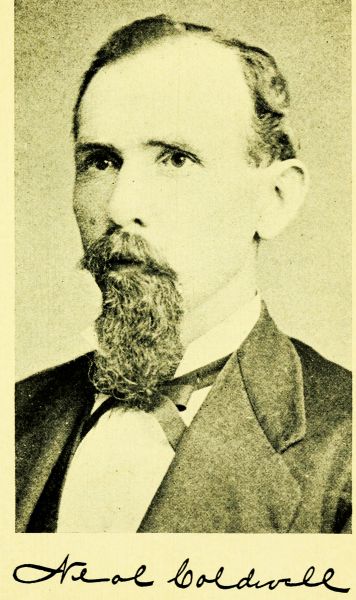
Neal Coldwell
While these prisoners were being held in camp other scouts were sent out in the northern part of the county with orders to sweep Bear Creek, Gentry, Red Creek, Big and Little Saline, to cross the San Saba River in Menard County and sweep up that stream from old Peg Leg Station to Menard. Many more suspects were caught in this haul.
With a party of scouts I was detailed on a mission to Fort McKavett, at that time one of the big military posts on the frontier. Many hard characters and gamblers gathered about these posts to fleece the soldiers out of their easy-made money. We made several arrests here, and camped for noon one mile below the government post on the San Saba River. During the dinner hour my horse, a gray, in lying down to wallow, rolled on some broken beer bottles and cut his back so badly that he was unfit for use for some time. When the escort moved north I was left with old Company "D" until the return of Company "A" on its return march some six weeks later. I thereby missed some of the exciting scouts that took place on the march north.
When Major Jones reached Coleman City he found orders from Governor Coke to send a scout of rangers to Lampasas County to help the civil authorities suppress a war known as the Horrell-Higgins feud. Second Sergeant N.O. Reynolds was detached from Company "A" and with ten men ordered to proceed to Lampasas and report to the sheriff of that county.
After leaving Coleman, Major Jones visited the northernmost ranger company and began his return march. This was to be his last trip with his escort, for immediately upon his return to Austin he was commissioned Adjutant-General of Texas. As there was no longer a major of the battalion, there was no need of an escort, so old Company "A" took its place on the line as a stationary company. Captain Neal Coldwell was ultimately made quartermaster of the battalion, and I believe ranked as major.
I was picked up at Company "D" by the escort on their return march and was with Company "A" when it was made a stationary command and located in Frio County.
In the latter part of 1877—during the late summer—a party of filibusters under command of a Mexican general named Winkler assembled in Maverick County, near Eagle Pass, and prepared to invade Mexico. Captain Coldwell, then commanding Company "A," was ordered to the Rio Grande to break up the expedition. This he did by arresting more than fifty participants. I was with him on this expedition and saw much border service during this summer.
I remember a scout I was called upon to make with Captain Coldwell over in Bandera County. The captain took with him John Parker, Hawk Roberts, and myself. In one week's time we caught some ten or twelve fugitives from justice and literally filled the little old jail at Bandera. Captain Coldwell detailed Hawk Roberts and myself to capture an especially bad man wanted in Burnet County for murder. The captain warned us to take no chances with this man—that meant to kill him if he hesitated about surrendering. I can't remember this murderer's name at this late date, but I recall perfectly the details of his capture. Sheriff Jack Hamilton of Bandera County sent a guide to show us where this fugitive lived. The guide led us some fifteen miles northwest of Bandera and finally pointed out the house in which the murderer was supposed to be. He then refused to go any farther, saying he did not want any of this man's game, for the fellow had just stood off a deputy sheriff and made him hike it back to Bandera.
It was almost night when we reached the house, so Roberts and I decided to wait until morning before attempting the arrest. We staked our horses, lay down on our saddle blankets without supper, and slept soundly till dawn. As soon as it was daylight we rode over near the house, dismounted, slipped up, and, unannounced, stepped right inside the room. The man we wanted was sleeping on a pallet with a big white-handled .45 near his head. Hawk Roberts kicked the pistol out of the man's reach. The noise awakened the sleeper and he opened his eyes to find himself looking into the business ends of two Winchesters held within a foot of his head. Of course he surrendered without fight. His wife, who was sleeping in a bed in the same room, jumped out of it and heaped all kinds of abuse on us for entering her home without ceremony. She was especially bitter against Sheriff Hamilton, who, she said, had promised to notify her husband when he was wanted so he could come in and give himself up. She indignantly advised her husband to give old Sheriff Hamilton a d—d good whipping the first chance he had.
While Company "A" was rounding up outlaws along the border, Sergeant Reynolds was covering himself with glory in the north. Upon reaching Lampasas and reporting to the sheriff as ordered by Major Jones, the sergeant was told that the Horrell boys were living on the Sulphur Fork of the Lampasas River and were defying the authorities to arrest them.
The Horrells were native Texans and had been raised on the frontier. These brothers, of which five were involved in the feud (the sixth, John Horrell, had been killed at Las Cruces, New Mexico, previously) were expert riders, and, having grown up with firearms in their hands, were as quick as chained lightning with either Winchester or pistol. Sam Horrell, the eldest, was married and had a large family of children. He was a farmer and lived a quiet life over on the Lampasas River. The other four boys, Mart, Tom, Merritt, and Ben, were all cattlemen. They stood well in the community, but were considered dangerous when aroused.
At this time Lampasas was a frontier town and wide open as far as saloons and gambling were concerned. The Horrells, like most cattlemen of the period, loved to congregate in town, go to the saloons and have a good time, perhaps drink too much and sometimes at night shoot up the town for fun, as they termed it. Some of the more pious and more settled citizens of the town did not approve of these night brawls, and called upon Governor Edmund J. Davis, Provisional Governor in 1873, to give them protection. Governor Davis had formed in Texas a State Police. Naturally they were rank Republicans, and many of them were termed carpetbaggers. This body was never popular in Texas, especially as many of the force were negroes.
In answer to the call of the citizens, Governor Davis dispatched Captain Williams with three white men and one negro to Lampasas. On the way up Captain Williams met several freighters going to Austin and stopped one of them, Tedford Bean, to ask the distance to Lampasas. The captain had been drinking, and he told Mr. Bean he was going to town to clean up those damn Horrell boys.
The little squad of police reached Lampasas about 3 p.m., hitched its horses to some live oak trees on the public plaza, left the negro to guard them, and then made a bee line to Jerry Scott's saloon on the west side of the square. Mart, Tom, and Merritt Horrell, with some ten or fifteen cow men, were in the saloon drinking, playing billiards and having a good time generally. One man was picking a banjo and another playing a fiddle. Captain Williams, an exceedingly brave but unwise man, took in the situation at a glance as he walked up to the bar and called for drinks.
He turned to Bill Bowen, a brother-in-law to Merritt Horrell, and said, "I believe you have a six-shooter. I arrest you."
"Bill, you have done nothing and need not be arrested if you don't want to," interrupted Mart Horrell.
Like a flash of lightning Captain Williams pulled his pistol and fired on Mart Horrell, wounding him badly. The Horrell boys drew their guns and began to fight. Captain Williams and one of his men, Dr. Daniels, were shot down in the saloon. William Cherry was killed just outside the door, and Andrew Melville was fatally wounded as he was trying to escape. He reached the old Huling Hotel, where he died later. At the first crack of a pistol the negro police mounted his horse and made a John Gilpin ride for Austin. Thus, within the twinkling of an eye, four state police were killed and only one of the Horrells wounded.
Tom and Merritt Horrell carried the wounded Mart to their mother's home, some two hundred yards from Scott's saloon, then mounted their horses and rode away. Great excitement prevailed in the town. The state militia was called out, and Governor Davis hurried other state police to Lampasas. They scoured the country for the Horrell boys, but to no avail.
Mart Horrell and Jerry Scott were arrested and carried to Georgetown, Williamson County, and placed in jail. Mart Horrell's wife went to the jail to nurse her husband and, of course, kept her brothers-in-law informed as to Mart's condition. As soon as he was well the Horrell boys made up a party and rode to Williamson County and assaulted the jail at night. The citizens and officers of Georgetown, taken unawares, put up a stiff fight, but the Horrells had ten or fifteen well organized and armed men with them. They took stations at all approaches to the jail and kept up a steady fire with their Winchesters at anyone who showed up to oppose them. Mr. A.S. Fisher, a prominent lawyer of the town, took an active hand in the fight and was badly wounded. Bill Bowen was slightly hurt while battering in the jail door with a sledge hammer. Mart Horrell and Jerry Scott were liberated and rode off with their rescuers.
By the next evening the Horrells were back on Lucies Creek. They at once made arrangements to leave the country and go to New Mexico. They had gathered about them Bill and Tom Bowen, John Dixon, Ben Turner, and six or eight other men as desperate and dangerous as themselves. They were so formidable that they no longer attempted to hide but openly and without hindrance gathered their cattle, sold the remnant to Cooksey and Clayton to be delivered to them in Coleman County. They even notified the sheriff of Lampasas County just what day they would pass with their herd through Russell Gap, but they were not molested.
As a cowboy I had worked for Cooksey and Clayton, and was with them when they delivered cattle to the Horrell boys on Home Creek, Coleman County. I had dinner in camp with the outlaws and they made no effort to hide from the authorities. I remember they sat about their camps with Winchesters across their laps.
When all was ready the Horrells moved slowly out of the country with their families and cattle and finally reached New Mexico, settling on the head of the Hondo River in Lincoln County. They had not been at their new home many months before Ben Horrell was shot and killed at a fandango near old Fort Stanton. Ben's brothers at once repaired to the dance hall and killed eight Mexicans and one woman.
This brought on a war between the Horrell boys and the Mexican population along the Hondo River, and it is said that in the fights that followed thirty or forty Mexicans were killed between Fort Stanton and Roswell. In one of those pitched battles Ben Turner was killed. Turner was prominent in all of the fights staged by the Horrells, was with them when Captain Williams was killed and was one of the assaulting party on the Georgetown jail. His death was keenly felt by his companions.
Having now outlawed themselves in New Mexico, the Horrells could no longer stay in that country. They turned back to Texas, and next year showed up at their old haunts in Lampasas County. The shock of the Civil War was beginning to subside and the State of Texas was then under civil government with a Democratic governor in office. The friends of the Horrells advised them to surrender to the authorities and be tried for the killing of Captain Williams and his men. They were assured a fair trial by the best citizens of Lampasas County. Accordingly, the Horrells gave up, and upon trial were acquitted of the charges against them.
The Horrells had not long been at ease before Merritt, the youngest of the brothers, was accused by Pink Higgins of unlawfully handling his cattle. Shortly afterward, while Merritt was seated unarmed in a chair in the old Jerry Scott saloon, Pink Higgins stepped to the back door of the place and shot him to death. Thus Merritt met his death in the same saloon where four years before he had been a party to the killing of Captain Williams. At this time Mart and Tom Horrell were living down on Sulphur Fork of Lampasas River. The news of their brother's death was quickly carried to them. They armed themselves and started in a run for Lampasas.
This move had been anticipated by the Pink Higgins party. They waylaid the Horrell boys outside the town and at their first fire killed Tom Horrell's horse and badly wounded Mart. Tom advanced single handed on the attackers and put them to flight. He then partly supported and partly carried his brother to the home of Mr. Tinnins, a neighbor, where a doctor was hurried to the wounded man.
Thus old Lampasas County was again the scene of war with Mart, Tom and Sam Horrell, Bill and Tom Bowen, John Dixon and Bill Crabtree on one side and Pink Higgins, Bob Mitchell and their friends on the other. These two factions met in the town of Lampasas and a furious battle followed. A man was killed on each side and the population greatly endangered. Hence the governor's order to Major Jones to send rangers to the aid of the officers at Lampasas.
When Sergeant N.O. Reynolds reported to the sheriff of Lampasas he was informed that the Horrell boys were living ten miles east of Lampasas and had ten or twelve desperate men with them, so that it meant certain death to anyone making an attempt to capture them.
"But, Mr. Sheriff, I am sent here to effect the capture of all offenders against the law, and it is my duty to at least make the attempt," replied the brave Reynolds.
"These men have never been arrested," declared Sheriff Sweet, "and it is my honest opinion they cannot be."
Reynolds then asked if the sheriff would send a guide to show him where the Horrells lived. The rangers under the intrepid Reynolds left Lampasas late in the night and finally the guide pointed at a flickering light about a mile off.
"There is where the Horrell boys live. I am going back to town," he said.
When asked if he would not accompany the rangers to the house, the guide replied, "No, not for a million dollars!"
With that he turned his horse and rode away.
Reynolds thought it would be best to wait until daylight before attempting the arrest. He planned to surprise the outlaws, if such a thing were possible, but if the rangers were discovered and an engagement came on they were to fight to the last man. As soon as dawn broke the rangers wended their way on foot to the Horrell brothers' ranch. It was a moment of great anxiety as they approached the house, but not a sound was heard, not a dog barked.
Sergeant Reynolds and his men tiptoed right into the room in which the Horrells were sleeping. Some of the men were on pallets on the floor, while others slept in beds in the one big room. Each ranger pointed a cocked Winchester at the head of a sleeper. Reynolds then spoke to Mart Horrell. At the sound of his voice every man sat up in bed and found himself looking into the muzzle of a gun. The sergeant quickly explained that he was a ranger and had come to arrest them. Mart replied they could not surrender, and Tom Horrell said it would be better to die fighting than to be mobbed.
This gave Reynolds his cue. He warned the outlaws that if anything was started there would be a dozen dead men in that house in one minute and advised them to listen to what he had to say. He then guaranteed the Horrells upon his honor that he would not turn them over to the sheriff to be put in jail and mobbed, but promised he would guard them in his camp until they could secure a preliminary examination and give bond.
"Boys, this seems reasonable," said Mart Horrell, rising to his feet. "I believe these rangers can be relied upon to protect us. Besides this fight has been thrust upon us. If we can get a hearing we can give bond."
They all agreed finally to this proposition of Sergeant Reynolds and laid down their arms, mounted their horses and under guard of the rangers were marched into the town of Lampasas.
The news of the capture of the Horrells spread like wildfire through the town and county. Hundreds of people flocked to Lampasas to see Sergeant Reynolds, the man that had accomplished the impossible in rounding up the most desperate band of men that ever lived. The news was rushed to Austin, and General Jones himself hurried to the scene. This act of Sergeant Reynolds covered him with glory and brought to his name imperishable renown. He was at once commissioned First Lieutenant, commanding Company "E."
The Horrell boys were admitted to bond after a preliminary hearing. After their release Mart Horrell came to Lieutenant Reynolds and feelingly thanked him for carrying out his promise. With tears streaming down his face he grasped the lieutenant's hand and said, "You are undoubtedly the bravest man in the world today." These unfortunate men were later shot to death in the Meridian jail. The Higgins and Mitchell parties surrendered to the authorities. Pink Higgins was tried and acquitted of the murder of Merritt Horrell. This ended the feud, but it started Lieutenant Reynolds on a new and important phase of his career as a ranger.
CHAPTER VIII
SERVICE WITH REYNOLDS, THE INTREPID
As soon as Sergeant Reynolds was commissioned first lieutenant he was placed in command of Company "E," then stationed in Coleman County, but immediately ordered to Lampasas. At this time Captain Sparks resigned the command of Company "C," and this company was also ordered to report to Lieutenant Reynolds at the same town. Late in August the two commands went into camp at Hancock Springs. Major Jones then authorized Lieutenant Reynolds to pick such men as he desired from these two companies for his own company and either discharge or transfer the remainder to other commands. No other officer in the battalion, I believe, was ever accorded this privilege.
Lieutenant Reynolds had a week or ten days in which to make his selection, so he studied the muster rolls of the companies carefully. He had ranged under such great captains as Perry, D.W. Roberts, Neal Coldwell, and with Major Jones himself. He knew what qualities were needed in a good ranger and made his selections accordingly. From old Company "A" Reynolds selected C.L. Nevill, Tom Gillespie, Shape Rodgers, Jack Martin, John Gibbs, W.T. Clements, and four others whose names I do not now remember. These were the scouts that had helped him capture the Horrells and naturally were his first choice. From Company "E" came Dick Ware, who one year later killed the noted train robber, Sam Bass, then served Mitchell County as its first sheriff for many years, and finally became United States marshal for the Western District of Texas under President Cleveland's administration. Henry Thomas, Miller Mourland, George Arnett, and other Company "E" boys were selected. Henry Maltimore, Ben and Dock Carter, Bill Derrick, Chris Connor, Henry McGee, Abe Anglin, J.W. Warren, Dave Ligon, Lowe Hughes, George (Hog) Hughes, and others were picked from Company "C."
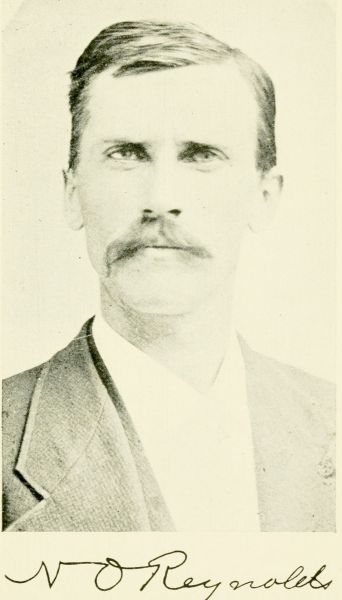
N.O. Reynolds
When he had exhausted the two companies Reynolds turned to General Jones and said, "There is a ranger down on the Rio Grande in Neal Coldwell's company that I want."
"Who is it?" asked the general.
"Private Jim Gillett."
"You shall have him," promised General Jones. "I will send an order to Captain Coldwell tonight to have Gillett report to you here."
It was late in the evening when Company "A's" mail came in from Frio Town, but Captain Coldwell sent for me as soon as General Jones' order arrived, and told me that I must leave the company next morning and report to the Adjutant-General at Austin. I was nonplussed, for I did not know what the order meant. Out on the frontier where we then were operating we seldom read newspapers or heard what the other companies were doing, so I did not even know that Reynolds had captured the Horrell boys and had been commissioned to command Company "E." The following morning I bade Captain Coldwell and the Company "A" boys goodbye and started on my long ride to Austin.
As I jogged along I asked myself many hundred times why I was ordered to report at Austin, and, boy-like, it made me nervous and uneasy. It took me two days to reach San Antonio and three more to get to Austin. I arrived in the latter town just at nightfall, but I was at the Adjutant-General's office as soon as it was opened next morning.
Presently General Jones entered with some officers of the State Militia. He shook hands with me and invited me to be seated, saying he had some business to attend to for the moment. It was probably an hour before the officers left and the general could turn to me. He very kindly inquired as to my trip and asked about Captain Coldwell and the company. He then told me about the arrest of the Horrell boys and Sergeant Reynolds' commission as first lieutenant commanding Company "E," vice Lieutenant Foster resigned. He explained Reynolds had requested that I be attached to his command, and ordered me to report to my new commander in Lampasas without delay.
I excused myself at once and lost no time in getting my horse out of the livery stable and resuming my way. A great load was lifted from my mind, and I was about as happy as a boy could be. I sang and whistled all the way to Liberty Hill, thirty miles from Austin. The following day about 2 p.m. I rode into Reynolds' camp at Hancock Springs.
I attracted some attention as I rode in, for I wore a big Mexican hat mounted with silver, a buckskin jacket fringed from shoulder to elbow with a bunch of flowers braided in highly colored silk on its back. On my heels were enormous Mexican spurs. I never saw a ranger sent to the Rio Grande for the first time that did not rig himself out in some such outlandish attire, only to discard it a few weeks later, never to wear it again. I was no exception, and I think every man in camp tried on my hat.
Lieutenant Reynolds selected C.L. Nevill for first sergeant, Henry W. McGee as second sergeant, and J.W. Warren and L.W. Conner, first and second corporals, respectively. On September 1, 1877, the company was sworn in. The new command was the most formidable body of men I had ever seen. Our commander, Lieutenant Reynolds, was over six feet tall and weighed probably one hundred and seventy-five pounds. He was a very handsome man, a perfect blond, with steel blue eyes and a long, light moustache. At that time he was about thirty years of age, vigorous in mind and body, and had a massive determination to succeed as a ranger. His mind was original, bold, profound and quick, with a will that no obstacle could daunt. He was the best ranger in the world—there was never another like him. The lieutenant was a native of Missouri, and was always known as "Major" or "Mage" Reynolds. It was said that Reynolds, though a mere boy, had served with the Confederates in the latter part of the Civil War. He was one of a party that captured a troop of Federal cavalry, the major of which was well supplied with clothing. The captors, however, were very scantily clad and Reynolds appropriated the major's uniform, hence his nick-name "Mage." In later years when I had grown more intimate with him and was probably closer to him than any other I mentioned this story. He neither affirmed nor denied it, declaring he was a Missourian by birth, a bootmaker by trade, and that his early history could interest no one.
First Sergeant Nevill was six feet and one inch in height and weighed one hundred and eighty-five pounds. All the non-commissioned officers were at least six feet tall and built in proportion, and many of the privates were from five feet eleven inches to six feet in height. I was probably the lightest man in the company, being only five feet nine inches and weighing but one hundred and forty pounds.
When the company's roster was complete Lieutenant Reynolds had but twenty-eight men,—lacking two of his full complement of thirty. The company was then ordered to Austin, but before being assigned to its position on the frontier the lieutenant enlisted John and Will Bannister, two celebrated frontiersmen. They were old cowboys, splendid shots, and well acquainted with every part of Kimble, Menard, Mason, and Kerr Counties, in which Company "E" was destined to operate. In appearance and ability this company compared favorably with any thirty rangers ever sent to the Texas frontier. Nearly every member of the company had had more or less experience as an officer, and all were exceedingly fine marksmen. Sergeant Henry McGee had been marshal of Waco and had figured in several pistol duels in that city. Dave Ligon, the oldest man in the command, had been a Confederate soldier and had served with General Forrest's cavalry.
In the summer of 1877, Lieutenant Armstrong of Captain Hall's company, assisted by Detective Jack Duncan of Dallas, Texas, captured the notorious John Wesley Hardin. It has been said that Texas, the largest state in the Union, has never produced a real world's champion at anything. Surely, such critics overlooked Hardin, the champion desperado of the world. His life is too well known in Texas for me to go into detail, but, according to his own story, which I have before me, he killed no fewer than twenty-seven men, the last being Charley Webb, deputy sheriff of Brown County, Texas. So notorious had Hardin become that the State of Texas offered $4000 reward for his capture. Hardin had left Texas and at the time of his capture was in Florida. His captors arrested and overpowered him while he was sitting in a passenger coach.
In September, 1877, Sheriff Wilson of Comanche County, in whose jurisdiction Hardin had killed Webb, came to Austin to convey the prisoner to Comanche for trial. Wilson requested the governor for an escort of rangers. Lieutenant Reynolds' company, being in Austin at the time, was ordered to accompany Wilson and protect Hardin from mob violence. This was the first work assigned Company "E" under its new commander.
The day we left Austin between one and two thousand people gathered about the Travis County jail to see this notorious desperado. The rangers were drawn up just outside the jail, and Henry Thomas and myself were ordered to enter the prison and escort Hardin out. Heavily shackled and handcuffed, the prisoner walked very slowly between us. The boy that had sold fish on the streets of Austin was now guarding the most desperate criminal in Texas; it was glory enough for me.
At his trial Hardin was convicted and sentenced to twenty-five years in the penitentiary. He appealed his case and was returned to Travis County for safekeeping. The verdict of the trial court was sustained, and one year later, in September, 1878, Lieutenant Reynolds' company was ordered to take Hardin back to Comanche County for sentence. There was no railroad at Comanche at that time, so a detachment of rangers, myself among them, escorted Hardin to the penitentiary. There were ten or twelve indictments still pending against him for murder in various counties, but they were never prosecuted.
Hardin served seventeen years on his sentence, and while in prison studied law. Governor Hogg pardoned him in 1894 and restored him to full citizenship.
In transmitting him the governor's pardon, Judge W.S. Fly, Associate Justice of the Court of Appeals, wrote Hardin as follows:
Dear Sir: Enclosed I send you a full pardon from the Governor of Texas. I congratulate you on its reception and trust that it is the day of dawn of a bright and peaceful future. There is time to retrieve a lost past. Turn your back upon it with all its suffering and sorrow and fix your eyes upon the future with the determination to make yourself an honorable and useful member of society. The hand of every true man will be extended to assist you in your upward course, and I trust that the name of Hardin will in the future be associated with the performance of deeds that will ennoble his family and be a blessing to humanity.
Did you ever read Victor Hugo's masterpiece, "Les Miserables"? If not, you ought to read it. It paints in graphic words the life of one who had tasted the bitterest dregs of life's cup, but in his Christian manhood rose about it, almost like a god and left behind him a path luminous with good deeds.
With the best wishes for your welfare and happiness, I am,
Yours very truly, W.S. Fly.
Despite all the kind advice given him by eminent lawyers and citizens, Hardin was unequal to the task of becoming a useful man. He practiced law for a time in Gonzales, then drifted away to El Paso, where he began drinking and gambling. On August 19, 1895, Hardin was standing at a bar shaking dice when John Selman, constable of Precinct No. 1, approached him from behind and, placing a pistol to the back of Hardin's head, blew his brains out. Though posing as an officer Selman was himself an outlaw and a murderer of the worst kind. He killed Hardin for the notoriety it would bring him and nothing more.
After delivering Hardin to the sheriff of Travis County in 1877, Lieutenant Reynolds was ordered to Kimble County for duty. Of all the counties in Texas at that time Kimble was the most popular with outlaws and criminals, for it was situated south of Menard County on the North and South Llano Rivers, with cedar, pecan and mesquite timber in which to hide, while the streams and mountains furnished abundance of fish and game for subsistence.
Up on the South Llano lived old Jimmie Dublin. He had a large family of children, most of them grown. The eldest of his boys, Dick, or Richard, as he was known, and a friend, Ace Lankford, killed two men at a country store in Lankford's Cove, Coryell County, Texas. The state offered $500 for the arrest of Dublin and the County of Coryell an additional $200. To escape capture Dick and his companion fled west into Kimble County. While I was working as cowboy with Joe Franks in the fall of 1873 I became acquainted with the two murderers, for they attached themselves to our outfit. They were always armed and constantly on the watchout for fear of arrest. Dublin was a large man, stout, dark complected, and looked more like the bully of a prize ring than the cowman he was. I often heard him say he would never surrender. While cow hunting with us he discovered that the naturally brushy and tangled county of Kimble would offer shelter for such as he, and persuaded his father to move out into that county.
Dublin had not lived long in Kimble County before another son, Dell Dublin, killed Jim Williams, a neighbor. Thus two of the Dublin boys were on the dodge charged with murder. They were supposed to be hiding near their father's home. Bill Allison, Starke Reynolds and a number of bandits, horse and cattle thieves and murderers, were known to be in Kimble County, so Lieutenant Reynolds was sent with his company to clean them up.
It was late in October, 1877, before the company reached its destination and camped on the North Llano River below the mouth of Bear Greek. As soon as our horses had rested and camp was fully established for the winter we began scouting. Several men wanted on minor charges were captured. We then raided Luke Stone's ranch, which was about ten miles from our camp, and captured Dell Dublin. He was fearfully angry when he found escape impossible. He tore his shirt bosom open and dared the rangers to shoot him. While he was being disarmed his elder brother, Dick, rode out of the brush and came within gun shot of the ranch before he discovered the presence of the rangers. He turned his horse quickly and made his escape, though the rangers pursued him some distance. When Dick learned that the Banister boys and myself were with Lieutenant Reynolds' company and hot on his trail he declared he would whip us with a quirt as a man would a dog if he ever came upon us, for he remembered us as beardless boys with the Joe Franks' cow outfit. However, despite his threat, he never attempted to make it good, but took very good care to keep out of our way until the fatal January 18, 1878.
There was no jail in Kimble County, so with a detachment of rangers I took Dell Dublin and our other prisoners to Llano County lockup.
Shortly afterward Reynolds selected Sergeant McGee, Tom Gillespie, Dick Harrison, and Tim McCarthy and made a scout into Menard County. He also had with him his negro cook, George, to drive his light wagon. On the return toward Bear Creek the scout camped for the night at Fort McKavett. At that time each frontier post had its chihuahua or scab town, a little settlement with gambling halls, saloons, etc., to catch the soldiers' dollars. At Fort McKavett were many discharged soldiers, some of them negroes from the Tenth Cavalry. These blacks had associated with white gamblers and lewd women until they thought themselves the equals of white men, and became mean and overbearing.
On this particular night these negro ex-soldiers gave a dance in scab town, and our negro, George, wanted to go. He was a light mulatto, almost white, but well thought of by all the boys in the company. He obtained Lieutenant Reynolds' permission to attend the dance, and borrowed Tim McCarthy's pistol to carry to it. When George arrived at the dance hall the ex-soldiers did not like his appearance, as he was allied with the rangers, whom they despised. They jumped on George, took his pistol and kicked him out of the place. The boys were all in bed when George returned and told McCarthy that the negroes at the dance hall had taken his pistol from him.
Lieutenant Reynolds was sleeping nearby and heard what George said. He raised up on his elbow and ordered Sergeant McGee to go with McCarthy and George and get the pistol. The negroes saw McGee coming and, closing the door, defied him to enter the dance hall.
McGee was cool and careful. He advised the negroes to return the pistol, but they refused, saying they would kill the first white-livered s— o— b— that attempted to enter the house. The sergeant then stationed himself at the front door, ordered McCarthy to guard the back entrance of the place, and sent George for the lieutenant. Reynolds hurried to the scene, taking with him Tom Gillespie and Dick Harrison. The lieutenant knocked on the door and told the blacks he was the commander of the rangers and demanded their surrender. They replied with an oath that they would not do so. Reynolds then ordered the house cleared of women and gave the negroes just five minutes in which to surrender.
Up to this time the women had been quiet, but they now began to scream. This probably demoralized the negro men. One of them poked McCarthy's pistol, muzzle foremost, out of a window.
"Here, come get your d—n pistol," he said.
McCarthy, a new man in the service, stepped up and grasped it. The instant the negro felt the touch of McCarthy's hand on the weapon he pulled the trigger. The ball pierced McCarthy's body just above the heart, giving him a mortal wound.
At the crack of the pistol the rangers opened fire through the doors and windows on the negroes within the house. Reynolds and his men then charged the place, and when the smoke of battle cleared they found four dead negro men and a little negro girl that had been killed by accident. Only one black escaped. He was hidden under a bed, and as the rangers came in, made a dash to safety under cover of darkness. McCarthy died the following day and was buried near old Fort McKavett. Negro George fought like a tiger and won the boys' praise.
A few days afterward the sheriff of Tom Green County, following the trail of a bunch of stolen cattle from San Angelo, came into our camp. Lieutenant Reynolds sent Sergeant Nevill and a scout of rangers with the sheriff. The trail led over to the South Llano, where the cattle were recovered. While scouting around the herd, Sergeant Nevill discovered a man riding down the trail toward him. He and his men secreted themselves and awaited the stranger's approach. It was getting quite dark, and when the newcomer had ridden almost over the concealed rangers without noticing their presence they rose up, presented their guns and ordered him to halt.
"Yes,—like hell!" he exclaimed, and, turning his horse, dived into a cedar brake. A shower of bullets followed, but failed to strike the fugitive. This was the notorious Dick Dublin with a $700 reward on his head.
Sergeant Nevill returned to camp with about fifty head of burnt cattle, but let the most notorious criminal in the county escape. Lieutenant Reynolds was disappointed at this, and said he did not understand how four crack rangers could let a man ride right over them and then get away. He declared his negro cook could have killed Dublin had he been in their place. This mortified the boys a great deal.
The latter part of December, 1877, Lieutenant Reynolds sent a scout out on Little Saline, Menard County. On Christmas day this detail had a running fight with four men. John Collins, the man who stole a yoke of oxen at Fredericksburg and drove them up to within two miles of our camp, was captured, as was also John Gray, wanted for murder in one of the eastern counties. Jim Pope Mason, charged with the murder of Rance Moore, was in this skirmish, but escaped.
One cold morning about the middle of January Corporal Gillett, with Privates John and Will Banister, Tom Gillespie, Dave Ligon, and Ben Carter, was ordered on a five days' scout. We saddled our horses and packed two mules. When all was ready I walked over to Lieutenant Reynolds. He was sitting on a camp stool before his tent and seemed in a brown study. I saluted and asked for orders.
"Well, Corporal," he said, after a moment's hesitation, "it is a scout after Dick Dublin again. That man seems to be a regular Jonah to this company. He lives only ten miles from here and I have been awfully disappointed at not being able to effect his capture. It is a reflection on all of Company 'E.' There is one thing sure if I can't capture him I will make life miserable for him. I will keep a scout in the field after him constantly."
I then asked if he had any instructions as to the route I should travel.
"No, no," he replied. "I rely too much on your judgment to hamper you with orders. After you are once out of sight of camp you know these mountains and trails better than I do. Just go and do your best. If you come in contact with him don't let him get away."
After riding a half mile from camp the boys began inquiring where we were going and who we were after. I told them Dick Dublin. We quit the road and traveled south from our camp over to the head of Pack Saddle Creek. Here we turned down the creek and rounded up the Potter ranch, but no one was at home, so we passed on into the cedar brake without having been seen.
On the extreme headwaters of South Llano River some cattlemen had built a large stock pen and were using it to confine wild cattle. This was far out beyond any settlement and probably fifty or sixty miles from our camp. I thought it possible that Dick Dublin might be hanging around the place, so we traveled through the woods most of the way to it. Here I found that the cattlemen had moved.
The scout had now been out two days, so we began our return journey. We traveled probably twenty-five miles on the third day. On the fourth day I timed myself to reach the Potter ranch about night. Old man Potter, a friend and neighbor of Dublin's, lived here with two grown sons. It was known that Dublin frequented the place, and I hoped to catch him here unawares. About sundown we were within a mile of the ranch. Here we unsaddled our horses and prepared to round up the house. If we met with no success we were to camp there for the night. I left John Banister and Ligon to guard camp while Gillespie, Will Banister, and Ben Carter, with myself, approached the ranch on foot. If I found no one there I intended to return to our camp unseen and round up the ranch again the following morning.
We had not traveled far before we discovered a lone man riding slowly down the trail to the Potter ranch. We remained hidden and were able to approach within fifty yards of the house without being seen. We now halted in the bed of a creek for a short consultation. The one-room cabin had only a single door, and before it was a small wagon. The Potters cooked out of doors between the house and the wagon. We could see a horse tied to the south side of the vehicle, but could not see the camp fire for the wagon and the horse. To our right and about twenty-five steps away old man Potter and one of his sons were unloading some hogs from a wagon into a pen.
We knew the moment we left the creek bed we would be in full view of the Potters and the ranch house. We decided, then, that we would advance on the house as fast as we could run and so be in good position to capture the man who had ridden into the camp. We rose from the creek running. Old man Potter discovered us as we came in view and yelled, "Run, Dick, run! Here comes the rangers!"
We then knew the man we wanted was at the camp. We were so close upon Dublin that he had no time to mount his horse or get his gun, so he made a run for the brush. I was within twenty-five yards of him when he came from behind the wagon, running as fast as a big man could. I ordered him to halt and surrender, but he had heard that call too many times and kept going. Holding my Winchester carbine in my right hand I fired a shot directly at him as I ran. In a moment he was out of sight.
I hurried to the place where he was last seen and spied him running up a little ravine. I stopped, drew a bead on him, and again ordered him to halt. As he ran, Dublin threw his hand back under his coat as though he were attempting to draw a pistol. I fired. My bullet struck the fugitive in the small of the back just over the right hip bone and passed out near his right collarbone. It killed him instantly. He was bending over as he ran, and this caused the unusual course of my ball.
The boys, whom I had outrun, now joined me, and Carter fired two shots at Dublin after he was down. I ordered him to desist as the man was dead. I examined the body to make sure it was Dublin, for I knew him intimately, as I had cow hunted with him before I became a ranger. We found him unarmed, but he had a belt of cartridges around his waist. He was so completely surprised by our sudden appearance he could do nothing but run. The $700 reward on him could never be collected, as it was offered for his arrest and conviction. Dublin's brothers, Role and Dell, swore vengeance against myself and the Banister boys, but nothing ever came of the oath.
In the month of February, 1878, Lieutenant Reynolds started to Austin with five prisoners we had captured in Kimble and Menard Counties. They were chained together in pairs, John Stephens, the odd man, was shackled by himself. As guard for these prisoners Reynolds had detailed Will and John Banister, Dave Ligon, Ben Garter, Dick Ware, and myself.
On the Junction City and Mason road, some ten miles east of our camp, was the small ranch of Starke Reynolds, a fugitive from justice, charged with horse stealing and assault to kill. Company "E" had scouted for him in Kimble County and had rounded up his ranch many times. We knew he was in the county, but he always managed to escape us. As we passed this ranch, Lieutenant Reynolds, Privates Ware, Carter, Ligon, and myself were marching in front, with a four-mule wagon following us, in which were the chained prisoners. Behind it came the Banisters, who were on guard that day and detailed to keep a constant watch on the captive outlaws.
We passed the Starke Reynolds' home about 10 o'clock in the morning, and Lieutenant Reynolds remarked that it was hardly worth while to round up the house as he had done so many times in the past without result, but that he would surely like to capture the fellow. We had not ridden more than half a mile beyond the ranch when we came face to face with Starke himself. He was a small man and riding an exceedingly good brown pony. We were about four hundred yards apart and discovered each other at the same instant. The outlaw was carrying a small sack of flour in front of him. He immediately threw this down, turned his horse quickly and made a lightning dash for the Llano bottoms, some three miles away.
At that point the Junction City and Mason road winds along a range of high mountains with the country sloping downward to the Llano River. This grade was studded with scrubby live oak and mesquite brush not thick enough to hide a man but sufficiently dense to retard his flight through it. We gave chase at once and for a mile and a half it was the fastest race I ever saw the rangers run. We were closely bunched the entire distance, with Lieutenant Reynolds—he was riding a fast race horse—always slightly in the lead. He finally got close enough to the fugitive to demand his surrender. Starke only waved his gun defiantly and redoubled his speed. Lieutenant Reynolds then drew his six-shooter and began firing at the outlaw. After emptying his pistol he began using his Winchester.
The Llano bottoms were now looming right up in front of us. The race had been fast enough to run every horse into a big limber. Carter, Ware, and Ligon dropped out of the race. Up to this time I had contented myself by trying to keep up with Lieutenant Reynolds, for it is always easier to follow a man through the brush than to run in the lead. I had a good grip on my bridle reins and was trying to steady my pony as best I could. I now saw that the outlaw was beginning to gain on us. I ran up beside the lieutenant and said, "He is getting away from us. Must I go after him?"
Lieutenant Reynolds turned and looked at me with the wildest look on his face that I ever saw. His hat was gone, his face was badly scratched by the brush with the blood running down over his white shirt bosom.
"Yes, G— d—n him; stop or kill him!"
I changed the bridle reins to my left hand, drew my gun with my right and, digging my spurs deep into my pony's side, I was out of sight of the lieutenant in three hundred yards. The fugitive saw that I was alone and that I was going to overhaul him. He suddenly brought his pony to a standstill, jumped down, took shelter behind the animal and drew a bead on me with his gun.
"G— d—n you, stop, or I'll kill you!" he cried.
I tried to obey his order, but my pony was running down hill and ran straight at him for twenty-five yards more before I could stop. I jumped down from my horse and made ready to fight, but Starke broke for a thicket on foot. As soon as he ran out from behind his pony I fired at him. The bullet must have come rather close to him, for he turned quickly and took shelter behind his mount again. As he peeped over his saddle at me I attempted to draw a bead on his head, but I was tired, nervous and unsteady. Before I could shoot Dave Ligon galloped right up to the outlaw, ordered him to surrender and drop his gun, which Starke did at once. The boys had heard me shoot and in five minutes were all upon the scene.
The captive was searched and ordered to remount his pony. With one of the boys leading Starke's mount we started back to the wagon, nearly three miles away. As soon as the outlaw was a prisoner and knew he would not be harmed no matter what he said, he began a tirade against the rangers. He declared the whole battalion was a set of d—d murderers, especially Company "E," and said it was curbstone talk in Menard, Mason and Kimble Counties that Lieutenant Reynolds' men would kill a man and then yell for him to throw up his hands. He kept up this running talk until he exhausted Lieutenant Reynolds' patience. The latter then ordered Starke to shut up, and declared the speaker was a d—d liar, for Company "E" never killed a man without first giving him a chance to surrender. Lieutenant Reynolds then said that with the last old brier-breaker captured he had accomplished the task set him and was now ready to go elsewhere.
As we rode along one of the boys remarked that my pony was limping badly.
"I wish his leg would come right off up to his shoulder," declared Starke in disgust. "If it hadn't been for him I would have made it to the bottoms and escaped."
On approaching the wagon the prisoner Stephens, a man of some intelligence and humor, stood up and called out to Starke, "By G—, old man, they got you! They rode too many corn fed horses and carried too many guns for you. I don't know who you are, but I'm sorry for you. While they were chasing you I got down on my knees here in this wagon and with my face turned up to the skies I prayed to the Almighty God that you might get away."
Starke was chained to this good-natured liar, and now, for the first time, our prisoner seemed to realize his condition. He asked Lieutenant Reynolds to send word to his family that he had been captured. The lieutenant thereupon sent one of the boys to Starke's home to tell Mrs. Reynolds that the rangers would camp on Red Greek for dinner, and if she wished to see her husband we would be there probably two hours.
Presently Starke's old gray-haired father came to our midday camp. When he saw his son chained he burst out crying, saying, "My son, it is not my fault that you are in this condition. I did my best to give you good advice and tried to raise you right."
After dinner we resumed our march toward Austin. Starke Reynolds was finally turned over to the sheriff of Tarrant County. He was admitted to bail and gave bond, but before he came to trial he was waylaid and killed, supposedly by relatives of the man he had previously attempted to murder.
Early in the spring of 1878 a ranchman living five miles above our camp saw a bunch of Indians on Bear Creek, Kimble County, and at once reported to Lieutenant Reynolds. The redskins had been seen late in the evening, and by the time a scout could be started after them it was almost night. The lieutenant, however, followed the trail until it entered a cedar brake. It was then too dark to work farther, so the scout returned to camp to make arrangements to resume the trail the following morning. On the march back to camp the rangers picked up a paint pony with an arrow sticking in its hip. The Indians had probably tried to catch the horse and, failing to do so, had shot it, as was their custom.
Just after dark a runner from Junction City came in and reported a bunch of redskins had been seen near the town stealing horses. It was a beautiful moonlight night and a close watch was kept on our horses. Just at midnight John Banister, an alert man on guard, noticed that one of our pack mules hitched at the end of our picket line was pulling back on its rope and looking over a brush fence that enclosed the camp. With Winchester in hand Banister passed through a gate, walked slowly down the fence and into some small underbrush near the mule.
Suddenly a man rose to his feet and fired on Banister at a distance of not more than ten steps, then broke and ran. Banister at once opened fire on the Indian. The very first report of a gun brought every man in camp out of his bed. We could see the flashes of Banister's gun and went to his aid in our night clothes and barefooted. I ran down by the picket line of horses and jumped the fence where the mule had seen the redskin. By moonlight I could glimpse the Indian running down the river bank. I shot at him nine times as he ran, but without effect. Some two hundred yards below our camp was a ford on the Llano and the fugitive was making for it.
Just as soon as the Indian reached the crossing and plunged into the river, eight or nine of the rangers that had followed Banister on the high ground were in a position to shell the swimmer as he crossed. There were probably a hundred shots fired at him, but he finally disappeared in the brush on the south side of the river. Investigation of the place where he crossed showed the timber cut all to pieces but, strange to say, not a shot hit the Indian as far as we ever knew. We found a blanket where the savage had risen and shot at Banister and, measuring the ground, found that the ranger was just twelve short steps from the Indian when fired upon by the redskin. It was a miracle that Banister was not killed; the bullet, a .45 caliber, buried itself in some sacks of corn in a tent just back of him.
The next morning we found where ten or twelve Indians had waited under some large pecan trees while this scout slipped up to our camp to investigate and steal a horse. The trees were about four hundred yards from camp and on the opposite side of the river. Some of the rangers jokingly said those old braves must have thought this lone one stirred up hell at the ranger camp.
On account of the range cattle and horses along the Llano River, Lieutenant Reynolds lost some eight or ten hours the next morning before picking up the Indian trail. This gave the redskins ten or twelve hours start, as they were at our camp just at midnight. The trail passed out west between North and South Llano Rivers and followed a rough mountain country that made pursuit difficult and slow. We followed the savages five or six days and finally abandoned the trail near the head of Devil's River after a heavy rain.
While we had been active in rounding up the numerous outlaws and cattle thieves that infested Kimble County, we had not been able to clean up the mystery of the Peg Leg stage robbers, which had long baffled the best detectives, sheriffs, and rangers. Peg Leg was a small stage station on the San Saba in the midst of a rough and very mountainous country. Here the stage was repeatedly held up and as repeatedly the robbers escaped. The scene of the hold-up was many times examined and parties made determined efforts to trail the bandits but always without success, for the trail was quickly lost in the rough mountains. One of the features that proved particularly puzzling was the constant recurrence of an exceedingly small footprint at each robbery. These marks were so very small they convinced many observers that a woman from Fort McKavett or Fort Concho was operating with the bandit gang. Naturally the rangers were anxious to round up this group of outlaws and put a stop to their depredations.
In May, 1878, Sergeant Nevill made a scout up on the South Llano and captured Bill Alison, a son-in-law of old Jimmie Dublin, father of the bandit, Dick Dublin. Alison was wanted on several charges of cattle theft, and was taken to Austin for safekeeping. After remaining in the Travis County jail for nearly a year without being able to give bond, Alison became discouraged. He believed his brothers-in-law, the Dublins, were not aiding him to get bond and became bitter and resentful toward them. This antagonism finally led to the unveiling of the Peg Leg mystery.
In the spring of 1879 Dick Ware and myself took some prisoners to the Austin jail. Bill Alison saw us and called out to me. He and I had been cowboys together long before I became a ranger.
"Jim," said Alison, "you know I have been cooped up here in this jail for nearly a year. People who ought to be my friends have evidently abandoned me and I am not going to stand it any longer. I can put the Peg Leg stage robbers behind the bars, and I am going to do it."
Ware, who was something of a diplomat, said, "Hold on, Bill. If you have anything to confess we will get an order from the sheriff to take you to see General Jones so you can talk to him."
The general at once wrote a note to Dennis Corwin, sheriff of Travis County, and asked that he let Alison accompany us to his office. The sheriff turned his prisoner over to us and we took him to General Jones, who had a private interview with him for over an hour. What Alison confessed we did not know, but we returned him to the jail.
General Jones moved quickly, for the very next day a scout of rangers from Company "E" was sent back to Kimble County. I was just preparing to go west to El Paso with Colonel Baylor, so I missed this last and most important scout back into Kimble County. However, this final expedition was so successful I cannot omit it from a history of the rangers.
Arriving at Kimble County the Company "E" detail arrested Role and Dell Dublin, Mack Potter and Rube Boyce. In the running fight that resulted in their capture Role received a bad wound in the hip. The two Dublin brothers and Mack Potter when arraigned in Federal court plead guilty to stage robbery and were sentenced to fifteen years at hard labor. During their trial the mystery of the Peg Leg robberies was finally cleared up. The Dublin boys were the guiding spirits in the hold-ups and worked with great cleverness. Old man Jimmie Dublin's ranch on the South Llano was their headquarters. From the ranch to Peg Leg Station on the San Saba was not more than sixty miles across a rough, mountainous country. As there were no wire fences in those days the robbers would ride over to the station, rob the stage and in one night's ride regain their home. Traveling at night they were never observed. Dick Dublin, whose death while resisting capture has already been described, was the leader of the bandit gang. Even the mystery of the tiny footprints was disclosed; they were made by Mack Potter, who had an unusually small foot for a man.
While Rube Boyce was confined in the Travis County jail he made one of the most sensational jail escapes in the criminal annals of Texas. Mrs. Boyce called at the prison with a suit of clean underclothes for her husband. The basket in which she carried them was examined and she was admitted into the cell of her husband. However, she had hidden a big .45 Colt's revolver about her person and smuggled it in. Rube changed his underwear, put the soiled garments in the basket and hid the pistol under them.
At the end of her visit Mrs. Boyce started out and Rube accompanied her down the corridor to the door. Mr. Albert Nichols, the jailer, opened the door with his left hand to let the woman pass out, at the same time holding his pistol in his right hand. As the door swung open Rube reached into the basket he was carrying for his wife, whipped out the hidden pistol, thrust it into the jailer's face and ordered him to drop his .45 and step within the jail. Realizing that a second's hesitation would mean his death, Nichols complied and was locked in by the outlaw.
Boyce then ran out of the back yard of the jail, mounted a pony that had been hitched there for him and galloped out of Austin, firing his pistol as he ran. He made a complete get-away. Three or four years later he was arrested at Socorro, New Mexico, and returned to Austin. At his trial for participation in the Peg Leg stage robberies he was acquitted, and perhaps justly so, for Bill Alison declared to me that Dick Dublin with his brothers Dell and Role and Mack Potter were the real robbers.
The arrest and conviction of the Dublins, together with the other men Lieutenant Reynolds had captured or killed completely cleaned out the stage robbers, cattle and horse thieves and murderers that had made Kimble County their rendezvous. Today Kimble County is one of the most prosperous and picturesque counties in the state. Its citizens are law-abiding and energetic. Junction City, the county seat, is a splendid little city of probably twenty-five hundred inhabitants.
Forty years ago, the time of which I write, there were no courthouses in Kimble County. The first district courts were held under the spreading boughs of a large oak tree. The rangers, of which I was frequently one, guarded the prisoners under another tree at a convenient distance from the judge and his attendants.
Late in the spring or early summer of 1878 at a session of the County Court of San Saba County, Billy Brown was being prosecuted by County Attorney Brooks for a violation of the prohibition laws. Brown took offense at a remark of the prosecuting attorney and attempted to draw his six-shooter on him. T.J.T. Kendall, a law partner of Brooks, saw Brown's move and quickly whipping out his own pistol, he killed Brown in the courtroom. Then, fearing a mob if captured, Kendall fortified himself in a second story of the courthouse and refused to surrender. He held the whole town at bay while his wife administered to his wants. Meantime, he sent a hurry call to the nearest rangers asking for protection against mob violence. Captain Arrington received the message and sent a detachment from Coleman to San Saba to preserve order.
General Jones was notified and ordered Lieutenant Reynolds at Junction City to march to San Saba with his company, take charge of Kendall and relieve Captain Arrington's men. It was probably two weeks after the killing before Company "E" reached San Saba, but Mr. Kendall was still holding fort in the upper story of the courthouse.
On the arrival of Reynolds' company, Kendall asked the court for a preliminary examination. When court convened, the prisoner waived examination and asked for transference to the Travis County jail at Austin. The court, realizing the feeling against Kendall, ordered his removal thither.