Front matter (continued 3)
Reading edition
When the time came for Kendall's removal a hack was driven up to the courthouse door, where a great crowd had assembled to see the prisoner. Jim Brown, sheriff of Lee County, Texas, and brother of Bill Brown, heavily armed, had taken his station within ten feet of the prison door. Just before Mr. Kendall descended the courthouse steps Lieutenant Reynolds ordered the crowd to fall back fifty feet from the hack. The people immediately obeyed with the exception of Jim Brown, who sat perfectly still on his horse. The lieutenant looked at Brown for a minute, then turned to his rangers and ordered them to draw their guns and move everyone fifty yards from the courthouse. Like a flash every ranger drew his gun, dismounted and waved the crowd back.
Brown turned to Reynolds and said, "I am going to Austin with you."
"If you do, you will go in irons. Move back!"
Brown, who had killed several men, slowly turned his horse and rode away. He did not know the man with whom he was dealing. Lawyer Kendall was thereupon carried to Austin without incident.
When we reached Austin, Jim Brown met Lieutenant Reynolds on the street and apologized for the way he had acted at San Saba. He said he fully intended to kill Kendall as he approached the hack, but the presence of so many rangers caused him to change his mind. Lieutenant Reynolds declared he was anticipating just such a move and had instructed his men to shoot Brown into doll rags at his first move.
Soon after this Lieutenant Reynolds moved Company "E" down on the San Saba in a beautiful pecan grove, an ideal summer camp, about two miles from the town of San Saba. From this point we scouted all over Llano, Lampasas, Burnet and San Saba Counties at our favorite pursuit of rounding up bad men. It was from this camp that we made our sensational ride to Round Rock after Sam Bass, the notorious train robber.
CHAPTER IX
SAM BASS AND HIS TRAIN ROBBER GANG
Sam Bass, the noted train robber, was born in Indiana, July 21, 1851. He came to Texas while quite a youth and worked for Sheriff Everhart of Denton County until he reached manhood. While still an exemplary and honest young man, Bass came into possession of a small race pony, a little sorrel mare. On Saturday evenings, when most of the neighborhood boys met in Denton, Bass raced his pony with much success. Mr. Everhart soon noticed that Sam was beginning to neglect his work because of his pony and, knowing only too well what this would lead to, he advised Sam to sell his mare. Bass hesitated, for he loved the animal. Finally matters came to such a point that Mr. Everhart told Sam he would have to get rid of the horse or give up his job. Thereupon Bass promptly quit, and this was probably the turning point in his life.
Bass left Denton County in the spring of 1877 and traveled to San Antonio. Here many cattlemen were gathered to arrange for the spring cattle drive to the north. Joel Collins, who was planning to drive a herd from Uvalde County to Deadwood, Dakota, hired Bass as a cowboy. After six months on the trail the herd reached Deadwood and was sold and all the cowboys paid off by Mr. Collins.
At that period Deadwood was a great, wide open mining town. Adventurers, gamblers, mining and cattlemen all mingled together. Though Joel Collins had bought his cattle on credit and owed the greater part of the money he had received for them to his friends in Texas, he gambled away all the money he had received for the herd. When he sobered up and realized all his money was gone he did not have the moral courage to face his friends and creditors at home. He became desperate, and with a band of his cowboys held up and robbed several stage coaches in the Black Hills. These robberies brought Collins very little booty, but they started Sam Bass on his criminal career.
In the fall of 1877, Collins, accompanied by Bass, Jack Davis, Jim Berry, Bill Heffridge, and John Underwood, better known as Old Dad, left Deadwood and drifted down to Ogallala, Nebraska. Here he conceived, planned and carried into execution one of the boldest train robberies that ever occurred in the United States up to that time. When all was ready these six men, heavily armed and masked, held up the Union Pacific train at Big Springs, a small station a few miles beyond Ogallala. The bandits entered the express car and ordered the messenger to open the safe. The latter explained that the through safe had a time lock and could only be opened at the end of the route. One of the robbers then began to beat the messenger over the head with a six-shooter, declaring he would kill him if the safe were not opened. Bass, always of a kindly nature, pleaded with the man to desist, declaring he believed the messenger was telling the truth. Just as the robbers were preparing to leave the car without a cent one of them noticed three stout little boxes piled near the big safe. The curious bandit seized a coal pick and knocked off the lid of the top box. To his great joy and delight he exposed $20,000 in shining gold coin! The three boxes each held a similar amount, all in $20 gold pieces of the mintage of 1877.
After looting these boxes the robbers went through the train, and in a systematic manner robbed the passengers of about $5000. By daylight the bandits had hidden their booty and returned to Ogallala. They hung around town several days while railroad officials, United States marshals and sheriffs' parties were scouring the country for the train robbers.
While in Ogallala before and after the robbery, Collins and his men frequented a large general merchandise store. In this store was a clerk who had once been an express messenger on the Union Pacific and who was well acquainted with the officials of that company. I have forgotten his name, but I will call him Moore for the sake of clearness in my narrative. Of course the great train robbery was the talk of the town. Moore conversed with Collins and his gang about the hold-up, and the bandits declared they would help hunt the robbers if there was enough money in it.
Moore's suspicions were aroused and he became convinced that Collins and his band were the real hold-up men. However, he said nothing to anyone about this belief, but carefully watched the men. Finally, Collins came to the store and, after buying clothing and provisions, told Mr. Moore that he and his companions were going back to Texas and would be up the trail the following spring with another herd of cattle. When Collins had been gone a day's travel, Mr. Moore hired a horse and followed him. He soon found the route the suspects were traveling, and on the second day Moore came upon them suddenly while they were stopping at a roadside farmhouse to have some bread cooked. Moore passed by without being noticed and secreted himself near the highway. In a short time Collins and his men passed on and Moore trailed them until they went into camp. When it was dark the amateur detective crept up to the bandits, but they had gone to sleep and he learned nothing.
The next day Moore resumed the trail. He watched the gang make their camp for the night and again crept up to within a few yards of his suspects. The bandits had built a big fire and were laughing and talking. Soon they spread out a blanket, and to Moore's great astonishment brought out some money bags and emptied upon the blanket sixty thousand dollars in gold. From his concealed position the trailer heard the robbers discuss the hold-up. They declared they did not believe anyone had recognized or suspected them and decided it was now best for them to divide the money, separate in pairs and go their way. The coin was stacked in six piles and each man received $10,000 in $20 gold pieces. It was further decided that Collins and Bill Heffridge would travel back to San Antonio, Texas, together; Sam Bass and Jack Davis were to go to Denton County, Texas, while Jim Berry and Old Dad were to return to the Berry home in Mexico, Missouri.
As soon as Mr. Moore had seen the money and heard the robbers' plans he slipped back to his horse, mounted and rode day and night to reach Ogallala. He notified the railroad officials of what he had seen, gave the names and descriptions of the bandits and their destinations. This information was sent broadcast over southern Nebraska, Kansas, Indian Territory, and Texas. In the fugitive list sent to each of the companies of the Frontier Battalion of rangers Sam Bass was thus described: "Twenty-five to twenty-six years old, 5 feet 7 inches high, black hair, dark brown eyes, brown moustache, large white teeth, shows them when talking; has very little to say."
A few days after the separation of the robbers, Joel Collins and Bill Heffridge rode into a small place in Kansas called Buffalo Station. They led a pack pony. Dismounting from their tired horses and leaving them standing in the shade of the store building, the two men entered the store and made several purchases. The railroad agent at the place noticed the strangers ride up. He had, of course, been advised to be on the lookout for the train robbers. He entered the store and in a little while engaged Collins in conversation. While talking the robber pulled his handkerchief out of his coat pocket and exposed a letter with his name thereon. The agent was a shrewd man. He asked Collins if he had not driven a herd of cattle up the trail in the spring. Collins declared he had, and finally, in answer to a direct question, admitted that his name was Joel Collins.
Five or six hundred yards from Buffalo Station a lieutenant of the United States Army had camped a troop of ten men that was scouting for the train robbers. As soon as Collins and Heffridge remounted and resumed their way the agent ran quickly to the soldiers' camp, pointed out the bandits to the lieutenant and declared, "There go two of the Union Pacific train robbers!"
The army officer mounted his men and pursued Collins and Heffridge. When he overtook the two men he told them their descriptions tallied with those of some train robbers that he was scouting for, and declared they would have to go back to the station and be identified. Collins laughed at the idea, and declared that he and his companion were cattlemen returning to their homes in Texas. They reluctantly turned and started back with the soldiers. After riding a few hundred yards the two robbers held a whispered conversation. Suddenly the two pulled their pistols and attempted to stand off the lieutenant and his troop. The desperadoes were promptly shot and killed. On examining their packs the soldiers found tied up in the legs of a pair of overalls $20,000 in gold, 1877 mintage. Not a dollar of the stolen money had been used and there was no doubt about the identity of the men.
Not long after the divide up in Nebraska Jim Berry appeared at his home in Mexico, Missouri. At once he deposited quite a lot of money in the local bank and exchanged $3000 in gold for currency, explaining his possession of the gold by saying he had sold a mine in the Black Hills. In three or four days the sheriff of the county learned of Berry's deposits and called at the bank to see the new depositor's gold. His suspicion became a certainty when he found that Berry had deposited $20 gold pieces of 1877.
At night the sheriff with a posse rounded up Berry's house, but the suspect was not there. The home was well provisioned and the posse found many articles of newly purchased clothing. Just after daylight, while searching about the place the sheriff heard a horse whinny in some timber nearby. Upon investigating this he suddenly came upon Jim Berry sitting on a pallet. Berry discovered the officer at about the same time and attempted to escape by running. He was fired upon, one bullet striking him in the knee and badly shattering it. He was taken to his home and given the best of medical attention, but gangrene set in and he died in a few days. Most of his $10,000 was recovered. Old Dad evidently quit Berry somewhere en route, for he made good his escape with his ill-gotten gain and was never apprehended.
Sam Bass and Jack Davis, after the separation in Nebraska, sold their ponies, bought a light spring wagon and a pair of work horses. They placed their gold pieces in the bottom of the wagon, threw their bedding and clothes over it, and in this disguise traveled through Kansas and the Indian Territory to Denton County, Texas. During their trip through the Territory Bass afterward said he camped within one hundred yards of a detachment of cavalry. After supper he and Davis visited the soldiers' camp and chatted with them until bedtime. The soldiers said they were on the lookout for some train robbers that had held up the Union Pacific in Nebraska, never dreaming for a moment that they were conversing with two of them. The men also mentioned that two of the robbers had been reported killed in Kansas.
This rumor put Bass and Davis on their guard, and on reaching Denton County they hid in the elm bottoms until Bass could interview some of his friends. Upon meeting them he learned that the names and descriptions of every one of the Union Pacific train robbers were in the possession of the law officers; that Collins, Heffridge, and Berry had been killed; and that every sheriff in North Texas was on the watch for Davis and himself. Davis at once begged Bass to go with him to South America, but Bass refused, so Davis bade Sam goodbye and set out alone. He was never captured. On his deathbed Bass declared he had once received a letter from Jack Davis written from New Orleans, asking Bass to come there and go into the business of buying hides.
Bass had left Denton County early in the spring an honest, sincere and clean young man. By falling with evil associates he had become within a few months one of the most daring outlaws and train robbers of his time. Before he had committed any crime in the state the officers of North Texas made repeated efforts to capture him for the big reward offered by the Union Pacific and the express company but, owing to the nature of the country around Denton and the friends Bass had as long as his gold lasted, met with no success.
Bass' money soon attracted several desperate and daring men to him. Henry Underwood, Arkansas Johnson, Jim Murphy, Frank Jackson, Pipes Herndon, and Collins,—the last one a cousin of Joel Collins—and two or three others joined him in the elm bottoms. Naturally Bass was selected as leader of the gang. It was not long before the outlaw chief planned and executed his first train robbery in Texas: that at Eagle Ford, a small station on the T.P. Railroad, a few miles out of Dallas. In quick succession the bandits held up two or three other trains, the last, I believe, being at Mesquite Station, ten or twelve miles east of Dallas. From this robbery they secured about $3000. They met with opposition here, for the conductor, though armed with only a small pistol, fought the robbers to a fare-you-well and slightly wounded one of them.
The whole state was now aroused by the repeated train hold-ups. General Jones hurried to Dallas and Denton to look over the situation and, strange to say, he arranged to organize a company of rangers at Dallas. Captain June Peak, a very able officer, was given the command. No matter how brave a company of recruits, it takes time and training to get results from them, and when this raw company was thrown into the field against Bass and his gang the bandit leader played with it as a child plays with toys. Counting the thirty rangers and the different sheriffs' parties, there were probably one hundred men in pursuit of the Bass gang. Sam played hide-and-seek with them all and, it is said, never ranged any farther west than Stephens County or farther north than Wise. He was generally in Dallas, Denton or Tarrant Counties. He would frequently visit Fort Worth or Dallas at night, ride up with his men to some outside saloon, get drinks all around and then vamoose.
Finally in a fight at Salt Creek, Wise County, Captain June Peak and his rangers killed Arkansas Johnson, Bass' most trusted lieutenant. Either just before or soon after this battle the rangers captured Pipes Herndon and Jim Murphy and drove Bass and his two remaining companions out of North Texas. At that time the state had on the frontier of Texas six companies of veteran rangers. They were finely mounted, highly equipped, and were the best mounted police in the world. Any company on the line could have been marched to Denton in ten days, yet they were never moved one mile in that direction. Any one of those highly trained commands could have broken up the Sam Bass gang in half the time it took a command of new men.
After the fight on Salt Creek only Sam Bass, Sebe Barnes, and Frank Jackson were left of the once formidable gang. These men had gained nothing from their four train robberies in North Texas, and were so hard pressed by the officers of the law on all sides that Bass reluctantly decided to leave the country and try to make his way to Old Mexico. Through some pretended friends of Bass, General Jones learned of the contemplated move. He, with Captain Peak and other officers, approached Jim Murphy, one of Bass' gang captured about the time of the Salt Creek fight, who was awaiting trial by the Federal authorities for train robbery, and promised they would secure his release if he would betray Bass. Murphy hesitated and said his former chief had been kind to his family, had given them money and provisions, and that it would be ungrateful to betray his friend. The general declared he understood Murphy's position fully, but Bass was an outlaw, a pest to the country, who was preparing to leave the state and so could no longer help him. General Jones warned Murphy that the evidence against him was overwhelming and was certain to send him to the Federal prison—probably for life-and exhorted him to remember his wife and his children. Murphy finally yielded and agreed to betray Bass and his gang at the first opportunity.
According to the plan agreed upon Murphy was to give bond and when the Federal court convened at Tyler, Texas, a few weeks later he was not to show up. It would then be published all over the country that Murphy had skipped bond and rejoined Bass. This was carried out to the letter. Murphy joined Bass in the elm bottoms of Denton County and agreed to rob a train or bank and get out of the country. Some of Bass' friends, suspicious of Murphy's bondsmen, wrote Sam that Murphy was playing a double game and advised him to kill the traitor at once. Bass immediately confronted Murphy with these reports and reminded him how freely he had handed out his gold to Murphy's family. Bass declared he had never advised or solicited Jim to join him, and said it was a low down, mean and ungrateful trick to betray him. He told Murphy plainly if he had anything to say to say it quickly. Barnes agreed with his chief and urged Murphy's death.
The plotter denied any intention of betraying Bass and offered to take the lead in any robbery Bass should plan and be the first to enter the express car or climb over the bank railing. Bass was mad and so was Barnes. They elected to kill the liar at once. Frank Jackson had taken no part in the conversation, but he now declared he had known Murphy since he was a little boy, and he was sure Murphy was sincere and meant to stand by them through thick and thin. Bass was not satisfied, and insisted that Murphy be murdered then and there. Jackson finally told Bass and Barnes that they could not kill Murphy without first killing him. Although the youngest of the party—Frank was only twenty-two years old—Jackson had great influence over his chief. He was brave and daring, and Bass at that time could not very well get along without him, so his counsel prevailed and Murphy was spared. The bandits then determined to quit the country. Their plan was to rob a small bank somewhere en route to Old Mexico and thus secure the funds needed to facilitate their escape, for they were all broke.
Bass, Sebe Barnes, Frank Jackson, and Jim Murphy left Denton County early in July, 1878. With his usual boldness, Bass, after he had passed Dallas County, made no attempt at concealment, but traveled the public highway in broad daylight. Bass and Barnes were still suspicious of Murphy, and never let him out of their sight, though they refused to talk to or to associate with him in any way. When Bass reached Waco the party camped on the outskirts of the town and remained there two or three days. They visited the town each day, looked over the situation, and in one bank saw much gold and currency. Jackson was enthusiastic and wanted to rob it at once. Bass, being more careful and experienced, thought it too hazardous an undertaking, for the run through crowded streets to the outskirts of the city was too far; and so vetoed the attempt.
While in Waco the gang stepped into a saloon to get a drink. Bass laid a $20 gold piece on the bar and remarked, "There goes the last twenty of the Union Pacific money and d—n little good it has done me." On leaving Waco the robbers stole a fine mare from a farmer named Billy Mounds and traveled the main road to Belton. They were now out of money and planned to rob the bank at Round Rock, Williamson County.
General Jones was now getting anxious over the gang. Not a word had been heard from Jim Murphy since he had rejoined the band, for he had been so closely watched that he had had no opportunity to communicate with the authorities, and it seemed as if he would be forced to participate in the next robbery in spite of himself.
At Belton Sam sold an extra pony his party had after stealing the mare at Waco. The purchaser demanded a bill of sale as the vendors were strangers in the country. While Bass and Barnes were in a store writing out the required document, Murphy seized the opportunity to dash off a short note to General Jones, saying, "We are on our way to Round Rock to rob the bank. For God's sake be there to prevent it." As the postoffice adjoined the store the traitor succeeded in mailing his letter of betrayal just one minute before Bass came out on the street again. The gang continued their way to Round Rock and camped near the old town, which is situated about one mile north of New Round Rock. The bandits concluded to rest and feed their horses for three or four days before attempting their robbery. This delay was providential, for it gave General Jones time to assemble his rangers to repel the attack.
After Major Jones was made Adjutant-General of Texas he caused a small detachment of four or five rangers to camp on the Capitol grounds at Austin. He drew his units from different companies along the line. Each unit would be detailed to camp in Austin, and about every six weeks or two months the detail would be relieved by a squad from another company. It will readily be seen that this was a wise policy, as the detail was always on hand and could be sent in any direction by rail or on horseback at short notice. Besides, General Jones was devoted to his rangers and liked to have them around where he could see them daily. At the time of which I write four men from Company "E"—Corporal Vernon Wilson and Privates Dick Ware, Chris Connor, and Geo. Harold—were camped at Austin. The corporal helped General Jones as a clerk in his office, but was in charge of the squad on the Capitol grounds, slept in camp and had his meals with them.
When General Jones received Murphy's letter he was astonished at Bass' audacity in approaching within fifteen or twenty miles of the state capitol, the very headquarters of the Frontier Battalion, to rob a bank. The letter was written at Belton, Texas, and received at the Adjutant-General's office on the last mail in the afternoon. The company of rangers nearest Round Rock was Lieutenant Reynolds' Company "E," stationed at San Saba, one hundred and fifteen miles distant. There was no telegraph to San Saba then. General Jones reflected a few moments after receipt of the letter and then arranged his plan rapidly.
He turned to Corporal Wilson and told him that Sam Bass and his gang were, or soon would be, at Round Rock, Texas, to rob the bank there.
"I want you to leave at once to carry an order to Lieutenant Reynolds. It is sixty-five miles to Lampasas and you can make that place early enough in the morning to catch the Lampasas and San Saba stage. You must make that stage at all hazards, save neither yourself nor your horse, but get these orders to Lieutenant Reynolds as quickly as possible," he ordered.
Corporal Wilson hurried to the livery stable, saddled his horse and got away from Austin on his wild ride just at nightfall. His horse was fresh and fat and in no condition to make such a run. However, Wilson reached Lampasas at daylight next morning and made the outgoing stage to San Saba, but killed his gallant little gray horse in the doing of it. From Lampasas to San Saba was fifty miles, and it took the stage all day to make the trip. As soon as he landed in town Corporal Wilson hired a horse and galloped three miles down to Lieutenant Reynolds' camp and delivered his orders.
After dispatching Corporal Wilson to Lieutenant Reynolds, General Jones hurried over to the ranger camp on the Capitol grounds and ordered the three rangers, Ware, Connor, and Harold, to proceed to Round Rock, put their horses in Highsmith's livery stable and keep themselves concealed until he could reach them himself by train next morning. The following morning General Jones went to Round Rock. He carried with him from Austin, Morris Moore, an ex-ranger but then deputy sheriff of Travis County. On reaching his destination the general called on Deputy Sheriff Grimes of Williamson County, who was stationed at Round Rock, told him Bass was expected in town to rob the bank, and that a scout of rangers would be in town as soon as possible. Jones advised Deputy Grimes to keep a sharp lookout for strangers but on no account to attempt an arrest until the rangers could arrive.
I well remember the hot July evening when Corporal Wilson arrived in our camp with his orders. The company had just had supper, the horses fed and tied up for the night. We knew the sudden appearance of the corporal meant something of unusual importance. Soon Sergeant Nevill came hurrying to us with orders to detail a party for an immediate scout. Lieutenant Reynolds' orders had been brief but to the point: "Bass is at Round Rock. We must be there as early as possible to-morrow. Make a detail of eight men and select those that have the horses best able to make a fast run. And you, with them, report to me here at my tent ready to ride in thirty minutes."
First Sergeant C.L. Nevill, Second Sergeant Henry McGee, Second Corporal J.B. Gillett, Privates Abe Anglin, Dave Ligon, Bill Derrick, and John R. and W.L. Banister were selected for the detail. Lieutenant Reynolds ordered two of our best little pack mules hitched to a light spring hack, for he had been sick and was not in condition to make the journey horseback. In thirty minutes from the time Corporal Wilson reached camp we were mounted, armed and ready to go. Lieutenant Reynolds took his seat in the hack, threw some blankets in, and Corporal Wilson, who had not had a minute's sleep for over thirty-six hours, lay down to get a little rest as we moved along. Say, boys, did you ever try to follow on horseback two fast traveling little mules hitched to an open-topped spring hack for one hundred miles? Well, it is some stunt. We left our camp on the San Saba River just at sunset and traveled in a fast trot and sometimes in a lope the entire night.
Our old friend and comrade, Jack Martin, then in the mercantile business at the little town of Senterfitt, heard us pass by in the night, and next morning said to some of his customers that hell was to pay somewhere as the rangers had passed his store during the night on a dead run.
The first rays of the rising sun shone on us at the crossing of North Gabriel, fifteen miles south of Lampasas. We had ridden sixty-five miles that short summer night—we had forty-five miles yet to go before reaching Round Rock. We halted on the Gabriel for breakfast of bread, broiled bacon and black coffee. The horses had a bundle of oats each. Lieutenant Reynolds held his watch on us and it took us just thirty minutes to breakfast and be off again. We were now facing a hot July sun and our horses were beginning to show the effects of the hard ride of the night before and slowed down perceptibly. We never halted again until we reached the vicinity of old Round Rock between 1 and 2 o'clock in the afternoon of Friday, July 19, 1878. The lieutenant camped us on the banks of Brushy Greek and drove into New Round Rock to report his arrival to General Jones.
Bass had decided to rob the bank at Round Rock on Saturday, the 20th. After his gang had eaten dinner in camp Friday evening they saddled their ponies and started over to town to take a last look at the bank and select a route to follow in leaving the place after the robbery. As they left camp Jim Murphy, knowing that the bandits might be set upon at any time, suggested that he stop at May's store in Old Round Rock and get a bushel of corn, as they were out of feed for their horses. Bass, Barnes and Jackson rode on into town, hitched their horses in an alley just back of the bank, passed that building and made a mental note of its situation. They then went up the main street of the town and entered Copprel's store to buy some tobacco. As the three bandits passed into the store, Deputy Sheriff Moore, who was standing on the sidewalk with Deputy Sheriff Grimes, said he thought one of the newcomers had a pistol.
"I will go in and see," replied Grimes.
"I believe you have a pistol," remarked Grimes, approaching Bass and trying to search him.
"Yes, of course I have a pistol," said Bass. At the words the robbers pulled their guns and killed Grimes as he backed away to the door. He fell dead on the sidewalk. They then turned on Moore and shot him through the lungs as he attempted to draw his weapon.
At the crack of the first pistol shot Dick Ware, who was seated in a barber shop only a few steps away waiting his turn for a shave, rushed into the street and encountered the three bandits just as they were leaving the store. Seeing Ware rapidly advancing on them, Bass and his men fired on the ranger at close range, one of their bullets striking a hitching post within six inches of Ware's head and knocking splinters into his face. This assault never halted Ware for an instant. He was as brave as courage itself and never hesitated to take the most desperate chances when the occasion demanded it. For a few minutes Dick fought the robbers single handed. General Jones, coming up town from the telegraph office, ran into the fight. He was armed with only a small Colt's double action pistol, but threw himself into the fray. Connor and Harold had now come up and joined in the fusillade. The general, seeing the robbers on foot and almost within his grasp, drew in close and urged his men to strain every nerve to capture or exterminate the desperadoes. By this time every man in the town that could secure a gun joined in the fight.
The bandits had now reached their horses, and realizing their situation was critical fought with the energy of despair. If ever a train robber could be called a hero this boy, Frank Jackson, proved himself one. Barnes was shot down and killed at his feet, Bass was mortally wounded and unable to defend himself or even mount his horse while the bullets continued to pour in from every quarter. With heroic courage, Jackson held the rangers back with his pistol in his right hand while he unhitched Bass' horse with his left and assisted him into the saddle. Then, mounting his own horse, Jackson and his chief galloped out of the jaws of hell itself. In their flight they passed through Old Round Rock, and Jim Murphy, standing in the door of May's store, saw Jackson and Bass go by on the dead run. The betrayer noticed that Jackson was holding Bass, pale and bleeding, in the saddle.
Lieutenant Reynolds, entering Round Rock, came within five minutes of meeting Bass and Jackson in the road. Before he reached town he met posses of citizens and rangers in pursuit of the robbers. When the fugitives reached the cemetery Jackson halted long enough to secure a Winchester they had hidden in the grass there, then left the road and were lost for a time. The fight was now over and the play spoiled by two over-zealous deputies in bringing on an immature fight after they had been warned to be careful. Naturally Moore and Grimes should have known that the three strangers were the Sam Bass gang.
Lieutenant Reynolds started Sergeant Nevill and his rangers early next morning in search of the flying bandits. After traveling in the direction the robbers were last seen we came upon a man lying under a large oak tree. Seeing we were armed as we advanced upon him he called out to us not to shoot, saying he was Sam Bass, the man we were hunting.
After entering the woods the evening before, Bass became so sick and faint from loss of blood that he could go no farther. Jackson dismounted and wanted to stay with his chief, declaring he was a match for all their pursuers.
"No, Frank," replied Bass. "I am done for."
The wounded leader told his companion to tie his horse near at hand so he could get away if he felt better during the night. Jackson was finally prevailed upon to leave Bass and make his own escape.
When daylight came Saturday morning Bass got up and walked to a nearby house. As he approached the place a lady, seeing him coming holding his pants up and all covered with blood, left her house and started to run off, as she was alone with a small servant girl. Bass saw she was frightened and called to her to stop, saying he was perishing for a drink of water and would return to a tree not far away and lie down if she would only send him a drink. The lady sent him a quart cup of water, but the poor fellow was too far gone to drink it. We found him under this tree one hour later. He had a wound through the center of his left hand, the bullet having pierced the middle finger.
Bass' death wound was given him by Dick Ware, who used a .45 caliber Colt's long barreled six-shooter. The ball from Ware's pistol struck Bass' belt and cut two cartridges in pieces and entered his back just above the right hip bone. The bullet badly mushroomed and made a fearful wound that tore the victim's right kidney all to pieces. From the moment he was shot until his death three days later Bass suffered untold agonies. As he lay on the ground Friday night where Jackson had left him the wounded man tore his undershirt into more than one hundred pieces and wiped the blood from his body.
Bass was taken to Round Rock and given the best of medical attention, but died the following day, Sunday, July 21, 1878. While he was yet able to talk, General Jones appealed to Bass to reveal to the state authorities the names of the confederates he had had that they might be apprehended.
"Sam, you have done much evil in this world and have only a few hours to live. Now, while you have a chance to do the state some good, please tell me who your associates were in those violations of the laws of your country."
Sam replied that he could not betray his friends and that he might as well die with what he knew in him.
Sam Bass was buried in the cemetery at Old Round Rock. A small monument was erected over his grave by a sister. Its simple inscription reads:
SAMUEL BASS Born July 21st, 1851 Died July 21st, 1878 A brave man reposes in death here. Why was he not true?
Frank Jackson made his way back into Denton County and hung around some time hoping to get an opportunity to murder the betrayer of his chief, an ingrate whose cause he himself had so ably championed. Jackson declared if he could meet Jim Murphy he would kill him, cut off his head and carry it away in a gunny sack.
Murphy returned to Denton, but learned that Jackson was hiding in the elm bottoms awaiting a chance to slay him. He thereupon asked permission of the sheriff to remain about the jail for protection. While skulking about the prison one of his eyes became infected. A physician gave him some medicine to drop into the diseased eye, at the same time cautioning him to be careful as the fluid was a deadly poison. Murphy drank the entire contents of the bottle and was dead in a few hours. Remorse, no doubt, caused him to end his life.
Of the four men that fought the Round Rock battle with Sam Bass and his gang all are dead: General J.B. Jones, and Rangers R.C. Ware, Chris Connor, and George Harold. Of the ten men that made the long ride from San Saba to Round Rock only two are now alive—Lieutenant N.O. Reynolds and myself.
CHAPTER X
A WINTER OF QUIET AND A TRANSFER
In the fall of 1878 a man named Dowdy moved from South Texas and settled on the headwaters of the Johnson Fork of the Guadalupe River in Kerr County. His family consisted of himself, wife, three grown daughters, a grown son, and a young son twelve or fourteen years old. Mr. Dowdy owned two or three thousand sheep and was grazing them on some fine upland pasture just above his home. He contracted for his winter supply of corn, and when the first load of grain arrived at the ranch the three girls walked out half a mile to where the sheep were grazing to stay with their younger brother while the elder returned to the ranch to measure and receive the corn. When young Mr. Dowdy returned to the sheep an hour later he was horrified to find that his three sisters and his little brother had been massacred by a band of roving Indians. From the signs on a high bluff nearby the sheep and their herders had been under observation by the redskins for some time and, seeing the only man leave, the Indians descended upon the defenseless girls and boy and killed them. As there was no ranger company within one hundred miles of Kerr County at the time, a party of frontiersmen quickly gathered and followed the murderers, but after pursuing them for nearly two hundred miles the posse lost the trail in the rough Devil's River country.
Kerr County then called for rangers, and General Jones ordered Lieutenant Reynolds to proceed to that county and go into camp for the winter at the Dowdy ranch. This descent upon the Dowdy family was the last raid ever made by Indians in Kerr County, and was perhaps the most heart-rending. We herded our horses that winter on the very ground where the unfortunate young Misses Dowdy and their brother were killed. At the time they were murdered the ground was soft and muddy from a recent rain, so one could see for months afterward where the poor girls had run on foot while the Indians charged on horseback. I remember one of the young ladies ran nearly four hundred yards before she was overtaken and shot full of arrows by a heartless redskin. These murderers were probably Kickapoos and Lipans that lived in the Santa Rosa Mountains, Old Mexico, and frequently raided Southwest Texas, stole hundreds of horses and killed many people. While guarding their horses on the ground where the Dowdy family was killed the ranger boys built a rock monument eight or ten feet high to mark the spot where the victims fell.
Lieutenant Reynolds kept scouting parties in the field at intervals throughout the winter but, like lightning, Indians never strike twice in the same place. The winter of 1878-79 was the quietest one I ever spent as a ranger. Kerr County was pretty well cleaned of outlaws and we made fewer arrests that season than ever before.
The rangers encountered but one real bad man in Kerr County. His name was Eli Wixon, and he was wanted for murder in East Texas. It was known that Wixon would be at the polls of the county precincts to vote on election day, November, 1878, so Lieutenant Reynolds sent Corporal Warren and Privates Will Banister and Abe Anglin to arrest Wixon. Corporal Warren found his man at the polls and lost no time in telling Wixon what he was there for, and ordered him to unbuckle his belt and drop his pistol. Wixon hesitated and finally called on his friends to protect him from the rangers.
The crowd came to his relief, and for a time it looked as if there would be trouble. Wixon abused the rangers, called them a set of dirty dogs, and dared them to shoot him. Corporal Warren was brave and resolute. He told Wixon his abuse did not amount to anything; that the rangers were there to arrest him and were going to do it. The corporal warned the citizens to be careful how they broke the law and if they started anything he declared Wixon would be the first man killed.
Then, while Banister and Anglin held the crowd back with their drawn Winchesters, Warren disarmed Wixon, grasped his bridle reins and led him away without further trouble. Lieutenant Reynolds took no chances with that sort of man, and as soon as Wixon was in camp he was promptly handcuffed and shackled. This usually took the slack out of all so-called bad men and it worked like a charm with our new prisoner.
As the winter wore on Lieutenant Reynolds, with but little to do, became restless. He once said of himself that he never had the patience to sit down in camp and wait for a band of Indians to raid the county so he might get a race. Action was what he wanted all the time, and he chaffed like a chained bear when compelled to sit idly in camp.
When the Legislature met early in 1879 it was known that it would be difficult to get an appropriation for frontier defense. From time immemorial there has been an element from East Texas in the Legislature that has fought the ranger appropriation, and in this instance that element fought the ranger bill harder than ever. The fund appropriated for frontier defense two years before was now running short and in order to make it hold out until it could be ascertained what the Legislature would do it became necessary for General Jones to order the various captains to discharge three men out of each company. In a week a similar order was promulgated, and this was kept up until the battalion was reduced to almost one-half its former strength. Lieutenant Reynolds was compelled to sit idly by and see his fine experienced rangers dwindle away before his eyes, and what he said about those short-sighted lawmakers would not look nice in print.
In March, 1879, Captain Pat Dolan, commander of Company "F," then stationed on the Nueces River, seventy-five miles southwest of Reynolds' company, wrote to Lieutenant Reynolds that a big band of horse and cattle thieves were reported operating in the vicinity of the head of Devil's River and along the Nueces. He wished to take a month's scout out in that country, but since the ranger companies had been so reduced he did not feel strong enough to operate against them alone and leave a reserve in his own camp. He, therefore, asked Lieutenant Reynolds to send a detachment to cooperate with him. I was then second sergeant, and with five men I was ordered to report to Captain Dolan for a three weeks' scout on Devil's River and the Pecos. I reported to the commander of Company "F" and we scouted up the Nueces River, then turned west to Beaver Lake on the head of Devil's River. From the lake we went over on Johnson's Run and covered the country thoroughly but without finding the reported outlaws.
One morning after starting out on our day's scout Captain Dolan halted the command and, taking with him Private Robb, went in search of water. A heavy fog came up after he left us and hung over the country the greater part of the day. The captain did not return to us, and Sergeant G.K. Chinn ordered his men to fire their guns to give the lost ones our position. We remained in the vicinity until night and then returned to Howard's Well, a watering place on Johnson's Run. The following morning we scouted out to the point from which the captain had left us the day before. It was now clear, the sun shining brightly, but the lost men could not be found. Dolan was an experienced frontiersman, and we concluded that, after finding himself lost in the fog, he would return to his headquarters on the Nueces, one hundred and twenty-five miles away. Sergeant Chinn, therefore, headed the command for this camp, and when we reached it we found Captain Dolan and Private Robb had preceded us. They had traveled through a bad Indian country with nothing to eat but what venison they had killed.
From Dolan's Company I marched my detail back to Company "E" by easy stages and reached our camp at Dowdy's ranch the last week in March with our horses ridden down. We had covered something like five hundred miles without accomplishing anything.
As soon as I arrived I walked up to the lieutenant's tent to make my report. I was met by First Sergeant C.L. Nevill, who told me that Lieutenant Reynolds had resigned and left the company. At first I thought the sergeant was only joking, but when I was convinced that the lieutenant had really gone I was shocked beyond measure. The blow was too strong and sudden for me, and I am not ashamed now at sixty-five years of age to admit that I slipped out of camp, sat down on the bank of the Guadalupe River and cried like a baby. It seemed as if my best friend on earth had gone forever. Reynolds had had me transferred from Coldwell's company to his own when I was just a stripling of a boy. As soon as I was old enough to be trusted with a scout of men and the vacancies occurred I was made second corporal, first corporal and then second sergeant. I was given the best men in the company and sent against the most noted outlaws and hardened criminals in the State of Texas. Lieutenant Reynolds gave me every chance in the world to make a name for myself, and now he was gone. I felt the loss keenly. I feel sure the records now on file in Austin will bear me out when I say Reynolds was the greatest captain of his time,—and perhaps of all time. The State of Texas lost a matchless officer when "Mage" Reynolds retired to private life. After leaving the ranger service he made Lampasas his home and served that county as its sheriff for several terms.
The Legislature finally made a small appropriation for frontier defense. Sergeant Nevill was ordered to report at Austin with Company "E" for the reorganization of the command. Reynolds' resignation practically broke up the company, and though Sergeant Nevill was made Lieutenant of Company "E" and afterward raised to a captaincy and left behind him an enviable record, yet he was not a "Mage" Reynolds by a long shot.
On reaching Austin, R.C. Ware and the Banister boys secured their transfers to Captain Marshes' Company "B," while the Carter boys, Ben and Dock, C.R. Connor, and Bill Derrick resigned the service and retired to private life. Abe Anglin became a policeman at Austin, Texas. Henry Maltimore and myself, at our requests, were transferred to Lieutenant Baylor's Company "C" for duty in El Paso County. With my transfer to this command the winter of inaction was over, and I was soon to see some exciting times along the upper Rio Grande.
CHAPTER XI
THE SALT LAKE WAR AND A LONG TREK
At the foot of the Guadalupe Mountains, one hundred miles east of El Paso, Texas, are situated several large salt deposits known as the Salt Lakes. These deposits were on public state land. For a hundred years or more the residents along the Rio Grande in El Paso County and in northern Mexico had hauled salt from the lakes free of charge, for there was no one to pay, as the deposits were not claimed by any owner. All one had to do was to back his wagon to the edge of the lake and shovel it full of salt and drive off.
From San Elizario to the Salt Lakes was just ninety miles, and there was not a drop of water on the route. The road that had been traveled so long by big wagon trains was almost as straight as an arrow and in extra fine condition. The salt haulers would carry water in barrels to what was known as the Half-way Station, about forty-five miles from San Elizario. Here they would rest and water their horses and leave half their water for the return trip. The teamsters would then push on to the lakes, load their wagons, rest the teams a day or two, and on their return trip stop at the Half-way Station, water their animals, throw the empty barrels on top of the salt and, without again halting, continue to San Elizario on the Rio Grande.
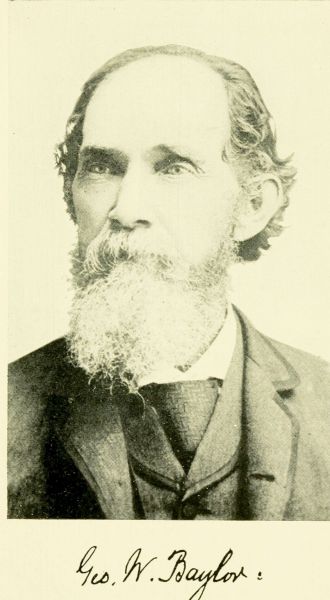
Geo. W. Baylor
Charley Howard, after his election as judge of the El Paso District, made his home at the old town of Franklin, now known as El Paso. He saw the possibilities of these salt lakes as a money-making proposition and, knowing they were on public land, wrote his father-in-law, George Zimpleman, at Austin, to buy some land certificates and send them to him so he could locate the land covering the salt deposits. As soon as the land was located Judge Howard forbade anyone to haul salt from the lakes without first securing his permission. The Mexicans along both sides of the Rio Grande adjacent to El Paso became highly indignant at this order. A sub-contractor on the overland mail route between El Paso and Fort Davis named Luis Cardis, supported the Mexicans and told them Howard had no right to stop them from hauling salt. Cardis was an Italian by birth, had come to El Paso County in 1860, married a Mexican wife, identified himself with the county, and become prominent as a political leader. He was a Republican, while Judge Howard was a Democrat. Cardis and Howard soon became bitter enemies, and in September, 1878, this conflict between them became so acute that Howard killed his opponent with a double-barreled shotgun in S. Shultz and Brothers' store in Franklin. This at once precipitated the contest known as the Salt Lake War, for grave threats were made against Howard by the Mexicans.
After killing Cardis, Judge Howard fled to New Mexico, and from his seclusion in that state he called on the governor of Texas to send rangers to El Paso to protect him and the courts over which he presided. At that time not a company of the Frontier Battalion was within five hundred miles of that town. El Paso was seven hundred and fifty miles by stage from San Antonio or Austin and the journey required about seven days and nights' travel over a dangerous route—an unusually hard trip on any passenger attempting it.
The governor of Texas, therefore, sent Major John B. Jones from Austin to Topeka, Kansas, by rail and thence as far west into New Mexico as the Santa Fe Railroad ran at that time, and thence by stage down to El Paso. Major Jones dropped into the old town of Franklin (now El Paso) unheralded and unknown. He sat about the hotel and gained the information he needed, then made himself known to the authorities and proceeded at once to organize and equip a company of twenty rangers. John B. Tays, brother to the Episcopal minister of that district, was made lieutenant of the new command, which was known as a detachment of Company "C" and stationed in the old town of San Elizario, twenty-five miles southeast of El Paso.
Soon after this detachment of rangers had been authorized, Judge Howard appeared at San Elizario and sought protection with it. No sooner had it become known that Judge Howard was back in Texas than the ranger company was surrounded by a cordon of armed Mexicans, two or three hundred in number, who demanded the body of the jurist. Lieutenant Tays refused to surrender Howard, and the fighting began, and was kept up two or three days at intervals. Sergeant Maltimore, in passing through the court yard of the buildings in which the rangers were quartered was shot down and killed by Mexican snipers located on top of some adobe buildings within range of the quarters. Then an American citizen, a Mr. Ellis, was killed near Company "C's" camp.
After several days of desultory fighting, the leaders of the mob, under flag of truce, sought an interview with Lieutenant Tays. The lieutenant finally agreed to meet two of the leaders, and while the parley was in progress armed Mexicans one at a time approached the peace party until forty or fifty had quietly surrounded Lieutenant Tays and put him at their mercy. The mob then boldly demanded the surrender of the ranger company, Judge Howard, and two other Americans, Adkinson and McBride, friends of the judge, that had sought protection with them.
There is no doubt that the Mexicans intimidated Lieutenant Tays after he was in their hands and probably threatened him with death unless their demands were granted. The lieutenant returned to the ranger camp with the mob and said, "Boys, it is all settled. You are to give up your arms and horses and you will be allowed to go free."
The rangers were furious at this surrender, but were powerless to help themselves, for the mob had swarmed in upon them from all sides. Billie Marsh, one of the youngest men in the company, was so indignant that he cried out to his commander, "The only difference between you and a skunk is that the skunk has a white streak down his back!"
Judge Howard, seeing the handwriting on the wall, began shaking hands and bidding his ranger friends goodbye. As soon as the Mexicans had gotten possession of the rangers' arms they threw ropes over the heads of Howard, McBride and Adkinson. Then, mounting fast running ponies, they dragged the unfortunate men to death in the streets of San Elizario and cast their mutilated bodies into pososas or shallow wells. The Mexicans then disappeared, most of them crossing the Rio Grande into Mexico.
Lieutenant Tays at once resigned as commander of the rangers, and Private Charles Ludwick was made first sergeant and placed in charge of the company until the governor of Texas could send a commissioned officer to take command of it. Had Lieutenant Tays held out twenty-four hours longer, a thing which he could easily have done, he would have escaped the disgrace and mortification of surrendering himself and his company to a mob of Mexicans, for within that time John Ford with a band of New Mexico cowboys swept into the Rio Grande valley to relieve the besieged rangers. On learning of the fates of Howard, McBride, Adkinson, Ellis, and Sergeant Maltimore, the rescue party raided up and down the valley from San Elizario to El Paso and killed several armed Mexicans accused of being part of the mob that had murdered the Americans. The present battalion of Texas Rangers was organized May 1, 1874, and in all their forty-six years of service this surrender of Lieutenant Tays was the only black mark ever chalked up against it.
Afterward, when I arrived in El Paso with Lieutenant Baylor I had many talks with Privates George Lloyd, Dr. Shivers, Bill Rutherford, and Santiago Cooper,—all members of Tays' company—and most of them believed Lieutenant Tays had a streak of yellow in him, while a few thought he made a mistake in agreeing to an interview with the mob, thereby allowing himself to be caught napping and forced to surrender.
Conditions in El Paso County were now so bad that Lieutenant Baylor was ordered into the country to take command of the ranger company. Before leaving to assume his command, Lieutenant Baylor was called to Austin from his home in San Antonio and had a lengthy interview with Governor Roberts. Baylor was instructed by his excellency to use all diplomacy possible to reconcile the two factions and settle the Salt Lake War peaceably. The governor held that both sides to the controversy were more or less to blame, and what had been done could not be undone, and the restoration of order was the prime requisite rather than a punitive expedition against the mob members.
On July 28, 1879, Private Henry Maltimore and myself reached San Antonio from Austin and presented our credentials to Lieutenant Baylor, who thereupon advised us that he had selected August 2nd as the day to begin his march from San Antonio to El Paso County. In his camp on the San Antonio River in the southern part of the city the lieutenant had mustered myself as sergeant, and Privates Henry Maltimore, Dick Head, Gus Small, Gus Krimkau, and George Harold.
Early on the morning of August 2, 1879, our tiny detachment left San Antonio on our long journey. One wagon carried a heavy, old-fashioned square piano, and on top of this was loaded the lieutenant's household goods. At the rear of the wagon was a coop of game chickens, four hens and a cock, for Lieutenant Baylor was fond of game chickens as a table delicacy, though he never fought them. His family consisted of Mrs. Baylor, two daughters—Helen, aged fourteen, and Mary, a child of four or five years—and Miss Kate Sydnor, sister of Mrs. Baylor. The children and ladies traveled in a large hack drawn by a pair of mules. Rations for men and horses were hauled in a two-mule wagon, while the rangers rode on horseback in advance of the hack and wagons. Two men traveling to New Mexico in a two-wheeled cart asked permission to travel with us for protection. Naturally we made slow progress with this unique combination. As well as I can remember, 1879 was a rather dry year, for not a drop of rain fell upon us during this seven hundred-mile journey. When we passed Fort Clark, in Kinney County, and reached Devil's River we were on the real frontier and liable to attack by Indians at any time. It was necessary, therefore, to keep a strong guard posted at all times.
Around our camp fires at night Lieutenant Baylor entertained us with accounts of early days on the frontier. He was born August 24, 1832, at old Fort Gibson in the Cherokee nation, now the State of Oklahoma. His father, John Walker Baylor, was a surgeon in the United States Army. Lieutenant Baylor was a soldier by training and by inheritance. In 1879 he was in his forty-seventh year and stood six feet two inches tall, a perfect specimen of a hardy frontiersman. He was highly educated, wrote much for papers and magazines, was a fluent speaker and a very interesting talker and story-teller. He was less reserved than any captain under whom I ever served. He had taken part in many Indian fights on the frontier of Texas, and his descriptions of some of his experiences were thrilling. Lieutenant Baylor was a high-toned Christian gentleman and had been a member of the Episcopal Church from childhood. In all the months I served with him I never heard him utter an oath or tell a smutty yarn. He neither drank whisky nor used tobacco. Had he written a history of his operations on the frontier and a biography of himself it would have been one of the strangest and most interesting books ever written.
I have not the power of language to describe Lieutenant Baylor's bravery, because he was as brave as it is possible for man to be. He thought everyone else should be the same. He did not see how a white man could be a coward, yet in a fierce battle fought with Apache Indians on October 5, 1879, I saw some of his rangers refuse to budge when called upon to charge up a mountainside and assault the redskins concealed above us in some rocks. George Harold, one of the attacking party, said, "Lieutenant, if we charge up that hill over open ground every one of us will be killed."
"Yes, I suppose you are right," declared Baylor, a contemptuous smile on his face. Then, pointing to some Mexicans hidden behind some boulders below us, he added, "You had better go back to them. That is where you belong."
Lieutenant Baylor was as tender hearted as a little child and would listen to any tale of woe. He frequently took men into the service, stood good for their equipment and often had to pay the bill out of his own pocket. All men looked alike to him and he would enlist anyone when there was a vacancy in the company. The result was that some of the worst San Simone Valley rustlers got into the command and gave us no end of trouble, nearly causing one or two killings in our camp.
Baylor cared nothing for discipline in the company. He allowed his men to march carelessly. A scout of ten or fifteen men would sometimes be strung out a mile or more on the march. I suppose to one who had commanded a regiment during the Civil War a detachment of Texas Rangers looked small and insignificant, so he let his men have pretty much their own way. To a man like myself, who had been schooled under such captains as Major Jones, Captain Coldwell, Captain Roberts, and Lieutenant Reynolds, commanders who were always careful of the disposition and conduct of their men, this method of Baylor's seemed suicidal. It just seemed inevitable that we would some time be taken by surprise and shot to pieces.
Another peculiarity of this wonderful man was his indifference to time. He would strike an Indian trail, take his time and follow it to the jumping off place. He would say, "There is no use to hurry, boys. We will catch them after a while." For instance, the stage driver and passenger killed in Quitman Canyon, January, 1880, had been dead two weeks before the lieutenant returned from a scout out in the Guadalupe Mountains. He at once directed me to make a detail of all except three men in camp, issue ten days' rations, and have the men ready to move early next morning. An orderly or first sergeant is hardly ever called upon to scout unless he so desires, but the lieutenant said, "You had better come along, Sergeant. You may get another chance to kill an Indian." It seemed unreasonable to think he could start two weeks behind a bunch of Indians, follow up and annihilate the whole band, but he did. Give Comanches or Kiowas two weeks' start and they would have been in Canada, but the Apaches were slow and a different proposition with which to deal.
Baylor was one of the very best shots with firearms I ever saw. He killed more game than almost the entire company put together. When we first went out to El Paso he used a Winchester rifle, but after the first Indian fight he concluded it was too light and discarded it for a Springfield sporting rifle 45-70. He always used what he called rest sticks; that is, two sticks about three feet long the size of one's little finger. These were tied together about four or five inches from one end with a buckskin thong. In shooting he would squat down, extend the sticks arm's length out in front of him with the longer ends spread out tripod-fashion on the ground. With his gun resting in the fork he had a perfect rest and could make close shots at long range. The lieutenant always carried these sticks in his hand and used them on his horse as a quirt. In those days I used to pride myself on my shooting with a Winchester, but I soon found that Lieutenant Baylor had me skinned a mile when it came to killing game at long distance. I never could use rest sticks, for I always forgot them and shot offhand.
I cannot close this description of Lieutenant Baylor without mentioning his most excellent wife, who made the long, tedious journey from San Antonio to El Paso County with us. She was Sallie Garland Sydnor, born February 11, 1842. Her father was a wholesale merchant at Galveston, and at one time mayor of that city. Mrs. Baylor was highly educated and a very refined woman and a skillful performer on the piano. Her bright, sunny disposition and kind heart won her friends among the rangers at once. How sad it is to reflect that of the twelve persons in that little party that marched out of San Antonio on August 2, 1879, only three are living: Gus Small, Miss Mary Baylor, and myself.
When we had passed Pecan Springs on Devil's River there was not another cattle, sheep or goat ranch until we reached Fort Stockton, two hundred miles to the west. It was just one vast uninhabited country. Today it is all fenced and thousands of as fine cattle, sheep and goats as can be found in any country roam those hills. The Old Spanish Trail traverses most of this section, and in traveling over it today one will meet hundreds of people in high powered automobiles where forty years ago it was dangerous for a small party of well armed men to journey. While ascending Devil's River I learned that Lieutenant Baylor was not only a good hunter, but a first class fisherman as well, for he kept the entire camp well supplied with fine bass and perch, some of the latter being as large as saucers.
Forty miles west of Beaver Lake we reached Howard's Well, situated in Howard's Draw, a tributary of the Pecos River. Here we saw the burned ruins of a wagon train that had been attacked by Indians a few months before. All the mules had been captured, the teamsters killed and the train of sixteen big wagons burned. Had the same Indians encountered our little party of ten men, two women and two children we would all have been massacred.
Finally we reached old Fort Lancaster, an abandoned government post, situated on the east bank of Live Oak Creek, just above the point where this beautiful stream empties into the Pecos. We camped here and rested under the shade of those big old live oak trees for several days. From this camp we turned north up the Pecos, one of the most curious rivers in Texas. At that time and before its waters were much used for irrigation in New Mexico, the Pecos ran bank full of muddy water almost the year round. Not more than thirty or forty feet wide, it was the most crooked stream in the world, and though only from four to ten feet deep, was so swift and treacherous that it was most difficult to ford. However, it had one real virtue; it was the best stream in Texas for both blue and yellow catfish that ranged in weight from five to forty pounds. We were some days traveling up this river to the pontoon crossing and we feasted on fish.
At Pontoon Crossing on the Pecos we intercepted the overland mail route leading from San Antonio to El Paso by way of Fredericksburg, Fort Mason, Menard, Fort McKavett, Fort Concho, Fort Stockton, and Fort Davis, thence west by Eagle Springs through Quitman Canyon, where more tragedies and foul murders have been committed by Indians than at any other point on the route. Ben Fricklin was the mail contractor. The stage stands were built of adobe and on the same unchanging plan. On each side of the entrance was a large room. The gateway opened into a passageway, which was roofed, and extended from one room to the other. In the rear of the rooms was the corral, the walls of which were six to eight feet high and two feet thick, also of sun dried brick. One room was used for cooking and eating and the other for sleeping quarters and storage. The stage company furnished the stage tender with supplies and he cooked for the passengers when there were such, charging them fifty cents per meal, which he was allowed to retain for his compensation.
When the stage rolled into the station the tender swung open the gates and the teams, small Spanish mules, dashed into the corral. The animals were gentle enough when once in the enclosure, but mean and as wild as deer when on the road. The stage company would buy these little mules in lots of fifty to a hundred in Mexico and distribute them along the route. The tiny animals were right off the range and real unbroken bronchos. The mules were tied up or tied down as the case might be and harnessed by force. When they had been hitched to the stage coach or buckboard the gates to the corral were opened and the team left on the run. The intelligent mules soon learned all they had to do was to run from one station to the next, and could not be stopped between posts no matter what happened. Whenever they saw a wagon or a man on horseback approaching along the road they would shy around the stranger, and the harder the driver held them the faster they ran.
On our way out our teams were pretty well fagged out, and often Lieutenant Baylor would camp within a few yards of the road. The Spanish stage mules would see our camp and go around us on the run while their drivers would curse and call us all the vile names they could lay their tongues to for camping in the road.
When we camped at a station it was amusing to me to watch the stage attendants harness those wary little animals. The stage or buckboard was always turned round in the corral and headed toward the next station and the passengers seated themselves before the mules were hitched. When all was ready and the team harnessed the driver would give the word, the station keeper threw open the gates and the stage was off on a dead run.
There should be a monument erected to the memory of those old stage drivers somewhere along this overland route, for they were certainly the bravest of the brave. It took a man with lots of nerve and strength to be a stage driver in the Indian days, and many, many of them were killed. The very last year, 1880, that the stage line was kept up several drivers were killed between Fort Davis and El Paso. Several of these men quit the stage company and joined Lieutenant Baylor's company, and every one of such ex-drivers made excellent rangers.
From Pontoon Crossing on the Pecos River we turned due west and traveled the stage route the remainder of the way to El Paso County. At Fort Stockton we secured supplies for ourselves and feed for our horses, the first place at which rations could be secured since leaving Fort Clark. Fort Stockton was a large military post and was quite lively, especially at night, when the saloons and gambling halls were crowded with soldiers and citizen contractors. At Leon Holes, ten miles west of Fort Stockton, we were delayed a week because of Mrs. Baylor becoming suddenly ill. Passing through Wild Rose Pass and up Limpia Canyon we suffered very much from the cold, though it was only the last of August. Coming from a lower to a higher altitude we felt the change at night keenly. That was the first cold weather I had experienced in the summer.
Finally, on the 12th day of September, 1879, we landed safe and sound in the old town of Ysleta, El Paso County, after forty-two days of travel from San Antonio. Here we met nine men, the remnant of Lieutenant Tays' Company "C" rangers. The first few days after our arrival were spent in securing quarters for Lieutenant Baylor's family and in reorganizing the company. Sergeant Ludwick was discharged at his own request, and I was made first sergeant, Tom Swilling second sergeant, John Seaborn first corporal, and George Lloyd second corporal. The company was now recruited up to its limit of twenty men. Before winter Lieutenant Baylor bought a fine home and fifteen or twenty acres of land from a Mr. Blanchard. The rangers were quartered comfortably in some adobe buildings with fine corrals nearby and within easy distance of the lieutenant's residence. We were now ready for adventure on the border.
When we arrived at Ysleta the Salt Lake War had quieted down and order had been restored. Although nearly a hundred Mexicans were indicted by the El Paso grand jury, no one was ever punished for the murder of Judge Howard and his companions. In going over the papers of Sergeant Ludwick I found warrants for the arrest of fifty or more of the mob members. Though most of the murderers had fled to Old Mexico immediately after the killing of the Americans, most of them had returned to the United States and their homes along the Rio Grande. I reported these warrants to Lieutenant Baylor and informed him that, with the assistance of a strong body of rangers I could probably capture most of the offenders in a swift raid down the valley. The lieutenant declared that he had received instructions from Governor Roberts to exercise extreme care not to precipitate more trouble over Howard's death, and, above all things, not incite a race war between the Mexican offenders and the white people of the country. He decided, therefore, that we had better not make any move at all in the now dead Salt Lake War. And of course I never again mentioned the matter to him.
Though the Salt Lake War was over, new and adventurous action was in store for us, and within less than a month after our arrival in Ysleta we had our first brush with the Apaches, a tribe of Indians I had never before met in battle.
CHAPTER XII
OUR FIRST FIGHT WITH APACHES
On October 5, 1879, at midnight, Pablo Mejia brought Lieutenant Baylor, from Captain Gregorio Garcia of San Elizario, a note stating that a band of Apaches had charged a camp of five Mexicans who were engaged in cutting hay for the stage company fourteen miles north of La Quadria stage station and killed them. As first sergeant I was ordered to make a detail of ten men and issue them five days' rations. I detailed Second Sergeant Tom Swilling, Privates Gus Small, George Lloyd, John Thomas, George Harold, Doc Shivers, Richard Head, Bill Rutherford, and Juan Garcia for the scout, and myself made the tenth man. It required an hour to arouse the men, issue the rations and ammunition and pack the two mules, so it was 1 o'clock a.m. when we finally left Ysleta.
By daylight we reached Hawkins Station, near where Fabins Station now is. Here we were told we would find the survivor of the terrible massacre. Riding up to the door of the stage house we had to thump some time before we had evidence that anyone was alive on the premises. Finally the door opened about an inch very cautiously and a Mexican peeped out. Lieutenant Baylor asked him if he had been one of the grameros or hay cutters.
"Si, senor," replied the sleepy Mexican.
Asked for an account of the massacre, the native said it was nearly dark when the Indians, numbering from twenty-five to fifty, charged the camp and uttered such horrid yells that everyone took to his heels and was soon in the chaparral. The speaker saw his pobrecita papa (poor papa) running, with the Indians about to lance him, and knew that he and the remainder of the party were killed. He himself only escaped. As he mentioned the tragic death of his beloved parent the tears rolled down his cheeks. Lieutenant Baylor comforted the weeper as best he could and asked if the Mexican would not guide the rangers to the raided camp, but the survivor declined with thanks, saying he must stay to help the station keeper take care of the stage mules, but he directed us to the ranch where some of the dead men's families lived and at which a guide could be obtained.
When we arrived at the ranch below Hawkins Station it was sunrise and we halted for breakfast after a night ride of forty miles. The people at the ranch were very uneasy when we rode up, but were rejoiced when they realized we were Texas Rangers and learned our mission. They showed us every attention. Among the first to come out to us was an old Mexican who had been in the hay camp when it was attacked. He gave a lurid account of the onset. His son had been one of the grameros, and when he mentioned this the tears began to flow.
"Ah, hijo de mi cara Juan. I shall never see him again," he lamented. "All were killed and I alone escaped!"
Lieutenant Baylor then explained to the weeping father that his son was very much alive and that we had seen him that very night bewailing the death of the father he thought killed. And it now developed that all the dead men were alive! When the camp was attacked each Mexican had scattered, and the Apaches had been too busy looting the stores to follow the fugitives. Moreover, those ranchers would fight and the Indians did not care to follow them into the brush.
A bright young Mexican went with us to the hay camp, which was about six miles toward Comales, where Don Juan Armendaris now has a cow ranch. The Apaches had made a mess of things in camp sure enough. They had broken all the cups and plates, poured salt into the sugar, this combination into the flour and beans and the conglomeration of the whole on the ground, as the sacks were all they wanted. The Indians smashed the coffee pot, the frying pan, the skillet and the water barrels with an ax. Then taking all the blankets, the raiders started eastward as though they intended to go to the Sierra Priela, but after going a mile the trail turned south. We found the redskins had come from the north by way of Los Cormuros and were probably from Fort Stanton, New Mexico, on their way to raid Old Mexico. They were in a dry country and making for the Rio Grande, fourteen miles to the south. When they discovered the hay camp on their route they charged it and fired on the hay cutters. The Mexicans scattered and made their escape in the darkness, each thinking himself the sole survivor and so reporting on reaching his home, though as a matter of fact not a single life was lost.
Our guide went back to give the alarm to the ranches below and we followed the trail down the mesa until opposite Guadalupe. There we crossed the overland stage route near the present Rio Grande Station and found our guide waiting for us. He had discovered the trail, and fearing the Indians might ambush the road below, he had awaited our arrival. The trail made straight for the Rio Grande, crossing about one mile west of the Mexican town of Guadalupe. From the pony and mule tracks Lieutenant Baylor judged there were fifteen to twenty Indians in the band. We had some trouble following the trail after we got to the river bottom, where loose horses and cattle ran, but a few of us dismounted and worked the trail out, crossed the river and struck camp for dinner.
Lieutenant Baylor sent Pablo Mejia into town to inform the president of Guadalupe that we had followed a fresh Apache trail to the Rio Grande going south into Mexico, and asked permission to follow the Indians into his country. The scout soon returned and reported that the president was not only pleased that we had pursued the redskins, but would willingly join us himself with all the men he could muster. Just after we crossed the river we came across a Mexican herder with a flock of goats. As soon as he heard we were trailing the Apaches he began yelling at the top of his voice and soon had the goats on the jump for town, though the Indians had passed the night before. We were quickly in saddle again, and as we rode into the pueblo we were kindly received by the people. We found a mare the Apaches had killed just on the edge of town and from which they had taken some of the choice steaks.
After leaving Guadalupe the trail went south, following closely the stage road from Juarez to Chihuahua. Not long after leaving town we met a courier coming to Guadalupe from Don Ramon Arrandas' ranch, San Marcos de Cantarica, twenty-one miles distant, who informed us that the Apaches had killed a herder on that ranch and had taken four horses and sixteen mules of the stage company. We hurried onward and reached Cantarica at sunset, having traveled seventy-eight miles since 1 a.m. that morning. Both men and horses were rather tired.
All was confusion at the ranch. The Mexican herder had been shrouded and laid out with a cross at his head and several little lighted candles near the body. Many women were sitting around the room with black shawls pulled up over their heads. The Apaches, numbering sixteen well armed and well mounted warriors, had slain their victim and captured the stock near the ranch just about noon. Mexican volunteers from Guadalupe and San Ignacio began to ride in until our combined force numbered twenty-five or twenty-six men. Everyone was excited at the thought of a brush with the redskins responsible for the murder.
Accompanied by our volunteer allies we left the ranch at daylight next morning and picked up the trail at once. It led off south along the base of the Armagora Mountains or Sierra Bentanos. As the Mexicans were familiar with the country they took the lead and followed the trail rapidly. About 11 o'clock the trailers halted at the mouth of the Canyon del Moranos, an ugly black hole cut in the mountains, looking grim and defiant enough without the aid of Apache warriors. When we had joined the Mexicans—we were traveling some half a mile behind them—Lieutenant Baylor and Captain Garcia held a short conference. The lieutenant turned to me and said that Captain Garcia declared the Indians were in the canyon among the rocks, and ordered me to detail two men to guard our horses while we scaled the mountain on foot and investigated it. I could not bring myself to believe that a band of Indians that had killed a man and driven off all the stage stock the day before had gone only thirty miles and was now lying in wait for us.
"You don't know the Apaches," Lieutenant Baylor declared when I voiced my thoughts. "They are very different from the plains Indians, the kind you have been used to following. These Apaches delight to get into the rocks and lay for their enemies."
At the conference the Mexicans suggested that Lieutenant Baylor should take nine of his men and ten of their volunteers and follow the trail up the canyon, but the lieutenant declared that this would never do, as the Apaches had no doubt anticipated just such a move and hidden themselves in the cliffs where they could kill their attackers without exposing themselves in the least. He proposed scaling the mountain and following them down on top of the ridge in the Indians' rear. And this was the strategy finally adopted.
The Mexicans dismounted and started up the mountainside about one hundred yards to our left. Lieutenant Baylor and his eight rangers marched straight forward from our horses and began the ascent. As we went along the lieutenant pulled some bunch grass and stuck it all around under his hat band so his head would look like a clump of grass and conceal his head and body if he should have to flatten himself on the ground. He counselled us to follow his example. I had taken some Mexican cheese out of my saddle pockets and was eating it as we marched carelessly up the mountain. Honestly, I did not believe there was an Indian within a hundred miles of us, but it was not long before I changed my mind. Suddenly there came a loud report of a gun and then another. I looked up to where the Mexicans had taken position behind a ledge of rocks and saw where a bullet struck the stones a foot above their heads. I did not want any more cheese. I threw down what I had in my hand and spat out what I had in my mouth.
These old Apache warriors, high in the cliffs above us, then turned their attention to our little band of eight rangers and fired twenty-five or thirty shots right into the midst of us. One of these big caliber bullets whizzed so close to my head that it made a noise like a wild duck makes when flying down stream at the rate of fifty to sixty miles an hour. Lieutenant Baylor ordered us to charge at once.
In running up the mountain I was somewhat in advance of the boys. We came to a rock ledge three or four feet high. I quickly scaled this, but before I could straighten up an Indian rose from behind a rock about fifteen to twenty yards ahead and fired point-blank at me. The bullet struck a small soap weed three feet in front of me and knocked the leaves into my mouth and face. I felt as if I had been hit but it was leaves and not blood that I wiped out of my mouth with my left hand. I turned my head and called to the boys to look out, but the warning was unnecessary,—they had already taken shelter under the ledge of rock.
Just as I turned my head a second shot from the Apache carried away the entire front part of my hat brim. I saw the warrior throw another cartridge in his gun and brought my Winchester quickly to bear upon him. When he saw that I was about to shoot he shifted his position and turned sideways to me. We both fired at the same instant. My bullet hit the redskin just above his hip and, passing straight through his body, broke the small of his back and killed him almost instantly. This old brave was a big man, probably six feet tall, with his face painted in red and blue paint. He used an old octagon barrel Winchester rifle and he had with him an old shirtsleeve tied at one end in which were two hundred and fifty Winchester cartridges.
Some Indians fifty yards up the mountain now began to shell our position, so I took shelter behind the ledge of rock. Fifteen or twenty feet to our left and a little higher up the mountain, Lieutenant Baylor was sheltered behind some boulders. He raised his head slightly above his parapet for a peep at the Indians and those keen sighted warriors saw him; a well directed shot cut part of the grass out of his hat. Had the bullet been six inches lower it would have struck him full in the face.
"Darn that old Indian," exclaimed Baylor, ducking his head. "If I had a shot gun I would run up and jump right on top of him."
The lieutenant was mad now and ordered a charge. The boys hesitated, and George Harold, an old scout, said, "Lieutenant, if we leave this shelter and start up the mountain the Indians hidden behind those rocks seventy-five yards above will kill us all."
"Yes, I suppose you are right; they would be hard to dislodge," replied Baylor.
The Apaches evidently had plenty of ammunition, as they kept up a desultory fire all day. Seeing we were not going to fall into their trap they turned their attention to our horses. Although the animals were four or five hundred yards from the foot of the mountain they killed Sergeant Swilling's horse, the bullet passing entirely through the body just behind the shoulders. When his horse, a large white one, staggered and tumbled over, Swilling began to mourn, for he had the horror of walking all Western men have. John Thomas, however, got the laugh on him by saying, "Sergeant, you had better wait and see if you are going back to camp." We could see the Indians' bullets knocking up dust all around the horses and the guard replying to the fire. Baylor now sent a man and had the guard move the horses out of range.
During the afternoon the Apaches moved up higher toward the crest of the mountain, and in doing so one of the Indians exposed himself. The Mexicans to our left spotted him and killed him with a well directed shot. The warrior fell out in open ground where he was literally shot all to pieces.
We had been without water all day and when night came Lieutenant Baylor and Captain Garcia decided it was useless to continue the fight any longer, so we withdrew toward our horses. After reaching the animals we could still hear the Indians firing on our positions. We might have captured the Apaches' horses by a charge, but we would have had to go down the side of the mountain and across a deep canyon where we would have been compelled to pick our way slowly under a constant cross fire from the concealed riflemen, and neither Baylor nor Garcia thought the horses worth the sacrifice required to capture them.
As the nearest water was thirty miles away and our men and horses weary and thirsty, we rode back to our hospitable friend, Don Ramon Arrandas' ranch, where our horses were fed and we ourselves supplied with fresh milk and cheese. On our return to Guadalupe we were most kindly entertained by Mr. Maximo Arrandas, custom house officer at San Elizario, and brother to Don Ramon. We reached our headquarters at Ysleta after being out five days and traveling two hundred and twenty-two miles, sustaining no other damage than a few bruises from scaling the mountain and the loss of Sergeant Swilling's horse. This first brush with Apaches, however, was but a prelude to other expeditions after this tribe, and we were soon hot on the trail of Victorio, the Apache Napoleon.
CHAPTER XIII
SCOUTING IN MEXICO
About a month after our first brush with Apaches, during November, 1879, Chief Victorio quit the Mescalero Reservation and with a party of one hundred and twenty-five warriors and a hundred women and children, traveled south into Mexico on a raid. This old chief was probably the best general ever produced by the Apache tribe. He was a far better captain than old Geronimo ever was and capable of commanding a much larger force of men. His second in command was Nana, also a very able officer.
Victorio knew every foot of the country and just where to find wood, water, grass and abundance of game, so he took his time and, coming from New Mexico down into the state of Chihuahua, stopped first at the Santa Maria. The country about this stream is very mountainous, especially to the south, and here he could find refuge in case of an attack from Mexican soldiers. Of this, however, there was not much danger at that time, for the country was thinly settled, farming and stock raising being confined to the neighborhood of the small towns. Gradually Chief Victorio moved down into the Candelaria Mountains, approaching them from the northwest. Here he could get fresh range for his large band of horses and be near the settlement of San Jose, owned by Don Mariano Samaniego. Here, also, he could watch the public road between Chihuahua and El Paso del Norte, the present Juarez.