Part Three Signers of the Declaration: Survey of Historic Sites and Buildings
Reading edition
Over the decades that separate present-day America from the early periods of its history, a large number of the structures commemorating those periods have been marred or obliterated. Those relating to the signers of the Declaration of Independence have not been spared. The ravages of war, urbanization, fire, aging, weathering, neglect, and vandalism have destroyed all the residences of 21 of these 56 men and seriously impaired some of those that have survived.
Beyond those factors detrimental to all historic buildings are two special ones that have hampered the marking and preserving of signers’ homes and other sites. For decades following adoption of the Declaration, these individuals were not accorded the reverence bestowed on them in modern times. Secondly, many of them have received only slight historical recognition because they lacked national reputations other than as signers.
Yet among the residences and buildings that remain are many of major significance. As a whole, they reveal much about the way of life of the signers and illuminate the events involved in the creation of the Declaration. Of outstanding significance is Independence National Historical Park, Pa. Within its boundaries the document was written, debated, approved, and signed. The National Park Service administers the park in cooperation with the city of Philadelphia and various private agencies. Three residences of signers are also units of the National Park System: Adams National Historic Site, Mass.; the Floyd House, in Fire Island National Seashore, N.Y.; and the Nelson House, part of Colonial National Historical Park, Va.
Almost half the extant homes of the signers are owned by private individuals, many of whom personally reside in them and a few of whom are descendants of the signers. The rest of the residences are owned and maintained by States, cities, and a wide variety of nongovernmental institutions, such as patriotic-civic organizations, memorial associations, local historical societies, foundations, universities, churches, and corporations and business firms.
Reflecting the dedicated efforts of many of the above individuals and agencies, a considerable number of the buildings and residences provide fine examples of historic preservation and restoration. Unfortunately, some structures have badly deteriorated. But the increased recent interest in the signers has enhanced the identification, renovation, and preservation of pertinent sites and buildings.
In addition to the preservation of sites and buildings, the subject of this book, the signers have been honored in many other ways. Commemoration varies widely, however, from State to State and from signer to signer. Some have been recognized in a major way; others hardly at all.
In the forefront of the groups that have marked extant homes and buildings, as well as the sites of former structures and graves, or otherwise memorialized the signers are: Daughters of the American Revolution; Daughters of the Revolution; Colonial Dames of America; National Society of Colonial Dames of America; Sons of the American Revolution; Sons of the Revolution; and the Descendants of the Signers of the Declaration of Independence, Inc., chartered by Congress in 1907.
A major share of the sites of residences with no physical remains has been marked. The 20 signers for whom no existing homes have been located are: Samuel Adams, Abraham Clark, William Ellery, Benjamin Franklin, Lyman Hall, John Hart, Francis Lewis, Philip Livingston, Thomas McKean, Lewis Morris, Robert Morris, John Morton, Robert Treat Paine, John Penn, George Read, Caesar Rodney, George Ross, Benjamin Rush, Roger Sherman, and James Smith. Another signer, Samuel Chase, is represented in this volume only by a structure (Chase-Lloyd House) that he began building but never resided in.
Monuments and memorials range from simple plaques to the Thomas Jefferson Memorial, D.C., in the National Park System. Statues of several signers are located in the U.S. Capitol. Special monuments have been erected to those from two States. The Founders’ Monument, in Augusta, Ga., is dedicated to the three signers from that State (Gwinnett, Hall, and Walton) and contains the burial places of the latter two. A monument to the three North Carolina signers (Hewes, Hooper, and Penn) at Guilford Courthouse National Military Park, in Greensboro, N.C., includes the tombs of Hooper and Penn.
Described in the following pages are the principal buildings associated with the signers of the Declaration. They are comprised of three categories: National Park Service Areas, National Historic Landmarks, and Other Sites Considered.
The principal aim of the National Survey of Historic Sites and Buildings is to identify nationally important sites that are not National Park Service Areas, but no survey of historic places would be complete without including them. This is particularly true because many of them were designated as National Historic Landmarks before they became part of the National Park System. Further information about a particular area may be obtained by writing directly to the park superintendent at the address listed immediately following the location.
National Historic Landmarks are those sites judged by the Advisory Board on National Parks, Historic Sites, Buildings, and Monuments to meet the criteria of national significance in commemorating the history of the United States (pp. 270–271). They have been declared by the Secretary of the Interior to be eligible for designation as National Historic Landmarks. Final designation occurs when the owners apply for such status. They receive certificates and bronze plaques attesting to the distinction.
Other Sites Considered consist of those sites deemed by the Advisory Board to possess noteworthy historical value but not national significance. The list of sites included in this category does not purport to be exhaustive; it is merely a representative sampling, all that is possible because of space limitations.
Many sites in the Other Sites Considered category in all phases of history are listed on the National Register of Historic Places, maintained by the National Park Service’s Office of Archeology and Historic Preservation. The register consists not only of sites in the National Park System and National Historic Landmarks but also those of State and local significance, nominated through appropriate channels by the various States. It is published biennally and distributed by the Superintendent of Documents, U.S. Government Printing Office, Washington, D.C., 20402. The latest volume is The National Register of Historic Places, 1972, price $7.80.
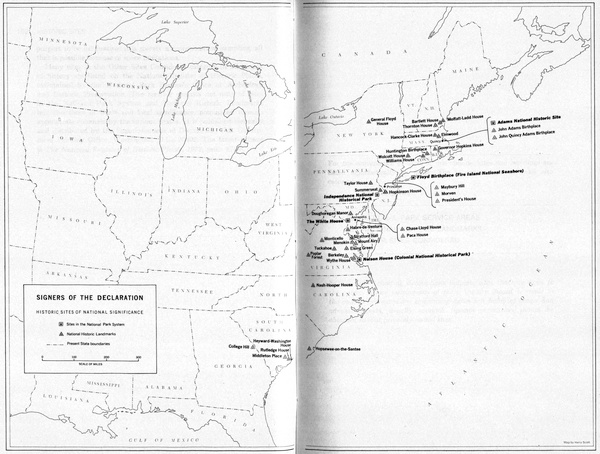
SIGNERS OF THE DECLARATION
HISTORIC SITES OF NATIONAL SIGNIFICANCE
(larger)
For the convenience of users of this volume, sites and buildings are listed alphabetically by State. The following code indicates site categories:
Site Categories ☑ NATIONAL PARK SERVICE AREAS ∆ NATIONAL HISTORIC LANDMARKS ⊗ OTHER SITES CONSIDERED
NOTE: The following descriptions indicate sites that are open to the public. Before visiting any of them, inquiry should be made to the owners or custodians concerning dates and hours of access and admission costs, usually nominal. Special permission should be obtained to visit privately owned sites.