Chapter XIII · SPECIFICATIONS FOR AMERICAN SHRAPNEL SHELLS
Reading edition
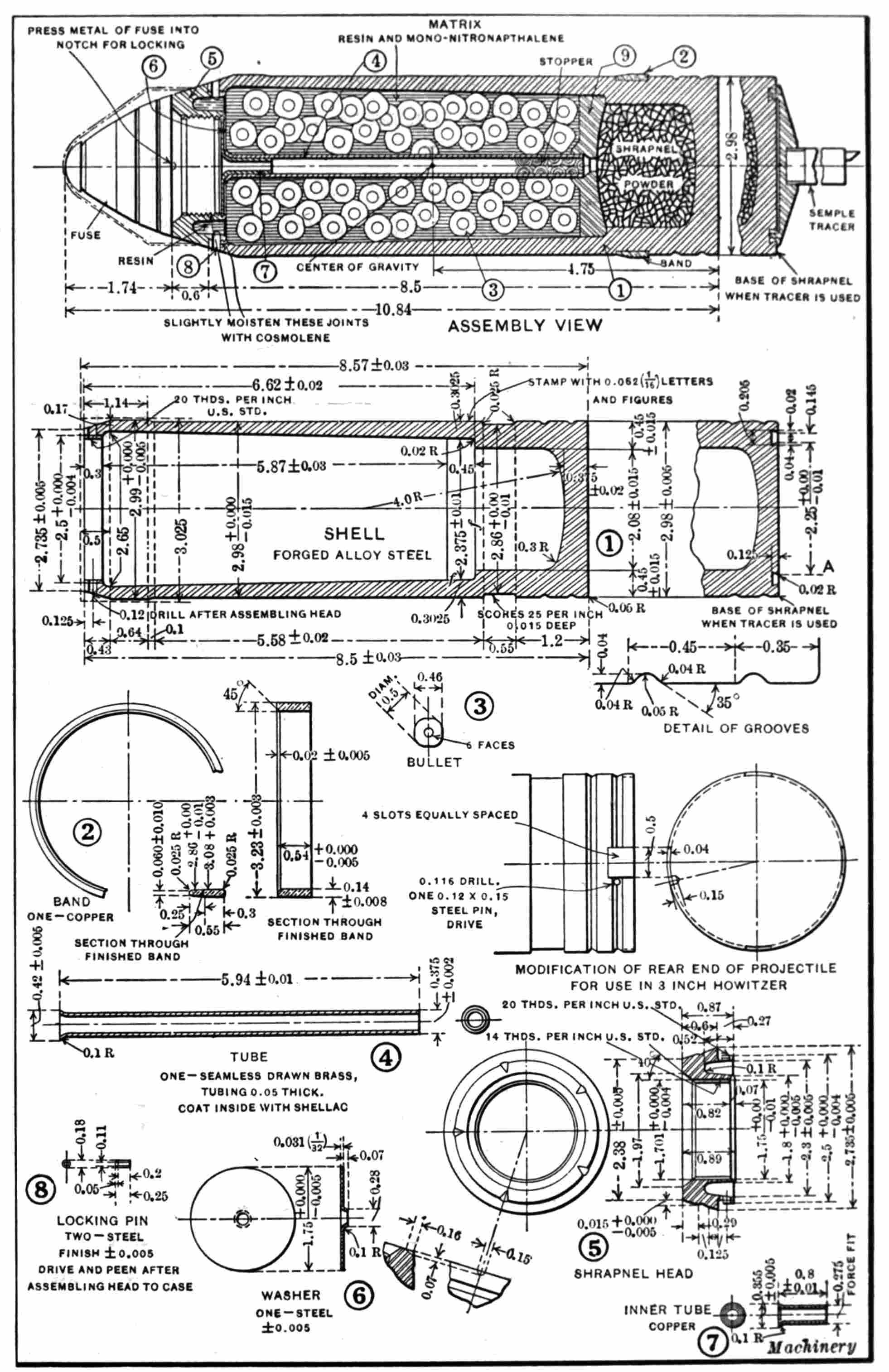
Fig. 1. Assembly and Details of American Shrapnel Shell
The American shrapnel shells comprise the following parts: forged shell body, copper driving band, head, washer, tubes, bullets, matrix, head filler, diaphragm, base charge, and fuse. In some cases a Semple tracer is used, and, when this is the case, the base of the shrapnel must be machined to accommodate it.
Shell.—The shell is to be made of forged alloy steel or bar stock having the properties outlined in Table I. The forgings must be annealed so that they can be machined with reasonable ease. The maximum elastic limit for the 2.95-inch and 3-inch shell forgings must not exceed 115,000 pounds per square inch, and in case of the 3.8-inch, 4.7-inch, and 6-inch must not exceed 110,000 pounds per square inch. All shrapnel shells must be subjected to an exterior hydraulic pressure of 20,000 pounds per square inch up to the rotating band, and to an interior hydraulic pressure of 1000 pounds per square inch. A certain number from each 1000 shells are also subjected to a ballistic test by firing completed shrapnels from a gun with a maximum pressure of 37,000 pounds, except for the 6-inch, which will be fired under a pressure of 22,500 pounds per square inch.
The shell is to be finished outside and inside except at points otherwise indicated, where it is to be left in the rough-forged state. The inside of the shell is to be coated with non-acid paint, except where machined, and the powder chamber is to be given a heavy coat. Great care should be taken to remove all burrs, scale, and sharp corners. The outline of the shell after the first operation, when made from bar stock, is shown by dotted lines in Fig. 1. The base of the shell is to be machined as illustrated to the right at A in Fig. 1, when a Semple tracer is used.
Copper Driving Band.—The copper driving band is to be cut from tubing of pure electrolytic copper, and machined to the dimensions shown. It is to be heated and expanded to 2.985 inch inside diameter—for the 3-inch shell—and is to be shrunk into the seat, then forced into the scores by passing through a die and afterwards turned to size.
Washer and Head.—The washer—for the 3-inch shell—is to be made from steel 0.031 inch thick and formed to shape by punching. The head is to be made from cold-drawn steel, finished all over, and coated inside with a non-acid paint. The crimping wall is to be turned down over the washer after machining, and a hole drilled after the head is assembled to the shell. Five notches equally spaced are to be cut around the head, and a crimping groove cut for putting on the fuse protecting cap.
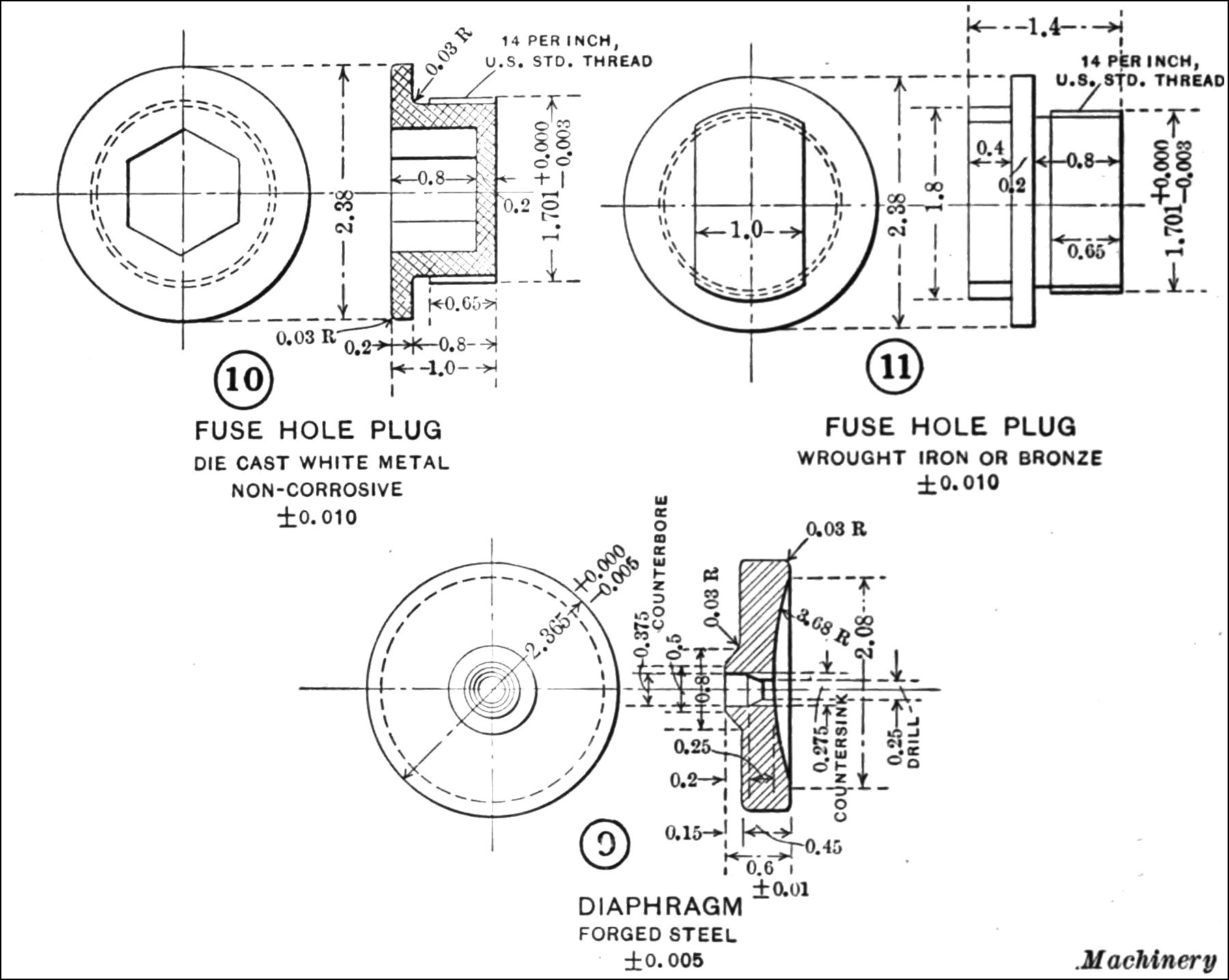
Fig. 2. Details of American Shrapnel Shell
Tube.—The tube is to be made from seamless drawn brass tubing, and is to be coated inside with shellac. An additional short tube is to be inserted at the nose or mouth of this tube, next to the fuse; this latter is to be made from seamless drawn copper, and is to be forced into the tube under pressure and crimped over.
Bullets.—The bullets used in the shrapnel are to be made from 12.5 per cent antimony to 87.5 per cent lead, and are to be flattened with six faces as shown in the illustration; 252 bullets are used in the 3-inch shrapnel.
Matrix and Head Filler.—The matrix is to consist of resin and mono-nitronaphthalene, poured into the shell, as will be described in connection with loading. The head is to be filled with melted resin, poured in.
Diaphragm.—The diaphragm is to be made of forged steel to the dimension shown. It is to be drilled and counterbored, and great care should be taken to remove all burrs, sharp corners, and scale. The bottom of the diaphragm is also to be given a heavy coat of non-acid paint.
TABLE I. PHYSICAL PROPERTIES OF STEEL FOR VARIOUS SIZES OF SHRAPNEL SHELLS
Caliber, Inches Tensile Strength, Pounds Per Square Inch Elastic Limit, Pounds Per Square Inch Elongation in 2 inches, Per Cent Contraction, Per Cent
2.95 3.00 3.80 4.70 6.00 120,000 120,000 110,000 110,000 110,000 90,000 90,000 80,000 80,000 80,000 16 16 15 15 15 45 45 40 40 40
Fuse-hole Plug.—There are two types of fuse-hole plugs; one is to be made from die-cast white metal, of non-corrosive properties, and machined to dimensions given in drawing, and the other of wrought iron or bronze. The weight of the wrought-iron plug—for the 3-inch shell—is to be 0.97 pound, and the weight of the bronze plug, 1.03 pound. Either type of fuse-hole plug may be used.
Locking-Pin.—Two steel locking-pins are required which must be finished to limits of ± 0.005 inch, driven in and peened over after the head is assembled in the shell.
TABLE II. PRINCIPAL DIMENSIONS OF AMERICAN SHRAPNEL SHELLS, HEADS AND DIAPHRAGMS
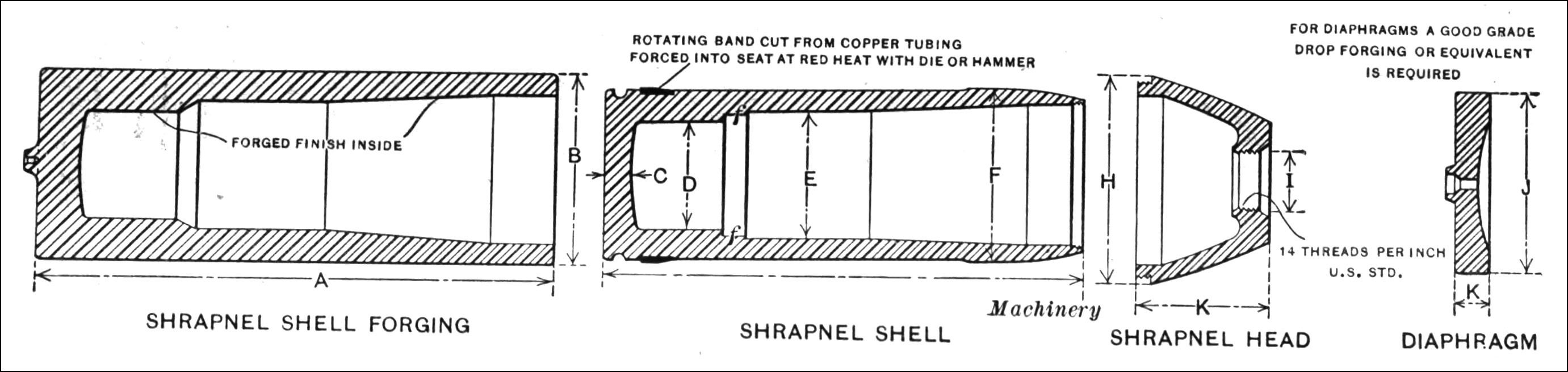
Caliber, Inches Shrapnel Forging Shrapnel Shell Shrapnel Head Diaphragm
A B C D E F G H I J K L
2.95 3.00 3.80 4.70 6.00 07.25 08.66 10.30 13.20 16.60 3.00 3.05 3.85 4.75 6.05 0.300 0.375 0.500 0.600 0.800 2.2 2.1 2.5 3.0 3.9 2.500 2.375 2.900 3.500 4.600 2.95 3.00 3.80 4.70 6.00 07.20 08.50 10.12 13.00 16.45 2.85 2.73 3.51 4.25 5.33 1.7 1.7 1.7 1.7 1.7 1.05 0.87 1.40 2.30 3.35 2.50 2.36 2.89 3.52 4.60 0.45 0.45 0.55 0.70 0.80
Directions for Loading American 3-inch Shrapnel Shell.—In loading, make sure that the diaphragm seats firmly on the shoulder in the shell, then pour in 0.25 ounce of powdered resin to seal the joints, and shake down well to fill all cracks. The powdered resin becomes plastic when the melted resin is poured in. Next put in one layer of bullets (18) and pour in 0.4 ounce of melted resin; then put in 108 bullets and pack by a pressure of six tons. Then pour in 3.75 ounces of melted mono-nitronaphthalene; put in 126 bullets; drive down with mallet below end of tube; and pour in 4 ounces of melted resin. After the mass has thoroughly cooled, face off matrix so that the depth from the end of the shell shall be 0.27 inch to allow for screwing in head, which should bear down hard on matrix. Next place washer in head and secure it by turning down crimping wall. Then fill annular space in lower face of head with melted resin, and after this is thoroughly cooled, face off flush with lower end of head. Screw head in place and secure with pins; then insert inner tube, pour in the base charge through the tube, and insert stopper. After the shell has been loaded, the shell and head should be painted from the rotating bands to the rear edge of the groove. For waterproofing, coat with a pure raw linseed oil black paint. Coat the remainder of the head with bitumastic solution, and crimp the waterproof cover in place while the solution is plastic. In the lower end of the inner tube should be placed a stopper of dry fibrous gun cotton rolled tightly into a cylinder and pressed down until it rests on the shoulder of the diaphragm and is about one inch long.
TABLE III. WEIGHTS AND MATERIALS USED IN AMERICAN 3-INCH SHRAPNEL SHELLS
Part Material Weight in Pounds
Shell Steel 5.80
Driving Band Copper 0.15
Washer Steel 0.02
Head Steel 0.45
Tube (including inner tube) Brass and Copper 0.09
Bullets (252) Lead-antimony Alloy 6.05
Matrix Resin and Mono-nitronaphthalene 0.52
Head Filler Resin 0.03
Diaphragm Steel 0.47
Base Charge Shrapnel Powder 0.17
Fuse 1.25
Semple Tracer 0.20
Tracer Support 0.17
Total Weight 15.37 ± 0.15
The case is to be stamped as follows with letters ¹⁄₁₆ inch high: Lot number of shrapnel shell, purchase order, date of issue of purchase order, fiscal year, and initials of manufacturer.
TABLE IV. PRINCIPAL DIMENSIONS OF VARIOUS SIZES OF CARTRIDGE CASES USED ON AMERICAN SHRAPNEL SHELLS
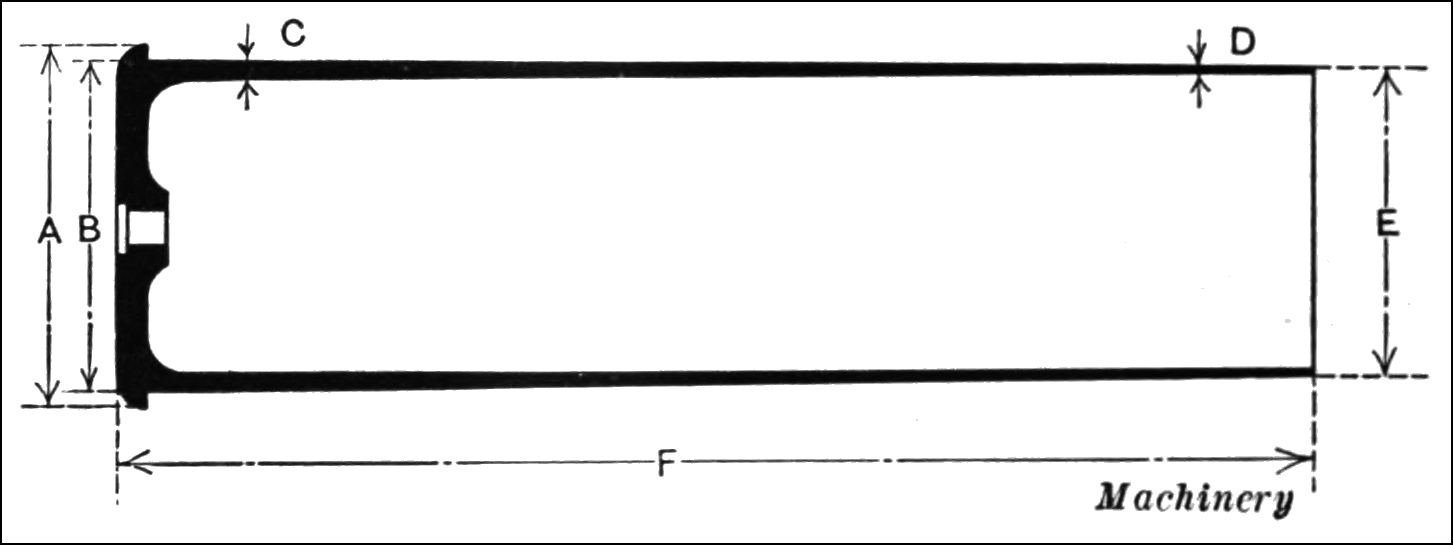
Caliber in Inches Dimensions in Inches
A B C D E F
3.0 3.8 4.7 6.0 3.50 4.30 5.25 6.75 3.20 4.05 5.00 6.50 0.06 0.07 0.10 0.08 0.04 0.04 0.05 0.04 3.05 3.75 4.75 6.25 10.8 14.4 16.8 10.0
Cartridge Case.—The various sizes of American cartridge cases for shrapnel shells are drawn from a blank of brass, known as “cartridge brass.” The principal dimensions of the various sizes of cases are given in Table IV.
The specifications covering the time and percussion fuse used in American shrapnel shells are the same as for the British “No. 85,” given in Chapter XI, with the one exception that the base of the fuse body is shaped to suit the American shell, and the thread is the U. S. standard, instead of Whitworth standard.