Front matter
Reading edition
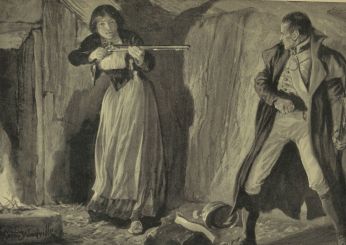
"UNBAR THE DOOR!" SHE COMMANDED. Frontispiece. See p. 286
SHAKESPEARE'S CHRISTMAS
AND OTHER STORIES
BY
"Q" (A.T. QUILLER-COUCH)
WITH ILLUSTRATIONS
LONDON SMITH, ELDER & CO., 15, WATERLOO PLACE 1905
(All rights reserved)
Copyright, 1904 In the United States of America By A.T. Quiller-Couch
CONTENTS
PAGE
Shakespeare's Christmas 1
Ye Sexes, Give Ear! 65
Captain Wyvern's Adventures 115
Frenchman's Creek 157
The Man Behind the Curtain 207
Rain of Dollars 243
The Lamp and the Guitar 291
LIST OF ILLUSTRATIONS
"Unbar the door!" she commanded. Frontispiece Whirled down the length of the room Landlord Oke gave a flourish with his chalk and wrote The little officer had turned white as a sheet "'Tis too late, my master!" Trecarrel called cheerfully down the trap In the name of H.M. King George III. I charge you to come along quiet Get down from your horse, Sir She caught up a guitar and chimed in
SHAKESPEARE'S CHRISTMAS
"And moreover, at this Fair there is at all times to be seen Jugglings, Cheats, Games, Plays, Fools, Apes, Knaves, and Rogues, and that of every kind.... Now, as I said, the way to the Celestial City lies just through this town, where this lusty Fair is kept; and he that will go to the City, and yet not go through this Town, must needs go out of the World."—Bunyan.
I
At the theatre in Shoreditch, on Christmas Eve, 1598, the Lord Chamberlain's servants presented a new comedy. Never had the Burbages played to such a house. It cheered every speech—good, bad, or indifferent. To be sure, some of the dramatis personæ—Prince Hal and Falstaff, Bardolph and Mistress Quickly—were old friends; but this alone would not account for such a welcome. A cutpurse in the twopenny gallery who had been paid to lead the applause gave up toiling in the wake of it, and leaned back with a puzzled grin.
"Bravo, master!" said he to his left-hand neighbour a burly, red-faced countryman well past middle age, whose laughter kept the bench rocking. "But have a care, lest they mistake you for the author!"
"The author? Ho-ho!"——but here he broke off to leap to his feet and lead another round of applause. "The author?" he repeated, dropping back and glancing an eye sidelong from under his handkerchief while he mopped his brow. "You shoot better than you know, my friend: the bolt grazes. But a miss, they say, is as good as a mile."
The cutpurse kept his furtive grin, but was evidently mystified. A while before it had been the countryman who showed signs of bewilderment. Until the drawing of the curtains he had fidgeted nervously, then, as now, mopping his forehead in despite of the raw December air. The first shouts of applause had seemed to astonish as well as delight him. When, for example, a player stepped forward and flung an arm impressively towards heaven while he recited—
When we mean to build, We first survey the plot, then draw the model—
and so paused with a smile, his voice drowned in thunder from every side of the house, our friend had rubbed his eyes and gazed around in amiable protest, as who should say, "Come, come, ... but let us discriminate!" By-and-by, however, as the indifferent applause grew warmer, he warmed with it. At the entrance of Falstaff he let out a bellowing laugh worthy of Olympian Jove, and from that moment led the house. The fops on the sixpenny stools began to mimic, the pit and lower gallery to crane necks for a sight of their fugleman; a few serious playgoers called to have him pitched out; but the mass of the audience backed him with shouts of encouragement. Some wag hailed him as "Burbage's Landlord," and apparently there was meaning, if not merit, in the jest. Without understanding it he played up to it royally, leaning forward for each tally-ho! and afterwards waving his hat as a huntsman laying on his hounds.
The pace of the performance (it had begun at one o'clock) dragged sensibly with all this, and midway in Act IV., as the edge of a grey river-fog overlapped and settled gradually upon the well of the unroofed theatre, voices began to cough and call for lanterns. Two lackeys ran with a dozen. Some they hung from the balcony at the back, others they disposed along both sides of the stage, in front of the sixpenny stools, the audience all the while chaffing them by their Christian names and affectionately pelting them with nuts. Still the fog gathered, until the lantern-rays criss-crossed the stage in separate shafts, and among them the actors moved through Act V. in a luminous haze, their figures looming large, their voices muffled and incredibly remote.
An idle apprentice, seated on the right of the cutpurse, began for a game to stop and unstop his ears. This gave the cutpurse an opportunity to search his pockets. Cantat vacuus: the apprentice felt him at it and went on with his game. Whenever he stopped his ears the steaming breath of the players reminded him of the painted figures he had seen carried in my Lord Mayor's Show, with labels issuing from their mouths.
He had stopped his ears during the scene of King Henry's reconciliation with Chief Justice Gascoigne, and unstopped them eagerly again when his old friends reappeared—Falstaff and Bardolph and Pistol, all agog and hurrying, hot-foot, boot-and-saddle, to salute the rising sun of favour. "Welcome these pleasant days!" He stamped and clapped, following his neighbours' lead, and also because his feet and hands were cold.
Eh? What was the matter? Surely the fog had taken hold of the rogues! What was happening to Mistress Quickly and Doll Tearsheet? Poor souls, they were but children: they had meant no harm. For certain this plaguy fog was infecting the play; and yet, for all the fog, the play was a play no longer, but of a sudden had become savagely real. Why was this man turning on his puppets and rending them? The worst was, they bled—not sawdust, but real blood.
The apprentice cracked a nut and peeled it meditatively, with a glance along the bench. The countryman still fugled; the cutpurse cackled, with lips drawn back like a wolf's, showing his yellow teeth.
"Hist, thou silly knave!" said the apprentice. "Canst not see 'tis a tragedy?"
The rascal peered at him for a moment, burst out laughing, and nudged the countryman.
"Hi, master! Breeds your common at home any such goose as this, that cannot tell tickling from roasting?"
The apprentice cracked another nut. "Give it time," he answered. "I said a tragedy. Yours, if you will, my friend; his too, may be"—with a long and curious stare at the countryman.
II
"My tongue is weary: when my legs are too, I will bid you good-night: and so kneel down before you; but indeed to pray for the Queen."
Play, epilogue, dance, all were over; the curtains drawn, the lanterns hidden behind them. The cutpurse had slipped away, and the countryman and apprentice found themselves side by side waiting while the gallery dissolved its crowd into the fog.
"A brisk fellow," remarked the one, nodding at the vacant seat as he stowed away his handkerchief. "But why should he guess me a rustic?"
"The fellow has no discernment," the apprentice answered dryly. "He even took the play for a merry one."
The countryman peered forward into the young-old face silhouetted against the glow which, cast upward and over the curtain-rod across the stage, but faintly reached the gallery.
"I love wit, Sir, wherever I meet it. For a pint of sack you shall prove me this play a sad one, and choose your tavern!"
"I thank you, but had liefer begin and discuss the epilogue: and the epilogue is 'Who's to pay?'"
"A gentleman of Warwickshire, Master What-d'ye-lack—will that content you? A gentleman of Warwickshire, with a coat-of-arms, or the College's promise—which, I take it, amounts to the same thing." The countryman puffed his cheeks.
"So-so?" The apprentice chuckled.
"When we mean to build We first survey the plot, then search our pockets.
How goes it? Either so, or to that effect."
"The devil!" The countryman, who had been fumbling in his breek pockets, drew forth two hands blankly, spreading empty fingers.
"That was your neighbour, Sir: a brisk fellow, as you were clever enough to detect, albeit unserviceably late. I wish we had made acquaintance sooner: 'twould have given me liberty to warn you."
"It had been a Christian's merest duty."
"La, la, master! In London the sneaking of a purse is no such rarity that a poor 'prentice pays twopence to gape at it. I paid to see the play, Sir, and fought hard for my seat. Before my master gave over beating me, in fear of my inches and his wife (who has a liking for me), he taught me to husband my time. For your purse, the back of my head had eyes enough to tell me what befalls when a lean dog finds himself alongside a bone."
He seated himself on the bench, unstrapped a shoe, slipped two fingers beneath his stocking, and drew forth a silver piece. "If a gentleman of Warwickshire will be beholden to a poor apprentice of Cheapside?"
"Put it up, boy; put it up! I need not your money, good lad: but I like the spirit of that offer, and to meet it will enlarge my promise. A pint of sack, did I say? You shall sup with me to-night, and of the best, or I am a Dutchman. We will go see the town together, the roaring, gallant town. I will make you free of great company: you shall hear the talk of gods! Lord, how a man rusts in the country!—for, I will confess it to you, lad, the rogue hit the mark: the country is my home."
"I cannot think how he guessed it."
"Nor I. And yet he was wrong, too: for that cannot be called home where a man is never at his ease. I had passed your years, lad, before ever I saw London; and ever since, when my boots have been deepest in Midland clay, I have heard her bells summon me, clear as ever they called to Whittington, 'London, thou art of townes a per se.' Nay, almost on that first pilgrimage I came to her as a son. Urbem quam dicunt Romam—I was no such clodpate as that rustic of Virgil's. I came expecting all things, and of none did she disappoint me. Give me the capital before all! 'Tis only there a man measures himself with men."
"And cutpurses?" the apprentice interjected.
"Good and bad, rough and smooth," the countryman assented, with a large and catholic smile. "'Tis no question of degrees, my friend, but of kind. I begin to think that, dwelling in London, you have not made her acquaintance. But you shall. As a father, lad,—for I like you,—I will open your eyes and teach your inheritance. What say you to the Bankside, for example?"
"The Bankside—hem!—and as a father!" scoffed the youth, but his eyes glistened. He was wise beyond his opportunities, and knew all about the Bankside, albeit he had never walked through that quarter but in daylight, wondering at the histories behind its house-fronts.
"As a father, I said; and evil be to him who evil thinks."
"I can tell you of one who will think evil; and that is my master. I can tell you of another; and that will be the sheriff, when I am haled before him."
"You said just now—or my hearing played a trick—that your mistress had a liking for you."
"And you said, 'Evil be to him that evil thinks.' She hath a double chin, and owns to fifty-five."
"What, chins!"
"Years, years, master. Like a grandmother she dotes on me and looks after my morals. Nathless when you talk of Bankside——" The apprentice hesitated: in the dusk his shrewd young eyes glistened. "Say that I risk it?" He hesitated again.
"Lads were not so cautious in my young days. I pay the shot, I tell you—a gentleman of Warwickshire and known to the College of Arms."
"It standeth on Paul's Wharf and handy for the ferry to Bankside: but the College closes early on Christmas Eve, and the Heralds be all at holiday. An you think of pawning your coat-of-arms with them to raise the wind, never say that I let you take that long way round without warning."
"Leave the cost to me, once more!" The countryman gazed down into the well of the theatre as if seeking an acquaintance among the figures below. "But what are they doing? What a plague means this hammering? A man cannot hear himself speak for it."
"'Tis the play."
"The play?"
"The true play—the play you applauded: and writ by the same Will Shakespeare, they tell me—some share of it at least. Cometh he not, by the way, from your part of the world?"
The countryman's eyes glistened in their turn: almost in the dusk they appeared to shine with tears.
"Ay, I knew him, down in Warwickshire: a good lad he was, though his mother wept over him for a wild one. Hast ever seen a hen when her duckling takes to water? So it is with woman when, haply, she has hatched out genius."
The apprentice slapped his leg. "I could have sworn it!"
"Hey?"
"Nay, question me not, master, for I cannot bring it to words. You tell me that you knew him: and I—on the instant I clapped eyes on you it seemed that somehow you were part of his world and somehow had belonged to him. Nearer I cannot get, unless you tell me more."
"I knew him: to be sure, down in Warwickshire: but he has gone somedel beyond my ken, living in London, you see."
"He goes beyond any man's kenning: he that has taught us to ken the world with new eyes. I tell you, master,"—the apprentice stretched out a hand,—"I go seeking him like one seeking a father who has begotten him into a new world, seeking him with eyes derived from him. Tell me——"
But the countryman was leaning over the gallery-rail and scanning the pit again. He seemed a trifle bored by a conversation if not of less, then certainly of other, wit than he had bargained for. Somebody had drawn the curtains back from the stage, where the two lackeys who had decked the balcony with lanterns were busy now with crowbars, levering its wooden supports from their sockets.
"Sure," said he, musing, "they don't lift and pack away the stage every night, do they? Or is this some new law to harass players?" He brought his attention back to the apprentice with an effort. "If you feel that way towards him, lad," he answered, "why not accost him? He walks London streets; and he has, if I remember, a courteous, easy manner."
"If the man and his secret were one! But they are not, and there lies the fear—that by finding one I shall miss the other and recover it never. I cannot dare either risk: I want them both. You saw, this afternoon, how, when the secret came within grasp, the man slipped away; how, having taught us to know Falstaff as a foot its old shoe, he left us wondering on a sudden why we laughed! And yet 'twas not sudden, but bred in the play from the beginning; no, nor cruel, but merely right: only he had persuaded us to forget it."
The countryman put up a hand to hide a yawn: and the yawn ended in a slow chuckle.
"Eh? that rogue Falstaff was served out handsomely: though, to tell the truth, I paid no great heed to the last scene, my midriff being sore with laughing."
The apprentice sighed.
"But what is happening below?" the other went on impatiently. "Are they taking the whole theatre to pieces?"
"That is part of the play."
"A whole regiment of workmen!"
"And no stage-army, neither. Yet they come into the play—not the play you saw without understanding, but the play you understood without seeing. They call it The Phœnix. Be seated, master, while I unfold the plot: this hammering deafens me. The Burbages, you must know——"
"I knew old James, the father. He brought me down a company of players to our town the year I was High Bailiff; the first that ever played in our Guildhall. Though a countryman, I have loved the arts—even to the length of losing much money by them. A boon fellow, old James! and yet dignified as any alderman. He died—let me see—was it two year agone? The news kept me sad for a week."
"A good player, too,"—the apprentice nodded,—"though not a patch upon his son Richard. Cuthbert will serve, in ripe sententious parts that need gravity and a good memory for the lines. But Richard bears the bell of the Burbages. Well, Sir, old James being dead, and suddenly, and (as you say) these two years come February, his sons must go suing to the ground landlord, the theatre being leased upon their dad's life. You follow me?"
The countryman nodded in his turn.
"Very well. The landlord, being a skinflint, was willing to renew the lease, but must raise the rent. If they refuse to pay it, the playhouse fell to him. You may fancy how the Burbages called gods and men to witness. Being acquainted with players, you must know how little they enjoy affliction until the whole town shares it. Never so rang Jerusalem with all the woes of Jeremy as did City and suburb,—from north beyond Bishopsgate to south along the river, with the cursings of this landlord, who—to cap the humour of it—is a precisian, and never goes near a playhouse. Nevertheless, he patched up a truce for two years ending to-night, raising the rent a little, but not to the stretch of his demands. To-morrow—or, rather, the day after, since to-morrow is Christmas—the word is pay or quit. But in yielding this he yielded our friends the counterstroke. They have bought a plot across the water, in the Clink Liberty: and to-morrow, should he pass this way to church, no theatre will be here for him to smack his Puritan lips over. But for this hammering and the deep slush outside you might even now hear the rumbling of wagons; for wagons there be, a dozen of them, ready to cart the Muses over the bridge before midnight. 'Tis the proper vehicle of Thespis. See those dozen stout rascals lifting the proscenium——"
The countryman smote his great hands together, flung back his head, and let his lungs open in shout after shout of laughter.
"But, master——"
"Oh—oh—oh! Hold my sides, lad, or I start a rib.... Nay, if you keep st-staring at me with that s-sol-ol-ol-emn face. Don't—oh, don't!"
"Now I know," murmured the apprentice, "what kind of jest goes down in the country: and, by'r Lady, it goes deep!"
But an instant later the man had heaved himself upon his feet; his eyes expanded from their creases into great O's; his whole body towered and distended itself in gigantic indignation. "The villain! The nipcheese curmudgeonly villain! And we tarry here, talking, while such things are done in England! A Nabal, I say. Give me a hammer!" He heaved up an enormous thigh and bestrode the gallery-rail.
"Have a care, master: the rail——"
"A hammer! Below there. A hammer!" He leaned over, bellowing. The gang of workmen lifting the proscenium stared up open-mouthed into the foggy gloom—a ring of ghostly faces upturned in a luminous haze.
Already the man's legs dangled over the void. Twelve, fifteen feet perhaps, beneath him projected a lower gallery, empty but for three tiers of disordered benches. Plumb as a gannet he dropped, and an eloquent crash of timber reported his arrival below. The apprentice, craning over, saw him regain his feet, scramble over the second rail, and vanish. Followed an instant's silence, a dull thud, a cry from the workmen in the area. The apprentice ran for the gallery stairs and leapt down them, three steps at a time.
It took him, maybe, forty seconds to reach the area. There already, stripped to the shirt, in a whirl of dust and voices, stood his friend waving a hammer and shouting down the loudest. The man was possessed, transformed, a Boanerges; his hammer, a hammer of Thor! He had caught it from the hand of a douce, sober-looking man in a plum-coloured doublet, who stood watching but taking no active share in the work.
"By your leave, Sir!"
"With or without my leave, good Sir, since you are determined to have it," said the quiet man, surrendering the hammer.
The countryman snatched and thrust it between his knees while he stripped. Then, having spat on both hands, he grasped the hammer and tried its poise. "'Tis odd, now," said he, as if upon an afterthought, staring down on the quiet man, "but methinks I know your voice?"
"Marry and there's justice in that," the quiet man answered; "for 'tis the ghost of one you drowned erewhile."
III
"Tom! What, Tom! Where be the others? I tell thee, Tom, there have been doings...."
"Is that Dick Burbage?" A frail, thin windle-straw of a man came coughing across the foggy courtyard with a stable-lantern, holding it high. Its rays wavered on his own face, which was young but extraordinarily haggard, and on the piles of timber between and over which he picked his way—timbers heaped pell-mell in the slush of the yard or stacked against the boundary wall, some daubed with paint, others gilded wholly or in part, and twinkling as the lantern swung. "Dick Burbage already? Has it miscarried, then?"
"Miscarried? What in the world was there to miscarry? I tell thee, Tom—but where be the others?"
The frail man jerked a thumb at the darkness behind his shoulder. "Hark to them, back yonder, stacking the beams! Where should they be? and what doing but at work like galley-slaves, by the pace you have kept us going? Look around. I tell you from the first 'twas busy-all to get the yard clear between the wagons' coming, and at the fifth load we gave it up. My shirt clings like a dish-clout; a chill on this will be the death o' me. What a plague! How many scoundrels did you hire, that they take a house to pieces and cart it across Thames faster than we can unload it?"
"That's the kernel of the story, lad. I hired the two-score rogues agreed on, neither more nor less: but one descended out of heaven and raised the number to twelve-score. Ten-score extra, as I am a sinner; and yet but one man, for I counted him. His name, he told me, was Legion."
"Dick," said the other sadly, "when a sober man gives way to drinking—I don't blame you: and your pocket will be the loser more than all the rest if you've boggled to-night's work; but poor Cuthbert will take it to heart."
"There was a man, I tell you——"
"Tut, tut, pull yourself together and run back across bridge. Or let me go: take my arm now, before the others see you. You shall tell me on the way what's wrong at Shoreditch."
"There is naught wrong with Shoreditch, forby that it has lost a theatre: and I am not drunk, Tom Nashe—no, not by one-tenth as drunk as I deserve to be, seeing that the house is down, every stick of it, and the bells scarce yet tolling midnight. 'Twas all this man, I tell you!"
"Down? The Theatre down? Oh, go back, Dick Burbage!"
"Level with the ground, I tell you—his site a habitation for the satyr. Cecidit, cecidit Babylon illa magna! and the last remains of it, more by token, following close on my heels in six wagons. Hist, then, my Thomas, my Didymus, my doubting one!—Canst not hear the rumble of their wheels? and—and—oh, good Lord!" Burbage caught his friend by the arm and leaned against him heavily. "He's there, and following!"
The wagons came rolling over the cobbles of the Clink along the roadway outside the high boundary-wall of the yard: and as they came, clear above their rumble and the slow clatter of hoofs a voice like a trumpet declaimed into the night—
"Above all ryvers thy Ryver hath renowne, Whose beryall streamys, pleasaunt and preclare, Under thy lusty wallys renneth downe, Where many a swan doth swymme with wyngis fair, Where many a barge doth sail and row with are——
We had done better—a murrain on their cobbles!—we had done better, lad, to step around by Paul's Wharf and take boat.... This jolting ill agrees with a man of my weight....
Where many a barge doth sail aund row with are—
Gr-r-r! Did I not warn thee beware, master wagoner, of the kerbstones at the corners? We had done better by water, what though it be dark.... Lights of Bankside on the water ... no such sight in Europe, they tell me.... My Lord of Surrey took boat one night from Westminster and fired into their windows with a stone-bow, breaking much glass ... drove all the long-shore queans screaming into the streets in their night-rails.... He went to the Fleet for it ... a Privy Council matter.... I forgive the lad, for my part: for only think of it—all those windows aflame on the river, and no such river in Europe!—
Where many a barge doth sail and row with are; Where many a ship doth rest with top-royall. O towne of townes! patrone and not compare, London, thou art the flow'r of Cities all!
Who-oop!"
"In the name of——" stammered Nashe, as he listened, Burbage all the while clutching his arm.
"He dropped from the top gallery, I tell you—clean into the pit from the top gallery—and he weighs eighteen stone if an ounce. 'Your servant, Sir, and of all the Muses,' he says, picking himself up; and with that takes the hammer from my hand and plays Pyrrhus in Troy—Pyrrhus with all the ravening Danai behind him: for those hired scoundrels of mine took fire, and started ripping out the bowels of the poor old theatre as though it had been the Fleet and lodged all their cronies within! It went down before my eyes like a sand-castle before the tide. Within three hours they had wiped the earth of it. The Lord be praised that Philip Gosson had ne'er such an arm, nor could command such! Oh, but he's a portent! Troy's horse and Bankes's bay gelding together are a fool to him: he would harness them as Samson did the little foxes, and fire brushwood under their tails...."
"Of a certainty you are drunk, Dick."
"Drunk? I?" Burbage gripped the other's thin arm hysterically. "If you want to see a man drunk come to the gate. Nay, then, stay where you are: for there's no escaping him."
Nor was there. Between them and the wagoners' lanterns at the gate a huge shadow thrust itself, the owner of it rolling like a ship in a sea-way, while he yet recited—
"Strong be thy wallis that about thee standis,
(meaning the Clink, my son),
Wise be the people that within thee dwellis,
(which you may take for the inhabitants thereof),
Fresh is thy ryver with his lusty strandis, Blith be thy chirches, wele sowning be thy bellis."
"Well sounding is my belly, master, any way," put in a high, thin voice; "and it calls on a gentleman of Warwickshire to redeem his promise."
"He shall, he shall, lad—in the fullness of time: 'but before dining ring at the bell,' says the proverb. Grope, lad, feel along the gate-posts if this yard, this courtlage, this base-court, hath any such thing as bell or knocker.
And when they came to mery Carleile All in the mornyng tyde-a, They found the gates shut them until About on every syde-a. Then Adam Bell bete on the gates With strokes great and stronge-a
Step warely, lad. Plague of this forest! Have we brought timber to Sherwood?
With strokes great and stronge-a The porter marveiled who was thereat, And to the gates he thronge-a. They called the porter to counsell, And wrange his necke in two-a, And caste him in a depe dungeon, And took hys keys hym fro-a.
Within! You rascal, there, with the lantern!... Eh? but these be two gentlemen, it appears? I cry your mercy, Sirs."
"For calling us rascals?" Nashe stepped forward. "'T hath been done to me before now, in print, upon as good evidence; and to my friend here by Act of Parliament."
"But seeing you with a common stable-lantern——"
"Yet Diogenes was a gentleman. Put it that, like him, I am searching for an honest man."
"Then we are well met. I' faith we are very well met," responded the countryman, recognising Burbage's grave face and plum-coloured doublet.
"Or, as one might better say, well overtaken," said Burbage.
"Marry, and with a suit. I have some acquaintance, Sir, with members of your honourable calling, as in detail and at large I could prove to you. Either I have made poor use of it or I guess aright, as I guess with confidence, that after the triumph will come the speech-making, and the supper's already bespoken."
"At Nance Witwold's, by the corner of Paris Garden, Sir, where you shall be welcome."
"I thank you, Sir. But my suit is rather for this young friend of mine, to whom I have pledged my word."
"He shall be welcome, too."
"He tells me, Sir, that you are Richard Burbage. I knew your father well, Sir—an honest Warwickshire man: he condescended to my roof and tasted my poor hospitality many a time; and belike you, too, Sir, being then a child, may have done the same: for I talk of prosperous days long since past—nay, so long since that 'twould be a wonder indeed had you remembered me. The more pleasure it gives me, Sir, to find James Burbage's sappy virtues flourishing in the young wood, and by the branch be reminded of the noble stock."
"The happier am I, Sir, to have given you welcome or ever I heard your claim."
"Faith!" said the apprentice to himself, "compliments begin to fly when gentlefolks meet." But he had not bargained to sup in this high company, and the prospect thrilled him with delicious terror. He glanced nervously across the yard, where some one was approaching with another lantern.
"My claim?" the countryman answered Burbage. "You have heard but a part of it as yet. Nay, you have heard none of it, since I use not past hospitalities with old friends to claim a return from their children. My claim, Sir, is a livelier one——"
"Tom Nashe! Tom Nashe!" called a voice, clear and strong and masculine, from the darkness behind the advancing lantern.
"Anon, anon, Sir," quoted Nashe, swinging his own lantern about and mimicking.
"Don't tell me there be yet more wagons arrived?" asked the voice.
"Six, lad—six, as I hope for mercy: and outside the gate at this moment."
"There they must tarry, then, till our fellows take breath to unload 'em. But—six? How is it managed, think you? Has Dick Burbage called out the train-bands to help him? Why, hullo, Dick! What means——" The newcomer's eyes, round with wonder as they rested a moment on Burbage, grew rounder yet as they travelled past him to the countryman. "Father?" he stammered, incredulous.
"Good evening, Will! Give ye good evening, my son! Set down that lantern and embrace me, like a good boy: a good boy, albeit a man of fame. Didst not see me, then, in the theatre this afternoon? Yet was I to the fore there, methinks, and proud to be called John Shakespeare."
"Nay, I was not there; having other fish to fry."
"Shouldst have heard the applause, lad; it warmed your old father's heart. Yet 'twas no more than the play deserved. A very neat, pretty drollery—upon my faith, no man's son could have written a neater!"
"But what hath fetched you to London?"
"Business, business: a touch, too, maybe, of the old homesickness: but business first. Dick Quiney——But pass me the lantern, my son, that I may take a look at thee. Ay, thou hast sobered, thou hast solidified: thy beard hath ta'en the right citizen's cut—'twould ha' been a cordial to thy poor mother to see thee wear so staid a beard. Rest her soul! There's nothing like property for filling out a man's frame, firming his eye, his frame, bearing, footstep. Talking of property, I have been none so idle a steward for thee. New Place I have made habitable—the house at least; patched up the roof, taken down and rebuilt the west chimney that was overleaning the road, repaired the launders, enlarged the parlour-window, run out the kitchen passage to a new back-entrance. The garden I cropped with peas this summer, and have set lettuce and winter-kale between the young apple-trees, whereof the whole are doing well, and the mulberry likewise I look for to thrive. Well, as I was saying, Dick Quiney——"
"—Is in trouble again, you need not tell."
"None so bad but it could be mended by the thirty pounds whereof I wrote. Mytton will be security with him, now that Bushell draws back. He offers better than those few acres at Shottery you dealt upon in January."
"Land is land."
"And ale is ale: you may take up a mortgage on the brewhouse. Hast ever heard, Mr. Burbage"—John Shakespeare swung about—"of a proverb we have down in our Warwickshire? It goes—
Who buys land buys stones, Who buys meat buys bones, Who buys eggs buys shells, But who buys ale buys nothing else.
And that sets me in mind, Will, that these friends of yours have bidden me to supper: and their throats will be dry an we keep 'em gaping at our country discourse. Here come I with Thespis, riding on a wagon: but where tarries the vintage feast? Where be the spigots? Where be the roasted geese, capons, sucking-pigs? Where the hogs-puddings, the trifles, the custards, the frumenties? Where the minstrels? Where the dancing girls? I have in these three hours swallowed as many pecks of dust. I am for the bucket before the manger and for good talk after both—high, brave translunary talk with wine in the veins of it—Hippocras with hippocrene: with music too—some little kickshaw whatnots of the theorbo or viol da gamba pleasantly thrown in for interludes. 'Tis a fog-pated land I come from, with a pestilent rheumy drip from the trees and the country scarce recovered from last year's dearth——"
"Dick Quiney should have made the better prices for that dearth," put in his son, knitting his great brow thoughtfully. "With wheat at fifty shillings, and oats——"
"The malt, lad, the malt! His brewhouse swallowed malt at twenty-eight or nine which a short two years before had cost him twelve-and-threepence the quarter. A year of dearth, I say. It took poor Dick at unawares. But give him time: he will pull round. Sure, we be slow in the country, but you have some in this town that will beat us. How many years, lad, have I been battering the doors of Heralds' College for that grant of arms, promised ere my beard was grey and yours fully grown?"
"Malt at twenty-eight, you say?"
"Last year, lad—a year of dearth. Call it a good twenty in these bettering times, and wheat anything under forty-five shillings."
"Well, we will talk it over." His son seemed to come out of a brown study. "We will talk it over," he repeated briskly, and added, "How? The chimney overleaning the road? 'Twas a stout enough chimney, as I remember, and might have lasted another twenty years. Where did you draw the bricks?"
Nashe glanced at his friend with a puzzled smile. Burbage—better used, no doubt, to the businesslike ways of authors—betrayed no surprise. The apprentice stared, scarcely believing his ears. Was this the talk of Shakespeare? Nay, rather the talk of Justice Shallow himself—"How a good yoke of bullocks at Stamford Fair?" "How a score of ewes now?"
A heavy tread approached from the gateway.
"Are we to bide here all night, and on Christmas morn, too?" a gruff voice demanded. "Unpack, and pay us our wage, or we tip the whole load of it into Thames." Here the wagoner's shin encountered in the darkness with a plank, and he cursed violently.
"Go you back to your horses, my friend," answered Burbage. "The unloading shall begin anon. As for your wage, your master will tell you I settled it at the time I bargained for his wagons—ay, and paid. I hold his receipt."
"For tenpence a man—mowers' wages," growled the wagoner.
"I asked him his price and he fixed it. 'Tis the current rate, I understand, and a trifle over."
"Depends on the job. I've been talkin' with my mates, and we don't like it. We're decent labouring men, and shifting a lot of play-actors' baggage don't come in our day's work. I'd as lief wash dirty linen for my part. Therefore," the fellow wound up lucidly, "you'll make it twelvepence a head, master. We don't take a groat less."
"I see," said Burbage blandly: "twopence for salving your conscience, hey? And so, being a decent man, you don't stomach players?"
"No, nor the Bankside at this hour o' night. I live clean, I tell you."
"'Tis a godless neighbourhood and a violent." Burbage drew a silver whistle from his doublet and eyed it. "Listen a moment, master wagoner, and tell me what you hear."
"I hear music o' sorts. No Christmas carols, I warrant."
"Aught else?"
"Ay: a sound like a noise of dogs baying over yonder."
"Right again: it comes from the kennels by the Bear-Pit. Have you a wish, my friend, to make nearer acquaintance with these dogs? No? With the bears, then? Say the word, and inside of a minute I can whistle up your two-pennyworth."
The wagoner with a dropping jaw stared from one to another of the ring of faces in the lantern-light. They were quiet, determined. Only the apprentice stood with ears pricked, as it were, and shivered at the distant baying.
"No offence, Sir; I meant no offence, you'll understand," the wagoner stammered.
"Nay, call your mates, man!" spoke up William Shakespeare, sudden and sharp, and with a scornful ring in his voice which caused our apprentice to jump. "Call them in and let us hear you expound Master Burbage's proposal. I am curious to see how they treat you—having an opinion of my own on crowds and their leaders."
But the wagoner had swung about surlily on his heel.
"I'll not risk disputing it," he growled. "'Tis your own dung-hill, and I must e'en take your word that 'tis worse than e'er a man thought. But one thing I'll not take back. You're a muck of play-actors, and a man that touches ye should charge for his washing. Gr-r!" he spat—"ye're worse than Patty Ward's sow, and she was no lavender!"
IV
The Bankside was demure. But for the distant baying of dogs which kept him shivering, our apprentice had been disappointed in the wickedness of it.
He had looked to meet with roisterers, to pass amid a riot of taverns, to happen, belike, upon a street scuffle, to see swords drawn or perchance to come upon a body stretched across the roadway and hear the murderers' footsteps in the darkness, running. These were the pictures his imagination had drawn and shuddered at: for he was a youth of small courage.
But the Bankside was demure; demure as Chepe. The waterside lanes leading to Mistress Witwold's at the corner of Paris Gardens differed only from Chepe in this—that though the hour was past midnight, every other door stood open or at least ajar, showing a light through the fog. Through some of these doorways came the buzz and murmur of voices, the tinkling of stringed instrument. Others seemed to await their guests. But the lanes themselves were deserted.
From the overhanging upper storeys lights showed here and there through the chinks of shutters or curtains. Once or twice in the shadows beneath, our apprentice saw, or thought he saw, darker shadows draw back and disappear: and gradually a feeling grew upon him that all these shadows, all these lidded upper windows, were watching, following him with curious eyes. Again, though the open doorways were bright as for a fête, a something seemed to subdue the voices within—a constraint, perhaps an expectancy—as though the inmates whispered together in the pauses of their talk and between the soft thrumming of strings. He remarked, too, that his companions had fallen silent.
Mother Witwold's door, when they reached it, stood open like the rest. Her house overhung a corner where from the main street a short alley ran down to Paris Garden stairs. Nashe, who had been leading along the narrow pavement, halted outside the threshold to extinguish his lantern; and at the same moment jerked his face upward. Aloft, in one of the houses across the way, a lattice had flown open with a crash of glass.
"Jesu! help!"
The cry ended in a strangling sob. The hands that had thrust the lattice open projected over the sill. By the faint foggy light of Mother Witwold's doorway our apprentice saw them out-stretched for a moment; saw them disappear, the wrists still rigid, as some one drew them back into the room. But what sent the horror crawling through the roots of his hair was the shape of these hands.
"You there!" called Nashe, snatching the second lantern from Burbage's hand and holding it aloft towards the dim house-front. "What's wrong within?"
A woman's hand came around the curtain and felt for the lattice stealthily, to close it. There was no other answer.
"What's wrong there?" demanded Nashe again.
"Go your ways!" The voice was a woman's, hoarse and angry, yet frightened withal. The curtain still hid her. "Haven't I trouble enough with these tetchy dwarfs, but you must add to it by waking the streets?"
"Dwarfs?" Nashe swung the lantern so that its rays fell on the house-door below: a closed door and stout, studded with iron nails. "Dwarfs?" he repeated.
"Let her be," said Burbage, taking his arm. "I know the woman. She keeps a brace of misbegotten monsters she picked up at Wapping off a ship's captain. He brought 'em home from the Isle of Serendib, or Cathay, or some such outlandish coast, or so she swears his word was."
"Swears, doth she? Didst hear the poor thing cry out?"
"Ay, like any Christian; as, for aught I know, it may be. There's another tale that she found 'em down in Gloucestershire, at a country fair, and keeps 'em pickled in walnut juice. But monsters they be, whether of Gloucester or Cathay, for I have seen 'em; and so hath the Queen, who sent for them the other day to be brought to Westminster, and there took much delight in their oddity."
While the others hesitated, William Shakespeare turned on his heel and walked past them into Mother Witwold's lighted doorway.
His father glanced after him. "Well, to be sure, the poor thing cried out like a Christian," he said. "But dwarfs and monsters be kittle cattle to handle, I am told." As the lattice closed on their debate he linked his arm in the apprentice's, and they too passed into the doorway.
From it a narrow passage led straight to a narrow staircase; and at the stairs' foot the apprentice had another glimpse into the life of this Bankside. A door stood wide there upon an ill-lighted room, and close within the door sat two men—foreigners by their black-avised faces—casting dice upon a drumhead. In a chair, beyond, a girl, low-bodiced, with naked gleaming shoulders, leaned back half asleep; and yet she did not seem to sleep, but to regard the gamesters with a lazy scorn from under her dropped lashes. A tambourine tied with bright ribbons rested in the lap of her striped petticoat, kept from sliding to the floor by the careless crook—you could see it was habitual—of her jewelled fingers. The two men looked up sharply, almost furtively, at the company mounting the stairs. The girl scarcely lifted her eyes. Scornful she looked, and sullen and infinitely weary, yet she was beautiful withal. The apprentice wondered while he climbed.
"Yes," his patron was saying, "'tis the very mart and factory of pleasure. Ne'er a want hath London in that way but the Bankside can supply it, from immortal poetry down to—to——"
"—Down to misshapen children. Need'st try no lower, my master."
"There be abuses, my son: and there be degrees of pleasure, the lowest of which (I grant you) be vile, sensual, devilish. Marry, I defend not such. But what I say is that a great city should have delights proportionate to her greatness; rich shows and pageants and processions by land and water; plays and masques and banquets with music; and the men who cater for these are citizens as worthy as the rest. Take away Bankside, and London would be the cleaner of much wickedness: yet by how much the duller of cheer, the poorer in all that colour, that movement which together be to cities the spirit of life! Where would be gone that glee of her that lifts a man's lungs and swells his port when his feet feel London stones? Is't of her money the country nurses think when to wondering children they fable of streets all paved with gold? Nay, lad: and this your decent, virtuous folk know well enough—your clergy, your aldermen—and use the poor players while abusing them. Doth the parish priest need a miracle-play for his church? Doth my Lord Mayor intend a show? To the Bankside they hie with money in their purses: and if his purse be long enough, my Lord Mayor shall have a fountain running with real wine, and Mass Thomas a Hell with flames of real cloth-in-grain, or at least a Lazarus with real sores. Doth the Court require a masque, the Queen a bull-baiting, the City a good roaring tragedy, full of blood and impugned innocence——Will! Will, I say! Tarry a moment!"
They had reached the landing, and looked down a corridor at the end of which, where a lamp hung, Shakespeare waited with his hand on a door-latch. From behind the door came a buzz of many voices.
"Lad, lad, let us go in together! Though the world's applause weary thee, 'tis sweet to thine old father."
As he pressed down the latch the great man turned for an instant with a quick smile, marvellously tender.
"He can smile, then?" thought the apprentice to himself. "And I was doubting that he kept it for his writing!"
Within the room, as it were with one shout, a great company leapt to its feet, cheering and lifting glasses. Shakespeare, pausing on the threshold, smiled again, but more reservedly, bowing to the homage as might a king.
V
Three hours the feast had lasted: and the apprentice had listened to many songs, many speeches, but scarcely to the promised talk of gods. The poets, maybe, reserved such talk for the Mermaid. Here they were outnumbered by the players and by such ladies as the Bankside (which provided everything) furnished to grace the entertainment; and doubtless they subdued their discourse to the company. The Burbages, Dick and Cuthbert, John Heminge, Will Kempe—some half-a-dozen of the crew perhaps—might love good literature: but even these were pardonably more elate over the epilogue than over the play. For months they, the Lord Chamberlain's servants, had felt the eyes of London upon them: to-night they had triumphed, and to-morrow London would ring with appreciative laughter. It is not every day that your child of pleasure outwits your man of business at his own game: it is not once in a generation that he scores such a hit as had been scored to-day. The ladies, indeed, yawned without dissembling, while Master Jonson—an ungainly youth with a pimply face, a rasping accent, and a hard pedantic manner—proposed success to the new comedy and long life to its author; which he did at interminable length; spicing his discourse with quotations from Aristotle, Longinus, Quintilian, the Ars Poetica, Persius, and Seneca, authors less studied than the Aretine along Bankside. He loved Will Shakespeare.... A comedy of his own (as the company might remember) owed not a little to his friend Will Shakespeare's acting.... Here was a case in which love and esteem—yes, and worship—might hardly be dissociated.... In short, speaking as modestly as a young man might of his senior, Will Shakespeare was the age's ornament and, but for lack of an early gruelling in the classics, might easily have been an ornament for any age. Cuthbert Burbage—it is always your quiet man who first succumbs on these occasions—slid beneath the table with a vacuous laugh and lay in slumber. Dick Burbage sat and drummed his toes impatiently. Nashe puffed at a pipe of tobacco. Kempe, his elbows on the board, his chin resting on his palms, watched the orator with amused interest, mischief lurking in every crease of his wrinkled face. Will Shakespeare leaned back in his chair and scanned the rafters, smiling gently the while. His speech, when his turn came to respond, was brief, almost curt. He would pass by (he said) his young friend's learned encomiums, and come to that which lay nearer to their thoughts than either the new play or the new play's author. Let them fill and drink in silence to the demise of an old friend, the vanished theatre, the first ever built in London. Then, happening to glance at Heminge as he poured out the wine—"Tut, Jack!" he spoke up sharply: "keep that easy rheum for the boards. Brush thine eyes, lad: we be all players here—or women—and know the trade."
It hurt. If Heminge's eyes had begun to water sentimentally, they flinched now with real pain. This man loved Shakespeare with a dog's love. He blinked, and a drop fell and rested on the back of his hand as it fingered the base of his wine-glass. The apprentice saw and noted it.
"And another glass, lads, to the Phœnix that shall arise! A toast, and this time not in silence!" shouted John Shakespeare, springing up, flask in one hand and glass in the other. Meat or wine, jest or sally of man or woman, dull speech or brisk—all came alike to him. His doublet was unbuttoned; he had smoked three pipes, drunk a quart of sack, and never once yawned. He was enjoying himself to the top of his bent. "Music, I say! Music!" A thought seemed to strike him; his eyes filled with happy inspiration. Still gripping his flask, he rolled to the door, flung it open, and bawled down the stairway—
"Ahoy! Below, there!"
"Ahoy, then, with all my heart!" answered a voice, gay and youthful, pat on the summons. "What is't ye lack, my master?"
"Music, an thou canst give it. If not——"
"My singing voice broke these four years past, I fear me."
"Your name, then, at least, young man, or ever you thrust yourself upon private company."
"William Herbert, at your service." A handsome lad—a boy, almost—stood in the doorway, having slipped past John Shakespeare's guard: a laughing, frank-faced boy, in a cloak slashed with orange-tawny satin. So much the apprentice noted before he heard a second voice, as jaunty and even more youthfully shrill, raised in protest upon the stairhead outside.
"And where the master goes," it demanded, "may not his page follow?"
John Shakespeare seemingly gave way to this second challenge as to the first. "Be these friends of thine, Will?" he called past them as a second youth appeared in the doorway, a pretty, dark-complexioned lad, cloaked in white, who stood a pace behind his companion's elbow and gazed into the supper-room with eyes at once mischievous and timid.
"Good-evening, gentles!" The taller lad comprehended the feasters and the disordered table in a roguish bow. "Good-evening, Will!" He singled out Shakespeare, and nodded.
"My Lord Herbert!"
The apprentice's eye, cast towards Shakespeare at the salutation given, marked a dark flush rise to the great man's temples as he answered the nod.
"I called thee 'Will,'" answered Herbert lightly.
"You called us 'gentles,'" Shakespeare replied, the dark flush yet lingering on either cheek. "A word signifying bait for gudgeons, bred in carrion."
"Yet I called thee Will," insisted Herbert more gently. "'Tis my name as well as thine, and we have lovingly exchanged it before now, or my memory cheats me."
"'Tis a name lightly exchanged in love." With a glance at the white-cloaked page Shakespeare turned on his heel.
"La, Will, where be thy manners?" cried one of the women. "Welcome, my young Lord; and welcome the boy beside thee for his pretty face! Step in, child, that I may pass thee round to be kissed."
The page laughed and stepped forward with his chin defiantly tilted. His eyes examined the women curiously and yet with a touch of fear.
"Nay, never flinch, lad! I'll do thee no harm," chuckled the one who had invited him. "Mass o' me, how I love modesty in these days of scandal!"
"Music? Who called for music?" a foreign voice demanded: and now in the doorway appeared three newcomers, two men and a woman—the same three of whom the apprentice had caught a glimpse within the room at the stairs' foot. The spokesman, a heavily built fellow with a short bull-neck and small cunning eyes, carried a drum slung about his shoulders and beat a rub-a-dub on it by way of flourish. "Take thy tambourine and dance, Julitta—
Julie, prends ton tambourin; Toi, prends ta flute, Robin,"
he hummed, tapping his drum again.
"So? So? What foreign gabble is this?" demanded John Shakespeare, following and laying a hand on his shoulder.
"A pretty little carol for Christmas, Signore, that we picked up on our way through Burgundy, where they sing it to a jargon I cannot emulate. But the tune is as it likes you—
Au son ces instruments— Turelurelu, patapatapan— Nous dirons Noël gaîment!
Goes it not trippingly, Signore? You will say so when you see my Julitta dance to it."
"Eh—eh? Dance to a carol?" a woman protested. "'Tis inviting the earth to open and swallow us."
"Why, where's the harm on't?" John Shakespeare demanded. "A pretty little concomitant, and anciently proper to all religions, nor among the heathen only, but in England and all parts of Christendom—
In manger wrapped it was— So poorly happ'd my chance— Between an ox and a silly poor ass To call my true love to the dance! Sing O, my love, my love, my love....
There's precedent for ye, Ma'am—good English precedent. Zooks! I'm a devout man, I hope; but I bear a liberal mind and condemn no form of mirth, so it be honest. The earth swallow us? Ay, soon or late it will, not being squeamish. Meantime, dance, I say! Clear back the tables there, and let the girl show her paces!"
Young Herbert glanced at Burbage with lifted eyebrow, as if to demand, "Who is this madman?" Burbage laughed, throwing out both hands.
"But he is gigantic!" lisped the page, as with a wave of his two great arms John Shakespeare seemed to catch up the company and fling them to work pell-mell, thrusting back tables, piling chairs, clearing the floor of its rushes. "He is a whirlwind of a man!"
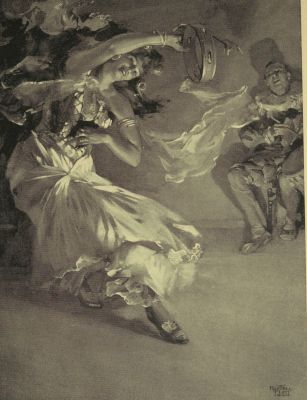
WHIRLED DOWN THE LENGTH OF THE ROOM.
"Come, Julitta!" called the man with the drum. "Francisco, take thy pipe, man!—
Au son de ces instruments— Turelurelu, patapatapan—"
As the music struck up, the girl, still with her scornful, impassive face, leapt like a panther from the doorway into the space cleared for her, and whirled down the room in a dance the like of which our apprentice had never seen nor dreamed of. And yet his gaze at first was not for her, but for the younger foreigner, the one with the pipe. For if ever horror took visible form, it stood and stared from the windows of that man's eyes. They were handsome eyes, too, large and dark and passionate: but just now they stared blindly as though a hot iron had seared them. Twice they had turned to the girl, who answered by not so much as a glance; and twice with a shudder upon the man with the drum, who caught the look and blinked wickedly. Worst of all was it when the music began, to see that horror fixed and staring over a pair of cheeks ludicrously puffing at a flageolet. A face for a gargoyle! The apprentice shivered, and glanced from one to other of the company: but they, one and all, were watching the dancer.
It was a marvellous dance, truly. The girl, her tambourine lifted high, and clashing softly to the beat of the music, whirled down the length of the room, while above the pipe's falsetto and rumble of the drum the burly man lifted his voice and trolled—
"Turelurelu, patapatapan— Au son de ces instruments Faisons la nique à Satan!"
By the barricade of chairs and tables, under which lay Cuthbert Burbage in peaceful stupor, she checked her onward rush, whirling yet, but so lazily that she seemed for the moment to stand poised, her scarf outspread like the wings of a butterfly: and so, slowly, very slowly, she came floating back. Twice she repeated this, each time narrowing her circuit, until she reached the middle of the floor, and there began to spin on her toes as a top spins when (as children say) it goes to sleep. The tambourine no longer clashed. Balanced high on the point of her uplifted forefinger, it too began to spin, and span until its outline became a blur. Still, as the music rose shriller and wilder, she revolved more and more rapidly, yet apparently with less and less of effort. Her scarf had become a mere filmy disc rotating around a whorl of gleaming flesh and glancing jewels.
A roar of delight from John Shakespeare broke the spell. The company echoed it with round upon round of hand-clapping. The music ceased suddenly, and the dancer, dipping low until her knees brushed the floor, stood erect again, dropped her arms, and turned carelessly to the nearest table.
"Bravo! bravissimo!" thundered John Shakespeare. "A cup of wine for her, there!"
The girl had snatched up a crust of bread and was gnawing it ravenously. He thrust his way through the guests and poured out wine for her. She took the glass with a steady hand, scarcely pausing in her meal to thank him.
"But who is your master of ceremonies?" demanded the page's piping voice.
William Shakespeare heard it and turned. "He is my father," said he quietly.
But John Shakespeare had heard also. Wheeling about, wine-flask in hand, he faced the lad with a large and mock-elaborate bow. "That, young Sir, must be my chief title to your notice. For the rest, I am a plain gentleman of Warwickshire, of impaired but (I thank God) bettering fortune; my name John Shakespeare; my coat, or, a bend sable, charged with a lance proper. One of these fine days I may bring it to Court for you to recognise: but, alas! says Skelton—
Age is a page For the Court full unmeet, For age cannot rage Nor buss her sweet sweet.
I shall bide at home and kiss the Queen's hand, through my son, more like."
"Indeed," said the page, "I hear reports that her Majesty hath already a mind to send for him."
"Is that so, Will?" His father beamed, delighted.
"In some sort it is," answered Herbert, "and in some sort I am her messenger's forerunner. She will have a play of thee, Will."
"The Queen?" Shakespeare turned on him sharply. "This is a fool's trick you play on me, my Lord." Yet his face flushed in spite of himself.
"I tell thee, straight brow and true man, I heard the words fall from her very lips. 'He shall write us a play,' she said; 'and this Falstaff shall be the hero on't, with no foolish royalties to overlay and clog his mirth.'"
"And, you see," put in the page maliciously, "we have come express to the Boar's Head to seek him out."
"That," Herbert added, "is our suit to-night."
"Will, lad, thy fortune's made!" John Shakespeare clapped a hand on his son's shoulder. "I shall see thee Sir William yet afore I die!"
If amid the general laughter two lines of vexation wrote themselves for a moment on Shakespeare's brow they died out swiftly. He stood back a pace, eyed his father awhile with grave and tender humour, and answered the pair of courtiers with a bow.
"Her Majesty's gracious notion of a play," said he, "must needs be her poor subject's pattern. If then I come to Court in motley, you, Sirs, at least will be indulgent, knowing how much a suit may disguise." The page, meeting his eye, laughed uneasily. "'Tis but a frolic——" he began.
"Ay, there's the pity o't," interrupted a deep voice—Kempe's.
The page laughed again, yet more nervously. "I should have said the Queen—God bless her!—desires but a frolic. And I had thought"—here he lifted his chin saucily and looked Kempe in the face—"that on Bankside they took a frolic less seriously."
"Why, no," answered Kempe: "they have to take it seriously, and the cost too,—that being their business."
"'Tis but a frolic, at any rate, that her Majesty proposes, with a trifling pageant or dance to conclude, in which certain of the Court may join."
A harsh laugh capped this explanation. It came from the dancing-girl, who, seated at the disordered table, had been eating like a hungry beast. She laid down her knife, rested her chin on her clasped hands, and, munching slowly, stared at the page from under her sullen, scornful brows.
"Wouldst learn to dance, child?" she demanded.
"With thee for teacher," the page answered modestly. "I have no skill, but a light foot only."
"A light foot!" the woman mimicked and broke into a laugh horrible to hear. "Wouldst achieve such art as mine with a light foot? I tell thee that to dance as I dance thy feet must go deep as hell!" She pushed back her plate, and, rising, nodded to the musicians. "Play, you!" she commanded.
This time she used no wild whirl down the room to give her impetus. She stood in the cleared space of floor, her arms hanging limp, and at the first shrill note of the pipe began to revolve on the points of her toes, her eyes, each time as they came full circle, meeting the gaze of the page, and slowly fascinating, freezing it. As slowly, deliberately, her hand went up, curved itself to the armpit of her bodice; and lo! as she straightened it aloft, a snake writhed itself around her upper arm, lifting its head to reach the shining bracelets, the jewelled fingers. A curving lift of the left arm, and on that too a snake began to coil and climb. Effortless, rigid as a revolving statue, she brought her finger-tips together overhead and dipped them to her bosom.
A shriek rang out, piercing high above the music.
"Catch her! She faints!" shouted Kempe, darting forward. But it was Shakespeare who caught the page's limp body as it dropped back on his arm. Bearing it to the window, he tore aside the curtain and thrust open a lattice to the dawn. The unconscious head drooped against his shoulder.
"My Lord"—he turned on Herbert as though the touch maddened him—"you are a young fool! God forgive me that I ever took you for better! Go, call a boat and take her out of this."
"Nay, but she revives," stammered Herbert, as the page's lips parted in a long, shuddering sigh.
"Go, fetch a boat, I say!—and make way there, all you by the door!"
VI
"Tut! tut!—the wench will come to fast enough in the fresh air. A dare-devil jade, too, to be sparking it on Bankside at this hour! But it takes more than a woman, they say, to kill a mouse, and with serpents her sex hath an ancient feud. What's her name, I wonder?"
The candles, burning low and guttering in the draught of the open window, showed a banquet-hall deserted, or all but deserted. A small crowd of the guests—our apprentice among them—had trooped downstairs after Shakespeare and his burden. Others, reminded by the grey dawn, had slipped away on their own account to hire a passage home from the sleepy watermen before Paris Garden Stairs.
"Can any one tell me her name, now?" repeated John Shakespeare, rolling to the table and pouring himself yet another glass of wine. But no one answered him. The snake-woman had folded back her pets within her bodice and resumed her meal as though nothing had happened. The burly drummer had chosen a chair beside her and fallen to on the remains of a pasty. Both were eating voraciously. Francisco, the pipe-player, sat sidesaddle-wise on a form at a little distance and drank and watched them, still with the horror in his eyes. One or two women lingered, and searched the tables, pocketing crusts—searched with faces such as on battlefields, at dawn, go peering among the dead and wounded.
"But hullo!" John Shakespeare swung round, glass in hand, as the apprentice stood panting in the doorway. "Faith, you return before I had well missed you."
The lad's eyes twinkled with mischief.
"An thou hasten not, master, I fear me thou may'st miss higher game; with our hosts—your son amongst 'em—even now departing by boat and, for aught I know, leaving thee to pay the shot."
"Michael and all his angels preserve us! I had forgot——"
John Shakespeare clapped a hand on his empty pocket, and ran for the stairhead. "Will!" he bawled. "Will! My son Will!"
The apprentice laughed and stepped toward the window, tittuping slightly; for (to tell the truth) he had drunk more wine than agreed with him. Standing by the window, he laughed again vacuously, drew a long breath, and so spun round on his heels at the sound of a choking cry and a rush of feet. With that he saw, as in a haze—his head being yet dizzy—the heavy man catch up his drum by its strap and, using it as a shield, with a backward sweep of the arm hurl off the youth Francisco, who had leapt on him knife in hand. Clutching the curtain, he heard the knife rip through the drum's parchment and saw the young man's face of hate as the swift parry flung him back staggering, upsetting a form, against the table's edge. He saw the glasses there leap and totter from the shock, heard their rims jar and ring together like a peal of bells.
The sound seemed to clear his brain. He could not guess what had provoked the brawl; but in one and the same instant he saw the drummer reach back an arm as if to draw the dancing woman on his knee; heard his jeering laugh as he slipped a hand down past her bare shoulder; saw her unmoved face, sullenly watching; saw Francisco, still clutching his knife, gather himself up for another spring. As he sprang the drummer's hand slid round from behind the woman's back, and it too grasped a knife. An overturned chair lay between the two, and the rail of it as Francisco leapt caught his foot, so that with a clutch he fell sideways against the table. Again the glasses jarred and rang, and yet again and more loudly as the drummer's hand went up and drove the dagger through the neck, pinning it to the board. The youth's legs contracted in a horrible kick, contracted again and fell limp. There was a gush of blood across the cloth, a sound of breath escaping and choked in its escape: and as the killer wrenched out his knife for a second stroke, the body slid with a thud to the floor.
The apprentice had feasted, and feasted well; yet throughout the feast (he bethought himself of this later), no serving-man and but one serving-maid had entered the room. Wines and dishes had come at call to a hatch in the wall at the far end of the room. One serving-maid had done all the rest, moving behind the guests' chairs with a face and mien which reminded him of a tall angel he had seen once borne in a car of triumph at a City show. But now as he left his curtain, twittering, crazed with fear, spreading out both hands toward the stain on the tablecloth, a door beside the hatch opened noiselessly, and swift and prompt as though they had been watching, two men entered, flung a dark coverlet over the body, lifted and bore it off, closing the door behind them. They went as they had come, swiftly, without a word. He had seen it as plainly as he saw now the murderer sheathing his knife, the woman sullenly watching him. The other women, too, had vanished—they that had been gleaning among the broken crusts. Had they decamped, scurrying, at the first hint of the brawl? He could not tell: they had been, and were not.
He stretched out both hands towards the man, the woman—would they, too, vanish?—and the damning stain? A cry worked in his throat, but would not come.
"Gone!" a voice called, hearty at once and disconsolate, from the doorway behind him. "Gone—given me the slip, as I am a Christian sinner. What? You three left alone here? But where is our friend the piper?"
The apprentice made a snatch at a flask of wine, and, turning, let its contents spill wildly over the bloodied tablecloth.
"Art drunk, lad—shamefully drunk," said John Shakespeare, lurching forward. "They have given me the slip, I say, and ne'er a groat have I to redeem my promises."
"They paid the score below—I saw them; and this thy son charged me to hand to thee." The apprentice drew a full purse from his pocket and flung it on the table. "I—I played thee a trick, master: but let me forth into fresh air. This room dizzies me...."
"Go thy ways—go thy ways, child. For my part I was ever last at a feast to leave it, and would crack one more cup with these good folk. To your health, Madam!" He reached a hand for the wine-flask as the apprentice set it down and went forth, tottering yet.
VII
Dawn was breaking down the river; a grey dawn as yet, albeit above the mists rolling low upon the tideway a clear sky promised gold to come—a golden Christmas Day. The mist, however, had a chill which searched the bones. The red-eyed waterman pulled as though his arms were numb. Tom Nashe coughed and huddled his cloak about him, as he turned for a last backward glance on Bankside, where a few lights yet gleamed, and the notes of a belated guitar tinkled on, dulled by the vapours, calling like a thin ghost above the deeper baying of the hounds.
"Take care of thyself, lad," said Shakespeare kindly, stretching out a hand to help his friend draw the cloak closer.
"Behoved me think of that sooner, I doubt," Nashe answered, glancing up with a wry, pathetic smile, yet gratefully. He dropped his eyes to the cloak and quoted—
"Sometime it was of cloth-in-grain, 'Tis now but a sigh-clout, as you may see; It will hold out neither wind nor rain—
and—and—I thank thee, Will——
But I'll take my old cloak about me.
There's salt in the very warp of it, good Yarmouth salt. Will?"
"Ay, lad?"
"Is't true thou'rt become a landowner, down in thy native shire?"
"In a small way, Tom."
"A man of estate? with coat-of-arms and all?"
"Even that too, with your leave."
"I know—I know. Nescio qua natale solum—those others did not understand: but I understood. Yes, and now I understand that fifth act of thine, which puzzled me afore, and yet had not puzzled me; but I fancied—poor fool!—that the feeling was singular in me. 'Twas a vile life, Will." He jerked a thumb back at Bankside.
"Ay, 'tis vile."
"My cough translates it into the past tense; but—then, or now, or hereafter—'tis vile. Count them up, Will—the lads we have drunk with aforetime. There was Greene, now——"
Shakespeare bent his head for tally.
"—I can see his poor corse staring up at the rafters: there on the shoemaker's bed, with a chaplet of laurel askew on the brow. The woman meant it kindly, poor thing!... She forgot to close his eyes, though. With my own fingers I closed 'em, and borrowed two penny pieces of her for weights. 'Twas the first dead flesh I had touched, and I feel it now.... But George Peele was worse, ten times worse. I forget if you saw him?"
Again Shakespeare bent his head.
"And poor Kit? You saw Kit, I know ... with a hole below the eye, they told me, where the knife went through. And that was our Kit, our hope, pride, paragon, our Daphnis. Damnation, and this is art! Didst hear that blotch-faced youngster, that Scotchman, how he prated of it, laying down the law?"
"That Jonson, Tom, is a tall poet, or will be."
"The devil care I! Tall poet or not, he is no Englishman and understands not the race. Art is not for us. We have dreamed dreams, thou and I: and thy dreams are coming to glory. But the last dream of a true Englishman is to own a few good English acres and die respected in a dear, if narrow, round. Dear Will, there is more in this than greed. There is the call of the land, which is home. For me—thou knowest—I had ne'er the gift of saving. My bolt is shot, or almost: two years at farthest must see the end of me. But when thou rememberest, bethink thee that I understood the call. Wilt guess what I am writing, now at the last? A great book—a sound book—and all of the red-herring! Ay, the red-herring, staple of my own Yarmouth. Canst never, as an inland man, rise to the virtues of that fish nor to the merit of my handling. But I have read some pages of it to my neighbours there and I learn from their approving looks that I shall die respected. Yet I, too, forgot and dreamed of art...."
On the Bankside at the foot of Paris Garden Stairs, deserted now of watermen, a youth sat with his teeth chattering.
Above, while he tried to clench his teeth, a window opened stealthily. There was a heavy splash on the tideway, and the window shut to, softly as it had opened. He watched. He was past fear. The body bobbed once to the surface, half a furlong below the spreading, fading circles thrown to the foot of Paris Garden Stairs. It did not rise again. The Bankside knew its business.
A heavy footfall came down the steps to the landing-stage.
"A glorious night!"
The apprentice watched the river.
"A glorious night! A night to remember! Tell me, lad, have I made good my promises, or have I not?"
"They rise thrice before sinking, I have always heard," twittered the lad.
"What the devil art talking of? Here, take my cloak, if thou feelest the chill. The watermen here ply by shifts, and we shall hail a boat anon to take us over. Meanwhile, if thou hast eyes, boy, look on the river—see the masts there, below bridge, the sun touching them!—see the towers yonder, in the gold of it!
London, thou art the flower of cities all!
—Eh, lad?"
The sun's gold, drifted through the fog, touched the side of a small row-boat nearing the farther shore. Behind, and to right and left along Bankside, a few guitars yet tinkled. Across the tide came wafted the voices of London's Christmas bells.
YE SEXES, GIVE EAR!
A STORY FROM A CHIMNEY-CORNER
A good song, and thank 'ee, Sir, for singing it! Time was, you'd never miss hearing it in these parts, whether 'twas feast or harvest-supper or Saturday night at the public. A virtuous good song, too; and the merry fellow that made it won't need to cast about and excuse himself when the graves open and he turns out with his fiddle under his arm. My own mother taught it to me; the more by token that she came from Saltash, and "Ye sexes, give ear" was a terrible favourite with the Saltash females by reason of Sally Hancock and her turn-to with the press-gang. Hey? You don't tell me, after singing the song, that you never heard tell of Sally Hancock? Well, if——I Here, take and fill my mug, somebody!
'Tis an instructive tale, too.... This Sally was a Saltash fishwoman, and you must have heard of them at all events. There was Bess Rablin, too, and Mary Kitty Climo, and Thomasine Oliver, and Long Eliza that married Treleaven the hoveller, and Pengelly's wife Ann; these made up the crew Sally stroked in the great race. And besides these there was Nan Scantlebury—she took Bess Rablin's oar the second year, Bess being a bit too fond of lifting her elbow, which affected her health—and Phemy Sullivan, an Irishwoman, and Long Eliza's half-sister Charlotte Prowse, and Rebecca Tucker, and Susan Trebilcock, that everybody called "Apern," and a dozen more maybe: powerful women every one, and proud of it. The town called them Sally Hancock's Gang, she being their leader, though they worked separate, shrimping, cockling, digging for lug and long-lining, bawling fish through Plymouth streets, even a hovelling job at times—nothing came amiss to them, and no weather. For a trip to Plymouth they'd put on sea-boots belike, or grey stockings and clogs: but at home they went bare-legged, and if they wore anything 'pon their heads 'twould be a handkerchief, red or yellow, with a man's hat clapped a-top; coats too, and guernseys like men's, and petticoats a short few inches longer; for I'm telling of that back-along time when we fought Boney and while seafaring men still wore petticoats—in these parts at any rate. Well, that's how Sally and her mates looked on week-a-days, and that's how they behaved: but you must understand that, though rough, they were respectable; the most of them Wesleyan Methodists; and on Sundays they'd put on bonnet and sit in chapel, and drink their tea afterwards and pick their neighbours to pieces just like ordinary Christians. Sal herself was a converted woman, and greatly exercised for years about her husband's condition, that kept a tailor's shop half-way down Fore Street and scoffed at the word of Grace; though he attended public worship, partly to please his customers and partly because his wife wouldn't let him off.
The way the fun started was this. In June month of the year 'five (that's the date my mother always gave) the Wesleyans up at the London Foundry sent a man down to preach a revival through Cornwall, starting with Saltash. He had never crossed the Tamar before, but had lived the most of his life near Wolverhampton—a bustious little man, with a round belly and a bald head and high sense of his own importance. He arrived on a Saturday night, and attended service next morning, but not to take part in it: he "wished to look round," he said. So the morning was spent in impressing everyone with his shiny black suit of West-of-England broadcloth and his beautiful neckcloth and bunch of seals. But in the evening he climbed the pulpit, and there Old Nick himself, that lies in wait for preachers, must have tempted the poor fellow to preach on Womanly Perfection, taking his text from St. Paul.
He talked a brave bit about subjection, and how a woman ought to submit herself to her husband, and keep her head covered in places of public worship. And from that he passed on to say that 'twas to this beautiful submissiveness women owed their amazing power for good, and he, for his part, was going through Cornwall to tackle the women-folk and teach 'em this beautiful lesson, and he'd warrant he'd leave the whole county a sight nearer righteousness than he found it. With that he broke out into axtempory prayer for our dear sisters, as he called them, dusted his knees, and gave out the hymn, all as pleased as Punch.
Sal walked home from service alongside of her husband, very thoughtful. Deep down in the bottom of his heart he was afraid of her, and she knew it, though she made it a rule to treat him kindly. But knowing him for a monkey-spirited little man, and spiteful as well as funny, you could never be sure when he wouldn't break out. To-night he no sooner gets inside his own door than says he with a dry sort of a chuckle—
"Powerful fine sermon, this evenin'. A man like that makes you think."
"Ch't!" says Sally, tossing her bonnet on to the easy-chair and groping about for the tinder-box.
"Sort of doctrine that's badly needed in Saltash," says he. "But I'd ha' bet 'twould be wasted on you. Well, well, if you can't understand logic, fit and fetch supper, that's a good soul!"
"Ch't!" said Sally again, paying no particular attention, but wondering what the dickens had become of the tinder-box. She couldn't find it on the chimney-piece, so went off to fetch the kitchen one.
When she came back, there was my lord seated in the easy-chair—that was hers by custom—and puffing away at his pipe—a thing not allowed until after supper. You see, he had collared the tinder-box when he first came in, and had hidden it from her.
Sal lit the lamp, quiet-like. "I s'pose you know you're sittin' 'pon my best bonnet?" said she.
This took him aback. He jumped up, found the bonnet underneath him sure enough, and tossed it on to the table. "Gew-gaws!" said he, settling himself down again and puffing. "Gew-gaws and frippery! That man'll do good in this country; he's badly wanted."
Sal patted the straw of her bonnet into something like shape and smoothed out the ribbons. "If it'll make you feel like a breadwinner," said she, "there's a loaf in the bread-pan. The cold meat and pickles are under lock and key, and we'll talk o' them later." She fitted the bonnet on and began to tie the strings.
"You don't tell me, Sarah, that you mean to go gadding out at this time of the evening?" cries he, a bit chapfallen, for he knew she carried the keys in an under-pocket beneath her skirt.
"And you don't suppose," answers she, "that I can spare the time to watch you play-actin' in my best chair? No, no, my little man! Sit there and amuse yourself: what you do don't make a ha'porth of odds. But there's others to be considered, and I'm going to put an end to this nonsense afore it spreads."
The time of the year, as I've told you, was near about midsummer, when a man can see to read print out-of-doors at nine o'clock. Service over, the preacher had set out for a stroll across the hayfields towards Trematon, to calm himself with a look at the scenery and the war-ships in the Hamoaze and the line of prison-hulks below, where in those days they kept the French prisoners. He was strolling back, with his hands clasped behind him under his coat-tails, when on the knap of the hill, between him and the town, he caught sight of a bevy of women seated among the hay-pooks—staid middle-aged women, all in dark shawls and bonnets, chattering there in the dusk. As he came along they all rose up together and dropped him a curtsey.
"Good evenin', preacher dear," says Sally, acting spokeswoman; "and a very fine night for the time of year."
I reckon that for a moment the preacher took a scare. Monstrous fine women they were to be sure, looming up over him in the dimmety light, and two or three of them tall as Grenadiers. But hearing himself forespoken so pleasantly, he came to a stand and peered at them through his gold-rimmed glasses.
"Ah, good evening, ladies!" says he. "You are, I presoom, members of the society that I've just had the privilege of addressin'?" And thereupon they dropped him another curtsey altogether. "Like me, I dare say you find the scent of the new-mown hay refreshingly grateful. And what a scene! What a beautiful porch, so to speak, to the beauties of Cornwall!—beauties of which I have often heard tell."
"Yes, Sir," answers Sal demurely. "Did you ever hear tell, too, why Old Nick never came into Cornwall?"
"H'm—ha—some proverbial saying, no doubt? But—you will excuse me—I think we should avoid speaking lightly of the great Enemy of Mankind."
"He was afraid," pursued Sal, "of being put into a pie." She paused at that, giving her words time to sink in. The preacher didn't notice yet awhile that Long Eliza Treleaven and Thomasine Oliver had crept round a bit and planted themselves in the footpath behind him.
After a bit Sal let herself go in a comfortable smile, and says she, in a pretty, coaxing voice, "Sit yourself down, preacher, that's a dear: sit yourself down, nice and close, and have a talk!"
The poor fellow fetched a start at this. He didn't know, of course, that everyone's "my dear" in Cornwall, and I'm bound to say I've seen foreigners taken aback by it—folks like commercial travellers, not given to shyness as a rule.
"You'll excuse me, Madam."
"No, I won't: not if you don't come and sit down quiet. Bless the man, I'm not going to eat 'ee—wouldn't harm a hair of your dear little head, if you had any! What? You refuse?"
"How dare you, Madam!" The preacher drew himself up, mighty dignified. "How dare you address me in this fashion!"
"I'm addressin' you for your good," answered Sally. "We've been talkin' over your sermon, me and my friends here—all very respectable women—and we've made up our minds that it won't do. We can't have it 'pon our conscience to let a gentleman with your views go kicking up Jack's delight through the West. We owe something more to our sex. 'Wrestlin'' with 'em—that was one of your expressions—'wrestlin' with our dear Cornish sisters'!"
"In the spirit—a figure of speech," explained the poor man, snappy-like.
Sal shook her head. "They know all about wrestlin' down yonder. I tell you, 'twon't do. You're a well-meaning man, no doubt; but you're terribly wrong on some points. You'd do an amazing amount of mischief if we let you run loose. But we couldn't take no such responsibility—indeed we couldn't: and the long and short of it is, you've got to go."
She spoke these last words very firmly. The preacher flung a glance round and saw he was in a trap.
"Such shameless behaviour——" he began.
"You've got to go back," repeated Sally, nodding her head at him. "Take my advice and go quiet."
"I can only suppose you to be intoxicated," said he, and swung round upon the path where Thomasine Oliver stood guard. "Allow me to pass, Madam, if you please!"
But here the mischief put it into Long Eliza to give his hat a flip by the brim. It dropped over his nose and rolled away in the grass. "Oh, what a dear little bald head!" cried Long Eliza; "I declare I must kiss it or die!" She caught up a handful of hay as he stooped, and—well, well, Sir! Scandalous, as you say! Not a word beyond this would any of them tell: but I do believe the whole gang rolled the poor man in the hay and took a kiss off him—"making sweet hay," as 'tis called. 'Twas only known that he paid the bill for his lodging a little after dawn next morning, took up his bag, and passed down Fore Street towards the quay. Maybe a boat was waiting for him there: at all events, he was never seen again—not on this side of Tamar.
Sal went back, composed as you please, and let herself in by the front-door. In the parlour she found her man still seated in the easy-chair and smoking, but sulky-like, and with most of his monkey-temper leaked out of him.
"What have you been doin', pray?" asks he.
Sal looked at him with a twinkle. "Kissin'," says she, untying her bonnet: and with that down she dropped on a chair and laughed till her sides ached.
Her husband ate humble pie that night before ever he set fork in the cold meat: and for some days after, though she kept a close eye on him, he showed no further sign of wanting to be lord of creation. "Nothing like promptness," thought Sally to herself. "If I hadn't taken that nonsense in hand straight off, there's no telling where it wouldn't have spread." By the end of the week following she had put all uneasiness out of her head.
Next Saturday—as her custom was on Saturdays—she traded in Plymouth, and didn't reach home until an hour or more past nightfall, having waited on the Barbican for the evening fish-auction, to see how prices were ruling. 'Twas near upon ten o'clock before she'd moored her boat, and as she went up the street past the Fish and Anchor she heard something that fetched her to a standstill.
She stood for a minute, listening; then walked in without more ado, set down her baskets in the passage, and pushed open the door of the bar-room. There was a whole crowd of men gathered inside, and the place thick with tobacco-smoke. And in the middle of this crew, with his back to the door, sat her husband piping out a song—
Ye sexes, give ear to my fancy; In the praise of good women I sing, It is not of Doll, Kate, or Nancy, The mate of a clown nor a King— With my fol-de-rol, tooral-i-lay! Old Adam, when he was creyated, Was lord of the Universe round; Yet his happiness was not complated Until that a helpmate he'd found. He had all things for food that was wanting, Which give us content in this life; He had horses and foxes for hunting, Which many love more than a wife,— With my fol-de-rol, tooral-i-lay!
He had sung so far and was waving his pipestem for the chorus when the company looked up and saw Sal straddling in the doorway with her fists on her hips. The sight daunted them for a moment: but she held up a finger, signing them to keep the news to themselves, and leaned her shoulder against the door-post with her eyes steady on the back of her husband's scrag neck. His fate was upon him, poor varmint, and on he went, as gleeful as a bird in a bath—
He'd a garden so planted by natur' As man can't produce in this life; But yet the all-wise great Creaytor Perceived that he wanted a wife. With his fol-de-rol, tooral-i-lay!
"You chaps might be a bit heartier with the chorus," he put in. "A man would almost think you was afraid of your wives overhearin'—
Old Adam was laid in a slumber, And there he lost part of his side; And when he awoke in great wonder He beyeld his beyeautiful bride.
With my fol-de-rol, tooral—why, whatever's wrong with 'ee all? You're as melancholy as a passel of gib-cats." [And with that he caught the eye of a man seated opposite, and slewed slowly round to the door.]
I tell you that even Sal was forced to smile, and the rest, as you may suppose, rolled to and fro and laughed till they cried. But when the landlord called for order and they hushed themselves to hear more, the woman had put on a face that made her husband quake.
"Go ahead, Hancock!" cried one or two. "'With transport he gazèd——' Sing away, man!"
"I will not," said the tailor, very sulky. "This here's no fit place for women: and a man has his feelin's. I'm astonished at you, Sarah—I reely am. The wife of a respectable tradesman!" But he couldn't look her straight in the face.
"Why, what's wrong with the company?" she asks, looking around. "Old, young, and middle-aged, I seem to know them all for Saltash men: faults, too, they have to my knowledge: but it passes me what I need to be afeared of. And only a minute since you was singing that your happiness wouldn't be completed until that a helpmate you'd found. Well, you've found her: so sing ahead and be happy."
"I will not," says he, still stubborn.
"Oh, yes you will, my little man," says she in a queer voice, which made him look up and sink his eyes again.
"Well," says he, making the best of it, "to please the missus, naybours, we'll sing the whole randigal through. And after that, Sarah"—here he pretended to look at her like one in command—"you'll walk home with me straight."
"You may lay to that," Sal promised him: and so, but in no very firm voice, he pitched to the song again—
With transport he gazèd upon her, His happiness then was complate; And he blessèd the marvellous forethought That on him bestowed such a mate—
"I reckon, friends, we'll leave out the chorus!"
They wouldn't hear of this, but ri-tooralled away with a will, Sal watching them the while from the doorway with her eyebrows drawn down, like one lost in thought.
She was not took out of his head, To reign or to triumph o'er man; She was not took out of his feet, By man to be tramped upon. But she was took out of his side, His equal and partner to be: Though they be yunited in one, Still the man is the top of the tree! With my fol-de-rol, tooral-i-lay!
"Well, and what's wrong wi' that?" Hancock wound up, feeling for his courage again.
"Get along with 'ee, you ninth-part-of-a-man! Me took out of your side!"
"Be that as it may, the Fish and Anchor is no place for discussing of it," the man answered, very dignified. "Enough said, my dear! We'll be getting along home." He stood up and knocked the ashes out of his pipe.
But Sally was not to be budged. "I knew how 'twould be," she spoke up, facing the company. "I took that preacher-fellow on the ground hop, as I thought, and stopped his nonsense; but something whispered to me that 'twas a false hope. Evil communications corrupt good manners, and now the mischief's done. There's no peace for Saltash till you men learn your place again, and I'm resolved to teach it to 'ee. You want to know how? Well, to start with, by means of a board and a piece o' chalk, same as they teach at school nowadays."