Front matter (continued 3)
Reading edition
Helford River, Helford River, Blessèd may you be! We sailed up Helford River By Durgan from the sea....
And about three-quarters of a mile above the ferry-crossing (where is the best anchorage) you will find the entrance of the creek they call Frenchman's, with a cob-built ruin beside it, and perhaps, if you come upon it in the morning sunlight, ten or a dozen herons aligned like statues on the dismantled walls.
Now, why they call it Frenchman's Creek no one is supposed to know, but this story will explain. And the story I heard on the spot from an old verderer, who had it from his grandfather, who bore no unimportant part in it—as will be seen. Maybe you will find it out of keeping with its scenery. In my own words you certainly would: and so I propose to relate it just as the verderer told it to me.
I
First of all you'll let me say that a bad temper is an affliction, whoever owns it, and shortening to life. I don't know what your opinion may be: but my grandfather was parish constable in these parts for forty-seven years, and you'll find it on his headstone in Manaccan churchyard that he never had a cross word for man, woman, or child. He took no credit for it: it ran in the family, and to this day we're all terribly mild to handle.
Well, if ever a man was born bad in his temper, 'twas Captain Bligh, that came from St. Tudy parish, and got himself known to all the world over that dismal business aboard the Bounty. Yes, Sir, that's the man—"Breadfruit Bligh," as they called him. They made an Admiral of him in the end, but they never cured his cussedness: and my grandfather, that followed his history (and good reason for why) from the day he first set foot in this parish, used to rub his hands over every fresh item of news. "Darn it!" he'd say, "here's that old Turk broke loose again. Lord, if he ain't a warrior!" Seemed as if he took a delight in the man, and kept a sort of tenderness for him till the day of his death.
Bless you, though folks have forgotten it, that little affair of the Bounty was only the beginning of Bligh. He was a left'nant when it happened, and the King promoted him post-captain straight away. Later on, no doubt because of his experiences in mutinies, he was sent down to handle the big one at the Nore. "Now, then, you dogs!"—that's how he began with the men's delegates—"his Majesty will be graciously pleased to hear your grievances: and afterwards I'll be graciously pleased to hang the lot of you and rope-end every fifth man in the Fleet. That's plain sailing, I hope!" says he. The delegates made a rush at him, triced him up hand and foot, and in two two's would have heaved him to the fishes with an eighteen-pound shot for ballast if his boat's crew hadn't swarmed on board by the chains and carried him off. After this, he commanded a ship at Camperdown, and another at Copenhagen, and being a good fighter as well as a man of science, was chosen for Governor of New South Wales. He hadn't been forty-eight hours in the colony, I'm told, before the music began, and it ended with his being clapped into irons by the military and stuck in prison for two years to cool his heels. At last they took him out, put him on board a ship of war and played farewell to him on a brass band: and, by George, Sir, if he didn't fight with the captain of the ship all the way home, making claim that as senior in the service he ought to command her! By this time, as you may guess, there was nothing to be done with the fellow but make him an Admiral; and so they did, and as Admiral of the Blue he died in the year 'seventeen, only a couple of weeks ahead of my poor grandfather, that would have set it down to the finger of Providence if he'd only lived to hear the news.
Well, now, the time that Bligh came down to Helford was a few months before he sailed for Australia, and that will be a hundred years ago next summer: and I guess the reason of his coming was that the folks at the Admiralty couldn't stand him in London, the weather just then being sultry. So they pulled out a map and said, "This Helford looks a nice cool far-away place; let the man go down and take soundings and chart the place"; for Bligh, you must know, had been a pupil of Captain Cook's, and at work of this kind there was no man cleverer in the Navy.
To do him justice, Bligh never complained of work. So off he packed and started from London by coach in the early days of June; and with him there travelled down a friend of his, a retired naval officer by the name of Sharl, that was bound for Falmouth to take passage in the Lisbon packet; but whether on business or a pleasure trip is more than I can tell you.
So far as I know, nothing went wrong with them until they came to Torpoint Ferry: and there, on the Cornish side of the water, stood the Highflyer coach, the inside of it crammed full of parcels belonging to our Vicar's wife, Mrs. Polwhele, that always visited Plymouth once a year for a week's shopping. Having all these parcels to bring home, Mrs. Polwhele had crossed over by a waterman's boat two hours before, packed the coach as full as it would hold, and stepped into the Ferry Inn for a dish of tea. "And glad I am to be across the river in good time," she told the landlady; "for by the look of the sky there's a thunderstorm coming."
Sure enough there was, and it broke over the Hamoaze with a bang just as Captain Bligh and his friend put across in the ferry-boat. The lightning whizzed and the rain came down like the floods of Deva, and in five minutes' time the streets and gutters of Torpoint were pouring on to the quay like so many shutes, and turning all the inshore water to the colour of pea-soup. Another twenty minutes and 'twas over; blue sky above and the birds singing, and the roof and trees all a-twinkle in the sun; and out steps Mrs. Polwhele very gingerly in the landlady's pattens, to find the Highflyer ready to start, the guard unlashing the tarpaulin that he'd drawn over the outside luggage, the horses steaming and anxious to be off, and on the box-seat a couple of gentlemen wet to the skin, and one of them looking as ugly as a chained dog in a street fight. This was Bligh, of course. His friend, Mr. Sharl, sat alongside, talking low and trying to coax him back to a good temper: but Mrs. Polwhele missed taking notice of this. She hadn't seen the gentlemen arrive, by reason that, being timid of thunder, at the very first peal she'd run upstair, and crawled under one of the bed-ties: and there she bided until the chambermaid brought word that the sky was clear and the coach waiting.
If ever you've had to do with timmersome folks I daresay you've noted how talkative they get as soon as danger's over. Mrs. Polwhele took a glance at the inside of the coach to make sure that her belongings were safe, and then, turning to the ladder that the Boots was holding for her to mount, up she trips to her outside place behind the box-seat, all in a fluff and commotion, and chattering so fast that the words hitched in each other like beer in a narrow-necked bottle.
"Give you good morning, gentlemen!" said Mrs. Polwhele, "and I do hope and trust I haven't kept you waiting; but thunder makes me that nervous! 'Twas always the same with me from a girl; and la! what a storm while it lasted! I declare the first drops looked to me a'most so big as crown-pieces. Most unfortunate it should come on when you were crossing—most unfortunate, I vow! There's nothing so unpleasant as sitting in damp clothes, especially if you're not accustomed to it. My husband, now—if he puts on a shirt that hasn't been double-aired I always know what's going to happen: it'll be lumbago next day to a certainty. But maybe, as travellers, you're not so susceptible. I find hotel-keepers so careless with their damp sheets! May I ask, gentlemen, if you've come from far? You'll be bound for Falmouth, as I guess: and so am I. You'll find much on the way to admire. But perhaps this is not your first visit to Cornwall?"
In this fashion she was rattling away, good soul—settling her wraps about her and scarcely drawing breath—when Bligh slewed himself around in his seat, and for answer treated her to a long stare.
Now, Bligh wasn't a beauty at the best of times, and he carried a scar on his cheek that didn't improve matters by turning white when his face was red, and red when his face was white. They say the King stepped up to him at Court once and asked him how he came by it and in what action. Bligh had to tell the truth—that he'd got it in the orchard at home: he and his father were trying to catch a horse there: the old man flung a hatchet to turn the horse and hit his boy in the face, marking him for life. Hastiness, you see, in the family.
Well, the sight of his face, glowering back on her over his shoulder, was enough to dry up the speech in Mrs. Polwhele or any woman. But Bligh, it seems, couldn't be content with this. After withering the poor soul for ten seconds or so, he takes his eyes off her, turns to his friend again in a lazy, insolent way, and begins to talk loud to him in French.
'Twas a terrible unmannerly thing to do for a fellow supposed to be a gentleman. I've naught to say against modern languages: but when I see it on the newspaper nowadays that naval officers ought to give what's called "increased attention" to French and German, I hope that they'll use it better than Bligh, that's all! Why, Sir, my eldest daughter threw up a situation as parlourmaid in London because her master and mistress pitched to parleyvooing whenever they wanted to talk secrets at table. "If you please, Ma'am," she told the lady, "you're mistaking me for the governess, and I never could abide compliments." She gave a month's warning then and there, and I commend the girl's spirit.
But the awkward thing for Bligh, as it turned out, was that Mrs. Polwhele didn't understand his insolence. Being a woman that wouldn't hurt a fly if she could help it, and coming from a parish where every man, her husband included, took pleasure in treating her respectfully, she never dreamed that an affront was meant. From the moment she heard Bligh's lingo, she firmly believed that here were two Frenchies on the coach; and first she went white to the lips and shivered all over, and then she caught at the seat to steady herself, and then she flung back a look at Jim the Guard, to make sure he had his blunderbuss handy. She couldn't speak to Sammy Hosking, the coachman, or touch him by the arm without reaching across Bligh: and by this time the horses were at the top of the hill and settling into a gallop. She thought of the many times she'd sat up in bed at home in a fright that the Frenchmen had landed and were marching up to burn Manaccan Vicarage: and how often she had warned her husband against abusing Boney from the pulpit—'twas dangerous, she always maintained, for a man living so nigh the seashore. The very shawl beside her was scarlet, same as the women-folk wore about the fields in those days in hopes that the invaders, if any came, would mistake them for red-coats. And here she was, perched up behind two of her country's enemies—one of them as ugly as Old Nick or Boney himself—and bowling down towards her peaceful home at anything from sixteen to eighteen miles an hour.
I daresay, too, the thunderstorm had given her nerves a shaking; at any rate, Jim the Guard came crawling over the coach-roof after a while, and, said he, "Why, Mrs. Polwhele, whatever is the matter? I han't heard you speak six words since we started."
And with that, just as he settled himself down for a comfortable chat with her, after his custom, the poor lady points to the two strangers, flings up both hands, and tumbles upon him in a fit of hysterics.
"Stop the hosses!" yells Jim; but already Sammy Hosking was pulling up for dear life at the sound of her screams.
"What in thunder's wrong with the female?" asks Bligh.
"Female yourself," answers up Sammy in a pretty passion. "Mrs. Polwhele's a lady, and I reckon your cussed rudeness upset her. I say nothing of your face, for that you can't help."
Bligh started up in a fury, but Mr. Sharl pulled him down on the seat, and then Jim the Guard took a turn.
"Pitch a lady's luggage into the road, would you?" for this, you must know, was the reason of Bligh's sulkiness at starting. He had come up soaking from Torpoint Ferry, walked straight to the coach, and pulled the door open to jump inside, when down on his head came rolling a couple of Dutch cheeses that Mrs. Polwhele had crammed on the top of her belongings. This raised his temper, and he began to drag parcel after parcel out and fling them in the mud, shouting that no passenger had a right to fill up the inside of a coach in that fashion. Thereupon Jim sent an ostler running to the landlady that owned the Highflyer, and she told Bligh that he hadn't booked his seat yet: that the inside was reserved for Mrs. Polwhele: and that he could either take an outside place and behave himself, or be left behind to learn manners. For a while he showed fight: but Mr. Sharl managed to talk sense into him, and the parcels were stowed again and the door shut but a minute before Mrs. Polwhele came downstairs and took her seat as innocent as a lamb.
"Pitch a lady's luggage into the road, would you?" struck in Jim the Guard, making himself heard above the pillaloo. "Carry on as if the coach belonged to ye, hey? Come down and take your coat off, like a man, and don't sit there making fool faces at me!"
"My friend is not making faces," began Mr. Sharl, very gentle-like, trying to keep the peace.
"Call yourself his friend!" Jim snapped him up. "Get off, the pair of you. Friend indeed! Go and buy him a veil."
But 'twas easily seen that Mrs. Polwhele couldn't be carried further. So Sammy Hosking pulled up at a farmhouse a mile beyond St. Germans: and there she was unloaded, with her traps, and put straight to bed: and a farm-boy sent back to Torpoint to fetch a chaise for her as soon as she recovered. And the Highflyer—that had been delayed three-quarters of an hour—rattled off at a gallop, with all on board in the worst of tempers.
When they reached Falmouth—which was not till after ten o'clock at night—and drew up at the Crown and Anchor, the first man to hail them was old Parson Polwhele, standing there under the lamp in the entry and taking snuff to keep himself awake.
"Well, my love," says he, stepping forward to help his wife down and give her a kiss. "And how have you enjoyed the journey?"
But instead of his wife 'twas a bull-necked-looking man that swung himself off the coach-roof, knocking the Parson aside, and bounced into the inn without so much as a "beg your pardon."
Parson Polwhele was taken aback for the moment by reason that he'd pretty nigh kissed the fellow by accident; and before he could recover, Jim the Guard leans out over the darkness, and, says he, speaking down: "Very sorry, Parson, but your missus was taken ill t'other side of St. Germans, and we've been forced to leave her 'pon the road."
Now, the Parson doted on his wife, as well he might. He was a very learned man, you must know, and wrote a thundering great history of Cornwall: but outside of book-learning his head rambled terribly, and Mrs. Polwhele managed him in all the little business of life. "'Tis like looking after a museum," she used to declare. "I don't understand the contents, I'm thankful to say; but, please God, I can keep 'em dusted." A better-suited couple you couldn't find, nor a more affectionate; and whenever Mrs. Polwhele tripped it to Plymouth, the Parson would be at Falmouth to welcome her back, and they'd sleep the night at the Crown and Anchor and drive home to Manaccan next morning.
"Taken ill?" cries the Parson. "Oh, my poor Mary—my poor, dear Mary!"
"'Tisn' so bad as all that," says Jim, as soothing as he could; but he thought it best to tell nothing about the rumpus.
"If 'tis on the wings of an eagle, I must fly to her!" cries the Parson, and he hurried indoors and called out for a chaise and pair.
He had some trouble in persuading a post-boy to turn out at such an hour, but before midnight the poor man was launched and rattling away eastward, chafing at the hills and singing out that he'd pay for speed, whatever it cost. And at Grampound in the grey of the morning he almost ran slap into a chaise and pair proceeding westward, and likewise as if its postilion wanted to break his neck.
Parson Polwhele stood up in his vehicle and looked out ahead. The two chaises had narrowly missed doubling each other into a cocked hat; in fact, the boys had pulled up within a dozen yards of smash, and there stood the horses face to face and steaming.
"Why, 'tis my Mary!" cries the Parson, and takes a leap out of the chaise.
"Oh, Richard! Richard!" sobs Mrs. Polwhele. "But you can't possibly come in here, my love," she went on, drying her eyes.
"Why not, my angel?"
"Because of the parcels, dearest. And Heaven only knows what's underneath me at this moment, but it feels like a flat-iron. Besides," says she, like the prudent woman she was, "we've paid for two chaises. But 'twas good of you to come in search of me, and I'll say what I've said a thousand times, that I've the best husband in the world."
The Parson grumbled a bit; but, indeed, the woman was piled about with packages up to the neck. So, very sad-like, he went back to his own chaise—that was now slewed about for Falmouth—and off the procession started at an easy trot, the good man bouncing up in his seat from time to time to blow back a kiss.
But after awhile he shouted to the post-boy to pull up again.
"What's the matter, love?" sings out Mrs. Polwhele, overtaking him and coming to a stand likewise.
"Why, it occurs to me, my angel, that you might get into my chaise, if you're not too tightly wedged."
"There's no saying what will happen when I once begin to move," said Mrs. Polwhele: "but I'll risk it. For I don't mind telling you that one of my legs went to sleep somewhere near St. Austell, and 'tis dreadfully uncomfortable."
So out she was fetched and climbed in beside her husband.
"But what was it that upset you?" he asked, as they started again.
Mrs. Polwhele laid her cheek to his shoulder and sobbed aloud; and so by degrees let out her story.
"But, my love, the thing's impossible," cried Parson Polwhele. "There's no Frenchman in Cornwall at this moment, unless maybe 'tis the Guernsey merchant[3] or some poor wretch of a prisoner escaped from the hulks in the Hamoaze."
"Then, that's what these men were, you may be sure," said Mrs. Polwhele.
"Tut-tut-tut! You've just told me that they came across the ferry, like any ordinary passengers."
"Did I? Then I told more than I know; for I never saw them cross."
"A couple of escaped prisoners wouldn't travel by coach in broad daylight, and talk French in everyone's hearing."
"We live in the midst of mysteries," said Mrs. Polwhele. "There's my parcels, now—I packed 'em in the Highflyer most careful, and I'm sure Jim the Guard would be equally careful in handing them out—you know the sort of man he is: and yet I find a good dozen of them plastered in mud, and my new Moldavia cap, that I gave twenty-three shillings for only last Tuesday, pounded to a jelly, quite as if someone had flung it on the road and danced on it!"
The poor soul burst out into fresh tears, and there against her husband's shoulder cried herself fairly asleep, being tired out with travelling all night. By-and-by the Parson, that wanted a nap just as badly, dozed off beside her: and in this fashion they were brought back through Falmouth streets and into the yard of the Crown and Anchor, where Mrs. Polwhele woke up with a scream, crying out: "Prisoners or no prisoners, those men were up to no good: and I'll say it if I live to be a hundred!"
That same afternoon they transhipped the parcels into a cart, and drove ahead themselves in a light gig, and so came down, a little before sunset, to the Passage Inn yonder. There, of course, they had to unload again and wait for the ferry to bring them across to their own parish. It surprised the Parson a bit to find the ferry-boat lying ready by the shore and my grandfather standing there head to head with old Arch'laus Spry, that was constable of Mawnan parish.
"Hullo, Calvin!" the Parson sings out. "This looks bad—Mawnan and Manaccan putting their heads together. I hope there's nothing gone wrong since I've been away?"
"Aw, Parson dear," says my grandfather, "I'm glad you've come—yea, glad sure 'nuff. We've a-been enjoying a terrible time!"
"Then something has gone wrong?" says the Parson.
"As for that," my grandfather answers, "I only wish I could say yes or no: for 'twould be a relief even to know the worst." He beckoned very mysterious-like and led the Parson a couple of hundred yards up the foreshore, with Arch'laus Spry following. And there they came to a halt, all three, before a rock that someone had been daubing with whitewash. On the top of the cliff, right above, was planted a stick with a little white flag.
"Now, Sir, as a Justice of the Peace, what d'ee think of it?"
Parson Polwhele stared from the rock to the stick and couldn't say. So he turns to Arch'laus Spry and asks: "Any person taken ill in your parish?"
"No, Sir."
"You're sure Billy Johns hasn't been drinking again?" Billy Johns was the landlord of the Passage Inn, a very ordinary man by rule, but given to breaking loose among his own liquors. "He seemed all right yesterday when I hired the trap off him; but he does the most unaccountable things when he's taken bad."
"He never did anything so far out of nature as this here; and I can mind him in six outbreaks," answered my grandfather. "Besides, 'tis not Billy Johns nor anyone like him."
"Then you know who did it?"
"I do and I don't, Sir. But take a look round, if you please."
The Parson looked up and down and across the river; and, sure enough, whichever way he turned, his eyes fell on splashes of whitewash and little flags fluttering. They seemed to stretch right away from Porthnavas down to the river's mouth; and though he couldn't see it from where he stood, even Mawnan church-tower had been given a lick of the brush.
"But," said the Parson, fairly puzzled, "all this can only have happened in broad daylight, and you must have caught the fellow at it, whoever he is."
"I wouldn't go so far as to say I caught him," answered my grandfather, modest-like; "but I came upon him a little above Bosahan in the act of setting up one of his flags, and I asked him, in the King's name, what he meant by it."
"And what did he answer?"
My grandfather looked over his shoulder. "I couldn't, Sir, not for a pocketful of crowns, and your good lady, so to speak, within hearing."
"Nonsense, man! She's not within a hundred yards."
"Well, then, Sir, he up and hoped the devil would fly away with me, and from that he went on to say——" But here my grandfather came to a dead halt. "No, Sir, I can't; and as a minister of the Gospel, you'll never insist on it. He made such horrible statements that I had to go straight home and read over my old mother's marriage lines. It fairly dazed me to hear him talk so confident, and she in her grave, poor soul!"
"You ought to have demanded his name."
"I did, Sir; naturally I did. And he told me to go to the naughty place for it."
"Well, but what like is he?"
"Oh, as to that, Sir, a man of ordinary shape, like yourself, in a plain blue coat and a wig shorter than ordinary; nothing about him to prepare you for the language he lets fly."
"And," put in Arch'laus Spry, "he's taken lodgings down to Durgan with the Widow Polkinghorne, and eaten his dinner—a fowl and a jug of cider with it. After dinner he hired Robin's boat and went for a row. I thought it my duty, as he was pushing off, to sidle up in a friendly way. I said to him, 'The weather, Sir, looks nice and settled': that is what I said, neither more nor less, but using those very words. What d'ee think he answered? He said, 'That's capital, my man: now go along and annoy somebody else.' Wasn't that a disconnected way of talking? If you ask my opinion, putting two and two together, I say he's most likely some poor wandering loonatic."
The evening was dusking down by this time, and Parson Polwhele, though a good bit puzzled, called to mind that his wife would be getting anxious to cross the ferry and reach home before dark: so he determined that nothing could be done before morning, when he promised Arch'laus Spry to look into the matter. My grandfather he took across in the boat with him, to look after the parcels and help them up to the Vicarage: and on the way they talked about a grave that my grandfather had been digging—he being sexton and parish clerk, as well as constable and the Parson's right-hand man, as you might call it, in all public matters.
While they discoursed, Mrs. Polwhele was taking a look about her to make sure the country hadn't altered while she was away at Plymouth. And by-and-by she cries out—
"Why, my love, whatever are these dabs o' white stuck up and down the foreshore?"
The Parson takes a look at my grandfather before answering: "My angel, to tell you the truth, that's more than we know."
"Richard, you're concealing something from me," said Mrs. Polwhele. "If the French have landed and I'm going home to be burnt in my bed, it shall be with my eyes open."
"My dear Mary," the Parson argued, "you've a-got the French on your brain. If the French landed they wouldn't begin by sticking dabs of whitewash all over the parish; now, would they?"
"How in the world should I know what a lot of Papists would do or not do?" she answered. "'Tis no more foolish to my mind than eating frogs or kissing a man's toe."
Well, say what the Parson would, the notion had fixed itself in the poor lady's head. Three times that night she woke in the bed with her curl-papers crackling for very fright; and the fourth time 'twas at the sound of a real dido below stairs. Some person was down by the back-door knocking and rattling upon it with all his might.
The sun had been up for maybe an hour—the time of year, as I told you, being near about midsummer—and the Parson, that never wanted for pluck, jumped out and into his breeches in a twinkling, while his wife pulled the counterpane over her head. Down along the passage he skipped to a little window opening over the back porch.
"Who's there!" he called, and out from the porch stepped my grandfather, that had risen early and gone to the churchyard to finish digging the grave before breakfast. "Why, what on the earth is wrong with ye? I made sure the French had landed, at the least."
"Couldn't be much worse if they had," said my grandfather. "Some person've a-stole my shovel, pick, and biddicks."
"Nonsense!" said the Parson.
"The corpse won't find it nonsense, Sir, if I don't get 'em back in time. I left 'em lying, all three, at the bottom of the grave overnight."
"And now they're missing?"
"Not a trace of 'em to be seen."
"Someone has been playing you a practical joke, Calvin. Here, stop a moment——" The Parson ran back to his room, fetched a key, and flung it out into the yard. "That'll unlock the tool-shed in the garden. Get what you want, and we'll talk about the theft after breakfast. How soon will the grave be ready?"
"I can't say sooner than ten o'clock after what has happened."
"Say ten o'clock, then. This is Saturday, and I've my sermon to prepare after breakfast. At ten o'clock I'll join you in the churchyard."
II
My grandfather went off to unlock the tool-shed, and the Parson back to comfort Mrs. Polwhele—which was no easy matter. "There's something wrong with the parish since I've been away, and that you can't deny," she declared. "It don't feel like home any longer, and my poor flesh is shivering like a jelly, and my hand almost too hot to make the butter." She kept up this lidden all through breakfast, and the meal was no sooner cleared away than she slipped on a shawl and stepped across to the churchyard to discuss the robbery.
The Parson drew a chair to the window, lit his pipe, and pulled out his pocket-Bible to choose a text for his next day's sermon. But he couldn't fix his thoughts. Try how he would, they kept harking back to his travels in the post-chaise, and his wife's story, and those unaccountable flags and splashes of whitewash. His pipe went out, and he was getting up to find a light for it, when just at that moment the garden-gate rattled, and, looking down the path towards the sound, his eyes fell on a square-cut, fierce-looking man in blue, standing there with a dirty bag in one hand and a sheaf of tools over his right shoulder.
The man caught sight of the Parson at the window, and set down his tools inside the gate—shovel and pick and biddicks.
"Good-mornin'! I may come inside, I suppose?" says he, in a gruff tone of voice. He came up the path and the Parson unlatched the window, which was one of the long sort reaching down to the ground.
"My name's Bligh," said the visitor, gruff as before. "You're the Parson, eh? Bit of an antiquarian, I'm given to understand? These things ought to be in your line, then, and I hope they are not broken: I carried them as careful as I could." He opened the bag and emptied it out upon the table—an old earthenware pot, a rusted iron ring, four or five burnt bones, and a handful or so of ashes. "Human, you see," said he, picking up one of the bones and holding it under the Parson's nose. "One of your ancient Romans, no doubt."
"Ancient Romans? Ancient Romans?" stammered Parson Polwhele. "Pray, Sir, where did you get these—these articles?"
"By digging for them, Sir; in a mound just outside that old Roman camp of yours."
"Roman camp? There's no Roman camp within thirty miles of us as the crow flies: and I doubt if there's one within fifty!"
"Shows how much you know about it. That's what I complain about in you parsons: never glimpse a thing that's under your noses. Now, I come along, making no pretence to be an antiquarian, and the first thing I see out on your headland yonder, is a Roman camp, with a great mound beside it——"
"No such thing, Sir!" the Parson couldn't help interrupting.
Bligh stared at him for a moment, like a man hurt in his feelings but keeping hold on his Christian compassion. "Look here," he said; "you mayn't know it, but I'm a bad man to contradict. This here Roman camp, as I was sayin'——"
"If you mean Little Dinnis Camp, Sir, 'tis as round as my hat."
"Damme, if you interrupt again——"
"But I will. Here, in my own parlour, I tell you that Little Dinnis is as round as my hat!"
"All right; don't lose your temper, shouting out what I never denied. Round or square, it don't matter a ha'porth to me. This here round Roman camp——"
"But I tell you, once more, there's no such thing!" cried the Parson, stamping his foot. "The Romans never made a round camp in their lives. Little Dinnis is British; the encampment's British; the mound, as you call it, is a British barrow; and as for you——"
"As for me," thunders Bligh, "I'm British too, and don't you forget it. Confound you, Sir! What the devil do I care for your pettifogging bones? I'm a British sailor, Sir; I come to your God-forsaken parish on a Government job, and I happen on a whole shopful of ancient remains. In pure kindness—pure kindness, mark you—I interrupt my work to dig 'em up; and this is all the thanks I get!"
"Thanks!" fairly yelled the Parson. "You ought to be horsewhipped, rather, for disturbing an ancient tomb that's been the apple of my eye ever since I was inducted to this parish!" Then, as Bligh drew back, staring: "My poor barrow!" he went on; "my poor, ransacked barrow! But there may be something to save yet——" and he fairly ran for the door, leaving Bligh at a standstill.
For awhile the man stood there like a fellow in a trance, opening and shutting his mouth, with his eyes set on the doorway where the Parson had disappeared. Then, his temper overmastering him, with a sweep of his arm he sent the whole bag of tricks flying on to the floor, kicked them to right and left through the garden, slammed the gate, pitched across the road, and flung through the churchyard towards the river like a whirlwind.
Now, while this was happening, Mrs. Polwhele had picked her way across the churchyard, and after chatting a bit with my grandfather over the theft of his tools, had stepped into the church to see that the place, and specially the table and communion-rails and the parsonage pew, was neat and dusted, this being her regular custom after a trip to Plymouth. And no sooner was she within the porch than who should come dandering along the road but Arch'laus Spry. The road, as you know, goes downhill after passing the parsonage gate, and holds on round the churchyard wall like a sunk way, the soil inside being piled up to the wall's coping. But, my grandfather being still behindhand with his job, his head and shoulders showed over the grave's edge. So Arch'laus Spry caught sight of him.
"Why, you're the very man I was looking for," says Arch'laus, stopping.
"Death halts for no man," answers my grandfather, shovelling away.
"That furrin' fellow is somewheres in this neighbourhood at this very moment," says Arch'laus, wagging his head. "I saw his boat moored down by the Passage as I landed. And I've a-got something to report. He was up and off by three o 'clock this morning, and knocked up the Widow Polkinghorne, trying to borrow a pick and shovel."
"Pick and shovel!" My grandfather stopped working and slapped his thigh. "Then he's the man that've walked off with mine: and a biddicks too."
"He said nothing of a biddicks, but he's quite capable of it."
"Surely in the midst of life we are in death," said my grandfather. "I was al'ays inclined to believe that text, and now I'm sure of it. Let's go and see the Parson."
He tossed his shovel on to the loose earth above the grave and was just about to scramble out after it when the churchyard gate shook on its hinges and across the path and by the church porch went Bligh, as I've said, like a whirlwind. Arch'laus Spry, that had pulled his chin up level with the coping, ducked at the sight of him, and even my grandfather ducked down a little in the grave as he passed.
"The very man!" said Spry, under his breath.
"The wicked flee, whom no man pursueth," said my grandfather, looking after the man; but Bligh turned his head neither to the right hand nor to the left.
"Oh—oh—oh!" squealed a voice inside the church.
"Whatever was that," cries Arch'laus Spry, giving a jump. They both stared at the porch.
"Oh—oh—oh!" squealed the voice again.
"It certainly comes from inside," said Arch'laus Spry.
"It's Mrs. Polwhele!" said my grandfather; "and by the noise of it she's having hysterics."
And with that he scrambled up and ran; and Spry heaved himself over the wall and followed. And there, in the south aisle, they found Mrs. Polwhele lying back in a pew and kicking like a stallion in a loose-box.
My grandfather took her by the shoulders, while Spry ran for the jug of holy water that stood by the font. As it happened, 'twas empty: but the sight of it fetched her to, and she raised herself up with a shiver.
"The Frenchman!" she cries out, pointing. "The Frenchman—on the coach! O Lord, deliver us!"
For a moment, as you'll guess, my grandfather was puzzled: but he stared where the poor lady pointed, and after a bit he began to understand. I daresay you've seen our church, Sir, and if so, you must have taken note of a monstrous fine fig-tree growing out of the south wall—"the marvel of Manaccan," we used to call it. When they restored the church the other day nobody had the heart to destroy the tree, for all the damage it did to the building—having come there the Lord knows how, and grown there since the Lord knows when. So they took and patched up the wall around it, and there it thrives. But in the times I'm telling of, it had split the wall so that from inside you could look straight through the crack into the churchyard; and 'twas to this crack that Mrs. Polwhele's finger pointed.
"Eh?" said my grandfather. "The furriner[4] that went by just now, was it he that frightened ye, Ma'am?"
Mrs. Polwhele nodded.
"But what put it into your head that he's a Frenchman?"
"Because French is his language. With these very ears I heard him talk it! He joined the coach at Torpoint, and when I spoke him fair in honest English not a word could he answer me. Oh, Calvin, Calvin! what have I done—a poor weak woman—to be mixed up in these plots and invasions?"
But my grandfather couldn't stop to answer that question, for a terrible light was breaking in upon him. "A Frenchman?" he called out. "And for these twenty-four hours he's been marking out the river and taking soundings!" He glared at Arch'laus Spry, and Arch'laus dropped the brazen ewer upon the pavement and smote his forehead. "The Devil," says he, "is among us, having great wrath!"
"And for aught we know," says my grandfather, speaking in a slow and fearsome whisper, "the French ships may be hanging off the coast while we'm talking here!"
"You don't mean to tell us," cried Mrs. Polwhele, sitting up stiff in the pew, "that this man has been mapping out the river under your very noses!"
"He has, Ma'am. Oh, I see it all! What likelier place could they choose on the whole coast? And from here to Falmouth what is it but a step?"
"Let them that be in Judæa flee to the mountains," said Arch'laus Spry solemn-like.
"And me just home from Plymouth with a fine new roasting-jack!" chimed in Mrs. Polwhele. "As though the day of wrath weren't bad enough without that waste o' money! Run, Calvin—run and tell the Vicar this instant—no, no, don't leave me behind! Take me home, that's a good man: else I shall faint at my own shadow!"
Well, they hurried off to the Vicarage: but, of course, there was no Parson to be found, for by this time he was half-way towards Little Dinnis, and running like a madman under the hot sun to see what damage had befallen his dearly-loved camp. The servants hadn't seen him leave the house; ne'er a word could they tell of him except that Martha, the cook, when she cleared away the breakfast things, had left him seated in his chair and smoking.
"But what's the meaning of this?" cried out Mrs. Polwhele, pointing to the tablecloth that Bligh had pulled all awry in his temper. "And the window open too!"
"And—hulloa!" says my grandfather, staring across the patch of turf outside. "Surely here's signs of a violent struggle. Human, by the look of it," says he, picking up a thigh-bone and holding it out towards Mrs. Polwhele.
She began to shake like a leaf. "Oh, Calvin!" she gasps out. "Oh, Calvin, not in this short time—it couldn't be!"
"Charred, too," says my grandfather, inspecting it: and with that they turned at a cry from Martha the cook, that was down on hands and knees upon the carpet.
"Ashes! See here, mistress—ashes all over your best carpet!"
The two women stared at the fireplace: but, of course, that told them nothing, being empty, as usual at the time of year, with only a few shavings stuck about it by way of ornament. Martha, the first to pick up her wits, dashed out into the front hall.
"Gone without his hat, too!" she fairly screamed, running her eye along the row of pegs.
Mrs. Polwhele clasped her hands. "In the midst of life we are in death," said Arch'laus Spry: "that's my opinion if you ask it."
"Gone! Gone without his hat, like the snuff of a candle!" Mrs. Polwhele dropped into a chair and rocked herself and moaned.
My grandfather banged his fist on the table. He never could abide the sight of a woman in trouble.
"Missus," says he, "if the Parson's anywhere alive, we'll find 'en: and if that Frenchman be Old Nick himself, he shall rue the day he ever set foot in Manaccan parish! Come'st along, Arch'laus——"
He took Spry by the arm and marched him out and down the garden path. There, by the gate, what should his eyes light upon but his own stolen tools! But by this time all power of astonishment was dried up within him. He just raised his eyes aloft, as much as to say, "Let the sky open and rain miracles!" and then and there he saw, coming down the road, the funeral that both he and the Parson had clean forgotten.
The corpse was an old man called 'Pollas Hockaday; and Sam Trewhella, a fish-curer that had married Hockaday's eldest daughter, walked next behind the coffin as chief mourner. My grandfather waited by the gate for the procession to come by, and with that Trewhella caught sight of him, and, says he, taking down the handkerchief from his nose—
"Well, you're a pretty fellow, I must say! What in thunder d'ee mean by not tolling the minute-bell?"
"Take 'en back," answers my grandfather, pointing to the coffin. "Take 'en back, 'co!"
"Eh?" says Trewhella. "Answer my question, I tell 'ee. You've hurt my feelings and the feelings of everyone connected with the deceased: and if this weren't not-azackly the place for it, I'd up and give you a dashed good hiding," says he.
"Aw, take 'en back," my grandfather goes on. "Take 'en back, my dears, and put 'en somewhere, cool and temporary! The grave's not digged, and the Parson's kidnapped, and the French be upon us, and down by the river ther's a furrin spy taking soundings at this moment! In the name of King George," said he, remembering that he was constable, "I command you all except the females to come along and collar 'en!"
While this was going on, Sir, Bligh had found his boat—which he'd left by the shore—and was pulling up the river to work off his rage. Ne'er a thought had he, as he flounced through the churchyard, of the train of powder he dribbled behind him: but all the way he blew off steam, cursing Parson Polwhele and the whole cloth from Land's End to Johnny Groats, and glowering at the very gates by the road as though he wanted to kick 'em to relieve his feelings. But when he reached his boat and began rowing, by little and little the exercise tamed him. With his flags and whitewash he'd marked out most of the lines he wanted for soundings: but there were two creeks he hadn't yet found time to explore—Porthnavas, on the opposite side, and the very creek by which we're sitting. So, as he came abreast of this one, he determined to have a look at it; and after rowing a hundred yards or so, lay on his oars, lit his pipe, and let his boat drift up with the tide.
The creek was just the same lonesome place that it is to-day, the only difference being that the pallace[5] at the entrance had a roof on it then, and was rented by Sam Trewhella—the same that followed old Hockaday's coffin, as I've told you. But above the pallace the woods grew close to the water's edge, and lined both shores with never a clearing till you reached the end, where the cottage stands now and the stream comes down beside it: in those days there wasn't any cottage, only a piece of swampy ground. I don't know that Bligh saw much in the scenery, but it may have helped to soothe his mind: for by-and-by he settled himself on the bottom-boards, lit another pipe, pulled his hat over his nose, and lay there blinking at the sky, while the boat drifted up, hitching sometimes in a bough and sometimes floating broadside-on to the current, until she reached this bit of marsh and took the mud very gently.
After a while, finding she didn't move, Bligh lifted his head for a look about him and found that he'd come to the end of the creek. He put out a hand and felt the water, that was almost luke-warm with running over the mud. The trees shut him in; not a living soul was in sight; and by the quietness he might have been a hundred miles from anywhere. So what does my gentleman do but strip himself for a comfortable bathe.
He folded his clothes very neatly in the stern-sheets, waded out across the shallows as naked as a babe, and took to the water with so much delight that after a minute or so he must needs lie on his back and kick. He splashed away, one leg after the other, with his face turned towards the shore, and was just on the point of rolling over for another swim, when, as he lifted a leg for one last kick, his eyes fell on the boat. And there on the top of his clothes, in the stern of her, sat my grandfather sucking a pipe.
Bligh let down his legs and stood up, touching bottom, but neck-deep in water.
"Hi, you there!" he sings out.
"Wee, wee, parleyvou!" my grandfather answers, making use of pretty well all the French he knew.
"Confound you, Sir, for an impident dirty dog! What in the name of jiminy"—I can't give you, Sir, the exact words, for my grandfather could never be got to repeat 'em—"What in the name of jiminy d'ee mean by sitting on my clothes!"
"Wee, wee," my grandfather took him up, calm as you please. "You shocked me dreadful yesterday with your blasphemious talk: but now, seeing 'tis French, I don't mind so much. Take your time: but when you come out you go to prison. Wee, wee—preeson," says my grandfather.
"Are you drunk?" yells Bligh. "Get off my clothes this instant, you hobnailed son of a something-or-other!" And he began striding for shore.
"In the name of his Majesty King George the Third I charge you to come along quiet," says my grandfather, picking up a stretcher.
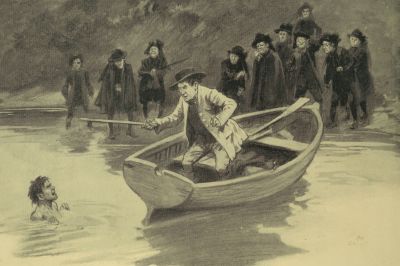
"IN THE NAME OF HIS MAJESTY KING GEORGE III. I CHARGE YOU TO COME ALONG QUIET."
Bligh, being naked and unarmed, casts a look round for some way to help himself. He was a plucky fellow enough in a fight, as I've said: but I leave you to guess what he felt like when to right and left of him the bushes parted, and forth stepped half-a-dozen men in black suits with black silk weepers a foot and a half wide tied in great bunches round their hats. These were Sam Trewhella, of course, and the rest of the funeral-party, that had left the coffin in a nice shady spot inside the Vicarage garden-gate, and come along to assist the law. They had brought along pretty nearly all the menkind of the parish beside: but these, being in their work-a-day clothes, didn't appear, and for a reason you'll learn by-and-by. All that Bligh saw was this dismal company of mourners backed by a rabble of school-children, the little ones lining the shore and staring at him fearsomely with their fingers in their mouths.
For the moment Bligh must have thought himself dreaming. But there they stood, the men in black and the crowd of children, and my grandfather with the stretcher ready, and the green woods so quiet all round. And there he stood up to the ribs in water, and the tide and his temper rising.
"Look here, you something-or-other yokels," he called out, "if this is one of your village jokes, I promise you shall smart for it. Leave the spot this moment, fetch that idiot out of the boat, and take away the children. I want to dress, and it isn't decent!"
"Mounseer," answers my grandfather, "I daresay you've a-done it for your country; but we've a-caught you, and now you must go to prison—wee, wee, to preeson," he says, lisping it in a Frenchified way so as to make himself understood.
Bligh began to foam. "The longer you keep up this farce, my fine fellows, the worse you'll smart for it! There's a magistrate in this parish, as I happen to know."
"There was," said my grandfather; "but we've strong reasons to believe he's been made away with."
"The only thing we could find of 'en," put in Arch'laus Spry, "was a shin-bone and a pint of ashes. I don't know if the others noticed it, but to my notion there was a sniff of brimstone about the premises; and I've always been remarkable for my sense of smell."
"You won't deny," my grandfather went on, "that you've been making a map of this here river; for here it is in your tail-coat pocket."
"You insolent ruffian, put that down at once! I tell you that I'm a British officer and a gentleman!"
"And a Papist," went on my grandfather, holding up a ribbon with a bullet threaded to it. ('Twas the bullet Bligh used to weigh out allowances with on his voyage in the open boat after the mutineers had turned him adrift from the Bounty, and he wore it ever after.) "See here, friends: did you ever know an honest Protestant to wear such a thing about him inside his clothes?"
"Whether you're a joker or a numskull is more than I can fathom," says Bligh; "but for the last time I warn you I'm a British officer, and you'll go to jail for this as sure as eggs."
"The question is, Will you surrender and come along quiet?"
"No, I won't," says Bligh, sulky as a bear; "not if I stay here all night!"
With that my grandfather gave a wink to Sam Trewhella, and Sam Trewhella gave a whistle, and round the point came Trewhella's sean-boat that the village lads had fetched out and launched from his store at the mouth of the creek. Four men pulled her with all their might; in the stern stood Trewhella's foreman, Jim Bunt, with his two-hundred-fathom net: and along the shore came running the rest of the lads to see the fun.
"Heva, heva!" yelled Sam Trewhella, waving his hat with the black streamers.
The sean-boat swooped up to Bligh with a rush, and then, just as he faced upon it with his fists up, to die fighting, it swerved off on a curve round him, and Jim Bunt began shooting the sean hand over hand like lightning. Then the poor man understood, and having no mind to be rolled up and afterwards tucked in a sean-net, he let out an oath, ducked his head, and broke for the shore like a bull. But 'twas no manner of use. As soon as he touched land a dozen jumped for him and pulled him down. They handled him as gentle as they could, for he fought with fists, legs, and teeth, and his language was awful: but my grandfather in his foresight had brought along a couple of wainropes, and within ten minutes they had my gentleman trussed, heaved him into the boat, covered him over, and were rowing him off and down the creek to land him at Helford quay.
By this 'twas past noon; and at one o'clock, or a little before, Parson Polwhele come striding along home from Little Dinnis. He had tied a handkerchief about his head to keep off the sun; his hands and knees were coated with earth; and he sweated like a furze-bush in a mist, for the footpath led through cornfields and the heat was something terrible. Moreover, he had just called the funeral to mind; and this and the damage he'd left at Little Dinnis fairly hurried him into a fever.
But worse was in store. As he drew near the Parsonage, he spied a man running towards him: and behind the man the most dreadful noises were sounding from the house. The Parson came to a halt and swayed where he stood.
"Oh, Calvin! Calvin!" he cried—for the man running was my grandfather—"don't try to break it gently, but let me know the worst!"
"Oh, blessed day! Oh, fearful and yet blessed day!" cries my grandfather, almost catching him in both arms. "So you're not dead! So you're not dead, the Lord be praised, but only hurt!"
"Hurt?" says the Parson. "Not a bit of it—or only in my feelings. Oh, 'tis the handkerchief you're looking at? I put that up against sunstroke. But whatever do these dreadful sounds mean? Tell me the worst, Calvin, I implore you!"
"Oh, as for that," says my grandfather cheerfully, "the Frenchman's the worst by a long way—not but what your good lady made noise enough when she thought you'd been made away with: and afterwards, when she went upstairs and, taking a glance out of window, spied a long black coffin laid out under the lilac bushes, I'm told you could hear her a mile away. But she've been weakening this half-hour: her nature couldn't keep it up: whereas the longer we keep that Frenchman, the louder he seems to bellow."
"Heaven defend us, Calvin!"—the Parson's eyes fairly rolled in his head—"are you gone clean crazed? Frenchman! What Frenchman?"
"The same that frightened Mrs. Polwhele, Sir, upon the coach. We caught him drawing maps of the river, and very nigh tucked him in Sam Trewhella's sean: and now he's in your tool-shed right and tight, and here's the key, Sir, making so bold, that you gave me this morning. But I didn't like to take him into the house, with your good lady tumbling out of one fit into another. Hark to 'en, now! Would you ever believe one man could make such a noise."
"Fits! My poor, dear, tender Mary having fits!" The Parson broke away for the house and dashed upstairs three steps at a time: and when she caught sight of him, Mrs. Polwhele let out a louder squeal than ever. But the next moment she was hanging round his neck, and laughing and sobbing by turns. And how long they'd have clung to one another there's no knowing, if it hadn't been for the language pouring from the tool-shed.
"My dear," said the Parson, holding himself up and listening, "I don't think that can possibly be a Frenchman. He's too fluent."
Mrs. Polwhele listened too, but after a while she was forced to cover her face with both hands. "Oh, Richard, I've often heard 'em described as gay, but—but they can't surely be so gay as all that!"
The Parson eased her into an armchair and went downstairs to the courtyard, and there, as you may suppose, he found the parish gathered.
"Stand back all of you," he ordered. "I've a notion that some mistake has been committed: but you had best hold yourselves ready in case the prisoner tries to escape."
"But, Parson dear, you're never going to unlock that door!" cried my grandfather.
"If you'll stand by me, Calvin," says the Parson, plucky as ginger, and up he steps to the very door, all the parish holding its breath.
He tapped once—no answer: twice—and no more answer than before. There was a small trap open in the roof and through this the language kept pouring with never a stop, only now and then a roar like a bull's. But at the third knock it died down to a sort of rumbling, and presently came a shout, "Who's there?"
"A clergyman and justice of the peace," answers the Parson.
"I'll have your skin for this!"
"But you'll excuse me——"
"I'll have your skin for this, and your blood in a bottle! I'm a British officer and a gentleman, and I'll have you stuffed and put in a glass case, so sure as my name's Bligh!"
"Bligh?" says the Parson, opening the door.
"Any relation to the Blighs of St. Tudy? Oh, no—it can't be!" he stammered, taken all aback to see the man stark naked on the threshold. "Why—why, you're the gentleman that called this morning!" he went on, the light breaking in upon him: "excuse me, I recognise you by—by the slight scar on your face."
Well, Sir, there was nothing for Bligh to do—the whole parish staring at him—but to slip back into the shed and put on the clothes my grandfather handed in at the door: and while he was dressing the whole truth came out. I won't say that he took the Parson's explanations in a nice spirit: for he vowed to have the law on every one concerned. But that night he walked back to Falmouth and took the London coach. As for Helford River, 'twasn't charted that year nor for a score of years after. And now you know how this creek came by its name; and I'll say again, as I began, that a bad temper is an affliction, whoever owns it.
THE MAN BEHIND THE CURTAIN
AN EXTRACT FROM THE MEMOIRS OF GABRIEL FOOT, HIGHWAYMAN
I sit down to this chapter of my Memoirs with an unwonted relish, because it exhibits me as an instrument in the hands of Providence. Doubtless, in our business, we perform that function oftener than the law recognises, but seldom so directly, so unequivocally, as in the adventure I shall now relate. And I say this, not because it left me with a title to one of the neatest little estates in the West of England, but because I, the one man necessary to the situation, dropped upon it (so to speak) with my hands in my pockets. I had never before happened within thirty miles of Tregarrick town: I walked in at one end purposing only to walk out at the other: and, but for a child's practical joke, I had done so and forgotten the place. It was touch and go, in short: the sort of thing to set you speculating on the possible extent of man's missed opportunities.
I had stepped ashore, after a voyage from Hull (undertaken from expedience and not for health), upon the Market Strand at Falmouth, with one shilling and fourpence in my pocket. I have been in lower water, but never with such a job before me; and I started to tramp it back to London with little more than a dog's determination to get there somehow. The third afternoon found me in Tregarrick, wet through, sullen, and moderately hungry. The time of year was October: all day it had been raining and blowing chilly from the north-west; and traffic had deserted the unlovely Fore Street when, as the town-clock chimed a quarter to five, I passed the windows and open archway of the Red Hart Hotel. A gust from the archway brought me up staggering and clutching my hat: I faced round to it, and, in so doing, caught a momentary glimpse, above the wire blind in a lower window, of a bald-headed man within standing with his back to the street; and at the same instant heard a coin drop on the pavement behind me.
A richer man would have halted, turned and scanned the pavement as I did. But a richer man would probably have taken longer to assure himself that nothing had been lost from his pocket, and would certainly have taken longer to suspect that the coin might have been tossed to him in charity. I flung a glance up at the window overhead, and spied a penny dangling over the sill by a string.
At once I recognised the secular jest; and stepped across the roadway to get a look at the performer. As I did so, an elderly man in an Inverness cape and rusty hat and suit emerged briskly from the archway of the inn, glanced up at the weather, and passed along the pavement beneath the window.
Thereupon, I saw the trick played to perfection. A curly-headed youngster popped into view, leaned out, rang the coin down at the very heels of the pedestrian, and whisked it as nimbly up. The man whipped round and, seeing nothing, pulled out a pair of spectacles and began to adjust them. I heard the youngster chuckle overhead as he stooped and a deflected gust from the archway, skimming his hat into the gutter, revealed the same bald head I had observed above the wire blind.
Just then, three other faces appeared; one above the same blind and two at the upper window behind the child. And a moment later I had spun right-about on my heel and was apparently in deep study of a damp placard upon a hoarding opposite.
The two faces at the upper window were interesting, had there been time to consider them; and one—that of a lady, obviously the child's mother—struck me as uncommonly beautiful, though pale and desperately sad. Beside her stood a man, as obviously the father; a handsome gentleman, with the flushed face and glassy stare of a drunkard. He stood there chuckling at the trick, and even the lady was smiling indulgently until she leaned out and caught a glimpse of the victim: whereupon, with a sudden terrified snatch, she drew the boy back from the window, and out of sight.
It was then, as I looked at the bald-headed man, seeking some explanation of her terror, that I caught sight of the face staring over the wire blind in the lower window, and lost not a second in presenting my back to it.
It belonged to an old acquaintance of mine. "Acquaintance," I say, because Robert Leggat and I had never been able to stomach each other. There was perhaps a trifle too much of the gentleman about both of us—enough, at any rate, to suggest rivalry, though we hunted different game. "Buck" Leggat was by gifts and election a sedentary scoundrel, with a tongue and a presence fatally plausible among women and clergymen, and a neat adaptable pen. Whence he came, or of what upbringing, I could never discover. I had heard some hint of an Oxford education, but he never alluded to that University in my company. Flash notes had brought him to the Old Bailey, and then his elegant deportment and a nice point of circumstantial evidence had saved his neck. This was about four years ago, and I had supposed him to be somewhere in the Plantations when his bad handsome face confounded me across Tregarrick Fore Street. He wore a clergyman's bands, too.
By good luck he had not recognised me, but was occupied with the bald-headed man who still groped on the pavement. The placard which I appeared to be studying announced the Sale by Auction of a considerable country estate, and my eyes roamed among such words as "farms," "tenements," "messuages," "acres," while I cast up the possible profit of my discovery. Here was I, pretty hungry, with barely the coin for a night's lodging. Here was Leggat, escaped convict, lording it in the coffee-room of a hotel, masquerading as a parson; therefore up to some game—a bold one—by the look of it a paying one. Decidedly I ought, with a little prudence, to handle a percentage.
I edged away from the hoarding to the shop-front on my left—a watchmaker's; and so, still presenting my back to the Red Hart, past a saddler's, a tailor's, the entrance of the County Hall, and the Town Clerk's office. Here, out of view from Leggat's window, I turned, stepped across the street into the hotel archway, and walked boldly into the coffee-room which opened out of it on the left.
Leggat had disappeared. The room in fact was empty.
I rang the bell, and after some minutes it was answered by a waitress, a decent girl, though somewhat towzled.
"There was a clergyman here a moment since," said I.
"That will be Mr. Addison. Do you wish to see him?" She eyed me with no great favour, and indeed my clothes ill agreed with the respectable dinginess of the coffee-room.
"So Addison's the name!" thought I, "and a pretty good one too. I wonder if Leggat has the face to claim descent from the essayist. He's capable of it." I pulled out my only shilling. "Well, yes, I want to have a talk with him: but I'll sit down and wait till he comes, and meanwhile you might bring me a glass of rum hot, with one slice of lemon. Mr. Addison is staying the night here, I suppose?"
"I don't know," she answered. "Anyhow, he won't be riding home to Welland till late. But hadn't you better come to the bar for your rum?"
"Well," said I, "if it's all the same to you, I'll stay where I am. To tell the truth, my dear, I've come to see Mr. Addison about putting up my banns: and that's a delicate matter, eh!"
Upon this she began to eye me more favourably, as I expected. There's an esprit de corps among women—or an esprit de sexe, if you will—which softens them towards the marrying man. Surrender to one, surrender to all. "But you don't belong to Welland parish," said she.
"Quite right. It takes two to make a wedding, and the young woman belongs to Welland."
"Who is she?"
"Aha!" I winked at her knowingly.
"I come from Welland parish myself," she went on, her curiosity fairly piqued.
"Then if you happen to be going home to church next Sunday keep your ears open after the second lesson."
She tossed her chin and went off on her errand, but returning in three minutes with the grog, must needs have another try. "I reckon it's Susie Martin," she declared, and nodded at me with conviction in her eye.
"Well, now, supposing it's Susie—and, mind you, I'm not admitting it—you won't forbid the banns, I hope?"
"La, no! And I'll wager Mr. Addison won't, either," she tittered.
Plainly, here was an answer worth pondering. "You seem to be pretty full in the bar, to-night?" I observed, casually, to gain time; and, indeed, a hubbub of voices from across the archway smote on our ears through the double baize doors.
"The auctioneer is standing treat."
"Oh!—ah, yes—the auctioneer, to be sure," I murmured.
"The sale won't begin in the Long Room before six: he has half-an-hour for wetting their whistles. Seeming to me, you'll be lucky if you get Mr. Addison to attend to your business before it's over. But, perhaps," she added archly, "you'll like to have a word with Susie, to fill up the time? Shall I send her word that you are here? I dare say she'll find a chance to slip down to you; that is, if her mistress attends the auction."
"But will she?" I asked, doing my best to look wise.
She nodded sagely. "I shouldn't wonder. She'll want to look after the squire; he's more than half drunk already."
"It's plain you're a clever girl," I said; "but we'll let Susie wait for a while. And my business can wait on Mr. Addison. If his is an auction, mine is notoriously a lottery."
"There's one thing to console you," she answered smartly and (in the light of later knowledge I am bound to add) wittily; "you aren't drawing a blank." And with this shaft she left me.
Now the girl's talk was nothing short of heathen Greek to me, as doubtless it is to the reader, and I sat for ten minutes at least digesting it with the aid of my grog. Here was Leggat, my quarry, identified with a Mr. Addison, incumbent or curate of a country parish within riding distance of Tregarrick. He was here to attend an auction. My thoughts flew to the bill I had been pretending to study half-an-hour before; but unfortunately I had given it no particular attention, and could only remember now that it advertised an estate of good acreage. The name "Welland," indeed, struck me as familiar, but I could not refer it to the bill, and must pull up for the moment and try a cast upon a fresh scent—Susie Martin. Mr. Addison, alias Leggat, is not likely to forbid her banns, whoever she may be; in other words, won't be sorry to see her married. And Susie is a servant—of a mistress who will probably be attending this auction—to look after a drunken husband, who presumably, therefore, is also concerned in the auction. I recalled the two faces at the upper window, the one tipsy and the other sad, and felt pretty sure of having fixed Susie's employers. I recalled the lady's start of terror as she had caught sight of the bald-headed man below, and that I had first seen the bald head behind the window out of which Leggat had looked a minute later. If the bald-headed man had been talking with Leggat, this might connect her terror with Leggat. And both she and Leggat were to attend the auction. But what was this auction? And who the dickens was the bald-headed man?
The tangle—as the reader will admit—was a complicated one. But so far fortune had served me fairly; and considering the adventure as a game, in my knowledge of Leggat and his ignorance of my being anywhere in the neighborhood, I still held the two best trumps. In speculating on the possible strength of these two cards a new opening occurred to me. I had come with the purpose of forcing Leggat to buy me off or admit me into his game. But might there not be more profit, as there would certainly be less risk, in taking a hand against him? I had no fancy for him as a partner. I knew him for an unhealthy villain, with an instinct for preying on the weak, a born enemy of widows and orphans. If only I could discover what the stakes were, and what cards the other side held! Well, but I could have a try for this, even. I could, for instance, apply to the squire for a job, and this might throw me in the way of Susie Martin.
I stepped to the baize door, and passed out upon the archway. Six yards to the right, the Boots, with his back to me, was fixing a ladder to climb it and light the great lantern over the entrance. To my left a broad staircase ran up into the darkness. I tip-toed towards it, gained the stairs, and mounted them swiftly, but without noise, guiding myself by the handrail.
The stairs ran up to the first floor in two flights, with a bend about half-way. At the top of the second flight I found myself facing a pitch-dark corridor. The rooms facing the street must (I knew) be on my right; but as I groped along, my palm found the recess of a doorway on my left, and pressed open the door which stood just ajar. I drew back and listened: then, hearing no sound, poked my head cautiously within.
The room was dark, but the glow of a dying fire at the farther end gave me some idea of its dimensions. A faint reflection of this glow fell upon the polished surface of something which I guessed to be a mahogany table-leg, and, after a second or two, I perceived, or thought I perceived, two heavily-curtained windows, reaching almost to the top of the wall opposite.
I was reconnoitring so, in the recess of the doorway, when I heard a low tapping far up the corridor, and withdrew my head in time to see a door open and the faint ray of a candle fall upon a figure standing there, about twenty yards from my hiding-place; the black-coated figure of Mark Leggat.
"Hullo!" I said to myself. "Now for Susie!"
It was not Susie, however, who stepped out and, closing the door behind her, confronted Leggat, candle in hand. It was the pale lady I had seen at the window.
They stood for a moment conversing—so their attitude told me—in short whispers; and then came slowly down the passage towards me, the lady appearing to protest whilst Leggat persuaded and reassured her. At first I took it for granted they would enter one of the doors opposite; but, as they still came on, I saw that I must either retreat or be discovered.
I backed, therefore, around the half-open door and into the room. Then, as their voices drew near, it flashed on me that this might be the room they were seeking. I took three breathless paces across it, and found the table's edge. Guiding myself by this, and guided by the mercy of Heaven, which kept my feet from striking against the furniture, I found myself within three yards of the window nearest to the fireplace, with just time enough to make a dash for cover, and whip behind the curtain before Leggat pushed the door wide, and the pair entered the room.
"You must give me five minutes!" Leggat was saying. "I tell you it's not for my sake, but for yours; it's your last chance!" Then, as the lady made no answer—"You did not believe you had another chance?" he asked.
"There can be none!" she answered now. "You have ruined me; you have ruined us all: and it was my fault for not warning Harry in time."
"My dear Ethel," he began; but a gesture of hers must have interrupted him, for he checked himself, and went on—"Very well, then, my dear Mrs. Carthew, if you prefer it; you are at once too weak and too scrupulous. A fatal defect, although you make it charming! Until too late, you hid from yourself that you loved me. When that became impossible you ran for shelter behind your vows and a theory—which you know in your heart to be impossible—that I, who had ventured so much for you, did not love you."
"Love!" she echoed hoarsely. "What love could it have been that sought this way?"
"Well, as it happens, it was a way. Harry? Tut-tut, with Harry I was merely the handiest excuse for going to the devil. Suppose you had never set eyes on me. You know well enough he was bound to gamble away Welland sooner or later, just as he will sooner or later drink himself dead. I am sorry for the child; but, look you, I am going to be frank. It was just through the child I hoped to get you. To save Welland for him I believed you would follow your heart and take my help with my love. You wouldn't. You couldn't help loving me, but—as you put it—you are a good woman: and even now, with the sale but an hour away and a sot of a husband to lead off with poverty, you won't."
She had set down the candle on the table; and now, having made a peephole between the two curtains, I saw her lift her head proudly.
"No," she said, "to my shame I loved you; but you would buy me, and I am not to be bought."
"I know it," he answered, and let out a grim laugh. "But on one point I am going to prove you mistaken. You believe that because I tried bribery I did not love you. You win by that error; but it is an error nevertheless, as I am going to prove."
While her eyes questioned him he drew a roll of notes from his pocket.
"Your fond brother-in-law intends to buy Welland," said he.
"James?"
"To be sure," he nodded while he ran through the notes with finger and thumb. "As the eldest brother, James Carthew wants Welland, to add it to the entailed estates. He has always wanted it: but these eight months, since that infant was born to him, he has wanted it ten times more. To-night he bids for it: and for decency's sake he bids through me—which is precisely where he comes to grief."
"I don't understand."
Leggat went on silently counting the notes. "Three thousand, five hundred," he answered; "the deposit money and a trifle over, in case of accidents. James Carthew is a rich man. I should reckon him up at a hundred and twenty thousand, and be within the mark."
"But why should he employ you?"
"In the first place, I suppose, because I've played the game for him throughout, and played it pretty successfully."
"You?"
He nodded. "You don't suppose Harry was playing against me all this while? My dear lady, you cannot ruin a man at the cards without some capital of your own; that is, supposing you play straight, as I beg to observe that I did. No, no: I had a backer, and that backer was your amiable brother-in-law."
"But why?"
"Simply because a steady-going man like James, however much he inherits by entail, resents the choicest portion of the property—which does not happen to be entailed—being willed away to a loose dog of a younger brother. And when that younger brother marries and has a son, whereas he has married a childless woman, he resents it yet more bitterly. He cannot digest the grievance that, when he dies, the whole must go to the son of the brother who sits and drinks the wine in Naboth's vineyard. But, as it happens, his childless wife dies, and presto! he marries again. At a decent interval a child is born, and now is his time to play a tit-for-tat."
"He always hated us, I know," she murmured. "But you——"
"But I," he answered gaily, "am about to spoil that pretty game—and for your sake. Yes, and although you don't know how, and will never know how, I am going to risk my neck for it." He tossed the bundle of notes across the table towards her. She put out a hand as it rolled off the table's edge and dropped at her feet. "Count them: because I have to use them to-night to buy Welland back for you." And now there was a real thrill in his voice. "Count them," he insisted: "they are only the first-fruits, and after to-night you may never see me again: they are only the deposit on the price, and after the auction I shall ride away—not back to Welland Vicarage. But I have a word to leave, or to send, for Master James Carthew, and if these notes do not buy Welland back for you I am mistaken. I am what I am, and from what we are such poor devils as I cannot escape. But at least I have loved you, and in the end you shall be sure of it. Count them!"
He wheeled about on the words as the door was flung open. On the threshold stood Squire Harry Carthew.
He was white in the face and more than half-drunk. Under one arm he carried a leather-covered case and a pair of foils. His gaze wandered from his wife to Leggat, then back again to his wife.
"I want," said he, addressing her with husky solemnity, "a word with Mr. Addison in private." She bent her head and moved from the room, and he bowed as she passed, but somewhat spoiled the effect by shutting the door upon her train.
"I think," he said, closing the door a second time and locking it upon her—and his tone grew suddenly sharp, though he remained none the less drunk—"I think, Mr. Addison, we need waste no time. My wife's maid, Susie, has told me all that is necessary. You will choose one of those pistols, and we can settle the matter here and now. No!"—for Leggat had begun to edge towards the packet of notes lying on the floor—"you are not to stir, please, until we understand one another." He laid the foils on the table and held out the case. Leggat took the pistol next to his hand.
"You are drunk, Carthew."
"Am I? Well, that is likely enough, and as a sportsman you won't object to allow for it in our arrangements." He slipped the door-key into his breeches pocket and, still holding the pistol in his right hand, leaned forward and laid his left on the base of the candlestick. "You start from that end of the room, and I from this by the fireplace. Are you ready? Here, take one of the foils too. After I have blown the candle out you will remain at your end and count twenty, in silence, of course. I will do the same at my end, and then we begin."
"Don't be a fool, man! This is no duel; it is murder, and foolish murder."
Squire Carthew puffed out the candle. Then the guard of the foil rattled softly upon the mahogany as he closed his hand upon it. "Count twenty, please."
I leave the reader to picture my situation. There, in the silence and the darkness with these two—one of them drunk—prowling to kill. In all my experience I can recall nothing so entirely discomfortable. I had no defence but the folds of a window curtain. I could not stir without inviting a thrust or a pistol shot, or both. And I may remark here, that there is a degree of terror which resembles physical sickness. Experto credite.
I heard the men kick off their shoes; and after that for many seconds—though I strained my ears, you may be sure—I heard nothing.
Then a hand brushed upon the woodwork of the recess and even rested for a moment against the curtain, within six inches of my nose. It was Leggat I could be sworn. I drew back as his fingers felt the stuff of the curtain and passed on groping; I even heard the soft crack of his elbow-joint as he gripped the foil again, which for the moment he must have tucked under his armpit.
And with that it flashed on me what he was after—the roll of notes lying on the floor, between the table and the fireplace, barely a foot beyond the table's edge and perhaps four yards from my hiding place. I knew the spot exactly. Squire Carthew had almost touched the packet with his foot as he stooped to blow out the candle.
I dropped on hands and knees behind my curtain, pushed it softly aside and began to crawl. I could hear nothing now but my own heart drumming. For the next few moments, if I made no sound, it was unlikely either that Leggat would steal back upon me or that the squire could reach me without encountering Leggat. My hand touched the table-leg, and the touch of it, coming unexpectedly, almost made me cry out. A moment later I felt more easy. Once beneath the table I was comparatively safe. But I must get my hand on these notes, and after pausing a second I steered towards the fireplace, poked out my head and shoulders beyond the table, and smoothed my palm across the floor until my fingers touched the packet and closed upon it.
At that moment, in the darkness, to the left, a foil rattled against a chair. The sound was a slight one, but it betrayed Leggat's whereabouts, and, with a gasp of triumph, Carthew came running upon him from the right.
I ducked my head, but before I could slip back he had blundered right across my shoulders, which reached, perhaps, to his knees. He went over me with an oath and a crash, and as he struck the floor his pistol exploded.
I drew back with the smoke of it in my mouth and nostrils—and listened. Not a sound came from Leggat's corner, not a groan from the body stretched within reach. The man was dead, for certain; and we others had no time to lose.
A thud in the corridor outside called me to my senses. "Robert Leggat," I cried, "this is a black night's job for you! Lay down that pistol, find your shoes, and run!"
At this distance of time I would give something to know how it took him—this voice calling his true name out of the darkness and across Carthew's body.
"My God! Who is that?" he asked, and I could hear his teeth chattering.
Before I had need to answer, he broke from his corner and flung up the window, but recollected himself, and ran for his shoes. He had scarcely found them when there came that rush upon the stairs for which I had been listening, and a woman's voice screamed, "The Mistress! They've murdered the mistress!"
In my heart I blessed Mrs. Carthew—poor soul—for having swooned so conveniently outside the door. By this time Leggat was clambering across the window sill. What sort of drop lay below it? I saw the black mass of his body framed there for a moment against a sky almost as black, and watched as he lowered himself, and disappeared. I listened for the thud of a fall; but none came, and running to see what had befallen him, I caught another glimpse of him as he stole past a lit skylight in a long flat roof scarcely six feet below.
Here was luck beyond my hoping. The crowd in the passage was still occupied with Mrs. Carthew, but at length someone tried the handle of the door. This was my cue. I clambered out after Leggat—who by this time had disappeared—drew down the window-sash cautiously and wriggled across the leads of the roof, pausing only at the skylight to peer down into an empty room, where a score of wooden-seated chairs stood in disarray by a long table—the deserted auction-room, doubtless. At the far end of this roof a chimney-stack rose gaunt against the night; and flattening myself against the side of it, I waited for the dull crash which told that the crowd had broken in the door.
I had made better speed, you understand, but for the risk of overtaking Leggat and being recognised. As it was, I had set the worst of all terrors barking at his heels, and by and by—it may have been after three minutes' wait—I chuckled at the sound of a horse's hoofs in the stable-yard below me. It was too dark for me to catch sight of the rider as he mounted; but he made for the lower gate of the yard and, once past it, broke into a gallop. As its echoes died away, I began my search for the ladder by which Leggat had descended; found it, as I had expected, in the form of a stout water-pipe; and having reached the ground without mishap, brushed and smoothed my clothes and sauntered up the stable-yard to the hotel archway.
At the foot of the stairs there, I was almost bowled over by the Boots, who came flying down three stairs at a stride. "The Doctor!" he shouted: "the Doctor!" He tore past me and out into the street.
I entered the coffee-room and rang the bell.
I suppose that I rang it at intervals for something like half-an-hour before the waitress found me yawning before the exhausted fire.
"Sale over yet?" I asked pleasantly.
"Sale over? Sale ov—?" She set down the lamp and gasped. "Do you tell me that you've slept through it all?"
"All what, my dear?"
Out it all came in a flood. "The Squire's shot himself! In the Blue Room over your very head—locked the door and shot himself clean through the brains! Poor gentleman, he felt his position, though he did drink so fierce. And now he's gone, and Mrs. Carthew no sooner out of one swoon than into another."
"Bless my soul!" cried I. "Now you speak of it, I did hear something like a pistol shot; but that must have been half-an-hour ago."
"It's a wonder," she said tragically, "his blood didn't drip on you through the ceiling."
It was useless (she agreed with me) to expect Mr. Addison to attend to my business that night. Indeed, though he was doubtless somewhere in the crowd, she could not recall having seen him. It would also be useless, and worse, to seek an interview with Susie, who was attending to her poor mistress.
"Very well," I said. "Then since I can see neither the parson nor the girl, I must make shift with the lawyer. No, my dear, you need not stare at me like that, I don't put my money on my back, like some of your gentry; but while I keep enough in my pocket there's no law in England against my employing as good an attorney as poor Mr. Carthew—or, if I choose, the very same man."
"What? Mr. Retallack?"
I nodded. "That's it—Mr. Retallack. I take it he came to attend the auction, and is upstairs at this moment."
"Why, yes; it was he that gave orders to break in the door and found the body. He began putting questions to Mrs. Carthew, but the poor soul wasn't fit to answer. And then he and Mr. James tackled Susie, who swore she knew nothing of the business until she heard the shot—as we all did—and, running out, found her mistress stretched in the passage: and now she's attending to her in the bedroom with the doctor. So the lawyer's at a standstill."
"Mr. James Carthew? Is he here too?"
"Yes: he's living at his town house this week, but he came here to-night—for the sale, I suppose. He's upstairs now, and his wife along with him; she heard the news cried up the street and came running down all agog with her bonnet on top of her nightcap. But I mustn't stay talking."
"No, indeed you must not," said I. "Here, tell me where you keep your tinder-box.... Now, while I light the candles, do you run upstairs and tell Mr. Retallack privately that a person wishes to speak with him in the coffee-room on an important matter and one connected with to-night's business."
The girl, hungry to be back at the scene of horror, lost no time. I had scarcely time to light the four candles on the chimney-piece when the baize door opened and I found myself bowing to a white-haired little gentleman with a kindly, flustered face. He was plainly suffering from nervous excitement in a high degree, and in the act of bowing attempted to rearrange his shirt-frill with an undecided hand.
"Good evening, Mr. Retallack."
"You sent for me——" he began, and broke off, obviously dismayed by my rough clothes and not altogether liking the look of his customer.
I offered him a chair; he looked at it doubtfully, but shook his head. "My business is of moment," said I, "and of some urgency. That must excuse me for summoning you just now, since as a matter of fact it has less to do with the unhappy pair upstairs than with what I take to be the cause of it. I mean the sale of the Welland estate."
He spread out his hands. "At such a time!" he protested.
"I am glad to find, sir, that you feel so deeply, since it proves you to be a real friend of the family. But as a lawyer you will not let emotion obscure your good sense, or miss a chance of saving Welland for the poor lady and orphan child upstairs merely because it happens to present itself at an untoward moment."
He eyed me, fumbling with the seals at his fob. His mind was by no means clear, but professional instinct seemed to warn him that my words were important.
"I do not know you, sir," he quavered; "but if you are here with any plan of saving Welland, I must tell you sadly that you waste time. I have thought of a hundred plans, sir, but have found none workable. It has destroyed my rest for months—for, with all his failings, I was sincerely attached to young Mr. Carthew, and no less sincerely to his unhappy lady. I warned him a hundred times: but the debts exist, the mortgagees foreclose, and Welland must go."