Front matter (continued 2)
Reading edition
She stepped a pace further into the room, shut home the door behind her, and cast her eye over the ale-scores on the back of it. There were a dozen marks, maybe, set down against her own man's name; but for the moment she offered no remark on this.
"Mr. Oke," says she, turning to the landlord, "I reckon you never go without a piece o' chalk in your pocket. Step this way, if you please, and draw a line for me round what these lords of creation owe ye for drink. Thank'ee. And now be good enough to fetch a chair and stand 'pon it; I want you to reach so high as you can—Ready? Now take your chalk and write, beginning near the top o' the door: 'I, Sarah Hancock——'"
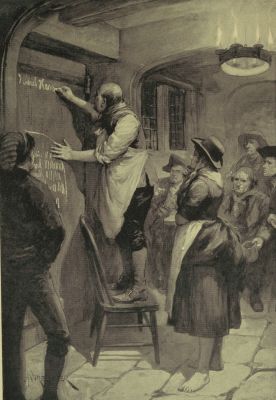
LANDLORD OKE GAVE A FLOURISH WITH HIS CHALK AND WROTE.
Landlord Oke gave a flourish with his chalk and wrote, Sally dictating,—
'I, Sarah Hancock—do hereby challenge all the men in Saltash Borough—that me and five other females of the said Borough—will row any six of them any distance from one to six statute miles—and will beat their heads off—pulling either single oars or double paddles or in ran-dan—the stakes to be six pound aside. And I do further promise, if beaten, to discharge all scores below.'
"Now the date, please—and hand me the chalk."
She reached up and signed her name bold and free, being a fair scholar. "And now, my little fellow," says she, turning to her husband, "put down that pipe and come'st along home. The man's at the top of the tree, is he? You'll wish you were, if I catch you at any more tricks!"
Well, at first the mankind at the Fish and Anchor allowed that Sal couldn't be in earnest; this challenge of hers was all braggadoshy; and one or two went so far as to say 'twould serve her right if she was taken at her word. In fact, no one treated it seriously until four days later, at highwater, when the folks that happened to be idling 'pon the Quay heard a splash off Runnell's boat-building yard, and, behold! off Runnell's slip there floated a six-oared gig, bright as a pin with fresh paint. 'Twas an old condemned gig, that had lain in his shed ever since he bought it for a song off the Indefatigable man-o'-war, though now she looked almost too smart to be the same boat. Sally had paid him to put in a couple of new strakes and plane out a brand-new set of oars in place of the old ashen ones, and had painted a new name beneath the old one on the sternboard, so that now she was the Indefatigable Woman for all the world to see. And that very evening Sally and five of her mates paddled her past the Quay on a trial spin, under the eyes of the whole town.
There was a deal of laughing up at the Fish and Anchor that night, the most of the customers still treating the affair as a joke. But Landlord Oke took a more serious view.
"'Tis all very well for you fellows to grin," says he, "but I've been trying to make up in my mind the crew that's going to beat these females, and, by George! I don't find it so easy. There's the boat, too."
"French-built, and leaks like a five-barred gate," said somebody. "The Admiralty condemned her five year' ago."
"A leak can be patched, and the Admiralty's condemning goes for nothing in a case like this. I tell you that boat has handsome lines—handsome as you'd wish to see. You may lay to it that what Sal Hancock doesn't know about a boat isn't worth knowing."
"All the same, I'll warrant she never means to row a race in that condemned old tub. She've dragged it out just for practice, and painted it up to make a show. When the time comes—if ever it do—she'll fit and borrow a new boat off one of the war-ships. We can do the same."
"Granted that you can, there's the question of the crew. Sal has her thwarts manned—or womanned, as you choose to put it—and maybe a dozen reserves to pick from in case of accident. She means business, I tell you. There's Regatta not five weeks away, and pretty fools we shall look if she sends round the crier on Regatta Day 'O-yessing' to all the world that Saltash men can't raise a boat's crew to match a passel of females, and two of 'em"—he meant Mary Kitty Climo and Ann Pengelly—"mothers of long families."
They discussed it long and they discussed it close, and this way and that way, until at last Landlord Oke had roughed-out a crew. There was no trouble about a stroke. That thwart went nem. con. to a fellow called Seth Ede, that worked the ferry and had won prizes in his day all up and down the coast: indeed, the very Plymouth men had been afraid of him for two or three seasons before he gave up racing, which was only four years ago. Some doubted that old Roper Retallack, who farmed the ferry that year, would spare Seth on Regatta-day: but Oke undertook to arrange this. Thwart No. 4 went with no more dispute to a whackin' big waterman by the name of Tremenjous Hosken, very useful for his weight, though a trifle thick in the waist. As for strength, he could break a pint mug with one hand, creaming it between his fingers. Then there was Jago the Preventive man, light but wiry, and a very tricky wrestler: "a proper angle-twitch of a man," said one of the company; "stank[1] 'pon both ends of 'en, he'll rise up in the middle and laugh at 'ee." So they picked Jago for boat-oar. For No. 5, after a little dispute, they settled on Tippet Harry, a boat-builder working in Runnell's yard, by reason that he'd often pulled behind Ede in the double-sculling, and might be trusted to set good time to the bow-side. Nos. 2 and 3 were not so easily settled, and they discussed and put aside half a score before offering one of the places to a long-legged youngster whose name I can't properly give you: he was always called Freckly-Faced Joe, and worked as a saddler's apprentice. In the end he rowed 2: but No. 3 they left vacant for the time, while they looked around for likely candidates.
Landlord Oke made no mistake when he promised that Sally meant business. Two days later she popped her head in at his bar-parlour—'twas in the slack hours of the afternoon, and he happened to be sitting there all by himself, tipping a sheaf of churchwarden clays with sealing-wax—and says she—
"What's the matter with your menkind?"
"Restin'," says Oke with a grin. "I don't own 'em, missus; but, from what I can hear, they're restin' and recoverin' their strength."
"I've brought you the stakes from our side," says Sally, and down she slaps a five-pound note and a sovereign upon the table.
"Take 'em up, missus—take 'em up. I don't feel equal to the responsibility. This here's a public challenge, hey?"
"The publicker the better."
"Then we'll go to the Mayor about it and ask his Worship to hold the stakes." Oke was chuckling to himself all this while, the reason being that he'd managed to bespeak the loan of a six-oared galley belonging to the Water-Guard, and, boat for boat, he made no doubt she could show her heels to the Indefatigable Woman. He unlocked his strong-box, took out and pocketed a bag of money, and reached his hat off its peg. "I suppose 'twouldn't do to offer you my arm?" says he.
"Folks would talk, Mr. Oke—thanking you all the same."
So out they went, and down the street side by side, and knocked at the Mayor's door. The Mayor was taking a nap in his back-parlour with a handkerchief over his face. He had left business soon after burying his wife, who had kept him hard at work at the cheesemongering, and now he could sleep when he chose. But he woke up very politely to attend to his visitors' business.
"Yes, for sure, I'll hold the stakes," said he: "and I'll see it put in big print on the Regatta-bill. It ought to attract a lot of visitors. But lor' bless you, Mr. Oke!—if you win, it'll do me no good. She"—meaning his wife—"has gone to a land where I'll never be able to crow over her."
"Your Worship makes sure, I see, that we women are going to be beat?" put in Sal.
"Tut-tut!" says the Mayor. "They've booked Seth Ede for stroke." And with that he goes very red in the gills and turns to Landlord Oke. "But perhaps I oughtn't to have mentioned that?" says he.
"Well," says Sal, "you've a-let the cat out of the bag, and I see that all you men in the town are in league. But a challenge is a challenge, and I mustn't go back on it." Indeed, in her secret heart she was cheerful, knowing the worst, and considering it none so bad: and after higgling a bit, just to deceive him, she took pretty well all the conditions of the race as Oke laid 'em down. A tearing long course it was to be, too, and pretty close on five miles: start from nearabouts where the training-ship lays now, down to a mark-boat somewheres off Torpoint, back, and finish off Saltash Quay.
"My dears," she said to her mates later on, "I don't mind telling you I was all of a twitter, first-along, wondering what card that man Oke was holding back—he looked so sly and so sure of hisself. But if he've no better card to play than Seth Ede, we can sleep easy."
"Seth Ede's a powerful strong oar," Bess Rablin objected.
"Was, you mean. He've a-drunk too much beer these four years past to last over a five-mile course; let be that never was his distance. And here's another thing: they've picked Tremenjous Hosken for one th'art."
"And he's as strong as a bullock."
"I dessay: but Seth Ede pulls thirty-eight or thirty-nine to the minute all the time he's racing—never a stroke under. I've watched him a score o' times. If you envy Hosken his inside after two miles o' that, you must be like Pomery's pig—in love with pain. They've hired or borrowed the Preventive boat, I'm told; and it's the best they could do. She's new, and she looks pretty. She'll drag aft if they put their light weights in the bows: still, she's a good boat. I'm not afeared of her, though. From all I can hear, the Woman was known for speed in her time, all through the fleet. You can feel she's fast, and see it, if you've half an eye: and the way she travels between the strokes is a treat. The Mounseers can build boats. But oh, my dears, you'll have to pull and stay the course, or in Saltash the women take second place for ever!"
"Shan't be worse off than other women, even if that happens," said Rebecca Tucker, that was but a year married and more than half in love with her man. Sally had been in two minds about promoting Rebecca to the bow-oar in place of Ann Pengelly, that had been clipping the stroke short in practice: but after that speech she never gave the woman another thought.
Next evening the men brought out their opposition boat—she was called the Nonpareil—and tried a spin in her. They had found a man for No. 3 oar—another of the Water-Guard, by name Mick Guppy and by nation Irish, which Sal swore to be unfair. She didn't lodge any complaint, however: and when her mates called out that 'twas taking a mean advantage, all she'd say was: "Saltash is Saltash, my dears; and I won't go to maintain that a Saltash crew is anyways improved by a chap from Dundalk."
So no protest was entered. I needn't tell you that, by this time, news of the great race had spread to Plymouth, and north away to Callington and all the country round. Crowds came out every evening to watch the two boats at their practising; and sometimes, as they passed one another, Seth Ede, who had the reputation for a wag, would call out to Sal and offer her the odds by way of chaff. Sal never answered. The woman was in deadly earnest, and moreover, I daresay, a bit timmersome, now that the whole Borough had its eyes on her, and defeat meant disgrace.
She never showed a sign of any doubt, though; and when the great day came, she surpassed herself by the way she dressed. I daresay you've noticed that when women take up a man's job they're inclined to overdo it; and when Sal came down that day with a round tarpaulin-hat stuck on the back of her head, and her hair plaited in a queue like a Jack Tar's, her spiteful little husband fairly danced.
"'Tis onwomanly," said he. "Go upstairs and take it off!"
"Ch't," said she, "if you're so much upset by a tarpaulin-hat, you've had a narra escape; for 'tis nothing to the costume I'd a mind to wear—and I'd a mind to make you measure the whole crew for it."
And as it was, I'm told, half the sightseers that poured into Saltash that day in their hundreds couldn't tell the women's crew from the men's by their looks or their dress. And these be the names and weights, more or less—
The Indefatigable Woman: Bow, Ann Pengelly, something under eleven stone; No. 2, Thomasine Oliver, ditto; No. 3, Mary Kitty Climo, eleven and a half; No. 4, Long Eliza, thirteen and over, a woman very heavy in the bone; No. 5, Bess Rablin, twelve stone, most of it in the ribs and shoulders; Stroke, Sarah Hancock, twelve stone four; Coxswain, Ann Pengelly's fourth daughter Wilhelmina, weight about six stone. The Indefatigable Woman carried a small distaff in the bows, and her crew wore blue jerseys and yellow handkerchiefs.
The Nonpareil: Bow, T. Jago, ten stone and a little over; No. 2, Freckly-faced Joe, twelve stone; No. 3, M. Guppy, twelve stone and a half; No. 4, Tremenjous Hosken, eighteen stone ten; No. 5, Tippet Harry, twelve stone eight; Stroke, Seth Ede, eleven six. And I don't know who the boy was that steered. The Nonpareil carried a red, white, and blue flag, and her crew wore striped jerseys, white and blue.
They were started by pistol; and Seth Ede, jumping off with a stroke of forty to the minute, went ahead at once. In less than twenty strokes he was clear, the Nonpareil lifting forward in great heaves that made the spectators tell each other that though 'twas no race they had seen something for their money. They didn't see how sweetly the other boat held her way between the strokes, nor note that Sally had started at a quiet thirty-four, the whole crew reaching well out and keeping their blades covered to the finish—coming down to the stroke steadily, too, though a stiffish breeze was with them as well as the tide.
I suppose the longest lead held by the Nonpareil during the race was a good forty yards. She must have won this within four minutes of starting, and for half a mile or so she kept it. Having so much in hand, Ede slowed down—for flesh and blood couldn't keep up such a rate of striking over the whole course—and at once he found out his mistake. The big man Hosken, who had been pulling with his arms only, and pulling like a giant, didn't understand swinging out; tried it, and was late on stroke every time. This flurried Ede, who was always inclined to hurry the pace, and he dropped slower yet—dropped to thirty-five, maybe, a rate at which he did himself no justice, bucketting forward fast, and waiting over the beginning till he'd missed it. In discontent with himself he quickened again; but now the oars behind him were like a peal of bells. By sheer strength they forced the boat along somehow, and with the tide under her she travelled. But the Indefatigable Woman by this time was creeping up.
They say that Sally rowed that race at thirty-four from the start to within fifty yards of the finish; rowed it minute after minute without once quickening or once dropping a stroke. Folks along shore timed her with their watches. If that's the truth, 'twas a marvellous feat, and the woman accounted for it afterwards by declaring that all the way she scarcely thought for one second of the other boat, but set her stroke to a kind of tune in her head, saying the same verse over and over—
But she was took out of his side, His equal and partner to be: Though they be yunited in one, Still the man is the top of the tree! With my fol-de-rol, tooral-i-lay—We'll see about that!
The Indefatigable Woman turned the mark not more than four lengths astern. They had wind and tide against them now, and with her crew swinging out slow and steady, pulling the stroke clean through with a hard finish, she went up hand-over-fist. The blades of the Nonpareil were knocking up water like a moorhen. Tremenjous Hosken had fallen to groaning between the strokes, and I believe that from the markboat homeward he was no better than a passenger—an eighteen-stone passenger, mind you. The only man to keep it lively was little Jago at bow, and Seth Ede—to do him justice—pulled a grand race for pluck. He might have spared himself, though. Another hundred yards settled it: the Indefatigable Woman made her overlap and went by like a snake, and the Irishman pulled in his oar and said—
"Well, Heaven bless the leddies, anyway!"
Seth Ede turned round and swore at him vicious-like, and he fell to rowing again: but the whole thing had become a procession. "Eyes in the boat!" commanded Sal, pulling her crew together as they caught sight of their rivals for the first time and, for a stroke or two, let the time get ragged. She couldn't help a lift in her voice, though, any more than she could help winding up with a flourish as they drew level with Saltash town, a good hundred yards ahead, and heard the band playing and the voices cheering. "Look out for the quicken!"—and up went a great roar as the women behind her picked the quicken up and rattled past the Quay and the winning-gun at forty to the minute!
They had just strength enough left to toss oars: and then they leaned forward with their heads between their arms, panting and gasping out, "Well rowed, Sal!" "Oh—oh—well rowed all!" and letting the delight run out of them in little sobs of laughter. The crowd ashore, too, was laughing and shouting itself hoarse. I'm sorry to say a few of them jeered at the Nonpareil as she crawled home: but, on the whole, the men of Saltash took their beating handsome.
This don't include Sal's husband, though. Landlord Oke was one of the first to shake her by the hand as she landed, and the Mayor turned over the stakes to her there and then with a neat little speech. But Tailor Hancock went back home with all kinds of ugliness and uncharitableness working in his little heart. He cursed Regatta Day for an interruption to trade, and Saltash for a town given up to idleness and folly. A man's business in this world was to toil for his living in the sweat of his brow; and so, half-an-hour later he told his wife.
The crowd had brought her along to her house-door: and there she left 'em with a word or two of thanks, and went in very quiet. Her victory had uplifted her, of course; but she knew that her man would be sore in his feelings, and she meant to let him down gently. She'd have done it, too, if he'd met her in the ordinary way: but when, after searching the house, she looked into the little back workshop and spied him seated on the bench there, cross-legged and solemn as an idol, stitching away at a waistcoat, she couldn't hold back a grin.
"Why, whatever's the matter with you?" she asked.
"Work," says he, in a hollow voice. "Work is the matter. I can't see a house—and one that used to be a happy home—go to rack and ruin without some effort to prevent it."
"I wouldn't begin on Regatta Day, if I was you," says Sal cheerfully. "Has old Smithers been inquiring again about that waistcoat?"
"He have not."
"Then he's a patient man: for to my knowledge this is the third week you've been putting him off with excuses."
"I thank the Lord," says her husband piously, "that more work gets put on me than I can keep pace with. And well it is, when a man's wife takes to wagering and betting and pulling in low boat-races to the disgrace of her sex. Someone must keep the roof over our heads: but the end may come sooner than you expect," says he, and winds up with a tolerable imitation of a hacking cough.
"I took three pairs of soles and a brill in the trammel this very morning; and if you've put a dozen stitches in that old waistcoat, 'tis as much as ever! I can see in your eye that you know all about the race; and I can tell from the state of your back that you watched it from the Quay, and turned into the Sailor's Return for a drink. Hockaday got taken in over that blue-wash for his walls: it comes off as soon as you rub against it."
"I'll trouble you not to spy upon my actions, Madam," says he.
"Man alive, I don't mind your taking a glass now and then in reason—specially on Regatta Day! And as for the Sailor's Return, 'tis a respectable house. I hope so, anyhow, for we've ordered supper there to-night."
"Supper! You've ordered supper at the Sailor's Return?"
Sal nodded. "Just to celebrate the occasion. We thought, first-along, of the Green Dragon: but the Dragon's too grand a place for ease, and Bess allowed 'twould look like showing off. She voted for cosiness: so the Sailor's Return it is, with roast ducks and a boiled leg of mutton and plain gin-and-water."
"Settin' yourselves up to be men, I s'pose?" he sneered.
"Not a bit of it," answered Sal. "There'll be no speeches."
She went off to the kitchen, put on the kettle, and made him a dish of tea. In an ordinary way she'd have paid no heed to his tantrums: but just now she felt very kindly disposed t'wards everybody, and really wished to chat over the race with him—treating it as a joke now that her credit was saved, and never offering to crow over him. But the more she fenced about to be agreeable the more he stitched and sulked.
"Well, I can't miss all the fun," said she at last: and so, having laid supper for him, and put the jug where he could find it and draw his cider, she clapped on her hat and strolled out.
He heard her shut-to the front door, and still he went on stitching. When the dusk began to fall he lit a candle, fetched himself a jugful of cider, and went back to his work. For all the notice Sal was ever likely to take of his perversity, he might just as well have stepped out into the streets and enjoyed himself: but he was wrought up into that mood in which a man will hurt himself for the sake of having a grievance. All the while he stitched he kept thinking, "Look at me here, galling my fingers to the bone, and that careless fly-by-night wife o' mine carousin' and gallivantin' down at the Sailor's Return! Maybe she'll be sorry for it when I'm dead and gone; but at present if there's an injured, misunderstood poor mortal in Saltash Town, I'm that man." So he went on, until by-and-by, above the noise of the drum and cymbals outside the penny theatre, and the hurdy-gurdies, and the showmen bawling down by the waterside, he heard voices yelling and a rush of folks running down the street past his door. He knew they had been baiting a bull in a field at the head of the town, and, the thought coming into his head that the animal must have broken loose, he hopped off his bench, ran fore to the front door, and peeked his head out cautious-like.
What does he see coming down the street in the dusk but half-a-dozen sailor-men with an officer in charge! Of course he knew the meaning of it at once. 'Twas a press-gang off one of the ships in Hamoaze or the Sound, that was choosing Regatta Night to raid the streets and had landed at the back of the town and climbed over the hill to take the crowds by surprise. They'd made but a poor fist of this, by reason of the officer letting his gang get out of hand at the start; and by their gait 'twas pretty plain they had collared a plenty of liquor up the street. But while Hancock peeped out, taking stock of them, a nasty monkey-notion crept into his head, and took hold of all his spiteful little nature; and says he, pushing the door a bit wider as the small officer—he was little taller than a midshipman—came swearing by—
"Beg your pardon, Sir!"
"You'd best take in your head and close the door upon it," snaps the little officer. "These fools o' mine have got their shirts out, and are liable to make mistakes to-night."
"What, me?—a poor tailor with a hackin' cough!" But to himself: "So much the better," he says, and up he speaks again. "Beggin' your pardon humbly, commander; but I might put you in the way of the prettiest haul. There's a gang of chaps enjoyin' theirselves down at the Sailor's Return, off the Quay, and not a 'protection' among them. Fine lusty fellows, too! They might give your men a bit of trouble to start with——"
"Why are you telling me this?" the officer interrupts, suspicious-like.
"That's my affair," says Hancock boldly, seeing that he nibbled. "Put it down to love o' my country, if you like; and take my advice or leave it, just as you please. I'm not asking for money, so you won't be any the poorer."
"Off the Quay, did you say? Has the house a quay-door?"
"It has: but you needn't to trouble about that. They can't escape that way, I promise you, having no boat alongside."
The little officer turned and whispered for a while with two of the soberest of his gang: and presently these whispered to two more, and the four of them marched away up the hill.
"'HANCOCK—TAILOR,'" reads out the officer aloud, stepping back into the roadway and peering up at the shop-front. "Very well, my man, you'll hear from us again——"
"I'm not askin' for any reward, Sir"
"So you've said: and I was about to say that, if this turns out to be a trick, you'll hear from us again, and in a way you'll be sorry for. And now, once more, take your ugly head inside. 'Tis my duty to act on information, but I don't love informers."
For the moment the threat made the tailor uncomfortable: but he felt pretty sure the sailors, when they discovered the trick, wouldn't be able to do him much harm. The laugh of the whole town would be against them: and on Regatta Night the press—unpopular enough at the best of times—would gulp down the joke and make the best of it. He went back to his bench; but on second thoughts not to his work. 'Twould be on the safe side, anyway, to be not at home for an hour or two, in case the sailors came back to cry quits: playing the lonely martyr, too, wasn't much fun with this mischief working inside of him and swelling his lungs like barm.[2] He took a bite of bread and a sup of cider, blew out the candle, let himself forth into the street after a glance to make sure that all was clear, and headed for the Fish and Anchor.
He found the bar-room crowded, but not with the usual Regatta Night throng of all-sorts. The drinkers assembled were either burgesses like himself or waterside men with protection-papers in their pockets: for news of the press-gang had run through the town like wildfire, and the company had given over discussing the race of the day and taken up with this new subject. Among the protected men his eye lit on Treleaven the hoveller, husband to Long Eliza, and Caius Pengelly, husband to Ann, that had pulled bow in the race. He winked to them mighty cunning. The pair of 'em seemed dreadfully cast down, and he knew a word to put them in heart again.
"Terrible blow for us, mates, this woman's mutiny!" says he, dropping into a chair careless-like, pulling out a short pipe, and speaking high to draw the company's attention.
"Oh, stow it!" says Caius Pengelly, very sour. "We'd found suthin' else to talk about; and if the women have the laugh of us to-day, who's responsible, after all? Why, you—you, with your darned silly song about Adam and Eve. If you hadn't provoked your wife, this here wouldn't ha' happened."
"Indeed?" says the monkey-fellow, crossing his legs and puffing. "So you've found something better to talk about? What's that, I'd like to know?"
"Why, there's a press-gang out," says Treleaven. "But there! a fellow with your shaped legs don't take no interest in press-gangs, I reckon."
"Ah, to be sure," says the little man—but he winced and uncrossed his legs all the same, feeling sorry he'd made 'em so conspicuous—"ah, to be sure, a press-gang! I met 'em; but, as it happens, that's no change of subject."
"Us don't feel in no mood to stomach your fun to-night, Hancock; and so I warn 'ee," put in Pengelly, who had been drinking more than usual and spoke thick. "If you've a meaning up your sleeve, you'd best shake it out."
Hancock chuckled. "You fellows have no invention," he said; "no resource at all, as I may call it. You stake on this race, and, when the women beat you, you lie down and squeal. Well, you may thank me that I'm built different: I bide my time, but when the clock strikes I strike with it. I never did approve of women dressing man-fashion: but what's the use of making a row in the house? 'The time is bound to come,' said I to myself; and come it has. If you want a good story cut short, I met the press-gang just now and turned 'em on to raid the Sailor's Return: and if by to-morrow the women down there have any crow over us, then I'm a Dutchman, that's all!"
"Bejimbers, Hancock," says Treleaven, standing up and looking uneasy, "you carry it far, I must say!"
"Far? A jolly good joke, I should call it," answers Hancock, making bold to cross his legs again.
And with that there comes a voice crying pillaloo in the passage outside; and, without so much as a knock, a woman runs in with a face like a sheet—Sam Hockaday's wife, from the Sailor's Return.
"Oh, Mr. Oke—Mr. Oke, whatever is to be done! The press has collared Sally Hancock and all her gang! Some they've kilt, and wounded others, and all they've a-bound and carried off and shipped at the quay-door. Oh, Mr. Oke, our house is ruined for ever!"
The men gazed at her with their mouths open. Hancock found his legs somehow; but they shook under him, and all of a sudden he felt himself turning white and sick.
"You don't mean to tell me——" he began.
But Pengelly rounded on him and took him by the ear so that he squeaked. "Where's my wife, you miserable joker, you?" demanded Pengelly.
"They c-can't be in earnest!"
"You'll find that I am," said Pengelly, feeling in his breeches-pocket, and drawing out a clasp-knife almost a foot long. "What's the name of the ship?"
"I—I don't know! I never inquired! Oh, please let me go, Mr. Pengelly! Han't I got my feelings, same as yourself?"
"There's a score of vessels atween this and Cawsand," put in Treleaven, catching his breath like a man hit in the wind, "and half-a-dozen of 'em ready to weigh anchor any moment. There's naught for it but to take a boat and give chase."
Someone suggested that Sal's own boat, the Indefatigable Woman, would be lying off Runnell's Yard; and down to the waterside they all ran, Pengelly gripping the tailor by the arm. They found the gig moored there on a frape, dragged her to shore, and tumbled in. Half-a-dozen men seized and shipped the oars: the tailor crouched himself in the stern-sheets. Voices from shore sang out all manner of different advice: but 'twas clear that no one knew which way the press-boat had taken, nor to what ship she belonged.
To Hancock 'twas all like a sick dream. He hated the water; he had on his thinnest clothes; the night began to strike damp and chilly, with a lop of tide running up from Hamoaze and the promise of worse below. Pengelly, who had elected himself captain, swore to hail every ship he came across: and he did—though from the first he met with no encouragement. "Ship, ahoy!" he shouted, coming down with a rush upon the stern-windows of the first and calling to all to hold water. "Ahoy! Ship!"
A marine poked his head over the taffrail. "Ship it is," said he. "And what may be the matter with you?"
"Be you the ship that has walked off with half-a-dozen women from Saltash?"
The marine went straight off and called the officer of the watch, "Boat-load of drunk chaps under our stern, Sir," says he, saluting. "Want to know if we've carried off half-a-dozen women from Saltash."
"Empty a bucket of slops on 'em," said the officer of the watch, "and tell 'em, with my compliments, that we haven't."
The marine saluted, hunted up a slop-bucket, and poured it over with the message. "If you want to know more, try the guard-ship," said he.
"That's all very well, but where in thunder be the guard-ship?" said poor Pengelly, scratching his head.
Everyone knew, but everyone differed by something between a quarter and half a mile. They tried ship after ship, getting laughter from some and abuse from others. And now, to make matters worse, the wind chopped and blew up from the sou'-west, with a squall of rain and a wobble of sea that tried Hancock's stomach sorely. At one time they went so far astray in the dark as to hail one of the prison-hulks, and only sheered off when the sentry challenged and brought his musket down upon the bulwarks with a rattle. A little later, off Torpoint, they fell in with the water-police, who took them for a party rowing home to Plymouth from the Regatta, and threatened 'em with the lock-up if they didn't proceed quiet. Next they fell foul of the guard-ship, and their palaver fetched the Admiral himself out upon the little balcony in his nightshirt. When he'd done talking they were a hundred yards off, and glad of it.
Well, Sir, they tried ship after ship, the blessed night through, till hope was nigh dead in them, and their bodies ached with weariness and hunger. Long before they reached Devil's Point the tumble had upset Hancock's stomach completely. He had lost his oar; somehow it slipped off between the thole-pins, and in his weakness he forgot to cry out that 'twas gone. It drifted away in the dark—the night all round was black as your hat, the squalls hiding the stars—and he dropped off his thwart upon the bottom-boards. "I'm a dying man," he groaned, "and I don't care. I don't care how soon it comes! 'Tis all over with me, and I shall never see my dear Sally no more!"
So they tossed till day broke and showed Drake's Island ahead of them, and the whole Sound running with a tidy send of sea from the south'ard, grey and forlorn. Some were for turning back, but Pengelly wouldn't hear of it. "We must make Cawsand Bay," says he, "if it costs us our lives. Maybe we'll find half-a-dozen ships anchored there and ready for sea."
So away for Cawsand they pulled, hour after hour, Hancock all the while wanting to die, and wondering at the number of times an empty man could answer up to the call of the sea.
The squalls had eased soon after daybreak, and the sky cleared and let through the sunshine as they opened the bay and spied two sloops-of-war and a frigate riding at anchor there. Pulling near with the little strength left in them, they could see that the frigate was weighing for sea. She had one anchor lifted and the other chain shortened in: her top-sails and topgallant sails were cast off, ready to cant her at the right moment for hauling in. An officer stood ready by the crew manning the capstan, and right aft two more officers were pacing back and forth with their hands clasped under their coat-tails.
"Lord!" groaned Pengelly, "if my poor Ann's aboard of she, we'll never catch her!" He sprang up in the stern-sheets and hailed with all his might.
Small enough chance had his voice of reaching her, the wind being dead contrary: and yet for the moment it looked as if the two officers aft had heard; for they both stepped to the ship's side, and one put up a telescope and handed it to the other. And still the crew of the gig, staring over their shoulders while they pulled weakly, could see the men by the capstan standing motionless and waiting for orders.
"Seems a'most as if they were expectin' somebody," says Pengelly with a sudden hopefulness: and with that Treleaven, that was pulling stroke, casts his eyes over his right shoulder and gives a gasp.
"Good Lord, look!" says he. "The tender!"
And sure enough, out of the thick weather rolling up away over Bovisand they spied now a Service cutter bearing across close-hauled, leaning under her big tops'l and knocking up the water like ginger-beer with the stress of it. When first sighted she couldn't have been much more than a mile distant, and, pull as they did with the remains of their strength, she crossed their bows a good half-mile ahead, taking in tops'l as she fetched near the frigate.
"Use your eyes—oh, use your eyes!" called out Pengelly: but no soul could they see on her besides two or three of the crew forward and a little officer standing aft beside the helmsman. Pengelly ran forward, leaping the thwarts, and fetched the tailor a rousing kick. "Sit up!" he ordered, "and tell us if that's the orficer you spoke to last night!"
The poor creature hoisted himself upon his thwart, looking as yellow as a bad egg. "I—I think that's the man," said he, straining his eyes, and dropped his head overside.
"Pull for your lives, boys," shouted Pengelly. And they did pull, to the last man. They pulled so that they reached the frigate just as the tender, having run up in the wind and fallen alongside, began uncovering hatches.
Two officers were leaning overside and watching—and a couple of the tender's crew were reaching down their arms into the hold. They were lifting somebody through the hatchway, and the body they lifted clung for a moment to the hatchway coaming, to steady itself.
"Sally!" screamed a voice from the gig.
The little officer in the stern of the tender cast a glance back at the sound and knew the tailor at once. He must have owned sharp sight, that man.
"Oh, you've come for your money, have you?" says he. And, looking up at the two officers overhead, he salutes, saying: "We've made a tidy haul, Sir—thanks to that man."
"I don't want your money. I want my wife!" yelled Hancock.
"And I mine!" yelled Pengelly.
"And I mine!" yelled Treleaven.
By this time the gig had fallen alongside the tender, and the women in the tender's hold were coming up to daylight, one by one. Sal herself stood watching the jail-delivery; and first of all she blinked a bit, after the darkness below, and next she let out a laugh, and then she reached up a hand and began unplaiting her pigtail.
"Be you the Captain of this here ship?" asks she, looking up and addressing herself to one of the officers leaning overside.
"Yes, my man; this here's the Ranger frigate, and I'm her Captain. I'm sorry for you—it goes against my grain to impress men in this fashion: but the law's the law, and we're ready for sea, and if you've any complaints to make I hope you'll cut'em short."
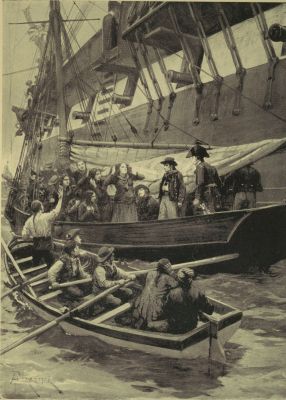
THE LITTLE OFFICER HAD TURNED WHITE AS A SHEET.
"I don't know," says Sal, "that I've any complaints to make, except that I was born a woman. That I went on to marry that pea-green tailor yonder is my own fault, and we'll say no more about it."
By this time all the women on the tender was following Sal's example and unshredding their back-hair. By this time, too, every man aboard the frigate was gathered at the bulwarks, looking down in wonderment. There beneath 'em stood a joke too terrible to be grasped in one moment.
"I beg your pardon, Mr. Rogers," says the Captain in a voice cold as a knife, "but you appear to have made a mistake."
The little officer had turned white as a sheet: but he managed to get in his say before the great laugh came. "I have, Sir, to my sorrow," says he, turning viciously on Hancock; "a mistake to be cast up against me through my career. But I reckon," he adds, "I leave the punishment for it in good hands." He glanced at Sally.
"You may lay to that, young man!" says she heartily. "You may lay to that every night when you says your prayers."
CAPTAIN WYVERN'S ADVENTURES
I
A philosophical man will go far before he discover a pastime more grateful or better soothing to his mind than painting in water-colours. I have heard angling preached up for a better; and when I answered on behalf of water-colours that it does not matter how ill you do it, was replied to that the same holds with angling if cheerfully practised. Well, then, at angling I make a cast and hitch my line over a bough, or it drops into some thicket, and thereat how can a man keep tranquil? No, no: I had liefer stain paper any day of the week.
On Saturday afternoon, the 10th of August, 1644—a very fair hot day—while I sat in the pleasant shady church of Boconnoc, near by Lord Mohun's house in Cornwall, copying down the writings on the monuments and the scutcheons in the windows in their right colours, it came into my mind to consider much that had happened to me in two years: how that fate had made a soldier of me, a plain Essex squire; how that, not content, it had promoted me to command a troop in his Majesty's regiment of horse; how that I, who had often desired to visit Cornwall for the sake of its ancient monuments, but had never thought (being by habit lethargic) to make so far a journey, was not only arrived there, but had leisure to follow my studies amid the fret and drilling of a great army.
Yet it was all very simple. On the 1st of August we had marched with his Majesty across the passes of the Tamar, the Earl of Essex giving ground before us and daily withdrawing his forces closer around Fowey; where, having a good harbour, he could easily fetch his victuals in from the sea. I will not tell how little by little we prevented him, and at last, surprising a fort by the harbour's entry, cut him off from aid of his shipping. All this was to come. Meanwhile, though pent in a few miles of ground, he had a fair back-door for his needs. The campaign was brought to a lock, and for almost two weeks we pushed matters half-heartedly; I believe, because the King had hopes of bringing the enemy to terms. Many letters came and went by trumpet; but in our camp on the moors over Boconnoc we did little from day to day save meet and picquer with small bodies of the rebel horse.
My duties giving me leisure, I turned to recreation; and Lord! how good it seemed to be antiquary again after two years of soldiering! That afternoon I played with my box of paints as a child who comes home for his first holidays, and takes down his familiar toys from the shelf. "Let others," said I, forgetting all the distractions of our poor realm of England, "let others have the making of history so I may keep the enjoying of it!" They were famous scutcheons, too, that I sat a-copying, the Mohuns having been Earls of Somerset, Lords of Dunster, and a great family in their day. Mohun, indeed, had come with the Conqueror—
Le viel William de Moion Ont avec li maint compagnon,
said the rhyme, as I remembered: and, behold! a fair monument against the north wall of the chancel (where I began) carried the royal coat of England and France with a label, impaling the ground or and engrailed cross sable of the Mohuns—this for a Philippa of their house that married with Edward, Duke of York, slain at Agincourt: and, beside it, Courtenay's three torteaux and FitzWilliam's three bendlets, Bevill and Brewer, Strange and Redvers, a coat vert with three bucks' heads having their antlers depressed (which I took for Hayre), and another coat to set an antiquary thinking, for it bore azure a bend or, with a label of three points gules. "Scrope or Grosvenor," said I to myself, looking up from my work towards the East windows, where the same scutcheon was repeated. "I wonder which claims you in these parts."
The shield that bore this famous device had it quartered on the sinister side with Courtenay and Redvers; and impaling these on the dexter side were, quarterly: (1) A space patched with clear glass (originally Mohun, no doubt); (2) Vert three stags' heads or (?Hayre); (3) azure three bendlets or (FitzWilliam); (4) a device which again puzzled me. It seemed to be an arm habited in a maunch, or sleeve, ermine, holding in the hand a golden flower.
Now while I painted, an old man had been moving about the far end of the church, whom I took for the sexton. I had passed him in the churchyard outside, when he was scything down the grass upon a grave; and had noted no more of his back than that he wore the clothes of a hind with a scrap of sacking over his shoulders—nor perhaps would have noted so much as this, had not his clothing seemed over-warm for the time of year.
But now, while I stood conning the coats in the East window, he drew towards me and spoke, stretching forward a hand timidly, almost touching my elbow.
"Sir," said he, and his voice and face bore instant witness together of gentle birth, "I am gladly at your service if anything there perplex you." With that he nodded towards the coats-of-arms.
In a trice I had recovered myself. "Then you, too, have a taste for such trifles?" answered I. "We are well met, Sir."
He shook his head, avoiding my look. You might have called his a noble face, but more than anything else it was patient. "I belong to these parts," said he; "and would ask a stranger to use my small knowledge: but, for myself, all such things may pass with me into oblivion, and I say 'Amen.'"
Said I then, "Maybe you can tell me of that coat in the fourth quarter dexter—the hand grasping a gold fleur-de-lys."
"Willingly," said he. "That is another device of the Mohuns, who in later times changed it for the sable cross engrailed. At the first they bore a man's hand in a sleeve: the flower it grasps came to them in this way: There was a certain Reginald Mohun, Lord of Dunster, who gave himself entirely to good works and founded a great abbey at Newenham, on the Somerset border. That was in Henry the Third's time—I think in twelve hundred and forty-six or, maybe, fifty. Having seen his abbey consecrated, he passed to the Court of Rome, which in those days was held at Lyons, to have his charters confirmed, and he happened there in Lent, when the Pope's custom was, on a day after hearing Laetare Jerusalem, to give a rose or flower of gold to the most honourable man then to be found at his court. They made inquiry that year and found the most honourable to be this Reginald Mohun, of whom the Pope asked what rank he bore in England. Mohun answered, 'a plain Knight bachelor.' 'Fair son,' said the Pope, 'hardly can I give you then this flower, which has never been given to one below a King or a Duke, or, at least, an Earl; therefore we will that you shall be Earl of Este'—which, as you know, is Somerset. Mohun answered, 'Holy Father, I have not wherewithal to maintain that title.' So the Pope gave him two hundred marks a year out of the Peter's pence; and so the Mohuns added golden flowers to their arms."
"I thank you, Sir," said I. "But whose is this other noble coat of azure with the bend or? Did Grosvenor ever wed in these parts? Or Scrope?"
"Neither," said he. "That coat is mine."
"Yours?" I cried, surprised out of good manners. "But this, Sir, is the very coat over which Scrope and Grosvenor contended."
"Any are welcome to it now," he answered. "But it is Carminowe, and I am Carminowe."
"I ought to have known of a third claimant," said I, musing. "I have indeed heard of Carminowe: but I had thought the family to be long since perished."
He drew back a little and scanned me. "Finis rerum," said he quietly. "It comes to all; but sometimes it lingers, and—as with me—lingers overlong. I believe, Sir, that you are a Captain in his Majesty's Troop, and will have seen your share of fighting and of life in camp. Your present occupation proves you to be a contemplative man. Will you answer if I put to you a question or two?"
"Willingly," said I.
"You are unmarried?"
"I am."
"And you volunteered for the King's service in a hot-fit of loyalty; or maybe in a hot-fit of indignation at the perils threatening him, or against the insolence of Parliament? You had come to an age when with cooling judgment these fits grow rare, yet have not quite given over their patient to the calm of middle life.—You will tell me if I guess amiss?"
"But on the contrary, Sir," said I; "you have read me correctly. 'Twas in a passion of loyalty that I took up arms."
"And in the quest of it," he went on, "you fancied that all the currents of your nature had been swept into a fresh channel; that you were a new man; that this upheaving strife altered the face of all things, and you along with it."
"Why, and so it has!" cried I.
"Nay, but think awhile! You have marched and countermarched for—how long?—two years?—two years of that period of life when honest thoughtful men turn to making account with themselves, try to learn why they were sent into the world and what to do, observe the hopes and ambitions of their fellows, prove their own limits, and so set up their rest against old age and death. You rode from home under a sudden persuasion that your business in the world, and the business of all these thousands of different men, was to defend his Majesty. How long this persuasion held you I will not guess; yet I do not doubt that, as the days went by, you observed all these particles of an army returning to their true natures—the young gentlemen of your troop picquering in bravado, or in mere love of a skirmish, because their blood is hot; coarser fellows lusting to break heads for the sake of plunder; craftier knaves, who know that war is insanely wasteful, robbing their own side at less risk; calculators such as Wilmot, Grenville, Goring, playing for high stakes under the fence of warfare, which of itself interests them not a jot. As for you, Sir—I took note of your horse just now at the churchyard gate. You see well to his grooming."
"I groom him always with my own hand," said I.
"To be sure—a man of method, strict and punctual in all soldierly duties! But the savour has gone out of them. Where the treasure is, there will the heart lie also." He nodded toward my drawings.
Now there lurked a nettle of truth in his words, and it stung me.
"And where may your treasure lie, Sir?" I asked pretty sharply.
"Come," said he, and led the way out into the churchyard. The sun was fast declining, and the light fell in warm beams against the gravestones and over the belted trees that ringed the prospect. He waved a hand.
"From the high land above us, Sir, you may look almost to two seas; and between these two seas all was once Carminowe's. Two hundred years before the Normans came, Carminowe was a great man; and for four hundred years after."
"A wide treasure," said I.
"You will not find my heart hid beneath a single turf of it, but here only," said he, and pointed; and I looked down upon a green grave.
"I think that I understand, Sir," said I, as gently as might be. "He was your son."
He bent his head. Yet anon shook it, patiently dissenting. "He was my son; the child of my old age. But, to understand, you must first be father to such an one, and outlive him."
Now I was casting about for a word or two of comfort, albeit knowing how idle they needs must be, when I heard a galloping on the drive and my name shouted lustily; and there came riding down to the gate from northward our Colonel Digby, waving a paper in his hand.
"Wyvern!" he called, as he reined up. "I have a favour to ask, and have ridden to ask it in person. Read you this letter; but first mount and ride with me to the ridge."
So I untethered my horse, mounted and rode with him to the ridge.
"Tell me what you see yonder."
I stood up in my stirrups, shading my eyes. "I see," said I, "a troop of horse on the third rise. To all appearance the riders are dressed in white."
"They are in their shirts, the dogs! Now read their challenge: for they attend on our answer."
"Tush!" said I, having glanced over the paper in my hand. 'Twas a foolish challenge, signed by one Straughan, Colonel of Horse in the Parliament forces, and dared us to a combat of cavalry, one hundred upon each side—in shirt and breeches, each man carrying but one pistol besides his sword. "Are we boys, that we should heed such braggart nonsense?"
I heard a chuckle beside me, and looked down to see that old Carminowe had run and caught up with us. He lifted the palm of his hand under which he scanned the foe, and his eyes met mine mockingly.
"They have wind," said Digby, "of the Earl's letter." (That morning a trumpet had returned with an answer to his Majesty's latest propositions; and it ran that Essex had no authority from Parliament to treat, nor could do so without breach of trust.) "And that wind has overblown their vanity."
"Then, with submission, Colonel," I said, "I would send them no answer, but let them cool in their shirts."
"And I agree," he answered. "But, as luck will have it, his Majesty has dictated an answer, and that answer is already on its way."
"To what effect did his Majesty answer?"
"To the same as a certain King of Israel who said, 'Let the young men arise and play before us.' There was no need to drum for volunteers, neither."
"Nay," I grunted, "we had never yet a lack of hot-headed fools!" I had no care to meet the gaze of old Carminowe, but I knew that it was upon me: for he stood close by my stirrup. I knew moreover that it was saying, "You, a staid man, mixt up in this folly! And this King who forwards it for sport—is this he whom your life's business was to defend?"
Now—as the army would understand it— our Colonel's seeking me in person, when so many would have striven for the chance to shine under his Majesty's eyes, was a high compliment; and the higher since certain of the hottest young bloods had (as I heard later) stipulated for my company. Yet for the moment I was angered, reading old Carminowe's thought and knowing it to be true. I had no natural taste for this bravery of mere fighting: and that I had arrived to be a man sought out for fighting was but a proof how emptily the mass of men exalts it above civil pursuits, seeing that my credit rested wholly on certain habits of steadiness and caution that in any other business I should have applied as cheerfully. I felt no desire at all to shine for his Majesty's light approbation, albeit, two years ago, I had enlisted in a fervour to die for his crown; and feeling my uneasiness under old Carminowe's gaze, I cursed him silently for having read me better than hitherto I had read myself.
But Digby would understand nothing of this. He was a good fighter and a good fellow, bred and trained in military vanities.
So I answered him curtly that, if this folly were afoot and now inevitable, I would come. I spoke too sourly perhaps, and my words, as I could see, wounded him.
"My dear Wyvern," said he, "I thought of you at once, and rode for you expressly. Other men are biting their mustachios at the bare chance of it. The King himself will be looking on."
"You were always my friend," said I, as we spurred forward together.
I wish to waste no words over that foolish combat. We were a hundred a side, drawn up in our shirt-sleeves on two opposing slopes, and we encountered in the hollow between. Digby, who led us, had given the word to hold our pistol-fire for close quarters, and I on the left had wasted an harangue on my troopers to the same effect. But, once the trumpets had sounded "charge," the whole affair became but a wild paper-chase. At forty yards' distance some young fools on the extreme right began popping off their pistols, and in half a dozen strides this infection had run like a wildfire along one line. With ordinary seasoned men of my own troop I had done far better; but these were the picked fools of an army, and the main of them under twenty years old. It is always short work between two bodies of horse meeting in full shock: one swerves and flies, or else goes under; the other presses on: there can be no other way. For me, I managed to unsaddle a man and break through the enemy's right with three troopers after me. Wheeling then, we saw the body of our friends in full flight; and a dozen of our foes, wheeling at the same instant, bore down on us nimbly. We spurred to meet them in second shock: but, as we encountered, one clever round-pate, who had reserved his fire, sent a bullet through my charger's shoulder-pin. I had at that instant a thrust to deliver under the arm of another fellow, and the poor brute's fall took me at unawares. I was flung heavily and stunned; and, the game being over, no doubt his Majesty rode moodily off to supper. Like other Kings, he was trained to sport; but I doubt if he ever arrived at enjoying it.
II
The main body of the Parliament horse and two regiments at least of their foot were quartered at Lestithiel, in the valley under Boconnoc—a neat tidy town, but not commodious for so great a mob. It stands by an ancient bridge of eight arches, where the tidal water running up from Fowey spends the last of its strength; and there is a Hall and Exchequer where the Dukes of Cornwall had been used to receive their Stannary accounts, with a small prison beside for debtors and offenders under the laws of Stannary.
This prison being crowded already with prisoners taken by the rebels, the Provost Marshal clapped me, with nine others made captive in the above skirmish, in the parish church of St. Bartholomew; and there set a guard over us, using us more gently (I suppose) for that we had come to him in more ceremonious fashion than by the ordinary hazard of war. The rebel cavalry had turned the church into a stable, and defiled it past description. Also I heard a tale of their having led a horse to the font and christened him Charles—a double insult to God and to their King; but will say in fairness that they practised no such blasphemy during my sojourn there, nor seemed the men to do it, but went about their grooming and feeding of their horses soberly enough, making no more of the church than if it had indeed been a stable. Over us they kept strict watch, but fed us as well as they themselves fared, and showed us no incivility; nay, at my request one found pen, ink, and paper for me that I might pass the time away by copying the scutcheons in the windows, the glass of which they had spared.
Among us ten unfortunates were two young gentlemen of Cornwall, Humphrey Grylls and John Trecarrel (but as "Jack" saluted by everyone). They both had hurts: Grylls a shot through the flesh of an arm, with two broken ribs to boot; Trecarrel a slight glancing wound across the left lower ribs. For myself, I had taken no harm beyond the bruise of my tumble, though my head swam for days after and I suffered from frequent fits of nausea. The other seven were common troopers, decent fellows; and one carried in his breeches' pocket a pack of cards, which kept us well amused until a Roundhead sergeant, discovering our play, reported it to the Provost-Marshal, who took the cards away.
In this church of Lestithiel, then, I dwelt from the day of my capture (August 10) until the last of the month, and on the whole very cheerfully; for we saw that the rebels intended us no injury, and from some of them we had news of Sir Jacob Astley's seizing the forts at the entry of Fowey Haven and so cutting off Essex from his supplies by sea; wherefore we told ourselves that the Earl must either surrender or make a desperate push to cut a way through his Majesty's posts, and that, whichever he might choose, our liberty would not be long delayed.
Also, and besides my copying of the scutcheons, I pleased myself with composing of a chronogramma which I here present to the reader. I thought it mighty ingenious at the time: and so it is, and I spent four days upon it—
VIVat reX, CoMes esseXIVs DIssIpatVr.
or, in English, "Long live the King, the Earl of Essex is put to the rout." You will see that, by taking out from the Latin all the letters that stand for Roman numerals—and no other—you get the Annus Domini 1644: in this way—
MDC together make sixteen hundred } the total 1644.
and }
XXVVVV, forty }
and }
IIII, four }
I have shown it to many in private, and all agree that no better chronogramma was made during the late troubles: but, to be sure, I had leisure for it.
To leave these toys—on the last day but one of August, and a little before nine in the evening, there came into the church (that was lit by a few lanterns only) two foot-soldiers bearing a ladder between them and a rope, which presently they set down in a corner by the belfry and departed. They being scarce gone, by-and-by there entered two other soldiers with a prisoner, whom they unbound—for his arms had been trussed behind him—and bade make what cheer he might until the morrow. Now, whether he had spied us or not as they brought him in I cannot say; but, being loosed, he moved at first down the aisle uncertainly as a man might who found even the dull light too strong for his eyes—then with a quick tottering step towards us, that were gathered around a lantern and taking our supper near the belfry: and as he drew toward us I knew him for old Carminowe.
"Why, what harm can they have found in you?" asked I, taking his hand (as fellows will in misfortune) and giving him a seat beside us. At this distance of time I will own that this speech of mine seems not over-delicate; yet these were the words I used, and, be sure, I meant them well.
He put my question aside. "You had ill-luck," he said. "I watched you from the high ground, and my heart went with you; that is to say, with you, Sir—and with you." Here he bowed to Grylls and Jack Trecarrel, and went on as if explaining his performance lucidly. "My son, Sirs, had he lived, would have been about your age. He died at eighteen and a few months: but I think of him year by year as alive and growing, and so I seem to share in his hopes and his high mettle."
My companions—as well they might—stared at him, and from him to me; thinking, no doubt, that here was some madman.
"Excuse me," said I, and presented him formally. "This gentleman and I are, in a fashion, acquaintances. He is a countryman of yours, by name Carminowe."
"Carminowe?" Young Grylls looked at him musingly. "I have read the name on a hundred old parchments at home."
"The estates, Sir," said Carminowe, "have passed into many hands, but into none worthier than that of Grylls."
"Faith, that's handsomely said!" answered Grylls, perceiving now that, in spite of the old man's dress, he had to do with a gentleman. "And, as for the estates, our greed (which, a generation or two back, was a scandal) has not swallowed them all, I hope?—though, for that matter, if these crop-ears prevail, 'tis little enough that any of us will inherit."
"They will not prevail at this bout," said the old man. "At Fowey, they tell me, the Earl has but six days' provisions and is planning to slip away by sea. Between this and the coast the soldiers have eaten all bare; in a day or two they must break through or surrender, and I think, gentlemen, I can promise that you will be soon enlarged."
"You speak with assurance, Sir," said I, handing him a crust and filling a pannikin for him from our common pail of water.
"And yet," said he, with a faint smile, "I am no combatant: no, nor even a spy—though to-morrow morning they are to hang me for one."
He spoke the words quietly and fell to munching his crust. The three of us—and the troopers too—stared at him amazed: and for explanation, his jaws being occupied, he pointed a thin finger at the ladder and rope.
"But surely," I began, "since you are no spy, someone can speak for you——"
"Lord, Sirs!" he took me up; "what does it matter? I had yet left to me a small estate in St. Teath parish, which they have twice pillaged. My son they slew on outpost duty, before the first Braddock fight." He turned to me again. "What says the Mohun motto, Sir? Generis revocamus honores, is it not? Well, there is no chance of that for the Carminowes. Let the Mohuns paint up their ancestral hand clutching the Pope's golden flower: I have held a fairer in mine, and seen it wither. I have lived through the bitterness of death; I have seen the end of things. The last Carminowe goes down the blind way of fate—goes out in obloquy to-morrow, hanged for a spy by mistake. I have finished my quarrel with the gods: they are strong, and I make no complaint that they choose to wind up with a jest. I do assure you, Sirs, that I neither fear death nor disdain any way of it."
But here Jack Trecarrel, that had been staring gloomily at the wall opposite, suddenly rubbed his eyes and sat up with a laugh.
"By the Lord, Master Carminowe! and if that be how you take it, you may yet turn the jest against the gods."
We stared at him all, trying to read his meaning.
"Nay," he went on, "I have a slow wit, and you must give me time. The notion in my head may be worth much or little. Only you must tell me, Master Carminowe, on what ground you promised us that our liberty was nigh at hand: for something will depend on that."
"'Tis that fortunate knowledge unfortunately brings me here," answered the old man with a grave smile. "You know the narrow road that passes for a space along the left bank above the bridge, and so strikes away to the north-east over the downs? It has deep hedges, you will remember, and at the bend stands a mean cottage. For days we have heard talk that the enemy would try to break away by this road; and a week ago Goring moved down a body of horse to the fields hard by and posted a strong picket in and about the cottage, to counter this design. Well, then, I, to-night, taking my ramble after sunset (as my custom is, and known to our sentries), came down to this cottage, supposing myself to be well within our lines. To my concern no one challenged me, and, creeping a little closer, I found the place empty. But while I stood, puzzling this out, a man called softly from a little way down the lane, where between the hedges all was dark to my eyesight, whom I approached without fear, supposing him to be one of our sergeants in command of a picquet, and that maybe he had a message for me to take back to Goring. 'Give the password, friend, and tell us, What time did he say?' this man demanded of me. I, taken aback by these words, stood still: and, with that, I saw beyond the hedge the faint light of the stars shining on many scores of morions and breastplates. 'Twas a whole troop of horse drawn up and standing silent in the field below. At once I knew that these must be rebels; that the pass had been sold by some traitor; and that I had tumbled by mistake into the part of his messenger. Heaven knows if, using my wit and naming an hour boldly, I might yet have escaped and carried back warning to camp. I think not: for they would have pressed me for the password. As it was, being dumbfoundered, I broke away and tried to run: but the fellow was after me in a trice, and my old legs carried me but a dozen yards before he had me down and flung on my back. You can guess, Sirs, what remains to tell. They marched me down here; and to-morrow—supposing me to know what would implicate, no doubt, several men of standing in both armies—they will close my mouth for ever. For 'tis certain the King's interests have been betrayed, and the rogues will break through to-night, no one hindering. They have a river-fog, too, to help them. Now, whether or not the infantry will make a dash for it after the horse I cannot tell you: but to-morrow his Majesty will march down into Lestithiel and you will be free."
"Then a few hours would suffice to save you, Master Carminowe?" said Trecarrel, still pondering.
The old gentleman shrugged his shoulders. "They will get my business done early," said he. "I pray you, feel no more concern about it." He turned to me and asked if I had amused myself with sketching the monuments of this church as well as of Boconnoc. The windows being dark against the lantern-light, we could see no more than the outlines of their blazonries: but he seemed to know them by heart. I told him how that among them I had found his own coat twice depicted—azure, a bend or, but this time without the three-pointed label of difference.
He nodded. "And that is right," said he; "we have no business with the label." He went on to tell that in Edward the Third's time, in the English camp before Paris, Carminowe of Cornwall had challenged Sir Richard Scrope with wrongfully bearing his arms; and that six knights appointed to decide the controversy had found Carminowe to be descended of a lineage armed azure, a bend or, since the time of King Arthur. This led us into converse on the Scrope and Grosvenor dispute. "'Tis curious," said he after a while, "that we may be the last men in England to sit awake talking over these old tales. For when the rebels have dispossessed his Majesty—as they surely will—and have destroyed the fountain of honour, who would light his pipe with such-like straws?"
But I would not allow the King's cause to be hopeless, and showed him my chronogramma, not without complacency.
He took the paper in hand, and was holding it close to the lantern, to con it, when at that instant Jack Trecarrel started up on his straw pallet into a sitting posture, and nudged Grylls—who, with the rest of our comrades, lay in a sound sleep; but, feeling his elbow jogged, he opened his eyes.
Having wakened Grylls, Trecarrel motioned to us both to do as he did without questioning, and began very cautiously to pull off his boots. While he did this a new thought seemed to strike him, for he puckered his brows awhile, and leaning towards me whispered across the back of Carminowe (who still bent forward, studying my scrap of paper), "Rouse the men on your side—softly as you can! They may all be useful." He turned to Grylls and whispered (as I suppose) the same order: for Grylls at once touched the shoulder of the trooper lying next him, and put finger to lip as the fellow stirred in his sleep and blinked up at him.
I on my part, having pulled off my boots obediently, began to rouse the men nigh me with similar caution; so that presently we had the whole ring awake and staring, their eyes asking what we intended. "Heaven help me if I know!" I muttered to myself, but endeavoured to answer the looks bent upon me by looking extremely wise.
"Most ingenious!" said Carminowe aloud, who all this while had been working out my riddle, observant of none of these preparations. He turned to me. "May I ask, Sir——"
"Hist!" commanded Trecarrel, laying a hand on his arm and peering into the space of darkness between us and the chancel, where three stable-lanterns shone foggily—one tilted on the cushion of the pulpit-desk, the other two set side by side on the altar itself. In the choir-stalls and on the floor between (where the altar-step, with a coat laid upon it, served for their pillow) maybe a score of rebels lay snoring. These did not belong to our regular guard, and indeed by night I never discovered that we had a guard: but some four hundred soldiers bivouacked, as a rule, in the churchyard outside, with sentries posted; which from the first had been a dead-wall to all our projects of breaking prison.
After peering for half a minute or so, Trecarrel raised himself to a kind of crouching posture, Grylls, at the same time, imitating him. They beckoned to a couple of our troopers to follow them; and, backing out of the lantern's rays, in a trice all four made a sudden dart across for the shadow of the belfry arch.
Then in a trice I understood what was forward; and, pointing to Carminowe's feet, signalled to him to slip off his shoes. The tower of Lestithiel church rises to a spire, and its belfry chamber stood then on a raised floor, approached, not as in most belfries by a winding stair, but through a trapway by a ladder reaching up from the ground. During our captivity this ladder had been removed and perhaps cast down outside in the grass of the churchyard. But now I followed Trecarrel's guess that the same had been found and carelessly brought back for Carminowe's hanging on the morrow. I knelt and unlaced the old man's shoes. He suffered this, eying me as if to ask what it meant, but making no protest.
One by one our comrades slipped away into the shadow under the belfry. I heard the ladder raised softly and then a light scraping as its upper end touched the stonework aloft. It seemed to me, too, that I heard a footstep mounting the rungs; but of this I could not be sure. Our enemies in the chancel snored on.
Five minutes passed; again I heard a light footfall, and Trecarrel came stealing back to us.
"Blow out the light," he commanded—and, as he crouched to whisper this, I saw his face running bright with sweat. "And give me the candle—the bolt of the trap is stiff."
He took the candle from me, and after waiting a moment, to be sure that none of those in the chancel had taken alarm at this blowing out of the light, we stole across all three to the ladder's foot. Trecarrel mounted again. I heard him rub the tallow on the bolt—or seemed, at least, to hear it; and by-and-by the trap opened with a creak. Still the sleepers took no alarm.
I pushed Carminowe forward, and believe that he was among the first to mount. One by one the others followed, Grylls carrying with him the coil of rope. I, as senior in command, took last turn. This adventure was not mine, nor could I see the end of it; but I supposed that in the uncommon military operation of retreating up a steeple the commanding officer's place must be the extreme rear.
My foot was on the lowest rung when some fool above, who had taken the coil of rope off Grylls' shoulders, let it slip through the hatchway. It struck the ladder, and came glancing down with a rush fit to wake the dead; and almost on the instant two or three of the men in the chancel had sprung to their feet and were snatching down the lanterns there. Now I had leapt aside nimbly—and luckily too, or the blow of it had either brained or, at the least, stunned me: and as it thudded on to the pavement I made a clutch at the rope and sprang for the ladder with a shout that woke the whole church and echoed back on me with a roar.
"Hoist!" I yelled, clambering as high as I might, and anchoring myself with an arm crookt through a rung.
"'Hoist' it is!" sung down Trecarrel's voice cheerfully. "Hold tight below—and you, lads, up with him! One, two, three—heave, my hearties!"
'Twas the only way: for already half a score of the rebel rogues were bearing down the nave towards me at a run. But, I thank Heaven, they had started in too great a hurry to remember their muskets. They reached the belfry arch to find the foot of my stairway lifted a good six feet above their heads. One or two leaped high and made a clutch for it, but missed; and as they fell back, staring and raising their lanterns, I was borne aloft and removed from them through the trapway like any stage god.
My comrades lifting me off the ladder, I found myself on a floor of stout oak, and in the midst of an octagonal chamber filled with a pale, foggy light—as I supposed, of the declining moon. Directly overhead, in a cavernous darkness, hung the great bells like monstrous black spiders, with their ropes like filaments let down and swaying: for a stiff and chilly breeze blew every way through the chamber, which had a high open window in each of its eight sides.
For these windows the most of us scrambled at once, foreseeing what must happen. Indeed, the baffled rogues below lost no time over their next move; but running for their muskets, began firing up at the hatch and at the floor under our feet—the boards of which, by the favour of Heaven, were of oak and marvellous solid; also the heavy beams took many of their shot; but none the less they made us skip.
This volley, fired suddenly within, at once, as you may guess, alarmed all the bivouacs in the churchyard. Crowds poured into the church, and word passing that all the eleven prisoners were escaped into the belfry under the spire, other crowds ran back into the street and began firing briskly at the windows. But this helped them nothing, the angle being too steep, and the bullets—or so many of them as found entrance—striking upwards over our heads. By-and-by a few cleverer marksmen climbed to the upper rooms of certain houses around the church, and thence peppered us hotly: yet with no more effect than the others, for by this time I had discovered, by sounding with my heel, where the stout beams ran beneath us. Slipping down from our window-sconces and choosing these beams to stand upon, we were entirely safe from the musketeers outside, and reasonably protected from those below.
"Now the one thing to pray for," whispered Trecarrel to me in a pause of the firing, "is that Lestithiel town contains no second ladder so tall as ours: and I believe it cannot."
"There is another thing to pray for," said I; "which is, that the dawn may come quickly."
He stared at me. "My good Sir, are you crazed?" he demanded. "Day has broke already! What light on earth do you suppose this to be all about us?"
"I took it for the moon," I confessed somewhat shamefacedly.
He burst into a laugh. "You and your friend then must have sped the time rarely with your Scropes and your Grosvenors, your fesses and bends, your counter-paleys and what-not. I can tell you the night dragged by tediously enough for me, that had to lie and listen to your discoursing!"
"But hullo!" said I; "they seem to have ceased firing below. And whose voice is that calling?"
'Twas the voice of the Provost-Marshal summoning us to parley. He had been roused up in haste, and by the tone of his voice was in a towering passion of temper.
"At your service, Sir!" I called out in answer, approaching the trap. "But if you want a parley it must be an honourable one, and no shooting up or catching me at disadvantage."
"My men will not fire again until I give the word."
"Very well, then: what do you require of us?"
"I require you to give up to me, and instantly, the prisoner whom we took last night. This done, I may consent to overlook your escapade."
"For what purpose do you want him?"
"That, Sir, is my affair, I should hope. 'Tis enough that I require his surrender."
"Indeed no, Sir: 'tis nothing like enough. The gentleman you speak of happens to be a friend of mine; and you have formed an opinion of him as incorrect as it is injurious. If I consent to release him to you it will only be on your engaging yourself most solemnly to do him no harm."
'Tis wonderful what an advantage height gives a man in an argument. The Provost-Marshal, dancing with rage on the floor far below and cricking back his neck to get sight of me, cut one of the absurdest figures in the world.
"I'll hang you all!" he threatened, lifting and shaking his fist. "I'll hang every mother's son of you!"
But here I felt a hand laid on my shoulder, and looked up to see Trecarrel standing over me and smiling, and the belfry full of a sudden with rosy morning light.
"Wyvern," said he, "don't be keeping all the fun to yourself! Let me have a turn with the man, and go you to the window—the north-east window yonder, and tell me an I speak not the truth to him."
I gave over the parley to him and moved to the window, as he directed.
"'Tis too late, my master!" Trecarrel called cheerfully down the trap. "You have thirty minutes at the most to reduce us, and 'twill take you all that time to pack up and clear. Already a body of the King's foot are coming over the hill straight for the bridge, and your one ragged regiment there is making haste to quit. Do I not speak the truth, Captain Wyvern?" He flung this question to me over his shoulder.
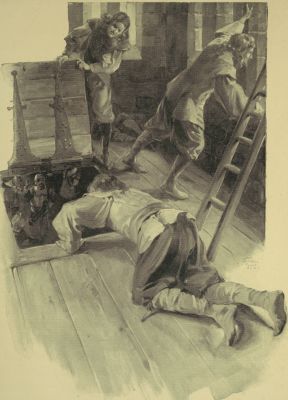
"'TIS TOO LATE, MY MASTER!" TRECARREL CALLED CHEERFULLY DOWN THE TRAP.
"The Lord be praised, you do!" I cried. "And see—another and stronger body making down to cross the ford to the southward!" By this time all the troopers around me were shouting and pointing and some of them capering for joy; and sure the morning sun has rarely looked on blesseder sight than these gallant troops made as they descended glittering to the river.
"Softly—softly!" Trecarrel rebuked us. "With so much noise I cannot hear what Master Provost-Marshal is threatening. Indeed, Sir," he called down, "your game is up. Go your ways now, and may they lead you to the proper end of all rebels!"
I did not hear the Provost-Marshal's answer: and for a minute or so—since the firing did not start afresh but all remained quiet—I supposed that he had taken our advice and given up the game. But turning for a look down into the church to assure myself, I saw Trecarrel rise to his feet with a face deadly white.
"The villains!" he gasped out, pointing to the hatchway. "They are bringing powder—there—right under us!"
And, while he pointed, the Provost-Marshal's voice came up to us, cold and sneering. "I'll give you this last chance, my gentlemen," he called. "Will you hand over my prisoner, or must I blow you all into air? You have half a minute to decide."
"Let us go down, gentlemen," said Carminowe, stepping forward. "I thank you sincerely: but in truth, as I have told you, I do not value life."
In an instant Trecarrel had recovered his composure. "With your leave, Captain," he said, addressing me, "'twas I that set this game going, and I for one am willing to play it out."
I glanced from him to Grylls, who stood against the wall with his arms folded. He wasted no words, but answered me with a gloomy nod. Now I turned to the troopers, from whom—as men of mean station—I confess that I looked for no such folly of magnanimity as to lay down their lives for an old man, who, besides, was begging us to yield him up. Judge my amazement then when a red-bearded fellow called Wilkes spoke up with a big oath, growling that "surrender" was no word for his stomach. "Suppose we belonged to your own troop, Captain—what would you look for us to answer?"
"In general," I told him, "I should look for my troop to follow where I dared to lead. But this is a different matter——"
A man by Wilkes' side cut me short. "Wounds alive, Sir! You don't command the only men in the army! Didn't his Majesty pick and choose us for special service? Very well, then; tell the old devil to fire and be damned to him!"
I ran my eyes over their faces. "I thank you all, friends," said I: "and because of your answer I, for one, shall die—if God wills it—in good hope for England."
"Time is up," the Provost-Marshal's voice announced from below. "Do you submit, Sir?"
"No!" I shouted, and all shouted together with me; nor did one or two forbear to add to their defiance words of the grossest insult.
I motioned to them to copy me and lay themselves down at full length above the strongest beams: and, so lying, I commended my soul to God. This waiting upon the slow-match was the worst of all. "Will it never come?" groaned one man, clenching his hands.
But it came at last, with a jarring lift of the earth and a great wind that took us—flat-laid as we were—and tossed us like straws in a heap against the wall. Then the foundations of the world opened with a roar, beating all sensation out of us—so that, had we died then, all taste of dying was gone from us. Answering the roar, as the walls rocked with it, the heavens seemed to split and open, letting through a downrush of slates and stones and mortar: and overhead a great bell clanged once. But in my memory the explosion and the answering downrush stand separated by a dark gulf, in which time was blotted out. I had covered my face with my cloak, and saw no flame at all. Yet when my eyes opened they rested first upon a great rent in the belfry flooring, through which one of the heavy beams, broken midway, thrust up two jagged ends. I saw this through a cloud of smoke, dust, and lime. Beside me my comrades lay under a thick coating of limewash and cobwebs. A couple of them had been flung across my legs, and one or two were groaning. On the far side of the chamber the man Wilkes had scrambled to his feet unhurt, and was leaning with his elbow against the wall. I found my voice, and, while the walls yet rocked, called to Grylls and Trecarrel. To my amazement their two voices answered me: and to my greater amazement one by one the heap of men disengaged themselves, and, shaking off the dust and lime from them, rose to their feet—the whole of them, save for a cut or two and a few bruises, unharmed. Old Carminowe, in particular, had not taken a scratch.
But while I stared at them, and while my shaken wits little by little took assurance that the tower stood yet and we were yet alive, in my ears rang the note of that bell which had sounded once overhead. I stared up with a new and horrible apprehension, mercifully till this moment delayed. I had not thought of the bells. The wind of the explosion had whirled two or three of their ropes aloft and flung them over the beams: but the concussion, which had shaken cartloads of cobwebs down upon us, had seemingly left the cage itself uninjured. My eyes sought to pierce the gloom up there in the bells' dark throats. It seemed to me that one of the clappers was swaying. I thought of all that mass of metal slipping, falling; and called on the men in a panic to fetch and lower the ladder.
Trecarrel or Grylls—I forgot which—besought me to delay: the enemy might yet be lying in wait for us outside the church. I, possessed with this new terror of the bells, scarcely heard them, and insisted upon lowering the ladder with all speed. It had fallen forward from the wall against which we had rested it, and now lay right across our heads. Fast as they could the men obeyed us, lowering it through the hatchway and thence guiding its descent by the rope knotted about an upper rung. As I had been last to mount, so I was first to slip down; as I reached the foot and steadied it for the others I heard Wilkes at the window overhead calling out that our troops had won the bridge.
And now comes in the strangest thing in all my story. We, that had lived in comradeship for three weeks, and had come through this extreme peril together, parted at the ladder's foot and ran our several ways without a word said! I took one glance around the church. A good third of the roof had been blown away and one of the tower-piers was evidently tottering. Two columns of the arcade along the south aisle lay prone. I need not say that scarce a pane remained in the windows: but I can remember marvelling that so much of the glass had fallen inwards and lay strewn over the whole flooring, even in the nave, and I remember it all the better through having to pick my way to the door with shoeless feet. In the porch I overtook and ran past old Carminowe. He did not halt to thank me, nor did I pause to receive his thanks.
Yet I saw him once again. From the church I ran to meet our troops, now re-forming at the bridge-end to clear the town. Half an hour later, as we drove the retreating rebels beyond the suburbs and out into the dusty lanes towards Fowey, almost by the last cottage we passed a corpse huddled under the hedgerow to the left of our march. It was the body of Carminowe, killed by a chance shot of the men from whom we had lately saved him. But with what purpose he had pursued them and invited it, I cannot tell.
FRENCHMAN'S CREEK
A REPORTED TALE
Frenchman's Creek runs up between overhanging woods from the southern shore of Helford River, which flows down through an earthly paradise and meets the sea midway between Falmouth and the dreadful Manacles—a river of gradual golden sunsets such as Wilson painted; broad-bosomed, holding here and there a village as in an arm maternally crook'd, but with a brooding face of solitude. Off the main flood lie creeks where the oaks dip their branches in the high tides, where the stars are glassed all night long without a ripple, and where you may spend whole days with no company but herons and sandpipers—