NOTES (continued 8)
Reading edition
Phonology: (1) of C. Oral a is a, fare 176, habben 189, but færeð 43, færen 45, hæfuest 50; uerden 48 is from fēran. a before nasals is normally o, comp 120, moni 93 (5 times), but whanene 31, whænnenen 27, þenne 182, muni 113; a before lengthening groups is o, hond 201, imong 141, but and 9 &c., andswerden 11 (6), answarede 51 (4), angles 34. æ is a (48), e (20), æ (16), after 179, æfter 186, bad 241, bed 298, hafde 212 (7), hæfde 233 (3), hehde (for hefde) 69, wes 8 (5), wæs 78, nes 104 (3), heleðes 248, sætterdæi 75. e is normally e, bereð 44, sellic 267 (often elsewhere seollic), speken 12; before lengthening groups, ende, uelde 211, hende 273; but æ is common, spækeð 159, ænde 34, 109, fæld 209, hændest 95, hændeliche 99; Hængest 89 (8) is the common form; a occurs in fareð 276 (ferian), ualde 203, þa 15, 39, 68, u in sugge 52, suggeð 167; eo in heoreð 58 (if from herian): bærnan gives berneð 108, forbærnan, forbærnen 165, ærnan, ærneð 108, mengan, mæingde 292, beside mengde C 15530 (Morsbach, § 107, anm. 3). i is i, blisse 146, wille 25, but u in nulle 191, nuste 264, us 62, wulle 25, and the pres. forms of willan; before lengthening groups i, child 44, þinge 61. o is o, folc 36, hope 58, but durste 137, dursten 158; on is mostly an or o, once æn 211; before lengthening groups o, bord 215, wolde 20 (4), wolden 19, 192, but walden 12, 42. u is u, burh 173, cumen 137, iwune 117, but ilomp 122, sonedæi 75; before lengthening groups u, funde 298, murnede 293. y is normally u, cume 118, wunne 188, but kime 263, kineborne 168, kineliche 173, kinelond 56, 192; before lengthening groups u, guldene 257, vmbe 36: king 139 is the regular form, but kenge 94.
ā is regularly a, hali 66, ihaten 34, but æ in bræd 218, bræ[d]ne 209, mære 42, særi 103; before two consonants a, hatte 32, ladlic 294, madmes 134, but hæhte 59 (7). ǣ1 is æ, bilæfuen 24, hæðene 8 (3), sæ 2, spræde 210, or e, bitechen 191, breden 250, stenene 222, but a in bitache 173, haðene 295 (possibly Scandinavian), ea in leare 150; before two consonants æ, ælche 129, æuer 44, læfdi 74, lædden 259, næuere 176, or a, alc 51, alchen 280, auere 7, nauere 23, vnwraste 80, wraððe 150, but e in arerde 223, elchen 21. ǣ2 is æ, æten 251, dæde 197, þræd 218, or e, deden 96, vnimete 254, but eo in weore 8, weoren 2 (9), neoren 138, and a in mare 223; before two consonants, þærfore 175, setten 250. ē is e, greten 144, ueden 190, but heo 73, þæ 63, 231; before two consonants, imetten 18, lette 283, but igrætten 18 (r. w. imetten), iuædde 100. ī is i, bliðe 24, 116, swiðe 2, fiftene 36, but bluðeliche 282, swuðe 129. ō is o, com 113, godne 49, most 110, but neoðeles 83. ū is u, bute 176, runen 148, 159, but ronenen 156. ȳ is u, biclused 177, cudðe 98, iscrudde 100, but forþi 48, 66, þa 8, 184.
ea before r + cons. is a, ȝare 224, iȝarked 238, 240, and æ, hærm 8, 295, kærf 217; the i-umlaut is seen in awariede 81, and, before a lengthening group, in ferde 85. ea before l + cons. is regularly a, al 37, and the numerous forms of eall, scat 189, but hælf 117, helue 129; before lengthening groups, a, alde 28, anwalde 83, athalden 20, halden 150 &c., walden 71, but athælde 83, hælden 13, holden 143, olden 187: the i-umlaut is a before lengthening groups, aldeste 29, halde 290, iuald 109, but æ in ælderen 193, ælderne 69. eo before r + cons. is eo, feor 160, heorte 288, but hærcne 147, werpeð 37; before lengthening groups, ȝeorne 288: the wur group has u, iwurðe 90, wurðliche 190, wurðscipe 71. The i-umlaut before lengthening groups is seen in ȝirnde 206, sturne 120, but deorne 148: wiersa is wurse 81, 291. eo before l + cons. is eo in seolf 81 &c. eo, the å-umlaut of e, is seen in feole 119, weoli 60; eo, u- and å-umlaut of i, in cleopien 249 and its forms, heore 37 &c., seoluer 88, seoððen 96, 97, seoueðe 64, but hennen 160, iluued 22, and without umlaut, niðer 82. ea after palatals is a, scal 38, æ, ȝæf 134, e, ȝef 133, 299, and before nasal o, scome 86. ie after ġ is e, biȝeten 87, ȝeuen 88, and i, biȝite 172, ȝif 201, ȝiuen 297: after sc, æ in schæren 216. ȝef, conj., is ȝif 10 &c. eo after ġ is u, ȝunge 160, ȝungen 187: geond is ȝeond 209. eo after sc is seen in scolde 241, scolden 45, scullen 24, 39, 68. heom is heom 9; eom, am 175, æm 24, 263, næm 176.
ēa is usually æ, æc 28, hæne 204, særes 216, slæn 165, but e in ȝette 242, ȝettest 184, iȝette 206, hehne 102, ileuen 53, 80, a in bad (influenced by bæd) 239; before two consonants æ, hæfden 87: the i-umlaut is e, bemen 249, dremden 146, heren 13 and its forms, ileueð 53, but æ in hæren 19, 68, ihærde 264, ihærd 156, i in hiren 184, biliueð 91, eo in heoreð 58 (if from hīeran), ileoueð 80, 81. ēo is regularly eo, beon 175 &c., biheold 288, feollen 127, freond 273, leoden 165, þreo 4; the i-umlaut is mostly wanting, deore 68 (4), freonde, dat. 273, neode 171, 212, but (fif)tene 36, 233. OE. sīen is seon 27. ēa after a palatal is seen in ȝer 36, ȝere 44, ȝeuen 76, ȝiuen 73 (4), ȝifuen 72, 76. gīet is ȝet 65.
a + g is aȝ, laȝe 69 (6), ofslaȝen 163, but dæȝen 69, ofslæȝen 138. æ + g is mostly æi, dæie 23, fæire 18 (9), fræinede 265, mæi 73, mæidene 290, sæide 152, uæin 263, but ai in dai 130, fain 286, mai 174, 204, main 290, maide 266, 283, maiden 282, ei in feire 210, feirest 89, seide 240 (3), seið 270, æ in færeste 7, æȝ in dæȝe 193, 194. e + g is generally ei, leide 215, toȝeines 240, þeines 101, weies 202, but awæi 129, bilæde 220: e + h is seen in hæhte 225, hæhten 230: i + g in þrien 284, þreoien 277 (influenced by þrēo): i + h in dihteð 67, dihte 135, isihðe 103: o + g, h in hohfulle 156, dohter 181: u + g, h in duȝeðe 141 (6), fluȝen 129, 130, but floȝen 129, fuhten 127. ā + g is aȝ, aȝene 208, 296, aȝere 201; ā + h is oh, oht 113, ohte 84 (3). ǣ1 + g, h is seen in fæie 127, bitæht 205, bitæhten 284; ǣ2 + g in maies 182; ē + g in beyne 168, twene 168 (with loss of g); ī + g in fridæi 74; ō + g in droȝen 93, inoȝe 134, sloȝen 126, ofsloȝen 119, vnnifoȝe 130; ō + h in biþohte 111, 142, noht 80, rohten, sohten 10, þohten 122, exceptionally afeoh 188. ea + h, ht is seen in æhtene 234, isæh 116, mæhti 65, sæh 23, sæxisce 97, sæxelonde 271, but saxelonde 124, 278, saxisce 114, sexisc 180; the i-umlaut in mihte 46, mihte 58, nihtes 23. eo + h, ht is mostly i, cnihtes 17, fihte 115, 172, rihten 20, but feht 120, 126, sexte 39, fæhte 155, sæxte 63, Peohtes 84, 107. ēa + h, is eh, heh 66, neh 291, æh, hæh 64, 65, hæhliche 16, 190, hæhne 205; ēa + g gives hæȝe 141, 259: the umlaut is wanting in hæhste 62 (3), hærre 13, ihæȝed 153. ēo + g, h is seen in driȝen 25, 196, iuaid 175, ræh 291. ā + w appears in nawiht 104; ī + w in tisdæi 76; ēo + w in acneowe 261, bleowen 249, neowe 28, 106, treowe 28, eouwer 24 (4), eoure 54, æoure 53, eou 26: feorðe 61, 72 is fēorþa.
The prefix æt is at, atstonde 183, atwite 204; on is a in afon 178, afeoh 188, among 146, but imong 157 is gemang. oþ is a in aþet 229: o is levelled to e in whanene 31, whænnenen 27, wunder 213: eo is written for e in cusseoð 277; i for e in cristine 294. The glide e is inserted in æuere 132, nauere 23, læuedi 65, næueden 228; i is prefixed in iliue 22, probably by anticipation of iluued.
w is lost in þong 219, beside þwong 217, 218; for w, u is written in Cantuarieburi 15, l is lost in scat 189. m is doubled in icummen 3, n in hennen 160, iborenne 259, whænnenen 27. n is lost in gome 228, and often in i 137 for in, iþan 126, iþere 72, a 81 for on: in 240 represents inn. f is kept in the combinations fd, fn, hafde 212, læfdi 74, æfne 70, 296, and as a final, hælf 117, initially after a word ending in a voiceless sound, færeð 43, fain 286, feorr 160, folc 36. Otherwise it is u, initially, as classified at 365/3-6, uorð 41, ualde 203, uerden 48, uast 132, uæin 263, ueden 190, uiue 105, uul 276, 277, medially, bilæuen 39, biuoren 95, uuele 280, deluen 221, helue 129; it is written fu in hæfuest 50, bilæfuen 24, ȝifuen 72, 76, leofue 54, 79. But exceptions are numerous, fare 176, færen 45, feole 119, fiue 39, forð 39, fforð 14, fuliwis 225, biforen 17, toforen 144, ifaren 105, vfel 78. of is shortened to o 213. For t, d is written in bed 100, th in bithecheð 276: in bezste 200 (4), z = ts; t is doubled in bett 100, lost in henges 32, 151, Hænges 55; for tt, ht is written in hæhte 59 &c., if it represents hatte. d is lost in lon 64, selcuðe 2, 35, walden 71. For þ, d appears in cudðe 98, dod 86, falled 38, iuald 109, ladlic 294, luted 54, madmes 134, odere 228, 276, swide 120, 236; whar 28 represents hwæðer. sć is regularly sc, scal 38, scenden 192, monscipe 153, bruttisc 281, but særes, schæren 216. The stop c is written k before e, i, also in kærf 217, in other positions c, castel 173, dronc 283; ah 8 (6) is Anglian ah, WS. ac. č is ch, ælchen 78, elchen 21, bitechen 191, drenche 272, muchel 42, richen 154, sechen 49, swulche 23, wulche 53, but alc 51, swulc 218. ic is ich 22, ic 175; cæster, Chastre 226. čč is cch in ræcchen 148; cw is qu, queð 147. Palatal g is written ȝ, ȝare 224, ȝirnde 206, hærȝieð 108: a parasitic ȝ appears in iȝeten 252. g is lost finally in weoli 60, moni 93; it exchanges with w in herberwe 131. čǧ is gg in sugge 52, 167, ligge 174 &c. Initial h is lost in lauerd 49, læuedi 65, loten 37, iloten 252, lust 30, lusten 149, nap 275, ræh 291, and added in hi[s] 36; also medially in hehne 102 (hēanne), whar 61. hw is regularly wh, whæt 27 &c., whar 28, while 237, but wulche 53. In burhȝe 205, burhȝen 251, the scribe wavers between h and ȝ; elsewhere he writes burhe, burȝen, burje, buruwe.
(2) Of O. Oral a is a, ac 8, faren 45; a before nasals is regularly a, fram 203, gan 92, 207, nam 92, wan 183, wane 189, wanene 27, þanne 204, 282, but drong 283, isomned 36; a before lengthening groups is o, among 156, londe 19 (16 times), longe 104, but amang 251, answerede 21, 78, lang 217, þwang 217, 218, onderfang 188: and is and 18, an 133, man, pron., me 276. æ is a, after 186, bar 257, sat 261, 287, spac 195, 262, nas 104, but þes 292. e is normally e, beste 238, Dence 229, selliche 2 (seollich O 14409); before lengthening groups e, ende 109, Englene 262, Englisse 226, felde 203, but Ænglis 34 (comp. 266/15), Œnglisse 281: forbærnan is forbearne 165, bearneþ 108; ærnan, erneþ 108; mengde, meynde 292. i is i, amidde 203, ligge 177, wille 196; before lengthening groups i, children 187, þing 60, but cheldren 159, þenges 35. The present forms of willan have o, wolle 20, wolleþ 87, wolt 184, a French writing for u, but nelle 191: ġift is ȝeftes 88, 133. o is o, bolle 257, dorste 137; before lengthening groups o, borde 215, wolde 19: on is a 117, 261, an 53; þane 74 (7) descends from LWS. þane. u is regularly o, borh 191 (4), come 137 (3), drongken 251, foliwis 225, gomes 2, loue 69, þos 183, wonie 173, but þus 48, 77, vp 38; before lengthening groups it is u, funde 298, grunde 109, hundred 5, 233, but mornede 293, wonder 35. y is u, Bruttesse 225, cunne 181, custe, clupte 289, dude 117, fulþ 276, lust 269, nuste 264, vuele 21; for u, o is written in come 118, comes 263, mochel 123 (6), soche 23, 291, woche 53 (hwylc), and before a lengthening group, goldene 257; but y is i in win 63, winne 188, kinelonde 192, and as usual in king 50, and e in dedest 162, wercheþ 68.
ā is regularly o, brod 218, ihote 34, 67, non 258, no 23, 204, (nā), on 59 &c., but a 60, 63, an 64, 65; before two consonants o, loþlich 294, one 214 (ānne), but ane 217, 223, 257, nanne 191, hatte 32 (8), haxede 265: þā is þe 7 &c., þās, þeos 18, 69, 215; þām, þan 1 &c.; hwām, wan 38. ǣ1 is e, bilefue 24, 46, erest 262, heþene 8 (3), sprede 210, but bitak 173, bitake 191, bitakest 205 (confusion with tacan), deal 220, heaþene 295, leore 150, rounded before r, stonene 222 (*stānen); before two consonants e, arerde 223, ech 185, euere 7, wendesdei 72, but leafdi 65, ladde 259, wraþþe 150. ǣ2 is e, dedes 87, onimete 254, sete 250, þere 44, 48, weren 2 (10), but ea in beade 298, reade 110, 171, 298, a in þar 119, þarin 283, þaron 5, þare 37 (4), ware 176, 210, eo in beore 93, eoten 251 (elsewhere ge-eten, pp., is represented by iheote O 6691, iȝeote O 14952); before two consonants it is a in þarfore 48, 86, adradde O 7575, ea in sealþe O 25574, and e in wepne O 14838. ē is e, cweme 184, seche 41, wene 175; before two consonants, cwemde 139, grette 18, 144, lette 221 (4), OE. lēt: aȝen 131, toȝenes 240 represent ongēn, togēnes; gē, pron., is ȝeo, 27, 53, 79; doþ 292, pr. s., has o from plural. ī is i, bliþe 24, swiþe 2, 51, wif 178 &c., written always ii in hii 8 (20), and y in tydinge 1 (3); but bloþeliche 282 (blȳþe), heredmen 67 (? influenced by heord); before two consonants i, fifþe 62, wisne 214, but womman 299. ō is o, com 1, soþ 50; before two consonants, most 110, moste 46. ū is ou, French writing for u, aboute 220, couþe 214, nou 48, þou 20, but u in dun 246, vre 35, 64, vs 20, 45, and o in bote 177, 218. ȳ is regularly u, biclused 177, cuðen 269, hude 202, lutel 206, prude 254, scrude 190: þȳ is þe 8, 184.
ea before r + cons. is regularly a, harm 8, iȝarked 238, ȝarue 224. The i-umlaut is represented by deorne 148, which points to Anglian e. ea before l + cons. is regularly a, al 22 &c., falleþ 38, halt 275, halle 99, half 117, salt 189, wal 222; before lengthening groups o, anwolde 83, atholde 20, 83, biholde 209, 223, holde 143, 150: the i-umlaut is seen in elder 29, heoldre 187, falleþ 109 (Ang. fællan). eo before r + cons. is eo in heorte 288, e in hercne 147, werpeð 37, o in for 203; before a lengthening group eo in ȝeorne 288: words of the wur group have o, worsipe 26, 68, worþliche 190, iworþe 91; the i-umlaut is o, forst 26, ȝornde 206: wyr is represented in worse 291, 292. eo before l + cons. is eo in seolue 113, seolf 209. The u-umlaut of a is wanting in care 123, 176. eo, u- and å-umlaut of i, gives cleopede 230, soueþe 64, and analogically ileued 22, but heora is hire 69 &c. ea after palatals is a, sal 89, e, ȝef 133 (3), before nasal, a, same 86. ie after g is e, biȝete 172, ȝeue 88, ȝefue 69, ȝef 201. ȝef, conj., is ȝif 20. eo after g is o, ȝonge 159, 187; after sc, o, solde 45, 178. eom is ham 24, 175, nam 176; heom, heom 69 (4).
ēa is divided between ea, dead 175, deaþe 46, slean 165, and e, bileue 53, 79, gret 63, lefue 92, lesing 50: the i-umlaut is represented by bilefeþ 53, ihure 149; before two consonants by ihord 50 (4). ēo is regularly eo, beo 27 &c., deor 43; before two consonants, biheold 246, 288, freond 273, 274; but biful 122, 140, ful 45: bitwine 167 descends from betwinum: deore 88, 236, freond, dat., 273, neod 38, 171 are without umlaut. OE. gīet is ȝet 65. ēa after g is e, ȝer 36, ȝere 44.
a + g is aȝ, daȝes 69, ofslaȝe 138 (ofslagen), and aw, lawe 285. æ + g is mostly ai, dai 23, faire 18 (7), mai 173, saiþ 273, saide 51 (5), or ay, mayde 282, moneday 70, but ei in seide 19, 240, seiþ 270, tisdei 70, wendesdei 72. æ + h occurs in iveiþed 175. e + g is ei, leide 220, oþerweies 122, or ey, awey 129, but ai in laide 215. e + h occurs in hehte 162, 225; i + h in sihte 103; o + h in dohter 181; u + g in floȝe 129. ā + g is ow, owe 201, owene 208. ā + h is seen in ohte 84; ǣ1 + h in bitahte 284; ī + g in friday 74; ō + g in sloȝen 126, ofsloȝen 119; ō + h in iþohten 122, noht 41, 218. ea + h is eh, seh 23; the i-umlaut of ea + ht is i, mihte 210, mihti 60, 65. eo + ht is i, cnihtes 5, fihte 126, rihte 20, sixte 63, but Peutes 84, 107; the i-umlaut is represented by nihte 23. ēa + g occurs in hehȝe 259; ēa + h in heh 64, neh 291: the i-umlaut in hehest 62. ēo + w is ou, ȝoure 53 &c., ȝou 24, 88, ou 83, but cnouwe 261.
e is added in here 7, ofte 86. on is reduced to an 53, a 117, and in the prefix of aboute 220, amidde 203; o becomes e in forte 229. For u, o occurs in onderfang 188, onimete 254. The suffix -ung is ing in rouning 143, tydinge 147.
Initial f is once v, vare 176, elsewhere f, faren 45, fareþ 48; between vowels or vowel and liquid it is u, v, delue 221, ived 100, iveiþed 175, vuele 21, but bilefeþ 53, life 46, and before u f is retained, biful 122: fu is written in bilefue 24, 46, lefue 92, 207, leofue 79, 274, lifue 22, lofuieþ 286, wifues 43 (5). For t, d is written in bed 100; fifþe 62 (fīfta) is an early instance of the modern form. d is lost in an 133, answerede 21. For þ, th appears in deathe 157; ð occurs only in louieð 57. sc is regularly s, sal 89, same 86, sende 192, solle 24, worsipe 26, Ænglis 34, but ss in Bruttesse 225, 281, Englisse 226, Œnglisse 281, and c in Dence 229 (Denisc), which appears to indicate a pronunciation for sc of [s]. The stop c is written k before e, i, ilke 34, kinelonde 192, and finally bitak 173, folk 36; nc is ng, dring 282, dringe 273, 275, dringþ 275, drong 283, drongken 251. č is ch, childe 43, ech 185, ich 22 (ihc 177), mochel 123, soche 23, 291, speche 266. Palatal g is regularly written ȝ, aȝen 131, ȝarue 224, sloȝen 126: hehȝe 259 represents hēage, meynde 292 mengde. h is added initially in ham 24 &c., haxede 265, heoldre 187, hifulled 258, himakede 240, hin 131. Initial hl is reduced to l, lotes 37, lust 269, hn to n nap 275, hw to w, wan 38, wanene 27, ware 176, wat 27, wile 237, woche 53. heo, pron., she, is regularly ȝeo 67 &c., comp. Orm’s ȝho, 112/2.
Accidence: (1) of C. A peculiar feature of these texts is the occasional addition of n after a final vowel. This ‘nunnation,’ fairly common in C, rare in O, is marked here by round brackets. Its use makes it doubtful at times whether a noun or adjective ending in n is a weak form or a strong form with added n. Strong declension of masc. and neut. nouns. In the s. n. a. maide 266, 283, 295 has lost final n. Gen. -es, þunres 73, twines 218: dat. -e, ræde 197, gomene 291, londe 3, vfele 51, crafte(n) 214, cume(n) 24, cunne(n) 188, inne(n) 112, liue(n) 25, rihte(n) 20, wurðscipe(n) 26; without inflection are ræd 298, gomen 231, kinelond 56, lond 162, vfel 78, gome (gamene) 228, lon 64, and the proper name Saturnus 75. The pl. n. a. of masculines ends in -es, cnihtes 17 (6), madmes 134, but cnihten 5, 27, ridern 233, sunen 105 are weak forms: neuters are ȝer 36, þing 50, wif 43, but haefden 87, loten 37, scipen 4 (3) are weak. Genitives are londe 33, þinge 260, weak forms are ænglene 262, cnihtene 55, 89, and, before a vowel, cnihten 77, 152, 195: datives have mostly -en, cnihten 155, dæȝen 69, goden 68, scipen 92, 232, but londes 137, þinge 61. The fem. nouns of the strong declension have -e in the s. n. a., duȝeðe 170, 252, 272, hude 202, 210, dæde 197, ferde 85, duȝeðe(n) 166, but sæ 2. Gen. -e, duȝeðe 141; humbre 117 is an indeclinable form: dat. -e, halle 99, helue 129, honde 257, halle(n) 259, but hælf 117, hond 201. Pl. n. are laȝe(n) 278, 285, probably weak; d. deden 96, laȝen 163, leoden 295 (from pl. noun lēode), runen 159, nihtes 23; a. leode(n) 165, 285, rune(n) 148, 156, probably weak. Nouns of the weak declension have mostly -e in all cases of the singular, but iueren 276, monen 76, læfdi 74 are dative, læuedi 65 acc.: the plural has -en throughout, n. gumen 2, ileuen 53, 80; d. iueren 233; a. bemen 249, nomen 231. The minor declensions are represented by mon s. n. 41, wimmon 180, monne s. d. 205, mon s. a. 214, wimmon 299, men pl. n. 7 &c., wimmonne(n) pl. g. 270, monnen pl. d. 112 (5), hiredmonnen 157, scipenmonnen 6 (for scipmonnen), cunnesmen pl. a. 98; burh s. n. 228, s. a. 173, 191, 223, burhȝe 205 (? confusion with pl. burga), burhȝe(n) s. d. 251; broðer s. n. 29; dohter s. d. 181; freond s. n., freonde s. d. 273; walden s. n. 71; childe s. d. 43, child s. a. 44, children pl. d. 187.
Adjectives, which in OE. end in a vowel, have e in all cases, bliðe 116, deore 181, ȝare 224, hende 287, mare 223, sturne 120, vnimete 254, wilde 43; those in -ig lose g, hali 66, mæhti 65, weoli 60. Of the weak declension are s. n. cristine 294, holde 154, leofue 274, d. bare 158, quicke 25, a. feire 210, hæðene 193, haðene 295. Strong inflections are s. d. m. richen 154, soðen 26, fæire 211, hæȝe 141, hæðene 205, s. d. neut. uncuðe 40, s. a. m. brædne 209, hæhne 205 (with burg f.), hehne 102, godne 49, guldene 257, stenene 222, wisne 214, but long, smal 217 are not inflected, s. a. f. gode 136, kineliche 173, stronge 85. mycel is s. n. muchel 42, d. muchele f. 171, a. muchele m. 221 (but dic is usually f. in L), muche 220, muchele f. 223, muchel neut. 201, pl. n. muchele 234: āgen gives aȝene s. n. neut. wk. 296, aȝere s. d. f. 201, aȝene s. d. neut. 208. The plural of all adjectives ends in -e, except særi pl. n. 103 (sārig), dæde(n) 110, ȝungen d., olden 187. OE. ān is s. n. an 59, 64, 161, a 218, 267, g. anes m. 202, d. ane m. 140, 141, 203, 213, an neut. 51, a. ænne m. 173, 209, 214, enne (ende) 211, with d. uelde 211, 217, ane 257, a 153, anne f. 65, ane 173, 212, 223, an neut. 240, a 215: nān is s. n. na 41, d. nane neut. 47, nan 228, a. nane f. 191, nan neut. 281: bēgen is beyne 168. Adjectives used as nouns with inflection are hæne s. n. m. 204, hæhste 62, bezste s. d. 238, fæie pl. n. 127, ælderen pl. g. 193, ælderne 69. Comparatives end in -e, mære 42, mare 8; the superlative has weak inflection in aldeste s. n. m. 29, bezste 268, hæhste s. a. f. 69, but strong in aðelest 33, fæirest 55, 89, 152, 270, hæhst 155, hendest 77, 95, 195; plurals are færeste n. 7, bezste 200, 256, deoreste 244.
The personal pronouns are ich 22, ic 175, me, we, us, þu, þe, ȝe, eou. The pronoun of the third person is s. n. he m. 16, heo 73, heo f. 66, hit neut. 5; d. him m. 72, heom 71, hire f. 74, 224; a. hine m. 13, 230 (with burg f.), 275, heo f. 66, 225; pl. n. heo 3 &c., d. heom 9, a. 67. Reflexives are þe seoluen 166, hine 111, him seoluen 145: definitive, seolf 81, 209: possessives, s. mi n. m. 32; mine d. m. 83, mire f. 181, 199, 201, mine neut. 22 (7); mine a. f. 149, 197, mi neut. 182; pl. a. mine 182; s. þin n. m. 154, þine 170, þine d. m. 154, 197, 263, þire f. 171, þine neut. 183, 186, a. m. 153 (possibly f., the nouns in -scipe are mostly f. in L), f. 166, þi neut. 108, 165, þin 196; pl. þine n. 167, d. 155, a. 165; his 10, hire 232; ure 35; eoure 54, eouwer 24 (4), æoure 53, heore 37. The definite article is s. þe n. m. 29, 218, þæ 63, 231, þa 15, 39, þe f. 224, þæ 228, þa 238, þat neut. 36, þe 43, þas g. m. 292, þere f. 117, þan d. m. 4, 40 (with leode f.), þa 73 (miswritten for þan), þere f. 3, 72, 217, þene 75 (miswritten for þere), þan neut. 1, 126, 136, 253, 290, þene a. m. 72 (7), þane 139, þa f. 174, 193, þat neut. 283, (for) þi instr. 48, 66, þa 8, 184, 252; pl. þa n. 7 &c., þan d. 6, 137, 187, þa a. 229, 285. Þat is used demonstratively, 8, 277, 283, 266 (with speche f.), 34 (with ænde d. m.); the article is also used pronominally in vppen þan þe, upon whom 38. The compound demonstrative is s. þes n. m. 162, þis neut. 7, 278, þas d. f. 117, þisse neut. 19, 162, þissen 285, þis 56, þas a. f. 215, þis neut. 116, 178, 209, 280; pl. þas n. 17, 79, 169, a. 231. The relatives are þe, þat 7, 150 (= that which), þa 58, 68, 96, 105, 172, 174; þer . . . on, on which, 210. Interrogatives are whæt 27 (3), what 31 (4), wulche pl. n. 53, the correlative is swulchere s. d. f. 103, swulche s. d. neut. 231, pl. n. 23: ilca is ilke s. n. m. 237, 275, ilken s. d. m. 34, ilke pl. a. 285. Indefinites are me 276; oðer s. n. m. 29, odere d. neut. 228, oder a. m. 276, oðer a. neut. 283, oðere pl. n. 164; anoðer s. n. neut. 122; ælches s. g. m. 202, ælche d. m. 203, f. 129, neut. 155, 291, aelchen 78, 185, alchen 280, elchen 21, alc 51; æueralche s. d. neut. 44; æi s. n. f. 272, a. f. 205; nohtes g. s. 82; moni 93, 153, 286, muni 113, pl. monie 126, 130; feole 119; al s. n. neut. 37, alle d. f. 244, neut. 22, al 56, alle a. m. 130, al 109, f. 197, pl. alle n. 99, all 110, alre g. 33 (8), alle d. 61, 68, al 112, alle a. 50, 135.
Four-fifths of the infinitives end in -en; cleopien 249 is the only infinitive of the second weak conjugation; there are no examples in -in or -i; those in -e are athælde 83, bilæue 46, cuðe 158, ligge 174, liðe 39, 92, 207, 243, ræde 171, spræde 210, all at the end of line or half-line, cume 164, iwurðe 90: contract verbs are afon 178, slæn 165. The dat. inf. is not inflected. Presents are s. 1. habbe 22, libbe 174; 2. ȝettest 184, hæfuest 50; 3. bereð 44, bitecheð 276, dihteð 67, drinkeð 275, fareð 276, falled 38, fordemed 170, exceptionally gladieð 272; contracted are halt 275, seið 270, sæið 274, sæiðe 273 (miswritten for sæið); pl. 1. biliueð 91, luuieð 57; 2. haldeð 193, luted 54; 3. ærneð 108, cusseoð 277, liggeð 82, hærȝieð 108, hatieð 157, luuieð 66, spilieð 159, wunieð 160, iuald 109 (gefiellaþ): subjunctive s. 1. fare 176, habbe 182; 2. biȝite 172, bitache 173, habbe 205, sugge 52: imperative s. 2. afeoh 188, drinc 282, hærcne 147, lust 30, 269. Past of Strong Verbs: I a. s. 1. sæh 23; 3. bad 241, 297, bed 298, ȝæf 134, ȝef 133, 299, isæh 116, queð 147, sæt 261, sat 287, spæc 195; pl. 3. æten 251, setten 250: I b. s. 3. bar 257, com 113 (4), nom 92, 207, 215; pl. 3. comen 1, 235 (11), come 229; subj. s. 3. come 241: I c. s. 3. bigon 221, dronc 283, funde 298 (weak form), gon 92 (3), ilomp 122, 140, kærf 217; pl. 3. drunken 146, 251, fuhten 127, gunnen 14, 249: II. pl. 3. driuen 229: III. s. 3. bad 239; pl. 3. fluȝen 129, 130, floȝen 129: IV. s. 3. scop 224, stod 136 (3); pl. 1. uerden 48 (weak form from fēran); 3. droȝen 93, sloȝen 126, ofsloȝen 119: V. s. 3. biheold 246, 288, hæhte 225 (weak form), lette (weak form), 283; passive, s. 1. hatte 32; 3. hatte 64, hæhte (hatte) 59, 60, 61, 62, 63, 161, 162, if it be not the active form with passive meaning; pl. 3. bleowen 249, feollen 127, hæhten 230, hetten 250. Participles past: I a. biȝite 212, iȝeten 252: I. b. iborenne adj. pl. 259, (kine) borne pl. 168, icumen 2 (6), icummen 3, icume 117, ouercumen 128: III. iloten 252: IV. ifaren 105, ofslæȝen 138, ofslaȝen 163, atstonde 183: V. ihaten 34, ihate 67, ihalden 102, 279, underfon 241. Past of Weak Verbs: s. 3. andswerede 21, arerde 223, bilæde 220, fræinede 265 (gefrægnan), ȝette 242, hafde 212 (5), hæfde 233, hehde (for hefde) 69, bitæhte(n) 284, hæfde(n), 214, næuede(n) 228; pl. 3. andswerden 11, cleopeden 226, halde 290. Participles past: biclused 177, bitæht 205, ibrusted 256, iȝarked 238, 240, ihæȝed 153 (*hēagian), islit 219, iuaid 175; inflected are iscrudde, iuædde 100. Minor Groups: nuste pt. s. 264; cuðe pt. s. 214, 281, cuðen pt. pl. 11; dursten pt. pl. 158, durste 137; scat 2 pr. s. 189, scal pr. s. 38, scullen 1 pr. pl. 68, 2 pr. pl. 24, pr. pl. 39, scolde pt. s. 241, scolden 1 pt. pl. 45; mai 1 pr. s. 174, pr. s. 204, mæi 73, mihte pt. s. 111, 210, mihte we 1 pt. pl. 46; most 2 pr. s. 110; beon inf. 28, am 1 pr. s. 175, æm 24, 263, næm 176, is pr. s. 32, js 67, us 62, nis 56, beoð 45, 1 pr. pl. 31, 33, 48, 110, seoð 31 (with s for b from sind, sīen), beoð 2 pr. pl. 79, pr. pl. 35, 271, 278, beo 1 pr. s. subj. 183, pr. s. subj. 41, beon 2 pr. pl. subj. 27, seon 27 (sīen), wes pt. s. 8 (6), wæs 78, nes 104, 218, weoren pt. pl. 2 (8), weore 8, neoren 138, weore(n) pt. s. subj. 266, ibeon pp. 154; wulle 1 pr. s. 25 (7), wulle(n) 30, 88, 184, nulle 191, wult 2 pr. s. 149, 178, wule pr. s. 202, wulleð 1 pr. pl. 194, 2 pr. pl. 87, pr. pl. 164, wulle pr. s. subj. 90, wullen 2 pr. pl. subj. 28, wolde pt. s. 20 (4), wolden pt. pl. 19, 192, walden 12, 42; don inf. 111, to don dat. inf. 298, dod pr. pl. 86, dude pt. s. 292, duden pt. pl. 71, 117, idon pp. 9, 63, 180; eode pt. s. 144, 253.
Noteworthy are the adverbs forðrihtes 107, at this very moment, stilledliche 159, probably miswritten for stilliche of the exemplar, rather than for stilleliche, which is unmetrical wherever it occurs, and whænnene(n) 27, representing hwanone. OE. nā conj. is once na, nor 191, but no 23, no . . . no, neither . . . nor 138.
(2) Of O. Strong declension of masc. and neut. nouns. In the s. n. a. maide 266 (3) has lost final n. Gen. -es, kinges 292: dat. -e, crafte 214, lifdaȝe 138, ȝere 44, inne 253, londe 19 (9), but dai 23, and the neuters folk 295, ȝer 36, hin 131, lond 64, 262 are uninflected; game 285, 291 represents gamene: borde s. a. 215 has added e. The pl. n. d. a. ends in -es, n. m. comes 263, kempes 5, neut. sipes 4, þenges 35, wifues 43, d. m. cnihtes 133, godes 68, neut. sipes 232, þinges, 61, a. m. cnihtes 23, neut. bordes 250, godes 93, londes 37, 193, lotes 37: gen. are cnihtes 112, Englene 262 (weak form), þing 260 (miswritten for þinge). The fem. nouns of the strong declension have -e in the s. n. a., blisse 251, hude 202, speche 266, tydinge 1, care 123, see 2, but leafdi 65, lesing 50, rouning 143: dat. -e, halue 221, winne 188, but half 117, hond 201, 257, win 63. Pl. n. are lawe 285, tydinge 104, lawes 278, d. rouninges 148, wiþerededes 87, a. leode 165, tydinge 147, ȝeftes 88, 133. Nouns of the weak declension have -e in all cases of the singular, n. wone 271, d. ivere 276, a. bolle 257; pl. n. are bileue 53, bilefues 79, gomes 2, d. ivere 233, a. rideres 233. The minor declensions are represented by man s. d. 205, s. a. 214, womman 299, men pl. n. 7, heredmen 67, wommanne pl. g. 270, men pl. d. 193; borh s. n. 224, s. a. 191; nihte s. d. 23; broþer s. n. 29, s. a. 164; dohter s. n. 181; childe s. d. 43, 44, cheldren pl. d. 159, children 187; freond s. n. 273, s. d. 273.
Adjectives, which in OE. end in a vowel, have -e throughout, bliþe 24, deore 236, deorne 148, ȝarue 224, hende 299, onimete 254, riche 33, 133, wilde 43; those in -ig lose g, mihti 60, sori 103. Of the weak declension are s. n. m. cristene 294, leofue 274, but heh 64, 205 is not inflected, s. n. f. faire 287, s. d. f. bare 157 (deathe is treated as f.), s. a. neut. heaþene 295. Strong inflections are s. d. m. heþene 205, s. a. m. goldene 257, stonene 222, wisne 214, but lang, smal 217, strong 222 are uninflected. mycel is moche s. n. neut. 181, mochele s. d. m. 26, f. 171, moche s. a. m. 220, mochel f. 123, neut. 201: āgen, owe s. d. f. 201, owene s. d. neut. 208. All adjectives have -e in all cases of the plural, except wonder 35, noun used as adj., and ȝong 187, miswritten for ȝonge. ān is s. n. an 64, on 59, 161, a 60, 63, d. one m. 203, on 140, 177, f. 237, one neut. 33, a. ane m. 217, 223, 257, one 173, 214, an f. 65, on neut. 240; nān is s. n. non 258, a. nanne m. 191, no f. 50. Adjectives used as nouns with inflection are Bruttesse s. d. neut. 225, 281, beste 238, Œnglisse 281. Of comparatives heoldre 187 is pl. d.; the superlatives beste s. n. m. wk. 268 and faireste pl. n. 7 are alone inflected.
The personal pronouns are ich, ihc 177, me, we, vs, þou, þe, ȝe, ȝeo 27, 53, 79, ȝou, ou 83. The pronoun of the third person is s. n. he m. 21, ȝeo f. 67 (6), hit neut. 5, d. him m. 19, a. hine m. 18 (5), hire f. 67, 225, pl. n. hii 8 (21), d. heom 69, a. 188: reflexive is him seolue 113; definitive, him seolf 209. Possessives are s. n. min m. 32, mi 269, f. 181, neut. 178, d. min m. 83, f. 201, mine neut. 22 (4), a. mine f. 149; s. d. þine f. 171, neut. 186, a. þine m. 196, þin neut. 108, þi 165, pl. n. þine 167, 263, d. 156, a. 165; his 19, 99, 101; hire 224; vre 35; ȝoure 26; hire 37 (6). The definite article is s. n. þe m. 29, f. 224, þat neut. 36, 38, 128, g. þes m. 292, d. þan m. 1 (11), þane 72, 144, þare f. 157 (with deathe, usually m.), þan 103 (m. form with sihte f.), neut. 1, 126, 238, a. þane m. 74 (7), þat neut. 206, þe instr. 8, 184, pl. n. þe 7 &c.: þat is used demonstratively 8, 45, 283. The compound demonstrative is s. n. þis neut. 278, d. þis f. 117, þisse neut. 137, þisne 285 (miswritten for þisse), a. þeos f. 215, þis neut. 178, 280, pl. n. þeos 18, þes 7, g. þeos 112, d. 68, a. 69. The relatives are þat 7 &c., þe 57, þat . . . he, who, 21, wan s. d., whom 38. Interrogatives are wat 27, 264, 266, 270, woche pl. 53, with correlative soche 23, 291: ilca is ilke s. n. m. 237, 275, s. d. m. 34, f. 103, neut. 285. Indefinites are me 276; oþer s. n. m. 29, a. neut. 283, pl. n. 164; anoþer 114; eche s. d. m. 203, neut. 21, 36, 280, ech 185; euereche s. d. f. 129, euerech 221, euereche neut. 44; eni s. a. f. 205; mani s. n. 114, pl. n. 286, manie pl. a. 119, 126; al s. n. neut. 89, alle d. m. 78, al neut. 22, alle a. m. 109, al 196, alle pl. n. 99, alre g. 77 (3), alle 260, alle d. 61, 68, al 270, al a. 93.
Nineteen-twentieths of the infinitives end in e; wonie 173 is the only infinitive of the second weak conjugation; those in -en are cuðen 269, faren 45, slean 165, wreken 164; in i-, granti 184, sarui 19, both French. The dat. inf. is not inflected, to biholde 209, 223, for habbe 293, for to . . . seche 37. Presents are s. 1. habbe 22, wene 175; 2. bitakest 205, hauest 50; 3. falleþ 38, fareþ 48, takeþ 276, stondeþ 227; contracted, dringþ 275, fulþ 276, halt 275, saiþ 273, 274, seiþ 270; pl. 1. habbeþ, louieð 57, but ȝefue 69 (5); 2. bilefeþ 53; 3. bearneþ, erneþ 108, falleþ 109, hatieþ 157, louieþ 67, 286, sleaþ 108: subjunctive s. 2. biȝete 172; 3. ȝefue 297: imperative s. 2. bitak 173, dring 282, ȝef 201, hercne 147, lust 269, nim 186, onderfang 188, send 186. Past of Strong Verbs: I a. s. 1. seh 23; 3. bad 239, 297, ȝaf 206, ȝef 133, 299, sat 261, 287, spac 195, 262; pl. 3. eoten 251, sete 250; subj. s. 3. beade 298, speke 266: I b. s. 3. bar 257, com 1 (3), come 144, nam 92 (3), pl. 3. beore 93, come 7, 104, 285, comen 18, 119; subj. pl. 3. come 113, 245: I c. s. 3. drong 283, funde 298 (weak form), gan 92, 207; pl. 3. drongken 251, gonne 245: II. pl. 3. driuen 229: III. pl. 3. floȝe 129: IV. pl. 3. sloȝen 126, ofsloȝen 119; subj. s. 1. bitoke 193: V. s. 3. biful 122, 140, biheold 246, 288, ful 45, hehte 225 (weak form active), 162 (in meaning passive), lette (weak form) 221, 250, 254, 283; passive s. 1. hatte 32; 3. 32 (8). Participles past: I b. ibore 259, icome 2 (4), icomen 27, 107, ouercome 128: IV. atstonde 183, ofslaȝe 138: V. ihote 34, 67. Past of Weak Verbs: s. 3. answerede 21, arerde 223, bitahte 284, grette 144, hadde 214, mornede 293 (murnde), swipte 284; pl. 3. cleopede 230, grette 18, hadde 123, ladde 259, seide 19, sette 230, wende 99, iþohten 122. Participles past: biclused 177, hifulled 258, iȝarked 238, ihord 50, 156, ileued 22, iscrud 100, isomned 36, ived 100, iveiþed 175, iwoned 121, himakede 240. Minor Groups: nuste pt. s. 264; couþe pt. s. 214, 281; dorste pt. pl. 137; salt 2 pr. s. 189, sal pr. s. 89, solle 2 pr. pl. 24, solde pt. s. 178, 1 pt. pl. 45; mai 1 pr. s. 173, pr. s. 204, mihte pt. s. 210, 258; most 2 pr. s. 110, mot pr. s. 38, 41, moste we 1 pt. pl. 46; beo inf. 175, ham 1 pr. s. 24, 175, nam 176, his pr. s. 34 (9), beoþ 1 pr. pl. 33 (4), 2 pr. pl. 79, pr. pl. 35 (5), beo pr. s. subj. 41, 2 pr. pl. subj. 27, beon pr. pl. subj. 172, was pt. s. 8 (10), nas 104, 218, weren pt. pl. 2 (5), were 4 (5), nere 138, were pt. s. subj. 218, 266; wolle 1 pr. s. 26 (8), nelle 191, wolt 2 pr. s. 149, 184, wole pr. s. 202, wolleþ 1 pr. pl. 184, 2 pr. pl. 87, pr. pl. 164, wolle 2 pr. s. subj. 20, woldes 2 pt. s. 178, wolde pt. s. 143, pt. pl. 19, 192; don inf. 178 (4), doþ pr. s. 292, pr. pl. 86, dedest 2 pt. s. 162, dude pt. pl. 117, idon pp. 138; goþ pr. pl. 43, 44.
Dialect: The speech of North Worcestershire, where the Brut was written, descended from a Saxon patois which was substantially South-Western, but with an Anglian element derived from the neighbouring Mercia. Occasional forms in the texts, which are foreign to this dialect, may be due, as Luhmann thinks, to the poet himself, who, as he tells us, had travelled ‘wide ȝond þas leode,’ or to some intermediate copyist, but otherwise the manuscripts present, on the whole, the natural development of the dialect of the original. What the professional scribes who copied them contributed to the divergences from the original text was mainly graphic and in a great measure due to the clash of native spelling with the French scribal methods to which they were accustomed.
Vocabulary: Scandinavian words in C O are bule bole, gærsume garisome, gistninge gystninge, hæil hail, laȝe lawe, swaines sweines, wæshail wassayl; in C only, ibon, dring, grið, loten, tiðende, utlaȝen; in O only, sleh, þorisdai: French in C O, castel, latimer; in O only, granti, pore, sarui.
Metre: (1) Of C. Like the Worcester Fragment, p. 232, and the Proverbs of Alfred, pp. 292-4, Layamon’s verse presents an intermediate stage in the transition from the OE. alliterative long line to the rhyming couplet as exemplified in King Horn (KH p. xlvi). Our text has i. lines which continue the OE. practice of binding together the two halves of the line by alliteration only, as Ah héo weore hǽðene; þat wes hǽrm þa máre, 8; of þat ílken ǽnde; þe ángles is iháten, 34; these have four stresses separated by light syllables varying in number: ii. lines which add rhyme as an ornament to alliteration, as heo cómen into hálle; hǽndeliche álle 99; út of þan léode; to úncuðe lónde, 40; swiðe monie péohtes; heo slóȝen iþan féhte, 126, and with similar imperfect rhymes 79, 92, 174, &c.; the rhythm of these also is alliterative: iii. lines like those of the second class in structure, but already showing in various degrees the disintegrating effects of rhyme in their wavering rhythm, as þat ouer sǽ weorẹn icúmen; swíðe | sélcuðe | gúmen, 2, or with a regular syllabic rhythm, as ne mí|hte wé | bilǽ|uè; for lí|ue né | for dǽ|ðè, 46: iv. lines with rhyme only, as þe féor|ðe hǽh|te Jú|pitér; of ál|le þín|ge hé | is whár, 61; and ǽf|ter óh|te món|nèn; þa béz|stẹ of mí|ne cún|nè, 200; these can be scanned as syllabic verse without assuming any licence which is not to be found in the Poema Morale: v. lines without alliteration or rhyme, as 67, 242, 286, 297; these may be regarded as corrupt. The alliteration is varied, rarely 2 + 2, as 75, 127, 161; 2 + 1, normal in OE., as 17, 29, 32 &c.; 1 + 1, by far the commonest, as 30, 36, 38, 42, &c.; 1 + 2, as 2, 13, 33: the last stress sometimes falls at the end of the second half-line, contrary to OE. usage, as 17. Crossed alliteration occurs at 31, 39, 40, 91, 124; distinct alliteration in each half-line at 76, 249. Perfect rhymes like sohten : rohten 10, imetten : igrætten 18 are comparatively few, imperfect ones frequent, as vnwraste : criste 80, ænde : grunde 109, dæðe : cuðe 158, monnen : hennen 160, ræde : neode 171, spræde : hude 210, hude : neode 212, inne : cunne 235, nap : up 275, wīn : ĭn 283; a final consonant is negligible, to : idon 9, wolde : athalden 20, laȝe : dæȝen 69, peohtes : fehte 126, fluȝen : vnnifoȝe 130, fæhte : cnihten 155, cumeð : gærsume 189, monnen : cunne 200, hude : ouerspræden 202, sætte : hæhten 230, scruden : prude 254, even a final syllable, scenden : lond 192; assonances are frequent, as driȝen : liuen 25, lond : strong 56, londe : stronge 85, 124, ligge : libbe 174, faste : castle 177, atwite : riche 204, ende : uelde 211, while : time 237, time : liðe 243; inflectional rhymes are admissible, as andswerden : cuðen 11, peohtes : londes 137, andswarede : wolde 151, children : olden 187, ihærde : seide 264; partial correspondences of sound suffice, as tiðende : kinge 1, wenden : kinge 14, leofue : laðe 79, læue : liðe 92, arerde : mare 223 (Bartels, 61), tiðende : londe 271, hende : kinge 287; proper names have special freedom, as Jupiter : whar 61, appollin : idon 63, Teruagant : lon[d] 64, alemanisce : horse 125, vortigerne : sone 265. The text has suffered much less from a metrical point of view than the Proverbs of Alfred, the interval of time between the original and the extant copy being shorter, but the changes are the same in kind. i. Words altered: for þa king 15 read muri; comp. ‘Swa he uorð to Cantuare-buri; þer him þuhte swiðe muri,’ L 29519, 20: l. 37, see note: l. 63, MS. O has possibly preserved the original: l. 85, read leod-ferde ful stronge: l. 146, for blisse—heom, read dune wes heom among; comp. ‘Þer wes swiðe muchel dune; þeines þer dremden,’ L 11574, 5: l. 242, for wolde read ȝirnde (Bartels 55); comp. 106/206: l. 268, for ær read euere: l. 286, for fain read sæl: l. 288, read þe leuedi he ȝeorne biheold; and comp. ‘He clepede to þere leuedi; heo wes him on heorten leof,’ L 1190, 1: l. 297, read dringe : ȝunge (for child). ii. Words omitted: l. 67, read dihteð alswa (Bartels 69): l. 107, read Lauerd king! nu forðrihtes; comp. 94/30, 96/50, 108/263: l. 131, read Vortigerne þe king; to herberwe wendẹ on hiȝing; comp. ‘Þa sæide þe king; Nu to scipe an hiȝing,’ L 32040, 1: l. 134, read hehȝe maðmes inoȝe; comp. ‘þa hæuekes ⁊ þa hundes; ⁊ hehȝe mine maħmes,’ L 22397, 8: l. 148, read runen swiðe deorne; comp. ‘and Hengest spæc wið Vortigerne; of rune swiðe derne,’ L 14768, 9: l. 209, where two lines have been compressed into one, read ‘⁊ he seolf wende; wide ȝeond þissen londe | To sechen on folde; ænne brædne fæld’; comp. ‘Ah anan heo wende; toward þissen londe,’ L 11634, 5; ‘Leir king wende on anne feld; ⁊ reste hine on folden,’ L 3510, 11: l. 215, read bule hude: l. 224, read nome þare; comp. ‘Þa andswarede eorles þare; Alle we beoð ȝarẹwe,’ L 27332, 3. iii. Substitution of forms: read l. 5, cnihtes; l. 110 alle; ll. 149, 178, wule; comp. ‘Ȝif ȝe hit lusten wlle,’ L 919: read l. 159, stilliche; l. 196, iwille : alle; l. 233, rideren. iv. Words rearranged mostly in a prose order: read l. 3, icumen weoren to londe; l. 14, wenden gunne; l. 82, nohtes ne beoþ; l. 83, ich eou wullẹ; l. 129, ⁊ awæi floȝen swuðe; forð an ælche helue; l. 214, ænne wisne mon he hæfden; l. 232, hider liðen; l. 250, Bord heo breden hetten; cnihtes þer to setten (Bartels 35). v. Padding: omit l. 9, and; l. 23, aer; l. 31, we; l. 86, muchele; l. 88, lond; l. 93, heore scipen; l. 97, heore; l. 113, read mani oht mon: omit l. 121, ofte; l. 128, þa; l. 218, noht; l. 248, mid him; l. 252 þa (wes); l. 285, þissen; l. 293 read hire for þat mæiden.
Elision takes place under the usual conditions, auerẹ 7, 132, cnihtenẹ 55, 89, sendẹ 198, bezstẹ 200, hudẹ 217, but hiatus is not infrequent, þinge 61, swiðe 84, alle 135, fæire 144, fulliche 183, hafde 212. In trisyllabic words the vowel of the middle syllable sometimes suffers syncope, as neoðẹles 83, hengẹstes 232, nauẹre 23, læuẹdi 65, naeuẹden 228, similarly answerẹde 21, 29, 55 and generally bịliue, weorẹn. The added n has small share in the metrical scheme; of the twenty-six certain instances of its use, three, rihten 20, cumen 24, comen 235, prevent hiatus, to which, however, the poet seems indifferent; once it makes a rhyme, hallen : men 259; twice it is in excess cunnen : wunne 188, Rouwenne : wimmonnen 270; once it rhymes with itself, hæfden : craften 214 (as emended above); four times it completes a rhyme, driȝen : liuen 25, iwiten : wurðscipen 26, ræden : dæden 110, innen : monnen 112; the remaining instances are whænnenen 27, wullen 30, 88, 184, duȝeðen 166, næueden 228, burhȝen 251, weoren 266, bitæhten 284. Doubtful are runen 148, ronen 156, leoden 165, 285, laȝen 278, 285; but they are most probably weak forms, and it may well be that the use of n spread from such cases to other forms. It is noteworthy that, out of these twenty-seven instances, the added n appears sixteen times at the end of line or half-line.
(2) Of O. The author of this recension had little regard for the metre of his original; ll. 68, 93, 112, 193, 226, 265, 297 are quite formless. Two lines are compressed into one, mostly unmetrical, at 67, 90, 157, 159, 173. Rhyme is substituted for alliteration at 114, 123, 131, 133, 149, 178, 221, 245; occasionally attempts are made to improve the rhyme, as at 35, 63, 253. At l. 7 a prose order is adopted; archaic words and phrases are rejected at 92, 108, 138, 139, 184, 207, 230, 251, 258, 267, 273, 278 &c.
Introduction: The priest Layamon, son of Leovenath, served the church at Ernley (Arley Regis) on the Severn near Radestone, ‘sel þar him þuhte.’ There it came into his mind that he would tell of the noble deeds of the English, and journeying wide over the land he got the noble books, Bede’s History in English, the Latin text of the same, which he ascribes to S. Austin and S. Albin, and the history which a French clerk made. Such is the poet’s account of his authorities, but of the two first he made no use, Wace’s metrical version of Geoffrey of Monmouth’s Historia Britonum was his main source. This he greatly amplified out of his legendary store and from other sources, writing in epic style and a somewhat archaic diction derived from the older English literature, and investing the whole with the charm of his imaginative and descriptive powers. But Imelmann maintains that, apart from some insignificant details, Wace was his only source, not indeed the text as we have it in Le Roux de Lincy’s edition, but a later lost redaction enlarged from an intermediate version which blended the original Wace with the first part of Gaimar’s Chronicle.
Layamon wrote in the early years of the thirteenth century, and finished his book before 1205 A.D.
This extract gives ll. 13785-14382 in Madden ii. pp. 152-177: it corresponds to Wace (W) 6860-7168. The references are to the older text of L, unless O is prefixed.
1. Vnder ðan, meanwhile; OE. under þām, where the prep. means among: ‘Entretant,’ W. Comp. ‘Under þis,’ SK 1858; ‘vnder þat,’ R. of Gloucester 116/11. L has also ‘Vnder þan ilke þinge,’ 29849, ‘Wnder þon,’ 6433. tiðende is OWScand. tíðindi: tydinge in O is OE. tīdung: see Björkman, 167. vortiger is from W: the OE. form is Wyrtgeorn.
5. Alse hit weoren, to all appearance: usually with swulc in L, ‘heo leopen ut of þan wuden; swulc hit deor weoren,’ 12828, 3070, 11571. For hit comp. 1/10. Kempes, champions, in O is a characteristic toning down of Kinges in C, but comp. L 25301.
6. wiðuten, not counting. scipen monnen is probably a scribal mistake for scipmonnen. þer wiðinnen, in the ships.
7. þis: sing. like þet 1/10 note: so too at 110/278, and with Hit, 110/271. færeste: ‘Od biax viaires et biax cors,’ W 6863.
8. ꝥ—mare: a typical comment, comp. ‘hire cheap wes þe wrse,’ L 385; ‘his hap wes þe betere,’ id. 4894, 816, 3857, &c.
9. hu—idon: Madden translates, ‘how they were disposed (their business)’: Mätzner, Sprachproben, says it corresponds exactly to OHG. wio getân, how conditioned, circumstanced; but his dictionary does not notice this use, which appears to be without support, for ‘þine ræddes ne beod noht idon,’ L 24956, where Madden translates, vaguely, ‘good,’ seems to mean, your counsels are not completed, i.e. ripe, perfect. On the other hand, wel idon occurs in L at least twenty-three times; with it Madden compares MHG. wol getan, translating good, excellent, brave; but it means more specifically, well equipped, (1) mentally, comp. 104/180; ‘þa wifmen wel idone; and þa betere biwitene,’ L 24677: (2) physically, 96/63; ‘ah he ne blakede no; for he wes cniht wel idon,’ L 7524; well fitted out, ‘scipen he hæfde sone; monie ⁊ wel idone,’ L 28234; well provided with money, ‘þe riche burh wel idone,’ L 5923; ‘Ðu ert wel don man,’ OEH ii. 29/15, the latter answering to the colloquial ‘well-to-do.’ Similar expressions are seen in ‘cnihtes wel bihedde,’ L 18010; ‘Jurdan is his bur-cniht; he is swiðe wel idiht,’ id. 18960; ‘twa hundred scipene; þer weoren wel biwitene,’ id. 20505; ‘wel bifunden,’ Orm 73/2176. The meaning here is accordingly, how they were provided for; a polite way of asking what they wanted.
11. cuðen, knew how, were able.
13. heren, obey: comp. 94/19; ‘nulle we him nauere hæren; ne hælde for ure hærre,’ L 7671, 4887, 8483.
15. Cantuarie: see 1/14.
16. Hæhliche spilede: Madden translates ‘nobly diverted themselves,’ with the usual meaning of OE. spilian, to play; and his interpretation is supported by, ‘mid haueken ⁊ mid hunden; hired-plæie luuien,’ L 14480. Luhmann, p. 91, regards this place as the only instance of that meaning in Layamon; he points out that everywhere else (as at 110/266) spilien has, from expressions like ‘spilede mid worden,’ L 17269, ‘plaȝede mid worden,’ L 17335, developed the meaning, to discourse, proper to OE. spellian. It seems unnecessary to make an exception here; the explanation, held high counsel, gives a good sense, and one more suitable for ‘hæhliche’ than the other.
17. folc kinge: comp. 96/47: variants are, ‘biforen þen folke kinge,’ L 9107; ‘þeos folkes king,’ id. 4872; ‘leod king,’ id. 6797; ‘leode king,’ id. 3691; ‘leodene king,’ id. 5394; ‘leodisc king,’ id. 2144. As here, O avoids the archaic expression in each case except the last, where it has, ‘on leodene king.’ Comp. OE. folc-cyning, lēod-cyning.
18. Sone swa: see 130/51.
20. mid rihten at halden, retain them and treat them fairly.
21. of—war: this phrase, which is repeated after the epic manner with the king’s name, as 96/51, 98/78 &c. appears for the first time at 13254, ‘of ufele he wes wel iwar,’ where the context requires the meaning, he was well versed, practised in evil-doing. (OE. wær, having knowledge of.) His character is bad, ‘Fax fu et faussement parla,’ W 6796; ‘þat iharde Uortigerne; þe swike wes ful derne,’ L 13603. Less ambiguous is, ‘Æfter Cap Oein; for elchen vuele he wes fein,’ L 6993. Þat . . . he in O = who.
23. Comp. ‘Ne seah ic el-þeodige | þus manige men mōdiglīcran,’ Beowulf, 336, 247-50. bi nihtes: comp. ‘feorh færde bi nihttes,’ L 4415.
24. for—bliðe: comp. 108/263; ‘Þe king wes gled for his kime,’ L 3962: with of, 128/9, 206/321; ‘forr mani mann | Wass off hiss come bliþe,’ Orm, 24/795, as in OE., ‘ealle wæron swiðe bliðe his ongeancymes,’ Ælf. Lives, ii. 208/292.
26. þurh—wurðscipen, by your true worthiness, as truly as you are honourable. For the position of eouwer comp. 102/154, 104/171. With for in O comp. 78/66, 119/78.
28. whar: OE. hwæðer. alde &c., at all seasons, under all circumstances: comp. 25/226.
32. hors: so W; in Hist. Britonum, Horsus: comp. such double forms as Sceaf, Sceafa; Geat, Geata.
34. ænde, quarter: comp. 100/109, 127/344, ‘heofon biþ open on sumum ende,’ BH 93/1; ‘þe alre leste ende,’ SK 587 (= de remotis partibus); Minot, ix. 3. angles, Ænglis O: the OE. names are Angel, Engel, Ongel; the final s here is probably due to Englisc. ‘De Saisone, dist-il, venon,’ W 6889; but they were Jutes.
35. tiðende, lit. happenings, here, customs, ways: comp. 110/271; ‘In France weore læwen; sulkuðe a þan dawen. | ⁊ selcuðe tidende,’ L 5137, where læwen and tidende are synonymous. gonde in O is regarded by Madden as a mistake for goude, a spelling found in C, but not, I think, in O: he translates ‘many good things’; Mätz. ‘wondrously good things’; but that gives a very unsuitable sense and spoils a rhyme. In Specimens it is taken for goinde: O has goinde, 1582, but mostly goinge, which is hard to parallel at this date in the sense of taking place, progressing. Brotanek, in Zupitza-Schipper, 339 suggests that gonde is OE. geondan, yonder; but L otherwise has only ȝeond, ȝond, prep. as at 106/209. Possibly it is a mistake for wonde, accustomed, instead of the usual iwoned 101/121; ‘To hire weren iwoned; wonder craftie men,’ O 1153: C has iwunde, wounded, 10420, and the prefix is occasionally dropped, as somned, 104/167.
36. vmbe is ambiguous: bi eche &c., O, means every fifteenth year: ‘Li prince qui les teres ont | Tos les jenes asamblé font | Qui de quinze ans sunt et de plus,’ W 6909. hi[s] for is: him MS. cannot be reflexive here: comp. ‘Þa ferde wes isumned,’ L 1482, and so always in L. But Kock, Anglia, xxv. 318 takes isomned as isomneð, assembles, with him as reinforcing dative, like 13/34.
37. iledene is regarded by Mätzner as for ledene, with otiose i prefixed, as in ‘iliue’ 94/22; it would in that case be pl. g. of leod as in ‘leodene king,’ L 5394. But ‘folk of the people,’ ‘nation-folk,’ Madden, is a strange expression (though leod-folc is common enough), and it would be a meaningless repetition; besides e for OE. ēo is rare in L. Kellner, Archiv cxiv. 164, proposes ileuede representing OE. gelyfed, advanced in age, and one MS. of W has ‘Tout li viellart et li plus fort’ as a variant of ‘Tot li millor et li plus fort | Sont mis fors del païs, par sort,’ 6193. But ileuede is not used elsewhere in L, and would connote decrepitude. Geoffrey of Monmouth has ‘totius regni iuvenes coram se venire praecipiunt (principes): deinde sorte proiecta potiores atque fortiores eligunt,’ 82/20; something corresponding to ‘iuvenes’ is required here, such as iwepned; comp. L 9942-6.
38. of: see 80/47.
45. feole is impossible: Mätzner suggests the substitution of lot, as in O, for beoþ, but that would require feol instead of feole. More probably the scribe has been influenced by beoð into miswriting feole for fallen: beoð is singular.
46. for liue &c. apparently means, for any consideration, at any price, like ‘for love or hire.’
47. for þan, because of the, for fear of the.
49. vnder lufte, under heaven: comp. ‘nes þa na man vnder lufte; þe cuðe betere cræftes,’ L 10104: lufte is Madden’s correction.
50. þurh alle þing, in every respect, qualifying Soð: comp. ‘he wes god þurh alle þing,’ L 6894: somewhat different is ‘⁊ þar an hiȝinge; þurh ut alle þinges,’ L 2358.
51 O. wis . . . war: comp. 18/16.
52. sugge: for the subj. comp. ‘geliefeð ðæt he swelc sie swelce he gehierð,’ Cura Past. 110/11. soðriht, adv. truly; comp. ‘a þilke time soh riht,’ L 9668, MS. O.
53. þat . . . on, and 54. þe . . . to: see 1/3.
55. cnihtene &c.: a recurring phrase, as 98/89, 102/152; ‘cnihten alre hendest,’ 104/195.
57. mode, feeling: comp. ‘on his heorte he hauede grome; on his mode muchele scome,’ L 4847, and with O, ‘þe leof hire weis on mode,’ L 4489. See KH 281 note.
58. hope to: see 178/89 note. heoreð . . . mid mihte, strenuously exalt; from herian, to glorify: it might be from hīeran, to obey, but the former meaning is more suitable here; comp. 102/139.
59-68. There is little doubt that Layamon found this strange jumble of the gods of the Romans, Teutons, and French Romance in his original, but appollin and teruagant are missing in the printed Wace. Identification of the Roman gods with those of the Teutons and Celts proceeded rapidly among the barbarians from the first century onward, so that the Spanish bishop, Martin of Bracara, denouncing in the sixth century the pagan practices of his flock, uses the Roman names of the gods (De Correctione Rusticorum, ed. Caspari, pp. xci, 7-11), in which he is followed by Ælfric in the homily De Diis Falsis (Kemble, Solomon and Saturn, 120; Wulfstan, ed. Napier, 104). L appears not to have known that under this system Mercurius is Woden; Jupiter, Thunor; Mars, Tiw; Venus, Frea; and Phoebus, perhaps the Sun, yet Wace says ‘Mercurion | Qui en nostre langage a non | Woden.’ In L 16790-4, there is a similar list of the Saxon gods with addition of Didon and Mamilon.
60. weoli, rich, powerful.
62. hæhste: comp. ‘Nu hateð Aganippus; þe is þe heȝest ouer us,’ L 3648: ‘Deorum maxime Mercurium colunt,’ Tacitus, Germania, 9: see Müllenhoff, Deutsche Alterthumskunde, iv. 212.
63. appollin is the god of Cassivellaunus, L 8081: one of the three idols of the Saracens in French romance, Mahomet and Tervagant being the others; ‘Mahummet sert e Apollin recleimet,’ Chanson de Roland, 8; ‘La lei i fut Mahum e Tervagan,’ id. 611. In L, Tervagant is the god of the Romans, 5353. wel idon: see 94/9 note. of gret win O, in whom we greatly delight: OE. wynn.
66. hired men, members of a household, courtiers. But Frea had nothing to do with these; she was the patroness and helper of lovers. Possibly L has misunderstood cortoier or cortois in his original.
67. dihteð, guides, directs.
69. Comp. ‘and habben þa ilke læȝen; þe stoden bi heore ældre dæwen,’ L 5960. hehde is for hefde: comp. ‘what he i Rome hæhde biwunnen,’ L 10547; ‘enne sune he hehde,’ id. 6958, 30185: for other instances in L of h substituted for f, see Luhmann, 45: the expression, to hold the highest law, may well mean, to have the highest authority, for Layamon’s use of laȝe is very wide and varied. But Brotanek treats hehde as past of heȝen, OE. hēgan, to put in force, to establish: this in L is hæhȝede, heȝede: Logeman suggests hehte (OE. hatan), promised.
71. heom is written for him, and they did worship to him: the subject heo is not expressed, because it is contained in heore preceding: see 6/18.
72-76. The Romans adopted the week of seven days, with their allotment to the heavenly bodies, from the Chaldaeans. They were already well acquainted with it in the first century A.D., and it was in regular use in the third. Owing to their many points of contact with the barbarians, it spread rapidly everywhere among the northern nations, each of which adapted it by substitution of their own equivalent deities in the names of the days, Saturn alone proving intractable (see Grimm, Teutonic Mythology, 1. 122 ff.; Müllenhoff, iv. 644 ff.). The North German invaders were already in possession of the system when they settled in England: comp. Byrhtferth’s Handboc, Anglia, viii. 321/4-17.
72. to wurðscipe, in his honour. wendesdei O, for Wednesdei, is representative of *Wēdnes-, Wǣdnes-dæg, out of Wōdines. (Holthausen, Anglia, Beiblatt, iii. 39.)
73. þunres dæi, day of Thunor: þorisdai O is Scandinavian: ODanish þūr (Björkman, 181): OE. þūres dæg. Comp. 85/99.
74. fridæi: OE. frige-dæg, the day of Freya, identified with Venus.
75. sætterdæi corresponds to OFrisian saterdei, OE. Sæterdei: sateresdei O to OE. sæteresdæg. The fullest form is Sæternes dæg = Sāturni dies (? Sǣ; see Anglia, Beiblatt, xx. 194). þene should be þere. sonedæi: OE. sunnan-dæg; perhaps OWScand. sunnudagr has influenced the ME. form.
76. monedæi: OFrisian mōnedei. tisdæi: OWScand. týsdagr: OE. tīwes-dæg. Tidea is said in the glossary to Specimens to be a Latinized form of Tiw in the dat. case, without support from any parallel and without explanation of d: probably it is a mistake for Tiwe, and as O has Tydea, the mistake would be derived from an earlier MS. common to both.
81. wurse, the evil one, the devil; comp. 110/291; ‘þat he wið þene wurse spæc,’ L 2841 where O has ‘feonde.’
82. nohtes, of a worthless kind: a descriptive genitive used predicatively: comp. ‘eower godas ne synd nahtes,’ Ælf. Lives, i. 182/205; ‘ne beoð ha riht nohtes,’ SJ 22/10: it is in principle the same as ‘ðæt fleax ðæt bið hwites hiewes,’ Cura Past. 86/19.
83. ‘Mult volanters vous retanrai,’ W 6957.
84. ohte, doughty: OE. āht, shortened from āwiht: so the root sense is ‘anything, good for anything, worth something.’ Comp. ‘ahte cniht wes Auelin,’ L 8141.
86. scome . . . grome: see 96/57 note, and for the corresponding verbs comp. ‘þerfore him ofte scomede; ⁊ his heorte gromede,’ L 13763.
94. dringches, warriors: OWScand. drengr, young man: the change of e to i is normal; see Björkman, 292.
95. hændest is taken by the editors generally as, nearest (to him), but everywhere else in L it means, courteous, or the like: comp. 98/77: perhaps him should be omitted.
97. him to, to Vortigern, but senden is corrupt; reading, seoððen siȝen him to, the meaning would be, next the Saxon knights followed after them; comp. ‘þe eorles heom siȝen to; mid fele heore cnihtes,’ L 9996.
98. aldene cannot be right, its final e does not belong to the dat. sing.: comp. ‘in alden hire denne,’ L 22027. Read aldrene, of the kin of his ancestors: comp. 98/69, 104/193; ‘of his eoldrene istreon,’ L 18609.
99. hændeliche is translated by Mätzner, courteously; rather, making a brave show.
100. iscrudde . . . iuædde: comp. ‘he us haueð wel iued; he us haueð wel iscrud,’ L 13573; 104/190.
101. hængest is the last word on the page, and the scribe has in consequence omitted -es: for swaine read swaines.
102. hehne, ‘hæhne,’ L 11378, represents OE. hēanne, acc. of hēan, mean, humble, and ‘hæne,’ 106/204, its nom. hēane: but ‘hæhne,’ 106/205, represents the acc. of hēah, high (seldom hēahne, mostly heanne).
104. Comp. ‘Nes hit noh[t] longe; buten ane stunde,’ L 14423. ne: see 25/241 note. longe is adverbial in form.
108. Comp. ‘ꝥ lond heo þurh arnden; ⁊ herȝeden ⁊ barnden,’ L 12129, 9934.
109. ænde: see 96/34. iuald, they fell; comp. ‘sixti þusende; he leide to þen gronde,’ L 4751.
111 is formal: see 102/142, L 1035, 3147 &c.
117. duden—iwune, behaved as usual: comp. ‘hu Osric Edwines sune; dude ut-laȝen wune,’ L 31270.
120. Comp. ‘þat fæht wes swuðe strong; ⁊ swuðe stær ⁊ swuðe longe,’ L 4170.
121. ‘Por ce que vaincre les soloient | Lor costume tenir voloient; | Mais lor usage i ont perdu,’ W 6991.
122. an oðer, nom. adj. agreeing with hit: the construction is frequent in L; comp. ‘ah al an oðer hit iwærd; oðer he iwende,’ L 17336: oðer, adj. is also found in the same construction; comp. 203/202; ‘ah al hit iwrað (= iwarð) oðer; þene heo iwenden,’ L 19506, but it is mostly adverbial, as, ‘ah al heo þohten oðer,’ L 5429; ‘al oþer hit schal go,’ OEM 41/140.
123. If hele represents OE. hælo, safety, heom means, to the Britons, but the transition is abrupt, and Logeman suggests that hele may mean, thing hidden, secret; its known meanings being, concealment, hiding-place; it might be better to substitute iheled for al hele.
127. feondliche, furiously; comp. ‘Dunwal i þan fæhte; wes feondliche kene,’ L 4168, where O substitutes ‘swiþe.’ feollen þa fæie: an oft-repeated formula in L.
130. vnnifoȝe: OE. ungefōg, immense; here, countless. Comp. ‘muchel ⁊ unifoh,’ L 8674, ‘monie ⁊ vniuoȝe,’ id. 13187; ‘For noldest þu nefre [hab]ben inouh, buten þu hefdest unifouh,’ Worcester Frag. D 39.
132. on uast, close to, fast by him; OE. on + fæst: comp. ‘He makede an temple onfest þe baðe,’ L 2852: but Luhmann, p. 95, deduces it from on œfeste, influenced by the prep. fæst bi.
133. The subject of ȝef is he, contained in kinge: see 6/18. ‘Et Lindesée et bons manoirs,’ W.
134. ‘unc sceal worn fela | māþma gemǣnra,’ Beowulf, 1783, 4.
136. a þan ilke, on the same footing, thus: comp. ‘⁊ þus ane stonde; hit stod æ ðon ilka,’ L 3117, 3716, 14890 &c. ‘Ensi ont longement esté | Et lor amor a mult dure,’ W 7001.
137. For londes read londe, or for þan, þas.
139 O. hendeliche, cleverly.
141. hæȝe dæie, festival; mostly associated with religious observance; comp. ‘Hit wes an anne hæhȝe dæie; halȝeden leoden,’ L 10708. ‘Un jor trova le roi haitié | Si l’a à consel afaitié,’ W 7009. duȝeðe monnen, the men of his nobility, the retainers of his court; the first element answers to OE. duguðe, s. g. of duguð.
148. ræcchen . . . runen, expound, disclose secret counsels; comp. ‘summe heo muche runen; ræhten heom bitweonen,’ L 25123; ‘þe sunne reccheð hire rune euch buten reste,’ SM 9/30. (‘Sol in aspectu annuncians in exitu, vas admirabile opus excelsi,’ Ecclus. xliii. 2.)
150. halden to wraððe apparently means, consider it a ground for anger: perhaps wenden should be read for halden.
153. þine monscipe ihæȝed, advanced thy dignity; comp. ‘⁊ mine monscipe hæien,’ 5451; ‘þurh þe haueð Morgan mi mæi; is monscipe afallet,’ id. 3838.
154. þine: see 92/26.
157. ‘Ai jo assés aparçéu | . . . | Que tu n’en as baron qui t’aint; | Cascuns te het, cascuns te plaint,’ W 7017.
158. bare, actual, absolute; comp. ‘his leode hine hateden | in to þan bare dæðe,’ L 7034; ‘bi þine bare life,’ id. 25800. þare O is a scribal error.
159. stilleliche, secretly; so too stille 104/170; comp. ‘mid stilliche runen,’ L 355; ‘mid heore stil rune,’ id. 3249: with spilieð comp. 110/266; ‘Þus speken þeos swiken; and spileden mid worde,’ L 3816.
161. ambrosie: Aurelius Ambrosius: O has the former name.
163. laȝen, ways, practices, a sense developed out of that of custom, but Mätzner translates, in a treasonable manner. His death was compassed by Vortigern, as O says.
169. androeinnes: L has elsewhere only Androgeus, and Androgeum as in W, with once Androchies gen. 8194. The present form corresponds to Androgen, Andragen, Andragenus of the prose Brut, ed. Brie, p. 33.
173. kineliche, royal, and therefore in the king’s gift.
175. Comp. ‘Þin hired þe hateð for me | ⁊ ich æm iuæid for þe,’ L 14458. iuaid is pp. of ȝefeogen, OE. *gefēogan: see NED v. 525, s.v. ivee. iveiþed is pp. of a derivative verb from OE. fæhð, feud: it occurs four times in O. uor þe, because of your unpopularity. ic wene &c., I expect to be killed.
176. fare &c.: see 34/86.
177. biclused: comp. ‘⁊ hæuede Valentin wel uaste | biclused in ane castle,’ L 12191: elsewhere O substitutes ‘bituned.’ ‘Si ai por toi maint anemi; | Ne puis par nuit estre aséur | Fors de castel et fors de mur,’ W 7040.
180. of—idon: see 94/9 note.
182. wine maies: OE. wine mǣg, a loving kinsman: L has also vniwinen, onwines, enemies, 14466.
184. hiren: comp. 94/19, 98/68. ‘Plus séurs en sera de moi | Et jo en servirai mius toi,’ W 7035.
188. afeoh: ‘Et bien les recoif et conroie,’ W 7052.
190. ueden . . . scruden: see 100/100.
195. Þa ȝet, still: OE. þā git. Comp. ‘hafde þa ȝet an honde,’ L 8540; ‘þe ȝet þe he wes i Rome’ (= while he was still in Rome), id. 9733.
196. driȝen, submit to. her &c., in this and in all things.
201. stonden—hond, to be in my possession permanently: comp. ‘Nu stond al þis muchele lond; a Bailenes aȝere hond,’ L 4330. Stonden in L often means little more than beon. a, unemphatic on: comp. ll. 215, 210.
202. anes bule hude: Madden suggests an or bules, but in the glossary treats bule as genitive: Mätzner thinks bule may represent a Scand. gen. bola; but bule-hude is a compound of which the first element is uninflected, yet genitive in essence, and so capable of association with an adjective in that case: the principle is the same as in ahnes, 74/207 note; the meaning is, the hide of one bull. Ælches weies, in every direction, but Mätzner explains, in any wise, any way, quoting ‘Ælches weies him wes wa,’ 18703, where the meaning appears to be, in both directions, on either side. in grene O, on a green, is a curious variant, and an early use of the noun in this sense.
204. hæne . . . riche; a frequent combination in L: it means the lowly . . . the exalted, the commons . . . the nobles, rather than, the poor . . . the rich.
210. þer . . . on, on which: see 1/3.
213. þe refers to hude. wunder ane strong: this combination of wunder ane with an adjective as here and at 106/219, 108/258, is frequent in the older text of L. So we find wunder ane brad, bliðe, cræftie, deop, fæir, laðe, lihte, monie, wod. It is also found with adverbs, as ‘Þa weop Vðer; wunder ane swiðe,’ L 18140, and once ‘bitter ane swiðe’ occurs, L 30302, where O has ‘biterliche swiþe.’ For wunder ane, O usually substitutes swiþe or wunderliche or rewrites or omits, but once for ‘wunder ane kene,’ 19935, it has kept ‘wonder one kene.’ Wunder is an adverb, as in ‘Þat feht wes wnder strong,’ L 1744; ‘mid wunder muchele strengðe,’ id. 25078, and ane is OE. ǣne, āne, adverbial derivative of ān, in an extended use, uniquely, exceptionally, so that the combination means, wonderfully strong beyond all comparison. The translation in Specimens, ‘a wonderfully strong one,’ does not take into account the form of ane, and anticipates the pronominal use of an. In ‘summe heo sæten stille; mucle ane stunde,’ L 25121, ane is the acc. of the article, the meaning being, for a long time.
214. cuðe a: on and of interchange with this verb elsewhere in L: so ‘And alle þe cuðe a boken,’ C 14431, ‘Ac al þat couþe of boke,’ O.
218. swulc, as it were: OE. swylce: O regularly substitutes ase.
220. ‘Une coroie en estendi | De coi grant tère avirona,’ W 7072. Similar tales are found in Virgil, Aeneid, i. 371; Saxo Grammaticus, ed. Holder, p. 143, of Ivar’s foundation of London: comp. Geoffrey of Monmouth, ed. San Marte, p. 313.
223. muchele ⁊ mare, great and glorious: B-T. quotes ‘Mære ⁊ miclu weorc drihtnes,’ Ps. Lamb., cx. 2.
224. scop . . . hire, shaped for it: OE. naman, or to naman scieppan, with dat. of person or thing named, as ‘scōp him Heor[o]t naman,’ Beowulf, 78; 179/107 note. L has a weak past also, ‘ah scupte him nome,’ 1951. ‘Cest non Vancastre li a mis, | El langage de son païs. | Vancastre cest nom del quir prent, | Sel puet l’on nomer altrement | Chastel de coroie en romans, | Kaer Kaerai en bretans. | Or l’apèlent pluisor Lancastre | Qui ne savoient l’aqoison | Dont Vancastre ot premier cest non,’ W 7075-84. The traditional site is Tong in Kent: ‘Tong Castle or rather Thong Castle, in Saxon Þwangceastre, in British Caer Kerry . . . both whiche woordes signifie a Thong of leather,’ Lambarde, A Perambulation of Kent, ed. 1576, p. 195. But Camden in his Britannia, published in 1586, p. 306, places it in Lincolnshire, at Caster, six miles from Grimsby. L specializes in place-names; see his account of London, 7099, Hampton, 9376, Caen, 27923, Cernel, 29674. The formula in l. 227 occurs at 6062, 9380 &c.
228. gome is translated ‘adventure’ by Madden, rather, proceeding, tricky device.
230. lane castel and Wace’s ‘Lancastre’ can hardly be meant for Lancaster; they are possibly due to the Lincolnshire tradition.
232. com is practically an auxiliary verb: comp. ‘Leir wes cumen liðen,’ Lear had arrived, L 3626, 5379; ‘Þenne þu cumes faren ham,’ when thou dost fare home, id. 4398: similarly ‘gon forð liðe,’ 108/243, 245.
233. Read rideren: used vaguely for knights.
234. comen is probably an interpolation. to iwiten, that is to say: comp. ‘and forð he gon liðen; mid his Brutleoden. | þat is to iwitene; mid twa hundred scipene,’ L 30914. æhtene, ‘good,’ Madden; but the meaning wanted is, eighteen large ships; ‘Vinrent dix huit nés cargies | De chevaliers et de maisnies,’ W 7087; and so Madden corrects, iii. 487. Mätzner reads æhtetene, OE. eahta tyne, but ahtene occurs again C 18015, where O has ehtetene.
237. umbe while, after a (short) time: so ‘umbe stunde,’ L 26505; ‘umben ane stunde,’ id. 15924; ‘umben longne first,’ id. 287: O has usually the same variant as here, but ‘bi on lutel stunde,’ O 11969: see KH 333 note.
238. mid, among, ranking with: comp. ‘cniht mid þane beste,’ L 707, ‘swike mid þan meste,’ id. 2547; ‘hærm mid þon meste,’ id. 9806.
239. bad in C is OE. bēad, offered him hospitality; in O, OE. bæd, invited him to a banquet, as also in C 241. gistninge, entertainment; ME. gistnen, derivative of OE. giest, influenced by OWScand. gista: see Björkman, 152.
240. to ȝeines him, against his coming, to receive him: comp. ‘scipen he þer funde. | þat to-ȝenes him weoren ibonned,’ L 9731. Elsewhere in L the preposition is joined with a verb of motion.
241. fæire underfon: see 5/11 note.
245. ꝥ, until: see 72/179.
246. ‘Le castel et l’oevre agarda, | Mult fu bien fais, mult le loa,’ W 7103.
249. Layamon’s delight in descriptions of feasts and music is in strong contrast to Wace’s prosaic manner. The present passage may be compared with L 3634, 5107, 14946. Mätzner would read gomen-men, musicians, or gleomen, with change of cleopien into gleowien, but gomen means games, a regular accompaniment of the feast (see KH 478 note), and cleopien proclaim, as in ‘Lette þe king gan awal; ⁊ lude clepien ouer al,’ L 3644.
250. hetten, ordered; perhaps a mistake for letten, as L has generally hehten in this sense. With breden comp. ‘bordes heo brædden,’ L 18523, where O has ‘bordes hii leiden’: it means, to cover with cloth and viands.
251. dræm &c.: comp. 102/146; ‘blisse wes on folke,’ L 5108, ‘blisse wes on hirede,’ id. 14947.
252. þa—iloten, then had the better fallen to their lot; lucky men were they! OE. gehlēotan, to share by lot.
253-268. In L 14956-81 Ronwen again appears as cupbearer.
254. vnimete prude, boundless splendour: OE. prȳto, influenced in this meaning by OWScand. prýþi, ornament.
255. al ꝥ scrud, all the clothing; sing., the pl. is ‘alle þa scrud,’ L 10180: the number changes in heo weoren. ibon, prepared, adorned: comp. ‘wel wes he ibon,’ L 12805, in O alle wel idiht; ‘þas scipen ibone,’ id. 32037. It is an East Scand. pp. bōin, as buen is West Scand. búinn: ‘iboned,’ L 8086, with same meaning is pp. of the derivative *ibonen parallel with bounen, derivative of buen. See Björkman, 206.
256. ibrusted, made bristly, rough: comp. ‘alle þai mete-burdes; ibrusted (ibrustled O) mid golde,’ L 24667; ‘vestes auroque ostroque rigentes,’ Virg. Æn., xi. 72.
261. sæt, went down on: comp. ‘þa hie for þam cumble on cneowum sæton,’ Grein, ii. 484/180: see KH 781 note.
263. wæs hæil is OWScand. væs heill, be well, good health to you! In ‘Lavert King wes hel tant li dist,’ W 7115, the forms are English: comp. ‘Wes þu, Hroðgar, hal!’ Beowulf, 407. for—uæin: see 94/24: O means, for thy coming is wholesome to me; for comes, plural with meaning of singular, comp. ‘hwanan eowre cyme syndon,’ Beowulf, 257; ‘hwonan his cyme sindon,’ Grein, iii. 89/1196; and for the usual expression, 94/24 note.
266. See 102/159. weoren, might be.
267. Keredic: ‘Redic li respondi premiers, | Brez ert, si fu bons latiniers; | Ce fu li premiers des Bretons | Qui sot le langaige as Sessons,’ W 7119. The name, Cerdic, Ceredic, Cerdicelmet, is in Nennius, ed. Petrie, ch. xxxvii. sellic, marvellous, gifted.
268. ær is probably a scribe’s mistake for æuer, due to her following.
271. tiðende, pl. practice: see 96/35; and for Hit with beoð pl. 1/10, 94/7. ‘Costume est, sire, en son païs,’ W 7127.
272. gladieð of drenche, find enjoyment in drinking: of with the adj. is common, with the verb rare: comp. 126/310.
273. Mid—hende, with pleasant courteous looks, or manner, generally including gesture: ME. lat, lot is OWScand. lát, Björkman, 91. Comp. ‘mid leofliche læten,’ L 19396; ‘mid swiðe uæire læten,’ id. 15661; ‘mid wunsumme lades,’ id. 12278. In Havelok 1246, ‘Wesseyl þe[i] ledden fele siþe,’ read seyden for ledden.
274. ‘Quant ami boivent entre amis, | Que cil dist wes hel qui doit boire | Et cil drinkel qui doit recoivre,’ W 7128. drinc hail, drink health, the latter word being a noun, OWScand. heill.
276. oðer—fareð, one brings another full one there. Different in W, ‘Dont boit cil tote la moitié,’ but afterwards he has ‘Et de boivre plain ou demi,’ 7143.
277. þreoien: nothing corresponding in W, only ‘entrebaisier.’
278. sele laȝen, pleasing customs: see KH 1110 note.
284 O. swipte, tossed it off: OE. swipian, to lash; comp. OWScand. svipa, to move quickly.
286. fain: the English had a bad reputation for their drinking habits among their French neighbours. Wace describes their revels on the night before the battle of Hastings, ‘Bublie crient e weisseil | E laticome e drincheheil, | Drinc hindrewart e drintome, | Drenc folf, drinc half e drinc tode,’ Roman de Rou, ed. Andresen, 7377, that is, They cry, be blithe and wassail, and let it (the cup) come and drinchail, drink after and drink to me, drink full, drink half and drink to thee. ‘Fercula multiplicant et sine lege bibunt. Wessail et dringail,’ says Burnellus of the English students at Paris at the end of the twelfth century, Nigelli Speculum, 63/19. The parallel place in the prose Brut is, ‘þat was þe ferst tyme þat “whatsaile” and “drynkehaile” come vp into þis lande; and fram þat tyme into this tyme it Haþ bene wel vsede,’ 52/13.
290. mod . . . main, mind and might: an OE. combination; comp. ‘ða ongunnon heo sticcemælum mod ⁊ mægen monian,’ Bede, 54/8, = ‘vires animosque resumere.’ halde to, inclined to: OE. hieldan: its use elsewhere in L is quite different; ‘þa hæðene hundes; hælden to grunde,’ L 19558, is typical.
291. Comp. ‘þe wurse him wes ful neh,’ L 13284, 16636; ‘þe wurs him wes on heorte,’ id. 9215; ‘þe scucke wes bi-tweonen,’ id. 276; ‘Tant l’a diables cimoné | Qui maint homme a à mal torné,’ W 7159. For ælche, swilce should perhaps be read.
292. mæingde, troubled, lit. mingled: the verb is mostly passive in L, as ‘his mod him gon mengen; he morȝnede swiðe,’ 3407; comp. ‘Almast menged him his mode,’ CM 8804.
293. murnede, said of painful longing.
295. leoden to hærme, to his people’s hurt: comp. ‘Twenti ȝer he heold þis lond; þa leoden al to hærme,’ L 2580; 176/24 note: folk in O is dative.
298. funde—ræd, thought it advisable: comp. ‘he uunde on his ræde; to don þat heo hine beden,’ L 21933; ‘Hit is on mine rede; to don þat þu bede,’ id. 31106; 12/5 in piece v. But W says he took the advice of his brother and friends, ‘Loë li ont et consillié | Que il li doint délivrement,’ W 7172.
Phonology: ... eo in heoreð 58 (if from herian) missing close parenthesis
w is lost ... bilæuen 39, biuoren 95 39 biuoren
(2) Of O. ... The present forms of willan misprinted as plain (non-bold)
... Initial hl is reduced to l “l” misprinted as bold instead of italic
hn to n, nap 275 “hn to n” added by author
Adjectives ... enne (ende) 211 enne(ende)
The personal pronouns ... mine neut. 22 (7) 22(7)
Four-fifths of the infinitives ... I c. s. 3. bigon 221, 221;
V. s. 3. biheold 246, 288 period after “s.” invisible
(2) Of O. ... man s. d. 205, 205.
The personal pronouns ... ilca is ilke s. n. m. 237, 275, s. d. m. 275 s. d. m.
al a. 93. al.
Metre: ... To sechen on folde; ænne brædne fæld’ close quote missing
comp. ‘Þa andswarede eorles þare comp,
37. ... one MS. of W W.
72-76. ... Grimm, Teutonic Mythology, 1. 122 ff 122ff
123. If hele represents OE. hælo text unchanged: error for “hǣlo”?
175. ... because of your unpopularity. unpopularity,
263. ... Beowulf, 257 Beowulf 257
XV. ORM
Orm’s three forms of the letter “g” (screenshot repeated from main volume):
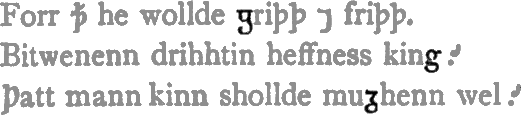
The printed linenotes almost always use yogh (ȝ) for insular g (ᵹ).
Manuscript: Junius 1, Bodleian Library, Oxford: an oblong folio, written in double columns on 118 leaves of parchment varying considerably in size, the largest being 508 × 200 mm.; about 1210 A.D., and an autograph, but corrected by a second and third hand. See further Holt, i. p. lxxvi.
Facsimiles: Skeat, W. W., Twelve Facsimiles, plate iv. Palaeographical Society; Second Series, plate 133. Napier, A. S., Notes on the Orthography of the Ormulum, Oxford, 1893, also in History of the Holy Rood-tree, E. E. T. S., O. S. 103.
Editions: White, R. M., Oxford, 1852. Holt, R., 2 vols., Oxford, 1878. Extracts in Mätzner, Sweet’s First Middle English Primer, 48-81, Emerson and other Readers.
Literature: The Author: Logeman, H., Archiv, cxvii. 29; Björkman, E., Archiv, cxix. 33, cxxiii. 23; Bradley, H., Athenaeum, May 19, 1906; Wilson, J., ibid., July 28, 1906; Phonology: Blackburn, F. A., The Change of þ to t in the Ormulum, American Journal of Philology, iii. 46; Bülbring, K. D., Die Schreibung eo im Ormulum, Bonner Beiträge, xvii. 51; Callenberg, C., Layamon und Orm nach ihren Lautverhältnissen verglichen, Jena, 1876; Hale, E. E., Open and Close ē in the Ormulum, Modern Language Notes, viii. 37; Kaphengst, C., An Essay on the Ormulum, Elberfeld, n. d.; *Lambertz, P., Die Sprache des Orrmulums, Marburg, 1904; Menze, G., Der Ostmittelländische Dialekt, Strassburg. diss., Cöthen, 1889; *Napier, A. S., as above; Grammar: Funke, O., see p. 450; Sachse, R., Das unorganische e im Orrmulum, Halle, 1881; Thuns, B., Das Verbum bei Orm, Leipziger Diss., Weida, 1909; Weyel, F., Der syntaktische Gebrauch des Infinitivs im Ormulum, Meiderich, 1896; Zenke, W., Synthesis und Analysis im Orrmulum, Götting. Diss., Halle, 1910, completed in Morsbachs Studien, no. xl; Consonant Doubling: Björkman, E., Orrms Doppelkonsonanten, Anglia, xxxvii. 351 (good summary of previous literature); Effer, H., Einfache und doppelte Konsonanten im Ormulum, Anglia, vii, Anzeiger, 166; Holthausen, F., Wel und well im Ormulum, Anglia, Beiblatt, xiii. 16; Trautmann, M., Orm’s Doppelkonsonanten, Anglia, vii, Anzeiger, 94, 208, Anglia, xviii. 371; General: Brate, E., Nordische Lehnwörter im Orrmulum, Paul-Braune, Beiträge, x. 1, 580; Deutschbein, M., Die Bedeutung der Quantitätszeichen bei Orm, Archiv, cxxvi. 49, cxxvii. 308; Kluge, F., Das französische Element im Orrmulum, ES xxii. 179; Kölbing, E., Zur Textkritik des Ormulum, ES i. 1, ii. 494; Monicke, C. H., Notes and Queries on the Ormulum, Leipzig, 1853; Reichmann, H., Die Eigennamen im Orrmulum, Göttingen, 1905, and as no. xxv of Morsbachs Studien; Sarrazin, G., Über die Quellen des Orrmulum, ES vi. 1.
Phonology: Orm supplemented the current graphic methods by devices of his own. Thus he systematically doubled a consonant after a short vowel in a closed syllable, so tunnderrstanndenn 109. Whether he meant thereby to indicate shortness of the vowel or length of the consonant is disputed. The latter view seems the more probable; the difficulty which is presented by the occurrence of the doubled consonant in unstressed syllables, where it is short in ordinary speech, is removed if, with Björkman, we suppose that the phonetist isolated his syllables in testing their value. Where the consonant after an open syllable is in fact short, Orm often places a breve over the preceding short vowel, as wĭtenn 3, tăkenn 40, wăke 76, 82, 105, hĕte 87, hĕre 123, but fails at times, as in sune 20, wake 56, here 114, 143. Likewise he uses very seldom an almost horizontal accent to indicate vowel length, as á 174, but more frequently, as if to emphasize his warning against possible error, doubles it, as le̋t, fe̋t 10, ha̋t 37, űt 53, &c., or even for greater insistence trebles it, as clū̋t 2, ȝē̋t 39, mostly before final t. Here, too, he is not systematic, thus time 115 has a single mark of length twenty times elsewhere, and words like ut have sometimes two, sometimes three accents.
Furthermore, Orm invented a special symbol with a flat top projecting on both sides for the guttural stop g, reserving the continental g for the dzh sound in such words as egge (edge), leggen, seggen: the latter occurs in this extract only in gluternesse 167, and that by mistake. In his representation of late OE. eo, ēo, the author hesitated between eo and e, preferring the former at the beginning, but gradually increasing the use of the latter, so that it becomes normal in the last third of the work and invariable in the Dedication and Preface, which were, no doubt, written last of all. He then appears to have aimed at uniformity by scraping out, not always effectually, the o wherever he had written eo, which was restored in many instances (but apparently not in this extract) by a later scribe in a fainter ink and thinner letter. Holt, by printing eo wherever it once existed, fails to represent the actual state of the manuscript: in this extract o is still visible, though partly erased, in heore 56, heoffness, leome 57, þeossterrnesse 65, deofless 67, heoffness, leome 70, heoffness 77, mildheorrtnesse 78, heoffness 107, 113, deofless 126; everywhere else it is completely erased. Finally, heffness 174 is so written without erasure in a line added lengthwise on the margin, perhaps from the following leaf, which is now missing and may have been withdrawn by the author. It is generally held that Orm employed eo and e to represent the same sound, the former being a traditional spelling. This is unlikely on the part of a determined phonetician like Orm, who would naturally be impatient of traditional spellings. Much more probable is Bülbring’s view that Orm spoke a mixed dialect, in which an [ö] sound existed beside the [e] sound, and that he finally decided for the latter.


Oral a is a, acc 3, habbenn 51; a before nasals a, grammcunndnesse 86, ‘năme’ i. 9717; a before lengthening groups a, faldess 56 (fal(o)d), hande 10, sang 131, but short in annd 114, unstressed, stanndenn 67, 117: the indefinite pronoun is mann 36. æ is a, affterr 21, fasste 59, wăke 76; ꝥat 46 was probably meant for þatt: wrecche 4 (4 times), wrecchelike 24 is OE. wrecca. e is e, cwellen 38, hĕre 123, hĕte 87, sett 146, but se̋tt 68 (probably miswritten), stressed wel 34 (13), qualifying a verb, and in most cases at the end of the first half-line, beside well 29 (4), qualifying adjective or adverb; e before lengthening groups is e, ende 113, genge 129, but short are senndeþþ 62 and enngle 15 (10), with a consonant after the lengthening group: whillc 152, iwhillc 134, 161 represent hwilc, gehwilc, swillke 69, swilc. i is i, cribbe 2, friþþ 133, inn 2 &c., mikell 93, wĭtenn 3 (Orm divided wiþþ utenn 113), but in 170: i before lengthening groups is i, bindenn 10, child 4, shildenn 67, 126, but brinngenn 18, sinndenn 74, 169, winnde clū́t 2, 7. o is o, follc 30, biforenn 16; before lengthening groups o, unorneliȝ 45, worde 60, but short are wollde 5, forrþrihht 1 (usually forþ uncompounded): o is u in wurrþenn 33, 48 (worden) by analogy of the infinitive. u is u, stunnt 27, vnnorne 4; before lengthening groups u, sungenn 131, tunge 119, wundenn 7, but short are hunngerr 37, unnderrstanndenn 109, wullderr 132, wunnderrliȝ 35. y is i, dill 27 (*dyll), gillteþþ 155, ifell 64, þrisst 37, wrihhte 151; before lengthening groups, kinde 108, but birrþ 3, 44.
ā is a, á 174, lare 79, whas 90; before two consonants a, bitacneþþ 100, gast 73: shortening in hallȝhe 69: swā is usually swa 17, but se 1 (swē). ǣ1 is æ, hæþenndom 161, læreþþ 73, sæ 12; before two consonants æ, næfre 41, unnclænnesse 161, but a in aniȝ 157 (ānig), lasse 39, mast 169 (North. māst). ǣ2 is mostly æ, færedd 84, 91, lætenn 45, 54, þær 19 (4), wæde 8, wære 17 (3), wærenn 58 (3), but e in greditleȝȝc 167, and with shortening fordredd 88 (4); before two consonants æ, wæpnedd 90, and e with shortening, sellðe 95. ē is e, betenn 158, eche 19, fe̋t 10, le̋t 10, but o in doþ 29 &c., from the plural. ī is i, bliþe 85, pinenn 36, riche 5 (4); before two consonants i, crist 1, 90, cristenndom 49, but elsewhere usually crisstendom. ō is o, dom 75, god 71; before two consonants o, frofrenn 60, 66: shortened in comm 26, 30, 55, soffte 85. ū is u, brukenn 174, -clū̋t 2, űt (numen) 53; shortened in vpp 18, 142, uss 3, 62. ȳ is i, bisne 43 (bȳsne), grisliȝ 91 (*grȳslig), kiþenn 92, litell 21 (3), shrideþþ 6.