The Foreign Mail Service at New York By E. G. Chat
Reading edition
"Steamer's mail!!!" This loud call, echoing throughout the foreign room in the Post-office Building, is the equivalent of the "Clear ship for action" on the man-of-war. Instantly distributors leave their separating cases, stampers abandon their "blocks," the electric stamp-cancelling machine temporarily ceases its humming, buzzing rattle, every available clerk or porter gets ready for the fray, and the whole force charges with alacrity on the fast accumulating pile, as sack after sack is dumped on a low, large table, at times entirely hid from sight by bags with labels indicating their origin, thousands of miles away, whether from the confines of Siberia, or the shores of the Indian Ocean.
The sight, even to men familiar with the work, is inspiring, especially when at times two, and on certain occasions three, steamers land their cargo of sacks at the same hour. Not infrequently this happens when some one thousand and odd sacks have to be made ready for an outgoing steamer, and then the foreign force is fairly on its mettle, and may well be compared again to the crew of a battle-ship when it has to fight fire inside and fire from the enemy outside. Here again, as on the battle-ship, organization and years' training tell. The wagon-loads of sacks melt before the vigorous and steady onslaught as did the Spanish fleet before Dewey's guns, and in a short while the room is cleared and the "field-day" over.
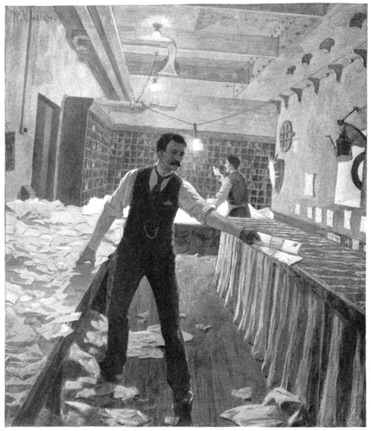
Sea Post-office Room.
One clerk empties the sacks, and throws the letter packages to another clerk at the case while he distributes the papers into the sack rack.
It would be difficult, in this great cosmopolitan city of New York, to find a person who does not make use of this foreign service, yet strange to relate is the fact that, outside of the clerks immediately handling these mails, hardly anyone can be found who knows, or even has the slightest idea of the International Postal Union system. Perhaps this is accounted for by the comparatively very recent establishment of said system, and its growth so immediate and rapid that the public has not so far "caught up" with it.
The system was aptly described by Postmaster-General Gary at the opening of the Washington Postal Congress, in 1897, as "one of the grandest projects of the century." No other agency is responsible to such an extent for the tremendous expansion of great ideals and the exchange of views between nations characteristic of the last quarter of this century.
Previous to 1875, when the Treaty of Bern, assented to and ratified by twenty-two nations, took effect, the exchange of mails between separate nationalities was done under such difficulties, and subject to delays and mishaps of so many kinds, that a normal growth and improvement in keeping with the progress of civilization was out of the question. In 1840 the foreign mail from England for the United States, carried on the Great Western, consisted of two sacks of mail. As late as 1873 a steamer from Europe with 20,000 letters on board was considered a record breaker. To-day the Cunard steamers and other transatlantic ships carrying what is called a "full European mail," usually bring some two hundred thousand letters, and an average of three hundred sacks of newspapers and printed matter for New York City, not to mention the five hundred and odd sacks for Canada, Mexico, and transpacific countries, and a few United States exchange offices, which are now taken direct to the trains and not handled at the New York office.
The working unit of the International Postal Union system is the "Exchange Office." Each postal administration selects these despatching and receiving centres according to quantity of mail handled at any particular point. In European countries many of these offices are on trains from one important point to another, and are called Travelling Exchange offices. They receive and despatch mails in the same manner as offices located in large cities. There are also exchange offices located on steamship lines, and they are called Sea Post-offices. No matter where located, these offices all conduct business on the same lines, and handle mail in the same manner throughout the world. The rules and regulations of this service are adopted by Postal Congresses, meeting about every six years and under the general supervision of the International Bureau of the Postal Union located at Bern, Switzerland, and supported by funds from all governments represented in the Union according to the respective importance of their mail service.
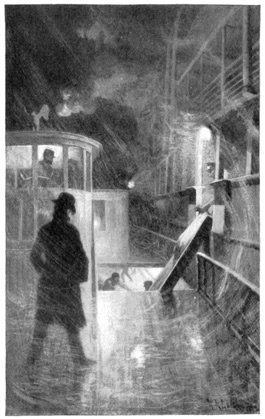
Transferring Mails from an Ocean Greyhound to the Post-office Boat, Postmaster General, through the Chutes.
Only through these exchange offices can correspondence go from one country to another, as no other offices are provided with the clerical force and system necessary to the handling of international mails. It is at times difficult to explain to business people that a North German Lloyd steamer calling at Gibraltar and Naples will carry mail for Naples only, and that a letter addressed to Gibraltar by that particular steamer cannot be delivered at that port, but will be carried all the way to Naples, whence it will be re-despatched to Gibraltar through a more or less circuitous route. This is because Gibraltar is not an "exchange office" with New York, and "closed mails" are not sent thereto from New York. A "closed mail," as the name indicates, is a mail duly tied up, sealed, and labelled with the name of the exchange office to which it is sent, and not to be opened until it gets there, passing sometimes through four or five countries before reaching its destination. No other kind of mails is carried by steamers, yet the answer will often be made to inquiries, that a certain letter would have been sent "in open mail" to London or elsewhere. This does not mean that the mail in which the letter in question would be sent is despatched "opened," but that it is sent in the "closed" mail for London, there to be opened and disposed of by the London clerks, just as if it had been mailed in London. This course is followed with all correspondence for offices abroad, or even entire countries, which is not in sufficient quantity to justify the establishment of an exchange; and the mails for these offices or countries is sent to the foreign exchange office with the best facilities for disposing of it. Thus mail for Liberia will be sent sometimes to Hamburg, Germany, and at other times to Liverpool, England.
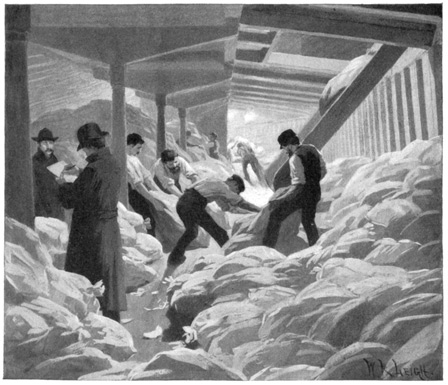
On Board the Postmaster General, at the End of the Chute—Receiving, Piling, and Checking Off Sacks.
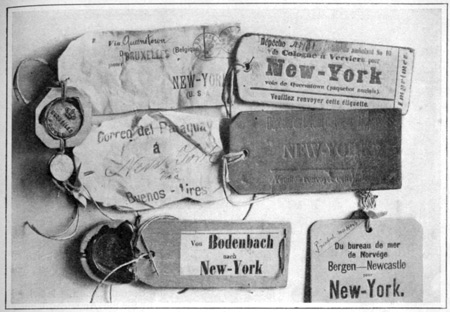
Some Sample Labels from Abroad.
Belgian label—string made fast through wooden block with wax seal and a second block of compressed lead. Paraguay label—plain linen. Austrian label—wooden block, string sealed with wax. German white leather label. Argentine label—strong, ordinary leather. Norwegian label—cardboard—string sealed on back with wax.
A closed mail consists of ordinary letters, printed matter, and other articles, and of registered articles. Sometimes all these elements will be enclosed in the same sack, or they may be despatched in separate sacks, when in sufficient quantity. The registered mail is tied up and sealed in distinctive red-striped sacks, and then these sacks are enclosed in ordinary mail-sacks, tied up and labelled in exactly the same manner as the sacks containing ordinary letters, so that it is impossible to tell from the outside which sack contains registered matter. A mail may consist of one sack only, containing all classes of correspondence, or it may be composed of a large number of sacks. In either case it is accompanied by a letter bill, enclosed in one of the sacks. This letter bill is one of a series beginning on January 1st of each year, being numbered with consecutive numbers to each foreign exchange office. Thus when Naples receives a mail from New York containing the letter bill numbered 65, and the previous mail received at that office had Letter Bill No. 63, Naples knows that mail with Letter Bill No. 64 is missing, and immediately notifies New York of the fact in a form called "Bulletin of Verification." This form is in use for official correspondence between all offices in the Postal Union regarding irregularities of all sorts discovered in the mails of one office for another. A record of the number of each mail and the particulars of its despatch being kept by each office, the inquiry from Naples in the above instance would immediately be investigated, and that office notified that the missing mail had been sent on such a date, by such a steamer, etc.; or, if more was known concerning its fate, as in the case of the mails sent per La Bourgogne last July, mention would be made of the fact. The Russian travelling exchange office of Kibarty to St. Petersburg frequently receives the mails sent from this office every Wednesday in inverted order, that is, the mail sent by a fast White Star liner at noon on Wednesday, may be received a few hours ahead of the mail sent by a slower American line steamer which sailed at 10 A.M. on the same day. The occurrence is so often repeated that one would think it would go unnoticed, and the Russian office would wait a few hours anyway before notifying New York that a mail is missing, but such is not the case, and the bulletin "Your mail No. —— is missing," is immediately sent to New York, followed next day by another bulletin, "Your mail No. —— has arrived." At the New York office the first bulletin is always held until receipt of the second, which is sure to follow and renders investigation unnecessary; they are called "Katie didn't," and "Katie did." Many bulletins are received subsequent to the holidays with best wishes for Christmas or New Year from one office to another. They are mostly all in English, French, or Spanish, and are, at times, more or less humorous, if not pathetic, as was one received from Martinique about the time Cervera's ill-fated fleet was hovering near that island. A mail from New York had just been received at St. Pierre, and in one of the sacks the horrified French Director of Posts had found a cat in the last stages of decomposition. He had sent for the American Consul to view the remains, and his bulletin to the New York office regarding this irregularity was a model of official French. It stated how the smell of that dead cat had penetrated every corner of his office, and one could read between the lines that he suspected the whole affair to be a joke played upon him by the Yankee postal clerks. The event was duly investigated in the New York office, but beyond the fact that one member of the numerous pussy tribe in the mail building was missing, little else could be positively ascertained. That the cat could have been sent in that bag as a joke was not to be thought of for an instant, but it was presumed that in its wandering among the piles of mail-sacks in the basement, pussy had found the sack for Martinique awaiting to be sealed, and had concluded to take a nap therein. The sack was probably tied up and sealed soon afterward, and the unwilling stow-away had been sent to the steamer. Later on it was reported by the purser of the steamer that he suspected there was something alive in one of the mail-bags, but such is the respect for postal seals that he never thought to open the sack in the presence of witnesses and release the animal. Thrown in the mail-room with other sacks on top of it, there could be no doubt that poor pussy had been smothered before passing the Hook, and his condition when landed at Martinique must have been such as to fully justify and explain the ill-disguised indignation of the French officials.
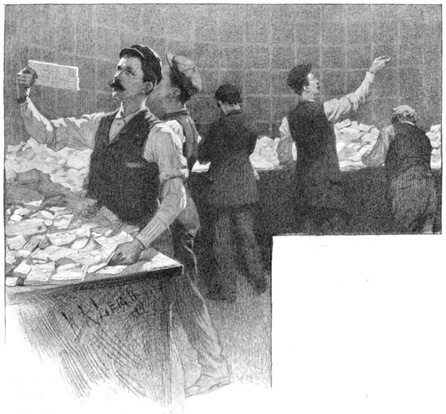
In the Newspaper Division.
Throwing papers into boxes for all parts of the world.
The letter bill describes minutely the mail it accompanies, states how many sacks of letters, how many sacks of papers, and how many articles registered, describing each registered article separately, except in cases of heavy registered mails, when a separate descriptive list is sent in addition to the letter bill. Thus it is easy for the office of destination to verify the mail it receives and ascertain whether any is missing.
Small closed mails are at times enclosed inside of closed mails for other offices; for instance, the mails made up at Paris for Guatemala are in a sack duly sealed and labelled as aforesaid, but this sack is put inside of one of the bags for the New York office, and in such cases the fact is noted on the letter bill sent with the New York mail.
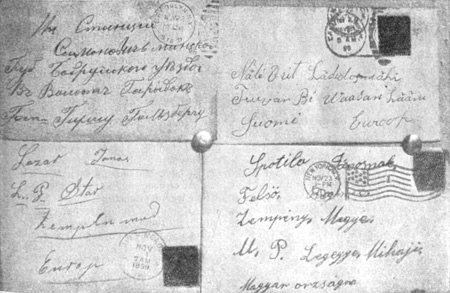
Samples of Ordinary Letters.
For Government of Simbursk, Russia. For Finland. For Hungary.
The business of the foreign clerks when a foreign mail is received in the manner described in our first lines is to open promptly every sack received, inspect and dispose of contents, and report to the chief clerk the result from each sack thus opened. Each clerk takes hold of one of the sacks piled on the table, and throws it on another table used for opening the mails. He cuts open the fastenings, keeping the label separate, and also the letter-bill, if he happens to find it in the sack; if several classes of mail matter are found therein, he pushes the ordinary letters over to one side, sweeps the newspapers into large four-wheeled baskets near by, takes to another place the smaller enclosed mails addressed to other offices, and lays the registered sack on the chief clerk's desk, where a man from the registry division will receive it and give a receipt for it. The clerk then calls out to the chief clerk the result of his examination, "Lisbon-Reg.-Bill and 1 Honolulu"—which means that in the sack just opened he found the mail from Lisbon for New York with the letter-bill, registered articles and a smaller closed mail for Honolulu. Like the rattle of musketry these calls are fired at the chief clerk, who marks everything on a tally-sheet, which will later on be compared with the advices received from the foreign offices on each letter-bill; and if any discrepancy is found it will be investigated, resulting in a bulletin of verification to office of origin, or in something worse for the foreign clerk who made an erroneous announcement of the contents, if the fault is laid to him. In a few minutes, sometimes an hour or more, an entire mail is opened and the room cleared, the registry man getting away to his department with all the registered mails, and the newspaper force wheeling away the baskets full of newspapers and packages. The letters are then divided into four parts—those for New York City proper, those for the rest of the United States and Canada, those for foreign countries which have been sent in open mail to New York, and those which are unpaid or partially prepaid. Many foreign offices make a separation of the mails for New York City from those for other places, but this is a matter of accommodation and reciprocal arrangements between exchange offices; and the work of separation is, strictly speaking, that of the foreign clerks in any office. The newspapers are treated in the same manner as the letters. All city mail is then sent to the city department for final distribution and delivery, and that for other parts of the United States and Canada is sent to the domestic mail division for despatch. All letters and mail addressed to other countries are retained in the foreign division, and included in the next mail for these countries. The unpaid and short-paid mail is "rated up" before delivery to other divisions. This mail is put up under distinctive labels. The despatching offices have marked on each article the amount of deficiency in prepayment. No matter where originating, this amount is marked in French money (centimes). The letter "T" (initial of French word "tax") is also stamped on covers. The foreign clerks at the receiving office calculate, in the money of their country, the amount of deficiency and double it up, stamping this charge on the covers for collection by office of delivery.
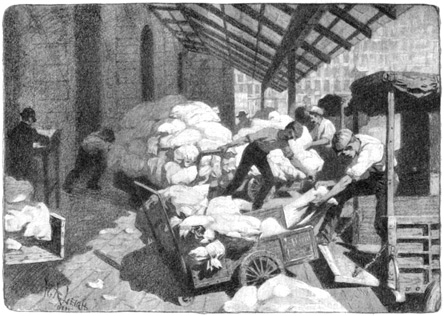
Despatching a Mail—Sacks Loaded on Trucks.
Despatching clerk, on the left, tallying off mails, sack by sack. Foreign mails are delivered to trucks sent by the Steamship Companies and are receipted for at the door of New York Post Office.
This work, and also that of separating New York mail and mail for the principal States and cities, is done by the sea post-offices in steamers of the North German Lloyd, Hamburg-American, and American Lines; and when mails are received by either of these steamers they are ready for delivery in a much shorter time than when received by other vessels. In addition to the sea post-office service, the transfer service has also in the last two or three years materially reduced the work at the foreign department in the New York office.
No sooner has the "ticker" reported the Campania or other big liner "off Fire Island" than a veteran of the transportation department, accompanied by a few clerks and porters, hastens to the foot of Cortlandt Street and boards the Postmaster-General, the flag-ship of the post-office fleet. The boat was built for this service, and is equipped with spacious mail-rooms, chutes for transboarding sacks, and other expediting appliances. Steam is up, and she is off down the bay to meet the big steamer. She makes fast to her sides, and the mails are received aboard through the chutes, while the clerks check and verify the number received on a sort of invoice called "way bill," prepared by the London, Havre, or sea post-office. Frequently the passengers are still awaiting the quarantine doctor while the mails are speeding on their way to the Battery, where the New York City sacks are landed; then to the Pennsylvania Railroad, then to the foot of Forty-second Street, where wagons await the mails for the Grand Central Depot. Thus a great saving in time is often made, while formerly the whole mail went first to the docks of the several transatlantic lines, then by wagons to the General Post-Office, then again by wagons to the different depots. When the mails are handled by sea post-offices during the sea-trip, they generally arrive ready for the trains, and little but what is for New York City proper comes to the general office; but the large and heavy mails on the Cunard and White Star Lines, also on the French Line, are not thus assorted, and fully two-thirds has to come to the foreign division to be handled as previously described.
We have explained to a great extent so far what seems to pertain to the incoming mails only; but we said at the start that the foreign mail is worked throughout the world in every exchange office very much after the same pattern, and it will now be easier to explain the handling of mail going from the United States to other countries. There are in the United States several exchange offices besides New York, but, with the exception of New Orleans and San Francisco, the mails they make up consist only of matter originating at each of these offices. Mail for some of the Central American republics is sent to New Orleans, and mail for transpacific countries goes mostly to San Francisco. All other mail, no matter where dropped in the letter-box, comes to the New York office through the instrumentality of the Railway Mail Service. Letters for abroad are tied up in bundles, and labelled "New York Foreign." Some of the railway mail offices make a preliminary separation by countries, and many bundles reach New York labelled "Russia," "Switzerland," etc.; but as there are many exchange offices in these foreign countries, these bundles have again to be opened at New York, and assorted, although this first separation facilitates the process. The bundles are cut open, and the letters are all passed through the electric machine or stamped by hand, the "back-stamp" thus impressed showing their date of arrival in New York.
This is not done with letters originating in New York City, the date and time of mailing being in that case shown in the stamp-mark cancelling the postage-stamps, and being held sufficient for records. The mail having been "back-stamped," goes on a low shelf in front of each distributor, and is then assorted according to destination. The "separating case" consists of nine rows of boxes, ten boxes in each row. Many of the boxes bear the names of exchange offices in Europe or those reached by steamers for Europe. There are also boxes for other parts of the world, in which letters are deposited to be later on taken to another special "separating case" for these countries. In each separating case there is a box where unpaid or short-paid letters are deposited. A special clerk takes them out, weighs them, marks thereon the deficient postage, and stamps them "T," when they are assorted on a separate case and tied up in bundles under labels indicating that the contents of the bundles consist of short-paid mail. They go in the same sacks as ordinary letters. When a box bearing the name of an exchange office is full (about one hundred and fifty letters), the contents are taken out, divided into two parts, the largest letters being laid across both parts, and the whole is tied up in a sheet of strong manila paper. String is not spared in this process, and so securely and strongly are these packages tied that they have been known to remain in the water for days and weeks at times, and when found, with the exception of the top letters and the edges, they were yet in a condition to permit delivery to persons for whom they were intended. Many people, no doubt, some weeks after the Elbe disaster, remember having received letters with a paster attached, stating that the letter had been found in the North Sea, in a bag originating in Norway and sunk with the Elbe. This was the only sack of mail ever recovered from that steamer. The same was true of the mail recovered from the Oregon, sacks being found far down the Jersey coast days after the wreck of that steamer, and forwarded to New York, where, after being dried, most of the letters were found to be deliverable.
The package thus wrapped and tied is labelled with the printed name of the exchange office for which its contents are intended, and thrown into a large basket. When the basket is full, it is wheeled over to the pouching rack, an iron frame divided into sections, each section bearing the name of an exchange office, and provided with four hooks which hold open a mail sack. The pouching clerk takes the packages of letters, reads the labels thereon, and throws them into the proper sack. When full (about seventy-five pounds), the sack is taken down and ready for tying and sealing up. The last sack taken down receives the letter-bill for the exchange office of destination. The sack is tied, and a label bearing the name of the office for which it is destined is inserted in the string. After several turns have been taken, both ends of the string are passed through the holes at the bottom of a small tin cup which is subsequently filled with hot wax, so that the string cannot be removed without its being cut open (see illustration on page 71). In this country labels made of good Holland linen are used fresh for each sack. In other countries other material is employed, some using leather, some wood, some strong cardboard. The return of labels of any value is generally requested, and they are used over and over until worn out. Great Britain does not use labels of any kind, but has the address of each sack stencilled on the sack itself, thus: "London for New York." This, of course, renders the sack useless for any other service. In the United States the labels are white for letter sacks, buff for papers, and cardinal red for registered mails.
The newspapers are assorted in the basement of the Post-office, very much in the same fashion as letters, but they are not tied up in bundles. The separating cases into which they are thrown are so made that a sack hanging at the lower end of the box receives the mail thrown therein, and when full, it is ready for tying, labelling, and sealing up. In this department are received the queerest odds and ends going through the mails to foreign countries, newspapers especially being selected to hide in their folds sundry articles of every description sent to friends "in the auld country." Jewelry, from the penny kind to really valuable articles, handkerchiefs galore, baby's dressing outfits, rattlesnake skins, plugs of tobacco, cucumbers—these and many other curios of every description are found and stopped. If the address of the sender appears on the package, it is returned to him direct. Otherwise it goes to the Dead Letter Office, where it is kept a certain length of time awaiting to be claimed. The unclaimed part is finally sold at auction.
In the letter department there are also curiosities, but of another kind. The greatest part of the letters addressed to Santa Claus in Greenland, or other Northern lands, are treated by the foreign clerks. There are also many mysteries to be unravelled in the queer hieroglyphics which are supposed to be the addresses of letters, especially those going to Russia, Turkey, Hungary, and even Italy. Clerks of the foreign department are not linguists; but the same characters recurring so constantly soon appear familiar, and they experience no trouble in "boxing" the letters to the proper office.
When a mail has closed, no more letters or papers are put in the assorting boxes, but everything that was there is taken out, tied, labelled, and sacked. The letter-bills are then prepared, and after all the sacks are sealed the way-bills are made up in duplicate copies. A full European mail via Queenstown or via Southampton averages nine to twelve hundred sacks, fully two-thirds of which have been made up in the New York office. The way-bill describes this large mail only as so many letter-sacks and so many paper-sacks from the New York office, or the Chicago, or other office of origin, for Paris, or for Dublin, etc., and when the steamers land the mail at its port of arrival, the way-bills are used to check and verify the number of sacks landed. One copy of the way-bill is returned to New York with a receipt from the official at the port of destination, and the responsibility of this office for the mails ceases. Their further transportation will be the business of the administration which has received them.
The Parcels Post system is also taken care of by the clerks of the foreign department, but as it is a system based on special conventions or agreements between any two countries, it is not within the sphere of an article relating to the international mail service as regulated by the Postal Union Conventions. The exchange of large parcels, however, as well as of ordinary correspondence, is one of the improvements which remain for future postal congresses to introduce in the system. At present, the United States parcels' post exchange is confined to the West Indies, Central America, Mexico, Hawaii, and Newfoundland. Ordinary merchandise not exceeding eleven pounds can be forwarded under that system for twelve cents a pound.
The general supervision over all American exchange offices is centred in the Office of Foreign Mails, in Washington, but the fact that over ninety per cent. of foreign mail matter is handled, or passes through the New York office would make exceedingly advantageous, especially for business interests all over the country, the transfer to New York of the supreme direction of that service. Many times questions have to be decided and steps taken at short notice, delay being the great bugaboo of postal officials, and in such cases constant and daily touch with a system ever increasing and improving would be of incalculable benefit. The New York force, however, is so well trained, its superintendents and clerks are so completely acquainted with every detail of the system, that so far the business world has not suffered from the present arrangement. It certainly has not gained. A flattering testimonial of this efficiency of the New York foreign force is found in a report to his government of the New Zealand Postal Agent residing at San Francisco and in charge of the important British-Australian Mail Service. "I find," says he, "that the New York officials are extremely anxious to make the best connections and are indefatigable in their efforts to expedite the transfer of mails. Messrs. Maze and Boyle,[1] Superintendent and Assistant Superintendent of mails in New York City, are particularly energetic and watchful, and no stone is left unturned at that office to further our interests in that direction, and the mails are often transferred to tugs and sent after the Atlantic liners when late."
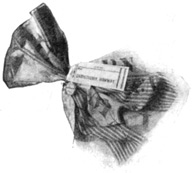
United States System of Tying, Sealing, and Labelling Sacks.