DANIEL WEBSTER WITH UNPUBLISHED MANUSCRIPTS AND SOME EXAMPLES OF HIS PREPARATION FOR PUBLIC SPEAKING By George F. Hoar
Reading edition

In one respect Daniel Webster is the most striking figure in our history, and one of the few most striking figures in all history. That is, in the impression he made on everybody—that, great as were his achievements, he was himself greater than his greatest achievement.
Franklin, Webster, and Emerson are the three great New Englanders. Each of them was a great public teacher. If Webster did not lack, at least he did not manifest, Franklin's wonderful common-sense, as applied to common things and common life. He had not Emerson's profound spiritual discernment or wonderful poetic instinct. But his intellect seems like a vast quarry. When you have excavated the great rocks at the surface, you know there is an inexhaustible supply left. When he died, the people felt as if the corner-stone of the Capitol had been removed; as if the elephant had died that bore the universe on its back.
Emerson's portraiture of Webster at Bunker Hill is made up of a few strokes. But it reveals the whole secret. Great as were the things that Webster said, profound as was his reasoning, lofty as are the flights of his imagination, stirring as are his appeals to the profoundest passions of his countrymen, there is a constant feeling that Jove is behind these thunderbolts. That is the contrast between him and so many other orators. Even in Choate and Phillips you are admiring the phrase and the elocution, and not the men. In Webster you are thinking of the man, and not the phrases. The best things that he said do not seem to his listener to be superior, and rarely seem to his listener to be equal, to the man who said them. There is plenty of reserve power behind—
... Half his strength he put not forth, but checked His thunder in mid-volley.
Emerson also said of him, "His strength was like the falling of a planet; his discretion, the return of its due and perfect curve."
Nothing certainly can be more profitable for youth who desire to cultivate the capacity for public speaking for the purpose of addressing juries, legislative bodies, or popular assemblies, than the study of the style, the delivery, and the method of preparation of him whom nearly all his countrymen think the foremost American orator, and whom many of them think the foremost orator who ever spoke the English tongue. Many admirable critics have dealt with these topics.[2]
Mr. Winthrop has told,[3] in his own delightful way, the story of one of Webster's compositions, famous at the time, now almost forgotten.
Mr. Winthrop says also truly of Daniel Webster:
"Daniel Webster, unlike Everett or Choate, was all deliberation, both in matter and manner. I do not believe that it ever occurred to him what gestures he should make, or that he ever remembered what gestures he had made. His words seemed to flow spontaneously and often slowly, whether from his lips or his pen, as from a profound and exhaustless reservoir of thought. Of him it might be, and perhaps often has been, said:
"... Deep on his front engraven Deliberation sat, and public care."
He says of Webster's eloquence that it was the eloquence of clear, cogent argument, and of occasional deep emotion, expressed in clear, forcible Saxon words—sometimes adorned by most felicitous quotations and sometimes by magnificent and matchless metaphors.
James Parton says:
"He discovered, he says, that the value as well as the force of a sentence depends chiefly upon its meaning, not its language, and that great writing is that in which much is said in a few words, and those words the simplest that will answer the purpose. Having made this notable discovery, he became a great eraser of adjectives, and toiled after simplicity and directness."
Edward Everett, who knew Mr. Webster very intimately, says:
"Perhaps the noblest bursts—the loftiest flights, the last and warmest tints of his discourses of this kind—were the unpremeditated inspiration of the moment of delivery."
I suppose, from all I can gather, that Mr. Webster, with very few exceptions indeed, committed to writing nothing but the heads of his speeches. But they were, nearly all of them, upon subjects constantly in his thoughts. He had undoubtedly matured sentences and phrases which came to his mind in leisure moments, and which came to his memory under the stimulant of great occasions and great audiences, in addressing juries or public assemblies or the Senate, with which he ornamented his discourses, or strengthened his argument. Most of the speeches we have only as they came to us in the imperfect reporting of the time. Some of them, like the oration at Plymouth, he probably revised carefully before they were published. We have his own testimony that this was true of the well-known "morning drum-beat" passage in the speech on the President's Protest.
Still, the testimony is abundant that some of his best passages must have come from an inspiration while he was upon his feet. Mr. Winthrop gives an account of one; Mellen Chamberlain, a most accomplished critic and observer, another. And there are plenty of others floating about. Judge Chamberlain says one thing of him, which I dare say may have been said before and since. It explains Webster's influence over his auditors and over posterity. He says:
"He was perfectly sane, and it may be the most perfectly sane orator who ever spoke English."
I have in my possession a good many of Mr. Webster's manuscripts, including his preparations for speeches, letters from him to intimate friends and from his intimate friends to him, a good many bound volumes of political pamphlets, some of them with the autographs of famous authors, and some of his books. From these I select a few which relate to important and interesting events in his life, or throw some additional light upon his habit and method of preparation for public speaking, adding some explanation and comment.
One of the greatest debates in our parliamentary history, only surpassed in importance in Mr. Webster's public life by the debate with Hayne on Foot's Resolution and the debate on the Compromise measures in March, 1850, is the debate on the Sub-Treasury in the early part of the year 1838. Silas Wright introduced the Sub-Treasury Bill January 16, 1838. January 30, 1838, the bill came on for a second reading, and Mr. Wright made an elaborate speech in its support. The next day Mr. Webster spoke. His speech, which is wholly a reply to Wright, makes no allusion whatever to Mr. Calhoun. It is reported in the fourth volume of his works, page 432. I have before me Mr. Webster's notes of preparation for that speech. They constitute a mere brief, all included on six pages of letter-paper, and mostly consisting of mere catch-words. The first sentence or two, however, indicate the difference between Webster and the supporters of the Sub-Treasury:
"Let the government attend to its own business; and let the people attend to theirs."
"Let the government take care of the currency for its own revenue; for all other purposes, let it leave it to the States and to the people."
"Ominous and disheartening sentences. Yet the whole spirit of the Administration and of this bill."
There is no hint in these notes, except the above, of any of the eloquent and weighty sentences with which the speech abounds.
February 15, 1838, Mr. Calhoun spoke on the Independent Treasury Bill. (See, for this speech, his Works, vol. 3, page 202.) He makes an allusion to one of Mr. Webster's arguments, viz., his claim that the government should furnish paper currency. But the speech contains nothing personal or calculated to excite challenge and reply. March 10, 1838, Calhoun makes a second speech on the same bill (reported, Works, vol. 3, page 244). That speech, also, contains hardly any allusion to Mr. Webster. It is devoted almost wholly to a reply to Clay, between whom and Calhoun a very angry personal altercation had arisen. March 12, 1838, Mr. Webster delivered his second speech on the Sub-Treasury, which is reported in his Works, vol. 4, page 424. It occupies seventy-six pages there. Of this, the last thirty-three are a reply to Mr. Calhoun. Calhoun said in his answer, which was made on the 22d of the same month, that Webster delivered this part of his speech with great vehemence, and evidently considered it the most important portion of his remarks. So much of the speech as is a reply to Mr. Calhoun, however, deals chiefly with a speech made by him at the extra session in September, 1837, and with a letter known as the "Edgefield Letter," written by Mr. Calhoun to his constituents in the vacation. I have Mr. Webster's entire preparation for this speech. It is in Webster's handwriting, and consists of eight heads, all on one page of a sheet of small note-paper, labelled on the back, in Webster's handwriting, "Heads of my speech on the Sub-Treasury," and is as follows:
"No. 1. General state of the country and credit system."
"No. 2. Our pecuniary condition and question of excess."
"No. 3. Is the measure suited to the condition of the country?"
"No. 4. Is it a just exercise of our powers?"
"No. 5. Mr. C.'s speech, September 19."
"No. 6. Mr. C.'s letter, November 3."
"No. 7. Mr. C.'s speech, February 15."
"No. 8. Identity of commerce."
Besides this, Mr. Webster wrote out the concluding part of the speech in twenty-one pages of a rather small letter-paper, of which I have the last eight, which correspond to about three of the seventy-six pages which the whole speech occupies in the printed report. This part seems to have been corrected again and again. A fac-simile of a part of one of these pages is here given, showing how careful was Mr. Webster's revision and correction. The whole page runs:
"Sir, the spirit of Union is particularly liable to temptation, & seduction, in moments of peace & prosperity. In war, this spirit is strengthened, by a sense of common danger, & by a thousand recollections of ancient efforts, & ancient glory, in a common cause.
"In the calms of a long peace, & the absence of all apparent causes of great alarm, things near gain an ascendancy over things remote. Local interests & feelings overshadow national sentiments. Our attention, our regard, & our attachment, are ever more solicited to what touches us closest, feel less and less the attraction of a distant orb. Such tendencies, we are bound by true patriotism, & by our love of union, to resist."
Mr. Calhoun replied to this speech of Webster, March 22, 1838, in a speech reported in his Works, vol. 3, pages 279-330. Calhoun had both Webster and Clay on his hands in this debate. He certainly bore himself with great courage and ability. The South had no reason to be ashamed of her champion, so far as this was a struggle of pure intellect. When Calhoun got through, Webster instantly rose and answered him in the speech beginning with the famous passage about carrying the war into Africa, reported in Webster's Works, vol. 4, page 500, but not found in the Globe. The Globe at that time was a weekly paper, containing very imperfect reports of the daily debates in the Senate. An appendix was published at the end of the session, which had some of the more important speeches written out from the reporters' notes or from other sources, probably under the supervision of their authors. This speech ended the discussion between Calhoun and Webster on this particular measure, although the debates on financial and other questions for several preceding and succeeding years make, in substance, but one long debate between these two famous champions, in which the whole issue between North and South, slavery and freedom, State rights and national powers, was under discussion.
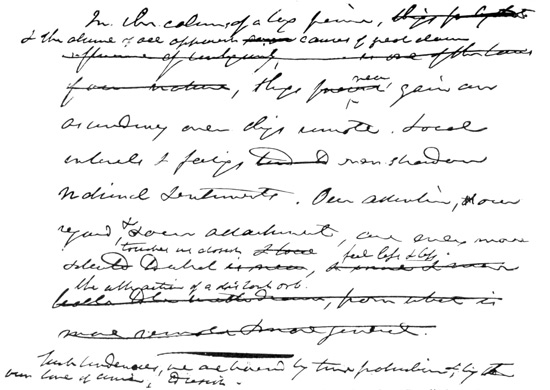
Fac-simile of a part of one of the concluding pages of Webster's draft of his speech in reply to Calhoun, March 12, 1838.
One passage in this speech explains the following note here given in fac-simile, from John Tyler to Mr. Webster, his Secretary of State, written when Jackson broke the silence of the Hermitage:
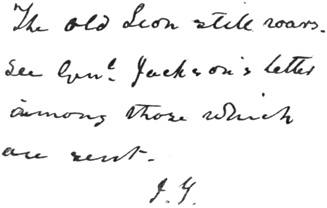
"The old Lion still roars. See Genl. Jackson's letter among those which are sent. J. T."
"On the broad surface of the country, Sir, there is a spot called 'the Hermitage.' In that residence is an occupant very well known, and not a little remarkable both in person and character. Suppose, Sir, the occupant of the Hermitage were now to open that door, enter the Senate, walk forward, and look over the chamber to the seats on the other side. Be not frightened, gentlemen; it is but fancy's sketch. Suppose he should thus come in among us, Sir, and see into whose hands has fallen the chief support of that administration, which was, in so great a degree, appointed by himself, and which he fondly relied on to maintain the principles of his own. If gentlemen were now to see his steady military step, his erect posture, his compressed lips, his firmly knitted brow, and his eye full of fire, I cannot help thinking, Sir, they would all feel somewhat queer. There would be, I imagine, not a little awkward moving and shifting in their seats. They would expect soon to hear the roar of the lion, even if they did not feel his paw."
This speech Mr. Everett declared to be the ablest and most effective of Mr. Webster's speeches on the currency. Lord Overstone, than whom there was never a higher authority upon finance in England, produced a copy of it before a committee of the House of Commons, by whom he was examined, and said it was one of the ablest and most satisfactory discussions of these subjects he had ever seen. He afterward spoke of Mr. Webster as a master who had instructed him upon these matters.
There are notes of a speech on the currency which occupy two pages and three and one-half lines of common letter-paper. The two sentences at the close sum up not only Webster's final conclusion after a life of reflection upon the subject, but, I believe, the final conclusion of the country as to the great doctrine of protection. "The sacrifice made by reducing prices must necessarily fall on labor."
"If price of cotton reduced, at home, may be not abroad. So other articles.
"But labor is fixed down to the place. If you reduce its price, it has no escape. The whole result, then, of reducing cost of production comes merely to this—that the capitalist shall manufacture at a less price, and deduct the loss in price from the labor of his workmen. This is the whole of it.
"I am for protecting labor. I am for enabling it to clothe itself well, feed itself well, and educate itself. I am desirous of giving to labor here, in its competition with capital, advantages which it does not possess elsewhere.
"Every man, who contemplates reduction, must survey the condition of other countries, with which we have great intercourse."
Mr. Webster went to Washington to attend the session of December, 1832, under the burden of a great responsibility. He had borne his share in the great debate in which he established the authority of the Union against the doctrine of nullification in a manner which had won for him the undying regard of the vast majority of his countrymen. President Jackson had done his part in asserting his determination to uphold the Constitution at all hazards and against all enemies. In all that, the President and Mr. Webster were in thorough accord. But he had no sympathy with President Jackson's desire to overthrow the banking system, to provide simply instrumentalities for the government to transact its business, leaving the business of the country to look out for itself. On the other hand, a considerable portion of his own party, led by Mr. Clay, desired to compromise with nullification, and so to modify the tariff as to leave South Carolina a substantial victory, and save her pride from being compelled to submission to the superior strength of the government. With this element Mr. Webster had no sympathy. Again, Jackson claimed to be the direct representative of the people, desired to extend the power of the executive and to circumscribe the legislative power, especially that of the Senate. In resisting that encroachment Webster and Calhoun were in complete accord. So Mr. Webster could have no permanent alliance or co-operation either with Jackson, Calhoun, or Clay.
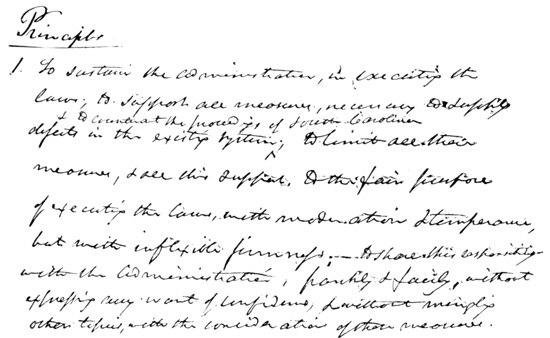
Fac-simile of the First Paragraph of Webster's "Principles."
Mr. Webster prepared for himself the following statement of the principles which were to govern his own course in this great emergency. Some of its language is found in his speech in the Senate of February 8, 1833. But with that exception, it has never, I believe, been made public until now. It is the chart which governed his course in that part of his public life of far greatest public importance, and the part of his public conduct on which his own fame must rest:
"PRINCIPLES.
"1. To sustain the administration, in executing the laws; to support all measures, necessary to supply defects in the existing system; & to counteract the proceedings of South Carolina; to limit all their measures, & all this support, to the fair purpose of executing the laws, with moderation & temperance, but with inflexible firmness;—to share this responsibility with the Administration, frankly & fairly, without expressing any want of confidence, & without mingling other topics, with the consideration of these measures.
"2. Not to give up, or compromise, the principle of protection; nor to give any pledges, personal or public, for its abandonment at any time hereafter.
"3. To bring down the revenue to the just wants of the Govt.: but this not to extend so far as to prevent Congress from making, for a limited time, a distribution of the proceeds of the sales of the public lands among the States, if Congress shall see fit to make such distribution: nor so far as to prevent appropriations to such objects of Internal improvement, as Congress may think deserving of national aid.
"4. To revise the Act of last session, with close scrutiny, & entire candor; & to reduce duties, in all cases, where such reduction can, with any fairness, be asked, & with any safety, granted; having just regard, to the necessities of the Country in time of war, to the faith plighted by existing & previous laws to the reasonable protection of capital, & especially to the security of the interests of labor & wages.
"5. If Congress shall not, before the end of the next session of Congress, pass a law for the distribution of the proceeds of the public lands, among the States, those proceeds to be regarded as so much general revenue, applicable to the ordinary purposes of Government; & the duties on imports to be so much farther reduced as may, by this means, become necessary.
"6. Provision to be made to direct the framing of proper issues in law, feigned or real, with a view to submit to the judgment of the Supreme Court of the U. S. the question, whether Congress possesses the Constitution to lay & collect duties on articles imported, for the avowed and only purpose of protecting & encouraging domestic products & manufactures.
"7. If the land bill shall pass, then some measure to be adopted to limit, practically, grants by Congress to objects of Internal Improvement, to such as in their nature transcend the powers & duties of separate States.
"8. A Comee. of the Senate to sit in the recess to take into consideration the law of the last session (according to Art. 4),—to make a detailed Report, the first day of next session; accompanied by such a bill, as they may recommend, for the purpose of adjusting the Revenue to the necessities of Government.
"Note.—My idea would be, that this Comee. should meet in Boston, Oct. 1, & prosecute its inquiries, in Boston, Providence, N. Y., Philadelphia & Pittsburg, if thought necessary.
"The Comee. to consist of one N. E. member
one from Middle States, one from N. W. States, one from S. W. States, one from Southern States."
It is very unpleasant to think that the great sentences of the Reply to Hayne, which the country knows by heart, were never delivered by Mr. Webster in the Senate chamber as we have them. Yet so it is. The speech was taken down in short-hand by Joseph Gales, one of the editors of the National Intelligencer, and one of the best stenographic reporters of that day. He was requested by Mr. Webster beforehand to report his speech, which he did. He wrote out his short-hand report at length. That report was submitted to Mr. Webster, and he, with it in his possession, wrote out in his own hand a revised version of the speech. Mr. Everett says, in the Life prefixed to his edition of Mr. Webster's Works, that Mr. Webster had Gales's report but a part of a day. But it is absolutely impossible that Mr. Everett is correct, although the statement was published in Mr. Webster's lifetime. The short-hand notes, and the speech as written out from them by Gales, and the speech in Mr. Webster's handwriting, are now all in the possession of the Boston City Library. They were purchased of Mrs. Gales, widow of Joseph Gales, for the sum of $575 by Robert C. Winthrop, acting in behalf of himself and twenty-two other subscribers who gave $25 each for the purpose. Mr. Webster wrote out the whole of it, although about a third of his manuscript is missing, not, however, the most important or the best known portion. The draught itself shows traces of revision and reconsideration by Mr. Webster in the matter of the structure of some important sentences. He changes Gales's report a great deal, and then in revision makes corrections again and again of his own draught. We give the famous passage about Massachusetts, and the noble peroration, as they are reported by the accurate short-hand writer, doubtless literally as they were spoken, and the passages as finally composed by Mr. Webster and now familiar to the world. The sentences actually spoken well account for the great impression made upon the auditors. They are such as Webster would have been likely to utter on a great occasion and great theme. But we do not like to think that any word or syllable among those that have stirred our hearts from our earliest boyhood did not, in fact, come from the inspired lips of the great patriot and orator. The emotion is like that felt when a lover of Milton sees the manuscript of Comus or Lycidas in the library at Cambridge, and learns that any other than the fit word and perfect phrase could ever have occurred to the poet to express his thought. The exquisite beauty of the verse still abides. But the sense that it was an inspiration is gone.
It is said that when Milo in his exile read Cicero's speech in his defence, he exclaimed, "O Cicero, hadst thou spoken thus, Milo would not be now eating figs at Marseilles." We cannot say that of the Reply to Hayne. Its grandeur is there as it came unpremeditated and fresh from heart and brain. But it is a little unpleasant to think that the phrases that all Americans know by heart differ so much from those which commanded the applause of the listening Senate on that great day which settled in the tribunal of reason the fate of the Republic.
The Passage about Massachusetts as Actually Spoken
"Sir, I shall be led on this occasion into no eulogium on Massachusetts. I shall paint no portraiture of her merits, original, ancient or modern. Yet, sir, I cannot but remember that Boston was the cradle of liberty, that in Massachusetts (the parent of this accursed policy so eternally narrow to the West), etc., etc., etc. I cannot forget that Lexington, Concord and Bunker Hill are in Massachusetts, and that in men and means and money she did contribute more than any other State to carry on the Revolutionary war. There was not a State in the Union whose soil was not wetted with Massachusetts blood in the Revolutionary war, and it is to be remembered that of the army to which Cornwallis surrendered at Yorktown a majority consisted of New England troops. It is painful to me to recur to these recollections even for the purpose of self-defence, and even to that end, sir, I will not extol the intelligence, the character and the virtue of the people of New England. I leave the theme to itself, here and everywhere, now and forever."
As Written Out by Mr. Webster and Printed
"Mr. President, I shall enter on no encomium upon Massachusetts. She needs none. There she is. Behold her, and judge for yourselves. There is her history; the world knows it by heart. The past, at least, is secure. There is Boston, and Concord, and Lexington, and Bunker Hill; and there they will remain forever. The bones of her sons, falling in the great struggle for Independence, now lie mingled with the soil of every State from New England to Georgia; and there they will lie forever. And Sir, where American Liberty raised its first voice, and where its youth was nurtured and sustained, there it still lives, in the strength of its manhood and full of its original spirit. If discord and disunion shall wound it, if party strife and blind ambition shall hawk at and tear it, if folly and madness, if uneasiness under salutary and necessary restraint, shall succeed in separating it from that Union, by which alone its existence is made sure, it will stand, in the end, by the side of that cradle in which its infancy was rocked; it will stretch forth its arm with whatever of vigor it may still retain over the friends who gather round it; and it will fall at last, if fall it must, amidst the proudest monuments of its own glory, and on the very spot of its origin."
Peroration as Actually Spoken
"When my eyes shall be turned for the last time on the meridian sun, I hope I may see him shining bright upon my united, free and happy country. I hope I shall not live to see his beams falling upon the dispersed fragments of the structure of this once glorious Union. I hope I may not see the flag of my country with its stars separated or obliterated; torn by commotions, smoking with the blood of civil war. I hope I may not see the standard raised of separate State rights, star against star, and stripe against stripe; but that the flag of the Union may keep its stars and its stripes corded and bound together in indissoluble ties. I hope I shall not see written as its motto, 'First liberty, and then union.' I hope I shall see no such delusive and deluded motto on the flag of that country. I hope to see, spread all over it, blazoned in letters of light and proudly floating over land and sea, that other sentiment, dear to my heart, 'Union and Liberty, now and forever, one and inseparable.'"
Peroration as Written Out by Mr. Webster and Printed
"When my eyes shall be turned to behold for the last time the sun in heaven, may I not see him shining on the broken and dishonored fragments of a once glorious Union; on States dissevered, discordant, belligerent; on a land rent with civil feuds, or drenched, it may be, in fraternal blood! Let their last feeble and lingering glance rather behold the gorgeous ensign of the republic, now known and honored throughout the earth, still full high advanced, its arms and trophies streaming in their original lustre, not a stripe erased or polluted, nor a single star obscured, bearing for its motto, no such miserable interrogatory as 'What is all this worth?' nor those other words of delusion and folly, 'Liberty first and Union afterwards'; but everywhere, spread all over in characters of living light, blazing on all its ample folds, as they float over the sea and over the land, and in every wind under the whole heavens, that other sentiment, dear to every true American heart, Liberty and Union, now and forever, one and inseparable!"
The family of one of Mr. Webster's colleagues have a story which has been repeated to me several times, but, so far as I know, has never been published, that the delegation were somewhat anxious lest Mr. Webster did not fully appreciate the strength of Hayne's attack, and the grave responsibility he had to bear in the reply. One of them at the request of his associates called on Mr. Webster that morning at his boarding-house, to communicate to him their great anxiety. He found him alone in the parlor of his dwelling, walking up and down, and humming to himself the refrain of the old English hunting-song:
Tantivy, tantivy, This day a stag must die.
He concluded there was no occasion for any further alarm.
When Mr. Webster went to the Senate next morning, as he made his way through the crowded chamber to his seat, John M. Clayton, of Delaware, said to him: "Mr. Webster, I hope you are primed and loaded this morning." "Five fingers, sir," was the reply, with a gesture as if pointing to a gun-barrel.
Mr. Winthrop says: "Of his emotions he said himself not long afterward, 'I felt as if every thing I had ever seen or read or heard was floating before me in one grand panorama, and I had little else to do than to reach up and cull a thunderbolt and hurl it at him.'"
What he said to Hiram Ketcham, of the Reply to Hayne, is true of nearly all his great speeches:
"In one sense I had no preparation whatever, but in another sense I was fully prepared. I did not know what words I should use when I rose to my feet, nor the order of argument in which I should proceed. These came to me under the excitement of debate. But I understood the subject as well as I was capable of understanding it. I had studied it; I had often urged similar arguments before other tribunals, and in this sense of the term I was thoroughly prepared."
It is clear that there was absolutely no time for the preparation of the language of Webster's Reply to Hayne. He had made an extemporaneous reply to Hayne—to an elaborate speech of Hayne's—the morning after it was delivered. Hayne replied to him, and Webster, after a single night's interval, made in two successive days the most famous speech in American history.
We may sum up what we know of Mr. Webster's habit of preparation and composition as follows:
First. He spoke always upon great subjects.
Second. They were subjects upon which he had long meditated with the expectation that he would be called upon to discuss them in public.
Third. He had matured in his mind the arguments on great public questions, and also eloquent thoughts and sentences which had occurred to him during such meditations, ready for use when such occasion came.
Fourth. With these exceptions his speeches were usually unpremeditated, both as to language and order of arrangement, except so far as he jotted down some points or heads just before he spoke.
Fifth. In some few instances he wrote out his speeches beforehand, making occasional corrections and interlineations, which in general did not seriously change or improve his first expression.
Sixth. Many of the speeches we have, especially those made in the Senate or made to political assemblies, are as taken down by the reporters, and not revised by him.
Seventh. Some few, as for example, the Plymouth Oration and the Reply to Hayne, were carefully revised and largely written out by him afterward.
Eighth. He was quite susceptible to the stimulant of the audience or the occasion, which not infrequently excited him to the very loftiest and most effective eloquence.
Ninth. In general, Webster's style was not a Saxon style. It was of a somewhat ponderous latinity. But on a few occasions, when his mind rose to a white heat, all the resources of our language, whatever their origin, were at his command in amplest measure.
Tenth. In general he mastered his subjects; his subject did not master him. Solidity, sincerity, gravity, self-restraint, characterized his every thought and every utterance. But sometimes the volcano poured out its molten lava.
Mr. Webster made an impression upon the people of Massachusetts, in his time, as of a demi-god. His magnificent presence, his stateliness of manner, his dignity, from which he never bent, even in his most convivial and playful moments, his grandeur of speech and bearing, the habit of dealing exclusively with the greatest subjects, enabled him to maintain his state. His great, sane intelligence pervades every thing he said and did. But he has left behind few evidences of constructive statesmanship. There is hardly a great measure of legislation with which his name is connected, and he seems to us now to have erred in judgment in a great many cases, especially in undervaluing the great territory on the Pacific. He consented readily to the abandonment of our claim to the territory between the forty-ninth parallel and that of fifty-four forty, which would have insured our supremacy on the Pacific, and have saved us from the menace and rivalry there of the power of England. He voted against the treaty by which we acquired California. That, however, is a proof of a larger foresight than that of any of his contemporaries. Alone he foresaw the terrible Civil War, to which everybody else of his time was blind. What even he did not foresee was the triumphant success of the Union arms. It is hardly to be doubted that if the Civil War had come in 1850 or 1851 instead of 1861 its result would have been different. But Mr. Webster's great service to the country, a service second to that of Washington alone, is that he inspired in the people to whom union and self-government seemed but a doubtful experiment, the sentiment of nationality, of love of the flag, and a passionate attachment to the whole country. When his political life began, we were a feeble folk, the bonds of the Union resting lightly upon the States, the contingency of disunion contemplated without much abhorrence by many leading men, both North and South. Mr. Webster awoke in the bosom of his countrymen the conception of national unity and national greatness. It has been said more than once that the guns of our artillery in the great battles of the Civil War were shotted with the Reply to Hayne.
A few years ago the State of New Hampshire presented to the United States for the Memorial Hall a statue of Webster—a ceremonial in which I had some part. After it was over, I got a letter from a brave Union soldier, who told me he had been stationed as a sentinel in a place in the woods where several sentries had been killed within a short time by a shot from the thicket. As he paced up and down on his midnight watch, thinking that at any moment his death-shot might ring out from the darkness and gloom about him, he kept up his heart by repeating to himself, over and over again, the great closing sentences of the Reply to Hayne, ending with the well-known words, "Liberty and Union, now and forever, one and inseparable."
History has not yet settled the question of the motive that inspired the 7th of March speech.[4] Doubtless there were good and patriotic men, men who had loved him till that hour, who went to their graves believing that Webster fell—fell like Lucifer, Son of the Morning. There are doubtless men living who think so to-day. To the thought of these men Whittier gave voice in his terrible Ichabod, which is said to have wounded the great heart of its subject more than any other stroke that ever smote his mighty forehead. But the general judgment of his countrymen, first mellowing and softening into the belief which Whittier himself expressed in his later and tender poem, "The Lost Opportunity," seems gradually coming to the conclusion that Webster differed from the friends of freedom of his time, not in a weaker moral sense, but only in a larger and profounder prophetic vision. When he resisted the acquisition of California, he saw what no other man saw, the certainty of the Civil War. It was not given even to him to foresee its wonderful and victorious result. When he compromised he saw in like manner the danger he tried to avert. He did not see the safety only to be attained through the path of danger and strife. I was one of those who in the conceit and presumption of youth, a lover of the liberty to which he then seemed to me to be recreant, judged him severely. But I have learned better in my old age. I think of him now only as the best type of the farmer's boy of the early time; as the great example of the New England character of the day of his earlier manhood; as the great defender and lover of Massachusetts, as the orator who first taught his country her own greatness, and who bound fast with indissoluble strength the bands of union; as the first of American lawyers, the first of American orators, the first of American statesmen, and as the delightful citizen and neighbor and friend, of whom the people of his town said when he was laid in the grave:
"How lonesome the world seems;" and of whom his nearest friend said, when he died:
"From these conversations of friendship no man—no man, old or young—went away to remember one word of profanity, one allusion of indelicacy, one impure thought, one unbelieving suggestion, one doubt cast on the reality of virtue, of patriotism, of enthusiasm, of the progress of man—one doubt cast on righteousness, or temperance, or judgment to come."
[A second paper to follow.]