HAVANA SINCE THE OCCUPATION By James F. J. Archibald
Reading edition
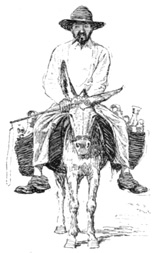
Milk Vender.
It is six months since the American administration in Havana began, and in that time many important changes have been made and many more are well under way; and the new ideas that are eventually destined to supplant the customs of the last century are fast taking a firm hold on the country. Even for those who have tried to follow this progress in detail in the newspapers it is not easy to realize the full extent of what has been accomplished, or of the steady hard work that is going on. Very few bear in mind the fact that a comparatively large section of our regular army is engaged in it here and elsewhere in Cuba. Without the blare of trumpets and without the inspiring strains of music the same heroes that came home fever-stricken, wan, and worn from that terrible struggle before Santiago are again facing a more subtle danger and fighting none the less hard and all in the same cause, but now there are no flaring headlines in our daily press, no bulletins to tell of the fight, because it is only against an unseen foe and there is no noise—but the hard work is there. Regiment after regiment of the volunteers goes home, but these men who "serve for pay" are sent down to the island again before they have rid themselves of the fever contracted while standing knee-deep in water in the trenches around Santiago. Now, it is hard work all day long under a burning tropical sun and many nights of weary patrol in the pest-hole of all creation—plain hard work to start a republic on the list of nations, to teach a people how to govern themselves who have before known nothing but the lash. All honor is due to these men who are doing this work; and our people are too prone to forget it, simply because the actual results are not immediately and always in evidence.
I saw the Eighth United States Infantry, just plain regulars from nowhere, before El Caney, and again I saw them in Havana patrolling the streets night and day, with two nights a week in bed. The regiment had by no means recovered from the Santiago campaign, and every day some one would be taken with that bone-racking fever that burns the life slowly out unless checked by a transfer to a Northern clime. But with it all there was no complaining, and they were soldiers in these times as well as in the field. Every private seemed to have the success of the commanding general at heart, and every officer watched with pride the daily improvement in the capital city.
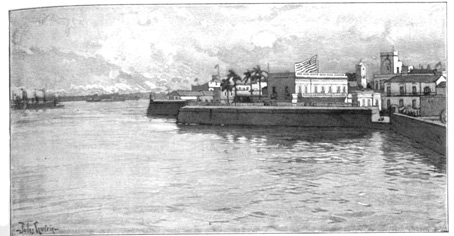
The Lieutenant-Governor's Palace.
Two of the largest sewers of the city empty into the harbor at this point.
The staff shares the danger with the line, and their work is the same steady, uninteresting grind. The engineers face death just as surely constructing sewers as they do digging trenches during an advance, the aides whether carrying despatches to a brigade on the firing line or reporting on some infested quarter in the city, and the surgeons whether attending the wounded at the front or Yellow Jack in some charity hospital. There is no glory for them if they succeed in this fight against death and disease, and they will get no thanks, for it is simply their duty.
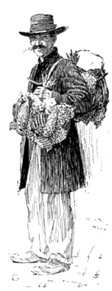
Poultry Vender.
The work has been going steadily on and is now well in hand, but it will be a long time before we shall be able to turn the island over to the Cuban people, and we cannot withdraw our forces until every detail of the new government has been thoroughly tested. A generation of education seems to be the only solution of the Cuban problem that confronts the American people, that they may keep the promise made to the civilized world to establish a stable form of government for an excitable little nation that does not know its own mind, and that is so divided that internal strife is always inevitable. Not merely an education of letters is needed, but an education in cleanliness, in religion, and in respect for superior knowledge of affairs; and it is that education that the American army officer has been giving since the first day of January, in the face of obstacles thrown in the way by the very people who will eventually reap the benefits of his labors. That the American people should for any other object than personal gain want to cleanse their city, organize their government, and teach them how to rule themselves, does not seem possible to them, and it is on account of this distrust that the work of establishing order is made difficult and at many times disagreeable.
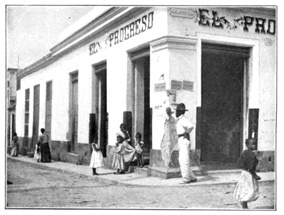
A Street Corner.
During the sovereignty of Spain no Cuban was ever consulted on any part of the administration of the affairs of the island, and for this reason they are largely ignorant of all the requirements of organization, unmindful of the necessity of proper municipal sanitary arrangements, and incompetent to cope with the suffering of their own people.
When our forces first occupied Havana the city was in a state of chaos, without the restraint of law, and the officers and men of the evacuating army had virtually an officially recognized license to do their will, no matter what it might dictate. Some Spanish officials had destroyed nearly all of the records of the island in the archives of the public buildings; and the result of this work, apparently done merely from spite, will be felt for many years to come, especially in the matter of the records of real-estate transfers, as at the present time it is almost impossible to obtain a clear title to any piece of property. In some cases the records were totally destroyed or carried away, and in others they were hopelessly disarranged so as to render them quite useless; the work showing that it was done by someone who understood the records and knew just what papers would be missed the most. An instance of this mischief may be given in the Department of Engineers, where they either destroyed or carried away every map or plan showing the location or construction of the sewers of the city; and by the loss of those plans the American engineers are compelled to hunt out the different mains, and it more than doubles their labor. In the matter of the real-estate records it will take years to get them in a condition that will be satisfactory to the demands of legal evidence in the transfer of property.
General Ludlow is doing excellent work in the matter of bringing Havana out of the unhealthful condition it was in when he took command, and it is a work that will take many months of hard labor and in which, in all probability, many lives will be sacrificed. He is greatly hampered in his work by not being able to make his department reports direct to Washington, as the course through division military channels is exceedingly slow.
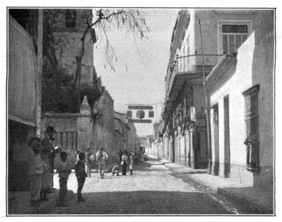
A Typical Street.
The condition of Havana in December, when the first of our Army of Occupation arrived, was filthy beyond all possibility of description. There being no sanitary arrangements for the poor or in the abodes of the poorer classes, the streets and the court-yards of some of these houses were in a disgusting condition. The most surprising feature was the total lack of all modesty; and these people really considered it in the light of a great oppression, and as a direct infringement upon their liberty and upon their rights, that the Americans should compel them to obey sanitary laws. The people of all classes were in the habit of throwing refuse of all sorts into the street, and there was no attempt made to carry it away, the rains being depended upon to clean the streets. There were carcasses of animals that had reached such a state of decay that it was possible to detect the terrible odor for many blocks, and yet the presence of this nuisance did not seem to annoy, in the slightest degree, those at whose door it lay, while to an American it was almost impossible to pass in the vicinity.
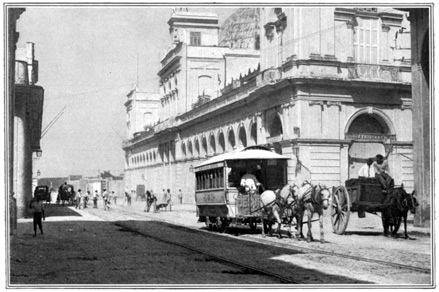
Columbus Market, showing Street Cleaners in the Distance.
The lack of a proper sewerage system is the cause of nearly all the disease and pestilence that have made Havana one of the most dreaded ports of the world. There are more and better sewers than is generally supposed, but the cause of their breeding sickness is the fact that they are, in many cases, open to the street by man-holes, and they all empty into the harbor immediately in front of the city. Two of the main sewers flow into the channel of the harbor directly under the Lieutenant-Governor's Palace, in which General Ludlow lives and in which he has his head-quarters; one empties under the Maestranza de Artilleria, in which some of the troops were quartered; and from these mains flow all the filth of Havana, that pest-hole of disease, while at all times there arises a sickening odor, and it will be the greatest of wonders if there is not much sickness among our troops, who are accustomed to cleanliness at home. The one thing that always is the most noticeable to Americans on their arrival in any of the towns or cities of Cuba is the offensive odor that is ever present.
The public buildings were in such a condition that not one of them could be used until they had been thoroughly cleaned. General Brooke made his head-quarters in the Vedado, a charming suburb, on account of the condition of the Captain-General's Palace, which, although it was occupied at the time of the evacuation by the Captain-General, was in such a condition that there were over thirty wagon-loads of filth hauled out of it.
All of the prisons, except the Presidio of Havana, were in a disgusting state of filth, but the same hard work has turned them into healthy buildings.
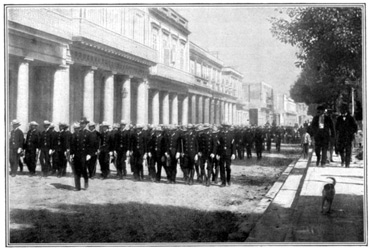
The New Havana Police, Organized Under the Supervision of Ex-Chief McCullagh, of New York, Parading in the Prado.
Chief McCullagh and Chief-of-Police Menocal on the sidewalk to the right of the picture.
Under the direction of Lt-Colonel W. M. Black, an officer of the regular Engineer Corps, the city has already become clean, and the death-rate is decreasing every month; and if the dreaded plague is averted this summer it will be owing to his labors, although he would in no wise be at fault were it to appear. Colonel Black has had most of the undesirable work, for in his department is included all of the street cleaning, sewers, harbor dredging, and cleaning all of the public buildings. Havana must remain in the same unhealthful condition as long as the main sewers empty into the harbor, as this is almost tideless and is little better than a stagnant pond; and although the water at the surface does not appear to be very foul, its condition is seen when a steamer moves along in the harbor and her screw stirs up the bottom, which creates the usual vile odor. It is the plan of the new administration to turn all of the sewers into the sea several miles from the city, the natural grade making the work comparatively easy, and in this way the greatest fault will be remedied—that of pouring the refuse into the harbor. When the dredging of the harbor commences in earnest and the narrow streets are dug up to lay the sewers, then will probably come a terrible sickness; and as a great portion of the labor must come from the United States we are surely destined to pay still more dearly for the freedom we are establishing for the Cuban people.
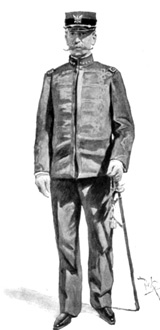
General Ludlow, Military Governor of Havana.
Surface street cleaning has done more to make Havana cleanly than anything else, and it was but a short time after the occupation that the city began to show the effects of this work. It was amusing to note the astonishment of many of the inhabitants when the first few squads of sweepers commenced work; and the idea of cleaning an unpaved street seemed to amuse them more than to impress them, as the majority did not know what it meant to sweep even their houses. Large gangs of native labor were given work in this department at good wages, not only for the sake of the work that was to be done, but also to allow them to earn their support; and among these street workmen were many gentlemen of standing in society who embraced the first opportunity to earn bread for starving families. The residents of Havana did not fare badly during the war, but the planter from the interior, whose estate had been burned and devastated, whose stock had been killed, by both the Cuban and the Spanish forces, and who had been compelled to move into the city by an edict from the Spanish, although there had been no arrangement made for his maintenance, suffered terribly.
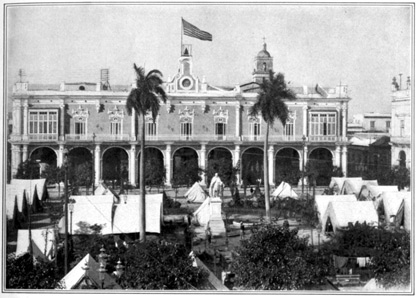
Captain General's Palace and the Mayor's Office.
Camp of the Second United States Artillery in the foreground.
The employment of these large numbers of men will also solve the problem of ridding the island of the depreciated Spanish currency, for all of this labor is paid in American money, and already the merchants are showing their preference for it.
One of the most interesting features of the change in affairs in Cuba is the Church, and the change that must be made in the administration of the affairs of that body. The Church being a part and department of the state and entirely dependent upon the government for its support, suddenly finds itself compelled to find other means of revenue. The Church of Cuba is not one that Catholicism could be proud of, except in the orders of women, for nearly all of the men's orders live in old monasteries a picturesque but inactive life of comparative comfort. Here are the same monks that one sees in Spain, the brown garb of the Franciscan with the sandalled feet, or the white and black of the Dominicans. Captain E. St. J. Greble, of General Ludlow's staff, has had charge of the poor of the Havana province and has worked night and day, with his heart in the work, to relieve the suffering; and he called at all of the churches to see what they needed, but none of them seemed in need, and yet their people were dying of want. Not so, however, with the women of the Church, for they had worked faithfully to accomplish what had been left undone. The Sisters of Mercy, the Sisters of Charity, the Order of the Sacred Heart, and several others had their convents filled with women and children of all ages and in all conditions of want, caring for them and many times denying themselves to feed their charges. One sister told us that they had not expected any help from us, as we were considered a Protestant nation and they dreaded our coming; and great tears rolled down her cheeks as we unloaded food and medicines for her charges. These noble women assist our officers in their work and are a marked contrast to the monks. There seems to be a total lack of any religious feeling; and on Sundays very few ever enter the churches, but the day is spent in pleasure and revel. Each Sunday of the Carnival which takes place during Lent, crowds of maskers throw flour and confetti all day and spend the night in dancing. Many pounds of flour were thus thrown away every Sunday, while thousands were suffering from hunger, yet great indignation was raised when the waste was prohibited, much of the flour used being what had been issued to Cuban Relief Committees for the poor.
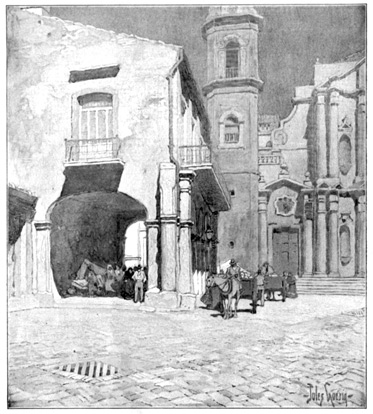
The Cathedral of Havana.
In the foreground can be seen one of the sewer openings, and to the right of the picture a second one appears.
Organizing the police and the courts for the city was one of the most difficult tasks that were accomplished during the reconstruction; and although it is well started it will take many months to perfect these departments. Major John Gary Evans, U.S.V., a former Governor of South Carolina, has had this portion of the work under his care and has organized a creditable force from the material at hand. Major Evans has been recently mustered out of the service, and Captain W. L. Pitcher, of the Eighth Infantry, has been put in charge of the work, and being a thorough soldier and a man of great diplomatic tact, he is just the man for the position at this critical period.
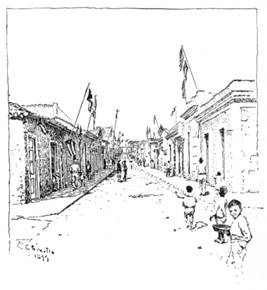
Street in the Poor Quarter, showing Sunday Decoration of Flags.
Always having been governed, the Cubans here again showed their lack of power to govern. The officers seemed to think their duties consisted of wearing a smart uniform and sitting over some liquid refreshment in a café; and only as they realize the importance of their office under American teaching will they cease to be dismal failures.
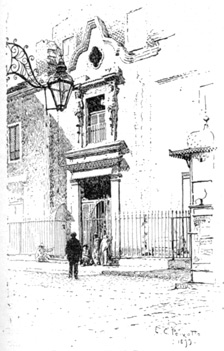
Beggars at a Church Entrance.
Cuban politics also enter into the difficulty. When the Assembly deposed Gomez from the head of the army, and the parade and mass meeting in his honor were called, General Ludlow gave orders that they should be allowed to have their celebration as long as they were orderly; but in direct violation of this order, Chief Menocal instructed the police, who had only been patrolling a few days, to stop the parades, and in this way the rioting was caused. There is a total disregard for keeping the rolls, although they are told about it every day. One of the police officers was found dead in the grounds of the Summer Palace, where Gomez and his followers were living, having been shot through the head and having been dead several days; yet at police head-quarters they had not noticed that he was absent from duty, from the fact that no roll was kept. It is this sort of thing that it is well for the persons to know who will very soon commence to demand that we withdraw our forces and allow the Cubans to govern themselves.
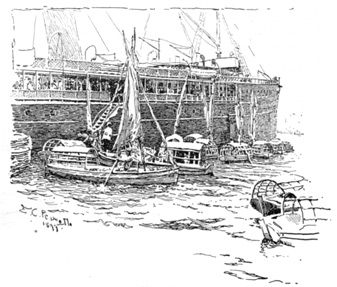
Harbor Boats.
Two of the most characteristic and at the same time unpleasant features, may be noted among those that have disappeared during the new administration of affairs. One is the ever-present professional street-beggar who infested the streets, invaded the cafés, and stood guard at every church-door; the other is the horrible bone-pit in the Cristobal Colon Cemetery. There are few prettier places allotted to the resting of the dead than this cemetery, on the outskirts of the city.
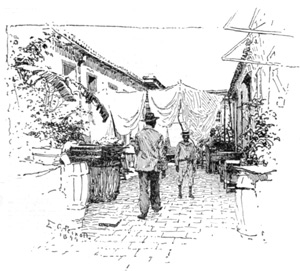
A Court-yard in the Tenement District.
The entrance to the enclosure is superb, the chapel is impressive, and the monuments are costly works of art, but away off in a far corner of the unused part of the cemetery was an enclosure about seventy-five feet square and fifty feet deep, with ghastly skulls and bones in all conditions of preservation, and piles of burial cases of all degrees from a costly casket down to a cracker-box or an oil-can. This is the inhuman manner of disposing of the bodies buried in a plot upon which the rental is not renewed every three years. There is ample room that is unused, so it is not the lack of space that causes the disturbing of the rest of the dead; it must be merely for gain for the cemetery corporation. In many cases the bodies of the poor are never buried at all, but at one side of the cemetery is a building, called the "Dead-house," in which arrangements are made for burning the bodies with lime until there is nothing left but the bones, which are then thrown into this pit. Thousands upon thousands were here in a pile that was fully forty feet deep and as large as the area of the pit.
The residents of Havana did not seem to know of the presence of this place, and if any did they seemed to take it as a matter of course, and no notice was taken of the horrible custom; but when the Americans took charge it was the most talked-of place in Havana, and became one of the sights of the city, creating such an amount of adverse criticism that the cemetery authorities caused dirt to be thrown in the pit to cover the bones.
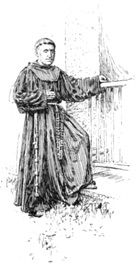
A Franciscan Monk.
Not only in Havana have reforms been going on, but all over the island the same work is being done by the American officers and men. Under General Fitzhugh Lee the province of Havana has seen the same radical changes, and all of the little towns have been washed and fed and begin to live anew.
The entire island is a great park that needs no artificial training to enhance its beauty, and it is destined to become the winter resort of all the Eastern States. But great administrative improvements in the ports, besides the police and material ones noted, will be necessary before this can happen. For instance, it would do much for the island if the port of Havana could be freed from the high pilot fees, anchorage fees, docking fees, and fees of all sorts that make it impossible for small craft to enter. Even the large steamers do not dock, but cargo has to be lightered out and passengers are compelled to use the small boats that swarm the harbor.
The people have not even begun to realize that the soldiers are there to help them in the establishment of their republic; to them a soldier means oppression, and the presence of armed troops gives them the idea that we are trying to keep the territory that we have paid so dearly to conquer. Not only must the Cubans realize what our troops, both officers and men, are doing, but our own people should realize it in the same sense. It is easy to criticise, but a nation cannot be built in a day; and whether they are establishing stable government in Cuba and Porto Rico by diplomacy, or by the sword in the Philippines, Americans should feel, concerning these new duties, that those on the spot often know best the needs of the situation; that the regular army are American soldiers, and that of what they are doing the nation will be proud in years to come.
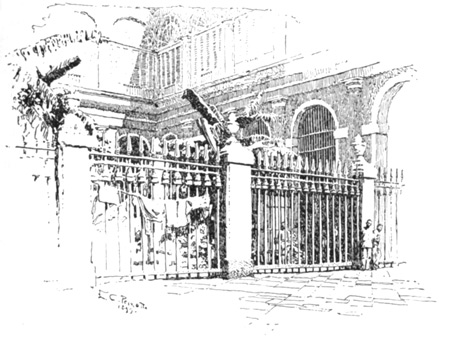
Court-yard of the Carcel, the City Prison.