SECTION XI (continued 3)
Reading edition
The Red Cross class roll must be sent in to the local Chapter early in the course.
A Secretary to handle the records should be chosen, and where the class is made up of Scouts, the officials should be preferably a Scout Captain or Scout Official.
The examiner must be a physician appointed by the local Red Cross Chapter and is preferably some one other than the instructor, but this is not necessary. Like the instructor, the examiner may be supplied by the Chapter or chosen by the class.
The Red Cross examination roll, which may be obtained from the Chapter, should be used in giving examinations and then returned to the Chapter, who will issue the certificates. Follow the directions on the roll carefully.
If a Scout holds a First Aid Proficiency Badge she may complete the course in seven and one-half hours. If she does not hold a Proficiency Badge in First Aid then fifteen hours will be required. A Girl Scout holding a Proficiency Badge in First Aid and taking a school course held under Red Cross auspices which she passes with a mark of at least seventy-five per cent, can, when the school principal certifies to this, get the Red Cross certificate without further examination by applying to the local Red Cross Chapter.
Advanced Courses
Advanced courses are open to those who have the Red Cross certificate. There must be an interval of at least six months after the elementary course before an advanced course can be taken, and the same interval between repetitions of it. The course of instruction is seven and one-half hours, mainly practical demonstrations. A Red Cross medal is given on completion of this course. Each time it is repeated, up to three times, a bar (engraved with year) is given to be added to the medal.
Fees
A fee of fifty cents is required for the elementary course. The local Red Cross Chapter has the right to reduce this fee.
The fee for the advanced course is one dollar, which covers the cost of certificate, examination and medal. The fee for bar and engraving is fifty cents. These fees cannot be reduced.
These fees cover the cost to the Red Cross of postage, certificates, medals, bars, and so forth, but do not cover that of instructor, examiner, or classroom supplies, which the Red Cross requires the class to take care of.
Information
Where there is no local Girl Scout organization refer to the local Red Cross Chapter; or if there is none, either to the Girl Scout National Headquarters, 189 Lexington Avenue, New York, N. Y., or to the Department of First Aid, American Red Cross National Headquarters, Washington, D. C.
4. THE HOME NURSE
The Girl Scout who has earned the Home Nurse Badge may be of great help where there is illness. But, she should remember that only such people as doctors and trained nurses who have knowledge and skill gained by special training and thorough practice are fitted to care properly for those who are very ill.
If the Scout with the badge keeps her head and shows herself steady, reliable and willing, when called upon for help in illness or emergencies, she proves herself a true Scout who is living up to the Scout motto of "BE PREPARED."
To earn the badge she should know:
How to keep the sick room clean and comfortable.
How to make a bed properly.
How to prepare for and help a sick person in taking a bath.
How to make a sick person comfortable in bed, changing position, etc.
How to take temperature, pulse and respiration.
How to prepare and serve simple, nourishing food for the sick.
How to feed a helpless person.
How to prepare and use simple remedies for slight ailments.
How to occupy and amuse the sick.
When helping about the sick, the Scout should wear a wash dress or an apron which covers her dress. She should be very neat and clean. She should wash her hands frequently, always before her own meals, and after coming into contact with the sick person and after handling utensils, dishes, linen, etc., used in the sick room. Great cleanliness is necessary not only for her own protection but to prevent illness spreading.
She should move quickly and quietly, but without bustle or hurry, taking care not to let things fall, not to bump against the furniture, not to jar the bed, not to slam doors, in fact not to make any unnecessary noises, as sick people are not only disturbed but may be made worse by noises and confusion. If a door is squeaky the hinges should be oiled. Too much talking, loud talking and whispering are to be avoided. Only cheerful and pleasant subjects should be talked of, never illnesses either that of the patient nor of others.
The best nursing aims not only to bring relief and comfort to those already sick, but to guard against spreading sickness.
We know, now, that many diseases are spread by means of germs which are carried from person to person by various means, such as air, water, milk, and other food; discharges from the mouth, nose, bowels, bladder, wounds; clothing; the hands; the breath, and so forth.
It has been found that great heat, intense cold, sunshine and some powerful drugs called disinfectants kill germs. Germs thrive and multiply in dirt, dampness and darkness. That is why it is important to have fresh air, sunshine and cleanliness in order to keep well, and to help in curing those who get sick.
The Room, Its Order and Arrangement
The hangings and furniture of a sick room should be of a kind that can be washed and easily kept clean. Plain wooden furniture is better than upholstered furniture which collects and holds the dust. If there is a rocking chair it should be for the use of the sick person only. Seeing and hearing other people rock may be very disturbing.
If carpets are movable, so much the better, as they can be taken out to be cleaned.
The room should be bright and attractive. Sick people like flowers and pretty things, but the flowers should not have a strong perfume, and there should not be too many ornaments around to collect dust and to take up too much room. Flowers should be taken out of the room every night and the water changed before being returned to the room in the morning. Never have faded flowers around.
The room should be kept neat—a place for everything and everything in its place.
Neatness and attractiveness are not only pleasing to the sick person and those who come into the room but may really make the sick person feel better.
Medicines should not be kept in sight. All dishes and utensils not in use should be taken away and should be washed immediately after use.
Ventilating and Lighting the Room
The room of a sick person should be so situated that it will get plenty of sunlight and be easily aired. A room that has two or more windows can be better ventilated than a room with only one. When there is only one window, it should be opened both top and bottom. If there is not a screen, one can be made by hanging a shawl or a blanket over a clothes horse or a high-backed chair, or over a line stretched across the lower part of the window. A fire place or a stove keeps the air circulating—the air being constantly drawn up the chimney—and so helps in ventilating a room.
When "airing" the room great care must be taken to keep the sick person free from draughts.
Unless special orders have been given to the contrary there should be plenty of sunshine let in. The eyes of the sick person should be protected from the glare by a screen.
If possible there should be a thermometer in the room. The proper heat is between 65 and 70 degrees. If the temperature of the room is as high as 70 degrees and the sick person is cold, it is better to give her a hot water bag and to put on more covers than to shut the windows, thus keeping out the fresh air. Cool air acts as a tonic for the sick.
Cleaning the Room
The carpet should be gone over every day to remove the surface dust. Use the carpet sweeper, being careful not to knock the furniture nor to jar the bed. Raise as little dust and make as little noise as possible. Torn-up wet paper scattered on a small part of the carpet at a time and lightly brushed up into a dustpan with a whisk broom, or a broom, cleans the carpet very well without raising dust.
If the carpet cannot be taken out to be swept or beaten but requires thorough sweeping, an umbrella with a sheet over it may be hoisted over the head of the sick person to keep the dust from her nose and nostrils. The bare parts of the floor should be gone over with a damp duster or a damp mop.
The dusting should be done with a damp or oiled duster also, so that the dust may not be scattered. A basin of soapy water should be at hand and the duster washed in it frequently while dusting, so that the dust collected on it from one surface will not be carried to another. While dusting special attention should be paid to the doorknobs and that part of the door around them.
When the dusting is finished the dusters should be thoroughly washed and scalded and hung out of doors to dry.
The Bed
A metal bedstead is better than a wooden one, as wood holds odors and moisture, and is apt to have more cracks and crevices for germs or bugs to lodge in. It should be white, for then it shows when it needs cleaning and bed bugs keep away from white surfaces which show them up easily.
If possible, have the bed in a part of the room, where the drafts will not strike the patient every time a door or window is opened, and where the light does not shine in the eyes. If it can be placed so that the patient can see from the window so much the better.
To Make an Unoccupied Bed
Remove pillows and bedclothes, one at a time, being careful not to let corners drag on the floor, and put to air. Turn the mattress over from end to end one day, and from side to side next day. If the patient does not have to return to bed at once leave to air for at least half an hour.
An old blanket, old spread or a quilted pad, spread over the mattress not only protects the mattress but prevents the sheets from wearing out, and may make the bed more comfortable. These should be kept clean.
The bed for a sick person is frequently made with a rubber sheet and a draw sheet. The draw sheet is so called because its proper use is to be drawn through under the patient without greatly disturbing her and give her a cool fresh place to lie on. Therefore it should be long enough to tuck in sufficiently under one side to allow of this being done. An ordinary sheet folded in two from top to bottom and placed with folded edge toward the head of the bed may be used. It should entirely cover the rubber sheet, which is usually put on between the bottom and the draw sheet.
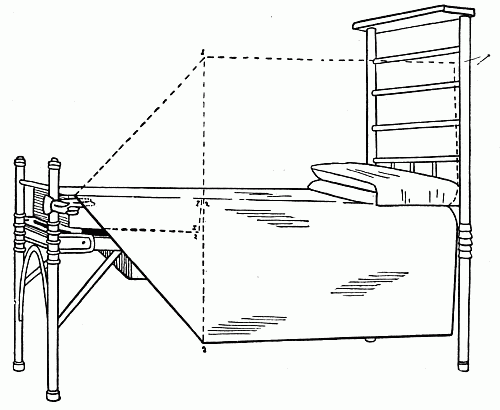
When the mattress is sufficiently aired, put on the protective covering. Over this spread the lower sheet so that the middle fold of the sheet lies up and down the centre of the mattress from head to foot. Keep perfectly straight. The sheet should be long enough to have at least fourteen inches over at ends and sides to tuck in. Tuck ends under mattress at head and foot drawing tightly so that it will be smooth and firm. Now tuck under at one side, folding neatly at corners, so that they will be mitred when finished. If there is no rubber nor draw sheet to put on, go to the other side of the bed and tuck in firmly at corners. Then, pulling the middle of the sheet very tightly with one hand, push the mattress with the other and tuck the sheet under. This under sheet should be very smooth without a wrinkle in it. If it is not long enough to tuck in well at both head and foot, leave plenty at the head to tuck in securely and tuck in at the sides tightly rather than risk having it come loose at the head. Be sure, however, that the mattress is entirely covered.
When Rubber and Draw Sheets Are Used
Before going around to the other side, lay the rubber sheet over the bed, so that the top edge will be well above where the lower edge of the pillow will come. Put the draw sheet over it. Tuck both well under the mattress on that side. Then, go to the other side and tuck in the corners of the lower sheet as directed, then stretching draw, rubber, and under sheet very tightly, tuck in separately.
Next spread the upper sheet, wrong side up, leaving as much at the head to turn back over the blankets as you left in the under sheet to tuck in. Have the middle fold over that of the lower sheet. Spread the blankets so that their upper edges will be even with the upper edge of the mattress. If the blankets are not long enough to reach as far up as they should, and yet tuck under firmly at the foot, place the lower one as directed, and the upper one so that there will be enough to tuck under at the foot, and hold the others in place. Tuck in all at once the foot and lower corners, mitring the corners as you did those of the lower sheet. Pull and straighten the sheet at the top and turn back smoothly over the blankets. If the bed is not to be occupied right away, tuck in both sides, stretching well so that it will have a smooth surface. Put on the spread, having the top edge even with the top of the covers. Tuck in neatly at foot and lower corners, letting the sides hang. Shake and beat the pillows thoroughly, make smooth and even, and put in place.
To Change the Under Sheet When the Patient Is in Bed
Loosen the bedclothes, without jarring the bed. Take off covers one at a time, until only one blanket and sheet remain. (If the patient feels cold, leave as many blankets as necessary to keep her warm.) Holding blankets with one hand or having patient hold it by the top, draw off the upper sheet, being careful not to uncover the patient. Remove the pillows. Have the patient as near the side of the bed as is safe, on her side, and facing the side on which she is lying. Roll the under sheets on the side of the bed close to the patient's back, making them as flat as possible. Pleat about half of the fresh under sheet lengthwise, and place close to the soiled sheets. Tuck in the other half, at the head, foot and side, draw the rubber sheet back over this fresh sheet, arrange the fresh draw sheet in place, tuck both in at that side and roll the free part close up to the patient's back. Now lift the patient's feet over the roll of fresh and soiled linen to the freshly made part, then have her roll her body over that side. Going to the other side of the bed, remove all the soiled linen and tuck the fresh sheets in, pulling tightly, being sure that there are no wrinkles under the patient. All the time keep the patient well covered. Now, spread the upper sheet and blankets over the covering the patient has had on while the lower sheets were being changed and, having the patient hold the coverings you have just put on, draw off the others, just as you took off the top sheet at first. Finish making the bed as you would an unoccupied one.
If the Bed Is to Be Occupied at Once
If the bed is to be occupied at once the coverings should be tucked in only at foot, corners and one side, then turned back diagonally from the head to foot.
The bed clothes should never be drawn too tightly over a person in bed, or they may irritate the skin, especially at the knees and toes. Bed sores may be started in this way. Perhaps the commonest cause of bedsores is from wrinkles in the under sheets. If the spread is heavy it should not be used over a patient. Use a sheet instead to protect the blankets.
Bathing
Bathing is more important for the sick than for the well. It not only keeps the skin clean and in condition to do its work, but it is soothing to the nerves, makes the sick person rest better and is refreshing.
If the room is the right temperature and the bath is carefully taken there is no danger of a sick person taking cold. On the other hand bathing helps to keep people in condition to avoid taking colds. (See Red Cross Text Book on Home Hygiene and Care of the Sick, page 156.)
When a patient is very sick or helpless, the bath should be given by someone who is able to do it deftly and quickly, with the least exertion to the patient.
Very often, however, a person in bed is quite able to bathe herself, with a little help, if the necessary things are brought to her.
To Prepare For a Bath in Bed
Have the room warm and free from draughts. A good temperature is 70 degrees. An old person or a baby may have it warmer.
Bring into the room everything needed. This will include:
An extra blanket to wrap around the sick person.
Two or more bath towels.
Two wash cloths—one for the face and another for the rest of the body.
Soap—Ivory or castile are good.
Pitcher of good hot water, and slop jar.
Alcohol and toilet powder if you have it.
Nail file and scissors.
Comb and brush.
Clean bed linen and nightgown. In cold weather these may be hung near the fire or radiator to warm.
A basin of water of a temperature that the sick person finds comfortable.
When everything is ready the Scout can help by loosening the bedclothes, arranging the extra blanket, removing the nightgown, and in holding the basin and towels, in changing the water or in any way that will make the bath easier for the sick person, perhaps washing the feet and back, being careful to keep all the rest of the body covered and warm, and in protecting the bed by bath towels spread under the part being washed. When doing this the wash cloth should not be so wet that it will drip and wet the bed. It should be held so that the corners do not touch against the bedclothes. There should not be too much soap used as it makes the skin feel sticky. Every part should be rinsed and dried thoroughly. Warm towels are a great help in this.
When the bath is finished alcohol or witch hazel may be used to rub the parts where there is most pressure as the back, shoulder blades, hips, buttocks, elbows, knees and ankles. This not only gives comfort but it prevents bedsores.
If a sick person gets a bath, so that it does not disturb nor tire her nor make her chilly she will usually enjoy it. By getting everything ready, by helping where needed, and by clearing up nicely the Girl Scout may make the bath a pleasure instead of something to be dreaded.
Sometimes sick people are able to go to the bathroom to take their own baths, if everything is gotten ready for them beforehand, so that they will not get tired doing so. People who are not well should never be allowed to lock themselves in the bathroom alone.
Getting Ready a Tub Bath
The bathroom should be well aired but warm. The water in the bath tub helps to warm it up. A bath towel or bath mat should be spread beside the tub on the floor and a chair with a blanket and a bath towel on it for the person to sit on while she is drying herself. The water should be about 105 degrees or a temperature that the person finds comfortable. Always let a patient try it herself with her hand and arm before getting in. Five to ten minutes is long enough to stay in the water. The towels should be within easy reach and the bathrobe, night gown and slippers placed ready to put on.
The bed should be put to air and left as long as possible, but if the patient has to get back in it immediately after her bath, it should be made—care being taken that it is warm enough. If necessary put in hot water bags and spread a blanket over the under sheet to wrap around her if she needs it. People chill easily after a bath if they are exposed to sudden cold.
Foot Baths
Foot baths are often used in the home as remedies for colds, headaches, sleeplessness and to give relief at the monthly period.
If there is not a regular foot tub a pail that is large enough to put the foot in is better than a basin as it lets the water come up around the ankles. A person may sit in a chair or on the side of the bed. Have tub about half full of water and at first of a heat that feels comfortable, putting more hot water in from time to time, until it is as hot as it can be stood. When adding hot water the feet should be away from the part of the tub where the water is poured in, and it should be added slowly to prevent possibility of burning. A person getting a foot bath should be kept very warm. Wrap a blanket around the knees so that the legs will be protected front and back. After fifteen or twenty minutes the feet should be removed from the water and dried without rubbing. They should be kept well covered for an hour or more. No one should go out immediately after a foot bath.
If mustard is to be added, mix it first in a cup and mix it gradually so that it does not lump. Two tablespoonfuls of mustard to a foot bath is about enough.
Changing of position, and supporting different parts of the body, give both rest and comfort to anyone in bed. This may be done by turning a patient and by the proper arrangement of pillows and other supports.
To turn a patient toward you place one hand over her shoulder and the other hand over her hip and draw toward you. Bend her knees, go to the other side of the bed, put both hands under her hips and draw toward you. Place a pillow lengthwise at her back, from her shoulder to waist for support.
A pillow, placed under or between the knees, often gives much relief and comfort. Small air pillows that can be placed under or against the small of the back relieve strain and rest the muscles. Anyone lying on her back will be rested by arranging pillows lengthwise at the sides to support arms. Rubber rings and air cushions are also used to relieve pressure and give support. They should always be covered, using towel or pillow case, if they have not their own fitted covers.
Rings of any size may be made of cotton wound with bandage. These are frequently needed under the heels, particularly for a patient lying on her back.
Sitting Up in Bed
When a patient is allowed to sit up in bed and a bed-rest is not available a straight chair placed bottom-up behind the patient makes a good support for the pillows. If there is no other support, at least six pillows are needed to make a patient comfortable. The pillows should be so arranged that the head is not thrown forward and that there is proper support for the back, and the arms.
Raising a Patient Who Has Slipped Down in Bed
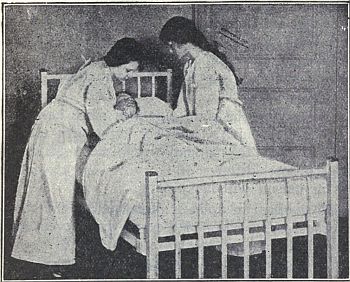
Have the patient draw up the knees until the soles of the feet are firmly on the bed. Place your right arm under the far shoulder in such a way that the patient's head rests in your bent elbow. Place the left arm under the thighs. Hold your back stiff. Have the patient clasp her hands around your waist. Lift without jerking. When two persons are doing the lifting, one should stand on either side of the bed. The person on the left side of the bed should place the right arm as though she were doing the lifting alone. Place the other arm under the small of the patient's back.
The person on the right side will place her left arm beside her companion's, and her right arm under the thighs. If able, the patient may place a hand on the shoulder of each lifter.
Lift in unison without jerking.
A pillow rolled in a sheet, placed under the body and tied to the head or sides of the bed will prevent slipping down in bed.
It is usually better to shake up and rearrange the pillows after raising the patient as the moving disarranges them somewhat.
To Change the Pillows
Slip the right arm under the shoulders in such a way that the neck and head are supported in your bent elbow; with the left hand gently draw out one pillow at a time, from above. In replacing, stand the pillows on the side at the head of the bed, lift the shoulders, and grasping the pillow by the middle draw down under the patient's head.
Another way is to have the patient near one side of the bed and lifting in the same way draw the pillows one at a time away from you. In replacing put the fresh pillows on the far side and again lifting the head pull them toward you.
The pillow should support the neck and shoulders. A small down or hair pillow placed under the back of the neck from time to time, rests and supports.
To Change the Nightgown
The nightgown should be loose enough to change easily. If there is an opening in the front, this may be made larger or the gown may be split up the back.
These openings may be sewn up again without in any way damaging the gown.
Have the gown well drawn up around the shoulders and neck.
Slip one hand through the arm hole of the gown, and bend the patient's arm. With the other hand draw off the sleeve.
Draw the hand through the corresponding sleeve of the fresh gown and lifting the head just as for changing the pillow, slip the soiled and fresh gown over the head at the same time. Pull away the soiled gown. Put your hand through the sleeve and draw the patient's hand through, then raising again draw the gown down under the back and hips.
Combing the Hair
The hair should be combed at least once a day. If this is done from the very beginning of an illness it will not get badly tangled.
Spread a towel over the pillow. Have the patient turn head on one side so that the back of the head is exposed. Part the hair in the middle from the forehead to the nape of the neck. Comb only a small strand at a time. If there are tangles, comb from ends toward the scalp. Avoid pulling by twisting the strand around the finger and holding loosely between the comb and the scalp. When the hair on one side has been combed, braid it, having the top of the braid near the ear. Do the other side the same way. If very much tangled a little oil or alcohol rubbed in makes it easier to comb.
Wash the comb and brush in soap and water once a week.
Wash the hands after combing the hair.
Be careful in removing the towel not to scatter the loose hairs and dandruff it may hold.
Getting Patient Up in Chair
If possible have a chair with arms.
Place beside the bed.
Put cushions on seat and fresh pillow at back.
Throw a blanket over all corner-wise, to wrap around the patient when she sits down.
While in bed put on stockings, slippers, bath robe (and underdrawers or flannel petticoat in winter).
Have the patient sit up in bed, and help her to swing her feet over the edge.
Stand in front of her, and have her place her hands on your shoulders. Place your hands under her armpits, and let her slip off the bed with her feet firmly on the floor. Turn and let her sit down slowly.
Place a stool for her feet.
Place the chair so that she will be out of drafts and so that the light does not shine directly into her face.
When patients become restless and nervous they may often be made more comfortable by rearranging the bed clothes, by fanning, by changing position, by rubbing the back and legs, by putting hot water bags at the feet, back and neck, or small of back. In summer try very cold water instead of hot water in the bags. Cold compresses may be applied to the back of the neck, the spine, the forehead, or wherever they may give comfort. A foot bath, a hot or cool sponging will not only quiet restlessness but will often make a patient sleepy. In using any wet application be sure not to get the pillows or bed clothes wet. Continued rubbing at the back of the neck or stroking of the forehead gently is soothing and quieting.
Temperature, Pulse, Respiration
The temperature of the average person in health is 98.6° Fahrenheit. This is called the normal temperature.
A temperature below 98.0 degrees is said to be sub-normal. A healthy person may have a sub-normal temperature in the early morning. People with a continuous low temperature, say around 97 (this is often the case with old people and those who are recovering from illness) need careful attention. If in bed, they should be kept warmly covered and supplied with hot water bags. If up, they should be warmly clothed, and protected from drafts, and sudden changes of temperature. Usually, in the early morning before daylight, the temperature is at the lowest. That is why it is important to watch sick people and babies and to put an extra cover over them at that time.
Any temperature above 100 degrees, if it continues, is serious. A temperature above 101 degrees is a fairly high one, and 103 degrees or above is very high.
The temperature is taken with a clinical thermometer placed in the mouth or in the armpit. For babies, and people who might break the thermometer if it were placed in the mouth, place the thermometer in the armpit. Temperatures of babies and very ill people are taken in rectum, but the Girl Scout should not attempt this. Always wash the thermometer in cold water before using. Wash in cold water and disinfect by wiping off with alcohol or ether after using. Hot water will break it. When the thermometer is being used every day it may be kept in disinfectant. Never lay down a thermometer that has been used until after it has been washed and disinfected.
To Take the Temperature in the Mouth
Cleanse the thermometer.
Shake down so that the mercury is below 96 degrees.
Have patient moisten lips.
Place the thermometer with bulb under tongue. Lips must be closed while holding it.
Hold two or three minutes, in this position.
Be sure that nothing hot or cold has been in the mouth for at least five minutes before taking temperature.
To Take Temperature in the Armpits
Wipe out armpit.
Insert the thermometer.
Place arm across the chest so that the thermometer is held securely. It should remain so for four or five minutes.
Pulse
The pulse may be counted on the thumb side of the inside of the wrist, at the temples, the ankles, and other parts of the body where the arteries are near the surface.
The pulse shows the number of times per minute which the heart beats or pumps.
A normal pulse rate for a man is around 72, for a woman 80, for a child 90, and for a baby 100 beats.
A very rapid or a very slow pulse shows that there is something wrong that should be reported. It takes a good deal of practice to learn to count the pulse.
Place two or three fingers on the beating artery, just touching firmly enough to feel the beats, and count for a half minute, then multiply by two to find the number of beats per minute. Be sure that the patient's hand is in a comfortable position while counting.
Respiration
Respiration is another word for breathing. An average normal person when sitting or lying still, breathes from twelve to twenty times per minute, and when moving about 24 times. We all know that quick moving makes quick breathing.
Respiration above 40 or below 8 is a danger sign. If the respiration is very fast, or difficult, or wheezy, or in any way very unusual, we can tell it at a glance. People who are breathing hard are frequently relieved by being propped up in bed.
To count the respiration. It is better to do this without the person's knowledge. It may be counted by watching the rise and fall of the chest or of the shoulders. Another way is to hold the person's hand as though taking the pulse, having her rest her hand and forearm lightly on the chest and count the rise and fall.
Dishes
Dishes used by patients with any of the contagious diseases, and this includes colds and sore throats, should be kept separate, and washed separately from the family dishes. They should be scalded after washing and have special dish cloths. Using separate utensils, and a separate room for the sick person are two of the surest ways to prevent the spread of the disease.
In such diseases as measles, scarlet fever, colds, mumps, influenza, dishes should be boiled every day. Put them in a large kettle in cold water and let them come to a boil. Even the thinnest glass will not break if treated in this way. Let the dishes stay in the water until cool enough to handle.
Dish cloths and dish mops should be thoroughly washed in good hot water and soap, and put in the sun to dry. They should be boiled regularly.
If it is necessary to disinfect linen put it all in a bag and leave in cold water to soak for some hours before putting it on to boil. Put a little washing soda in the water. After boiling hard for fifteen or twenty minutes it may be washed with the other garments.
Stains should be washed out before putting linen in the wash.
Utensils and Their Care
All utensils should be kept clean and ready for instant use. The bedpan should always be warmed before being used. Running warm water in and on it is usually the easiest way to do this. It should be thoroughly dried on the outside so that it will not wet the bed. It is a good plan to have a piece of rubber sheet or several thicknesses of old newspapers covered with a bath towel to put under the bedpan in bed. When carrying away, keep covered. Use cold water first, and after washing with soapy water, rinse and dry before putting away.
Basins in constant use, especially if they are used to hold disinfectant, need to be well scoured with sapolio from time to time. Nothing is more shiftless looking than a dark rim of dirt or stain around a basin.
Hot water bags should be emptied when not in use and hung upside down. The stoppers should be kept fastened to them.
Ice caps should be dried inside and out and stuffed with cotton or tissue paper to keep the sides from sticking together.
Hot and Cold Applications
Hot applications are used to relieve pain, to supply heat, and to bring down temperature. Both moist and dry heat are used. Hot water bags, metal heaters, electric pads, hot flannels are the commonest forms of dry heat. Fomentations, poultices, and baths are the simplest forms of moist heat.
In applying heat, one should be ever on the watch to avoid burning a patient. The skin of babies, children, old people, and of those who have been ill a long time, is very easily burned. Again, the same heat that is easily tolerated by one person, may burn another.
Hot water bags or their substitute, electric pads or metal heaters should always be wrapped in towels or have their own coverings. Never fill a hot water bag more than two-thirds full. The water should not be hot enough to scald a patient if the bag should spring a leak. Before putting in the cork, expel the air by twisting the upper part between the neck and the level of the water before putting in the cork. Be sure to cork tightly. If the bag is to be where the patient will bear the weight, put in a very little water and renew from time to time. Where there is no hot water bag, stone bottles may be used, or bags of salt or sand may be heated in the oven. The practice of using ordinary glass bottles is an unsafe one, as the corks are not always to be depended on to stay tight and the glass breaks easily. When bags of salt or sand are used the coverings should be thick enough to prevent the particles from sifting through. Pieces of flannel the right size may in some cases supply all the heat that is necessary. They should be covered with another flannel to keep in the warmth.
To make a mustard plaster. Have ready a piece of old muslin (a piece of an old nightgown will do) two inches wide and two inches longer than twice the length of the poultice required. On one end of it, with a margin of an inch on three sides, place a piece of oiled paper or shelf paper or a piece of clean paper bag, the size you wish the poultice to be. Mix one tablespoonful of mustard with 8 tablespoonfuls of flour, before wetting. Have water about as hot as the hand can stand. Do not use boiling water. Stir the water into the mustard and flour gradually so that it will not lump. Make the paste stiff enough to spread thinly on the paper, about a quarter of an inch thick. Turn the margins of the cloth over the paste. Fold the long end over so that all the paste is covered and tuck the end under the turned-in edges of the sides. Fold it and take it to the patient in a hot towel or between hot plates. The skin where it is to be placed should be oiled. Test the heat by holding it against the back of your own hand. Put on slowly and leave for two minutes. Watch and remove sooner if the skin becomes reddened or if it is uncomfortable. After removing wipe away the moisture from the skin and cover with a soft piece of muslin, and place a piece of flannel over that. A blister after a mustard paste shows very careless nursing. Never let a patient go to sleep with a mustard plaster on.
ADMINISTERING AN INHALATION
Fomentations or stupes are pieces of flannel wrung out of very hot water and placed on the skin. They should be two or three times as large as the part to be treated, and should be applied as hot as the patient can bear them, without burning the skin. Have two sets, so that one set will be ready to put on when the other is taken off. The stupes should be wrung as dry as possible and as they must be very hot to do any good, a fomentation wringer is a great protection for the hands. One may be made by putting halves of a broom handle through the ends of a short roller towel in the middle of which the fomentation has been placed. By twisting the sticks in the opposite direction the fomentation can be wrung very dry. Take it to the bed in the wringer and do not open until ready to place on the skin, as it will lose its heat very quickly. Put a little oil or vaseline on the skin and apply the fomentation gradually. Cover with a dry flannel and put wadding over that. A piece of oiled skin or oiled paper between the wadding and the dry flannel helps to keep in the heat and moisture. Hold in place with a towel or binder pinned tightly.
Cold is applied by means of ice bags and by cold compresses. In filling an ice bag the ice should be in small pieces, and the bag not too full. Expel the air as from a hot water bag. Cover with a towel or a cover for the purpose. Never put the rubber near the skin, it may freeze if so left. Besides, the cover absorbs the moisture that collects on the outside as the ice melts.
Cold compresses are a common remedy for headache. Old handkerchiefs are excellent for this purpose. Fold in frayed edges, two or three thicknesses will be heavy enough, and have two, large enough to cover the forehead. Wring one out of ice water so that it will not drip, and put on the forehead. Keep the other on a piece of ice and change the two applications frequently. When applied to the neck a dry cloth should be placed outside to protect the pillow or the patient's clothing. Cold compresses for inflamed eyes should be of one thickness only, and a little larger than the eye. Have a number and change very often. Use a separate compress for each eye. If there is a discharge a compress should not be used a second time. The discarded compresses should be collected in a paper bag or wrapped in newspapers and burned.
When cold compresses are applied to the head there should be a hot water bag at the feet.
Gargles, sprays, and inhalations are often ordered for sore throats and colds.
Salt or soda added to water in the proportion of a teaspoonful to a pint makes an excellent gargle.
A very cold gargle or one as hot as can be held without burning is better than a tepid one.
Do not go out in the cold air directly after using a hot gargle.
Use at least six separate mouthfuls each time you gargle, and hold long enough at the back of the throat for the gargle to reach every part.
A spray should not be used for the nose without a special order from the doctor. The liquid sometimes gets into the passage leading to the ear and causes earache.
Always wipe the nozzle of the atomizer before using. It should be cleaned after each use and boiled, if another patient is to use it. Always boil the nozzle and clean out the bottle when the atomizer is to be put away. Keep it in a box where dust will not reach it.
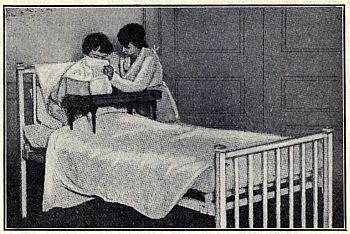
Inhalations are useful to relieve difficult breathing and for loss of voice or hoarseness. Fill a pitcher, bowl, or basin, two-thirds full of boiling water. Wrap with a towel to prevent burning if it should touch a patient. Usually drugs such as peppermint spirits, oil of eucalyptus, or tincture of benzoin, in dose of a teaspoonful to the hot water contained in the receptacle, is enough. If no drug is at hand, the steam itself may be depended upon to do some good. Pin one end of a bath towel around the face below the eyes and spread the other over the pitcher inhaling the steam as it rises. It may not be possible to induce a child to do this, in which case make a tent of an open umbrella with a sheet thrown over it at the head of the bed, leaving the front a little open. Place the pitcher so that the child will get the steam and hold the pitcher carefully all the time. Do not let the pitcher touch the patient.
Another means of inhalation is to hold a funnel, made of a piece of folded paper in the nose of a kettle of very hot water, near the patient so that the steam can be inhaled. Be very careful not to scald the patient. After a steam inhalation one should not go out in the cold air nor have the windows opened for an hour or more.
Common Medicines and Other Remedies
It is a very safe rule never to take medicines oneself without a doctor's orders. Above all, never advise others, even when you know from experience that certain medicines have helped yourself and others. Medicines should be taken upon prescription from the physician, should be measured accurately, and given at the exact hour ordered.
Read carefully the label or box from which you take the medicine before and after opening or uncorking, and read the name again when putting back in its place. Many people have been poisoned by not reading the label. Have all glasses and spoons, etc., thoroughly cleansed before and after using.
Accuracy, attention, cleanliness, regularity should be watchwords.
In giving either food or medicine, the following measures are helpful:
1 teaspoonful measures 50 grains.
2 teaspoonfuls make 1 dessertspoonful.
2 dessertspoonfuls make 1 tablespoonful.
2 tablespoonfuls make 1 ounce.
8 ounces make 1 cupful or glassful.
16 ounces make one pint, or pound.
(This applies to either liquid or dry measure.)
In giving pills, capsules, tablets give a drink of water first to moisten the tongue and throat. This helps them to slip down more easily.
If there is danger of a pill or tablet choking the patient, crush the pill or tablet between two spoons.
When medicines are taken by spoon, the spoon should be licked by the patient in order to get the full amount.
Nearly all medicines should be mixed with water, and should be followed with a drink of water unless orders are given to the contrary.
Keep all medicines tightly corked.
Buy medicines only in small quantities, as most of them lose their strength in time.
In buying vaseline or cold cream it is better to have it in a tube than in jars. Being opened and dipped into constantly soon makes the contents of a jar unclean.
Common Remedies
Such remedies as the following are to be found in many homes.
Castor oil, clove oil, vaseline, baking soda (this is the same thing as bicarbonate of soda or saleratus), salt, lime water, alcohol, camphorated oil, spirits of camphor, flaxseed, aromatic spirits of ammonia. Do not confuse this latter remedy with ammonia water used for cleansing things.
Castor oil should be taken in these doses:
Baby: 1 to 2 teaspoonfuls.
Older children: 1 tablespoonful.
Adult: 1 to 2 tablespoonfuls.
There are many ways of taking castor oil. Heat the glass or spoon, put in some orange or lemon juice, then the oil, then more juice. Open the mouth wide and put the oil far back. Have more juice at hand to swallow immediately after. Chilling the mouth by holding a piece of ice in it for a few minutes also helps to disguise the taste. A couple of tablespoonfuls of lemon or orange juice with a quarter of a teaspoonful of soda mixed thoroughly with the oil will make it effervesce so that it is not unpleasant to take.
If the dose is vomited, wait a little while, then give another. Do not give directly before nor directly after a meal.
Olive oil is often taken in doses of one or two teaspoonfuls after meals to regulate the bowels or to help people gain weight or when the appetite is small. It is also used to rub into the skin of under-nourished babies and to rub sick people, especially if the skin is very dry. After rubbing with oil always wipe the skin with a towel.
Vaseline is used to grease sore and chafed parts. A little may be inserted into the nostrils for a cold. Camphorated vaseline is especially good for this. In case of an irritating cough that keeps a child from sleeping, a little plain pure vaseline may be put in the mouth, and it will be found very soothing.
Vaseline is also used to grease such utensils as nozzles and to put on the parts to which poultices or fomentations are to be applied.
Soda may be used for burns (moisten and apply as a paste), as a gargle (one teaspoonful to a pint of water), as an enema (the same proportion), for colds (a teaspoonful in a quart of water to be taken internally in the course of each day), and in bilious attacks, water with this amount of soda may be given. Also to get a person to vomit, in which case the water should be slightly warm.
Salt may be used as a gargle in the same way as soda, and even mixed with soda, also for enemas. Coarse salt, when heated and put into bags, may be used when there is no hot water bag.
Lime water is used in mixing the baby's milk and is put in the milk for sick people when they cannot take full strength milk. The usual proportion is two tablespoons of lime water to a half glass of milk, which makes about 1 part of lime water to 3 parts of milk.
Alcohol may be used to disinfect the more delicate utensils as the thermometer. Most alcohol now obtainable is wood alcohol or denaturated; that is, mixed with powerful poisons, so that it should never touch the mouth. Never place a bottle of alcohol near a flame. If it is ever necessary to use an alcohol lamp, use the solid alcohol. It is much safer.
Camphorated oil is often used to rub the chest and neck with in case of colds. It should be warmed and rubbed in thoroughly. Protect the bedclothes and the patient's clothes with towels. After rubbing, wipe and cover the part with a flannel, to prevent chill.
Spirits of camphor or aromatic spirits of ammonia, a few drops on a handkerchief or piece of cotton, held five or six inches from the nose, relieves faintness. Inhaling the camphor in this way will often make it easier to breathe through the nose in case of a head cold. Fifteen drops of aromatic spirits of ammonia in a tablespoonful of water may be given to anyone recovering from a faint or to relieve nausea.
Flaxseed tea is an old-fashioned remedy for coughs. Pour a quart of boiling water over two tablespoonfuls of flaxseed and let it simmer for two or three hours, or until reduced to about a pint of tea. Strain through a fine strainer several times so that it will not be stringy, flavor with lemon, and add honey or sugar. Put in a covered jar, and take a teaspoonful at a time to relieve irritation in the throat.
The Daily Clean-Out.—People, sick or well, should have a bowel movement once or twice a day. Taking medicine for this purpose is a very bad habit. If healthy people have the proper exercise and food, and drink plenty of good water, medicine is not necessary. Eating coarse grained food, as bran muffins, corn meal porridge, fruits, and vegetables, drinking plenty of water, exercising in the open air, and having a regular time for going to the lavatory (immediately after breakfast and the last thing at night before retiring are suggested times) are habits that are usually sufficient to keep the bowels in good order.
If the waste matter is not carried off by the bowel movements, the body will in time become poisoned by the decayed substance in the intestines, and illness follows. Many headaches, "tired feelings," "blues," and even appendicitis may be caused by constipation.
People who are sick and therefore deprived of taking exercise to help in keeping their bowels regular, need to have very special attention paid to their diet and to have plenty of drinking water always at hand. Also they should have bedpan or whatever other attention they need regularly, and when asked for, immediately.
Chill, if due to exposure, may be treated by giving a warm bath or a foot bath, and putting to bed between warm blankets and with hot water bags. Rub briskly under the covers and give a warm drink such as tea, coffee, milk, etc.
Some Common Ills and Their Treatment
When a chill is not merely due to being cold, give the same treatment except the rubbing, take the temperature, and if there is fever, send for the doctor, as it may be the beginning of an illness.
Colds or cramps, or pain in the bowels may be caused by constipation, by gas, by undigested food, by the monthly period or more serious causes. Apply heat (hot water bag or fomentation), sip hot water in which is a little baking soda (one-half teaspoonful to a cup), or a few drops of peppermint. Try a hot foot bath. Lie down and keep very quiet with a hot water bag at feet. If pain continues, except in the case of the monthly illness, empty the stomach either by putting the finger down the throat or by drinking warm water and soda until vomiting starts. Take an enema or a dose of castor oil. If the pain still continues, send for a doctor.
Convulsions. Send for a doctor at once. Loosen all clothing, undress if possible. Watch and prevent patient from hurting herself. Do not try to restrain. Try to force a spoonhandle wound with a bandage between the teeth, to prevent biting of tongue. Keep lying down with head slightly raised. As soon as possible, administer enema or dose of castor oil. Put ice bag on head and hot water bottle to feet. Keep warm. A child may be put into a warm bath and held until convulsions subside. Keep very quiet and handle as little as possible when the convulsion is over, as handling may cause a repetition of the twitching.
Croup. Give steam inhalation. Keep a kettle of very warm water in the room. If this is not possible, fill the bathroom with steam by turning on the hot water, and take the patient there. Put hot fomentations to neck, chest, and abdomen. Send for doctor, who will usually order medicine to make the child vomit, which brings some relief.
Earache. Use hot applications against the ear. A heated glass or a cup in which there is a cloth wrung in very hot water, held against the ear may be found very comforting. Never put drops nor anything else into the ear canal. Either send for the doctor or take the patient to him, as there may be a developing abscess which needs to be opened.
Fever. Patient should go to bed in a well ventilated room and keep quiet. The bowels should move freely and plenty of water be taken. Bathing the hands, face and neck or rubbing with alcohol gives relief, especially if there is restlessness. Only liquid food should be given, and even that should not be urged.
Headaches. The commonest causes of frequent headaches are eye-strain and indigestion. The cure is being fitted with glasses and taking a proper diet. Rest and quiet, careful eating, cold compresses to the head, a hot water bag to the feet, or a foot bath will usually relieve an ordinary headache. Sometimes, as when there is constipation, a dose of castor oil is necessary. An enema will often give instant relief. Never take headache medicines unless a doctor has specially ordered it. These medicines may contain powerful poisons. The danger of taking them is that while for the time being they may relieve the headache, the cause of the headache remains, and the headache returns unless the cause, such as eye-strain or indigestion, is removed.
Hiccoughs can be usually stopped by drinking a glass of water in sips while holding the breath. They are usually caused by eating too fast or by some form of indigestion.
Colds, Their Prevention and Care
Everybody knows that colds are "catching." People who are over-tired or under-fed, who stay too much in either under-heated or over-heated rooms, or who do not bathe regularly, or who do not get exercise enough in the open air, are those most likely to catch cold.
If you have a cold yourself, stay away from others if possible, and do all in your power to prevent others coming close to you. Cover the mouth when coughing or sneezing, use paper or old rags instead of handkerchiefs and then burn them; wash your hands before touching things others are to use, and use separate dishes, which should be kept entirely apart from the family dishes and washed separately. If such precautions are taken by the first member of the family to take cold, it would seldom spread through the family.
When people around you have colds, avoid getting close to them, gargle often, take deep breaths of fresh air whenever possible, wash your hands often and keep them away from your nose and mouth.
You do not need to be told that the handkerchief used by anyone with a cold is full of germs. It should be kept from touching other things and should never be left lying around.
If, at the first signs of a cold, a good dose of castor oil is taken, a glass of hot lemonade and a hot bath before going to bed, a cold may be "broken up," as we say. In mild weather, the windows may be left open, but if the weather is very cold it is better to air the room from another room, in order to keep an even temperature, but there should be good ventilation.
If the throat is sore, gargling and a cold compress to the neck will bring relief. If there is fever and headache, you have already been told what to do. Anyone with a cold should eat very lightly and drink plenty of water. They should be as quiet as possible and get all the rest and sleep possible.
Camphorated or plain vaseline may be put in the nostrils, and if there is a cough, plain vaseline may be taken internally—placed on the tongue at the back of the mouth. A spoonful of flaxseed tea taken as often as necessary to relieve irritation may bring relief. Inhalations are helpful in hoarseness. Never give any cough medicines except what are ordered by a doctor.
If the symptoms continue after the first night it is advisable to call a doctor, as what seems a slight cold may be the beginning of a serious illness, as measles, scarlet fever, pneumonia, etc. If there is earache, rapid breathing, great weakness or sleepiness the doctor should be called at once.
Any symptom that lasts after a cold, as pain in one part, weakness, or high temperature, needs a doctor's attention.
Food for the Sick
Food for the sick should be light and easily digested. Generally the doctor says what may be eaten. Such foods as the following are included in so-called invalid foods: Milk, milk soups, eggs, raw and soft-cooked, rennet, custards, ice creams, albumin water, well cooked cereals, gruels, broths, toasts, milk toast, jellies made with gelatine, such as lemon and wine jelly; macaroni, spaghetti, well-cooked bread (never fresh bread), tea, coffee, cocoa.
Sick people should have their meals as regularly as possible, at regular hours and promptly and attractively served. The tray, the dishes, the tray-cloth, should be spotlessly clean, and the tray should not be over-loaded with dishes or food. If it is necessary to bring all the food for a meal to the room on the tray at once in order to save steps, remove some of it, perhaps the dessert, until the patient is ready for it.
Before leaving the room to prepare the tray, arrange everything so that the patient may eat the food as soon as it is brought. As a rule it is better for the sick member of the family to have her meals served before the family sits down to the table, so that she may have her food fresh and hot, and not get tired waiting.
Try to have food that the patient likes, if possible. If she does not like what may be served her, it may be served so attractively that her appetite may be tempted.
All food should be tasted before serving. Serve hot food hot, and cold food cold.
Milk is the most nourishing of liquid foods. If it is to be heated, do not let it boil. Always take the chill off milk served to children.
Generally speaking, cooked food is better than uncooked, even fruits. Baked apples or apple sauce, for example, are safer to give the sick than raw apples.
Toast is better than bread. Toast upon which the butter has melted should not be given to a sick person. Have the toast hot, and butter each mouthful as eaten. Bread should be at least one day old before being given to a sick person. Hot breads, such as fresh rolls and biscuits, are not good foods for ill people. Fried foods should be kept from invalids and children.
The best way to prepare a potato for an invalid is to bake it. It should be served when it is light and mealy, and never after it has become soggy.
The best way of cooking meat is to broil it, having the outside well browned, and the inside soft and juicy, never dry and hard.
A Tray for Liquid and Soft Food
The tray should be large enough to hold two glasses or a cup and saucer and a glass, as well as salt or sugar. Put two spoons on the tray, and if the patient is using a tube or a feeder, put that on the tray. One of the glasses should contain fresh water. Offer a glass of water before and after the nourishment.
The tray for soft solids. Suppose the meal is to be boiled rice, or other cereal, and toast. The tray should have a fresh doilie, salt, sugar (covered), a glass of water, two teaspoons, a knife, if butter is allowed on the toast, and a small pitcher of milk or cream for the rice. Put the cereal in a deep saucer or small bowl, cover with a plate or saucer and rest on another plate. Spread a small napkin on another plate. Put the toast on it, then wrap the napkin around it to keep hot.
Sick people should have plenty of water to drink. Besides having a pitcher of fresh water and a glass where it may be easily reached, always put a glass of fresh cool water on the tray when food or medicine are brought. While ice water is bad for both sick and well people, the water should be cool enough to be agreeable and refreshing. Water that is chilled to the right temperature by being kept in the ice chest, bottled, is preferable. It should be drunk slowly and not gulped down. Water standing in the room should be kept covered at all times.
Feeding Helpless Patients
A patient is often so weak that she cannot lift her head in order to eat. In this case she would be given liquids through straws or by spoon or "feeder." Sometimes by putting a small quantity of liquid in a glass, two tablespoonfuls, a patient is enabled to drink without spilling a drop.
If necessary, slip one hand under the pillow, raise the head a little, holding the glass to the lips with the other. Anyone lying down should take food very slowly. If solid, it should be cooked, especially well, as there is danger of choking.
Tubes should be washed immediately after using. If used continuously they should be cleaned with a tube brush made for that purpose. Straws should be burned or destroyed. If feeding with a spoon, be careful that neither the food nor the spoon burns the lips or mouth. Feed slowly and a little at a time, allowing plenty of time between mouthfuls.
Occupying and Amusing the Sick
When people are recovering from an illness, or when they are what we call chronic invalids, they often enjoy and are helped by being amused or occupied. At this time a Girl Scout may be very helpful. First of all, she should be cheerful herself. Then she should be able to play two or three quiet games, such as cards, dominoes, checkers, and be able to read aloud and to tell cheerful and amusing stories. Children may often be kept quiet and happy by hearing little rhymes recited. It might be a good idea for every Girl Scout to be able to tell three short stories and three funny stories, know three conundrums and three short poems, play three quiet games of cards, play checkers, play dominoes and know three puzzles.
Excitement is always bad for sick people and they become tired easily, so they should not be read to, talked to, nor played with for too long an interval, even if they seem to wish it themselves. The Scout must always remember that these things are being done for the pleasure of the sick person, and she must be very patient, to let the games or stories be of their own choosing if they wish it, and to avoid being noisy herself.
Daily Routine
There should be a regular daily routine. Have regular hours for feeding, bathing, giving treatment and medicines, giving the bedpan, etc. Be punctual.
Usually the first thing to do in the morning is to close or open the window as necessary, and to give the patient a bedpan. Have it warm. Take temperature, pulse and respiration and record them. Bring a basin of warm water, soap, towel, etc., to wash hands and face, and a glass of water to brush teeth. Tidy the hair. Straighten up the room a little. Prepare and serve patient's breakfast. After an hour the bed bath may be taken, but a tub bath should not be taken until two hours after breakfast.
Make the bed. Clean up the room. If the patient is well enough, let her read or see visitors after this. Serve the dinner. After dinner, open the windows, lower the shades, and let the patient rest and sleep if possible for at least an hour. Sick people need more rest than well people and should have a regular hour for rest in the daytime. If they sleep, so much the better, as it has been proved that patients who take a nap during the day sleep better at night. After four o'clock give a drink of some kind of hot or cold substance, as needed or desired—broth, milk, lemonade. In the late afternoon sick people are often tired and restless. Change of position, rearrangement of the pillows or a good rub give comfort and relieve the restlessness. Diversion of some kind, nothing noisy or exciting, may serve the same purpose. It may be found wise to delay the bath until this time of day as bathing has a soothing effect.
Between supper and bedtime the sick person should be kept from excitement. This is a good time for reading aloud or allowing them to read for themselves, but a very poor time to see visitors.
Preparations for the Night. Bring in all the necessities for washing the hands and face and brushing the teeth and combing the hair, and help where needed. Change the nightgown (it is better to have a gown for the day and one for the night), brush the crumbs from the bed, make the sheet smooth, shake up the pillows and straighten out the bedclothes, having extra covers handy in case of need. Fill the hot water bag, attend to the fire, if there is one, and arrange everything in the room just as it will be needed for the night. Give a warm drink, and allow the patient to rinse the mouth (or, if wished, the brushing of the teeth may be delayed until this time). The last thing to do for the sick person is to give a good rub, paying special attention to the bony parts (lower end of spine, shoulder-blades, hips, knees, ankles). Then arrange the ventilation.
Before settling a sick person for the night, be sure that everything about the room is done, as any moving about after she is prepared to sleep may tend to disturb her and prevent her from going to sleep.
5. THE HEALTH GUARDIAN FOR GIRL SCOUTS
Has the town you live in a free swimming pool with instructors and well arranged hours for little children, older girls and boys and grown-ups? Can you step out after school and have a couple of hours on a well kept tennis court? Is there a good golf course reasonably near, with convenient trolley service? Are there plenty of playgrounds, so that the children are off the streets? And, since grounds are not enough, are there friendly young play-leaders connected with them, to get the children together and teach them all sorts of games and sports?
If none of these things are to be found, or not enough of them, wouldn't you like to have them?
"Of course I should," you reply, "but what can I do about it? I am only a girl, and I can't get all these things by just wishing for them!"
But that's just what you can do.
All these things in a town mean that the town is looking out for the health of its young people. Exercise is one of the most important means of preserving health, and most of the large cities nowadays are working hard to see that no child shall be out of reach of a good park, a good swimming pool and a good playground.
This all comes under the city government and as this is a democratic form of government, these things are all arranged by vote. That is, the citizens vote to use the public money for such things and vote for the officials who shall spend the money for them. Do you see that if you make up your mind now about the village improvements you want, you can vote for them later and get them?
Women are naturally interested in all that happens to children, and if all the women of a community should get together and vote for everything that concerned the health and happiness and good education of children, can't you see what happy days their school-days would be?
If you saw "Public Health" at the head of a chapter, you might not think it looked very interesting; but when you once get the idea that if your mother had had her say on the Public Health Board you would have had a fine skating pond with a good skate-house, last winter, and sunny, well-aired school rooms to study in, with a big gymnasium for basket ball in bad weather, you may be more interested in the merit badge for Public Health called "Health Guardian!"
Remember that Public Health is simply good housekeeping, applied to the community.
It is a subject which women are sure to take up more and more, and a Girl Scout who has given the matter a little thought and study is going to make a good citizen later on, and will be certain to have her advice asked—and taken—in the matter of making her town healthy and happy.
For instance, if the desks in the public schools are not of the right height and shape, the children are bound to suffer in their health and hygiene.
It is the business of the State to see that all public buildings, schools, theatres, factories, etc., have a certain amount of light and air to the cubic foot, because so much is necessary for health.
It is the business of the State to see that only a certain number of hours a day should constitute a day's work. This is because a certain amount of rest is a necessity for all citizens.
It is the business of the State to see that food and water can be brought into the community. Also that they be kept pure, both in transportation and after they reach the community. This includes the policing of all reservoirs and the filtering of the water; the refrigerating of meat and milk; the condemning of rotten fruit and vegetables; the collecting and disposal of all garbage and waste.
It is the business of the state to prevent spitting in public places, (one of the greatest sources of public infection); to prevent the use of common drinking utensils, towels, etc.; to insist on the isolation of contagious diseases and the placarding of the houses where they occur.
In order to carry on these great wise policies the state should offer free clinics where citizens can find out what is the matter with them and how to prevent it, and trained community nurses for the sick.
Do you see what a wonderful power an intelligent woman can be in the community she lives in? Women ought to be much better, really, in this public housekeeping than men, because most of them have had to learn to do it on a small scale, and know how necessary light, air, rest, exercise and cleanliness are.
But, you may say, as yet, I am too young to vote, anyway; what can I do?
The answer is very simple: every citizen, whether she is young or old, whether she has a vote or not, can find out the laws of the town she lives in and help to enforce them!
And the most important of these laws are those which affect the public safety and the public health. Whether there is a Public Health Commissioner or a Town Board or a Village Superintendent or only a District Nurse to appeal to, there is sure to be somebody whose business it is to listen to violation of the law.
If every troop of Girl Scouts knew the health laws of their town, and helped to get them obeyed, there would be a wonderful lessening of epidemics and a wonderful advance in the health and beauty of our towns.
If the Girl Scouts stood, all over the country, for the intelligent guardianship of the public health and recreation, they would rapidly become one of the greatest and most respected organizations in America, for this reason alone.
6. THE HEALTH WINNER
"... For since a little self-control, since a clean and elementary diet, pure water, openness of the body to sun and air, a share of honest work, and some degree of mental peace and largesse, are the simple conditions of health, and are or ought to be, accessible to everybody—
"To neglect these is sheer treason."
—Toward Democracy, by Edward Carpenter.
Five Points of Health for Girl Scouts
A cheerful Scout, a clean Scout, a helpful Scout, is a well Scout. She is the only Scout that really is prepared. She not only knows the laws of health, she lives them: she stands tall, she plays daily in the open air, she rests and sleeps at night, and conserves her energy at all times, she is careful to get the right amount of air, water, sun and food each day, and perhaps most important of all, she keeps clean.
1. Stand Tall—Every Scout should be recognized a long way off, not only by her uniform, but by her erect carriage. In sitting, the lower back should be against the back of the chair. In bending forward to read or write, bend straight from the hips. At Scout meetings practice sitting without support for the back. When "at ease" during drill, stand with feet apart and parallel and with hands hanging free. When resting, lie flat on the back without pillows. Correct posture is obtained by balancing the different parts of the body—hips, head, chest in a straight line, so that the bony framework bears the weight. The muscles and ligaments will not then be strained, and the bones will not be forced into an abnormal position. Two rules to remember are: "Stand tall" and "Keep your spine long."
2. Take Exercise—If you have watched soldiers obey commands in drill you know how quickly their joints and muscles work. The setting-up exercises given in the Handbook have been planned to preserve the power of joints and muscles, and to prevent them from becoming like rusty machines. These exercises should be taken with windows open, if not out of doors. Clothing should be light and loose, and corsets removed. These exercises are not to be considered a substitute for vigorous outdoor work or play, but only as supplementary to or when these are impossible. The day should be planned to include at least an hour and a half of vigorous activity in the open air. This will take different forms, according to the place and season, so that in the summer one may swim, row or paddle, or play tennis or any other game outdoors, and in the winter skate, coast or snowshoe. However, the best all year round exercise, and the simplest and easiest to get is walking. Five miles a day is an adequate average. Even walking alone is good exercise, but walking in a group or two and two is better, because keeping step, singing, whistling and talking and laughing together add enormously to the exhilaration of motion and of sun, wind or rain in the face.
A Girl Scout should avoid unusual exercise before, during and immediately following menstruation. However, she should remember that a reasonable amount of exercise at this time is quite normal and beneficial, except where there is an actual disorder of some sort. In this case a physician should be consulted.
3. Rest and Conserve Energy—Go to bed early and sleep from eight to eleven hours, according to age. Sleep with windows open all the year round. Rest sometime during the day, flat on the back if possible, but even five minutes sitting quietly with hands in the lap and eyes closed is better than nothing. The following table shows the number of hours of sleep that are needed at different ages:
AgeHours of Sleep
10 and 11 years 9½to11
12 and 13 years 9to10½
14 and 15 years 8½to10
16 and 17 years 8to9½
18 and 19 years 8to9
20 and over atleast 8
Save Your Eyes
The reason it is important to rest and to sleep enough is because it is while at rest that the body regains energy lost during activity, and stores it up for future work and play. There are other ways of saving energy, and one of them is by keeping the body in such good repair that like a good machine it does its work with a minimum expenditure of force and heat. This is the main reason for the setting-up exercises, or indeed for any sort of exercises. Perhaps the single best way to save energy is by saving your eyes. There is almost no work or play that does not involve the use of our eyes. If people are blind they can learn to do many things without vision, but it is infinitely harder than with it. Modern life, especially in cities, makes a constant demand on our eyes, and more than this, the demand is on one part of the eyes—the muscles concerned in near work. The best way to rest the eyes, and one which not only rests the tired parts but exercises the parts that are not used, is by doing things that will involve distant vision. Walking and looking far ahead and far away on every side rests the eyes best of all, and this is one reason why a good walk will often clear up a headache. Another way to insure distant vision is by riding backward in a car. Then as the landscape flows past you, your eye muscles relax to the position needed for distant vision. If you cannot walk or ride and are doing close work, like sewing or reading, look up and "at nothing" every once in a while.
The following are some important rules to remember in saving your eyes:
Rest your "near" eye muscles by looking at distant objects and places.
Do not work facing a light or where the rays from a light cross your field of vision directly.
Work so far as possible by indirect or reflected light.
If you must work near uncovered artificial lights, wear an eye-shade.
When sewing or writing have the light at your left, unless you are left-handed. This is to keep the shadow of your hands from the work.
Avoid a glare or light that is in streaks or bars of alternate dark and bright. Diffused, even light is best.
Have your eyes examined by a competent oculist immediately:
If you have headaches,
If the eyes sting or burn after using,
If print or other objects dance or blur,
If you must get close to your work to see it,
If near work tires your eyes or you,
If there is the slightest irritation or soreness about the lids or other parts.
How to Avoid Muscle Strain
Girls and women in attempting to live an outdoor life or indeed when trying to do many of the things numbered among the Scout activities, such as First Aid, Home Nursing and Hiking, often give themselves quite unnecessary pain and fatigue from lifting, pulling and carrying weights in the wrong way. Ability to carry and lift or move is not so much dependent upon absolute strength as it is on knowing how. The whole body, so far as it is a physical mechanism, may be thought of as a series of levers, of which the muscles, bones, and joints make up the parts and are fulcrum, power arm or weight arm as the case may be. Without going into the details of bodily structure or even knowing the names of the different bones and muscles, it is possible to learn a few simple things about the right use of these levers that will be useful at all times.
Certain parts of the body are more able to do heavy work than others, and the first thing to remember is that the upper part of the back, the shoulders and the upper arms are stronger than the lower back, the abdomen and the lower arms. Therefore, whenever you are trying to lift or move an object, see if you cannot use these stronger parts. If the arms are held away from the body when lifting, pulling, throwing or pushing, the muscles of the upper arm, the shoulders and the upper back will be brought into play. If the arms are held close to the body, the lower-arm muscles are unduly taxed and in trying to help them out, pressure is made on the abdominal and pelvic muscles, which are not fitted to bear this sort of strain. Therefore, in carrying a bag or suitcase, where this is absolutely unavoidable, try to swing the arm free from the body, so as to use the upper arm and back muscles for the weight.
Another important way to save strain is by pushing instead of pulling. It is almost impossible to push anything so hard as to injure your back or abdominal muscles. It is almost impossible, on the other hand, to pull even a relatively light weight without some strain. If you will think of how a horse in harness actually exerts his strength in drawing a wagon, you will see that what he does is to push against the straps, and it is the straps that pull the wagon. Even the strongest horse could not pull a wagon with his teeth very far, or pull something tied only to the back leg muscles. Get behind and push is the rule to remember, and never resort to pulling until you have tried every device for pushing instead.
If you must pull, try to use heavy muscles, such as leg muscles, to do it with. Often a weight may be lifted or pulled by getting the foot under or in back and using the arms only to steer with. This applies particularly to objects like trunks or bureaus.
Always take advantage of any natural leverage that you can and if you must move something heavy, do not lift it at once and attempt to carry it, but lift one end and swing or shove it and then lift the other end and shove it. If you will watch expressmen at work you will notice that they roll boxes and trunks, holding them almost on end and tipping them just enough to turn them along their shortest axis. In this way the boxes carry themselves, so far as their main weight is concerned.
Carrying a weight on the head or shoulders is another way of converting a pull into a push, and this is taken advantage of by peasant women in Europe, who often are seen carrying heavy weights to market in baskets perched on their heads, while they stride along arm-free. A knapsack strapped on to the shoulders is not only more convenient because it leaves the arms and hands free to swing naturally or use for other purposes, but because the weight is distributed and is carried by means of heavy muscles pushing up under the strap. A weight should be distributed over a set of muscles as evenly as possible, and this is the reason for suspending a knapsack from two shoulders instead of one, when possible.
Finally, in doing any sort of lifting or pulling, if the muscles that are to be used are contracted before grasping the weight they will be able to do their work with far less effort. Try lifting a small weight like a book in two ways—first, have your hand and fingers relaxed and limp when you grasp it, and see how heavy it seems and how hard it is to contract your muscles properly while lifting it. Then drop the book and go at it again, this time anticipating its weight and contracting your hand and finger muscles before grasping it. See how easily it comes up. Try this same thing with heavier weights, and learn always to contract the muscle before taking the load. In carrying a weight for any distance it is well to shift it from one arm to another, always preparing the muscles by contracting them before the weight is assumed.
Using the muscles so as to take advantage of their lever-like qualities in the best way, contracting them before loading, and pushing instead of pulling, go to make up what is sometimes called "getting a purchase."
4. Supply Daily Need for Air, Sun, Water and Food—Besides exercise and rest there are other controllable factors upon which health depends. These are air, heat and light of the sun, water and food. To grow and work properly the body needs plenty of each of these.
Air—If you cannot work or play outdoors you can still bring out of doors in by opening your windows at frequent intervals. You will find that work goes better, and that you do not tire so easily if you make it a rule to open the windows and doors and move about the room for five minutes every hour or two. Sleep with windows open or out-of-doors. Camp and hike as often as possible. Work in the garden. Play out-of-door games.
Heat—The proper temperature of the body is between 98 and 99 degrees Fahrenheit. Human life depends upon the maintenance of this temperature at all times, and very slight changes either up or down interfere seriously with all the other life processes. The main source of heat is from food consumed, or really burned, in the body. Artificial heating in houses helps conserve the body heat, as does clothing. But clothes and shelter may make you overheated, which is nearly as bad as being cold; they may also shut out fresh air. Clothes should not be too heavy nor too tight. Shoes should have soles straight on the inner side, and be broad enough to allow the toes full play, and have low heels. Shoes that are comfortable to hike in are apt to be the best for all the time wear.
At night the clothes worn during the day should be aired and dried thoroughly. This will help much in maintaining the right body temperature, because clothes become damp from wearing, and dampness uses up body heat.
Sunlight—Sunlight is one of the best health bringers known. Little children—and grown people, too—suffering from the most serious forms of tuberculosis, that of the bones, get well if they are kept in the sunlight. In one of the finest hospitals for children in the world, in Switzerland, the main treatment is to have the children play outdoors without clothes in the sunlight, and they do this even when there is heavy winter snow on the ground. Human beings droop and die without the sun, just as plants do, though it takes longer to kill them. It is a gloomy person who does not feel happier in the sun, and a happy and cheerful person is generally healthy. So get into the sun whenever you can. Walk on the sunny side of the street, and open your windows to the sun whenever you can. However, in hot climates and in the warmest summer days, remember that the sun can injure as well as help, and do not expose the head or body unnecessarily.
Water—As about three-quarters of our body weight is water, the solid portions of bone, muscle, and so forth, constituting only one-quarter, and as considerable water is given off each day by evaporation from skin and lungs and with excreta, the loss must be made up. In addition to the water taken with meals and contained in the food a Girl Scout should drink at least six tumblers of water daily. This is a quart and a half. One glass should be taken on arising and before breakfast, two between breakfast and lunch, two between lunch and dinner, and one before going to bed. Be sure the water is pure, and boil any water the purity of which is doubted in the slightest. Water kept cool in the ice chest, or in a jar with a moist cover, is better than ice water, both because cool water actually quenches thirst more easily, being more readily absorbed than ice cold water, and because it is difficult to control the purity of ice.
Food—Food should be clean and kept clean. Growing girls can tell whether they are eating enough of the right sort of food, and if they are getting the best out of it, by seeing whether they are up to the right weight for their height and age. A chart is given at the end of this section showing the standard weight for each height at each age. The following are good rules to follow in making your daily food habits:
Do not eat between meals.
Eat slowly and chew food thoroughly.
Eat freely of coarse cereals and breads.
Eat meat only once a day.
Have green vegetables, salad or fruit every day.
Drink as much milk as possible, but no coffee or tea.
If you do not have at least one bowel movement a day it is a sign of constipation, which means the accumulation of waste material from food in the intestine. Exercise, especially walking, eating coarse vegetables, coarse breads and coarse cereals, and fruit, and drinking enough water will help the bowels to move properly. Constipation is not only an unclean habit of the body, but it is dangerous, because the waste matter decays and poison is carried all over the body. Headaches, indigestion, bad breath and chronic fatigue are some of the results.
5. Keep Clean—A Girl Scout should be sure that the air, water and food that she allows to enter her body are clean. Be sure that they are pure when they reach her, and keep them so by keeping her body, clothes and room clean with the help of sun, soap and water. You have probably heard of germs, microbes and bacteria. These are names for the same organisms, which are tiny forms of plant life unseen by the eye, and of which our unaided senses give us no knowledge. They exist everywhere and in many forms. Most of them are harmless to human life, and many of them are useful, as, for example, one that grows on the roots of peas and beans and helps the plants to extract nitrogen from the air. Some bacteria, however, are harmful, and these are known as disease germs, as they are active in producing diseases, especially those diseases which we know as contagious. The dangerous germs nearly all live in dust and dirt and in dark places. When we clean house and dispose of waste material and bring air and sunlight into dark and dirty places we are doing more than removing unpleasant sights and smells, we are destroying the breeding places of disease.
Every girl wants a clear skin. Proper food, water and exercise give this; but it is also necessary to keep the surface clean by taking a hot bath with soap at least twice a week, and a cold or tepid sponge and rubdown the other days. Besides the loose dirt which comes on the body from the outside, perspiration and oil come from the inside through the skin pores, and when accumulated give a disagreeable odor. Special attention is needed to guard against this odor, particularly under the armpits, and soap and water should be used daily. A hot bath is relaxing and opens the pores. A cold bath is stimulating and closes the pores. A hot bath is best taken at night, or if taken in the morning, follow by a cool sponge or shower. Do not take a cold plunge bath unless advised to do so by a physician.
Always wash the hands immediately before handling or preparing food and before eating. Always wash hands after going to the bathroom. Keep nails short, and clean with nail brush each time the hands are washed and with orange stick when necessary.