FORMS FOR SCOUT CEREMONIES
Reading edition
1. ENROLLMENT
Before a girl may become enrolled as a regular Girl Scout she must be at least ten years old, and must have attended the meetings of a Troop for at least a month, during which time she must have passed her Tenderfoot Test. The Captain must have prepared the candidate for enrollment by explaining the meaning of the Promise and the Laws and making sure that she fully understands the meaning of the oath she is about to make, and that she also comprehends the meaning of "honor." The following is a convenient form for enrollments.
(1) The Scouts stand in the form of a horseshoe with the officer who is to enroll at the open side, facing Scouts.
(2) Officer addresses troops on the subject of what it means to be a Scout.
(3) Patrol Leader brings candidate to officer and salutes and returns to place.
(4) Officer addresses candidate in low tone: "What does your honor mean?" Candidate answers. Officer: "Will you on your honor, try: To do your duty to God and to your Country; to help other people at all times; to obey the Scout Laws?" Candidate and officer both salute as candidate repeats Promise. Officer: "I trust you on your honor to keep this Promise."
(5) Officer pins Tenderfoot Badge on the new scout, explaining what it stands for, that it symbolizes her Scout life, and so forth.
(6) Scout and officer salute each other. Scout turns and troop salutes her, scout returning salute, and then goes alone to her place.
(7) All Scouts present repeat Promise and Laws. Troop then breaks ranks to take up some Scout activity.
When many scouts are to be enrolled, four at a time may be presented to the officer, but each should singly be asked and should answer the question: "What does your honor mean?" All four repeat the Promise together and the officer addresses all together in saying: "I trust you on your honor to keep this Promise," but speaks to each separately as she puts on the pin.
A Captain may perform this ceremony or she may ask some higher Scout officer to do so.
2. Presentation of Other Badges
The following form of ceremony was devised for special use in the presentation of the highest honor attainable by a Girl Scout, the Golden Eaglet, but the same outline may be followed for giving Merit Badges, and First and Second Class Badges, or any other medals or honors.
Presentation of Golden Eaglet.—As the presentation of the Golden Eaglet is an important occasion in the life of a Scout and her Troop, it should take place at a public Scout function, such as a District or Community Rally, a reception to a distinguished guest of the Scouts, or possibly at the time of a civic celebration.
The Court of Awards is responsible for all details of the meeting, and it is suggested that it invite parents, friends and other persons interested in the Scout movement to be present. The medal may be presented by the Chairman of the Court of Awards, some other member of that Committee or by a higher Scout officer.
Arrangements for the ceremony should be planned so that during the presentation of guests, the Court of Awards, the Eaglet's troop and the Color Guard form a hollow square, with the Captain at her post three paces in front of the Troop, the Lieutenant at her post "center and rear" of the Troop. The ceremony should be rehearsed wherever possible, so that all action and form shall be as smart as possible.
1. The Court of Awards enters and takes its place at right angles to the assembled guests.
2. The Captain enters, takes post, and gives all commands.
3. The Color Guard (bearer of the American flag, bearer of the Troop flag, and two guards) followed by Troop to which the Eaglet belongs, enter and march two paces in front of the Court of Awards. The lieutenant is at the left of the leading file. The Troop marches in single file, by twos or in Squad formation according to the number, and the space available.
When the Troop is very large, or the space restricted, the Eaglet's Patrol may take the place of the Troop. As the Colors pass, the Court of Awards should rise, stand at attention, and if Scouts, salute.
4. When the Color Guard at the head of the column has passed the Court of Awards, the command "Column left, MARCH!" is given. When the last file has completed the movement, the following commands are given:
(1) "Scouts, HALT!"
(2) "Left, FACE," or "Squads, left, MARCH, Squads, HALT," according to the formation of the column.
(3) "Right, DRESS, FRONT!"
5. At the command "Left, FACE," or "Squads, left, MARCH, Squads HALT," the Color Guard makes a left turn, marches forward until on a line with the Court of Awards, again makes a left turn, immediately halts and grounds flags.
6. When the Troop and Color Guard are in position, the Captain gives the command "Patrol Leader and Eaglet, forward, MARCH!" The Patrol Leader escorts the Eaglet to the Captain, salutes the Captain and returns to her position in line.
7. The Chairman of the Court of Awards comes forward, the Captain faces her, salutes, and presents the Eaglet to her.
8. The Chairman after reading the list of Merit Badges which the Scout has earned in order to receive the Golden Eaglet, pins the medal on to the Eaglet's blouse, over the middle of the right pocket. The Eaglet salutes.
If desired this is the opportunity for the Official presenting the badge to say a few words.
9. After the presentation, the Eaglet turns, and facing her Captain and Troop, stands at attention as the Colors are raised, the Scout flag dipped, and the Troop salutes. The Eaglet returns the salute and then marches to her position in line.
10. The Captain gives the command "Color Guard forward, MARCH." The Color Guard marches in front of the Captain and Troop who salute as the Colors pass, make a right turn two paces in front of the Court of Honor and march out.
11. After the Colors have left the "square" the Lieutenant takes her position at the left of the leading file.
The Captain gives the commands:
"Right, FACE, MARCH!" or "Squads right, MARCH!" "Column left, MARCH!"
and the Troop marches out. The Captain turns, salutes the Court of Awards and passes out.
O—LIEUT.
00000000
Troop—
00000000
O—Capt.
cxx
Color cxx Court of
Guard cxx Awards
cxx
————
————
————
Guests
Where there is no Local Council or Court of Awards, Captains are asked to communicate with the National Headquarters concerning the ceremony of presentation of the Golden Eaglet.
ALTERNATE FORMS FOR SCOUT CEREMONIES
In the case of troops for which this formal procedure is not practical, and for the better assistance of Captains and Councils who feel the need of a more definite formulation of the Scout principles on these occasions, the following ceremonies are suggested. They are designed to meet the necessity for expressing at each stage of the Scout's progress, recognition of her achievement up to that point and appreciation of her future responsibilities.
1. Tenderfoot Enrollment
1. The Troop being assembled in any desired formation, the Captain calls forward those who have passed the test.
Captain: "Scout ——, do you think you know what it means to be loyal to God and your Country, to help other people at all times, and to obey the Scout Laws?"
Scout: "I think I do, and I will try my best not to fail in any of them."
This is repeated to each Tenderfoot.
Captain: "Are you ready to make your Promise with your Troop?"
New Scouts (together): "Yes."
Captain: "Scouts of Troop ——, repeat your promise."
All salute and repeat the Promise.
Captain: "I trust you on your honor to keep this Promise." (Here, when practicable, investiture of hat, neckerchief, etc., takes place.) Captain then pins on Tenderfoot pin While attaching it, she says:
Captain: "This pin makes you a Girl Scout. It is yours, so long as you are worthy of it." Captain dismisses recently enrolled Scouts to their Troop position. (Here the Captain may add, if she wishes, anything in her judgment applicable to the Troop as a whole, or to the new Scouts individually.)
2. Conferring Second Class Badges
The Troop being assembled in any desired formation, the Captain calls forward those who have passed the test.
Captain: "Scout ——, you have learned what is necessary for a Second Class Scout to know. Do you think you can apply your knowledge, if the occasion should arise?"
Scout: "I think so, and I will always try to Be Prepared."
Captain: "Scouts (reciting the candidates' names in order), do you think that the discipline and training you have gone through have made you more capable of doing your duty to God and to your Country, of helping other people at all times and of obeying the Scout Laws, than you were as a Tenderfoot?"
Scouts (together): "Yes."
Captain (pinning on each badge, and speaking to each Scout as she does so): "You are now a Second Class Scout, which means that though you have learned much, you have still much to learn." Captain dismisses Second Class Scouts to their Troop position. (Here the Captain may address the Troop at her discretion.)
3. Conferring First Class Badge
The Troop being assembled in any desired formation, the Captain calls forward those who have passed the test and presents them to the presiding Official.
Captain: "Commissioner ——, these Scouts of —— Troop have passed their First Class Tests. I recommend them to you for First Class badges."
Official (to each Scout separately, the Captain giving her the name): "Scout ——, you have passed the final Scout test. You should thoroughly understand by now the meaning of duty to God and Country, the privilege of helpfulness to others, and the seriousness of the Scout Laws. Are you sure that you do."
Scout: "I am. And I realize that I must help other Scouts to see these things as I see them."
Official: "Scouts —— (reading the candidates' names in order), it has taken a great deal of thought and time and energy on the part of a great many people to enable you to wear this badge. Are you prepared to pay this back in generous service, when and where you can?"
Scouts (together): "Yes."
Official (pinning on each badge and speaking to each Scout as she does so): "You are now a First Class Scout. Remember that the world will judge us by you."
Official (to Captain): "I congratulate you, Captain ——, Troop ——, and the members of the Council, on these First Class Scouts, and I trust that the Town of —— will have every reason to be proud of them and to feel that it can depend upon them as especially good citizens and loyal Americans." Captain acknowledges this in suitable manner and dismisses First Class Scouts to Troop position. (Here the Official may address the audience at discretion.)
4. Conferring Merit Badges
The Troop being assembled in any desired formation, the Captain calls forward those who have passed the test and presents them to the presiding Official. (Note—The Merit Badges may be conferred by a member or members of the Council, if desired.)
Captain: "Members of the Girl Scout Council of ——, these Scouts have passed the various tests for their Merit Badges, and I recommend them to you for decoration accordingly."
Official: "Scouts (reading the list), you have fairly won the right to wear these badges we are about to present to you, and we are glad to do so. We take this opportunity of reminding you, however, that all good Scouts understand that they are far from having completely mastered the subjects represented by these badges. The symbols which you wear on your sleeve mean that you have an intelligent interest in the subjects you have chosen, understand the principles of them, and can give reasonable, practical proof of this. Do you realize that the Girl Scout Organization credits you with a good foundation and trusts to you to continue to build upon it intelligently?"
Scouts (together): "Yes."
Official (pinning on badges and speaking to each girl separately): "We congratulate you on your perseverance and wish you all success in your work." (Note—When more than one badge is to be presented to a Scout, they may be attached, for the ceremony, to a piece of ribbon and put on with one motion.)
Captain dismisses Scouts to Troop position. (Here the official may address the audience at discretion.) This ceremony being distinctly less formal and intimate than the regular class awards, Scout songs and cheers are in order.
5. Golden Eaglet Ceremony
The Troop being assembled in any desired formation, the Captain presents the Golden Eaglet to the Official who is to make the award.
Captain: "Commissioner ——, Scout ——, of Troop ——, of ——, has not only passed the twenty-one Merit Badge Tests required for the honor of the Golden Eaglet, but is, in the judgment of her Troop, fully worthy of it. We therefore recommend her to you for the decoration."
Official: "What badges does Scout —— offer?"
Captain reads the list Badges earned by the Candidate.
Official: "Troop ——, do you agree that Scout —— has fairly won this decoration and that you are willing to have her represent you to your National Organization as your Golden Eaglet?"
Troop (together): "Yes."
Official: "Members of the Council, do you agree that Scout —— has fairly won this decoration and that you are willing to have her represent you to your community as your Golden Eaglet?"
Council (rising if seated): "Yes."
Official: "Scout ——, you have won the highest honor in the gift of the Girl Scouts." "If the Scout life meant nothing more to you than a reasonable understanding of certain subjects, there would now be nothing more for the Girl Scouts to teach you; but I am sure that your training has not failed in this respect, and that you understand now, even better than the average Girl Scout, that your great principles of duty to God and Country, helpfulness to others, and obedience to the Scout Laws, are lessons that no Scout can fully learn as long as she lives. Do you agree to this?"
Golden Eaglet: "I agree to it thoroughly."
Official (pinning on badge): "I have the honor of naming you a Golden Eaglet, and in the name of the Girl Scouts I congratulate you heartily on your fine achievement." Scout salutes or shakes the hand of the Official, as desired, and returns to her troop position. (Here the Official may address the audience at discretion).
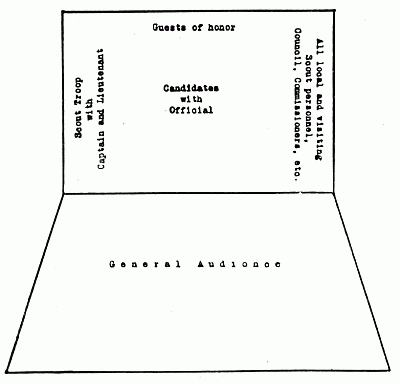
The accompanying diagram of suggested relative positions in Scout ceremonies lends itself equally to a small room, theatre, hall or open field. Whether the Scouts form a troop or even one patrol; whether they make use of strict military formation or informal grouping; whether the visiting Scout dignitaries are many or limited to one member of the local Council, the Scout bodies face each other, and the guest or guests of honor, equally with the general audience, can observe the Troop and the candidates easily from the side.
All Troops who are familiar with military drill can take their usual positions in their usual manner and observe all details of color guard, salutes, etc., to any desired extent. Troops and Captains not familiar with such procedure, by accustoming themselves to this general grouping, will always be able to present a dignified appearance.
Note: These suggestions for the various ceremonials assume that the regular opening of the Scout meetings has already taken place; therefore nothing is given but the actual matter of the presentations, etc. In the case of the Tenderfoot, Second Class and First Class awards, the ceremonies constitute the special business of the meeting, and opening and closing should proceed as usual. They are distinctly Scout business and are not, in general, offered to the public.
The awarding of Merit Badges might with advantage be connected with any local civic ceremony where interest in young people may be created; and in the case of the Golden Eaglet award it is distinctly desirable thus to connect it. Any visiting dignitary, national or state, may with propriety be asked to officiate; and where different organizations are taking their various parts in a public function, it will not always be possible to claim the time nor the space for the regular Scout opening ceremonies, nor would this necessarily be advisable. It is, therefore, well to be provided with a form like the preceding, where a small delegation from the Troop, the Captain and a Councillor could, if necessary, represent the essential units of the organization among a number of other societies; and the words of the ceremony would explain the occasion sufficiently without much concerted action, and may be inserted at the proper place, preceded and followed by any Troop or local customs preferred.
PLAN OF ASSEMBLY FOR GIRL SCOUT CEREMONIES
6. How to Conduct a Scout Meeting
1. One long whistle blast: Silence, listen for orders.
2. Three short whistle blasts: "Fall In," or "Assemble," three paces in front of Captain, Squad formation.
567 8 5 678
*** * * ***
*** * * ***
123 4 1 234
*Captain
Lieutenant*
3. "Right Dress," "Front."
4. Inspection. Captain inspects for posture, and for personal appearance which should be neat and clean in every particular, and uniform, which should be correct as to style, length, placing of insignia, etc. All necessary corrections should be made in a low tone of voice to the individual Scout.
5. "Color Bearer, Forward—Center" "March." The Color Bearer, appointed to carry flag, upon receiving order to "March", takes one step backward, executes "Right Face," marches out of rank, executes "Left Face," marches to point on line with flag, executes "Right Face," marches to within two steps of flag and comes to "Halt." She salutes flag, takes staff in both hands, wheels right, and marches to position three paces in front of, and facing troop. The captain and Lieutenant have moved to position at right angles to, and at right of troop. If a color Guard is used instead of Color Bearer, two Scouts act as guards, their position being on either side of bearer. They leave ranks together, form in line at right of troop, march shoulder to shoulder and always wheel to the right, the Color Bearer being the pivot and giving all orders to Guard. After Bearer has taken flag and turns, the Guards salute, take one step forward, about-face, and all march to position in front of troop. The Color Guard never takes part in the repeating of the Promise, Laws, Pledge of Allegiance or singing of Star Spangled Banner.
6. "Scouts, the flag of your country, Pledge Allegiance." The Pledge of Allegiance should be followed by one verse of the Star Spangled Banner.
7. "The Scout Promise," "Salute."
8. "The Scout Laws, Repeat."
9. "Color Bearer, Post-March." The Color Bearer, turning always to right, returns flag to its post, places it in position, salutes, and returns to place, entering ranks from rear of line. The Color Guard, wheels right, marches to post, Guards stand at attention while the Bearer places flag, salutes, and about-faces. The Guards step forward, about-face, and the Color Guard wheels and returns to ranks.
10. "Fall Out."
11. Business Meeting.
12. Scout activities, including work for tests and badges, singing games and discussion of Scout principles.
13. Closing Exercises.
Closing Exercises
1. "Fall In."
2. America, or Battle Hymn of the Republic.
3. "Dismissed." Scouts salute Captain.
The form for opening and closing exercises suggested above takes only 20 minutes and is a practical method of ensuring uniformity when groups from different troops come together. Troops may use more elaborate forms, depending upon the amount of time which the girls wish to spend upon this type of work. For instance:
(a) In a troop composed of many patrols each Corporal forms her patrol and reports to the Lieutenant, who in turn reports to the Captain, "The company is formed," etc.
(b) In dismissing, troops with a bugler may play "Taps" or may sing the same to words locally composed.
(c) In some troops Corporals give commands. This is good because it emphasizes the patrol system.
But the form outlined is given as the minimum requirement, and troops using it need never feel at a loss in large rallies, for every ceremony necessary to express the Scout spirit with dignity is there.
No additions made locally should change the essential order of these exercises, all additions which are made being merely amplifications of it in detail, which may not be possible nor desirable in every community.
Business Meeting
The meeting opens with the Chairman, Secretary and Treasurer in place, with the Secretary at the right and the Treasurer at the left of the Chairman. The idea is to have every Scout in the troop learn to be the Chairman so that any and all could act in the capacity of a Business Chairman at any kind of meeting.
The meeting is called to order by the Chairman. "Will the meeting please come to order?"
The Chairman asks the Secretary to call the roll. "Will the Secretary call the roll? And will the Treasurer collect the dues?"
The Chairman calls for the Secretary's report. "Will the Secretary read the minutes of the last meeting?"
The Chairman calls for corrections of the minutes. "Are there any corrections?"
If there are none she says: "If not, the minutes stand approved."
If there are corrections the Chairman calls for further corrections, "Are there further corrections, etc. If not, the minutes stand approved as corrected."
Form of Secretary's report: "The regular meeting of Pansy Troop No. 5, held at the club house, on April 4th, was called to order at 3 o'clock. In the absence of the Chairman, Scout —— took the chair. The minutes of the previous meeting were read and approved, dues collected amounted to ——. After —— was discussed and voted upon, the meeting adjourned."
The Chairman calls for the Treasurer's report. "Will the Treasurer give her report?"
Form of Treasurer's report:
Balance on hand Jan. 1, 1919 $2.50
Members' dues$1.00
Fines.301.30
Total$3.80
Disbursements—
Janitor$1.00 $1.00
Balance on hand2.80
Total$3.80
The Chairman calls for corrections as before.
Then the Chairman calls for a discussion of old business, that is, anything discussed at previous meetings, that has been left undone or left to be decided at a later date. Any member of the meeting may bring up this old business, or the Chairman may start the discussion. "The business before the meeting is ——. What is your pleasure in regard to this," or "Will anyone make a motion?"
The member who wishes to make the motion says: "Madam Chairman, I move that—"
Another member who agrees to this says: "I second the motion."
If the motion is not seconded at once, the Chairman says: "Will anyone second the motion?"
After the motion has been moved and seconded the Chairman immediately states the question as, "It has been moved and seconded that the troop have a Rally on May 2. Are you ready for the question?" or "The question is now open for discussion." If no one rises, the Chairman proceeds to put the question. "All those in favor say aye, opposed no."
Then the Chairman says, "The motion is carried," or "The motion is not carried," as the case may be.
After the old business has been attended to, the Chairman calls for new business, saying, "Is there any new business to be discussed?"
The Chairman then dismisses the meeting by calling for a motion for adjournment.
Adjournment: "Will some one move that the meeting be adjourned?"
If this is moved and seconded it is not necessary to put it to a vote.
The Chairman says: "The meeting is adjourned."