THE ARGONAUT, OR PAPER NAUTILUS.
Reading edition
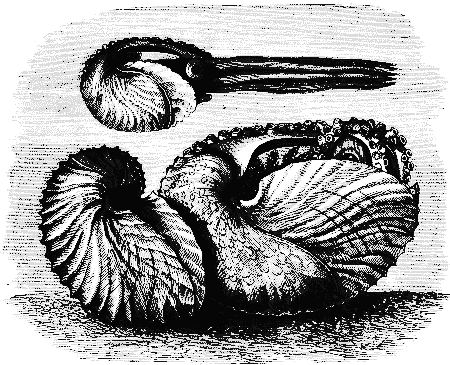
ARGONAUT, OR PAPER NAUTILUS.
This mollusk received the first title in allusion to the pretty fable which was formerly narrated of its sailing powers, and the latter title is given on account of the extreme thinness and fragility of the shell. It is remarkable that the shell of the argonaut is, during the life of its owner, elastic and yielding, almost as if it were made of thin horn.
The two arms of the argonaut are greatly dilated at their extremities; and it was formerly asserted, and generally believed, that the creature was accustomed to employ these arms as sails, raising them high above the shell, and allowing itself to be driven over the surface by the breeze, while it directed its course by the remaining arms, which were suffered to hang over the edge of the shell into the water and acted like so many oars. In consequence of this belief the creature was named the argonaut, in allusion to the old classical fable of the ship Argo and her golden freight.
The animal, or "poulp," as it is technically called, is a lovely creature despite its unattractive form. It is a mass of silver with a cloud of spots of the most beautiful rose color, and a fine dotting of the same, which heighten its beauty. A large membrane, which is the expanded velation of the arms, covers all. It has been definitely proved that the use of the expanded arms which cover the exterior of the shell is to build up its delicate texture, and to repair damages, the substance being secreted by these arms, and by their broad expansions moulded into shape. The larger figure in the en- graving represents the argonaut while thus within its shell. While crawling the creature turns itself so as to rest on its head, withdraws its body as far as possible into its shell, and, using its arms like legs, creeps slowly but securely along the ground, sometimes affixing its disks to stones or projecting points of rocks for the purpose of hauling itself along. When, however, it wishes to attain greater speed, and to pass through the waters, it makes use of a totally different principle. Respiration is achieved by the passage of water over double gills or branchiæ; the water, after it has completed its purpose, being ejected through a moderately long tube, technically called a siphon. The orifice of the siphon is directed toward the head of the animal, and it is by means of this simple apparatus that progression is effected. When the creature desires to dart rapidly through the water, it gathers its six arms into a straight line, so as to afford little resistance to the water, keeps its velated arms stretched tightly over the shell, and then, by violently ejecting the water from the siphon, drives itself by reaction in the opposite direction. The uppermost figure shows the argonaut in the act of swimming.

THE TRAP DOOR SPIDER OF JAMAICA.
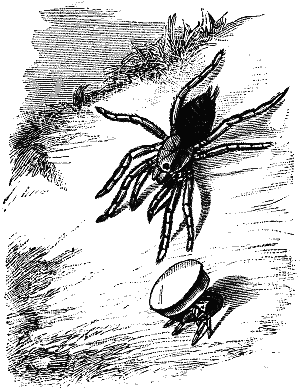
TRAP DOOR SPIDER.
This spider digs a burrow in the earth and lines it with a silken web. The burrow is closed by a trap door, having a hinge that permits it to be opened and closed with admirable accuracy. The door is circular, and is made of alternate layers of earth and web, and is hinged to the lining of the tube that leads to the burrow by a band of the same silken secretion. The door exactly fits the entrance to the burrow, and when closed, so precisely corresponds with the surrounding earth that it can hardly be distinguished, even when its position is known. It is a strange sight to see the earth open, a little lid raised, some hairy legs protrude, and gradually the whole form of the spider show itself.
The mode in which these spiders procure food seems to be by hunting at night, and in some cases by catching insects that are entangled in the threads that the creature spins by the side of its house.
In the day time they are very chary of opening the door of their domicile, and if the trap be raised from the outside, they run to the spot, hitch the claws of their fore feet in the silken webbing of the door, and those of the hind feet in the lining of the burrow, and so resist with all their might. The strength of the spider is wonderfully great in proportion to its size.
To Make a Hole in Glass.
New Remedies describes the following easy method of making a hole in plate glass: Make a circle of clay or cement rather larger than the intended hole; pour some kerosene into the cell thus made, ignite it, place the plate upon a moderately hard support, and with a stick rather smaller than the hole required, and a hammer, strike a rather smart blow. This will leave a rough-edged hole, which may be smoothed with a file. Cold water is said to answer even better than a blow.
The Preservation of Eggs.
As science advances, the processes proposed for the preservation of organic substances are being brought to greater and greater perfection. No subject perhaps in this connection has received greater attention, and been the subject of more processes, patent and otherwise, than that of the preservation of eggs. In fact this is a question of considerable importance, not only from a culinary, but also from an industrial standpoint—that of the manufacture of albumen for photographic purposes. In the Moniteur de la Photographie Dr. Phipson calls attention to a new process, which may be briefly stated as follows:
On taking the eggs from the nest they are covered over, by means of a bit of wool, with butter in which has been dissolved 2 or 3 per cent of salicylic acid. Each egg, after receiving this coat, is placed in a box filled with very fine and absolutely dry saw dust. If care be taken that the eggs do not touch each other, and that they be perfectly covered with the saw dust, they will keep fresh for several months—perhaps for more than a year. Dr. Phipson states that he has experimented with this process for two years, with most excellent results. So much for the preservation of the entire egg; but there is also a process for the preservation of the albumen of the egg for photographic uses, due to M. Berg. In this process, the white, separated from the yolk, is evaporated in zinc pans or porcelain cups, at a temperature of 45° C. The solidified albumen thus obtained is pulverized by means of a mill. The yolk, by means of machinery, is whipped up into a light mass, and then spread out on zinc plates and evaporated to dryness at a temperature of 80°, and finally powdered. The powders thus obtained keep for a long time. The white of eggs, so prepared, is used for the purposes to which albumen is applied in the industrial arts, while the powdered yolks are used for domestic purposes.
Characteristics of American Sheep Husbandry.
Dr. Hayes, in his recent address before the National Agricultural Congress, remarking that a very inadequate idea is given of a nation's resources by the number of sheep raised—the character of the animals being of the first consideration—proceeds to show some of the characteristics of American sheep husbandry. He states that the sheep of the United States consist, first, of what are called native sheep; second, descendants from improved English races; third, the Mexican sheep found in Texas, New Mexico, Colorado, and California; fourth, the merino sheep, and crosses of that breed with the three preceding races. The merinos constitute the principal and characteristic race of the United States; and this is the most important fact in the enumeration of our resources for sheep husbandry and the wool manufacture. England has no merinos, except in her colonies; Russia has but 12,000,000 merinos; France, but 9,000,000. The merinos and grades in the United States exceed 25,000,000. Merino wool is for clothing what wheat is for food; it is the chief material for cloth at the present day, the coarsest as well as the finest. While the softest, it is the strongest of all fibers. From its fulling and spinning qualities, it is the best adhesive for the cheap fabrics—coarser wool, cotton, or shoddy; the mixture of merino wool increasing indefinitely the material for cheap clothing. An abundance of merino wool is the greatest boon the world has received from the animal kingdom in the last century. It is, in fact, in its extended culture the product of the last century. A century ago all the merinos in the world, confined exclusively to Spain, did not number 1,000,000. 1765 marks the epoch of the first exportation of the merinos to Saxony; 1786, to France; 1833, to Australia; 1802, the introduction of the first merino sheep to this country; and to Gen. Humphreys, of Connecticut, and to the introduction to his farm of twenty-one rams and seventy ewes, may be directly traced the most celebrated breeds of the American merino; producing individuals actually sold for $5,000 each, others for $2,000 to $3,000, and one for which $10,000 was refused. The fiber of the merino sheep is not the only excellence of the animal; when properly bred, this race has a hardiness surpassing all other high-bred races. The "yolk," provided by nature to assist in the growth of the wool, abounding in this race more than in any other, causes the tips of the fleece to be cemented, and to become impenetrable to rains and snows. A lighter pasture suffices for their maintenance than would support the mutton races. This race is fitted, above all others, for the remote pastoral lands and for culture on a large scale.
Our breeders, in aiming to increase the weight of their fleece, have developed the length of the staple, and have unconsciously created a merino combing wool—a wool in special demand through modern improvements in machinery and changes in the fashion of goods. Mr. Ferneau, an eminent Belgian wool manufacturer, who has thoroughly studied our wool resources and manufactures, says that three quarters of the American wool is "combing wool," and will be ultimately employed for this purpose. The bulk of American merino wools is of strong, sound, and healthy staple, having few weak spots in them. Those from the other States of the West are free from burrs. Those from California have this defect in a high degree. They are admirably fitted for blankets, flannels, and fancy cassimeres, and the great bulk of our card wool manufactures. They are so excellent, as a whole, that M. Ferneau says they are too valuable to be used for clothing purposes. They supply nine tenths of all the card or clothing wool consumed in American mills.
THE PROGRESS OF SCIENCE IN MEXICO.
Mexico, the land of so many and such frequent revolutions, and the scene of such intestinal commotions and bitter strife through the whole period of her existence, from the Spanish conquest up to within a few years, is at present happily in a state of comparative peace and quiet; the laws are less disregarded, brigandage is gradually disappearing, more attention is being paid to the protection of life and property, and public education is in a prosperous condition. No greater evidence of this felicitous state of affairs could be afforded than that shown in the display of energy and zeal with which the present administration, aided by the foremost Mexican scientists, is carrying out an extended system of scientific explorations, investigations, and internal improvements; and the progress of which is being recorded in a valuable series of government publications; one of these—the Annals of the Minister of Public Works—being now before us. This volume, the third of the series, begins with an article by the able director of the National Meteorological Observatory, Sr. Mariano Barcena, calling attention, in the first place, to the great national importance, as well as necessity, of a well organized system of meteorological observations; (2) giving a description of the Mexican Observatory, its equipment, the questions it proposes to investigate, and the hours of observation; (3) an explanation, accompanied by charts, of the daily system of registration pursued at the observatory; and, finally, observations on the periodic phenomena of vegetation, and notes on the orography and geology of the valley of Mexico. Sr. A. Anquiano follows with a communication on the "Geographical Position of Chalco," prefacing the results of his labors by an able essay on the "Mexican Method" of determining the latitude of places, a "method" founded on an observation of the stars. It would be interesting to quote from this, but our limited space will not permit. The "Citlaltepetl Commission," consisting of the engineers, Srs. Plowes, Rodriguez, and Vigil, whose patriotic ardor induced the minister to commission them to explore "and be the first to plant the flag of Mexican science on the snow clad peak of Citlaltepetl," render their report of operations during the year 1877 in the form of an exceedingly interesting memoir. They ascertained the peak of the volcano Citlaltepetl (or Orizaba) to be 17,651 feet above the level of the sea, which is 292 feet more than Humboldt made it. After a somewhat exhaustive treatise on the "Telescope and its Amplifying Power," by Sr. Jimenez, we have a long and extremely interesting account of the Ancient Aqueduct of Zempoala, one of the most notable of existing monuments of the old Spanish rule. These aqueducts (for there were three) were projected and carried to a successful termination by an humble and ignorant Franciscan monk—the Friar Tembleque. The construction of these remarkable works, begun in 1554 and occupying a period of 17 years, was undertaken for the purpose of carrying water from Zempoala to Otumba (a distance of 27 miles), and was the occasion of a curious contract between the inhabitants of these two cities. It seems that Otumba, situated at a high elevation, needed water; Zempoala was blessed with water, but was sadly in need of spiritual advisers; the people of the former city, therefore, agreed to furnish a certain proportion of friars to minister to the religious wants of the parties of the second part, and the latter in return bound themselves to furnish water, and the labor and materials for the building of an aqueduct to lead it, to the parties of the first part. No tradition remains to state when these structures ceased to be used. The longest of the three extends across the valley of the Papelote, a distance of 2,960 feet, and consists of 68 arches, the highest of which has an altitude of 106 feet. Señor Salazar urges on the Minister of Public Works the importance of having these monuments of a past age repaired and restored, not alone for archaeological reasons, but because Otumba to-day is as greatly in need of running water as it was in that remote period when these viaducts were constructed. Señor Barcena follows with a description and colored plate of a plant (Gaudichaudia Enrico-Martinezii) new to the Mexican flora, and Sr. Federico Weidner with some "General Reflections on the Iron Industry of the Country." Succeeding the latter paper, an exhaustive article by the same writer gives us, from a geological point of view, the structure, as far as can be ascertained, of the "Cerro de Mercado" of Durango, which is said to be one vast mass of iron. The author after a thorough examination of this hill, last year, concludes that it is of eruptive or volcanic origin. This is contrary to the statements made in most published works, the authors of which probably derived their notions from the views expressed by Humboldt, who was of the opinion that this mass of iron was an immense aerolite. Sr. Weidner, however, concludes that the great traveler never visited the locality in person, but obtained his information from heresay. He shows that the hill is deficient in the chemical constituents of aerolites, namely, iron, nickel, and cobalt, in a native or malleable state; but, on the contrary, is made up in a great measure of crystalline magnetic iron, and various useful oxides of the same metal. By a careful estimate of the quantity of iron contained in that portion only of the Cerro which appears above the surface of the soil, the author obtains as a result the enormous sum of 507,000,000 pounds, and this reduced to a metallic state would yield 250,000,000 pounds of pure iron. The structure of this remarkable hill is made apparent to the reader by means of an excellent geological section, in colors, accompanying the text.
The volume closes with some notes by Sr. Barcena on the "Hydrographic System of the Hacienda of Cienega de Mata, and its application to one of the theories that explain Natural Fountains."
In taking leave of this subject we have to congratulate the Mexican Government not only for the valuable matter contained in its scientific publications, but also for the very excellent style in which the latter are being issued. The general make up of the volume before us leaves little to be desired; the arrangement of the types is extremely tasty, the imprint is clean, sharp, and clear, the paper good, the margins of the pages broad, and the illustrations exceedingly well executed. It is to be sincerely hoped that the present state of peace, which our sister republic is enjoying, will endure for numerous years to come; and that the scientific work begun under such happy auspices may go on uninterruptedly until the whole country shall have been thoroughly explored. For as yet, we know but comparatively little about the geology of Mexico, and a great deal is yet to be learned, too, about her natural productions.

Alum in Bread.—A Reply to Dr. Mott's Article in Scientific American of November 16, entitled "Deleterious Use of Alum in Baking Powder."
by w. p. clotworthy, baltimore, md.
On August 13, 1878, I obtained letters patent for the exclusive right to use exsiccated ammonia alum in baking powders. This fact I state that the public may know the reason that elicits this reply to the remarkable article on adulterations in baking powders, in the Scientific American of Nov. 16th, emanating from the pen of Henry A. Mott, Jr. I wish the Professor had been equally candid in stating his reasons for contributing the article. It is rare for a chemist to turn philanthropist without some consideration. The analysis of forty-two baking powders requires no little labor; twenty-one were examined at the expense of the government for the benefit of the Indian Department, the others, no doubt, at the expense and for the benefit of the Royal Baking Powder Company. I hope his services have been liberally requited. The public certainly owe him nothing for his labor or opinions. An excuse can be made for the prejudice existing against the use of alum in any form for baking purposes; it is an inheritance from a preceding age; but no apology can be offered for a practical chemist in this day, who labors to keep alive and foster a prejudice by the suppression of truths and facts. Professor Mott, in attempting to prove a fraud in food, has perpetrated a fraud in facts. That this opinion may not be unwarranted, I will state the facts about alum, which may be new to the public, but familiar to every chemist. Alum was formerly a compound of sulph. alumina and sulph. potash. In the past ten years nearly all manufacturers of alum have substituted sulph. ammonia for the sulph. potash; this change removes from alum a dangerous and objectionable ingredient, and adds a healthful one. Professor Mott recommends the use of ammonia in the form of a carbonate—carbonate of ammonia is one of the results in baking powder of the decomposition which takes place between alum and bicarbonate of soda; in the complete decomposition which takes place pure alumina is eliminated, highly recommended as an antacid. During the process of baking, alum is completely decomposed through the liberation of carbonic acid. Professor Mott must have known this, yet with this knowledge warns the public on the deleterious effect of alum in bread.
About the first of last October I determined to vindicate the use of exsiccated ammonia alum as a substitute for cream of tartar, and accordingly issued a circular to the trade; from this circular I now give the following extract, which enters minutely into the subject:
"To claim that an experience of 35 years in compounding medicines should entitle my opinion on chemicals and chemical compounds to a respectful consideration, is neither presumptuous nor unreasonable. With this simple introduction I now avow myself the originator and patentee of exsiccated ammonia alum baking powder. The use of exsiccated ammonia alum has been declared unhealthful by the advocates of other baking powders, and every manufacturer using it has been held up for public reprobation. This has been done by rival manufacturers, either through ignorance or malice; if from the former they are to be pitied, if from the latter they are contemptible. These opinions have been promulgated by kitchen chemists, whose circle of knowledge begins and ends with cream tartar and soda; and even of these articles they only know that cream tartar is in some way derived from grapes. In this circular I propose to state a few facts in relation to cream tartar and exsiccated alum, and the combinations they form with bicarbonate of soda, and allow you to form your own opinion of their respective merits. Crude tartar is the incrustation found in wine casks. It contains coloring matter and about 15 per cent. of lime. This article is purified and called the cream of tartar, but it is impossible to extract all the lime. Commercially pure cream tartar contains at least 5 per cent. of lime. When cream tartar is used in proportion of two parts to one of bicarbonate of soda, you will have an average of 3 to 4 per cent of lime. In using cream tartar and soda in baking, a chemical change commences as soon as water is added; the cream tartar unites with the soda, setting free the carbonic acid gas, which lightens the bread, and the residue is Rochelle salts. This is what you eat in your bread, the cream tartar and soda entirely disappearing in the process of baking, by forming this salt. Any doctor or chemist will confirm the above statement. When I undertook to manufacture baking powder, I labored to improve the quality and cheapen the cost. The first I accomplished by retaining the carbonic acid until heat was applied, the latter, by manufacturing a more economical acid than foreign cream tartar. After more than a thousand experiments covering a period of six months, I discovered by exsiccating ammonia alum I provided an article that would possess the necessary qualities. This article no more resembles the ordinary alum than charcoal resembles wood—it is light, porous, friable, and without taste. This article, under the influence of heat, combines with the soda and forms Glauber salts. In baking, the alum unites with the soda, just as cream tartar unites. In using the baking powder prepared according to my formula, you have in your bread Glauber instead of Rochelle salts. To your physician apply for his opinion of these salts; I will bow to his decision. Another false impression these zealous guardians of the public health have made is, that I used the exsiccated alum because it was cheap. The fact is that when I commenced its use it cost by the thousand pounds 12 per cent. more than the best cream tartar is worth to-day, and 33 per cent. more than average price of that article for the past year. I have since reduced the cost of manufacturing, and as I did so, correspondingly reduced the price of powder to the public. I regard the quantity of soda in cream tartar baking powders as very objectionable; they generally contain about 33 per cent. In my powder only 20 per cent. The prejudice in the public mind against alum, originated in the habit of the English bakers buying damaged flour, and by the addition of crude alum, made their bread in appearance equal to that made from best flour. Against this practice laws were enacted, not so much against the qualities of alum, as against its use in covering up a fraud in flour. This was the common potash alum and uncombined with any carbonated alkali, and it passed into the stomach unchanged. It is a trick—for it deserves no better name—of our rivals to show by chemical analysis that my powder contains alum, but are careful neither to state the kind nor the change it undergoes in baking. The manufacturer who knowingly misrepresents the goods of a rival, may well be doubted when he speaks of the quality of his own.
"Great stress is laid on the fact that cream tartar is a vegetable acid, the product of the grape, hence it must be healthy. They forget that cream tartar is not entirely vegetable, but principally second handed minerals. It is a compound of tartaric acid, potash, and lime; the last two are minerals, which the grape takes up from the earth, but redeposits them as crude tartar when fermentation converts the grape into wine. In 1807 Sir Humphry Davy from this crude tartar first made the metal potassium. Of lime it is unnecessary to speak. The potash and lime form the bulk of cream tartar. In ammonia alum there is no more mineral substance than in cream tartar. The chemistry of nature is wonderful. Vegetation lives on minerals—wheat, corn, potatoes, are all mineral compounds. Lime, soda, potash, magnesia, sulphur, iron, etc., are all found abundantly in water and grain, and all these minerals are essential in food."
Professor Mott has given the Royal Baking Powder the benefit of his indorsement; it may be all that he claims for it. But baking powders are now judged by constituent ingredients and chemical analysis; to this test I propose to bring the Royal. It is now in the hands of a competent chemist, and when the analysis is complete I will give the public the benefit of a comparison between that powder and the Patapsco. I will take Professor Mott's analysis of Patapsco, which, though not correct, I accept as such. The comparison will be made on the healthfulness of constituents in combination, and the chemical changes they undergo in baking. This is a progressive age. The people want facts, and they will form their own theories. Will the reader believe that in the reign of Henry VIII. of England, a citizen of London was executed for burning coal, which was then a capital offense? A pope about the same time issued a Bull excommunicating all Catholics who used tobacco, calling it the devil's weed. To-day coals still burn, and tobacco solaces millions of the civilized world. If the Royal Baking Powder Company (what a misnomer) possessed royal prerogatives, the advocates of exsiccated alum would fare no better than they did under the sumptuary laws of England. Professor Mott has fulminated ex cathedra his blast, but we survive. "Truth is a torch, the more 'tis shook it shines." Our strength is in the intelligence of the age.
Smith, Hanway & Co., Baltimore.
The Elongation of Tree Trunks.
The College Quarterly says that experiments made at the Iowa Agricultural College show that the popular notion that the trunks of trees elongate is entirely erroneous. Tacks were driven into the trunks of various trees, and the distance between them accurately measured. At the end of the season they were found to have neither increased nor decreased their distances. In the experiment, tree trunks were selected of all ages, from one year up to five or six, and in no case was there any change whatever noticeable.