ASTRONOMICAL NOTES.
Reading edition
by berlin h. wright.
Penn Yan, N. Y., Saturday, December 14, 1878. The following calculations are adapted to the latitude of New York city, and are expressed in true or clock time, being for the date given in the caption when not otherwise stated:
PLANETS.
h. m.
Mars rises 4 57 mo.
Jupiter sets 7 54 eve.
Saturn in meridian 6 16 eve.
Uranus rises 10 11 eve.
Neptune in meridian 8 48 eve.
FIRST MAGNITUDE STARS, ETC.
h. m.
Alpheratz in meridian 6 28 mo.
Mira (var.) in meridian 8 39 eve.
Algol (var.) in meridian 9 26 eve.
7 stars (Pleiades) in merid. 10 06 eve.
Aldebaran in meridian 10 54 eve.
Capella in meridian 11 33 eve.
Rigel in meridian 11 34 eve.
Betelgeuse in meridian 0 18 mo.
Sirius rises 8 05 eve.
Procyon rises 7 40 eve.
Regulus rises 9 43 eve.
Spica rises 2 24 mo.
Arcturus rises 1 27 mo.
Antares rises 6 30 mo.
Vega sets 9 52 eve.
Altair sets 8 40 eve.
Deneb sets 1 02 mo.
Fomalhaut sets 9 16 eve.
MOON'S PLACE IN THE CONSTELLATIONS AT 7 P.M.
Saturday, Cancer 26°
Sunday, Leo 9°
Monday, Leo 23°
Tuesday, Virgo 7°
Wednesday, Virgo 22°
Thursday, Libra 6°
Friday, Libra 21°
REMARKS.
The sun will attain his greatest southern declination and enter the constellation Sagittarius December 21, 5h. 45m. evening, at which time winter begins. Mars will be 5° north of the moon December 21, in the morning. Saturn will be 90° east of the sun December 18, passing the meridian at 6 o'clock in the evening. He is now advancing among the stars, and will soon be again upon the equinoctial colure. Uranus will be nearly 4° north of the moon December 15.

Sympathetic Inks.
Under the name of sympathetic inks are designated certain liquids which, being used for writing, leave no visible traces on the paper, but which, through the agency of heat, or by the action of chemicals, are made to appear in various colors. The use of such means for secret correspondence is very ancient. Ovid, Pliny, and other Roman writers speak of an ink of this kind, which, however, was nothing more than fresh milk. It merely sufficed to dust powdered charcoal over the surface of the paper upon which characters had been traced with the colorless fluid, when the black powder adhered only to those places where the fatty matter of the milk had spread. Such a process, however, was merely mechanical, and the results very crude.
A great number of sympathetic inks may be obtained by means of reactions known to chemistry. For instance, write on paper with a colorless solution of sugar of lead; if the water that is used for the solution be pure, no trace of the writing will remain when it becomes dry. Now hold the paper over a jet of sulphureted hydrogen, and the characters will immediately appear on the paper, of an intense black color. The following recipes for inks of this kind are more simple: If writing be executed with a dilute solution of sulphate of iron, the invisible characters will appear of a beautiful blue, if the dry paper be brushed over with a pencil full of a solution of yellow prussiate of potash; or they will be black, if a solution of tannin be substituted for the prussiate. If the characters be written with a solution of sulphate of copper, they will at once turn blue on exposing to the vapors of ammonia. Another sympathetic ink is afforded by chloride of gold, which becomes of a reddish purple when acted upon by a salt of tin. A red sympathetic ink may be made in the following manner: Write with a very dilute solution of perchloride of iron—so dilute, indeed, that the writing will be invisible when dry. By holding the paper in the vapor arising from a long-necked glass flask containing sulphuric acid and a few drops of a solution of sulpho-cyanide of potassium, the characters will appear of a blood-red color, which will again disappear on submitting them to the vapors of caustic ammonia. This experiment can be repeated ad infinitum.
During the war in India, some years ago, important correspondence was carried on by the English by means of the use of rice water as a writing fluid. On the application of iodine the dispatches immediately appeared in blue characters.
Sympathetic inks which are developed under the influence of heat only are much easier to use than the foregoing. The liquids which possess such a property are very numerous. Almost every one perhaps knows that if writing be executed on paper with a clean quill pen dipped in onion or turnip juice, it becomes absolutely invisible when dry; and that when the paper is heated the writing at once makes its appearance in characters of a brown color. All albuminoid, mucilaginous, and saccharine vegetable juices make excellent sympathetic inks; we may cite, as among the best, the juices of lemon, orange, apple, and pear. A dilute solution of chloride of copper used for writing is invisible until the paper is heated, when the letters are seen of a beautiful yellow, disappearing again when the heat that developed them is removed. The salts of cobalt, as the acetate, nitrate, sulphate, and chloride, possess a like property. When a dilute solution of these salts is used as an ink, the writing, although invisible when dry, becomes blue when exposed to heat. The addition of chloride of iron, or of a salt of nickel, renders them green, and this opens the way for a very pretty experiment: If a winter landscape be drawn in India ink, and the sky be painted with a wash of cobalt alone, and the branches of the trees be clothed with leaves executed with a mixture of cobalt and nickel, and the snow-clad earth be washed over with the same mixture, a magic transformation at once takes place on the application of heat, the winter landscape changing to a summer scene.
There is a well known proprietary article sold in Paris under the name of "Encre pour les Dames" (ink for ladies). Hager, in a recent scientific journal, states that this consists of an aqueous solution of iodide of starch, and is "specially intended for love letters." In four weeks characters written with it disappear, preventing all abuse of letters, and doing away with all documentary evidence of any kind in the hands of the recipient. The signers of bills of exchange who use this ink are of course freed from all obligations in the same length of time.
NEW WIRE CLOTHING FOR BURRING CYLINDERS.
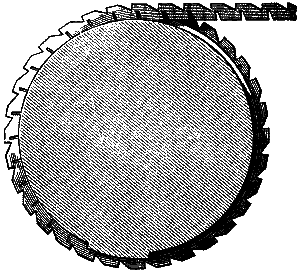
NEW WIRE CLOTHING FOR BURRING CYLINDERS.
Heretofore two kinds of clothing for cylinders for treating fibrous material have been employed, one consisting of a set of serrated rings cut from sheet steel and secured to the periphery of the cylinder, and the other consisting of flat serrated iron wire. The serrated rings, of necessity, entail a great loss of material in their manufacture, and the iron wire clothing is so soft that it soon wears out or becomes dull, necessitating the reclothing or sharpening of the cylinder.
Our engraving represents a new form of steel wire clothing for such cylinders, which was recently patented by Mr. Frank P. Pendleton, of Philadelphia, Pa.
The improvement consists in notching or nicking the base of the teeth or back of the wire, so as to admit of bending the wire around the cylinders without breaking.
Petroleum and Gold.
As one of the leading staples of American export, our petroleum wells have been more valuable than gold mines. A recent discovery by Mr. John Turnbridge, of Newark, N. J., indicates that in some cases petroleum wells may be in fact, as well as in effect, real gold mines. He says that while investigating the peculiar behavior of the hydrocarbons and their singular quality of separating the precious metals from aqueous solutions, assisted by constant application that furnished evidence of the force of chemical action which could be satisfactorily measured, there occurred to him the probability that analogous effects might be traced in the operations of nature; more particularly in certain geological formations peculiar to auriferous soils. These ideas, he asserts, have been singularly verified in subsequent research by the discovery of gold in many samples of crude petroleum, also in the sediment or refuse of the distillation of that substance. The attraction existing between the hydrocarbons and many elementary bodies ought to create no surprise, especially if reference is had to the reducing action of the hydrocarbons in contact with metallic solutions. The procedure in the examples above referred to consist in pouring crude petroleum on vegetable fiber or wood shavings and firing it, collecting the ashes and making the usual fire assay. The cupel disclosed a small pellet. After due examination with the appropriate test it was found to be pure gold. The distillery refuse when assayed gave $34.85 value per ton. It may be mentioned in the last case considerable molybdenum was present, a substance resembling plumbago. Mr. Turnbridge has no knowledge of the locality whence these samples of crude petroleum were originally obtained. He infers, however, that oil wells in the vicinity of auriferous deposits may yield a larger quantity of gold than from oil wells situated in carboniferous strata. There has been, he states, a practical application of this discovery for the recovery of gold, applied in cases where quicksilver has failed to be of service.
Reduction of Nitrate of Silver by Means of Charcoal.
A very simple method of reducing nitrate of silver, analogous to that some years ago mentioned by the late Mr. Hadow, is given in the Archiv der Pharmacie, by Mr. C. F. Chandler. If crystallized or fused nitrate of silver be placed upon glowing charcoal, combustion forthwith takes place, the silver remaining behind in a metallic form, while nitrous oxide and carbonic acid are freely given off. The nitrate of silver is fused by the heat developed by the reaction, and is imbibed through the pores of the charcoal; as every atom of consumed carbon is replaced by an atom of metallic silver, the original form and structure of the charcoal are preserved intact in pure silver. By proceeding in this manner it is possible to produce silver structures of any desired size, possessing in every way the original form of the wood. A crystal of nitrate of silver is in the first place put upon a piece of charcoal, and a blowpipe flame is then applied in the vicinity, in order to start the reaction in the first instance, and as soon as combustion commences crystal after crystal may be added as these, one after another, become consumed. The silver salt is liquefied, and penetrates into the charcoal, where it becomes reduced. Pieces of silver may in this way be prepared, of one or two ounces in weight, which exhibit all the markings and rings of the original wood to a most perfect and beautiful degree.
New Agricultural Inventions.
Mr. Charles E. Macarthy, of Forsyth, Ga., has patented an improved Horse Power, designed more particularly to be located beneath a gin house for ginning cotton, but applicable for all purposes for which a horse power is ordinarily employed.
An improved Corn Planter has been patented by Mr. Thomas A. Sammons, of Lewisburg, West Va. This corn planter is designed to plant the corn in straight rows both ways and at varying distances apart. It is constructed upon the general principle of a reciprocating slide, passing alternately beneath a hopper, and carrying a number of grains from beneath the same to a discharge outlet.
An improved machine for Cutting the Bands of Gavels or bundles of grain, and feeding the same to the cylinder of a thrasher, has been patented by Mr. James M. O'Neall, of Fort Worth, Texas.
An improved Sulky Breaking Plow has been patented by Mr. Edward T. Hunter, of Hallsville, Ill. This is an improved sulky attachment for breaking plows, which is so constructed as to receive any ordinary plow; it may be adjusted to cause the plow to work deeper or shallower in the ground, and will allow the plow to be turned to either side.
Mr. Osman C. Du Souchet, of Alexandria, Mo., has invented an improved Check Row Corn Planter and Drill, which is so constructed that its operating mechanism may be at all times under the control of the driver. It will plant the corn in accurate check row, and is easily controlled.
An improved Thrashing Machine has been patented by Mr. Peter Parrott, of Red Bud, Ill. This is an improvement in the class of thrashing machines having an attachment for removing dust from the space in front of the cylinder, and having pickers for loosening or shaking the grain from straw delivered from the cylinder.
An improved Corn Planter has been patented by Mr. John H. Zarley, of Oakland, Ill. The object of this invention is to provide an efficient and cheaply constructed corn planter, which may be drawn forward by horses, but is arranged so that the seed valves may be operated by hand.
Messrs. Clayton M. Van Orman and James M. Hagenbaugh, of Athens, Mich., have patented an improved Grain Separator, in which the arrangement of the screens, feedboard, and blast of a fanning mill effect the thorough removal from the grain of all impurities. Only two screens are employed.
An improved Churning Apparatus has been patented by Messrs. William H. Foster and Isaac C. Roberts, of Louisburg, Kan. It is simple, inexpensive, convenient, and effective in operation. It will bring the butter very quickly, and at the same time gather it.
An improved Plow has been patented by Mr. Robert B. Mitchell, of Minneapolis, Kan. The object of this invention is to improve the construction of sod, stirring, and other plows, so that the cutter may be moved forward as it is worn or ground off. It prevents roots, grass, and other trash from gathering upon the share.
Messrs. John B. Martin and William T. Carothers, of Clarence, Mo., have patented an improved Hay Loader capable of placing hay upon stacks or ricks, or upon wagons. It is simple in its construction and effective in its operation.
Naphtha and Benzine.
We have often been asked the difference between benzine and naphtha, many people wanting to know whether naphtha didn't include benzine, or whether it wasn't the same thing under a marketable name. A prominent refiner says that benzine is the first product that arises from the process of refining crude oil, and bears the same relation to naphtha that that distillate does to refined oil. In other words, benzine is crude naphtha. The reason it is not quotable under the name of benzine, therefore, is because it has to be reduced to naphtha before it is marketable in any extensive quantity.
The process that benzine is subject to, to produce naphtha, is not a separate business, but is carried on by the regular oil refiners in the same stills and retorts that the refined oil is produced. The benzine is treated with sulphuric acid, and the result is naphtha, which is in wide demand in Europe, especially in France, for the purpose of producing aniline dyes, while it is also put to many other purposes.
This demand is partially instrumental in keeping up its price, but its rapid evaporation also has a tendency in that direction, as any large seller of it has to take into consideration the depreciation that might take place by the time he sells it on that account, and for the same reason buyers give no more orders than immediate necessity requires.
All refiners, however, do not produce naphtha, but some of them sell the benzine, which is largely used for fuel purposes, for which it is much better than coal, as it is not only absolutely cheaper, but gives a steadier heat.—Parker Daily.
For joining the porcelain heads to the metal spikes used for ornamental nails, the Prakt. Maschinen Construct., recommends the use of a thick paste made of a mixture of Portland cement and glue.