FURTHER RESEARCHES UPON THE ELEMENT FLUORINE.
Reading edition
By A.E. TUTTON.
Since the publication by M. Moissan of his celebrated paper in the Annales de Chimîe et de Physique for December, 1887, describing the manner in which he had succeeded in isolating this remarkable gaseous element, a considerable amount of additional information has been acquired concerning the chemical behavior of fluorine, and important additions and improvements have been introduced in the apparatus employed for preparing and experimenting with the gas. M. Moissan now gathers together the results of these subsequent researches—some of which have been published by him from time to time as contributions to various French scientific journals, while others have not hitherto been made known—and publishes them in a long but most interesting paper in the October number of the Annales de Chimîe et de Physique. Inasmuch as the experiments described are of so extraordinary a nature, owing to the intense chemical activity of fluorine, and are so important as filling a long existing vacancy in our chemical literature, readers of Nature will doubtless be interested in a brief account of them.
IMPROVED APPARATUS FOR PREPARING FLUORINE.
In his paper of 1887, the main outlines of which were given in Nature at the time (1887, vol. xxxvii., p. 179), M. Moissan showed that pure hydrofluoric acid readily dissolves the double fluoride of potassium and hydrogen, and that the liquid thus obtained is a good conductor of electricity, rendering electrolysis possible. It will be remembered that, by passing a strong current of electricity through this liquid contained in a platinum apparatus, free gaseous fluorine was obtained at the positive pole and hydrogen at the negative pole. The amount of hydrofluoric acid employed in these earlier experiments was about fifteen grms., about six grms. of hydrogen potassium fluoride, HF.KF, being added in order to render it a conductor. Since the publication of that memoir a much larger apparatus has been constructed, in order to obtain the gas in greater quantity for the study of its reactions, and important additions have been made, by means of which the fluorine is delivered in a pure state, free from admixed vapor of the very volatile hydrofluoric acid. As much as a hundred cubic centimeters of hydrofluoric acid, together with twenty grms. of the dissolved double fluoride, are submitted to electrolysis in this new apparatus, and upward of four liters of pure fluorine is delivered by it per hour.
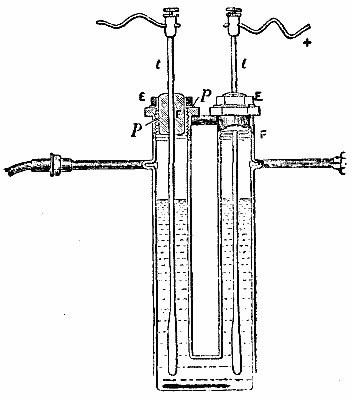
This improved form of the apparatus is shown in the accompanying figure (Fig. 1), which is reproduced from the memoir of M. Moissan. It consists essentially of two parts—the electrolysis apparatus and the purifying vessels. The electrolysis apparatus, a sectional view of which is given in Fig. 2, is similar in form to that described in the paper of 1887, but much larger.
The U-tube of platinum has a capacity of 160 c.c. It is fitted with two lateral delivery tubes of platinum, as in the earlier form, and with stoppers of fluorspar, F, inserted in cylinders of platinum, p, carrying screw threads, which engage with similar threads upon the interior surfaces of the limbs of the U-tube. A key of brass, E, serves to screw or unscrew the stoppers, and between the flange of each stopper and the top of each branch of the U-tube a ring of lead is compressed, by which means hermetic closing is effected. These fluorspar stoppers, which are covered with a coating of gum lac during the electrolysis, carry the electrode rods, t, which are thus perfectly insulated. M. Moissan now employs electrodes of pure platinum instead of irido-platinum, and the interior end of each is thickened into a club shape in order the longer to withstand corrosion. The apparatus is immersed during the electrolysis in a bath of liquid methyl chloride, maintained in tranquil ebullition at -23°. In order to preserve the methyl chloride as long as possible, the cylinder containing it is placed in an outer glass cylinder containing fragments of calcium chloride; by this means it is surrounded with a layer of dry air, a bad conductor of heat.
The purifying vessels are three in number. The first consists of a platinum spiral worm-tube of about 40 c.c. capacity, immersed also in a bath of liquid methyl chloride, maintained at as low a temperature as possible, about -50°. As hydrofluoric acid boils at 19.5° (Moissan), almost the whole of the vapor of this substance which is carried away in the stream of issuing fluorine is condensed and retained at the bottom of the worm. To remove the last traces of hydrofluoric acid, advantage is taken of the fact that fused sodium fluoride combines with the free acid with great energy to form the double fluoride HF.NaF. Sodium fluoride also possesses the advantage of not attracting moisture. After traversing the worm condenser, therefore, the fluorine is caused to pass through two platinum tubes filled with fragments of fused sodium fluoride, from which it issues in an almost perfect state of purity. The junctions between the various parts of the apparatus are effected by means of screw joints, between the nuts and flanges of which collars of lead are compressed. During the electrolysis these leaden collars become, where exposed to the gaseous fluorine, rapidly converted into lead fluoride, which being greater in bulk causes the joints to become hermetically sealed. In order to effect the electrolysis, twenty-six to twenty-eight Bunsen elements are employed, arranged in series. An ampere meter and a commutator are introduced between the battery and the electrolysis apparatus; the former affording an excellent indication of the progress of the electrolysis.
FIG. 1.—FLUORINE APPARATUS.
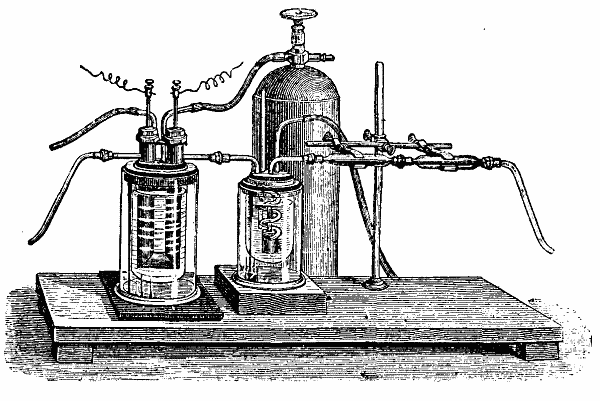
As the U-tube contains far more hydrofluoric acid than can be used in one day, each lateral delivery tube is fitted with a metallic screw stopper, so that the experiments may be discontinued at any time, and the apparatus closed. The whole electrolysis vessel is then placed under a glass bell jar containing dry air, and kept in a refrigerator until again required for use. In this way it may be preserved full of acid for several weeks, ready at any time for the preparation of the gas. Considerable care requires to be exercised not to admit the vapor of methyl chloride into the U-tube, as otherwise violent detonations are liable to occur. When the liquid methyl chloride is being introduced into the cylinder, the whole apparatus becomes surrounded with an atmosphere of its vapor, and as the platinum U-tube is at the same instant suddenly cooled the vapor is liable to enter by the abducting tubes. Consequently, as soon as the current is allowed to pass and fluorine is liberated within the U-tube, an explosion occurs. Fluorine instantly decomposes methyl chloride, with production of flame and formation of fluorides of hydrogen and carbon, liberation of chlorine, and occasionally deposition of carbon. In order to avoid this unpleasant occurrence, when the methyl chloride is being introduced the ends of the lateral delivery tubes are attached to long lengths of caoutchoue tubing, supplied at their ends with calcium chloride drying tubes, so as to convey dry air from outside the atmosphere of methyl chloride vapor. If great care is taken to obtain the minimum temperature, this difficulty may be even more simply overcome by employing a mixture of well pounded ice and salt instead of methyl chloride; but there is the counterbalancing disadvantage to be considered, that such a cooling bath requires much more frequent renewal.
FIG. 2.
CHEMICAL REACTIONS OCCURRING DURING THE ELECTROLYSIS.
In the paper of 1887, M. Moissan adopted the view that the first action of the electric current was to effect the decomposition of the potassium fluoride contained in solution in the hydrofluoric acid, fluorine being liberated at the positive pole and potassium at the negative terminal. This liberated potassium would at once regenerate potassium fluoride in presence of hydrofluoric acid, and liberate its equivalent of hydrogen:
KF = K + F.
K + HF = KF + H.
But when the progress of the electrolysis is carefully followed, by consulting the indications of the amperemeter placed in circuit, it is found to be by no means as regular as the preceding formulæ would indicate. With the new apparatus, the decomposition is quite irregular at first, and does not attain regularity until it has been proceeding for upward of two hours. Upon stopping the current and unmounting the apparatus, the platinum rod upon which the fluorine was liberated is found to be largely corroded, and at the bottom of the U-tube a quantity of a black, finely divided substance is observed. This black substance, which was taken at first to be metallic platinum, is a complex compound containing one equivalent of potassium to one equivalent of platinum, together with a considerable proportion of fluorine.
Moreover, the hydrofluoric acid is found to contain a small quantity of platinum fluoride in solution. The electrolytic reaction is probably therefore much more complicated than was at first considered to be the case. The mixture of acid and alkaline fluoride furnishes fluorine at the positive terminal rod, but this intensely active gas, in its nascent state, attacks the platinum and produces platinum tetrafluoride, PtF4; this probably unites with the potassium fluoride to form a double salt, possibly 2Kl.PtF4, analogous to the well known platinochloride 2KCl.PtCl4; and it is only when the liquid contains this double salt that the electrolysis proceeds in a regular manner, yielding free fluorine at the positive pole, and hydrogen and the complex black compound at the negative pole.
PHYSICAL PROPERTIES OF FLUORINE.
Fluorine possesses an odor which M. Moissan compares to a mixture of hypochlorous acid and nitrogen peroxide, but this odor is usually masked by that of the ozone which it always produces in moist air, owing to its decomposition of the water vapor. It produces most serious irritation of the bronchial tubes and mucous membrane of the nasal cavities, the effects of which are persistent for quite a fortnight.
When examined in a thickness of one meter, it is seen to possess a greenish yellow color, but paler, and containing more of yellow, than that of chlorine. In such a layer, fluorine does not present any absorption bands. Its spectrum exhibits thirteen bright, lines in the red, between wave lengths 744 and 623. Their positions and relative intensities are as follows:
λ =744very feeble.
740"
734"
714feeble.
704"
691"
687.5"
685.5"
683.5"
677strong
640.5"
634"
623"
At a temperature of -95° at ordinary atmospheric pressure, fluorine remains gaseous, no sign of liquefaction having been observed.
METHODS OF EXPERIMENTING WITH FLUORINE.
When it is desired to determine the action of fluorine upon a solid substance, the following method of procedure is adopted. A preliminary experiment is first made, in order to obtain some idea as to the degree of energy of the reaction, by bringing a little of the solid, placed upon the lid of a platinum crucible held in a pair of tongs, near the mouth of the delivery tube of the preparation apparatus. If a gaseous or liquid product results, and it is desirable to collect it for examination, small fragments of the solid are placed in a platinum tube connected to the delivery tube by flexible platinum tubing or by a screw joint, and the resulting gas may be collected over water or mercury, or the liquid condensed in a cooled cylinder of platinum. In this manner the action of fluorine upon sulphur and iodine has been studied. If the solid, phosphorus for instance, attacks platinum, or the temperature of the reaction is sufficiently high to determine the combination of platinum and fluorine (toward 500°), a tube of fluorspar is substituted for the platinum tube. The fluorspar tubes employed by M. Moissan for the study of the action of phosphorus were about twelve to fourteen centimeters long, and were terminated by platinum ends furnished with flanges and screw threads in order to be able to connect them with the preparation apparatus. If it is required to heat the fluorspar tubes, they are surrounded by a closely wound copper spiral, which may be heated by a Bunsen flame.
In experimenting upon liquids, great care is necessary, as the reaction frequently occurs with explosive violence. A preliminary experiment is therefore always made, by allowing the fluorine delivery tube to dip just beneath the surface of the liquid contained in a small glass cylinder. When the liquid contains water, or when hydrofluoric acid is a product of the reaction, cylinders of platinum or of fluorspar are employed. If it is required to collect and examine the product, the liquid is placed along the bottom of a horizontal tube of platinum or fluorspar, as in case of solids, connected directly with the preparation apparatus, and the product is collected over water or mercury if a gas, or in a cooled platinum receiver if a liquid.
During the examination of liquids a means has accidentally been discovered by which a glass tube may be filled with fluorine gas. A few liquids, one of which is carbon tetrachloride, react only very slowly with fluorine at the ordinary temperature. By filling a glass tube with such a liquid, and inverting it over a platinum capsule also containing the liquid, it is possible to displace the liquid by fluorine, which, as the walls are wet, does not attack the glass. Or the glass tube may be filled with the liquid, and then the latter poured out, leaving the walls wet; the tube may then be filled with fluorine gas, which being slightly heavier than air, remains in the tube for some time. In one experiment, in which a glass test tube had been filled with fluorine over carbon tetrachloride, it was attempted to transfer it to a graduated tube over mercury, but in inclining the test tube for this purpose the mercury suddenly came in contact with the fluorine, and absorbed it so instantaneously and with such a violent detonation that both the test tube and the graduated tube were shattered into fragments. Indeed, owing to the powerful affinity of mercury for fluorine, it is a most dangerous experiment to transfer a tube containing fluorine gas, filled according to either the first or second method, to the mercury trough; the tube is always shattered if the mercury comes in contact with the gas, and generally with a loud detonation. Fluorine may, however, be preserved for some time in tubes over mercury, provided a few drops of the non-reacting liquid are kept above the mercury meniscus.
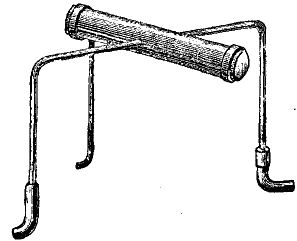
For studying the action of fluorine on gases, a special piece of apparatus, shown in Fig. 3, has been constructed. It is composed of a tube of platinum, fifteen centimeters long, closed by two plates of clear, transparent, and colorless fluorspar, and carrying three lateral narrower tubes also of platinum. Two of these tubes face each other in the center of the apparatus, and serve one for the conveyance of the fluorine and the other of the gas to be experimented upon. The third, which is of somewhat greater diameter than the other two, serves as exit tube for the product or products of the reaction, and may be placed in connection with a trough containing either water or mercury.
The apparatus is first filled with the gas to be experimented upon, then the fluorine is allowed to enter, and an observation of what occurs may be made through the fluorspar windows. One most important precaution to take in collecting the gaseous products over mercury is not to permit the platinum delivery tube to dip more than two or at most three millimeters under the mercury, as otherwise the levels of the liquid in the two limbs of the electrolysis U-tube become so different, owing to the pressure, that the fluorine from one side mixes with the hydrogen evolved upon the other, and there is a violent explosion.
FIG. 3.
ACTION OF FLUORINE UPON THE NON-METALLIC ELEMENTS.
Hydrogen.—As just described, hydrogen combines with fluorine, even at -23° and in the dark, with explosive force. This is the only case in which two elementary gases unite directly without the intervention of extraneous energy. If the end of the tube delivering fluorine is placed in an atmosphere of hydrogen, a very hot blue flame, bordered with red, at once appears at the mouth of the tube, and vapor of hydrofluoric acid is produced.
Oxygen.—Fluorine has not been found capable of uniting with oxygen up to a temperature of 500°. On ozone, however, it appears to exert some action, as will be evident from the following experiment. It was shown in 1887 that fluorine decomposes water, forming hydrofluoric acid, and liberating oxygen in the form of ozone. When a few drops of water are placed in the apparatus shown in Fig. 3, and fluorine allowed to enter, the water is instantly decomposed, and on looking through the fluorspar ends a thick dark cloud is seen over the spot where each drop of water had previously been. This cloud soon diminishes in intensity, and is eventually replaced by a beautiful blue gas—ozone in a state of considerable density. If the product is chased out by a stream of nitrogen as soon as the dense cloud is formed, a very strong odor is perceived, different from that of either fluorine or ozone, but which soon gives place to the unmistakable odor of ozone. It appears as if there is at first produced an unstable oxide of fluorine, which rapidly decomposes into fluorine and ozone.
Nitrogen and chlorine appear not to react with fluorine.
Sulphur.—In contact with fluorine gas, sulphur rapidly melts and inflames. A gaseous fluoride of sulphur is formed, which possesses a most penetrating odor, somewhat resembling that of chloride of sulphur. The gas is incombustible, even in oxygen. When warmed in a glass vessel, the latter becomes etched, owing to the formation of silicon tetrafluoride, SiF4. Selenium and tellurium behave similarly, but form crystalline solid fluorides.
Bromine vapor combines with fluorine in the cold with production of a very bright but low temperature dame. If the fluorine is evolved in the midst of pure dry liquid bromine, the combination is immediate, and occurs without flame.
Iodine.—When fluorine is passed over a fragment of iodine contained in the horizontal tube, combination occurs, with production of a pale flame. A very heavy liquid, colorless when free from dissolved iodine, and fuming strongly in the air, condenses in the cooled receiver. This liquid fluoride of iodine attacks glass with great energy and decomposes water when dropped into that liquid with a noise like that produced by red-hot iron. Its properties agree with those of the fluoride of iodine prepared by Gore by the action of iodine on silver fluoride.
Phosphorus.—Immediately phosphorus, either the ordinary yellow variety or red phosphorus, comes in contact with fluorine, a most lively action occurs, accompanied by vivid incandescence. If the fluorine is in excess, a fuming gas is evolved, which gives up its excess of fluorine on collecting over mercury, and is soluble in water. This gas is phosphorus pentafluoride, PF5, prepared some years ago by Prof. Thorpe. If, on the contrary, the phosphorus is in excess, a gaseous mixture of this pentafluoride with a new fluoride, the trifluoride, PF3, a gas insoluble in water, but which may be absorbed by caustic potash, is obtained. The trifluoride, in turn, combines with more fluorine to form the pentafluoride, the reaction being accompanied by the appearance of a flame of comparatively low temperature.
Arsenic combines with fluorine at the ordinary temperature with incandescence. If the current of fluorine is fairly rapid, a colorless fuming liquid condenses in the receiver, which is mainly arsenic trifluoride, AsF3, but which appears also to contain a new fluoride, the pentafluoride, AsF5, inasmuch as the solution in water yields the reactions of both arsenious and arsenic acids.
Carbon.—Chlorine does not unite with carbon even at the high temperature of the electric arc, but fluorine reacts even at the ordinary temperature with finely divided carbon. Purified lampblack inflames instantly with great brilliancy, as do also the lighter varieties of wood charcoal. A curious phenomenon is noticed with wood charcoal; it appears at first to absorb and condense the fluorine, then quite suddenly it bursts into flame with bright scintillations. The denser varieties of charcoal require warming to 50° or 60° before they inflame, but it once the combustion is started at any point it rapidly propagates itself throughout the entire piece. Graphite must be heated to just below dull redness in order to effect combination; while the diamond has not yet been attacked by fluorine, even at the temperature of the Bunsen flame. A mixture of gaseous fluorides of carbon are produced whenever carbon of any variety is acted upon by fluorine, the predominating constituent being the tetrafluoride, CF4.
Boron.—The amorphous variety of boron inflames instantly in fluorine, with projection of brilliant sparks and liberation of dense fumes of boron trifluoride, BF3. The adamantine modification behaves similarly if powdered. When the experiment is performed in the fluorspar tube, the gaseous fluoride may be collected over mercury. The gas fumes strongly in the air, and is instantly decomposed by water.
Silicon.—The reaction between fluorine and silicon is one of the most beautiful of all these extraordinary manifestations of chemical activity. The cold crystals become immediately white-hot, and the silicon burns with a very hot flame, scattering showers of star-like, white-hot particles in all directions. If the action is stopped before all the silicon is consumed, the residue is found to be fused. As crystalline silicon only melts at a temperature superior to 1,200°, the heat evolved must be very great. If the reaction is performed in the fluorspar tube, the resulting gaseous silicon tetrafluoride, SiF4, may be collected over mercury.
Amorphous silicon likewise burns with great energy in fluorine.
ACTION OF FLUORINE UPON METALS.
Sodium and potassium combine with fluorine with great vigor at ordinary temperatures, becoming incandescent, and forming their respective fluorides, which may be obtained crystallized from water in cubes. Metallic calcium also burns in fluorine gas, forming the fused fluoride, and occasionally minute crystals of fluorspar. Thallium is rapidly converted to fluoride at ordinary temperatures, the temperature rising until the metal melts and finally becomes red hot. Powdered magnesium burns with great brilliancy. Iron, reduced by hydrogen, combines in the cold with immediate incandescence, and formation of an anhydrous, readily soluble, white fluoride. Aluminum, on heating to low redness, gives a very beautiful luminosity, as do also chromium and manganese. The combustion of slightly warmed zinc in fluorine is particularly pretty as an experiment, the flame being of a most dazzling whiteness. Antimony takes fire at the ordinary temperature, and forms a solid white fluoride. Lead and mercury are attacked in the cold, as previously described, the latter with great rapidity. Copper reacts at low redness, but in a strangely feeble manner, and the white fumes formed appear to combine with a further quantity of fluorine to form a perfluoride. The main product is a volatile white fluoride. Silver is only slowly attacked in the cold. When heated, however, to 100°, the metal commences to be covered with a yellow coat of anhydrous fluoride, and on heating to low redness combination occurs, with incandescence, and the resulting fluoride becomes fused, and afterward presents a satin-like aspect. Gold becomes converted into a yellow deliquescent volatile fluoride when heated to low redness, and at a slightly higher temperature the fluoride is dissociated into metallic gold and fluorine gas.
The action of fluorine on platinum has been studied with special care. It is evident, in view of the corrosion of the positive platinum terminal of the electrolysis apparatus, that nascent fluorine rapidly attacks platinum at a temperature of -23°. At 100°, however, fluorine gas appears to be without action on platinum. At 500°-600° it is attacked strongly, with formation of the tetrafluoride. PtF4, and a small quantity of the protofluoride, PtF2. If the fluorine is admixed with vapor of hydrofluoric acid, the reaction is much more vigorous, as if a fluorhydrate of the tetrafluoride, perhaps 2HF.PtF4, were formed. The tetrafluoride is generally found in the form of deep-red fused masses, or small yellow crystals resembling those of anhydrous platinum chloride. The salt is volatile and very hygroscopic. Its behavior with water is peculiar. With a small quantity of water a brownish yellow solution is formed, which, however, in a very short time becomes warm and the fluoride decomposes; platinic hydrate is precipitated, and free hydrofluoric acid remains in solution. If the quantity of water is greater, the solution may be preserved for some minutes without decomposition. If the liquid is boiled, it decomposes instantly. At a red heat platinic fluoride decomposes into metallic platinum and fluorine, which is evolved in the free state. This reaction can therefore be employed as a ready means of preparing fluorine, the fluoride only requiring to be heated rapidly to redness in a platinum tube closed at one end, when crystallized silicon held at the open end will be found to immediately take fire in the escaping fluorine. The best mode of obtaining the fluoride of platinum for this purpose is to heat a bundle of platinum wires to low redness in the fluorspar reaction tube in a rapid stream of fluorine. As soon as sufficient fluoride is formed on the wires, they are transferred to a well stoppered dry glass tube, until required for the preparation of fluorine.
ACTION OF FLUORINE UPON NON-METALLIC COMPOUNDS.
Sulphureted Hydrogen.—When the horizontal tube shown in Fig. 3 is filled with sulphureted hydrogen gas and fluorine is allowed to enter, a blue flame is observed on looking through the fluorspar windows playing around the spot where the fluorine is being admitted. The decomposition continues until the whole of the hydrogen sulphide is converted into gaseous fluorides of hydrogen and sulphur.
Sulphur dioxide is likewise decomposed in the cold, with production of a yellow flame and formation of fluoride of sulphur.
Hydrochloric acid gas is also decomposed at ordinary temperatures with flame, and, if there is not a large excess of hydrochloric acid present, with detonation. Hydrofluoric acid and free chlorine are the products.
Gaseous hydrobromic and hydriodic acids react with fluorine in a similar manner, with production of flame and formation of hydrofluoric acid. Inasmuch, however, as bromine and iodine combine with fluorine, as previously described, these halogens do not escape, but burn up to their respective fluorides. When fluorine is delivered into an aqueous solution of hydriodic acid, each bubble as it enters produces a flash of flame, and if the fluorine is being evolved fairly rapidly there is a series of very violent detonations. A curious reaction also occurs when fluorine is similarly passed into a 50 per cent. aqueous solution of hydrofluoric acid itself, a flame being produced in the middle of the liquid, accompanied by a series of detonations.
Nitric acid vapor reacts with great violence with fluorine, a loud explosion resulting. If fluorine is passed into the ordinary liquid acid, each bubble as it enters produces a flame in the liquid.
Ammonia gas is decomposed by fluorine with formation of a yellow flame, forming hydrofluoric acid and liberating nitrogen. With a solution of the gas in water, each bubble of fluorine produces an explosion and flame, as in case of hydriodic acid.
Phosphoric anhydride, when heated to low redness, burns with a pale flame in fluorine, forming a gaseous mixture of fluorides and oxyfluoride of phosphorus. Pentachloride and trichloride of phosphorus both react most energetically with fluorine, instantly producing a brilliant flame, and evolving a mixture of phosphorus pentafluoride and free chlorine.
Arsenious anhydride also affords a brilliant combustion, forming the liquid trifluoride of arsenic, AsF3. This liquid in turn appears to react with more fluorine with considerable evolution of heat, probably forming the pentafluoride, AsF5. Chloride of arsenic, AsCl3, is converted with considerable energy to the trifluoride, free chlorine being liberated.
Carbon bisulphide inflames in the cold in contact with fluorine, and if the fluorine is led into the midst of the liquid a similar production of flame occurs under the surface of the liquid, as in case of nitric acid. No carbon is deposited, both the carbon and sulphur being entirely converted into gaseous fluorides.
Carbon tetrachloride, as previously mentioned, reacts only very slowly with fluorine. The liquid may be saturated with gaseous fluorine at 15°, but on boiling this liquid a gaseous mixture is evolved, one constituent of which is carbon tetrafluoride, CF4, a gas readily capable of absorption by alcoholic potash. The remainder consists of another fluoride of carbon, incapable of absorption by potash and chlorine. A mixture of the vapors of carbon tetrachloride and fluorine inflames spontaneously with detonation, and chlorine is liberated without deposition of carbon.
Boric anhydride is raised to a most vivid incandescence by fluorine, the experiment being rendered very beautiful by the abundant white fumes of the trifluoride which are liberated.
Silicon dioxide, one of the most inert of substances at the ordinary temperature, takes fire in the cold in contact with fluorine, becoming instantly white-hot, and rapidly disappearing in the form of silicon tetrafluoride. The chlorides of both boron and silicon are decomposed by fluorine, with formation of fluorides and liberation of chlorine, the reaction being accompanied by the production of flame.
ACTION OF FLUORINE UPON METALLIC COMPOUNDS.
Chlorides of the metals are instantly decomposed by fluorine, generally at the ordinary temperature, and in certain cases, antimony trichloride for instance, with the appearance of flame. Chlorine is in each case liberated, and a fluoride of the metal formed. A few require heating, when a similar decomposition occurs, often accompanied by incandescence, as in case of chromium sesquichloride.
Bromides and iodides are decomposed with even greater energy, and the liberated bromine and iodine burn in the fluorine with formation of their respective fluorides.
Cyanides react in a most beautiful manner with fluorine, the displaced cyanogen burning with a purple flame. Potassium ferrocyanide in particular affords a very pretty experiment, and reacts in the cold. Ordinary potassium cyanide requires slightly warming in order to start the combustion.
Fused potash yields potassium fluoride and ozone. Aqueous potash does not form potassium hypofluorite when fluorine is bubbled into it, but only potassium fluoride. Lime becomes most brilliantly incandescent, owing partly to the excess being raised to a very high temperature by the heat developed during the decomposition, and partly to the phosphorescence of the calcium fluoride formed.
Sulphides of the alkalies and alkaline earths are also immediately rendered incandescent, fluorides of the metal and sulphur being respectively formed.
Boron nitride behaves in an exceedingly beautiful manner, being attacked in the cold, and emitting a brilliant blue light which is surrounded by a halo of the fumes of boron fluoride.
Sulphates, nitrates and phosphates generally require the application of more or less heat, when they too are rapidly and energetically decomposed. Calcium phosphate is attacked in the cold like lime, giving out a brilliant white light, and producing calcium fluoride and gaseous oxyfluoride of phosphorus, POF3. Calcium carbonate also becomes raised to brilliant incandescence when exposed to fluorine gas, as does also normal sodium carbonate; but curiously enough the bicarbonates of the alkalies do not react with fluorine even at red heat. Perhaps this may be explained by the fact that fluorine has no action at available temperatures upon carbon dioxide.
ACTION OF FLUORINE UPON A FEW ORGANIC COMPOUNDS.
Chloroform.—When chloroform is saturated with fluorine, and subsequently boiled, carbon tetrafluoride, hydrofluoric acid and chlorine are evolved. If a drop of chloroform is agitated in a glass tube with excess of fluorine, a violent explosion suddenly occurs, accompanied by a flash of flame, and the tube is shattered to pieces. The reaction is very lively when fluorine is evolved in the midst of a quantity of chloroform, a persistent flame burns beneath the surface of the liquid, carbon is deposited, and fluorides of hydrogen and carbon are evolved together with chlorine.
Methyl chloride is decomposed by fluorine, even at -23°, with production of a yellow flame, deposition of carbon, and liberation of fluorides of hydrogen and carbon and free chlorine. With the vapor of methyl chloride, as pointed out in the description of the electrolysis, violent explosions occur.
Ethyl alcohol vapor at once takes fire in fluorine gas, and the liquid is decomposed with explosive violence without deposition of carbon. Aldehyde is formed to a considerable extent during the reaction.
Acetic acid and benzene are both decomposed with violence, their cold vapors burn in fluorine, and when the latter is bubbled through the liquids themselves, flashes of flame, and often most dangerous explosions, occur. In the case of benzene, carbon is deposited, and with both liquids fluorides of hydrogen and carbon are evolved. Aniline likewise takes fire in fluorine, and deposits a large quantity of carbon, which, however, if the fluorine is in excess, burns away completely to carbon tetrafluoride.
Such are the main outlines of these later researches of M. Moissan, and they cannot fail to impress those who read them with the prodigious nature of the forces associated with those minutest of entities, the chemical atoms, as exhibited at their maximum, in so far as our knowledge at present goes, in the case of the element fluorine.—Nature.