STEAM ENGINE VALVES.1
Reading edition
STEAM ENGINE VALVES.1
By THOMAS HAWLEY.
RIDING CUT-OFF VALVES—PECULIARITIES AND MERITS OF THE DIFFERENT STYLES.
In considering the slide valve in its simple form with or without lap, we find there are certain limitations to its use as a valve that would give the best results. The limitation of most importance is that its construction will not allow of the proper cut off to obtain all the benefits of expansion without hindering the perfect action of the valve in other particulars. At this economical cut off the opening of the steam port is very little and very narrow, and although this is attempted to be overcome by exceedingly wide ports, sixteen inches in width in many cases in locomotive work, this great width adds largely to the unbalanced area of the valve. The exhausting functions of the valve are materially changed at the short cut off, and when much lap is added to overcome this defect, there usually takes place a choking of the exhaust port. You might inquire, why not make the port wider, but this would increase the minimum amount of load on the valve, and this must not be overlooked. Then the cut off is a fixed one, and we can govern only by throttling the pressure we have raised in the boiler or by using a cut off governor and the consequent wastes of an enormous clearance space. You will observe, therefore, that the plain slide valve engine gives the most general satisfaction at about two-thirds cut off and a very low economic result. The best of such engines will require forty-five to fifty pounds of steam per horse power per hour, and to generate this, assuming an evaporation of nine pounds of water to a pound of coal, would require between five and six pounds of coal per horse power per hour. And the only feature that the valve has specially to commend it is its extreme simplicity and the very little mechanism required to operate it.
Yet this is of considerable importance, and in consideration of some special features at its latest cut off, the attempt has been many times made to take advantage of these features. For instance, at 90° advance, the valve opens very rapidly indeed and fully satisfies our requirements of a perfect valve. This is one good point, and in this position also the exhaust and compression can be regulated very closely and as desired without much lap, and as the opening of the exhaust port comes with the eccentric at its most rapid movement the release is very quick and as we would have it. This is only possible at the most uneconomic position of the valve as regards cut off.
The aim of many engineers has been to take advantage of these matters by using the valve with 90° angular advance of eccentric ahead of crank, for the admission, release, and compression of the steam, and provide another means of cutting off, besides the one already referred to, viz., cutting off the supply of steam to the chest, and overcome the objection in this one of large clearance spaces. This is done by means of riding cut off valves, often called expansion valves, of which, perhaps, the most widely known types in this vicinity are the Kendall & Roberts engine and the Buckeye. The former is used in the simplest form of riding cut off, while the Buckeye has many peculiar features that engineers, I find, are too prone to overlook in a casual examination of the engine. In these uses of the slide valve, too, means are suggested and carried out of practically balancing the valve.
The origin of the riding cut off is most generally attributed to Gonzenbach. His arrangement had two steam chests, the lower one provided with the ordinary slide valve of late cut off, and steam was cut off from this steam chest by the expansion valve covering the ports connecting with the upper steam chest. This had the old disadvantage that all the steam in the lower chest expanded with that in the cylinder, at a consequent considerable loss. This was further improved by causing the riding cut off to be upon the top of the main valve, instead of its chest, and resulted in a considerable reduction of the clearance space.
This is the simplest form, and is shown in Fig. 1. The steam is supplied by a passage through the main valve which operates exactly as an ordinary slide valve would. That is, the inside edges of the steam passage are the same as the ordinary valve, the additional piece on each end, if I may so term it, being merely to provide a passage for the steam which can be closed, instead of allowing the steam to pass the edge. The eccentric of the main valve is fastened to the shaft to give the proper amount of lead, and the desired release and compression, and the expansion valve is operated by a separate eccentric fastened in line with or 180° ahead of the crank. When the piston, therefore, commences to move from the crank end to open the port, D, the expansion valve is forced by its eccentric in the opposite direction, and is closing the steam port and would have closed it before the piston reached quarter stroke, thus allowing the steam then in the cylinder to do work by expansion. The eccentric operating this expansion valve may be set to close this steam port at any point in the stroke that is desired, the closing occurring when the expansion valve has covered the steam port. Continuing the movements of the valves, the two would move together until one or the other reached its dead center, when the movements would be in opposite directions.
FIG. 1
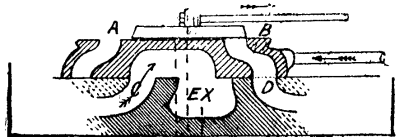
There are three ways of effecting the cut off in such engines, the main valve meanwhile being undisturbed, its eccentric fastened securely so as not to disturb the points of lead, release, and compression. All that is required is to cause the edge of the expansion valve to cover the steam port earlier in the stroke, and this can be done, first, by increasing the angular advance of the cut off eccentric; second, by adding lap to the cut off valve; and third by changing the throw of the eccentric. In all these instances the riding valve is caused to reach the edge of the steam port earlier in the stroke. We will take first, as the simplest, those methods by which the lap of the cut off valve is increased.
It will be noted that there is but one edge of this valve that is required to do any work, and that is to close the valve. The eccentrics are so placed that the passage in the main valve is opened long before the main valve itself is ready to admit steam to the cylinder, so that only the outer edges are the ones to be considered, and it will be readily seen that the two valves traveling in opposite directions, any lap added to the working edge of the cut off valve will cause it to reach the edge and therefore close the port earlier than it would if there was less lap. And we might carry it to the extreme that we could add lap enough that the steam passage would not be opened at all.
In Fig. 2 is shown the method by which this is accomplished, in what is called Meyer's valve, and such as is used in the Kendall & Roberts engine. We have only one point to look after, the cut off, so we can add all the lap we wish without disturbing anything else. In this engine the lap is changed by hand by means of a little hand wheel on a stem that extends out of the rear of the steam chest. The valve is in two sections, and when it is desired to cut off earlier, the hand wheel is turned in such a direction that the right and left hand screws controlling the cut off valve move one valve portion back and the other forward, which would, if they were one valve and they should be so considered, have the effect of lengthening them, or adding lap to them. The result would be that the riding valve would reach the edge of the steam port earlier in the stroke, bringing about an earlier cut off. If the cut off is desired to be later, the hand wheel is so turned that the right and left hand screws will bring the valve sections nearer together, thus practically taking off lap. Now this may be done by hand or it may be done by the action of a governor.
FIG. 2
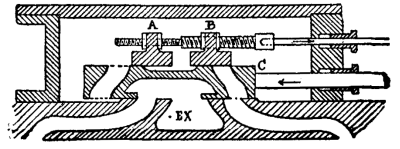
In the latter case the governor at each change of load turns the right and left hand screws to add or take away lap, as the load demands an earlier or later cut off; in other cases the governor moves a rack in mesh with a gear by which the valve sections are brought closer together or are separated. The difficulty with the case where the hand wheel is turned by hand is that the cut off is fixed where you leave it, and governing can only be at the throttle. For this reason anywhere near full boiler pressure would not be obtained in the cylinder of the engine. If the load was a constant one, and the cut off could be fixed at about one-third, causing the throttle to open its widest, very good results would be obtained, but there is no margin left for governing.
If the load should increase at such a time the governor could not control it under these conditions, and it would lead to a decrease in speed unless the lap was again changed to give a later cut off. On this account the general practice soon becomes to leave the cut off at the later point and give range to the throttle, and we come back once more to the plain slide valve cutting off at half stroke, and the only gain there is, is in a quick port opening and quick cut off. But these matters are more than offset by the wire drawing between the steam pipe and chest, through the throttle, and the fact that there is added to the friction of the engine the friction of this additional slide valve and a considerable liability to have a leaky valve.
In the case where the governor changes the position of the cut off valve a greater decree of economy would result. In this engine, of which the Lambertville engine is a type, the main valve is a long D slide, with multiple ports at the ends through which the steam enters the cylinders. It is operated from an eccentric on the crank shaft in the usual manner. The cut off valve is also operated from the motion on an eccentric fixed upon the crank shaft. The rod or stem of the cut off valve passes through the main valve rod and slide. Upon the outer end of the cut off valve rod are tappets fastened to engage with tappets on the eccentric valve rod. Connection between the cut off eccentric, therefore, and the cut off valve is only by means of the engagement of these tappets. The eccentric rod is fastened to a rocker arm having motion swinging about a pin or bearing in the governor slide, which may be raised or lowered by a cam operated by the governor. The cut off slide is of cylindrical shape and incloses a spring and dash pot with disks attached by means of which the valve is closed. The motion for operating the valves is relatively in the same direction, the cut off eccentric having the greatest throw and greater angular advance to cause it to open earlier and quickly before the main valve is ready to admit steam. The cut off eccentric rod swinging the rocker arm, the tappets thereon engage with those upon the cut off valve rod and open the passages to the main valve, and in their movement compress the spring in the main valve. According as the speed of the engine, the rock arm will be raised or lowered so that the tappets upon the eccentric rod may keep in engagement a shorter or longer time before they disengage, thus allowing the spring that has been compressed by the movement of the cut off valve to close that valve quickly and the supply of steam to the engine, the cut off valve traveling with the main valve for the balance of the stroke. This device will give a remarkably quick opening and a quick cut off, but in view of the fact that the governor has so much to do, its delicacy is impaired and a quick response to the demands of the load changing not so likely to occur. The cut off cannot be as quick as in some other engines, because the valves are moving in opposite directions, and while this fact would help, so far as shortening the distance to be traveled before cut off, the resistance of the valves to travel in opposite directions, or rather the tendency of the valve to travel with the main valve, hinders its rapid action.
FIG. 3
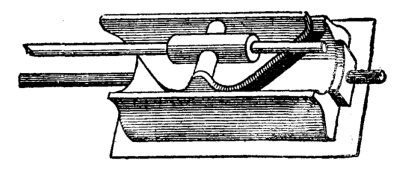
This is one great objection to the rack and gear operated by the governor, that two flat valves riding upon each other and sliding in opposite directions at times require a considerable amount of force to move them, and as only a slight change in load is required by the load, the governor cannot handle the work as delicately as it should. It is too much for the governor to do well. To overcome this difficulty the Ryder cut-off, shown in Fig. 3, was made by the Delamater people, of New York. The main slide valve is hollowed in the back and the ports cut diagonally across the valve to form almost a letter V. The expansion valve is V-shaped, and circular to fit its circular-seat. The valve rod of the expansion valve has a sector upon it and operated by a gear upon the governor stem, which rotates the valve rod, and the edge of the valve rod is brought farther over the steam port, thus practically adding lap to the valve. Little movement is found necessary to make the ordinary change in cut-off, and it is found to be much easier to move the riding valve across the valve than in a direction directly opposite. It would require considerable force to move the upper valve by the governor faster than the lower, or in a direction opposite to that in which it is moving, but very little force applied sideways at the same time it is moving forward will give it a sideways motion. In this device the governor has only to exert this side pressure and therefore has less to do than if it were called upon to move the upper valve directly against the movement of the lower.
Something similar is the valve of the Woodbury engine, of Rochester, N.Y. The cut-off valve is cylindrical, covering diagonal ports directly opposite, and is caused to be rotated by the action of the governor that operates a rack in mesh with a segment. Very little movement will effect a considerable change in the lappage of the valve, the valve turning about one-quarter a revolution for the extremes of cut off. The cut off valve rod works through a bracket and its end terminates in a ball in a socket on the end of the eccentric rod. In this case the governor has not as much to do as in other instances.
FIG. 4
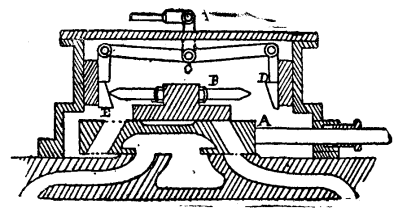
Still another method of effecting this change in cut off, but hardly by increasing the lap of the valve, is shown in the next drawing, Fig. 4. The cut off valve is held upon the main valve by the pressure of steam upon its back and rides with it until it comes in contact with the cut off wedge-shaped blocks, when its motion is arrested, and the main valve continuing its movement the steam port is closed by the main valve passing beneath the cut off valve. Thus the main valve travels and carries the cut off valve upon its back again until the cut off valve strikes the wedge on the other end and the cut off is effected. The relative positions of the blocks are determined by the governor, that will raise or lower them so that the cut off valve will engage with them earlier or later as desired. This device was designed specially as an inexpensive method of changing the common slide valve into an automatic cut off. The cut off would not be as quick as in other cases we have cited, depending here upon the movement of the lower valve alone, and that, too, is in its slowest movement; whereas in the other cases, the edges approaching each other, by the differing movement of the valves the cut off is very rapid, provided the distance to travel is not long. In this device considerable noise must result by the cut off valve striking the cut off blocks, and a considerable amount of leakage is likely to occur past this valve.
But there is one great objection in the valve gears thus far cited, that the travel of the expansion valve upon the main valve is variable. I have in mind the case of a Kendall & Roberts engine, which had been run for a long time at no better economy than would be obtained from a plain slide valve engine, and when it was attempted to get an earlier cut off by separating the two cut off valves, they had worn so much in their old place on the valve that shoulders were found sufficient to cause a disagreeable noise and a leaky valve. This is very apt to occur, not only where the valve is run for a long time on one seat, but in cases of variation of the travel of the expansion valve. The result is that a change will bring about a leaky valve, something that every engineer abhors.
The construction of the Buckeye engine, which is also of this type, is such that the travel of the valve on the back of the main valve is always the same, no matter what the cut off may be. Then this engine makes use of our second proposition as a means of effecting the cut off, viz., by advancing the eccentric. You will readily observe that anything that will cause the cut off valve to reach a certain point earlier in the stroke will bring about an earlier cut off as it hastens everything all around. This is the plan pursued in the Buckeye, in which the governor, of the shaft type, turns the eccentric forward or back according as the load demands. Then, in addition, the valve is balanced partially, the attempt not being made to produce an absolutely balanced valve, on the ground that there should be friction enough to keep the surfaces bright and to prevent leakage. The most perfect valve will, of course, be entirely balanced under all conditions of pressure so as to move with perfect ease. With the riding cut off valve in connection with the plain slide valve, this is not accomplished, and it does not matter whether it is partially unbalanced to prevent leakage or not, the fact that it is not entirely balanced prevents it reaching the ideal valve.
FIG. 5
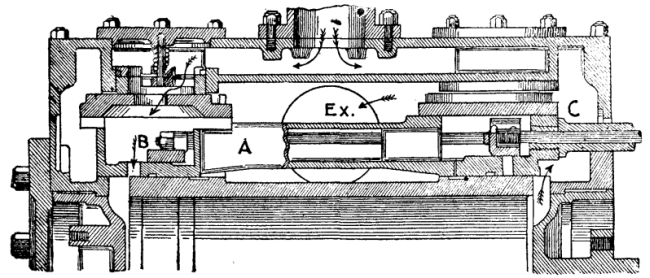
This valve, Fig. 5, differs from the others also in this particular, that the exhaust takes place at the end of the valve instead of under the arch. Two eccentrics are used, the one for the main valve being fastened to the shaft and the other riding loosely upon it and connected to the fly wheel governor, by which it may be turned forward or back as the load requires. The three points of lead, or admission and exhaust and compression, are fixed and independent of the changes and cut off. The motion of the main eccentric is given to a rocker arm, the pivot of which is at the bottom, and from the upper end the valve rod transfers the motion to the valve without reversing the motion, as is done sometimes in the slide valve to overcome the effects of the angularity of the connecting rod. The action of the rocker arm, therefore, so far as the main valve in the Buckeye is concerned, is no different than that which would occur if no rocker arm intervened. The motion of the cut off eccentric, through its eccentric rod, is given to a rocker rocking in a bearing in the center of the main rocker arm (see Fig. 6). The motion of this eccentric is reversed, so far as the cut off valve is concerned, and when the cut off eccentric is moving forward, the cut off valve is being pushed back. The main valve rod is hollow, and the cut off valve rod passes through it.
FIG. 6
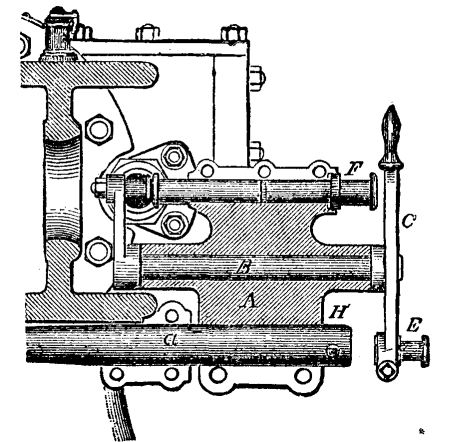
The cut off eccentric can be placed in any position to cause it to cut off as desired, and by drawing the valve forward, by increasing the angular advance of the eccentric, the cut off valve is caused to reach and cover the steam passage in the main valve earlier in the stroke. Instead of being ahead of the crank, the main eccentric in this arrangement follows the crank, on account of the exhaust and steam edges being exactly opposite from those in the ordinary slide. What is the steam edge of the common slide is in this the exhaust edge, and what is the exhaust edge in the common valve is the steam edge in this one. The valve, therefore, must be moved in the opposite direction from what is ordinarily the case, the main eccentric being not 90 deg. behind the crank. It has a rapid and full opening just the same, for it is at this point behind the crank, or ahead of it, that the eccentric gives to the valve its quickest movement, or between the eccentric dead centers. The cut off eccentric is considerably ahead of the main eccentric, and about even with the crank. If it was not for the reversal of motion of the cut off valve through the rocker arm this eccentric would be about in line with the crank, but on the other end. The movement of the cut off valve, therefore, at the time of port opening is very little, being about on its dead center, passing which, it immediately commences to close.
The object of the peculiar construction of the rocker arm, and the pivot for the cut off rocker being placed thereon, is to provide equal travel on the back of the main valve, no matter what the cut off. I have already explained, in connection with the slide valve, that advancing the eccentric does not change the movement of the valve on its seat, but simply its relation to the movement of the piston. You will see that this is unchanged as using the main valve as a seat or any other seat. If the main valve was to remain stationary, and only the cut off valve to be operated by its eccentric, the movement of this cut off valve on a certain plane would be the same for all positions of the eccentric.
Moving the main slide does not affect the matter in any way, for it moves at the same time the pivot of the cut off, and while the cut off seat has assumed a different position with reference to the engine, it is still as though stationary so far as the cut off valve is concerned. This is the object of this peculiar construction, and not, as some engineers suppose, simply to make an odd way of doing things. And the object of it all is to give at all cut offs the same amount of travel, so that there might be no unequal wear to bring about a leak, to prevent which a perfect balancing has been sacrificed.
Referring to the valve and this engine as to how it will satisfy our requirements of a perfect valve gear, we find that the first requirement of a rapid and full opening is met, in that the opening occurs when the main eccentric is moving very rapidly, yet not its fastest, and while this opening will be very satisfactory, it is not so rapid an opening as is obtained in some other forms of valves and valve gears, but this could be overcome very readily by increasing the lead a trifle, and in my experience with these engines I find that the practice is very general by engineers and by builders themselves to give them a considerable amount of lead. As to the second requirement, the maintenance of initial pressure until cut off, giving a straight steam line, cards from this engine will not be found to show that the engine satisfies this requirement, and for this reason, that the cut-off valve commences to close the port immediately after the piston commences to move. The cut off eccentric you will remember is set to move with the crank or very nearly so, and the lighter the load, the greater will this fact appear. For the lightest loads the governor places the eccentric in advance of the crank, so that the cut off valve will commence to close the port before steam is admitted by the main valve to the engine. Now, the later the cut off, the less will this wire drawing appear at first, and the shorter the cut off, the amount of wire drawing increases sensibly. The operation of the valve, therefore, in this particular, cannot be considered as meeting our requirement that the port shall be held open full width until ready to be closed. Many men claim for this engine that the closing occurs when the cut off eccentric is moving its fastest. This is a fact, and if we consider the point of cut off only to be the point of absolute cut off, the cut off must be instantaneous, for there is an instantaneous point where the cut off is final only to be considered. The reasoning applied here would hold good also to a less extent on the slide valve, but is not the point of absolute cut off. We want to note how long it is from the time the valve commences to close at all until finally closed, and, as I have shown you, this is considerable in this engine.
Referring to the point of cut off finally, it is determined upon by a governor of the fly wheel type. The eccentric is loose about the shaft, and arms projecting therefrom are connected by other arms to the extremity of an arm upon which is mounted a weight, and which is attached to the spokes of the fly wheel, or special governor wheel in this case, and which is fastened to the crank shaft. As the speed increases through throwing off a portion of the load the governor weights fly out, and this movement is transferred through the lever connections to the eccentric, causing it to be turned ahead, and the manner hastening the movement of the cut off valve on its seat and causing it to reach and cover the edge of the steam port earlier in the stroke. This engine was the pioneer in governors of this character, the advantage being, in addition to its necessity for the work of turning the eccentric ahead or back, that the liability of the engine to run away, as very often happens from the breaking of the governor belt or a similar cause, was not possible.
The cut off valve has a travel considerably beyond the edge of the steam passage after the valve is closed, and this has one advantage, that the valve is less liable to leak, and to this must be added the loss from the friction of this moving valve, and moving too in opposition to the main valve. In our perfect valve, as we outlined it, the valve does not move after the port is closed. The exhausting functions of the valve are very good, giving a quick opening and a full opening, because this opening occurs when the eccentric is moving its fastest. The engine also possesses a distinct advantage in having remarkably small clearance spaces. The length of the steam passage is very small in comparison with any form of engine, and having but two ports instead of four, as in the Corliss and four valve type.
In these there must be included in the clearance, that to the exhaust port as well as the steam port, adding a considerable amount where the piston comes close to the head. As the engines leave the maker's hand the engines are provided with a considerable amount of lap to give plenty of compression, but are, of course, capable of having more added to increase compression, or some planed off to decrease it.
One of the peculiar things about this engine is the failure to realize anywhere near boiler pressure, noticeable in every case that has come under my notice. The considerable lead gives it for an instant, but it soon falls away, indicating the steam chest pressure only by a peak at the junction of the admission and steam lines. This is probably due to the fact that the cut off valve commences closing the steam passage so soon after steam is admitted, and in this particular does not satisfy the requirements of a perfect valve. There is this about the engine, that above all others of this type there has come under my notice fewer engines of this type with a maladjustment of valves from tampering by incompetent engineers.
[1]
Lecture delivered at Wells Memorial Institute, Boston, in the Lowell Free Course for Engineers. From report in the Boston Journal of Commerce.