THE MECHANICAL REELING OF SILK.
Reading edition
When automatic machinery for thread spinning was invented, English intelligence and enterprise were quick to utilize and develop it, and thus gained that supremacy in textile manufacture which has remained up to the present time, and which will doubtless long continue. The making of the primary thread is the foundation of all textile processes, and it is on the possibility of doing this by automatic machinery that England's great textile industries depend. The use of highly developed machinery for spinning cotton, wool, and flax has grown to be so much a part of our conception of modern life, as contrasted with the times of our grandfathers, as often to lead to the feeling that a complete and universal change has occurred in all the textile industries. This is, however, not the case. There is one great textile industry—one of the most staple and valuable—still in the primitive condition of former times, and employing processes and apparatus essentially the same as those known and employed before such development had taken place. We mean the art of silk reeling. The improvements made in the production of threads of all other materials have only been applied to silk in the minor processes for utilizing waste; but the whole silk trade and manufacture of the world has, up to this time, been dependent for its raw silk threads upon apparatus which, mechanically speaking, is nearly or quite as primitive as the ancient spinning wheels. Thousands of operatives are constantly employed in forming up these threads by hand, adding filament by filament to the thread as required, while watching the unwinding from the cocoon of many miles of filament in order to produce a single pound of the raw silk thread, making up the thread unaided by any mechanical device beyond a simple reel on which the thread is wound as finished, and a basin of heated water in which the cocoons are placed.
Viewed from any standpoint to which we are accustomed, this state of things is so remarkable that we are naturally led to the belief that there must be some special causes which tended to retard the introduction of automatic machinery, and these are not far to seek. The spinning machinery employed for the production of threads, other than those of raw silk, may be broadly described as consisting of devices capable of taking a mass of confused and comparatively short fibers, laying them parallel with one another, and twisting them into a cylindrical thread, depending for its strength upon the friction and interlocking of these constituent fibers.
This process is radically different from that employed to make a thread of raw silk, which consists of filaments, each several thousand feet long, laid side by side, almost without twist, and glued together into a solid thread by means of the "gum" or glue with which each filament is naturally coated. If this radical difference be borne in mind, but very little mechanical knowledge is required to make it evident that the principle of spinning machinery in general is utterly unsuited to the making up of the threads of raw silk. Since spinning machinery, as usually constructed for other fibers, could not be employed in the manufacture of raw silk, and as the countries where silk is produced are, generally speaking, not the seat of great mechanical industries, where the need of special machinery would be quickly recognized and supplied, silk reeling (the making of raw silk) has been passed by, and has never become an industrial art. It remained one of the few manual handicrafts, while yet serving as the base of a great and staple industry of worldwide importance.
There is every reason to suppose that we are about to witness a transformation in the art of silk reeling, a change similar to that which has already been brought about in the spinning of other threads, and of which the consequences will be of the highest importance. For some years past work has been done in France in developing an automatic silk-reeling machine, and incomplete notes concerning it have from time to time been published. That the accounts which were allowed to reach the outer world were incomplete will cause no surprise to those who know what experimental work is—how easily and often an inventor or pioneer finds himself hampered by premature publication. The process in question has now, however, emerged from the experimental state, and is practically complete. By the courtesy of the inventor we are in a position to lay before our readers an exact analysis of the principles, essential parts, and method of operation of the new silk-reeling machine. As silk reeling is not widely known in England, it will, however, be well to preface our remarks by some details concerning the cocoon and the manner in which it is at present manufactured into raw silk, promising that if these seem tedious, the labor of reading them will be amply repaid by the clearer understanding of the new mechanical process which will be the result.
The silkworm, when ready to make its cocoon, seeks a suitable support. This is usually found among the twigs of brush placed for the purpose over the trays in which the worms have been grown. At first the worm proceeds by stretching filaments backward and forward from one twig to another in such manner as to include a space large enough for the future cocoon. When sufficient support has thus been obtained, the worm incloses itself in a layer of filaments adhering to the support and following the shape of the new cocoon, of which it forms the outermost stratum. After having thus provided a support and outlined the cocoon, the worm begins the serious work of constrution. The filament from its silk receiver issues from two small spinnarets situated near its jaws. Each filament, as it comes out, is coated with a layer of exceedingly tenacious natural gum, and they at once unite to form a single flattened thread, the two parts lying side by side. It is this flat thread, called the "baye" or "brin," which serves as the material for making the cocoon, and which, when subsequently unwound, is the filament used in making up the raw silk. While spinning, the worm moves its head continually from right to left, laying on the filament in a succession of lines somewhat resembling the shape of the figure eight. As the worm continues the work of making its cocoon, the filament expressed from its body in the manner described is deposited in nearly even layers all over the interior of the wall of the cocoon, which gradually becomes thicker and harder. The filament issuing from the spinnarets is immediately attached to that already in place by means of the gum which has been mentioned. When the store of silk in the body of the worm is exhausted, the cocoon is finished, and the worm, once more shedding its skin, becomes dormant and begins to undergo its change into a moth. It is at this point that its labors in the production of silk terminate and those of man begin. A certain number of the cocoons are set aside for reproduction.
In southern countries the reproduction of silkworms is a vast industry to which great attention is given, and which receives important and regular aid from the government. It is, however, quite distinct from the manufacturing industry with which at present we have to do. The cocoons to be used for reeling, i.e., all but those which are reserved for reproduction, are in the first place "stifled," that is to say, they are put into a steam or other oven and the insect is killed. The cocoons are then ready for reeling, but those not to be used at once are allowed to dry. In this process, which is carried on for about two months, they lose about two-thirds of their weight, representing the water in the fresh chrysalis. The standard and dried cocoons form the raw material of the reeling mills, or filatures, as they are called on the Continent. Each filature endeavors as far as possible to collect, stifle, and dry the cocoons in its own neighborhood; but dried cocoons, nevertheless, give rise to an important commerce, having its center at Marseilles. The appearance of the cocoon is probably well known to most of our readers. Industrially considered, the cocoon may be divided into three parts: (1) The floss, which consists of the remains of the filaments used for supporting the cocoon on the twigs of the brush among which it was built and the outside layer of the cocoon, together with such ends and parts of the thread forming the main part of the shell as have become broken in detaching and handling the cocoon; (2) the shell of the cocoon, which is formed, as has been described, of a long continuous filament, which it is the object of the reeler to unwind and to form up into threads of raw silk; and (3) the dried body of the chrysalis.
We shall first describe the usual practice of reeling, which is as follows: The cocoons are put into a basin of boiling water, on the surface of which they float. They are stirred about so as to be as uniformly acted upon as possible. The hot water softens the gum, and allows the floss to become partially detached. This process is called "cooking" the cocoons. When the cocoons are sufficiently cooked, they are subjected to a process called "beating," or brushing, the object of which is to remove the floss.
As heretofore carried on, this brushing is a most rudimentary and wasteful operation. It consists of passing a brush of heather or broom twigs over the floating cocoons in such manner that the ends of the brush come in contact with the softened cocoons, catch the floss, and drag it off. In practice it happens that the brush catches the sound filaments on the surface of the cocoon as well as the floss, and, as a consequence, the sound filament is broken, dragged off, and wasted. In treating some kinds of cocoons as much as a third of the silk is wasted in this manner, and even in the best reeling, as at present practiced, there is an excessive loss from this cause. At the present low price of cocoons this waste is not as important as it was some time ago, when cocoons were much dearer; but even at present it amounts to between fifteen and twenty millions of francs per annum in the silk districts of France and Italy alone. In France the cooking and brushing are usually done by the same women who reel, and in the same basins. In Italy the brushing is usually done by girls, and often with the aid of mechanically rotated brushes, an apparatus which is of doubtful utility, as, in imitating the movement of hand brushing, the same waste is occasioned.
After the cocoons are brushed they are, in the ordinary process, cleaned by hand, which is another tedious and wasteful operation performed by the reeler, and concerning which we shall have more to say further on. Whatever may be the preparatory operations, they result in furnishing the reeler with a quantity of cocoons, each having its floss removed, and the end of the filament ready to be unwound. Each reeler is provided with a basin containing water, which may be heated either by a furnace or by steam, and a reel, upon which the silk is wound when put in motion by hand or by power. In civilized countries heating by steam and the use of motive power is nearly universal. The reeler is ordinarily seated before the reel and the basin. The reeler begins operations by assembling the cocoons in the basin, and attaching all the ends to a peg at its side. She then introduces the ends of the filaments from several cocoons into small dies of agate or porcelain, which are held over the basin by a support.
The ends so brought in contact stick together, owing to the adhesive substance they naturally contain, and form a thread. To wring out the water which is brought up with the ends, and further consolidate the thread, it is so arranged as to twist round either itself or another similar thread during its passage from the basin to the reel. This process is called "croisure," and is facilitated by guides or small pulleys. Having made the croisure, which consists of about two hundred turns, the operator attaches the end of a thread to the reel, previously passing it through a guide fixed in a bar, which moves backward and forward, so as to distribute the thread on the reel, forming a hank about three inches wide.
The reel is now put into movement, and winds the thread formed by the union of the filaments. It is at this moment that the real difficulties of the reeler begin. She has now to maintain the size and regularity of the thread as nearly as possible by adding new filaments at the proper moment. The operation of adding an end of a filament consists of throwing it in a peculiar manner on the other filaments already being reeled, so that it sticks to them, and is carried up with them. We may mention here that this process of silk reeling can be seen in operation at the Manchester exhibition.
It is only after a long apprenticeship that a reeler succeeds in throwing the end properly. The thread produced by the several filaments is itself so fine that its size cannot readily be judged by the eye, and the speed with which it is being wound renders this even more difficult. But, in order to have an idea of the size, the reeler watches the cocoons as they unwind, counts them, and, on the hypothesis that the filament of one cocoon is of the same diameter as that of another, gets an approximate idea of the size of the thread that she is reeling. But this hypothesis is not exact, and the filament being largest at the end which is first unwound, and tapering throughout its whole length, the result is that the reeler has not only to keep going a certain number of cocoons, but also to appreciate how much has been unwound from each.
If the cocoons are but slightly unwound, there must be fewer than if a certain quantity of silk has been unwound from them. Consequently their number must be constantly varying in accordance with their condition. These facts show that the difficulty of maintaining regularity in a thread is very great. Nevertheless, this regularity is one of the principal factors of the value of a thread of "grege," and this to such an extent that badly reeled silks are sold at from twenty to twenty-five francs a kilogramme less than those which are satisfactorily regular.
The difficulty of this hand labor can be still better understood if it be remembered that the reeler being obliged to watch at every moment the unwinding of each cocoon, in order to obtain one pound of well reeled silk, she must incessantly watch, and without a moment of distraction, the unwinding of about two thousand seven hundred miles of silk filaments. For nine pounds of silk, she reels a length of filament sufficient to girdle the earth. The manufacturer, therefore, cannot and must not depend only on the constant attention that each reeler should give to the work confided to her care. He is obliged to have overseers who constantly watch the reelers, so that the defects in the work of any single reeler, who otherwise might not give the attention required by her work, will not greatly diminish the value either of her own work or that of several other reelers whose silk is often combined to form a single lot. In addition to the ordinary hand labor, considerable expense is thus necessitated for the watching of the reelers.
Enough has now been said, we think, to give a good idea of silk reeling, as usually practiced, and to show how much it is behind other textile arts from a mechanical point of view. To any one at all familiar with industrial work, or possessing the least power of analysis or calculation, it is evident that a process carried on in so primitive a manner is entirely unsuitable for use in any country in which the conditions of labor are such as to demand its most advantageous employment. In the United States, for instance, or in England, silk reeling, as a great national industry, would be out of the question unless more mechanical means for doing it could be devised. The English climate is not suitable for the raising of cocoons, and in consequence the matter has not attracted very much attention in this country. But America is very differently situated. Previous to 1876 it had been abundantly demonstrated that cocoons could be raised to great advantage in many parts of that country. The only question was whether they could be reeled. In fact, it was stated at the time that the question of reeling silk presented a striking analogy to the question of cotton before the invention of the "gin." It will be remembered that cotton raising was several times tried in the United States, and abandoned because the fiber could not be profitably prepared for the market. The impossibility of competing with India and other cheap labor countries in this work became at least a fact fully demonstrated, and any hope that cotton would ever be produced in America was confined to the breasts of a few enthusiasts.
As soon, however, as it was shown that the machine invented by Eli Whitney would make it possible to do this work mechanically, the conditions were changed; cotton raising become not only possible, but the staple industry of a great part of the country; the population was rapidly increased, the value of real estate multiplied, and within a comparatively short time the United States became the leading cotton country of the world. For many years much more cotton has been grown in America than in all the other countries of the world combined; and it is interesting to note that both the immense agricultural wealth of America and the supply required for the cotton industry of England flow directly from the invention of the cotton gin.
Attention was turned in 1876 to silk raising, and it was found that all the conditions for producing cocoons of good quality and at low cost were most favorable. It was, however, useless to raise cocoons unless they could be utilized; in a word, it was seen that the country needed silk-reeling machinery in 1876, as it had needed cotton-ginning machinery in 1790. Under these conditions, Mr. Edward W. Serrell, Jr., an engineer of New York, undertook the study of the matter, and soon became convinced that the production of such machinery was feasible. He devoted his time to this work, and by 1880 had pushed his investigations as far as was possible in a country where silk reeling was not commercially carried on. He then went to France, where he has since been incessantly engaged in the heart of the silk-reeling district in perfecting, reducing to practice, and applying his improvements and inventions. The success obtained was such that Mr. Serrell has been enabled to interest many of the principal silk producers of the Continent in his work, and a revolution in silk reeling is being gradually brought about, for, strangely enough, he found that the work which he had undertaken solely for America was of equal importance for all silk-producing countries.
We have described the processes by which cocoons are ordinarily cooked and brushed, these being the first processes of the filature. Instead of first softening the gum of the cocoons and then attacking the floss with the points of a brush, Mr. Serrell places the cocoons in a receptacle full of boiling water, in which by various means violent reciprocating or vortex currents are produced. The result is that by the action of the water itself and the rubbing of the cocoons one against the other the floss is removed, carrying with it the end of the continuous filament without unduly softening the cocoon or exposing any of the more delicate filament to the rough action of the brush, as has hitherto been the case. The advantages of this process will be readily understood. In brushing after the ordinary manner, the point of the brush is almost sure to come into contact with and to break some of the filament forming the body of the cocoon. When this occurs, and the cocoon is sent to be reeled, it naturally becomes detached when the unwinding reaches the point at which the break exists. It then has to be sent back, and the end of the filament detached by brushing over again, when several layers of filament are inevitably caught by the brush and wasted, and very probably some other part of the filament is cut. This accounts for the enormous waste which occurs in silk reeling, and to which we have referred. Its importance will be appreciated when it is remembered that every pound of fiber thus dragged off by the brush represents a net loss of about 19s. at the present low prices.
The mechanical details by which Mr. Serrell carries out this process vary somewhat according to the nature of the different cocoons to be treated. In one type of machine the water is caused to surge in and out of a metal vessel with perforated sides; in another a vertical brush is rapidly raised and lowered, agitating the water in a basin, without, however, actually touching the cocoons. After a certain number of strokes the brush is automatically raised, when the ends of the filaments are found to adhere to it, having been swept against it by the scouring action of the water. The cleaning of the cocoons is performed by means of a mechanism also entirely new. In the brushing machinery the floss is loosened and partially detached from the cocoon. The object of the cleaning machine is to thoroughly complete the operation. To this end the cocoons are floated under a plate, and the floss passed up through a slot in the latter. A rapid to and fro horizontal movement is given to the plate, and those cocoons from which the floss has been entirely removed easily give off a few inches of their filament, and allow themselves to be pushed on one side, which is accomplished by the cocoons which still have some floss adhering to them; because these latter, not being free to pay off, are drawn up to the slot in the plate, and by its motion are rapidly washed backward and forward in the water. This washing soon causes all the cocoons to be freed from the last vestiges of floss without breaking the filament, and after about twenty seconds of movement they are all free and clean, ready for reeling.
We have now to explain the operation of the machine by which the thread is formed from the prepared cocoon. At the risk of some repetition, however, it seems necessary to call attention to the character of the work itself. In each prepared cocoon are about a thousand yards of filament ready to pay off, but this filament is nearly as fine as a cobweb and is tapering. The object is to form a thread by laying these filaments side by side in sufficient number to obtain the desired size. For the threads of raw silk used in commerce, the sizes vary, so that while some require but an average of three filaments, the coarsest sizes require twenty-five or thirty. It being necessary keep the thread at as near the same size as possible, the work required is, in effect, to add an additional cocoon filament to the thread which is being wound whenever this latter has tapered down to a given size, or whenever one of the filaments going to form it has become detached. Those familiar with cotton spinning will understand what is meant when it is said that the reeling is effectively a "doubling" operation, but performed with a variable number of ends, so as to compensate for the taper of the filaments. In reeling by hand, as has been said, the size of the silk is judged, as nearly as possible, by a complex mental operation, taking into account the number, size, and state of unwinding of the cocoons. It is impossible to do this mechanically, if for no other reason than this, that the cocoons must be left free to float and roll about in the water in order to give off their ends without breaking, and any mechanical device which touched them would defeat the object of the machine. The only way in which the thread can be mechanically regulated in silk reeling is by some kind of actual measurement performed after the thread has left the cocoons. The conditions are such that no direct measurement of size can be made, even with very delicate and expensive apparatus; but Mr. Serrell discovered that, owing to the great tenacity of the thread in proportion to its size, its almost absolute elastic uniformity, and from the fact that it could be stretched, two or three per cent. without injury, it was possible to measure its size indirectly, but as accurately as could be desired. As this fact is the starting point of an entirely new and important class of machinery, we may explain with considerable detail the method in which this measurement is performed. Bearing in mind that the thread is of uniform quality, it is evident that it will require more force to stretch a coarse thread by a given percentage of its length than it will to stretch one that is finer. Supposing the thread is uniform in quality but varying in size, the force required to stretch it varies directly with the size or sectional area of the thread itself. In the automatic reeling machine this stretch is obtained by causing the thread to take a turn round a pulley of a given winding speed, and then, after leaving this pulley, to take a turn around a second pulley having a somewhat greater winding speed.
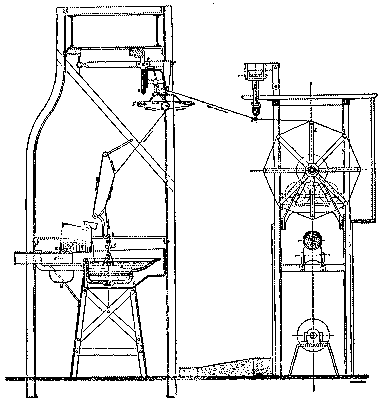
Fig. 1 THE MECHANICAL REELING OF SILK.
By this means the thread which is passing from one pulley to the other is stretched by an amount equal to the difference of the winding speed of the two pulleys. In the diagram (Fig. 2) the thread passes, as shown by the arrows, over the pulley, P, and then over the pulley, P¹, the latter having a slightly greater winding speed. Between these pulleys it passes over the guide pulley, G. This latter is supported by a lever hinged at S, and movable between the stops, TT¹. W is an adjustable counterweight. When the thread is passed over the pulleys and guided in this manner, the stretch to which it is subjected tends to raise the guide and lever, so that the latter will be drawn up against the stop, T¹, when the thread is so coarse that the effort required to stretch it is sufficient to overcome the weight of the guide pulley and the adjustable counterweight. But as the thread becomes finer, which, in the case of reeling silk, happens either from the tapering of the filaments or the dropping off of a cocoon, a moment arrives when it is no longer strong enough to keep up the lever and counterweight. These then descend, and the lever touches the lower stop, T. It will be readily seen that the up and down movements of the lever can be made to take place when the thread has reached any desired maximum or minimum of size, the limits being fixed by suitably adjusting the counterweight.
FIG. 2.
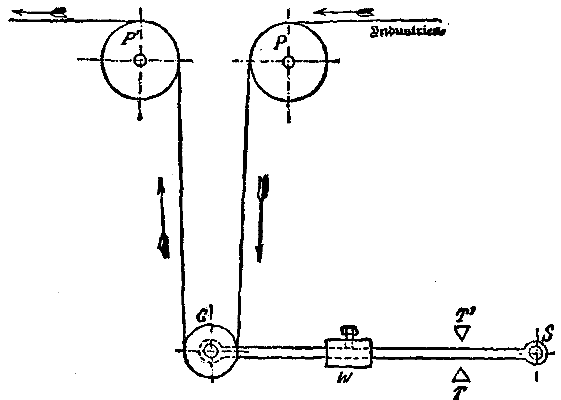
In the automatic reeling machine this is the method employed for regulating the supply of cocoons. The counterweight being suitably adjusted, the lever falls when the thread has become fine enough to need another cocoon. The stop, T, and the lever serve as two parts of an electric contact, so that when they touch each other a circuit is completed, which trips a trigger and sets in motion the feed apparatus by which a new cocoon is added. In practice the two drums or pulleys are mounted on the same shaft, D (Fig. 1), difference of winding speed being obtained by making them of slightly different diameters.
The lever is mounted as a horizontal pendulum, and the less or greater stress required according to the size to be reeled is obtained by inclining its axis to a less or greater degree from the vertical. An arrangement is also adopted by which the strains existing in the thread when it arrives at the first drum are neutralized, so far as their effect upon the lever is concerned. This is accomplished by simply placing upon the lever an extra guide pulley, L¹, upon the side opposite to that which corresponds to the guide shown in the diagram, Fig. 2.
An electric contact is closed by a slight movement of the lever whenever the thread requires a new filament of cocoon, and broken again when the thread has been properly strengthened. It is evident that a delicate faller movement might be employed to set the feed mechanism in motion instead of the electric circuit, but, under the circumstances, as the motion is very slight and without force, being, in fact, comparable to the swinging of the beam of a balance through the space of about the sixteenth of an inch, it is simpler to use a contact.
The actual work of supplying the cocoons to the running thread is performed as follows: The cleaned cocoons are put into what is called the feeding basin, B1 (Fig. 1), a receptacle placed alongside of the ordinary reeling basin, B, of a filature. A circular elevator, E, into which the cocoons are charged by a slight current of water, lifts them over one corner of the reeling basin and drops them one by one through an aperture in a plate about six inches above the water of the reeling basin.
The end of the filament having been attached to a peg above the elevator, it happens that when a cocoon has been brought into the corner of the reeling basin, the filament is strung from it to the edge of the hole in the plate in such a position as to be readily seized by a mechanical finger, K (Fig. 3), attached to a truck arranged to run backward and forward along one side of the basin. This finger is mounted on an axis, and has a tang projecting at right angles to the side of the basin, so that the whole is in the form of a bell crank mounted on the truck.
FIG. 3.
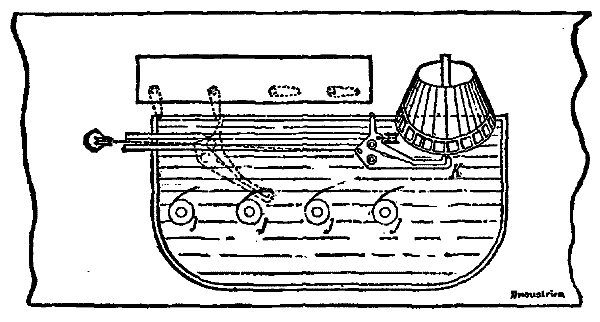
There are usually four threads to each basin. When neither one of them needs an additional cocoon, the finger of the distributing apparatus remains, holding the filament of the cocoon at the corner of the basin where it has been dropped. When a circuit is closed by the weakening of any one of the threads, an electromagnetic catch is released, and the truck with its finger is drawn across the basin by a weight. At the same time the stop shown dotted in Fig. 3 is thrown out opposite to the thread that needs strengthening. This stop strikes the tang of the finger, and causes the latter to be thrown out near to the point at which the filaments going to make up the weakened thread are being drawn from the cocoons. Here the new filament is attached to the new running thread by a kind of revolving finger, J, called in France a "lance-bout." This contrivance takes the place of the agate of the ordinary filature, and is made up, essentially, of the following parts:
(1) A hollow axis, through the inside of which the thread passes instead of going through the hole of an agate. This hollow axis is furnished, near its lower end, with a ridge which serves to support a movable portion turning constantly round the axis. (2) A movable portion turning constantly round the axis. (3) A finger or hook fastened on the side of the movable portion and revolving with it. This hook, in revolving, catches the filament brought up by the finger and serves it on to the thread.
Such are the principal parts of the automatic reeling machine. Although the fact that this machine is entirely a new invention has necessitated a somewhat long explanation, its principal organs can nevertheless be summed up in a few words: (1) A controlling drum which serves to give the thread a constant elongation; (2) a pulley mounted on a pivot which closes an electric current every time that the thread becomes too fine, and attains, in consequence, its minimum strength, in other words, every time that a fresh cocoon is needed; (3) electromagnets with the necessary conducting wires; (4) the feeding basin; (5) distributing finger and stops; and (6) the lance-bout.
Our illustration, Fig. 1, shows diagrammatically a section through the cocoon frame and reel. The thread is composed of three, four, or more filaments, and after passing through the lance-bout, it travels as shown by the arrows. At first it is wound round itself about two hundred times, then passed over a fixed guide pulley, and over a second guide pulley lower down fixed to the frames which carry the lance-bouts, then up through the twist and over the smaller of the pulleys, D. Taking one complete turn, it is led round the guide pulley, L, from there round the larger of the pulleys, D, round the second guide pulley, L¹, then back to the large wheel, and over a fixed guide pulley across to the reeling frame. Power is supplied to the latter by means of a friction clutch, and to insure even winding the usual reciprocating motion of a guide is employed. The measuring apparatus is pivoted at F, and by raising or lowering the nuts at the end of the bar the required inclination is given.
We had recently an opportunity of examining the whole of this machinery in detail, and seeing the process of silk reeling in actual operation, Mr. Serrell having put up a complete set of his machines in Queen Victoria Street, London. Regarded simply as a piece of ingenious mechanism, the performance of these machines cannot fail to be of the highest interest to engineers, the reeling machine proper seeming almost endowed with human intelligence, so perfectly does it work. But, apart from the technical perfection, Mr. Serrell's improvements are of great importance as calculated to introduce the silk-reeling industry in this country on a large scale, while at the same time its effect upon India as a silk-growing country will be of equal importance.—Industries.