THE BRITISH ASSOCIATION.
Reading edition
THE BRITISH ASSOCIATION AT MANCHESTER PORTRAITS OF THE PRESIDENT AND PRESIDENTS OF SECTIONS
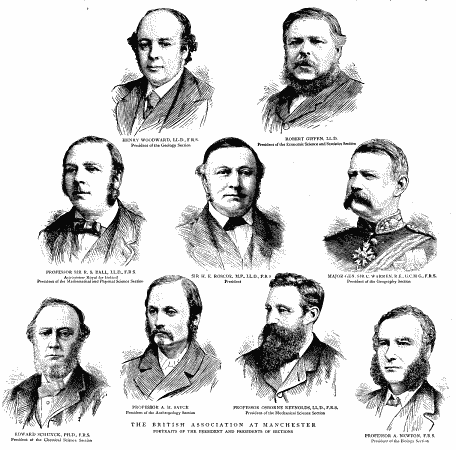
The fifty-seventh annual meeting of the British Association was opened on Wednesday evening, Aug. 31, 1887, at Manchester, by an address from the president, Sir H.E. Roscoe, M.P. This was delivered in the Free Trade Hall. The chair was occupied by Professor Williamson, who was supported by the Bishop of Manchester, Sir F. Bramwell, Professor Gamgee, Professor Milnes Marshall, Professor Wilkins, Professor Boyd Dawkins, Professor Ward, and many other distinguished men. A telegram was read from the retiring president, Sir Wm. Dawson, of Montreal, congratulating the association and Manchester on this year's meeting. The new president, Sir H. Roscoe, having been introduced to the audience, was heartily applauded.
The president, in his inaugural address, said Manchester, distinguished as the birthplace of two of the greatest discoveries of modern science, welcomed the visit of the British Association for the third time. Those discoveries were the atomic theory of which John Dalton was the author, and the most far-reaching scientific principle of modern times, namely, that of the conservation of energy, which was given to the world about the year 1842 by Dr. Joule. While the place suggested these reminders, the time, the year of the Queen's jubilee, excited a feeling of thankfulness that they had lived in an age which had witnessed an advance in our knowledge of nature and a consequent improvement in the physical, moral, and intellectual well-being of the people hitherto unknown.
PROGRESS OF CHEMISTRY.
A sketch of that progress in the science of chemistry alone would be the subject of his address. The initial point was the views of Dalton and his contemporaries compared with the ideas which now prevail; and he (the president) examined this comparison by the light which the research of the last fifty years had thrown on the subject of the Daltonian atoms, in the three-fold aspect of their size, indivisibility, and mutual relationships, and their motions.
SIZE OF THE ATOM.
As to the size of the atom, Loschmidt, of Vienna, had come to the conclusion that the diameter of an atom of oxygen or nitrogen was the ten-millionth part of a centimeter. With the highest known magnifying power we could distinguish the forty-thousandth part of a centimeter. If, now, we imagine a cubic box each of whose sides had this length, such a box, when filled with air, would contain from sixty to a hundred millions of atoms of oxygen and nitrogen. As to the indivisibility of the atom, the space of fifty years had completely changed the face of the inquiry. Not only had the number of distinct, well-established elementary bodies increased from fifty-three in 1837 to seventy in 1887, but the properties of these elements had been studied, and were now known with a degree of precision then undreamt of. Had the atoms of our present elements been made to yield? To this a negative answer must undoubtedly be given, for even the highest of terrestrial temperatures, that of the electric spark, had failed to shake any one of these atoms in two. This was shown by the results with which spectrum analysis had enriched our knowledge. Terrestrial analysis had failed to furnish favorable evidence; and, turning to the chemistry of the stars, the spectra of the white, which were presumably the hottest stars, furnished no direct evidence that a decomposition of any terrestrial atom had taken place; indeed, we learned that the hydrogen atom, as we know it here, can endure unscathed the inconceivably fierce temperature of stars presumably many times more fervent than our sun, as Sirius and Vega. It was therefore no matter for surprise if the earth-bound chemist should for the present continue to regard the elements as the unalterable foundation stones upon which his science is based.
ATOMIC MOTION.
Passing to the consideration of atoms in motion, while Dalton and Graham indicated that they were in a continual state of motion, we were indebted to Joule for the first accurate determination of the rate of that motion. Clerk-Maxwell had calculated that a hydrogen molecule, moving at the rate of seventy miles per minute, must, in one second of time, knock against others no fewer than eighteen thousand million times. This led to the reflection that in nature there is no such thing as great or small, and that the structure of the smallest particle, invisible even to our most searching vision, may be as complicated as that of any one of the heavenly bodies which circle round our sun. How did this wonderful atomic motion affect their chemistry?
ATOMIC COMBINATION.
Lavoisier left unexplained the dynamics of combustion; but in 1843, before the chemical section of the association meeting at Cork, Dr. Joule announced the discovery which was to revolutionize modern science, namely, the determination of the mechanical equivalent of heat. Every change in the arrangement of the particles he found was accompanied by a definite evolution or an absorption of heat. Heat was evolved by the clashing of the atoms, and this amount was fixed and definite. Thus to Joule we owe the foundation of chemical dynamics and the basis of thermal chemistry. It was upon a knowledge of the mode of arrangement of atoms, and on a recognition of their distinctive properties, that the superstructure of modern organic chemistry rested. We now assumed on good grounds that the atom of each element possessed distinct capabilities of combination. The knowledge of the mode in which the atoms in the molecule are arranged had given to organic chemistry an impetus which had overcome many experimental obstacles, and organic chemistry had now become synthetic.
Liebig and Wohler, in 1837, foresaw the artificial production in the laboratories of all organic substances so far as they did not constitute a living organism. And after fifty years their prophecy had been fulfilled, for at the present time we could prepare an artificial sweetening principle, an artificial alkaloid, and salacine.
SYNTHESIS.
We know now that the same laws regulate the formation of chemical compounds in both animate and inanimate nature, and the chemist only asked for a knowledge of the constitution of any definite chemical compounds found in the organic world in order to be able to promise to prepare it artificially. Seventeen years elapsed between Wohler's discovery of the artificial production of urea and the next real synthesis, which was accomplished by Kolbe, when in 1845 he prepared acetic acid from its elements. Since then a splendid harvest of results had been gathered in by chemists of all nations. In 1834 Dumas made known the law of substitution, and showed that an exchange could take place between the constituent atoms in a molecule, and upon this law depended in great measure the astounding progress made in the wide field of organic synthesis.
Perhaps the most remarkable result had been the production of an artificial sweetening agent, termed saccharin, 250 times sweeter than sugar, prepared by a complicated series of reactions from coal tar. These discoveries were not only of scientific interest, for they had given rise to the industry of coal tar colors, founded by our countryman Perkin, the value of which was measured by millions sterling annually. Another interesting application of synthetic chemistry to the needs of everyday life was the discovery of a series of valuable febrifuges, of which antipyrin might be named as the most useful.
An important aspect in connection with the study of these bodies was the physiological value which had been found to attach to the introduction of certain organic radicals, so that an indication was given of the possibility of preparing a compound which will possess certain desired physiological properties, or even to foretell the kind of action which such bodies may exert on the animal economy. But now the question might well be put, Was any limit set to this synthetic power of the chemist? Although the danger of dogmatizing as to the progress of science had already been shown in too many instances, yet one could not help feeling that the barrier between the organized and unorganized worlds was one which the chemist at present saw no chance of breaking down. True, there were those who professed to foresee that the day would arrive when the chemist, by a succession of constructive efforts, might pass beyond albumen, and gather the elements of lifeless matter into a living structure. Whatever might be said regarding this from other standpoints, the chemist could only say that at present no such problem lay within his province.
Protoplasm, with which the simplest manifestations of life are associated, was not a compound, but a structure built up of compounds. The chemist might successfully synthesize any of its component molecules, but he had no more reason to look forward to the synthetic production of the structure than to imagine that the synthesis of gallic acid led to the artificial production of gall nuts. Although there was thus no prospect of effecting a synthesis of organized material, yet the progress made in our knowledge of the chemistry of life during the last fifty years had been very great, so much so indeed that the sciences of physiological and of pathological chemistry might be said to have entirely arisen within that period.
CHEMISTRY OF VITAL FUNCTIONS.
He would now briefly trace a few of the more important steps which had marked the recent study of the relations between the vital phenomena and those of the inorganic world. No portion of the science of chemistry was of greater interest or greater complexity than that which, bearing on the vital functions both of plants and of animals, endeavored to unravel the tangled skein of the chemistry of life, and to explain the principles according to which our bodies live, and move, and have their being. If, therefore, in the less complicated problems with which other portions of our science have to deal, we found ourselves often far from possessing satisfactory solutions, we could not be surprised to learn that with regard to the chemistry of the living body—whether vegetable or animal—in health or disease, we were still farther from a complete knowledge of phenomena, even those of fundamental importance.
Liebig asked if we could distinguish, on the one hand, between the kind of food which goes to create warmth and, on the other, that by the oxidation of which the motions and mechanical energy of the body are kept up. He thought he was able to do this, and he divided food into two categories. The starchy or carbo-hydrate food was that, said he, which by its combustion provided the warmth necessary for the existence and life of the body. The albuminous or nitrogenous constituents of our food, the flesh meat, the gluten, the casein out of which our muscles are built up, were not available for the purpose of creating warmth, but it was by the waste of those muscles that the mechanical energy, the activity, the motions of the animal are supplied.
Soon after the promulgation of these views, J.R. Mayer warmly attacked them, throwing out the hypothesis that all muscular action is due to the combustion of food, and not to the destruction of muscle.
What did modern research say to this question? Could it be brought to the crucial test of experiment? It could; but how? In the first place, we could ascertain the work done by a man or any other animal; we could measure this work in terms of our mechanical standard, in kilogramme-meters or foot-pounds. We could next determine what was the destruction of nitrogenous tissue at rest and under exercise by the amount of nitrogenous material thrown off by the body. And here we must remember that these tissues were never completely burned, so that free nitrogen was never eliminated. If now we knew the heat value of the burned muscle, it was easy to convert this into its mechanical equivalent and thus measure the energy generated. What was the result?
Was the weight of muscle destroyed by ascending the Faulhorn or by working on the treadmill sufficient to produce on combustion heat enough when transformed into mechanical exercise to lift the body up to the summit of the Faulhorn or to do the work on the treadmill?
Careful experiment had shown that this was so far from being the case that the actual energy developed was twice as great as that which could possibly be produced by the oxidation of the nitrogenous constituents eliminated from the body during twenty-four hours. That was to say, taking the amount of nitrogenous substance cast off from the body, not only while the work was being done, but during twenty-four hours, the mechanical effect capable of being produced by the muscular tissue from which this cast-off material was derived would only raise the body half way up the Faulhorn, or enable the prisoner to work half his time on the treadmill. Hence it was clear that Liebig's proposition was not true.
The nitrogenous constituents of the food did doubtless go to repair the waste of muscle, which, like every other portion of the body, needed renewal, while the function of the non-nitrogenous food was not only to supply the animal heat, but also to furnish, by its oxidation, the muscular energy of the body. We thus came to the conclusion that it was the potential energy of the food which furnished the actual energy of the body, expressed in terms either of heat or of mechanical work.
But there was one other factor which came into play in this question of mechanical energy, and must be taken into account; and this factor we were as yet unable to estimate in our usual terms. It concerned the action of the mind on the body, and although incapable of exact expression, exerted none the less an important influence on the physics and chemistry of the body, so that a connection undoubtedly existed between intellectual activity or mental work and bodily nutrition. What was the expenditure of mechanical energy which accompanied mental effort was a question which science was probably far from answering; but that the body experienced exhaustion as the result of mental activity was a well-recognized fact.
CHEMISTRY OF VEGETATION.
The phenomena of vegetation, no less than those of the animal world, had, however, during the last fifty years been placed by the chemist on an entirely new basis.
Liebig, in 1860, asserted that the whole of the carbon of vegetation was obtained from the atmospheric carbonic acid, which, though only present in the small relative proportion of four parts in 10,000 of air, was contained in such absolutely large quantity that if all the vegetation on the earth's surface were burned, the proportion of carbonic acid which would thus be thrown into the air would not be sufficient to double the present amount. That this conclusion was correct needed experimental proof, but such proof could only be given by long-continued and laborious experiment.
It was to our English agricultural chemists, Lawes and Gilbert, that we owed the complete experimental proof required, and this experiment was long and tedious, for it had taken forty-four years to give a definite reply.
At Rothamsted a plot was set apart for the growth of wheat. For forty-four successive years that field had grown wheat without the addition of any carbonized manure, so that the only possible source from which the plant could obtain the carbon for its growth was the atmospheric carbonic acid. The quantity of carbon which on an average was removed in the form of wheat and straw from a plot manured only with mineral matter was 1,000 lb., while on another plot, for which a nitrogenous manure was employed, 1,500 lb. more carbon was annually removed, or 2,500 lb. of carbon were removed by this crop annually without the addition of any carbonaceous manure. So that Liebig's prevision had received a complete experimental verification.
CHEMICAL PATHOLOGY.
Touching us as human beings even still more closely than the foregoing was the influence which chemistry had exerted on the science of pathology, and in no direction had greater progress been made than in the study of micro-organisms in relation to health and disease. In the complicated chemical changes to which we gave the names of fermentation and putrefaction, Pasteur had established the fundamental principle that these processes were inseparately connected with the life of certain low forms of organisms. Thus was founded the science of bacteriology, which in Lister's hands had yielded such splendid results in the treatment of surgical cases, and in those of Klebs, Koch, and others, had been the means of detecting the cause of many diseases both in man and animals, the latest and not the least important of which was the remarkable series of successful researches by Pasteur into the nature and mode of cure of that most dreadful of maladies, hydrophobia. The value of his discovery was greater than could be estimated by its present utility, for it showed that it might be possible to avert other diseases besides hydrophobia by the adoption of a somewhat similar method of investigation and of treatment.
Here it might seem as if we had outstepped the boundaries of chemistry, and had to do with phenomena purely vital. But recent research indicated that this was not the case, and pointed to the conclusion that the microscopist must again give way to the chemist, and that it was by chemical rather than biological investigation that the causes of diseases would be discovered, and the power of removing them obtained. For we learned that the symptoms of infective diseases were no more due to the microbes which constituted the infection than alcoholic intoxication was produced by the yeast cell, but that these symptoms were due to the presence of definite chemical compounds, the result of the life of these microscopic organisms. So it was to the action of these poisonous substances formed during the life of the organism, rather than to that of the organism itself, that the special characteristics of the disease were to be traced, for it had been shown that the disease could be communicated by such poisons in the entire absence of living organisms.
Had time permitted, he would have wished to have illustrated the dependence of industrial success upon original investigation, and to have pointed out the prodigious strides which chemical industry in this country had made during the fifty years of her Majesty's reign. As it was, he must be content to remark how much our modern life, both in its artistic and useful aspects, owed to chemistry, and therefore how essential a knowledge of the principles of the science was to all who had the industrial progress of the country at heart. The country was now beginning to see that if she was to maintain her commercial and industrial supremacy, the education of her people from top to bottom must be carried out on new lines. The question how this could be most safely and surely accomplished was one of transcendent national importance, and the statesman who solved this educational problem would earn the gratitude of generations yet to come.
In welcoming the unprecedentedly large number of foreign men of science who had on this occasion honored the British Association by their presence, he hoped that that meeting might be the commencement of an international scientific organization, the only means nowadays existing of establishing that fraternity among nations from which politics appeared to remove them further and further, by absorbing human powers and human work, and directing them to purposes of destruction. It would indeed be well if Great Britain, which had hitherto taken the lead in so many things that are great and good, should now direct her attention to the furthering of international organizations of a scientific nature. A more appropriate occasion than the present meeting could perhaps hardly be found for the inauguration of such a movement. But whether this hope were realized or not, they all united in that one great object, the search after truth for its own sake, and they all, therefore, might join in re-echoing the words of Lessing: "The worth of man lies not in the truth which he possesses, or believes that he possesses, but in the honest endeavor which he puts forth to secure that truth; for not by the possession of truth, but by the search after it, are the faculties of man enlarged, and in this alone consists his ever-growing perfection. Possession fosters content, indolence, and pride. If God should hold in his right hand all truth, and in his left hand the ever-active desire to seek truth, though with the condition of perpetual error, I would humbly ask for the contents of the left hand, saying, 'Father, give me this; pure truth is only for thee.'"
At the close of his address a vote of thanks was passed to the president, on the motion of the Mayor of Manchester, seconded by Professor Asa Gray, of Harvard College. The president mentioned that the number of members is already larger than at any previous annual meeting, namely, 3,568, including eighty foreigners.