HYPNOTISM IN FRANCE.1
Reading edition
HYPNOTISM IN FRANCE.1
The voluntary production of those abnormal conditions of the nerves which to-day are denoted by the term "hypnotic researches" has manifested itself in all ages and among most of the nations that are known to us. Within modern times these phenomena were first reduced to a system by Mesmer, and, on this account, for the future deserve the attention of the scientific world. The historical description of this department, if one intends to give a connected account of its development, and not a series of isolated facts, must begin with a notice of Mesmer's personality, and we must not confound the more recent development of our subject with its past history.
The period of mesmerism is sufficiently understood from the numerous writings on the subject, but it would be a mistake to suppose that in Braid's "Exposition of Hypnotism" the end of this subject had been reached. In a later work I hope to show that the fundamental ideas of biomagnetism have not only had in all periods of this century capable and enthusiastic advocates, but that even in our day they have been subjected to tests by French and English investigators from which they have issued triumphant.
The second division of this historical development is carried on by Braid, whose most important service was emphasizing the subjectivity of the phenomena. Without any connection with him, and yet by following out almost exactly the same experiments, Professor Heidenhain reached his physiological explanations. A third division is based upon the discovery of the hypnotic condition in animals, and connects itself to the experimentum mirabile. In 1872 the first writings on this subject appear from the pen of the physiologist Czermak; and since then the investigations have been continued, particularly by Professor Preyer.
While England and Germany were led quite independently to the study of the same phenomena, France experienced a strange development, which shows, as nothing else could, how truth everywhere comes to the surface, and from small beginnings swells to a flood which carries irresistibly all opposition with it. This fourth division of the history of hypnotism is the more important, because it forms the foundation of a transcendental psychology, and will exert a great influence upon our future culture; and it is this division to which we wish to turn our attention. We have intentionally limited ourselves to a chronological arrangement, since a systematic account would necessarily fall into the study of single phenomena, and would far exceed the space offered to us.
James Braid's writings, although they were discussed in detail in Littré and Robin's "Lexicon," were not at all the cause of Dr. Philips' first books, who therefore came more independently to the study of the same phenomena. Braid's theories became known to him later by the observations made upon them in Béraud's "Elements of Physiology" and in Littré's notes in the translation of Müller's "Handbook of Physiology;" and he then wrote a second brochure, in which he gave in his allegiance to braidism. His principal effort was directed to withdrawing the veil of mystery from the occurrences, and by a natural explanation relegating them to the realm of the known. The trance caused by regarding fixedly a gleaming point produces in the brain, in his opinion, an accumulation of a peculiar nervous power, which he calls "electrodynamism." If this is directed in a skillful manner by the operator upon certain points, it manifests itself in certain situations and actions that we call hypnotic. Beyond this somewhat questionable theory, both books contained a detailed description of some of the most important phenomena; but with the practical meaning of the phenomena, and especially with their therapeutic value, the author concerned himself but slightly. Just on account of this pathological side, however, a certain attention has been paid to hypnotism up to the present time.
In the year 1847 two surgeons in Poictiers, Drs. Ribaut and Kiaros, employed hypnotism with great success in order to make an operation painless. "This long and horrible work," says a journal of the day, "was much more like a demonstration in a dissecting room than an operation performed upon a living being." Although this operation produced such an excitement, yet it was twelve years later before decisive and positive official intelligence was given of these facts by Broca, Follin, Velpeau, and Guérinau. But these accounts, as well as the excellent little book by Dr. Azam, shared the fate of their predecessors. They were looked upon by students with distrust, and by the disciples of Mesmer with scornful contempt.
The work of Demarquay and Giraud Teulon showed considerable advance in this direction. The authors, indeed, fell back upon the theory of James Braid, which they called stillborn, and of which they said, "Elle est restée accrochée en route;" but they did not satisfy themselves with a simple statement of facts, as did Gigot Suard in his work that appeared about the same time. Through systematic experiments they tried to find out where the line of hypnotic phenomena intersected the line of the realm of the known. They justly recognized that hypnotism and hysteria have many points of likeness, and in this way were the precursors of the present Parisian school. They say that from magnetic sleep to the hypnotic condition an iron chain can be easily formed from the very same organic elements that we find in historical conditions.
At the same time, as if to bring an experimental proof of this assertion, Lasigue published a report on catalepsy in persons of hysterical tendencies, which be afterward incorporated into his larger work. Among his patients, those who were of a quiet and lethargic temperament, by simply pressing down the eyelids, were made to enter into a peculiar state of languor, in which cataleptic contractions were easily produced, and which forcibly recalled hypnotic phenomena. "One can scarcely imagine," says the author, "a more remarkable spectacle than that of a sick person sunk in deep sleep, and insensible to all efforts to arouse him, who retains every position in which he is placed, and in it preserves the immobility and rigidity of a statue." But this impulse also was in vain, and in only a few cases were the practical tests followed up with theoretical explanations.
Unbounded enthusiasm and unjust blame alike subsided into a silence that was not broken for ten years. Then Charles Richet, a renowned scientist, came forward in 1875, impelled by the duty he felt he owed as a priest of truth, and made some announcements concerning the phenomena of somnambulism; and in countless books, all of which are worthy of attention, he has since then considered the problem from its various sides.
He separates somnambulism into three periods. The word here is used for this whole class of subjects as Richet himself uses it, viz., torpeur, excitation, and stupeur. In the first, which is produced by the so-called magnetic passes and the fixing of the eyes, silence and languor come over the subject. The second period, usually produced by constant repetition of the experiment, is characterized chiefly by sensibility to hallucination and suggestion. The third period has as its principal characteristics supersensibility of the muscles and lack of sensation. Yet let it be noticed that these divisions were not expressed in their present clearness until 1880; while in the years between 1872 and 1880, from an entirely different quarter, a similar hypothesis was made out for hypnotic phenomena.
Jean Martin Charcot, the renowned neurologist of the Parisian Salpetriere, without exactly desiring it, was led into the study of artificial somnambulism by his careful experiments in reference to hysteria, and especially by the question of metallotherapie, and in the year 1879 had prepared suitable demonstrations, which were given in public lectures at the Salpetriere. In the following years he devoted himself to closer investigation of this subject, and was happily and skillfully assisted by Dr. Paul Richer, with whom were associated many other physicians, such as Bourneville, Regnard, Fere, and Binet. The investigations of these men present the peculiarity that they observe hypnotism from its clinical and nosographical side, which side had until now been entirely neglected, and that they observe patients of the strongest hysterical temperaments. "If we can reasonably assert that the hypnotic phenomena which depend upon the disturbance of a regular function of the organism demand for their development a peculiar temperament, then we shall find the most marked phenomena when we turn to an hysterical person."
The inferences of the Parisian school up to this time are somewhat the following, but their results, belonging almost entirely to the medical side of the question, can have no place in this discussion. They divide the phenomena of hystero-hypnotism, which they also call grande hysterie, into three plainly separable classes, which Charcot designates catalepsy, lethargy, and somnambulism.
Catalepsy is produced by a sudden sharp noise, or by the sight of a brightly gleaming object. It also produces itself in a person who is in a state of lethargy, and whose eyes are opened. The most striking characteristic of the cataleptic condition is immobility. The subject retains every position in which he is placed, even if it is an unnatural one, and is only aroused by the action of suggestion from the rigor of a statue to the half life of an automaton. The face is expressionless and the eyes wide open. If they are closed, the patient falls into a lethargy.
In this second condition, behind the tightly closed lids, the pupils of the eyes are convulsively turned upward. The body is almost entirely without sensation or power of thought. Especially characteristic of lethargy is the hyper-excitability of the nerves and muscles (hyperexcitabilite neuromusculaire), which manifests itself at the slightest touch of any object. For instance, if the extensor muscles of the arm are lightly touched, the arm stiffens immediately, and is only made flexible again by a hard rubbing of the same muscles. The nerves also react in a similar manner. The irritation of a nerve trunk not only contracts all the small nerves into which it branches, but also all those muscles through which it runs.
Finally, the somnambulistic condition proceeds from catalepsy or from lethargy by means of a slight pressure upon the vertex, and is particularly sensitive to every psychical influence. In some subjects the eyes are open, in others closed. Here, also, a slight irritation produces a certain amount of rigor in the muscle that has been touched, but it does not weaken the antagonistic muscle, as in lethargy, nor does it vanish under the influence of the same excitement that has produced it. In order to put an end to the somnambulistic condition, one must press softly upon the pupil of the eye, upon which the subject becomes lethargic, and is easily roused by breathing upon him. In this early stage, somnambulism appears very infrequently.
Charcot's school also recognize the existence of compound conditions, the history of whose symptoms we must not follow here. These slightly sketched results, as well as a number of other facts, were only obtained in the course of several years; yet in 1882 the fundamental investigations of this school were considered virtually concluded. Then Dumont-Pallier, the head of the Parisian Hospital Pitié, came forward with a number of observations, drawn also exclusively from the study of hystero-hypnotism, and yet differing widely from those reached by the physicians of the Salpetriere. In a long series of communications, he has given his views, which have in their turn been violently attacked, especially by Magnin and Bérillon. I give only the most important points.
According to these men, the hyper-excitability of the nerves and muscles is present not only in the lethargic condition, but in all three periods; and in order to prove this, we need only apply the suitable remedy, which must be changed for each period and every subject. Slight irritations of the skin prove this most powerfully. A drop of warm water or a ray of sunshine produces contractions of a muscle whose skin covering they touch.
Dumont-Pallier and Magnin accede to the theory of intermediate stages, and have tried to lay down rules for them with as great exactness as Charcot's school. They also are very decided about the three periods, whose succession does not appear to them as fixed; but they discovered a new fundamental law which regulates the production as well as the cessation of the condition—La cause qui fait, defait; that is, the stimulus which produces one of the three periods needs only to be repeated in order to do away with that condition. From this the following diagram of hypnotic conditions is evolved:

And, furthermore, Dumont-Pallier should be considered as the founder of a series of experiments, for he was the first one to show in a decisive manner that the duality of the cerebral system was proved by these hypnotic phenomena; and his works, as well as those of Messrs. Bérillon and Descourtis, have brought to light the following facts: Under hypnotic conditions, the psychical activity of a brain hemisphere may be suppressed without nullifying the intellectual activity or consciousness. Both hemispheres may be started at the same time in different degrees of activity; and also, when the grade is the same, they may be independently the seat of psychical manifestations which are in their natures entirely different. In close connection with this and with the whole doctrine of hemi-hypnotism, which is founded upon these facts, stand the phenomena of thought transference, which we must consider later.
As an addition to the investigations of Charcot and Dumont-Pallier, Brémaud, in 1884, made the discovery that there was a fourth hypnotic state, "fascination," which preceded the three others, and manifested itself by a tendency to muscular contractions, as well as through sensitiveness to hallucination and suggestion, but at the same time left to the subject a full consciousness of his surroundings and remembrance of what had taken place. Descourtis, in addition, perceived a similar condition in the transition from hypnotic sleep to waking, which he called delire posthypnotique, and, instead of using the word "fascination" to express the opening stage, he substituted "captation." According to him, the diagram would be the following:
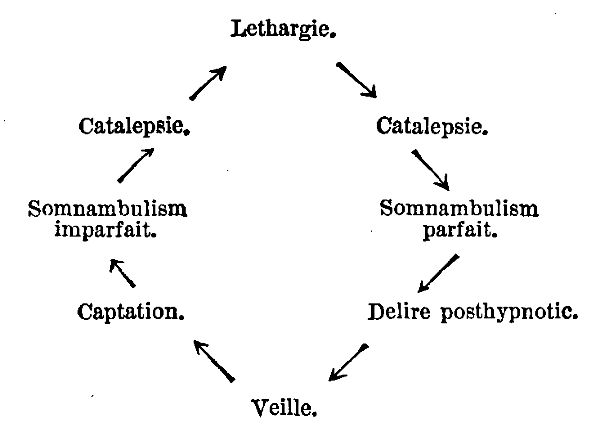
This whole movement, which I have tried to sketch, and whose chief peculiarity is that it considers hypnotism a nervous malady, and one that must be treated clinically and nosographically, was opposed in 1880 in two directions—one source of opposition producing great results, while the other fell to the ground. The latter joined itself to the theory of the mesmerists, and tried, by means of exact experiments, to measure the fluid emanating from the human body—an undertaking which gave slight promise of any satisfactory result.
Baillif in his thesis (1878) and Chevillard in his (for spiritualists) very interesting books, tried, by means of various arguments, to uphold the fluidic explanation. Despine also thought that by its help he had been able to explain the phenomena; but it was Baréty who, in the year 1881, first turned general attention in this direction. According to him, mankind possesses a nerve force which emanates from him in different kinds of streams. Those coming from the eyes and fingers produce insensibility to pain, while those generated by the breath cause hypnotic conditions. This nerve force goes out into the ether, and there obeys the laws that govern light, being broken into spectra, etc.
Claude Perronnet has more lately advanced similar views, and his greatest work is now in press. Frederick W.H. Myers and Edmund Gurney sympathize with these views, and try to unite them with the mesmerist doctrine of personal influence and their theory of telepathy. The third champion in England of hypnotism, Prof. Hack Tuke, on the contrary, sympathizes entirely with the Parisian school, only differing from them in that he has experimented with satisfactory results upon healthy subjects. In France this view has lately been accepted by Dr. Bottey, who recognizes the three hypnotic stages in healthy persons, but has observed other phenomena in them, and vehemently opposes the conception of hypnotism as a malady. His excellently written book is particularly commended to those who wish to experiment in the same manner as the French investigator, without using hysterical subjects.
The second counter current that opposed itself to the French neuropathologists, and produced the most lasting impression, is expressed by the magic word "suggestion." A generation ago, Dr. Liebault, the patient investigator and skillful physician, had endeavored to make a remedial use of suggestion in his clinic at Nancy. Charles Richet and others have since referred to it, but Professor Bernheim was the first one to demonstrate its full significance in the realm of hypnotism. According to him, suggestion—that is, the influence of any idea, whether received through the senses or in a hypersensible manner (suggestion mentale)—is the key to all hypnotic phenomena. He has not been able in a single case to verify the bodily phenomena of grandehypnotisme without finding suggestion the primary cause, and on this account denies the truth of the asserted physical causes. Bernheim says that when the intense expectance of the subject has produced a compliant condition, a peculiar capacity is developed to change the idea that has been received into an action as well as a great acuteness of acceptation, which together will produce all those phenomena that we should call by the name of "pathological sleep," since they are only separable in a gradual way from the ordinary sleep and dream conditions. Bernheim is particularly strenuous that psychology should appear in the foreground of hypnotism, and on this point has been strongly upheld by men like Professors Beaunis and Richet.
The possibility of suggestion in waking conditions, and also a long time after the sleep has passed off (suggestions posthypnotiques ou suggestions a (longue) echeance), as well as the remarkable capacity of subjects to change their personality (changement de la personnalite objectivation des types), have been made the subject of careful investigation. The voluntary production of bleeding and stigmata through spiritual influence has been asserted, particularly by Messrs. Tocachon, Bourru, and Burot. The judicial significance of suggestion has been discussed by Professor Liegeois and Dr. Ladame. Professor Pitres in Bordeaux is one of the suggestionists, though differing in many points from the Nancy school.
This whole tendency brings into prominence the psychical influence, while it denies the production of these results from purely physical phenomena, endeavoring to explain them in a different manner. These explanations carry us into two realms, the first of which has been lately opened, and at present seems to abound more in enigmas than in solutions.
Metallotherapie, which was called into existence by Dr. Burg, and further extended by Dr. Gellé, contains a special point of interest—the so-called transference in the case of hysterically or hypnotically affected persons. Transference is caused by electro-magnetism, which has this peculiarity—that in the case of specially sensitive persons it can transfer the bodily affection from left to right, and vice versa. The transference of paralysis, the cures attempted on this plan, and the so-called "psychical transference," which contains special interest for graphologists, are at the present time still open questions, as well as the closely connected theory of human polarity; and the odic experiments of Dr. Chazarain are yet waiting for their confirmation. At present the problem of the connection between magnetism and hypnotism is under investigation, and in such a manner that we may hope for a speedy solution.
Still stranger than these reports are the accounts of the distant operation of certain bodies; at least, they seem strange to those unacquainted with psychometry and the literature of the past century relating to this subject. Two physicians in Rochefort, Professors Bourru and Burot, in treating a hystero-epileptic person, found that gold, even when at a distance of fifteen centimeters, produced in him a feeling of unbearable heat. They continued these experiments with great care, and, after a number of trials, came to this conclusion—that in some persons certain substances, even when carefully separated from them by long distance, exercise exactly the same physiological influence as if introduced into their organism. In order to explain these phenomena, they refer to the radiating force of Baréty, an explanation neither satisfactory to themselves nor to others. Lately the distinguished Parisian physician, Dr. Luys, has confirmed by his experiments the existence of these phenomena, but he thinks the explanation referable to hyper-sensitiveness of the "regions emotives et intellectuelles de l'encephale" yet even he has not reached the kernel of the difficulty.
In close connection with action at a distance is the question of distant production of hypnotic sleep. For an answer to this problem, they are experimenting in both France and England; and Frederick W.H. Myers has thrown an entirely new light upon the subject by the investigations he is making upon a purely experimental basis. In Italy they have limited themselves to the study of isolated cases of hystero-hypnotism, except as the phenomena of magnetic fascination investigated by Donato have given rise to further research; but all the books I have seen upon this subject, as well as many by French authors, suffer from ignorance of the latest English discoveries.
With this I think that I have given a slight outline of the history of hypnotic investigation to the end of the year 1886. I shall attempt a criticism of this whole movement at some other time, as space is not afforded to me here; but I should like to make this statement now, that two of the characteristic indications of this period are of the gravest import—first the method ("Our work," says Richet, "is that of strictly scientific testing, observation, and arrangement"); and, secondly, the result. Hypnotism has been received into the realm of scientific investigation, and with this the foundation of a true experimental psychology has been laid.
MAX DESSOIR.