THE DETERMINATION OF NITRIC ACID BY THE ABSORPTION OF NITRIC OXIDE IN A STANDARD SOLUTION OF PERMANGANATE OF POTASSIUM.
Reading edition
By H.N. MORSE and A.F. LINN.
The method which we propose consists in the conversion of the nitric acid into nitric oxide; the absorption of the latter in a measured, but excessive, quantity of a standard solution of permanganate of potassium; and the subsequent determination of the excess of the permanganate by means of a standard solution of oxalic acid or sulphate of manganese.
THE APPARATUS.
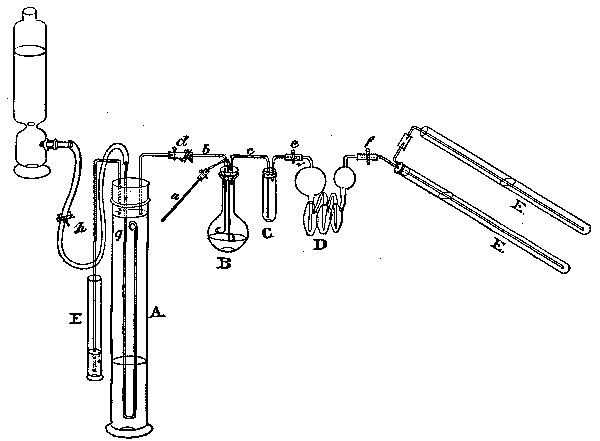
A is an apparatus for the generation of carbon dioxide free from air, which will be explained hereafter.
B is a flask, having a capacity of 125 or 150 c.c., in which the nitrate is decomposed in the usual manner by means of ferrous chloride and hydrochloric acid.
C is a small tube for the condensation of the aqueous hydrochloric acid which distills over from B.
D is a Geissler bulb, containing a concentrated solution of potassium carbonate, to arrest any acid vapors coming from C.
E, E are two pieces of ordinary combustion tubing, having a length of about 650 or 700 mm., in which is placed the permanganate solution employed for the absorption of the nitric oxide. Their open ends are provided with lips in order to facilitate the pouring of liquids from them, care being taken not to so distort the ends that rubber stoppers cannot be made to fit them tightly. They are placed in a nearly horizontal position in order to diminish the pressure required to force the gases through the apparatus and thus lessen the danger of leakage through the rubber joints.
a is a tube through which the ferrous chloride and hydrochloric acid are introduced into B, as in the method of Tiemann-Schulze.
b serves for the introduction of carbon dioxide to expel the air before the decomposition of the nitrate, and the nitric oxide afterward.
c is an unbroken tube ending at the lower surface of the stopper in B, and at the bottom of C.
The rubber joint, d, is furnished with a Mohr and also a screw pinch cock. The joints, e and f, are furnished with Mohr pinch cocks. The rubber tubing upon these should be of the best quality, and must be carefully tied.
DETERMINATION OF NITRIC ACID.
THE SOLUTIONS.
In consequence of the large volume of the permanganate solution required for the complete absorption of the nitric oxide, we have found it advantageous to use three solutions instead of two.
1. A solution of permanganate such that one c.c. is equivalent to about fifteen milligrammes of nitrate of potassium, according to the reaction:
KMnO4 + NO = KNO3 + MnO2.
This solution is employed for the absorption of the nitric oxide. Its strength need not be exactly known. There is no objection to a more concentrated solution, except that which pertains to all strong standard solutions, namely, that a small error in measurement would then give a larger error in the results. 100 c.c. of this solution are required for each determination, and the measurement is always made in one and the same 100 c.c. measuring flask, which, if necessary, should be labeled to distinguish it from that used for solution No. 2.
2. A solution of oxalic acid which is very slightly stronger than that of the permanganate just described—that is, a solution such that one c.c. of it will somewhat more than decompose one c.c. of the permanganate, according to the reaction:
2KMnO4 + 3H2SO4 + 5C2H2O4.2H2O = K2SO4 + 2MnSO4 + 18H2O + 10CO2.
The exact strength of this solution need not be known, since we only require the difference in value between it and solution No. 1, which is determined by means of solution No. 3. 100 c.c. of this solution are also required for each determination, and the measurement, as in the preceding case, is always made in the same 100 c.c. measuring flask.
3. A dilute, carefully standardized solution of permanganate of potassium.
The method of using these solutions is as follows: 100 c.c. of No. 1 and No. 2 are measured off (each solution in its own measuring flask), brought together in a covered beaker glass, and acidified with dilute sulphuric acid. The excess of oxalic acid is then determined by means of solution No. 3.
When it is desired to make a determination of nitric acid, 100 c.c. of solution No. 1 are measured off, and as much of it as may be convenient is poured into the tubes, E, E, together with about a gramme of zinc sulphate for each tube, which substance appears to considerably facilitate the absorption of the nitric oxide by the permanganate. When the operation is over, the contents of E, E are poured into a beaker glass. 100 c.c. of solution No. 2 are then measured off, and a portion, together with a little sulphuric acid, poured into E, E, to dissolve the oxide of manganese which has separated during the absorption of the nitric oxide. The oxide having been dissolved, the liquid in E, E, and the rinsings of the tubes, also the residues of permanganate and oxalic acid left in the measuring flasks, and the rinsings from these, are all brought together in the same beaker glass. Finally, the amount of solution No. 3 required to decompose the excess of oxalic acid is determined. If we subtract from the amount thus found the quantity of permanganate required to equalize solutions Nos. 1 and 2 (previously ascertained), we shall have the amount of permanganate actually reduced by the nitric oxide, according to the reaction:
6KMnO4 + 10NO = 3K2O + 6MnO + 5N2O5;
in other words, on the basis that one molecule of potassium permanganate will oxidize one and two-thirds molecules of nitric oxide:
(KMnO4 = 1-2/3 NO).
The method of using the apparatus is simple. The nitrate is placed in B, and the joints made tight, except that at f, which is left open. A current of carbon dioxide is passed through the apparatus until all of the air has been displaced. Connection is then made at f, and soon afterward the current of carbon dioxide is shut off at d.
The flask, B, is now heated as long as may be necessary in order to produce, on cooling, the diminished pressure required for the introduction of the ferrous chloride and hydrochloric acid. Before removing the flame, the joint at f is closed to prevent the return of the permanganate solution.
As soon as the flask, B, has become sufficiently cool, the ferrous chloride and hydrochloric acid are introduced through the tube, a (which has been full of water from the first), in the same manner and quantities as in the well-known Tiemann-Schulze method.
The pinch cock at d is then opened, and the apparatus allowed to fill with carbon dioxide. When the pressure has become sufficient to force the gas through the solution of permanganate, the pinch cock at f is removed. It should be opened only slightly and with great caution at first, unless one is certain that the pressure is sufficient. If the pressure is insufficient, the fact will be made apparent by a rise of the permanganate in the small internal tube.
The flow of carbon dioxide is now reduced to a very slow current, or entirely cut off. The contents of B are slowly heated, until the decomposition of the nitrate is complete and the greater part of the nitric oxide has been expelled, when the apparatus is again closed at f and d, and allowed to cool. The tube, a, is then washed out, by the introduction through it into B of a few cubic centimeters of strong hydrochloric acid.
The process of filling the apparatus with carbon dioxide, and of heating the contents of B, is repeated. When it becomes apparent, from the light color of the liquid in B, that all of the nitric oxide has been expelled from it, the current of carbon dioxide is increased and the heating discontinued. Care must be taken, however, not to admit too strong a current of carbon dioxide, lest some of the nitric oxide should be forced unabsorbed through the permanganate solution. It is also necessary, for the same reason, to avoid too rapid heating during the decomposition of the nitrate.
When all of the nitric oxide has been forced into the solution of permanganate, the determination is made in the manner already described.
To test the method, nine determinations were made with quantities of pure nitrate of potassium varying from 100 to 200 milligrammes. The maximum difference between the volumes of permanganate actually used and those calculated was 0.05 c.c., while the main difference was 0.036 c.c. The measurements of the permanganate were made from a burette which had been carefully calibrated. We also made a number of determinations, using a solution of manganous sulphate in the place of the oxalic acid. The advantage of this method lies in the fact that it is not necessary to dissolve the oxide which is precipitated upon the glass within the tubes, E, E, since, in the presence of an excess of permanganate, the reduction by nitric oxide extends only to the formation of MnO2; also in the fact that the solution of manganous sulphate is more stable than that of oxalic acid. A solution of the sulphate having been once carefully standardized, can be used for a long time to determine the value of permanganate solutions.
The details of the method are as follows: A solution of manganous sulphate slightly stronger than No. 1 is prepared.
The difference between 100 c.c. of it and 100 c.c. of No. 1 is ascertained, according to the method of Volhard, by means of solution No. 3.
The contents of E, E, together with the rinsings from the tubes, are poured into a capacious flask. 100 c.c. of the manganous sulphate and a few drops of nitric acid are then added, and the whole boiled. Finally, the excess of manganous sulphate is determined, in the manner described by Volhard, by means of solution No. 3. Subtracting from the total amount of permanganate thus used the quantity required to equalize the 100 c.c. of solution No. 1 and the 100 c.c. of the manganous sulphate, we shall have the quantity of permanganate reduced by the nitric oxide.
It must, however, be remembered that the value of solution No. 3 is now to be calculated on the basis of the equation KMnO2 + NO = KNO3 + MnO2. One molecule of permanganate equals one molecule of nitric oxide when manganous sulphate is used, since no part of the permanganate employed in this method is reduced below the superoxide condition. In other words, solution No. 3 now represents only three-fifths as much nitric acid as it does when oxalic acid is used.
The results obtained by this method were moderately satisfactory, but not quite so exact as those obtained when oxalic acid was used. A series of four determinations gave differences, between the volumes of permanganate calculated and used, of 0.05 to 0.15 c.c.
The principal objection to the method lies in the difficulty of determining, in the presence of the brown oxide of manganese, the exact point at which the oxidation is complete.
The carbon dioxide generator, A, was devised by us to take the place of the ordinary generators, in which marble is used. We have found that a submersion of twenty hours in boiling water does not suffice to completely remove the air which, as is well known, is contained in ordinary marble; hence some other substance must be employed as a source of the gas. In the apparatus which we are about to describe, the acid carbonate of sodium is used.
It consists of a long, narrow cylinder (450 x 60 mm.); a tightly fitting rubber stopper, through which three tubes pass, as shown in the figure; a small cylinder, F, containing mercury; and a sulphuric acid reservoir, G.
The tube, g, is drawn out to a fine point at the end and curved, so that the acid which is delivered into A falls upon and runs down the outside of the tube. The tube, h, dips under the mercury in F. G and g are connected by means of a long piece of rubber tubing which is supplied with a screw pinch cock.
The apparatus is made to give any required pressure by raising or lowering G and F; but the elevation of G, as compared with that of F, should always be such that the gas will force its way through h rather than g. The upper part of the cylinder, F, is filled with cotton wool to prevent loss of mercury by spattering.
The material placed in A consists of a saturated solution of acid carbonate of sodium, to which an excess of the solid salt has been added. The sulphuric acid is the ordinary dilute. The apparatus, if properly regulated, serves its purpose very well. The principal precaution to be observed in using it is to avoid a too sudden relieving of the pressure, which would, of course, result in the introduction of an unnecessarily large quantity of sulphuric acid into A.