ATLANTIC STEAMERS.1
Reading edition
ATLANTIC STEAMERS.1
By W. JOHN.
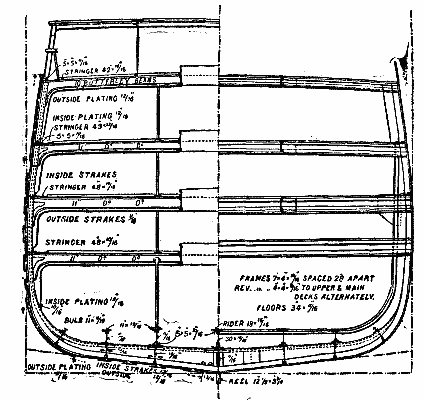
Fig. 1—CITY OF ROME.
The author said that he hoped to bring before the meeting impartially certain facts which might be of interest, and which, when recorded in the pages of the "Transactions," might be found of some use as data for future reference. In dealing with passenger steamers, he would do so principally from a shipbuilder's point of view; but the moment he commenced to think over Atlantic passenger ships as a shipbuilder, he was met by the question whether the present tendency toward divorcing the passenger and cargo trade from each other is likely to continue or not. If the answer is yes, then it seems to become an important question, for the present at least, how to build, on moderately small dimensions, the fastest, safest, and most economical passenger steamer, using all the most modern improvements to make her commodious and luxurious, and an easy sea boat into the bargain. If cargo is still to be carried in the passenger ships of the future, a moderate speed only will be aimed at in the immediate future, and every effort will be devoted to economy of fuel, comfort, and safety, with a fair carrying capacity. This latter policy is one which may possibly prevail at least for a time, as it has powerful supporters in Liverpool; but he could not help thinking that very high speeds—higher than we have yet attained—must eventually gain the day. He also thought that they were on the eve of important movements, which will indicate what the next step in the passenger trade is to be; for it must be remembered, among other things, that none of our present English transatlantic liners, even the latest, have yet been fitted with the latest modern improvements for economy of fuel or quick combustion, such as triple expansion engines or forced draught. They must, therefore, be at some disadvantage, other things being equal, compared with the ships of the future possessing them. The Great Eastern steaming up Milford Haven about twenty-five years ago between two lines of the channel fleet of old—two and three decked wooden line-of-battle ships—the whole fleet saluting with yards manned, was a sight to be remembered. More than this, that ship, with all her mournful career, has been a useful lesson and a useful warning to all naval architects who seriously study their profession—a lesson of what can be done in the safe construction of huge floating structures, and a warning that the highest flights of constructive genius may prove abortive if not strictly subordinated to the practical conditions and commercial requirements of the times. The Sirius and Great Western crossed the Atlantic in 1838, and in 1840 the first ship of the since celebrated Cunard Company made her first voyage. This was the Britannia, which, with her sister ships, the Arcadia, Caledonia, and Columbia, kept up the mail service regularly at a speed of about 8½ knots an hour. The Britannia was 207 ft. in length between perpendiculars, and 34 ft. 4 in. extreme breadth, 22 ft. 6 in. depth of hold, 423 horse power—nominal—and 1,153 tons burden, built of wood, and propelled by paddles. In 1860 the Collins Line started in opposition to the Cunard, and, after a series of disasters, collapsed in 1858. This was three years after the Persia, the first Cunarder built of iron, had been completed. In 1850, also, the Inman Line was started with the City of Glasgow, of 1,600 tons builders' measurement, and 350 horse power. She was built of iron, and was the first screw steamer sent across the Atlantic from Liverpool with passengers, and was the pioneer of the great emigrant trade which Mr. Inman, above all others, did so much to develop and make cheap and comfortable for the emigrants themselves, as well as profitable to his company. That the builders of the celebrated old Great Britain, in 1843, and Mr. Inman, in 1850, should have pronounced so decisively in favor of the screw propeller in preference to the paddle for ocean steaming is a proof of their true practical judgment, which time and practical experience have made abundantly clear. While the Cunard Company went on developing its fleet from the early wood paddle steamer Britannia of 1,130 tons in 1840 to the iron paddle steamers Persia, etc., in 1858, the iron screw steamer China of 1862, to the still more important screw steamers Bothnia and Scythia, vessels of 4,335 tons, in 1874, the Inman and other lines were as rapidly developing in speed and size, if not in numbers. The year 1874 is memorable, for it saw the White Star steamers Britannic and Germanic put into the water, as well as the Inman steamer City of Berlin and the two before mentioned Cunard steamers, Bothnia and Scythia. By the addition of these two ships to their fleet the White Star Line, although started only in 1870, reached a front rank position in the New York passenger trade. The author gave in separate tables the logs of several of these ships, some from published documents and some kindly furnished by the owners. The Great Western had crossed the Atlantic from Bristol to New York in 15 days as early as 1838. The first Cunard steamer, the Britannic, was about the same speed, from 8¼ to 8½ knots an hour. The average duration of the Cunard voyages in the year 1856 was 12.67 days from Liverpool to New York, and 11.03 days from New York to Liverpool. The Bothnia, in 1874, reduced the passage to about nine days. The White Star Britannic, in 1876, averaged 7 days 18 hours 26 minutes outward from Queenstown to New York, and 9 days 6 hours 44 minutes homeward, and has averaged for the last ten years 8 days 9 hours 36 minutes outward, and 8 days 1 hour 48 minutes homeward. The City of Berlin, of the Inman Line, also built in 1874, 8 days 10 hours 56 minutes, and homeward 8 days 2 hours 37 minutes; and for the nine years from 1875 to 1883 inclusive, averaged outward 8 days 19 hours 56 seconds, and inward 8 days 8 hours 34 seconds; or, putting it into rounder figures, the Britannic had reduced the average passage between the two points to 8¼ days, and the City of Berlin to 8½ days. From the year 1874 on to 1879 no further advance was made in Atlantic steaming, but in that year the Arizona was added to the Guion Line, and it soon became evident that another important stride had been made in the Atlantic passenger trade, which would lead to most important results. The results, as we all know, have been sufficiently startling. The Guion Line, which had started in 1866 with the Manhattan, had now the fastest passenger ship on the Atlantic. In spite of burning some fifty per cent. more coal than the Britannic, the ship was an obvious commercial success. The spirited policy which brought her into existence was appreciated by the public, and the other lines had to move forward. Then followed a period of rivalry, the Cunard Company building the Gallia and Servia, the Inman Company the City of Rome, and the Guion Line the Alaska, all of which were completed in 1881, and afterward the Oregon for the Guion Line—1883—the Aurania the same year for the Cunard Company, and, later still, the America for the National Line, and the Umbria and Etruria for the Cunard Company in 1885.
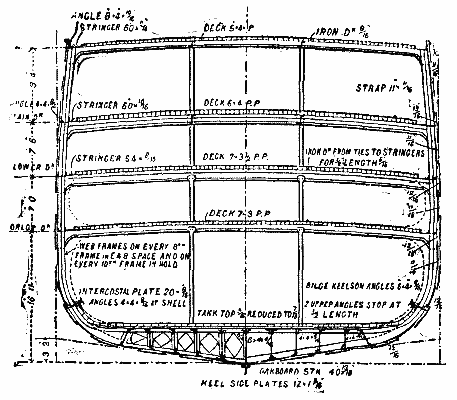
Frames from outer edge of Tank to Upper Deck, 7 × 3½ × 8/16 for 250 ft. Amidships, for 60 ft. before and abaft these Points 6½ × 3½ × 6/16 at end of Vessel 5 × 3½ × 7/16, all spaced 24 in. apart and all carried to Upper Deck, double from Bilge to Bilge in way of Engines.—Frames in Tank on Lattice and Solid Floors, 5 × 3½ × 8/16, Intermediate Frames, 8 × 4 × 9/16—Rev: Frames, 4½ × 3½ × 8/16, carried to Upper and Main Deck alternately double, 4½ × 4½ × 8/16 from Bilge to Bilge in E and B space. Fig. 2—SERVIA.
Since the completion of the Etruria, for various reasons there has been a pause in the tremendous strides made since 1879, and we may briefly review the results. Taking the Britannic as a standard with her ten years' average of 8¼ days across, and her quickest passage of 7 days 10 hours 53 seconds, we have now the following steamers of higher speeds. Taking them in the order of their absolutely fastest passage out or home, they stand thus:
TABLE I.
Days.Hours.Mins.
1Etruria.6531
2Umbria (sister ship).slightly longer.
3Oregon.61035
4America.61344
5City of Rome.6180
6Alaska.61837
7Servia.62355
8Aurania.711
It will thus be seen that from the 15 days' passage or thereabout, of the earliest Atlantic steamers, we had got down in the days of the Scotia to about 9 days; in the Britannic to 8¼ days, and, at the present time, we have got to 6¼ days, with seven ships afloat that have done the passage under seven days, and capable of making their average passages range between 6½ and 7¼ days.
Ranged in order of gross tonnage, these eight vessels stand as follows:
TABLE II.
1. City of Rome.8,144
2. Oregon.7,375
3. Aurania.7,269
4. Servia.7,212
5. Umbria.7,129
6. Etruria.7,100
7. Alaska.6,586
8. America.5,528
Here the America shows to advantage, for while being eighth in size she is fourth in point of speed, and from what the author can learn, although he had no authenticated details on the subject, he believed she is economical in coal consumption. He might perhaps be permitted to say that one of the most difficult subjects in connection with the propulsion of ships on which to get absolutely accurate data is that of coal consumption. The records of six to eight hours' trials for the purpose of ascertaining the coal consumption are absolutely worthless, as all shipbuilders and engineers know, and so far as English ships are concerned they are never attempted. Foreign owners frequently stipulate for such trials in their contracts with English shipbuilders, and get wonderfully economical results on paper, but the fact that the trials only extend over a few hours renders them valueless, however carefully the coal may be weighed during that period. An authentic record of the absolute quantity of coal consumed, say by each of the eight fastest Atlantic liners, together with their average indicated horse power on the voyage, for a series of voyages, would be extremely valuable.
He gave, in Table III., the consumption per indicated horse power per hour for a number of ships. This table affords valuable data, for it gives, in addition to the dimensions, the moulded draught of water, the midship area, the displacement, the indicated horse power, the speed on trial, the coefficients for the lines both from the block or parallelopipedon, and also from the midship section prism, together with the length and angle of entrance obtained by Kirk's rule, the Admiralty displacement coefficient, together with the coal consumption per day and per indicated horse power per hour.
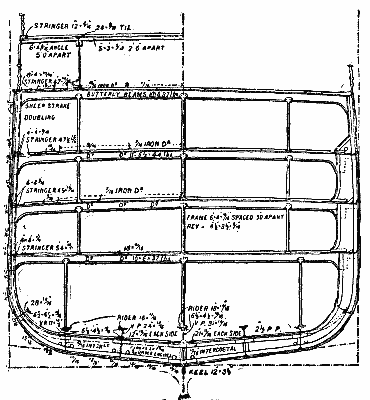
Fig. 3—OREGON.
This table, as will be seen, contains some of the most important of the Atlantic liners, and also a number of other typical ships, which will add a variety to its interest and a value to it. The coefficient, which is contained in the thirteenth column of the table, viz.:
Dis 2/3 × speed³
——————————
I.H.P. ×√(entrance.) 10
generally comes out for ships of similar type more nearly a constant in the true sense of the word than the corresponding Admiralty constant. As an example, we have the curves of resistance and horse power for the City of Rome and the Normandie, a large vessel of 6,000 tons, which the Barrow Company built for the Compagnie Generale Transatlantique, in which the coefficient of fineness and the form of the lines pretty closely resemble each other below water; and if we take from the curves the corresponding speeds and horse powers, and work out the constants by the two systems, we have at 14 knots the Admiralty constant for the City of Rome 322.2, and for the Normandie 304.8; and taking for a modified form of constant, the City of Rome gives 253.7 and the Normandie 251.9, which, as will be seen, are much closer together. Similarly, at 15 knots the Admiralty constant for the City of Rome is 310, and for the Normandie 295.2, while a modified constant comes out for the former at 245, and for the latter 244, again agreeing almost identically. The same at 16 knots, for the City of Rome the Admiralty constant comes out 297.6, and for the Normandie 282.8, while a modified constant comes out for the two ships 234.4 and 233.7 respectively, again showing marked agreement. It may be mentioned that in these two ships the engines are of a similar type, being three-crank tandem engines, and the propellers have in both pitch and surface practically the same proportions to the power and speed. The value of these modified constants will probably be found to increase as the speeds increase up to the limit and beyond that point at which wave resistance becomes an important factor.
TABLE III.
Name Length Breadth Moulded draught Midship area Dist. Indicated H.P. Speed Block coefficient Midship section coefficient Prismatic midship section coefficient D2/ 3 × S3 I.H.P. D2/ 3 × S3 I.H.P. × √ent. Kirk's system Coal consumption Cylinders Boilers Working Pressure
Length of entrance Angle Per day Per I.H.P. Diameter Stroke Heating surface Bar surface
ft. in. ft. in. ft. in. Ins. Ins. Lbs.
City of Rome 542 6 52 0 21 5½ 1031 11,230 11,890 18.235 .649 .925 .702 255 201.3 161.27 8° 29' 185 2.2 {3 @ 46 } {3 @ 86 } 72 29,286 1398 90
Normandie 459 4 49 11 19 9¾ 892 7,975 6,959 16.66 .614 .901 .681 265 219.5 146.41 8° 44' 148 2 {3 @ 35 7/16} {3 @ 74 7/8} 67 21,404 756 85.2
Furnessia 445 0 44 6 22 2½ 893 8,578 4,045 1 14 .682 .903 .755 284 273 108.7 10° 28' 97 2.2 49-100 66 10,396 440 90
Arizona 450 0 45 1½ 18 9 758 6,415 6,300 17 .589 .895 .658 269.2 217 153.79 7° 30' — — {1 @ 62 } {2 @ 90 } 66 — — 90
Orient 445 0 46 0 21 4½ 904 7,770 5,433 15.538 .621 .919 .676 270.8 225 144.17 8° 21' — — {1 @ 60 } {2 @ 85 } 60 — — 75
Stirling Castle 420 0 50 0 22 3 990 7,600 8,396 18.4 .569 .889 .639 286.8 233.7 151.3 8° 22' — — {1 @ 62 } {2 @ 90 } 66 21,161 787 100
Elbe 420 0 44 9 20 0 807 6,350 5,665 16.571 .591 .901 .655 275.5 229 144.6 7° 56' — — {1 @ 60 } {2 @ 85 } 60 — — —
Pembroke Castle 400 0 42 0 17 0 648 5,130 2,435.8 13.25 .623 .623 .692 284 258 122.9 8° 49' 44 1.7 43 and 86 57 7,896 288 99
Umbria and Etruria 500 0 57 0 22 6 1090 9,860 14,321 20.18 .538 .896 .637 260 191.8 184 6° 52' 315 2.1 {1 @ 71 } {2 @ 105 } 72 38,817 1606 110
Aurania 470 0 57 0 20 0 1020 8,800 8,500 1 17.5 .575 .942 .632 266 204.6 170 8° 38' 215 2.2 {1 @ 68 } {2 @ 91 } 72 23,284 1001 —
America 441 8 51 3 — — 6,500 — 1 17.8 — — — — — — — 185 — {1 @ 63 } {2 @ 91 } 66 — 882 —
Oregon 501 0 54 2 23 8 1150 11,000 13,300 18.3 .599 .849 .67 227.9 190 164.3 9° 39' 310 2.2 {1 @ 70 } {2 @ 104 } 72 38,047 1428 110
Servia 515 0 52 0 23 3½ 1046 10,960 10,300 1 16.9 .610 .862 .71 231 192 145.3 10° 42' 205 2 {1 @ 72 } {2 @ 100 } 78 27,483 1014 —
Scotia, P.S. 369 0 47 6 19 9 867 6,000 4,632 1 14.31 .605 .92 .65 208.9 186 126.8 13° 21' 168 3.4 — — — —
Alaska 500 0 50 0 21 0 949 9,210 — — .614 .904 .679 — — 160.23 8° 2' — — {1 @ 68 } {2 @ 100 } 72 — — 100
Aller 438 0 48 0 21 0 907 7,447 7,974 17.9 .590 .899 .656 277 225 150.6 8° 10' — — {1 @ 44 } {1 @ 70} {1 @ 100 } 72 22,630 799 150
Ems 430 0 46 10 20 7½ 877 7,030 7,251 17.55 .593 .907 .652 273 223 149.4 8° 40' — — {1 @ 62 } {2 @ 86 } 60 19,700 780 100
1 Mean speed of a voyage across the Atlantic Ocean.
The author next considered the strains to which a ship is exposed, and stated that he had before him the calculations for three of the largest vessels, two of them of iron and the other of steel; and he found, in the case of the iron, the maximum tension on the gunwale during the greatest hogging strains likely to be endured at sea would not exceed about six tons per square inch, while in the case of the steel ship it is only about 6½ tons. These strains are well within the limits of safety, and a comparison of the scantlings of these with the others justifies the assertion as to their general safety from a structural point of view. The sections of these three ships are shown in Figs. 1, 2, and 3, with their principal scantlings. It will be seen from these sections that the three ships differ materially in their mode of construction. In the case of Fig. 1, which represents the City of Rome, the largest of the three, it will be seen that the main framing of the vessel is entirely transverse, with very heavy keelsons in the bottom, and large partial bulkheads or web frames, and the outside plating arranged on what is termed the edge to edge principle, with a great portion of it double. In the next section, Fig. 2, the Servia, which is built of steel, on the other hand, the bottom is built on the longitudinal cellular system, the first application, he believed, of this system to an Atlantic liner. The plating of the Servia is of the usual alternate outer and inner strake system, partly double; while the third section, the Oregon, approaches more nearly to the ordinary system of framing and plating usually adopted, but it will be seen that she was well tied in the bottom by very heavy intercostal and plate keelsons, as well as in the top by heavy stringers and sheer strakes, with much of her plating doubled, and heavy web frames inside. The author next considered the question of stability, and went on to deal with the subject of twin screws, and stated that the Barrow Shipbuilding Company has done more in the way of planning and designing for the adoption of twin screws lately than for any other mode of propulsion, and this chiefly for passenger steamers. He did not attach much importance to the particular form of the blade either in single or twin screws, as he believed so long as the disk area, the surface, and pitch were properly adjusted to the speed of the vessel, and to enable the engines to use, at the maximum speed, just the full quantity of steam that the boilers can make, we have got pretty nearly as far as we can get. To fix these dimensions of the propeller accurately at the present time, and without further knowledge of the action of the screw on the water, was, he thought, impossible. All the rules and formulæ are empirical. The best one he knew is given in Table IV., due to Mr. Thom, the head of the Barrow Company's engineering drawing office, and at present acting manager, who has used it for some years in practice. These formulæ are based upon the assumption that the area of propeller disk should be proportional to the indicated horse power, divided by the cube of the speed, and the same with the projected area of the propeller and also the surface.
TABLE IV.
Particulars of Propellers and Constants.
Ship.Length of ship.Disk constant.Proj. surf. constantFeet per minute. Speed of tips.
City of Rome.542220694,715
Normandie459250664,099
Furnessia445223693,654
Eden300211643,080
Yorouba270213633,202
Taygete260238563,166
Kow-shing250171693,369
S.Y. Monarch152221654,040
S.Y. Aries138179562,986
Twin screw Fenella200244642,890
Twin screw H.M.S. Fearless1220277675,022
Twin screw H.M.S. Iris2300412221——
Twin screw H.M.S. Iris3300346994,961
Twin screw H.M.S. Iris4300439825,309
Disk constant = Area of propeller disk × speed of ship in knots.³ I.H.P.
Projected area of constants Projected area of propeller × speed of ships in knots.³ I.H.P.
Expanded area constants may be obtained and used in the same way.
The discussion which followed was opened by Mr. Holt. He said that if they were to have greater speed on the Atlantic, there was one point which was not alluded to in the paper, and that was the total abolition of cargo on board the great passenger steamers. If vessels were built solely for passenger traffic, they would be able to insure greater speed by reason of the greater slightness in build and the additional space at the command of the designer. The existing Atlantic express steamer was far too heavy, and might, if cargo was dispensed with, be made with finer lines and more yacht-like. He looked on the proposition to fit such vessels with longitudinal bulkheads with great fear. If a collision took place—such, for example, as that which sunk the Oregon—water would get access to one side only of the ship, and it was not at all improbable that if a sea was on, she would turn right over. At all events, very serious risk would be involved.
Mr. W.H. White, Chief Constructor to the Admiralty, said the question of twin screw propulsion was one of special interest to himself, and had been so for many years. In 1878 he dealt with it as fully as he then could on the basis of the Admiralty data, and he then ventured to say everything in favor of twin screws that Mr. John had said in his paper. If greater power than that now used in such a ship as the Etruria, for example, were demanded, two screws must be used. Good as are the results obtained with the Etruria, it was by no means certain that still better might not be had. If she had been fitted with two screws instead of one, very great advantage would be gained by the greater submergence of the twin screws, as thus racing would be almost wholly prevented.
Mr. Calvert urged that more attention should be devoted to studying the relative values of different portions of the propeller.
The sitting was then suspended. In the afternoon, as we have already stated, the members visited the steamship Germanic on the invitation of Messrs. Ismay, Imrie & Co., subsequently proceeding to Messrs. Cope Brothers' tobacco works, and thence to the exhibition, where the dinner of the Institution took place in the evening.
On Friday morning no paper was read; some official business was transacted, and this being done, the discussion on Mr. John's paper was resumed.
Mr. Biles remarked that there were many advantages in the use of twin screws which had not been sufficiently taken into account. When a ship with twin screws was being handled in dock there was greater maneuvering power, and therefore less liability for the ship to come in contact with the walls, although, if she did so, there would be greater probability of damage to the propellers. He thought means could be easily devised of protecting the screws when the ship was in dock. Another of the incidental advantages connected with twin screws was that smaller engines and smaller propellers were required, and therefore they might run them at a higher speed. They would also get lighter machinery with twin screws, and there would be less liability to have bad castings and forgings in the smaller engines, and of course the cost would be less.
With respect to the question of the middle line bulkheads, he could not quite agree with Mr. John as to the great advantages of them in a big passenger steamer. He thought there would be greater difficulty in managing a ship so built if she was in danger of sinking. Increased subdivision in a longitudinal direction was a very desirable thing, and almost necessary for a condition of immunity from sinking. In future Atlantic steamers longitudinal bulkheads should be placed not in the middle line, but nearer the sides of the ships, and they should recognize the fact that they had engines and boilers in different compartments, and make arrangements whereby the ship would still float, although the doors in these compartments were kept open. The proper way to arrive at that was to have a ship with great beam, and to have two longitudinal bulkheads at considerable distances from the sides of the ship, subdivided as completely as possible, both under and above water, so that, even supposing they got water into the space between one bulkhead and the side of the ship, they would have sufficient buoyancy in the other parts of the ship to keep her afloat. Broad ships must necessarily mean deep ships, in order to have comfort at sea. They were limited in length, and first came the question how many passengers they wanted to carry. The experience of a ship like the America—which was only 400 ft. in length—showed it was not necessary to go to great length to have great speed. A ship of 400 ft. to 430 ft. in length, 65 ft. of beam, and with a depth of 45 ft., would be a ship of proper dimensions for the Atlantic trade, and he believed it quite possible to build a vessel of special construction of about 7,000 tons gross register which should steam with less consumption of coal than the Umbria and Etruria at a rate of 22 knots, crossing the Atlantic from Liverpool to New York in six days. He thought that was likely to be the vessel of the future, and that it would be quite as commercially successful as the Umbria or Etruria.
Mr. J. Campbell remarked that at present the great American liners had only the ordinary compound engines, and he thought that, instead of converting them to triple expansion, they should take a step further at once, and adopt quadruple expansion engines. This class of engines was being very successfully built in various parts of the country. He should recommend the adoption of a three-crank six-cylinder engine.
Mr. Hamilton did not think it had been demonstrated that greater efficiency had been got out of twin screws than out of single screws; but there was no doubt they would tend to additional safety.
Mr. Martell said that when they had got satisfactory data, twin screws would be adopted for ships requiring great speed; but they had not got that data at present.
Admiral Sir John Hay, referring to twin screws as applying to sea-going steamers which might be employed for imperial defense, said it was quite certain that the defense of their extended commerce would always require to be assisted by ships such as the Oregon and other magnificent vessels which had been used for that purpose on a recent occasion. He believed that for war purposes the twin screw was recognized by all naval men as having very many advantages. If that were so, it was quite evident that it would be a great advantage, under such conditions as occurred at the loss of the Oregon, if the compartments could be made completely water-tight; and the twin screw, with the separation of the ship longitudinally, gave them the very greatest possible protection. They could not trust to bulkheads that were only closed occasionally by doors. What was required for war purposes was the entire and complete isolation of different parts of the ship, having always practically closed communications between them.
Mr. John then replied on the general discussion. He was pleased to find that they had faith in the future of the twin screw and of subdivision. The public had a right to demand greater safety than they at present had on the Atlantic, or could have with a single screw.
1
A paper recently read before the Institution of Naval Architects.