OPTICAL TELEGRAPHY.1
Reading edition
OPTICAL TELEGRAPHY.1
CRYPTOGRAPHY.—PRESERVATION OF TELEGRAMS.
Optical telegraphy, by reason of its very principle, presents both the advantage and inconvenience of leaving no automatic trace of the correspondence that it transmits. The advantage is very evident in cases in which an optical station falls into the hands of the enemy; on the other hand, the inconvenience is shown in cases where a badly transmitted or badly collated telegram allows an ambiguity to stand subject to dispute. Moreover, in case of warfare between civilized nations that have all the resources of science at their disposal, there may be reason to fear lest one of the enemy's optical stations substitute itself for the corresponding station, and take advantage of the situation to throw confusion into the orders transmitted. The remedy for this appears to reside in the use of cryptography and in the exchange, at various intervals, of certain words that have been agreed upon beforehand, and that the enemy is ignorant of.
As for the automatic preservation of telegrams, the problem has not been satisfactorily solved. It has been proposed to connect the key of the manipulator of the optical apparatus with the manipulator of an ordinary Morse apparatus, thus permitting the telegram to be preserved upon a band of paper. It is unnecessary to say that the space occupied by a dispatch thus transmitted would be considerable; but this is not what has stopped innovators. The principal objection resides in the increase in muscular work imposed by this arrangement upon the telegrapher. Obliged to keep his eye fixed intently at the receiving telescope, while at the same time maneuvering the manipulator and spelling aloud the words that he is receiving, the operator should have a very sensitive manipulator at his disposal, and not be submitted to mental or physical overtaxation. So the apparatus that have been devised have not met with much success.
Two French officers, working independently, have hit upon the same idea of receiving the indications transmitted by the vibration of the luminous fascicle directly upon their travel. The method consists in the use of that peculiar property of selenium of becoming a good conductor under the action of a luminous ray, while in darkness it totally prevents the passage of the electric current. Such modification of the physical properties of selenium, moreover, occurs without the perceptible development of any mechanical work. If, then, in the line of travel of the luminous fascicle emitted by the optical apparatus, or in a portion of such fascicle, we interpose a fragment of selenium connected with the two poles of a local pile, it is easy to see that the current from the latter will be opened or closed according as the luminous ray from the apparatus will or will not strike the selenium, and that the length of time during which the current passes will depend upon the length of the luminous attacks. A Morse apparatus interposed in this annexed circuit will therefore give an automatic inscription of the correspondence exchanged. Such is the principle. But, practically, very great difficulties present themselves, these being connected with the rapid weakening of the electric properties of the selenium, and with the necessity of having recourse to infinitely small mechanical actions only. The problem is nevertheless before us, and it is to be hoped that the perseverance of the scientists who are at work upon it will some day succeed in solving it.
Finally, we may call attention to the attempts made to receive the luminous impression upon a band prepared with gelatino-bromide of silver. In practice this band would unwind uniformly at the focus of the receiving telescope, which would be placed in a box, forming a camera obscura. The velocity of this band prepared for photographing the signals would be regulated by clockwork. The experiments that have been made have not given results that are absolutely satisfactory, by reason of the length of the signals received and the mechanical complication of the device.
OPTICAL TELEGRAPHY BY MEANS OF PROJECTORS.
Fig. 23.

The projectors employed for lighting to a distance the surroundings of a stronghold or of a ship have likewise been applied in optical telegraphy. For this purpose Messrs. Sautter, Lemonnier & Co. have added to their usual projecting apparatus some peculiar arrangements that permit of occultations of the luminous focus at proper intervals. Figs. 21 and 22 show the arrangement of the apparatus, the principle of which is as follows: When the axis of the projector points toward the clouds, and in the direction occupied by a corresponding station, the occultations of the luminous source placed in the focus of the apparatus produce upon the clouds, which act as a screen, an alternate series of flashes and extinctions. It is therefore possible with this arrangement, and by the use of the Morse alphabet, to establish an optical communication at a distance. The use of this projector (the principal inconvenience of which is that it requires a clouded sky) even permits two observers who are hidden from each other by the nature of the ground to easily communicate at a distance of 36 or 48 miles.
USE OF THE PROJECTOR IN OPTICAL TELEGRAPHY.
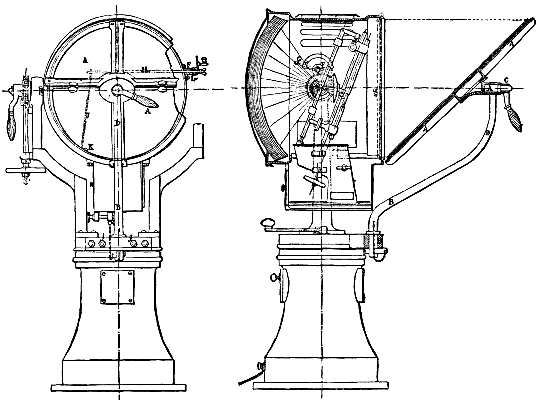
Figs. 21 and 22.—FRONT VIEW AND LONGITUDINAL SECTION OF THE MANGIN PROJECTOR. (Scale 1/15). A. Elliptical mirror. B. Arm of the same. C. Nut for fixing the mirror. D. Support of the mirror. E. Occultator. F. Support for same. G. Lever for maneuvering the occultator. I. Support of the occultator rod. J. Screw for fixing the mirror support. K. Screw for fixing the support of the occultator rod. L. Screw for fixing the occultator support.
The apparatus shown in Figs. 21 and 22 permits of signaling in three ways:
1. Upon the Clouds.—In this case the mirror, A, is removed, and the projector inclined above the horizon in such a way as to illuminate the clouds to as great a distance as possible. A maneuver of the occultator, E, between the lamp and the mirror arrests the luminous rays of the source, or allows them to pass, and thus produces upon the clouds the dots and dashes of the conventional alphabet.
2. Isolated Communication by Luminous Fascicles.—When it is desired to correspond to a short distance of 2 or 3 miles, and establish a communication between two isolated posts, the mirror, A, is put in place upon its support, B. The luminous fascicle emanating from the source reflected by the mirror is thrown vertically. By revolving the mirror 90° around its horizontal axis the fascicle becomes horizontal, and may thus be thrown in a given direction at unequal intervals and during irregular times, and furnish conventional signs.
3. Night Communication upon the Entire Horizon.—When we wish to correspond at a short distance, say two miles, and make signals visible from the entire horizon, the mirror, A, is put in place, so that it shall reflect the luminous fascicle vertically. The fascicle, at a distance of about fifty feet, meets a white balloon which it renders visible from every point in the horizon. The maneuver of the occultator brings the balloon out of darkness or plunges it thereinto again, and thus produces the signs necessary for aerial communication.
Fig. 24.

These ingenious arrangements, which depend upon the state of the atmosphere, do not appear to have been imitated outside of the navy.
CAPT. GAUMET'S OPTICAL TELEGRAPH.
The system of optical communication proposed by Capt. Gaumet, and which he names the Telelogue, is based upon the visibility of colored or luminous objects, and upon the possibility of piercing the opaque curtain formed by the atmosphere between the observer's eye and a signal, by utilizing the difference in brightness that exists between such objects and the atmosphere. It is a question, then, of giving such difference in intensity its maximum of brightness. To do this, Capt. Gaumet proposes to employ silvered signals upon a black background. He uses the simple letters of the alphabet, but changes their value. His apparatus has the form of a large album glued at the back to a sloping desk. Each silvered letter, glued to a piece of black cloth, is seen in relief upon the open register. A sort of index along the side, as in commercial blank-books, permits of quickly finding any letter at will. Such is the manipulator of the apparatus.
The receiver consists of a spy-glass affixed to the board that carries the register. For a range of two and a half miles, the complete apparatus, with a 12×16 inch manipulator and telescope, weighs but four and a half pounds. For double this range, with a 20×28 inch manipulator and telescope, the total weight is thirteen pounds. The larger apparatus, according to the inventor, have a range of seven miles.
For night work the manipulator is lighted either by one lamp, or by two lamps with reflector, placed laterally against it.
This apparatus, although well known, and having been publicly experimented with, has not, to our knowledge, been applied practically. From a military standpoint, its short range will evidently not permit it to compete with optical telegraphic apparatus, properly so called. Perhaps it might rather be of service for private communications between localities not very far apart, since it costs but little and is easily operated.
OPTICAL SIGNALING BETWEEN BODIES OF TROOPS.
Optical communications by signals, during day and night, with experienced men, may, in the absence of telephones, telegraphs, and messengers, render important service when the distance involved is greater than two thousand feet.
This mode of correspondence is based upon the use of the Morse alphabet. The signals are divided into night and day ones. The day signals are made with small flags. When these are wanting, sheets of white cardboard may be used. The night signals are made with a lantern provided with a support, which may be fixed to a wall or upon a bayonet.
In day signaling, the dashes of the Morse alphabet are formed by means of two flags (Fig. 23) held simultaneously at arm's length by the signaler. The dots are formed with a single flag held in the right hand (Fig. 24). In this way it is possible, by extremely simple combinations, to establish a correspondence, and produce any conventional signal. By means of relay stations, the signals may be transmitted from one to another to a great distance.
In signaling with the lantern, long and short interruptions of the luminous source are produced by means of a screen.
OPTICAL TELEGRAPHY BY LUMINOUS BALLOONS.
Various interesting experiments have been made with a view to utilizing luminous captive balloons for optical communications. As we have already seen, this maybe effected by using opaque balloons, and throwing upon them at unequal intervals a luminous fascicle by means of a projector. As for using a luminous source placed in the car of a balloon, that cannot be thought of in the present state of aeronautic science; the continual rotation of the balloon around its axis would render the projection and reception of the signals in a given direction impossible.
OPTICAL TELEGRAPHY IN THE MARINE.
For communicating optically from ship to ship during the day, the marine uses flags of different forms and colors, and flames. Between ships and the land there are used what are called semaphore signals, which are made by means of a mast provided with three arms and a disk placed at the upper part. The combinations of signs thus obtained, which are analogous in principle to those of the Chappe telegraph, permit of satisfactorily communicating to a distance.
On board ship, hand signals are used like those employed by the army for communicating between bodies of troops. For night communications the marine employs lights corresponding to the day flags, as well as rockets, and luminous rays projected by means of reflectors and intercepted by screens.
In conclusion, it may be said that optical telegraphy, which has only within a few years emerged from the domain of theory to enter that of practice, has taken a remarkable stride in the military art and in science. It is due to its processes that Col. Perrier has in recent years been enabled to carry out certain geodesic work that would have formerly been regarded as impracticable, notably the prolongation of the arc of the meridian between France and Spain. Very recently, an optical communication established between Mauritius and Reunion islands, to a distance of 129 miles, with 24 inch apparatus, proved that, in certain cases, the costly laying of a submarine cable may be replaced by the direct emission of a luminous ray.
[1]
Continued from page 8094.