EUTEXIA.1
Reading edition
EUTEXIA.1
By Thomas Turner, Assoc. R.S.M., F.C.S., Demonstrator of Chemistry, Mason College.
There are a number of interesting facts, some of which are known to most persons, and many of them have been long recognized, of which, however, it must be owned that the explanation is somewhat obscure, and the connections existing between them have been but recently pointed out. As an example of this, it is well known that salt water freezes at a lower temperature than fresh water, and hence sea-water may be quite liquid while rivers and ponds are covered with ice. Again, it is noticed that mixtures of salts often have a fusing-point lower than that of either of the constituent salts, and of this fact we often take advantage in fluxing operations. Further, it is well known that certain alloys can be prepared, the melting-points of which are lower than the melting-point of either of the constituent metals alone. Thus, while potassium melts at 62.5° C., and sodium at about 98°, an alloy of these metals is fluid at ordinary temperatures, and fusible metal melts below the temperature of boiling water, or more than 110° lower than the melting-point of tin, the most fusible of the three metals which enter into the composition of this alloy. But though these and many similar facts have been long known, it is but recently, owing largely to the labors of Dr. Guthrie, that fresh truths have been brought to light, and a connection shown to exist throughout the whole which was previously unseen, though we have still to acknowledge that at present there is much at the root of the matter which is but imperfectly understood. Still Dr. Guthrie proves a relationship to exist between the several facts we have previously mentioned, and also between a number of other phenomena which at first sight appear to be equally isolated and unexpected, and we are asked to regard them all as examples of what he has called "eutexia."
We may define a eutectic substance as a body composed of two or more constituents, which constituents are in such proportion to one another as to give to the resultant compound body a minimum temperature of liquefaction—that is, a lower temperature of liquefaction than that given by any other proportion.2 It will be seen at once by this definition that the temperature of liquefaction of a eutectic substance is lower than the temperature of liquefaction of either or any of the constituents of the mixture. And, further, it is plain that those substances only can be eutectic which we can obtain both as liquid and solid, and hence the property of eutexia is closely connected with solution.
Following in the natural divisions adopted by Dr. Guthrie, we may consider eutexia in three aspects:
I. CRYOHYDRATES.
If a dilute aqueous saline solution be taken at ordinary temperatures, and then slowly cooled to some point below zero on the Centigrade scale, the following series of changes will in general be observed: On reaching a point below zero, the position of which is dependent upon the nature of the salt and the amount of dilution, it will be found that ice is formed; this will float upon the surface of the solution, and may be readily removed. If the ice so removed be afterward pressed, or carefully drained, it will be found to consist of nearly pure water, the liquid draining away being a strong saline solution which had become mechanically entangled among the crystals of ice during solidification. If we further cool the brine which remains, we notice a tolerably uniform fall of temperature with accompanying formation of ice. But at length a point is reached at which the temperature ceases to fall until the whole of the remaining mother-liquor has solidified, with the production of a compound called a cryohydrate,3 which possesses physical properties different from those of either the ice or the salt from which it is formed.
If, on the other hand, we commence with a saturated saline solution, in general it is noticed on cooling the liquid a separation of salt ensues, which salt sinks to the bottom of the mass, and may be removed. The salt so separating may be either anhydrous or a "hydrate" of greater concentration than the mother-liquor. So long as this separation proceeds the temperature falls, but at length a point is reached at which the thermometer remains stationary until the whole is solidified, with the production of a cryohydrate. This temperature of solidification is the same whether we start with a dilute or a saturated solution, and the composition of the cryohydrate is found to be constant. The temperature of production of the cryohydrate is identical with the lowest temperature which can be produced on employing a mixture of ice and the salt as a freezing mixture or cryogen.
It will be readily seen that in the formation of a cryohydrate we have an example of eutexia, since the constituents are present in such proportion as to give to the resultant compound body a minimum temperature of liquefaction.
II. EUTECTIC SALT ALLOYS.4
Although it has been long known that on mixing certain salts the resulting substance possessed a lower melting-point than either of the constituent salts alone, still but few determinations of the melting-points of mixtures of salts have been made, and even these are often of small value, on account of the very considerable range of temperature observed during solidification. This is due largely to the fact that eutectic mixtures were not known, as equivalent proportions of various salts have been employed, while eutectic mixtures are seldom found to possess any simple arithmetical molecular relationship between their constituents.
Eutectic salt alloys closely resemble cryohydrates in behavior. If for simplicity we confine our attention to a fused mixture of two salts in any proportion other than eutectic, it is found that, on cooling, the thermometer falls steadily, until at length that salt which is in excess of the proportion required for a eutectic mixture begins to separate out. If this is removed, the thermometer falls until a fixed point is reached at which the temperature remains stationary until the whole of the mixture solidifies. On remelting, the temperature of solidification is found to be quite fixed, and the mixture is evidently eutectic.
It is of interest to notice that from our knowledge of the cryohydrates it becomes possible to predict the existence, composition, and temperature of solidification of a eutectic alloy, if we are previously furnished with the melting-points of mixtures of the substances in question. Or, in other cases, we may predict from the curve of melting-points that no eutectic alloy is possible.
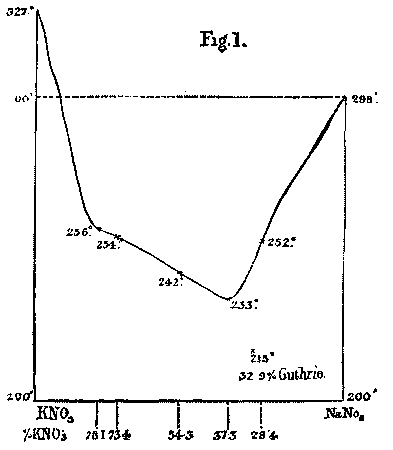
As an example, we may take the determinations of the melting-points of mixtures of potassium and sodium nitrate by M. Maumené.5 These are graphically represented in Fig. 1, the curve being derived from the mean of the temperatures given in the memoir. From this diagram we should be led to expect a eutectic mixture, since the curve dips below a horizontal line passing through the melting-point of the more fusible of its constituents. From our curve we should expect a eutectic mixture with about 35 per cent. KNO3, and with a temperature of solidification below 233°. Dr. Guthrie gives 32.9 per cent. at 215°. This agreement is as good as might be expected when one remembers that the melting-points, not being of eutectic mixtures, are difficult to determine, and a considerable range is given; that analyses of mixtures of potassium and sodium salts are apt to vary; and that the two observers differ by ±7° in the temperatures given for the melting-points of the original salts.
Fig. 1.
Dr. Tilden has drawn my attention to an interesting example of the lowering of melting-point by the mixture of salts. The melting-point of monohydrochloride of turpentine oil is 125°, while that of the dihydrochloride is 50°; but on simply stirring together these compounds in a mortar at common temperatures, they immediately liquefy. Two molecules of the monohydrochloride and one molecule of the dihydrochloride form a mixture which melts at about 20°.
III. EUTECTIC METALLIC ALLOYS.
Although many fusible alloys have been long known, I believe no true eutectic metallic alloy had been studied until Dr. Guthrie6 worked at the subject, employing the same methods as with his cryohydrates. It is found if two metals are fused together and the mixture allowed to cool, that the temperature falls until a point is reached at which that metal which is present in a proportion greater than is required to form the eutectic alloy begins to separate. If this solid be removed as it forms, the temperature gradually falls until a fixed point is reached, at which the eutectic alloy solidifies. Here the thermometer remains stationary until the whole has become solid, and, on remelting, this temperature is found to be quite fixed. In addition to the di-eutectic alloys, we have also tri- and tetra-eutectic alloys, and as an example of the latter we may take the bismuth-tin-lead-cadmium eutectic alloy, melting at 71°.
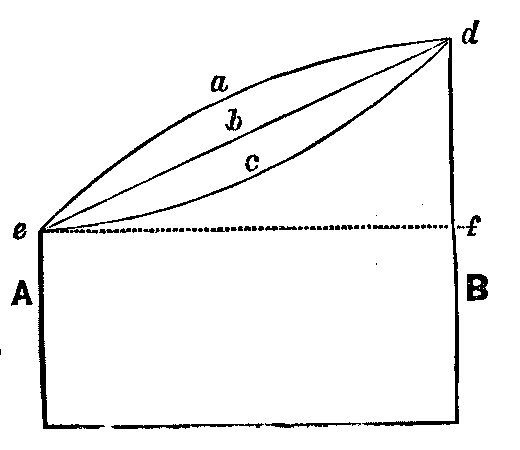
We have already seen with salt eutectics that, given the curve of melting-points of a mixture in various proportions, we may predict the existence, composition, and melting-point of the eutectic alloy. As a matter of course, the same thing holds good for metallic eutectics. An interesting example of this is furnished by the tin-lead alloys, the melting-points of which have been determined by Pillichody.7 From these determinations we obtain the curve given in Fig. 2, and from this curve, since it dips below a horizontal line passing through the melting-point of the more fusible constituent, we are at once able to predict a eutectic alloy. We should further expect this to have a constitution between PbSn3 and PbSn4 and a melting-point somewhat below 181°. On melting together tin and lead, and allowing the alloy to cool, we find our expectation justified; for by pouring off the fluid portion which remains after solidification has commenced, and repeating this several times with the portion so removed, we at length obtain an alloy which solidifies at the constant temperature of 180°, when the melting-point of tin is taken as 228°. On analysis 1.064 grm. of this alloy gave 0.885 grm. SnO2, which corresponds to Sn 65.43 per cent., or PbSn3.3. This, therefore, is the composition of the eutectic alloy, and it finds its place naturally on the curve given in Fig. 2.
Fig. 2.
It will be seen that the subject of eutexia embraces many points of practical importance and of theoretical interest. Thus it has been shown by Dr. Guthrie that the desilverizing of lead in Pattinson's process is but a case of eutexia, the separation of lead on cooling a bath of argentiferous lead poor in silver being analogous to the separation of ice from a salt solution. Dr. Guthrie has also shown that eutexia may reasonably be supposed to have played an important part in the production and separation of many rock-forming minerals.
It is with considerable diffidence that I suggest the following as an explanation of the multitude of facts to which previous reference has been made.
In a mixture of two substances, A and B, we have the following forces active, tending to produce solidification:
1. The cohesion between the particles of A.
2. The cohesion between the particles of B.
3. The cohesion between the particles of A and the particles of B.
With regard to this last factor, it will be seen that there are three cases possible:
1. The cohesion of the mixture A B may be greater than the cohesion of A + the cohesion of B.
2. The cohesion of A B may be equal to the cohesion of A + the cohesion of B.
3. The cohesion of A B may be less than the cohesion of A + the cohesion of B.
Now, since cohesion tends to produce solidification, we should in the first case expect to find the melting-point of the mixture higher than the mean of the melting-points of its constituents, or the curve of melting-points would be of the form given in a, Fig. 3. Here no eutectic mixture is possible.
Fig. 3.
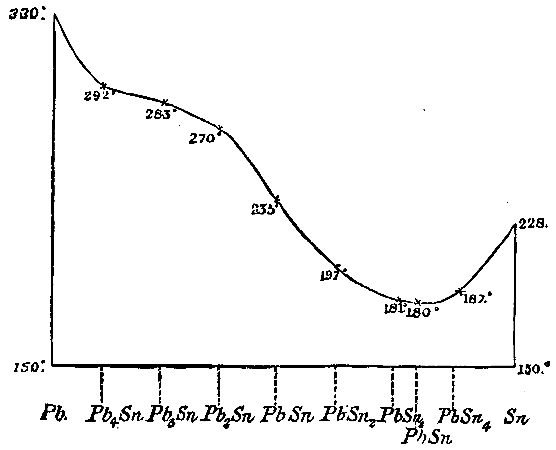
In the second case, where cohesionA B = cohesion A + B, we should obtain melting-points for the mixture which would agree with the mean of the melting-points of the constituents, the curve of melting-points would be a straight line, and again no eutectic mixture would be possible.
In the third case, however, where cohesionA B is less than cohesion A + B, we should find the melting-points of the mixture lower than the mean of the melting-points of its constituents, and the curve of melting-points would be of the form given in e, Fig. 3. Here, in those cases where the difference of cohesion on mixture is considerable, the curve of melting-points may dip below the line e f. This is the only case in which a eutectic mixture is possible, and it is, of course, found at the lowest point of the curve.
If it be true, as above suggested, that the force of cohesion is at its minimum in the eutectic alloy, we should expect to find, in preparing a eutectic substance, either that actual expansion took place, or that the molecular volume would gradually increase in passing along our curve of melting-points, from either end, for each molecule added, and that it would obtain its greatest value at the point corresponding to the eutectic alloy.
Of this I have no direct evidence as yet, but it is a point of considerable interest, and I may possibly return to it at some future time.—Chemical News.
[1]
Read before the Birmingham Philosophical Society, January 22, 1885.
[2]
Guthrie, Phil. Mag. [5], xvii., p. 462.
[3]
Guthrie, Phil. Mag., 4th Series, xlix., pp. 1, 206, 266; 5th Series, i., pp. 49, 354, 446, vi., p. 35.
[4]
F. Guthrie, Phil. Mag. [5], xvii., p. 469; F.B. Guthrie, Journ. Chem. Soc,. 1885, p. 94.
[5]
Comptes Rendus, 1883, 2, p. 45.
[6]
Phil. Mag., 5th Series, xvii., p. 462.
[7]
Dingler's Polyt. Jour., 162, p. 217; Jahresberichte, 1861, p. 279.