THE LIMITATIONS OF SUBMARINE TELEGRAPHY.8
Reading edition
THE LIMITATIONS OF SUBMARINE TELEGRAPHY.8
The weight of the conductors, says Henry Vivarez in La Lumiere Electrique, plays an important part in submarine telegraphy, not merely as a heavy item in the outlay, but as one of the principal factors in laying down the lines, and in taking them up in case of damage. When the conductor is being raised, the grappling-irons which lift it have to resist not merely the vertical component of the weight of the cable, but also the considerable effects resulting from friction against the water. It thus frequently happens, when working at great depths, that the conductor may be exposed to a strain greater than it is able to bear, and we are forced to have recourse to stratagems to bring it to the surface. These artifices consist in the use of two or more ships in raising, which is done as shown in Figs. 2 and 3, or, in the most simple cases, with the aid of an auxiliary buoy, as in Fig. 4. In any event, we see that the difficulties, and of course the cost of raising, must be considerable.
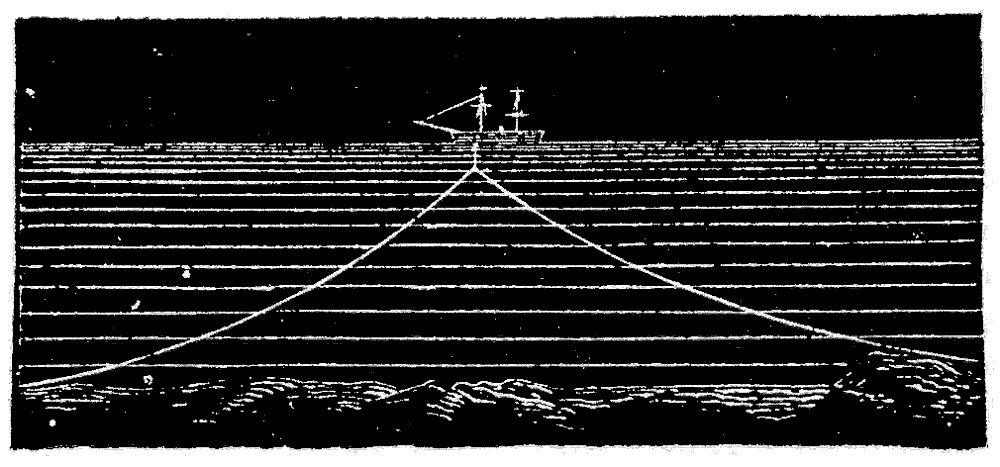
Fig. 1.
Hence to decrease the weight of the cables would be an important step in advance. If the weight is in general very great, it is because the copper core does not take any part in the strain which the entire cable has to resist. We know, indeed, that copper cannot bear a breaking-strain greater, at most, than 28 kilos per square millimeter. Besides, it would be elongated by such a strain by a very considerable fraction of its initial length; and, if the core were made to take part in any manner whatever in the strain which the entire cable has to support, it would be drawn out beyond its limit of elasticity, and would remain permanently elongated, while the substances in which it is inclosed would return to their natural length. It would result that, being no longer able to find room in a sheath which had become too short, the copper wire would take a sinuous form in its gutta-percha envelope, and would occasion at certain points ruptures, the effect of which would be to decentralize the wire, to perforate the layer of insulating matter, and finally to open out a fault in the cable.
But there exists an alloy (silicium bronze) which can be drawn out into wires having a conductivity equal to that of copper, and a mechanical resistance equal to that of the best iron. The use of this alloy would render it possible to set free the coating of the cables from a part of the strain which it now has to resist, and to diminish, consequently, their dimensions and weight. Wires are now made of this alloy, having a conductivity of from ninety-seven to ninety-nine per cent. of the standard, which at 0°C., and with the diameter of a millimeter, have a resistance of 20.57 ohms per kilometer. These wires do not break with a less strain than from 45 to 48 kilos. per square millimeter, and, which is a very precious property, their increase in length at the moment of rupture does not exceed one or one and a half per cent.
Let us consider the deep-sea section of cable of the French company from Paris to New York—the so-called "Pouyer-Quertier" cable, constructed and laid in 1879 by Siemens Brothers of London.
The respective weight of each of its component elements is, per nautical mile, copper core, 220 kilos; gutta-percha, 180 kilos; hemp, or an equivalent, 80 kilos; 18 wires of galvanized iron of 2 millimeters in diameter, 860 kilos; external hemp and composition, 400 kilos; total, 1,740 kilos. Total diameter, 30 millimeters. Total mechanical strength, 3,000 kilos, the wires of the covering being supposed to be of iron. Weight under water, 450 kilos. It can support its own weight without breaking for a length of from six to seven miles.
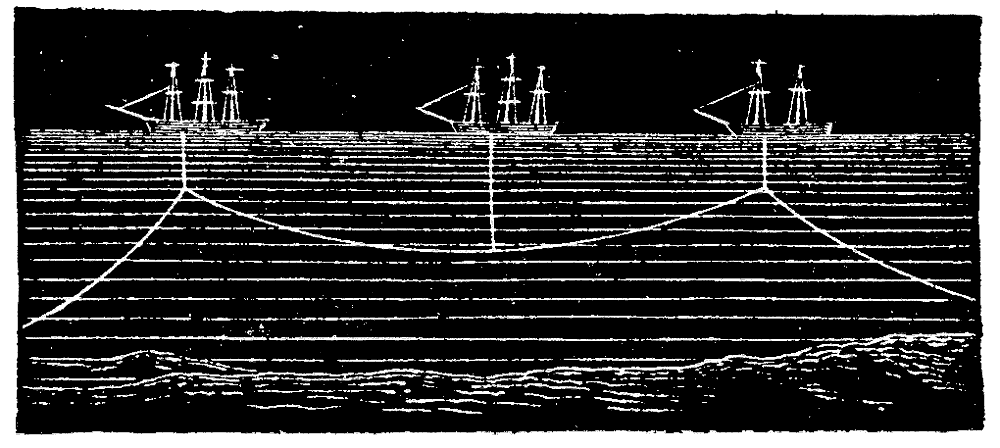
Fig. 2.
The Atlantic presents from north to south, and at about an equal distance from each continent, a sort of longitudinal ridge, in which the depths vary from 300 to 400 meters. This ridge spreads out, in 50° north latitude, into the region which has received the principal wires connecting England and France with the United States. On both coasts there are depressions in which the bottom is at the depth of from 4,000 to 6,000 meters. The one on the east extends from the south point of Ireland to the latitude of the Cape of Good Hope, and its left-hand boundary follows the general outlines of the west coasts of Europe and Africa. The two others, the northwestern and the southwestern, form two basins, bordering respectively on the United States and the Antilles and South America.
In these depressions soundings have shown certain zones in which the depths exceed 6,000 meters, the principal of which are found to the west of the Canaries, to the south of Newfoundland, between Porto Rico and the Bermudas, and to the right of the Isle of Marten-Vaz.
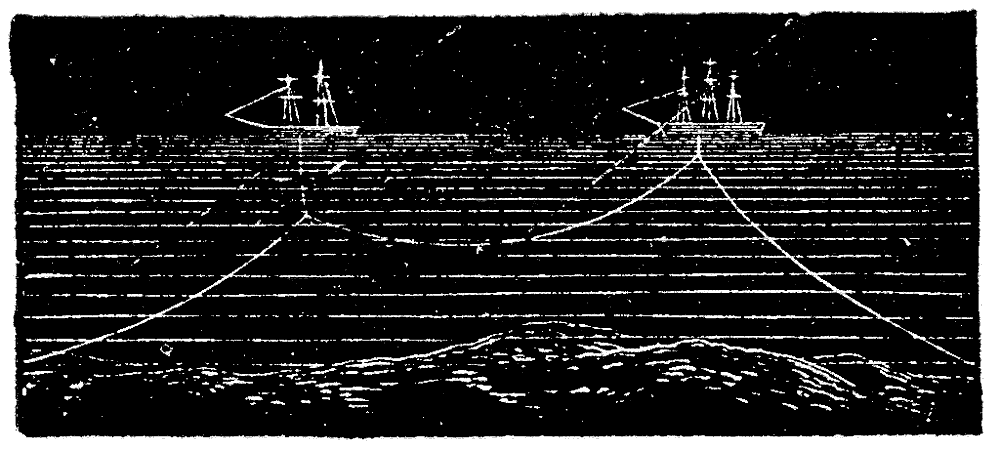
Fig. 3.
The great depths of the Pacific are differently distributed. Between Japan and California, between 40° and 50° north latitude, there is the Tuscarora depression, which has depths of from 6,000 to 8,000 meters. Parallel to Japan and the Kuriles there is a depression in which has been found the greatest known depth—8,513 meters.
We see, therefore, that any new great submarine line, having to extend into another zone than that which has received the present Atlantic cables, must traverse depressions in which the bottom reaches a maximum depth of 4,000 meters. The possibility of raising a damaged cable would be very problematical under such conditions, and it would become certainly impossible in case of a cable from San Francisco to Japan.
Under these conditions, we are forced to conclude that the use of the present cables limits strikingly the progress of submarine telegraphy, which must remain confined to certain zones of the Atlantic, to inland seas, and to lines along the coasts. But if we consider the daily progress of applied science, and the constantly increasing demand for rapid communication between nations, it is certain that we must shortly undertake the study of new cables intended to traverse the greatest depths of the ocean for long distances. Necessity, therefore, compels us to investigate the new solutions of the problem, which may furnish us with light cables, easy to lay, and possible to repair.
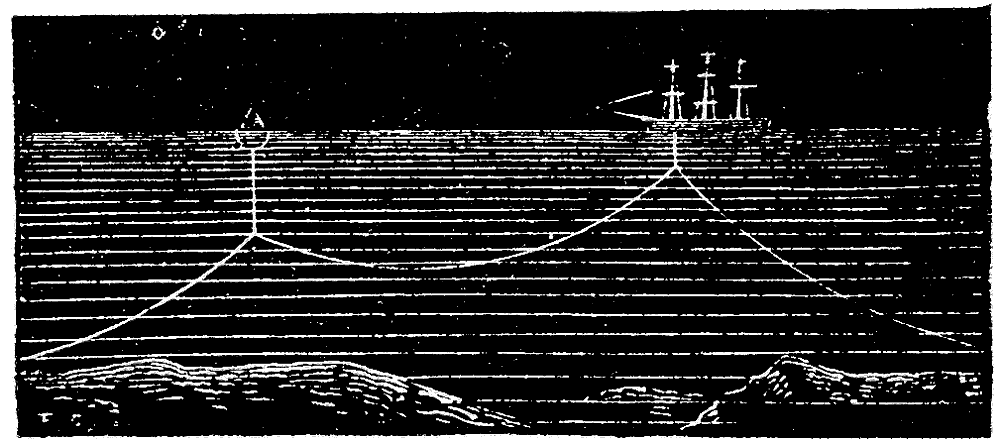
Fig. 4.
A cable made by Mr. J. Richards is composed as follows: core of silicium bronze equal in weight to that of the Pouyer-Quertier cable, or, per nautical mile, 220 kilos; gutta-percha, 180 kilos; layer of hemp, 80 kilos. The sheathing is formed of 28 wires of galvanized iron of 1.25 millimeters in diameter, each covered with hemp, and all twisted into a rope around the dielectric; the wires, 500 kilos: the hemp covering them, 250 kilos. The weight of the cable is, therefore, 1,230 kilos in the air, and 320 kilos in the water. Its diameter is 25 centimeters, and its resistance to fracture 2,800 kilos, of which the core supports one-half. Under these conditions, the cable can support from eight to nine nautical miles of its length, and can be raised from the greatest depths. The results of this comparative examination are self-evident.
For an equal conductivity and an approximately equal mechanical strength, the new cable is in weight and bulk equal to about two-thirds of the Pouyer-Quertier cable. It would cost about $165 less per mile, and would require, for laying, a ship and engines of less power, and therefore cheaper. The reduced armature will suffice to resist friction and the attacks of animal life in the deep sea; but for the shore ends we must keep to the types generally employed. Such as it is, and although it may undergo modifications in detail from a more complete study and from experience, it merits the attention of competent engineers.