HERBST'S METHOD OF FILLING. Demonstrated by Dr. G. C. Cludius, Grenoble, France.12
Reading edition
HERBST'S METHOD OF FILLING. Demonstrated by Dr. G. C. Cludius, Grenoble, France.12
At the July meeting of the Odontological Society of France, Dr. Cludius, from Grenoble, made the following demonstration of a new method of gold filling, saying:
We feel the necessity of making the operation of filling teeth with gold easier, if possible, especially in difficult cases, in order to lessen the fatigue of the operator, as well as to prevent the suffering of the patient, during hours without interruption, under the ceaseless blows of the mallet. The remedy has been sought in new forms of material, like sponge and crystal gold. These have not given any help in the performance of good operations, but have rather facilitated poor work. We are not in need of varieties in the forms of gold, but we ought to try and improve its manipulation, and this has recently been done in a novel manner by Dr. Herbst, whose rotation method has been mentioned in the dental journals within only a few months; and yet it seemed necessary that this great invention, made in Bremen, should take its way by America to come to us.
In the January meeting of the Odontological Society of New York, Dr. Bödecker mentioned it for the first time, describing the excellence of fillings made by Dr. Herbst in less than half the time that any mallet work would have required, and he expressed his intention of going to study the method with the inventor. Thinking that I was yet nearer to Bremen, I went thither, and found there Dr. W. D. Miller, who had come on the same errand. Mr. Brasseur had also written to Dr. Herbst, and it is by his (Mr. B.'s) invitation that I came to Paris to show you what I have learned in Bremen. To-morrow morning I shall show the method in the mouths of patients at the Dental College of France. Dr. Herbst did not patent his new method, to which may be given the name of "rotation gold filling." All he desires is that every one may try the system, and he feels himself already largely paid by the acknowledgments he is daily receiving.
He proves that by his way of rotation one is able to adapt the gold more perfectly to the walls of the cavity than by any other means hitherto employed. One can thus work gold in the very weakest teeth, because there is no force employed, yet the gold is as much condensed as by any mallet known.
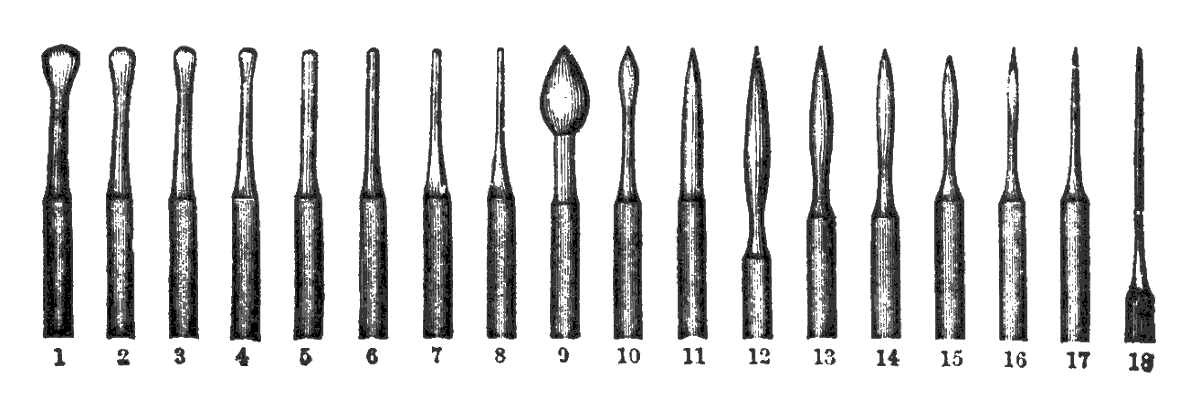
The new instruments are very simple, and you may find them in the dental depots. One can easily prepare them for himself—at least the principal one, No. 5—by putting a broken burr in the hand-piece and holding it like a pen for writing until the rotating end of the burr is ground to a roof-like shape, on a dry Arkansas stone. Nos. 1, 2, 3, and 4 are smooth burnishers, and help to fix the first layers of gold in large fillings. They are afterward used as finishers, Nos. 9 to 17 are finishing burnishers, and No. 18 is a needle-point finisher.
The cavity is to be prepared in the usual way, but retaining points are very much less needed than for other methods. Take, for instance, a central cavity in a molar—and, moreover, the fundamental idea of this system is to transform all cavities to be filled into central cavities. Now fix several cylinders, of a size proportioned to the cavity, with a common plugger, and then take No. 2, or 3, or 4, and by a slow rotation polish the gold against the walls. If the gold does not stick directly, put in more cylinders with the plugger, and recommence the condensation with the burnisher. On this first layer of gold a second one is to be made to adhere; but the polished surface prevents, and here No. 5 finds employment in quick rotation and interrupted touches until the polish is gone. (I may here remark that the gold is condensed by this rotation and without pressure in a very remarkable way.) For large fillings, No. 5 is to have proportionate points,13 which, if too fine, will make holes in the gold, and the pressure is to be intermittent, in order to avoid the development of heat, which would be painful and irritating to the pulp.
All the instruments by use get gilded, and will not work longer without tearing out the gold; but this inconvenience may be prevented by occasionally rubbing them while in rotation upon a piece of tin.
The filling of the cavity is continued in the way above described.
Let us now take the case of two incisors with lateral cavities approximating one another. The two cavities, prepared as usual, are treated as if one, and the gold is at the same time introduced into both cavities, fixing some cylinders in the four corners by rotation of the proper burnishers, and condensation with No. 5, until they are filled, so that there appears to be a single mass of gold. No. 18 is then pushed with regular rotation between the teeth until the mass is quite separated, so that thin files, and disks, and tapes may be employed in finishing the fillings.
In filling similar cavities between the second bicuspid and first molar, after they are properly prepared, place a matrix and fill one cavity with shellac to retain the matrix, and distribute the resistance, and then fill the other like a central cavity, beginning at the cervical border, and pressing especially against the matrix at that point, work toward and finish at the middle of the crown. Having filled the first one, remove the shellac and fill the other in the same way.
The rotation and the pressure, if intermittent, do not produce heat—at least, not more than will render the gold cohesive.
Dr. Herbst filled for me two molars, carious to the cervical border, and very sensitive there, for which reason they had for years been filled with plastics, because I was afraid of perforation if retaining points were made, without which gold filling by malleting would not have been possible; and I was too nervous to sit three or four hours in the chair. Dr. Herbst filled both teeth by rotation, without retaining points, in a little more than one hour. Several gentlemen present have seen them and observed the severe tests to which Mr. Brasseur subjected them, and I may add that notwithstanding the great sensitiveness of the dentine and the proximity of the pulps, I felt not the least inconvenience from heat, and my own patients bear like testimony.
We will now split a crown filled in the hand, and you see that the gold is pressed into the smallest depressions of the interior surface, and is so uniformly condensed as to resemble an ingot, impossible to separate in pieces, yet you may note the different stages of the rotation.
I saw Dr. Herbst fill six cavities—some of them large ones—in front teeth, taking altogether at the same sitting about one hour.
It would be difficult to precisely describe the manipulation requisite for the great variety of cases presenting in practice, but I have explained to you in theory the typical ones in the hope of stimulating you to try this method of filling by rotation, which I look upon as one of the most ingenious modes yet given to our profession. The results are splendid, and the operator will thereby save much time and prevent great suffering on the part of the patient.