BJERKNES'S EXPERIMENTS.
Reading edition
As a general thing, too much trust should not be placed in words. In the first place, it frequently happens that their sense is not well defined, or that they are not understood exactly in the same way by everybody, and this leads to sad misunderstandings. But even in case they are precise, and are received everywhere under a single acceptation, there still remains one danger, and that is that of passing from the word to the idea, and of being led to believe that, because there is a word, there is a real thing designated by this word.
Let us take, for example, the word electricity. If we understand by this term the common law which embraces a certain category of phenomena, it expresses a clear and useful idea; but as for its existence, it is not permitted to believe a priori that there is a distinct agent called electricity which is the efficient cause of the phenomena. We ought never, says the old rule of philosophy, to admit entities without an absolute necessity. The march of science has always consisted in gradually eliminating these provisory conceptions and in reducing the number of causes. This fact is visible without going back to the ages of ignorance, when every new phenomenon brought with it the conception of a special being which caused it and directed it. In later ages they had spirits in which there was everything: volatile liquids, gases, and theoretical conceptions, such as phlogiston. At the end of the last century, and at the beginning of our own, ideas being more rational, the notion of the "fluid" had been admitted, a mysterious and still vague enough category (but yet an already somewhat definite one) in which were ranged the unknown and ungraspable causes of caloric, luminous, electric, etc., phenomena. Gradually, the "fluid" has vanished, and we are left (or rather, we were a short time ago) at the notion of forces—a precise and mathematically graspable notion, but yet an essentially mysterious one. We see this conception gradually disappearing to leave finally only the elementary ideas of matter and motion—ideas, perhaps, which are not much clearer philosophically than the others, particularly that of matter taken per se, but which, at least, are necessary, since all the others supposed them.
Among those notions that study and time are reducing to other and simpler ones, that of electricity should be admitted; for it presents itself more and more as one of the peculiar cases of the general motion of matter. It will be to the eternal honor of Fresnel for having introduced into science and mathematically constituted the theory of undulations (already proposed before him, however), thus giving the first example of the notion of motion substituted for that of force. Since the principle of the conservation of energy has taken the eminent place in science that it now occupies, and we have seen a continual transformation of one series of phenomena into another, the mind is at once directed to the aspect of a new fact toward an explanation of this kind. Still, it is certain that these hypotheses are difficult of justification; for those motions that are at present named molecular, and that we cannot help presuming to be at the base of all actions, are per se ungraspable and can only be demonstrated by the coincidence of a large number of results. There is, however, another means of rendering them probable, and that is by employing analogy. If, by vibrations which are directly ascertainable, we can reproduce the effects of electricity, there will be good reason for admitting that the latter is nothing else than a system of vibration differing only, perhaps, in special qualities, such as dimensions, direction, rapidity, etc.
Such is the result that is attained by the very curious experiments that are due to Mr. Bjerknes. These constitute an ensemble of very striking results, which are perfectly concordant and exhibit very close analogies with electrical effects, as we shall presently see.
Fig. 1.
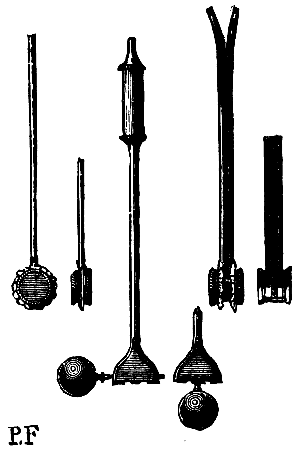
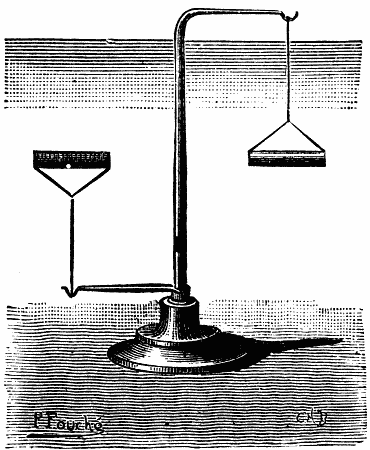
They are based on the presence of bodies set in vibration in a liquid. The vibrations produced by Mr. Bjerknes are of two kinds—pulsations and oscillations. The former of these are obtained by the aid of small drums with flexible ends, as shown to the left in Fig. 1. A small pump chamber or cylinder is, by means of a tube, put in communication with one of these closed drums in which the rapid motion of a piston alternately sucks in and expels the air. The two flexible ends are successively thrust outward and attracted toward the center. In an apparatus of this kind the two ends repulse and attract the liquid at the same time. Their motions are of the same phase; if it were desired that one should repulse while the other was attracting, it would be necessary to place two drums back to back, separated by a stiff partition, and put them in connection with two distinct pump chambers whose movements were so arranged that one should be forcing in while the other was exhausting. A system of this nature is shown to the right in Fig. 1.
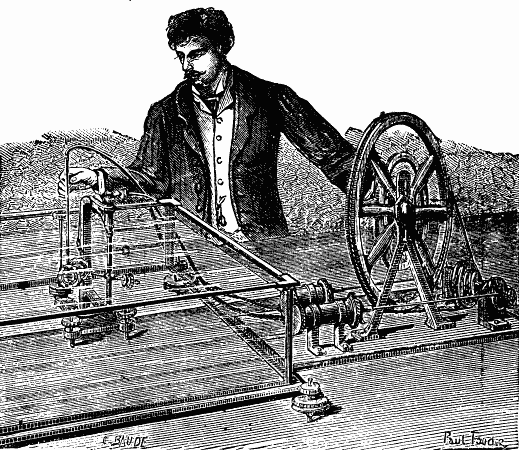
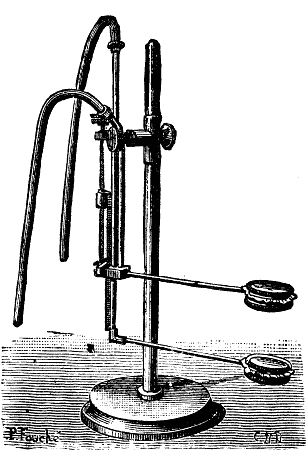
The vibrations are obtained by the aid of small metal spheres fixed in tubular supports by movable levers to which are communicated the motions of compression and dilatation of the air in the pump chamber. They oscillate in a plane whose direction may be varied according to the arrangement of the sphere, as seen in the two apparatus of this kind shown in Fig. 1. Fig. 2 will give an idea of the general arrangement. The two pistons of the air-pumps are connected to cranks that may be fixed in such a way as to regulate the phases as may be desired, either in coincidence or opposition. The entire affair is put in motion by a wheel and cord permitting of rapid vibrations being obtained. The air is let into the apparatus by rubber tubing without interfering with their motions.
Fig. 2.
We may now enter into the details of the experiments:
The first is represented in Fig. 2. In a basin of water there is placed a small frame carrying a drum fixed on an axle and capable of revolving. It also communicates with one of the air cylinders. The operator holds in his hand a second drum which communicates with the other cylinder. The pistons are adjusted in such a way that they shall move parallel with each other; then the ends of the drums inflate and collapse at the same time; the motions are of the same phase; but if the drums are brought near each other a very marked attraction occurs, the revolving drum follows the other. If the cranks are so adjusted that the pistons move in an opposite direction, the phases are discordant—there is a repulsion, and the movable drum moves away from the other. The effect, then, is analogous to that of two magnets, with about this difference, that here it is the like phases that attract and the different phases that repel each other, while in magnets like poles repel and unlike poles attract each other.
It is necessary to remark that it is indifferent which face of the drum is presented, since both possess the same phase. The drum behaves, then, like an insulated pole of a magnet, or, better, like a magnet having in its middle a succeeding point. In order to have two poles a double drum must be employed. The experiment then becomes more complicated; for it is necessary to have two pump chambers with opposite phases for this drum alone, and one or two others for the revolving drum. The effects, as we shall see, are more easily shown with the vibrating spheres.
This form has the advantage that the vibrating body exhibits the two phases at the same time; relatively to the liquid, one of its ends advances while the other recedes. Thus with a vibrating sphere presented to the movable drum, there may be obtained repulsion or attraction, according as the side which is approached is concordant or discordant with the end of the drum that it faces.
Fig. 3.
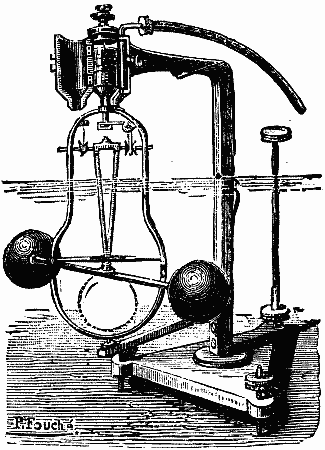
With the arrangement shown in Fig. 3 there may be performed an interesting series of experiments. The two spheres supported by the frame are set in simultaneous vibration, and the frame, moreover, is free to revolve about its axis. The effect is analogous to that which would be produced by two short magnets carried by the same revolving support; on presenting the vibrating sphere to the extremities the whole affair is attracted or repulsed, according to its phase and according to the point at which it is presented; on replacing the transverse support by a single sphere (as indicated in the figure by a dotted line) we obtain the analogue of a short magnet carried on a pivot like a small compass needle. This sphere follows the pole of a vibrating sphere which is presented to it, as the pole of a magnet would do, with this difference always, that in the magnet, like poles repel, while in oscillating bodies like phases attract.
In all the preceding experiments the bodies brought in presence were both in motion and the phenomena were analogous to those of permanent magnetism. We may also reproduce those which result from magnetism by induction. For this purpose we employ small balls of different materials suspended from floats, as shown in Fig. 4 (a, b, c). Let us, for example, take the body, b, which is a small metal sphere, and present to it either a drum which is caused to pulsate, on an oscillating sphere, and it will be attracted, thus representing the action of a magnet upon a bit of soft iron. A curious experiment may serve to indicate the transition between this new series and the preceding. If we present to each other two drums of opposite phases, but so arranged that one of them vibrates faster than the other, we shall find, on carefully bringing them together, that the repulsion which manifested itself at first is changing to attraction. On approaching each other the drum having the quicker motion finally has upon the other, the same action as if the latter were immovable; and the effect is analogous to that which takes place between a strong and weak magnet presented by their like poles.
Fig. 4.
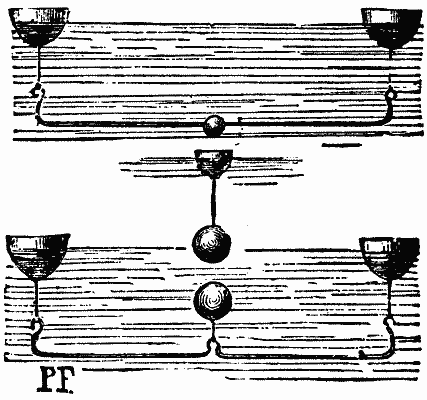
By continuing these experiments we arrive at a very important point. Instead of the body, b (Fig. 4), let us take c. As the figure shows, this is a sphere lighter than water, kept in the liquid by a weight. If we present to it the vibrating body, it will be repelled, and we shall obtain the results known by the name of diamagnetism. This curious experiment renders evident the influence of media. As well known, Faraday attributed such effects to the action of the air; and he thought that magnetic motions always resulted from a difference between the attraction exerted by the magnet upon the body under experiment, and the attraction exerted by the air. If the body is more sensitive than the air, there is direct magnetism, but if it is less so, there is diamagnetism. Water between the bodies, in the Bjerknes experiments, plays the same role; it is this which, by its vibration, transmits the motions and determines the phases in the suspended body. If the body is heavier than water its motion is less than that of the liquid, and, consequently, relatively to the vibrating body, it is of like phase; and if it is lighter, the contrary takes place, and the phases are in discordance. These effects may be very well verified by the aid of the little apparatus shown in Fig. 5, and which carries two bars, one of them lighter and the other heavier than water. On presenting to them the vibrating body, one presents its extremity and takes an axial direction, while the other arranges itself crosswise and takes the equatorial direction. These experiments may be varied in different ways that it is scarcely necessary to dwell upon in this place, as they may be seen at the Electrical Exhibition.
Fig. 5.
Very curious effects are also obtained with the arrangement shown in Fig. 6. Between the two drums there is introduced a body sustained by a float such as represented at a, Fig. 4. Various results may, then, be obtained according to the combinations adopted. Let us suppose that the phases are alike, and that the interposed body is heavier than water; in this case it is repelled as far as the circumference of the drums, at which point it stops. If the phases are different, the influenced body behaves in the opposite manner and stops at the center. If the body is lighter than water the effects are naturally changed. Placed between two like phases, it is attracted within a certain radius and repelled when it is placed further off; if the phases are unlike, it is always repelled. We may easily assure ourselves that these effects are analogous to those which are produced on bodies placed between the poles of wide and powerful magnets. It is useless to repeat that the analogies are always inverse.
Fig. 6.
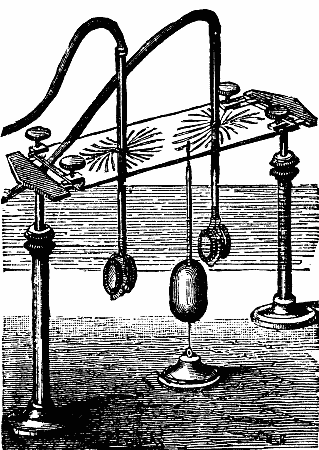
Mr. Bjerknes has carried the examination of these phenomena still further in studying experimentally the actions that occur in the depths of the liquid; and for this purpose he has made use of the arrangement shown in Fig. 7. By the side of the vibrating body there is placed a light body mounted on a very flexible spring. This assumes the motion of that portion of the fluid in which it is immersed, and, by the aid of a small pencil, its direction is inscribed upon a plate located above it. By placing this registering apparatus in different directions the entire liquid may be explored. We find by this means figures that are perfectly identical with magnetic phantoms. All the circumstances connected with these can be reproduced, the vibrating sphere giving the phantom of a magnet with its two poles. We may even exhibit the mutual action of two magnets. The figures show with remarkable distinctness—much more distinct, perhaps, than those that are obtained by true magnets.
Fig. 7.
However, it must not be thought that these so interesting facts are the result of groping in the dark and the outcome of some fortunate experiment; for they have, on the contrary, been foreseen and predetermined. Mr. Bjerknes is especially a mathematician, and it was a study, through calculation, of the vibratory motion of a body or system of bodies in a medium that led him to the results that he afterwards materialized.
After the production, by Mr. Lejeune, of his solutions, Mr. Bjerknes in 1865 entered upon a complete study of the subject, and recognized the fact that the result of such motions was the production of regular mechanical actions. He calculated the directions of these, and, along about 1875, perceived the possibility of reproducing the effects of permanent magnetism. More recently, in 1879, he saw that magnetism by derivation might likewise be explained by those hypotheses, and figured by actions of this kind. It was not till then that he performed the experiments, and submitted a body to the results of calculation.
The same process has led him to the conclusion that the action of currents might be represented in the same manner; only, instead of bodies in vibration, it would require bodies in alternating rotation. The effects are much more difficult to ascertain, since it is necessary to employ viscid liquids.
Meanwhile, the experiments have been performed. Up to the present time attractions and repulsions have not been shown, and I do not know whether Mr. Bjerknes has obtained them. But, by the process pointed out, the lines of action (electric phantoms, if I may so express myself) have been traced, and they are very curious. By supposing the current perpendicular to the plate, and in the presence of the pole of a magnet, the influences produced around it are very well seen, and the figures are very striking, especially in the case of two currents. Mr. Bjerknes does not appear as yet to have obtained from these experiments all that he expects from them. And yet, such as they are, they have already led him to important conclusions. Thus, calculation, confirmed by application, has led him to renounce the formula proposed by Ampère and to adopt that of Regnard as modified by Clausius. Is he right? This is what more prolonged experimentation will allow to be seen.
These researches, however, are beset with difficulties of a special nature, and the use of viscid liquids is a subject for discussion. Mr. Bjerknes desired to employ them for reproducing the effects that he had obtained from water, but he found that the lines of force were no longer the same, and that the phenomena were modified. It is necessary, then, to hold as much as possible to liquids that are perfect. The experimenter is at present endeavoring to use these liquids by employing cylinders having a fluted surface; but it is clear that this, too, is not without its difficulties.
This series of experiments offers a rare example of the verification of algebraic calculation by direct demonstration. In general, we may employ geometry, which gives a graphic representation of calculation and furnishes a valuable control. Sometimes we have practical application, which is a very important verification in some respects, but only approximate in others. But it is rare that we employ, as Mr. Bjerknes has done, a material, direct, and immediate translation, which, while it brings the results into singular prominence, permits of comparing them with known facts and of generalizing the views upon which they are based.
Hypotheses as to the nature of electricity being as yet only tolerably well established, we should neglect nothing that may contribute to give them a solid basis. Assuming that electricity is a vibratory motion (and probably there is no doubt about it), yet the fact is not so well established with regard to it as it is to that of light. Every proof that comes to support this idea is welcome, and especially so when it is not derived from a kind of accident, but is furnished by a calculated and mathematical combination. Viewed from this double standpoint, the experiments of Mr. Bjerknes are very remarkable, and, I may add, they are very curious to behold, and I recommend all visitors to the Exhibition to examine them.—Frank Geraldy, in La Lumiere Electrique.