PHYSICS WITHOUT APPARATUS.
Reading edition
The Chain and the String.—To the extremity of a string about 18 in. in length attach a chain about 15 in. in length, the extremities of which are united. Holding the string vertically between the fingers, give it a rapid rotary motion. The chain will first open out as seen at A of the figure. Upon increasing the velocity of rotation, it will be thrown out farther and farther until it finally forms a circle in a horizontal plane. In this motion, the string forms a sort of conoidal surface, distended by centrifugal force.
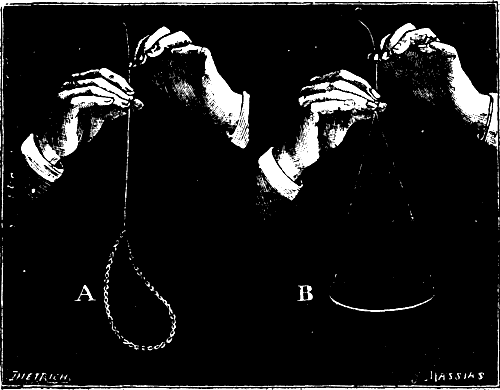
B of the figure gives the exact aspect that the arrangement offers to the eye during the revolution. In the same way, a penholder attached by one of its extremities to a string assumes an almost horizontal position.
This experiment illustrates the principle of centrifugal force.
A Coin Rolling Upon a Parasol.—In treatises upon physics and mechanics inertia is defined as follows: No particle of matter in a state of rest possesses within itself the power of putting itself in motion; or, if it be moving, of bringing itself to a state of rest.
As an example of this principle, we may recall here the trick performed by certain jugglers, and that consists in making a coin roll over the top of a Japanese paper parasol. The parasol is revolved very rapidly, and, to the eyes of the spectator, the coin seems to remain immovable. It is, in reality, the parasol that revolves under the coin.
Breaking Stones with the Fist.—It is through the live force acquired, or inertia at rest, that stones are broken by a blow of the fist. This experiment is performed as follow: The right hand being properly bandaged with a handkerchief, the stone to be broken is taken with the left and allowed to rest upon a larger stone or upon an anvil. Then the stone to be broken is struck with the right fist, while care is taken to raise it a slight distance above the anvil just before the fist touches it. The stone then takes on the velocity of the fist that strikes it, and coming into violent contact with its support, is very promptly broken.
As simple as this experiment is, it always surprises the spectators.
Experiment on Inertia.—It is not impossible to remove from a table set for a guest a large napkin employed in lieu of a table cloth, without disarranging the objects placed upon it. To this effect, it suffices to give the napkin a quick horizontal jerk in stiffening the edges held by the hands.
We recommend our readers to try this experiment only with table ware of slight value, for one cannot always be sure of succeeding immediately. Tinware may be employed very advantageously.
The Dice and the Dice Box.—A dice box and two dice are held in the hand, and the question is to throw one die into the air and catch it in the box. This is not difficult, but the difficulty is to cause the second to enter, for if this be thrown into the air, the first, which is already in the box, will fly into the air likewise and fall outside. In order to make the second enter while the first is already in the box, it must not be thrown into the air, but the hand and the box must be quickly lowered in freeing it, so that the first die, which is in the box, shall be at a less height than the second, which is in the fingers. The dice fall less quickly than the hand and the box.