A RESEARCH ON THE LIQUEFACTION OF HELIUM.1
Reading edition
A RESEARCH ON THE LIQUEFACTION OF HELIUM.1
My experiments on the liquefaction of helium were carried out with a sample of that gas, sent to me by Prof. Ramsay from London, in a sealed glass tube holding about 140 c. cm. I take this opportunity of rendering him my most sincere thanks. In his letter Prof. Ramsay informed me that the gas had been obtained from the mineral clevite, and that it was quite free from nitrogen and other impurities, which could be removed by circulation over red hot magnesium, oxide of copper, soda lime, and pentoxide of phosphorus. The density of the gas was 2.133 and the ratio of its specific heats (Cp/Cv) 1.652, the latter figure indicating that the molecule of helium was monatomic, as had already been found to be the case with argon. Prof. Ramsay further informed me that the gas was only very slightly soluble in water, 100 c. cm. of water dissolving scarcely 0.7 c. cm. of helium.
From the results of my earlier experiments I had been led to expect that it would be only possible to liquefy helium at a very low temperature; the small values obtained for the density and solubility of the gas, together with the fact that its molecule is monatomic, indicating a very low boiling point. For this reason I did not consider it necessary to use liquid ethylene as a preliminary cooling agent, but proceeded directly to conduct my experiments at the lowest temperature that could be produced by means of liquid air. The apparatus employed in these investigations is figured in the accompanying diagram.
The helium was contained in the glass tube, c, of the Cailletet's apparatus, C. The tube, c, reached to the bottom of a glass vessel, a, which was intended to contain the liquid air. The vessel, a, was surrounded by three glass cylinders, b, b' and b", closed at the bottom and separated from one another. The outer vessel, b", was made just large enough to fit into the brass collar, o, which supported the lid, u, of the apparatus. The tube, a, fitted into an opening in the center of the lid; the tube, t, connected with an apparatus delivering liquid oxygen, passed through a hole on the right. The vessel, b, was also connected with a mercury manometer and air pump by means of a T tube, p, v, one arm of which passed through the third hole in the lid of the apparatus. The tube, a, was closed by a stopper, through which passed the tube, c, of the Cailletet's apparatus, a tube connected with the drying apparatus, u, u', and one limb of a T tube, by means of which the manometer and air pump could be put in connection with the interior of the vessel. The lower part of the whole apparatus was inclosed in a thick walled vessel, e, containing a layer of phosphorus pentoxide.
By turning the valve, k, the vessel, b, could be partially filled with liquid oxygen, which, under a pressure of 10 mm. of mercury, boiled at about -210° C. Almost immediately the gaseous air began to condense and collect in the tube, a; a supply of fresh air was constantly maintained through the drying tubes, u and u', which were filled with sulphuric acid and soda lime respectively. When the quantity of liquid air ceased to increase, the tap on the U tube, u, was closed, the T tube, p' v', was connected with the manometer and air pump, and the liquid air was made to boil under a pressure of 10 mm. of mercury. In order to protect the liquid air from its warmer surroundings, a very thin, double wall tube, f, reaching to the level of the liquid in the outer vessel, was placed inside the tube, a. When, as in some of my experiments, liquid oxygen was used in the inner vessel, this part of the apparatus was dispensed with.
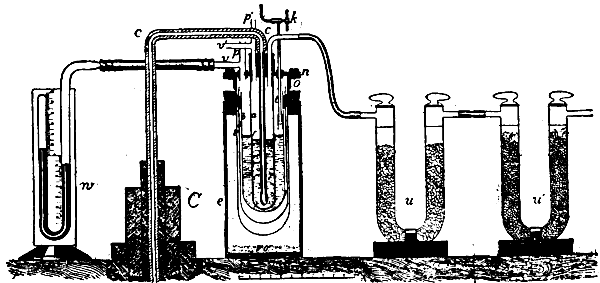
Using the apparatus I have just described, I carried out two series of experiments, in which liquid air and liquid oxygen were employed as cooling agents. The tube of the Cailletet's apparatus was thoroughly exhausted by means of a mercury pump, and then carefully filled with dry helium. In the first series of experiments the helium, confined under a pressure of 125 atmospheres, was cooled to the temperature of oxygen boiling, first under atmospheric pressure (-182.5°), and then under a pressure of 10 mm. of mercury (-210°). The helium did not condense under these conditions, and even when, as in subsequent experiments, I expanded the gas till the pressure fell to twenty atmospheres, and in some cases to one atmosphere, I could not detect the slightest indication that liquefaction had taken place. The first time that I compressed the gas I had, indeed, noticed that a small quantity of a white substance separated out and remained at the bottom of the tube when the pressure was released. Possibly this may have been due to the presence of a small trace of impurity in the helium, but it could not have constituted more than 1 per cent. of the total volume of the gas.
In the second series of experiments I employed liquid air, boiling under a pressure of 10 mm. of mercury. The helium was first confined under a pressure of 140 atmospheres, and then allowed to expand till the pressure fell to twenty atmospheres, or, in some cases, to one atmosphere. The results of these experiments were also negative, the gas remained perfectly clear during the expansion, and not the slightest trace of liquid could be detected. The boiling point of liquid air was taken, from my previous determination, to be -220° C. (Comptes Rendus, 1885, p. 238). This number cannot, however, be taken as a constant, as the liquid air, boiling under reduced pressure, becomes gradually poorer in nitrogen. Further, the quantity of nitrogen lost by the liquid air on partial evaporation varies not only with the rate of boiling, but even according to the manner in which it has been liquefied.
If air, under high pressure, be cooled first to the temperature of boiling ethylene, and then to -150° C., it liquefies, and, on reducing the pressure slowly, liquid air is obtained boiling under atmospheric pressure. During the process a considerable quantity of the liquid air evaporates, and the proportion of nitrogen to oxygen in the remaining liquid is less than in air liquefied under high pressure. If the liquid air obtained by this process be made to boil under a pressure of 10 mm. of mercury, the proportion of nitrogen in the mixture continues to decrease, but, on account of the large quantity of oxygen present, the liquid does not solidify, although its temperature is some six degrees below the freezing point of nitrogen. When, as in some of my former experiments, the air was liquefied under normal pressure by means of liquid oxygen boiling under a pressure of 10 mm. of mercury, the ratio of nitrogen to the oxygen in the liquid air was the same as in the gaseous air from which it had been produced. The liquid air, obtained by direct condensation at normal pressure, appeared to lose oxygen and nitrogen with about equal rapidity, and at the end of the experiment a considerable quantity of liquid nitrogen remained behind in the apparatus. On reducing the pressure to 10 mm. of mercury the nitrogen solidified. Prof. Dewar has stated that liquid air solidifies as such, the solid product containing a slightly smaller percentage of nitrogen than is present in the atmosphere. My experiments have proved this statement to be incorrect; liquid oxygen does not solidify even when boiling under a pressure of 2 mm. of mercury.
After carrying these experiments to a successful conclusion, I found that it was yet necessary to prove that, on reducing the vapor pressure of boiling oxygen, to a minimum, no corresponding fall of temperature takes place. The vessel, e, was partially filled with liquid oxygen, and, by means of a small siphon, a small quantity of the liquid was allowed to flow into the tube, a. The inner vessel, a, was then connected with the air pump and manometer, and the pressure was reduced to 2 mm. of mercury. The oxygen remained liquid and quite clear. In a second experiment the temperature of the liquid oxygen, boiling under 2 mm. of mercury pressure, was measured by means of a thermometer. The temperature indicated lay above -220° C., a temperature easily arrived at by means of liquid air. I, therefore, concluded that liquid air was a much more efficient cooling agent than liquid oxygen, and that it would be quite unnecessary to make further experiments on the liquefaction of helium.
In every single instance I have obtained negative results, and, as far as my experiments go, helium remains a permanent gas, and apparently much more difficult to liquefy than even hydrogen. The small quantity of the gas at my disposal, and, indeed, the extreme rarity of the minerals from which it is obtained, compelled me to carry out my investigation on a very small scale. Using a larger apparatus, and working at a much higher pressure, I could have submitted the gas to greater expansion. Further, I should have been able to measure the temperature of the gas at the moment of expansion by means of a platinum thermometer, as I did when working with hydrogen; but to make such experiments I should have required 10, if not 100, liters of the gas. As I was unable to determine the temperatures to which I cooled the gas, by any experimental means, I have been obliged to calculate them from Laplace's and Poisson's formula for the change of temperature in a gas during adiabatic expansion.
T/T1 = (p/p1)k – 1/k.
Where:
T, p are the initial temperature and pressure of the gas.
T1, p1 are the final temperature and pressure of the gas.
k is the ratio (cp/cv) which, for a monatomic gas, is 1.66.
In the first series of experiments the gas, under a pressure of 128 atmospheres, was cooled down to -210° C.
pTp1T1
At.Deg.At.Deg.Deg.
125-210 C.50-229.3 C.43.7 A.
......20-242.7 C.30.3 A.
......10-250.1 C.22.9 A.
......5-255.6 C.17.4 A.
......1-263.9 C.9.1 A.
The results of these calculations tend to show that the boiling point of helium lies below -264° C., at least 20° lower than the value I have found for the boiling point of hydrogen. If the boiling point of a gas be taken as a simple function of its density, helium, which, according to Prof. Ramsay's determination, has a density of 2.133, more than double that of hydrogen, should liquefy at a much higher temperature. Both argon and helium have much lower boiling points than might be expected, judging from their densities. This anomalous condition may be accounted for by the fact that in each case the molecular structure is monatomic, as shown by the values obtained for the ratios of their specific heats.
The permanent character of helium might be taken advantage of in its application to the gas thermometer. The helium thermometer could be used to advantage in the determination of the critical temperature and boiling point of hydrogen. To determine whether the hydrogen thermometer is of any value at temperatures below -198° C. I carried out a series of experiments, in which I measured the temperature of liquid oxygen boiling under reduced pressure. I made use of the identical thermometer tube employed by T. Estreicher (Phil. Mag. [5] 40, 54, 1898) as a hydrogen thermometer for the same purpose, and applied the same corrections as were made in his experiments.
PressureTemperature.
Helium Thermometer.Hydrogen Thermometer.
Mm.Deg.Deg.
741-182.6 C.-182.6 C.
240-191.8 C.-191.85 C.
90.4-198.7 C.-198.75 C.
12-209.3 C.-209.2 C.
9-210.57 C.-210.6 C.
The results of these experiments prove that the coefficient of expansion of hydrogen does not change between these limits of temperature, and that the hydrogen thermometer is a perfectly trustworthy instrument even when employed to measure the very lowest temperatures.
I have already pointed out (Wied. Ann., Bd. xxxi, 869, 1887) that the gas thermometer can be used to measure temperatures which lie even below the critical point of the gas with which the instrument is filled. For instance, the critical temperature of hydrogen, which I have found to be -234.5° C. (Wied. Ann., 56, 133; Phil. Mag. [5] 40, 202, 1898) can be determined by means of a hydrogen thermometer. The helium thermometer could be used at much lower temperatures, and would probably give a more exact value for the boiling point of hydrogen than it is possible to obtain by means of a platinum thermometer.