The Vertical Propeller.
Reading edition
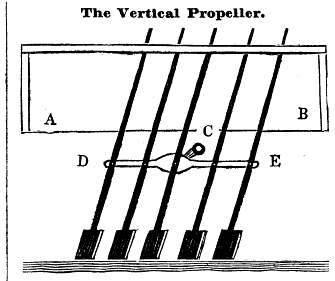
We have alluded to this subject in a former number, and now present one of the several plans which have been introduced within the present year, although we are not fully authorised to give the name of the inventor of this particular plan. We have preferred to represent the paddles and crank unconnected with an apparent vessel or section thereof, but must require the reader to suppose that the line A B is the level of the railing of the boat, and that the crank-shaft E projects from the side, while the crank-pivot governs the motion of the walking bar D E, and with it the paddles, which are supposed to be just now dipping in the surface of the water. It will be understood that the motion of the walking bar being circular, and that of the heads of the paddles being vertical and nearly rectilinear, the motion of the blades of the paddles must be elliptical, inclining to the horizontal; and that the position of the paddles is kept so nearly vertical that they will meet with less resistance in entering or leaving the water than those of a common paddle wheel, while the atmospheric resistance to be encountered thereby is much less. There appears no reasonable doubt that this plan might be made to succeed well on a larger scale, though it is very doubtful whether any of the steamboat proprietors can be persuaded to adopt it until it has been more thoroughly tested by experiment.