Ornamental Kites.
Reading edition
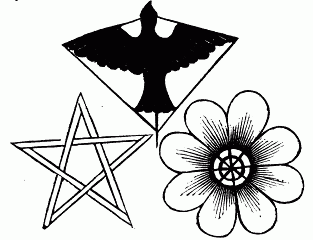
This month being considered as one of the best for flying kites, we may indulge our young friends with an article on that subject. The principle on which kites are made to ascend by the action of the wind, is too well understood, even by children, to require explanation. We shall merely introduce and describe some fancy models of kites, which are not often seen. The pattern, fig. 1, which is the figure called a star, is very easily made. The frame consists simply of the strips, or rods of light wood; spruce timber, willow twig's—and interlocked, as shown in the cut; so that each rod shall pass alternately over and under the other rods at each intersection. These rods being lashed together at the points, the whole frame is covered with white or yellow paper, and the twine is attached to three of the angles of the star.
The eagle, fig. 2, is but little more difficult; a rod extends from the beak to the tail, and is crossed by another which extends from tip to tip of the wings. The rods being lashed together, a small thread is drawn from the place of the head of the eagle, to the two extremities of the wings, and thence to the leeward end of the centre rod. This thread should be white or light blue, and will not be visible when aloft; but the form of the eagle should be made of black, dark or brown paper. The paper eagle must be sewed to the several threads, and two or more threads may extend from the wings to the centre rod to support the feathers of the wings. The eagle kite appears curious, but is not so elegant as
The Rose, fig. 3. To construct this figure there must be four light rods of wood, made to cross each other in the centre, being there lashed together, and thus constituting eight arms. From the end of each arm, a thin strip of light wood or reed, is bent in a curved form to the next arm on either side: the bow being lashed to the arms. This frame is covered with white paper, which is to be afterward colored with rose color, with the yellow centre. The twine must be fastened to four of the arms, and the tail of the kite should be covered with green paper, which by the contrast, will have a pleasing effect.