PART V RELIEF WORK OF THE ASSOCIATED CHARITIES FROM JUNE, 1907, TO JUNE, 1909
Reading edition
PART V RELIEF WORK OF THE ASSOCIATED CHARITIES FROM JUNE, 1907, TO JUNE, 1909
PAGE
I. The Nature of the Cases 281
1. Introductory 281
2. Nature of the Dependency 282
3. Social Character of the Cases 286
4. Occupations of Applicants 294
II. The Methods of Relief Employed 298
1. Reapplications 298
2. Emergent Relief 299
3. Permanent Relief 305
4. Relief Refused 310
5. Conclusions 314
6. The Associated Charities Since the Fire 317
I THE NATURE OF THE CASES
1. INTRODUCTORY
In Parts I and II frequent mention has been made of the important rehabilitation rôle played by the Associated Charities. In this fifth part of the Relief Survey, measure is taken of the burden carried by the Associated Charities for the two years after it resigned as an investigating agent of the San Francisco Relief and Red Cross Funds and took up, with the financial aid of the funds, its independent work of caring for the remnant. The remnant was composed of the people who had suffered from the earthquake and fire but had asked for no help until more than a year had elapsed; of those who continued to need aid because of the extraordinary vicissitudes of their life; of others who had formed the habit of turning to a relief agency for assistance; and of those who required further succor because that given by the Corporation had been inadequate.
The Associated Charities was selected for special study, not only because it had been continuously the agent of the Corporation, but because its work promised to give the fullest answer to the question: To what extent has the San Francisco problem of dependency deepened? This study is, then, in a sense, an exhibition of the aftermath of the great disaster.
The range of the inquiry involved the asking of three questions: First, what was the character of the rehabilitation? Second, how was it done? Third,—a quadruple question,—how much was induced by the disaster itself, how much by the fact of the existence of relief measures the year after the disaster, how much by the administration of these measures, and how much by conditions that tend at all times to produce dependency?
The field of investigation plainly defines itself as: first, to know the number and character of the persons that remained dependent after the fifteen months of conscientious rehabilitation work, and to compare them in regard to number and character with the lesser number of persons that for two years before the disaster were under the care of the Associated Charities; second, to learn what methods of relief were used to render these persons once more effective members of the community; and third, to measure in some degree the efficiency of these methods.
The primary purpose of this study was to learn as far as possible the psychological effects of the disaster by studying a group of refugees who continued to draw on the relief funds after the general public had fallen out of the bread line. It has been impossible, however, to hold strictly to the purpose, because the Associated Charities,[225] in resuming its normal place in the community, aimed rightly to administer to the needs of the city’s poor whether or not the individual applicant could show a relation between his necessity and the disaster. From the point of view of the Associated Charities, all persons applying for aid from June, 1907, to June, 1909, had an equal claim on its funds. Its power of realizing this aim of impartially meeting the needs of the applicants has been limited by the fact that as a society it was known by the public at large, as well as by the direct and indirect sufferers from the disaster, by their relatives, and by their friends, to be acting as the financial agent of a corporation that continued to have large sums of money to disburse.
2. NATURE OF THE DEPENDENCY
The interest in the relief administration centers in the desire to know to what extent it altered the poverty situation of the city. The presumption is, of course, that the work of the Associated Charities and kindred agencies was greatly increased by the disaster, but it is important to get a specific idea of the increase for the two selected years, and to determine what proportion is a distinct result of the social upheaval brought by the earthquake and fire of 1906.
To answer this question required a knowledge of the work of the Associated Charities for the two years before the fire as exact as for the two years under consideration.[226] By one of the most notable incidents of the great fire, the building containing the records of the Associated Charities escaped the flames. These records, no previous study of whose facts had been made, were therefore available. The stories of the applicants to the Associated Charities for the two years preceding April 18, 1906, have been analyzed, and in order that comparison might be possible, a similar study of records has been made of the post-disaster cases.
As the means to aid during the two years from June, 1907, to June, 1909, were drawn almost exclusively from the Corporation and the Board of Trustees of Relief and Red Cross Funds, a statement of the work of the Associated Charities is practically a survey of the further use made of the disaster relief funds.
The Associated Charities, as an independent agent, reopened its doors to applicants on June 17, 1907; but since it had assumed the responsibility before the complete transfer of duties was effected, data are here given for the period beginning June 1. From June 1, 1907, until June 1, 1909, 6,766 applications were made to it in the following order:
June 1, 1907, to December 31, 1907 2,547
January 1, 1908, to December 31, 1908 3,154
January 1, 1909, to June 1, 1909 1,065
Total 6,766
From April 18, 1904, to April 18, 1906, 1840 cases had applied for aid at the office. There was therefore a nearly fourfold increase in applications during the two post-disaster years under comparison. There are no data to show the sequence of increase or decrease of cases for the earlier period. The number of monthly applications during 1908 and 1909 was as follows:
TABLE 96.—NUMBER OF APPLICATIONS TO THE ASSOCIATED CHARITIES FOR ASSISTANCE, BY MONTHS. 1908 AND 1909[227]
Month 1908 1909
January 474 229
February 815 237
March 417 219
April 219 145
May 172 135
June 195 274
July 146 113
August 152 97
September 115 84
October 173 42
November 126 161
December 150 183
Total 3,154 1,919
Although for three of the months of 1909, June, November, and December, there was an increase of applications over the corresponding months of the previous year,—an increase of 41, 28, and 22 per cent respectively,—the work for 1909 as a whole, compared with 1908, decreased 39 per cent.
In relating the facts found in the case records of applicants from June 1, 1907, to June 1, 1909, 815, or 12 per cent, of the 6766 records are omitted,—107 because they were found to be the records of cases belonging not to the Associated Charities but to other relief societies; 606 because they were not relief society records, but were those of cases cared for in the City and County Hospital which for reasons of office organization were, during a number of months of the year 1907, filed with the Associated Charities’ records; 102 because they were too incomplete to give the required data. The facts drawn from the remaining 5951 cases are compared with 1550 cases of the earlier pre-disaster period. Two hundred and ninety cases, or 15.8 per cent, of the 1840 cases of that period (April 18, 1904, to April 18, 1906), had to be omitted, some because they were records of cases handled by other relief societies, and a larger number because the statement cards lacked sufficient data to permit tabulation. The large number of cases marked “Unknown” throughout this study makes it incontestably plain that the records are lacking in many details. Though admirably complete as compared with those before the fire, and much more so during the years 1908 and 1909 than during 1907, yet data have failed with regrettable frequency.
TABLE 97.—ASSOCIATED CHARITIES CASES CLASSIFIED AS HAVING LIVED OR NOT HAVING LIVED IN THE BURNED AREA, AND BY NUMBER AIDED, AND NUMBER REFUSED AID. JUNE 1, 1907, TO JUNE 1, 1909[228]
Classes of applicants Appli- cants aided Appli- cants re- fused aid Total
Applicants who had lived in burned area:
With rehabilitation record 1,309 571 1,880
Without rehabilitation record 1,512 604 2,116
Total 2,821 1,175 3,996
Applicants who had not lived in burned area 1,303 439 1,742
Grand total 4,124 1,614 5,738
One point on which the records in many cases fail to supply information is as to whether or not the applicant had been burned out. In the previous studies of this Survey no division has been made of the refugees into the two classes of those who lived within or without the burned area, because dependency as a result of the disaster was known to be due not alone to having been in the first named class. Since one of the vital points of this study, however, is to determine how much of the relief work of the Associated Charities during the second of the two-year periods was due, directly or indirectly, to the earthquake and fire, an effort has been made to reach the point by dividing the 5,738 applicants about whom the fact was known into two groups: 3,996, or 69.6 per cent, of whom had lived within the burned area; 1,742, or 30.4 per cent, of whom had lived without. The further classification given in Table 97 reveals the interesting fact that a large number of persons who had lived in the burned area made no recorded application for rehabilitation until after June, 1907.
Fifty-three per cent of those burned out, who by June, 1909, had come to the Associated Charities for assistance, first made application for relief needed as a result of the disaster, after the rehabilitation work was done. Many of them had undoubtedly received their share of clothes, had stood in the bread line, and had lived in the camps, but as their names are not on the records of the Rehabilitation Committee they had had, up to the time that they applied to the Associated Charities, no rehabilitation in the accepted sense of the term.
3. SOCIAL CHARACTER OF THE CASES
The social characteristics of these cases are second in importance only to the question of their relation to the disaster.
What do the records show with regard to their nationality, their family relations, their ages, the size of their families, their occupations, and their characteristics in general? What were the disabilities that drove them to ask for help? What proportion of the disabilities from which they suffered can be marked against the rehabilitation methods?
Forty-one different countries, as shown by Table 98, are represented by the persons who made application in each of the two-year periods, and of whom the place of birth was learned.
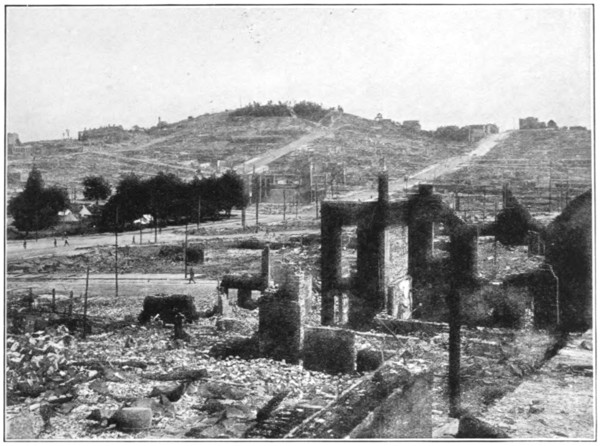
Completely devastated. First tents in Washington Square
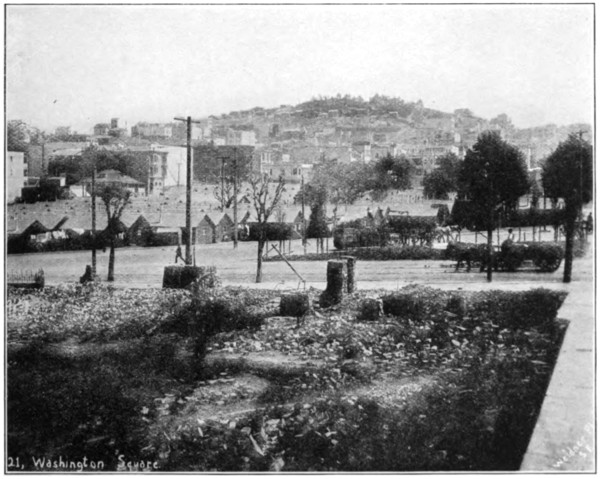
Partly Rebuilt. Cottages in Washington Square
Telegraph Hill and Washington Square
The situation as far as nationality governed application shows but slight variation between the two periods of time. There are, however, a few interesting variations; as, for instance, the falling off in the second period in the number of applicants born in the British Empire, in the Scandinavian countries, and in the United States. Only the Irish and Italians have materially increased their proportionate numbers. Did the relief funds cause this increase, or did the catastrophe bear most heavily on these nationalities? When it is recalled[229] that the Latin Quarter was wiped out and that “South-of-Market,” largely the residential quarter of the poor Irish, was entirely burned, the fire seems undoubtedly to be responsible.
TABLE 98.—NATIVITY OF APPLICANTS FOR RELIEF FROM ASSOCIATED CHARITIES, BEFORE FIRE AND AFTER FIRE[230]
Nativity APPLICANTS OF EACH SPECIFIED NATIVITY
Number Per cent
Before fire After fire Before fire After fire
United States 532 1,933 42.7 37.0
Ireland 135 734 10.9 14.0
Italy 65 541 5.2 10.4
Spain, Mexico and Porto Rico 113 500 9.1 9.6
Germany 118 475 9.5 9.1
Great Britain, Canada and Australasia 113 373 9.1 7.1
Norway, Sweden and Denmark 38 138 3.1 2.6
Finland, Russia, Poland and Armenia 32 150 2.6 2.9
Other countries (24) 97 381 7.8 7.3
Total 1,243 5,225 100.0 100.0
No question is of greater importance than that involved in the relation between relief and the family. In Parts I and II the effort of the Rehabilitation Committee has been shown to have been to limit closely the amount of aid given to single, able-bodied persons and to able-bodied men.[231] This policy is shown in the following table to have influenced the work of the Associated Charities also, so that the widow and the handicapped family received primary consideration in the extended rehabilitation work.
TABLE 99.—FAMILY TYPES AMONG APPLICANTS FOR RELIEF FROM ASSOCIATED CHARITIES, BEFORE FIRE AND AFTER FIRE[232]
Family type CASES OF EACH SPECIFIED TYPE
Number Per cent
Before fire After fire Before fire After fire
Families
(1) Married couples with children 500 2,012 34.2 33.9
(2) Married couples without children 109 522 7.5 8.8
(3) Widows with children 167 1,044 11.4 17.5
(4) Deserted wives with children 53 258 3.6 4.3
(5) Widowers with children 41 144 2.8 2.4
(6) Deserted husbands with children 8 20 0.6 0.3
(7) Divorced men or women with children 26 109 1.8 1.8
(8) Orphan families 10 30 0.7 0.5
(9) Illegitimate families 6 65 0.4 1.1
Total families 920 4,204 63.0 70.6
Detached persons
Men 362 916 24.8 15.4
Women 163 798 11.1 13.4
Total detached persons 525 1,714 35.9 28.8
Dependent minors 16 33 1.1 0.6
Grand Total 1,461 5,951 100.0 100.0
Since the term “families” covers the widest range of variations in social status, it has seemed wise to make the nine family classifications given in the above table. It is plain that the seventh group lacks in value as compared with the classifying of each group separately according to sex. The incompleteness of the records made a separation by sex impossible. The most notable difference in the numbers applying for relief before and after the fire occurs in the case of widows with children. If to the 1,044 widows with children—taking the figures of the second period—be added the 258 deserted women and the 30 orphaned families, all supported by women, 1,332, or 22.3 per cent of all the cases, are shown to be families dependent upon women as breadwinners. If the 798 childless, detached women be added to the 1,332, we have 2,130 women dependents, or 35.7 per cent of those that applied,[233] which must be compared with 26.8 per cent for the period before the fire. The 164 widowers and deserted husbands with children, 2.7 per cent of all the cases of the later period, is a relatively larger number of such cases than is usually found in charity records. The proportion of the group called “illegitimate families” rests upon facts open to challenge as to exactness or completeness. Though the presumption is that the number is too small, 65 such cases for the second period are all that can be proven by the records. The fact that the percentage of applications from single men was less after than before the fire shows that the policy to limit relief given to this class had a deterrent effect. The 49 dependent minors applying to the Associated Charities in the two periods for various reasons were not referred for care to the city’s child-caring agencies.
Of 1,375 married couples who had lived in the burned area 647, or nearly 47 per cent, had a rehabilitation record, while the majority of all the men applying were without such records. By actual count over 80 per cent of the single men who made the first application after June, 1907, had come to San Francisco within the year after the disaster, lured presumably by the expectation of work.
The age of the person entered on the statement card as the main source of support for the family group, has been chosen as the age basis for Table 100.
In the second period of time 55.6 per cent of all the cases in which the age was ascertained were over forty years of age. This proportion falls to 54 per cent when the family cases alone are considered.
From the records for the first period, it was possible to tabulate data relative to the age of the breadwinner for only 661 family groups. In only 175 of these 661 groups, or 26.5 per cent, was the breadwinner known to be over forty years of age.
TABLE 100.—AGE OF PRINCIPAL BREADWINNER IN FAMILIES APPLYING FOR RELIEF FROM ASSOCIATED CHARITIES. JUNE 1, 1907, TO JUNE 1, 1909[234]
Age of breadwinner FAMILIES WITH BREADWINNER OF EACH SPECIFIED AGE
Number Per cent
Under 30 years 682 16.2
30 years and under 35 years 597 14.2
35 years and under 40 years 647 15.4
40 years and under 60 years 1,632 38.8
60 years or over 646 15.4
Total 4,204 100.0
TABLE 101.—AGE OF PRINCIPAL BREADWINNER IN FAMILIES APPLYING FOR RELIEF FROM ASSOCIATED CHARITIES, BEFORE FIRE AND AFTER FIRE, BY FAMILY TYPE[235]
Family type Families for which informa- tion as to age of bread- winner is available FAMILIES WITH BREADWINNER 40 YEARS OF AGE OR OVER
Number Per cent of all families
Married couples with children
Before fire 372 83 22.3
After fire 2,012 946 47.0
Married couples without children
Before fire 84 26 31.0
After fire 522 293 56.1
Widows and deserted women with children
Before fire 135 44 32.6
After fire 1,302 864 66.4
Widowers and deserted men with children
Before fire 34 17 50.0
After fire 164 110 67.1
Other family types
Before fire 36 5 13.9
After fire 204 65 31.9
Total Before fire 661 175 26.5
After fire 4,204 2,278 54.2
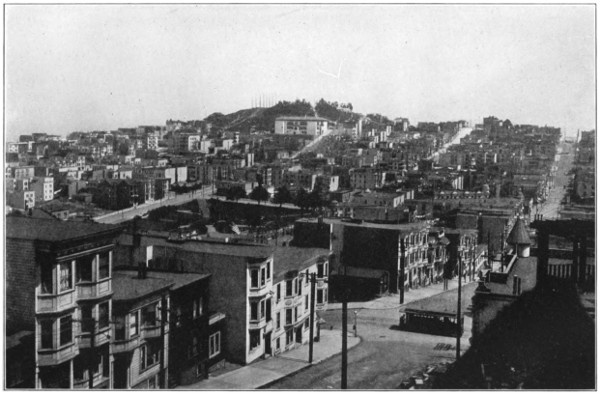
Largely rebuilt. Washington Square restored to park uses
Telegraph Hill and Washington Square
The preponderance of applicants past forty in the second period is not surprising. Given a prosperous community and care in dispensing aid in time of disaster it was to be expected that those approaching middle age would be the ones to apply for and to receive aid.
It is interesting to note whether the strain due to the conditions following the disaster was felt more by the native or by the foreign born married groups.
TABLE 102.—AGE OF PRINCIPAL BREADWINNER IN FAMILIES THAT HAD BEEN BURNED OUT APPLYING FOR RELIEF FROM ASSOCIATED CHARITIES, BY NATIVITY AND REHABILITATION RECORD. JUNE 1, 1907-JUNE 1, 1909[236]
Nativity and rehabilitation record Families burned out for which information as to age of breadwinner is available FAMILIES BURNED OUT WITH BREADWINNER 40 YEARS OF AGE OR OVER
Number Per cent
Native born
With rehabilitation record 558 322 57.7
Without rehabilitation record 473 226 47.8
Total 1,031 548 53.2
Foreign born
With rehabilitation record 966 666 68.9
Without rehabilitation record 1,032 583 56.5
Total 1,998 1,249 62.5
All cases with rehabilitation record 1,524 988 64.8
All cases without rehabilitation record 1,505 809 53.8
Grand total 3,029 1,797 59.3
The answer given by the table is that the foreign born family was older than the native born, whether it had had rehabilitation aid before applying to the Associated Charities or not. The facts indicate that the courage and resourcefulness of comparative youth whether of the foreign or of the native born, tended to make men under forty wait until all other resources had failed before appealing for aid.
The number of children shown in Table 103 gives but the approximate number of living children of the different families. Though data were fairly complete for children, minor and adult, living at home, there were probably many instances in which children who were married or no longer members of the household, were not named on the statement card. The count, however, tells facts sufficiently interesting to a student of dependency to warrant its inclusion.
TABLE 103.—NUMBER OF CHILDREN IN FAMILIES HAVING CHILDREN APPLYING FOR RELIEF FROM ASSOCIATED CHARITIES, BEFORE FIRE AND AFTER FIRE
Number of children FAMILIES HAVING EACH SPECIFIED NUMBER OF CHILDREN
Number Per cent
Before fire After fire Before fire After fire
One 263 1,204 32.4 32.7
Two 205 989 25.3 26.9
Three 150 608 18.5 16.5
Four 85 370 10.5 10.0
Five 58 255 7.2 6.9
Six 26 130 3.2 3.5
Seven 9 69 1.1 1.9
Eight 9 36 1.1 1.0
Nine or over 6 21 .7 .6
Total 811 3,682 100.0 100.0
In the first period only 6 per cent of these families applying had more than five children; in the second only 7 per cent. Seventy-six per cent of the families in each period had three or a smaller number of children. Large families evidently played a small part in the dependency situation. It is true that the cases which presented serious problems of treatment were often those with a large number of children, but the actual number of such cases was small. The high average age of the applicant and the likelihood, therefore, of his having unrecorded children living away from home must, it is reiterated, be borne in mind.
The applicants in 75 per cent of the cases of the second period, mentioned in Table 104, were found to be suffering from two or more disabilities. The classifications were taken from the case records.
TABLE 104.—CAUSES OF DISABILITY AMONG APPLICANTS FOR RELIEF FROM ASSOCIATED CHARITIES, BEFORE FIRE AND AFTER FIRE
Disability CASES IN WHICH THE CHIEF DISABILITY WAS AS SPECIFIED
Number Per cent
Before fire After fire Before fire After fire
Death 31 111 2.0 1.9
Illness 493 1,366 31.8 23.0
Old age 56 344 3.6 5.8
Accident 94 264 6.1 4.4
Unemployment 302 1,532 19.5 25.7
Laziness 26 184 1.7 3.1
Desertion or divorce 90 151 5.8 2.5
Vicious habits 143 295 9.2 5.0
Other disabilities 315 1,704 20.3 28.6
Total 1,550 5,951 100.0 100.0
The largest single disability for the second period was unemployment. Of those who applied to the office between June, 1907, and June, 1909, 1532, or 25.7 per cent, came for the alleged reason that they were out of work. The greater percentage of illness before than after the disaster is also noteworthy. Included in the other disabilities or handicaps that led to application for relief should be mentioned unsanitary surroundings and overstrain, the latter a term used to describe a general break-down of nerve due to the conditions following the disaster. Under the caption “vicious habits” are included all cases in which drunkenness, the drug habit, brutality, licentiousness, or professional mendicancy had played their part in bringing persons to be a charge upon a charity office. Add to those classed as having vicious habits those who were recorded as being lazy, as having deserted or divorced a partner, and 49 of those reported under “other disabilities” who had been neglectful or had served a penal term, and we have a total of 679 persons of the second period who may be said to have come to make application, or caused others to apply, by reason of the effects of wrong living. As this count does not include those whose illnesses resulted from evil practices or those whose unemployment resulted from disabling vice, it is not complete. It indicates, however, that dependency after the fire did not come in an exceptionally large number of cases as a result of evil living. Before the fire vicious habits were reported as responsible for 9.2 per cent of all the cases of distress.
4. OCCUPATIONS OF APPLICANTS
In the table that follows all applicants for relief for the second period are classified by general occupation.
TABLE 105.—APPLICANTS FOR RELIEF FROM ASSOCIATED CHARITIES CLASSIFIED BY GENERAL OCCUPATIONS, AS REFUGEES WITH AND WITHOUT REHABILITATION RECORD, AND AS NON-REFUGEES. JUNE 1, 1907, TO JUNE 1, 1909
Occupation APPLICANTS WHO HAD LIVED IN BURNED AREA Applicants who had not lived in burned area Applicants whose former place of residence is doubtful Total of all classes
With rehabili- tation record Without rehabili- tation record Total
Professional service 44 38 82 45 6 133
Public service 11 7 18 10 .. 28
Personal and domestic service 574 366 940 252 13 1,205
Unskilled labor 255 372 627 288 20 935
Transportation 94 110 204 83 10 297
Trade 172 114 286 109 15 410
Manufacturing and mechanical industries 579 460 1,039 371 30 1,440
Miscellaneous occupations 24 32 56 30 3 89
Unknown 127 617 744 554 116 1,414
Total 1,880 2,116 3,996 1,742 213 5,951
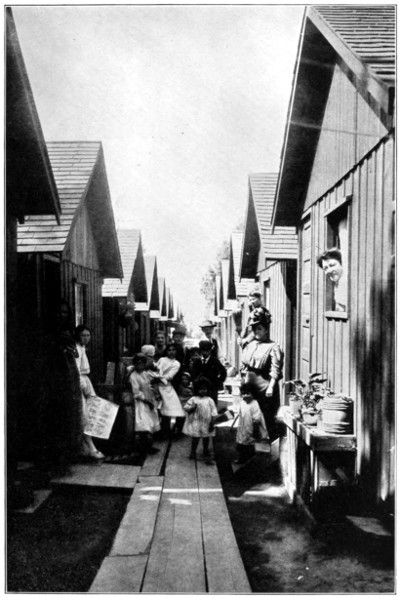
A street, showing close quarters in camp
Washington Square Camp
In between 23 and 24 per cent of the cases, the facts of occupation were not stated in the records. A study of the cases remaining proves how widely need distributed itself through all economic classes in the community. The persons enumerated were engaged in about 200 different callings.
Of the 4,537 persons for whom data concerning occupation were secured, 32 per cent were employed in the manufacturing and mechanical industries, 27 per cent were in personal and domestic service, and 21 per cent were in unskilled labor. The proportion of applicants in trade was 9 per cent and in transportation between 6 and 7 per cent. Less than 3 per cent of the applicants were in professional service or in miscellaneous occupations and less than 1 per cent in public service. Whether considered as having lived within or without the burned area, no striking difference appears in the proportion in each group of occupations.
The facts concerning the occupations of the needy show that the mass of poverty in San Francisco centered, as might be expected, in the same occupations before the fire as afterwards. The data for both periods are presented in Table 106.
TABLE 106.—GENERAL OCCUPATIONS OF APPLICANTS FOR RELIEF FROM ASSOCIATED CHARITIES, BEFORE FIRE AND AFTER FIRE[237]
Occupational group APPLICANTS IN EACH SPECIFIED OCCUPATIONAL GROUP
Number Per cent
Before fire After fire Before fire After fire
Professional service 67 133 6.1 2.9
Public service 13 28 1.2 .6
Personal and domestic service 259 1,205 23.4 26.6
Unskilled labor 243 935 22.0 20.6
Transportation 85 297 7.7 6.5
Trade 107 410 9.6 9.0
Manufacturing and mechanical industries 297 1,440 26.8 31.8
Miscellaneous occupations 36 89 3.2 2.0
Total 1,107 4,537 100.0 100.0
In the two years before April 18, 1906, as in the two years following June 1, 1907, the largest percentage of persons was engaged in those vocations which are grouped as mechanical and manufacturing trades, as unskilled labor, and as personal and domestic service. The proportion of applicants in these three groups combined was, however, smaller before the fire, totaling 72.2 per cent before the fire as compared with 79 per cent in the later period. This is possibly due, in part, to the fact that the proportion of persons whose occupation was unknown was larger before the fire than after. The proportion of demand for help from persons in professional and public service was larger before the fire than after, for applicants in these occupations constituted 7.3 per cent of the cases in the period from April, 1904, to April, 1906, and only 3.5 per cent of the later cases. The disaster only slightly affected the proportion of persons in need who were in transportation employment or in trade. Before the fire 7.7 per cent of all applicants were in transportation employment and 9.6 per cent in trade, and after the fire 6.5 per cent were in transportation employment and 9 per cent in trade.
No specific data as to income are offered, because after some brief experimentation a study of income seemed futile. A person applying for aid may understate his income because he is humanly open to the temptation of trying to make as good a case for himself as possible, or may overstate it because he does not take into account the amount of irregularity to which he as a weekly or daily wage-earner is subject. In about 3000 of the cases in which income data were available for study, the potential earning power could have been in every case safely estimated by the occupations. The income for the average breadwinners, most of them semi-skilled, may be said to have approached during the periods stated the sum of $15 to $20 per week, an amount that represents something near the minimum earning power of the wage workers in San Francisco, a class of persons paid more highly than in any other part of the United States. For instance, among the American families burned out who were given aid, 32 gave their earning power at $10 to $15 per week, 27 at $15 to $20, and 21 at $20 or over.
It is of course of fundamental importance that the relief agent should know the total income of the families or individuals applying for aid. Only by learning what the income actually or approximately is can treatment be made to fit actual need. The record hurriedly written under pressure of work may fail to reveal the facts used by the investigator in determining treatment. The record may not, therefore, show the actual sum of knowledge held and used as the basis for treatment. The record, on the other hand, may be no more meager than was the investigation that it records. In the latter case, investigation, as well as treatment, has been in the hands of an agent who has lacked either time or training, or both, to do work such as is called for by the present standards of adequate case work.[238]
Summarizing the facts concerning the character of the cases and the situation that forced these individuals to seek aid, it would appear that the cases group themselves into three leading types.
1. Dependency because of abnormal conditions.
2. Dependency because disaster had converted semi-dependency into complete dependency.
3. Dependency because character and circumstance, irrespective of abnormal conditions, induced dependency.
It is plain that each group requires a separate treatment and that in estimating the character and utility of the relief measures applied, each class will have to be kept in mind. A conscientious effort was made to find how many of the applicants belonged to both periods of treatment, but the results of the efforts were so inconclusive that they cannot be given.
II THE METHODS OF RELIEF EMPLOYED
1. RE-APPLICATIONS
The preceding chapter makes plain that from June, 1907, to June, 1909, there was made on charity the largest demand in the history of San Francisco, and it seems safe to assert that the majority of those who asked aid would never have done so had they not been suddenly overtaken by the material losses and physical strain of a great disaster.
This chapter deals with the policies and costs of relief and the reasons discernible for refusing aid to applicants.
Any account of relief work, to be satisfactory, must include such a statement of the effect of the relief upon those to whom it was given as will enable the reader to decide how far it was appropriate and sufficient for the need it aimed to supply, how far it was given only to those who could or would benefit by its use, and how far, when refused, it was justifiably withheld. An attempt was made to note the instances in which the work of the Associated Charities could be said to have restored a family to efficiency. Only a case by case re-visit, by Relief Survey investigators, which for the reasons given later it was thought best not to make, would have determined the point for any great number of cases.
Table 107 shows the size of the grants and the number of persons that applied to the Associated Charities after having been under the care of the Rehabilitation Committee before June, 1907.
The largest proportion of the earlier grants was for furniture, which were given, in sums of from $75 to $150, to 905 applicants. The next largest was for general relief, by which 388 applicants were aided, in the greatest number of instances because of sickness.
TABLE 107.—SIZE OF GRANTS MADE BY THE REHABILITATION COMMITTEE, BEFORE JUNE 1, 1907, TO APPLICANTS FOR RELIEF WHO AFTERWARDS APPLIED FOR RELIEF FROM THE ASSOCIATED CHARITIES
Amount of grant APPLICANTS RECEIVING GRANTS OF EACH SPECIFIED AMOUNT
Number Per cent
Under $50 82 4.4
$50 and under $100 420 22.3
$100 and under $150 437 23.2
$150 and under $200 293 15.6
$200 and over 517 27.5
None 131 [239] 7.0
Total 1,880 100.0
There is evidence that 1768[240] persons aided by one group of rehabilitation workers reapplied later to another group.[241] The question that arises is, Why?[242] In reading the records of cases, reapplication cannot be attributed to any one cause. For example, a group of about 60 lodging-house keepers, the majority of whom had been given over $200 with which to establish rooming houses, had to apply to the Associated Charities for aid in untangling their subsequent business difficulties. In a few instances the first grant served as a spur to ask for more; in other instances the amount given was insufficient to accomplish what was intended; in still other instances, failure of health, inability to secure lodgers, rise of rentals, the bank flurry, the unemployment crises, each played a part in inducing a miscarriage in the plan.
2. EMERGENT RELIEF
The relief given by the Associated Charities from June, 1907, to June, 1909, can be divided from the point of view of material service rendered into three principal types of aid:
1. Moving camp cottages to permanent locations.
2. Giving aid.
(a) In sums less than $50, or in kind. (Emergency and temporary relief.)
(b) In the form of care for the destitute sick.
(c) By finding work for the unemployed.
3. Administering pensions and grants.
(a) Grants made by the Rehabilitation Committee previous to the assumption of work by the Associated Charities.
(b) Grants or pensions made by the Associated Charities from money donated by the Corporation on advice of the Rehabilitation Committee.
The first type of aid has been already considered. The aid given in money, other than large grants and pensions, and in kind (2, a), is noted in Table 108.
TABLE 108.—EMERGENCY AND TEMPORARY RELIEF GIVEN IN MONEY OR IN ORDERS BY ASSOCIATED CHARITIES. JUNE 1, 1907, TO JUNE 1, 1909[243]
Nature of aid Number of grants or orders Amount of grants or orders
Food
Groceries 3,526 $10,158.44
Meat 3,519 5,301.90
Milk 2,435 2,877.25
Vegetables 23 32.65
Emergency and food 592 2,094.20
Total 10,095 20,464.44
Household
Rent and furniture 499 6,466.88
Sewing machines 52 1,355.00
Fuel 163 212.35
Total 714 8,034.23
Clothing 212 1,583.37
Lodging 447 639.80
Transportation 27 76.85
Merchandise 718 718.00
Carfare and incidentals 1,042 2,438.57
Grand total 13,255 $33,955.26
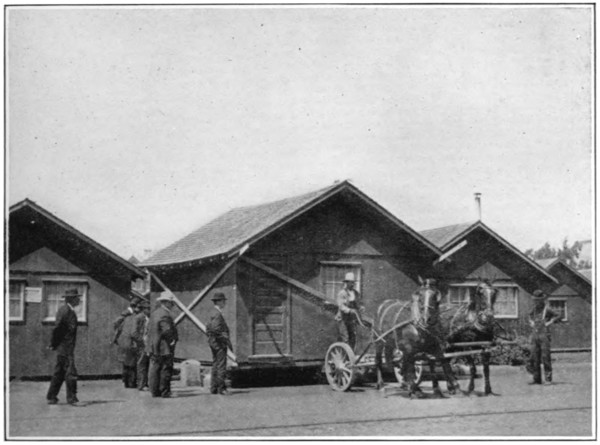
1. The start
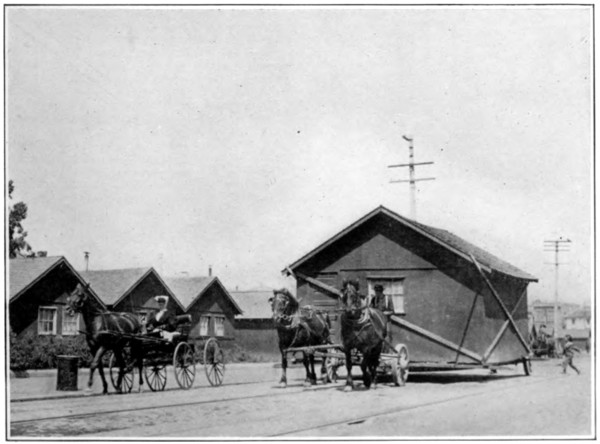
2. Well under way
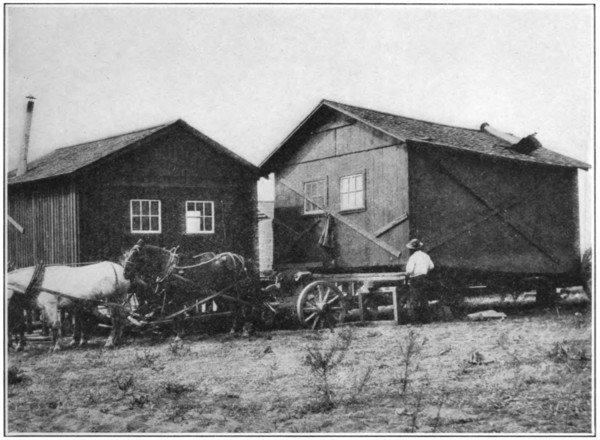
3. Joining two cottages
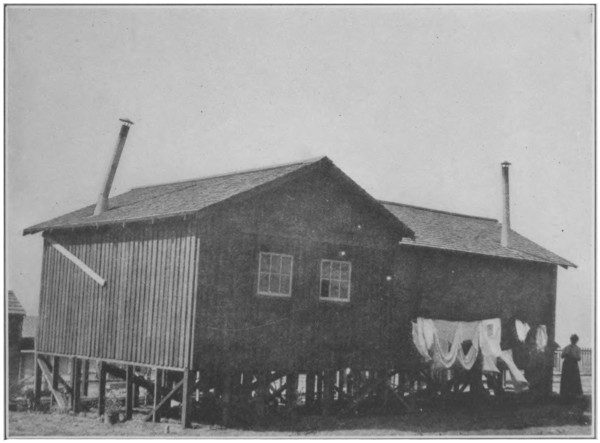
4. The completed dwelling
Removal from the Camp
Most of this relief went to persons who would be dependent on aid in normal times and to the unemployed. The relief for the hungry was given for the most part in the form of orders, which varied in amounts from 10 cents to $10.44. The two items “emergency and food” are classed together under “food,” because they represent temporary aid given to persons whose special emergent need was food, but who had to have coupled with it other necessities. The rent and furniture grants varied in amounts from $1.00 to $75. A small supply of half worn clothing was kept on hand for distribution. This supply was drawn on in some instances; in others, money or an order was given for the purchase of new clothing. Materials for clothing, “merchandise,” were given in the form of $1.00 orders.
The following table shows actual expenditures for medical relief made by the Associated Charities in the course of its case work.
TABLE 109.—EXPENDITURE BY ASSOCIATED CHARITIES FOR CARE OF SICK, IN ADDITION TO AID FROM RED CROSS FUNDS. JUNE 1, 1907, TO JUNE 1, 1909
Nature of aid Number of grants Amount of grants
Glasses 79 $229.73
Ambulance 6 21.00
Hospital 9 118.14
Surgical 23 230.22
Prescriptions at $.25 847 211.75
Prescriptions for larger amounts 1,351 1,181.38
Total 2,315 $1,992.22
In Parts I and II accounts have been given of how the Department of Relief and Rehabilitation aided the hospitals in their care of the sick. To the Associated Charities, however, fell the task of caring for the sick poor in their homes, a task made doubly heavy because of the scattering of the applicants throughout the city. In the table of disabilities, in Chapter I,[244] it has been shown that although the percentage of sickness among applicants was less in the second period than in the first, the number of sick persons to be cared for was much greater. As the expense of caring for the sick in their homes was not made solely chargeable upon the Relief and Red Cross Funds, physicians and nurses having given their services freely, specific enumeration of services rendered to the sick does not belong to this particular study.
The Society’s employment bureau was during the two-year period after the fire in charge of a paid agent, who replaced the volunteers that had been able before the disaster to give but irregular service. As has been shown in the preceding chapter, the community was called on to care for an unusually large number of middle-aged women, widows with children, and aged men. The employment agent had therefore to deal with the problem of the more or less untrained, incapable worker, with whom a regular agency could not or would not grapple.
In looking through the records, applicants were found to have been of all ages, but except during the unemployment crises of February and October, 1908, they were predominantly feminine. In regard to capacity the majority were low-skilled. Among these were the usual types of persons: the willing and able to work, pathetically few in number; the willing but inefficient because too delicate, too refined, or too specialized as to training; and the willing, the eager for employment, who ought to be protected from work. In the last class were not only the obviously incapacitated, but the children under suitable working age and the widowed mothers.
The good social service work done by the employment agent in showing women in what way they could best serve the real welfare of their children and in bringing them in touch with the public and private sources of relief is an interesting and suggestive story, but it is not one that belongs to this Relief Survey, except in so far as it shows that the Associated Charities itself was enabled to do better work for its people after having passed through the ordeal of the rehabilitation work than before the disaster. The fine spirit of independence that drove some to persist in seeking work is illustrated by the following stories.
An Irish widow who had been burned out and who was suffering from incipient tuberculosis applied for work. She consented after much persuasion to go to a home farm near San José, where for the sake of her self-respect she was to do some housework. After a week or more a letter arrived from the perplexed head of the house saying that the Irish woman had suddenly and summarily left with the announcement that she’d “rather die than be so lazy.” She had left to hire out as a cook in a family which was quite unaware of her being tubercular.
Another woman accepted aid to carry out an employment plan which was somewhat opposed to her own. She dropped from sight, apparently having acquiesced in the office scheme. A year later she was found at a different address placidly pursuing, with fair success, the vocation she had been warned not to undertake on account of probable failure through ill health.
A widow in wretched general health who was burned out, had received before June, 1907, in addition to the aid of the camp and bread line, $1.00 for expressage. She came to ask the Associated Charities in the late spring of 1908, for money to go into business. Even the staff, whose policy was to make the largest possible concession to plans made by the applicant, hesitated and proposed that she do something involving less personal responsibility. She refused, so some generous-hearted members of the Rehabilitation Committee interceded for her. Two grants were made therefore, contrary to the judgment of the society’s staff, of $150 and $200 respectively, to be used under Associated Charities supervision for business purposes. In June, 1909, the woman was reported to be dying in a hospital; the business enterprise had failed.
In finding work for applicants a standard rate of wages for standard work was insisted upon. For all work the quality of which was below par by reason of the delicate health, relative inefficiency, or character defect of the applicant, the employer was left to settle terms with the employe. The greater number of women were given the only employment of which the average untrained middle-aged woman is capable; domestic work, “day’s work,” and house cleaning were paid for at prices ranging from $1.50 per day to $2.00 per day, plain sewing at $1.60 per day, care of the sick at $10 per week.
The two periods of unemployment which came in February and October, 1908, and which came as an indirect result of the disaster, brought heavy problems.
On February 5, 1908, arrangement was made to give work to unemployed men. It was decided that work orders should be granted to those applying, preference being given to men with families. From February 5 to March 26, 1781 work orders of three days each were given, a total of 5343 days’ work. As there were a number of repetitions, 1781 work orders represented about 920 men at work during the—approximately—six weeks. The majority of the men were untrained. One hundred and ninety-eight who had training were classified as follows: Bricklayers and stone masons, 7; electricians, plumbers, machinists, and engineers, 44; upholsterers, 2; watchmakers, 3; painters, 11; butchers, 5; cooks and bakers, 13; carpenters, 74; teamsters, 22; clerks and bookkeepers, 17. About 15 per cent of the 198 were members of unions. Most of the applicants had large families dependent upon them. As they were chiefly men newly arrived in San Francisco who expected to profit by the demand for labor created by the rebuilding, they were in reality not a fair charge on the relief funds. Their only relation to the earthquake and fire was the fact of their having been attracted to the city after April, 1906, by what proved to be in their case a Will-o’-the-wisp. The Porto Ricans and the Russians lead in the number of those who had come to San Francisco after the fire, and these are followed in point of numbers by the Mexicans and the Spanish.
As to the kind of work provided, four plumbers, six carpenters (all union men), and some of the laborers were set to work on the camp cottages. Seventeen of the carpenters were given work on the new Associated Charities building then in process of construction. Other groups were given work by the Corporation in repairing the almshouse road, in taking apart buildings at Stanley Place, South Park, and Lobos Square, and in loading wagons with warehouse supplies to be taken to the Relief Home. At this time and in the similar crisis in October, preference was given to family men. The payment was made either in money, or in kind; sometimes in both. Ninety-seven per cent of the men were paid at the following rate for three days’ work: Meat order, $1.00; grocery order from the store room of the Associated Charities, $3.00; and cash $.50. In some few cases, to those who were sent to work on the almshouse road, carfare also was given. As the Associated Charities purchased all groceries at wholesale, it was able to give four dollars’ worth of groceries for the three-dollar order. Men with large families, if they had no other employment were allowed five days’ work each week instead of three.
In October, 1908, about one-third of the men given employment were put to work upon a temporary tuberculosis hospital which was being built at the Ingleside Track. Four hundred and forty-two dollars in labor was paid for building four large wards, a diet kitchen, medicine closets in each one of the wards, and the bath and toilet rooms. Two-thirds of the men worked either at the almshouse or at the quarry which was started and run for several weeks by the Associated Charities. Many of the men, however, resented being put at quarry work which they considered belonged to convicts. Their dissatisfaction, the physical inability of a large number of them to do such heavy labor, and the inclemency of the weather, which caused the work to be intermittent, made the experiment one that can not be classed as a notable success.
To carry on this work for the unemployed the San Francisco Relief and Red Cross Funds made during February, March, and October, 1908, three appropriations of $5,000 each. Of this amount, $14,105.26 was expended in wages or equivalent aid to unemployed men and their families.
3. PERMANENT RELIEF
The work of relief was carried on with most care in the case of those applicants to whom money had been given in sums of over $50, in some instances in one grant, in others, in the form of pensions. Though numerically of relatively slight importance, these cases occupied so much of the attention of the force that they may justly be taken as most representative of policies and accomplishments. The amounts of the gifts are shown in Table 110. The grant was made most often to the family whose dependence was a result of the abnormal times.
TABLE 110.—GRANTS AND PENSIONS OF $50 AND OVER GIVEN BY THE ASSOCIATED CHARITIES[245]
Amount of grant or pension Grants or pensions of each specified amount
$50 and under $100 28
$100 and under $150 55
$150 and under $200 47
$200 and under $250 48
$250 and under $300 8
$300 and under $350 11
$350 and under $400 4
$400 and over 4
Total 205
The disaster case has many variations, but the common mark is that the applicant is thrifty, in fairly good health, and capable of self-support. Adventitious circumstances brought a reduction or a loss of income. With rare exceptions, when the grant was sufficient the family became entirely self-supporting. The policy of the office was to find what had been the former standard of living, and to aid so that not only would the same standard be maintained but a higher one if possible attained. The two cases that follow illustrate how in 18 or more cases a grant of from $75 to $500 gave the aid needed to make a fresh and successful start.
A peddler of imported linen goods, in poor health, with a wife also in poor health, and four children under fourteen years of age, who had been burned out, asked for no aid until 1908. He believed he could do without help, but when the wife became very ill the man knew that he must appeal for relief. He was granted at once $250 to purchase a stock of goods, though his plan for resuming his old business was vague. For about three months, as the family seemed able to care for itself, the case was not held under treatment. Then the wife died, leaving the man as sole caretaker of four ill children. The children, three suffering with typhoid fever and one with tuberculosis of the hip, were sent to a sanatorium and a grant of $150 was secured, which was supplemented later by a grant of $300. A large part of these two sums was spent for hospital treatment, but the remainder was invested in getting the man to make a fresh start at his old business of selling imported linens. When the family was revisited in June, 1909, the man’s sister-in-law reported him as making a good living. Having employed a housekeeper, he was able to keep his children properly and to give them a suitable education. This expenditure of $700 lightened burdens brought alone by disaster and illness.
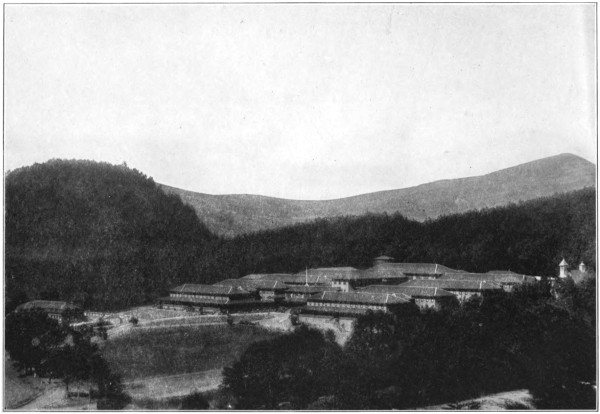
Home for the Aged and Infirm (the “Relief Home”)
An American widow fifty-nine years of age, with a daughter of forty stone deaf and in ill health, and the daughter’s three children under thirteen, had kept a boarding house before the fire in fairly comfortable quarters in one of the busier districts of San Francisco. The daughter, separated from her husband, an inebriate and a gambler, was entirely dependent on her mother. With high courage the fine woman planned to rent and furnish a hotel in one of the smaller watering places of the state. The Rehabilitation Committee gave her $400 for the purpose. The venture failed, so two years later she applied to the Associated Charities for rehabilitation. She was given $200 with which to move the furnishings saved from the first venture to a suburban town, where she now has a successful rooming and boarding house. She is valiantly carrying her own burdens.
There are some 20 or more cases whose success is dubious, because the money was used for purposes for which it was not intended; because the plan to keep a domestic group intact through the expenditure of a large grant was frustrated; or because defective character balked the rehabilitation plans. In most of these cases the investigation failed to unearth characteristics or resources which, if discovered, would have made a flat grant unnecessary or undesirable.
Pensions were granted of course for several different ends. In a good many instances they were given primarily to tide a family over the period during which one of the younger members was being given a good business training so as to be prepared to undertake the chief support of the group. These so-called “scholarship” grants had definite and satisfying results. A typical case will illustrate the method.
A Mexican seamstress of thirty-five and her three orphan sisters were living together at the time of the disaster. One of the sisters, aged thirty-three, had to be sent afterwards to a hospital for the insane. A married sister, aged thirty-four, with a child of three years, was deserted by her husband the day of the earthquake, and had to place the child in the Orphans’ Home. The deserted wife assumed charge of the household, and the two young sisters of fifteen and thirteen who were markedly intelligent were kept at school. The seamstress was very proud of her young sisters, so she borrowed $20 from a woman who worked in the same factory with her in order that she might send the elder to a business college. Later when taken ill she found herself in debt and unable to carry out her plan. She then applied to the Associated Charities and was given two grants of $75, one for general relief, the other to keep the girl in the business college. The girl graduated and her knowledge of Spanish and English then enabled her to get a specially advantageous position. All the sisters are the better for the grant which raised their social status.
The pension was given most often to persons who, because of the catastrophe, fell into dependency from which, unaided, it was impossible for them to extricate themselves. The unanswered question in connection with these pension cases was: What sum of money, in San Francisco, constituted an adequate monthly sum for the support of a needy family? If a semi-dependent, how much should have been spent before it could be proven whether the power of self-support was latent or was lacking? No one knew, as the community’s best practice furnished no guide. The Rehabilitation Committee and the Associated Charities acted on the general principle of granting such pensions as they felt they could afford. The Associated Charities hoped, moreover, that if the sum of $15 to $25 given as a pension were not sufficient, the usual neighborhood help would gradually develop so as to eke out the amount given. The pensions were most often given in the form of money, but in some cases in weekly food orders. The following pension case is illustrative:
A Greek aged thirty-five deserted his wife and five children under thirteen years of age at the time of the fire. Before the disaster the family was known to the Associated Charities as one in which the man was not meeting his responsibilities. The oldest child, a boy, was a decent, serious little chap; the second, also a boy, was so wild that he had later to be sent to a reformatory; and the three youngest were sickly, weak-eyed little creatures. When the woman made application immediately after the disaster she was given $75 for clothing. She was lost in the big body of refugees, but when found again in the fall of 1908, though pitifully destitute, was making a brave effort to support her children. The eldest boy was given a position as office boy at the Associated Charities at $4.00 a month, a baby from the children’s agency was put to board in the home at the rate of $11 a month, and $150 was appropriated, to be given in monthly sums of $20. With this monthly income of $35, $10 of which went for rent, she was enabled, having judgment in expenditure, to get along.
As is brought out in Part VI, an unusual number of old people had been thrown on the community for care. To some of these, who were invalids, pensions were given so that they need not go to the Relief Home.
In the two-year period covered by this study, from June 1, 1907, to June 1, 1909, the total receipts of the San Francisco Associated Charities amounted to $252,046.75.[246] As has been stated above,[247] this money was contributed almost exclusively by the Corporation and the Board of Trustees of Relief and Red Cross Funds. The Associated Charities disbursed, in the period dealt with, $236,303.72,[248] of which sum $180,577.78, or 76.4 per cent, was expended directly on relief work, and $55,725.94 was expended on salaries and other administrative expenses.[249] The expenditure for salaries amounted to $41,560.21 for the period,—a monthly average of $1,351.80 for the last seven months of 1907, of $2,023.19 for the year 1908, and of $1,563.86 for the first five months of 1909.
Data are not available for a complete classification of disbursements according to the nature of the relief afforded. It is impossible to state separately the expenditure for the purposes termed in this Part “emergency and temporary relief” and “aid given the unemployed.”
It appears from data available that there was a total expenditure by the Associated Charities for housing, from June 1, 1907, to June 1, 1909, of $59,556.06.[250]
4. RELIEF REFUSED
The policy behind a refusal to aid measures the quality of relief as well as the policy which shapes giving. The cases to which material aid was refused have therefore been segregated and an attempt is here made to state what the records show concerning the basis and utility of such refusal. It will be remembered that 5951 cases applied for relief and that 1704 of these were refused aid. The following table gives the number refused who had or who had not lived in the burned area and the number who had not made application for rehabilitation aid before June, 1907.
TABLE 111.—APPLICANTS FOR AID FROM THE ASSOCIATED CHARITIES TO WHOM AID WAS REFUSED, CLASSIFIED AS HAVING LIVED OR NOT HAVING LIVED IN THE BURNED AREA. JUNE 1, 1907, TO JUNE 1, 1909[251]
Classes of applicants APPLICANTS REFUSED AID
Number Per cent
Applicants who had lived in burned area
With rehabilitation record 571 35.4
Without rehabilitation record 604 37.4
Total 1,175 72.8
Applicants who had not lived in burned area 439 27.2
Grand Total 1,614 100.0
It must be borne in mind that the total number of applications made to the Associated Charities on the part of applicants who had been burned out was, 1,880 by those who had had a rehabilitation record before June, 1907, and 2,116 by those who had had no such record. The percentage of refusals is seen to be, therefore, very nearly the same,—about 30 per cent of refusals for the first class, 29 per cent for the second.
Although many of these applicants had rations until, and shelter perhaps for months after they had secured work, to refuse further aid to 1,175 applicants burned out, or 29 per cent of those who made application from June, 1907, to June, 1909, called for an exercise of courage and a holding firm to the well-defined principles of the relief administrators.
The following criticisms are typical of those that had to be answered:
A woman prominent in labor circles, speaking of a rejected case, said to one of the managers of the Associated Charities and voiced a rather widespread sentiment: “I can’t see the justice of this picking and choosing. My friend was burned out and was just as good as some of those who received help—and there was plenty of money! Who was it for, if not for the refugees?” Another in writing to the office said: “Mrs. X—— is old and ought not to have to work any more. Surely some of that relief money can be found for her.” The bitterness of the refugees themselves made, however, the loudest plaint in the chorus of discontent.
Two classes then, in one or other of which many San Franciscans are today, quarreled with this policy of investigating the claims of the refugees; on the one hand, those who held theoretically that all who had felt the blow should, if they asked, receive help; on the other, those who held concretely that they themselves, having been losers, had a “right” to a portion of the relief fund.
The natural desire to give generously to the limits of one’s capacity, especially to those whom disaster has robbed of competence, is what constructive charity work always has to face from those who “cease not to give without any regard.” As years make it possible to view without prejudice the aim and result of the more cautious, less emotional policy pursued, it seems demonstrable that time will vindicate the much criticized deliberation of the Rehabilitation Committee and the Associated Charities. As has been considered in Part I, the extent of need and of the sum to meet it were both unknown, and what was foreseen happened,—that a portion of the fund was needed to be held in reserve for those who at first courageously refrained from asking help, but who as the strain proved too great necessarily appealed. The dual risk of giving to the sham refugee and of carrying the man who could help himself and who was inclined to lean on relief could only be avoided by careful investigation and treatment, even though both raged at the refusals of an “unjust” committee. The final argument is that no relief should be so generous as to dry up the normal sources of aid in a community. That aid is wisest which rouses all the neighborhood and civic sources of help into effective action.
It is undeniable that the records show a certain number of persons to have been refused aid who seemed as entitled to help as some who by influence or persistence got at least a minimum. “Influence” is used with no invidious intention. In San Francisco as in every other community a certain number of wholly disinterested persons bear an enormous share of the burden of the charity work. When these asked aid for a case and gave their word that it was deserved, it was difficult, often impossible, to deny the aid. The Associated Charities did give help in a good many instances where in its own judgment aid could have been refused and the cases left for reconstruction to neighborship and individual capacities. Table 112 shows the causes for refusal to aid.
The first three reasons for refusal and the ninth and tenth could be brought under the heading “thirst for relief money,” and make the total for the type, 516, or 30.3 per cent of the refusals. The attitude of mind was expressed collectively by the naïve Italian woman who said frankly that she “thought they could get something nice,” and by the Irish woman who said with equal naïveté “they could get something for the asking.” The 77 applicants who asked for money for purposes of relief no longer being granted, asked aid too late for the building of a cottage or for the moving of a house or for furniture. Twenty-seven of these had not been burned out, and about two-fifths of the remaining 50 had had rehabilitation before June, 1907.
TABLE 112.—REASONS FOR NOT GIVING AID FROM ASSOCIATED CHARITIES TO APPLICANTS
Reason for not giving aid APPLICANTS WHO HAD LIVED IN BURNED AREA Applicants who had not lived in burned area Applicants whose former place of residence is doubtful Total
With rehabil- itation record Without rehabil- itation record
Applicant merely seeking more relief money 54 36 21 3 114
Applicant has already had as much money as is justified 29 4 1 .. 34
Applicant able to get along without help 143 149 61 15 368
Applicant has relatives who can help or have helped 27 54 30 2 113
Money no longer given for use desired 19 31 25 2 77
Applicant would not accept aid offered 24 27 11 3 65
Applicant’s plan unpracticable 19 14 26 1 60
Applicant withdrew application 25 30 43 5 103
Case reported without knowledge of applicant 10 3 13 8 34
Pauperization feared 7 3 3 .. 13
Applicant a professional beggar 31 14 11 2 58
Applicant lazy 4 12 4 .. 20
Applicant vicious 5 11 8 1 25
Applicant a drunkard 34 17 4 3 58
Applicant unthrifty 3 11 4 .. 18
Applicant could not be found 13 40 36 14 103
Aid received from other sources or case referred to other societies 53 68 73 19 213
Disposal of application not known 71 80 65 12 228
Total 571 604 439 90 1,704
In reading some of the cases of families burned out who had no rehabilitation record in the group of 368 “able to get along without aid,” the question often mooted was, “If these were not given, why were others?” This may be a feeling, not a judgment. It is probable that the records, though relatively complete, do not tell enough to permit a fair judgment, but it is one of the regrets of the analyst of these cases that in justice to the difficulties of the current work they could not be re-visited. The protest of the office was that re-visits would stir a whole neighborhood to descend upon it again in hope that there was a little more money to be distributed,—a protest voiced concretely by one visitor, who said, “We can scarcely be seen to pass along the street in a given neighborhood without receiving calls a few days later from people eager to know if there is any more relief money to give away.” The objection, based as it was on a recognition of human frailty, had to be respected. Other objections given to a re-visit were that some persons would be found to be so disgruntled that a fair statement could not be got from them; that others were too stupid to understand the questions or too indifferent to care to answer them. An attempt to re-investigate any of these groups would fairly seem to have been a waste of effort and money.
The small number, 13, refused on the ground of fear of pauperization may raise a smile, but the heading is a reflex of the dread in the minds of some of the visitors. “This is a very decent family who have never had aid,” writes one of the visitors, “and I do not think it well to begin for fear of pauperizing them.” It is noteworthy that of the 58 refused as “professional beggars,” 45 had lived in the burned area and of these 31 had rehabilitation records; that of the 58 refused on account of alcoholic habits, 51 had lived in the burned area, 34 of whom had a rehabilitation record. Whether these refugees had acquired the habits of begging and of drinking after the earthquake experience is not shown by the records. The individuals in these last two groups, many of whom were members of families, needed much more than they asked for, but the thorough investigation and constructive treatment they should have received could not be meted out to them at a time when material assistance was the overwhelming issue.
5. CONCLUSIONS
Positive questions have been asked; they have received but few definite answers. It is easy to question, but hard to answer positively, when past efforts are but meagerly recorded, and present efforts are too fresh for an accurate measure to be taken of their results. It is a simple task theoretically to define a line of inquiry; it is a complex one to separate human beings into classes and to determine just what circumstances of character and condition forced each into his appropriate place.
The notable facts for the inquirer as to the effect of the disaster upon the dependency situation are these: There were a little over three and one-half times as many applicants for aid at the Associated Charities during the two years from June, 1907, to June, 1909, as in those from April 18, 1904, to April 18, 1906.
It is not as plain as could be wished how many of the 3996 applicants to the Associated Charities who had lived in the burned area were charges on public or private charity before the fire, or would have become so in any case. The point seems hardly demonstrable.
What is plain beyond question is that the disaster brought for the two years a burden of dependency of over three times the ante-disaster proportions. What is not so plain is how far the relief funds swelled these proportions.
As to results, the records prove some definitely successful instances of aid given. Health restored; financial independence regained by the capable, temporarily dependent; and relatives or friends found to support dependent adults and minors, are achievements cheeringly demonstrable in 25 per cent of the cases.
A relief fund whose amount was fairly adequate to meet the need has had one patent result. A number of persons tottering toward dependency by reason of the failing health of a breadwinner, of a wife, or of children, who in ordinary times would not have been helped in San Francisco, at the right moment received the inspiration of friendly visitors and the instruction of trained nurses. The intellectual and physical care added to the material combined to stay deterioration, and in some instances to raise standards.
The more insistent call of the children for protection because of the demoralizing effects of the camp life brought response from the Associated Charities, which through its children’s agency found for each defenseless child a protecting friend, a foster home, or when nothing else was available or suitable, an appropriate institution.
For the remainder of the cases, results lie less within the range of demonstration. This much is certain; there was neither impulsive nor indiscriminate giving. Though the amount that was spent, inclusive of administration expenses, totals for the period from June 1, 1907, to June 1, 1909, a sum of $236,303.72, yet the first feeling on reading the history of the treatment of the average case was rebellion that in so many instances such niggardly doles had been given. When, as was of course true of adult dependence, the aim was restoration of financial independence, the means granted often seemed insufficient to warrant any hope of success. After this feeling has been for six months tried in the crucible of a careful investigation of the facts of cost of living[252] and habits of spending among persons of low income, it still seems not without foundation.
One result of the disaster and of the use of the relief funds is the notably increased efficiency in relief work in San Francisco. Out of the widespread experience born of and bred by facing a large and varied round of relief problems, comes the first gain. While it is incorrect to say that San Francisco had no poverty in the days before the fire, it is true that the mass of those seeking aid were dependents because of unemployment and ill health, both due in many cases to ignorance or to vicious practices. The problem of destitution involved in the care of this type of cases does not stimulate a worker to any such broad and aggressive social policies as those which he must meet when handling the cases of capable and nearly self-directing people whom circumstances alone, loss of occupation, insanitary conditions, new situations, force to seek aid and guidance. Add to this fact of greater experience, that the relief funds enabled the work to be carried by a staff of visitors more nearly adequate than before the fire to meet the demand for investigation and treatment. Add the further fact that there had been enough not only to pay for relatively efficient office service but to give aid of a kind approximately sufficient. In a summary of these three gains will be found in part the value to the Associated Charities of San Francisco and to the people it serves of having been selected as the final agent of the San Francisco Relief and Red Cross Funds will in part be clear.
6. THE ASSOCIATED CHARITIES SINCE THE FIRE
When the Associated Charities set up its own office in June, 1907, the allowance of money made to it from the relief fund enabled the society to form a staff of from 12 to 15 experienced workers; to institute a division of labor among the office force which had never before been possible; to announce the formation of a new department, namely, a civic relief bureau; and to undertake to deal in a thorough-going way with all cases handled by this bureau, obtaining employment for applicants when necessary, and giving whatever relief might be called for by the exigencies of the case.
The co-operation of the Associated Charities with all the other philanthropic agencies of the city has been made much closer by the fire. In working together shoulder to shoulder under the Relief Corporation, the philanthropic agencies of the city became well acquainted with one another and the way was paved for important working agreements.
One such working arrangement is that by which various children’s institutions make use of the placing-out department of its children’s agency. During the years 1907-1909, 212 children were taken from orphanages and placed in family homes. Curiously enough, only four of these were children of refugees. The work of the placing-out department in 1909 was double what it had been before the fire.
The children’s agency has another department which demands mention here, because as a result of the disaster its work has also been doubled. This is the boarding-out department. Its expansion is due to two causes. On the one hand, children’s institutions could accept fewer children, having been cut down in capacity by their material losses; and on the other, there had been an actual increase in the number of foundlings, illegitimate infants, and children requiring protection. The records of the juvenile court for 1907-1909 show that 29 per cent of dependency cases came from residents of public camps. The boarding-out department of the Associated Charities had some of these to provide for. Among the candidates for public care were the children of ten insane mothers and the infants of ten unmarried mothers whose plight was thought to be directly traceable to the situation after the fire.