PART IV HOUSING REHABILITATION
Reading edition
Part IV HOUSING REHABILITATION
PAGE
I. General Plan of Housing Work 215
1. Introductory 215
2. Retrospective 216
3. The General Plan 218
II. The Camp Cottages 221
1. General Cost 221
2. Families Occupying the Cottages 223
3. Wages and Occupations 226
4. Housing Before and After the Fire 229
5. Two Cottage Settlements 234
6. Brief Comments 237
III. The Bonus Plan 239
1. The Plan Itself 239
2. Bonus Recipients 240
3. Occupations and Resources 244
4. The Houses—Character and Cost 248
5. Brief Comments 251
IV. The Grant and Loan Plan 253
1. The Plan Itself 253
2. Relation Between the Department of Lands and Buildings and the Housing Committee 256
3. The Number Aided and the Cost 257
4. Families Making Use of the Grants and Loans 259
5. Occupations and Resources 262
6. Housing Before and After the Fire 266
7. Status of Loans in 1909 and 1911 and Additional Aid 271
8. Cases of Expensive Building 273
9. Brief Comments 276
General Conclusions on Housing Plans 277
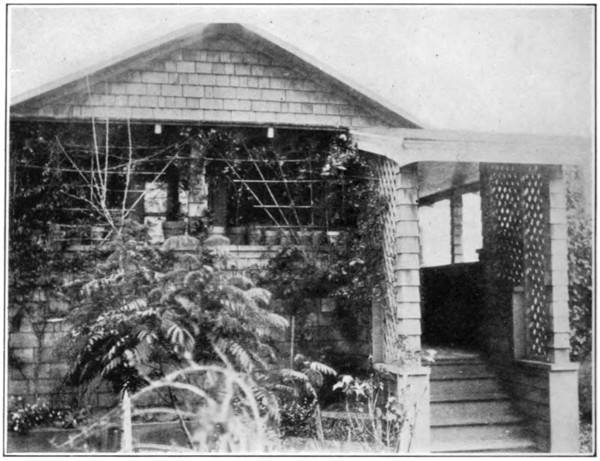
In the land of flowers
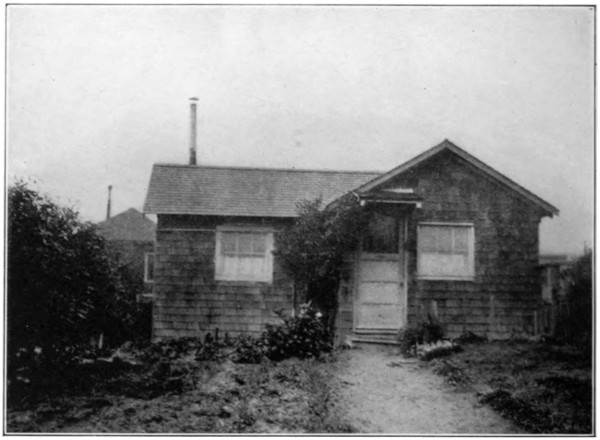
A simple but cozy home
Cottage Homes a Year after Removal
I GENERAL PLAN OF HOUSING WORK
1. INTRODUCTORY
A specific housing study was undertaken as one feature of this Relief Survey in order to ascertain the extent and character of the destruction of homes, to review the efforts made to furnish temporary shelter, and the policy and methods followed in the administration of the relief fund for building purposes. Some effects of the disaster upon the applicants were studied and the results recorded.
An attempt was also made to combine with the more specific study a consideration of the social status of each family, the occupation and earnings of the breadwinner and of other members, and certain facts relating to race characteristics and to rent expenditures. The investigation was begun in August, 1908, by a force of field workers who during the following three months made visits to the families and from personal interviews and corroborating inquiry obtained all or part of the information desired. The time intervening between the fire and the close of the study was therefore about two and one-half years. Though the city was by no means entirely rebuilt at the time of the study there was a demand for and a supply of labor which was in a large measure normal. Those who had received aid from the relief funds to rebuild had had time to consider what their permanent housing policy should be and, in the majority of cases, had made determinate plans.
The general plan of the study was to secure information for three specific periods: for the time immediately preceding the earthquake, when it was assumed that conditions were normal; for the interval between the disaster and the time the applicants built and occupied their new homes, when conditions were abnormal; and finally, for the period covered by the investigation, when most of the applicants had been living for some time in their new homes, and when conditions were again relatively normal.
Easy access was had to the fairly complete minutes of the various committee meetings, and to the numerous and well-arranged letters of instruction written by those who had charge of the housing work. Records had been kept of every case aided, showing the nature, extent, purpose of the grants, and the date at which the relief was given. This material, together with reports of the auditor of the Corporation and extensive files of newspaper clippings, was available for this study.
2. RETROSPECTIVE
There was delay in carrying out any comprehensive plans for housing because, as has been told,[168] emergency needs had first to be met, and because when the complex relief organization had taken shape, rehabilitation was halted by the action of some of the eastern donors to the funds. Another delaying element was the expectation that the national government might be persuaded to place large deposits with local banking houses, which might become available, on easy terms, for building purposes.[169] To this end a delegation of San Francisco citizens visited Congress to discuss the plan with the members. After careful consideration by financiers and those socially interested, the plan was decided to be impracticable.
When the Department of Lands and Buildings began to work it needed large quantities of lumber, but private interests had quickly purchased, at the excessive prices asked, the large supply which had been brought to the city. The Department was obliged at the beginning to secure from outside firms an option on 3,000,000 feet of lumber and a proportionate number of shingles. The option was secured at reasonable terms and the lumber was speeded to the city by steamers; but so great was the demand for teamsters that men had finally to be brought from nearby cities and towns to transport it to the building sites. Many planing mills had been destroyed, and those running were so crowded with private orders that the Department to avoid great delay had to erect two planing mills. These mills caused a saving not only in time but in expense.
The difficulty of securing reliable contractors was increased by the number of private orders received by the local firms, so that additional contractors had to be secured from adjacent cities. The expense of construction was increased still further by the abnormal prices asked for labor. The destruction of deeds and other evidences of title; the difficulty and expense of re-surveys; the perplexity in trying to locate building sites because of the uncertainty as to whether certain parts of the city would in the future be used as business or residence sections; the tardiness of insurance adjustments and the repudiating of liability by not a few companies,—these factors combined to retard the work and increase the cost of building.
In Part I[170] a brief account is given of the first efforts made by the Department of Lands and Buildings to provide permanent cottages for some of the refugees. As soon as it became known that building was to be begun on a large scale, various real estate firms with vacant lot holdings came forward with proposals to sell, lease, or rent to those in charge of the relief fund. A typical proposition by a large real estate company provided for the erection of 3,000 or more houses, to be well equipped with sanitary plumbing, to be placed on graded grounds, and to be supplied with an adequate water system. The price of each house, complete, was to be $1,506. An objection raised against this and similar schemes for re-housing was that large tracts of unimproved land were as a rule situated in outlying and inaccessible districts. Practically all of those who were seeking shelter had formerly lived near the business center of the city, many at least within walking distance of their places of employment. They naturally had no desire to take up permanent residence in an outlying district where excessive expenses would have to be incurred. All plans, whether submitted in good faith or not, that seemed to be based primarily on a desire for personal profit were wisely rejected by the Department.
The proposition was not only seriously considered of aiding on a large scale the applicants to build, but steps were taken towards the purchasing, leasing, and renting of lots. Inspectors located all available vacant lots and tracts of land within the city, and experts determined their value. But as all such property was shown to be too unsatisfactorily situated to justify a large expenditure, it was decided after further discussion not to purchase, lease, or rent any lots, but to confine activities either to erecting houses or to aiding those needing help to construct their own. A further reason that led the Corporation to withdraw the plan was that to carry it into effect would require the Corporation to exist for five years at least, and probably longer.
The Department considered the possibility of purchasing ready-built houses, for example in Michigan, to be shipped to the city in sections. A few such houses, as an experiment, were bought and set up on vacant lots. Objections to the purchase of such houses were that the workmen of the city, whose number was increased by the influx of outside workers, needed to be employed as builders, and that large supplies of lumber were soon to be available. The plan was quickly abandoned.
Though the general theory that people should be aided only to regain their former standard of living was one that played an important part in determining the question of shelter for the individual family, the desirability of not restoring former bad housing conditions necessarily meant that in many cases a family could be encouraged, by promise of aid, to build and maintain a home of its own which would be much superior to the quarters formerly occupied. The opportunity which the city had to prevent the return of its people to undesirable homes was to be determined, as far as the applicants for shelter were concerned, by the work of the Department coupled with the applicant’s readiness to make beneficial use of better conditions of environment.
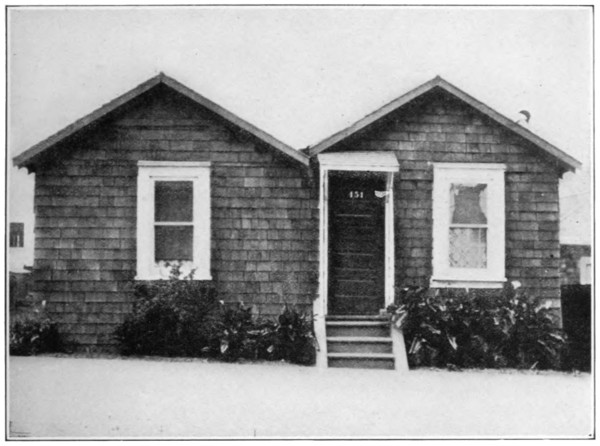
Substantial and weatherproof
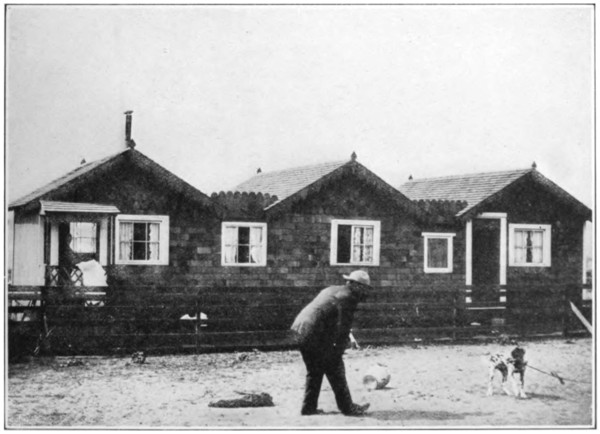
Commodious and attractive
Homes from Camp Cottages
3. THE GENERAL PLAN
Any adequate plan for housing had to make provision for four classes of people. First, the property owners, who had in the past acquired some property within the burned district, should be helped to their feet again. The carrying out of the bonus plan, intended to meet the needs of this class, is fully described in Chapter III.[171] Second, the chronic dependents should be accepted by the city as permanent charges. The execution of the plan made for caring for this class is the subject of Part VI.[172] Third, the non-property owners who were resourceful, should be stimulated, by means of grants or loans, to acquire their own homes either through the purchase of lots or through leasing the same at a nominal sum for a period of years. The plan is dealt with in Chapter IV.[173] Fourth, the non-property owners who had never lived in other than rented quarters and who were not likely to make wise use of a grant for the erection of a permanent home, should be sheltered until cheap cottages could be erected for their temporary use. This last plan[174] is fully described in Chapter II of this Part.
The work of the Department of Lands and Buildings divides itself into three parts: first, the erection of camp cottages; second, the payment of bonuses to property owners wishing to re-build; third, a sharing for a time with the housing committee of the Department of Relief and Rehabilitation of the work entailed in making grants and loans to non-property owners for building purposes.
The number of houses erected directly by the Corporation or in part from aid given by it according to the three plans which are fully described in the following chapters, is shown in the following table:
TABLE 63.—HOUSES ERECTED BY OR WITH THE AID OF THE SAN FRANCISCO RELIEF AND RED CROSS FUNDS, BY STYLE OF HOUSES OR PLAN UNDER WHICH RELIEF WAS GIVEN
Style of houses or plan of relief Houses erected
Camp cottages 5,610
Grant and loan buildings 1,572
Bonus houses 885
Two-story tenement houses 19
Total 8,086
The camp cottages and the tenement houses were entirely constructed by the Department of Lands and Buildings through its own contractors, and were assigned for occupancy by the camp commanders. The capacity of these camp cottages, allowing one person to the room, was 15,288 persons, and the greatest population at any one time was 16,448. The tenement houses accommodated about 650 people. The grant and loan buildings were erected partly by contractors of the housing committee[175] of the Department of Relief and Rehabilitation, and partly by the people themselves. Those applicants whose houses were built by the housing committee made part payments to the amount of $57,073.16 in cash. Each owner of a so-called bonus house received from the Department of Lands and Buildings the promised bonus upon the completion of his building, in the erection of which the Department had no part.
The amount expended for shelter in the camps has been given in Part I,[176] and expenditures for the aged and infirm will be considered in detail in Part VI; but to gather the total expenditures from the relief funds into one enumeration, the following inclusive table is given:
TABLE 64.—EXPENDITURES FOR HOUSING MADE BY THE FINANCE COMMITTEE OF RELIEF AND RED CROSS FUNDS, BY THE SAN FRANCISCO RELIEF AND RED CROSS FUNDS, A CORPORATION, AND BY THE UNITED STATES ARMY FROM CONGRESSIONAL APPROPRIATION, FROM APRIL, 1906, TO JUNE, 1909
Housing the homeless (emergency shelter) $187,056.56 [177]
Assistance in construction of permanent homes:
Through Lands and Buildings Dept., as bonuses $423,288.17
Through Department of Relief and Rehabilitation, all grants of Rehabilitation Committee, of Committee V, or of other sub-committee, and all loans whether repaid or not 567,300.85
$990,589.02
Construction of camp cottages and tenements 884,558.81 [177]
Construction of Ingleside Model Camp for aged and infirm 36,230.59 [177]
Construction and equipment of permanent home for aged and infirm 374.722.22 [177]
Total expenditures $2,473,157.20
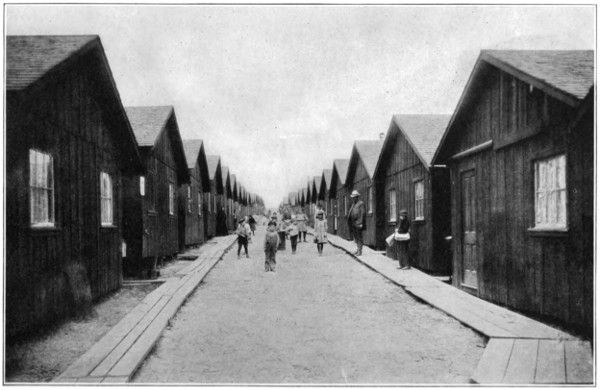
A tent camp was opened here May 19, 1906
Camp No. 13, Franklin Square
II THE CAMP COTTAGES
1. GENERAL COST
The pressure to provide permanent shelter is shown to have been keenly realized by the Corporation from the beginning of its work, and, before the Corporation was called into existence, by the army officials, the Finance Committee, and the American National Red Cross. On September 10, 1906, therefore, the Department of Lands and Buildings had ground broken for the building of cottages in the official camps.[178] From that date until March 19, 1907, the work was steadily continued, the contractor being spurred by the offer of a bonus if certain houses were completed within ninety days, and the threat of a forfeiture if a longer time were taken. When the task was done 5,610 cottages had been erected; 4,068 of three rooms and 1,542 of two rooms each. There had also been built 19 two-story tenement houses which sheltered about 650 persons. The total cost of the cottages and tenement houses including painting, plumbing, sewering, flush toilets, hoppers, water and gas connections, the moving of tanks from the principal parks, the laying of sidewalks, and a proportion of office expenses, was, as is shown in Table 64, $884,558.81.
The total cost of the 19 tenement houses, including painting, sewering, patent flush toilets, water, gas in each room and in halls, sinks in kitchen, baths and public laundries, was $41,678.95, an average of about $2,200 per tenement. The 15,288 rooms in the two- and three-room cottages cost, on the average, about $55 per room.
The erection of these cottages was essentially if not entirely a business proposition. Little machinery was demanded. A superintendent of building construction, aided by a small clerical force, constituted the actual working body. After purchasing the lumber in large quantities, the Department contracted with five large constructing companies to erect the cottages in camps situated in different parts of the city.
The contractors assumed the responsibility of supplying labor and other service; the Department, that of inspecting the completed work. It was planned to charge a monthly rental of $4.00 for the two-room and $6.00 for the three-room cottages, but the plan of collecting rent from the cottages located on city property was vigorously opposed by the mayor and made illegal by a special ordinance. However, the technicality was avoided and the law satisfied by substituting, for the form of lease, a contract of purchase and sale, whereby the occupant agreed to buy outright the house occupied by him and to pay for it in monthly instalments which equaled in amount the rent formerly agreed upon. The amounts advanced on the cottages by the occupants were later refunded to those who purchased lots on which to place their cottages. The total amount collected was $117,521.50 of which $109,373 was refunded. The amount of $8,148.50 was unclaimed at the date of the investigation. About 5,343 of these houses were, upon the breaking up of the camps, moved either by individuals or the Associated Charities to purchased or rented lots and became the permanent homes of the owners. Thus ground rent, hitherto practically unknown in the city, is now paid by many of the camp refugees.
The cottages were moved to all sections of the city, even to surrounding towns and counties, and in not a few cases ownership was exchanged many times. Visits were made to addresses given for 1,137 of these removed cottages, as a result of which a total of 680 fairly complete records was secured and the findings tabulated. The investigators tried to get the present location of the remaining 457 cottages from cottagers whose addresses at the date of removal from camp were similar to those of unidentified recipients, but the clue was useless, as the cottages either had not been moved to the addresses given, or had later been moved again by the owners. Eighty-seven cottages are known to have been sold to others and their original owners to have effectually disappeared from the community; 23 cottagers are known to have refused to pay, or been unable to pay, ground rent, the lot owners in consequence having seized their cottages; and nine cottages were rented and the owners could not be found. The 680 families found and interviewed had, with few exceptions, owned and occupied the same cottages in the camps. The exceptions were the occupants of the houses moved by the Associated Charities and the few who had not made their home in the official camps but were given cottages.
2. FAMILIES OCCUPYING THE COTTAGES
The important questions to be considered in this review of the housing situation are, who were the people who used these cottages, and what difference did the effort of the relief authorities really make to them?
The proportion of foreign born persons among the occupants of the camp cottages was very large, though not quite so large, as will be seen, as was the proportion of the foreign born among the recipients of bonuses.[179]
TABLE 65.—NATIONALITY OF APPLICANTS RECEIVING AID UNDER THE COTTAGE PLAN
Nationality Native born applicants whose parents were of each specified nationality Foreign born applicants of each specified nationality
American 193 ..
Irish 16 127
Italian 6 73
German 4 55
Mexican 1 52
English 2 34
Porto Rican 0 27
French 1 15
Other nationalities 8 66
Total 231 449
The three nationalities which will be found in greatest numbers among the recipients of the bonus likewise appeared most frequently among those who received camp cottages, though the order is different. The Americans among the cottagers outnumbered the Irish, and the Italians were in the third place.
The status of these families with regard to marriage, death, divorce, and desertion was obtained in every case.
TABLE 66.—CONJUGAL CONDITION OF FAMILIES RECEIVING AID UNDER THE COTTAGE PLAN
Conjugal condition Families of each specified conjugal condition
Married couples 402
Widows 188
Single men or women 44
Deserted wives 25
Widowers 18
Divorced men or women 3
Total 680
Though the number of families given as intact is 402, in 73 instances either the husband or the wife had, at the time of the investigation, gone from home in search of work, health, or for other reasons. The large excess of women who had lost their husbands, over the number of men who had lost their wives, is striking, and is certainly out of all proportion to the number of widows in the city. No explanation is offered other than to suggest the greater financial necessity of widows, especially of those with children. It is known that some of those included among the 44 single persons were members of a larger family, and possibly in a few instances they supported an aged parent or others. Six of the desertions occurred between April 18, 1906, and the time of the investigation, and four persons were during that time removed from family life to be imprisoned.
There were 1,312 children enumerated as members of these complete or broken families, many of them born to young married people who had but recently come to the city. More children[180] were found in the Italian than in the American or Irish families, the proportion being 3.1 children to an Italian family, 2.1 to an Irish family, 1.8 to an American family. Ages were recorded of the persons making application for cottages.
TABLE 67.—AGES OF APPLICANTS RECEIVING AID UNDER THE COTTAGE PLAN[181]
Age period Applicants in each specified age period
Less than 30 years 81
30 years and less than 40 years 191
40 years and less than 50 years 173
50 years and less than 60 years 132
60 years and less than 70 years 71
70 years and over 24
Total 672
Sixty-six per cent of the 680 applicants were women. It is interesting to compare this number with the 41 per cent of women among the recipients of bonuses[182] and the 18 per cent among the families receiving grants and loans.[183] The burden of making application fell more and more on the women as the family moved down in the social and economic scale. From April 18, 1906, to the date of the investigation, 138 persons in the group suffered the handicap of illness, 55 were invalided, 28 met with accidents, and 89 were removed by death. These data represent the carrying of unduly heavy burdens.
The number of families in the group that supported other than their own children, aged parents, or other relatives, was only 68, or 10 per cent of the total. The size of the households was, however, further increased by the presence of some persons who were self-supporting or who contributed to the common income. The comparatively small number of dependents both before and after the fire may have been due to poverty, to lack of room, or to the fact that many were comparatively recent arrivals and had no dependents in America.
3. WAGES AND OCCUPATIONS
The work and wages of this group of families before and after the disaster were carefully studied.
TABLE 68.—OCCUPATION BEFORE THE FIRE, OF 415 OF THE MEN IN FAMILIES RECEIVING AID UNDER THE COTTAGE PLAN
Occupational group MEN IN EACH SPECIFIED OCCUPATIONAL GROUP
Pro- prie- tors Em- ploy- es Total
Personal and domestic service 10 185 195
Manufactures and mechanical pursuits 9 88 97
Trade 15 105 120
Professional 1 2 3
Total 35 380 415
The incomes of the 35 men who conducted a business before the fire, as estimated by them, ranged from $20 to $200 a month in 24 instances. Eleven men gave no figures, but said they had gotten a living out of their business. Certainly the living was precarious for the group as a whole, for they had little if any savings. At the time of the investigation, the number owning their own business was less than half what it had been in April, 1906. The nature of employment suffered sharp changes. The record is not complete, but for the 341 men whose post-disaster occupation record as employes was obtained, 174 may be classed under personal and domestic occupations, 92 under manufactures and mechanical pursuits, 59 under trades and transportation, and two under professional. Fourteen were classed as miscellaneous. It would appear that the number employed at work demanding chiefly physical strength, is somewhat increased; the number engaged at work requiring skilled labor, slightly reduced.
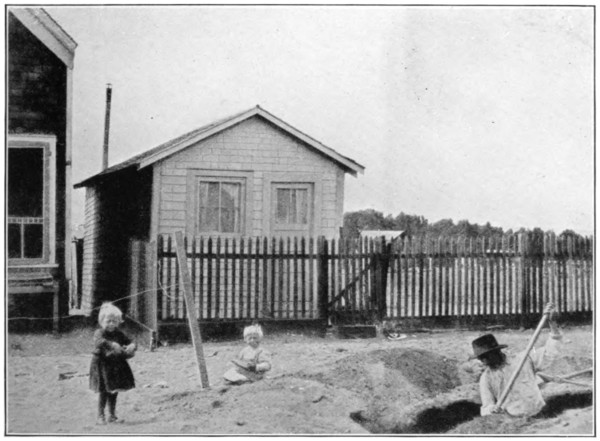
A janitor’s comfortable home
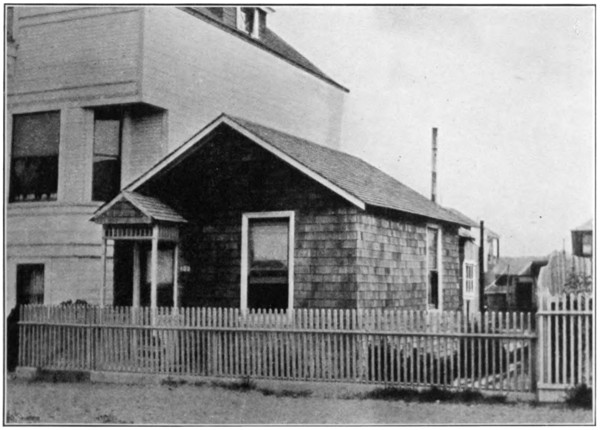
Improved at small expense
Camp Cottages After Removal
The following table gives the wages received by the 380 male employes before the disaster:
TABLE 69.—ESTIMATED MONTHLY WAGES RECEIVED BEFORE THE FIRE BY THE 380 MEN WHO WORKED FOR WAGES, IN THE FAMILIES RECEIVING AID UNDER THE COTTAGE PLAN
Monthly wages Employes receiving wages specified
Less than $20 6
$20 and less than $30 21
$30 and less than $40 43
$40 and less than $50 49
$50 and less than $75 170
$75 and less than $100 60
$100 and less than $150 21
$150 and less than $200 3
“Made a living” 7
Total 380
Some few are shown to have made very good incomes, but it is not known why they had been unable to acquire property before the fire. The actual wages were in most cases, because of irregularity of employment, considerably less than the amounts given above, which represent what would be the wages for regular employment. It was impossible to ascertain how irregular any given employment was. In comparing the wages received after the disaster, practically no change is found. Previous to April 18, 1906, 76 per cent of these men received less than $75 per month, while at the time of the investigation 75 per cent of them were receiving less than that amount. From the standpoint of income received by the chief breadwinner alone, many families were practically on the same financial basis as at the time of the disaster.
Of the 265 women who before the fire were either the entire support of the family or were supplementing the earnings of their husbands, 162 had been engaged in personal and domestic service, 88 in manufactures, 12 in the trades, and three in the professions. Of these women, 213 were widows. After the disaster the number of women employed was reduced to 258. Their wages before the disaster varied from less than $20 a month, received by 71 women, to “$50 to $75” received by 11, and “above $75” received by one. One woman claimed to have earned more than $75. A large proportion, 49, gave their wages as “living expenses.” After the disaster the number getting less than $20 a month was increased to 94; but on the other hand, 14 were receiving from $50 to $75. As in the case of the men, irregularity of employment meant that the actual incomes of the women were less than their own estimates. Previous to the fire, in 216 different families, or 32 per cent of the total 680, children or adults other than the principal breadwinner were contributing to the home by their outside earnings; afterwards this number increased to 271, or 40 per cent.
Sub-letting of rooms was a source of income to 113, or 17 per cent, of the families before the disaster; afterwards the number was reduced to 46, or 7 per cent. The two- and three-room cottages were hardly large enough for their own members.
TABLE 70.—ESTIMATED YEARLY INCOMES BEFORE AND AFTER THE FIRE OF FAMILIES RECEIVING AID UNDER THE COTTAGE PLAN[184]
Estimated yearly income FAMILIES HAVING YEARLY INCOME SPECIFIED
Before fire After fire
Less than $300 43 102
$300 and less than $600 168 179
$600 and less than $800 211 176
$800 and less than $1,200 119 100
$1200 and over 94 84
Total 635 641
Table 70 shows that after the fire the proportion of families in the lower income groups was somewhat larger, and the proportion in the higher income groups somewhat smaller than before the fire. It appears from a further study of the data that 329 families had greater incomes before the fire than after, while 215 had greater incomes after the fire, and 92 substantially the same income at both periods. Families to the number of 44 failed to report on this point.
The standard of living of the families of four to five members with a smaller yearly income was extremely low. Some were aided by relatives and others were assisted from time to time by philanthropic societies. Those who had received regularly as much as $600 a year were probably self-supporting but had put aside no savings. Only 6 per cent of this group of families had savings at the time of the fire, and only 7 per cent were to receive insurance for losses. They carried however only a small burden of debt. Afterwards, 131 were reported to be in debt, in the main for improvements made on their property or for the purchase of a lot. They had, therefore, comparatively little insurance and savings on which to draw, and received little aid from gifts and loans with which to rebuild. In fact, only 10 of the entire number stated that they had received gifts from relatives or from any other source, and an equal number, that they had obtained loans. The gifts from relatives ranged from $10 to $750, and the loans obtained, from $25 to $250. Two cases are noted of large amounts received, one of $3,300, the other of $5,000, for property sold or inherited after the fire.
In addition to the privilege of removing the cottages from the camps without charge,[185] 415, or 61 per cent, of the applicants received money grants from the Rehabilitation Committee. These amounts were given for various purposes, but in the main for furniture, clothing, sewing machines, and other general household rehabilitation. A certain number were granted small amounts for housing purposes in order that they might make improvements on their cottages or, in a few cases, to aid in the construction of new homes.
4. HOUSING BEFORE AND AFTER THE FIRE
Only 15 of these families had owned the houses in which they were living at the date of the fire, though seven others possessed real estate for which they received rent. One family claimed to have owned property valued at $5,000. As the majority of the group had lived in rented houses no attempt was made to learn the value of the rented property. At the time of removal from the camps all but four owned the cottages in which they were living. Table 71 shows the character of their previous dwellings.
TABLE 71.—TYPES OF HOUSES OCCUPIED BEFORE THE FIRE BY FAMILIES RECEIVING AID UNDER THE COTTAGE PLAN[186]
Style of house Families living in houses of each specified style
A flat or flats 466
Small houses or cottages 109
Furnished rooms 67
Apartments 15
Basements 4
Total 661
It must be borne in mind that the homes which they had occupied were the least desirable in the city. The houses had been used almost exclusively as dwellings; only 24 of the families had had a shop or store connected with their homes. After the disaster but seven had a shop and dwelling combined. The number of rooms occupied before the fire by those who during camp life and afterwards lived in two- and three-room cottages, was:
TABLE 72.—NUMBER OF ROOMS PER FAMILY OCCUPIED BEFORE THE FIRE BY FAMILIES RECEIVING AID UNDER THE COTTAGE PLAN.[187]
Number of rooms occupied Families occupying each specified number of rooms
1 50
2 111
3 204
4 and less than 7 284
7 and less than 10 12
Total 661
The congestion during camp life was probably more undesirable though not so extensive, crowding being excessive in comparatively few instances.
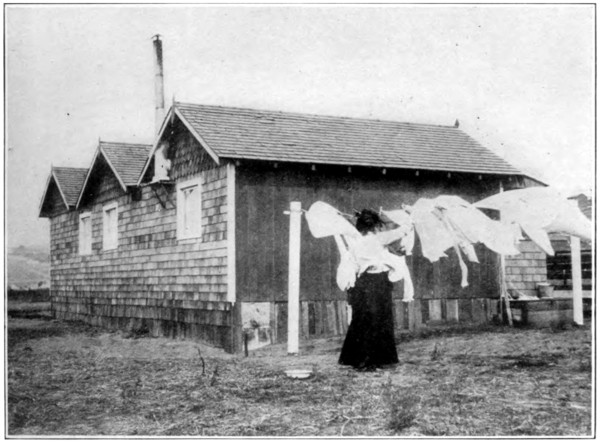
Where the trade winds blow
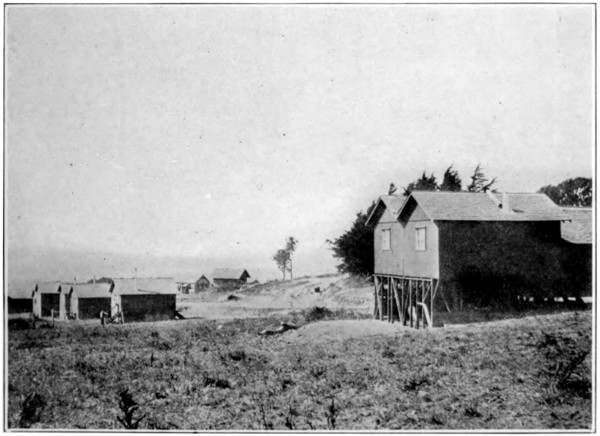
In full view of the Pacific
Camp Cottages at Hill Crest
In 379 of the 680 families who lived in camp cottages there had been not more than one person to a room; in 260, not more than two to a room. The large number of cottages erected made it necessary to place them close together. In the parks regular streets were laid out on which the cottages fronted with very little space intervening between the buildings. The compact housing of people meant that in some cases respectable people were compelled to associate to a certain extent with the less desirable. On the whole, however, the general moral conditions were not bad, the statements of some that the camp environment was bad for young people being offset by those of others that they had been able to maintain their accustomed moral standards. Naturally, the families whose living conditions had been most favorable before the disaster were the ones most tried by the abnormal camp life.
The housing condition before the fire was, in some instances, not only inadequate but unhealthful. It is certain that only 197, or 29 per cent, of the families had the use of a bath. When the cottages were moved from the camps, in 425 cases they were occupied as permanent homes with few if any important additions. However, 245 of the families had made improvements, 60 by adding rooms, 160 by adding front or back porches, others by adding windows or doors or making other minor improvements. The houses as a rule were placed on wooden foundations. A few were shingled, but in most instances cracks were sealed with strips, or covered with building paper inside. With their original coat of green paint they appeared much the same as when erected in the camps. Some persons who were fortunate enough to secure two or more cottages joined them to make one good sized house.
The re-visit in 1908 disclosed the fact that only 16 bath tubs had been put into the removed cottages, and that only 40 per cent of the cottages had been connected with the water mains. The occupants of the remaining 60 per cent, perhaps because they were financially unable to connect their houses with the regular water supply, had to draw their water from hydrants in adjoining lots. The location of some of these cottages upon the high hills characteristic of the city made them difficult of access, and in some instances the daily supply of water had to be carried 50 to 100 feet up steep hills.
The toilet provision in the removed camp cottage homes was even less satisfactory. In only 101 instances, or 15 per cent, were toilets installed within the house. In the remaining 85 per cent the privies were outside the house. When a number of cottages were grouped together on the same tract of land, as frequently occurred, the occupants—in a few cases as many as 10 families—invariably shared the common privy.
When the cottages were removed from the official camps most of those occupying them were given them free of charge.[188] The only cost to be met was for the moving and subsequent improvements or repairs. The expense of moving varied according to the distance and accessibility of the location chosen. The usual price charged by moving companies ranged from $12.50 to $25; $15 for one and $25 for two cottages being the common charge. The applicants paid the cost or were aided to do so by their relatives, friends, or in some cases by their landlord. The landlord would advance the necessary amount in order to have the building placed on his own lot, for which he was to receive a monthly ground rent. The Associated Charities[189] met the expense of moving 175 of the 680 cottages; the social settlements moved a few others. The total cost of the houses to these applicants, including moving expenses and all other improvements, is given in Table 73.
TABLE 73.—COSTS INCURRED, BY OR IN BEHALF OF APPLICANTS, FOR COTTAGES OCCUPIED BY FAMILIES RECEIVING AID UNDER THE COTTAGE PLAN[190]
Cost incurred Cottages costing as specified
Less than $50 365
$50 and less than $100 130
$100 and less than $200 120
$200 and over 52
Total 667
The expenditure of the larger sums meant that substantial additions had been made, and that by the increase of housing space the building had been made far more desirable as a permanent home.
At the time of the investigation the cottagers had lived in their new locations for from ten to eighteen months. Although 558, or 82 per cent, of those who had occupied rented rooms before the fire preferred their old to their present quarters, a majority were satisfied with their new neighborhood, and 315, or 46 per cent, claimed that the new environment was as desirable as the old, or in some cases more desirable. Upon removal from the camps many of the cottages had been taken to vacant lots to be grouped so closely together that there was comparatively little privacy for each family. The objection of some to their present surroundings was due partly to this fact, partly to the loss of familiar friends that had made the old neighborhood congenial. The Corporation had been anxious that the cottages should not be removed to different parts of the city to be grouped under conditions practically identical with those in the camps. However, though the sale of cottages to vacant lot owners had been steadily refused, the liberal policy of giving cottages to those occupying them in the official camps or to others in need of shelter resulted in a number being located close together on the same leased tract. The lots varied greatly in size. In some instances four or five cottages were erected on an ordinary city lot, of 80 to 100 feet depth and 20 feet width. In others, 60 or more cottages were crowded onto a tract as large as a city block. About 70 per cent of the families occupied lots with at least one other cottage.
The lots were purchased by the cottagers, leased for a term of years, or rented by the month. Of the 680 families only 70 had purchased lots. The prices paid ranged from $250 to $3,000, but in more than half of the cases were under $1,000. At the time of the investigation these lots were being paid for by monthly instalments of from $8.00 to $25, and but seven of the 70 families had canceled their indebtedness. Half the number had not paid more than a quarter of the price of the lot, and some were barely meeting the interest on the debt and were making no headway toward acquiring the property.
Those leasing lots had signed contracts which would be in force from two to five years,—a few even longer. What will happen when the agreements expire, especially to those who have made no improvements on their cottages, it is difficult to predict. It is known that many who removed their cottages from the camps disposed of them shortly afterward so as to get housing accommodations similar to those they had had before the disaster. Some of the cottages which were made into convenient and tasteful homes will doubtless be occupied by their owners for a long time, for the owners will make an effort to complete the purchase of their lots, or to renew the leases when they expire.
The rentals paid by those who were leasing lots varied from $6.00 to $15 per month, though a great majority paid from $6.00 to $8.50. Those renting from month to month perhaps occupied slightly less desirable lots; the rentals paid varied for the most part from $3.00 to $8.00 per month.
5. TWO COTTAGE SETTLEMENTS
Mention has been made of the unsatisfactory cottage settlements that took the place of the camp life.[191] Two such settlements were visited and the housing and other living conditions investigated.
The first tract is a sand lot belonging to an old estate, which was leased by a real estate agent for a period of five years at a rate of $280 per month. The Corporation refused to sanction his plan, but by some means he secured an official permit in October, 1907.
After he had spent over a month in grading his tract and in placing most of the 1,200 feet of sewer pipes, he was notified by the city board of health that he might not be allowed to open his settlement as his locality was threatened by the bubonic plague. In March of the following year when he could make it clear that his sewerage and sanitation system complied with the public health ordinances, he was granted a health permit. On May 1, 1908, his block was opened to occupants. Two men, one of whom was a Porto Rican boss who had come to San Francisco after the disaster by way of Hawaii, were his assistants in securing people to move into the block. Many came to this settlement from Lobos Square, when that camp was broken up on June 30, 1908. For each cottage moved, the two assistants received $1.00 commission, the boss receiving in addition from the house-movers a commission of from $1.00 to $2.00.
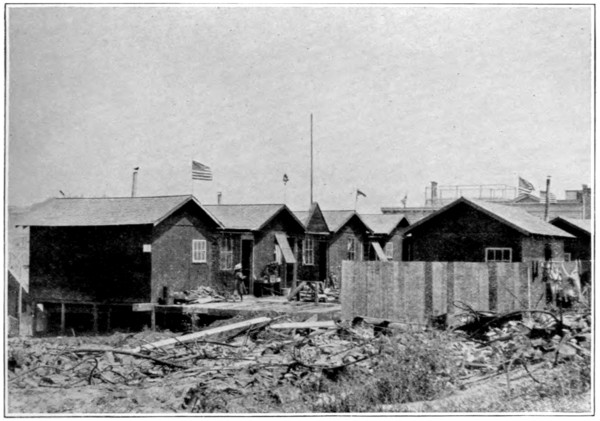
First cottages in Villa Maria
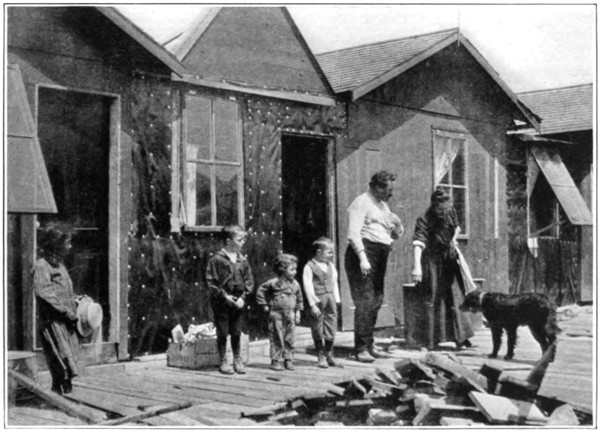
The proprietor and his family
Beginnings of a Cottage Settlement
This block is 412 feet long and 272 feet wide, and the whole is sub-divided into lots, each 20 x 371⁄2 feet. A two-plank sidewalk 3,016 feet in length was laid and 18 inches of gravel placed on the two interior streets by the residents, who received as payment a remittance of part of their ground rent. Each lot was leased for a term of three years, with the privilege of a two-year renewal to the satisfactory lessees, at a monthly rate of $6.00 for the lots on the inner streets, $7.00 and $8.00 for those facing the city streets. There were several exceptions to these rentals, however, one being the case of a hardworking, but very poor old woman whose monthly rate was lowered $1.00; another case was that of a woman who for a time was paying a $10 monthly instalment in order to buy her house; a third, that of a family which, after the cottage granted had been burned, was transferred to a higher priced cottage at the same rent of $6.00. At the time of the investigation only 12 of the 121 cottages were vacant. All had been moved from Lobos Square by their original occupants or owners, except about 20 which were moved by the agent in order to fill the block.
According to the agent, a number of families were at the time of the investigation in arrears for their monthly ground rent and 12 had not paid since they moved their cottages onto the block. On the average the arrearage was equivalent to the entire number being one month behind. Though several families vacated their cottages mainly because of their inability to pay the rent, none had been evicted on that account. Several purchasers of the vacated cottages had had to pay the arrears to the agent as well as the purchase price to the owners of the cottages.
The sanitary conditions, according to the visitors’ report, met the requirements of the board of health but did not conform to the normal sanitary standard. One toilet and an adjoining hydrant were provided for four cottages. Inspections usually were made twice a week by the janitor whose duty it was to enforce cleanliness. The members of each group did the cleaning in common and reported any breakage or defect in the plumbing to one of the camp residents, a plumber. The janitor and plumber received pay for their services in free rent.
Near each toilet and hydrant stood a large covered garbage can which was emptied three times a week or oftener. The agent paid for these services, which amounted to $25 a month for the block, and also the water bill, which amounted to about $92 a month. He provided a supply of ordinary garden hose, kept at two of the centrally located cottages, with which to fight fire. About one-quarter of the cottagers had made small additions to their cottages, such as porches, and about one-third had bettered them slightly by paint, screen doors, and similar improvements. A few of the most energetic had small, pretty gardens. The housing conditions of a majority of these people seemed, on the whole, to be better than before the fire. They at least paid less rent, and in most cases, enjoyed cleaner quarters and better sanitation.
There was little sickness, though dissipation and moral degeneracy were conspicuous among the majority of these people, who before the fire had lived, many of them, in very undesirable localities. They suffered keen poverty, due in part to scarcity of work, but perhaps largely to intemperance and shiftlessness. Any day a group of men might be found idle, while their women and children provided meager support.
The second tract was, previous to April 18, 1906, a vacant lot 192 x 137 feet. It was leased by a woman, a Mexican, for a period of three years, with the privilege of a one-year renewal. No money was spent in grading, in filling for sidewalks, or for other improvements; practically the only item of expense was for sewerage. One hopper, one faucet, and a toilet for each four families were installed to conform to the requirements of the board of health. The landlady paid $100 for this sanitary work, which had caused great dissatisfaction on account of its poor quality. The individual families had had an increase in water rent from 50 cents the first month to $1.15 the fourth, on account of leakage in the pipes. The ground rent of $6.00 a month for lots 25 feet square facing the city streets and of $5.00 for inner lots of the same size was a little cheaper than that asked in other similar settlements; but added charges for garbage and water made a total cost that was on the average about what was met by those who occupied cottages elsewhere, under better conditions. There were 55 children in all on the lot.
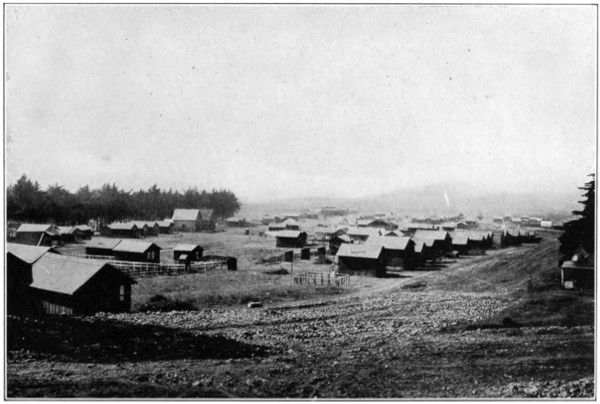
Camp Cottages on a Suburban Tract
The 27 families occupying this lot came from the Lobos Square camp. The landlady, as an inducement, had offered free ground rent for the month of June, 1908. Three-quarters of the cottages were moved and repaired by the Associated Charities at an average cost of $28.50 a cottage.[192] The Associated Charities had recently shingled and put in sinks for the six most nearly dependent households. It is not known how much the landlady paid for her lease nor what profits she reaped. She regretted the undertaking, however,—a result that might have been foreseen when such a helpless class of tenants was accepted.
6. BRIEF COMMENTS
The erection of a large number of two- and three-room cottages was necessary if shelter were to be given to the poorest class of the homeless refugees. With individual exceptions, the people had been accustomed to comparatively low standards of living. They consumed each day the daily wage, so were helpless when overtaken by the disaster.
The investigation revealed that those responsible had acted wisely in providing the shelter without consulting the wishes of those for whom it was intended. Opportunity to secure shelter was given through the “bonus” and the “grant and loan” schemes for those who had some means and initiative; but those without resources of their own were not in a position wisely to suggest the manner of their housing. The Department outlined the work on a large scale and executed it in a straightforward, businesslike manner. The happy result was abundant shelter for all the poorest families with the oncoming of the winter rains.
Some critics have claimed that a more equitable distribution of the funds would have been to give to the poorest class as much as to the more fortunate refugees, but a careful examination of the facts shows that the policy adopted was more feasible as well as more expedient. Those who possessed vacant lots, or other property, or who could command means with which to build, gave tangible proof that the foundation of previous thrift and enterprise would serve as a guarantee of wise use of aid from the relief funds. The applicants who had owned no property, possessed no savings, and whose standard of living was low, could offer little, if any, guarantee of a wise use of funds. Had a body of expert social workers been engaged to study each family individually and to plan its future home, superintending the purchase of a lot and the construction of a house,—in fact, teaching each to be a good householder,—a more liberal housing allowance could have been safely granted. Such a constructive plan would have called for far more elaborate and efficient machinery than was at hand, and would have required a much longer time. However, it is realized that a situation which concerned practically the future home life of every camp refugee presented a wonderful and probably unparalleled opportunity for wise constructive philanthropy.
It will be important, in the event of future disasters, to see if the least efficient can be re-housed so as to be, through careful supervision of individuals, brought to a higher standard of living.
III THE BONUS PLAN
1. THE PLAN ITSELF
The first definite housing resolution agreed upon by the Executive Committee of the San Francisco Relief and Red Cross Funds was an effort to advance through its Department of Lands and Buildings 331⁄3 per cent of the cost of a home to be built on the ground owned by any resident of the city whose house had been destroyed, with the provision that in no instance should the amount granted to any one person exceed $500. This was the most generous housing offer made and was limited to those who were to rebuild within the burned territory. It was known as the “bonus plan.” The offer was announced to the public through the newspapers in August, 1906, by the Department of Lands and Buildings, and remained open until October 1, 1906, being reopened in February, 1907, for two weeks. Originally, $400,000 was set aside for the bonuses. In February, 1907, an additional $100,000 was appropriated.
The bonus, or gift, offered to anyone who desired to rebuild on property owned by him in the burned district was granted to 885 persons. The total amount granted was $423,288.17.[193] In slightly over 10 per cent of the cases the amount actually given as a bonus to the applicant was less than $500, due to the fact that he had received aid from other departments, or because the cost of the house was less than $1,500. In one instance the amount of the bonus was as low as $83.
The general procedure was for an applicant to submit his plans to the Department of Lands and Buildings for approval, and when approval was obtained to begin to build his house. Little machinery was required, for no attempt was made to investigate the actual needs of the applicants. The Department satisfied itself that the person was eligible under the terms offered, and before making payment received assurance from its inspector that the building was located at the place designated by the applicant and represented a certain value. The length of time between the granting of an application and the completing of the house varied from one to 14 months. When the second appropriation of $100,000 was made, consideration was given to the question of fixing a maximum limit upon the cost of the houses to be built by the receivers of bonuses, but no definite action followed.
During the early stages of the relief work the great question was, how soon will the burned district be rebuilt. Houses must be rebuilt if residents temporarily living in the nearby cities were not to be permanently lost. Stores and warehouses must be rebuilt if the small tradesmen and lodging-house keepers were to return, to attract, in their turn, other industries. Labor leaders asserted that a large number of those who were living in outlying districts or outside the city were workingmen who were handicapped both by loss of time and by increase in expenditure in having to go to and from their accustomed places of labor. Four or five thousand workingmen were said to be anxiously waiting to make use of a liberal offer to re-establish their homes on their own lots in the burned area. The number was over-estimated, for only 885 bonuses were granted, many to persons who owned their own business and were not workingmen on a daily wage. If such a large number ever made application for the bonus, they either did not possess sufficient savings or enjoy an income large enough to avail themselves of the Corporation’s offer. Capitalists were also anxious for rebuilding to begin as rapidly as possible; so the plan, when announced, was gladly received by all classes. It is possible that the expenditure of the first $400,000 appropriated for bonuses at the moment when many were debating the wisdom of rebuilding, turned the tide of decision in favor of immediate action. As early as March, 1907, 470 bonus homes had been built at an expenditure of $200,147.17.
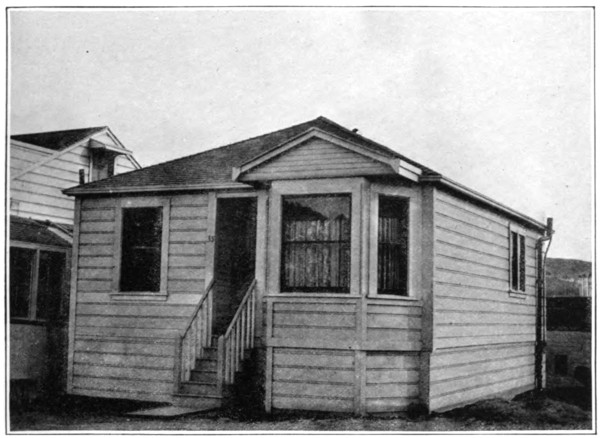
Home built by a letter carrier
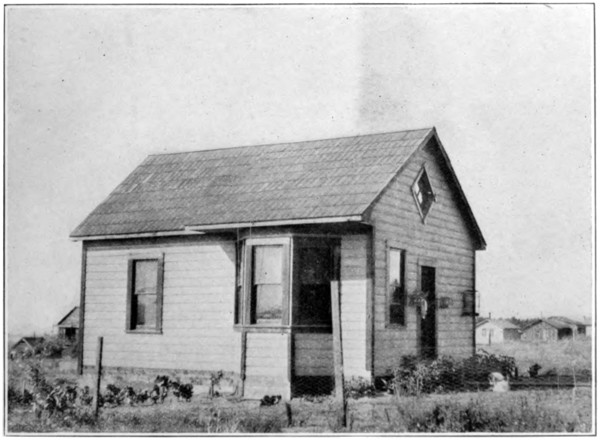
Home of an elderly U. S. Government employe. Bonus, $250
Bonus Houses
2. BONUS RECIPIENTS
The field investigation of the bonus cases made by this Survey included visits to 572 persons, or 65 per cent of the entire number. These were selected at random and scattered over the entire burned district. In 26 instances the investigator was refused information, 44 of the houses were rented out and the addresses of owners could not be obtained, and 12 of the houses had been sold or were vacant and the whereabouts of the owners were unknown. The remaining 490 cases, 55 per cent of the total number receiving bonuses, yielded practically complete schedules. All except one of the bonus recipients studied—Notre Dame College, an institution accommodating about 75 students—represented families, or were persons who wished to establish homes. It is believed that the cases selected are in every way typical and that the results obtained would be substantially the same if the entire number had been visited. The characteristics of these 489 persons who received bonuses, and their relative condition before and after the disaster, are briefly given in the following pages.
TABLE 74.—NATIONALITY[194] OF APPLICANTS RECEIVING AID UNDER THE BONUS PLAN
Nationality Native born applicants whose parents were of each specified nationality Foreign born applicants of each specified nationality
Irish 19 185
Italian 1 93
American 81 ..
German 2 41
English 3 10
French 2 11
Other nationalities 3 38
Total 111 378
That a large proportion of those who received bonuses were foreign born was to be expected, as the regions burned were inhabited largely by the Italians north of Market Street and by the Irish, south.
The conjugal condition of the bonus recipients is shown in Table 75.
TABLE 75.—CONJUGAL CONDITION OF FAMILIES RECEIVING AID UNDER THE BONUS PLAN
Conjugal condition Families of each specified conjugal condition
Married couples 321
Widows 126
Widowers 23
Orphaned children 8
Single men 6
Single women 5
Total 489
In November, 1908, when the schedules were completed, 390 of the 489 families, or 80 per cent, had the same status as before the fire; 99, or 20 per cent, had suffered changes of various kinds. These changes, in the main, resulted from deaths and the natural separation of maturing children from the home. From the date of the disaster to the time of the investigation, 53, or 11 per cent, of the families suffered loss by death of one or more of their members, the total deaths being 57. One of this number had been killed by the earthquake, and many,—the exact number could not be ascertained,—died from such indirect effects of the disaster as nervous prostration, or typhoid fever contracted in camp. The deaths for the period considered, though slightly above the normal, were not excessive.
In 41 per cent of the bonus cases the application was filed by the wife or some other woman member of the family, and the grant was made in her name. The large number of women applicants may be explained in part by the fact that the blank application for a bonus had to be signed by the owner of the lot, whether man or woman,[195] and it is a common practice in San Francisco, as elsewhere, for a husband to put his property in his wife’s name. Furthermore, Table 75 shows a large proportion of widows among the applicants and a small proportion of widowers.
The size of the family was, as a rule, not large, and the burden of dependence carried not heavy. In only 28 cases were there persons other than children who were wholly dependent. In 43 cases relatives or friends lived with the family, but were either self-supporting or made contribution to the family income. There were 1,333 children of these families, or 2.7 to a family, not all of whom were living at home; many, married or single, were living and working away from their parents.
TABLE 76.—AGES OF APPLICANTS RECEIVING AID UNDER THE BONUS PLAN[196]
Age period Applicants in each age period
Less than 30 years 6
30 years and less than 40 years 80
40 years and less than 50 years 144
50 years and less than 60 years 116
60 years and less than 70 years 108
70 years and less than 80 years 33
80 years and over 2
Total 489
It will be seen from Table 76 that 47 per cent of the applicants were under fifty years of age and that 29 per cent were over sixty years of age. The few that had reached an advanced age were given a bonus not on account of their need, but as a stimulus to build on their property in the burned district.
The health of the family was more fully recorded than in the case of the camp cottagers. No note was made of such minor ailments, or accidents, as would bring no handicap, but 181, or 37 per cent, of the families suffered from sickness and accident to such an extent that there was a distinct handicap, either through burdensome doctors’ bills, or by having the source of income temporarily reduced or cut off. Including the 53 families who had sustained deaths, 48 per cent of the whole number were shown to have suffered from the effects of illness or accident. This total burden should not, however, be reckoned as an aftermath of the disaster.[197]
3. OCCUPATIONS AND RESOURCES
The means by which the men in the families earned a livelihood before April, 1906, are given in Table 77.
TABLE 77.—OCCUPATIONS BEFORE THE FIRE OF 433 MEN IN FAMILIES RECEIVING AID UNDER THE BONUS PLAN
Occupational group MEN IN EACH SPECIFIED OCCUPATIONAL GROUP
Proprietor Employes Total
Personal and domestic service 112 80 192
Manufactures and mechanical pursuits 22 61 83
Trade 38 62 100
Professional service .. 2 2
Retired 46 .. 46
Invalid 10 .. 10
Total 228 205 433
The number of those who had owned and operated an individual business is shown to exceed slightly the number that were employed at a definite rate of wages. Thirty different industries and 66 different kinds of employment are included in the four categories. The number of women who earned support for themselves outside of their own homes, and in whole or in part, for their families, was 31; of these, 17 were in personal and domestic service, 11 in manufactures, two in trade, and one in professional service. The heads of the remaining 25 families were either aged men or women who were supported by their own children, or persons otherwise cared for.
The status with reference to ownership of business remained almost unchanged; only 12 persons who had owned and managed a business before the fire were forced later to seek permanent employment as wage-earners. Almost exactly the same number of persons, 11, who were wage-earners before the disaster, conducted a business of their own at the time of the investigation. These slight variations show that the bonus recipients, possessing more than ordinary ability, were able to re-establish themselves.
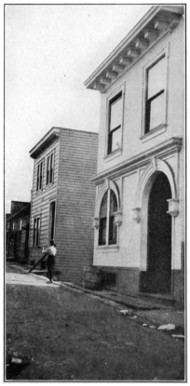
Built by Italians Bonuses $500 each
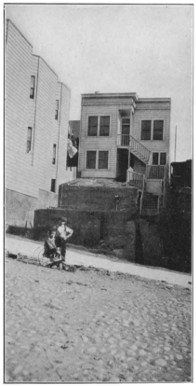
Home of two Italian families
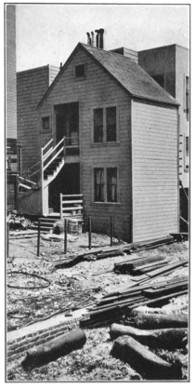
A widow’s venture Bonus $500
Bonus Houses
Built by Italians Bonuses $500 each
Home of two Italian families
A widow’s venture Bonus $500
Bonus Houses
Perhaps a better estimate of the earning capacity of the bonus applicants is obtained by comparing the number whose incomes were permanently increased or diminished or remained practically the same during the stress of abnormal conditions. A study of the data shows that 201 applicants enjoyed larger incomes before the fire than after; that 237 applicants had smaller incomes before the fire than after, and that in 47 cases the income was about the same at both periods. Of the 490 applicants, including Notre Dame College, for which information was secured, five failed to supply information as to relative income.
The large number of those who enjoyed increased incomes at the time of the investigation may be accounted for in part by the fact that members of the same families before April 18, 1906, were not contributing to their limit. In not a few cases, however, an increase in wages of those who had previously worked full time, accounts for the difference. Perhaps the chief significance of the figures lies in the fact that in the majority of cases there was no serious decrease in income.[198] The number of women who added to the family income, or managed their own property, before and after April, 1908, did not materially change. In the earlier period, 109 of the women[199] were conducting a business or earning wages; in the later period, 94 were doing so.
The number of contributors to the family income in both periods was obtained in each instance. In 41 families the number of contributors was larger before the fire than after; in 76 families the number was smaller before than after. Three hundred and sixty-nine families had the same number of contributors to the family income at both periods, and three families failed to supply information on this point. The additional number of contributors may in several instances be accounted for by the greater age of the children, an increase which is to some extent counterbalanced by the withdrawal on account of marriage or advancing age of some contributors to the common purse.
It was not possible to estimate the exact value of the lots owned by the applicants before the fire; their exact value could have been learned only by sale. What is, however, believed to be a fairly accurate estimate is given in Table 78.
TABLE 78.—VALUE OF LOTS OWNED BEFORE THE FIRE BY APPLICANTS RECEIVING AID UNDER THE BONUS PLAN[200]
Value of lots owned before the fire Applicants owning lots of each specified value
Less than $1,000 53
$1,000 and less than $2,000 274
$2,000 and less than $3,000 131
$3,000 and over 27
Total 485
The above valuations are supposed to be those extant before the disaster. Although in some districts the value of lots may have increased after the fire, and in others may have decreased, no effort was made, because of the inherent difficulties, to ascertain the amount of the later valuation. It is not known why the bonus was granted to the five persons who did not own lots before the disaster.
In addition to the lots on which these dwellings had stood, 51 families had owned both before and after the fire other realties, such as houses, lots, or ranches. The value of the additional real property in 40 cases was found to have averaged $7,558. Similar data with reference to 35 families showed the average value of their additional property after the fire to be $4,052; 17 other families possessed additional property before, but not after; while 16 families reported acquiring additional property after the disaster. In practically every instance the owners drew from their properties a substantial addition to their incomes.
In order to rebuild their homes, 352, or 72 per cent, of the applicants negotiated loans with banks or with relatives or friends. The interest was from 61⁄2 to 8 per cent. Previous to April 18, 1906, 61 of those who later received the bonus had rented their houses and occupied living quarters elsewhere,—in four instances, in cottages on lots on which the houses stood; in others, with relatives, in rented rooms in more desirable residence sections, or in houses owned in other parts of the city. After the fire the number who rented their homes to others increased to 74; 22 of this number, in place of four, lived on their own lots in small cottages or shacks built in the rear of each lot.
Four hundred and fifty, or 92 per cent, of those who received the $500 bonus had carried, and received after the fire, insurance in amounts ranging from less than $500 to $20,000. Of 204 families from whom reliable data were secured, 25 were found to have received full payment; 78 to have received more than 75 per cent, but less than 100 per cent of their loss; 82, more than 50 per cent but less than 75 per cent; and 12, more than 25 per cent but less than 50 per cent. One received less than 25 per cent and six received nothing.
The field workers found it peculiarly difficult to learn what had been the amount of bank savings of the different families. Many refused to answer the question; others denied that they had had savings; 167, or 34 per cent, of those tabulated admitted having put aside amounts varying from less than $500 to more than $4,000; and 38 that they had savings, the amounts of which they would not give.
Though all aided under the bonus plan were property owners,[201] a number were in debt both before and after the fire. Table 79 indicates the number in debt and the amount of this indebtedness.
TABLE 79.—INDEBTEDNESS CARRIED BEFORE AND AFTER THE FIRE BY FAMILIES RECEIVING AID UNDER THE BONUS PLAN[202]
Amount of indebtedness FAMILIES WHOSE INDEBTEDNESS WAS AS SPECIFIED
Before fire After fire
Less than $500 21 38
$500 and less than $1,000 49 66
$1,000 and less than $2,000 61 83
$2,000 and less than $3,000 32 65
$3,000 and over 13 72
Total 176 324
From the table it will be noted that before the fire 179, or 37 per cent, of those aided, had carried a burden of debt, while afterwards the number was increased to 328, or 67 per cent. Loans to the amount of the indebtedness noted could have been obtained upon the property owned.
Additional aid was granted by the Rehabilitation Committee to 116, or 24 per cent, of the bonus grantees, in amounts varying from $5.00 to $500. These grants were in the main for clothing, sewing machines, medicine, or other general household relief. The aid included 59 furniture grants. In 10 of the 116 cases the full bonus was not given, so that the sum of grants amounted to not more than $500. Sixty-five of the applicants were not eligible for the full bonus, as the buildings they erected were worth less than $1,500 each. The department, it may be remembered, had agreed to pay not more than one-third of the value of the house which should be erected.[203]
4. THE HOUSES—CHARACTER AND COST
As far as this group of families is concerned the burned area was built up substantially as before the earthquake. As wood was the material available, without exception the 490 bonus houses were frame. The general appearance of the houses was good. Most were painted and had adequate foundations, and a majority had basements. The basements in many cases were sublet, or were used for business purposes. The number of stories to a house varied from one to four; only three of the houses, however, had four stories. The greater number were of two stories. All the houses were connected with the city water supply and the sewerage system. Three hundred and eighty-one, or 78 per cent, of the new houses contained bath rooms, and all but three had installed one or more patent flush closets.
A fair gauge of the character of the houses rebuilt is the cost, if the high price of building materials be borne in mind.
TABLE 80.—COST OF HOUSES REBUILT AFTER THE FIRE BY APPLICANTS RECEIVING AID UNDER THE BONUS PLAN
Cost of houses Houses costing as specified
Less than $1,500 65
$1,500 and less than $3,000 210
$3,000 and less than $5,000 118
$5,000 and less than $10,000 92
$10,000 and over 5
Total 490 [204]
One house cost $39,000, another $78,000, and three from $10,000 to $20,000. It must be remembered that one of these was Notre Dame College. Only 16 per cent of the houses were built by the applicants themselves. The original plan was to aid those that had suffered the loss of their homes. Fifty-five of the houses destroyed were, however, used for both dwelling and business purposes; 69 of those rebuilt were similarly used. Each business was on a small scale,—a grocery or fruit store, a saloon, or a barber shop. The number of rooms in the houses formerly occupied and those in the houses lived in after the fire is given in the following table:
TABLE 81.—NUMBER OF ROOMS IN HOUSES OWNED BEFORE THE FIRE AND IN HOUSES REBUILT AFTER THE FIRE BY APPLICANTS RECEIVING AID UNDER THE BONUS PLAN
Number of rooms HOUSES HAVING EACH SPECIFIED NUMBER OF ROOMS
Before fire After fire
1 .. ..
2 .. 1
3 1 6
4 14 51
5 and less than 9 150 184
9 and less than 13 171 138
13 and less than 16 83 58
17 and less than 21 42 23
21 and over 28 28
Total 489 489
Average number of rooms before fire 12.2
Average number of rooms after fire 10.6
As in not a few cases two houses instead of one were built on a lot, the combined number of rooms is given in the preceding table. A further examination of the data shows that in 168 of the bonus cases the houses were rebuilt to contain a greater number of rooms, in 259 to have less, in 62 to have the same. No attempt has been made to compare size and desirability of the rooms, but it seems probable that there was no great difference in the character of the houses rebuilt as far as rooming space is concerned.
In 453, or 93 per cent, of the bonus cases tabulated, the exact number of rooms occupied by the family and its dependents in its own or in a rented house was ascertained.
TABLE 82.—NUMBER OF ROOMS PER FAMILY OCCUPIED BEFORE AND AFTER THE FIRE BY FAMILIES RECEIVING AID UNDER THE BONUS PLAN[205]
Number of rooms occupied FAMILIES OCCUPYING EACH SPECIFIED NUMBER OF ROOMS
Before fire After fire
1 8 11
2 13 37
3 65 72
4 and less than 7 302 303
7 and less than 10 55 27
10 and over 10 3
Total 453 453
The proportion of families occupying less than four rooms was smaller before the fire than after the fire, while the reverse is true of families occupying seven or more rooms. It would appear from this that after the fire the crowding was slightly increased. By actual count, 218 families were found to have occupied more rooms before the fire than after, 152 families occupied the same number, while 83 enjoyed a larger number after the fire.
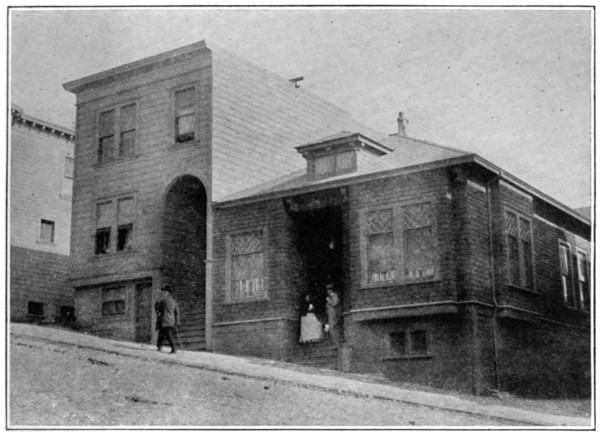
Two ambitious dwellings built with aid of bonuses
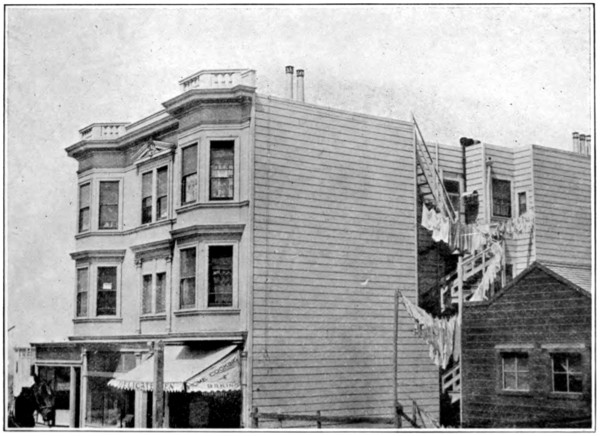
Built with bonus of $500 and money privately loaned
Bonus Houses
The number of families who let rooms before and after the fire was extraordinarily large. Before the fire 375, or 76 per cent, and afterwards 378, or 77 per cent, let either furnished rooms or unfurnished suites. In a majority of cases the family itself occupied one flat and let the others. It is evident that the average small property owner rebuilt his house with the expectation of drawing an income from it.
5. BRIEF COMMENTS
If the Corporation had refused to grant a bonus to anyone who was to build a house to cost above $2,500, more than 50 per cent of the grants would have been denied. When the second appropriation of $100,000 was set aside for the bonus grants in 1907, one intimately connected with the work wrote: “In connection with the proposed expenditure of $100,000 to be used for assisting those intending to rebuild in the burned district, I will state that, as there will be numerous applicants for such assistance, it might be wise to place some restrictions upon the bonus other than those now in force. For instance, I recommend that a person desiring to build a house valued at $3,000 should not be granted said bonus, as evidently he is not in need, and in my opinion, does not require our help. Furthermore, I believe it would be well to investigate each application to determine whether the applicant has received assistance from the Committee previous to placing the application with the Department.”
The man who had to pass on the bonus applications said: “Henceforth the bonus should be granted only in cases which have been proven conclusively to be in need of it, for my impression after a careful examination of these applications, is that they are not in particular need of the bonus but could get along perfectly well without it, though possibly not so easily.”
Another letter, dated March 11, 1907, to the staff in charge of the grants said, “In making the allotments under the new appropriation I would advise that you question each grantee carefully and refuse to issue the amount where the house is already completed or nearly built. This, of course, can only be determined from personal examination of the applicant, for many whose houses are already practically completed, frame their applications as if they were just about to begin.”
The feeling that, regardless of loss, there was the right to share in the relief funds, pushed many who had already begun to build into the ranks of applicants for the liberal gift of $500. A possible evil effect of this liberal offer was that some persons, in order to take advantage of it, incurred heavy indebtedness, which they would be forced for a long time to carry. The extra cost for building during the fall of 1906 and the winter of 1907 offset in a measure the financial gain from the bonus.
After a great disaster the efficient distribution of a large sum of money to aid in rebuilding calls for the exercise of two distinct functions, business management and supervision of rehabilitation work. It is not probable that the same person can with equal success perform the two functions. A neglect of either means a grave miscarrying of the plan itself.
IV THE GRANT AND LOAN PLAN
1. THE PLAN ITSELF
The Department of Lands and Buildings at first gave its entire attention to the camp cottages and bonuses. However, a large number of applications for small grants or loans to build had been early filed away to bide their time. The insistence of applicants and the recognition of their need to be heard led to the transfer of these applications to another department of the Corporation. November 1, 1906, the Rehabilitation Committee[206] referred to its new housing committee of five members, Committee V, the 800 applications that had accumulated.
Committee V organized at once and formulated plans for making grants and loans and for building houses. It assumed the work of housing to be general rehabilitation, and therefore perfected a system whereby all those asking for assistance could be investigated and helped according to their needs.
There were, speaking in general, two classes of applicants to whom the committee extended aid:
1. Some applicants planned and built their own houses, but received aid from the relief funds. A maximum cost of each house to be erected was fixed by the committee, and the applicant was supposed to pay the greater part. The amounts distributed under this plan were considered grants and not loans.
2. Other applicants desired to purchase houses which were planned and constructed under the direction of the committee. In some cases of this class the grant covered the entire cost of the house, while in others the grant was supplemented in one or both of the two following ways:
a. A part of the cost of the house was treated as a loan to be repaid by the applicant.
b. The applicant made a cash payment covering a part of the cost.
The Committee, in order to make good its second offer, engaged contractors to build houses which, including plumbing, should cost not more than $500.[207] Under both offers, the applicant was required to show that he had suffered material loss and that he was the head of a household and was able to support his family; that he was unable to secure a suitable house at a reasonable rent, and that he had secured a lot in the city and county of San Francisco on which to build. The plan of the building submitted had to comply with the provisions of the city building code. The carrying out of the plans,[208] with any modification of policy, the Rehabilitation Committee left to its sub-committee, to which the grant and loan plan had been referred.
The housing committee, assuming that theirs was in the highest sense rehabilitation work, perfected a thorough system of investigation of all applications. It defined its purpose to be: “To assist families in need of proper shelter to obtain a home suitable to their wants and in proportion to their earnings.”
In placing the grants and loans, its theory was to give aid so as to stimulate the recipient to use it for the distinct benefit of his family. In a case where a family had heavy burdens and a limited income, money was granted outright. When there was reason to believe that a recipient could repay a part of the large amount needed, a grant was frequently supplemented by a loan. As general rules should be few in number, the committee exercised its own judgment in each individual instance. The plans therefore worked differently in different cases. In some cases the applicant deposited part of the cost of the house to be built which was supplemented by a grant or loan. In other cases, the applicant being unable to make a deposit, the committee bore the entire first cost of the house.
Many were aided who had no real estate before April, 1906, but purchased or leased a lot in order to build. Even the maximum limit set for the cost of the house was not adhered to in every instance. The loans ranged from $37 to $595,[209] as the committee found it wise to readjust its own plan so that the amounts given or loaned should be such as would meet the actual needs revealed by a careful investigation. A reliable bank was enlisted to see that the loans were properly executed, mortgages recorded, and monthly instalments collected. This bank became the financial agent of the Corporation, and those who received loans felt their obligation to be to it rather than to the Corporation. In case a house were built on a lot temporarily leased, the bank secured from the applicant and the owner of the property an agreement to the effect that the house should not be moved without the consent of the committee. In case an applicant failed to meet his financial obligation the house reverted to the Corporation, not to the lot owner.
The committee, it may be seen, had two clearly defined functions: (a) to administer a business which called for the employment of contractors, the outlining of plans and specifications for buildings, the appointing of inspectors to locate lots and to examine the buildings erected, and (b) to conduct a bureau of rehabilitation through which might be learned the present and past conditions and the future prospects of the individual applicants. The oversight given by the two groups, business men and social workers, meant a decrease in the number of failures to re-establish homes.
The work of Committee V, which began November 1, 1906, ended the latter part of July, 1907. The committee as a whole was in continuous session during the first weeks. Thereafter two of its members gave to it practically all their business hours. After July, 1907, however, minor details connected with final acceptances and instalments of additional plumbing and other tasks incidental to the closing of the work, were under the direction of one member.
In many instances the delays were long between the asking for and the receiving of a grant or loan, in part because the grant and loan plan was the last housing plan to be put into effect. Some families were purposely not given assistance until the house was completed, which accounted for the delay of some months between the approval of an application and the payment of the grant. Other families were themselves the cause of long delays, because of their inability quickly to build. The actual delays ranged from less than one month in 62 instances to twelve months in one instance. Fifty per cent of the 896 applicants for whom detailed information was secured had to wait two months or less.
2. RELATION BETWEEN THE DEPARTMENT OF LANDS AND BUILDINGS AND THE HOUSING COMMITTEE
As the Department of Lands and Buildings and the housing committee were both engaged in building houses, it was found to be important in order to avoid delays in the work, to plan some division of duties. Accordingly, on March 29, 1907, following much discussion, a plan of co-operation was agreed upon. The housing committee was to consider all applications first and to determine in each case the amount of aid to be granted; the terms, whether on a cash or instalment basis; and the general design and specifications for the house. The Department of Lands and Buildings was to have full charge of construction and cost and of the inspection of completed cottages.
This agreement, which called for a division of work, gave recognition to the dual need, of rehabilitation of applicants and of sound business management. The housing committee turned over to the Department the designs, blue prints, and specifications for the four styles of cottages that were being erected, together with outstanding contracts. The following regulations to govern the two bodies were determined upon:
1. The housing committee should send to the Department of Lands and Buildings, in each case, a description of the lot upon which the building was to be erected, together with the name and address of the applicant, and should designate the style of cottage to be constructed.
2. When the housing committee received from the Department of Lands and Buildings the total cost of the house and the name of the contractor, the amount necessary to pay for the house should be deposited to the housing committee’s account and held there until ordered paid to the contractor.
3. When the house had been completed and accepted by the Department of Lands and Buildings the contractor should be given an order on the cashier for the amount due. The cashier should draw the necessary check, signed by a representative of the housing committee.
4. The Department should send notice to the housing committee when a house had been completed and accepted.
On March 11, 1907, the manager of the Department of Lands and Buildings had at the request of the Executive Committee of the Corporation been made superintendent of construction of the housing committee.
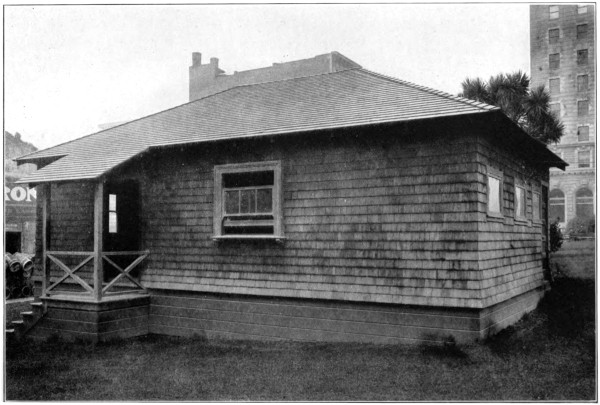
Headquarters Department of Lands and Buildings
Despite the detailed regulations there were dissatisfaction and friction; so on April 26, 1907, the housing committee passed a resolution to the effect that inasmuch as the housing committee bore the full responsibility of the manner in which the relief work relating to the building of houses was conducted, and, since the members of the housing committee were dissatisfied with the manner in which the superintendent of construction was performing his duties, the housing committee made a most urgent request to the Executive Committee that the superintendent withdraw from all work in which the housing committee was concerned.
The specific charges were (a) that poor contractors were employed, (b) that desirable contractors who were difficult to obtain at that time complained of the superintendent’s treatment, (c) that the superintendent who had done efficient service in erecting the camp cottages, was entirely unfit for his new position because of his unfriendly and unsympathetic attitude toward the applicants, (d) that, finally, the building of the much-needed new houses was unnecessarily slow.
The relation which unfortunately existed between these two, the Department and the committee, is mentioned at this stage, in order to explain in a measure the long delay and hold-up of orders by the committee. It accounts for much of the dissatisfaction that existed among the people and for some hardships endured by not a few applicants. The delays due to friction made it necessary for the housing committee to continue its work after the bonus plan was discontinued.
3. THE NUMBER AIDED AND THE COST
A complete statement of the work done shows that there were 2,098 applications for relief under the grant and loan plan acted upon subsequent to November 1, 1906. Assistance was given in 1,572[210] cases, the total expenditure being $519,723.17. Previous to November 1, 1906, the Rehabilitation Committee, as part of its regular work and without special machinery, had made grants in 163 cases. The amounts granted in these 163 cases bring the total expenditure for relief in grant and loan cases up to $567,300.85. The 1,572 cases in which aid was given subsequent to November 1, 1906, are dealt with in this chapter. Families to the number of 543 had homes planned and built for them by the committee, while 1,029 families were given aid to build according to their own plans. The 543 families for whom houses were constructed by the committee received 543 grants, amounting to $197,942.86, or an average of $364.54 per grant, and 384 loans amounting to $115,558.33, an average of $300.93 per loan. It will be noted that loans were made only to applicants who also received grants. The assistance given to the members of this group amounted in all, therefore, to $313,501.19. In addition, the applicants whose houses were constructed by the committee, themselves deposited amounts aggregating $57,073.16 towards the erection of their homes; but this sum is, of course, distinct from the relief given and is not included in the above total.
The houses were classified, according to the manner in which they were planned and built, as Styles I-VI.
TABLE 83.—STYLE OF 543 HOUSES BUILT BY THE HOUSING COMMITTEE FOR APPLICANTS RECEIVING AID UNDER THE GRANT AND LOAN PLAN
Style Houses of each specified style
I 1, 2 or 3 rooms 78
II 3 rooms 9
III 4 rooms 348
IV 5 rooms 94
V 4 rooms 13
VI 5 rooms 1
Total 543
The 1,029 applicants who built according to their own plans, received altogether $206,221.98 in grants, an average of $200.41 per grant. The amounts granted to individuals ranged from $55 to $570.[211]
In its work of construction the committee employed 20 building contractors[212] and one plumbing contractor. The average cost of the 543 dwellings erected was $544.92 for the construction work alone. Five hundred and eleven of these houses were equipped with plumbing at an additional cost averaging $146.15 per house.
To obtain the material presented in this study, visits were made to 1,157 of the families who had received grants or grants and loans from the housing committee. From 896, or 77 per cent of the families visited, schedules were obtained for tabulation. No trace of 172 of the remaining 261 could be found. They had received aid to build their own houses, and had undoubtedly done so in most cases. As they had come as strangers into their various new neighborhoods, only to move shortly, the people in the immediate vicinity knew nothing of them. Of the remaining 89 families, 33 had rented and 35 had sold their houses, and had disappeared. Only eight persons were found who had received aid but had not built; 13 who had built refused to give any information.
4. FAMILIES MAKING USE OF THE GRANTS AND LOANS
Data with regard to who and what the 896 families visited were, are given in the following pages. The 28 different nationalities represented is a greater number than for those who received the bonus, a smaller number than for the camp cottagers.
TABLE 84.—NATIONALITY OF APPLICANTS RECEIVING AID UNDER THE GRANT AND LOAN PLAN
Nationality Native born applicants whose parents were of each specified nationality Foreign born applicants of each specified nationality
American 397 ..
Irish 19 115
German 12 108
English 3 43
Italian 3 33
Swedish .. 24
Scotch 3 18
French 1 18
Austrian .. 12
Danish .. 12
Other nationalities 7 68
Total 445 451
The Americans and Irish head the list, as in the camp cottage group. The large number of Americans and the small number of Italians as compared with the bonus group may be explained in part by the fact that these applicants were not compelled to build in the burned section, which, it may be recalled, included the portions of the city that had been most thickly settled by the Irish and Italians.
The status of the families that had received the grant and loan was more normal than that of either of the other groups. This is shown by the figures given in Table 85.
TABLE 85.—CONJUGAL CONDITION OF FAMILIES RECEIVING AID UNDER THE GRANT AND LOAN PLAN
Conjugal condition Families of each specified conjugal condition
Married couples 729
Widows or deserted wives 127
Widowers 18
Single men 11
Single women 11
Total 896
The above 14 per cent of widows and deserted wives should be compared with the 31 per cent for the camp cottage group, and the 26 per cent of widows for the bonus group. A family to avail itself of this aid had to have resources of its own. The widows and deserted wives with children had with these 127 exceptions to be helped in other ways. In 143 instances, or 16 per cent of the total, the families had others living with them. There were 2,069 children in all the families, or 2.3 to each family. The number of children to an Italian family was 2.5; to an Irish family, 3.0; and to an American family, 1.9. In 689, or 77 per cent of the families, the domestic status, when visited, was the same as before the fire. The remaining 207 families, or 23 per cent, had been unable to maintain the same family relations. The separation or scattering of their members was attributed to the following causes:
In 82 families a death or deaths had occurred. The children from 40 families had left home to work or to attend school, adult members of 37 families went away to work or for other purposes, and children from 37 families married and left home. There were eight cases of divorce or desertion, and three cases in which the nature of the family’s change of status could not be determined.
It is not known to what extent the deaths in 82 families were caused indirectly by the disaster. There was but slight variation in the number of dependents carried before and after the fire. Some changes were due to loss of members of the family by death or marriage and the loss of earning power due to old age. The actual number of families in which there were no dependents had decreased in the fall of 1908 from 91 to 70.
Of the 896 applications, 161, or 18 per cent, were filed by the wife or some other woman member of the family. As in the other groups, the age of each applicant, but not of the members of his or her family, was obtained.
TABLE 86.—AGES OF APPLICANTS RECEIVING AID UNDER THE GRANT AND LOAN PLAN
Age period Applicants in each age period
Less than 30 years 76
30 years and less than 40 years 279
40 years and less than 50 years 290
50 years and less than 60 years 147
60 years and less than 70 years 74
70 years and less than 80 years 27
80 years and over 3
Total 896
The majority of the applicants were in the prime of life, with small families whom they supported by their daily wages. Some of the comparatively small number—251 applicants—above fifty years of age were not able to work on full time.
Upon the question of the health of the families before the fire, during the period of camp life, and after moving into the new home, information was secured for 882 cases. Only 53 families reported a handicap due to ill health for the period before the fire, as compared with 356 who report ill health during the period of camp life, and 294 who report ill health after moving into the new home. It is probable that the estimate of 53 families handicapped by illness before the fire is too low.
It would appear from the above that an unduly large proportion suffered from illness during the two and one-half years following the disaster. The schedules state in many cases that sickness was due directly to the earthquake, the fire, and subsequent abnormal living conditions. It is impossible to state the number so handicapped as distinct from those whose illness had no connection with the catastrophe.
5. OCCUPATIONS AND RESOURCES
Only 66 of the men in the grant and loan group were proprietors in business before the disaster; the remainder being skilled and unskilled wage-earners. Though only 66 of these men could claim business ownership before the fire, they had been engaged in 31 different industries or professions. Their distribution by groups of occupations was as follows: professional, three; personal and domestic, 10; manufactures, 21; trades, 30. The past occupations of one who was retired and of one who would not give the information are not material. Of the 66, only 46 were in business for themselves after the fire. The rather meager incomes drawn by these applicants from their business or profession before and since the disaster are given below:
TABLE 87.—MONTHLY INCOME BEFORE AND AFTER THE FIRE OF MEN RECEIVING AID UNDER THE GRANT AND LOAN PLAN WHO WERE IN BUSINESS BEFORE THE FIRE[213]
Monthly income MEN HAVING MONTHLY INCOMES AS SPECIFIED
Before fire After fire
$25 and less than $100 35 22
$100 and less than $200 17 9
$200 and less than $300 6 ..
“A living” 8 14
Total 66 45
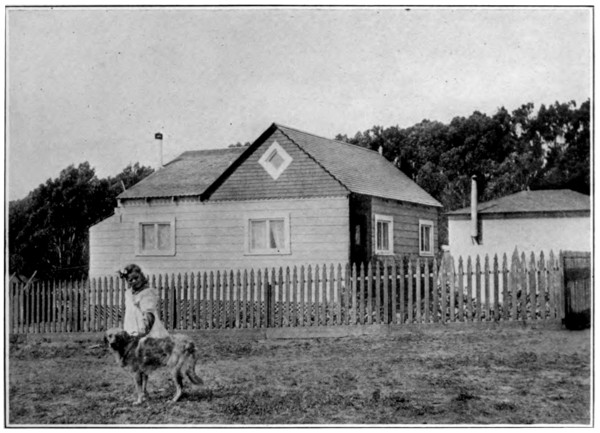
Built by the owner with insurance money and a grant of $250
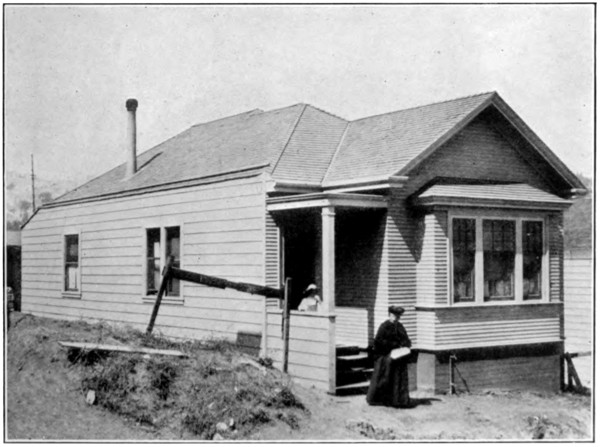
Built by a teamster with a grant of $250 and money privately loaned
Grant and Loan Houses
The incomes received after the disaster did not differ widely from those received before, though a larger number, it is seen, reported having merely a scant living.
Seventy-five per cent of the men in the grant and loan group worked for wages or on a monthly salary before the fire. They include artisans, men of ordinary skill, and laborers, engaged in 87 different industries. Of the 670 wage-earning or salaried men for whom data were tabulated 16 were employed in professional service, 230 in personal and domestic service, 254 in manufacturing or mechanical pursuits, and 170 in trade, transportation, or miscellaneous occupations. The wages received ranged from $25 to $200 per month. Two hundred and eighteen men received larger wages before the fire than after, but the reverse was true in 285 cases. The indication is that the abnormal conditions had made no great change in the earnings for the two and a half years after the fire.
As in the other groups, the incomes here considered are based upon the nominal wage, for no estimate of the irregularity in the employment, either before or after the disaster, could be obtained. During the period immediately following the earthquake, many men of this group could not secure steady employment. The family incomes, therefore, were for a time very meager.