PART I ORGANIZING THE FORCE AND EMERGENCY METHODS (continued 2)
Reading edition
It must be borne in mind that the kitchen system was introduced after the bread line had been reduced to less than one-half its greatest length, and that it threw into conspicuous relief those who were without power to re-establish themselves or unwilling to try to do so.
The hot meal kitchens caused no sudden drop in the amount of food distributed. On May 12 when, as has been already commented upon, there was a marked decrease in the number of persons receiving rations, there were but five kitchens in operation; but the new method did effectively help to weed out those who no longer needed free rations. Colonel Febiger wrote late in June that “by the operation of these hot food camps thousands of dollars were saved for future relief; probably 95 per cent of the 15,000 persons now being supported by food relief were absolutely in need of it, those not in need either having withdrawn or having been forced out.”
The kitchens were at first run exclusively by the Desmond Construction Company under contract with the Bureau of Consolidated Relief Stations; that company, which had already made its experiment, having been the only one willing to undertake what was considered by the contractors to be an undesirable job. When by June 21 the number of kitchens had been gradually increased to 27, two other contractors were operating under the Bureau.
The Bureau and the Red Cross provided police protection, furnished sites for the kitchens, and supplied fuel and water. Each contractor provided his own buildings or tents, equipment, and service. The contractor agreed to furnish a wholesome meal, and to submit his daily menu to the relief officials for approval.
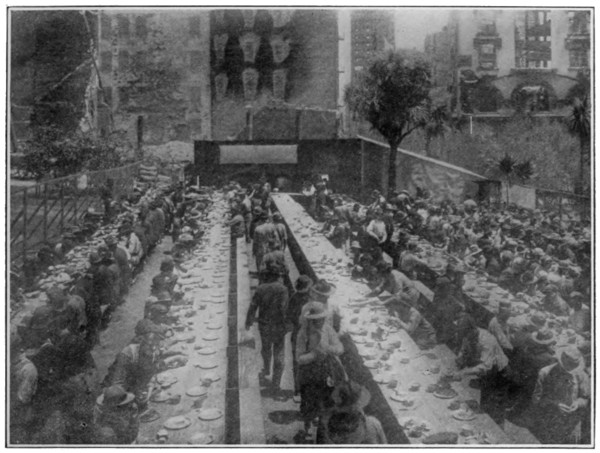
An open air dining room
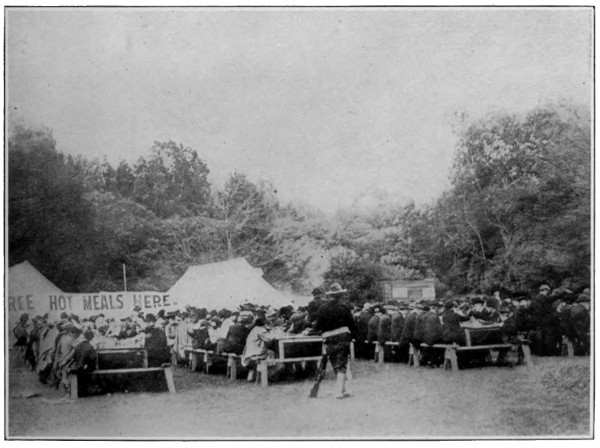
In Golden Gate Park
Hot Meal Kitchens
The following is a typical daily menu:
Breakfast
Hot Hash, or Hot Mush and Milk Bread or Hot Biscuit Coffee, and Sugar
Dinner
Hot Soup, or Roast Beef or Hash One Vegetable, Bread Coffee, and Sugar
Supper
Soup, or Irish Stew Bread or Hot Biscuits Tea, and Sugar
Meals were supplied to any person who was ready to pay cash or who possessed a meal ticket. The meal tickets were issued daily by the Red Cross and were redeemed by it by payment made to the contractor in cash or in kind from the relief supplies. The original plan was to serve ten-cent free meals with provision for granting an extra five-cent purchase to such persons as might be considered in need of extra food.
Certain kitchens within the Presidio reservation are not reported on later than July 11, when they were furnishing about 1,200 meals a day. One thousand meals a day would probably be a liberal estimate for the remainder of the time, thirty days, that these Presidio kitchens were to remain open, but such an estimate is not included in Table 8.
TABLE 8.—MEALS SERVED BY HOT MEAL KITCHENS, FROM MAY TO OCTOBER, 1906, INCLUSIVE
Month MEALS SERVED Amounts disbursed from Relief and Red Cross Funds in payment for meals
Free Paid
May 87,160 (Unknown) (Unknown)
June 402,522 1,027 (all in 3 days) $46,610.55
July 486,182 3,786 (all in 11 days) 75,756.30
August 377,776 4,608 61,379.75
September 109,448 684 17,746.80
October 11,875 .. 2,953.14
Total 1,474,963 (Unknown) (Unknown)
From the data on hand we can estimate the proportion of ten-cent meals at 12.1 per cent and fifteen-cent meals at 87.9 per cent.
The first report of meals paid for is for June 28. Those who patronized these restaurants paid from 10 to 20 cents for their meals, the average price being 15 cents. The extent to which this opportunity was utilized is shown in Table 9.
TABLE 9.—FREE AND PAID MEALS SERVED BY HOT MEAL KITCHENS ON SPECIFIED DATES IN 1906
Date Free meals served PAID MEALS SERVED
Number Per cent of free meals
June 28 16,666 617 3.7
July 1 14,087 423 3.0
August 1 15,202 191 1.3
September 1 7,484 82 1.1
The last paid meal was served on September 19, 1906. The last kitchen closed was that at Speedway Camp, where the final meal was served October 10, 1906.
Frequent complaints were made that the kitchens supplied food which lacked in quality and variety, was poorly cooked, and served on fly-infested tables in unsanitary rooms. In some instances the complaints were justified, but the army inspections were thorough, and the contractors on the whole lived up to the contracts. Some of the complaints were made not by those who were using the kitchens but by those who were critical of the kitchen system itself.
It is not possible to estimate the total value of the food distributed. For food and its distribution the Relief and Red Cross Funds expended $1,226,567.16. The army report gives $259,811.20 as expended for subsistence stores, but this is not a complete statement of the disbursements made by it from the appropriation from Congress. These sums do not include an estimate of the value of donations in kind that were used as such and not sold. General Greely in his report stated that in the food donations distributed by the army there were about 2,000,000 complete rations, which had to be increased by substitutions and by purchase to supply the 3,873,745 rations distributed by the army during May and June. Two commodities that had been donated in excess of need were flour and potatoes.
TABLE 10.—EXPENDITURES OF SAN FRANCISCO RELIEF AND RED CROSS FUNDS FOR PURCHASE AND DISTRIBUTION OF FOOD, TO MAY 29, 1909
Purchases of food
Groceries $560,205.77
Meat 182,798.74
Bread 84,436.10
Milk, fresh 33,032.64
Fruits and Vegetables 25,029.01
Flour 21,848.14
Miscellaneous 8,029.43
Total $915,379.83
Distribution of food
Stoves, hardware, kitchen utensils, dishes, fuel, etc. $30,540.72
Labor of all kinds 39,968.72
Drayage, etc. 14,787.10
Total 85,296.54
Hot Meal Kitchens 204,446.54
Bureau of Special Relief 21,444.25
Grand total $1,226,567.16
TABLE 11.—PERSONS TO WHOM RATIONS WERE ISSUED IN MAY AND JUNE, 1906
Date Number of persons
1906
May 1 313,117
2 313,117
3 279,631
4 230,207
5 264,570
6 262,027
7 233,989
8 223,915
9 222,313
10 204,637
11 186,960
12 147,232
13 139,405
14 126,970
16 97,886
18 91,812
22 73,163
24 62,239
26 39,432
29 54,883
31 44,289
June 2 42,374
5 39,084
7 35,237
9 34,268
12 29,621
14 22,753
16 22,295
19 16,608
21 16,246
23 15,451
26 15,340
28 15,339
30 15,353
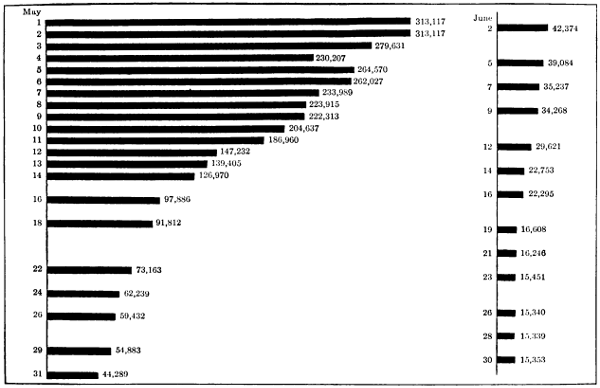
CHART 1.—PERSONS TO WHOM RATIONS WERE ISSUED IN MAY AND JUNE, 1906
Among the persons who received rations, as indicated in the table and chart, are included both those to whom raw rations were issued and those who were served with free meals at the hot meal kitchens.
3. DISTRIBUTION OF CLOTHING
Of secondary urgency was the demand for clothing. The requests for clothing were fewer than those for food, though many refugees fled from the burned areas with no clothing except nightgowns or calico slips, a poor protection from the cold nights and chilly April mornings and evenings.
The records of distribution are incomplete. General Greely estimated the number of persons who received clothing at 200,000. Much of the clothing donated bore the wellknown mark of the charity gift in kind. The second hand clothing in many cases was, to repeat General Greely’s comment, “more or less of a burden on the Red Cross.” Some was useless; some required to be cleaned and disinfected. The new clothing was, in the words of Captain Bradley, who had charge of its distribution, “of old and dead stock of mediocre and poor quality.” Part of the shoes and articles of clothing supplied from the army stores and charged against the appropriation from Congress were of obsolete pattern. The same criticism was made of some of the household goods donated. A large number of the cots, for instance, were worthless or of poor quality. There was the further handicap to the distributor, of not knowing what donations were to be expected or when they were to be received. This uncertainty meant serious delays in supplying the need and severe criticism of the administrators, but the latter did not feel themselves justified in making purchases of clothing in large quantities when clothing similar to that ordered might, later, be received as a gift.
The memory is vivid to some of those who worked in the refugee camps during the midsummer of 1906, of the children in striped sweaters and gay Tam-o’-Shanters. The caps were not suitable for summer wear, but they had been sent in large quantity with the sweaters to be distributed. The mental picture of Golden Gate Park with its scattered barracks and tents pitched close to ornamental lakes and neglected flower beds is accentuated by the note of high color given by the sweaters and caps.
Distribution of clothing, like the distribution of food, was quickly undertaken by independent groups of volunteers, who collected and gave out what could be got in the city itself. While the fire was spreading the army from its stores in the Presidio gave blankets and quantities of shoes, shirts, ponchos, and other clothing for men. As the donations from abroad began to arrive in large quantities they were quickly handed out without careful discrimination in sorting or adapting to individual needs.
On May 4 the army, in consultation with Dr. Devine, took charge of the organization of the clothing and household distribution. The Crocker School on Page Street was taken for use as a warehouse. A warehouse for second hand clothing exclusively was established ten days later in the Everett Grammar School, on Sanchez Street. Neither was adapted for use as a department store, but nine departments were organized, each in charge of an experienced clerk:
1. Men’s clothing and hats.
2. Men’s furnishings and underwear.
3. Women’s furnishings and underwear.
4. Boots and shoes.
5. Children’s clothing and hats.
6. Children’s underwear.
7. Bedding and furniture.
8. Household goods.
9. Tentage.
From the departments went during May a daily average of twenty truckloads; during June, eighteen. Among the household goods that had to be handled were towels, sheets, pillows, pillow cases, blankets, comforters, mattresses, stoves, cooking utensils, cutlery, dishes, brooms, wash tubs, washboards, boilers, irons, clotheslines, axes, chairs, tables, and sewing machines.
The method of distribution was similar to that for food. Each civilian chairman made requisition for the articles that were found by the superintendents of the stations to be needed within his section, and each requisition was filled so far as the warehouse stock would admit. The articles were sent to the separate stations for distribution. The army had charge of reception and distribution of goods; the Red Cross, of determining who should be entitled to aid. The first registration was used as a basis for determining need, but there was no uniform system of record and various forms are found to have been in use,—an instance of the necessity for a general, accepted form of registration and record.
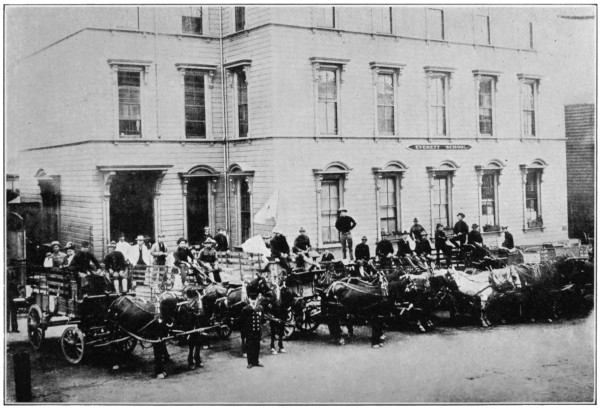
Soldiers guarding the supply wagons
Warehouse for Second Hand Clothing
It was planned to complete by the middle of July the general distribution of clothing and household goods by determining whether each refugee at that time had a decent supply which would prevent present suffering. After that date the Rehabilitation Committee was to consider further need of clothing and household goods in relation to general need of rehabilitation. The distribution did end practically on August 1, when those who had requisitions for articles that had not been furnished were given by the Rehabilitation Committee the cash value of the articles called for on their requisitions as far as approved by the civilian chairmen of their sections.
The later development of the methods of distributing clothing shows increased efficiency as greater experience was gained.
After August 15 the Bureau of Special Relief[58] had charge of filling orders for clothing for those living outside the camps whose needs were urgent but not great; the more important cases of need of clothing and household goods were cared for by the Rehabilitation Committee. From August 6 the residents of the camps were supplied with all necessary clothing through the Department of Camps and Warehouses, an arrangement which continued until the middle of October, after which issues of clothing were made by requisition through the department headquarters on the supply of clothing kept in Golden Gate Park. From December, 1906, the Department of Camps and Warehouses sent individual requisitions for clothing to the Bureau of Special Relief. Possibly these were such as it could not itself fill.
All issues of clothing were stopped on May 16, 1907, and the supply on hand was turned over to the Rehabilitation Committee, which distributed it among a number of institutions. It is probable, however, that for a long time only a very small quantity of clothing had been issued to meet the needs of the aged, infirm, and sick at Ingleside.[59] It is to be noted further that as early as August, 1906, issues were limited, and were made only to destitute persons whose circumstances could easily be investigated.
4. FURNISHING TRANSPORTATION
The rapid exodus of refugees from the city during the first week after the disaster meant a desirable lessening of the task of providing food, clothing, and shelter. The transportation work, which divides itself into four administrative periods, began the first day of the fire, when refugees were given free passage across the bay, down the peninsula, and to points far inland. No special arrangement was made. The transportation companies merely threw open their gates and let the people crowd into the boats and trains. The committee on transportation of refugees, a sub-committee of the Citizens’ Committee, had comparatively little work to do. It told the public that the railroads were ready to carry the people and it made inquiry as to the ability and willingness of other communities to care for refugees. From many communities, some distant, came quick, generous offers to care for definite numbers of people.
When the first period, the period of indiscriminate free transportation, ended on April 26, the Southern Pacific Railroad, the only railroad running out of the city and the one that in normal times carried the greater part of the suburban traffic by ferry and train to towns across the bay, had transported, according to an official report, the following number of free passengers:
TABLE 12.—PERSONS CARRIED FROM SAN FRANCISCO AS FREE PASSENGERS BY THE SOUTHERN PACIFIC RAILROAD, FROM APRIL 18 TO APRIL 26, 1906
Destination Persons carried
Suburban points around the bay 226,000
Other points in California 67,000
Other states 7,684
Total 300,684
The value of this service, according to the official report, was $456,000. The report states that on April 19 the refugees, most of whom went to Oakland and adjoining communities, left San Francisco at the average rate of 70 per minute. There is no report from any other transportation company. The 226,000 passengers carried to points around the bay included some thousands of persons that crossed more than once, many to go back and forth daily on public or private business, others, a considerable number, to view the fire and ruins.
On April 25, a committee on transportation was organized informally by the officials of the various railroads and the men in charge of relief work, in order to prevent an abuse of free transportation. The new committee, which was recognized as authoritative by the Citizens’ Committee, had for chairman William Sproule of the Southern Pacific Railroad, for secretary and executive, Oscar K. Cushing. On April 26, a transportation bureau was opened in a small office on Fillmore Street near Franklin Hall. The secretary was given power to issue orders for passes and part-rate tickets, which because of his experience in railroad business and in social work he could be relied upon to do with discretion. Each applicant in the long file which day by day stretched down Fillmore Street and around the corner to Sutter, a perplexed, restless file of men, women, and children, eager to be out of the city, was interviewed personally by him to determine whether the applicant were able to pay any part of his fare, whether the best way to restore him to self-support was to grant him transportation, and whether he would be a charge upon the community to which he wished to go. When letters of recommendation or personal interviews failed to give the information desired, a quick investigation was made. If the applicant were able he paid something toward his ticket but never more than at the rate of half fare.
On May 10 the railroads stopped the issue of free and reduced rate tickets as a relief measure. This marked the end of the second short period of regulated free transportation work. A week later, on May 18, the transportation work was merged with that of the Bureau of Special Relief and Rehabilitation,[60] and when Mr. Cushing became executive head of the joint work no material change was made in the method of caring for transportation cases.
During the third period, beginning May 10, the period of united effort, the committee guaranteed to pay in certain cases reduced railroad rates, at first a half-fare rate, later a one-cent-a-mile rate. The railroads in their discretion gave in other cases free passage provided the committee made a brief statement of the circumstances of the applicant with a recommendation for free passage.
When the permanent Rehabilitation Committee was organized, July 2, 1906, the transportation bureau was again merged, which marked the beginning of the fourth period of its work, the period of completed organization. During the fourth and last period, which ended June 2, 1908, when the last transportation grant was paid, the transportation methods held unchanged with but occasional variation of rates and with a rapidly decreasing number of cases to be considered.
The relative importance of the transportation work to the other rehabilitation work, on the basis of the number of individuals concerned, steadily decreased from one-half in the first two weeks to about one-eighth in the middle of July.
Many a case was brought to the attention of the Committee by a distant relative or friend. For instance, a man wrote from a little town in Illinois as follows:
“Dear Kind Friend,—I have an aunt by the name of —— ——. You will do me a favor if you will send Mrs. —— to Chicago, Ill. I would send the money to pay fare but as I have not got it to spare I cannot do it. I hope you will be kind-hearted enough to send her to Chicago. Also arrange to get her meals on the train for her. You can call on her, Mayor Schmitz, at —— and have a talk with her. Please get my Aunt Clara to come back if you can do so.——If there is anything I can do for your City please let me know and I will try and help you folks at once. There are tears in My eyes as I think of the beautiful City you once had that is now in ashes. Reply at once.”
“Aunt Clara” could not be found.
An inquiry addressed to a man in whose behalf the Committee had been asked for help by a Chicago clergyman brought this terse and satisfactory reply:
“Dear Sir,—We are no longer in need of relief and we do not desire transportation to Chicago. I have so informed Rev. ——.”
Vague plans, or plans that did not commend themselves, led to refusal. There were, for instance, a man who thought he would like to try his fortune in Nome; a Syrian who had an idea he might get on better in Portland, Oregon, though he had no relatives there and no prospect of work; a Scotch Australian with a large family, known to the Associated Charities for years, who looked hopefully to Australia, though he had left it because he was a failure there; two girls, domestic servants, who wanted to go back to Ireland because they “were afraid of the shakes”; an old man whose only reason for returning to Europe was his desire to see his son ordained a priest; a widow, “saleslady” by occupation, who asked to be sent to Los Angeles on the strength of a letter from a friend, apparently a traveling man living in a hotel, whose mildly expressed concern for her welfare she took as a promise to provide a home. A stonemason wanted to leave his family without resources and try his fortune in Canada. A man whose family had been sent to Massachusetts in the early days to leave him free to get a start got tired of trying and wanted to join them. Another man merely wanted to go away on a visit, leaving his family behind. After the middle of June, requests that wife and children be sent away for a visit while the man stayed behind at work, were refused, though in the abnormal conditions of the earlier days they were frequently allowed. In a considerable number of cases, as of carpenters, shoemakers, domestic servants, and laundresses, transportation was refused because it was known that nowhere else in the country was the opportunity so good for work and good pay in those occupations.
In looking over the records one finds many reasons given for leaving San Francisco. Jewelers, inventors, masseurs, hair dressers, producers of “art work,” said they could find little demand for their services in the first few weeks after the fire. Acrobats, mental science lecturers, teachers of elocution, music, Hebrew, religion, and higher mathematics, could find no one to demand their teaching. Saloonkeepers and barmen had lost their shops through the closing of the saloons, and when they opened July 5, conditions would be hard because a higher license was to be asked. It seems like a jest of fate that at a time when thousands of people were living in tents a tent-sewer could find no occupation. It also seems curious that physicians and nurses should have wished to leave the city, but it is a fact that the demand for their services was decreased rather than increased by the disaster. Physicians suffered perhaps as much as any other class of persons, for they lost not only their offices, libraries, and instruments, but also a large proportion of their patients,—the profitable, well-to-do ones left town, and the poorer ones were stimulated by the out-of-door life, plain food, or by necessity, into unusual good health.[61] Bakers, grocers, and lodging-house keepers asked for transportation because, though there was a demand for their services, they had no capital with which to make a new start. Tailors, dressmakers, milliners, printers, and a number of others could not, or would not, wait for the demand which came for them a few weeks later. In the middle of May, for example, it was thought that ladies’ tailors could not expect to make a living for six months; early in June employers could not begin to get the number they wanted. In but few cases could lack of occupation be accepted as the sole justification for leaving the city. Carpenters and laborers who could not get work in San Francisco in June could hardly be expected to get it anywhere.
Sickness was a reason for transporting some of the refugees. A man who had been hurt in the earthquake was sent to relatives as soon as he was able to leave the hospital. Another man, whose little store had been wrecked by the earthquake, he himself injured, and his wife and one child killed, was sent to his sister in Chicago, his other children having been provided for by a charitable organization. A woman suffering from cancer was taken to her sister in Brooklyn by a nurse who was also being assisted to reach her destination. It was not uncommon in the earlier days to find a woman so nervous that her physical condition was a menace to the prospects of her family. One such woman would not allow her husband to do any regular work; another was so irritable that desertion seemed imminent. In such a case as the last the only hope of saving the family seemed, paradoxically, to lie in temporary separation. More than one woman who begged to be sent away for a visit was told, “We are doing this, you understand, because we are sorry for your husband and want to give him a chance to get on his feet here; but please encourage him by writing every week.” The policy, in spite of these instances, was definitely laid down that families should be kept together.
There were numerous examples of that re-distributing of responsibility for dependents which takes place when losses come to families individually. An aunt or grandmother in Nevada or Missouri or New York would offer to take care of a little boy or a young girl, in order to relieve the family in San Francisco. An epileptic woman whose daughters had lost their work on account of the fire was given a home by a cousin in Massachusetts. This cousin, with unnecessary caution, wrote to the woman: “I will not let him (Dr. Devine) know you have any daughters—only that you are without a home and in poor health.” A woman had been visiting her married daughter in San Francisco, and the daughter, after the fire, could neither entertain her longer nor pay her fare home. Still another instance was that of a Roumanian, seventy-seven years old. He had had a home with his granddaughters for the previous two years, but they were burned out and his only refuge was the old home in Roumania. Unfavorable surroundings as a reason for granting transportation may be illustrated by the case of a young girl who had been living in a basement with twenty refugees, men and women. She was sent to her father in Ohio.
The willingness of relatives and friends to receive refugees determined the transporting of a large number of persons. The letters that found their way to the files of the Rehabilitation Committee as evidence that the would-be travelers would not be unprovided for at the end of their journeys form a unique body of testimony. They give a glimpse of those obscure wells of charity in which we all believe, on account of frequent individual instances, but into whose depths we are seldom allowed to look. The open-hearted offers of hospitality that went out from humble homes all over the country were, in fact, a contribution to the relief fund, though they found no place in the list of donations, the quality of their mercy being too subtle. They may be given recognition by a few quotations from many letters:
From Delancey Street, New York, to a Jewish tailor with a wife and six children:
My dear brother,—I have received your letter, also dispatch, and in spite of all my efforts I send you only ten dollars. I cannot send you more for the present. I advise you to come over as soon as you can with your family, on my responsibility, as there are plenty of work for you. Don’t spend the time with nothing but come as soon as you possible can.
From a woman in Council Bluffs, to her sister:
You must and had better come here. J—— can work at his trade here and you can stop with us until you can do better.
From a little California town:
My dear cousin,—I am awfully sorry to hear you and all the family lost everything. But let you and Jennie and all the family come right up and stop with us. You will want for nothing as we have plenty for all and as many more. Hoping you will come right away, ———.
From a Russian woman in Chicago:
Beloved sister,—You shall not think about anything but come to Chicago———. You shall not worry about anything. Everything will be provided for you when you arrive here. You shall also get work.
A mother in Michigan wrote to her daughters, who had been in domestic service:
Girls, for my part I wouldn’t have any desire of living side of the Pacific ocean any longer and you know we would feel better to have you back here with us.
Another Michigan letter, from the brother of a refugee:
I want you to come with all your family and share our home until you get all rested up and see what is best to be done. Old frozen Michigan ain’t the worst place after all.
A woman in Spokane who offered a home to a friend and her little girl wrote, with a naïve appreciation of her own generosity and of the happy combination of disposition and circumstances to which she was able to refer:
I write to extend my sympathy to you and you know I have a big heart and a large house and would be only too glad to have you come and stay with me as long as you want to and it would not cost you one cent.
A man in Nevada who had secured work for a former business associate, wrote to him:
Through the kindness of friends (and I may say myself), we have furnished you and wife with a home furnished complete, so if you can get means to come up you will be O. K., as your rent is paid for a couple of months.
There could be no doubt that the boy whose mother in Los Angeles had found work for him, and who wrote him as follows, would be looked after:
A Mrs. T—— to whom I appealed for you gave me as a loan on the sly five dollars for your fare down, which must be returned as soon as possible so please do not use it unless you fail to get a pass.
Some friends in southern California offered a home to three sisters, working girls:
If you can get passes, which no doubt you can by applying to Mayor Schmitz, as I have written to him, asking for you, come down and stay with us for as long as you wish. We have a house in our yard which we can fix up for you without any inconvenience to us. You can live there as long as we stay here.
The great majority of these people who were assisted to leave the city seem to have been those that could easily be spared from San Francisco during its period of reconstruction. They were, on the whole, lacking in physical vigor or in mental qualities of courage and initiative, or in attachment to their city. They did, however, give the impression that, under less exacting circumstances, they would have been able to get along creditably. It seemed fair to expect that in nearly all the cases the substitution of a more favorable environment would have results so satisfactory as to justify transportation as a rehabilitation measure, while the burden of dependence, whatever it might be, would be so distributed as not to bear heavily in any one place. The policy of those responsible for decisions was not to send to other cities persons that were likely to become dependent on charity. The transportation agreement of the charity organization societies of the largest cities was respected. The prompt answers to telegraphic inquiries given by all the eastern cities was a very important help. It was reassuring to find that the plan that was satisfactory in ordinary times proved indispensable in the emergency.
For the second period of the work of transportation, which seems to represent about the average, Table 13 is given.
TABLE 13.—DESTINATION OF PERSONS SENT FROM SAN FRANCISCO BY THE TRANSPORTATION COMMITTEE, FROM APRIL 26 TO MAY 10, 1906, INCLUSIVE[62]
Destination PERSONS SENT TO DESTINATION SPECIFIED
Men Women Children Total
California 122 541 379 1,042
Oregon 28 103 40 171
Washington 20 85 57 162
Colorado 11 46 35 92
Nevada 2 40 11 53
Utah 9 26 11 46
Montana 5 13 13 31
Arizona 4 8 .. 12
Idaho 2 3 3 8
Wyoming .. 3 .. 3
New Mexico .. 1 .. 1
East (including Europe) 188 553 322 1,063
Total 391 1,422 871 2,684
These figures are based, not on a study of individual cases, but on lists and registers kept by the various committees in charge of transportation. Although they probably are not absolutely correct, they are sufficiently exact for the present purpose. The term Pacific States in the following table includes the tier of states from Montana to New Mexico; all east of them is called East. Alaska and British Columbia destinations are included in Pacific States, and eastern Canadian and European points are included in East. The number of persons sent to such points was very small.
The following table shows the number carried for all periods, exclusive of those carried to suburban points.
TABLE 14.—PERSONS SENT FROM SAN FRANCISCO, BY PERIOD AND BY GENERAL DESTINATION, APRIL 26, 1906, TO JUNE, 1908[63]
Period Total number of persons sent PERSONS SENT TO Average number of persons sent per day
Cali- fornia points Other Pacific States East (in- cluding Europe) Other foreign points
1906
2d Apr. 26-May 10 2,684 1,042 579 1,063 .. 179.0
3d May 11-Jun. 30 1,015 212 193 609 1 20.0
4th July 365 97 70 193 5 11.8
August 350 221 23 106 .. 11.3
September 90 32 3 55 .. 3.0
October 128 13 45 57 13 [64] 4.1
November 77 10 2 13 52 [64] 2.6
December 37 11 3 17 6 1.2
1907
January 37 7 6 19 5 1.2
February 31 6 7 18 .. 1.0
March 21 3 3 10 5 [65]
April 22 9 3 10 .. [65]
May 8 1 4 3 .. [65]
June 3 .. 1 2 .. [65]
July 4 .. .. 4 .. [65]
December 2 .. .. 2 .. [65]
1908
June 2 .. .. 2 .. [65]
Total 4,876 1,664 942 2,183 87
TABLE 15.—TERMS OF TRANSPORTATION OF PERSONS SENT FROM SAN FRANCISCO IN SECOND AND THIRD PERIODS
Terms of transportation PERSONS TRANSPORTED
April 26 to May 10, inclusive May 11 to June 30, inclusive
Number Per cent Number Per cent
Carried free by railroads 2,096 78 136 13
Low rate paid by Applicant 588 22 188 19
Committee .. .. 597 59
Applicant and Committee jointly .. .. 94 9
Total 2,684 100 1,015 100
TABLE 16.—DESTINATION OF PERSONS SENT FROM SAN FRANCISCO IN SECOND AND THIRD PERIODS
Destination PERSONS SENT TO DESTINATIONS SPECIFIED
April 26 to May 10, inclusive May 11 to June 30, inclusive
Number Per cent Number Per cent
California points 1,042 38 .8 212 20 .9
Other Pacific Coast states 579 21 .6 193 19 .0
East 1,063 39 .6 609 60 .0
Various foreign points .. .. 1 .1
Total 2,684 100 1,015 100
TABLE 17.—VALUE AT REDUCED RATES OF TRANSPORTATION FURNISHED THROUGH THE COMMITTEE
Terms of transportation VALUE OF TRANSPORTATION FURNISHED
May 11 to June 30, 1906 July 1, 1906, to June 2, 1908 Total
Paid by applicant $4,987.27 $585.47 $5,572.74
Paid by Committee 10,878.32 30,921.70 41,800.02
Estimate of contribution by railroads 42,369.40 5,015.70 47,385.10
Total $58,234.99 $36,522.87 $94,757.86
5. PROVIDING SHELTER
In April in San Francisco, the weather being temperate and dry, shelter for the homeless may properly be considered an easy third in order of importance in the supplying of relief. The first night after the earthquake the people who had been driven from their homes by fire or by fear of another shock, sought rest in the public squares and parks, in vacant lots and in military reservations. Bedding was the necessity carried from their homes by many refugees who expected to return to them after the danger was past. Each family took possession of the first spot available. The more fortunate separated themselves from other families by means of trunks or boxes, or by a sheet or blanket thrown over a pole that rested on two stakes driven into the ground. As the hours passed a few real tents were secured, and shacks were made out of loose boards, tin cans, and sheet iron. Soon, tents from the army stores and from private sources were provided in increasing numbers and were set up with varying degrees of order.
Two hundred thousand persons came out from the burned district homeless, of whom possibly 75,000 left the city. These latter are included in the number of refugees that sought transportation, as shown in the preceding section. Shelter was found in some parts of the city for a large number through the hospitality of friends or strangers, through payment for lodging in cash or credit, or through the use of unoccupied houses. Two thousand persons found shelter in vacant houses through the efforts of the police. The capacity to house the needy was swelled by the use of basements, attics, and barns. The number of the homeless was increased to some extent by the general rise in rentals, which was great in certain parts of the city and which forced a small number of people into the ranks of applicants for shelter. During the first two weeks perhaps a thousand persons had no shelter but what they could find in the burned district amid the ruins or on wharves.
Tents were provided in the first days by voluntary agencies, by the sub-committee on housing the homeless, by the army, and by the American National Red Cross. The first named committee, which was one of those hastily appointed by the Citizens’ Committee immediately after the disaster, also built barracks. It set to work with great energy, but with complete independence of any other committee, especially of the Finance Committee and of the committees on relief of the hungry and on transportation, whose work it therefore overlapped. It appointed another sub-committee, on roofing the homeless, which canvassed the city for vacant houses and rooms and then induced but few persons to make use of its finds. It formulated plans for the construction of two permanent camps and made recommendations to the army to place all the homeless in Golden Gate Park, to which park it had as early as April 20, assisted by an army officer, hauled lumber for the building of barracks, for the flooring of tents, and for latrines.
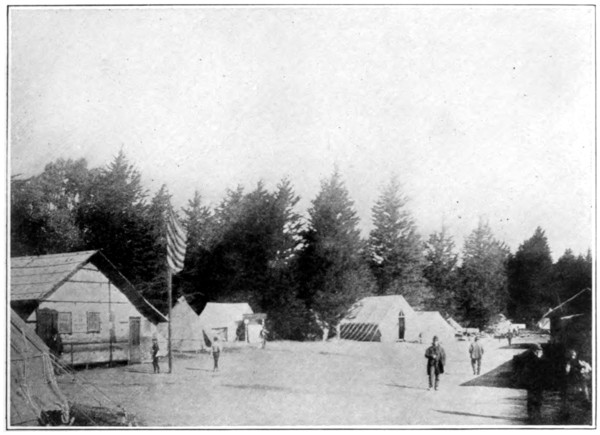
An administration headquarters
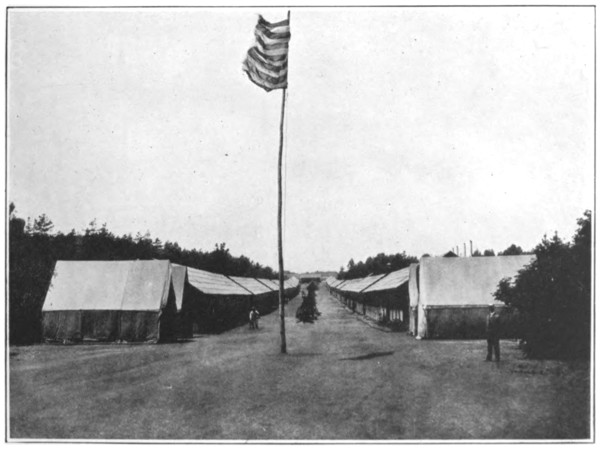
Camp No. 6, The Speedway, showing barracks
Camps in Golden Gate Park
This committee was discharged from duty, on request of its chairman, two weeks after its appointment, but its members continued to incur unauthorized expense for at least four weeks longer. The committee made such a fine showing for speed that its work got ready recognition, speed in those first days being at a premium; but its lack of deliberation led to the embarrassment of the relief authorities. The barracks could not be connected with street sewers because they were situated on low ground, so later there was difficulty in disposing of waste and surface water. One of the camps, Camp 6, could not be given fire protection, and both camps had to have heavy additions made to the initial expenditures to secure greater privacy and protection against drafts. In them the refugees were brought into an association so close as to be either demoralizing or humiliating. Both camps would probably soon have been closed if the authorities had felt justified in abandoning them after the large expenditure made. The initial mistake was to erect barracks during the emergency period. Tents, which the army and the American National Red Cross stood ready to provide, were much more practical. They could be moved at small expense from place to place, and until the rainy season set in they furnished sufficient shelter. Tents, not barracks, were the need of the emergency period.
The two barracks built in Golden Gate Park by the committee on housing the homeless were No. 1, known later as Camp 5, near the Children’s Playground, and No. 2, known later as Camp 6, or the Speedway Camp. Camp 5 consisted of 18 buildings with 16 two-room apartments in each, separated by a partition only 8 feet high. The rooms were 10 feet square—a front room with a window and a door and a rear room with no window or outside door. Camp 6 was of the same type of construction and consisted of 10 barracks and separate buildings for hospital, laundry, and other general purposes. The barracks of Camp 5 were occupied from the first of May to the middle of December; those of Camp 6 from June 1 to the latter part of August of the following year.
As late as the end of May General Greely reported that he could not get sufficient data on which to base housing recommendations. The first registration had shown that a little over a fourth of the applicants to the food stations were living at the same address when they were registered as on April 17, the day before the earthquake. In a few cases these people were no doubt housed in tents or shacks on the site of their burned homes. But most of them had not lost their homes or personal effects, though they had been affected by the disaster in other ways. They had lost their work, or had suffered some injury in health from the shock, or, merely demoralized by the general confusion and the abundance of free provisions, had assumed a mental attitude of dependence not really justified. Most of this last class, to be sure, did not survive the registration, but there were no doubt some who were not weeded out until after the canvass had been made. Sixteen per cent more are known to have been living in houses at the time of the registration, but as their addresses on April 17 were not given, it is impossible to know whether or not they had been driven out of their homes by the disaster.
TABLE 18.—HOUSING OF REGISTERED FAMILIES, BY CIVIL SECTIONS, MAY, 1906. NUMBERS
Residence at time of registration NUMBER OF FAMILIES HOUSED AS SPECIFIED IN CIVIL SECTIONS Total
I II III IV V VI VII
Same as on April 17 856 225 572 1,105 197 424 1,955 5,334
Tent or shack 741 79 1,407 272 1,082 467 317 4,365
A house different from that of April 17 640 294 669 924 681 945 2,168 6,321
A house; uncertain whether the same as or different from that of April 17 336 191 329 257 215 999 804 3,131
Total whose addresses in May were given 2,573 789 2,977 2,558 2,175 2,835 5,244 19,151
Addresses in May not given 17 24 120 19 45 41 21 287
Total registration 2,590 813 3,097 2,577 2,220 2,876 5,265 19,438
TABLE 19.—HOUSING OF REGISTERED FAMILIES, BY CIVIL SECTIONS. PERCENTAGES, BASED ON THE TOTAL NUMBER OF FAMILIES WHOSE ADDRESSES IN MAY, 1906, WERE GIVEN
Residence at time of registration PER CENT OF FAMILIES HOUSED AS SPECIFIED IN CIVIL SECTIONS Total
I II III IV V VI VII
Same as on April 17 33.3 28.5 19.2 43.2 9.1 15.0 37.3 27.9
Tent or shack 28.8 10.0 47.3 10.6 49.7 16.5 6.1 22.8
A house different from that of April 17 24.9 37.3 22.5 36.1 31.3 33.3 41.3 33.0
A house; uncertain whether the same as or different from that of April 17 13.0 24.2 11.0 10.1 9.9 35.2 15.3 16.3
Total whose addresses in May were given 100.0 100.0 100.0 100.0 100.0 100.0 100.0 100.0
Less than a fourth of the 19,438 registered[66] were living in tents or shacks. These 4,365 families or parties included some 19,000 individuals. As the population of the “official camps”[67] outside of Golden Gate Park (which was not included in the registration) was less than 8,500 at the time, and as it was wellknown that some of the people in the permanent camps were already providing their own food, it is evident that in the early days of May about one-half of the registered tent and shack dwellers were in the unofficial, unsupervised camps and isolated makeshifts for shelter which were one of the most difficult problems of the situation. The registration card did not ask what the character of the dwelling was, and for this reason, as has already been said, the proportion of persons in tents and shacks was no doubt understated, since the description given by the enumerator of the “permanent location” of the family may not always have suggested, when it should, a tent or a shack to the tabulator.
In May about a third of all were living in houses which were not their homes on April 17. These families, together with those who were living in tents and shacks, made up 55.8 per cent of the total. Considerably over half, therefore, of those who were receiving rations in the middle of May had presumably been burned out of their homes, or “shocked out,” as one of them put it. Many of those who had found house shelter were living under very unfavorable conditions. Overcrowding does not show on the registration card, and bad sanitary conditions can only be guessed at. In 206 cases it was stated that the “house” was a basement or rear building; occasionally it was a barn.
The seven civil sections[68] naturally present contrasts in the matter of housing conditions. In Section VII only 6 per cent of the refugees were living in tents or shacks, while in Sections III and V almost half of them were. Section VII shows the highest percentage of families in houses to which they had moved after the fire, and Section IV is not far behind. The facts which come out about Section IV at first seem curious. Although it included about half of the burned area, it had the highest percentage of families living in the same place as on April 17. The unburned part of Section IV at the time of the fire probably was more thickly populated than any equal area in the city, for in other sections there were great areas either not built upon or occupied by factories, etc. This was practically one solid residence section filled mostly with flats and populated by persons employed chiefly in adjacent parts of the burned district, who thus lost employment, if not property. Although it contained several permanent camps, only 10.6 per cent of those who were receiving rations were living in tents or shacks. It is probable that 43.2 per cent who were living “at the same address” included a number of Italians on Telegraph Hill who were already back on the same house lot, though in shelters improvised from tarpaulins, boards, sheets of tin, corrugated iron, and other possible, though unusual, building materials. Most of the Italians and others who lived about Telegraph Hill had taken refuge, however, in Section III, in which a part of the Italian quarter lay.
Section V shows the condition that would be expected in both IV and V,—half the refugees in tents or shacks, only a small percentage at their former addresses, and the rest crowded into the housing accommodations nearest to their old homes. It would have been interesting to tabulate the distance between the two addresses, but this would have involved so much labor that it could not be undertaken.
The nationality of the head of the family was given in 14,963 cases, over three-fourths of all. Over two-fifths of these were native Americans; nearly one-half were Germans and Austrians, Irish, Italians, English and Scotch, and Scandinavians, of numerical importance in the order indicated; and the rest represented many different countries. The facts are shown in Table 20.
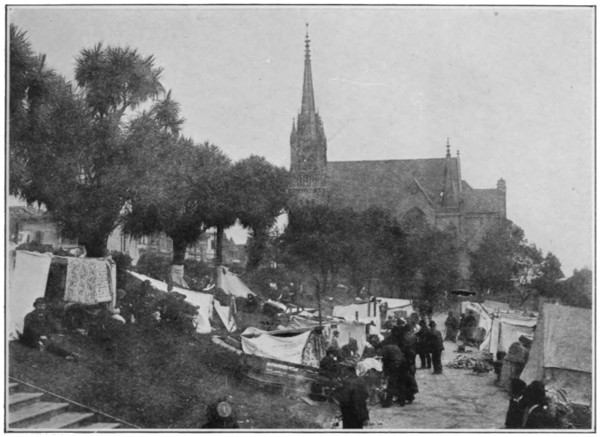
Shelters of sheets and quilts
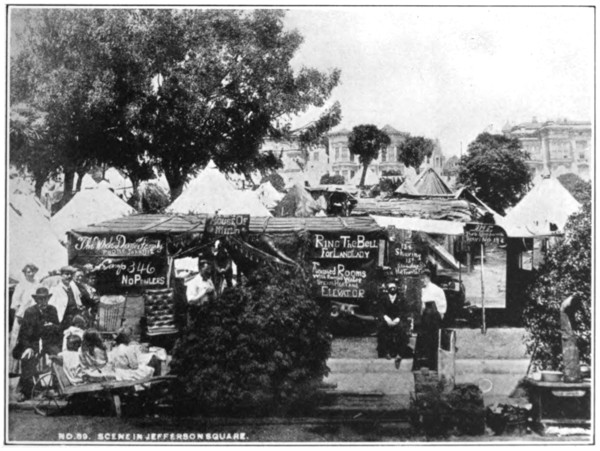
Tents and shacks
Early Shelters in Jefferson Square
It is not possible to compare these figures closely with the nationality of the population of San Francisco as given in the United States Census of 1900, because the census figures are for individuals, while these are for families, the nationality of the family being inferred from the nationality of its head. In the census figures the native born children of a German or Irish father appear as born in the United States, while in the refugee figures such a family group appears as a unit among the foreign born. In this way it is evident that if the refugee figures could have been made up on the same basis of individuals instead of families, they would have shown a considerably higher proportion than they do of native born, and a correspondingly lower proportion of nearly all the foreign nationalities. Possibly the native born children of foreigners would raise the percentage of native born among the refugees to an even higher percentage than they had in the total population of the city. A few comparisons, however, it is safe to make. The Irish and Italians are represented much more strongly among the refugees than their proportions in the population would require; while on the other hand, a population of over 10,000 Chinese[69] was represented by only 20 families drawing rations. In Table 20 the nationalities are arranged in the order of their importance in the population of the city in 1900. Only the first three groups maintained the same relative position among the refugees.
TABLE 20.—NATIONALITY OF POPULATION OF SAN FRANCISCO IN 1900, COMPARED WITH NATIONALITY OF HEADS OF FAMILIES AMONG REFUGEES IN 1906
Country of birth POPULATION OF SAN FRANCISCO, 1900— INDIVIDUALS OF EACH SPECIFIED NATIVITY REFUGEES, 1906— HEADS OF FAMILIES OF EACH SPECIFIED NATIVITY
Number Per cent Number Per cent
United States 225,897 66.0 6,229 41.7
Germany and Austria 37,035 10.8 2,264 15.1
Ireland 15,963 4.7 2,140 14.3
England and Scotland 11,956 3.5 972 6.5
China 10,762 3.1 20 0.1
Sweden, Norway, Denmark 9,591 2.8 709 4.7
Italy 7,508 2.2 1,208 8.1
Canada 5,199 1.5 167 1.1
France 4,870 1.4 400 2.7
Switzerland 2,085 0.6 104 0.7
Japan 1,852 0.5 31 0.2
Russia 1,511 0.4 125 0.8
Mexico 1,459 0.4 75 0.5
Australia 1,096 0.3 24 0.2
Other countries 5,998 1.8 495 3.3
Total 342,782 100.0 14,963 [70] 100.0
TABLE 21.—NATIONALITY OF HEADS OF FAMILIES AMONG REFUGEES, BY CIVIL SECTIONS, MAY, 1906. NUMBERS
Country of birth NUMBER OF HEADS OF FAMILIES OF EACH SPECIFIED NATIONALITY IN CIVIL SECTIONS Total
I II III IV V VI VII
United States 1,015 354 790 1,106 736 177 2,051 6,229
Germany, Austria 331 85 264 413 289 158 724 2,264
Ireland 234 80 228 249 432 169 748 2,140
Italy 66 14 698 59 90 114 167 1,208
England and Scotland 169 48 103 133 125 61 333 972
Sweden, Norway, and Denmark 78 39 88 51 108 113 232 709
France 95 11 79 46 27 31 111 400
Canada 24 9 12 31 10 6 75 167
Russia 11 10 7 28 29 6 34 125
Switzerland 18 2 28 9 11 8 28 104
Mexico 24 .. 42 3 3 1 2 75
Japan 6 .. 11 11 .. .. 3 31
Australia 3 2 3 2 6 1 7 24
China 3 2 9 6 .. .. .. 20
Other countries 57 15 142 105 46 56 74 495
Total 2,134 671 2,504 2,252 1,912 901 4,589 14,963
Unknown 456 142 593 325 308 1,975 676 4,475
Grand total 2,590 813 3,097 2,577 2,220 2,876 5,265 19,438
TABLE 22.—NATIONALITY OF HEADS OF FAMILIES AMONG REFUGEES, BY CIVIL SECTIONS, MAY, 1906. PERCENTAGES BASED ON THE TOTAL NUMBER OF CASES IN WHICH INFORMATION AS TO NATIVITY WAS AVAILABLE
Country of birth PER CENT OF HEADS OF FAMILIES OF EACH SPECIFIED NATIONALITY IN CIVIL SECTIONS Total
I II III IV V VI VII
United States 47.5 52.7 31.6 49.1 38.6 19.6 44.6 41.6
Germany, Austria 15.5 12.7 10.5 18.3 15.1 17.5 15.8 15.1
Ireland 11.0 11.9 9.1 11.1 22.6 18.8 16.3 14.3
Italy 3.1 2.1 27.9 2.6 4.7 12.7 3.6 8.1
England, Scotland 7.9 7.2 4.1 5.9 6.5 6.8 7.3 6.5
Sweden, Norway, and Denmark 3.7 5.8 3.5 2.3 5.6 12.5 5.1 4.7
France 4.5 1.6 3.2 2.0 1.4 3.4 2.4 2.7
Other countries 6.8 6.0 10.1 8.7 5.5 8.7 4.9 7.0
Total 100.0 100.0 100.0 100.0 100.0 100.0 100.0 100.0
The distribution of nationalities varies somewhat in the different sections. Sections III and VI have a considerably smaller proportion of native born than the others. Italians are conspicuously prominent in Section III and Irish in Section V. Germans and Austrians are relatively most numerous in Sections IV and VI, and least numerous in Section III; the proportion of Italian families is less than 5 per cent in all sections except III and VI; the proportion of Irish varies from 9 per cent in Section III to 23 per cent in Section V. In Section VI the nationality of over two-thirds of the families was not given, and in Section II, as has been explained, the registration was not representative of the total body of refugees within its boundaries.
The number of persons registered as having been provided with shelter was but a part of the whole. The estimated number of persons who were living in shacks and barracks on June 1 was 40,000[71] according to the census taken by General Greely; 42,000 according to the Southern Pacific Railroad; 39,000 according to a computation made for this Relief Survey.[72] Of this last number, 34,000 were in tents, 5,000 in barracks and rough shacks. There was a slight increase in the camp population in late May and in June, due to the return of refugees from Oakland and other points, but apart from this accretion the camp population was subject to slight variation.
The first of June a San Franciscan wrote to Charities and the Commons[73] an account of conditions, which gives a picture of what life in the camps meant to some of the refugees:
“The courage and energy of the population of San Francisco in the face not only of disaster but of extreme terror and sudden homelessness has not been exaggerated, but to a great many the full effect of the strain is not even yet apparent. The discomforts of living, in spite of adequate relief, are very great. Wind and fog—for the weather has been unusually cold for a month, dust unspeakable, cooking out of doors in camps and streets, lack of water for toilet appliances, the incessant boiling of water and milk for fear of fever, absence of light and means of transportation for some time—in short, the total uprooting of all the ordinary habits of life, is bearing more and more heavily on the women and children. Schools are closed, thus turning thousands of children literally into the ruined streets. It is now proposed to have a vacation school in Golden Gate Park for the children in camps there, but this is only a very small part of the whole number.
“And for those who stay by the city much of this discomfort will go on for several months to come. That under such circumstances men and women become apathetic and lose pride and self-respect when they can no longer endure the strain of petty hardships, is not surprising. Archbishop Riordan, on his way to the scene of the disaster, is said to have predicted, as the worst effect of it, the deterioration of health and character which would be its inevitable result upon those who are not of the exceptional stuff of which heroes and pioneers are made.”
The Official Camps
The army had control of some camps from the beginning and gradually assumed charge of others until 21[74] camps were under military discipline. These camps became known by the rather misleading title of “permanent camps.” The first to be brought under army control were four situated in the Presidio, three in Golden Gate Park, one in Harbor View, and one in Lobos Square.
During May the Franklin Square camp, those at Fort Mason, and at 19th and Minnesota Streets were taken over by the army. Early in June the camps in Jefferson Square, Lafayette Square, Mission Park, Duboce Park, Hamilton and Washington Squares were added, and in July, Alamo Square, Precita Park, and Columbia Park. Each camp was in charge of a camp commander, who according to the size of the camp, had on his staff clerks, foremen, laborers, and a nurse for the hospital department.[75] One or two of the larger camps had a camp carpenter. Plumbing and carpentry for the smaller camps were done by mechanics from headquarters.
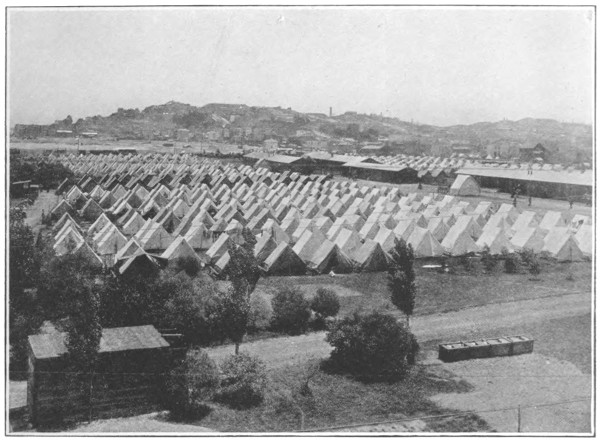
Tent camp, opened May 9, 1906
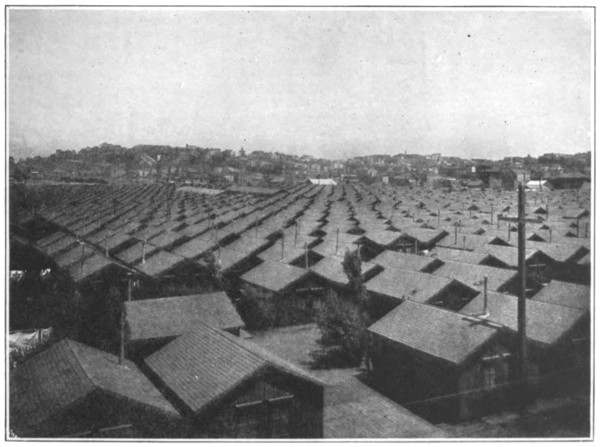
Cottages
Camp No. 9, Lobos Square
During July and August the tents in the permanent camps were floored. Buildings were put up in each camp containing latrines and wash and bath-houses with hot and cold running water.
The unofficial camps, whose moral and sanitary condition was very unsatisfactory, harbored a large number of refugees. As late as September 1, 1906, their estimated population was from 10,000 to 15,000. The Finance Committee had tried to have the campers move into the official camps, but had failed because the police department, which was the only authority that could eject, was unwilling to remove any large number of persons. The police, of course, reflected the attitude of the general public, which seems to have classed as official, though it was not recognized as such by the Finance Committee, a large independent camp, which was a private business venture, renting land to refugees on which they might erect their own tents. General Greely, as has been described,[76] had tried to induce removal to the official camps. The importance of having all camp life under military discipline can be readily appreciated when one considers how difficult under any auspices it would be to give sanitary and moral protection to a large body of persons living under abnormal conditions.
The three essentials for camp tenants laid down as rules by General Greely were decency, order, and cleanliness. The camp commanders tried to get rid of the disorderly element as far as they could without causing hardship to others. When a person was ejected from one camp all other camps were notified and he was not allowed to enter any of them.
The following statement of the number of ejectments from May, 1906, to January, 1908, shows that there was constant attention to this problem. The dashes which appear in the columns representing ejectments, opposite June, 1906, and February and March, 1907, indicate that no ejectments were reported for these months, though it is probable that ejectments which were not reported occurred in the months mentioned and in the months between January, 1908, and the close of the relief work.
TABLE 23.—EJECTMENTS FROM CAMPS DURING THE ENTIRE PERIOD OF THE RELIEF WORK, BY MONTHS
Month and year Eject- ments
1906 May 18
June ..
July 5
August 108
September 75
October 43
November 60
December 35
1907 January 15
February ..
March ..
April 1
May 26
June 11
July 27
August 23
September 10
October 10
November 5
December 4
1908 January 12
Total ejectments for period 488
Reasons for ejectments, as stated by the camp commanders, and the number of ejectments for each reason or group of reasons, are shown in Table 24.
TABLE 24.—REASONS FOR EJECTMENTS FROM CAMPS DURING THE ENTIRE PERIOD OF THE RELIEF WORK
Reason for ejectment Eject- ments
Drunkenness 148
Drunken and disorderly conduct 133
Disturbance of the peace and disorderly conduct 74
Immorality 14
Refusal to pay rent 12
Refusal to work in camp 10
Vagrancy 9
Assault 5
Stealing and burglary 4
Miscellaneous reasons 48
Reason not stated 31
Total 488
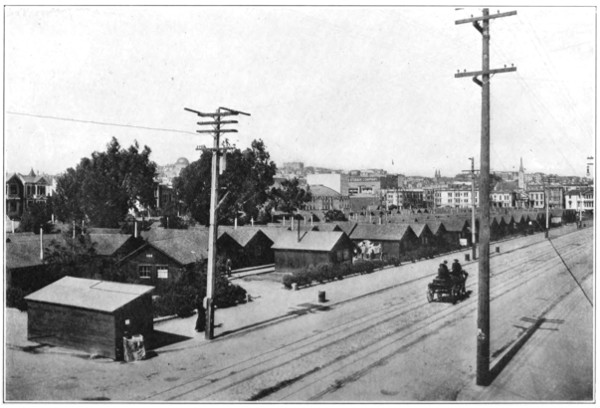
Where the first cottages were built, September, 1906
Camp No. 20, Hamilton Square
Table 25 shows the total population of the official camps for each month from May, 1906, to June, 1908, inclusive.
TABLE 25.—POPULATION OF OFFICIAL CAMPS, EXCLUSIVE OF INGLESIDE MODEL CAMP, FROM MAY, 1906, TO JUNE, 1908, INCLUSIVE (The figure given for each month is the maximum daily total)
Month and year Persons sheltered
1906 May 13,170
June 17,274
July 17,959
August 18,356
September 18,305
October 15,558
November 13,969
December 14,245
1907 January 14,616
February 15,149
March 16,447
April 17,223
May 17,524
June 17,592
July 17,300
August 15,785
September 11,424
October 8,916
November 5,331
December 3,367
1908 January 1,760
February 1,700
March 1,392
April 1,321
May 1,230
June 948
Although the data available for determining the character of the camp population are incomplete, from the weekly reports of the camp commanders we can derive figures which probably represent a fair average of the conditions. It appears that from September to December, 1906, about 39 per cent of the persons sheltered were men, about 31 per cent women, and about 30 per cent children. Approximately 55 per cent of the members of the camp population were at work. The proportion of persons who were at work was about 89 per cent among the men, about 39 per cent among the women, and about 25 per cent among the children.
The large percentage of men who were working is worthy of notice. There were numerous complaints during the existence of the camps that these were harboring a large number of idle, shiftless men. Those who offered such criticisms failed to take into account that there is even in normal times a considerable percentage of unemployed men who spend much of their time in public places. A part of the apparently well and able-bodied were in reality incapable of much work, and others though apparently unemployed were night workers. When the haunts of the idle were covered with ashes, it is hardly strange that they should have been found in numbers in the public parks and squares.
In Chapter 1 the story has been told of the need felt for making some permanent provision for the refugees before the oncoming of the rainy season. The Corporation, after making a careful study of the situation in the camps, decided to adopt a separate cottage plan for temporary as well as for permanent housing, except in one locality, South Park, whose limited area gave no space for separate cottages.
On August 1, 1906, the care of the camps passed from the army to the Department of Camps and Warehouses.[77] From then until June 30, 1908, when the last camp was closed, that department had entire charge of maintenance. The Department of Lands and Buildings was responsible for the construction of the cottages built to replace the tents. The first of August, 1906, the Corporation made public its plan to build cottages[78] and let the contracts for the erection of buildings. Building began September 10, and on the sixteenth 20 cottages in Hamilton Square were completed. At least two or three months, however, intervened before any considerable number of houses could be made ready for the refugees. Before completing its work the Department of Lands and Buildings had installed in the public squares for use in connection with the 5,610 cottages which it had built, 667 patent flush closets, 247 hoppers, over six miles of gas and water pipe and over five miles of sewer pipe; also the necessary fittings, which included 325 galvanized sinks, with faucets and traps, and 624 gas brackets.[79]
Thus for the period of approximately six months those who had no resources to build found house room as best they might. Many difficulties were met by those who controlled the funds. Building had had to be delayed because of the extraordinary amount of work involved in supplying food, clothing, water, sanitary protection, and temporary shelter. The pressure on the relief machinery seemed to tax its utmost capacity. When it was necessary to push rebuilding plans, additional machinery and more workers had to be provided.
In the official camps the refugees had in large measure been supplied with tents free of charge. As the time came for the removal of tents and temporary shacks and the substitution of wooden buildings, the question was raised, who would be entitled to their use, and on what terms? Cottages were assigned by the camp commanders, first, to those in the official camps; second, to those in shacks and tents outside; third, to those still in the city who were living in cellars and similar places, including those who were receiving shelter from friends, and those who were citizens but were living outside the city. Some who had not been burned out, but needed to be better housed, received cottages and moved them for permanent use to lots which they owned or leased.
For seven months the people had been furnished with tents free of charge, but when the change was made to the wooden cottages, it was thought best to charge a nominal rental.[80] The argument was that to give everything and ask nothing in return, on the one hand killed the self-respect of the efficient class and on the other gave opportunity to the idle to shirk all civic and social responsibility; that the no-rent policy had brought about serious economic disturbances, and its continuance would prepare the way for yet more serious trouble.
Finally, it was foreseen that the abnormal real estate conditions which had made it possible for the homeless to secure shelter, would not be relieved until those living in camp cottages should seek and be able to secure quarters elsewhere. Accordingly, it was definitely decided that as fast as buildings were made available in the camps, they should be leased to refugees by camp commanders at nominal rates. A special form of lease was provided which, theoretically, each applicant was compelled to sign before occupying a cottage.
The San Francisco Relief and Red Cross Funds, a corporation, was the lessor; and the refugee, the lessee. The lease was in effect a contract of purchase, for it provided that the tenant should become the owner of the cottage if he paid his rent to August 1, 1907. In general the applicant agreed to pay a specified rent and gas rate per month, to comply with all rules and regulations of the camp department and the camp commanders. He agreed not to assign his lease to another nor sublet without written consent. He agreed furthermore to vacate the house at the expiration of his lease unless through full payment of all rents and charges he had acquired ownership. In that event he agreed to remove the house from the camp at his own expense before August, 1907. Failure to remove meant to forfeit ownership. When on account of ill-health or other disability a person was not able to pay rent, the camp commander notified the Rehabilitation Committee.
The shelter furnished by the army and the Finance Committee was with few exceptions on public land. When the Corporation was ready to build cottages it asked the park commission for permission to use certain parks and squares. The commission having no power to give the authority agreed, on August 17, 1906, to ignore the occupation of parks and squares, on the understanding that such use was for a period of not more than one year; the cottages were then to be removed as rapidly as possible.
The parks and squares were the most suitable places in which to give temporary shelter. The damage and loss to the city from their use were insignificant, and in the camps policing and sanitation were supplied. There would have been rivalry among owners of land to secure the camps, and consequent charges of favoritism, graft, etc. The parks and squares were well situated with reference to the centers of industry and the building operations. Throughout the work the park commissioners co-operated with the Relief Corporation and rendered valuable assistance. To have followed the suggestion of the committee on housing the homeless to establish but one encampment, would have been very unwise. In the summer following the disaster many persons were hindered from becoming self-supporting because of their remoteness in Golden Gate Park from centers of work.
The camp in South Park, already spoken of as unique in character, consisted of nineteen two-story tenement buildings and a one-story bath-house and laundry building. Some of the buildings were divided into 16 suites of two rooms each and the others into 12 tenements of two rooms each. The total number of rooms was 656. The maximum population was 648. They had adequate fire protection and the occupants were required to take part regularly in a fire drill. There was steady demand for the rooms, by reason of the nearness of the camp to the shipping and manufacturing districts. The tenements were full almost all the time.
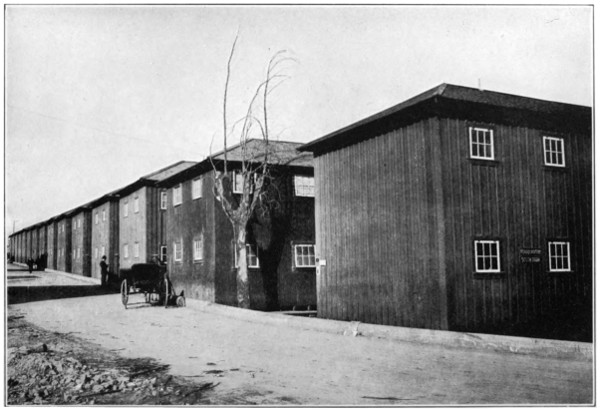
Where two-story tenements were built
Camp No. 28, South Park
Removal from the Camps
The terms of the contract signed by applicants fixed, in large measure, the conditions under which cottages could be removed from the camps and become the permanent property of their owners.[81] Whenever a person proved to the Department that he had purchased or leased a lot in the city and county of San Francisco, he was permitted at his own expense to move his house.
In June, 1907, the park commissioners requested the Relief Corporation to clear the public squares of cottages by August 17. Clearing the squares and parks of these cottages proved to be a difficult task, for many occupants sought delay on the ground of being unable to secure other quarters. In a few cases the persons had either to be evicted or to have the houses pulled down over their heads. On account of the poverty of many occupants, and in order to secure better sanitary supervision while the fear of bubonic plague lasted, the camp at Lobos Square was retained after the others had been abandoned. It was used by the poorest of the refugees from other camps, as well as by its own unusual number of dependents. This camp was not entirely abandoned till June 30, 1908.[82]
Cottages to the number of 5,343 were removed from the camps, all but a few to be used as dwellings. Real estate firms which applied to purchase cottages to establish them in groups on their own lots were refused by the Department on the ground that any such arrangement would tend to perpetuate camp life; lacking superintendence and control, such camp life would be worse than that which then existed. Despite the action of the Department, however, large vacant lots were sub-divided and rented to individual owners of cottages.[83] Seventy-four of the cottages were given to philanthropic agencies and were installed by them in various parts of the city for use as club rooms or for similar purposes.
The work of the Associated Charities in moving and repairing cottages deserves special mention. The Corporation arranged with the Associated Charities to move from the camps the cottages belonging to widows with children and to families having incapacitated breadwinners. The moving of cottages, which began in July, 1907, was not ended until the latter part of June, 1908.[84] The amount of work accomplished at a cost comparatively small shows excellent business management. The greater part of the work of moving, installing, and repairing the cottages was done by unemployed carpenters, plumbers, and laborers. “Considering the number of cottages moved and made habitable, we have had very few complaints as to the workmanship,” is noted in a report of the Associated Charities,—a comment that could not be made in connection with many houses erected by the regular contractors.
The efforts being made by families permanently to own homes are shown by the following figures: The number of cottagers buying lots was 208; paying ground rent, 447; owning own property, 30; given one month’s rent to move from camp but present condition unknown, 18. Total, 703.
Under the supervision of the Associated Charities the 208 families buying lots bid fair, according to reports given in 1908, to own them in the immediate future. It is doubtless true that but for the direction of the society these families never would have seriously considered owning a house and lot.
From August 1, 1906, to June 30, 1908, there is accurate information from which to determine the cost of the camps. During this period 7,171,522 days’ shelter was furnished at a cost of $884,558.81 for construction of cottages and of $453,000.04 for maintenance, a total of $1,337,558.85, a daily per capita cost of 18.7 cents. The daily per capita cost of maintenance was 6 cents. No allowance is here made for the value of the tents in use from August 1 till they were replaced by the cottages, but their value is more than offset by that of the cottages when they were vacated.[85]
For the whole period of the relief work, the cost of the camps was as follows:
TABLE 26.—COST OF CAMPS DURING THE ENTIRE PERIOD OF THE RELIEF WORK
Value of shelter furnished by the army as reported by General Greely $421,195.08
Paid by Finance Committee for shelter up to August 1, 1906 187,056.56
Paid for sanitation of camps and city up to August 1, 1906 155,473.60
Cost of building camp cottages and tenements after August 1, 1906 884,558.81
Paid by Department of Camps and Warehouses, for maintenance after August 1, 1906 453,000.04
Total $2,101,284.09
In addition to the shelter furnished at Ingleside and the Relief Home, an estimate of 11,000,000[86] days of shelter for the entire relief period may be given, a figure that is probably too small. From it we get an average daily per capita cost of 19.1 cents.
The apparently greater cost of shelter for the early period is due possibly to too low an estimate of the number of days’ shelter furnished outside of official camps. It must be kept in mind that the disbursements given above include all disbursements for sanitation and for medical care in the camps, and also that the residents of the camps included a large proportion of aged, infirm, and dependent persons. The actual cost would be reduced if it were possible to deduct the value of the tents and cottages at the time they ceased to be used.
What is astounding in this story of giving shelter to a great displaced city population of 250,000[87] souls is not the number of days that shelter had to be provided or the sum total of cost. The astounding fact is that when Camp Lobos, the last stamping ground of the residuum,[88] was closed to refugees on June 30, 1908, the number of persons that had to be cared for by the Associated Charities and the Relief Home was so small. In June, 1906, 40,000 persons were living at the expense of the relief funds in camps and shacks; two years later, leaving out of consideration those who had been given shelter at Ingleside, only 703 had to be aided by charitable agency to obtain permanent shelter.
This section may well be closed by a brief and necessarily inadequate statement of the social work undertaken in connection with the camp life. Four important settlements were swept to ashes by the fire,—the South Park Settlement, a pioneer work in San Francisco, the Telegraph Hill Neighborhood Association, the Nurses’ Settlement, and the Columbia Park Boys’ Club. The residents of each showed, as did the Associated Charities, their power of readjusting their work to meet the new demands for service. They transferred their activity to the camps where they, as well as groups of other volunteers, tried to improve social conditions.
Various organizations of women co-operated also to help carry on the work of the sewing center at the Hearst Grammar School, which was established the middle of May by the representative of the American National Red Cross, in connection with its employment bureau. Here volunteers met and distributed garments and taught women and girls to sew, giving materials to some in exchange for their work on garments, which were distributed to other refugees. The work grew so that sewing circles were opened in various camps and other suitable places, which furnished proper clothing and gave employment and instruction to women and girls. By July, 1907, over 75,000 garments had been made in the 75 centers that had been established in camps, churches, public schools, and settlements. The work itself had been brought under the Corporation as a part of its Department of Relief and Rehabilitation, and had been given the name of Industrial Bureau, with Lucile Eaves as director, Rev. D. O. Crowley as adviser, and six seamstresses on salary. Miss Eaves, formerly head worker of the South Park Settlement, had been in charge of the sewing circles before the incorporation of the San Francisco Relief and Red Cross Funds. There is no account of expenditures made for this work to August 1, 1906. After that date the Corporation expended $37,895.70. The two largest items of expenditure were $28,521.09 for dry goods and other supplies and $4,464 for service.
Temporary social halls were built at the expense of the Corporation to be used by residents of the camps as meeting places and by social workers for kindergartens, day nurseries, reading rooms, sewing classes, and improvement clubs, for religious meetings, for lectures, and for concerts.
The story of the quick recovery of the settlements themselves and of how, awaiting the building of new quarters, they by makeshifts got the people together, cannot be told here. To show in a measure what it meant to the social worker to find himself suddenly bereft of all the means to serve his end, the following paragraphs written by a probation officer are given:
“On the morning of April 20, practically every vestige of the three years’ work of the juvenile court had vanished.
“Our office was cleaned out; little piles of delicate white ash represented our records, compiled with such care and toil. Where the detention home stood was a heap of tangled scrap iron. Three out of five of our officers were homeless. Our probationers were scattered to the four winds of heaven. Fortunately, none of the children in detention was injured; during the first day of the fire they were safely conveyed to a sand-dump camp at the western edge of the city.”
6. SAFEGUARDING HEALTH
Sanitation was at once recognized to be a pressing problem. As has been told, latrines were quickly built in the camps and in other parts of the city, and a large force of plumbers was kept at work to repair leaks in sewers so as to prevent the seepage of sewage into the water supply. Citizens were ordered to boil all drinking water and the authorities took charge of all milk as soon as it was delivered to the city. Sanitary orders were cheerfully obeyed. “Obey the Sanitary Law or be shot” tacked on a partially wrecked house showed that some of the refugees held to a pioneer code. That they did so, and that the authorities were alert, the excellent health record of the months that followed bears testimony. The sanitary problem was to a small degree lessened by the fact that with the terror of the earthquake and fire in their eyes, the vicious and parasitic classes fled from the city; to a large degree by the fact that nature was kind in giving conditions that were peculiarly favorable to life in the open.
To put emphasis on sanitation was an essential. Colonel G. H. Torney,[89] of the army medical department, was placed in charge of all sanitary work, both of the camps and of the city. By April 28 a medical officer had been assigned to each of the six military districts.[90] This officer assigned inspectors to make daily inspections of the camps in his district, to keep a close watch for infectious diseases, and to see that there was a large force of scavengers. The expense of the work was borne by the army and was drawn from the Congressional appropriation.
Because of the army’s efficiency during the first few weeks there was no serious outbreak of disease, though there was for a short time a fear that smallpox might become epidemic. As long, however, as the city authorities permitted groups of people to live in isolated camps proper sanitary supervision was impossible. The greatest danger was from the flies and from the use of water drawn in the early days from wells and other unusual sources of supply. As soon as possible sterilizers were installed in the camps and weekly tests made of the water used in each.
Early in May a physician named by the city authorities was stationed at each district headquarters to have charge of all health regulations and to be subject to the orders of Colonel Torney.
The services of the army officers were retained to make reports on conditions until the middle of May, when the division into sanitary districts was abandoned and Colonel Torney’s duties were changed so that he might become chief sanitary officer of permanent camps under General Greely, the division commander. An army medical officer was then assigned to each official camp. He was responsible for the sanitation of his camp, but not for territories beyond its boundaries. He could be called upon to advise the civil authorities who were responsible for the final removal of all camp garbage and refuse after it had been taken from the camps designated to places outside camp limits.
The board of health, acting under orders of the Executive Commission, appointed a health corps which was paid by the Finance Committee of Relief and Red Cross Funds and subject to the direction of the camp commander. The personnel of the corps under the board of health in each camp consisted, varying according to the camp population, of one to two surgeons, one to four nurses, a pharmacist, and from two to ten laborers. There were for service at large one surgeon, two dentists, two sanitary inspectors, one pharmacist, six laborers, and two chauffeurs. The total number in the corps was: surgeons, 24; nurses, 26; dentists, 2; laborers, 89; inspectors, 2; pharmacists, 15; chauffeurs, 2.
Taking into account the character of the camp population, a considerable part of which was of the class that does not understand the need of sanitary precautions, the freedom from epidemic during the first few months is remarkable. A report of the medical department of the army shows that 30 cases of typhoid fever occurred in April, 55 in May, and 10 up to June 23, 1906. As the average number of cases per month reported by the city to the state board of health for the two years previous to the fire was only 12, there is apparently an increase of this disease during April and May. The 30 cases which developed in April must have been due to infection previous to April 18, so that unless the statistics of either the army or the city board of health are incorrect, an increase of this disease must have threatened before the fire. Of the 95 cases which developed between April 18 and June 23 only five developed in official camps. Of smallpox there were 123 cases between April 18 and June 23. Five of these were reported by the board of health as camp cases, but none of them originated in official camps under army control.
In October and November, 1906, there was a decided increase in the number of cases of typhoid fever, the bureau of hospitals alone having charge at one time of 155 cases. The patients came from camps, official and unofficial, and from houses. The epidemic, if it can be called such, was found to be carried not by contaminated milk or water but by flies. The sanitation methods of the board of health had not been good enough to protect the refugees in the various camps. The board of health, therefore, not the Department of Camps and Warehouses, was responsible for the number of typhoid fever cases.
The care of the sick was a minor problem of the relief work. The number of persons seriously injured by the fire and earthquake was but 415. Most of the hospitals stood outside the burned section, and though some of them suffered heavy damage by the earthquake, no demand had to be made for hospital facilities that could not be met fairly adequately. Some of the sick were immediately cared for in neighboring communities, and by the army in its hospitals at the Presidio and at Fort Mason, and in a field hospital established in Golden Gate Park.[91] At one time during the summer following the disaster many of the city hospital beds were vacant, even though numerous chronic cases became hospital charges when relatives and friends were no longer financially able to provide for them.
The physicians and nurses who came immediately after the disaster to San Francisco to offer their services could not be utilized, as the demand for medical and nursing service was not greater than could be supplied by local physicians and nurses. A party of fourteen nurses that came from Seattle soon after the disaster reported for duty at five o’clock one afternoon. “Have you return transportation?” asked the chairman of the committee that received them. “Yes,” was the answer. “Well, there is a train which starts for Seattle tomorrow morning at nine o’clock,” was the laconic order.
In this incident we see the need of a clearing house of information to be established as one of the very first agencies in a large work of relief. It would in this case have prevented the sending of unnecessary nurses and physicians and would have saved expense. More important, however, would have been its service in standardizing the methods of record keeping and in preventing overlapping of work of the various departments.[92]
There was immediate need of medical supplies to replace the stock destroyed by fire. But the sub-committees on drugs and medical supplies and on care of the sick and wounded, appointed by the Citizens’ Committee, could find little to do in those early days after the disaster, as the army practically took charge of the distribution of the medical supplies and was using the California Red Cross as its agent. This branch of the Red Cross not only cared for some of the sick directly, but did much more important work in collecting information as to the needs of the sick and as to the condition of the hospitals throughout the city.
The Finance Committee, acting early in May on the advice of Colonel Torney, established 26 free dispensaries which were supplied by the army with drugs and other medical supplies. It was careful not to compete with retail trade, so closed any dispensary near which a retail drug store was later opened. The Finance Committee also appointed early in May a committee on hospitals and authorized it to make payments to designated hospitals for the care of destitute patients. The hospitals which were to receive payments from the relief funds were at first named by the board of health, later by the Finance Committee itself, which made selection of six hospitals. An executive officer, a physician, was appointed to pass on the eligibility of the patients who applied for free care and to determine the time of discharge of each from the hospital.
In July this executive officer, whose title was that of supervisor of accredited hospitals, served under direction of the Executive Commission; but after August 1 he was subject to the Corporation, an arrangement which held until July 1, 1908, when the Bureau of Hospitals of the Department of Relief and Rehabilitation was closed. The Associated Charities was then given authority by the Corporation to send destitute patients directly to the hospitals. The Corporation reimbursed the hospitals for care given. The hospitals selected to receive patients whose care was paid for from the funds were changed from time to time.
The value of the compensation to hospitals was at first equivalent to $13 or $14 a week for each patient. On July 18 the Executive Commission had fixed the maximum rate of $2.00 per day without supplies. This was to cover cost of operations and attendance. It had remained in force until the Bureau of Hospitals was closed.
The Bureau’s records, which are inadequate in some respects, show that the highest number of hospital cases for one week, 276, was reached during the period of the typhoid epidemic. Later reports show an average of about 212 patients per week from August, 1906, to September, 1907. Of the patients sent to hospitals through the Bureau 10 per cent were children, 35 per cent men, and 55 per cent women.
The financial report of the Corporation shows that the total cost for the care of the sick to May 29, 1909, was $344,165.07. In addition, food, medical supplies, and furnishings were given to hospitals to the value of $97,670.16. Of the $344,165.07, there was expended previous to August 1, 1906, $107,396.43. The sum of $278,070.76 was paid directly to hospitals for the care of patients, on presentation of vouchers, while the balance of $66,094.31, though not paid directly to the hospitals, was expended in various ways for the benefit of the hospital patients. Between August 1, 1906, and June 1, 1909, $231,110.46 was paid directly to hospitals for the care of patients. This latter sum, less $1,960.25 which cannot be distributed, represents 134,373 days of hospital care at an average cost of $1.71 per patient per day. The average rates of the different hospitals varied from $1.07 to $2.00.
Although the rates paid by the relief funds were often less than the actual cost to the hospitals of caring for patients in normal times, it was to the advantage of the hospitals to care for the sick, many of whom they would have had to take in any case. The volume of business helped to lower the per capita cost of maintenance. It was also an incentive to the directors to increase their facilities and to private benefactors to give money toward their support.
7. RELIEVING THE JAPANESE AND CHINESE
The Japanese asked for very little relief, in part because many had difficulty in speaking English, but more generally because all were aware of the anti-Japanese feeling of a small but aggressive part of the community; this in spite of the fact that Japan contributed directly to the local committee and through the American National Red Cross nearly a quarter of a million dollars.
On April 20, independent relief associations were formed by Japanese residents in San Francisco and Oakland, but on the same day they wisely united under the name Japanese Relief Association to care for practically all their fellow countrymen.
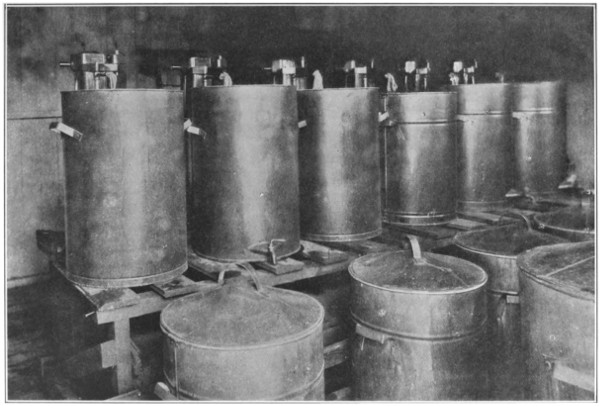
Tanks for Sterilizing Water, Lobos Square Camp
The Japanese Relief Association estimated the number of their countrymen made destitute by the fire to be over 10,000, which is about 3 per cent of the total number of persons made dependent for short or long periods of time. On July 6, 1906, not over 100 Japanese were receiving assistance from the Relief and Red Cross Funds. Of these about 50 were receiving shelter only, in Lafayette Square, and 50 were receiving help at relief stations. That is, the Japanese constituted not more than one-half of 1 per cent of the bread line and about a quarter of 1 per cent of the population of the official camps. Even at the beginning the number receiving help from the Relief and Red Cross Funds was probably not much greater. The Relief Survey estimates that the total value of relief of all kinds furnished by the army and the Finance Committee to Japanese did not exceed $3,000. Among the 30,000 or more persons who applied for rehabilitation, there was not one Japanese. Their own relief association, assisted by Japanese throughout the state, within ten days after the disaster sent between 7,000 and 8,000 of them to places outside of San Francisco. On July 6 some of these had returned and the number of Japanese refugees then in the city was estimated by the association to be 4,000, two hundred of whom it was supplying with provisions.
China contributed $40,000 to the San Francisco Relief and Red Cross Funds for the general work of relief.
There is not much information available about the Chinese. They probably received altogether more food than the Japanese and they certainly received more in the way of shelter, yet the total value of all aid given them was relatively insignificant. Like the Japanese, and for the same reasons, they did not ask for much. At the beginning a separate camp was established for them,—Number 3, in the Presidio reservation. The population of this camp on May 8, 1906, was 186. Later, when cottages were built in Portsmouth Square, on the border of Chinatown, 37 out of the 153 cottages were assigned to Chinese. Not over 140 applications for rehabilitation were made by Chinese. About half of the number were assisted at an average expenditure of about $70. Nearly all these cases were brought to the notice of the Committee by social workers, as only a few Chinese applied voluntarily for relief. Ten thousand dollars is a liberal estimate of the value of relief given to the Chinese.
III QUESTIONS OF FINANCE
1. CLAIMS
The word “claim” as used in the relief accounting was applied to anything from a time check for a day’s work to a ten thousand dollar demand for goods seized, a usage that arose from the fact that for the first few days, when there was no available cash, many obligations were incurred that were a proper charge on the relief funds though not authorized by the Finance Committee.
Some claims were made by those who suffered a change of sentiment toward contributing relief. During the hours of urgent need men donated their goods, workmen gave their labor, and professional men, their services, who when later they saw the size of the relief funds could not resist the insidious craving to have a share of the big whole. There is the instance of men belonging to one of the building trades who did work for which they expected no pay but later were not satisfied to take the $4.00 a day offered as payment by the Finance Committee. They demanded $6.00 because other men were receiving that amount for a day’s work. Business houses within and without the city evinced the same spirit.
Day by day the flood of claims swelled. Claimants and their attorneys laid siege to the Finance Committee and tried by bribes and threats of lawsuits to collect their claims. A large force of clerks and a special committee were kept hard at work trying to learn the merits of the claims. The Finance Committee itself day after day was compelled, instead of discussing necessary relief measures, to give the greater part of its sessions to the hearing or to the discussion of these claims.[93]
The circumstances of seizure had varied. Often when the fire was almost upon a store somebody would assume authority and break it open to give the stock to the people. In such a case the stock would have been destroyed by fire and there was no justice in the claim for seizure except where the owner as a consequence lost insurance. Irresponsible individuals who had no connection with relief committees had seized goods and impressed vehicles. Those who suffered loss through such lawless acts were unfortunate, but they had no real claim to reimbursement from the relief funds.
The same may be said of the individuals, the business houses, and the transportation companies whose goods were stolen, not seized, from freight cars and warehouses. Many claims for regrettable losses which might have been legitimate if brought against state, city, or person, were unjust when brought against the relief funds. Fraudulent attempts were also made to collect from the relief funds for losses that had no connection with the relief work and for losses that had never occurred. It was a perplexing problem to deal with these thousands of claims, the difficulties of which were increased by the insistence of those with the least valid claims.