Front matter
Reading edition
Sacred Mysteries
AMONG
The Mayas and the Quiches,
11,500 YEARS AGO.
THEIR RELATION TO THE SACRED MYSTERIES OF EGYPT, GREECE, CHALDEA AND INDIA.
FREE MASONRY
In Times Anterior to the Temple of Solomon.
ILLUSTRATED.
BY
AUGUSTUS LE PLONGEON,
Author of "A Sketch of the Ancient Inhabitants of Peru, and their Civilization;" "Vestiges of the Mayas;" "Essay on Vestiges of Antiquity;" "Essay on the Causes of Earthquakes;" "Religion of Jesus compared with the Teachings of the Church;" "The Monuments of Mayax and their Historical Teachings."
NEW YORK: Robert Macoy, 4 Barclay Street. 1886.
Entered according to Act of Congress, March 15, 1886, by AUGUSTUS LE PLONGEON, in the Office of the Librarian of Congress at Washington.
All Rights Reserved.

To
Mr. Pierre Lorillard,
THIS SMALL HISTORICAL STUDY OF THE SACRED MYSTERIES PRACTICED IN REMOTE AGES BY THE MAYAS AND QUICHES
Is Respectfully Dedicated,
AS A FEEBLE TESTIMONIAL OF MY APPRECIATION OF HIS EFFORTS TO HELP IN REMOVING THE VEIL THAT HAS SO LONG HUNG OVER THE HISTORY, CUSTOMS AND CIVILIZATION OF THE ANCIENT INHABITANTS OF THIS WESTERN CONTINENT.
AUGUSTUS LE PLONGEON.
New York, May 20th, 1886.
PREFACE.
The forests of Yucatan and Central America are to-day, for the majority of the people of the United States, even those who call themselves scientific and well informed, as much a terra incognita, as America was to the inhabitants of Europe before its discovery by Cristobal Colon in 1498, when for the first time he came in sight of the northern coast of South America, and navigated along it from the mouth of the river Orinoco to Porto Cabello in the Golfo Triste.
A few, having perused the books of J. L. Stephens, Norman, and other tourists who have hurriedly visited the ruins of the ancient cities that lie hidden in the depths of those forests, have a vague idea that there exist the remains of stone houses built some time or other before the discovery, aver authoritatively that "their builders were but little removed from the state of savagism, and that none of their handwork is worth the attention of the students of our age. Their civilization, they confidently say, was at best very crude. They were ignorant of the art of writing; and the scanty records of their history chronicled on deer-skins, in pictorial representations, are well nigh unintelligible. They had no sciences, no mental culture or intellectual development. They were in fact a race whose intelligence was for the most part of lower order. From what they did nothing is to be learned that has any direct bearing on the progress of civilization." In no wise can they be compared with the Egyptians or the Chaldees, much less with the Greeks or Romans; it is not, therefore, worth our while to spend time and money in researches among the ruins of their cities. It is to Greece, it is to Egypt, to Chaldea, that Americans must go in order to make new discoveries. In those countries must be established schools for study of Greek, or Egyptian, or Chaldean archæology: and American schools have been established at Athens and Alexandria, and expeditions sent to Syria, to the shores of the Euphrates.
But the European scientists, who for many years past have explored those old fields in order to obtain relics to fill the shelves of the museums of their capitals and turned up the soil of the Orient in search of archæological treasures, now look to the Western continent in quest of the origin of those ancient civilizations which they have been unable to find in the countries where they once flourished; and they look with that reverence which true learning begets, on those ancient American temples and palaces that are objects of contempt for some modern American scientists.
Thus we see established in Paris the "Société des Américanistes" whose sole object is the study of all things pertaining to ancient American civilization. That Society, composed of students, spares no efforts to obtain knowledge respecting the architecture, the sciences, the arts, the language, and the civilization of the people who inhabited, in remote ages, the various countries of this Western continent. A premium of 25,000 francs has been offered for the discovery of an alphabet or key to the inscriptions carved on the walls of the monuments in Yucatan and Central America. M. Désiré Charnay has been sent to obtain molds of the sculptures and other precious relics that lie hidden and lost in the recesses of the Central American forests. Casts have been made from such squeezes as he obtained. These casts adorn the Trocadero Museum at Paris, duplicates of the same having been presented to the Smithsonian Institute at Washington by Mr. Pierre Lorillard of New York. This gentleman is the only American who has ever contributed with his wealth and influence (he has spent 25,000 dollars) in expeditions for the recovery of facts and objects that may throw light on the ancient history of America.
Then again we have in Europe the international "Congrès des Américanistes" that convenes every four years in one of the capitals of Europe for the purpose of collecting all new data, obtained in the interval, concerning ancient American civilization.
In England, at Cambridge, there is in the University a large building especially dedicated to Central American archæology. There are to be seen, as I am informed by General Sir Henry Lefroy, the casts and photographs obtained by Mr. Maudslay, a wealthy gentleman who has devoted his time and wealth to the work of obtaining fac-similes in plaster and photographs of the ancient monuments of Honduras and Guatemala.
But what have we in New York, in the United States, in fact, to offer to students of American archæology?
True, Mr. George Peabody, among his many benefactions, left a sum of money for the foundation of a museum to be specially dedicated to the collection of objects pertaining to American archæology. Such museum exists at the University of Cambridge, Massachusetts. It bears his name. Does it contain anything that may throw light on the history of the ancient inhabitants of this Western Continent? I once wrote to an influential gentlemen connected with the University asking him to propose to the trustees the purchase of a copy of my collections of casts and mural paintings. His answer dated July 23d, 1885, was: "I will send your letter to one of the trustees, enjoining him to accept its offer, but I fear they will treat that proposal as they have so many others and say no! The collection of tracings they ought to secure. The time has come when such things should be got at any cost. We shall soon be as they are in India, hunting everywhere for things which were easily to be had a few years ago."
My correspondent has visited the ruined cities of Yucatan; he knows the value of my collections.
I have done all in my power to call the attention of American scientists, of the men of leisure and money, to the fact that in New York perfect fac-similes of the palaces and temples of the Mayas could be erected in Central Park, both as ornament to the place, and object of study for the lovers of American archæology who may not have the means, nor the time, nor the desire, to run the risk of submitting to the privations and hardships that those who wish to visit the ruined cities, must inevitably encounter.
But alas! all in vain.
Three years ago I had casts made from some of the stereotyped moulds made by me of the sculptures at Uxmal and offered them for exhibition in the Metropolitan Museum of Art in Central Park. They have been placed in the cellar, out of the way, "for want of space against the wall." The public has never seen them. I once remonstrated with one of the trustees, and proposed to sell to the museum a copy of the collection of fresco paintings from Chichen Itza, last remnants of ancient American art. The answer of the gentleman was "No! those things are not appreciated, they are looked upon as of no value." Nevertheless, some of the illustrations in this book are photographs of the same despised casts and mural paintings.
During the last lecturing season I offered to several literary, scientific and historical societies, to give lectures illustrated with views made by us of the monuments, and enlarged with the stereopticon. In every instance I received the same answer. "Our people are not interested in such a subject." What! Americans not interested in American antiquities! in ancient American history! in ancient American civilization!
Desiring to make the subject known before the lecture season was over, en desespoir de cause, I asked Dr. John Stoughton Newbury, of the School of Mines at Columbia College, if he could give me a chance to present the subject before the members of the New York Academy of Science. I had no hope of a favorable answer; but to my great surprise Professor Newbury received my offer enthusiastically. Mrs. Le Plongeon lectured on the monuments of Yucatan on the 2nd of March last, at Columbia College. Let the ladies and gentlemen who were present say if the facts and views presented to them were of sufficient interest to command their attention. A lady, Mrs. Francis B. Arnold, residing at 21 West 12th Street, New York, was so pleased that she asked Mrs. Le Plongeon to lecture at her own house to a select party of friends. Let again the ladies and gentlemen who were present at Mrs. Arnold's house, say if there is nothing worth seeing and studying in the remains of ancient American civilization.
Let Mrs. Arnold and Dr. Newbury accept our heartfelt-thanks for affording us an opportunity of presenting ancient America to a few appreciative minds, if no more.
Mrs. Le Plongeon and I have written two works on Yucatan. One is: "Monuments of Mayax, and their historical teachings." The other: "Yucatan, its ancient palaces and modern cities; life and customs of the Aborigines." We have offered them to several publishing houses, but the same answer has been given by all. "There is no money in the publication of such books; American readers do not care for this subject."
Notwithstanding such rebuffs, I made up my mind to present to American readers some of the historical facts that have been brought to light by deciphering the bas-reliefs and mural inscriptions, by means of the ancient hieratic Maya alphabet discovered by me. I offer them in this small volume that I take pleasure in dedicating to Mr. Pierre Lorillard, as the most worthy of it among the Americans, for his generous help to students of American archæology.
Ancient Maya Hieratic alphabet according to mural inscriptions. Egyptian Hieratic alphabet according to Messrs. Champollion le Jeune and Bunsen.
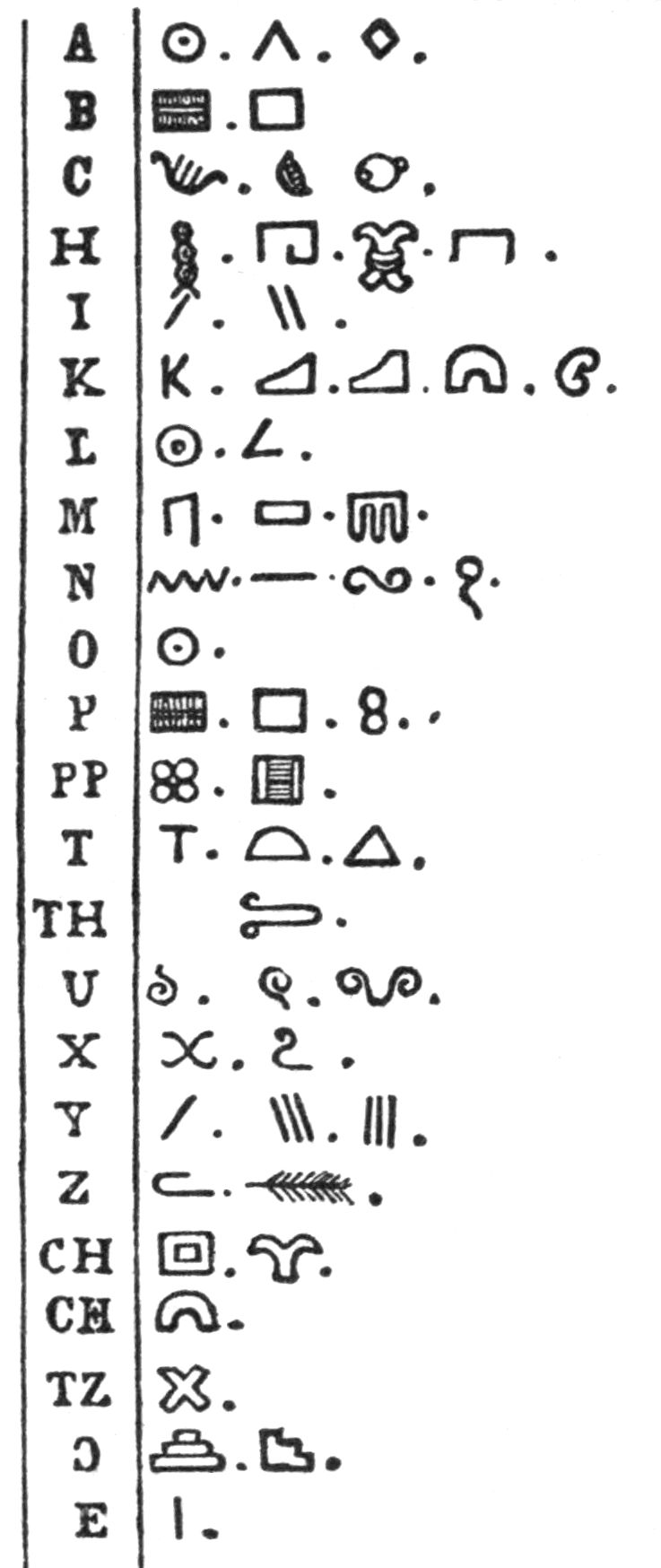
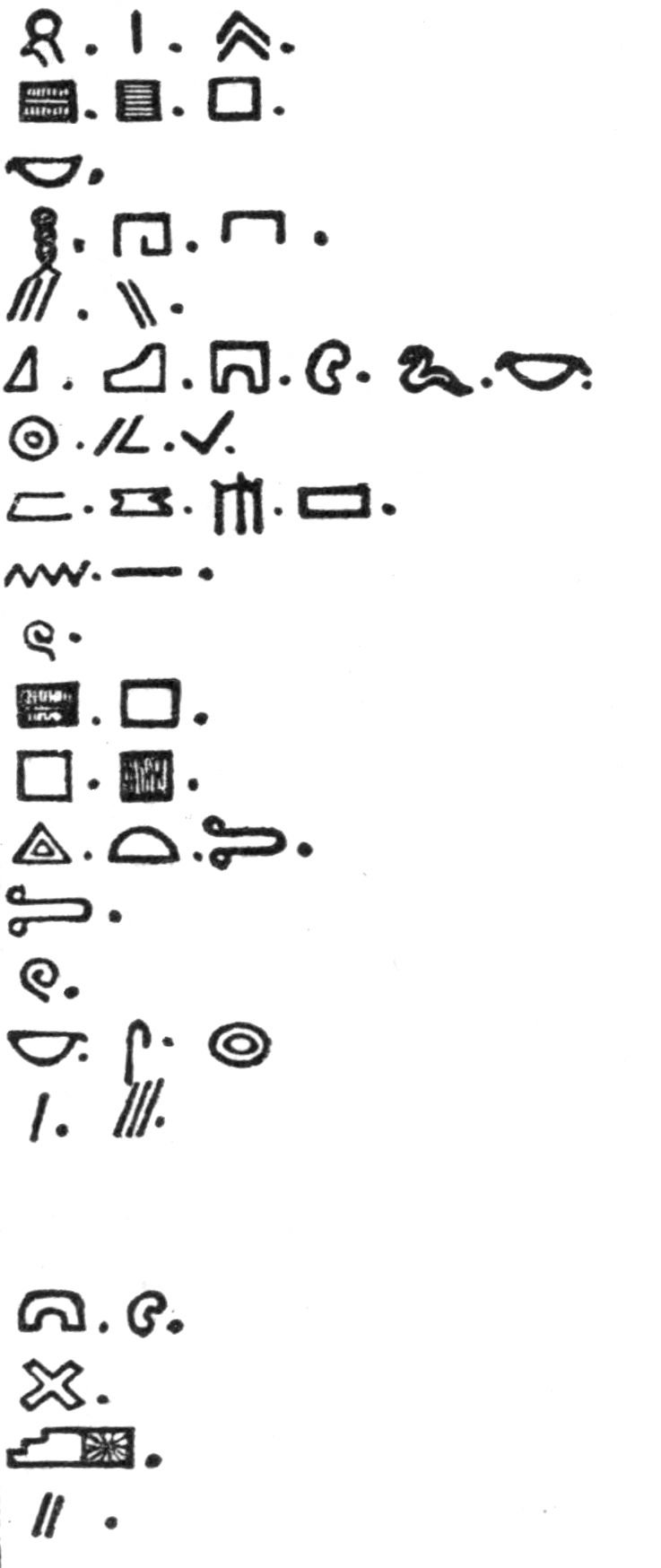
If the perusal of this book fails to awaken in this country an interest in ancient American civilization and history, then I will follow the advice said to have been given by Jesus of Nazareth to his disciples when sending them on their mission of spreading the gospel among the nations: "And whomsoever shall not receive you, nor hear you, when ye depart thence, shake off the dust under your feet...." St. Mark, chap. vi., verse 11—for I shall consider it useless to spend more time, labor, and money on the subject in the United States, remembering the fate of Professor Morse, when he asked Congress for permission to introduce his electric telegraph in this country.
In this small book (which two of the most prominent firms in New York have positively refused to publish believing it to be a bad speculation), I present only such facts as can be proved by the works of well-known writers ancient and modern, and by the inscriptions carved on stone by the Maya learned men and historians. It is for you, Reader, to judge if they are worthy your consideration.
ILLUSTRATIONS.[1]
PAGE.
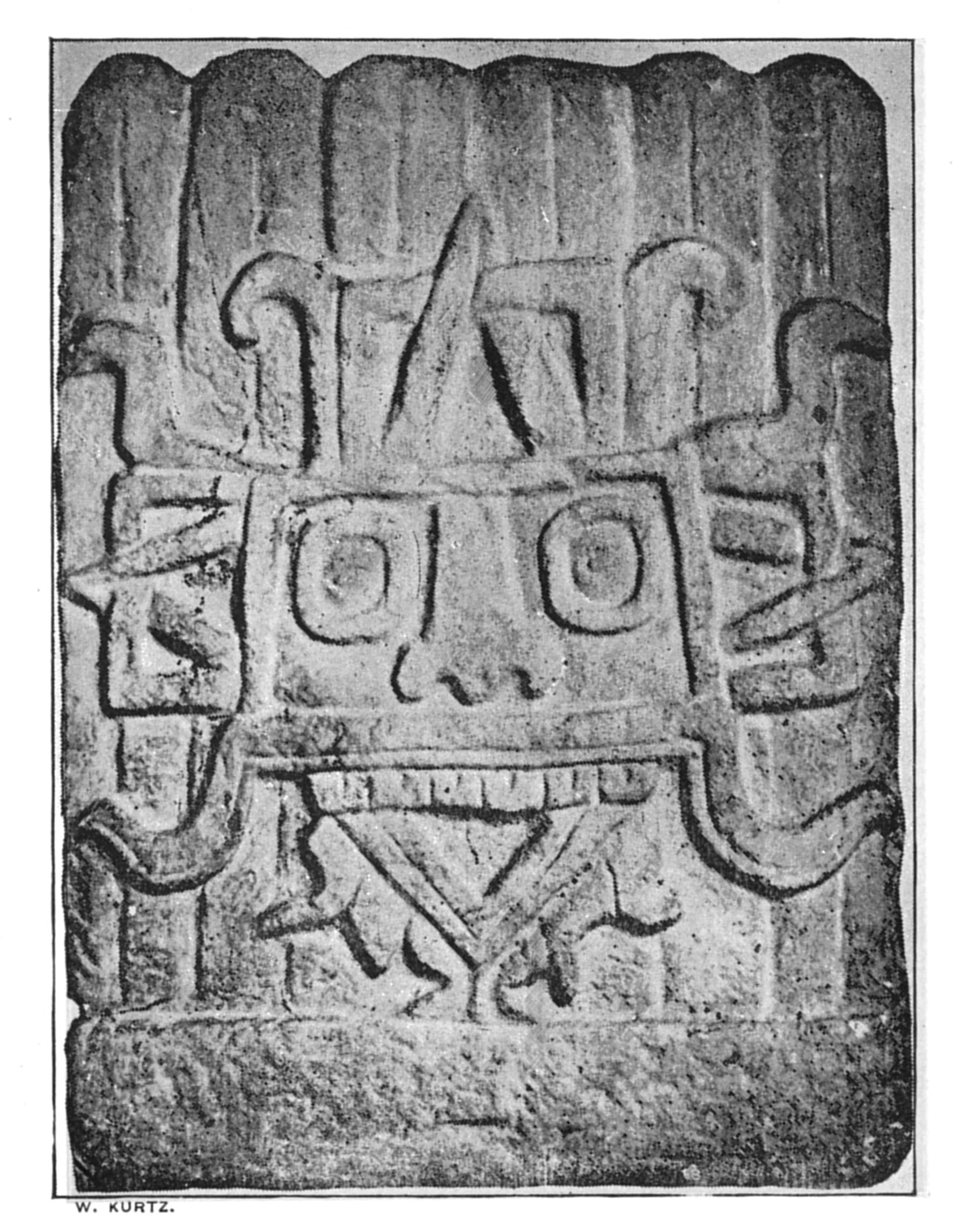
Symbolical stone found in the Mausoleum of high pontiff Cay at Chichen. 19
View of the pyramid called "House of the Dwarf," at Uxmal, 34
Ground plan of the Sanctuary, 35
Ground plan of the Temple of Mysteries, 36
Part of cornice surrounding the Sanctuary, 39
Cross bones and skeletons carved on the cornice of the Sanctuary, 39
Part of a statue with apron on which is sculptured the image of an extended hand. (From Uxmal.) 40
Symbolical slab with title of the high pontiff, 45
Symbols from the turret dedicated to the high pontiff Cay in the palace of King Can, at Uxmal, 65
Tableau of the creation, from the east façade of the palace at Chichen-Itza, 72
Prince Coh in battle (from mural paintings at Chichen-Itza), 78
Prince Coh's body laid out for cremation (from mural paintings at Chichen-Itza), 80
Slab from Prince Coh's Mausoleum, at Chichen, leopard eating the heart of his enemies, 85
Dying leopard with human head, from Prince Coh's Mausoleum at Chichen-Itza, 86
Priest of Osiris making an offering (from the tombs of Thebes), 86
Statue of Prince Coh, found in his Mausoleum at Chichen-Itza, now in the National Museum in the City of Mexico, 87
Slab from Prince Coh's Mausoleum at Chichen, representing Queen Moo, under the figure of a macaw, eating the heart of her enemies, 88
Tableau of the Mastodon worship, at Chichen, 93
Small terra cotta heads from British Honduras, 104
Sculptures on monolith gate at Tiahuanuco (Peru), from a model in the museum of the Long Island Historical Society in Brooklyn, 104
Bas-reliefs from small room at the foot of Prince Coh's monument at Chichen-Itza, 115, 118
Symbols of lower Egypt (from Sir Gardner Wilkinson's works on Egypt), 115
Plate XVII, part II. of Troano M.S., 116
Plate XXV. part II. of Troano M.S., head dress of mother Earth, 118
Maps of the Maya Empire, 120
Yaxche, sacred tree of the Mayas, 124
Plate VI., part II. of Troano M.S., 126
Worship of sacred tree (Papaya) from a Mexican M.S., in the library of the British Museum, 134
Plate XXIV., part I., Troano M.S., 137
Sons of King Can, represented under the symbol of deer-heads, totem of the country, plate XVI, part II. of Troano M.S., 139
SACRED MYSTERIES
AMONG
THE MAYAS AND THE QUICHES.
There are authors who attribute the origin of modern Free Masonry to the followers of Pythagoras, because some of the speculations of that Philosopher concerning the meaning of the numbers are to be found in the esoteric doctrines taught in the masonic lodges. Others, on account of the Christian symbols that have been incorporated in the decoration of things pertaining to Masonry, following the Swedish system, say that the Essenes and first Christians founded it. Others, again, make it originate in the building of Solomon's temple, many Jewish names, emblems and legends, taken from the Bible, having found their way into the rites of initiation to several degrees. Others, still, make it go back to Adam. Ask them why—they do not know. While not a few, and I among them, earnestly believe that Masonry existed before Adam was created. I believe it, because I am convinced that this pretended ancestor of man is a myth—and has never existed. Thomas Payne and those of his school say that the Druids were the fathers of the craft; they being worshipers of the sun, moon and stars: and these jewels of the firmament being represented on the ceilings of the M⸫ lodges. Dance of Villoison speaks of Herculaneum as its birth place, because of the many similarities that existed between the collegia of the Romans and the lodges of the operative Masons of the middle ages. Michael Andrew Ramsay, a Scotch gentleman, in a discourse delivered in Paris in 1740, suggested the possibility of the fraternity having its origin, in the time of the crusades, among the Knight Templars, and he explains it in this way:—
The Pope, Clement V., and Phillippe-le-bel, King of France, fearing the power of the Templars and coveting their immense wealth, resolved to destroy the Order. When, in 1308, Jacques de Molay, then Grand Master of the Order, was preparing an expedition to avenge the wrongs and disasters suffered by the Christians in the East, the Pope, who was the only power to which, in the spiritual, the Templars owed allegiance, enticed him to France.
On his arrival he was received with every mark of friendship: but, soon after, the King caused him to be arrested together with some of the other dignitaries, accusing them of the most heinous crimes, imputing to them the secret rites of their initiation. By order of the Archbishop of Sens and his provincial council, Jacques de Molay, Guy of Auvergne and several other officers of the Order were burned alive on March 18, 1314.
The Pope, by a bull dated on the 2d of April, and published on the 2d of May, 1312, that he issued on his own responsibility, the Council of Vienne, in Dauphiné, being adverse to hasty measures, declared the Order abolished throughout the world. The execution of the Grand Master and his companions gave the coup de grace to the Order. Some of the Knights who had escaped to Portugal continued the Order. They assumed the title of Knights of Christ, which it bears to this day; but it never recovered its former prestige and power.
Jacques de Molay, before dying had appointed Johan Marcus Larmenio as his successor to the office of Grand Master. The Knights who, fleeing from the persecution, had taken refuge in Scotland at the Court of King Robert Bruce, refused to recognize his authority; and pretending to reëstablish the Order of the Temple, under the allegory and title of Architects, protected by the King, laid the foundation of the Order of Free and Accepted Masons of the Scottish Rite in 1314.
This new society soon forgot the meaning of the execratory oath that the members were obliged to take at their initiation; the death of Clement V., of Phillippe-le-bel, of the accusers and enemies of Jacques de Molay and the other Knights who had been executed, having removed the object of their vengeance. Still they continued to decorate their lodges with tokens commemorative of the death of the Grand Master, to impose on all new members the obligation of avenging it, which they signified by striking with an unsheathed dagger at unseen beings, his supposed murderers, although all their efforts were now directed to the restoration of the honor of their association. This allegory is well-known to the Knights of Kadosh. A century had scarcely elapsed when this idea also was abandoned, the founders and their disciples having passed away. Their successors saw only allegories in the symbols of the Order, and the extensive use of words and texts from the Bible was then introduced. Of their work but little is positively known until the reign of Charles I. of England, when their mysterious initiations began to attract attention.
The enemies of Cromwell and of the Republic, having in view the reëstablishment of the monarchy, created the degree of Grand Master to prepare the minds of the Masons for that event. King William III. was initiated. Masonry, says Preston, was very much neglected as early as the reign of James II., and even after this period it made but slow progress until 1714, when King George I. ascended the throne.
Three years later, in February, 1717, the first Grand Lodge was established in London. A committee from the four lodges then existing in that city met at the tavern of the "Apple Tree" and nominated Anthony Sayer, who was elected Grand Master on the 24th of the following June, day of St. John the Baptist, that for this reason was selected as patron of the Order.
This origin of the craft is credited by many of the best authorities on the subject. They found their opinion on the fact that many of the ceremonies practiced by the Architects are still observed among the Masons; and that the Grand Lodge preserved, with the spirit of the ancient brotherhood, its fundamental laws. There are others, however, who likewise claim to be well informed, that pretend it did not originate in any order of chivalry, but in the building fraternities of the Middle Ages.
Be the origin what it may, the fact is that after the establishment of the Grand Lodge at "Apple Tree Tavern," Masonry spread over Europe at a rapid rate, notwithstanding the bitter opposition of the Church of Rome that fulminated against it its most terrible anathemas as early as 1738 at the instigation of the Inquisition. Pope Clement XII., on the 28th of April of that year, caused a prohibitory bull to be issued against Free Masonry, entitled In Eminenti, in which he excommunicated all Masons; and the Cardinal Vicar of Rome, by edict in the name of the High Priest of the God of Peace and Mercy, decreed the penalty of death against them in 1739; and on May 18, 1751, Pope Benoit XIV. renewed the bull of Clement XII. by another beginning with these words: Providas Romanorum Pontificum.
The Order was introduced in France in 1725, and on the 14th of September, 1732, all Masonic Associations were prohibited by a decree of the Chamber of Police of the Chatelet of Paris.
In 1727, Lord Coleraine founded a lodge in Gibraltar, and in the succeeding year in Madrid, the capital of Spain, the strong-hold of the Inquisition.
But in 1740, in consequence of the bull of Clement XII., King Philip V., of Spain, promulgated an ordinance against the Masons in his kingdom, many of whom were arrested and sent to the galleys. The Inquisitors took advantage of the opportunity to persecute the members of a lodge they discovered in Madrid. They caused them to be loaded with chains, to be obliged to row in the galleys without other retribution than scanty rations of victuals of the poorest quality, but an abundant supply of bastinade. Fernando VI. renewed the ordinance on July 2, 1751, making Masonry high treason.
The brotherhood made its appearance in Ireland in 1730. It is not positively known if it existed in the country before that time.
In 1732 it crossed the Atlantic and was imported in America. In that year a lodge was held in "Tun tavern" in Philadelphia, the B⸫ having previously met in Boston, which may be regarded as the birthplace of American Free Masonry. Henry Price was the first provincial Grand Master appointed by the Grand Lodge of England on April 30th, 1733.
The same year witnessed its establishment in various cities of Italy. In 1735, the Grand Duke Francis of Lorraine was initiated. He protected the Masons, and the craft flourished in Italy until 1737, when Juan Gaston of Medicis, Grand Duke of Tuscany, issued a decree of prohibition against it. Soon after his death, which occurred the same year, the lodges which had been closed were reopened. It was not long, however, before they were denounced to the Pope Clement XII., who issued his bull of 28th of April 1738, and sent an inquisitor to Florence who caused various members of the society to be cast into dungeons. They were set at liberty as soon as Francis of Lorraine became Grand Duke of Tuscany. He not only protected the Masons, but founded lodges in Florence and other places in his estates.
In 1735 a lodge was established in Lisbon the capital of Portugal. It will be remembered that some of the Knight Templars, under the title of "Knights of Christ," had kept alive the ancient order in that country in defiance of the Pope's thunderbolts.
Among the Masons initiated in England were a great many Germans as early as 1730. These seem to have met occasionally in traveling in Germany, or to have corresponded with each other; but no lodge is known to have existed previous to the year 1737, when one without name was established in Hamburg, although Grand Master Lord Strathmore had authorized in 1733, eleven gentlemen and Brothers to open one.
In 1740, B. Puttman, of the Hamburg lodge, received a patent of Provincial Grand Master from England, and the lodge assumed the title of Absalom.
King Frederick II., denominated the Great, whilst still Crown Prince, had been initiated; and from the time of his initiation took great interest in the welfare of the brotherhood. Crowned King of Prussia, he continued to give it his support, assuming the title of "Great master universal, and Conservator of the most ancient and most respectable association of ancient free masons or architects of Scotland." Masonry enjoyed under his reign such consideration, that many German princes, following his example, were initiated; and so many of the nobility joined the society, that to belong to it came to be regarded as a mark of nobility and high breeding.
Notwithstanding his multifarious State duties, and the many wars that took place during his reign, which demanded his constant attention, he found time to frame a constitution to cement together again the Order, that at one time, owing to external persecutions on the one hand, to internal dissensions, suscitated by the incorporation to it of the Rosicrucians and still more that of the Illuminati on the other, seemed on the eve of falling asunder. That constitution, signed by him in his palace at Berlin, on the 1st of May, 1786, saved Free Masonry from annihilation in Germany, for many regarding it with suspicion, attacked and persecuted it: the Catholics because it came from Protestant England; the Protestant clergy looked upon it as hostile to Christianity, because of the teachings and symbols altogether Catholic of the 18th degree, those of Rosa Cruz, whose motto "we have the happiness of being in the pacific unity of the sacred numbers," and "in the name of the holy and indivisible Trinity," bespeaks its Jesuit origin. The people believed in the accusation of witchcraft and sorcery, made against it by its enemies, because of the vail of secrecy thrown over their meetings.
Authors have endeavored to show that modern free-masonry is not derived from the mysteries of the ancients. J. G. Findel, an advocate of this opinion, says: "Seeing that the ancient symbolical marks and ceremonials in the lodges bear a very striking resemblance to those of the mysteries of the ancients some have allowed themselves to be deceived, and led others astray imagining they can trace back the history of the craft into the cloudy mists of antiquity. Instead of endeavoring to ascertain how and when these ceremonies were introduced into our present system, they have taken it for granted that they were derived from the religious mysteries of the ancients."
Now, if we merely consider the tokens of recognition, the pass words and secret words, the decorations of the lodges, according to the degrees into which modern Masonry is divided, tokens, words and decorations nearly all taken from the Bible and symbolical of events, real or imaginary, some of which are said to have taken place in comparatively modern times, after the decline and final discontinuance of the ancient mysteries in consequence of the spread of Christianity; others having occurred in the early days of the Christian era; others at the time of the building of Solomon's Temple, all of which had certainly nothing to do with the religious mysteries of Egypt, Chaldea, Greece, Etruria, etc., that were instituted ages before the pretended occurrence of those events, then we may positively affirm that it is not derived from these. But if, on the other hand, we observe, and it is difficult to overlook it, that these symbols are precisely the same that we find in the temples of Egypt, Chaldea, India, and Central America, whatever may have been the esoteric meaning given to them by the initiated of those countries, we are bound to admit that a link exists between the ancient mysteries and Free Masonry. It is for us to try to discover when that link was riveted and by whom.
If the theory of Chevalier Ramsay be true, that is, if modern Masonry had its beginning in the Society of Architects founded in Scotland under the protection of King Robert Bruce, and the title of "Ancient and Accepted Masons of the Scottish rite," seems to favor that opinion, then we may trace its origin to the order of Knight Templars; and through them to the ancient mysteries practiced in the East from times immemorial. It is well known that one of the charges made against Jacques de Molay and his associates by their accusers was that they used secret rites in their initiations. Their four oaths were well known; but not their rites of initiation. What were they?
We are told that the aim of the Society of Architects was to perpetuate the ancient Order of the Temple. It is therefore to be presumed that they continued to observe the rites and ceremonies practiced in the chapters of the Templars, to use them at the initiations of members into the new Society, to whom they communicated the intimate meaning of their symbols. Were these rites analogous to those observed in the initiations to the symbolical degrees? These degrees were, it must be remembered, the only ones originally recognized by the brotherhood; as there are but three in the Society of Jesus; the Neophites—the Coadjutors—and the Profess; as there were anciently among the priests of the temples of Egypt, who indeed considered it a great honor to be judged worthy of admission to the third degree; that is, to participation in the greater mysteries. Was their explanation of the symbols similar to that taught in M⸫ lodges? The Templars were accused, as Masons are to day, by the Romish Church, since it has lost its hold and influence on the association, of the crime of heresy, and many Masons have suffered death by being burnt alive as heretics.
From whom did the Templars receive those symbols, and their esoteric meaning, in which we plainly trace the doctrine of Pythagoras? No doubt from the Christians who, like the Emperor Julian, the Bishop Synnesius, Clement of Alexandria and many other pagan philosophers, who had been initiated to the mysteries by the priests of Egypt, before being converted to Christianity. In that case the connection of modern Masonry with the ancient religious mysteries of Egypt, consequently with those of Greece and Samothracia is easily traced; and the resemblance of the symbolical marks and ceremonials of M⸫ lodges with those of the mysteries naturally accounted for. Thus it is that many masonic authors may have been led to trace the origin of the craft to followers of Pythagoras; and others to the Essenes and first Christians.
Krause, in his work, has endeavored to prove that Masonry originated in the associations of operative masons that in the Middle Ages travelled through Europe, and by whom the cathedrals, monasteries, and castles were built; whose fundamental laws, traditions, customs and tools are now used in the lodges in a figurative sense.
These associations may have sprung from the building corporations of the Romans: if so, we have a connecting link between the lodges of the Middle Ages and the mysteries of the ancients. The initiates of the architectural collegia of the Romans did not call themselves Brothers; this is a title that came into use only when the Christian Masonic fraternities adopted it. They styled themselves Collega or Incorporatus.
They worked in buildings apart or in secluded rooms; and the constitution of M⸫ lodges, so far as the officers, their titles and duties, and the symbols are concerned, is so similar to theirs that one might be inclined to believe that the early Masons imitated the Roman collegia.
This theory is not without semblance of plausibility. Rome, during several centuries, held sway over Gaul and Britain. Roman colonists settled in various parts of those countries. With their language and customs they imported many of their institutions and associations. That of the builders or collegia, as is manifest from the remains still existing of the magnificent roads and edifices of various kinds constructed by them. The Collegæ held their lodges wherever they established themselves; no doubt initiated new members. In the course of time, when those countries freed themselves from the yoke of Rome, these societies of builders became the associations of the itinerant operative masons which inherited the symbols, tokens and pass words of the Collegæ. These, in all probability, had received them, either from the Chaldean magicians, who flocked to Rome at the beginning of the Christian era, when the progress of philosophical incredulity had shaken the confidence in legal divination; or from some of the priests of inferior order, all initiated to part of the lesser mysteries, that, when the sacerdotal class having lost in majesty, power and wealth, in order to preserve whole its numerous hierarchy, repaired to the Capital of the world to escape misery by levying contributions on the credulity and superstition of the people.
The Christian Church, on the one hand, the Roman emperors on the other, fearing the influence of those magicians and priests, persecuted them even to death. These learned and wise men formed secret societies to preserve and transmit their knowledge. These societies lasted during the Middle Ages—the Rosicrucians, the Theurgists, among them. Leibnitz, one of the greatest men of science that ever lived, who died in Hanover, in 1716, at the age of seventy years, became a member of one of these societies; and there received an instruction he had vainly sought elsewhere.
Were their mysterious meetings remnants of the ancient learned initiations? Everything tends to make us suspect it. The trials and examinations to which those who applied for initiation were obliged to submit; the nature of the secrets they possessed; the manner in which they were preserved. In these again may be found an explanation of why so many of the Pythagorean doctrines made their way into Masonry.
Of the ceremonies performed at the initiation into the mysteries of Egypt we know but little at present, for the initiated were very careful to conceal these sacred rites. Herodotus tells that if any person divulged any part of them, he was thought to have called down Divine judgment upon his head, and it was accounted unsafe to abide in the same house with him. He was even apprehended as a public offender and put to death.
Still, on reading the visions in the book of Henoch, and comparing them with what we know of the trials to which were subjected the applicants for initiation into the greater mysteries of Eleusis and Egypt, and those of Xibalba, one can scarcely refrain from believing that, under the title of Visions, the author relates his experience at the initiation, and what he learned in the mysteries before being converted to Christianity. That book is believed to have been written at the beginning of the Christian era, when, under the yoke of the Roman emperors, the customs and religion of the Egyptians fell into decadency; and the Christian bishops of Alexandria, such as George, Theophilus, Cyril, the murderer of the beautiful, learned and noble Hypathia, daughter of the mathematician Theon, persecuted the worshipers of Isis and Osiris, and converted their temples into Christian churches, after defacing and whitewashing the ancient sculptures that covered their walls, on which they painted rough images of saints. It may be that its author, although having embraced Christianity, still retained in his heart of hearts a strong love for the ancient institutions that were fast disappearing in the midst of the political and religious dissensions that were raging at the time. Fearing lest the learning of the priests of old and the knowledge he had acquired by his initiation into the mysteries should become lost, the dread of death being removed by the new order of things, he put, for greater safety, in the mouth of Henoch, as instructing his son, what he had seen and learned in the secrecy of the temples.
Let us hope that further discoveries in the ruins of the temples, or in the tombs, may put into our possession some papyrus whose contents will throw light on the subject, and reveal these secrets. The masonic objects found under the base of the obelisk, known as Cleopatra's needle, now in Central Park, New York, show that many of the symbols pertaining to the rites of modern Free Masonry, were used in Egypt by building organizations and architects at least 1900 years ago. And although I do not agree with all the conclusions of Dr. Fanton, notwithstanding they are approved by some of the high masons at Cairo and Alexandria, I am ready to recognize many of the emblems, and admit that they belonged to the mysteries, if their meaning anciently was not quite the same as we give them to-day.
The reluctance of the Egyptians to admit strangers to the holy secret of their mysteries was for a very long time insuperable. However, they seem to have relaxed at rare intervals, in favor of personages noted for their wisdom and knowledge. So they admitted the great philosopher Thales, who went to Egypt to learn geometry and astronomy, about 587 years before the Christian era. Eumolpus, king of Eleusis, who, on returning to his country, instituted the mysteries of that name in honor of the goddess Ceres, that presided over the crops and other fruits of the earth. Orpheus, the celebrated Greek poet, obtained likewise the honor of the initiation, and established the Orphic ceremonies, which, according to Herodotus, were observed alike by the Egyptians and the Pythagoreans. It must be remembered that Pythagoras, after being submitted to extremely severe ordeals, to cause him to desist from his desire of being initiated, was, on account of his firmness, granted the privilege of initiation. Many of the rites and ceremonies were therefore brought from Egypt to Greece. Speaking of the Thesmophoria festivals in honor of Ceres, next in importance to the mysteries of Eleusis, Herodotus says: "These rites were brought from Egypt into Greece by the daughters of Danaus, who taught them to the Pelagic women; but in the course of time they fell into disuse, except among the Arcadians who continued to preserve them. The Pelasgians had also initiated the inhabitants of Samothracia. They in turn taught the Athenians the mysteries of the 'Cabiri.'"
From that it results that if we desire to obtain an insight of the Egyptian mysteries, we must see what happened at the initiation into those of Greece.
No one could be admitted to the greater unless they had been purified at the lesser, and one year at least had elapsed since they had become mystai or initiated.
The initiation to the greater mysteries when the Mystai took the degree of Ephoroi, that is Inspector, by being instructed in the secret rites, except a few reserved for the priests alone, was as follows:
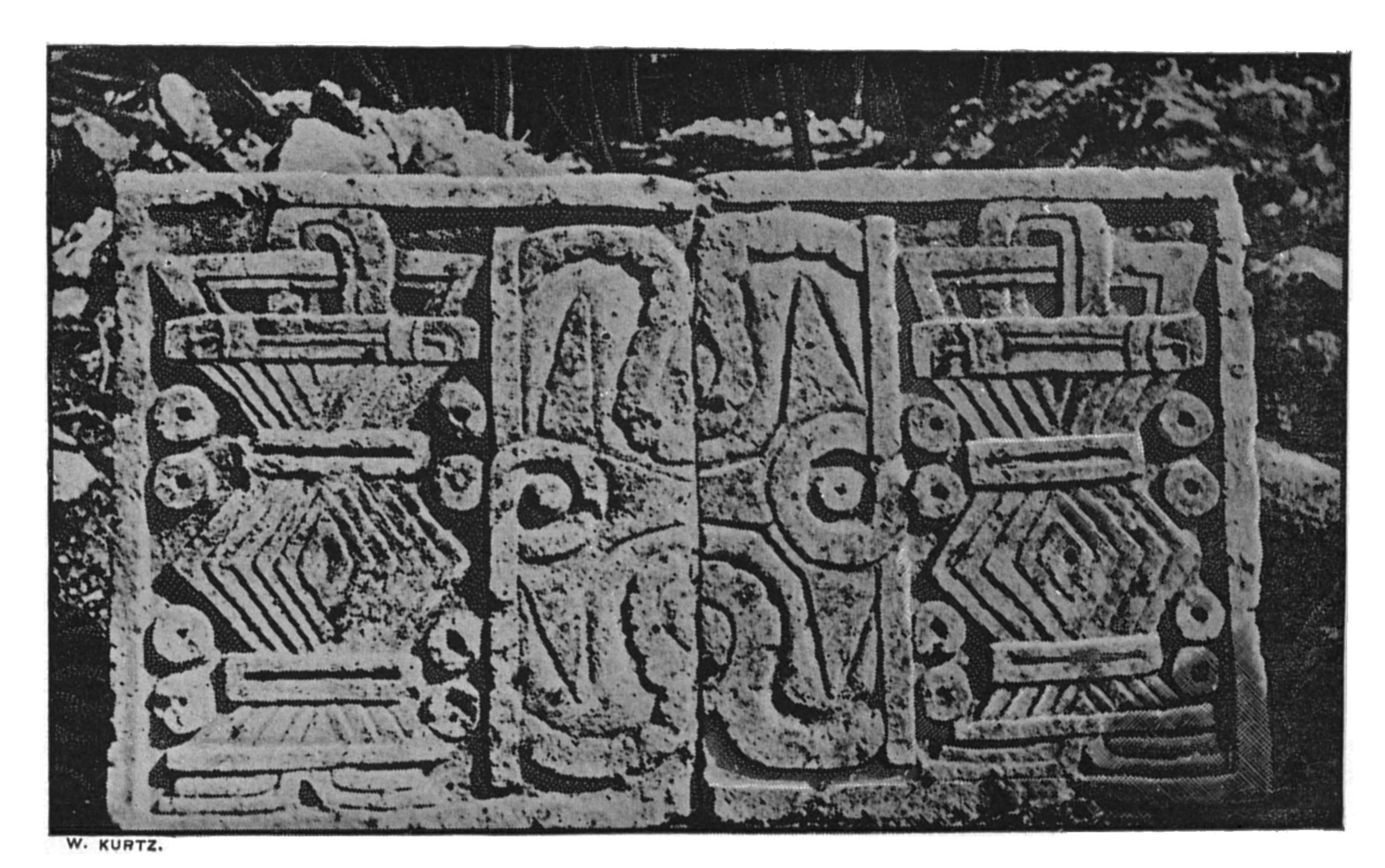
The candidate, being crowned with myrtle, which was used instead of the acacia, was admitted by night into an immense building called the Mystikos Sêkos, that is the "mystical enclosure." At their entrance they purified themselves by washing their hands in holy water, being at the same time admonished to present themselves with minds pure and undefiled, without which external cleanliness of the body would by no means be accepted. After this the holy mysteries were read to them from a book called Petrôma, because the book consisted of two stones fitly cemented together. I have discovered such stones, last year, in the mausoleum of high pontiff Cay, in the city of Chichen-Itza, in Yucatan. The priest who conducted the ceremonies was called hierophantês. He proposed certain questions, to which answers were returned in a set form. Then, strange and amazing objects presented themselves. Sometimes the place they were in seemed to shake, as if an earthquake was occurring, or whirl round and round as if carried away in a tornado. Sometimes it appeared bathed in bright and resplendent light, and flames seemed to issue from the walls, threatening to consume the temple; and all of a sudden they were extinguished by invisible hands, and the most profound obscurity succeeded to the dazzling radiance. Flashes of lightning, at intervals, broke forth with extreme brilliancy, only to make the darkness more dark, when peal after peal of thunder caused the building to shake to its very foundations. These were succeeded by loud cries for help and laments of persons in great agony; soon to be replaced by the most frightful noises and bellowings, and terrible apparitions. The nerves of the applicants were tried to the utmost, and required to be strung by the most indomitable will and moral as well as physical courage, to enable them to withstand to the last such awful trials.
All the faint hearted were invariably rejected and refused admission to the next degree, the Epopteia, or Inspection. Powerful narcotic drugs were administered to the timorous, that plunged them into a deathlike sleep, from which they emerged with but confused recollections, if not entire forgetfulness, of the terrible scenes they had witnessed, and which they believed to be produced by some frightful dream or dreadful nightmare.
I will now quote from the book of Henoch. Chap. xiv. ver. 12.—"I saw a spacious habitation built with stones of crystal. The roof had the appearance of agitating stars and flashes of lightning. Flames burnt around its walls, its portals blazed with fire. This dwelling was hot as fire—cold as ice." Chap. xvii. ver. 1.—"They raised me up into a certain place where there was the appearance of burning fire, and when they pleased, they assumed the likeness of men,—(ver. 3)—and I beheld the receptacles of light and of thunder at the extremities of the place. There was a bow of fire and arrows in their quiver—a sword of fire and every species of lightning."
Chap. xxi. vers. 4.—"Then I passed to another terrific place—(ver. 5)—where I beheld the operation of a great fire blazing and glittering, in the midst of which there was a division—columns of fire struggled together to the end of the abyss and deep was their descent. (Ver 6.)—This was the place of suffering."
Those who resisted to the last the trials of the Autopsia, as the initiation was called, were then dismissed with these three words: Kon-x Om Pan-x, which, strange to say, have no meaning in the Greek language. Captain Wilford, in his Essay on Egypt, says they correspond to the words Cansha Om Pansha, which the Brahmins pronounce every day to announce to the devotees that the religious ceremonies are over. They have been translated, "retire, O retire, profane!" Corresponding to the ite missa est of the Catholic Church.
These words are not Sanscrit, but Maya. "Con-ex Omon Panex," go, stranger, scatter! are vocables, of the language of the ancient inhabitants of Yucatan, still spoken by their descendants, the aborigines of that country. They were probably used by the priests of the temples, whose sumptuous and awe-inspiring ruins I have studied during fourteen years, to dismiss the members of their mystic societies, among which we find the same symbols that are seen even to-day in the temples of Egypt as in the M⸫ lodges.
I will endeavor to show you that the ancient sacred mysteries, the origin of Free Masonry consequently, date back from a period far more remote than the most sanguine students of its history ever imagined. I will try to trace their origin, step by step, to this continent which we inhabit,—to America—from where Maya colonists transported their ancient religious rites and ceremonies, not only to the banks of the Nile, but to those of the Euphrates, and the shores of the Indian Ocean, not less than 11,500 years ago.
But let us return to the mysteries of Eleusis. In the trials to which the Mystai were subjected to try their fitness to become Ephoroi, Masons no doubt recognize several of the ceremonies that took place at their initiation into the craft. If Free Masonry had not its origin in the ancient Sacred Mysteries, how could these rites have found their way into it?
The Ephoroi were now prepared for the third degree, the Epopteia—the most sacred of all. In this the Epoptai or "Inspectors of themselves" were placed in presence of the gods, who were supposed to appear to the initiated. Proclus, a philosopher, disciple of the divine Plato, in his commentaries on the Republic of his master, says: "In all initiations and mysteries, the gods exhibit themselves under many forms, and appear in a variety of shapes. Sometimes their unfigured light is held forth to view. Sometimes this light appears under a human form, and sometimes it assumes a different shape." And again, in his commentaries on the first Alcibiades: "In the most holy of the mysteries, before the god appears, the impulsions of certain terrestrial demons become visible, alluring the initiated from undefiled good to matter." Then all the seductions that human mind can imagine to excite the passions were placed within the grasp of those who aspired to become Epoptai. They were invited to freely give way to voluptuousness, to the enjoyment of all kind of mundane pleasures, before they renounced them forever. Nothing that could possibly entice applicants to fall from their state of moral and physical purity was omitted; all that could be done to induce them to yield to temptation was resorted to. If in a moment of weakness they allowed their senses to obtain the mastery over their reason, woe to them! for before they could realize their position, before they had time to recall their scattered thoughts, the bright surroundings disappeared as by magic; they were plunged in the most dense obscurity; the ground gave way under their feet; and they were precipitated into a deep abyss, from which if they escaped with their life, they never did with their reason.
Theon of Smyrna, in his work Matematica, divides the mysteries into five parts.
1. The purification.
2. The reception of sacred rites.
3. The Epopteia, or reception.
4. End and design of the revelation, the building of the head and fixing of the crowns.
5. The friendship and interior communion with God, the last and most awful of all the mysteries.
It is supposed the prophet Ezekiel alludes to these initiations, when he speaks of the abominations committed by the idolatrous ancients of the house of Israel in the dark, every man in the chambers of its imagery.
Here again, I will quote from the book of Henoch: Chap. xxii.—"From thence I proceeded to another spot where I saw on the West a great and lofty mountain, a strong rock and four delightful places."
Chap. xiv. ver. 14.—"Then I went to another habitation more spacious than the former. Every entrance which was opened before me was erected in the midst of a vibrating flame. Ver. 18.—Its floor was on fire, above were lightning and agitated stars, whilst its roof exhibited a blazing fire. Ver. 21.—One of great glory sat upon the orb of the brilliant sun. Ver. 24.—A fire of great extent continued to rise up before him."
It is said that the ordeal through which the candidates were obliged to pass previous to admission into the Egyptian mysteries, were even more severe, and that Pythagoras, wise philosopher as he was, had a narrow escape from it.
The priests alone could arrive at a thorough understanding of the mysteries. So sacred were their secrets held that many of the members of the sacerdotal order, even, were not admitted to a participation of them; but those alone who proved themselves deserving of the honor; since Clement of Alexandria, tells us: "the Egyptians neither entrusted their mysteries to every one, nor degraded the secrets of divine matters by disclosing them to the profane, reserving them for the heir apparent to the throne, and for such of the priests as excelled in virtue and wisdom."
From all we can learn on the subject, the mysteries consisted of two kinds, the greater and the lesser, divided into many classes. The candidate for initiation had to be pure, his character without blemish. He was commanded to study such lessons as tended to purify the mind. Great was the honor of ascending to the greater mysteries and it was difficult to attain to it. An inscription of a high priest at Memphis, says Mr. Samuel Birch, states: "That he knew the arrangements of the Earth, and those of Heliopolis and Memphis; that he had penetrated the mysteries of every sanctuary; that nothing was concealed from him; that he adored God and glorified Him in all His works, and that he hid in his breast all that he had seen." Had he not kept his secrets so carefully concealed, no doubt he would have told us that at one of the initiations the figure of the god Osiris, in whose honor the mysteries were celebrated, and whose name the initiates did not dare pronounce, appeared to the candidate, as it did at Heliopolis to Pianchi, king of Ethiopia.
At a later period, when the ancient customs had become relaxed owing to the invasion of the country by foreigners and to the government passing from the hands of native rulers to those of Persian, of Greek or Roman governors, many, besides the priests, came to be admitted to the lesser mysteries. But all had to pass through the different grades and conform to the prescribed rules, as in the case of Thales, Eumolpus, Orpheus, Pythagoras, Plato, Herodotus and others.
I will not here describe at length the initiations to the mysteries in honor of the Sun God, Mithra, instituted by Zoroaster, but only state that Porphyrius, on the testimony of Eubulus, says that this philosopher and reformer having selected a cavern in a pleasant locality in some mountains near Persia, dedicated it to Mithra, the Sun, creator and father of all beings; that he divided it into geometrical figures intended to represent the climates and elements; in a word that he imitated in a small way the order and disposition of the universe by Mithra. After him, it became customary to consecrate caverns for the celebration of mysteries; as we see yet in Japan.
The candidates for initiation to the Mithra mysteries were submitted to the most awful trials—among which one was to try the docility and courage of the applicant. He was ordered by the priest to kill a man. According to Plutarch, in his life of Pompeius, these mysteries were brought to the Occident by Cilician pirates about sixty-eight years before the Christian era. They were well received by the Greco-Latin world, and the initiated were soon to be counted by thousands. In the time of the Emperor Adrian, the mysteries of Mithra had become so popular that Pallas, a Greek writer, composed a poem on the subject, that Porphyrius has preserved in a special treatise on the abstinence from the use of animal flesh.
The mysterious initiations vividly impressed the imagination, as at times and by way of expiation, human victims were offered and immolated. The ceremonies of the priests consisted, says Origenes, in imitating the motions of the celestial bodies, those of the planets, in fact of the heavens. The initiated took the names of the constellations and dressed themselves as animals. A theology purely astronomical was taught in these mysteries, in which they used the purification by water in honor of the goddess Ardvi çoura anâhita, "She of the celestial waters;" the confession of sins; and a sort of eucharist, or offering of bread, still observed by the Parsis or fire worshippers in India. It may be said that during the last years of the Roman Empire, the religion of Mithra had become the state religion. It is not, therefore, to be wondered at, if it extended to the Roman provinces of Gaul and Britain, and if some of its rites have found their way into Free Masonry, and are practised to the present day; thus again relating it with very ancient sacred mysteries, established by Zoroaster, the author of the Zend-Avesta at least 1,100 years before Christ, although Hermippus, the Greek translator of his work, places him 5,000 years before the taking of Troy.
If we go to Hindostan, there we will learn of a secret society of wise and learned men, whose object is the study of philosophy in all its branches, but particularly the spiritual development of man. The leading fraternity is established in Thibet; and the high pontiff and other dignitaries of the Lama religion belong to it. They are known throughout India by the name of Mahatmas or Brothers. To obtain this title it is necessary to suffer a long and weary probation, and pass through ordeals of terrible severity. Many of the Chelas, as the aspirants are called, have spent twenty, even thirty years of blameless and arduous devotion to their task, and still they are in the earlier degrees, looking forward to the happy day when they may be judged worthy to have the title of Brother conferred upon them.
These Mahatmas are the successors of those secret societies of learned Brahmins, so celebrated for their wisdom, from very remote ages, in India; and of whose colleges or lodges, always built on the summit of high mounds, either natural or artificial, Alexander, the Great, when he achieved the conquest of that country, was never able to take possession. Philostratus informs us, that their mode of defense consisted in surrounding themselves with clouds, by means of which they could at will render themselves visible or not, and hurling from their midst tempests and thunder on their enemies. Evidently in those early times, they had discovered gunpowder, or some other explosives of like nature, and made use of them to explode mines, and destroy their assailants. These same Brahmins claimed to have been the teachers of the Egyptians, who, according to that, would have received their civilization and scientific knowledge from them, as also did the Chaldeans. It is well known that the Magi were strangers who came to Babylon, possessors, says the prophet Daniel, not only of a special learning, but of a peculiar tongue. They formed a powerful society, into which at the beginning none but those of their own people were admitted, as their science was both exclusive and hereditary. A certain religious character was attached to the whole body; every priest must be a Chaldean, but every Chaldean was not a priest. They passed their whole lives in meditating questions of philosophy. Astronomy was their favorite study; but they acquired great reputation for their astrology. They were versed in the arts of prophesying, of explaining dreams and prodigies, and the omens furnished by the entrails of victims offered in sacrifice. The parents taught the children. At their head was a high pontiff with the title of Rab-mag, Venerable, or according to its meaning in the Maya language, Lab-mac, "the old man." At Babylon they were the ruling order, the advisers of the King. Nothing is known to-day of their rites of initiation; but they must have been very similar to those of the Egyptians, since the civilization of Chaldea and that of Egypt were twin sisters; offspring from the same parents.
I have endeavored in a cursory manner to show that the ancient sacred mysteries were established for the same purpose in every civilized nation of antiquity, that is for the cultivation of science; the acquirement of knowledge; the bettering of man's moral and physical nature; the development of his intellectual and mental faculties; the understanding and study of the laws that govern the material and spiritual world, thus bringing him into closer contact with Deity. They kept their learning and discoveries a profound secret, surrounding them with mysterious allegories, and enigmatical symbols, for, as says Strabo: "to surround the things that are holy with a mysterious obscurity is to make Divinity venerable, is to imitate its nature that escapes man's senses," or, as Gregory of Nazianze, wrote to Jerome: "the less ignorant men understand the more they admire," and as the priests of to-day, in fact of all times, of all religions, they wished to be regarded by the masses as dispensers of the god's favors, as mediators between the Deity and man.
This similarity of the rites practiced in the initiations, the identity of symbols, proves that these rites and symbols had been communicated from one to another, just as in modern Free Masonry the initiations are the same in the lodges, the world over, having been carried to the most distant lands, by travelers, colonists or missionaries, from the fountain head, the Grand Lodge of England.
But with respect to the ancient Sacred Mysteries, the query arises as to where they originated. We know that from Egypt and Chaldea they were brought to Greece and Rome. From whom did the Egyptians and Chaldeans receive them? The Brahmins asserted that the Magi and the Hierophants were their disciples.
Admitting this assertion to be true, may we not ask, from whom did the Brahmins learn them? No doubt, if we question them on the subject, they will answer that they are the originators of these mystic rites, and secret societies of learned men; and with difficulty we could gainsay their assertion, were it not that Plutarch and other Greek writers, who have described the Eleusinian mysteries, have taken care to preserve the words used at the closing of the ceremonies by the officiating priest; and also made known to us the name and shape they gave to their place of meeting.
It is well known that the Brahmins, in many of their religious ceremonies, make use of words that are not Sanscrit, but are said to belong to a very ancient form of speech—now dead—the Akkadian, spoken by the inhabitants of the countries situated along the banks of the Euphrates, near its mouth. Strange as it may appear, this language presents many affinities with the Maya, which is still the vernacular of the aborigines of Yucatan and other countries south of the Peninsula. The fact is that the words con-x—om—pan-x, mean nothing in Greek, but, as we have said, are pure Maya vocables, that have the same meaning as that given to can-sha—om—Pansha by Captain Wilford.
That is not all. We are also told that the place or temple where the initiated assembled to perform their ceremonies, had the form of a rectangle, and that it represented the "Universe." Modern Masons have wrongly translated that idea by the Sanscrit word loga, from which the word lodge has been derived, and the form of M⸫ lodges adopted.
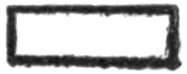
The shape of the temples was that of the Egyptian letter M called "ma", a word that also means place, country and, by extension, the Universe. The Egyptians adopted it, therefore, not because they believed, as Dr. Fanton suggests, that the earth was square or oblong, for they knew full well it was spherical, but because the sign of the word ma', conveyed to their mind the idea of the Earth, as the word earth represents it to ours. But ma is also the radical of Mayax; and likewise, in the Maya language, it means the country, the Earth. The Mayas selected the oblong square to represent it, because it is the geometrical figure that is nearest in shape to the contours of the Yucatean peninsula.
So we have found a bridge to cross the vast expanse of water that lies between the Eastern and Western Continents—a clue that may lead us to the birth-place of the ancient sacred mysteries in those "Lands of the West," that "Land of Kui," the mother-land of the gods and of the ancestors of the Egyptians, where the god Osiris reigned supreme over the souls emancipated from the trammels of matter.
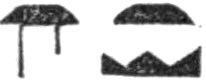
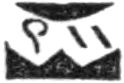
In the depths of the forests that cover the soil of Central America, lie hidden, under a cloak of verdure, the ruins of ancient cities. There, are to be seen the crumbling, awe-inspiring remains of grand old monuments; mementos of the power and civilization, of the scientific and intellectual attainments of the mighty races that erected them, and have disappeared forever in the abyss of time.
At Uxmal, one of these ancient great metropolis in Yucatan, there exists an artificial mound of peculiar construction.
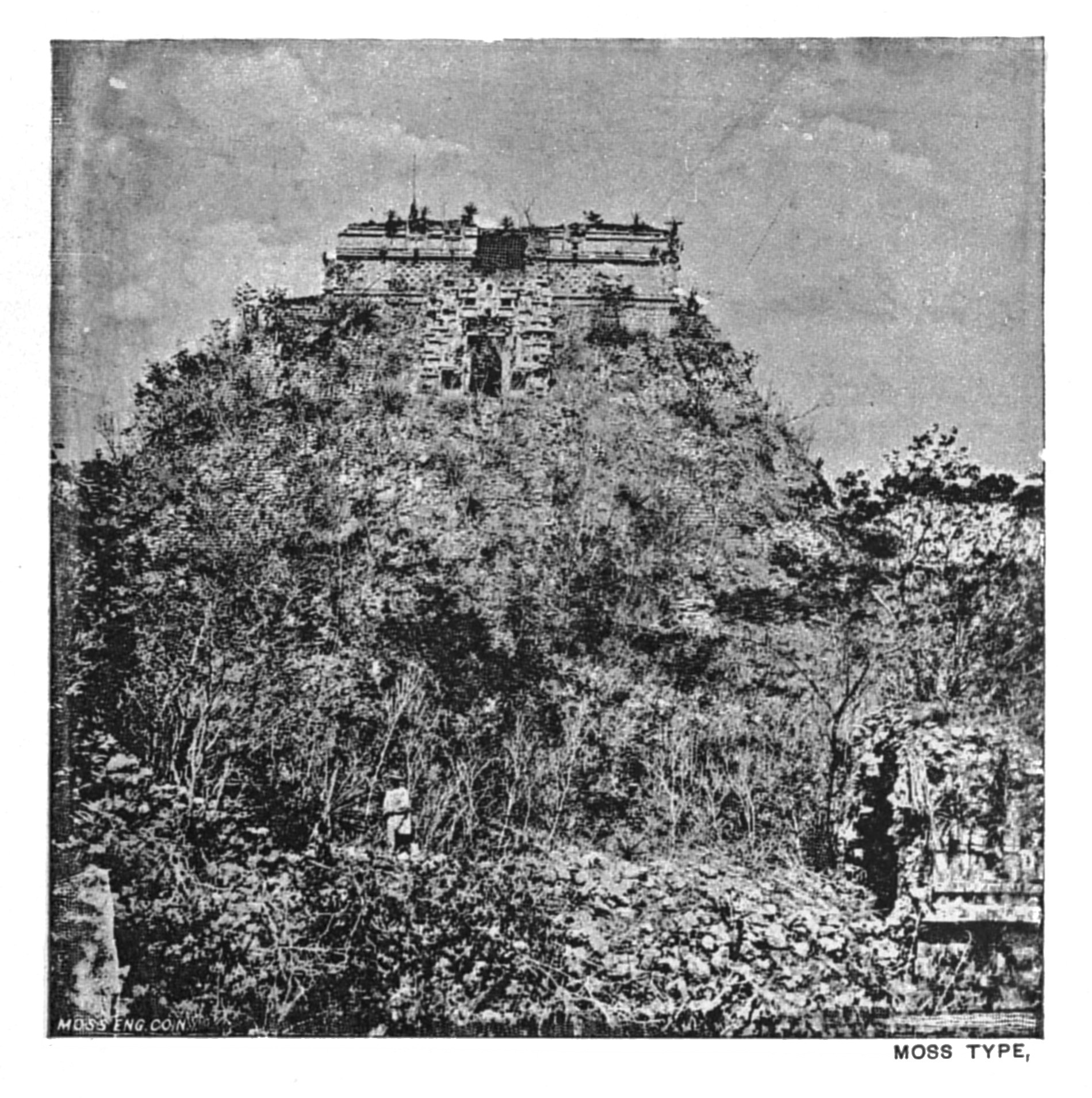
The entire structure measured 29 metres (about 95 feet) in height; 66 metres (214 feet 6 inches) in length at the base, and 33 metres (107 feet 3 inches) in width. The lower part is formed of the frustum of an elliptical cone 14 metres (45 feet 6 inches) in height, divided into 7 gradients, each 2 metres high. On the upper plane of the frustum, which forms a terrace 35 metres long by 10 metres wide, are constructed the Sanctuary, or Holy of Holies, facing west, whose ground plan is made in the shape of a cross with a double set of arms; and a truncated rectangular pyramid 6 metres high, the upper plane of which supports the crowning edifice 6 metres high, 29 metres long and 7 metres wide.
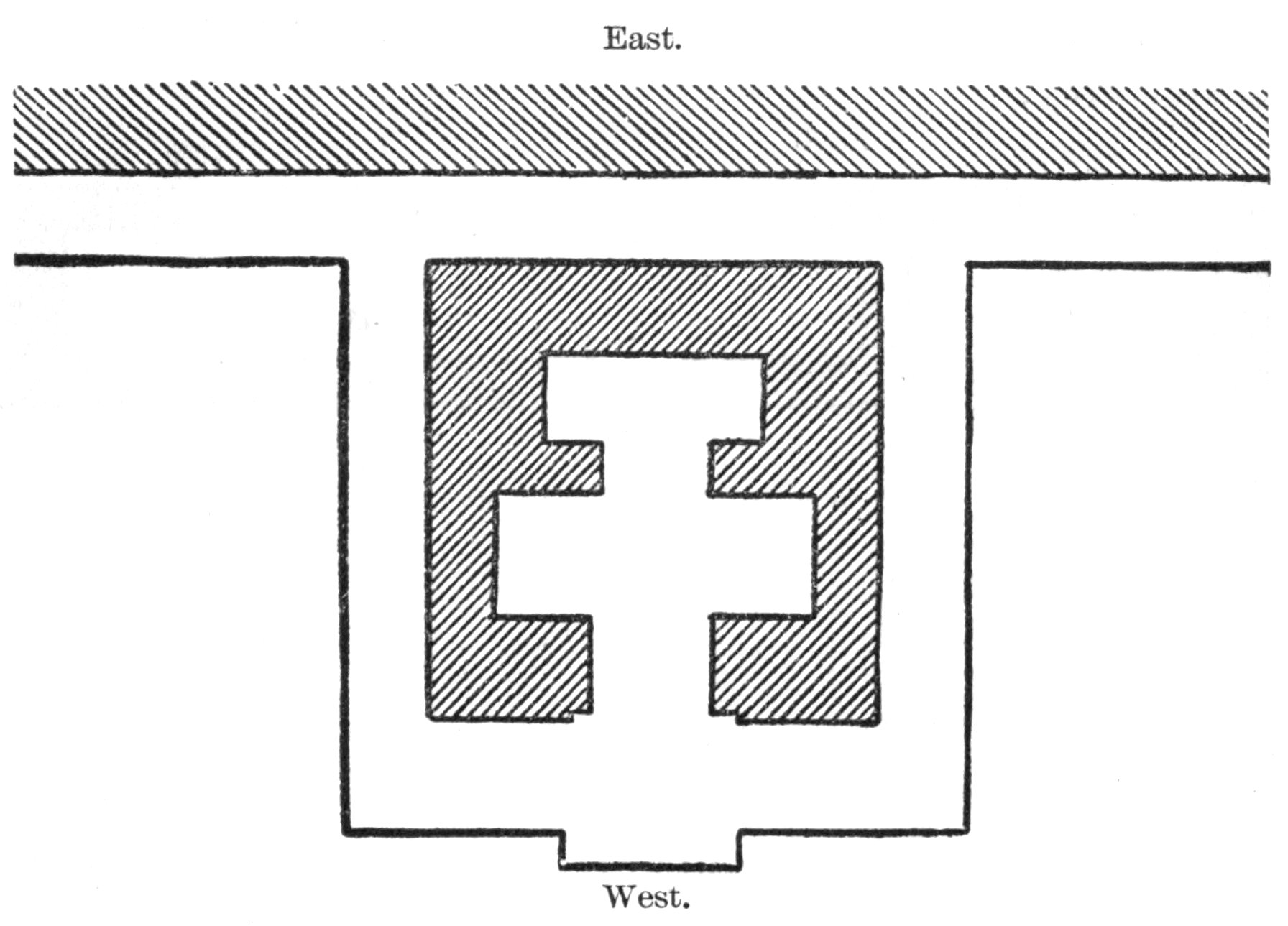
GROUND PLAN OF SANCTUARY.
This building emblem of the "Lands of the West," is composed of three separate apartments 2m. 25c. wide, having originally no communication with each other. Holes have been bored in the partition walls that have much weakened the construction; for what purpose it is difficult to surmise, unless it be for the love of destruction.
The rooms at the extremities are of the same size, 5m. 50c. (about 17 feet 10 inches) long, while the middle chamber is 7m. 25c. in length. The door of this chamber faced west, and led, by means of a small stair, to a terrace formed by the roof of the sanctuary.
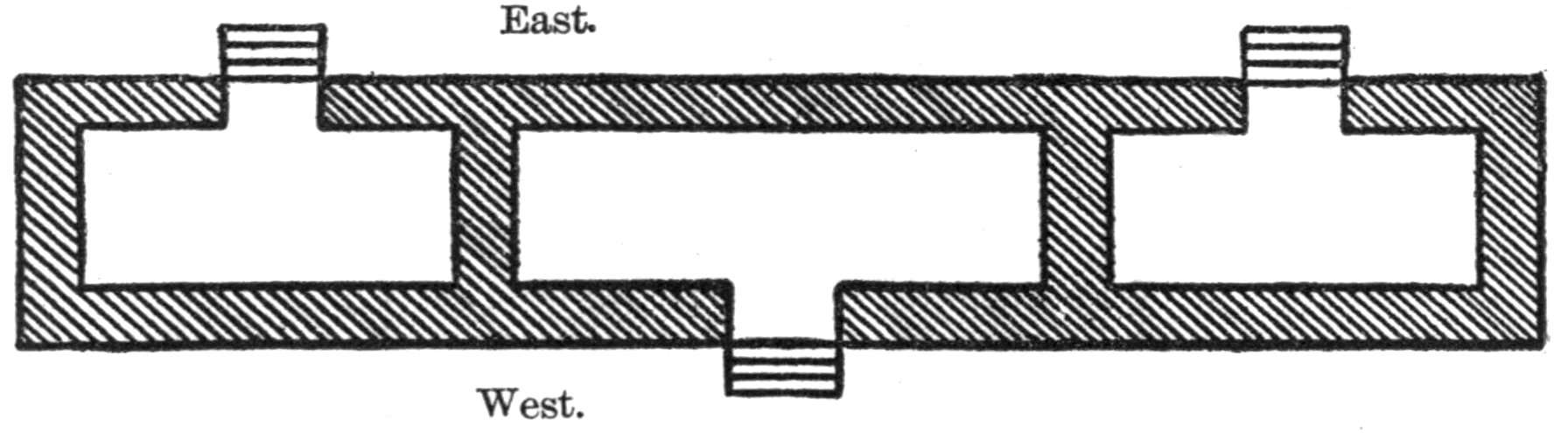
GROUND PLAN OF TEMPLE OF MYSTERIES.
From there the learned priests and astronomers, elevated above the mists of the plains below, could without hindrance follow the course of the celestial bodies, in the clear cloudless skies of Yucatan, where at times the atmosphere is so pure and transparent that stars are clearly visible to the naked eye, that require the aid of the telescope to be seen in other countries.
The doors of the other rooms faced East. The ceilings, like those of all the apartments in the monuments of Yucatan and Central America, form a triangular arch. This shape was adopted by the builders, not because they were ignorant of how to construct circular arches—since they erected edifices roofed with domes, but in accordance with certain esoteric teachings pertaining to the mysteries and relating to the mystic numbers 3.5.7.
This kind of arch is also found in the ancient tombs of Chaldea, at Mughier—in the center of the great pyramid of Ghizeh, in Egypt—in the most ancient monuments of Greece, as the treasure room at Mikéné, in the tombs of Etruria and other places.
Here, again, we learn from the book of Henoch, that the subterranean building that he constructed in the land of Canaan in the bowels of the mountain, with the help of his son Mathusalath, was in imitation of the nine vaults that were shown to him by the Deity, each apartment being roofed with an arch, the apex of which formed a key-stone with mirific characters inscribed on it. Each of the nine letters, we are told, represented one of the nine names traced in characters emblematical of the attributes of Deity. Henoch then constructed two triangles of the purest gold, and traced two of the mysterious characters on each. One he placed in the deepest arch; the other he entrusted to Mathusalath, to whom he communicated important secrets.
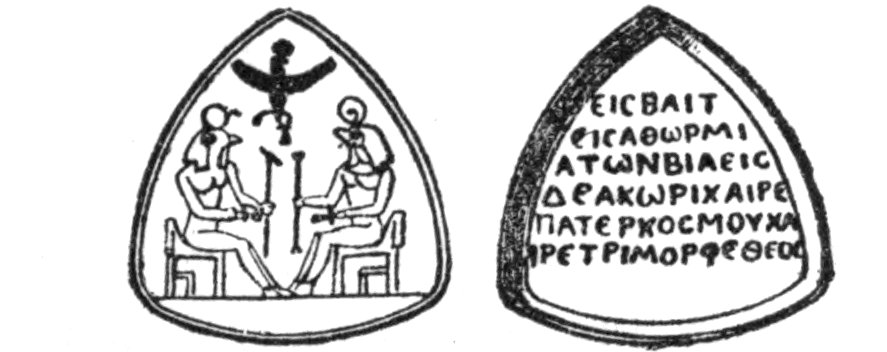
Thou art Bait (the soul); thou art Athor, one of the Bia; and thou art Akori. Hail, father of the world! hail, triform God!
The triangular arches appear, therefore, as landmarks of one and the same doctrine, practised in remote times, in India, Egypt, Chaldea, Greece, Etruria and Central America.
In the ceilings of the rooms situated at the north and south extremities of the building are carved in peculiar and regular order, in deep intaglio, semispheres, ten centimeters in diameter, intended to represent the stars that at night so beautify the firmament. Inside of the triangle formed at each end of said rooms by the converging lines of the arch are also several of these semispheres—those in the north room form a triangle (Fig. 1); while those in the south room, five in number, figure a trapezium (Fig. 2); with one of these half spheres in the middle.
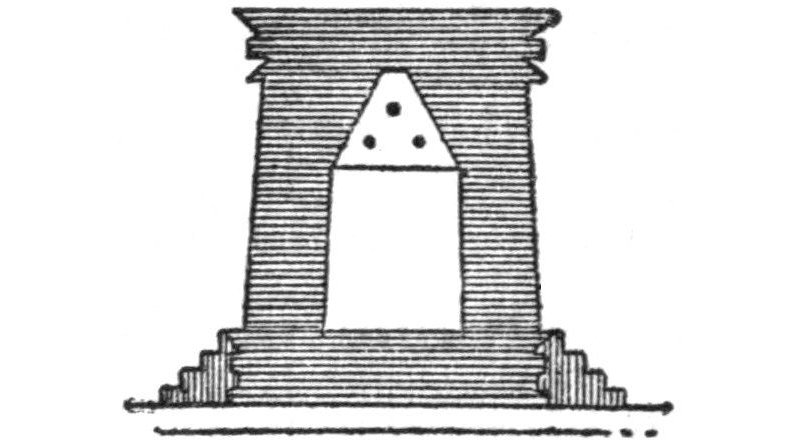
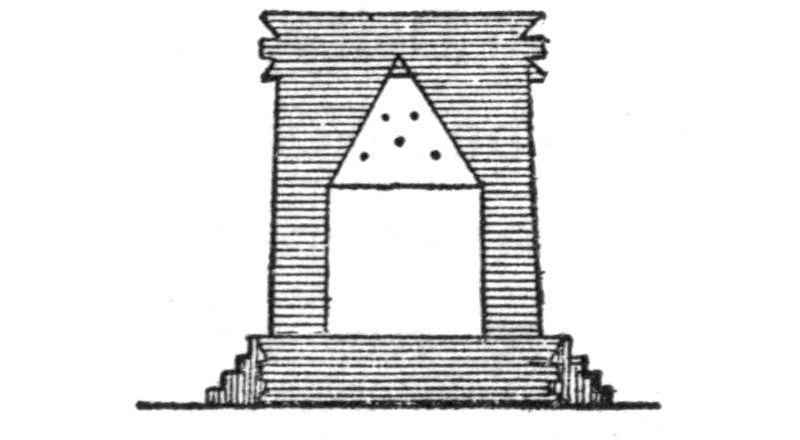
Fig. 1. Fig. 2.
The middle chamber is now devoid of decorations of any sort. Its length, seven meters, is to-day the only vestige which remains to indicate that in it, in former times, were practised rites and ceremonies pertaining to the third degree of initiation. This chamber could be reached by walking on the narrow terrace round the building; but I feel certain that those whose privilege it was to assemble within its walls, got to it from the west side.
There was a stairway nine metres wide, beautifully ornamented, leading from the court yard adjoining the priests' palace, to the entrance of the sanctuary. Thence another small stairway 2m. 40c. wide, situated on the north side of the sanctuary, led to the upper terrace, to the roof of that monument, and to the middle chamber. The access to the north and south rooms was by a grand stairway of ninety-six steps, each 20cm. high, that led to the upper terrace surrounding the whole edifice. This stairway, situated on the east side of the mound, is fourteen metres (45 feet 6 inches) wide, and, like that on the east side, so steep as to require no little practice and care to ascend and descend its narrow steps with comparative safety and ease.
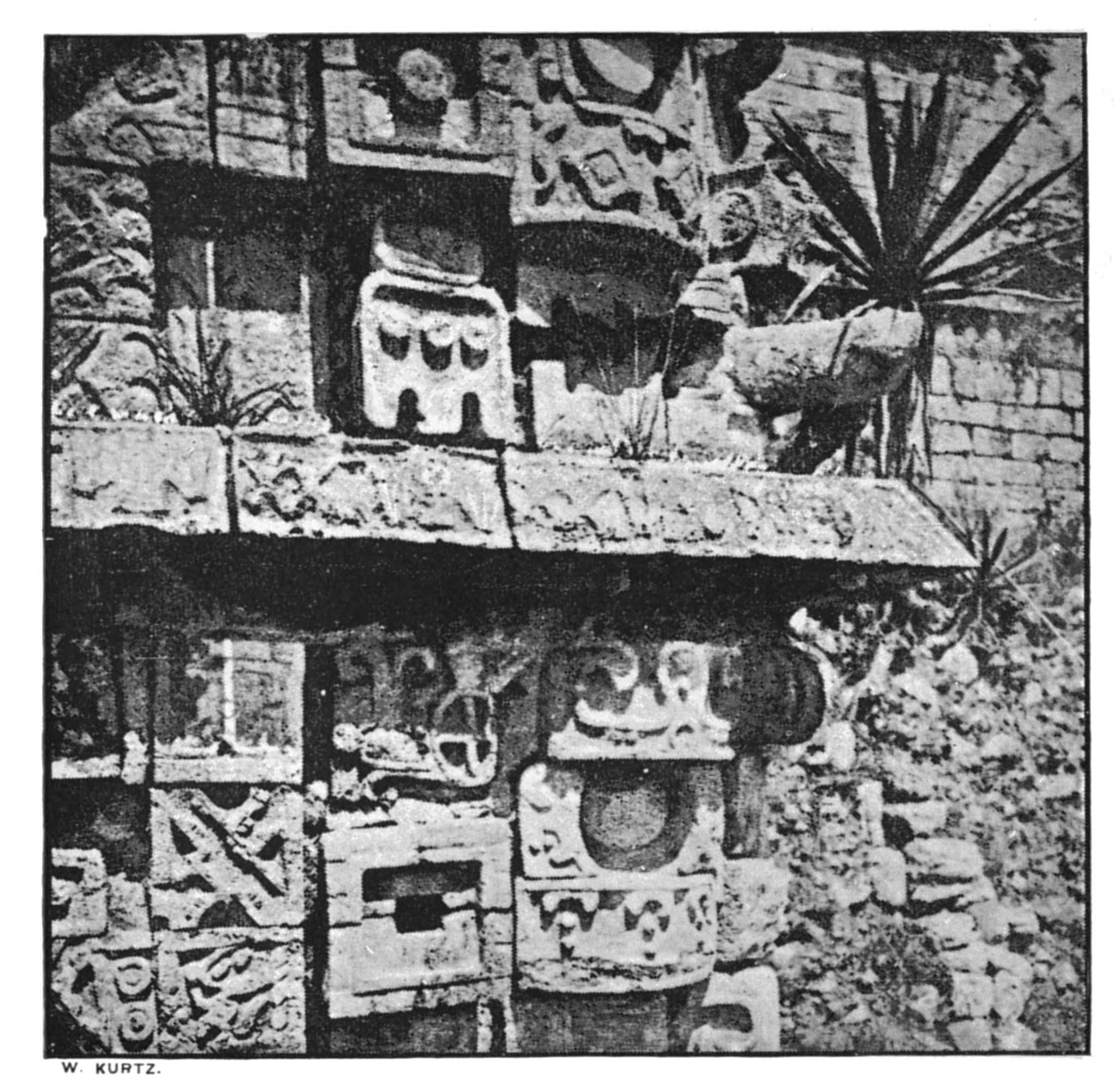
A few centimetres above the lintel of the entrance to the sanctuary is a cornice that surrounds the whole edifice. On it are sculptured these symbols,
many times repeated. On the under part of this cornice are small rings cut in the stone, from which curtains were suspended, to hide the Holy of Holies from profane gaze.
The exterior of the monument was once upon a time ornamented with elaborate and beautifully executed sculptures, which have now, in great part, disappeared. Still those that adorn the exterior walls of the sanctuary, remain as specimens of the beautiful handiwork and of the great skill of the artists; whilst the exquisite architectural proportions of the whole edifice bespeak the mathematical and other scientific attainments of the architects who planned the building and superintended its erection.
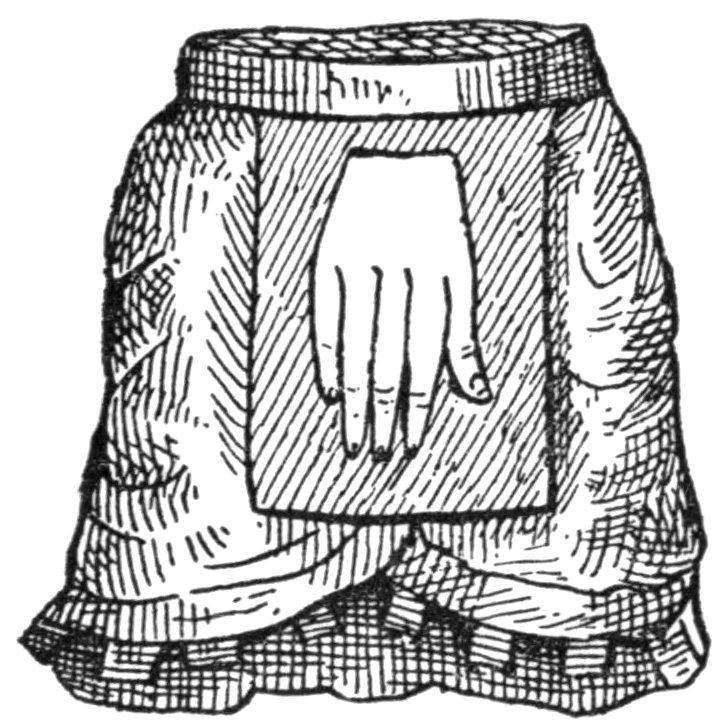
The ornaments that cover these walls are remarkable in more than one sense. They are not only inscriptions in the Maya language, written in characters identical with, and having the same meaning and value as those carved on the temples of Egypt; but among them are symbols known to have belonged to the ancient sacred mysteries of the Egyptians, and to modern Free Masonry. In August 1880, among the débris, at the foot of the mound just described, I found pieces of what once had been the statue of a priest. The part of the statue, from the waist to the knee, particularly attracted my attention. Over his dress the personage wore an apron with an extended hand, as seen in the adjoining illustration. A symbol that will easily be recognized by members of the masonic fraternity.
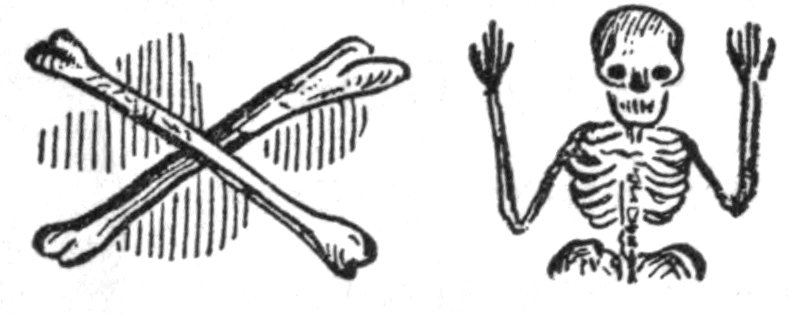
We must not forget that Plato informs us that the priests of Egypt assured Solon, when he visited them 600 years before the Christian era, that all communications between their people and the inhabitants of the "Lands of the West" had been interrupted for 9,000 years, in consequence of the great cataclysms, during which, in one night, the large island of Atlantis disappeared, submerged under the waves of the ocean. Are we not then right if we surmise that the monuments of Mayax existed 11,500 years ago, and that mysteries, similar to those of Egypt, were celebrated in them? To support that belief we have the symbols already mentioned as existing in the chambers, the construction of the chambers themselves, the sculptures carved on the cornice that surrounds the sanctuary, representing cross bones and skeletons, with arms and hands uplifted, tokens that many of the Masons again cannot fail to recognize; besides other emblems that I will endeavor to explain, which exist on the walls of the residence of the priests, an edifice adjoining that temple. This may be considered the oldest known edifice in the world consecrated to secret rites and ceremonies; and its builders the founders of the sacred mysteries, that were transported from Mayax to India, Chaldea, Egypt, Etruria, by colonists or missionaries.
What the ceremonies of initiation were among the Mayas, it is difficult to surmise at present, all their books, except four that still exist, having been destroyed by the monks who came with the Spanish adventurers, or soon after the conquest.
But they must have been similar to the rites of initiation practiced by the Quiches, a branch of the Maya nation, at Xibalba, a place in the heart of the mountains of Guatemala. We learn from the Popol-Vuh, sacred book of the Quiches, that the applicants for initiation to the mysteries were made to cross two rivers, one of mud, the other of blood, before they reached the four roads that led to the place where the priests awaited them. The crossing of these rivers was full of dangers that were to be avoided. Then they had to journey along the four roads, the white, the red, the green and the black, that led to where the council, composed of twelve veiled priests, and a wooden statue dressed and wearing ornaments as the priests, awaited them. When in presence of the council, they were told to salute the King; and the wooden statue was pointed out to them. This was to try their discernment. Then they had to salute each individual, giving his name or title without being told; after which they were asked to sit down on a certain seat. If, forgetting the respect due to the august assembly, they sat as invited, they soon had reason to regret their want of good breeding and proper preparation, for the seat, made of stone, was burning hot. Having modestly declined the invitation, they were conducted to the "Dark house," where they had to pass the night, and submit to the second trial. Guards were placed all round, to prevent the candidates from holding intercourse with the outer world. Then a lighted torch of pine wood and a cigar were given to each. These were not to be extinguished. Still they had to be returned whole at sunrise, when the officer in charge of the house came to demand them. Woe to him who allowed his torch and cigar to get consumed! Terrible chastisements, death, even, awaited him.
Having passed through this second trial successfully, the third was to be suffered in the "House of Spears." There, they had to produce four pots of certain rare flowers, without communicating with any one outside, or bringing them at the time of their coming; and had also to defend themselves, during a whole night, against the attacks of the best spearmen, selected for the purpose, one for each candidate. Coming out victorious at dawn, they were judged worthy of the fourth trial. This consisted in being shut for a whole night in the "Ice house," where the cold was intense. They had to prevent themselves from being overcome by the cold and frozen to death.
The fifth ordeal was not less terrible. It consisted in passing a night in company with wild tigers, in the "Tiger house," exposed to be torn to pieces, or devoured alive, by the ferocious animals. Emerging safe from the den, they had to submit to their sixth trial in the "Fiery house." This was a burning furnace where they had to remain from sunset to sunrise. Coming out unscorched, they were ready for the seventh trial, said to be the most severe of all, in the "House of the bats." The sacred book tells us it was the house of Camazotz, the "God of the bats," full of death-dealing weapons, where the God himself, coming from on high, appeared to the candidates and beheaded them, if off their guard.
Do not these initiations vividly recall to mind what Henoch said he saw in his visions? That blazing house of crystal, burning hot and icy cold—that place where were the bow of fire, the quiver of arrows, the sword of fire—that other where he had to cross the babbling stream, and the river of fire—and those extremities of the Earth full of all kinds of huge beasts and birds—or the habitation where appeared one of great glory sitting upon the orb of the sun—and, lastly, does not the tamarind tree in the midst of the earth, that he was told was the Tree of Knowledge, find its simile in the calabash tree, in the middle of the road where those of Xibalba placed the head of Hunhun Ahpu, after sacrificing him for having failed to support the first trial of the initiation? Even the title Hach-mac, "the true, the very man," of the high priest in Mayax, that we see over the bust of High Pontiff, prince Cay Canchi, son of King Can at Uxmal, recalls that of the chief of the Magi at Babylon.

These were the awful ordeals that the candidates for initiation into the sacred mysteries had to pass through in Xibalba. Do they not seem an exact counterpart of what happened, in a milder form at the initiation into the Eleusinian mysteries? and also the greater mysteries of Egypt, from which these were copied? Does not the recital of what the candidates to the mysteries in Xibalba were required to know, before being admitted, in order to distinguish the wooden statue pointed out to them as the King from the veiled Brothers; to avoid seating themselves on a burning hot stone seat; to keep lighted the torch and cigar and prevent them from being consumed; to produce the flowers asked from them while isolated from the world in a guarded chamber; to defend themselves from the attacks of dexterous spearmen; to protect themselves against the intense cold of the "Ice house;" to remain unhurt amidst wild tigers; or unscorched in the middle of a burning furnace; recall to mind the wonderful similar feats said to be performed by the Mahatmas, the Brothers in India, and of several of the passages of the book of Daniel, who had been initiated to the mysteries of the Chaldeans or Magi which, according to Eubulus were divided into three classes or genera, the highest being the most learned?
Will it be said that the mysteries were imported from Egypt or Chaldea or India, or Phœnicia to America? Then I will ask when? By whom? What facts can be adduced to sustain such assertion? Why should the words with which the priest at the conclusion of the ceremonies in the Eleusinian mysteries, and the Brahmins at the end of their religious ceremonies, dismiss the assistants, be Maya instead of Greek or Sanscrit words? Is it not probable that the dismissal continued to be uttered in the language of those who first instituted and taught the ceremonies and rites of the mysteries to the others? That sacred mysteries have existed in America from times immemorial, there can be no doubt. Even setting aside the proofs of their existence, that we gather from the monuments of Uxmal, and the description of the trials of initiation related in the sacred book of the Quiches, we find vestiges of them in various other countries of the Western Continent.
Garcilasso de la Vega informs us that in Peru, it was illicit for any one not belonging to the nobility to acquire learning. There again, as in Egypt, in Chaldea, Etruria, India, Mayax, science was the privilege of the priests and kings. The sacerdotal class held the pre-eminence. Sacerdotal orders were conferred only upon young men who had given proofs of sufficiency for such important office; and before they could be received into the Society of the Amautas or wise men, which was considered a great honor, they had to submit to very severe ordeals. The rites and ceremonies of initiation were imported in Peru by the ancestors of Manco Capac, the founder of the Inca dynasty, who were colonists from Central America, as we learn from an unpublished MS., written by a Jesuit father, Rev. Anello Oliva, at the beginning of the year 1631, in Lima; and now in the library of the British Museum in London. The name Quichua, of the general language of Peru, points directly to the Quiches as the branch of the Maya nation that carried civilization to that country.
If from South America we go to New Mexico, there we find the Zuñis, and other Pueblo Indians. Having preserved their independence by shaking off at an early period the yoke of the Spaniards, they have been little influenced, if at all, by the civilization of the Europeans, and live to-day as their ancestors did many centuries back; preserving with great care, not only the purity of their language, which they teach their children to speak correctly, but their customs, traditions, and ancient religious rites and observances.
Mr. Frank Cushing, who was commissioned by the Smithsonian Institution, at Washington, to make a study of their customs and manners, has been adopted by the tribe, and has now become one of their most influential chiefs. Among the many interesting things discovered by him, not the least is the existence of twelve sacred orders, with their priests, their initiations, their sacred rites, as carefully guarded as the secrets of the ancient sacred mysteries to which they bear great resemblance. He has been initiated into many of them, having had to submit to ordeals almost as severe as those of Xibalba from which no doubt they are derived, having been brought among them by Maya colonists and afterward Nahualt invaders. The Nahualts invaded and for a long time held sway over Mexico and some of the northern portions of Central America. The aborigines of those countries at last expelled them from their territories, when they scattered in all directions, about the beginning of the Christian era. Some reached as far north as the gulf of California and Arizona. The Yaqui Indians, neighbors of the Mayos, and who inhabit the countries watered by the rivers Yaqui and Mayo in Sonora, are descendants of a Nahualt tribe, from which in all probability, the adjoining nations, the inhabitants of the seven cities of Cibola, the Zuñis among them, learned many of their religious practices; and the institution of the twelve sacred orders, that recall the twelve priests who presided at the initiation into the sacred mysteries at Xibalba.
Seeking for the origin of the institution of the sacred mysteries, of which Masonry seems to be the great-grandchild, following their vestiges from country to country, we have been brought over the vast expanse of the blue sea, to this western continent, to these mysterious "Lands of the West" where the souls of all good men, the Egyptians believed, dwelt among the blessed. It is, therefore, in that country, where Osiris was said to reign supreme, that we may expect to find the true signification of the symbols held sacred by the initiates in all countries, in all times, and which have reached us, through the long vista of ages, still surrounded by the veil, well-nigh impenetrable, of mystery woven round them by their inventors. My long researches among the ruins of the ancient temples and palaces of the Mayas, have been rewarded by learning at the fountain-head the esoteric meaning of some at least of the symbols, the interpretation of which has puzzled many a wise head—the origin of the mystification and symbolism of the numbers 3, 5, and 7.
Whoever has read history knows that in all nations, civilized as well as uncivilized, from the remotest antiquity, the priests have claimed learning as the privilege of their caste, bestowed upon them by special favor of the Ruling Spirit of the universe. For this reason they have zealously kept from the gaze of other men their intellectual treasures, and surrounded them with the veil of mystery. They have carefully hid all their discoveries, scientific or artistic, under the cover of symbols, reserving their esoteric or secret meaning for the initiated; giving to the people only such exoteric or public explanation of them as best suited their purpose. They put into practice the principle, that "It was necessary to keep the discoveries of the philosophers in the works of art or nature from those unworthy of knowing them," enunciated by the erudite and celebrated English monk Roger Bacon, one of the most learned men of his time, who was confined during many years in a prison cell by his ignorant brethren on account of his great erudition. This same principle is yet closely adhered to by the Brahmins, the Buddhist priests of Thibet, the Adepts of India, and I might add the Jesuits among the Christians, although they are very inferior in knowledge to the others; the secrecy they have observed for centuries, and do still observe, being their best guarantee of power and honor.
Judging from the numerous devices and emblems that formed the ornamentation of the temples and palaces in the ancient ruined cities of Yucatan, the priests of Mayax seem to have been as addicted to symbology as their congeners in India, Egypt, Chaldea and other countries. Among these devices and symbols, several belong clearly to their sacred mysteries.
The study of the relics of ancient Maya civilization has made manifest to my mind the source of many of the primitive traditions of mankind, which have reached us through the sacred books of the Hindoos, the Chaldeans, the Egyptians, and the Jews. These, having received them from both the Chaldees and the Egyptians, have consigned the relation in the Pentateuch, a book long attributed to Moses, but now believed by Matthew Henry and other commentators, who pride themselves upon their orthodoxy, to have been written in times subsequent to the foundation of the Hebrew monarchy. Might it not be possible that, in Mayax also, could be found the origin of the mystification of the numbers 3, 5, and 7, regarded as mystic by all civilized nations of antiquity all over the earth?
Surely this mystification must have originated with one of these nations and been carried to the others either by colonists, missionaries, or travelers. It is not admissible, or even presumable, that the same idea and mysticism has been attached to these numbers by all these different peoples without being communicated from one to another. Such abstruse speculations respecting the ontological properties of numbers can not be ascribed to the first workings of the human mind in its incipient steps toward intellectual development. In its awakening, human intellect, still unable to comprehend the causes of the natural phenomena that take place, as everyday occurrences, in the material existence of man, does not soar in the elevated regions of metaphysics or of philosophical and abstract theories. Do we not see, even in our midst, that men who live in ignorance ascribe the manifestations of the powers of nature to unseen, mighty beings, of whom they continually stand in awe; to whom they tribute homage, and address prayers filled with the superstitious fears that these fancies of their untutored imagination inspire in them? Abstract conceptions, numerical combinations, metaphysical speculations, philosophical hypothesis, are productions of highly cultivated intelligences, of minds accustomed to reason on causes and effects, to deduce things unseen from things seen.
The mysticism with which these numbers have been invested, their symbolization in the sacred mysteries, must have had its origin in material causes, palpable to physical senses, the memory of which became lost in the course of ages, altered by being transported among peoples living far away from the nation that conceived the idea, by passing from mouth to mouth, in the secrecy of initiations, generation after generation. The idea of a sole and omnipotent Deity, who created all things, seems to have been the universal belief in early ages, among all the nations that had reached a high degree of civilization. This was the doctrine of the Egyptian priests. They called the Divine Intelligence Kneph, and placed him above and apart from the Triads. Damascius, an eclectic philosopher, who taught in the schools of Athens, about the year 526 of the Christian era, in his "Treatise on Principles," says that "they asserted nothing of the first principle of all things, but celebrated it as a thrice unknown darkness, transcending all intellectual perception." Proclus, platonic philosopher, director of the school of Athens in 450 after Christ, says: "the Demiurgos or Creator is triple, and the three intellects are the three kings, he who exists, he who possesses, he who beholds." These three intellects, therefore, he supposes to be the Demiurge; the same as the three kings of Plato, and as the three whom Orpheus celebrates under the names of Phænes, Ouranos, and Kronos, kings of the great "Saturnian continent," in the Atlantic ocean.
In Chaldea, the twin sister of Egypt, daughter of Poseidon, king of the "Lands beyond the sea" and Lybia, we find that notwithstanding the apparent polytheistic character which, from the earliest times, religion had assumed, it was possible for the priests and learned men, if we give credence to Pythagoras, Democritus, and other philosophers, to account by esoteric explanation for the multiplicity of their gods, resolving them into the powers of nature, thus reconciling the whole scheme with monotheism. In fact, above and apart from the personages which peopled their Pantheon and were reverenced with equal respect by kings and people, they recognized a superior deity, Ra, so far removed from their first triad, that they did not know how to worship it. The meaning of the name Ra seems to have been unknown to the historians. They only assert that it means God emphatically; but its origin still remains a mystery. In Egypt they gave that name to the "Sun" particularly, as the fount of all things, the life-giver and sustainer of all that exists on earth. La, in the Maya language, means "that which has existed forever. The eternal truth."
So it is evident that the ancient Chaldeans recognized a supreme being, a divine essence, Ra, to which the Triads were subordinate.
The same conceptions about Deity existed in India from the remotest antiquity. H. T. Colebrooke, in his notice on "the Sacred Books of the Hindoos" says: "In the last part of the Niroukta, dedicated exclusively to the divinities, it is thrice affirmed that there are only three gods; and that these three gods designate one sole deity. The gods are three only, whose mansions are the Earth, the intermediate regions and heavens; that is the fire, the air, and the sun; but Pradjapati, the Lord of all creatures, is their collective God. In fact there is but one God, the "great Soul" Maha-atma. It is called the "Sun," because the sun is the soul of all beings, of all that moves, and of all that does not move. The other gods are only parts or fractions of his person." The belief in a Triune God has also existed from very early ages among the Chinese philosophers. Lo-pi, a Chinese writer, who flourished toward the eleventh century of the Christian era, during the Songs dynasty, explaining certain passages of the Hi-Tse, says: That the "Great Term," is "the Great Unit" and the great Y. That the Y has neither body or shape. That all that has body and shape was made by that which has no body or shape. Tradition recounts that the "Great Term" or the "Great Unit" comprehends three; that one is three and three are one.
Hiu-Chin, who lived under the dynasty of the Hans, is the author of a Chinese dictionary called Choueven in which he has preserved many ancient traditions. He wrote about the beginning of the Christian era. Explaining the character Y he says: In the first beginning reason subsisted in unity. Reason made and divided Heaven and Earth; converted and perfected all things. And Tao-Tse, a contemporary of Confucius, who wrote the Tao-te-King, a book reputed very profound, said more than five hundred years before Christ: "That reason, Tao, produced one. That one produced two, that both produced three; and that three had produced all things." All early writers who have given an account of the religion of the ancient Peruvians, tell us that they worshiped a mighty unseen being who they believed had created all things, for which reason they called him Pacha-camac. He, being incomprehensible, they did not represent under any shape or figure, although they raised a magnificent temple in his honor on the sea coast that rivaled in wealth and splendor those dedicated to the Sun at Titicaca and Cuzco. We are also informed that He stood at the head of a trinity composed of Himself—Pacha-camac—Con—and Uiracocha.
In this conception of a Supreme Being, Creator of all things, we see reflected the teachings of the Popol-vuh, Sacred book of the Quiches, in which we read, "that all that exists is the work of Tzakol—the Creator—who by his will caused the Universe to spring into existence, and whose names are Bitol—the maker—Alom—the engenderer—Qaholom—He who gives being."
The fact that the same doctrine of a Supreme Deity composed of three parts distinct from each other, yet forming one, was universally prevalent among the civilized nations of America, Asia and the Egyptians, naturally leads to the inference that at some time or other, communications and relations more or less intimate have existed between them. They must, then, have imparted their traditions, metaphysical speculations, and intellectual attainments one to another.
In fact, all historians agree with Philostratus and admit that commercial intercourse did exist between Egypt and India. Nay more, Eusebius asserts that in the reign of Memnon, king of Ethiopia, a body of Ethiopians from the countries about the Indus river migrated and settled in the valley of the Nile. And the many Chinese bottles, with inscriptions in that language, found in the tombs of Thebes, prove, beyond the least doubt, that communications have existed between the inhabitants of China and the Egyptians in times very remote, as is conjectured from the inferior quality of the bottles, that some seem to believe were manufactured before the art of making objects of porcelain reached the high degree of perfection to which it attained afterward.
On the other hand, the vase with Chinese inscriptions found by Dr. Schliemann in the lowest stratum of his excavations at Hissarlik, inscriptions that were partly deciphered by the eminent indianist Mr. Emile Burnouf and afterward thoroughly interpreted by the great Chinese scholar Fi-Fangpao, when ambassador at Berlin, and proved to mention the fact of the vase having contained samples of Chinese gauze, shows that active commercial intercourse was carried on by the Chinese with Greece and Asia Minor even before the siege of Troy.
These conceptions concerning the Triune God have come down through the vista of ages, to the present day, preserved in the works of the philosophers, and are still held sacred by many among Christians and Brahmins. But we do not learn from their sacred books where, when or how said doctrine originated. Whatever may have been the source from which it sprang, it is certain that the priests and learned men of Egypt, Chaldea, India, or China, if they still knew the true history of its origin at the time they wrote, kept it a profound secret, and imparted it only to a few select among those initiated in the sacred mysteries.
We need not seek for information among the fathers of the Christian Church, for they are as silent as the tomb on the subject. They admitted into their tenets the notion of a Triune God as taught by the pagan philosophers, and appropriated it, as they have many other of their teachings and theories, without knowing, without inquiring, concerning their origin. The councils pronounced them revelations from on high; unfathomable mysteries not to be investigated; and imposed them as dogmas, to be implicitly believed, with blind faith, as they are to-day, by the followers of the Romish Church. Through their adherents the idea of the three persons in the Godhead has found its way into Free Masonry, and on the columns that adorn the temple, in the working of one of the degrees, we read these inscriptions: "In the name of the holy and indivisible Trinity;" and further down, "We have the happiness to dwell in the pacific unity of the sacred numbers."
To those initiated to the lesser mysteries the doctrine was presented under the garb of the complicated metaphysical speculations with which it has reached us. Such explanations of the symbolical nature of the mystic numbers were given to them so as to make it well-nigh impossible to obtain a fair understanding of their purport. By the perusal of the extracts just quoted it is easy to see that all the reasonings concerning the mystic value of number 3 and its relations to a Supreme Deity are mere fancies of the imagination, vague speculations, fallacious cavils; meaningless for practical and inquiring minds. So far as explaining the nature of the Deity all philosophers agree in admitting that it transcends the intelligence of man since man is finite; and what is finite will never be able to comprehend that which is infinite.
Some of the Greek philosophers reflected in their teachings, as well as in their writings, the doctrines they had learned from their teachers, the priests of Heliopolis, Memphis and Thebes. From them we may gather a glimmer of dim light pointing toward the origin of the symbolization of the numbers. We have said that Proclus asserts that the three component parts of the triple deity were three intellects or three Kings—a fact corroborated by Plato, who also had been admitted to the mysteries, and by Orpheus, who celebrated these three Kings, in the ceremonies instituted by him, that Herodotus says were identical with the Egyptian mysteries.
Pythagoras, who had received his knowledge of the numbers and their meaning from the Egyptians, taught his disciples that God was number and harmony. He caused them to honor numbers and geometrical diagrams with the names of the gods. The Egyptians likened nature to the equilateral triangle, the most perfect and beautiful of all triangles; and according to Servius, assigned the perfect number 3 to the great God.
The Chaldees symbolized the Eusoph or great light, by an equilateral triangle; and in the Sri-Santara or cosmogonical diagram of the Hindoos, which has served as model for many of their temples, the nameless, the great Aum that dwells in the infinite, is figured as an equilateral triangle. The Egyptians held the equilateral triangle as the symbol of "Nature" beautiful and fruitful. In the hieroglyphs it was the emblem of worship. We see, over the main altar, in all the ancient Catholic churches, the representation of an equilateral triangle containing the all-seeing eye of Osiris, as symbol of Deity. The same emblem is familiar also to those who visit masonic lodges as one under which is figured the "Great Architect of the Universe."