Front matter (continued 2)
Reading edition
If from those countries that we have been accustomed to consider as the "Old World," and guided by the three words of dismissal used by the Brahmins, and the officiating priests of Eleusis, at the closing of their religious ceremonies, words we have shown to belong to the Maya language, we carry our inquiries into the "Lands of the West," there again we will find that the triangle was also symbolical among the Mayas and their neighbors.
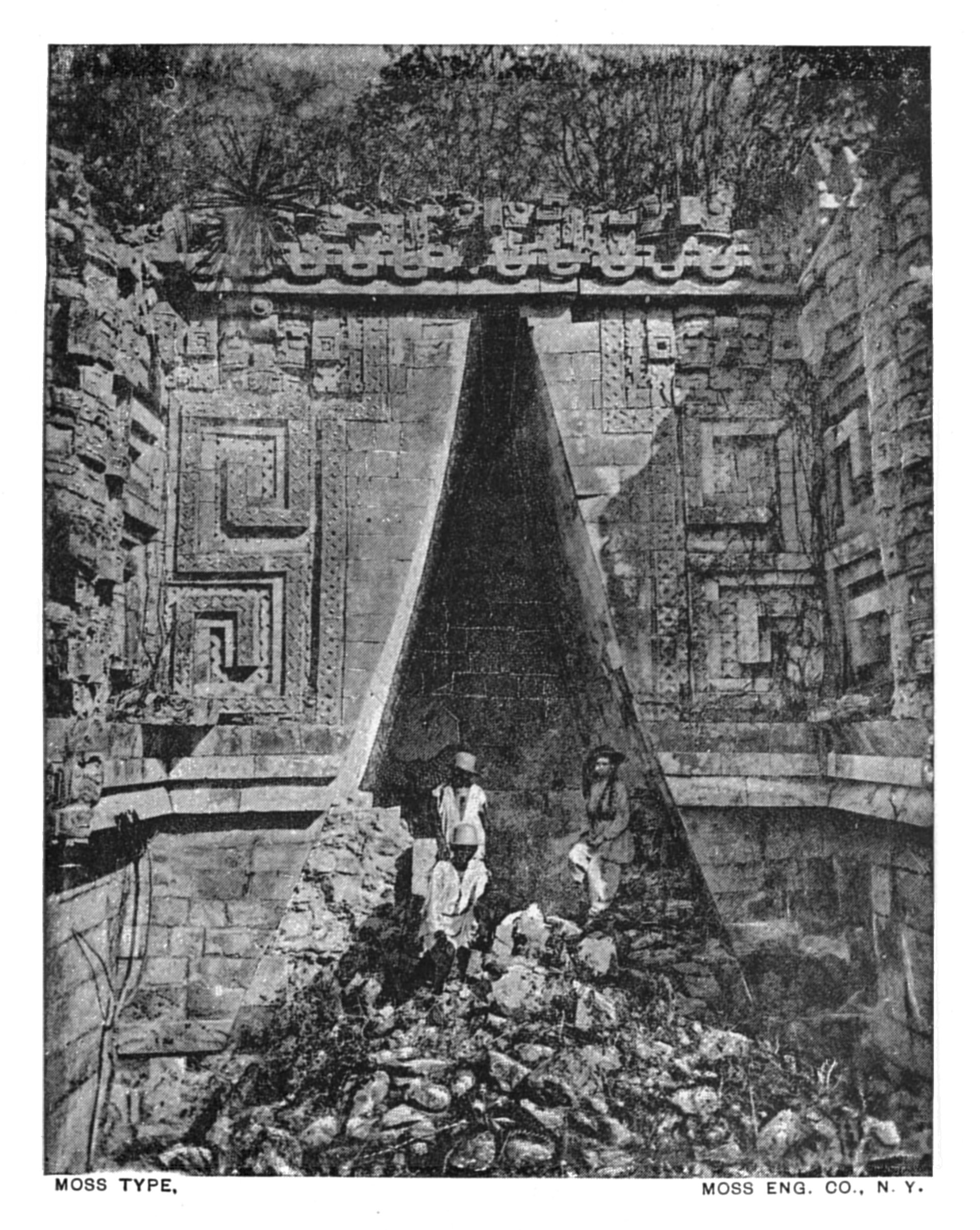
We see it in the position of the three semispheres carved, as already said, at each end of the northern chamber of the building above the sanctuary at Uxmal. We next meet with it in the triangular arches that form the ceilings of the apartments in all the temples and palaces, in fact in all the edifices of Mayax, as well as in those of Palenque and other localities of Central America.
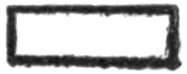
The general plan of these edifices is the same everywhere; not because they were built by the same architects, or at the same period, but because their construction was in accordance with certain teachings pertaining to the mysteries. In all the buildings, whatever their size, the ground plan was in the shape of an oblong square , that is of their letter M, pronounced Ma. Ma is the contraction of Mam, the ancestor, as they denominated the Earth, and by extension the Universe. Ma is also the radical of Ma-yax, the name of the Yucatecan peninsula, in ancient times, whose shape, no doubt, suggested that of the letter M, both to the Mayas and to the Egyptians. In fact, in Egypt and in Mayax, the figure in the hieroglyphs, stands for Earth and Universe. It will be noticed by examining their plans, that this was also the shape of the apartments in the temples and palaces of Chaldea, of Egypt and Greece; that of the tombs of the Etruscans; hence, no doubt, was assigned to the masonic lodges in our days.
The triangular ceiling in those countries, and there is no reason for doubting that it was the same in the "Lands of the West," was symbolical of the Triune God, the Ruling Spirit of the Universe, supposed to reside in the heavens, above all things. (This accounts for the constellations of the firmament being represented on the ceilings).
According to Zoroaster, He is the fire, the sun, the light; that the later Platonists have described as power, intellect, soul, or spirit; and the ancient theologians, who invoked the sun in their mysteries, according to Macrobius, as power of the world, light of the world, spirit of the world; that Plutarch gives as intelligence, matter, kosmos, beauty, order, the world; of these three he says, "universal nature may be considered to be made up, and there is reason to conclude that the Egyptians were wont to liken this nature to what they called the most beautiful and perfect triangle."
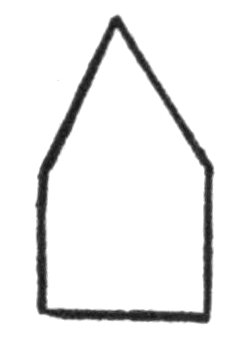
It will be noticed that the geometrical figure formed at the ends of each of these apartments, by the lines of the ceilings, sides, and floor, is a pentagon, symbol of the mystic number 5 whose name, penta, in Greek also conveys the idea of Universe; whilst Ho in Maya, meaning 5, is also the radical of Hool, the head, hence the Deity.
Then, lastly, the number of planes forming the rooms—the two of the ceilings, the two of the sides, the two of the ends, and that of the floor—seven in all, shows conclusively not only why the builders adopted the triangular arch instead of the circular, but also that the plan of their buildings was conceived in strict adherence to the mystic numbers 3, 5, 7, or their multiples, as we see by the height of the pyramids; the number of courses of the stones forming the walls; that of the terraces on which the temples stood; that of the degrees of the stairs by which they were reached.
Only two edifices of different construction have been found among the ancient cities of the Mayas. One, now completely ruined, having been shattered by a thunderbolt in 1848, was in Mayapan. That place was destroyed, according to Bishop Landa, in the year 1446 of the Christian era, by the lords and nobles of the country, to put an end to the dynasty of the Cocomes that governed with tyrannical rule. The other, still standing, although much injured by the action of time and vegetation, is to be seen in the most ancient city of Chichen. These buildings were consecrated to the study of astronomy; no doubt also to the performance of certain religious ceremonies connected with the worship of the sun, moon, and other celestial bodies. They were circular; their ground plan formed three concentric circles representing the Zodiac, and their vertical section, in its general outlines, conveys to the mind that, in their inward or esoteric construction placed before the eyes of the masses yet hidden from them, the architect wished to represent the figure of the mastodon, which was venerated by the people as image of Deity on Earth—probably because this pachyderm was the largest and most powerful creature that lived in the land.
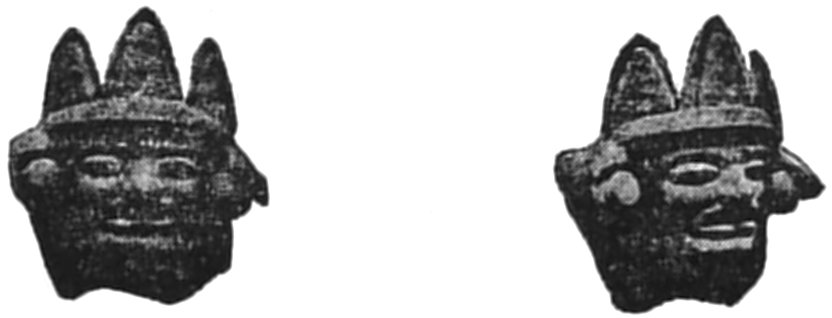
Among the ornaments which beautified one of the seven turrets that adorned the south façade of the north wing of the ancient palace of King Can, and were dedicated to each of the seven members composing his family, on that set apart to commemorate the name of his eldest son Cay (Fish), the high pontiff, are seen these symbols:
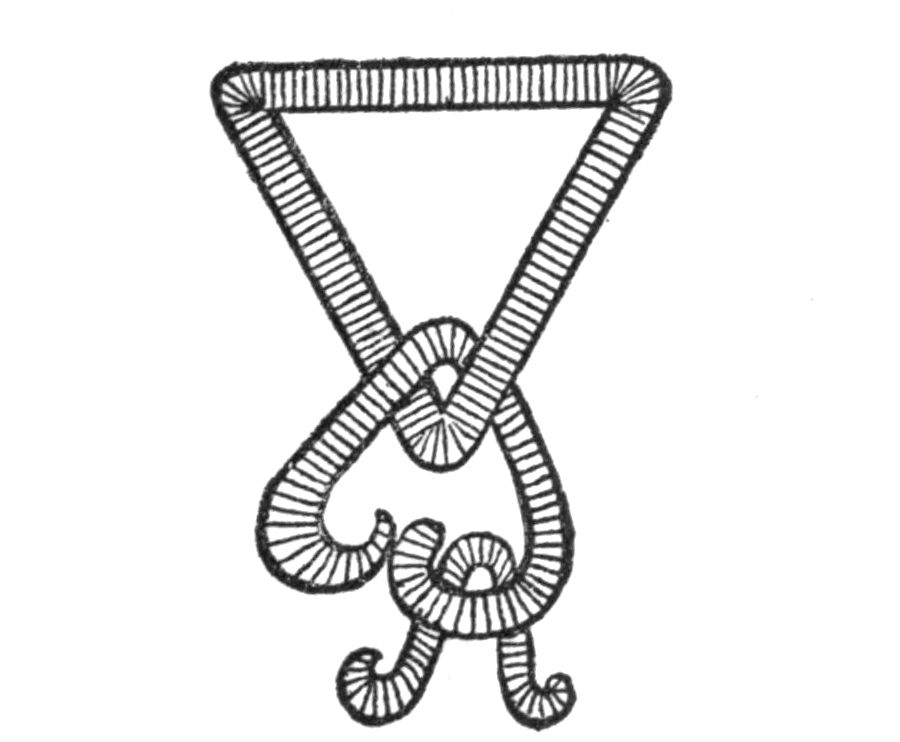
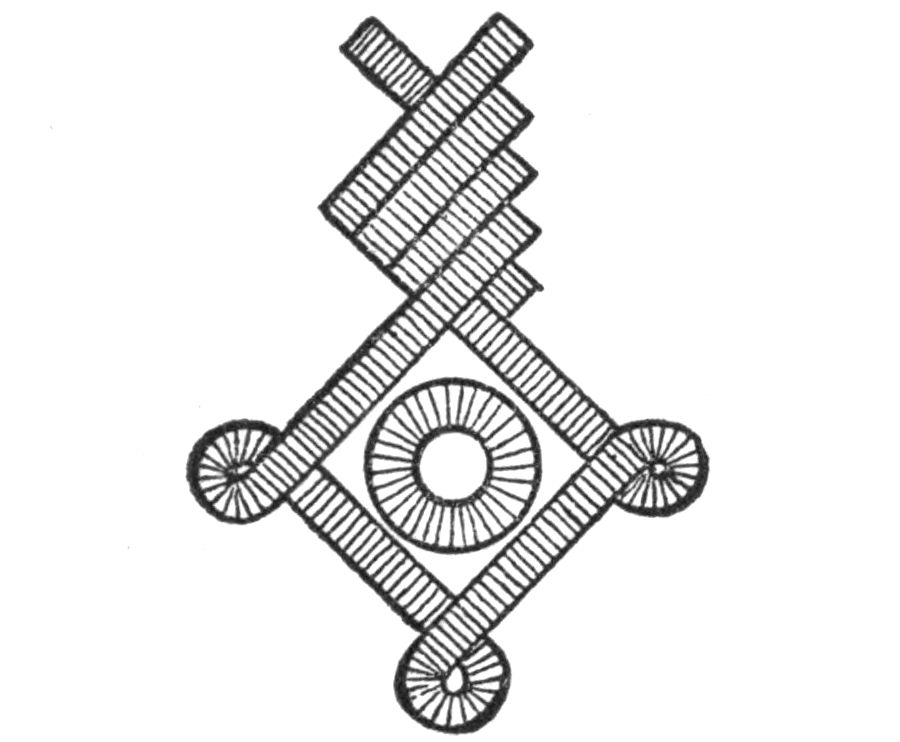
Fig. 1. Fig. 2.
My knowledge of the symbols and sacred characters used by the learned priests of Mayax, in the mural inscriptions and ornaments of their temples and palaces, enables me to understand their exoteric meaning. The first (Fig. 1) is composed of an equilateral triangle with the apex downward; through it passes a ribbon tied in a knot. The triangle seems here to represent the whole country, the "Lands of the West," composed of three great continents, "North and South America" of to-day, and "the great island," called Atlantis by Plato, that disappeared in the midst of an awful cataclysm, under the waves of the ocean, as described by the author of the Troano MS., who thus confirms the account of it given by the priests of Egypt, to Solon. The ribbon tied in a knot would indicate that the initiates, to whom the esoteric explanation of the symbol had been imparted, were bound to each other, to secrecy and to their oath. Its hidden meaning may have been that the equilateral triangle represented Deity ever watchful, always creating—Nature in which we move, and live and have our being, in which all things are bound.
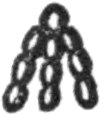
The second emblem (Fig. 2) seems to have belonged more particularly to the highest degree of the sacred mysteries, since we find it among other symbols sculptured on the slabs that formed the external casing of the mausoleum raised to the memory of the high pontiff Cay. This second emblem is also a ribbon, tied up so as to form three loops, each occupying one angle of an oblong square, image of the Universe; the fourth angle being adorned with flat folds, that are emblematic of Mayax the seat or head of the government, so arranged as to form the steps—5 in number—of a throne. This accounts for their being placed at the upper angle. The three round loops are symbolical of the three great parts composing the "Lands of the West," that the Greek mythologists figured by the trident of Poseidon, their god of the sea. As to the sign , in Mayax as in Egypt, it was meant to represent the sun. It was placed in the middle of the square simply to signify that as the sun was the centre of the universe, the vivifying soul of all things, so his representative the "Child of the Sun," the high priest, was the light that illumined the secrets of the sacred mysteries by his wisdom; and whose knowledge made him the fit ruler of the country. Is also the first letter of the Maya and Egyptian alphabets, corresponding to our Latin letter A, initial of Ah, maya masculine article, denoting strength, power—Ah being likewise the first syllable of the word Ahau King.

We know as yet too little of the religious tenets of the ancient priesthood of Mayax, to venture upon an explanation. All we can assert positively is that number 7 was the particular appendage of the third degree of the mysteries. It was considered as endowed with great potentiality; was as Pythagoras says, the vehicle of life, containing soul and body.
What motives may have induced the founders of the mysteries in Mayax to select the numbers 3, 5, 7, as symbols of the various degrees into which they divided them, we can at present only surmise. It is probable that certain natural causes, or the commemoration of important events which had taken place in the life of the nation, or in that of the family of the founders of the dynasty that governed it, suggested their adoption. The fact is that the seven members of that family were collectively symbolized by the emblem of the Ah-ac-Chapat or Seven Headed Serpent. It is difficult to prognosticate if we shall ever obtain an insight into the secret teachings of the Mayas, even if we had access to their libraries; for it is to be presumed that they did not confide them to the papyrus of their books.
Landa, in his "Relation of the things of Yucatan," says: "The sons or the nearest relatives succeeded to the high priest in his dignity; with him was the key of their sciences, and in that they most concerned themselves, because it was the priests who gave advice to the lords and answered their queries.... It was the high priest who nominated the priests for cities or villages which had none, examined them as to their proficiency in sciences and ceremonies. He entrusted to them the things of their office, and bade them give good example to the people. The priests employed themselves in the service of the temple and in teaching their divers sciences, particularly how to write the books that contained them. They taught the sons of the other priests and the younger sons of the princes who were sent to them in their childhood, if they saw them inclined for that profession."
In order to understand the explanation of the possible origin of the mystification of the numbers 3, 5, and 7, it is necessary to know something of the people among whom it seems to have originated.
If we start from the mouths of the Mississippi River and travel due south, across the Gulf of Mexico, at a distance of exactly four hundred and eighty miles, we come to the northern coast of the Yucatecan Peninsula. Its north-easternmost point, Cape Catoche, is one hundred and twenty miles from Cape San Antonio, the western end of the island of Cuba. Yucatan divides the Gulf of Mexico from the Caribbean Sea. It is comprised between the 17° 30′ and 21° 50′ of latitude north, and the 88° and 91° of longitude west from the Greenwich meridian. Its length is, therefore, 260 miles from north to south, and its breadth 180 miles from east to west. The whole country is a fossiliferous limestone formation, elevated a few feet only above the sea; its maximum height in the interior being about 70 feet. Although its rocky surface, bare for the most part, is, in places only, covered with a few inches of tillable loam, formed by the detritus of the stones and the decomposition of vegetable matter, its soil is of surprising fertility.
The whole country is now covered with well-nigh impenetrable forests. A bird's eye view of it from the top of one of the lofty pyramids, that seem like light-houses in the midst of that ocean of foliage, impresses the beholder with the idea that he is looking on an immense sea of verdure having for boundary the horizon, and whose billows come to die, with gentle murmur, at the foot of the monument on which he stands. Not a hill, not a hillock even, breaks the monotony of the landscape, which is only relieved by clusters of palm trees that loom here and there, as islets, above the dead green level.
Anciently, this country, now well nigh depopulated, was thickly peopled by a highly civilized nation, if we are to judge by the great number of large cities whose ruins exist scattered in the midst of the forests throughout the country, and by the stupendous edifices, once upon a time temples of the gods, or palaces of the kings and priests, whose walls are covered with inscriptions, bas-reliefs, and other interesting sculptures that equal in beauty of design and masterly execution those of Egypt and Babylon.
The author of the Troano MS.—a very ancient treatise on geology, one of the four known books which escaped destruction at the hands of Bishop Landa and other fanatical Catholic monks who accompanied the Spanish invaders, when, after a struggle of twenty years, they at last, in 1541, became masters of the country—tells us that anciently the peninsula was called Mayax; that is, the primitive land, the terra firma. It gave its name to the whole empire of the Mayas, that comprised all the countries known to-day as Central America, from the isthmus of Darien on the south, to that of Tehuantepec on the north. The site of the government was at Uxmal; but the great emporium of their arts and sciences, the heart, consequently, of that marvellous civilization, was at Chichen-Itza; that became a vast metropolis. In its temples pilgrims from all parts came to worship, and even offer their own persons as a sacrifice to the Almighty, by throwing themselves into the sacred well from which the city took its name. There also came the wise men from afar, to consult the H-Menes, learned priests, whose college still exists. Among these foreigners, were bearded men whose features vividly recall those of the Assyrians of old, and the Afghans of to-day.
From Chichen this great civilization seems to have extended its influence to the remotest parts of the Earth, and to have exercised its controlling power among far distant and heterogeneous nations. The fact is, that we meet with the name Maya in many countries of Asia, Africa, Europe, as well as of America, and always with the meaning of wisdom and power attached to it. Wherever we find it, there also are found vestiges of the language, of the customs, of the religion, of the cosmogonical and historical traditions of the people of Mayax. Many of these traditions have been recorded in the sacred books of various nations and have come to be regarded as the primitive history of mankind. To quote a few instances. The creation of the world, according to their conceptions, is sculptured, and forms an interesting tableau over the door-way, on the east façade of the palace at Chichen-Itza.
It might serve as illustration for the relation of the creation, as we read of it at the beginning of the first chapter of the Manava Dharma Sastra, or ordinances of Menu; a book compiled, says the celebrated indianist, H. T. Colebrooke, about 1300 years before the Christian era, and from other and more ancient works of the Brahmins. Said relation completed, however, by the narrative of the myth according to the Egyptians as told by Eusebius in his work Evangelical Preparations.
Effectively, in the tableau we see represented a luminous egg, emitting rays, and floating in the midst of the waters where it had been deposited by the Supreme Intelligence. In that egg is seated the Creator, his body painted blue, his loins surrounded by a girdle; he holds a sceptre in his left hand; his head is adorned with a plume of feathers; he is surrounded by a serpent, symbol of the Universe.
Porphyrius, speaking of Jupiter, the Creator in the Orphic mysteries, says, "the philosophers, that is the initiated, represented him as a man, seated, alluding to his immutable essence; the upper part of the body naked, because it is in its upper portions (in the skies) that the Universe is seen most uncovered; clothed from the waist below because the terrestrial things are those most hidden from view. He holds a sceptre in his left hand because the heart is on that side, and the heart is the seat of understanding that regulates all the actions of man."
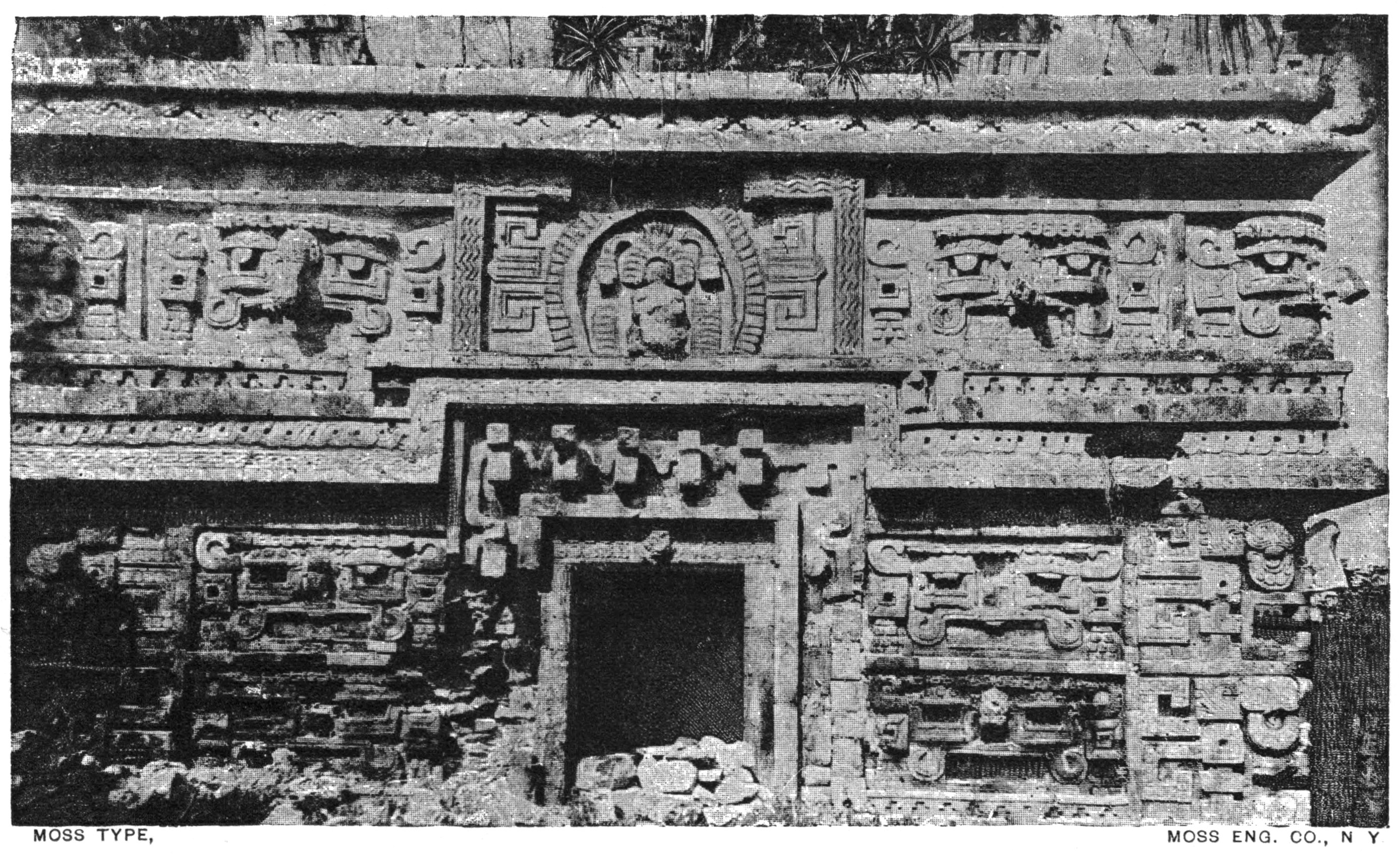
And again, "the Egyptians call Kneph the intelligence, or creative power." Kneph, or be it Kaneh, seems a cognate of can-hel, a Maya word the meaning of which is serpent (dragon); they say that this god threw from his mouth an egg in which was produced another god called Phtha, (Thah is another Maya word, it means the worker—hence the Maker, the Creator); and Eusebius asserts, "That they represented Kneph, or the Efficient Cause, as a man of a blue color, with a girdle round his loins, a sceptre in his hand, a crown on his head, adorned with a plume of feathers; and that emblematically they figured him under the form of a serpent."
Will any one with common sense pretend that these conceptions concerning the Creator, we find not only identical, but expressed in like manner and with the same symbols, by the philosophers of India, of Egypt, and of Mayax, are mere coincidences? If they are not the result of hazard, they must have been conceived by the wise men of one of these countries, that, no doubt, in which the civilization was the oldest, and communicated to others; these, in turn, taught them to their neighbors, as we know the Egyptians did to the Greeks.
Again, we read in Genesis that at a very early period in man's history, a certain man murdered his brother through jealousy. The victim we are told was named Abel, his murderer Cain.
No doubt the writer of the book simply repeated the story he had learned from the Egyptian priests, concerning the murder of Osiris (in whose honor the mysteries were instituted), by his brother Set, through jealousy; making such alterations in his narration as not to divulge the secrets he had sworn to keep.
If any of those initiated to the higher mysteries were still acquainted with the true history of the murder, they kept it a profound secret; and only gave of it such exoteric explanations as best suited their purpose. Very little can be learned from the ancient historians. Herodotus always excuses himself from speaking on the subject; although he asserts he is well acquainted with what pertained to the mysteries: and what we gather from the book of Plutarch, de Iside et Osiride, is a version invented to satisfy the initiates of the lower degrees. In it Osiris is represented as having become the culture hero of Egypt. After ascending the throne, having taught his subjects the arts of civilization, he undertook an expedition from Egypt, in order to visit and dispense the same benefits to the different countries of the world. He left his wife and sister Isis in charge of the affairs of the kingdom which she administered aided by the counsels of her friend and preceptor Thoth. Isis, being extremely vigilant, Set, her other brother, had no opportunity for making innovations in the government. Still he desired to sit on the throne. After the return of Osiris, he conspired against him and persuaded seventy-two other persons to join with him in the conspiracy, together with a certain queen of Ethiopia named Aso who happened to be in Egypt at the time. He invited his unsuspecting brother to a banquet, and caused a beautiful chest to be brought into the banqueting-room. It was much admired by all. He then, as if in jest, offered to give it to the person it fitted best. All tried getting into it one after another, but it did not fit any as well as Osiris when he in turn laid himself down in it. Then Set, aided by the conspirators, closed the lid and fastened it on the outside with nails.
This story of a brother being slain at the request of another brother, through jealousy, is also related in Valmiki's ancient Sanscrit poem, the "Ramayana." We are not informed by the author from where he obtained it; but the victim was called Bâli, and Maya is represented as being his enemy. The recital of this event being identical with that archived in the sculptures and mural paintings still existing on the walls of certain edifices at Chichen-Itza, and with the account of it recorded in the second part of the Troano MS. would seem to indicate that the relation of the fratricide was brought to India by some Maya traveler or missionary; or maybe by the colonists from Mayax that Valmiki tells us took possession of and settled, in very remote ages, in the countries, at the south of the Indo-Chinese peninsula, known to-day as Dekkan. They, of course, brought to their new home with the language and customs, the civilization, traditions, and folk-lore from the mother country. Among these the tradition that, in very ancient times, the son of one of their primitive rulers murdered his brother through jealousy, in order to possess himself of his wife, with whom he had fallen in love, and of the reins of the government.
In the inflated style of the Hindoo poets Valmiki recounts the murder of Bâli. The story is as follows. There were two princes named Bâli and Sougriva, sons of a king of the Monkey nation. After the death of their father, Bâli the eldest was called to the throne, being elected sole monarch and supreme lord by the people. A terrible feud had originated between Bâli and Maya on account of a woman they both coveted. Maya challenged Bâli to mortal combat and allured him into an ambush. Bâli not returning after a time was believed to have succumbed, and his brother Sougriva ascended the throne. Bâli returned however, and finding his brother installed in his place accused him of treason in the council of the nobles and before the people. He charged him with causing the news of his death to be circulated in order to usurp the reins of the government. Then he banished him from court, sent him adrift without means, depriving him of his home, his wife and his social position.
Sougriva met Rama; besought his help to avenge his wrongs. Having received his promise to kill Bâli, strong in the protection of such an ally, he challenged his brother to mortal combat, although he knew that alone he was not a match for him. During the encounter that ensued, Rama who was present, seeing that Sougriva was being badly beaten, sent an arrow through the breast of Bâli and killed him. The last word of that prince to his slayer who was standing by him, were: "What glory dost thou expect to reap from the death thou hast given me whilst I was not even looking toward thee? Hidden thou hast wounded me in a cowardly manner while my attention was engrossed in that duel." And so Bâli was treacherously slain.
We learn from the sculptures and mural paintings that adorn the walls of the palaces at Chichen-Itza and Uxmal that king Can (Serpent) the founder, or maybe the restorer, of these ancient cities, had three sons whose names were Cay (Fish), Aac (Turtle), and Coh (Leopard), and two daughters, Moo (Macaw), and Nicté (Flower).
It was the law among the Mayas that the youngest of the brothers should marry the eldest of the sisters to insure the legitimate and divine descent of the royal family. This same custom of princes of royal blood marrying their sisters existed among the Egyptians from the earliest days, and it became in after times general; such alliance being considered fortunate. It also prevailed with the Ethiopians, the Greeks, those of Mesopotamia in the time of the patriarchs, the Peruvians, and many other nations. Prince Coh was a brave and successful warrior; at the head of his followers, whom he had often led to victory, he had conquered many nations and greatly added to the glory and extent of the Maya empire. Being the youngest of the brothers, he was the one who had to marry Moo, the eldest of the sisters. She, on her part, loved him dearly and was proud of his exploits. After the death of King Can, their father, the country was parcelled among his children. Moo became the queen of Chichen, and many of the lords swore allegiance to her. After her death she received the honors of apotheosis; became the goddess of fire, and was worshiped in a magnificent temple, built on the summit of a high and very extensive pyramid whose ruins are still to be seen in the city of Izamal.
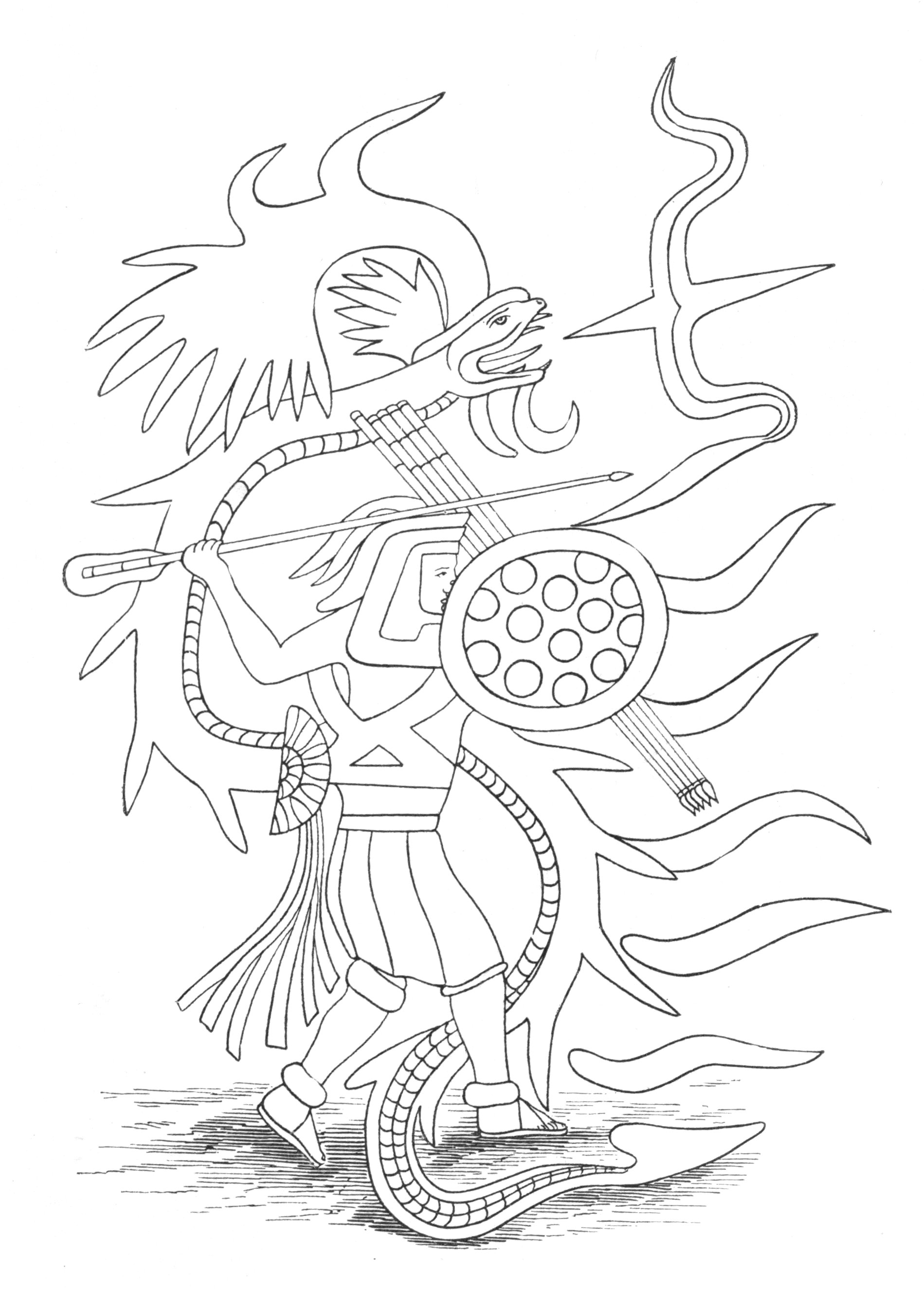
Aac, the second son of king Can, was also in love with her. To his lot had fallen the ancient metropolis Uxmal, "the three times rebuilt." His headless and legless statue is still to be seen over the main entrance on the façade of the palace known as the "House of the Governor," at that place. The flayed bodies of his two brothers and his eldest sister are at his feet; their heads hang from the belt round his waist: and the ruins of his private residence, ornamented with turtles,—his totem—yet exist at the northwest corner of the second of the three terraces on which the palace is built. The law of the land and her own predilection for Coh were insurmountable barriers that prevented Aac from marrying Moo. He was not a warrior but a courtier. He spent his life in idleness amidst pleasures and frivolities. Still he was envious of the fame won by his younger brother; jealous of him because of the love of the people, and still more of that of his sister and wife. He allowed his evil passions to gain the mastery over his better feelings. He incited a conspiration against the friends of his childhood, with the object of killing his own brother, to obtain forcible possession of the sister he so much coveted, seize the reins of the government, and become the supreme lord of the whole empire.
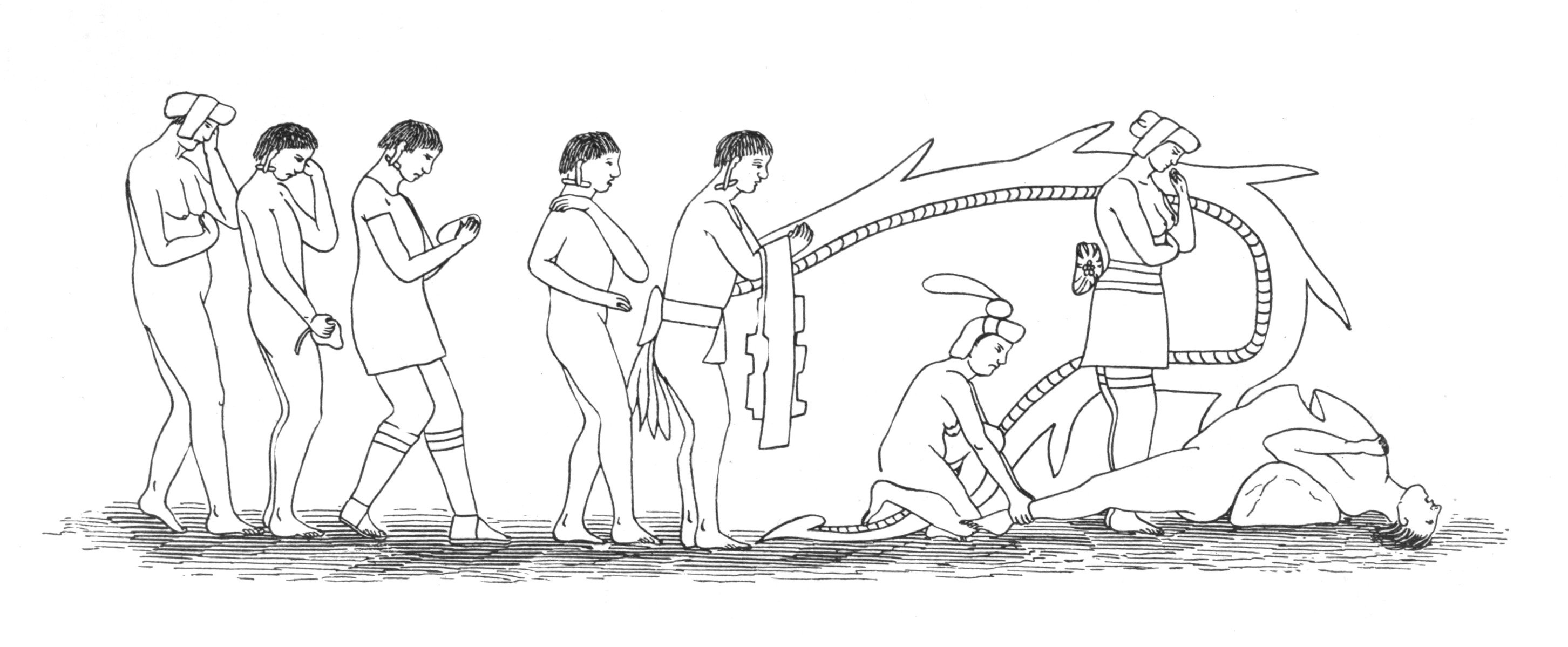
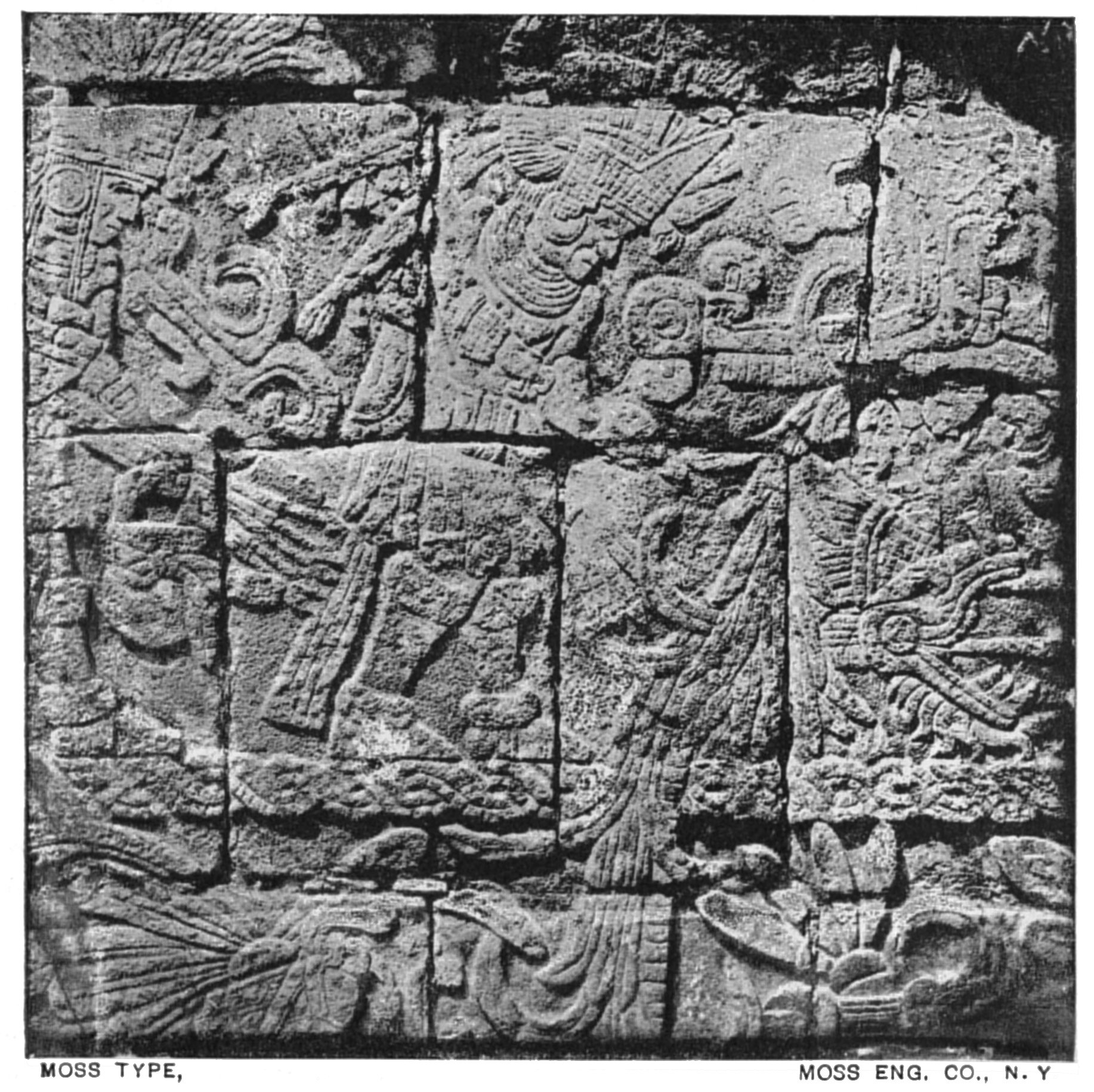
In the carvings on the wooden lintels over the entrance of Coh's funereal chamber, in the paintings that adorn its walls, and in which that part of the life of the personages concerned in these events is portrayed, Aac is represented full of wrath, holding three spears in his hand, engaged in a terrible altercation with Coh. From the sculptures that adorned his mausoleum we learn that he was murdered treacherously by being stabbed with a spear three times in the back; and the author of the Troano MS. in giving an account of that murder and its consequences, has recorded this fact and illustrated it in the first section of plate xiv., in the second part of his work. [When I disinterred his statue, I found in an urn his heart, partially cremated, and the flint head of the spear with which he was slain.] In one of the tableaux of the mural paintings the body of Coh, surrounded by his wife, his sister Nicté, his children and his mother, is being prepared for cremation; the heart and other viscera having been extracted to be preserved in urns. A similar custom prevailed among the Egyptians of high rank whose bodies were embalmed according to the most expensive process. The internal parts of the body having been removed, were cleansed, embalmed in spices and various substances, then deposited in four vases that were placed in the tomb with the coffin.
At the death of Coh the whole country became involved in a civil war. The conspirators, partisans of Aac, striving to seize the reins of the government, the friends of Prince Coh fighting to avenge his death and in defense of their queen. The goddess of war favored at times one party, then the other. Aac, in order to obtain the preponderance, had recourse to diplomacy. He renewed his suit for the hand of his sister. He sent messengers to her, with a present of fruits, begging her to accept his love now that she was free. The scene is vividly pictured in the mural paintings.
Queen Moo is represented seated in her house situated in the middle of a garden. At her feet, but outside of the house to indicate that she does not accept it, is a basket full of oranges. Her extended left hand shows that she declines to listen to the messenger who stands before her in an entreating posture, and that she scorns the love of Aac who is seen on a lower plane, making an obeisance. Over his head is a serpent, typical of his name, Can, looking as lovingly as a serpent can be made to look, at a Macaw perched on the top of a tree and above the figure of the queen whose totem it is. The tree is guarded by a monkey in a threatening attitude. This monkey here, as in Egypt the cynocephalus, is the emblem of the preceptor of Moo, symbol therefor of wisdom.
This tableau is most interesting and significant, since in it we have a natural explanation of the myth of the temptation of the woman by the serpent. Here we have the garden, the woman, the temptor, and the fruit. The story of this family incident passing from mouth to mouth, from generation to generation, from country to country, has become disfigured probably by peoples that did not hold woman in as high esteem, or did not honor her as much as the Mayas did. Perhaps, also, an old misanthropical bachelor, hater of the fair sex, wrote a distorted account of the tradition out of spite at having been jilted by his lady-love, and his version was accepted by the author of Genesis, if he himself did not make the alteration. The fact is that the author of the Troano MS.—(Plate xvii., part second) as the artist who painted the scene just described—asserts that she refused to listen to Aac's entreaties, in consequence of which the civil war continued. At last Moo and her followers succumbed. She fell into the hands of Aac who, after ill-treating her, put her to death together with Cay the high pontiff, his elder brother, who had sided with the queen of Chichen, with right and justice. In token of his victory, Aac caused his statue—the feet resting on the flayed bodies of his kin, their heads being suspended from his belt—to be placed over the main entrance of the royal palace at Uxmal, where, as I have said, its remains may be seen to-day.
I may add here in explanation of the tableau of the scene in the garden, that the present of a basket of oranges was the offer of marriage made by Aac to Moo. It is usual with the aborigines of Yucatan, that yet retain many of the customs of their forefathers, when a young man wishes to propose marriage to a girl to send by a friend as a present, a fruit, or flower, or sweetmeat. The acceptance of the present is the sign that the proposal of the suitor is admitted, and from that moment they are betrothed; whilst the refusal of the present means that he is rejected. A similar custom exists in Japan. When a young lady expects a proposal of marriage a convenient flower-pot is placed in a handy position on the window-sill. The lover plants a flower in it. If next morning the flower is watered he can present himself to his lady-love knowing that he is welcome. If on the contrary, the flower has been uprooted and thrown on the side-walk, he well understands he is not wanted.
The family name of the kings of Mayax was Can (serpent) as Khan is still the title of the Kings of Tartary and Burmah, and of the governor of provinces in Persia, Afghanistan and other countries in Central Asia. Can was therefore the family name of Aac. The meaning of the writer of Genesis when he says that the serpent spoke to the woman and seduced her with a fruit is now easily understood.
The account of the fratricide in Genesis, in the Ramayana, or in the papyri of Egypt, is nothing more or less, with a slight variance, than the story of the feuds of king Can's children. This story, treasured by the priests of Egypt and India, consigned in their sacred books and poems, has been handed down to us among the primitive traditions of mankind.
Nowhere, except in Mayax, do we find it as forming part of the history of the nation. Nowhere, except in Mayax, do we find the portraits of the actors in the tragedy. There, we not only see their portraits carved in bas-reliefs, on stone or wood, or their marble statues in the round, or represented in the mural paintings that adorn the walls of the funereal chamber built to the memory of the victim, but we discover the ornaments they wore, the weapons they used, nay, more, their mortal remains.
The following is the certificate of Charles O. Thompson, Principal and Professor of Chemistry at the Worcester Free Institute, who made the chemical analysis of part of the cremated remains found in the stone urn that was near the chest of the statue that occupied the centre of the mausoleum raised to the memory of the famous warrior Coh, twenty feet below the upper plane of the monument.
Worcester, Mass., Sept. 25, 1880.
"Stephen Salisbury, Jr., Esq., submits an unknown solid for qualitative examination.
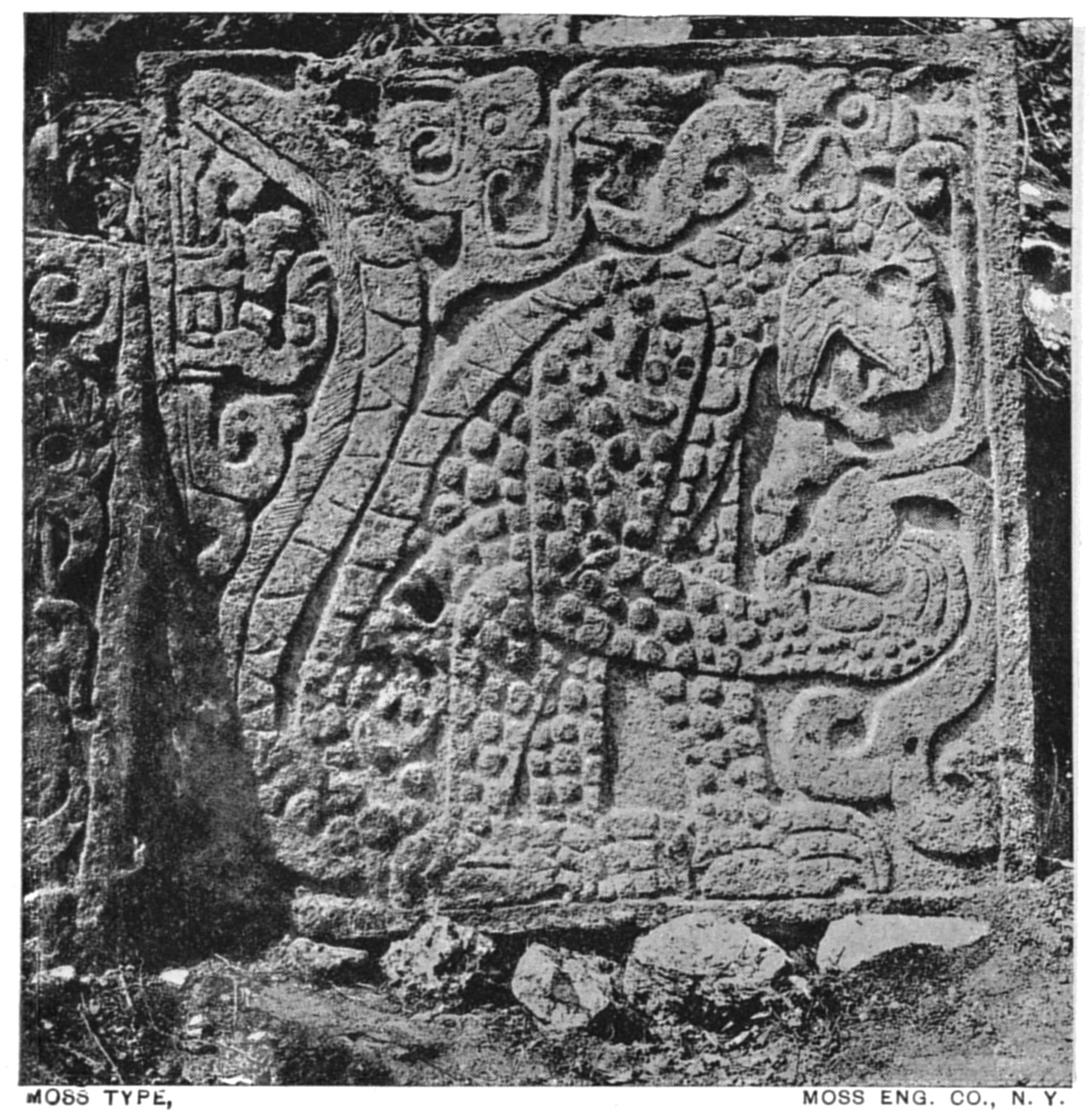
"Under microscope it presents a certain compactness and horny aspect characteristic of animal matter which has been charred in a close vessel, it loses 9 per cent. when dried at 100° and 9 per cent. more by combustion. After calcination, a dross and residue remains which contains 3 per cent. fenic oxide, a little alumina and much silica. Warm water exposed to action of residue shows traces of potash and soda.
"These results are consistent with the theory that the mass was once part of a human body which has been burned with some fuel."
"Charles O. Thompson."
There is a fact certainly worthy of notice, and this is that the names of the personages mentioned in the various accounts of the fratricide are precisely identical, or are words having the same signification. May not that be regarded as unimpeachable proof that they all refer to the same event?
No one who has any knowledge of philology will ever deny that A-bel—A-bal—Bal-i—Balam are identical words.
A, contraction of Ah, is the Maya masculine article, the. Bal is the radical of Balam. Balam is for the superstitious aborigines, even to-day, the Yumil Kaax—the "Lord of the fields" the "Leopard" which they also call Coh—the totem of the victim of Aac is the leopard—and it is so represented in the bas-reliefs and sculptures.
In Egypt, the spotted skin of the leopard, usually without the head, but sometimes with it, was always suspended near the images and statues of Osiris. The skin of a leopard was worn as a mantle over the ceremonial dress of his priests.
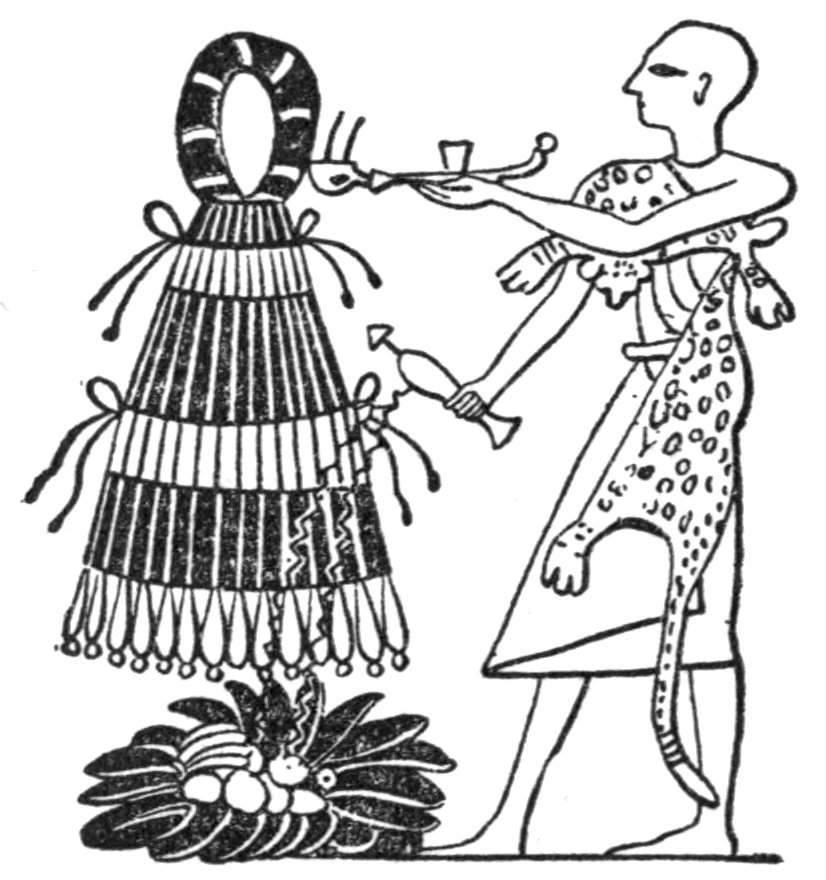
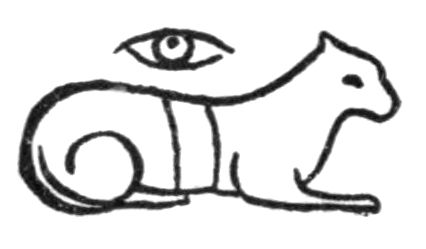
Besides, when represented as King of the Amenti—of the "West"—the symbol of Osiris was always a crouching leopard with an open eye over it.
We must not lose sight of the fact that the leopard's skin worn by Nimrod and Bacchus was a sacred appendage to the Mysteries. It was used in the Eleusinian as well as in the Egyptian mysteries instituted in honor of Osiris. It is mentioned in the earliest speculations by the Brahmins on the meaning of their sacrificial prayers the Aytareya Brahmana, and is used in the agnishtoma the initiation rites of the Soma mysteries. When the neophyte is to be born again he is covered with a "leopard skin," out of which he emerges as from his mother's womb. A leopard skin is worn by the African warriors, who are so fortunate as to possess one, as a charm to render them invulnerable to spears according to the French traveler Paul du Chaillu.
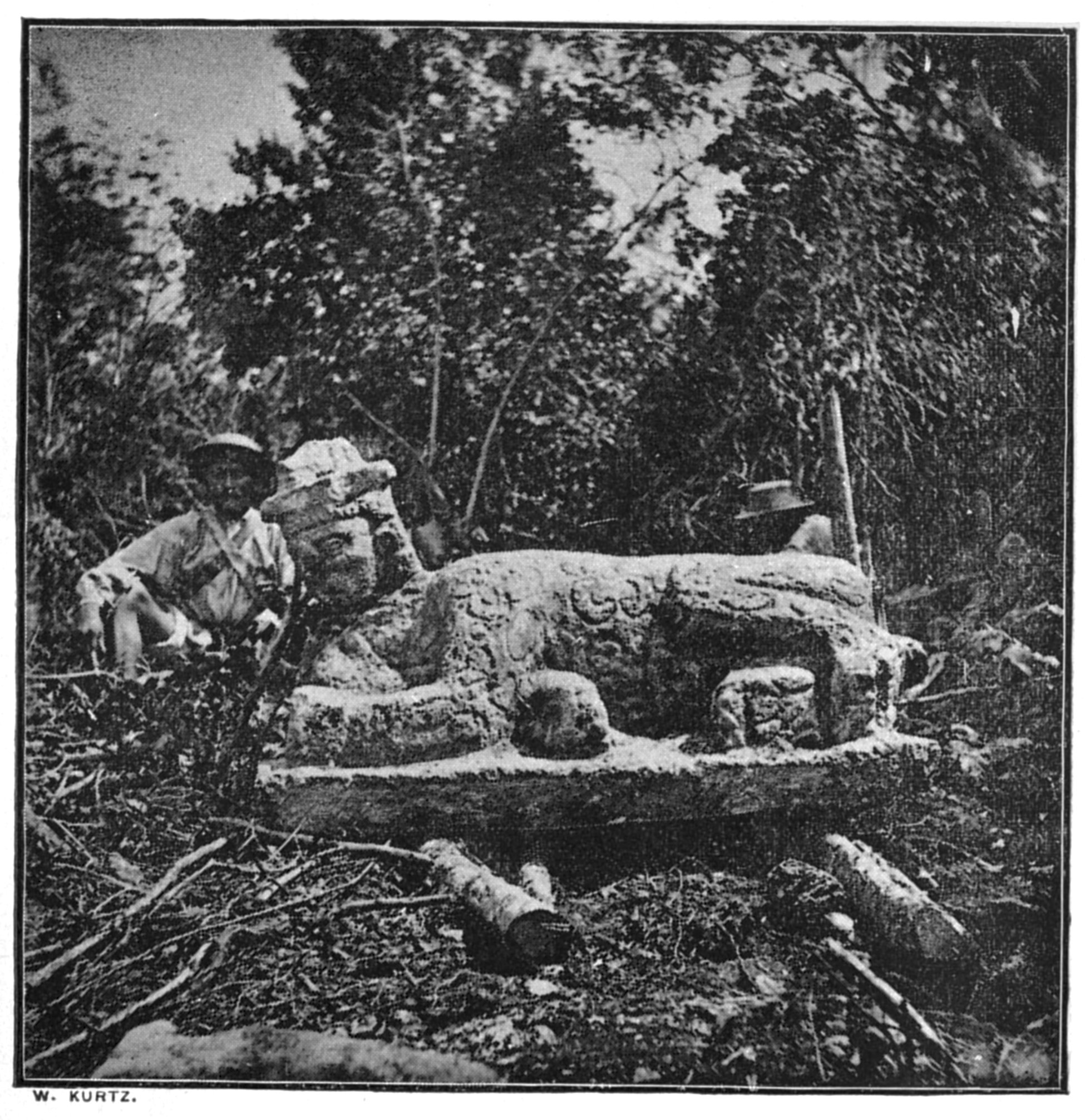
It would seem as if the manner in which Coh met his death, by being stabbed with a spear, had been known to their ancestors, and that they imagined that wearing his totem would save them from being wounded with the same kind of weapon used in killing him. That the inhabitants of Africa had communications with those of the Western Continent there can be no doubt, since populations of black people existed on the isthmus of Panama and other localities at the time of the first arrival of the Spaniards; besides their pictures can be seen in the mural paintings at Chichen.
As to the name Osir, or be it Ozil, it would seem to be a nickname given to Coh on account of the great love his sisters, and the people in general, professed for him. Ozil is a Maya verb that means to desire vehemently. He, therefore, who was very much desired—dearly beloved.
Osiris in Egypt, Abel in Chaldea, Bali in India, are myths. Coh, in Mayax, is a reality—a warrior whose mausoleum I have opened; whose weapons and jade ornaments are in my possession; whose heart I have found, and a piece of which was analyzed by Professor Thompson; whose statue, with his name inscribed on the tablets occupying the place of the ears, I have unearthed, and which is now in the National Museum in the City of Mexico, one of the most precious relics in that institution, having been robbed from me, by force of arms, by the Mexican authorities.
Isis was the wife and sister of Osiris. The word Isis may simply be a dialectical mode of pronouncing the Maya word iↄin (idzin) the younger sister. Her headgear, as a goddess, was a vulture. That bird was her totem and the peculiar type of maternity.
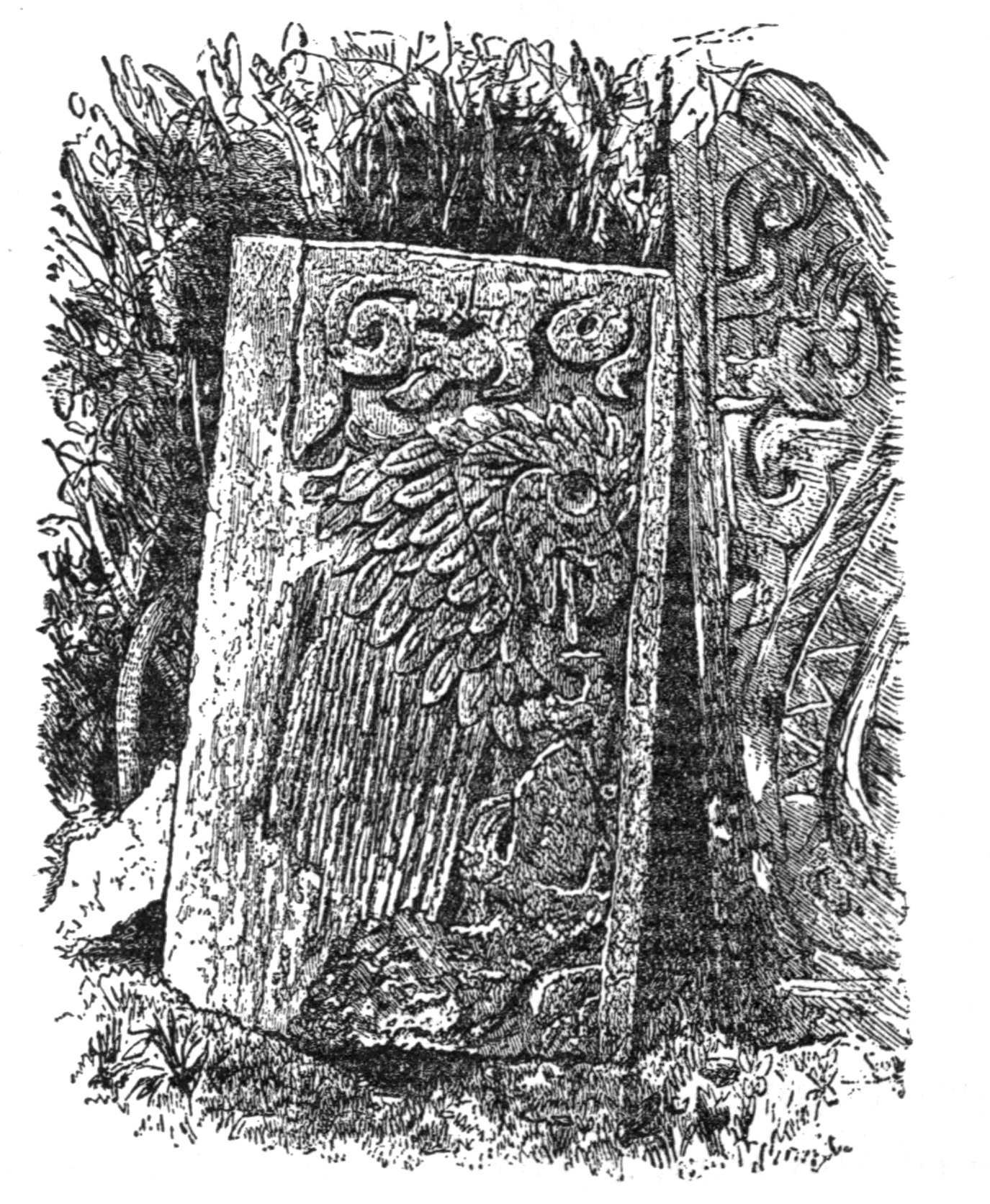
Isis was often called the great mother-goddess Mau; a word certainly as suggestive of the name Moo, sister and wife of Coh and queen of Chichen, as the vulture is of the Macaw. It must not be forgotten that one of the titles of Isis was the royal wife and sister.
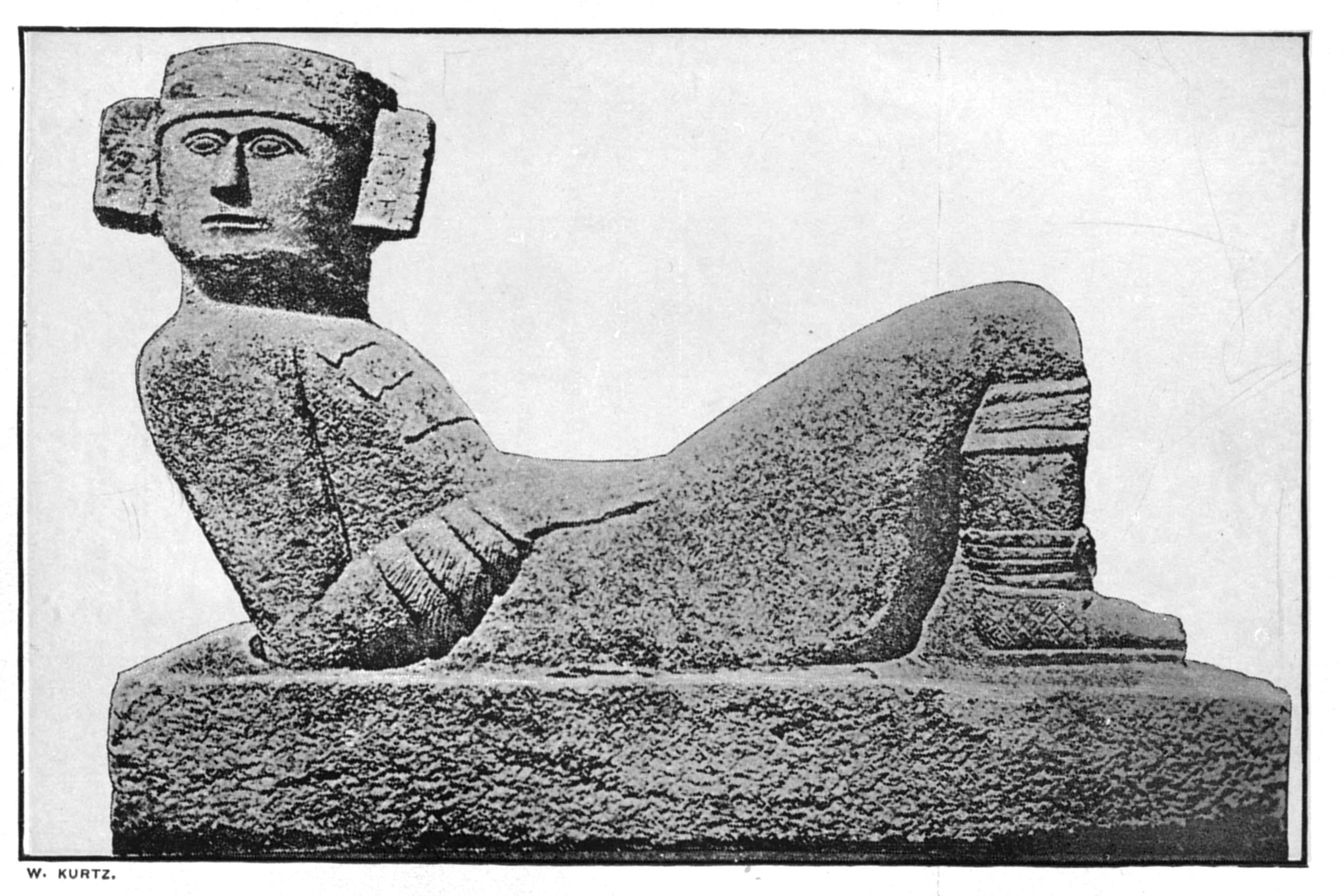
Authors, who of course know nothing of the facts in the ancient history of Mayax, revealed to me by the sculptures and the mural paintings of the temples and palaces of the Mayas, and contained in the pages of the Troano MS., do not believe that Osiris and his sister Isis were deified persons who had lived on earth, but fabulous beings, whose history was founded on metaphysical speculations, and adapted to certain phenomena of nature. But the primitive rulers of the Mayas, whose history is an exact counterpart of that of the children of Seb and Nut, were deified after their death and worshiped as gods of the elements. My object is not here to enter into long explanations on these historical disclosures. I refer the reader who wishes to know more of the subject to my work, "The Monuments of Mayax and their Historical Teachings."
As to the names Cain, Set, Sougriva, Aac, they all convey the idea of something belonging to or having affinity with water.
Cain, by apocope, gives Cay, the Maya word for "fish."
Set is a cognate word of the Maya Ze, to ill-treat with blows. Can a name be more appropriate to designate one who has killed his brother with three thrusts of his spear; and his sister by kicking her to death, as Aac is represented doing by the author of the Troano MS.?
Set, after being treated with the same honor as the other members of the family of Seb, came to be regarded as the Evil principle and was called Nubti, that is, according to the Maya language, the adversary, from nup adversary and ti for. He also was the Sun God, the enemy of the serpent. Here again we have a most singular resemblance, to say the least. Aac, in the sculptures of Mayax, is always pictured surrounded by the sun as his protecting genius; while the serpent, emblem of the country, always shields Coh and his sister-wife within its folds. The escutcheon of the city of Uxmal shows that the title of that metropolis was the "Land of the Sun." In the bas-reliefs of the queen's chamber at Chichen, the followers of Aac are seen to render homage to the Sun; the friends of Moo to the serpent. So in Mayax as in Egypt, the Sun and the Serpent were inimical. In Egypt this enmity was a myth; in Mayax a dire reality.
The hippopotamus and the crocodile were emblems of Set. Plutarch says "that at Hermopolis there was a statue of Set, which was a hippopotamus with a hawk upon its back fighting with a serpent." Both the hippopotamus and the crocodile are amphibious animals, having consequently much affinity with water.
Aac, in Maya, is the name for the turtle, also an amphibious animal.
The name Sougriva, of the brother of Bâli, is a word composed of three Maya primitives, zuc, lib, ha, zuc, quiet, tranquil; lib, to ascend, and ha, water—"He who tranquilly rises on the water" as the turtle does.
The universal deluge is another tradition of the early days that was credited by certain civilized nations of antiquity.
The Egyptian priests who, from times immemorial, had kept in the archives of the temples a faithful account of all events worthy of being remembered, derided the Greek philosophers when they spoke of the deluge of Deucalion and the destruction of the human race. Their answer was that as they had been preserved from it the inundation could not have been universal; they even added that the Hellenes were childish in attaching so much importance to that event, as there had been several other local catastrophes resembling it. They told Solon that the greatest cataclysm on record in their books was that during which Atlantis disappeared under the waves of the ocean, in one day and night, in consequence of violent earthquakes and volcanic eruptions; that from that time all communications between their people and the inhabitants of the "Lands of the West" had become interrupted; the occurrence having taken place 9,000 years before his visit to Egypt.
An account of that fearful event was also preserved by the learned men of Mayax who give of it a description identical with that given by the Egyptians. Nearly all the nations living on the western continent have kept the tradition of it, but they do not pretend that all mankind was destroyed.
In Mayax the learned priests caused a relation of it to be carved in intaglio on the stone that forms the lintel over the interior doorway in the rooms on the south side of their college. The building is known to this day by the name of Akab-ↄib, the dark, or terrible writing.
The author of the Troano MS., a work, I have already said, on geology, dedicates several pages at the beginning of the second part to the recital of that fearful cataclysm, and the phenomena which then took place. This leaves no longer room for doubting that a large continent existed in the middle of the Atlantic ocean, and which was destroyed within the memory of man; and that the narrative by Plato of the submersion of Atlantis is, in the main, correct. The Maya author represents the lost land by the figure of a black man with red lips, which would imply that it was mostly inhabited by a race of black men. In this case, the presence of black-skinned populations on the Western continent, anterior to the advent of the Spaniards, would be easily accounted for. The Mayas like the Egyptians, represented the world as an old man. Plutarch says they called East the face, North the right side, South the left side; this conception has reached our days, only we reckon the East as the right hand, West the left, North the face.
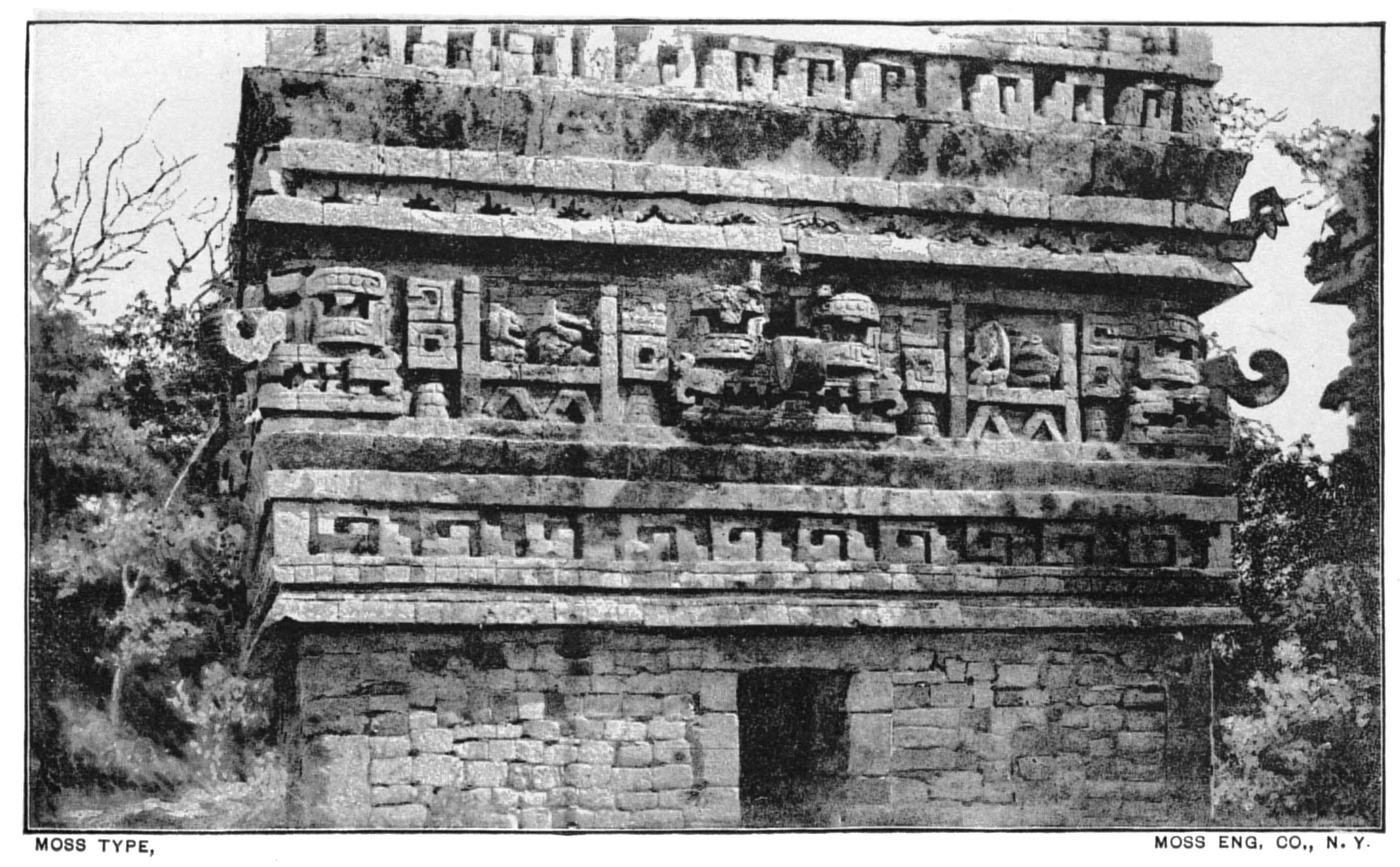
When the author of the Troano MS., speaks of the "Master of the land" par excellence, that is king Can deified, he pictures him sometimes with a human body, painted blue, and the head of a mastodon. On the façade of the building at Chichen Itza called by the natives Kuna, the house of God, to which Stephens, in his work on Yucatan, gives the name of Iglesia, is a tableau representing the worship of that great pachyderm, whose head, with its trunk, forms the principal ornament of the temples and palaces built by the members of king Can's family.
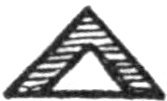
This tableau is composed of a face intended for that of the mastodon. Over the trunk and between the eyes formerly existed a human head, which has been destroyed by malignant hands. It wore a royal crown. This is still in place. On the front of it is a small portrait cut in the round of some very ancient personage. On each side of the head are square niches containing each two now headless statues, a male and a female; they are seated, not Indian fashion, squatting, but with the legs crossed and doubled under them, in a worshiping attitude. Each carries a symbol on their back; totem of the nation or tribe by which the mastodon was held sacred. Under these figures, are two triangles emblems of offerings and worship in Mayax as in Egypt. So also was the other symbol image of a honey-comb, an oblation most grateful to the gods, since with the bark of the Balche tree, honey formed the principal ingredient of Balche, that beverage so pleasing to their palate: the same that under the name of nectar, Hebe served to the inhabitants of Olympus. It is the Amrita, still enjoyed, on the day of the full moon, by the gods, the manes and the saints, according to the Hindoos; although it was the cause of the war between the gods and the Titans, and is the origin of many sanguinary quarrels among the tribes of equatorial Africa even in our days.
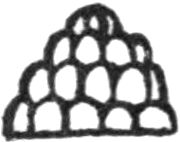
These symbols leave no doubt as to the fact that the personages represented by the statues are in the act of worshiping the mastodon.
The corona of the upper cornice, that above the mastodon's head, is formed of a peculiar wavy adornment often met with in the ornamentation of the monuments erected by the Cans. Emblematic of the serpent, it is composed of two letters N juxtaposed, monogram of Can . The corona of the lower cornice is made of two characters that read in Maya Ah ↄam, He of the throne—the monarch.
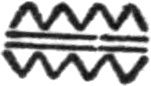
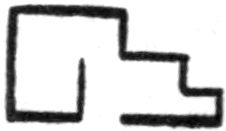
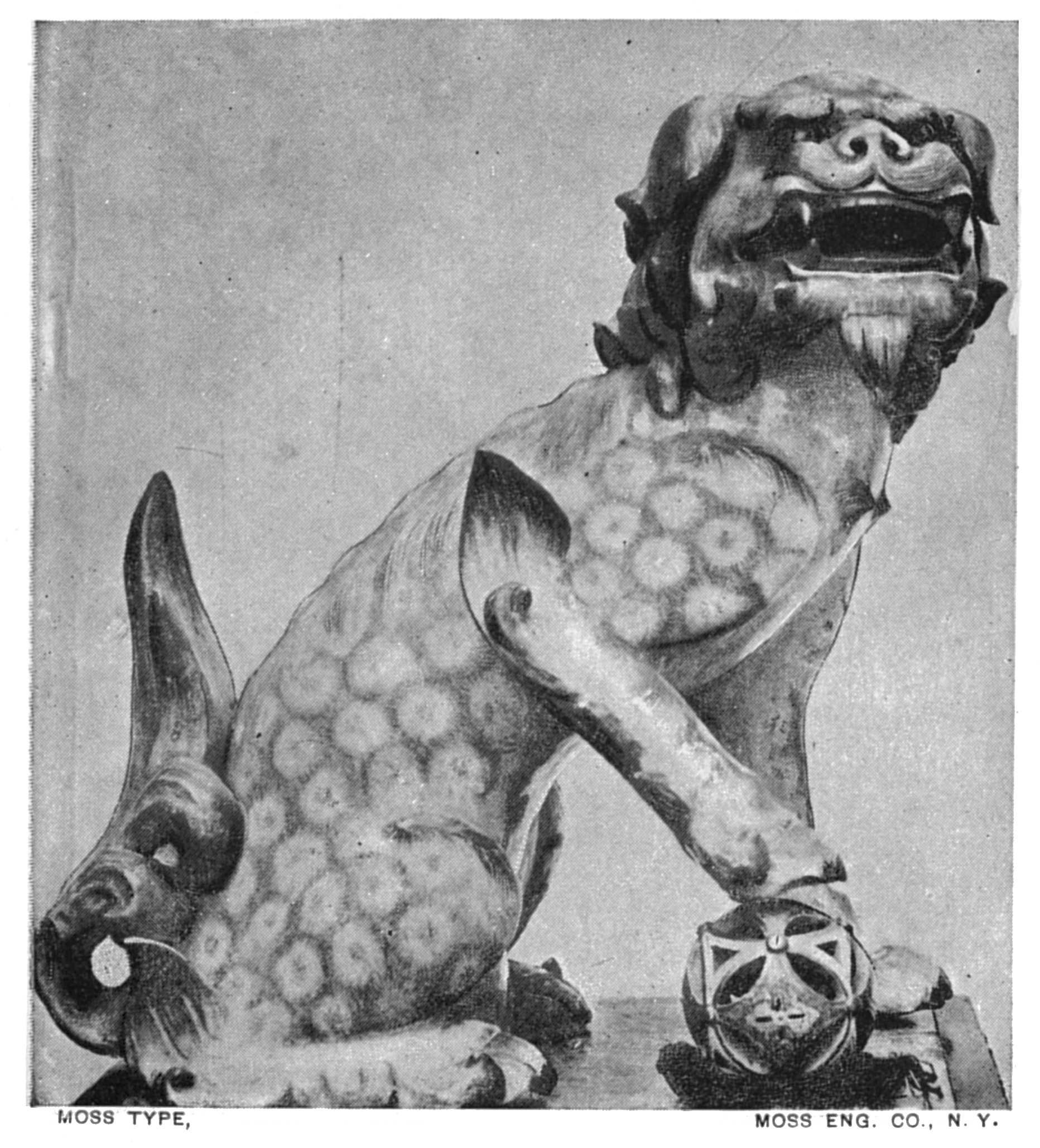
In Japan the seven members of the Can family, deified and figured by the same symbols as in Mayax, are worshiped to-day in the shrine of the palace at Tokio, dedicated to the goddess symbolized by a bird. This goddess calls to mind the goddess Moo of the Mayas, or Isis of the Egyptians. In the upper part of the shrine, over and above all the other attendants who have wings and beaked noses, is seen an elephant couchant, the god of fire standing on his back. In the midst of the flames that surround him is the head of a bird. So in Chichen we see the followers of queen Moo, who, we are informed by the author of the Troano MS. became the goddess of fire, carrying her totem, a bird, in their head-gears.
The Japanese claim to be offspring of the gods, and produce two different genealogical tables in support of their assertion. These gods amounting to seven, are said to have reigned an almost incalculable number of years in the country; although they assert that these primitive gods were spiritual substances, incorporeal. They were succeeded by five terrestrial spirits, or deified heroes, after whom appeared the Japanese themselves.
Here again we have a reminiscence, as it were, of the twelve gods, that the Egyptians told Herodotus, had governed their country, an incalculable number of years, before the reign of Menes their first terrestrial king. These gods were converted by the Greeks into the twelve deities, dwellers of the Olympus. The twelve serpent heads, brought to light by me in December, 1883, from the center of the mausoleum of the high-pontiff Cay, at Chichen-Itza, are emblematic of the twelve rulers, who had reigned in Mayax in times anterior to the great cataclysm when Atlantis was submerged; whose portraits, with the sign cimi, dead, adorn the east façade of the palace with the tableau of creation, showing that they existed in very early times. Of these rulers we again find a dim tradition in China in the Tchi, also called che-cull-tse—the twelve children of the emperor of Heaven, Tien-Hoang, who had the body of a serpent. Each of these Tchi are said to have lived eighteen thousand years, and to have reigned in times anterior to Ti-hoang, sovereign of the country in the middle of the land.
From this short digression let us return to the worship of the mastodon which we find very prevalent in India in that of the elephant Ganesha, the god of prudence, of wisdom, of letters, represented as a red colored man with the head of an elephant. He is invoked by the Hindoos of all sects at the outset of any business. No one would dream of writing a letter or a book without previously saluting Ganesha. His image is seen at the crossing of the roads, oftentimes decorated with a garland of flowers, the offering of some pious devotee. Architects place it in the foundation of every edifice. It is sculptured or painted at the door of every house as a protection against evil; at one of the entrances of every Hindoo city, that is called Ganesha-pol, as well as in some conspicuous door of the palace. We have already seen that in the most ancient edifices of Mayax the mastodon's head with its trunk is the principal and most common ornament. Are these mere coincidences? The name Ganesha-pol would be according to the Maya language, the head of Ganesha; pol, in Maya, being the head. If I wished to go further I might say that in Ganesha we have a dialectical pronounciation of Can-ex, "the serpents." No deity in the Hindoo pantheon is so often addressed; and his titles are so numerous that like Osiris it might be named Myrionymus "with ten thousand names."
So many are the legends accounting for the elephant head, it may be safely assumed that its origin is unknown. May not its worship have been introduced in India, with many other customs, that for instance of carrying the children astride on the hip; of printing an impression of the human hand, dipped in red liquid, on the walls of the temples and other sacred buildings by devotees etc.; by colonists from Mayax where these customs prevailed, and the worship of the mastodon was widely spread if not general? This surmise assumes the semblance of probability when we consider that the body of Ganesha is painted red, the color characteristic of the American race, and the symbol of nobility of race among the Egyptians.
The elephant was not among the animals worshiped by them. They do not seem to have been much acquainted with it. But the imprint of the red hand, so commonly seen on the walls of the temples of Mayax and India, has never been observed in the temples of Egypt; neither did the Egyptian women carry their children astride on their hip, as do still those of India and Yucatan, although many other customs were common to the people of these countries. It is probable that the colonists from the "Lands of the West" who settled in the valley of the Nile, replaced the worship of the mastodon, which did not exist in the country, by that of the bull, the largest and most useful of their domestic animals; and that this was the origin of their veneration for the bull Apis, as those who were initiated into the mysteries of Osiris well knew, being told that Apis ought to be regarded as a fair and beautiful image of their soul.
From the remotest antiquity the serpent was held by every people in the greatest veneration as the embodiment of divine wisdom. We have already said that Eusebius asserts that the Egyptians figured emblematically Kneph, the Creator, as a serpent; and that the Maya learned priests represented the engendered, the ancestor of all beings, in the sculptures, protected within the coils of the serpent. Mr. Stanyland Wake, in his book on the origin of the serpent worship writes: "the student of mythology knows that certain ideas were associated by the people of antiquity with the serpent, and that it was the favorite symbol of peculiar deities; but why that animal rather than any other was chosen for that purpose is yet uncertain."
The late Mr. James Fergusson in his work on "Serpent and Tree Worship," a work so full of erudition and interesting researches, whilst he conclusively shows that these worships were common to all civilized and half civilized nations of antiquity, fails to indicate the country where they originated. All authors who have written on the subject, admit that their origin is still an impenetrable mystery; although they agree that they are so intimately connected as to make it impossible not to believe it must have been the same.
The limited scope of this book does not allow me to give the matter all the space it deserves. I will therefore content myself, with bringing forth such facts as will conclusively show, at least to unprejudiced minds, that the serpent and tree worship indeed originated on this "Western continent," and from the same cause; "the love of the country," from the amor-patriæ, still so firmly rooted in the heart of the aborigines, that it is difficult to induce them to leave the spot where they are born, even to better their condition. Everywhere on the Eastern continents serpent worship is connected with mythological narratives, metaphysical speculations, or astronomical conceptions, far above the intellectual and scientific attainments of the mass of people among whom it prevailed.
These were mere fictions invented by the priests and learned men, to conceal either the real facts, or may be, their own ignorance of them. Still, anxious to maintain the preponderance and power that knowledge gave them over the multitudes, and having to satisfy their curiosity, they imagined such explanations as best suited the notions current in their times and the ideas of the people.
In early days the serpent, emblem of Kneph, the Creator, was the agathodæmon, the good genius. It is still so regarded by the Chinese, who consider it one of their most beautiful symbols. Later, when it became emblematical of Set or Typho, the slayer of Osiris, it was looked upon with horror, as the evil principle, the destroyer, the enemy of mankind. It has ever since continued to be so held by the Jews, the Christians, the Mahometans, in fact by all peoples whose religious tenets are founded on the Bible. If the tree and serpent were worshiped throughout the Eastern continents from the shores of the Atlantic ocean to those of the Pacific, from Scandinavia to Egypt and the Asiatic peninsulæ, their worship was not less spread amongst the nations that inhabited the "Lands of the West." We find vestiges of it everywhere on the Western continent; from the banks of Brush creek, in Adams county, in the State of Ohio, where still exists, on the crest of a mound, the effigy of a great serpent 700 feet long, entirely similar to that discovered by Mr. John S. Phené in Glen Feechan, Argyleshire, in Scotland, to the ancient city of Tiahuanuco, whose ruins are 13,500 feet above the level of the Pacific on the shores of lake Titicaca, near the frontier of Bolivia, on the high plateau of the Andes. There is yet to be seen a very remarkable doorway formed out of a single monolith 13 feet 5 inches long, 7 feet high above the ground, and 18 inches thick. This monolith has attracted the attention of d'Orbigny and the other travelers who, like myself, have been struck with astonishment by the beauty of the sculptures that adorn its south-eastern façade. Mayas, no doubt, were the unknown builders of that great city; since in the sculptures mentioned, we find, as in the temples of Japan, the totem of prince Coh, of his wife and sister Moo, and of their father king Can (serpent).
I will make here a short digression in order to describe these sculptures, that with the knowledge we possess to-day of the history of the founders of the principal ruined cities of Mayax, afford us another proof that the builders of that city of Tiahuanuco belonged to a then highly civilized nation, which sent colonists to the remotest parts of the earth, as the English do to-day, and to whose historical annals may be traced many of the primitive traditions of mankind. This city was already in ruins when Manco Capac laid the foundation of the Inca's empire, and had been constructed by giants before the sun shone in heaven, as the natives said to the Spaniards when questioned as to its antiquity.
We have seen that the members of the family of king Can, are still worshiped in the temples of Japan, as of old they were in those of Egypt; we now meet unimpeachable records of them, carved on very ancient monuments, on the shores of lake Titicaca, at the foot of the great glaciers of Sorata and Illimani, as we have found them in mythological lore of India and Greece. Will it be said that these are mere coincidences?
The front of this monolithic gate was once upon a time as highly polished as the material, trachite, will permit. The whole space above the doorway is divided into four bands about eight inches high. The lower band contains seventeen small heads, in low relief, adorned in a somewhat similar manner to that of the central figure. Seven of these, those directly under that figure wear, like it, a badge that seems to be a plume composed of three feathers. These small heads are separated by grecques having macaw's heads at their salient sides; these grecques are the symbol of power and strength. In the ancient Maya and Egyptian alphabets the grecque is equivalent to our latin letter H. Ah is the Maya masculine article, and it conveys to the mind the idea of might and power; this, taken in connection with the macaw's head, totem of Moo, the queen of Chichen, signifies the mighty, the powerful Moo.
The other bands are divided into squares of the same size, except in the center over the doorway, where there is a figure 32 by 21 inches.
Its head, the form of which is not only conventional, as its square eyes and mouth indicate, but likewise emblematical, consists of three superposed layers in the shape of escutcheons, the uppermost of which is sculptured so as to represent a human face. These three escutcheons as the three feathers of the plume that adorns it, the triple throne on which the figure seems to stand, the three dots on each cheek, the three oblong squares on the breast-plate, the three macaw's heads at the extremities of the triple sceptre it holds in its hands, are symbolical of the three great western regions that the Egyptians designated by the generic name of "Lands of the West" and represented by the character which is an image of the crown worn by some of the high chiefs in Mayax. That the central figure was meant to represent these countries, the sign , that stands in lieu of the mouth, indicates. It is the letter M, pronounced Ma, of the Maya and Egyptian ancient alphabets. It is the radical of Mayax, name of the Maya empire. But Ma in Egypt as in Mayax, is a word that signifies land, country, and by extension universe; and in Mayax as in Egypt is one of the signs for land.

The head is surrounded by rays divided into groups of four; four on the top, four on each side, and four on the under part. Each ray is terminated by a circle with a dot in the center , a sign very often met with on the monuments of Mayax; particularly on the trunk of the mastodon's heads. It is the first letter of the ancient Maya and Egyptian alphabets, and correspond to our letter A, the initial of the Maya word Ahau, king.
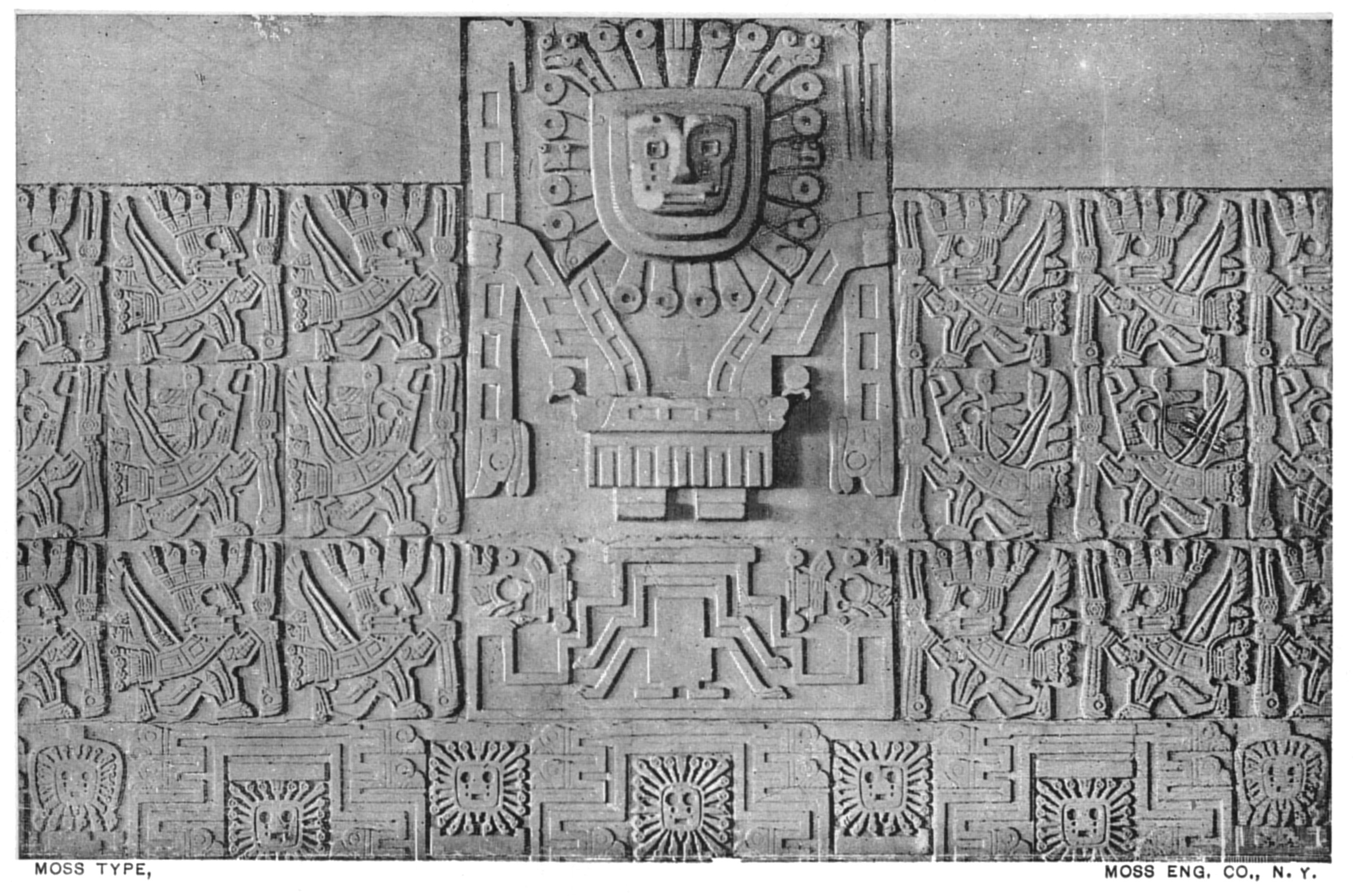
This would indicate that the central figure was likewise symbolical of the king par excellence, ruler of the empire, whom the kneeling personages that surround it, are in the act of worshiping as shown, not only by their posture, but also by the sign , carved on the neck of the macaw-headed figures, the followers of the queen Moo (macaw), which again in Mayax as in Egypt is the symbol of offering, worship, and adoration. The name of this great king we read in the four heads of leopards, terminating the rays at the upper angles, and those in the middle on each side of the escutcheon, and in the four rays of each group. Translating these symbols by means of the Maya language, we find that Can Coh was the name of the potentate; and that he was a member of the Can family, rulers of Mayax. This fact is indicated by the serpent heads at the lower angles of the escutcheon, those at the extremities of the breast-plate, the four oblong squares carved on the ribbons that support it, and the number of rays forming each group round the head.
In Maya four is can; but can also means serpent, likewise power. Number four according to Pythagoras, was particularly connected with Mercury, the Thoth of the Egyptians, as the deity who imparted intellectual gifts to man. The Tetraktus or number four represented the mystic name of the Creative Power; and in later times it meant intellect, wisdom, all that is active. Pythagoras asks: "How do you count?" Mercury: "one, two, three, four." Pythagoras: "Do you not see that what are four to you are ten and our oath? those (1, 2, 3, 4,) added together, forming ten, and four containing every number within it." The four leopard heads are his totem, Kancoh, Coh being leopard. Further on, I will refer more in detail to these personages, and to the rôle they have played in the civilization of the world, having been, and being still, worshiped in many countries under different names. The peculiar shape of the sceptre held in the left hand of the figure, the upper part of which is bifurcated, each end terminating with the head of a macaw, totem of the queen Moo of Chichen-Itza, sister and wife of Coh, and its undulations, like those of a serpent in motion, seem intended as an emblem of the three great regions that composed the empire that is likewise portrayed in the three rows of kneeling winged personages. The upper portion of said sceptre is symbolical of the Western continent, divided into two great parts united by the Isthmus of Panama. The lower was meant to represent that extensive island that sunk beneath the waves of the Atlantic ocean, about 11,500 years ago.
The sceptre held in the right hand of the central figure being whole, would show that the entire country was governed by a potentate to whom the rulers of the seventeen nations, into which the empire was divided, paid homage and acknowledged as their suzerain. These seventeen divisions of the empire are indicated by the seventeen small heads sculptured on the lower band, and the seventeen signs of land that adorned the arms, the breastplate, and the ribbon from which it is suspended.
Of the small kneeling winged figures, those of the middle row are portrayed with the heads of macaws to signify that they are the particular adherents of queen Moo, that here, as in Mayax, carry her totem as a badge or sign of recognition; whilst the others have human heads, but wear on their crowns her totem, in token that they recognize her as their suzerain. All these figures are ornamented with twelve serpents, arranged in groups of three, whilst the sash they carry across their body from the shoulder to the waist on the opposite side, terminates in a peculiar knot adorned with the four circles, that we have said stood for the word Ahau, that is king, indicating that their lord paramount is a member of the Can (serpent) dynasty. The whole tableau recalls vividly, that presented by the kneeling beaked nosed personages in attendance at the shrine of the bird deity at Kioto.
Mr. Angrand, the well known French archæologist, finds, and with reason, a coincidence between these sculptures and those of Central America, having a corresponding symbolical significance. In them he sees the proof of the identity of origin, of the intimate relationship of the builders of Tiahuanuco and those of Palenque, Ocosingo, and Xochicalco. He might have added, and be nearer to the truth, those of the cities of Mayax, that were founded many centuries before those mentioned by him.
In Mayax, it is where, indeed, the image of the serpent, as a symbol, is most commonly met with. We see it on almost every edifice in every city. It is one of the favorite ornaments, especially at Chichen-Itza, of which place it seems to have been the particular protecting genius. There it is found everywhere. It guards the entrance of all public edifices. It is at the foot of their grand stairways, as if defending the ascent. The columns that support their porticos are representations of it. Its head forms the base, its body the shaft. The nobles and other personages of high rank wore adornments made in the shape of serpents. Chichen may indeed be called the "City of Serpents" par excellence. If we, therefore, wish to know the true meaning of the serpent as a symbol, if we desire to inquire as to the motives that led to its worship, it is necessary to question the learned priests of that city; to consult the books in which the philosophers of Mayax have consigned their knowledge and their esoteric doctrines.
The origin of the "Serpent Worship" they tell us, can be traced to two apparently distinct causes. One, the esoteric, taught only to a few select of those initiated in the greater mysteries, is the homage to be tributed by the creature to the Creator. The other, the exoteric, inculcated on the uninitiated, was the love of the country, and the respect due by the subjects to their rulers, living images and vicars of the Deity on earth.
In order to comprehend the first, or esoteric, we must recall to mind that Eusebius says that the Egyptians represented emblematically Kneph the Creator, and the world also, under the figure of a serpent, which, Horapollo asserts, was of a blue color with yellow scales; but they fail to inform us as to what may have been their motives for thus symbolizing the First Cause; or from whom they had received this symbol, that was the same used by the Mayas. A clue to this mystery can no doubt be found in the cosmogonical notions prevalent among the ancient civilized nations; for, strange to say, they seem to have been alike with all. We read in the Manava-dharma-sastra that the visible universe in the beginning was nothing but darkness. Then the great, self-existing Power dispelled that darkness, and appeared in all His splendor. He first produced the waters; and on them moved Narayana the divine spirit.
Berosus, recounting the ancient legend of the creation according to the Chaldeans, says: "In the beginning all was darkness and water; and therein were generated monstrous animals and strange and peculiar forms.... A woman ruleth them all." Her name in Chaldee is Thalath, in Greek Thalassa (the sea), that is in Maya Thallac (a thing without steadiness).
Genesis recounts that: "In the beginning the Earth was without form and void; and darkness was upon the face of the deep, and the spirit of God moved upon the face of the water. And God said, Let there be light and there was light."
In Primander, that modern critics consider the most ancient and authentic of the first philosophical books of Egypt, attributed to Hermes Trismegistus, in the dialogue between Thoth and Primander, the Supreme Intelligence, we read these words of Thoth. "I had then before my eyes a most prodigious spectacle. All things had resolved themselves into light. A marvellous, pleasing and seducing sight it was to contemplate. It filled me with delight. After a while a horrid shadow, which ended in oblique folds, and assumed a humid nature, agitated itself with terrific noise. From it escaped smoke with uproar, and a voice was heard above the din. It seemed as the voice of the light; and the verb came forth from that voice of light; that verb was carried upon the humid principle. Out of it came forth the fire pure and light, and rising, it was lost in the air that, spirit-like, occupies the intermediate space between the water and the fire. The earth and the water were so mixed that the surface of the Earth covered by the water appeared nowhere."
And in what are termed the modern Hermetic books, the origin of things is thus explained: "The principle of all things existing is God, and the intellect, and nature, and matter, and energy, and fate, and conclusion, and renovation. For there were boundless darkness in the abyss, and water, and a subtile spirit, intellectual in power, existing in chaos. But the holy light broke forth, and the elements were produced from among the sand of a watery essence."
In the Popol-Vuh, the sacred book of the Quiches, we read: "This is the recital of how everything was without life, calm and silent, all was motionless and quiet; void was the immensity of the heavens; the face of the Earth did not manifest itself yet; only the tranquil sea was, and the space of the heavens. All was immobility and silence in the darkness, in the night; only the Creator, the Maker, the Dominator, the Serpent covered with feathers, they who engender, they who create, were on the waters as an ever increasing light. They are surrounded by green and blue, their name is Gucumatz."
We have already said how the Maya sages have taken care to perpetuate their cosmogonical conceptions, by causing the narrative of the creation to be carved, in high relief, over the doorway of the east façade of the palace at Chichen-Itza, and that these conceptions were identical with those of the Hindoos and the Egyptians. It cannot be argued that this identity of ideas about the origin of things, arrived at by the wise men of India, Egypt, and Mayax, and expressed in as nearly the same words as the genius of the vernacular of these various countries admits, is purely accidental; or, that they have arrived separately at the same conclusions on the subject, without communicating one with the other. The notion and its explanation must have originated with one, and been taught to the others just as our modern scientific discoveries, or religious beliefs, are carried from country to country, even the most remote, and made known to their inhabitants. What should we think of the man who would pretend that the railway, electric telegraph, and many other of the latest inventions, instead of having originated in one particular country, nay, more, in the brain of a particular man, have sprung simultaneously among all the various nations which make use of them? Would not that man be regarded as a born idiot or a fit subject for a lunatic asylum? We can easily understand how these cosmogonical notions have passed from the Egyptians to the Chaldees or to the Hindoos or vice versa; but who brought them to the "Lands of the West" and when? Who can say they did not arise among the inhabitants of the "Western continent;" and were not conveyed by them to the other nations?
In my work "The Monuments of Mayax," I have shown how the legends accompanying the images of several of the Egyptian deities, when interpreted by means of the Maya language, point directly to Mayax as the birthplace of the Egyptian civilization. How the ancient Maya hieratic alphabet, discovered by me, is as near alike to the ancient hieratic alphabet of the Egyptians as two alphabets can possibly be, forcing upon us the conclusion that the Mayas and the Egyptians either learned the art of writing from the same masters, or that the Egyptians learned it from the Mayas. There is every reason to believe that the cosmogonical conceptions, so widely spread, originated with the Mayas, and were communicated by them to all the other nations among which we find their name.
An analysis of the tableau of creation, carved on the façade of the palace at Chichen-Itza, cannot fail, therefore, to prove interesting. In it we shall find a proof of the scientific attainments of its designers; and also the reason why the serpent came to be worshiped all over the Earth.
The philosophers of Mayax must have known that the waters cover the greatest part of the globe (about three fifths); and that water being a combination of gases (oxygen and hydrogen), the most subtile of fluids, must have been the first form of matter produced. This is why on each side and on the top of the tableau they placed the symbol of water ; taking care to leave without it, at the upper part, a portion equal to two-fifths of its length. In the midst of the waters they represented the figure of an egg, that is a germ. Why an egg and not any other seed? Is it because their study of physiology had made them acquainted with the fact, that no being exists on Earth, but that is born from an egg? They represented the egg emitting rays. The rays of the light into which says Thoth, all things resolved themselves; that, says the Quiche, author of the Popol-Vuh, appeared on the water as an increasing brightness that bathed the Creator, the feathered serpent, the Kneph, as the Egyptians would name it, in green and azure. It is well to notice that the symbols of water terminate with the head of serpents; because they compared the waves of the ocean to the undulations of the serpent's body while in motion.
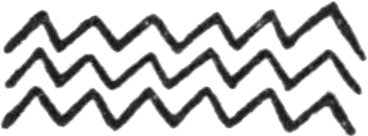
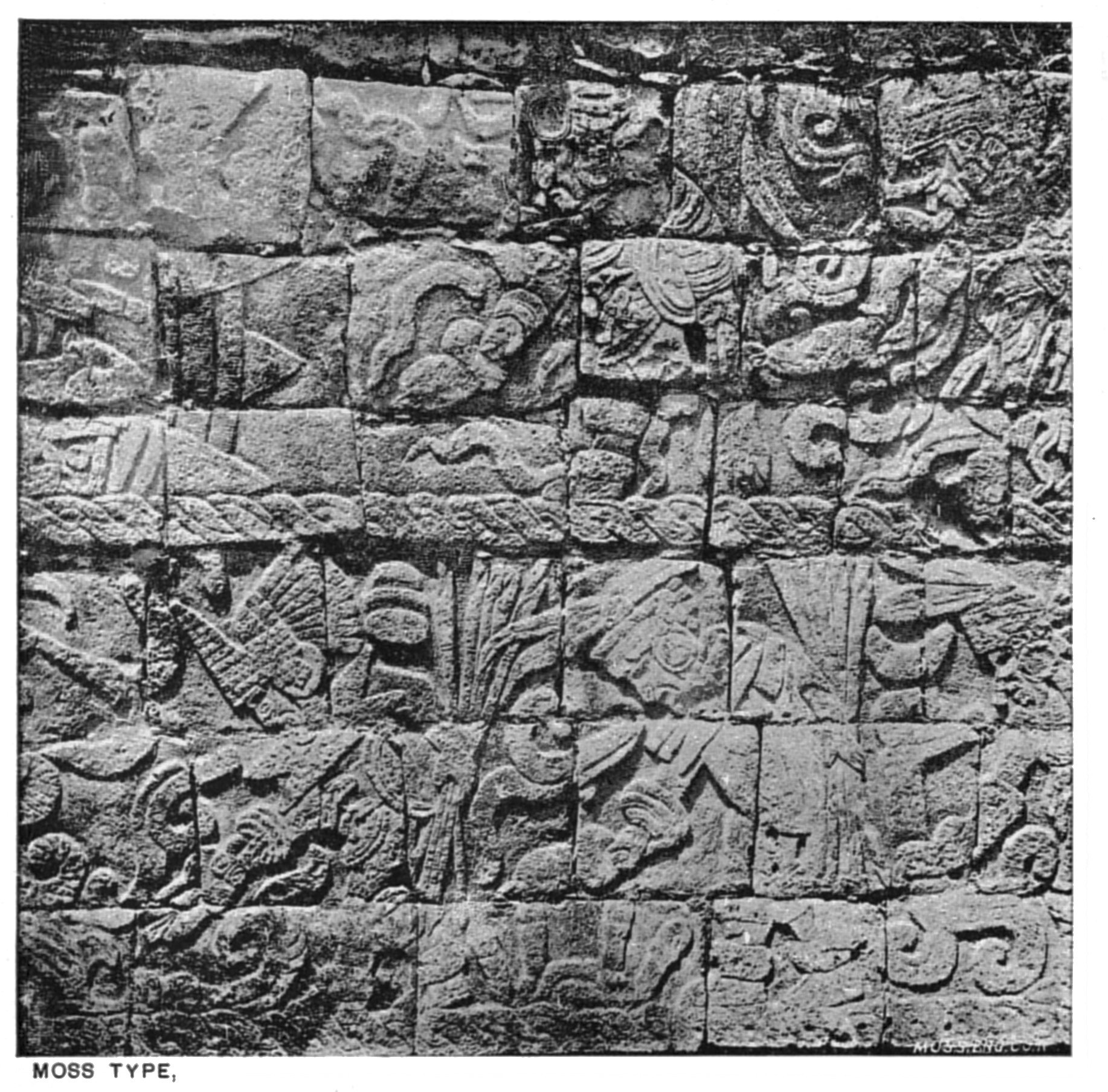
For this reason the Mayas named the sea Canah, the great, the powerful serpent: and in the Troano MS., the sea is always designated by a serpent's head. This explains why the Quiches, the Mayas, the Egyptians, the Hindoos, represented the world, and, by extension, the maker of it, as a serpent. Thus it is that they placed a serpent within the egg, behind the creator to indicate that this symbol is the totem of the ancestor of all beings. And here we have one of the origins of the serpent worship: that is, the adoration of the Creator.
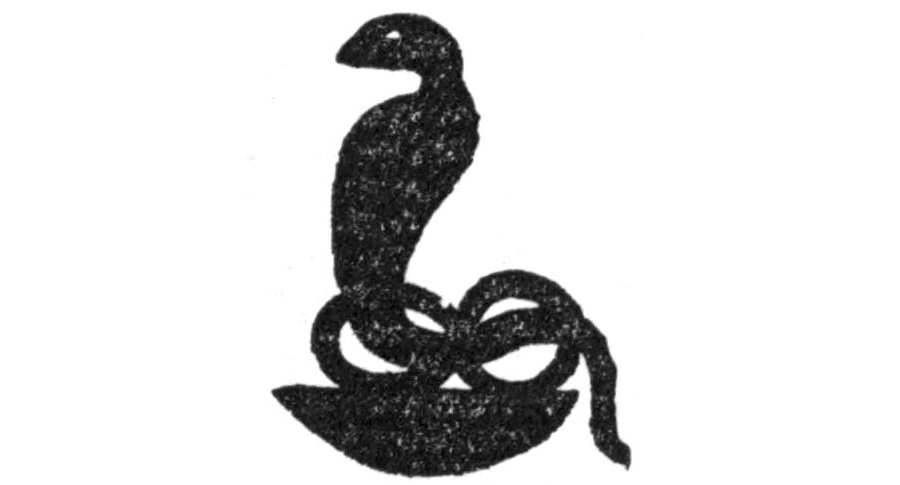
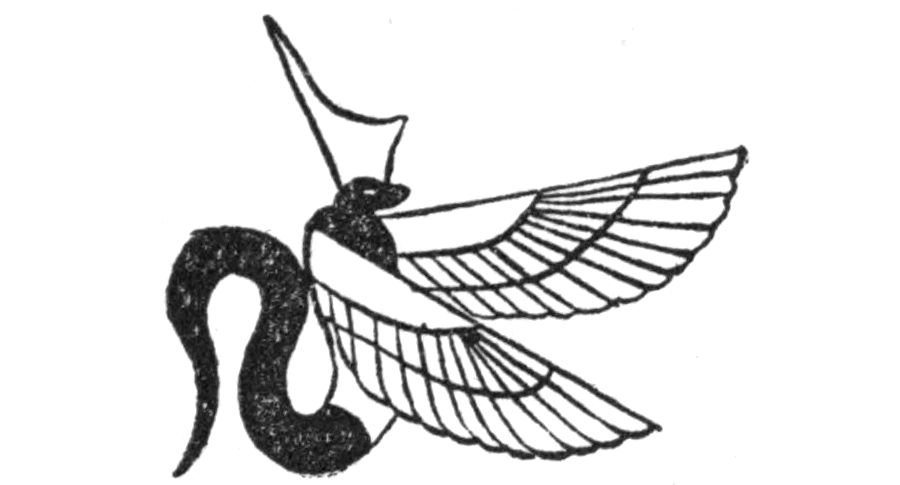
Fig. 1. Fig. 2.
In Egypt the goddess Uati, the genius of the lower country, is at times represented as a serpent with inflated breast, the body standing erect over a basket or sieve, the lower part resting against a figure resembling our numeral 8. At times again, as a winged serpent, with inflated breast, wearing on its head a cap or crown of peculiar shape, that it is said to be the crown of lower Egypt. Why the Egyptians selected such symbols to represent the lower country, we are not informed; and it is doubtful if the learned Egyptologists could explain the motive.
Now it is a most remarkable fact, that these are the very symbols used by the Maya hierogrammatists and artists to figure their own motherland, the Maya empire.
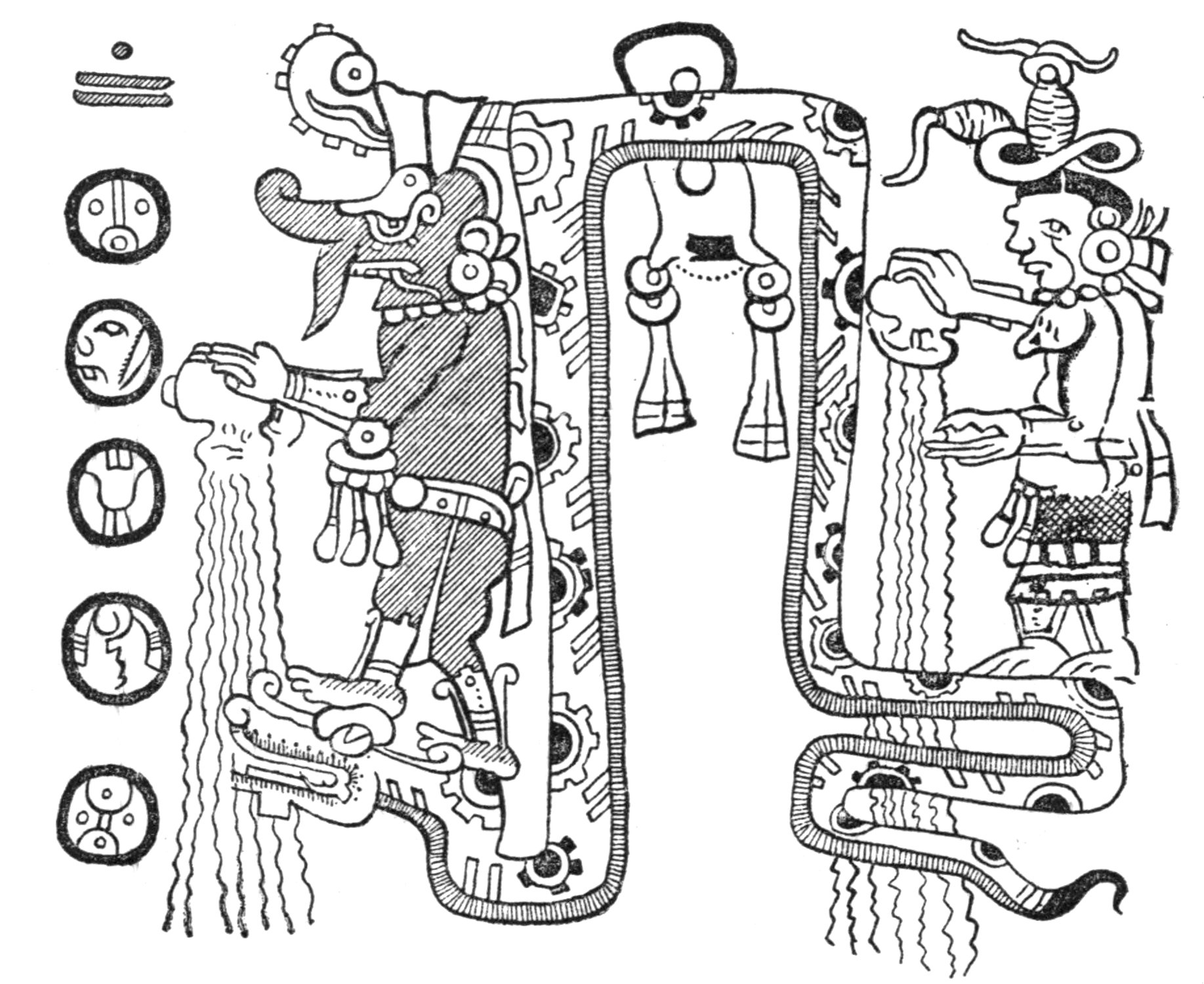
The author of the Troano MS., sometimes pictures Mayax as a serpent with an inflated breast (Plate. XVII., Part II.), at other times as a serpent with part of the body bent in the shape of the Yucatan peninsula,[2] and the artists who executed the paintings in the funereal chamber of Prince Coh, typified the country as a winged serpent, with the back painted green, the belly yellow, wearing a blue crown on the head, its tail ending with a peculiar dart resembling in general contour the southern continent of America.
This is not the place to give minute explanations of these symbols which I have considered in another work, I simply wish to consign here such facts as cannot be attributed altogether to hazard. So the peculiar twist against which rests the body of the serpent, emblem of the lower country, is exactly the same that forms the symbol used in the Troano MS., to represent the gulf of Mexico and the Caribbean sea, whose waters bathe the peninsula of Yucatan, that seems as if standing erect between them as the serpent in the Egyptian sign.
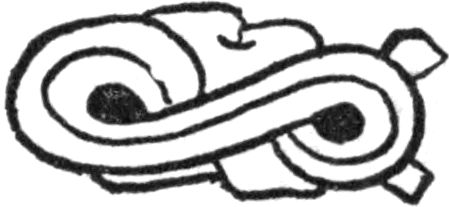
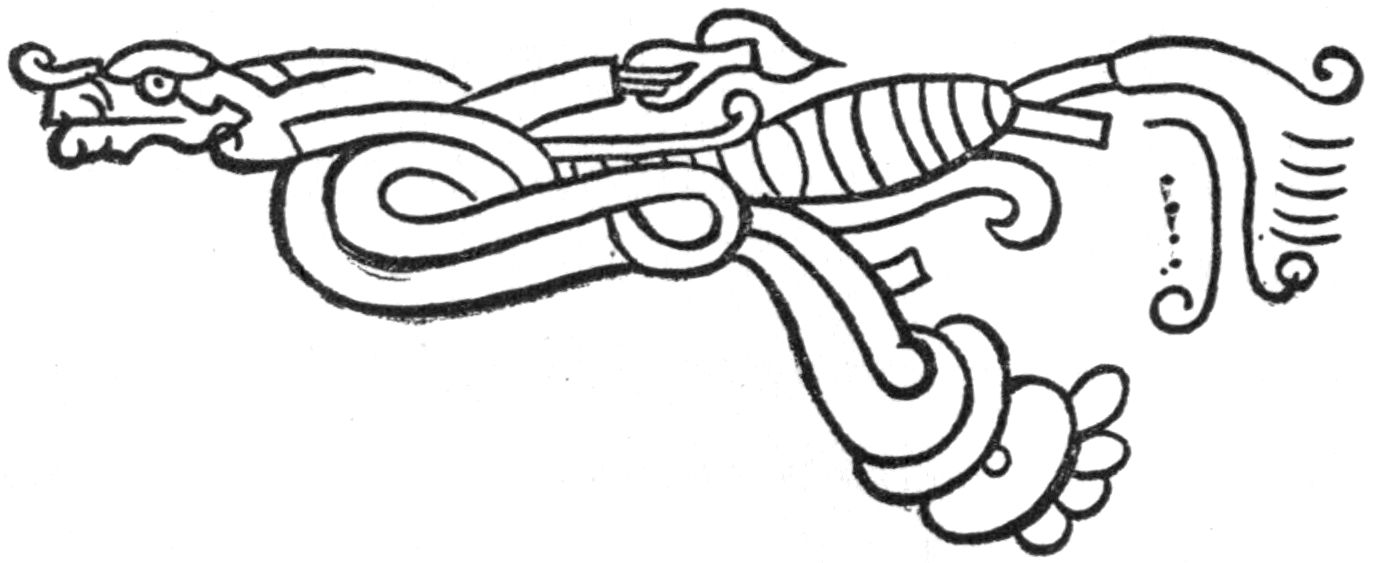
As to the sieve, it is called, by the natives of that country, Mayab. Mayab was, in past ages, one of the names of the peninsula. The crown of Lower Egypt , is precisely that worn by certain chieftains, whose portraits we see in the bas-reliefs at Chichen-Itza. There the peak was worn in front; in Egypt at the back: may be as a mark of respect on the part of the Egyptians toward their mother country, to signify that as the child, Egypt must stand behind its parent, as it is customary for children to do among the aborigines of Yucatan.
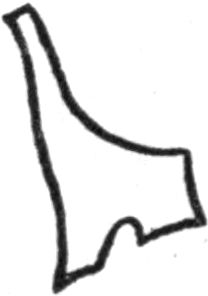
Since the Egyptians and the Mayas used identical signs as symbols of the country in which they lived, may it not be inferred that the same cause prompted their selection? We must not lose sight of the fact that the winged serpents introduced into the paintings of Egypt, are merely emblematic representations connected with the mysterious rites of the dead, and the mode of being in Amenti; that is, in the "Lands of the West" where the souls of the departed were supposed to return and exist, after being liberated from their mortal body.
In early days Uati or Mati, the country of Mayax, was one of the divinities, worshiped by the settlers on the banks of the Nile; and the asp, not any other snake, played a conspicuous part in the religious mysteries, and was universally honored.
Here, again, we may ask why? What possible relation can exist between the asp and the country; between the asp and the office of king or the attributes of Deity? Still it was the badge of royalty, worn as an ornament on the head-dress of kings and gods. Is the selection of the asp as a mark of distinction to be ascribed to a mere whim? May not that predilection be assigned to the fact that, when angry, it dilates its breast; and when in that condition it recalled to the minds of the colonists, the geographical contours of the land of their forefathers in the West, and the way it was represented in the books, from which they had studied in their childhood? If we look at a map of the Western continent, it will be easy to perceive that the contours of Central America—that is the Maya empire of old—figure a serpent with an inflated breast, in a position similar to that of the emblem of lower Egypt (Figs. 1 and 2, p. 115.), the head being the peninsula of Yucatan, anciently the seat of the government; and that the southern continent would be the dart of its tail, as pictured by the Maya artists. The green color of its back, the verdant, tropical forests that cover the land; the yellow belly, the internal volcanic fires, that cause the surface to wriggle like a serpent; the blue crown on its head, the blue canopy of heaven above; the wings, the smoke of the volcanoes; the fins, the high peaks of the chain of mountains that traverses the country from north to south, part of the Cordilleras, that are as the backbone of the continent.
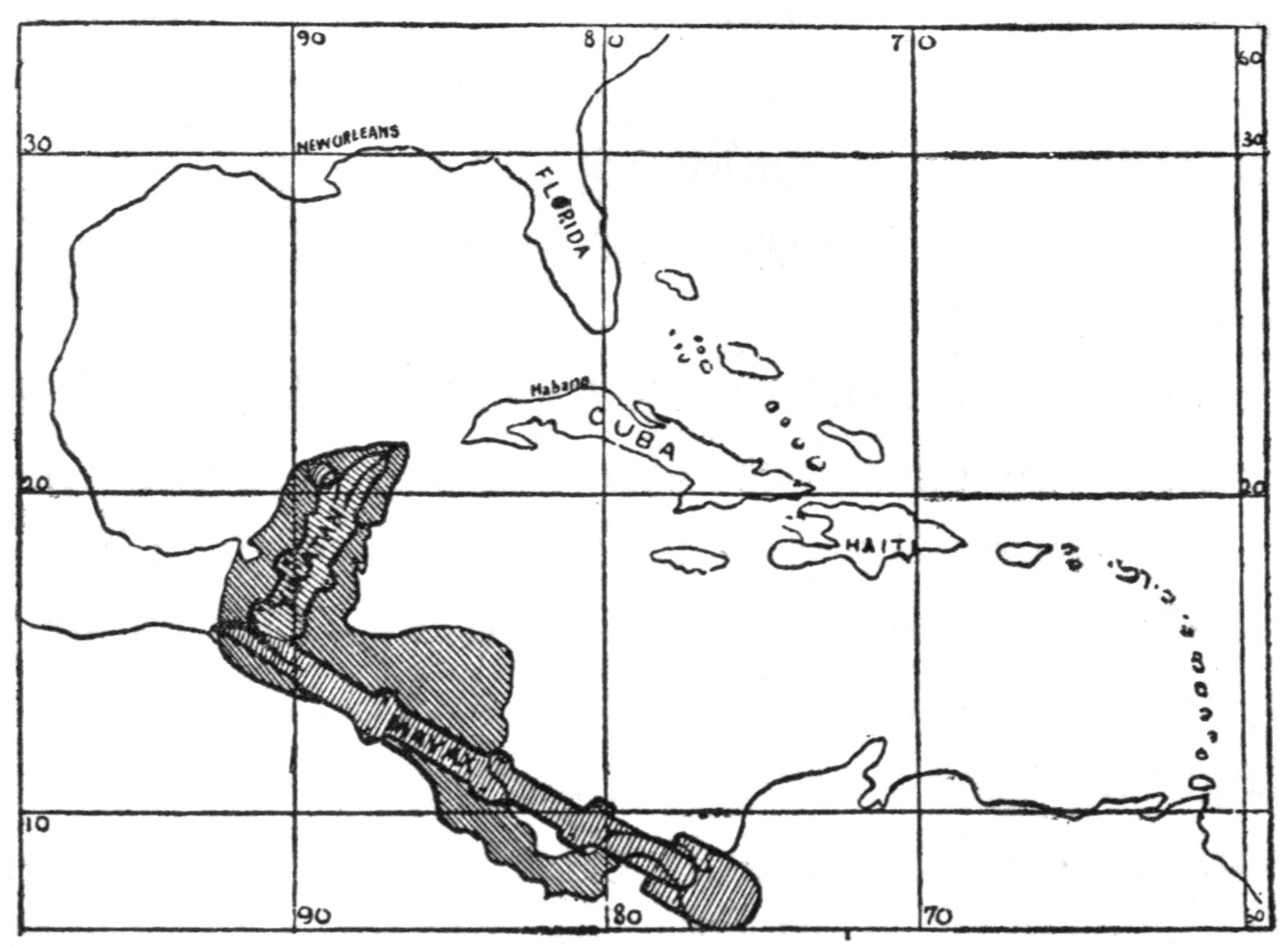
The intense love of their country is one of the most striking characteristics of the aborigines to the present day. That love may be said to amount to fanaticism. In it we find another origin of the serpent worship, emblem of the motherland.
In the Serpent mantra, in the Aytareya Brahmana, a passage speaks of the Earth as the Sarpa Rajni, the queen of the serpents, and the mother of all that moves, still worshiped by the Nayas, dwellers in the valley of Cashmere.
In Mayax the primitive rulers derived their title Can (serpent) from the shape of the contours of their empire, as the priests of the sun received theirs from the name Kin of that luminary. Their emblem however, was not a winged serpent, with a dart at the end of the tail, but a rattlesnake covered with feathers; image of the feathered mantle used by the king, the high-pontiff, and other high dignitaries, as ceremonial dress. This feathered rattlesnake adorns the walls of the royal mansions. It is seen at Uxmal, on the east façade of the west wing of king Can's palace and at other places. After their death these rulers, images of Deity on earth, received the honors of apotheosis. They became gods and goddesses and were worshiped as such. In Assyria the symbol of the winged serpent was replaced by that of the winged circle, emblem of Asshur, the supreme deity of the Assyrians; and this symbol is seldom found in the sculptures except in immediate connection with the monarch. It seems to be also closely related with the sacred or symbolical tree.
Here again, is another origin of "Serpent Worship," in that of the kings of Mayax under the symbol of the "feathered serpent." One of the names for rattlesnake, in Maya, is Ahau-Can, the royal serpent. In the sculptures the king is often represented by this emblem with seven rattles at the end of the tail; seven having been the number of the members of king Can's family. In Egypt the kings and queens were honored as gods after their death. In Greece and other countries, the heroes were deified and worshiped as divinities.
From all antiquity and by all nations, the tree and serpent worship have been so closely identified, as to guarantee the inference that their origin is the same, although it seems difficult to comprehend what possible analogy may exist between them, without a knowledge of the place where they originated, of the people that first instituted it, of their traditions and peculiar notions. Many learned students have published the results of their researches on the subject. None, however, has yet assigned a birthplace to the tree or serpent worship.
The late Mr. James Fergusson tells us that he is inclined to believe that it was in "the mud of the lower Euphrates, among a people of Turanian origin, and spread thence to every country of the old world." This is truly indefinite. Then comes the query: what about the tree and serpent worship among the inhabitants of the Western continent? For they also had their sacred trees; and with them as with the natives of the Eastern world, the tree was symbolical of eternal life.
The oak tree was dedicated to Baal, the chief god of the Phœnicians and other eastern nations. Under it the Druids performed their most sacred rites in honor of Œseus, the Supreme Being. The ash was venerated by the Scandinavians. The inhabitants of the island of Delos believe the gigantic palm tree to be the favorite production of Latona. The people of Samos, Athens, Dodona, Arcadia, worshiped in sacred groves, as those of Canaan. In India the worship of the tree is of very ancient date, as in the island of Ceylon: in the courtyard of every monastery a bo-tree (ficus Indicus) is planted. Nowhere, however, do we find the origin of that worship mentioned.
Mr. Fergusson advises us to look to the Egyptians, these being the most ancient civilized people, for an explanation of it, averring that it undoubtedly prevailed among them before the multifarious Theban pantheon was elaborated. In Egypt the tamarisk was the holy tree chosen to overshadow the supposed sepulchre of Osiris, the king of Amenti. The persea was sacred to Athor, the regent of the West, often identified with Isis. The sycamore was consecrated to Nut, mother of Isis and Osiris, frequently represented in the paintings of the tombs, standing in its branches, pouring from a vase, a liquid which the soul of the departed, under the form of a bird with a human head, catches in his hands. It is the water of eternal life. So the trees were particularly sacred to the deities connected with Amenti, that is, to the deified kings and queens from the "Lands of the West."
We are told that the sacred tree was an emblem found in frequent association with the "winged circle" in Assyria. As this symbol is always met with in immediate connection with the monarchs, it would seem that the worship of the tree bears a close relation to, if it is not typical of, that of the deified heroes and kings.
To understand the relationship between the tree, the winged serpent or "circle" and the "monarchs" it is again necessary to consult the annals left carved in stone or written in their books by the wise men of Mayax. From them we learn that the Mayas held certain trees sacred, Landa, Cogolludo, and other early writers tell us that, even as far down as the time of the Spanish conquest, the aborigines believed in the immortality of the soul, that would be rewarded or punished in the life beyond the grave, for its deeds whilst in the body.
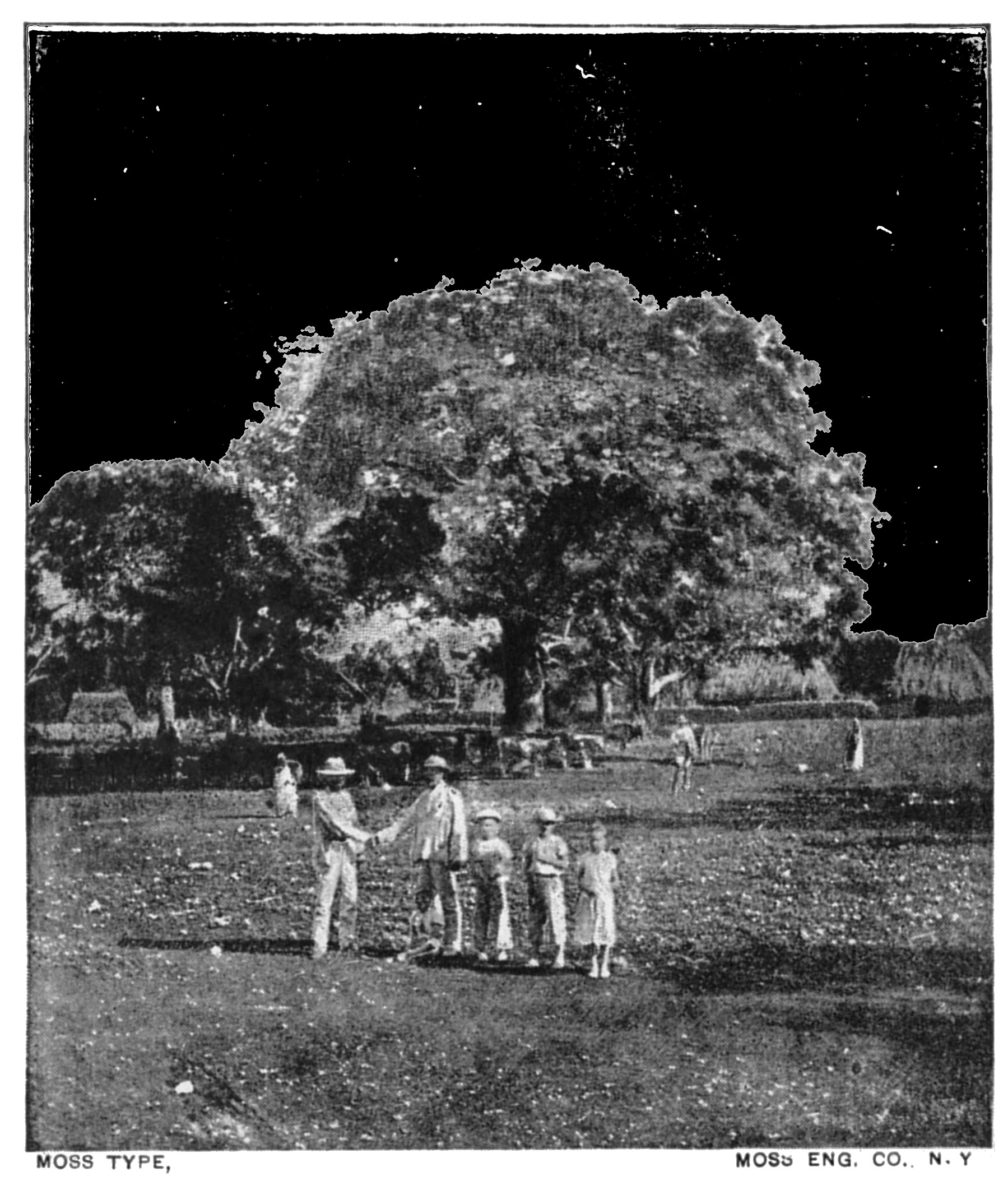
Their reward was to consist in dwelling in a delectable place, where pain was unknown, where there would be an abundance of delicious food, which they would enjoy, with eternal repose, in the cool shade beneath the evergreen and spreading branches of the yaxché (ceiba tree), which is found planted, even to-day, in front of the main entrance of the churches, throughout Yucatan and Central America. Sometimes the churches are built in the midst of groves of ceiba trees, that in some localities are replaced by the gigantic palm tree (Palma real).
The Maya empire was of old, according to the author of the Troano MS., figured as a tree, planted in the continent known to-day as South America, its principal branch being formed by the Yucatecan peninsula. (See map, page 120.) Here we have the key to the origin of the tree worship, and its intimate relation to the winged serpent and the king. It is again the worship of the country symbolized by a tree, as it also was by a serpent, or by the Ruler. Thus we find a natural explanation of the tradition current among the ancient nations, that the TREE par excellence, the tree of life, that is of civilization, of knowledge, was placed in the middle of the land, of the garden, of the primitive country (Mayax) of the race; the empire of the Mayas being placed between the two great continents, North and South America, forming the "Lands of the West."[3]
This relation of the tree, the serpent and the country in the middle of the World, is confirmed by the Chinese writers, commentators on the Chou-king, one of the most ancient literary monuments of China. Speaking of the Tien-Hoang or kings of heaven, Yong-chi says: Tien-hoang had the body of a serpent. He was the origin of letters. He gave names to the ten Kan, and to the twelve Tchi, in order to determine the place of the year; and Yuen-leao-fan, another writer, says that Kan means the trunk of a tree, and that Tchi are the branches, reason why they are called Che-cull-tse, the twelve children. It is well to remark here that the children of king Can were called Can-chi, which is still a family name among the aborigines.
Ti-huang, king of the Earth, is also called Hoang-kiun, that is, he who reigns sovereignly in the middle of the earth, and also Tse-yuen, or the son principle, the engendered, the Brahma of the Hindoos, the Kneph of the Egyptians, the Mehen of the Mayas.
The cross is another sacred symbol much reverenced by all nations, civilized and semi-civilized, ages before the establishment of Christianity: and although we find representations of it in almost every part of the world, from its mere delineation scratched on the rock, to the stately temples and admirably hewn caves of Elephanta in India, still nowhere do we learn of its origin. There are several varieties of crosses, but all may be traced back to the primitive form which resembles the Latin cross.
Among the earliest type known on the Eastern continents is the "Cruz Ansata," called the "Key of the Nile." It was the "symbol of symbols" among the Egyptians, the Phœnicians and the Chaldees, being the emblem of the life to come. It was placed on the breast of the deceased, sometimes as a simple on the fulcrum of a cone; sometimes represented as supported on a heart. It is also seen adorning the breasts of statues and statuettes in Palenque, Copan, and other ancient cities of Guatemala, Nicaragua, and various localities of Central America. Everywhere it was associated with water. In Babylon it was the emblem of water deities. In Egypt, Assyria, and Britain, it was emblematical of creative power and eternity. In India, China, and Scandinavia of heaven and immortality. In Mayax of rejuvenescence and freedom from physical suffering. The cross, as a symbol, was placed on the breast of the initiate after his new birth was accomplished in the Bacchic and Eleusinian mysteries.

Remesal and Torquemada assert, in their respective works, that when in 1519, the Spaniards, under Hernan Cortez, landed at the island of Cozumel, they found crosses which the natives worshiped as gods in their temples. After them many writers, on their authority, have affirmed the same thing. This, however, seems to have been a mistake. Bernal Diaz del Castillo, who accompanied Cortez, does not mention the existence of such symbols in Cozumel, but emphatically says that Cortez, having ordered the destruction of the idols that were in the sanctuaries, caused an image of the Virgin Mary to be placed in their stead, and near it a wooden cross, made by two of his carpenters, to be erected, recommending the natives to take great care of them when he left. Dr. Pedro Sanchez de Aguilar, another of the early writers, maintains that the stone crosses found afterward in the island were made in imitation of that of Cortez; and Bishop Landa, although a most zealous missionary, intent on converting the aborigines to the Catholic faith, does not mention the existence of crosses in Cozumel before the advent of the Spaniards; a fact he would certainly have taken advantage of in his predication of the gospel, and would not have failed to mention in his work, had he been satisfied that the symbol really existed.
There can be no doubt that in Mayax, in very remote ages, the cross was an emblem pertaining to the sacred mysteries. No external vestiges of the symbol are to be found among the remains of the temples and palaces of the Mayas, such as those seen at Palenque and other places of Central America. Only one image of a perfect cross have I ever met with in the ancient edifices of Yucatan besides the ground plan of the sanctuary at Uxmal. (See page 35.) It forms part of the inscription carved on the lintel of the doorway of the east façade of the palace at Chichen. Still tradition tells us that the cross was symbolical of the "God of Rain." If so, they made no image of it, nor did they celebrate any festival in honor of it at the time of the conquest, but held it simply as a notion of their forefathers.
The ancient Maya astronomers had observed that at a certain period of the year, at the beginning of our month of May, that owes its name to the goddess Maya, the good dame, mother of the gods, the "Southern Cross," appears perfectly perpendicular above the line of the southern horizon. This is why the Catholic church celebrates the feast of the exaltation of the holy cross on the third day of that month, which it has consecrated particularly to the Mother of God, the Good Lady, the virgin Ma-R-ia, or the goddess Isis anthropomorphised by Bishop Cyril of Alexandria.
In all localities situated within the 12th and 23d degree of latitude north, about the beginning of January, the dry season sets in and no more rain falls during several months. In May and April in the countries like Yucatan, where there is no water on the surface of the ground, all things become parched; the trees and shrubs lose their leaves, nature looks desolate, all living beings thirst for a drop of moisture, the birds and other wild creatures, mad with thirst, lose their characteristic shyness and venture near the haunts of man, imperiling their lives in search of water; death, for want of it, seems to threaten all creation.
But four bright stars appear in the south. A shining cross stands erect above the southern horizon. It is the heavenly messenger that brings good tidings to all, for it announces that the flood-gates of heaven soon shall be open; that the so longed for rain will shortly descend from on high, and with it joy and happiness, new life to all creatures. Man hails with thankful heart, welcomes with songs of gladness, this brilliant harbinger of the life to come, for indeed it is a god for him, the God of Rain that rejuvenates nature, frees man and all other creatures from physical sufferings, brings felicity to them—heaven therefore—and, with renewed life, immortality. Is it not the creative power that is eternally renovating and revivifying all things on the surface of the earth? Is it then strange that all nations, in every age, should have worshiped the cross as symbol of the life to come and immortality, and held it in so great veneration? It must be remembered that all the civilized nations in the "Lands of the West" and in the "Eastern Continent," dwelt in latitudes where the constellation known as "the Southern Cross" is visible during the month of May, and that the first showers soon follow its apparition above the horizon. From these of course it was transmitted to the others further north, that accepted the symbol, without understanding its meaning, and in aftertimes many speculations have been indulged in concerning its origin: but the unsophisticated natives, in the midst of their forests to-day, rejoice at the sight of the "Southern Cross" and prepare to sow their fields.