Tyanḍi Båråbudur.
J. H. translation
VI.
After having walked through the umbrageous kĕnari-avenue and the village of Bårå which we meet on our way when starting from the dukuh of Bråjånålå, we shall arrive within half an hour at the hill upon which we see stand the pasanggrahan, and the colossal ruin. By carriage in less than a quarter of an hour.
The first sight of this wonder of architecture is a rather disappointing one because, when standing at the end of the avenue, we only perceive the outer-walls of its south-easterly angle.
But this becomes quite otherwise as soon as we have reached the top of the hill, and got out of our carriages in front of the mentioned pasanggrahan lying opposite the north-west corner of the ruin, but which has been built as high as its foot. We then overlook the enormous mass of stone gradually developing itself in majestic lines and forms, in all the terraces, following each other in a regular range of succession till we see rise in their centre the high cupola now covered again by a cone with three sun-shades[15].
If we want to understand the overwhelming beauty of this ruin we must first try to know the whole in its different parts, and best of all, examine to what purpose this work of art had been produced by the Buddhists of Central Java who are said to have existed there more than eleven centuries ago.
I suppose that, when their predecessors left India for Java, they are likely to have brought a vase or urn containing some real or pretended ashes of the Buddha himself in order to bury them under a simple hill or in an artless dagob as soon as they had reached the place of their settling, to render these ashes to the worship of the believers, and to make them suppose as if this hill or cairn were the real grave of the Master himself.
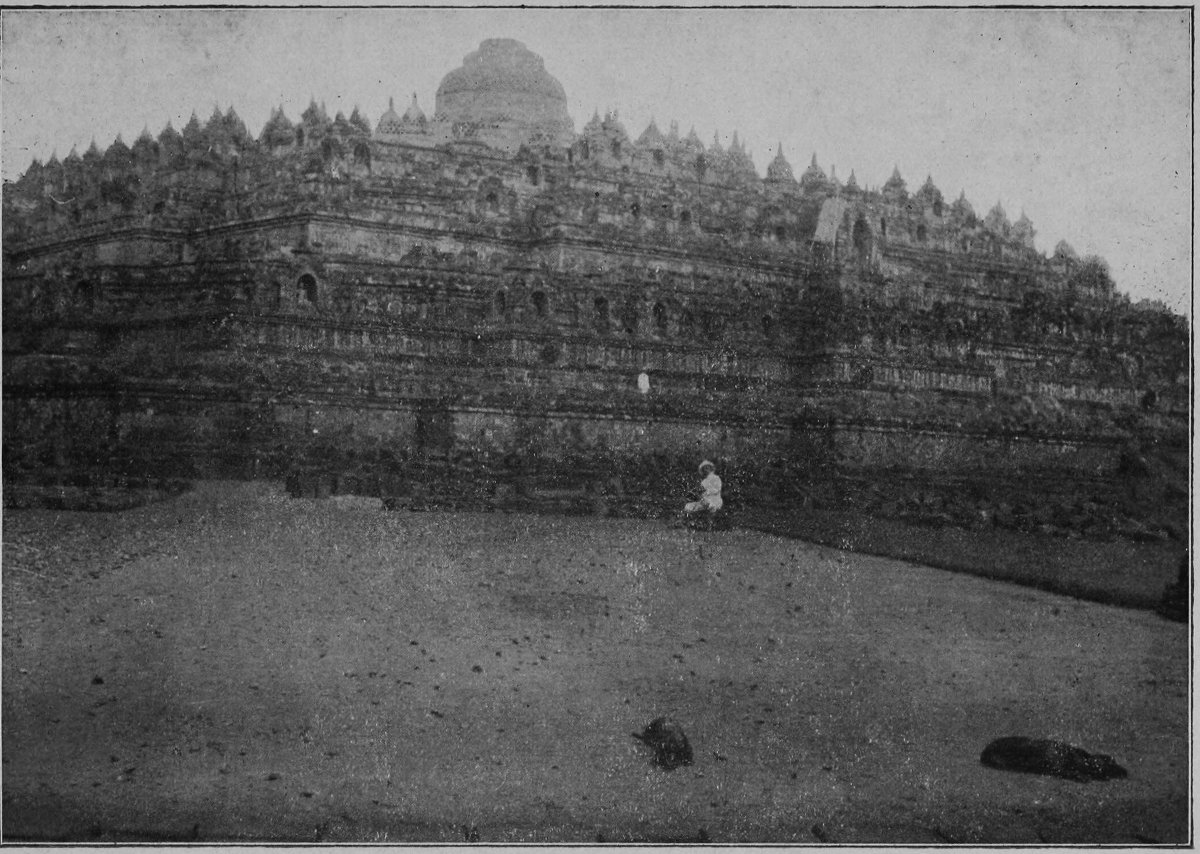
The Tyanḍi Båråbudur (N. W. front).
27
But after a lapse of an uncountable number of years or, perhaps some centuries, this colony became a large and powerful empire, and—just as the Christians first assembled in grottoes or catacombs, and afterwards built churches rich and magnificent like St. Peter’s at Rome, and the Cologne cathedral—the Buddhists also disregarded their simple cairn, and wanted something better, something more worthy and beautiful, in consequence of which they built a dagob large and in solemn style, surrounded by many gradually descending terraces, walled in and covered with sculptures abundantly hewn, which was to speak, with the clearness of plastic art or in the poetic language of symbolism, of the Master and his doctrine, of the Redeemer and redemption, of life’s insufficiency and of victory after death.[16]
He who would approach this dagob to sacrifice his flowers to the Buddha, to meditate his life there, and perhaps, to utter his homage in a prayer[17] was obliged to mount all these terraces, and walk along these sculptures which became, as it were, a revival of the Buddha and his doctrine which taught him the dissolving in the nirvâna, the approaching of the infinite not-to-be as the end purpose of all life, and the deliverance of all the miseries of a sensual existence[18].
Many a sculpture reminded him there that self-conquest, self-command, singleness and purity of heart, veracity and meekness, and the love for all beings, either man or beast, were to lead him to that final purpose.
28
And if not blind with his eyes open, he reached at last the Master’s grave in a frame of mind so pure and noble, so serious and well-meant that the pilgrimage itself became a step on the right path.
But not always, and not to every one.
For even the impressions received there were of a transient kind, and it may be that many a one who went there for form’s or appearances’ sake only, remained as insensible of these impressions as he was of the majestic vista the highest terraces displayed deep down and far off on the surrounding mountains, valleys and plains, a view most astonishing, and culminating in the satisfaction of mounting the ruin even at this day.
Let us now follow the way the pilgrim took, and mount the hill which carries this heavy mass of stone.
Standing on the small plain at its north-west corner, in front of the pasanggrahan where we now find comparatively nice accommodation, and where once may have stood the cloister or dwelling of the monks who took care of the stûpa, we overlook the whole scene: a polygonal mass of dark-grey stone, a chaos of dome-shaped roofs and cones, of re-entering walls and projecting frame work, crowned by a higher situated middle-cupola the lost cone of which van Erp renewed after the copy of found fragments, but which was afterwards removed again.
We approach and ascend the outer-terrace, a tridodecahedral or rather a quadrangle, each side projecting twice outside in the shape of a rectangle, and encircling the equally polygonal temple.
This terrace has nothing to do with the original style of building. For about two yards deeper there lies another one, formerly extending three yards farther to outside, but now for the greater part hidden under a burden of 5500 cubic metres of stone[19].
Supposing now this lower terrace to be some two yards deeper on, we then arrive at the (probably) original outer terrace; but as its uncovered outer part has been lost since, we now can’t possibly ascertain its bounds.
When, according to my schematism offered to the Dutch Government by the board of directors of the “Oudheidkundige Vereeniging”, 29 the upper series were dug up (1890) and the lower-part of the ruin’s outer wall had been uncovered, we found there heavy frames and bands, and underneath a series of 160 images much better hewn than the demi-relievoes, and for the greater part well preserved under their firm covering. Some years ago we had not the slightest idea of their existence. I proposed the Dutch Government to have them photographed so that they now have come within the range of the study of archaeologists[20].
It therefore appears that the first outer-terrace must have been twice heightened at its original foot, that is, before the last planned imageries had been entirely finished at its foot or hardly sketched.
And this must have been done by the Buddhists themselves to assure, perhaps, firmer foundations to the whole building[21].
But let us now return to the outer-terrace we mounted. In former times it must have been surrounded by a heavy breast-work which now has disappeared altogether.
In the centre of each side this parapet was replaced by the upper step of a staircase on two sides closed in by means of heavy banisters.
The banisters of such stairs ended into nâga heads with turned elephant’s trunks and gave entrance to the lower heightening.
Out of all still existing stairs, and upon those we now find ourselves there are other ones leading over all the higher terraces to the 30 large middle-dagob we can still reach along this path without being obliged to walk all round these galleries, and without passing the imageries standing there.
On our first way we therefore only walk about part of the outer-terrace, along the north- and half east-side, and it is on this side that we shall mount the stair which will bring us to the very first gallery (also walled in on its outside) on the second terrace. And we shall find there the starting-point of four different series of alto-relievoes of which some prepare each other in regular succession.
Yet, these imageries, more or less reviving the heavy outer-wall above the outer terrace, and consequently standing comparatively high above the lower series we uncovered in 1890 (now covered again) don’t tell us any story or legend, but allude to symbolical ornaments only.
Notwithstanding, they can’t be said to be without sense, though we may not readily understand them.
They represent numberless, but continually modified repetitions of some motives: a man seated near an incense-offering or a flower-vase, and a man standing between two women, nymphs or servants; both scenes every time separated by a single woman’s image provided with a lotus or another symbol. This lotus may refer to female Bodhisattvas, otherwise I should be inclined to think of apsarasas or celestials, because I don’t see any reason for so many Bodhisattvîs. And yet, why not, provided that they are not taken as personal, legendary or historical Bodhisattvîs.
Don’t we also find them in other ruins (tyanḍi Parambanan, and tyanḍi Sévu), and in the Sari and Pĕlahosan cloisters?[22].
And on the top of the heavy cornice covering these imageries, stand—or formerly stood—from distance to distance, just above the sacrificers, small temples of a completely similar form, each of them containing a deep niche, wherein a Buddha image on a lotus-throne provided with the prabha or disc behind his head.
A square spire with screen-shaped stories reminding us of the Siam pagodae or of some tyaityas also represented on the imageries of our temple, crowned each small temple which had been flanked by two wings with similar but lower spires. And between every two 31 small niche-temples stood—or stands—, just above the groups of the three small images, an altar-shaped stone-block, covered by a bell-shaped dagob which has or had been crowned with a conical column.
The front part of each of these dagob-pedestals has been adorned with a sitting man’s or woman’s image with a flower-vase or an incense-offering, or with both of them.
The back parts of these niche- and dagob temples formed—and they partly still form—an (formerly) uninterrupted cornice which carried the small spires and the dagobs, and beneath, a single wall-opening which, following all the re-enterings of the tridodecahedral, was only interrupted by the four doorways which showed us a repetition (on a larger scale) of the small niche-temples.
These stairs were and are still the weak points of the architecture.
Dissimilar as they are in height and depth of the steps, they sometimes occupy the greater part of the floor of the surrounding galleries. Even the doorways once covering them from terrace to terrace, but which now have for the greater part disappeared, were less proportioned to the whole, and therefore not always equally rich in style, and beauty. It still appears from that which has remained that the side-posts of these doorways—just as those of each niche—had been formed by the serpent’s bodies of two nâgas whose tails ended into the mule of a monster-head we saw above the doorway. We already came across this very same motif on our walk round the niches, and on the banisters of tyanḍi Mĕndut and tyanḍi Pawon, and find it back in all the Buddha temples in Java, especially in those of the plain of Parambanan, and in the ruins of the temple group of this name whose buddhistic character will not be easily acknowledged. At the foot of the doorway (or of the niche) these nâga-heads ended into outward turned mythical monster-heads which, at first sight remind us of elephants rather than of snake-like animals, because their upper lips generally (not always) change into a trunk curled up on their foreheads. Wilhelm von Humboldt and after him all European examiners, among whom the Dutch scholar Leemans, therefore took these monstrous figures for elephant’s heads without perceiving however, that they changed into serpent’s bodies when seen on the side-posts of the doorways; they also didn’t see the relation there was between these heads and the monster-head above the doorways and niches.
32
Many years ago I had been misguided myself, and in the beginning I even defended my error against the king of Siam who was, for all I know, the only one that disputed this, and H. M. succeeded in convincing me by logical argumentation.
In this ornament the nâga represents a power inimical to buddhism, and the monster which conquers this power by crushing the enemy’s tail should be, according to the Siam opinion, Rahu who also tries to devour the sun during every eclipse.
This is comprehensible because this Rahu has always been represented as a head only, and after that his body severed from his head by Vishnu’s tyakra, had fallen into the sea and perished.
When I afterwards communicated this explanation of the royal Buddhist to the members of the Mission archéologique de l’Indo-Chine, this mission’s director (who afterwards became the first director of the École française d’Extrême Orient), Mr. Louis Finot, the great indo-archaeologist, (even according to professor Kern) thought this monster-head didn’t represent Rahu but Garuḍa, the destroyer of the nâgas. And when I argued I had always seen this wâhana, god Vishnu’s riding animal or eagle, represented as a bird or as man-bird provided with wings and claws or at least with the beak of a bird of prey, the French-Indian scholar assured me he did know Vishnu’s representations seated on such a monster-head only[23].
It was I who afterwards found such garuḍa-heads with claws of a bird of prey (with 3 or sometimes 4 front-toes).
As for the rest Garuḍa is the deity’s faithful servant, and, according to the Buddhists of the northern church, Vishnu must have revealed himself in their Buddha for the ninth time. He is also the natural defender of this church, and the destroyer of its subterranean enemy.
In the form of the Javanese kĕris (creese) I found, for about seven years ago, the nâga mostly adorned with a proboscis and an elephant’s lip which may be taken as an indisputable proof of the truth of our idea about this nâga-symbol.
But we are standing, in front of the eastern staircase, or before that which has remained of it.
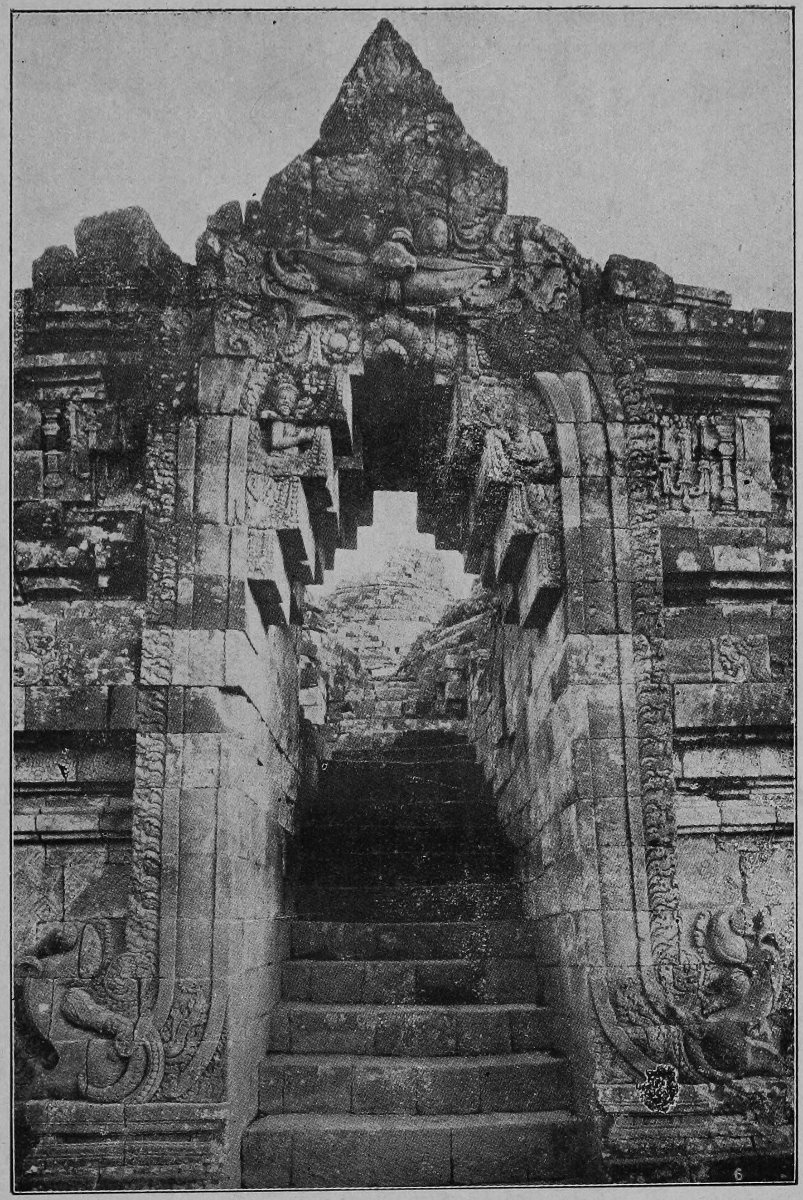
Northern staircase of the ruin of the Båråbudur, with the gate leading from the fourth polygonal and surrounding terrace to the round ones and the high middle-dagob. The only gate which has remained intact, with the Garuḍa-Nâga ornament on its frontside.
33
Even the beautiful banisters rising from above, out of a monster’s mule, and ending in a nâga-head with trunk curled up, are no more to be seen[24].
Eight high steps lead us to the first gallery.
The very first thing we see is that the two walls are hewn with two series of imageries richly framed, and placed above each other, whilst it is clear to be seen that this must have been done after that these walls had been run up from their combination of stone-blocks, and that an uninterrupted band of exquisite festoons has been affixed above these sculptures under the cornice of the back-wall.
Because of their having been modelled in relief style all these sculptures are therefore no basso but alto-relievoes.
The upper series of the front wall covers the somewhat declining back parts of the mentioned niche- and dagob temples.
On the back wall we see similar temple-groups, but all of them, even the small niche-temples, are crowned with dagobs and cones.
The three following and higher walls also carry such temple-groups, and beneath the cornices of the outer-walls we see a band modified for each wall, but always beautifully thought, and formed of elegant rosettes and guirlandes with birds.
On the five encircling walls of the Båråbudur we see no less than 432 niches provided with Buddha-images we are going to speak about afterwards[25].
We now turn to the left in order to begin our walk along the sculptures of the upper series of the back-wall.
This wall is the only one that has remained almost wholly preserved, showing us a comparatively well explained row of following 34 events which give us an idea about the life of the Buddha Siddhârta Gautama, the Shâkyamuni, from beginning to end[26].
Out of these 120 sculptures we can only give a superficial description of a few of them that have been explained best.
Those of the lower series and of the two rows on the front wall of this gallery, and the few rows of the two walls of the three following galleries we shall pass in silence. Not yet all of them have been explained, and many a sculpture has been so badly damaged that it doesn’t seem possible to explain them. Other ones are lost at all. That which remained well preserved generally represents a worship of the Buddha, of dagobs or tyaityas, of bodhi-trees, or perhaps of different relics. Sometimes they also show us a distribution of viands, or other presents, a preaching, a fable about animals or a scene from the former lives of the Buddha as man or beast, or certain Bodhisattvas or divine predecessors of the Buddha, the Redeemer of this world[27].
Some sculptures are likely to be mere symbols. Formerly their number amounted to more than 2000[28].
Let us begin our walk to the left of the eastern staircase in order to return to our starting-point following the course of the sun of the 35 northern hemisphere[29], going through the South, West and North. This order of succession regulated after this sun, we always find back on these and other Hindu ruins; more or less a witness of the northern origin of Javanese Buddhism[30].
The Siamese also followed this direction, and maintained that a walk to the right of the Buddha or the dagob, consequently with our left side turned to it, would show our ignorance or want of respect.
For convenience’ sake, and in order to assist the visitor in finding the few sculptures, we shall always count them from the preceding staircase or from the first till the ninth wall-angle, and begin with the eastern staircase.
The first scenes relate that which preceded Buddha’s life.
The fourth sculpture of the series (No. 7 of Wilsen’s pictures in Dr. Leemans’ work), or 1 after the first angle, may be, according to Foucher, some of the many Pratyeka-Buddhas[31] in the park of gazelles near Bénarès, and, when a deity informs them the birth on earth of a consummate Buddha, one of them rises from his lotus-throne in order to be burned by his own shine and ascetic diligence when seven elbows higher in the air. The former explanation given by Leemans and myself, according to Wilsen’s, was inaccurate.
Further towards the South we meet more than one representation of Buddha’s parents, the Shâkya king of Kapilavastu, Shudhódana, and his first wife Mâyâ, honoured for the coming event, the next birth of the divine son.
The twelfth (23 W. L., 1 after the fourth angle) is a symbolical indication of Buddha’s descent from heaven in a palanquin moved on in the air by celestials.
The thirteenth (25 W. L., 2 after the fourth angle) shows us Mâyâ asleep, guarded by female servants, receiving the Buddha in a dream, in the shape of a white elephant carried by lotus-cushions, descending from heaven into her lap[32].
36
The twenty-seventh (53 W. L. eighth angle, 1) shows us Mâyâ on her journey to her paternal home. According to time-honoured usage she goes there to wait for her confinement. However, she doesn’t come any farther than Lumbini garden, and the following sculpture (55 W. L. angle nine, 1) tells us how she, while standing there under a tree, saw the Buddha born from her side, and how the latter immediately took seven steps to each of the four zones of heaven, and as many steps to the zenith, and that as a sign of his next authority over the five parts of the world[33].
A rain of lotus flowers falls upon him, and lotus-plants open themselves under his feet on each step he takes. The crescent of the moon on the hind part of his head must refer to his heavenly or perhaps princely origin[34].
On the following sculptures we see the young king’s son, most times on his father’s knees, honoured by brahmins and laymen. His mother is no more to be seen, because she (as every Buddha-mother) died seven days after his birth.
The thirty-first sculpture (61 W. L., 1 after the southern staircase) may refer to the brahmin who perceives the Buddha-tokens at Siddhârta’s body, and predicts his next greatness; however, in quite another sense than the king wishes.
37
On 77 and 79 (W. L., angle two, 5 and 6) we perceive similar scenes, but this happens more after all.
The forty-ninth (97 W. L., angle five, 4) on the westside sketches us Siddhârta’s authority over others, and also as for manly strength. In a wedding match (svayamvara) he bends a bow no other can bend, and sends his arrow through seven cocoa trees. On this ground he gains the hand of his cousin Rashodara, the most beautiful girl of all Shâkya virgins[35].
Four other sculptures refer to the four encounters outside the palace, which, in spite of paternal precautions, showed him life’s misery. What then would be the use of these precautions to celestial beings who only revealed themselves to him, and to his equerry and guide in order to persuade the next Buddha in giving up all worldly greatness and domestic happiness; in leaving his father and family, and gaining strength in a life of retirement, of privation and expiation, of self-denial and self-command in order to finish his heavenly task: the redemption of suffering mankind!
Outside the eastern gate he first comes across a decrepit grey-head (111 W. L., 6 after the seventh angle); afterwards, on his drive from the southern gate, he meets a sick one in death-struggle (113 W. L., angle 8, 1); and when he finds himself outside the western entrance a corpse shows him the end of life (115 W. L., angle nine, 1), and finally, outside the northern gate, a mendicant friar or bhikshu teaches him as how to gain the victory over life and death, and find peace by ruling all carnal desires (117 W. L., angle nine, 2).
On the sixty-first sculpture (121 W. L., 1 after the western staircase) he discusses his resolution with his disappointed father. The sleeping watchmen or servants refer to the night which passes on discussing the subject.
On the two following sculptures (123 and 125 W. L., 2 and 3 38 after the staircase) he communicates his resolution to his wife (or wives), and his meditating posture, but also the larger disc of light crowning the higher seat upon which, among sleeping women and servants, he is watching the last night, all this speaks of the holy task of life which raises him for ever above his family.
The following scene (127 W. L., 1 after the first angle) tells us, how, in spite of closed doors and sleeping gate-keepers, he succeeds in leaving house and home to begin abroad the life of a poor wanderer seated on the noble sun-horse Kanthaka. The lotus-cushion carrying him again, just as it happened when he descended to earth, and which, on the next sculptures (129 W. L., 1 after the second corner) also carries Kanthaka through the air, speaks once more of his heavenly sending.
Then come the leave-takings from his servant Tyhanda (131 W. L., second angle, 2), and the taking off his princely garb (133 W. L., second angle, 3), his hair-dress and weapons (135 W. L., second angle 4 and following ones), and shabbily clothed in a hunter’s skirt—his first cowl turned yellow by long usage—he begins the life of the thinking ascetic whose sanctifying power we see continually indicated by the lotus-cushion and the disc of light.
Mâra, the wicked spirit of darkness, vainly tries to check him by offering him the dominion over the four parts of the world (the East, South, West, and North)[36].
Far from his native town Siddhârta already began his new life which henceforth gave him claim to the name of the wise Shâkya (Shâkya-muni)[37].
The following sculptures show us the penitent clothed as Buddha with the urna and the tiara, the ring of hair on his forehead, and the knot of hair on his crest, with the lotus-cushion and disc of the sun worshipped by princes and inferior people, by priests and laymen, men, women and celestials.
On the seventy-second sculpture (141 W. L., angle three, 1) we see him ask for being instructed by the wise brahmin Alara who is unable to teach his wiser superior[38]. The Shâkya’s superiority appears from his Buddha posture and his lotus-throne.
39
On the now following one [143 W. L., 1 after the fourth angle] we see him near another wise person, called Udraka[39], and as this one also turns out to be his inferior he leaves him accompanied by five of his [Udraka’s] disciples.
On the following one [145 W. L., 2 after the fourth angle] he approaches Rajargriha[40], the capital of the empire of Magadha. Its king Bimbisâra and the queen come to visit him, and offer him half their empire, but the Bodhisattva doesn’t seek for worldly greatness.
The two first scenes on the north side [151 and 153 W. L., fifth angle, 1 and 2] place him and his five followers on the banks of a brook, vainly trying to seek strength [for wisdom] in a life of abstinence and penitence. He therefore breaks with that life and with his disciples, who wrongly suppose him an apostate and leave him alone to continue elsewhere their lives of penitence. Six years of misery convinced the wise Shâkya that a sound spirit can live in a sound body only.
The sculptor of these scenes incorrigibly hewed the disciples’ dislike in their Master’s changed opinion, which is to be seen in their spokesman’s posture. The hands of this man are a masterpiece of expression. It would be a loss never to be remedied if these hands were taken away, which, after all, would be of no value to the robber because they can’t give back the proportion to their arms and bodies. Nothing, however, is safe from the rapaciousness of foolish tourists-compilers.
The eighty-first sculpture [161 W. L., angle seven, 1] teaches us how Sujâtâ, the daughter of a village headman, takes care of the penitent, almost dying from exhaustion, and how she refreshes him with nutritive milk.
We see an almost similar representation on the eighty-fourth sculpture [167 W. L., angle seven, 4]. Such repetitions are more to be seen, though they are rare ones.
The Shâkya Muni accomplished his purpose at last. He got all knowledge, and truth became his power. He has ripened to appear as Buddha, the Enlightened, the awaking luminary celestial, to come in the world wrapped in darkness, to teach the true doctrine, the dharma, and redeem mankind from sin.
40
Seated on a heap of bulrush, under a fig-tree, afterwards sanctified as the tree of knowledge, the bodhidruma, he fights his last fight against the Evil Spirit which he knows to conquer once more; and the latter budges from his side for ever.
On the ninety-fourth sculpture [187 W. L., the first after the first angle after the western staircase] we see how the weapons of demons or false deities fall upon him as harmless flowers. A second and larger disc speaks of his increasing power, the magnificence of the sun rising in full glory.
The following sculpture (189 W L., after the second angle) tells us how Mâra tries to conquer him by the charmingness of his daughters, the apsarasas (the rosy morning-mists) (Kern). But though one of these nymphs adopts the shape of Yashódarâ, Râhula-mata (the mother of Râhula, Siddhârta’s son), he henceforth lives a life of love highly beneficial to all beings.
Teaching and honoured he goes to Banaras (Bénarès) such as the last sculptures on the north side will show us.
On the one hundred and seventeenth (233 W. L., eighth angle, 1) he proclaims truth to the five disciples found back, and now for ever his faithful followers and first apostles[41].
The three last sculptures of the whole series which bring us back again to our starting-point near the eastern staircase, speak of Buddha’s greatness, but don’t refer to his journey to the native-town and to the reclaiming of father and son, of his wife and step-mother, the first buddhistic nuns. The last sculpture but one (237 W. L., 2 after the ninth and last angle) speaks of his death, for the washing of his corpse hewn there, may only apply to his death, though the sitting posture of the dead one may seem in flat defiance of this.[42] But this posture on the lotus-throne, with his two hands in his lap, is the posture of meditation or perfect rest suiting the nirvâna which is also the posture of the fourth Dhyâni-buddha, Amitâbha, hewn on the four lower-walls and dominating there the West, opposite to the setting sun speaking in a symbolical sense of the finished task of life.
41
Behind the dead one we see stand two monks pouring their vases to purify the corpse before the cremation will make an end to his material existence.
On the last sculpture (239 W. L., 3 after the last angle) the Buddha thrones in the very same posture, as the glorification of death, as the immortal Talhâgata who, in spite of his material death, continues to live in his holy doctrine, and who can never die as such.
That the study of Foucher’s work could also assist me in finding the sense of some other not comprehended sculptures may appear from the 5th panel after the 7th angle past the eastern staircase, which shows us the killing of Siddhârta’s elephant by his angry nephew Dervadatta.
42
VIII.
When, for more than thirty years ago, I began to study the majestic ruin, I thought (like I afterwards wrote[43] in my first essay about the Båråbudur) many other imageries, at least those of the undermost series of the back wall, and those of the uppermost row on the front wall of this first gallery, to be the representations of Buddha’s former lives, of the jâtakas of the man honoured by all the Buddhists of the northern and the southern church as the Redeemer of this world, the Dhyâni-Buddha of the Mahâyânists, for the last time reincarnated for about 25 centuries ago, and who enjoyed the rest of the nirvâna after having finished his heavenly task, but in order to reveal himself once more to a future world, that is, as the Redeemer of not yet existing beings.
When in July 1896 I attended the king of Siam for three days on his journey to the ruins, this royal Buddhist expressed the same supposition, especially with regard to the lower series on the back wall of this first gallery.
But I could not possibly study these jâtakas as long as I didn’t know any translation of the original sanscrit- or pâli text[44] in one of the languages known to me.
In 1893 professor J. S. Speyer published in the “Bydragen van ’t Koninklijk Instituut” an English translation of 34 of these legends derived from a sanscrit manuscript, the so-called Jâtakamâla or the wreath of birth stories[45].
43
And in the same “Bijdragen”, but in those of 1897, professor Kern gave a translation of an essay which had appeared from the hand of the Russian Orientalist Sergius E. Oldenburg—as far as it concerned the Båråbudur—who discussed the representations of a few jâtakas on different monuments whereas Dr. Kern had been so kind as to inform me of them by letter.
It therefore became possible for me to recognise in the two mentioned series some of the legends treated in Speyer’s Jâtakamâlâ, and moreover, show some other ones elsewhere.
And five years ago Speyer gave at length a full account of the Maitrakanyaka legend superficially treated by Oldenburg, and hewn on six sculptures of the lower series on the back wall. Oldenburg however, had only mentioned five of them.
In November 1899 I visited the Båråbudur in order to examine all these sculptures one by one, that is, in as much as they still existed and had not been lost or damaged, or no more to be recognized since the engravings studied by Oldenburg had been drawn in Leemans’ work.
It is a pity that these drawings are not exactly true ones, and not to be relied upon, but we shall afterwards speak about them.
As short as possible I shall successively treat these sculptures, mentioning again their numbers they refer to when counted from the preceding staircase, and afterwards from the first till the ninth reentering or projecting wall angle, and begin again from the eastern staircase, and walk towards the South. Doing this I’ll have to count in the disappeared and consequently missing sculptures—and many of them have been lost on the front wall—, because otherwise the numbers after each new loss would become quite worthless. Corner-sculptures are those which occupy the two sides of a wall angle, in Leemans’ engravings divided in two by a perpendicular line.
Let us begin with the upper series on the front wall after the eastern staircase.
Second corner, 3, 4 and 5 (W. L., 16, 17, and 18.)[46].
The Lord once lived as a rich man who did much good. One day rising from table to fill the beggar’s bag of a monk, Mâra, the Evil Spirit, opened a precipice before his feet wherein he saw hell flaming. But the Lord steps through this precipice, remains uninjured, 44 and favors the monk, in reality a Pratyéka-Buddha, a heavenly saint, with a gift and the latter afterwards disappears in a brilliant cloud.
On 3 we see the benefactor with his gifts, on 4 he steps through hell, and on 5 the monk ascends to heaven.
Hell is represented here by condemned persons in a cauldron with boiling contents.
Second corner 11 and 12 (W. L. 24 and 25). The Bodhisattva once lived as a hare in a wilderness frequented by many hermits. Her authority over all other animals was honoured even in heaven.
In order to put her to the test, Indra, the god, descends to her in the shape of an exhausted traveller. An otter brings him fish, a jackal presents him with a lizard and a cup of sour milk (left behind by another traveller), and a monkey favors him with juicy fruit to refresh the man. But the hare who could give nothing else but bitter grass flung herself into a fire (burned by Indra’s will) in order to be taken by the poor man as roasted food. But now Indra shows himself again in his divine shape, saves the hare out of the flames, and carries her to heaven in order to adorn his own palace, and that of the dévas, and also the moon, with the hare’s picture[47].
On 11 the animals carry their presents to Indra, and on 12 the hare is going to fling herself into the fire.
Second corner, 18, the corner-sculpture and 1 and 2 after the third corner (W. L., 31, 32, 33 and 34).
The Lord as a king of a happy people. Five yakshas (demons), expelled from Kuvera’s kingdom, the subterranean god of riches, come to tempt him in order to ruin him. They ask him for a good meal, but refuse the best things the king offers them, and demand human blood and human flesh.
The Lord doesn’t wish to let them go unsatisfied, but he is not inclined to sacrifice one of his subjects, and therefore offers them his own blood and flesh in spite of his ministers’ and courtiers’ resistance.
The demons reclaim themselves and acknowledge the king’s holiness, he then admonishes them not to do wrong in future, but only that which is good (also, among others, to leave off drinking intoxicants).
45
Indra descends from heaven to praise the Lord and to close his wounds.
On 18 and on the corner-sculpture the yakshas come across a herd who praises the king’s virtues. On 1 and 2 we see them near the king.
These five yakshas were afterwards reincarnated men, and became the first disciples who followed and left again the Shakya-muni in order to join the Buddha once more, and to become his first apostles[48].
Fourth corner, 3, 4 and 5 (W. L. 37, 38 and 39). Now the Buddha of after life was king Samjaya’s son and hereditary prince.
One day, riding his white elephant, he met with some brahmins who asked him, in the name of their king, for the elephant. He dismounts and gives them the noble animal.
On account of this foolish deed he saw himself driven away by his father who acted at the instigation of his (the father’s) courtiers.
He mounts his carriage accompanied by Madrî, his wife, and their two children, and then sets off. Once more some brahmins come to ask him for his fine horses. The prince gives his consent, and puts himself before the carriage. Another brahmin appears now, and demands this carriage; Madrî and the children get out, and the prince takes his little son on his, and the mother takes their little daughter on her arm to continue their journey afoot.
Trees bend their branches in homage, lotus-ponds refresh, and clouds overshadow them, and so they reach their place of exile where they find a tabernacle built for them by Indra.
One day, when Madrî found herself in the wood to seek for roots and fruit for their meal, there came a brahmin demanding from her husband the two little ones in order to lead them away as bound slaves.
An earth-quake calls Indra’s attention, and when the deity hears the cause of this he also comes, as a brahmin, to the now childless father, and claims the latter’s wife, the disconsolate mother.
But as the prince is also inclined to comply with this demand of his, Indra reveals himself and gives him back all that which he lost. Even his place at his father’s court.
On 3 we see him cede his elephant, and the children have been hewn on 4. On 5 the yakshas conduct the princely carriage after having put out the horses.
46
Fifth corner, 1, 2, 3 and 4 [W. L., 48, 49, 50 and 51].
Time was when the Lord himself was a king to whom one of his subjects offered his most beautiful daughter. At the advice of his courtiers sent to her, fearing that the king would become crazy of love for such an strikingly beautiful woman, he declines the offer after which she marries one of his officials. One day taking a drive the king saw her, and took a passionate love to her. On his being informed that she had already entered upon marriage he controls his passions, and even refuses to get her from the hands of her own husband, because he places his feelings of justice above his personal happiness.
On 1 the offer is being delivered to the king; on 2 his messengers visit the virgin; on 3 they give the prince a full account of the state of things, and on 4 the king meets her himself.
Fifth corner. 5 [W. L., 52].
As a retired old sailor the Lord, though almost blind, allowed himself to be gained into embarking for a commercial journey in order to assure the ship a safe voyage.
A heavy storm flung the ship far away, and through unknown seas till near the end of the world. Return again was impossible and their ruin seemed to be inevitable. One means only could save them, and they prayed the deities for help for the sake of the Lord’s spotless virtue and love of truth. And this succeeded.
The storm abated, and they could return to the harbour. On their journey home through an emerald-green sea, the blind sailor, seeing with the eyes of other passengers, told them to pull up sand and stones from the bottom of the sea, and take them on board by way of ballast. On their arrival into the harbour this appeared to be precious stones and jewels.
The only remained sculpture shows us the merchants with their ship on the open sea.
Fifth corner, 9 and 10 [W. L., 56 and 57].
We here see the Lord as a fish obeyed by all other fishes of the lake. Because of want of rain this lake once dried up, and became a little pool in which the fish didn’t know any means to escape from the birds of prey. The Bodhisattva prayed Indra for rain as a reward for his true virtue, and the deity himself came to him, and 47 it rained as fast as it could pour, and Indra promised that the very same spot would be never tried again by such a plague.
The first sculpture represents the fishes in the lake before, and the other one, after the rain.
Fifth corner, 11 [W. L. 58].
A young sparrow—it was the Bodhisattva—who despised all little worms and insects—was outdistanced by the other young of the paternal nest. When on the occasion of a forest-fire all other animals fled away he only remained behind, because he could not fly. Praying he knew to persuade the fire-god Agni into going off. Since that day every forest-fire died out on this spot.
We see the young sparrow on the nest whilst the other birds fly away in all directions, and while all other animals give way for the fire.
Fifth corner, 12 [W. L. 59].
It once happened that the Lord descended from heaven in the shape of Indra[49] in order to convert a king, Sarvamitra, who daily drank too much strong liquor with his courtiers. As a brahmin Indra now offers the king a bottle of sûra praising the pernicious properties of this drink in so eloquent a manner that the prince renders homage to the preacher as a guru (teacher), after which the latter admonishes him to fear drinking that he might afterwards live with him in heaven.
The sculpture needs no further interpretation.
Seventh corner, 3, 4, 5 and 6 (W. L. 65, 66, 67 and 68).
In the primeval forest the Lord once lived, as a brahmin, a life of severe penitence with six brothers and one sister. Only every fifth day they came together in his hut to hear him proclaim the doctrine. As for the rest they didn’t see each other. Every day their two servants put the eight portions of lotus-stems on the leaves of the lotus, and according to their age they came one by one to fetch their sober meal in order to take it in their own hut.
Indra, putting the Bodhisattva to the test, took away the first portion during five following days so that the Lord was obliged to fast. On the next service the others assembled again, and saw how their brother had grown thin. Being informed of the cause of it everyone 48 wished the thief to be punished in a fitting manner, and even three strange auditors, a yaksha, an elephant, and a monkey cursed the thief, every one of them in his own manner. The Lord, returning good for evil, hopes that this one and the other that suspected one of them, wrongly perhaps, may live to see all his wishes fulfilled. But then Indra comes, and accusing himself he says why he did so—and humbles himself before the Lord whom he wishes to serve as his superior.
On 3 and 4 we see the hermits in the wood. On 5 is to be seen the lotus-pond with the servants seeking for leaves and stems, and on 6 we see Indra humbling himself before the Lord.[50]
Seventh corner, 11, 12 and 13 [W. L. 73, 74 and 75].
Another time the Lord, a rich brahmin, left everything he possessed, and accompanied by his wife, who didn’t wish to leave him, he went to the woods to live there a hermit’s life.
There they were found by the king who came in this region to chase, and touched as he was by the woman’s beauty he ordered her to be kidnapped and carried away to his zenana.
In spite of her cry for help her husband doesn’t oppose himself against this robbery, and when the king asks him why he does not the brahmin answers with an oration about the virtue of self-command, and he therefore compels the king to honour him as an ascetic and to ask his pardon.
On 11 we see the brahmin and his wife on their way to the wood; on 12 the hunting king, and on 13 the woman’s abduction.
Seventh corner, 15, 16, and 17 and the eighth corner, 1 (W. L., 77, 78, 79 and 81).
In the lake of Mânasa the Bodhisattva once ruled as a king over many hundreds of thousands of swans, and was assisted by his viceroy Sumukha. Their praise sounded till the court of the king of Bénarès who desired to meet the two swans. He therefore ordered another lake to be made in the neighbourhood of his court-capital which was much more beautiful than the first mentioned, and promulgated 49 everywhere that he should guarantee the safety of all birds who came to visit the new lake.
The swans of Mânasa went there in spite of their ruler’s objections, and so the Lord himself was obliged to follow them.
Shortly after he saw himself caught by the king’s hunter, and all other swans flew away with the exception of Sumukha however, who would not leave the Lord. The bonds which tied him to his king were stronger than those which kept the king in his trap, he said, and he demanded the hunter to bind him first, and afterwards release his master.
This touched the hunter and releasing both of them the Lord now requests him to speak with the king to persuade the latter not to punish, but to reward his hunter. This happens, and the king offers rich presents to the two swans they decline, and now all the swans return to their lake.
This lake with the swans has been hewn on 15. On 16 the king is informed of these birds. On 17 we see how the Lord is caught whilst all the other swans fly away with the exception of one of them.
The following sculpture after the eighth corner, which represents the meeting with the king, is almost wholly lost, the other one is lost at all.
Ninth corner, 5, 6, 7 and 8 [W. L., 90, 91, 92 and 93].
Another king once pursued a sharabha [a strong kind of stag], and fell from his horse into a cleft over which the wild beast had easily jumped, but before which the horse started back in full run. The sharabha descends into the cleft in order to rescue the fallen man, and help him on his way home after having admonished him to persevere in all princely virtues.
The chasing king we see on 5; on 6 the hunter stands on the brink of the cleft, on 7 we see the stag [the Lord] run to assist the fallen man, and on 8 the latter bids his rescuer farewell.
Southern staircase, 2, 3, 4 and 5 [W. L. 95, 96, 97 and 98].
In another life the Master ruled as a ruru [another kind of stag] over all other wild animals. One day he rescued a traveller out of a swollen mountain-stream, and for his only reward he wished the saved man to be silent about the event.
Now the queen, whose dreams had never turned out to be false ones, 50 had dreamed of a stag who preached the doctrine sitting on a throne. The king therefore offered a rich reward to him who could show him this miracle of an animal.
The drowned person was a poor fellow, and breaking his promise, he led the king into the wood and showed him the ruru, but doing this the hand which had served him to indicate the animal, fell from his arm as if it had been cut by a sword.
The stag now asked the king who had conducted him there, the prince mentions his guide’s name, and when the ruru recognises and reproaches him his breach of faith, and whilst the king has the intention to shoot at the man, the noble animal sues the weak man’s mercy who had by his own fault recklessly lost his welfare in this, and in a future world.
The king pardons the guilty one and conducts the stag to his palace, and throning there the ruru preaches the law of love before the whole court.
The animals in the wood have been hewn on 2; on 3 the drowned person is rescued; the king meets the stag on 4, and the preaching stag has been hewn on the 5th sculpture.
Southern staircase, 6, 7, 8 and 9 [W. L. 99, 101, 102 and 103].
The Buddha of after life once ruled as king over a troop of monkeys in the Himâlaya. They lived in a fig-tree, abundant with fruit, situated on the bank of a brook. In order not to make the tree known by its delicious fruit the king ordered his people not to have a single fruit ripened on the branches which hung over the water.
Once upon a day such a fruit unperceivedly ripened fell into the stream, and drove away to an open spot in the wood, where the king and his wives were fishing.
Never before had the prince seen or tasted such a fine and nice fruit, and so he went up-stream to look for the tree.
Seeing the many monkeys he told his hunters to drive them away. But in order to take to flight the animals had to risk a leap no one but their ruler only ventured to undertake. He jumps, reaches the mountain-slope situated on the other side, and seeks there for a long bambu which enables him to return to the tree. Armed with this he forms with his own body a bridge over which all the monkeys know to escape at the cost of the Lord who sees his skin torn to bloody pieces by the monkeys’ toes.
51
This happens to the astonishment of the hunters who now catch up the swooning king of monkeys, and lay him upon a bed of leaves. He soon came to, and when the king interrogates him the Lord answers that he did his duty, because a prince should serve his subjects, and not let himself served by them.
On the 6th and 7th sculpture the king accepts the fig, on 8 he and his hunters go in search of the tree, and on 9 has been hewn the wonderful escape of the monkeys.
Southern staircase, 10 and the corner-sculpture [of the first angle] [W. L. 103 and 104].
The Lord once lived in a wood as an ascetic and taught patience to all who visited him.
It then came to pass that the king and his wives came into this wood to amuse themselves, and while the latter took a bath in a brook, which ran there, the former fell asleep.
Awaking he didn’t see them any more. They had strayed to the hermit and listened to his preaching. The king found them there, and angrily called the preacher a liar, and menaced him with his sword. The wise man however, remained calm, and the king, embittered as he was by his wives’ supplications, came up to the pious teacher, and cut his hands, ears, nose and feet.
The martyr, who only feared that the king could be said to have killed an innocent person, suffered much more from his sorrow for the king’s fall than from his own wounds, but when the evildoer left the dying man he saw the ground opening itself before him, and fell into the flaming depth.
The frightened courtiers thought that the preacher himself had punished their master, and they asked for mercy, and dying the poor man blessed them, and also the murderer whose ruin had remained unknown to him.
On 10 we see the king asleep, on the corner-sculpture we see him go off to seek for his wives. I suppose the first and 2nd sculpture behind the corner [W. L. 105 and 106] refers to the widows on their way home.
Second corner, 5 [W. L., 111].
This sculpture brings us again in the presence of a king, the unbelieving prince of Videha, who lived a life of unjustice renouncing 52 all virtues. There was a time when the Lord lived as a devarshi [a wise one among the celestials] in the Brahmâloka, and descended to earth to convert the unbelieving ruler.
As sure—he says—as this life has been preceded by other lives there will once come other future lives. He then speaks about the tortures of hell which fall to the evil-doer and unbeliever when he doesn’t mend his life, and ... the king acknowledges that he is in the right, and bids the Lord to lead him henceforth on the right path[51].
The sculpture need no further explication.
Second corner, 6, 7, 8 and 9 [W. L., 112, 113, 114 and 115].
Seven hundred astrayed and exhausted travellers meet on their way an elephant, the Bodhisattva. They had been expelled from their country with 300 others who had died on the way.
By means of his trunk the elephant shows them the way to a stream where to quench their thirst and near which they will find a dead elephant whose meat will feed them. Along a shorter cut he speeds to the indicated spot, runs headlong into the bottom of a ravine and was smashed.
It is on this spot that the hungry wanderers find his dead body, and angels descend from heaven to sing his praise.
On 6 the exiles come across the elephant; on 7 we see them on their way to the place pointed out to them; on 8 the elephant is ready to fall into the precipice, and on 9 the saved ones worship the ashes of their rescuer.
I suppose this homage to the ashes closed in a tyaitya, as if it were to indicate a preceding cremation, should be taken in a symbolical sense only.
Second corner, 10, 11, 12 and 13 [W. L., 116, 117, 118 and 119].
This is one of the most important jâtakas.
As Sutasoma, a king’s son, the Bodhisattva was once walking with his wives in the garden of his palace when there entered a brahmin whom they invited to deliver a harangue about virtue. This harangue was unexpectedly interrupted by the arrival of a monster who put all of them 53 to flight, that is, with the exception of the prince himself. Another king had formerly procreated this monster by a lioness; most times he lived of human flesh only. Persecuted as he was by his own subjects after his father’s death he called in the aid of the demons and promised them a sacrifice of one hundred king’s sons. He now came to carry off Sutasoma to add him to the princes he already apprehended.
Sutasoma resolves to follow the lion’s son in order to convert him and to rescue the imprisoned princes. But on his arriving at the den of the violent monster he remembers that he left the brahmin unrewarded, and that he hasn’t wholly heard the latter’s preaching, and so he asks for permission to do that which he neglected; afterwards the man-eater could dispose of him.
The latter who has already gathered his 100 princes after all, releases his prisoner hoping to rejoice afterwards at the man’s fall as a person false to his word.
But after having heard and presented the brahmin with gifts Sutasoma returns to the lion’s son in spite of his parents’ and wives’ supplications. Has not the lion’s son become his benefactor by allowing him to do his duty? On this ground he has a right to his commiseration and to be released from the curse resting on him by birth.
And when the astonished robber asks him what this brahmin did say the prince delivers so eloquent a harangue about law that the lion-man converts himself and puts all his prisoners at liberty to follow them to Sutasoma’s residence.
On 10 we see the prince with the brahmin; on 11 the former is carried away by the robber; 12 refers to the continuation of the preaching, and on 13 has been hewn the reclaiming of the lion-man.
Second corner, 14, 16 and 17 third corner, 2 (W. L. 120, 122, 123 and 127).
Once upon a day the Lord was born as the son of a king whose elder sons had died young. In order to withdraw him from the influence of the demons the newborn son was educated in an iron house (ayogriha).
Once driving through the residence the young man saw much that set him thinking; he saw how old age, sickness and death threatened everyone while storms, inundations and fire destructed their properties. 54 Returned at home he resolves to part from the world and to live in the wilderness as a hermit and penitent, and to ask his father’s consent. All that lives, is from the moment of being in mother’s womb, doomed to death, is not it? And all that lives kills to save life, but nobody can kill death. Even the angels and devas can’t.
His father asks him whether this death will not catch him in the wilderness as sure as anywhere, but agreeing he says that death can’t find him unfit to the preparation for the transition in a future life.
The father agrees at last, and the prince devotes his further life to the dhyâna, the holy meditation which will lead him to the brahmâloka.
The prince’s birth has been hewn on 14; 16 shows us the brahmin’s homage to the new-born; 17 represents the drive outside the palace, and 2 after the following corner describes the prince’s life in the wilderness.
Besides, I suppose the corner-sculpture and the first behind the corner (W. L., 124 and 126) to refer to the prince’s leave-taking from his father and wives, just as it afterwards happens with Siddhârta.[52]. Striking is the conformity of this life with that of the king’s son of Kapilasvastu.
Fourth corner, 2, 3 and 5 (W. L., 129, 130 and 132).
Living in the primeval forest as a strong buffalo the Buddha of after life was continually teased by a monkey who, taunting the wild animal’s inexhaustible kindness, perpetually came in his way.
A yaksha admonishes the bull to be less patient and to crush or thrust down the snarer, but the strong one answers that the monkey can’t be otherwise than he now is, and that they should bear him as he is. There is no better exercise in meekness than suffer a bad treatment patiently, and by which one may hope to set the snarer thinking, and make him turn from sin.
On 2 we see the bull and the monkey, on 3 we also perceive the yaksha, and on 5 the bull delivers his harangue to the demon, and 55 know to persuade him into acknowledging and praising virtue[53].
Fourth corner, 6, 7, 8 and 9 (W. L., 133, 134, 135 and 136).
The Lord once living in the wilderness as a wood-pecker came across a lion who suffered unbearable pains because of a piece of bone which had remained in his throat. The wood-pecker relieved his pains by putting a piece of wood into the opened mule, and by getting the bone out of the throat.
A long time afterwards flying round and almost starving from hunger the wood-pecker met the lion again who was regaling himself on an antelope, he had just killed.
After a moment’s hesitation his former rescuer begs him for a little bit of the antelope’s meat, but the lion asks the beggar whether he is tired of life, and whether he ought not to be thankful that his life was spared when he formerly ventured himself into the inquirer’s mule. A lion doesn’t know any commiseration.
Ashamed the wood-pecker flies away. A sylvan deity follows him, and asks why he doesn’t pick the lion’s eyes, and takes as much of the prey as he likes. And the bird answers with a glorification of virtue; he who does good will find his reward in a future life, but he who returns evil for evil will lose the merit of all his good deeds.
The deity praises the wood-pecker as a wise one, a saint, and disappears.
On 5 has been hewn the lion in the wood where the wood-pecker comes-to him; on 7 the lion writhes with pain, and on 8 he is helped by the wood-pecker.
On 9 we see the hungry bird near the lion with his prey.
Major Van Erp supposes that this last sculpture should refer to another jâtaka. See at the bottom.
56
Many pieces formerly placed among the mentioned sculptures, have been lost whereas other ones have not yet been explained. But when we remember how those described here follow each other in the same range of succession like the jâtakas in the Mâla translated by Speyer, we then may believe that the not expounded and missing sculptures have had some connection with other former lives, and that even this gallery may have been a continuous series.
Oldenburg indicated indeed, still other jâtakas in this series which had not been translated by Speyer, that is, after the western staircase, 6, 7, 8 and 9 (W. L., 192, 193, 194 and 195).
The Lord hewn as a tortoise at sea takes the endangered crew of a sinking ship on his back, and carrying them ashore he offers his own body to the starving ones.
On 6 has been hewn the tortoise, on 7 the sinking ship surrounded by sharks and other fish, on 8 we see the tortoise with the shipwrecked men on his back, and 9 describes the rescued ones with their rescuer who is inclined to sacrifice himself.
On the front-wall of the fifth and highest gallery Oldenburg meant the second sculpture behind the southern staircase (W. L. CCCLXXXIX) to be the Lord as the horse Balâha, which, once carried travellers across the sea.
But as for the lower series of the back-wall of the first gallery he shows to:
3 after the eastern staircase and 1 after the next corner which should refer to king Dakshina Pantyala’s conversation with the bewitched nâga Janmatyitra; the latter’s exorcism and redemption by hunter Halaka (the Lord), and the hunter’s admission into the residence of the grateful nâga.
This nâga is to be recognised at the serpents in his hair[54].
Mr. Foucher fortunately gives us an account of this story (according to the text of the Divyâvadana) far more detailed than I could have possibly taken from other sources.
57
It refers to the Sudhana Kumârâ Vadâna: the 1th after the second corner, and following relievoes: 8, 10, 12, 14, 16, 18, 20, 22, 24, 26, 28, 30, 32, 34, 36, 38 and 40 W. L. It begins with the first panel south of the eastern staircase.
1. In the empire of Pantyâla there once lived 2 kings, one in the north, and the other in the south. The first was a good prince, and his empire prospered. The latter was bad, and his empire had fallen into decay. Probably, the first prince may have been hewn here.
2. The other bad king discusses with his ministers what to do to raise his empire from decay. Under the pretext of a hunting-party he inspects his neglected country, and then forms a plan to kidnap the young nâga Jammatyitraka from the hands of his thriving neighbour. Now it should be understood that this nâga lives in a pond situated outside the capital of north-Pantyâla, and as he knows to dispose of rain the country abounds with excellent produce even during the dry monsoon. Perhaps the brahmin we see before the king, will be the snake-charmer whose crimes we are going to know.
3. This relievo shows us a succession of three events. First of all (to the right) the young nâga kneeled down calls in hunter Halaka’s assistance. In the midst we see the same nâga, angrily and most unwillingly rising from his lotus-pond under the brahmin’s formula of exorcism, and in front of the latter’s sacrificial fire; but hunter Halaka kills the conjurer after having compelled him to give up his wicked plan.
And to the left may have been hewn the very same brahmin when he shortly before got the king’s secret command to commit this evil. In this case this episode should be exceptionally thought as a preceding one to both the middle-most and first sculpture.
4. The young nâga’s parents make their son’s rescuer splendidly welcome. On this occasion the hunter wears a princely costume which is above his rank (caste), but he appears without his host’s present, the never failing knot.
5. In the Himâlaya. The hunter squats down near the kinnarî Manoharâ he caught with his knot. To the left other kinnarîs are flying over a lotus-pond. To the right we see the ascetic whose words directed the hunter’s arm on his catching the fairy.
58
6. The hunting Sudhana, crown prince of the northern empire, is just coming on, and the hunter presents him with the kinnarî he caught. Fairy and prince fall in love with one another.
7. The king of the northern empire, Sudhana’s father, discusses with his purohita or private prelate, the traitor in this drama, who tries to persuade the king into charging the prince with the heavy burden to overpower a rebellious vassal against whom no less than 7 expeditions had already failed.
8. The prince bids his mother fare-well, and charges her with the care of his young wife.
9. Sudhana under a tree outside the rebellious town. Vaisyravana, one of the four great deities of this country, sends his general Pântyika with a troop of yakshas to assist him.
10. Once more in Hâstinapura, the royal residence of the northern empire. The king asks his purohita to interpret a bad dream upon which the priest demands to sacrifice a kinnarî in order to avert an immanent danger. The king hesitates, and the queen gives proof of her dislike.
11. The good heart of both triumphs, and Manoharâ escapes through the air.
12. With the assistance of the yakshas Sudhana performed the task he took upon his shoulders and offers his father the taxes and fines of the rebels submitted.
13. After having learned the reason of Manoharâ’s absence he applies to his mother again for help.
14. Druma, king of the region of the kinnaras, surrounded by his court. Manoharâ, seated on his left hand, relates her experience among mankind. So we find ourselves in the Himâlaya again, in this region of fairies and spirits hardly to be penetrated.
15. Sudhana consults the risyi who once helped the hunter on his catch, and who now hands him a ring and a travelling-plan Manohara had given him to this purpose.
16. Sudhana outside the capital of king Druma, where he comes across some kinnarîs who are drawing some water out of a well to cleanse Manoharâ’s body from all human-smell. Sudhana flings the ring into a vase of one of the fairies, and requests her to be the first to empty this vase on her mistress’s head. According to the text Foucher consulted, the fairy should have 59 remained quite ignorant of all this, consequently the sculptor must have swerved from this text, or, perhaps, meant another one.
17. Manoharâ found the ring, and tells her father about Sudhana’s coming. The king agrees to put him to the test; to the left of this relievo we see him bend his bow to drive an arrow through 7 cocoa-trees. Druma himself is watching this, and to be recognised by his prabha.
18. He then gives the prince his daughter.
19. The newly-married couple is now enjoying their happiness in the woman’s quarter. In honour of them, and to the accompaniment of music, a court-dancer is showing her art of dancing. This fair dancer is one of the best proofs of the sculptor’s art.
20. Returned at Hastinâpura the newly-married distribute presents among their people.
In this same series follow 6 other sculptures referring to the Maitrakanyaka-jâtaka; a note-worthy karma-legend.
We shall find them after having turned the fifth corner of the northern staircase, and on our having reached the east side of the ruin where we are going to view the 2nd, 3d and 4th sculpture (W. L., 214, 216 and 218), and 1 after the sixth corner (W. L., 220), and 1 and 2 after the seventh corner (W. L., 222 and 224) all of which Mr. Winter photographed for me.
On the first of these imageries we first see a woman handling a balance, and probably serving the customers of the young merchant Maitrakanyaka. This woman is likely to be his mother, and if he himself has been hewn near her, he can’t possibly be the shabbily dressed and bearded man who stands next to her. This man rather reminds of a brahmin or a mendicant friar instead of a rich merchant. The man by her other side is not visible on the photograph.
Clearer however, is the following group in which professor Speyer made us known Maitrakanyaka’s mother throwing herself at her son’s feet, and beseeching him to give up his plan to undertake a sea-voyage.
The widow’s tress made the professor suppose that the beautiful moustache (with which Wilsen adorned this little sculpture in Leemans’ work) should be a mistake of the draughtsman. And he observed this rightly, and so did I after heaving read Speyer’s essay,[55] 60 because I have been able to ascertain in loco that even the woman’s breasts, Wilsen didn’t see or engrave at least, are clearly to be seen and palpable. To be very short the legend runs as follows:
Maitrakanyaka was still a child when his father was shipwrecked on a voyage. According to time-honoured usage he was afterwards inclined to choose his father’s profession. In the beginning his mother told him that he had kept a shop, and afterwards had dealt in perfumes and in gold.
Maitrakanyaka did likewise, and gave his mother the first 4, 8, 16 and 32 kârshâpanas he gained, that they might be divided among the brahmins and indigent. These were four good deeds.
But when he was told that his father had gone abroad on business, and as he soon saw that his mother could not deny this he resolved to tread in his father’s foot-steps in spite of his mother’s resistance who feared to lose her only child in the very same way like she formerly lost his father. Bathing in tears she fell on her knees at last, and tried to detain him at the last moment, but he gave her a kick and went on board. This was one evil deed, and according to the doctrine of the karma, the eternal law of cause and consequence, he should be punished for this deed of his as sure as he would be rewarded for his good deeds.
On the second sculpture we see him shipwreck, and after having reached the shore he finds there four celestial young women who reward him for his first good deed by letting him, for many years, dream a dream of perfect happiness till his karma drives him away from there, successively showing him eight, afterwards sixteen, and at last two-and-thirty more and more beautiful nymphs in return of the as many kârshâpanas he formerly gave away to the indigent. Finally he happens to enter a castle which gate closes itself behind him, and there he sees a martyr bearing a red-hot wheel turning for ever on his head, that is, the inexorable punishment to all who insulted their father or mother. This wheel the unhappy one will always bear till another, guilty of the same deed, will release him.
On the third, fourth, and fifth sculpture have been hewn the encounters with the 8, 16 and 32 nymphs, though, for want of room, we can’t see 5 of the 16 and 19 of the 32 nymphs. And on the sixth and last sculpture we first see Maitrakanyaka suffer under the torture of the red-hot wheel, but at a short distance from this we 61 see him released by the expression of his self-denying wish, that another, guilty of such a deed, may never come to free him.
I think the last group of this very same imagery should refer to the conclusion of this karma-legend: the Bodhisattva’s dying and his transition into the nirvâna.[56].
Foucher means that the four relievoes which precede the shipwreck, refer to the same jâtaka, and that Maitrakanyaka may have been already represented with his mother on the first sculpture where the son offered his mother a purse filled with the kârshâpanas he first gained. On the following panel, divided into two by a style of building, Foucher sees, to the right, the son in his last business which may appear from the goldsmith’s balance whereas the larger purse should refer to the very same one in which he gathered the 32 kârshâpanas.
On the other, left part, Foucher thinks he also sees the mother at her son’s feet. So does Speyer, and so do I.
As with regard to the following relievoes I refer to that which I already said formerly.
As for the seventh relievo I beg to point to my explanation, and interpretation in my “Oudheidkundige aanteekeningen” IVth (page 25 and 26). According to Foucher the sculptor should not have dared to represent Maitrakanyaka as a repentant sinner, because of his being the Bodhisattva himself. Anyhow, the redemption of this punishment by a deed of the highest self-denial appeared so very significant to me that it should not have been unnoticed, neither in metaphor nor in writing, but this would have been impossible if this punishment had not preceded the redemption itself.
And moreover, granting the one little sculpture to represent the older penitent with the flaming nimble on his head, it surely should have preceded Maitrakanyaka’s sculpture, and by no means come after this whilst M. first arrives in the town of darkness, and afterwards finds there the martyr from whom he takes possession of the nimble. And last of all, the separating trees should not have had any sense at all if they should not refer to two following events relating to the very same person.
62
I think it my duty to point to the following sculptures of the upper series of the front-wall which represent no jâtakas but refer to the Buddha of after life.
After the eastern staircase and the second corner, 15 (W. L., 28).
Buddha in a preaching posture forming the tyakra with the thumb and index of his right arm such as all Buddhas do, we see hewn in the niches of the highest, fifth, wall[57].
Lotus-throne and prabha, style of hair-dress and costume have been hewn in the same manner as those of the Buddhas of all niches. All round about him we see auditors rendering homage to him.
Western staircase, fifth corner, 2 (W. L., 235) shows a similar sculpture, but above the Buddha two angels are floating in the air, and near him we see stand burning incense-offerings.
After the seventh corner, 4 and 8 (W. L., 252 and 256) we see similar representations, with this difference however, that on the last sculpture the Lord has been hewn in the posture of the fifth Dhyâni-Buddha (like all Buddhas on the 4 lower walls on the north side), and that his curls of hair have not been finished.
Still other relievoes of this very same lower series have been explained by Mr. Foucher.
At the south-west corner, west of the southern staircase, has been hewn king Mândhâtar’s life, but not any sculpture before the eighth can be expounded from the Divyâvadâna text. The seven preceding sculptures are likely to refer to the same history the sculptor brought to light something more than the text’s writer did, who starts from the hero’s birth, and describes his acts of government after having given a short account of his youth.
Foucher’s meaning was quite unexpectedly confirmed by another writing, the so-called Bodhisattvavadânakalpalata which runs as follows:
“One day (king) Uposyada went on horseback in order to visit a hermit’s colony which had asked for his assistance to be defended from demons.
There were princely risyis who kept a stone bottle ready. This was meant for a sacrifice which was to have the power to procreate children. The king, tired as he was of the long ride, and before he could be prevented from doing so, empties the bottle. Returned at 63 home he discovers an unpainful swelling on his head, and when the tumour had ripened at length out came a boy whose education was disputed by the 60.000 women of the harem.”
On this ground of birth the child was called Mûrdhyaya, and Mândhâtar or Mûrdhatar when both names are joined together.
It was the Kasymir poet Ksyemendra who gave Foucher this missing link to explain the sculptures.
On the two first relievoes we see the distribution of presents done in the name of the king that he might get a child.
On the third sculpture the king is departing.
On the fourth we see Upasyada dismounting, and the sacrificial vase he is going to drink from.
5 shows us the child got by this.
6 and 7 refer to the horoscope of the future tyakravartin or suzerain of the world, and the astrologer’s reward.
On 8 the young prince bids his father farewell in order to travel about the country.
On 9 he is informed of his father’s death, and his succession to the throne.
10. Between the young prince and two risyis floating in the air, recognisable by their large tuft of hair and their rosaries, we see some broken winged birds sitting on the ground. The curse of one of the 500 risyis, living in a neighbouring wood, broke their wings.
The king, indignant at such cruelty, denies the risyis every right for staying on his territory.
11. On his further journey Mândhâtar forms a plan to cause a rain of corn so as not to oblige his people to work any longer.
12. Cotton shall be cultivated no more, neither spinned nor weaved, and now ready clothes are falling down out of the clouds.
13. Taking offence at the fact they ascribe the merit of all these wonders to themselves, the king now produces a seven days’ rain of gold which fell within the walls of his palace, and with the exception of the king himself and his ministers we only see women gather the treasures falling down out of vases hidden in the clouds.
14. Mândhâtar marches out to conquer the world. The feet of none stir the earth.
64
15. A yaksha shows the king the way as how to make new conquests. The sculptor represented this yaksha as a brahmin-minister.
16. The guide brings the king to his pinnacle of glory. Two kings having a striking resemblance to each other, throne in a palace on seats which are equally high.
One of them is Syakra, the Indra of deities, and on Mândhâtar’s unuttered wishes he ceded to him half his territory. Only by his non-blinking the god is to be distinguished from the man-king, and it goes without saying that the sculptor was not able to show this.
17. Deities fighting asuras (devils). With the assistance of their human ally the deities gain the victory over them.
18, 19, and 20 don’t exactly correspond to the text which teaches us that Mândhâtar asked his ministers who got the day.
“The king” they replied upon which the creezy one tried to dethrone Indra in order to rule himself. Scarcely did he entertain this, when he saw himself flung down from heaven to earth, and dying he bewails his blind impertinence.
20 may bear upon his cremation, and upon the entombing of his ashes into a stûpa.
Out of the 10 relievoes in front (south) of the western staircase, the sixth explains itself.
A pigeon was caught by a falcon, and the Bodhisattva buys the poor animal’s liberty by offering the bird of prey a proportional part of his own flesh. This is the so-called Syébi-jataka.
Out of the 30 relievoes belonging to the lower series of the north-west corner, some 22 or 25 may refer to the Rudrâyanavadana. Passing the first 3 sculptures north of the western staircase we shall see on:
4. Rudrâyana, king of Roruka, consulting Râyagriha merchants about the merits of their prince, Bimbisâra.
5. A king receives from a courtier a square sheet of paper or gives him this. It is Rudrâyana’s letter addressed to Magadha’s king. So the principal personage should be one of these two, but who knows which? It doesn’t appear after all.
65
6. A reception at the court of one of them in order to lend an ear to the bearers of the letter or to take their leaves. All round about a large dish, likely full of rice, we see some 20 smaller plates full of other eatables.
7. Bimbisâra receives the jewel-case Rudrâyana sent him with the letter.
8. In the midst we see the box containing the presents made in return all which Magadha’s king destined for his cousin of Roruka. The principal personage is Bimbisâra again, who gives, or Rudrâyana, who receives.
9. Bimbisâra gets a precious armour from Rudrâyana.
10. Roruka’s inhabitants on the occasion of the present’s arrival made in return by Bimbisâra; a drawing with a silhouette of the Buddha. The bearer is riding an elephant.
11. Almost on a part with 4, but now Râjagriha’s messengers are sounding the praise of the Buddha.
12. Rudrâyana requested the Buddha for being instructed by a monk, and the Lord sent him Mahâkâtyâyana who now takes a higher seat next to the king. A declining gesture of the monk may refer to a refusal to preach the doctrine in the woman’s quarter. This ought to be done by a nun.
13. The nun Syailâ preaches before the king and his wives.
14. Such another representation but with a second nun standing behind Syailâ. In all likelihood an ordinator. In the king’s place we see a third BHIKSYUNÎ who may be queen Tyandraprabhâ. Acquainted as she is with the circumstance that she won’t live much longer she got the king’s permission for being admitted into the order.
15. The queen, after death born again in heaven, descends to show the king the way for a reunion in the Great Beyond.
16. Rudrâyana communicates to his son Syikhanḍin his resolution to become a monk, and so to abdicate the throne in his son’s behalf.
17. At Râyagriha the Buddha consecrated Rudrâyana a bhiksyu, and on his first way as a mendicant friar he declines Bimbisâra’s rich offerings.
18. To the right we see how merchants from Rudrâyana’s country inform him Syikhanḍin’s bad behaviour. And to the left how the 66 son is informed by his wicked ministers about his father’s return, and we then also see how he therefore forms a plan to have his father murdered. In the back-ground we see Syikhanḍin’s mother in her own palace.
19. Even this relievo is divided in two. To the right Syikhanḍin learns that his father has been killed, perhaps by the man with the long sword. And to the left he seeks comfort from his mother who frees him from the heavy burden of parricide by letting him know that Rudrâyana wasn’t really his father.
20. But the equally unpardonable murder of a bhiksyu, a saint, weighs heavily on the king. In order to free him from so great a debt they now pretend there are no saints. Deceivers are those who mean to be arahats. To the left we see two cats, each of them in a stûpa of her own. They have been taught to answer to the names of the two first converts convinced by Mahâkâtyâyana, and to the right we see the queen-mother with her son who agrees with such sofisms.
21. To the right king Syikhanḍin in a sedan-chair. He tells his retinue to throw sand at the monk Mahâkâtyâyana. To the left the monk himself, released as he now is from the heap of sand, predicts Roruka’s downfall to the two good ministers Hiru and Bhiru.
22. From his palace the king is watching the rain of jewels which precedes the wicked storm of sand[58].
People jostle each other on catching up the treasures. In the foreground we see the two good ministers loading a boat with the mentioned riches.
23. Fate in fulfilment. Roruka and almost all its inhabitants are buried under the sand. We see Mahâkâtyâyana on his home-journey in the village of Khara. Through the air the tutelary goddess of the destructed town followed him to that place, and the monk leaves her his begging cup over which a stûpa will be built.
24. In the next stage, called Lambaka, the inhabitants offer the royalty to the monk’s disciple, Syâmaka, because of the wonder they saw, that is, that the shadow of the tree under which he 67 took his seat, behaved to himself but didn’t follow the course of the sun.
25. In the third stage, named Vokkâna, the monk gives his mendicity to a woman, who in former life, had been his mother. Reason for the building of a new stûpa.
26, 27 and 28. A rural scene between two sea-pieces. On 27 we see a monk in a town fenced all around. Mahâkâtyâyana’s return in Syrâvastî. 26 and 28 represent Hiru’s and Bhiru’s disembarkment on the spots where they once will found the towns of Hiruka, and Bhiruka.
The 2 remaining panels, 29 and 30, relate the touching story of the two kinnaras who could never forget that one day, 697 years ago, man and wife had been separated in their millennial life for a whole night because of a swollen river.
The king of Bénarès, one day hunting for game, surprised and listened to them. In the one relievo we see the prince hewn in a standing—in the other in a sitting posture, for the rest both the representations consecrated to the kinnara- or Bhalâtya-jâtaka, have been hewn in the same manner.
These mythical beings I always called gandharvas because they always represent birds provided with a human head and bust. I never saw them with a horse’s head like kinnara’s have been described in Dowson’s Classical Dictionary.
With the exception of the Maitrakanyakavadâna, mentioned here-above, Foucher didn’t explain any other relievo of the inferior series of the back wall at the north-west corner, because we haven’t any data.
He also had no time necessary for a complete and decisive study of the sculptures we see on the 3 higher galleries. He only acknowledged their less historical or legendary sense but accepted their iconographic character. Some sculptures of the second gallery I thought to be Hindu-gods represented as Bodhisattvas, he, on the other hand, thought they were Avalokitésyvara, and Manjusyri. This does correspond at last to my meaning because Avalokitésyvara is nobody else but the deity Shiva, in this case Padmapâni, at the same time the fourth Dhyâni-Bodhisattva.
68
IX.
A short word about some sculptures we see on the three higher galleries. No double series are to be seen there, but the hewn panels, especially those of the back-walls of the second and fourth gallery, are a little higher, and have been partly modeled in an excellent style.
Wilsen’s and Leemans’ engravings are not always true representations of the sculptures themselves, f. i. no: 214 (W. L.) representing the unpardonably bad drawing of Maitrakanyaka’s mother. But for professor Speyer’s acute observation she would have been never recognised perhaps, and this group would then have remained unexplained for ever, if this sculpture, and so many other ones, might happen to be ruined at all. Fortunately enough, I ordered this group to be photographed for about 4 years ago, and these photos can’t possibly lie[59].
The productions, formerly taken by Mr. van Kinsbergen to the cost of the Dutch Government, are beyond my reach, and so I’ve not been able to control whether this sculpture has been photographed or not. I think it was not.[60].
Let me mention another example of Wilsen’s inaccuracy, the thirtieth sculpture we see on the back-wall of the second gallery, and so much the more, because it might have been easily photographed. More than one expert did so, among others, in 1901 (in my presence) the known Padang and Atyèh photographer C. Nieuwenhuis. Comparing this photo with Wilsen’s drawing we shall perceive that the two inner-pilasters of the small temple have been wrongly drawn, and that the outer-pilasters, behind the standing women, have 69 been forgotten; that the prabha (glory) behind the saint’s head, we see sitting inside this small temple, impossibly goes upward before the upper-threshold of the entrance; and that the young lions and the throne’s carpet have been disfigured as well as the garlands and prayer-bells, both in form and placing. This also refers to the visitor’s parasol, and to the flower-offering we see near him. The second parrot, just above the right bodhi-tree, and one flower-piece to the right under this tree, have been wholly left out. This visitor’s hand flatly folded for a sĕmbah (salaam) has not been folded flatly, because the finger-tips only touch each other, so that the sĕmbah itself is to be recognised no more. The right foot of this man the drawer also forgot[61].
It is not difficult to show such mistakes in other drawings of Wilsen’s; and I therefore suppose them not to be relied upon for the explanation of further particulars.
There where Wilsen copied monks (bhiksyus) he nearly always raised them to Buddhas by decorating their clean-shaven heads with the hair-crown, the tiara or usynîsya! as if he, who didn’t even know the text the sculptor had followed, knew far better than the latter! And don’t we know how he, just like Ovid in his Metamorphoses, changed women into men or otherwise?
I further point to the above mentioned sculpture because of the worship of the bodhi-tree characterised by parasols and tyĕmaras (fly-flaps), rosettes and prayer-bells. Such fig-trees are still cultivated and honoured by all the Ceylon (and elsewhere) pagodae even at this day, and in consequence of this worship by buddhistic ancestors the Sundas and Javanese always respect kiaras and wĕringins (banyan-trees) and other akin Ficaceae.
Such trees as we always see on the alun-aluns, the front-places of kratons and dalĕms of princes and native chiefs originally meant, I think, a recognition to Buddha’s fig-tree. The preacher and his 70 doctrine are forgotten here in Java, but one of the forms of this worship still exists.
I mention the eighteenth and the twenty-second sculpture (eastern staircase, fifth corner, 2 and sixth corner, 1) because of the winged shell, the syankha, provided with payongs and tyĕmaras as a sign of dignity.
Even now Javanese princes carry the tyåkrå, the trisulå and other weapons of deities in their ampilan[62], and so Vishnu’s tyankra doesn’t mean that the person whom it is carried after, should refer to this deity, though it is true that the Buddha of the Mahâyânists must be this god’s avatâra.
Among the following imageries I more especially see Hindu-gods as Buddha’s predecessors. (Bodhisattvas).
The four-armed sculpture we see on 18 (southern staircase, fourth corner 5), in Buddha posture on a throne carried by a bull, the nandi, the vâhana or Shiva’s carriage, makes us think, even without any other characteristic, of a Bodhisattva, perhaps. The lost head might have given more certainty.
Similar images we find on 100, 101, 102 and 104 W. L.[63].
On the first (northern staircase, second corner, 1) we see a four-armed sculpture on a lotus-throne in Buddha posture, with the glory, and in his left hand an elephant’s hook and a flower. The objects in his right hand are to be recognised no more. The throne itself has been adorned with elephants, lions and nâgas. The four arms near the single face may possibly refer to Vishnu or another deity, 71 but not to Brahma which we see generally hewn four-faced: the small Buddha image in the crown only speaks of Buddhism[64].
And as Buddha, according to the northern church, had been Vishnu’s avatâra, this deity may by no means raise our astonishment because of his being represented here as a Bodhisattva.
Even the following sculpture (2 after the second corner) has been hewn four-armed, but too badly damaged to be recognised as the deity it should represent.
This also refers to the third sculpture (3 after the corner). The six arms may point to Shiva.
The fourth sculpture (5 after the same corner, W. L., 104) would not be easily recognised on Wilsen’s drawing. On the ruin itself however, there is no doubt whatever, because we here see clear enough that the upavîta is nothing else but the Cobra (snake) with a nicely modeled and crowned head. And this only speaks of Shiva or of his son Ganesha who has been always represented as an elephant or with an elephant’s head so that here he can’t be meant as such.
Another sculpture (W. L., 106, the seventh after the second corner) is still note-worthy, because the temple wherein it sits (not on a lotus-cushion) has been crowned by five shivaïtic trisyulas. Should this be a woman’s image it then may represent a Târâ or female deity, but it hasn’t any token to be recognised as Durgâ, the syakti of Shiva[65].
72
Unique of its kind is the sixty-ninth sculpture on the back-wall of the following, third, gallery (northern staircase, second corner, 2).
To the left we see a deity (a Bodhisattva, perhaps) in a temple crowned by eleven trisyulas. To the right such another deity (or greatness?) on a lower seat. Between these two stands a tree the branches of which don’t bear leaves or fruit, but swords and daggers. And beneath there we see a cauldron full of boiling contents hanging over a flaming fire. Next to this we see three (armed) men guarding three fettered prisoners who are likely to ask for mercy to the second, less great deity. It seems however, that one of the keepers is waiting for further instructions of the deity we see in the small temple.
The eleven trisyulas make us think of Shiva again, perhaps as Kâla, the god of death, the all destroying time.
Leemans thought this representation should be connected with a particular event or, should refer, in a general sense, to hellish punishments. The last mentioned explanation seemed acceptable to me, but then when taken in a pure symbolical sense.
The king of Siam simply called this a representation of hell. “Buddha sees hell.”
We may leave the walled terraces after having seen two other sculptures we find on the back-wall of the fourth and highest gallery which has no more than 20 angles and hewn wall-panels.
First of all I’ll mention the fifty-seventh sculpture (3 after the northern staircase). There we see a Buddha throning in a temple upon which we see, to the right, a flaming tyakra and, to the left, a crescent of the moon floating in the air on lotus-cushions.