Front matter
Reading edition
Cover
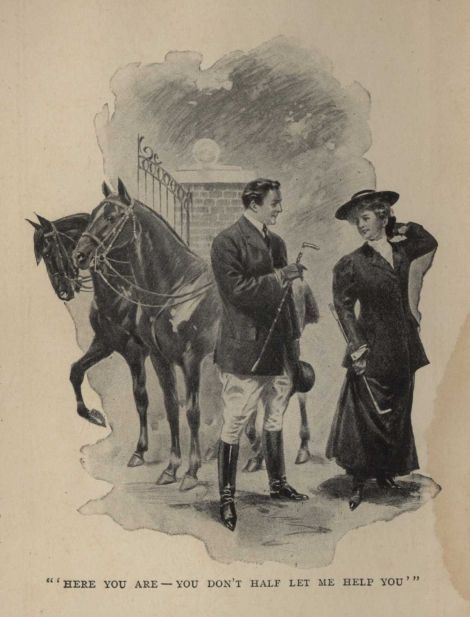
"'HERE YOU ARE--YOU DON'T HALF LET ME HELP YOU'"
ROUND THE CORNER IN GAY STREET
By GRACE S. RICHMOND
AUTHOR OF "With Juliet in England," "The Indifference of Juliet," etc.
ILLUSTRATED BY MAUD THURSTON AND CHARLES M. RELYEA
A. L. BURT COMPANY Publishers -- New York
COPYRIGHT, 1907, 1908, BY PERRY MASON COMPANY
COPYRIGHT, 1908, BY DOUBLEDAY, PAGE & COMPANY PUBLISHED, AUGUST, 1908
ALL RIGHTS RESERVED, INCLUDING THAT OF TRANSLATION INTO FOREIGN LANGUAGES, INCLUDING THE SCANDINAVIAN
PRINTED IN THE UNITED STATES AT THE COUNTRY LIFE PRESS, GARDEN CITY, N.Y.
TO MARJORIE, GUERNSEY AND JEAN
CONTENTS
BOOK I. GAY STREET
CHAPTER
An Introduction by Telephone
Gay Street Settles Down
Peter Sees a Light
Forrest Plays a Trick
Without Gloves
Weeds and Flowers
Jane Puts a Question
Murray Gives an Answer
Snap Shots
Hide and Seek
In the Garden
BOOK II. WORTHINGTON SQUARE
Jane Wears Pearls
Shirley Has Grown Up
Luncheon for Twelve
Pot-hooks
Black Care
A Breakdown
Christmas Greens
Peter Reads Rhymes
A Red Glare
Peter Prefers the Porch
BOOK I. GAY STREET
CHAPTER I
AN INTRODUCTION BY TELEPHONE
The hour for breakfast at the home of Mr. Harrison Townsend, in Worthington Square, was supposed to be eight o'clock. In point of fact, however, breakfast was usually served from that hour on, until the last laggard had appeared.
The head of the house himself was always promptly on hand at eight. On the morning of April second he had, as usual, nearly finished his breakfast before the door opened to admit a second member of the family. Mr. Townsend raised his eyes as a tall and slender figure limped slowly across the floor.
"Morning, Murray!" he said, and dropped his eyes again to his paper.
"Good morning, sir!" responded his son, and glanced indifferently over the table as he sat down. "Bring me grapefruit and a cup of coffee," he said to the maid. "No, nothing else. Be sure the grapefruit is fixed as I like it."
Mr. Townsend finished his newspaper and his coffee at the same moment, and rose from the table. Although five minutes had elapsed since the elder of his two sons came into the room, no conversation had passed between them. Mr. Townsend's glance dropped upon the young man, who, with his look of ill health, would have appeared to a stranger to have lived several more than the twenty-three years which were really his.
"You're not feeling well this morning, Murray?"
"About as usual."
"It's not strange that you have no strength, when you take nothing substantial with your morning meal."
"How can I, when I can't bear the sight of anything but fruit?"
"You don't get out enough."
"I suppose I don't. There's nothing to take me out."
Mr. Townsend turned away. As he passed through the door, he met his daughter Olive, and greeted her.
This very pretty, dark-skinned, dark-eyed girl of eighteen evidently had been keeping late hours on the previous evening. Her long lashes drooped sleepily over her eyes as she nodded to her brother.
"Grapefruit any good?" she asked.
"Fair, if it wasn't sweetened like a bonbon."
"I like mine sweet. Annie, tell Gretchen to put half a dozen maraschino cherries in my grapefruit and some crushed ice."
"You must like the mess that will be," Murray observed.
"I do--very much," replied his sister, decidedly.
The two continued their breakfast in silence, which was presently interrupted by the advent of a fourth member of the family. Forrest Townsend, flinging into the room with a rush, dressed in riding clothes, and casting hat and crop upon a chair as he passed it, offered a picturesque contrast to the two dark-eyed young persons. Of a little more than medium height, strongly built, fair-haired and blue-eyed, he looked the young athlete that he was.
"Hello!" was his morning greeting, as he dropped into a chair. He proceeded instantly to give his directions to the maid. No invalid order was his.
"No--no grapefruit. I want my chop, and some bacon and eggs; tell Gretchen to brown the eggs better than she did yesterday. Muffins this morning? What? Oh bother! You know I hate toast, Annie! Oh, waffles--that's better! Coffee, of course."
"Sounds like an order you 'd give at a hotel," observed his sister, with scorn. "I wonder Gretchen does n't make a fuss at having to cook a whole breakfast like that just for you. Nobody else wants such a heavy meal at this hour."
"The bigger geese you all are then. If I picked at my breakfast the way the rest of you do, I 'd soon lose this good muscle and wind of mine."
"I never heard that hot waffles and syrup were good for muscle and wind." Murray looked cynical under his dark eyebrows. "They would n't be allowed at any training-table."
Forrest leaned back in his chair and surveyed his brother. "A lot you know about training tables--a fellow who spent his two college years cramming for honours," he said, pointedly. "No wonder you look like a pale ghost on such rations. Here comes mother at last."
Mrs. Harrison Townsend, in a trailing pale blue gown, her fair hair piled high upon her head, came in with an air of abstraction.
"Out late last night?" Forrest asked her, attacking his chop with relish. "A dissipated lot you all look but me. Even Murray would be taken for a chap that got in toward morning. That comes of reading in bed. Now look at me. I was in after the last of you, and I 'm as fresh as a daisy."
"For a boy not out of his teens your hours strike me as peculiar." Murray rose slowly as he spoke. He glanced at his mother. She was busy with letters she had found at her plate.
Murray limped slowly over to the end of the room, where a great semi-circular alcove, filled with windows, a cushioned seat running round its whole extent, looked out upon the shrubbery and the street beyond. He sank down upon this seat, and gazed indifferently out of the window.
Across the narrow side street which led away from stately Worthington Square into a much less pretentious neighborhood stood a big furniture van, unloading its contents before a small brown house. Although upon the left side of the Townsend place lay a fine stretch of lawn, at the right the house stood not more than ten yards away from the side street. Its present owner had attempted to remedy this misfortune of site by planting a thick hedge and much shrubbery, but a narrow vista remained through which, from the dining-room windows, the little brown house opposite could be seen with the effect of being viewed through a field-glass and brought into close range.
"What's that over there in Gay Street?" Olive had caught a glimpse of the furniture-van. "New people moving in? Goodness! How many tenants has that house had? They 're always moving out and moving in--nobody can keep track of them."
Mrs. Townsend, looking up from her letter, glanced out in her turn. "There is certainly no need to keep track of them," she observed. "What your Grandfather Townsend could have been thinking of when he built this house on the very edge of such a fine lot----"
"Grandfather Townsend was a shrewd old man, and had an eye to the sale of lots on the farther side of the house when land got high here," was Forrest's explanation.
Five minutes later he was out of the house and crossing the lawn to the stables--a gay and gallant young figure in his riding clothes. From the window of his own room upstairs Murray watched his brother go, feeling bitterly, as he often did, the contrast between Forrest's superb young health and his own crippled condition, the result of an accident two years before, and the illness which had followed it.
"Don't get outdoors enough!" he said to himself. "I fancy if I could go tearing out of the house like that every morning, jump on Bluebottle, and gallop off down Frankfort Boulevard I could get outdoor air enough to keep me healthy."
An hour afterward there was a knock at his door, and a child's voice called: "O Murray, may I come in?"
His thirteen-year-old sister Shirley somehow seemed nearer to Murray than any other member of his family. "Come in!" he responded.
"O Murray," the little sister began instantly, "some new people are moving into the little brown house, and there 's a girl just my age! She looks so nice! I 've been watching her. She 's helping wash windows. Oh, please come into the den and let me show you!"
From the 'den' it could all be seen. There were two girls on the small porch, each washing a window. The elder girl looked as if she were about eighteen, her abundant curly hair, of a decided reddish brown, being worn low at her neck after the fashion of girls of that age. Even across the street the observers could see that she had a merry face, full of life and colour.
The younger girl, was about Shirley's size, round-faced and sturdy, and apparently of an amiable frame of mind, for having accidentally tipped over her pail, she took the mishap in the jolliest spirit, and throwing back her thick brown braids of hair, mopped up the swimming porch with lively flourishes.
"I wish we could see 'em closer," suggested Shirley. "They look so nice--don't you think they do?--not a bit like the other people that have lived in that house. I saw their mother, I 'm sure I did, a little while ago--she had the dearest face! Murray, don't you think you 'd like to take a little walk? It would be such fun to go past the house while they 're out there, and they 'd be sure to turn and look, so we could see their faces. Please, Murray! We may not have so good a chance after they get the windows washed."
It was something to do, certainly. Motives of interest for the daily walk upon which the doctors insisted were few, and the older brother gladly followed his anxious young leader out into the spring sunshine. Slowly, Murray's cane tapping their advance, they turned the corner from Worthington Square into Gay Street.
Coming rapidly toward them from the opposite direction was a young fellow of about Murray's age. This youth, looking toward the brown house, gave a low whistle. The girls upon the porch turned and waved their cloths, and the newcomer, making three leaps of the short path to the house, and one jump of the low porch, was with them.
They did not shout, those three, and the elder girl's voice, Murray noted, was delightfully modulated; but he and Shirley were close now, and they could not help hearing the greeting.
"Hard at it already? Everything come? I got off for an hour, and thought I 'd rush up and do what I could."
"That was lovely of you, Pete," said the elder girl. A surreptitious glance from Murray, and a frank stare from Shirley, proved her to possess a very attractive face, indeed, as she smiled at the stoutly built young man before her. "Yes, everything has come, and mother can keep you busy every minute. Window-washing would n't seem to come first, but we thought we 'd get at least this little front room in order by night, so that when you all came home----"
Her voice was growing indistinct as the passers-by moved reluctantly on. But the younger girl at this point broke in, and her voice, high and eager like Shirley's own, carried farther:
"O Petey, Jane and I are to have the dearest, littlest room you ever saw, right under the eaves. Jane can't stand up all over, but I can--except close to the wall. It's so little, Jane thinks we can paper it ourselves. If we can only----"
Here the deeper voice of the youth interrupted, and nothing more was distinguishable. Murray and Shirley walked on, both, it must be confessed, wishing they had eyes in the backs of their heads.
"Oh, do let's turn and go back!" begged Shirley, with one quick glance behind. But Murray made her keep on to the corner, and then insisted on crossing the street.
"Even now they may guess that we 're watching them," he said. "Don't stare so at them, child."
"But they're going in. Oh, look,"--she clutched his arm--"there's the mother! I'm sure she is. Look! Isn't she dear?"
She did look "dear." She was enveloped in an apron, and her sleeves were rolled up to the elbows revealing a pair of round, white, capable arms. Her abundant gray hair rolled and puffed about her face in a most girlish fashion, her bright, dark eyes were set under arching eyebrows, and her face, almost as fresh in colouring as her daughter's, was full of charm.
The young man, laughing, put an arm about her shoulders, and drew her back with him into the house. The two girls, gathering up their pails and cloths, and exchanging low, gay talk, followed, and the door was closed.
The April sunshine suddenly faded out of the narrow side street and left it as commonplace as ever. Yet not quite. Murray and Shirley, gazing across at the dull little brown house. were longing to enter it. It was quite evident that life of a sort they hardly knew was about to be lived within.
With this new interest to stimulate him, it was perhaps not strange that Murray should have found it rather easier than usual to get out for his afternoon walk, or that it should have ended by a slow progress through Gay Street. There were somehow so few young people he cared for, and the faces of the three he had seen had struck him as so interesting, that he wondered, as he tapped along with his cane, by what means he could learn to know them.
Just as Murray came along the street, the younger of the two girls he had seen opened the door, and holding it ajar, addressed somebody inside in her childishly penetrating voice:
"I 'm going to find a telephone somewhere, Janey, if I have to ring at every door. No--I 'll tell them we are n't the sort of people who borrow molasses and telephones and things all the time, but---- Why, I 'll say it's very important--anybody would understand about wall-paper not coming and the man waiting. No, I don't suppose they have in such a little house, but it won't do any harm to ask. Of course, across the street they'd have--but I don't quite---- No, of course I won't, but----"
She ended an interview which evidently was not proceeding according to her satisfaction by closing the door and running down the steps into the street. Murray wanted very much to speak to her and offer the use of his telephone, but she whisked away so fast he had no time. He walked more slowly than ever, saw her turn away from two Gay Street doors, and then retraced his steps, and met her as she was preparing to ascend the third small porch.
"I beg your pardon," he said, "but I thought I heard you say something about needing to use a telephone. Won't you please come over and use ours--the house on the corner?"
"Oh, thank you!" She looked relieved. "That's good of you. We hate to bother anybody like this, and Jane--my sister--did n't want me to, but the paper man is waiting, and he 's getting very cross, and we do want to get the dining-room done before night. I 'll go and tell Jane. She 'll have to telephone. I can't--I don't know how!"
She ran into the house, and a moment later the elder sister emerged, and came down to Murray to accept his courtesy.
"It's very kind of you," she said, as he accompanied her across the street and in at the hedge gate. "To-morrow happens to be a legal holiday, you know, and the paperer says if he does n't have the right paper this afternoon it will be three days before he can finish."
"That would be an awful bother," Murray declared, "just as you 're getting settled. I 'm glad we 're so near. Come in. This way, please. Take this chair here by the desk. I 'll just wait in the hall and show you the way out."
As he waited, Murray could not help hearing. The business did not seem to be easily accomplished. When his visitor had succeeded in getting the paper house on the telephone she had a very bad time making the man at the other end of the line understand about the mistake in the paper, and when it became plain that he did understand, Jane's surprised little sentences showed that he was a most unaccommodating person, and would not do what she requested.
"You can't do it?" she asked, and Murray observed that with all the trouble she was having her voice did not lose its courteous intonations.
"Not this afternoon at all? We are very anxious to get the room settled and the paperer says---- Yes, I know, but it surely was n't our mistake. I beg your pardon--it 's only three o'clock, I think, not four. He says there 's plenty of time if---- No, I 've nobody to send."
"Look here!" Murray's disgusted voice was at her ear. He was gently attempting to take the receiver away from her. "Let me tackle that person, please."
The next moment Jane was standing beside the desk, her cheeks rosy with a quite reasonable indignation at the treatment she had been receiving from the surly unknown. At the telephone sat her new acquaintance, sending rapid requests over the wire in a tone which plainly was making somebody attend.
"Not fix up your own mistake to-night--with to-morrow a holiday? Why not? There's plenty of time. Send by a special messenger, of course, and tell him to be quick. Who's talking to you? That does n't make any special difference, does it? It may be a small order--I don't see what that has to do with it. Mrs. Bell needs that paper up within half an hour. Yes--well, this is Harrison Townsend's house--Worthington Square, and I 'm telephoning for our friends. What? Oh, you will! Well, thank you! I 'm glad you see your way clear. Yes--half an hour--I say, make it twenty minutes, can't you, please? Very well." And Murray broke off, and hung up the receiver with an impatient click which expressed his contempt for a clerk who would hurry up an order for Worthington Square when he would n't do it for Gay Street.
"Idiot!" he remarked.
The girl beside him moved toward the door, smiling. "It was ever so kind of you," she said. "The paper is for the dining-room, and you can guess how it upsets things to have the dining-room in confusion."
"I hope you didn't mind my telling that fellow you were our friends," said Murray, as he accompanied his guest to the door. "Such near neighbours----"
"Oh, I understood! That was what made it so easy for him to get a messenger! Only--please don't think we----"
"Yes?" Murray was smiling encouragingly at her.
"It sounds absurd, but--it's so dreadfully soon to be borrowing telephones----"
"Or molasses?"
They both laughed. Murray's hand lingered upon the door knob, which at this moment it became timely for him to turn for her. "I could n't help hearing your sister assuring you that she would tell people you never borrowed molasses. I don't see why not. We might need to borrow it of you some time, but of course if you feel there's something especially prohibitive about molasses----"
He knew he was not saying anything brilliant, but it made her laugh again, and laughing is an excellent way of getting over a trying situation.
But he was obliged to open the door for her without delay, for she plainly was not going to be tempted into lingering. She ran down the steps, and he saw her bronze-red hair catch the sunshine as she went. As she reached the bottom he called after her: "I hope you'll like that paper mighty well when it's on!"
"Thank you!" he heard her answer, over her shoulder, and he was sure that she was still smiling. It seemed to him reasonably certain that the Bells were pleasant people to know.
CHAPTER II
GAY STREET SETTLES DOWN
Tramp, tramp, upon the little porch. Peter flung the door wide, and in marched the four male members of the house of Bell. The door opened hospitably at once into the living-room, so that the four were able at a glance to see what had been accomplished, and they immediately gave voice to their surprise. "Hi!" This was fifteen-year-old Rufus's exclamation. "Hi! hi! Hip, hip, hurray-ay!"
"Well, well, they must have worked!" said Peter. "I was up here an hour this morning, and they had n't got further than washing the windows."
"When it comes to hustling work, Mother Bell and corps can't be beaten," declared Ross McAndrew, the cousin of the Bells, a pleasant-faced lad of eighteen.
There was a rush from the rear of the house, and Nancy was upon them--Nancy, the twelve-year-old, with the thick brown braids and the round, bright face. Ross caught her and swung her up to his shoulder, where she struggled frantically.
"I 'm too old, Ross!" she pleaded, rumpling his curly fair hair in revenge until it stood on end. "Put me down! Put me down at once! O-oh, you 're bumping my head against the ceiling!"
He looked up and laughing swung her gently down. "It is n't a very lofty apartment, is it, Nan? Did it hurt?"
"Only my feelings. Does n't it look nice here? Mother worked at the kitchen, and Jane and I did all this. We wanted it to look like home when you came."
"It does, indeed. But I must admit I 'm glad mother kept at the kitchen," laughed her father, with a tweak of one fat braid. "It seems too much to expect that we should have a meal to-night in all the disorder, but Peter brought back word this morning that we were to come."
"Indeed you are," said a voice from an inner doorway, and everybody turned. A fresh white apron tied about her trim waist--where did she find it in the confusion?--her beautiful hair in careful order, Mrs. Bell beamed at her big family. "We've nothing but an Irish stew for you, but we had it on this morning as soon as the fire was built, and it's tender and fine."
"Good for you! We like nothing better. Where's Janey?"
"In the kitchen, trying to make places for you all at the kitchen table. We could n't do anything with the dining-room. The paperer has only just gone."
"Come on, you people!" called a blithe voice from the next room, and Jane's face looked over her mother's shoulder. "Turn to the right as you come through the door, and follow the wall round. I 've made a passage that way, but you 're likely to get into perilous places if you try to steer for yourselves."
In single file they followed directions, all but young Rufus, who preferred leaping from box to barrel, and from table to trunk, and so reached the haven of the kitchen first.
"Whoo-p!" he ejaculated. "Say, but this is jolly! Mm-m! Smell that stew? Hope you 've lots of it?"
"All you can eat," responded Jane, confidently. "Now if you 'll let me seat you all, I 'll make a place for every one. Mother to go first, at the other end, in the chair--our only one available as yet. Next, Ross, on the cracker-box, and Nan on the wood-box. Daddy's to have this soap-box all to himself, with a cushion on it. Peter can sit on that coal-hod, turned upside down."
There was a roar at this, and a protest from Peter. "'Can't I have a newspaper to pad the top of it, sis?"
"If you will find one," Jane responded, unmoved. "Rufe will have to take the top of that flour-barrel, and we 'll hand up his things."
Mrs. Bell was a famous cook, and understood well the quantity of food necessary to appease the keen appetites of her big family, so the bowls were replenished again and again, until all were satisfied, and still the kettle was not quite empty.
"You're not much like a girl I saw to-day, Janey," remarked Peter, balancing himself in the attempt to sit comfortably back upon his coal-hod, while his sister removed the plates and set forth a dish of baked apples and cream. Peter laughed at the recollection. "She was too stately and languid to lift her eyes to look at me, after the first frosty glance. We rode up town on the same street car yesterday, when I was coming here to make sure the house was ready for us. It was the rush hour, of course, and I gave her my seat. I think--yes, I really think"--Peter paused to reflect--"she said, 'Thank you,' though since of course I was n't looking at her as I took off my hat I did n't see her lips move. She and I got off the car together, and came up Gay Street together----"
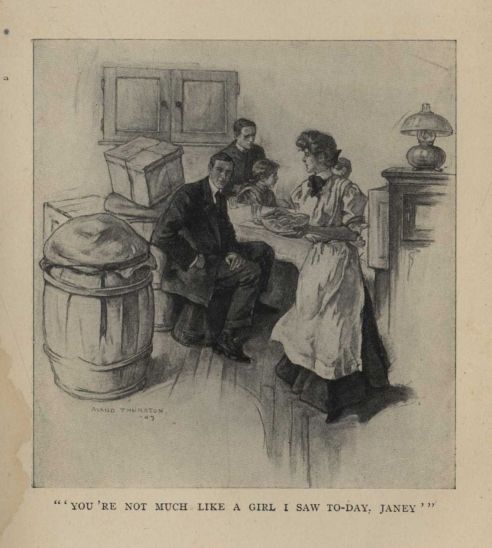
"'YOU 'RE NOT MUCH LIKE A GIRL I SAW TODAY, JANEY'"
"Together!" from Jane.
"On opposite sides of the street. She was a little ahead, for the car stopped on her side. I looked across at her with interest as I came along--wanted to find out what our neighbors were like, you know. She was carrying a big muff, and had some things in it--been shopping, of course. Oh, I don't mean parcels--she would n't be caught carrying a parcel--but letters and a purse and a card-case and a pocket-handkerchief, and so forth. Well, as we came along I noticed she had dropped something--handkerchief, by the way it fluttered down. Of course I bolted across the street, through six inches of spring mud, grasped the article, and rushed after her. I said, 'Pardon me, but you dropped your handkerchief,' and held it out. She took it, murmured 'Thank you!'--I saw her lips move this time--"and sailed on like a queen. I took off my hat, waded back through the mud, and was continuing on my thankless way----"
"Thankless!--I thought you just admitted she thanked you," objected Ross, with a twinkle.
"It was one of those thankless thank-yous, just the same," explained Peter, with gravity. "Well, as I say, I went on--like this story--meditating upon her cordial manner, when I saw something else fall from the capacious muff."
"You didn't!" Jane looked incredulous.
"Pardon me, I did. This time I did not bolt across the street; indeed, I stopped to consider whether I should not shout, 'Hi, hi, there, you 've dropped your purse, lady!' like a street gamin. But reflecting on the embarrassment this might cause me at some future date, when she and I should really meet, I picked my way across again, seized the pocketbook, and was about to pursue her, when she looked round and caught me in the act of scrutinizing it, as one naturally does upon picking up a gold-mounted, aristocratic affair like that, the like of which he expects never----"
"Oh, go on!" Rufus could no longer endure his brother's tantalising eloquence.
"I hastened to her side," continued Peter, who was gifted in the art of putting things elaborately when he chose, "and remarked, 'I believe this is yours?' She--now what, friends, would you naturally expect a girl to do on receiving the third favour from a stranger within fifteen minutes?"
"What did you expect? Did you suppose she would fly into your----"
"Did you want her to open the pocketbook and hand you a quarter, saying, 'Here, my honest lad----'"
"Think she 'd say, 'You must call and see father. He will give you a position in his----'"
"Your suggestions are far-fetched and improbable. I expected none of these things to happen. But consider the situation. Here was I, crossing the street for the third time in the mud----"
"Go on!"
"Would n't you have thought, considering the absurdity of the affair--her strewing things along the street like that--the least she could have done would have been to----"
"Smile!" supplied Jane. "Did n't she, Peter?"
"She did not," avowed Peter. "She just looked at me as if she thought I had been about to steal her purse, took it, and went on, this time without saying thank you!"
"Good gracious!" This from Ross. "She must be a nice girl to know. And you look pretty well, too, Pete, in that blue suit."
"Where does she live?" Nancy inquired, her round face sympathetic with Peter's mock humiliation.
"In the big house across the street. If you get out of milk or eggs, Janey, don't hesitate to run across and borrow some," counselled Peter.
"Now if you 'll just make use of us all this evening," proposed Mr. Bell, rising, "we can accomplish a good deal--eh, boys? Shall I open the boxes and barrels, Martha?"
At this suggestion three more pairs of strong arms were put at Mrs. Bell's service. She set every one at work at once.
"Yes, Joe, dear," she agreed, "if you will open the boxes, I 'll take out the things and put them in place as far as I can. That's right, Nancy, you help Jane with the dishes, and when they are done you can go up stairs and make up the beds. Ross and Peter----"
"Yes, we 'll set up the beds," said Peter, with alacrity, anticipating the division of work, "and uncrate the chests of drawers and the bedroom furniture generally. Come on, Ross. You 're as much one of the family as any of us now, since you helped us move, and a little family labour like this will complete the job. Whoever lives with us has to learn to be handy man about the house."
"I 'm ready." Ross looked it. There was an air of alertness about him, for he was slimmer and lighter than Peter, and his fair curly hair made him appear much younger, although only two years separated the ages of the cousins.
"You will find the furniture mostly in the rooms where it belongs," Mrs. Bell called after them. "Jane will be up soon and straighten you out, if you get mixed. Rufus, suppose you go round after the others and bring away all the litter they leave after the uncrating, and make a neat pile of it in the wood-shed."
The steep and narrow little staircase ascended abruptly between walls from the dining-room and led to low-ceiled regions above, which, to the eyes of Murray and Shirley Townsend, from the big house across the street, facing Worthington Square, would have seemed too cramped and small of dimensions to be habitable, to say nothing of the possibility of their ever being made comfortable. But the Bells were of the sort who make the best of everything, and so far none of them had suggested that the little house was not an abode fit for the finest.
"Jane and Nan in one room, Rufe and I in another, and Mr. Ross McAndrew alone in state in this little one in the corner. I judge by the signs that's the stowing of the crowd intended," speculated Peter, surveying each room in turn.
"That corner room's as big as any. I don't think I ought to have it all to myself," objected Ross.
"What, not that spacious eight-by-nine apartment, with one whole side under the eaves?" laughed Peter. "Well, since we can't split ourselves into halves, and like the family of the famous poem 'we are seven,' I don't see but you 'll have to make the best of your loneliness. The beds are only three-quarters size, and Rufe takes up less room than you do, so he and I naturally chum it."
"All right. Let's make a start. Catch hold of that bureau, and heave it around into place."
They fell to work with a will. Ross, the more lightly built, showed the greater energy of the two, though Peter worked away quite as steadily. But after an hour of hard labour Peter called a halt.
"Oh, let's put it through," and Ross bent over a box with undiminished ardour.
His attitude appealed to Peter, spoiling for fun after a long day at the factory, and in a twinkling he had tipped his cousin head first into the nearly empty box. Shouts, laughter and a lively scuffle ensued--so lively a scuffle, indeed, that Mr. Bell, Jane and Nancy, in the dining-room below, energetically sweeping up the litter made by the paperer, smiled at one another in mock dismay as the floor above resounded with the pounding and scraping of boot-heels, and the very walls of the small house trembled with the fray.
"Goodness, I should think it was elephants up there!" cried Nancy, and ran half-way up the stairs to see what was going on.
Mr. Bell opened his mouth to say, "Tell them it's an old house, Nan, and the ceiling 's cracked"--when the thing happened.
The ceiling was old, the house was not too solidly built, and the battle above had reached its height when, quite without warning, down upon the freshly cleaned floor fell a great mass of plaster. The powdery lime rose in a suffocating cloud and covered Jane and her father with dust and debris.
It was a minute more before the combatants, wrestling furiously over the bare floors above, could be made to understand by a horrified young person, who shrieked the news at them from the top of the staircase, the havoc they had wrought.
But when they comprehended what had happened they hurried downstairs.
"Well, of all the----" Ross was too shocked to finish.
"I say, but we've done it now, have n't we?" exclaimed Peter, in disgust. "Janey--dad--it did n't hurt you, did it?"
"Only my pride--and my hair," answered Jane, as she vainly tried to brush her curly locks free from plaster.
"It's a shame! Why didn't you stop us? Clumsy louts! Pulling the place down about our ears the very first night!"
"And how we hurried that paper man, to get him through to-night!" lamented Nancy, brushing off her father with anxious fingers. "We were going to have the dining-room all settled to-morrow----"
"And to-morrow 's a holiday," murmured Jane, from under her hair.
She was bending forward, with her head at her knees, while Mrs. Bell shook out the clinging lumps from the tangle of hair in which they were caught.
"It's a quarter of ten," announced Rufus, cheerfully. "Do we have to clear this up to-night?"
"I should say so!" Ross caught up a broom.
"It's the least we can do. Get a box, will you, Rufe, and let's have the worst over. Pete and I will do the job, and the rest of you can go upstairs and dance a hornpipe over our heads. If you will throw things at us from time to time down the stairs it may relieve your feelings."
"Don't feel too badly. I had a notion all the time that that ceiling ought to have been pulled down before we papered the room; it looked old and shaky to me. Now we 'll have a new one that will stand pillow-fights as long as we live here," said Mrs. Bell, smiling at the rueful countenance of her nephew.
"Right you are, and I'll have a man here to put that plaster on in the morning, holiday or no holiday," promised Peter.
In ten minutes the plaster had been swept up, Jane's hair had received a thorough brushing, Mr. Bell had been relieved of several lumps which had worked their way down his back, and the family went to bed in as good spirits as if nothing had happened.
The next morning Peter started early in quest of a plasterer to restore the ceiling, and finding it by no means easy to discover one who cared to work when he might play, came home after two hours' search baffled but still determined. A passing acquaintance gave him a clue, and he was presently hurrying across the street in search of the Townsends' coachman, whose brother, the acquaintance had said, might be persuaded to do the job.
In the stables, much to his astonishment, he came fairly upon the girl whose propensity for losing things he had described with so much gusto the evening before.
"I beg your pardon," he said, quickly--he seemed to be always begging her pardon--"but I was looking for your coachman. I--he--I hoped he could tell me the name--that is, of course he knows the name--I mean, I wanted his brother's address."
Peter was no stammerer, and it irritated him very much to be saying all this so awkwardly, but there was something about the cool dark eyes of this girl, as she stood looking at him, which rather disconcerted him. She had evidently just dismounted from her horse, and now Peter observed two things--first that she was rather oddly pale, and second, that her side-saddle had slipped, and rested at an altogether improper angle upon the horse's back. As he saw this he came forward.
"What is the matter?" he asked quickly. "You haven't had a fall? You didn't ride this way, of course?"
"Yes, I did," she answered, lifting her head rather high, and then suddenly drooping it again.
"How far? When did it slip? Were you alone?" Peter examined the side-saddle.
"It began to slip--back--at--the boulevard," said the girl, rather slowly. "I--I don't know just how I kept on, but I did. Lewis is n't here. He ought to be. I can't put up Blackthorn myself."
"Let me do it for you." Peter took the bridle from her. He soon had the horse in the stall and had put away the saddle and bridle.
"That was a plucky thing to do," declared Peter, coming back to the stable door, where the girl had dropped into the coachman's chair, "to ride home with a slipping saddle. But you ought not to have done it, you know. It might have slipped a lot more with a jerk, and thrown you. See here, you 're not feeling just right, are you? Shall I call somebody?"
"No, no!" She started up. "If mother knew the least thing went wrong she would n't let me ride at all. If you--if you just would n't mind staying here a little, till I feel like myself again----"
"Why, of course I will"--and Peter stayed.
It was only for a few minutes, and meanwhile Lewis, the coachman, had returned, and the matter of the loose saddle-girth had been fully discussed by all three. Then Peter took his way home.
Jane met him at the door. "Did you find where the plasterer lives?" she asked, eagerly.
Peter stared at her, turned about, and gazed across the street, as if he expected to see a plasterer following in his path, trowel and float in hand. Then he burst into a laugh. He mumbled something which sounded like a very peculiar name, if it was a name, and rapidly retraced his footsteps across the street, to make his inquiry of Lewis, the coachman.
CHAPTER III
PETER SEES A LIGHT
The Bells had been at home for a fortnight in Gay Street.
The little house was in order from cellar to roof, and its occupants had settled down to the routine of their daily living, well content with the new abode. In a way they missed the larger house and freer environments of the remote suburban place they had left, but the early hour at which Mr. Bell and the boys were now able to reach home, and the later one at which they could leave in the morning, amply compensated for the more cramped quarters made necessary by the higher rates of rental in the city.
"It's not a very friendly neighborhood, though, is it, Janey?" commented Peter one evening, as he and Jane stood on the porch, enjoying the mild mid-April evening. "How many calls have you had? Two?"
"Three," corrected Jane, cheerfully. "The two old ladies on the right, the mother of six the left, and one odd person from Westlake Street. The rest are still looking us over."
"Nobody from Worthington Square?" Peter's tone was quizzical.
"Absolutely nobody," Jane laughed. "But we have one acquaintance in Worthington Square, Peter--the little Townsend girl with the sweet, pale face. She wants to know us dreadfully, and she's such a dear, democratic little person the smiles positively tremble on her mouth when I meet her--which I do almost every day. So does Nancy. It 's the oddest thing! Nan says she almost never stirs out that the Townsend child does n't appear."
"She wants to get acquainted. I don't blame her. They 're the dullest lot over there. There seems to be one stirabout--the good-looking chap who 's off on horseback every day. But the other son 's a paleface, and the daughter--hum--well----" Peter's pause was eloquent. "I think she's---- Hello! What's that?"
He had looked over at the big house as he spoke of its inmates, and his eye had been caught by an appearance which struck him as unusual. The house was dimly lighted everywhere, but in one room, the upper one with the semicircular window, there was an effect of brilliancy of a ruddier color than is ordinarily produced by electric lights. As Peter and Jane now stared at it, it seemed to grow in intensity, and there showed a wavering and flashing of this singular light which looked suspiciously like fire.
"Do you suppose there can be anything wrong?" speculated Peter, anxiously. "Of course a fire of coke or cannel in a fireplace might give that effect, through those thin curtains, but we--haven't seen--anything like it--before--and--By George!" as the light flared more ruddily than ever for an instant and then grew dull again, "I believe there is trouble there! Anyhow, I 'll run over and find out! They can't blame me for that."
He was starting off at a run when Jane darted after him. "I 'm sure I saw flames jump up, Pete!" she called, excitedly. "The window's open, and the curtain blew to one side. Oh, hurry! Most of them are away; I saw them drive off an hour ago."
She was running at Peter's side, fleet of foot as he. Her mind had leaped to the youngest member of the unknown household, the one who did not drive away after nightfall to dinners and parties, like the others. Only that day she had met Shirley and exchanged with her the few bright words the little girl seemed to welcome so eagerly. They ran up the steps of the great portico, with its stately columns, and hurrying across it, came to a partly opened door. Peter rang the bell, peering impatiently through the vestibule into the large, square, half-lighted interior. "I 'll wait just one minute for an answer," he said with his foot on the threshold, "and then I 'll be up that gorgeous staircase back there."
Jane put her head in at the door. "I smell smoke!" she breathed, and Peter pushed past her. Delaying no longer, he ran across the hall and up the staircase, closely followed by Jane.
As he reached the top, a little white-clad figure ran screaming toward him. He rushed by, but Jane, at his heels, caught the little girl up in her arms.
"There, there, darling," she soothed the frightened, sobbing child, "you 're all safe! Peter will take care of the fire. Are they all away? There, don't be frightened, dear!"
Over Shirley's head Jane saw Peter vanish through a doorway--beyond which she could see a mass of smoke and flame--slam down a window, and dash out again, closing the door behind him. Then he was off down the stairs, shouting for help as he went, and getting no response from any quarter of the strangely deserted house.
"Take her away!" he called back to Jane, as he ran, and Jane attempted to obey.
"Where are your clothes, dear?" she asked the child in her arms, but could get no coherent answer.
She looked about her, and carrying Shirley, who was slender and as light of weight as a much younger child, soon discovered the little girl's room. She caught up the pile of clothes on a chair, and attempted to dress her charge. But Shirley only cried and clung. Jane pulled a silken blanket from the little brass bed, and wrapping the child in it, and rolling her clothes into a bundle, which she tucked under one arm, carried her downstairs and into a small reception-room near the front entrance.
Peter, dashing through the silent house toward the rear, hoping to come upon a man-servant somewhere, was met at last by a startled maid.
"A room upstairs is on fire," he said. "Any men here to help me put it out? If there are n't I must send in an alarm. Any fire-extinguishers about?"
The girl's wits scattered at the news, but she managed to recall the fact that the coachman must be at the stable again by this time, and flew to call him. Peter ran back to keep track of events. He saw that the walls were heavy, that the fire was thus far confined to the one room, and that if help came speedily it would not be necessary to call out the fire department, an expedient to be avoided, he felt sure, unless the danger to the house was greater than he thought.
But the frightened maid forestalled him in this plan. She ran to the telephone and sent in the alarm herself, although in the confusion of her fright she lost some minutes in getting the message properly reported. Meanwhile, the coachman having arrived to aid Peter, bringing with him the apparatus kept in the stables for the purpose of extinguishing fire, the two were soon successfully fighting the flames without further aid.
Shirley, downstairs, was still trembling in Jane's arms, and incoherently crying for her brother Murray, who, she insisted, had not gone out with the others that evening, but had been reading in the room which was now on fire. At that moment Murray himself came limping in at the open door. The maid met him at the threshold.
"O Mr. Murray," she began--and Jane, in the reception-room, heard her--"the house is on fire, and----"
"What? Where? Where's Shirley? Who's----"
Jane, with the child in her arms, appeared at the door of the reception-room. "She 's here--quite safe," she said; and with an exclamation, Murray came anxiously toward the two. Then he paused and looked up the staircase, for through the distant closed door upstairs could be heard the sounds of voices, shouting directions. The maid was beginning an excited explanation when Jane interrupted her:
"My brother is here, and he and your coachman are putting it out, I 'm sure."
"Has anybody sent in an alarm?"
"I did," said the maid. "The young man told me not to, but how did he know he could put it out? And the master 'd be blamin' me----"
"We don't want the firemen here if we don't need them," Murray was beginning, when the distant and familiar clang of a gong stopped the words upon his lips. In a moment more it became evident that a fire-engine and its train were upon them. Murray turned away, and started hurriedly up the stairs.
At the approaching noises, which to the delicate child had always been peculiarly terrifying, little Shirley began to cry afresh. Jane gathered her up with an air of determination.
"I'm going to take her to our house across the street," she said to the maid. "There's no need of her staying here to be so frightened."
The girl made no remonstrance. She was too excited to do more than bewail the absence of the other servants, and the misfortune of her having been left alone in charge. "I 'd just stepped out of the door a minute, miss," she explained, "to speak to a friend of mine that was passing. 'T was a mercy I left the door open, or the young gentleman couldn't have----. There's the gong!--There 's the fire-engine!--Oh, my--but look at the crowd comin' after 'em!"
"Show me a side door where I can slip out, please," requested Jane hurriedly, and the maid obeyed.
As the firemen ran in at the front door, Jane, with Shirley in her arms, hurried out at a low side entrance, from which a path through the shrubbery led to a gateway in the high hedge next the street.
As she reached her own porch, the rest of her family came rushing out, having heard the commotion in the street. She almost ran into Nancy who stopped abruptly to stare at Jane's burden.
"Come back into the house with me, Nan," said Jane, quickly. "Here 's our frightened little neighbour. The fire will soon be out, but I thought she'd be happier over here, for the family are all away."
In the house she put Shirley down upon the couch in the front room, and the child, staring up, her big eyes full of tears and fright, beheld the face of the girl she had so longed to know smiling down at her.
"This is splendid!" said Nancy Bell. "I've wanted to know you like everything, and now I 've got you right here in my own house. Won't you let me help you get dressed? I 'd love to."
Seeing that Nancy would be better for the shy little visitor than any number of older persons, Jane left the two together, and went out to see what was happening.
It was very little. The fire-engine was already turning to leave, the driver grumbling at a needless alarm. "All out!" a voice was shouting, and the crowd was reluctantly pausing upon the edge of the lawn, disappointed that no further excitement was to be had. Upstairs the firemen had found the fire subdued to a mere dying smother of smoke, the efficient chemical having made quick work of the blaze, which had not had time to attack the walls of the room, but had been confined to its furnishings.
Peter, his hands and clothes grimy, made light of the affair to Murray, who was looking in at the ruin of the room.
"I took a few liberties with your front door," Peter said, "finding it open and no one about. Oh, no, it hadn't much headway; I saw that when I decided not to call out the department. It was quite a blaze, but mostly the light stuff about. It must have caught from the curtains blowing into that student-lamp."
"That's my fault," Murray owned. "I hate electric lights to read by, so I lighted that lamp here. I was reading, but the room began to feel stuffy, and I opened the window. It looked so pleasant outside I thought I 'd take a turn round the square. I 'm not a fast walker"--he glanced at his lame leg--"and I was probably at the other side of the square when you came in. Look here, you must have been mighty quick to take in the situation, for I couldn't have been away over five minutes when you saw the blaze."
"My sister and I happened to be standing out on our porch--you see, we live just round the corner in Gay Street--about opposite these windows here----"
"I know," Murray nodded. "I 've seen you."
"We thought at first it was a cannel-coal fire--you know how they flash with a red light. But when we suspected, we just ran across. I hope your little sister wasn't too badly frightened?"
"Her room's next to this. Poor child, she was frightened. I deserve a thrashing, you know, for my carelessness. Every one of the family is out, and all the servants except my mother's maid. It was very kind of your sister to take Shirley in charge. She's downstairs with her now."
"Will your people be getting news of the fire-alarm and be frightened?" Peter asked, putting on his coat.
"I don't think so. Father and mother are out of town at a dinner, and my sister's at a party in a country house. They won't be likely to hear. I don't know where my brother is. Don't go. Must you? I--you know I'm awfully obliged to you for this----"
"It's nothing. Glad I happened to be on hand," and Peter would have said good night and run down the stairs, but he saw that his host meant to go down with him. So he descended slowly, keeping pace with the other's halting steps, and talking with him as he went.
"Your sister was here when I came in," said Murray, glancing into the small reception-room. The maid, who had been watching the departure of the crowd from the window of this room, turned to him.
"The young lady took Miss Shirley home with her," she explained. "I was that flustered I let her go without so much as asking you, Mr. Murray, but----"
"It's all right," Murray put in, hastily. "It was just the thing to do, the child was so scared. If they 're at your house, I 'll just step over there with you, if you don't mind."
"Glad to have you," said Peter, wondering what Jane would say to this second unexpected introduction.
Murray, as he walked slowly toward the house in Gay Street, felt distinctly glad of the chance. Since his illness he had led a lonely life, and he longed for comrades near at hand. From behind the curtains he had done not a little watching of the coming and going in Gay Street, and had been strongly attracted toward each one of the household across the way. He liked the faces of those people. He had wished that he could make their acquaintance.
"Walk in!" invited Peter, throwing the door hospitably open; and Murray, his quick, curious eyes taking in everything at a glance, entered the small front room, which was just then unoccupied. He heard voices and laughter near at hand, but for the moment, while Peter went to summon his mother, he had time to look about him.
There was not very much in the room, and there was nothing of value, as that word was used in the Townsend house, yet the visitor could not help finding the place warmly attractive. There was a homelike look about it, and there was an indefinable air of refinement. The furniture was old and very nearly shabby, but it was not the cheap and tawdry furniture one might have expected to find in such a house. The pictures on the walls were all good copies of great pictures, or photographs set under glass. Piles of music lay on the old-fashioned square piano, and a few papers and magazines, all of good selection, were upon the table, in the centre of which burned a brilliant lamp. But most of all, the character of the household was shown by the books--as it inevitably is.
Of these there were a surprising number. Murray felt his respect for the Bell family rising immensely as he noted the contents of the rows of home-made book-shelves. They were in plain, worn bindings, most of them, quite unlike the stately rows in the great library at home; but they were the same old friends, in common clothes, and Murray rejoiced at the sight.
Peter was quickly back, bringing with him the lady whom Murray recognised as the mother of the family. She was a lady--no doubt of that. He had been sure of it before. Now, as he listened to her voice--the test incontrovertible--he knew beyond question.
She greeted him cordially. He was charmed with her face, with her manner, with everything about her. Then Peter brought all the others in, and Murray shook hands with them all. Shirley appeared, clinging to Nancy's hands, and Shirley was so happy, and begged so hard in his ear to stay a few minutes longer, that he willingly delayed their departure.
Fine fellows, Peter and Ross and Rufus proved to be on acquaintance. Not in the least overawed by the presence of the rich man's son from Worthington Square, they talked business and football and politics and various other things in those few minutes, in a hearty, half-boyish, decidedly manly fashion that he thoroughly enjoyed.
It happened that Murray said less to Jane than to any of the others, but he noticed her not a little. He thought he had never seen a girl who looked so spirited and sweet and gay and gentle all in one. He felt that his sister Olive must learn to know her at once, that she might learn what it is to be pretty without seeming aware of the fact, and how it is possible to make a stranger feel wholly at his ease without appearing to exercise any arts.
"I suppose I ought to be taking my sister home," Murray said at last, getting to his feet. "The truth is, she has wanted to know Miss Nancy since she first saw her, and so----"
"Murray wanted to know you, too," said Shirley, in Nancy's ear; but as her brother paused, the words were audible to everybody.
"To know me?" queried Nancy, in surprise, and everybody smiled.
"I'm sure my mother and sister will call--soon," said Murray, trying to feel sure of that rather doubtful proposition as he made it.
The moment would have been an awkward one in some small houses, for it was impossible not to remember that the Worthington Squares do not make many calls in the Gay Streets, but young Rufus, studying Shirley with interest, broke in, without intention, upon his mother's reply. Rufus was quite untroubled by the social inequalities existing between localities divided only by a stone's throw.
"That 's a dandy tennis-court you will have there when you put it out," he remarked.
"It's pretty fair--and we shall have it in shape early this year," replied Murray, smiling. There was a beauty about Murray's rare smile which quite transformed his pale face. His eyes met Jane's as he spoke.
"It 's too bad to grow up past the point of breaking the ice so easily, is n't it?" she said, merrily, as he shook hands.
"We 'll have to follow their wise example," he replied.
"I hope that you 'll find your way over to Gay Street often in the future," declared Peter, shaking hands.
"I mean to, thank you, if you'll let me?" Murray looked into Mrs. Bell's eyes, and a shade of wistfulness crept into his own, which she saw, and recognising, was sure she understood.
"Please come, if you care to," she said, cordially, and he felt her warm, firm hand give his a friendly pressure, which quite completed the capturing of his heart.
A ringing step on the porch outside, a knock at the door--it boasted no bell--and everybody looked up surprised, for it was nearly ten o'clock. Ross opened the door.
"I beg your pardon," said a gay and careless voice outside, "but I came to look for my brother and sister. They seem to be lost, and I 'm told they 're here."
"Come in!" said Ross, and the owner of the voice appeared upon the threshold. Standing there, surveying the company with his characteristically assured expression, his handsome face taking on a saucy smile as his eyes fell on his brother, Forrest Townsend was carefully and formally presented by Murray to each one of the household in turn.
He looked a fine figure in his evening clothes, his long outer coat falling open, his hat in his hand. His audacious young eyes fell on Jane before he was presented to her, and his manner acquired a sort of laughing gallantry rather effective. "It was a very lucky fire for us," he said, gaily, as he bowed. "I only wish I had been at home."
CHAPTER IV
FORREST PLAYS A TRICK
"It's no more than civil, mother, that you and Olive should go over and call!" insisted Murray Townsend, with heat.
"I can't see that it is necessary at all," replied Mrs. Townsend, with offsetting coolness. "The young man has been properly thanked for his services; indeed, I should say that between you and Forrest and Shirley the entire family have had quite fuss enough made over them."
"I didn't make much of the fuss," Forrest said. "I was only there five minutes at the end of the show. Time enough to see, though, that those people are n't off the same piece as the usual tenants of that house. They 've seen better days, or I miss my guess."
"Not at all. They 've never had much money, but they 're educated people, just the same--self-educated, a mighty good sort. You 've only to look at the books that fairly line that little room to see for yourself. Is n't there any rule for sizing up men but by the dollars they 've made--or women but by the clothes they wear?"
The vehemence of Murray's speech was so unusual, and his ordinarily quiet and indifferent expression had given place to one so eager, that the family all turned with one accord to look at him. They were at dinner, one late April evening, a week after the fire. The dining-room was the one place in the house where all the family were accustomed to meet; therefore any question of the sort which Murray had proposed was brought up there as a matter of course.
Mr. Townsend himself answered his son's pointed observation, forestalling the rejoinder about to fall from his wife's lips:
"It's the way of the world, Murray, and an unjust one in many cases. Still, one can't help feeling that a man who has lived to the age of Joseph Bell without reaching a position higher than the one he holds with the Armstrong Company can't be possessed of a very unusual endowment of brains."
"I should say that depends on whether making money has been his ambition, or something else."
"He certainly hasn't achieved the something else," was Olive's comment. "Not even a decent home."
"Decent!" Murray turned on her. "It's a home worthy the name--I can tell you that! And if you refuse to call on these people that live in it, after Peter Bell saved ours over our heads, I say you 're acting like snobs!"
"Murray!" His mother spoke very sharply. Forrest laughed. He enjoyed the scene, being inclined, by his remembrance of Jane, to take his brother's side. Mr. Townsend came to the rescue.
"You are rather rough in your language, Murray, but I think you are right in your notions about the call. It's only a courtesy, surely, Eloise, to go over and make one call. You don't need to continue the acquaintance unless you wish, but I should be glad myself if you would go. It is several days now since----"
"It's a week," said Murray.
"He knows--no doubt of that!" laughed Forrest. "He's cultivated the acquaintance, anyhow. I saw him walking up the street yesterday with the pretty girl of the family."
"You walked up with her yourself the day before!" cried Shirley.
Forrest threw back his head and laughed. "You 're a little spy. Well, I don't mind owning that I did. She's a trim-looking girl on the street, too, if she does n't wear the furbelows Olive does. She----"
"We may as well go over and call, mother," said Olive, with emphasis. "If both the boys are running after the family, we ought to find out what they are."
"You won't be so condescending as you think," Murray said to her, as he left the room at her side. "Mrs. Bell is n't the sort to be impressed with the honour you do her."
Mrs. Townsend and Olive, realising that the wishes of the three male members of the family were not to be lightly disregarded, made the call without further delay. Dressed as carefully as if they had been calling in Worthington Square, they knocked upon the door of the little house in Gay Street, and were admitted by Nancy.
It chanced that this was a Saturday afternoon. And Saturday was a half-holiday for nearly all workers in the city. Thus it came about that in the middle of the stiff little call--stiff in spite of Mrs. Bell and Jane, who had received their visitors with all simplicity and naturalness--Peter arrived at home. Being burdened with small parcels, he hurried round to the kitchen door, and depositing his parcels on the table there, started in search of his sisters.
"Jane--Nan--where are you?" he shouted through the little house, and before Nancy, springing down the stairs, could stop him, he had bolted into the front room.
Olive Townsend, turning quickly, recognised the big, fresh-coloured youth, with the good-humoured, clever-looking face, who had several times been of assistance to her. Peter was presented to the visitors by his mother, who seemed quite undisturbed by the interruption. Jane only laughed, and Peter himself recovered his balance with but a momentary show of confusion.
"It was important business, you see," he said, smiling, and explaining to Jane. "I brought home the flower-seeds you wanted, and I had an idea they must get into the ground within the next fifteen minutes, or it would be too late."
"I don't wonder he thought so," Jane said to Olive, glancing from her brother to her guest. "I impressed upon him this morning the fact that if the sweet peas were n't planted to-day we should n't have any growing before August. Don't go, Peter. Perhaps Miss Townsend can tell us what else we ought to have in our garden."
Peter obediently drew up a chair and sat down.
Olive, responding that she knew nothing whatever about gardens, because the gardener always attended to whatever flower-beds there were about the grounds, was conscious of a keen and steady scrutiny from Peter's cool gray eyes, quite as if he were not in the least abashed by her distinguished presence.
She was, moreover, forced to acknowledge, as the moments went by, that Peter could talk, and talk well. He came to the assistance of Jane, who had begun to feel the difficulties of entertaining the visitor, and told an amusing incident of the morning's experience. Before she knew it, Olive was laughing, for Peter's clever mimicry was quite irresistible.
As she rose to go Olive made an immense condescension: "I believe it must have been you, Mr. Bell," she said, "who picked up my handkerchief for me one day."
Peter laid his hand on his heart with a droll gesture and a formal bow--an interesting combination.--"I think I had the honour," he admitted, with a twinkle.
And now something unforeseen happened. Exactly as the visitors rose to go, the April skies, which five minutes before had been smiling, suddenly opened, and poured out one of those astonishing spring downfalls which arrest street traffic on the instant.
Mrs. Townsend and Olive, with the door opening to let them out, stood still upon the threshold in dismay, glancing down at their delicate spring attire.
"You can't go in this," said Mrs. Bell, cordially. "It will be over soon. Please come back and sit down."
The fates must surely have intended from the first to mix up things between these two families of Townsend and Bell. With that end in view nothing could have been more opportune than this shower, for it lasted a good half-hour without showing signs of slackening, and it contributed also lightning and thunder, which made Olive shrink and shudder. Also Ross, McAndrew and young Rufus Bell, coming home in the late afternoon, and being caught at the corner in the downpour, dashed for the little front porch for shelter, and then into the living-room.
Ross, making apologies on account of his moist condition, and getting through the room and out with Rufus as fast as possible, was yet able to take in the surprising fact that Peter was sitting in the corner with the girl from the aristocratic square, chatting cheerfully with her, and eliciting not altogether unwilling smiles in response.
Out in the kitchen, with the door closed, Ross and Rufus interviewed Nancy.
"How on earth did old Peter get into it like this?" Ross inquired, as he hung his coat to dry by the stove. "I could hardly believe my eyes to see him confabulating with Miss Worthington Square. She seems quite human, does n't she--when you get her indoors?"
"I don't know," said Nancy. "I only let them in. She looks awfully pretty, don't you think? And maybe she's nice when you get to know her."
"If you ever do," qualified Ross. "Pretty? Well, all I saw was a gorgeous hat and a pair of big eyes; I felt as if somebody was looking at me with a spy-glass. She is n't in it with our Janey, if you're talking about prettiness."
"No, of course not!" cried loyal Nancy.
By the time the storm had ceased, a good deal of the stiffness in the little front room had melted away. It may be possible for some people to be formal and frigid for the space of a ten-minute call, but to keep it up for full three-quarters of an hour longer, while rain pours, and lightning flashes, and unconventional young persons dash in and out, and a youth like Peter tells jolly stories--that becomes much more difficult. Mrs. Townsend maintained a peculiar dignity to the end, but Olive--well, in spite of her prejudices, Olive was young, and liked young associates, and as she looked and listened, it became more and more difficult for her to refuse to recognise that the people in this little house were not ordinary, not commonplace, not uneducated, as she had fancied them, but bright, and gay, and interesting.
When she gave Jane her hand, as she took her leave--the April storm having at last given place again to brilliant April sunshine--she found herself wishing she might know this prepossessing maid. There was a straightforward sweetness in the glance of Jane's rich hazel eyes, a captivating charm in her free smile, which the other girl had never encountered in quite so beguiling a form. Olive Townsend, of all the girls whom Jane had ever met least likely to succumb to the fascinations of another girl not in her own "set," fell, nevertheless, considerably under Jane's influence on that very first encounter. In taking leave she said to Jane that which she had not dreamed of saying, commonplace an expression of friendliness as it was: "I shall hope to see you often, since we live so near."
"Gone--gone--all gone?" queried Ross, putting in his head cautiously at the living-room door, as the visitors turned the corner.
"All gone," replied Peter. "Gone forever--silks and velvets and new spring hats."
"Ribbons and laces, and sweet, pretty faces," chanted Ross, reminded of the old child-rhyme. "'Sugar and spice, and everything nice.' Not much sugar about Miss Worthington Square, eh, Pete?"
"Oh, I don't know," mused Peter, gazing absently out of the window toward the square, where Olive's spring finery was just fluttering out of sight. "She 's not so bad at close range. I should n't wonder if an earthquake shock might stir her up into quite an interesting girl. Lacking that, some lesser convulsion of nature might possibly----"
"The Bell family certainly did their best to shock her. If daddy and Nan could have just burst in from somewhere, I think the effect would have been complete," declared Jane, merrily.
The subject of these comments, upon reaching home, found herself called upon for an opinion of the Bells.
Forrest Townsend, encountering his sister upon the stairs, followed her to her room.
"Own up that they 're not as odd as you thought," he demanded.
"They 're very well--of their sort," was Olive's reply, observing herself in her mirror, and congratulating herself on the fact that the new spring hat was undoubtedly becoming.
"See here, why not send Jane and Peter an invitation to your party?"
"'Jane and Peter!' You seem to be pretty intimate with them already."
"I don't call them that to their faces. But you 've seen for yourselves they 're all right. Ask them over; it won't hurt you."
"Why, Forrest Townsend--people who don't know a soul in our set! What an idea!"
"A mighty good idea. Nobody 'll know they live in Gay Street--and you won't be ashamed of them either."
"I shall not do anything of the sort." Olive took off the hat and laid it in its box. "I don't know what in the world has got into you and Murray; you 're both perfectly mad over the Bells. If you 're so charmed with that girl you can go and call on her, I suppose."
She recalled with some surprise her own liking for Jane, wondering, now that her brother showed his prepossessions so strongly, how she could have fancied her. It seemed sometimes to be a matter of principle with Olive never to like the people whom Forrest or Murray liked.
"See here," said Forrest, frowning, "I think it's pretty ill-natured of you not to invite one or two persons I ask you to, whether you happen to want them or not. This party may be your birthday affair, but there 's no reason why somebody else should n't have a hand in the inviting. Let's see your list, will you?"
Olive unwillingly handed him a sheet of paper, upon which the names of her prospective guests were written. He scanned it sharply.
"Same old crowd," he observed, his handsome brows knit into a scowl. "I should think you 'd want a little fresh blood, to liven things up."
"For you to sit in a corner with, you mean."
"Will you do it to please me?"
"No!" Olive snatched the list out of his hand and returned it to a box, which she laid in a drawer of her desk.
Forrest stood looking at her for a moment, then, without a further word, shrugged his shoulders and walked out of the room.
Two hours later he came quietly back. Olive had gone out, as he knew. He crossed the room to the desk, searched and found the box into which he had seen the list put, and discovered, as he had expected, the invitations to the birthday party folded and partially addressed. He knew that they were to go out upon the morrow, and that Olive doubtless would finish the task of addressing them that evening. He had heard her bewailing the fact that this labour consumed so much time, but he had not cared to offer to assist her.
Forrest looked the invitations over, smiling to himself, took out two unaddressed envelopes and put them into his pocket, closed the door and strolled away. In his own room he took them out again, and wrote upon them in his best hand, "Peter Bell, Esq.," and "Miss Jane Bell," adding the street and number, and stamping and sealing them, still with the laugh in the corners of his mischievous mouth.
The next day, when Olive's invitations went into the letter-box on the corner, they were shortly followed by two of which the giver of the party had no knowledge.
It happened that the early morning mail in Gay Street always arrived just before the departure of the family workers for their place of business. So when Nancy, after answering the postman's ring, came back to the table with the mail, both Peter and Jane, just finishing breakfast, were on hand to receive it.
"Whose handwriting can this be, I wonder?" speculated Jane, intently studying the dashing address.
Peter glanced over her shoulder. "Same as mine," he observed, ripping his envelope open. "Looks like a wedding invitation; but since none of our friends, Janey, are so much as thinking of getting married-- Hello, what's this?"
"Oh, why--" Jane was stammering, eagerly. "O Petey--how lovely--why-- There, I knew she was n't as cold and proud as you thought her!"
"Who--what?" demanded Nancy, with excitement.
"Miss Olive Townsend," explained Jane, flushing with pleasure.
"What! Miss Worthington Square invited you two every-day folks to her party?" Ross inquired, getting up from the table and reaching for his hat. "Pete, you 'll lose your car if you stand mooning over that thing."
"How did you know she was to have a party?"
"Little Miss Shirley confided it to me."
"Me, too!" cried Nancy, proudly. "But she did n't tell me her sister would ask you."
"Miss Olive probably didn't intend to," hazarded Peter, folding up his note and putting it carefully in his pocket, "until she came to call and saw our charms. She came--she saw--we conquered--eh, Janey?--with our sweet smiles and our stories. How about it, sister? Do we go?"
"If," began Jane slowly, the smile fading a little on her bright face, "if----"
"If we've anything to wear!" supplied Ross, and began to whistle gaily. "Oh, ye shall walk in silk attire," breaking off to glance at the clock and start hastily for the door, with Peter and Rufus after him. Jane turned to Mrs. Bell, who, sitting quietly in her place at the head of the table, was regarding her young daughter as if she understood all the doubts which had instantly risen in the girl's mind.
"I think we can manage it, dear," she said, "if the party dress does n't have to match the invitation."
Jane's face grew flushed again. "I can wear anything, mother, if I have some fresh ribbons. But Peter----"
"Yes--Peter--" agreed Mrs. Bell. She rose and came round to Jane. "Peter shall have a new cravat," said she, and smiled into Jane's eyes.
Jane smiled back. Each knew that the other was thinking of Peter's best black suit--in which he went to church on Sundays. Each knew that the Townsend sons would wear evening clothes.
"Yes, with a new cravat Petey will be all right," said Jane. "Dear boy, he was pleased, was n't he? And it is nice of her to ask us!"
CHAPTER V
WITHOUT GLOVES
"O Jane, the big porch is all shut in with white stuff, and there's a striped awning where the carriages stop, just as if it was a great grown-up party or a wedding. And I saw them carrying in loads of palms and things. Oh, are n't you excited to be going?"
This was Nancy Bell, flying into the front room upstairs, where Mrs. Bell and Jane were putting the finishing touches to Jane's frock, to be worn that evening.
"Awfully excited, darling," admitted Jane, smiling at the eager little sister.
"Oh, how pretty that is!" Nancy clasped her hands in ecstasy over the dainty ruffled skirt, with its tiny yellow flowers scattered over a white ground. Then she caught up the long sash belt of primrose-yellow ribbon, its graceful rosettes and flowing ends promising an effective finish to the simple toilet. "You 'll be the prettiest girl at the party!" she declared, joyously.
Mrs. Bell and Jane laughed across at each other. "In a ten-cent dimity," their eyes said, with congratulations, "reduced from eighteen!"
"My ribbon is what rejoices my soul," said Jane, touching the soft silk. "That was a bargain we just happened on--the price cut in two because of a few soiled places. We simply did n't use those at all, and there were enough long lengths to make the streamers. It's such a beautiful quality it makes the whole dress look finer than it is."
"How can you ever wait till evening?" sighed Nancy. "O Jane, Shirley wants me to hide in the shrubbery over there by the hedge, and she's going to slip out with some ice-cream and cake for me!"
Mrs. Bell's eyes and Jane's met again with a smile. Jane's eyebrows went up in interrogation. Mrs. Bell nodded. "I think Nancy may have that much of the party," she said.
Evening came at last, although Nancy had moments of feeling sure that it never would. Jane, her curly auburn locks tied up in charming fashion, with various rebellious tendrils waving about her face, slipped into the pretty frock, and Mrs. Bell arranged the primrose girdle, which set off the whole effect. Peter, in his best black suit and wearing the new cravat, looked at his sister approvingly.
"My, but I 'm proud of my girl!" he said.
"Not prouder than I am of my big brother," responded Jane.
The family saw them off, rejoicing in their youthful good looks, and sure they would hold their own in appearance with anybody in Worthington Square. Peter and Jane, not feeling quite so confident, yet experiencing a pleasant stir of anticipation, walked slowly round the corner.
Nearly all the guests were arriving in carriages, and the brother and sister, as they crossed the porch, encountered a number of these, entering from the porte-cochère. As Jane's eyes fell upon the gaily dressed young people, the first thing she observed about them gave her an unpleasant shock. They all, youths and girls, were wearing gloves. Jane glanced from her own round white arms, bare from the elbows, to Peter's uncovered hands.
"Peter, we never once thought of gloves," she murmured in his ear, as they lingered to let the party from the carriages go in at the door ahead of them.
Peter stared from her to the other guests. Then his gay twinkle replaced the look of dismay. "Gloves--on youngsters like us! Don't you care a bit," he whispered back in her ear.
It was a little difficult not to care, especially for Jane, as in the dressing-room upstairs she met many curious glances. The maid in charge even offered to help her put on her gloves, and Jane could not help feeling a bit unhappy as she replied that she was not wearing gloves.
But the sight of Peter, smiling serenely at her from the head of the staircase, where he awaited her, strengthened her resolution not to mind. A glance at the mirror had assured her that the inexpensive little dimity with its primrose ribbons was irreproachable in its dainty distinction of style--thanks to Mrs. Bell's clever fingers--and this knowledge was very comforting. Her face was as bright as ever when she joined Peter, whose hearty whisper: "You 're all right!" put her quite on her feet again.
Downstairs, where Olive Townsend stood receiving with her mother, with Forrest and Murray close at hand, a brief but interesting colloquy took place just before Jane and Peter came into the reception room. Forrest had been keeping sharp watch on the hall entrance, and the moment that he saw the two Bells arrive and make their way toward the staircase, he watched for a chance to get a word in the ears of his family. A lull in the arrivals gave him his opportunity.
"Olive," he said coolly to his sister in an undertone, "I took the liberty of sending Jane and Peter Bell an invitation--and they 're here. I want you to brace up and give them just as nice a welcome as you 're giving the rest. Hold on! If you 're angry at anybody, it's at me, and you 've no right to take it out of them for that. One thing I can tell you; if you are frosty to them you 'll settle with me afterward."
He had his sister in a corner--so to speak. Olive cared very much for appearances. There were many eyes upon her; she could make no angry response or show chagrin in any way without attracting notice and comment. All she could do--which she promptly did--was to whisper back, with lips which smiled for the sake of those who looked at her:
"You wretch, I 'll pay you off--never fear!"
"Do; I don't mind," and Forrest approached his mother. He was her favourite son, and she was a thorough woman of the world. He had reckoned on her making the best of the situation; and when he had told her, with a gay glance and a furtive squeeze of her hand, he received no more severe threat of punishment than he had expected in her light: "You naughty boy! You 'll have to take care of them; nobody else knows them, or will care to."
"I'll see to them," was her son's careless reply, and he crossed over to Murray, who was indifferently playing his part of young host. To him, as Jane and Peter appeared at the doorway, Forrest made a hasty explanation.
Murray's face instantly brightened, and he answered promptly: "It was a risky thing to do, but I 'm glad they 're here. Between us we 'll make sure they have a good time."
There was nothing in the greeting of Mrs. Townsend or of Olive to give Peter and Jane a hint of their position. The Bells had expected only a formal reception on an occasion like this, and when they received it, felt no special lack. And whatever was wanting in the greeting of the hostesses was made up by the masculine half of the receiving party.
"This is jolly," said Forrest, giving each a hearty grasp of the hand. "'I 'm immensely glad you could come," and as others pressed toward him, he passed them on to Murray.
"Do you know," said Murray, "having you two come to-night makes up to me for the whole thing. I detest parties, as a rule, never go to them, and would n't come downstairs at our own affairs if I could get out of it. But I 'm glad I could n't--this time--. See here, you don't know many of these people, do you?"
"Nobody at all."
"Of course not--having only just moved into the neighbourhood. I can't do much myself except sit about and look on, and I 'm going to be so bold as to beg your company, Miss Bell, for so much of the evening as you 'll give me. There are a lot of pleasant nooks about the rooms and halls, and I 'd like to try them all with you. That's a selfish plan, is n't it?" and he smiled at her.
"It's lovely of you, of course, and you know it," she answered.
"It's a risk for me, lest I lose you, but I 'll present a few of these chaps to you, first, so if you care to dance----"
"I don't--truly."
"I 'm glad. But I 'll do it, for the sake of my conscience," and Murray began the task on the spot.
Half a dozen youths accordingly bowed ceremoniously to Jane, gazed with interest at her charming face, said something or other in the way of an attempt at conversation, and got away again. Not one asked Jane to dance.
"She needs Olive's guardianship, not mine," thought Murray, resentfully. "If Olive backed her up, the rest would accept her in a jiffy. But Olive won't do it--I know that well enough,--so I 'll do my best in my way, and thank my stars for the chance. There is n't a girl in the house to match her, that's sure."
The moment that his duties in the reception-room were over Murray convoyed Jane away to one of the attractive retreats he had mentioned, a beflowered nook on the staircase landing, from which they could view the hall below, and see the greater part of the long drawing-room, where the dancing had begun. Strains of gay music from the orchestra floated pleasantly up to them.
"Now this is something like!" said Murray, sinking back upon the soft divan behind the palms. He pulled off his gloves as he spoke, rolled them into a ball and crammed them into his pocket. He did not put them on again that evening--a bit of kindliness which two guests understood and appreciated.
"If I 'm not monopolising the host when he ought to be looking after his other guests," replied Jane, as her eyes followed the distant dancers.
"If there is any monopoly, I 'm the guilty one--and enjoying my guilt. Honestly, Miss Bell, it's a fine chance for me to get acquainted with my neighbour, if she 'll let me. And as for my being missed--" A shake of the head told Jane more than its owner meant of his loneliness, at which she had hitherto only guessed.
Meanwhile, Peter had also fallen into friendly hands, if youthful ones. Shirley, allowed to play a modest part in the affairs of the evening, but finding nobody willing to give her more than a smile and nod, fell upon Peter as a possible ally. He had been standing at one side of the crush, in the doorway of the drawing-room, looking on with interested eyes, but feeling a trifle deserted, nevertheless, when he felt a warm little hand slide into his own. Looking down, surprised, he met Shirley's friendly smile.
"You don't know many people, do you?" asked that frank young person.
"I don't know anybody," returned Peter. "No, I ought not to say that, for your brother Forrest presented me to a number of girls. But I don't know how to dance, and they soon left me for livelier company."
"'Nobody asks me to dance, either," said Shirley, "because Olive would n't invite any boys of my age, and the big ones want the big girls."
"I don't," Peter assured her. "I want one about thirteen years old, dressed in a jolly white lacy frock, with pink ribbons and pink slippers. I feel more at home with a girl like that than with any of those I was introduced to. You see, their hair was so--done up!"
"Done up! Was n't your sister's hair done up?" queried Shirley. "Oh no, I remember! Those lovely thick curls of hers were tied in a bunch at her neck--such a lovely way; none of the others do theirs like that. She 's awfully pretty, is n't she? Prettier than Olive, I think."
"I admire my sister very much," agreed Peter, "but it would be hard for anybody to be prettier than your sister."
His eyes turned to Olive as he spoke. She stood near by, exchanging gay talk with a tall youth in the interval between dances. More beautifully dressed than any young girl he had ever seen, her dark face lighted into brilliancy by excitement, the rare colour in her cheeks set off by the big bunch of red roses she carried, she was a picturesque figure indeed.
"Yes, Olive does look pretty," admitted Olive's little sister. "Excuse me a minute, please," she added, and slipped over to Olive's side. If Peter could have heard the brief whispered conversation exchanged, he would hardly have dared to stand watching it, as he did.
"Olive," begged Shirley, when with difficulty she had secured her sister's reluctant attention, "if I take care of Peter Bell for a while, won't you be nice to him? He does n't dance, and he does n't know anybody----"
"It's enough that he 's here!" retorted Olive, with a frown. "I didn't ask him or his sister, so I----"
"You did n't ask him?"
"No, no--run along!
"But who----"
"Forrest--without saying a word to me."
"Oh!" Shirley gasped, and was silent for a minute. Then she pulled at Olive's arm again.
"Olive, but they 're our guests just the same, and----"
"Shirley, don't bother me now!"
"Listen, Olive, just a minute. Peter says nobody could be prettier than you."
It was a shot which told. Olive's grudging attention was arrested. She glanced over her sister's head, in the direction of Peter. Her eyes met his, and she turned away again, but not before the momentary vision of the strong, intent face had impressed itself upon her as rather better worth consideration than many of the others.
The thought of such a compliment as Shirley had reported coming from those firm-set lips of Peter Bell gave the recipient rather a novel sensation.
Olive had been out of patience with Peter from the moment that she caught sight of his unconventional attire, but she felt all at once more tolerant of his presence. "He did n't tell you to tell me that, I suppose?" she whispered to Shirley.
"Oh, no, I only----"
"Go back, and tell him to save some time for me after this dance. I 'll keep the next one for him."
"But, Olive, you know he does n't dance----"
"I'll sit it out with him, since he doesn't know enough to come and ask me for himself."
Half an hour later Jane, passing through the hall with Murray, on the way to the library, where he was to show her certain books of which they had been talking, caught sight of her brother just mounting the staircase to the retreat on the landing. To her surprise and relief--for she had anxiously looked for him from time to time, and had seen him with nobody but little Shirley--she noted that he was now in the company of his girlish hostess, and that that young person was turning upon him a gracious face.
To Jane the remainder of the evening passed in full pleasure. She spent an interesting hour in the library with Murray, who made himself a delightful companion, expanding in the sympathetic atmosphere of her good comradeship into a more genial warmth and sincerity of manner than she had imagined him capable of showing. Then Forrest came in search of her, and bore her away to join a company of young people who were going to supper together.
Under Forrest's wing she found her position secure, for he was a much-admired youth, and whatsoever girl he chose to favour must--as he had known--be treated with friendliness by all his companions. Jane's own charms came to her aid also, and brought several unattached young gentlemen to her side, so that before the evening was over she had made what Forrest inwardly congratulated himself upon as "a respectable success."
Upon the landing Peter established Olive and himself on the divan among the palms. He studied his companion's face a moment, then said abruptly, "I want to tell you, Miss Townsend, that I 'm more than sorry to be here by an accident."
She looked up at him, startled, but met only a quiet smile. "How did you--I didn't mean you----"
"I know you did n't--and you were very kind not to show how you must have felt. Perhaps it would be in better taste for me not to mention it at all. But I wanted you to know that I appreciated your courtesy in accepting the situation."
"But how----"
"I found out--from a little slip of Miss Shirley's. I wanted to go home, of course, but--I could n't make up my mind to spoil my sister's evening, and besides--I thought your brother's invitation made it right for us to be here."