Front matter (continued 5)
Reading edition
As for Peter himself, when he had got rid of his Santa Claus costume and put himself in order again, he also came back to the living-room. His face had been put in order as well as his dress, and nobody noticed anything odd about him. But there was something odd about him--very odd. He felt like a railway locomotive off the track, obliged to convey to the beholders, by its steadiness of gait, the impression that it was still on!
CHAPTER IX
A RED GLARE
"By all that's astonishing, are you actually idling? And may I come and idle, too?"
Shirley looked up from the depths of one of the capacious willow chairs, which, well stocked with cushions, were favourite lounging-places upon the great side porch of the Townsend house, and from which one could look out over a long and charming stretch of lawn toward the tennis-court.
It was a warm evening in late May. Everybody else was away, and Shirley had settled herself for one of the rare hours of rest and solitude which she so much enjoyed when her work was done. But she answered Brant Hille cordially:
"Of course you may, if you will be nice and soothing. These first warm days make me feel a trifle lazy."
"Not strange, when you spend them in a stuffy office." Brant accepted the cushions she tossed to him, and disposed himself comfortably upon them on the top step near her feet.
"The office is n't stuffy. I 've sat by a wide-open window all day. Besides, the first thing Murray did when he went in with father was to overhaul our whole system of ventilation. So the office is never stuffy, even in winter."
"Don't be belligerent, or I 'll not be responsible for the soothing effects of my society. What can I do to lull you to repose? You don't like banjo music, or I 'd have brought my banjo over. It's just the evening for that."
"If you had, you'd have gone home again."
"You are in a sweet mood!" Brant spoke with the familiarity of old acquaintance. "Would you object to telling me what's gone wrong with your ladyship?"
"I can't find out the French for certain phrases it's necessary to use in the correspondence we have on hand just now. There are no equivalents for the idioms that I can discover as yet, and it's most important that I get them right. I 've practically had to make a phrase-book for myself so far, because the dictionaries and hand-books don't give the terms I want. I got hold of some old correspondence last week that helped me immensely, but to-day I was completely baffled. I suppose it has got on my nerves, and made me fractious."
Yet she did not look particularly nerve-worn, lying there in the low chair, in her thin white frock, her round arms resting upon the arms of the chair, her head thrown back, as she regarded her visitor from under low-sweeping lashes. Neither did she look in the least like the young woman of business she had become.
Brant was always trying to convince himself that her work was spoiling her--it would be a comforting realisation if he could think it. But as often as he had succeeded in making himself half believe that some other girl, whose ways of living were such as he approved, was nearly as attractive as Shirley Townsend, just so often did the sight of Shirley in some unbusinesslike surroundings upset his convictions. To-night she looked particularly feminine and alluring, in spite of her avowed fractiousness and her explanation of the cause.
"All baffling things wear on one," he answered, with an air of being sympathetic. "I know how it is, from experience. I 'd like a dictionary or a phrase-book myself--one that would tell me what to say to you when you want to be 'soothed.' Shall I go in and get a book of verse and read aloud to you?"
"Please don't."
"Fiction, then?
"Worse and worse."
"History? Philosophy? Science? Travel?--Or humour?"
"None of them. I don't like to be read to--as a duty."
"Duty! I'd be delighted."
"I should n't, then."
"What do you want?"
"Silence, I think," said the girl in the chair, with a mischievous look at the back of her companion's head. Her face was demure again, however, when he turned. "Don't you like just to sit and gaze off into space on a languid night like this, and say nothing at all?"
"If you prefer to have me go home----"
"Not in the least. I 'd like to know you were there on call--if you would n't talk."
A silence of some length ensued. Brant stared moodily off over the darkening lawn, watching distant electric lights twinkle into existence along the rows of tree-tops which outlined the streets. Shirley closed her eyes. She really was more weary than she knew. It had been a busy winter in the office, and she had worked hard to be able to fill the place she held. Her achievements in the matter of the technical French correspondence had proved of considerable importance to the firm, and her satisfaction at becoming so useful had led her to spend much of her spare time in making herself proficient.
It was fully fifteen minutes--he thought it at least an hour--before Brant looked around. He had vowed to himself that he would give her all the silence she wanted, that he would not speak until she spoke. But after a time her absolute motionlessness struck him as caused by something even less flattering to himself than her desire for absence of speech.
"Confound it--I believe she 's gone to sleep!" he said to himself, and rose abruptly, to stand looking down at her, discomfited and very nearly angry. Of all the odd girls, one who would tell you to stop talking, and then go off to sleep in your presence, was certainly the oddest. He supposed she might be tired, and with reason, but--to go to sleep!
The shaded electric bulbs, which hung at each corner of the porch, at this moment came glowingly into life, as somebody within switched on the current. They were not designed to illuminate the porch strongly, only to turn its gloom into a mellow moonlight effect. But the light was quite sufficient to show Brant that although Shirley's lashes still swept her cheek, her lips were smiling.
"It was a frightful test of your friendship, n't it?" she murmured, without opening her eyes. "But you did nobly. I never thought you could hold out so long!"
"You--rascal! I 'll wager you wanted to talk, yourself, after a while."
"Of course I did. The minute a woman gets what she wants, she wants--something else."
"What is it now? Me to go home?"
"How distrustful of yourself you are to-night!"
"That's the effect you usually have on me." Brant drew up a chair. "Shirley," he began again abruptly, "do you know what I wish?"
"No."
"Do you want to know it?"
"Not badly."
"You don't care a straw for me, do you?"
"Several straws."
"You do! I say----"
A door opened. Sophy said, deferentially, "You 're wanted at the telephone, if you please, Miss Shirley."
Shirley vanished. Brant rose and paced about the porch, waiting.
"Of course it's no use!" he said, discontentedly, to himself. "I 've got as far as this forty times--and no farther. The next thing she did would be to throw a soaking wet blanket over me. I ought to be used to it. But she might at least take me seriously. She never does. It 's no good--this growing up with a girl and then trying to convince her that you mean anything when you speak!"
Inside, Shirley was listening to a rapid fire of words which woke her up as thoroughly as anything had ever done in her life. They came in the voice of Peter Bell, a voice at once excited and controlled:
"Shirley, the factory is on fire. I don't want father to hear about it--he 'd come down--you understand. Will you think up some way to get him off with yourself for the next hour? We 'll probably have to turn in a general alarm, and if we do, somebody 'll be sure to call him up and tell him. That 's all. I can count on you?"
"Yes--yes. Peter----"
But Peter was already gone. Evidently he had no time to spare for answering questions. Shirley turned away from the telephone, thinking rapidly.
She knew that Mr. Joseph Bell was at home, for she had seen him, an hour earlier, training vines over the front porch. She understood that Peter had remained for late work at the factory office, as he so often did, although it was now nearly nine o'clock. And she knew well that it would never do for Peter's father to go down to the burning building--the excitement of a great fire at his own place of business would be the worst thing in the world for him.
Mr. Joseph Bell had kept steadily on at his work throughout the year, and nothing that Peter had feared had happened. It had been arranged somehow so that the most fatiguing part of his duties now came upon the broad shoulders of the son instead of the bent ones of the father. But it was as necessary as ever that there should be no sudden strain, either physical or mental, and it was this which she now must prevent.
Brant Hille, waiting impatiently outside, saw Shirley fly back to him, and looked up at her with gratification. But her first words made him sit up, for she spoke in haste:
"Brant, is your car ready for a start?"
"Always is. Want to----"
"Will you get it--quick? The Armstrong paper-factory is on fire. Mr. Bell mustn't know it. I can't stop to explain. I must get him away where he won't hear. I 'll go ask him and Mrs. Bell to take a drive with us--out to the farm, perhaps. I 'll run over. You drive round there--will you?"
"Why on earth should n't he know? He----"
"Oh, don't stop to talk about it. I 'll tell you afterward. The general alarm may go in any minute, and somebody will telephone him if he's at the house. Quick--please!"
Of course Brant did not understand, but Shirley's manner was not to be taken lightly. Even as she spoke she left him and ran indoors again. Well, if he could serve her, it would be better than having to sit beside her in silence while she thought about technical French phrases. Besides, he was an enthusiastic motorist, and a hurry call for the car always gave him more or less pleasure. He bolted across the lawn, through the hedge by a short cut to the street, and so to his own home, on the farther side of Worthington Square.
Shirley hurried across Gay Street, having stopped only to pick up a long coat and scarf. She caught sight of Mrs. Bell's light skirt at the edge of the vine-screen of the porch.
"Isn't it a perfect night?" Mrs. Bell heard a familiar, clear-toned voice ask. "Don't you and Mr. Bell want to take a gentle little spin down Northboro road in Mr. Hille's car? He 's asked me out, and given me leave to invite whomever I want. I 'd love to have you."
Mr. Brant Hille--inviting Mr. and Mrs. Joseph Bell to go motoring with him at nine o'clock on a May evening--there was no precedent for this! But Mrs. Bell, with the intuition of the mother of young people, thought she understood. Shirley wanted a chaperon, and her kind young heart prompted her to ask a pair who were not much accustomed to the delights of automobiling in the moonlight.
"Why, yes, we'll go," said Mr. Bell, getting up from his rocking-chair. "We 're all alone to-night--the young people are off at a party. If you 'll persuade the young man not to put on too much speed."
So in less than five minutes the party were settling themselves in the big green car, its headlights making a wide, brilliant track before it down the quiet street.
"All ready?" asked Hille, and started the car. As it began to move, the distant but distinct sound of a telephone-bell struck upon Shirley's ear. Mr. Bell turned his head. "Was that in our house?" he asked.
Mrs. Bell was tying a scarf over her hair, slightly muffling her ears. She had not heard.
"Go on--fast!" breathed Shirley in Hille's ear. The street was nearly empty, and he obeyed. For a moment Mr. Bell's attention was taken by the new sensation of speed,--not appreciable speed, from the motorist's stand-point, because the car was within city limits, but to the novice considerable.
At the intersection of Gay Street with Conner Street it was possible to look for a moment straight down toward the heart of the city, into the business district. A red glare was plainly visible, although partly dimmed by hundreds of twinkling electric lights between.
"Must be a big fire," said Mr. Bell, straining his eyes to see. Then the trees and houses hid the city from view. "It was down our way, too. I wish I could telephone the factory and find out. Peter's there. He 'd know. Might be that was our telephone-bell that rang."
"I did n't hear any bell, dear," his wife assured him.
"A fire always looks nearer than it is," said Hille, over his shoulder, driving on without diminishing his speed. Instead, he accelerated it. The street was a quiet one, there was nobody in sight.
"One summer, when I was a little girl, and we were staying in the country, father and I walked half a mile to see a fire--and found a big red moon coming up behind the trees," said Shirley, and talked lightly on.
Brant seconded her efforts with skill, for which she inwardly thanked him, and between them they soon had the thoughts of their guests far away from the dangerous subject. They ran quickly through the suburbs out into the open country, taking the Northboro road, for that course led directly away from the red glare which, as Shirley covertly glanced back from time to time, could be clearly perceived on the western side of the city behind them.
Gaily as she talked and laughed, the girl's thoughts were with Peter. He was somewhere back in that red glare, working, without doubt, if there were anything for him to do. She was thankful that it was after hours, and that there were probably few of the factory hands about the place, yet there were undoubtedly many things to be saved in the office--books and papers and drawings. She knew Peter well enough to be sure that his own personal safety would be the last thing he would think of, so long as he could do what might look like his duty to the house he served.
The Bells did not know how far they went, nor did they guess at what a pace. Brant's machine was a fine one, and he was an expert at smooth running. The flight through the warm moonlight was a delightful experience, for few curves and no sharp grades gave accent to the speed, and the hour flew by as swiftly as the road. When they turned again toward the city, the crimson glow upon the clouds had gone.
"The fire is out," remarked Mr. Bell, as they arrived at the top of a small hill in the suburbs, from which he could see into the heart of the business district. "Hope it was n't as serious as it looked."
But Brant's eyes and Shirley's, younger and sharper, could make out a dense mass of smoke hanging over the place where the flames had been.
"It won't do to take them home yet," thought the girl, setting her wits at work again.
The result was an invitation to the Bells to alight at the great porch of the Townsend house, instead of in Gay Street, with the promise of some light refreshment. At first they shook their heads; but Hille declared so loudly that he knew what Shirley had to offer, and could not think of letting them down short of the full measure of the entertainment, that there seemed to be no way out without spoiling the pleasure of the two young people. So presently they were all partaking of a hastily concocted iced drink, served with tiny cakes, and laughing over Hille's stories of certain college incidents, which he told with gusto, incited thereto by Shirley's whispered, "You 're helping me splendidly. Please keep it up, and I 'll be forever in your debt."
"If there's any way of making you forever in my debt," Brant made reply under his breath, "I 'll do a continuous performance for your friends till daylight."
But such an effort as this would have been was unnecessary. Mrs. Bell presently took her husband away, and since it was a late hour, and no other chaperons appeared upon the scene, Brant was forced to go, also. He was obliged to give up making any further attempts at gaining headway in Shirley's good graces, for although she dismissed him with hearty thanks, it was with an air of abstraction hardly to be wondered at. Her one desire was to hear the telephone-bell ring again, and learn that although the factory might have burned to the ground, no lives were lost--and that not a hair of her friend's head was hurt.
She stood alone upon the porch, waiting anxiously, when the Townsend landau drove in at the gate, bringing home Murray and Jane, who had been out to dinner.
"There she is," said Murray, with suppressed excitement. The next instant he was out, had whirled Jane out also, and was grasping his young sister's hands.
"Don't be frightened--it 's all right. But a few things have happened this evening. The Armstrong factory----"
"I know. Is it gone?"
"To the foundations. Peter found the fire, fought it alone till the firemen came, rescued the night-watchman--played the leading part generally--till an accident put him out. My word!--that fellow----Well--he 's all right, but he 's burned a bit, and his leg 's broken. He was so confoundedly risky, trying to save the last calendar on the wall----"
"Where is he?"
"St. Martin's Hospital. We 've just come from there. He got his knock-out the first half-hour after the thing began, so there 's been time to get him fixed up. Our man Larrabee was at the fire, saw Peter put into the ambulance, and telephoned me at the Kingsfords'. Tried three times to get his people at home, but could n't. See here, he wants you to tell his mother--says Jane is too much upset."
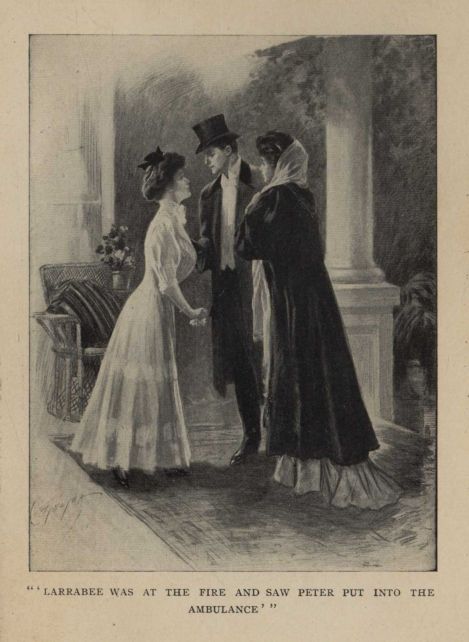
"'LARRABEE WAS AT THE FIRE AND SAW PETER PUT INTO THE AMBULANCE'"
Shirley looked at Jane. "I 'm not upset," said Jane, but her lips were unsteady. Murray put his arm around her.
"You see, Larrabee thought it was worse than it was with Peter, when they put him in the ambulance. He was stunned by the fall that broke his leg. It gave Janey a bad shock, and no wonder--it did me. But the old boy 's himself again, all right, and his one idea is to let his mother know why he does n't come home, but to keep even the news of the factory fire from his father to-night, if he can. We don't see why, but he seems to, so we 'll follow his wishes. It's the least we can do for him."
Shirley slipped through the hedge, and slowly crossed Gay Street in the moonlight. She was trying hard to be cool and do as Peter wanted her to do. If she rang, Mr. Bell would come to the door, and then how should she manage, what excuse should she give? She thought of a way.
"Mr. Bell," she said when he appeared, "Janey 's come home from her party--and she 's had just a little bit too much party. She feels like a small girl again, and wants her mother to come over for a few minutes."
"Why, of course," said Mr. Bell, heartily, from the shadow of the doorway. "Nothing much the matter with the little girl?"
"Oh, no--she 'll be all right in the morning."
So Mrs. Bell crossed the road with Shirley, and the girl, with her arm round the elder woman's shoulders, gently told her the news. Mrs. Bell took it as Peter had known she would, quietly, although, aside from his personal injury, there was much cause for anxious thought in the loss of the factory and the consequent putting of its workers out of employment.
When Peter's mother had gone home again, resting on Murray's promise that in the morning he would take her to the hospital, Shirley turned to her brother. He had taken Jane upstairs, and come down again, himself too restless to go to bed. He discovered his sister to be in a like mood, and they sat down once more in the moonlit porch to talk it over, regardless of the hour, which was past midnight.
"I wonder sometimes," said Murray, suddenly, when he had told Shirley in detail all he knew of the events of the evening, "whether anybody but me fully appreciates that chap, Peter Bell. Do you know what I' ve been thinking a long time? That he 's the man we need at the head of one of our departments. From all I can learn, he 's been growing as nearly invaluable to the Armstrongs as a man can be, yet they have n't raised his salary for two years. Now 's our chance to jump in and get him. If I can only convince father--and I think he 's pretty nearly convinced--I 'll make Peter an offer to-morrow. Pretty good medicine for a broken leg and burned hands--eh?"
"I should hope it would be."
"You 'd like to see him in the business, would n't you?"
"If you think him fit for it."
"If I think him fit! What about you?"
"How can I judge? It's for you to say."
Murray looked sharply at her, in the shaded light of the electric bulbs. He smiled, for in spite of her remarkably quiet manner, her fingers, unconsciously twisting and untwisting her delicate handkerchief, were, as he put it to himself, "giving her away." He had an idea that it mattered a good deal to his sister what Peter Bell's future might be, although he was confident that there was no understanding between them.
If he knew Peter, that young man was not the one to ask to marry a rich man's daughter until his own feet were on substantial ground. But that Peter cared, and cared very deeply, for Murray Townsend's sister, Murray was well assured.
"It's for me to say, is it?" he went on, wickedly persisting in his theme. "But it's for you to think! How about having him round our office every day--desk next mine--giving you dictation, now and then, maybe, when it suits me to put it off on him? Think you could stand it? Look up at him as coolly as you do at me? Could you, Miss Townsend, stenographer? See here, what are you jumping up for?"
"Because you are getting impudent," responded Miss Townsend, turning her head so that her face was in shadow. Her heart was beating so quickly she was afraid her brother would recognise the fact. It had been an agitating evening all through, and now this last suggestion was rather more than she could face with composure.
"I 've a notion P. B. himself could put up with the situation," went on Murray, watching her. "His dictation might be a trifle flurried at first, and he might forget himself now and then, and ignore those purely businesslike relations which should always exist between a business man and his stenographer. But I 've no doubt that by a judicious course of snubbing you could----"
But he was talking to the empty air. By a hasty flight and the abrupt closing of a door, his sister had put herself out of range.
CHAPTER X
PETER PREFERS THE PORCH
"You 're quite sure you want me?" asked Peter Bell.
"Quite sure," replied Murray Townsend. The two pairs of eyes looked into each other.
Peter's gaze shifted to his father. "I 'll do it under one condition," he said. "That father gives up factory work and goes to live at the old farm."
Mr. Harrison Townsend turned also toward Mr. Joseph Bell. He smiled slightly, noting the hesitation of the other man.
"It's time you and I retired, Bell," said he. "I 've been getting to the point for a long time. Let's make a bargain of it. If you 'll go back to the farm, I 'll come and spend a good share of my time there. I 'd like to help with the haying. I should enjoy watching the cows come home. I 'll venture to say I could drive a mowing-machine--for an hour or two."
The four men occupied the small rear porch of the house in Gay Street, looking out on Nancy's garden. Peter lay upon a couch, his leg in splints, his hands in bandages. After a few days at the hospital he had been brought home, to spend the long hours of his recovery where he could bear them best. The other three were close by, Murray nearest. He had put off making his proposition to Peter until he and his father could arrive at a perfect agreement as to every term of the offer.
Joseph Bell met his son's meaning gaze with understanding. He knew nothing counted with Peter as did the anxiety over his father's physical condition. He had kept his boy a long time upon the rack, because of his own unwillingness to give up his old work. But the work was taken away from him now; there would be a considerable interval before the Armstrongs would be ready for him again; and he could hardly think of trying for a new position. Meanwhile, the haying season was approaching. He thought with longing of the scent of the newly cut grass. He could not work hard out under the sun, he knew that; but--he could play at work. And his friend, Harrison Townsend, rich man though he was, was offering to play, too.
He looked at Peter and smiled, under his short gray beard. Peter smiled back entreatingly. Slowly Joseph Bell nodded. "All right, Peter," he said. "I'll let you have your way at last."
For a moment Peter could not speak. He lay with dropped eyelids, fighting lest the sudden relief from the long strain should unman him before these who had been paying tribute to his manhood. But after a short space he looked from Mr. Townsend to his son.
"I 'll come," said he, and forgetting his bandaged hands, started to hold one out. Then he smiled whimsically, and added in an odd tone, "If you 're not afraid of the bad omen in taking on a man with a pair of hands like these?"
"Not much, when we remember what put them in that shape!" declared Murray, in a tone of great satisfaction; and his father gave an emphatic assent.
"What do you think 's going to happen now?" cried Nancy, rushing out upon Peter's porch, a week later.
"Give it up. But nothing can surprise me, after recent events," replied Peter, removing his gaze for a moment from the morning newspaper pinned up in front of him to the excited face of his sister, but looking immediately back again at the absorbing column of business news he had been with some difficulty perusing. His hands had been slow in recovering from the severe injuries they had received.
"This will. Somebody's going to be married."
"Remarkable. But such events have occurred before in the history of nations," replied her brother, abstractedly.
"Not at the Townsend house, for Murray married Jane over here. Ah, ha! I thought you 'd give me your undivided attention at last," crowed Nancy, triumphantly.
Peter did his best to look unconcerned, but his heart had begun to thump quite suddenly and disconcertingly. He waited. He forgot the newspaper.
"Have n't you noticed how devoted Brant Hille has been for the last year?" Nancy demanded.
"No."
"Then you 've been blind."
"I 've been busy."
"How oddly you speak! Is your throat sore?"
"Don't tease, Nan. I'm not up to it." It was no use trying to look unconcerned.
Nancy saw, and took pity on him, as she might not have done if he had been upon his feet. "It's Olive, then--though I believe I could have made you think it was Shirley. It's not Brant Hille's fault that it is n't, I can tell you that. Olive's going to marry an Englishman she met last summer abroad--Mr. Arthur Crewe of Manchester. It's just announced. The wedding 's to be the first of July. You 'll be on crutches, Peter. Is n't that lucky? You can go."
"Oh, yes, I 'll dance at the wedding!" agreed Peter, looking as if the shot that missed him had come uncomfortably close.
"It's going to be a big wedding--a gorgeous one. Is n't that like Olive? Shirley's to be maid of honour, and there 'll be six bridesmaids. Six ushers--and you 'd have been one if you had n't broken your leg. Olive told me so."
"Compensation in all things," murmured Peter.
"The best man is the Englishman's brother. Olive says he 's stunning. Would n't it be funny if he and Shirley should take a fancy to each other? The maid of honour and the best man often do, you know."
"Very interesting. I should say you had been taking a course of novels, you 're so full of possible plots." And Peter eyed his newspaper as if he preferred its practical columns to his sister's outlines of sentimental situations. Nancy laughed.
"Shirley's to have a vacation, for a week before the wedding. Perhaps she 'll find time to get over to see you oftener, then."
"She 's been over to see me."
"How many times?"
"Twice."
"For how long?"
"Five minutes, the first time, three, the second."
"How many other people present?"
"A dozen or so."
"Have a satisfactory visit?"
"Oh, very!" Peter hit the newspaper with his elbow, and it fell down. "What have you got it in for me this morning for, Sis?" he demanded, wrathfully.
Nancy stopped laughing and looked serious. "It won't hurt you any. It may wake you up. I just want you to know that I 'm honestly and truly worried about Brant Hille."
Then she vanished, and Peter lay wishing he had two good legs, that he might get up and go and see for himself just how much all this meant. He read the newspaper no more that morning; it lay forgotten on the floor where it had fallen.
The weeks went by slowly enough to the convalescent, impatient to begin his new work, and full of plans for it. Long talks with Murray helped most to make the waiting endurable, and the two young men grew to know and respect each other still more deeply than ever before. Everybody was kind. Both Mr. and Mrs. Townsend came often to see Peter; and even Olive, although at times distraught with the business of preparation for her approaching marriage, found a half-hour now and then in which to slip across to Gay Street and talk with him.
At these times she found decided refreshment in his society, for Peter's ideas on the subject of matrimony were both novel and sensible, and in after years she often found herself remembering and putting into practice one or another of his quizzical maxims, founded on much shrewd observation.
"You are coming to my wedding, you know," she said, on the last of these occasions, three days before the date set for that event. "And I want you at dinner the evening before, so you may get to know Mr. Crewe, and he you, as well as you can in one short evening. I'm so disappointed he could n't be here all this week, as he planned."
"Dinners?--weddings?--on these sticks?" scoffed Peter, that day promoted to crutches and finding them as yet merely invitations to ironic humour.
"Certainly. If you make them an excuse for staying away, I shall never forgive you."
"Please let me off from the dinner. If you 'll put me in the porch, and let me be found there afterward, I 'll agree, but I can't hobble out to the table on crutches of torture."
"Not even to take out Shirley?" Olive glanced at him mischievously, and saw him colour slightly as he answered:
"That would be an inducement if anything would. But I 'm sure you 'll adopt my point of view if I beg you to."
"Then I shall have to send her in with Geoffrey Crewe--or Brant Hille."
"Will the men stay behind when the ladies come out?"
"Yes, of course."
"Then I prefer the porch," persisted Peter, comfortably; and Olive acknowledged that he had chosen the wiser part.
So on Tuesday evening, when Shirley, in the midst of a rainbow-tinted group of young women, floated airily out from the brightly lighted and oppressively warm dining-room to the cool, softly lighted recesses of the great porch, it was with a sense of refreshing change that she went straight to the big chair by a pillar, where Peter sat waiting for her. As she dropped into a low seat by his side, she thought she had never seen him show to greater advantage, although he could not rise to do her honour, and could only say, with a straight, upward glance, "This is kind of you. I 've been thinking for an hour how you 'd look when you came out that door."
"Do I look it?"
"My imagination fell a long way short. It's months since I 've seen you in this sort of thing."
He indicated her gauzy evening frock of pale rose-colour. A wreath of tiny rosebuds crowned her hair; a little silver basket of roses, ribbon-tied, lay in her lap, a dinner favour like those the others carried, but suiting her attire with special charm.
"Do you remember our first party?" asked Shirley, smiling at him.
"I certainly do," Peter assured her. "You had on a white dress and pink ribbons--pink slippers, too. You came up and slid your hand into mine, because you saw I was feeling lonely. You were jolly kind to me that night, and I never forgot it. I suppose I was a pitiful object, standing there looking on, all by myself."
"You did n't look pitiful at all, but rather superior, if I remember, like a big St. Bernard, condescending to watch the antics of a lot of frolicsome terriers."
Peter threw back his head and laughed low, with a gleam of white teeth. Whatever there might have been that was odd about Peter's appearance at that first party, there could be no criticism of his looks to-night.
Olive, taking critical note of Shirley's companion, owned that she should feel no hesitation in presenting him to Mr. Arthur Crewe and his brother as a connection of the family. When that moment arrived, the American and the Englishmen appeared to take a frank liking to one another on the spot, for the Crewes both sat down to talk, and Peter, sitting up, met them half-way in a cordial effort to become acquainted in the brief time allotted them.
"Will you tell me what you think of him?" It was Olive, slipping for a moment toward the end of the evening into the chair by Peter's, he being temporarily left to himself.
"I think he's a man," said Peter, heartily, and to the point. "There 's nothing better I could say than that, is there?"
"I suppose not, being one yourself. A woman would think it necessary to add a number of complimentary things about his appearance and his manner and all that."
"I could do that, at a pinch," said Peter, smiling, "for my memory would tell me that they were all right, though I thought nothing about them at the time. I was looking to see what it was you were going to marry, and I found out--as far as a half-hour's talk would show it. I wish you great happiness, Olive--and I believe you 'll get it."
"Thank you," and Olive was gone again, being in constant demand, as the central figure of the occasion. She found time, however, to ask much the same question of Arthur Crewe concerning Peter Bell, and received so nearly the same sort of answer that she laughed, and told him of the similarity in the two estimates.
"I am flattered," said Crewe, "for I don't know when I 've met a young American I 've liked better. He 's both frank and reserved--a combination which appeals to me. It looks a bit as if you were going to have him in the family, I believe you told me? I sincerely hope you will--though, if you don't mind my saying it, now that I see your sister, I feel as if I 'd like to leave Geoffrey here for the summer, with deliberate intention. I fancy it's too late for that, though."
"I 'm glad you like Peter. It would be too unkind to the family to take more than one daughter to England."
"See how well Geoffrey appreciates his privileges?" whispered Crewe, indicating his brother, as that personable young man went by with Shirley, his manner suggesting concentration of attention upon the subject in hand. Then he looked in Peter's direction. "The chap in the chair isn't deserted, is he? I think each bridesmaid has taken a turn at him, and he seems equal to them all."
However this might have been, Peter found himself thoroughly weary at the end of the evening, and glad to be put into a wheeled chair and taken home, ignominious as that mode of departure seemed. Arthur Crewe insisted on walking at Peter's elbow, all the way round to the house in Gay Street and the two parted with friendly warmth of good-will on each side.
According to Nancy, who kept Peter informed, Geoffrey Crewe neglected none of the opportunities afforded him by his brief visit, and in one way and another Shirley was kept busy all the next day. The wedding was to take place in the evening, so Peter had plenty of time to rest and reflect on the advantages an able-bodied man has over a temporary cripple, as he caught glimpses, from time to time, of such sights as Shirley driving off in the trap with the younger Englishman, or sitting beside Brant Hille as he took a portion of the bridal party away for a spin in his big green car.
Olive had chosen to be married at home, so every effort at effective decoration had been expended upon the house and grounds in Worthington Square. For a hot night in July, it was expected that the outdoor arrangements would be most popular, and the great lawn, with its natural beauties of landscape-gardening enhanced by the devices of electricity and Chinese lanterns, flowers and bunting, was like a fairyland.
"If a fellow's will amounted to anything, a scene like this would make him get on his legs, if both of them were only just out of the repair-shop!" groaned Peter, as he was brought through the gates by Rufus at an early hour. He took note of the paths winding away through the grounds, made enticing to promenades by every witchery of art, and his imagination already pictured Shirley, in her maid-of-honour attire, floating away down one of them, devotedly attended by Brant Hille or Geoffrey Crewe.
"Cheer up. The wounded-hero role is awfully taking with the girls, you know," consoled Rufus, divining the tantalising effect of this stage setting upon his handicapped brother.
"Wounded hero be shot!" retorted Peter.
"It would be the most soothing thing that could happen to him. Would you like to change places with him, instead of being able to dash about in search of what you want?"
"I shouldn't mind, if my crippled condition seemed to have the hypnotic effect yours did last evening. According to Nancy, the bride-elect was n't in it with you at posing as an interesting figure. She said the bridesmaids were four deep around you."
"Kind-hearted things--they were nearly the finish of me. When I become a society man please notify my family. I shall not have the brains, myself."
"I will. Where will you be placed for the ceremony?"
"Behind a screen of palms, if possible," requested Peter. He did not get his wish literally, but by grace of a special plea to one of the ushers, he was put in an inconspicuous place of great advantage, where he could not only view the entire scene, but could watch the bridal party during its whole course, from stair-landing to improvised altar beneath a vine-covered canopy at one end of the long drawing-room.
Olive made a strikingly beautiful bride, as her friends had known she would, and her bridesmaids were nearly all more than ordinarily fair--or seemed so in their picturesque garb. But to Peter, in all the bridal party there was only one face and figure worth more than a moment's glance. And when the maid-of-honour finally turned away from the altar to take her position by the side of the best man for the ceremonies of reception and congratulation which followed upon the conclusion of the marriage service, the one onlooker who could not get up and take his place in the gay company forming in line to greet the bridal party, was feeling more than ever like a stranded canal-boat in the company of a fleet of racing yachts.
They came to him, however, when they were free--Olive Crewe and her husband, Shirley and Mr. Geoffrey Crewe, several of the bridesmaids, and even Brant Hille, and Peter said all the things that were expected of him, and said them well. He might be no "society man," as he had said, but he possessed the self-command and quickness of wit which take the place of familiarity with such situations. Arthur Crewe liked him better than ever as the two shook hands, and Peter spoke his quiet but earnest words of felicitation and prophecy for the future.
"I 'm sorry I can't be here to see you when you get about again," said Crewe, at parting. "I can quite fancy the energy and enthusiasm you put into your work."
"I don't need to see you at yours to be sure you 're a steam-engine both at project and performance," responded Peter, smiling.
"We 'd work jolly well together, I venture to say," said the Englishman. "Perhaps we'll have the chance some day."
"I wish we might," and Peter gave the friendly hand a hearty grip. "Good-bye--good-bye. The best of luck."
Peter sat alone upon the Townsend porch, waiting for someone to come and take him home. Everything was over; the bridal pair had gone; the last lingerers along the lantern-lighted paths among the shrubbery had straggled in and reluctantly taken their departure. The big marquee in the centre of the lawn, where supper had been served, was empty except for scurrying caterer's men. The string orchestra stationed in the summer-house had at last stopped playing, mopped their perspiring heads, and packed up their instruments. Mrs. Townsend had betaken herself to her room in a state of collapse, requiring the attendance of her husband and Jane; and Murray paced up and down the upper hall, thinking to himself that he had never before realised what unpleasant things weddings were when they occurred in one's own family.
As for Shirley, no one had laid eyes upon her since the moment when the Townsend landau had driven away, with everybody throwing confetti, and Olive, leaning out, had flung her bouquet straight at her sister's feet. Everybody had laughed as Shirley picked it up, but the girl had run away with the white bridal roses crushed close against her breast, her lips set tight and her eyes brilliant with unshed tears. She and Olive had been more to each other during this last year than ever before--and England, as a place of permanent residence, seemed a very, very long way off.
It was odd that at the last everybody seemed to have forgotten Peter. Ross, laughing with a pretty girl, had walked directly past him and gone home, unmindful. Peter had supposed he would come back, but he did not. The servants were busy, the quiet of the deserted porch restful, and Peter leaned his head against one of the tall white pillars, thinking less of the evening that was past than of the future that was, coming--so soon as he could walk sturdily about once more.
Up through the narrowest and least conspicuous path of all, one which few of the wedding revelers had noticed because its entrance was designedly unlighted, came a slim white figure with bent head. Peter, gazing dreamily out over the lawn, saw it at once, and recognised it with a start of gladness.
Shirley came on across the velvety grass without looking up, and slowly ascended the porch steps with her eyes still cast down. Reaching the top, she turned about and stood leaning against the pillar, on the other side of which was Peter's chair, without noticing his presence, staring off at the rainbow-tinted lights, and seeing a little misty halo about each one.
When she had stood motionless there for some time, Peter spoke, so quietly that he hardly startled her. She turned about with a little choking breath, said, "Oh, is it you?" in a tone of relief, and resumed her former position.
"I wish I could help make it easier," said Peter, very gently. "You 've made things easier for me so many times, first and last."
"You do," said Shirley, in a half-whisper.
"Do I? I'm glad. But how?"
"Just by being there."
Peter's face lighted up. This was a most unusual tribute from his independent little friend. He got slowly to his crutches, and with a greater effort than he had yet made, came stumping round to her side of the pillar, and stood near her, leaning against a great green tub which held a towering palm. He felt somehow as if he must be literally upon his feet in order to stand by her in this crisis.
Both were silent again for some minutes, until suddenly Shirley looked round at him, and exclaimed, "Why, I mustn't let you stand like this! Please sit down again."
"Not unless you do."
"Why? I 'm not tired."
"But I want to be near you. I 've done nothing all the evening but envy the men who could get about and do things for you."
"You 'll soon be walking off at your usual breakneck pace," said Shirley, the colour coming back with a rush into cheeks which had been pale since Olive went.
"To the office--yes--your office. I can hardly wait. But I wonder sometimes if I can keep my wits and do my work there."
"Why not?"
"Don't you know why?"
Shirley's little moist ball of a handkerchief was all at once being clutched very tight in her fingers. She shook her head.
"I think you do. I think you must know why I 'm half out of my head with the prospect of being manager of the new house of Townsend & Son."
"I 'm glad that you like the prospect," said Shirley, in the lowest of voices, and looking anywhere but at Peter.
"Are you? Do you like it?"
"Very much."
Peter forgot his crutches, and one of them fell with a rattle at Shirley's feet. She would have bent to pick it up, but he prevented her, and laboriously reached for it himself.
"I 'm not going," said Peter, deliberately, "to let you wait on me, when all in life I want is the chance to serve you--all my life."
"It would be a very poor partnership," said Shirley, in a half-whisper, after a minute--and Peter's heart stopped beating--"if the serving were all on one side"--and Peter's heart went thumping on again, though not in proper rhythm.
"Partnership! Is it a partnership, Shirley?"
She nodded. But she moved three steps out of reach. Peter made a hasty movement, and both crutches slipped down to the floor with a crash, and slid away off the edge of the porch to the ground. Peter glared after them. Then he looked at Shirley, standing there, rose-cheeked, her tear-wet eyes now full of laughter.
"Oh, please get them for me, dear!" he pleaded. "Or--no--never mind the crutches! Just--come here!"